A Crash Course in C
GDSC Reading Week Workshop 3
Admin Stuff
- A CSC209 disclaimer
- Getting the demo code
- SSH into the DH2020 Lab machines using the Remote-SSH VSCode extension
- Open terminal (Ctrl + `) in VSCode, and run:
- git clone https://github.com/utmgdsc/2023-c-workshop
- This should download the GitHub repository, and you should have access to the
files
What is C?
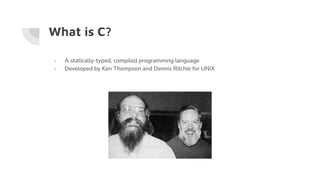
- A statically-typed, compiled programming language
- Developed by Ken Thompson and Dennis Ritchie for UNIX
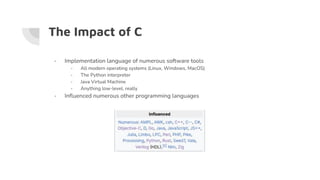
The Impact of C
- Implementation language of numerous software tools
- All modern operating systems (Linux, Windows, MacOS)
- The Python interpreter
- Java Virtual Machine
- Anything low-level, really
- Influenced numerous other programming languages
Python vs. C
Python
- Runtime:
- Interpreted
- Type System:
- Dynamic, strong
- Paradigm:
- Object-oriented, functional
- Easy to use, beginner-friendly
- Sloooooow
C
- Runtime:
- Compiled
- Type System:
- Static, weak
- Paradigm:
- Structural/Imperative
- Difficult to master, memory
management is a pain
- Blazing fast
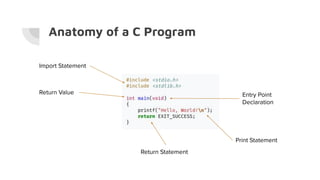
Anatomy of a C Program
Import Statement
Entry Point
Declaration
Return Value
Return Statement
Print Statement
Control Flow and Data Types
- Conditional Statements
- If-Else, Switch-Case
- Loops
- For and While Loops
- Function Calls
- Type Casting
- Various Flavors of Integers
- Int, unsigned int, long, long long
- Floats and Doubles
- Char (characters)
- Booleans (with a caveat!)
- Arrays
- Structs (create your own type!)
- Pointers
- Strings…?
C is a very simple language,
but very hard to master!
Pointers: A Motivating Example
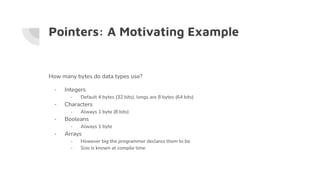
How many bytes do data types use?
- Integers
- Default 4 bytes (32 bits), longs are 8 bytes (64 bits)
- Characters
- Always 1 byte (8 bits)
- Booleans
- Always 1 byte
- Arrays
- However big the programmer declares them to be
- Size is known at compile time
How Big is a String?
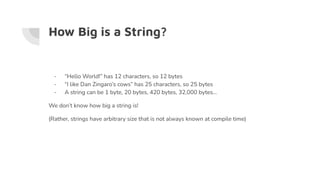
- “Hello World!” has 12 characters, so 12 bytes
- “I like Dan Zingaro’s cows” has 25 characters, so 25 bytes
- A string can be 1 byte, 20 bytes, 420 bytes, 32,000 bytes…
We don’t know how big a string is!
(Rather, strings have arbitrary size that is not always known at compile time)
Pointers (for real this time)
- Stores the memory address of an object
- Rather than the object itself
- “Points” to the object
- Closest analogue: object IDs in Python
- Pointers are 4 bytes (32 bits) or 8 bytes (64 bits), depending on the system
- Indicated by an asterisk * in C
- e.g. int *c declares a pointer (named c) pointing to an integer
- Pointer operators
- ‘&’ (The reference operator)
- ‘*’ (The dereference operator)
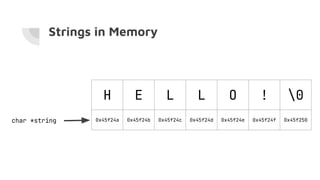
- How strings are stored in C!
- char *, or char[]
Strings in Memory
H E L L O ! 0
0x45f24a 0x45f24b 0x45f24c 0x45f24d 0x45f24e 0x45f24f 0x45f250
char *string
C’s Memory Model
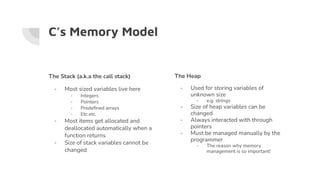
The Stack (a.k.a the call stack)
- Most sized variables live here
- Integers
- Pointers
- Predefined arrays
- Etc etc.
- Most items get allocated and
deallocated automatically when a
function returns
- Size of stack variables cannot be
changed
The Heap
- Used for storing variables of
unknown size
- e.g. strings
- Size of heap variables can be
changed
- Always interacted with through
pointers
- Must be managed manually by the
programmer
- The reason why memory
management is so important!
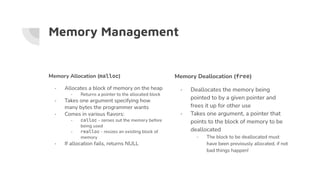
Memory Management
Memory Allocation (malloc)
- Allocates a block of memory on the heap
- Returns a pointer to the allocated block
- Takes one argument specifying how
many bytes the programmer wants
- Comes in various flavors:
- calloc - zeroes out the memory before
being used
- realloc - resizes an existing block of
memory
- If allocation fails, returns NULL
Memory Deallocation (free)
- Deallocates the memory being
pointed to by a given pointer and
frees it up for other use
- Takes one argument, a pointer that
points to the block of memory to be
deallocated
- The block to be deallocated must
have been previously allocated, if not
bad things happen!
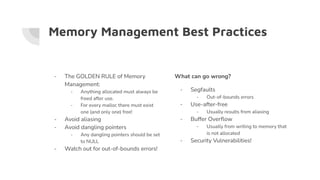
Memory Management Best Practices
- The GOLDEN RULE of Memory
Management:
- Anything allocated must always be
freed after use.
- For every malloc there must exist
one (and only one) free!
- Avoid aliasing
- Avoid dangling pointers
- Any dangling pointers should be set
to NULL
- Watch out for out-of-bounds errors!
What can go wrong?
- Segfaults
- Out-of-bounds errors
- Use-after-free
- Usually results from aliasing
- Buffer Overflow
- Usually from writing to memory that
is not allocated
- Security Vulnerabilities!
Structs and Typedefs
Structs
- Allow programmers to create custom
data types
- Provide ways of grouping related
data under a single name
- This is done by defining fields within
a struct
Typedefs
- Allow programmers to create type
aliases for existing types
- Can be used to redefine existing
types to a more relevant name, or
define a struct to use more succinct
syntax
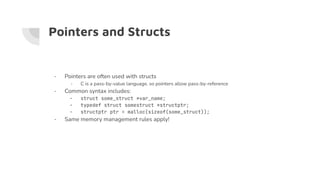
Pointers and Structs
- Pointers are often used with structs
- C is a pass-by-value language, so pointers allow pass-by-reference
- Common syntax includes:
- struct some_struct *var_name;
- typedef struct somestruct *structptr;
- structptr ptr = malloc(sizeof(some_struct));
- Same memory management rules apply!
Putting It All Together
A Linked List!
- What we will implement:
- Append
- Push
- Remove
- Index
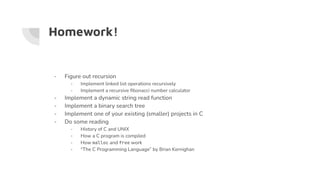
Homework!
- Figure out recursion
- Implement linked list operations recursively
- Implement a recursive fibonacci number calculator
- Implement a dynamic string read function
- Implement a binary search tree
- Implement one of your existing (smaller) projects in C
- Do some reading
- History of C and UNIX
- How a C program is compiled
- How malloc and free work
- “The C Programming Language” by Brian Kernighan
Thank You!
Any Questions?

Basics of C

  • 1.
    A Crash Coursein C GDSC Reading Week Workshop 3
  • 2.
    Admin Stuff - ACSC209 disclaimer - Getting the demo code - SSH into the DH2020 Lab machines using the Remote-SSH VSCode extension - Open terminal (Ctrl + `) in VSCode, and run: - git clone https://github.com/utmgdsc/2023-c-workshop - This should download the GitHub repository, and you should have access to the files
  • 3.
    What is C? -A statically-typed, compiled programming language - Developed by Ken Thompson and Dennis Ritchie for UNIX
  • 4.
    The Impact ofC - Implementation language of numerous software tools - All modern operating systems (Linux, Windows, MacOS) - The Python interpreter - Java Virtual Machine - Anything low-level, really - Influenced numerous other programming languages
  • 5.
    Python vs. C Python -Runtime: - Interpreted - Type System: - Dynamic, strong - Paradigm: - Object-oriented, functional - Easy to use, beginner-friendly - Sloooooow C - Runtime: - Compiled - Type System: - Static, weak - Paradigm: - Structural/Imperative - Difficult to master, memory management is a pain - Blazing fast
  • 6.
    Anatomy of aC Program Import Statement Entry Point Declaration Return Value Return Statement Print Statement
  • 7.
    Control Flow andData Types - Conditional Statements - If-Else, Switch-Case - Loops - For and While Loops - Function Calls - Type Casting - Various Flavors of Integers - Int, unsigned int, long, long long - Floats and Doubles - Char (characters) - Booleans (with a caveat!) - Arrays - Structs (create your own type!) - Pointers - Strings…? C is a very simple language, but very hard to master!
  • 8.
    Pointers: A MotivatingExample How many bytes do data types use? - Integers - Default 4 bytes (32 bits), longs are 8 bytes (64 bits) - Characters - Always 1 byte (8 bits) - Booleans - Always 1 byte - Arrays - However big the programmer declares them to be - Size is known at compile time
  • 9.
    How Big isa String? - “Hello World!” has 12 characters, so 12 bytes - “I like Dan Zingaro’s cows” has 25 characters, so 25 bytes - A string can be 1 byte, 20 bytes, 420 bytes, 32,000 bytes… We don’t know how big a string is! (Rather, strings have arbitrary size that is not always known at compile time)
  • 10.
    Pointers (for realthis time) - Stores the memory address of an object - Rather than the object itself - “Points” to the object - Closest analogue: object IDs in Python - Pointers are 4 bytes (32 bits) or 8 bytes (64 bits), depending on the system - Indicated by an asterisk * in C - e.g. int *c declares a pointer (named c) pointing to an integer - Pointer operators - ‘&’ (The reference operator) - ‘*’ (The dereference operator) - How strings are stored in C! - char *, or char[]
  • 11.
    Strings in Memory HE L L O ! 0 0x45f24a 0x45f24b 0x45f24c 0x45f24d 0x45f24e 0x45f24f 0x45f250 char *string
  • 12.
    C’s Memory Model TheStack (a.k.a the call stack) - Most sized variables live here - Integers - Pointers - Predefined arrays - Etc etc. - Most items get allocated and deallocated automatically when a function returns - Size of stack variables cannot be changed The Heap - Used for storing variables of unknown size - e.g. strings - Size of heap variables can be changed - Always interacted with through pointers - Must be managed manually by the programmer - The reason why memory management is so important!
  • 13.
    Memory Management Memory Allocation(malloc) - Allocates a block of memory on the heap - Returns a pointer to the allocated block - Takes one argument specifying how many bytes the programmer wants - Comes in various flavors: - calloc - zeroes out the memory before being used - realloc - resizes an existing block of memory - If allocation fails, returns NULL Memory Deallocation (free) - Deallocates the memory being pointed to by a given pointer and frees it up for other use - Takes one argument, a pointer that points to the block of memory to be deallocated - The block to be deallocated must have been previously allocated, if not bad things happen!
  • 14.
    Memory Management BestPractices - The GOLDEN RULE of Memory Management: - Anything allocated must always be freed after use. - For every malloc there must exist one (and only one) free! - Avoid aliasing - Avoid dangling pointers - Any dangling pointers should be set to NULL - Watch out for out-of-bounds errors! What can go wrong? - Segfaults - Out-of-bounds errors - Use-after-free - Usually results from aliasing - Buffer Overflow - Usually from writing to memory that is not allocated - Security Vulnerabilities!
  • 15.
    Structs and Typedefs Structs -Allow programmers to create custom data types - Provide ways of grouping related data under a single name - This is done by defining fields within a struct Typedefs - Allow programmers to create type aliases for existing types - Can be used to redefine existing types to a more relevant name, or define a struct to use more succinct syntax
  • 16.
    Pointers and Structs -Pointers are often used with structs - C is a pass-by-value language, so pointers allow pass-by-reference - Common syntax includes: - struct some_struct *var_name; - typedef struct somestruct *structptr; - structptr ptr = malloc(sizeof(some_struct)); - Same memory management rules apply!
  • 17.
    Putting It AllTogether A Linked List! - What we will implement: - Append - Push - Remove - Index
  • 18.
    Homework! - Figure outrecursion - Implement linked list operations recursively - Implement a recursive fibonacci number calculator - Implement a dynamic string read function - Implement a binary search tree - Implement one of your existing (smaller) projects in C - Do some reading - History of C and UNIX - How a C program is compiled - How malloc and free work - “The C Programming Language” by Brian Kernighan
  • 19.