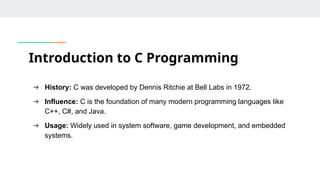
➔ History: Cwas developed by Dennis Ritchie at Bell Labs in 1972.
➔ Influence: C is the foundation of many modern programming languages like
C++, C#, and Java.
➔ Usage: Widely used in system software, game development, and embedded
systems.
Introduction to C Programming
3.
C Syntax
Influence
C isoften considered a "mother
language" due to its direct or
indirect influence on many
contemporary programming
languages.
80%
Modern programming
languages have syntax or
structural elements
derived from C
4.
➔ Efficiency: Cprovides low-level access to memory and high-level language
features.
➔ Portability: Programs written in C are highly portable and can be compiled on
various platforms.
➔ Foundation: Learning C helps in understanding other programming
languages and computer architecture.
Why Learn C Programming?
5.
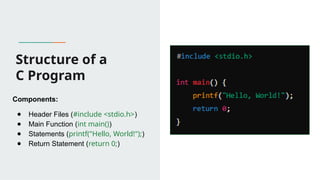
Structure of a
CProgram
Components:
● Header Files (#include <stdio.h>)
● Main Function (int main())
● Statements (printf("Hello, World!");)
● Return Statement (return 0;)
Arrays
● Definition: Collectionof elements of
the same data type.
● Syntax: dataType
arrayName[arraySize];
● Example: int numbers[5] = {1, 2, 3, 4,
5};
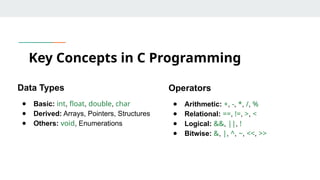
Key Concepts in C Programming
Control Structures
● Conditional: if, else, switch
● Loops: for, while, do-while
➔ Variable thatstores the memory address of another variable.
➔ Syntax: dataType *pointerName;
➔ Usage: Dynamic memory allocation, passing variables to functions by
reference.
Pointers in C
10.
➔ Array ofcharacters ending with a null character (0).
➔ Syntax: char str[] = "Hello";
➔ String Functions: strlen(), strcpy(), strcmp()
Strings in C
11.
➔ File Operations:fopen(), fclose(), fread(), fwrite(), fprintf(), fscanf()
File Handling in C
Advantages of C
➔Efficiency: Fast execution and low-level memory access.
➔ Portability: Easily runs on various platforms with minimal changes.
➔ Rich Libraries: Extensive standard libraries for diverse functionalities.
➔ System-Level Programming: Ideal for operating systems and
embedded systems.
➔ Foundation for Other Languages: Serves as a base for learning and
understanding other programming languages.
17.
Limitations of C
➔No Object-Oriented Support: Lacks built-in support for object-oriented
programming (OOP).
➔ Manual Memory Management: Requires manual allocation and
deallocation of memory, leading to potential memory leaks.
➔ No Built-in Error Handling: Lacks native error-handling mechanisms like
exceptions.
➔ Limited Standard Library: The standard library is relatively small compared
to modern languages.
➔ Low-Level Complexity: Pointer manipulation and manual memory
management can be error-prone and complex.
System Programming
Operating Systems
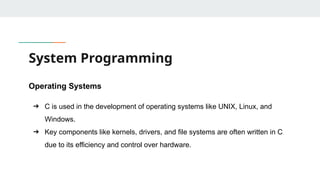
➔C is used in the development of operating systems like UNIX, Linux, and
Windows.
➔ Key components like kernels, drivers, and file systems are often written in C
due to its efficiency and control over hardware.
20.
Embedded Systems
Microcontrollers andIoT Devices:
➔ C is widely used in programming microcontrollers and IoT devices.
➔ It allows direct manipulation of hardware, making it ideal for real-time, low-
level programming in embedded systems.
21.
Game Development
Game Enginesand Graphics:
➔ C is used in game engines such as Unreal Engine and for developing
performance-critical parts of games.
➔ Its efficiency is crucial for rendering graphics, processing physics, and
managing memory in games.
22.
Database Management
Interfacing withDatabases:
➔ C is employed in creating database management systems like MySQL.
➔ It enables direct interaction with databases, allowing for optimized
performance in querying and data manipulation
23.
What next?
➔ CProgramming with UI - GTK
➔ C Programming with Database



![Arrays
● Definition: Collection of elements of
the same data type.
● Syntax: dataType
arrayName[arraySize];
● Example: int numbers[5] = {1, 2, 3, 4,
5};
Key Concepts in C Programming
Control Structures
● Conditional: if, else, switch
● Loops: for, while, do-while](https://image.slidesharecdn.com/cprogramming-250724084803-b8106235/85/C-Programming-fundamental-concepts-with-uses-7-320.jpg)


![➔ Array of characters ending with a null character (0).
➔ Syntax: char str[] = "Hello";
➔ String Functions: strlen(), strcpy(), strcmp()
Strings in C](https://image.slidesharecdn.com/cprogramming-250724084803-b8106235/85/C-Programming-fundamental-concepts-with-uses-10-320.jpg)