The Healthcare Reform Timeline Presented by   What Changes to Expect from the new Healthcare Law
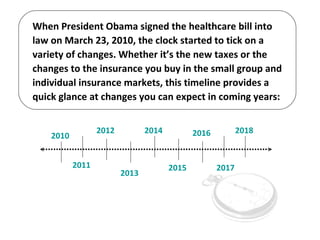
When President Obama signed the healthcare bill into law on March 23, 2010, the clock started to tick on a variety of changes. Whether it’s the new taxes or the changes to the insurance you buy in the small group and individual insurance markets, this timeline provides a quick glance at changes you can expect in coming years: 2010 2011 2012 2013 2014 2015 2016 2017 2018
2010 A  temporary small business tax credit  is available for six years for some firms that provide qualified health coverage. The rules include: 1) Only firms with 10 or fewer employees receive full credit. Firms with 11 to 25 employees, credit is reduced. Firms with more than 25 employees get no credit. 2) Only firms that pay their workers an average of $25,000 or less are eligible for the full credit. The credit is reduced as the wage goes up, phasing out at $50,000. 3) Only firms covering 50 percent or more of insurance costs will be eligible. Beginning in 2014, if you qualify for the employer tax credit, you must purchase your plan in the exchange.
A 10 percent excise tax  on indoor tanning services  begins July 1. Insurance reforms begin.  In June, temporary high-risk pools are created for uninsured adults with pre-existing conditions. For plan years beginning in late September, there will be prohibitions on lifetime and annual benefit spending limits, non-group plans will not be allowed to cancel coverage, plans must cover most preventive care and dependents will be allowed to stay on parents’ policies until age 26. ( 2010  continued) Return to Timeline
2011 Employers will be required to report employee  health benefits on W-2s . Manufacturers and importers of brand-name drugs  will begin paying a $2.5 billion tax. Consumer-driven account limits begin  on over-the-counter medications. The penalty for using HSAs for non-qualified purchases doubles to 20 percent. Employers may voluntarily participate in federally subsidized long-term care  programs. Participating firms’ employees will be automatically enrolled and subject to payroll deductions unless they opt out. Return to Timeline
2012 Businesses will have to send Form 1099s  for every business-to-business transaction of $600 or more. Brand-name drug tax  is $3 billion per year through 2016. Return to Timeline
2013 2.3 percent excise tax  on medical devices begins. Threshold at which medical expenses  as a percentage of income, are deductible increases to 10 percent, from 7.5 percent Medicare payroll tax  on wages and self-employment income in excess of $200,000 ($250,000 joint) will increase. Medicare investment tax imposes 3.8  percent tax on investment income for higher-income taxpayers. Cafeteria plan  Flexible Spending Accounts  will be limited to a maximum of $2,500 Return to Timeline
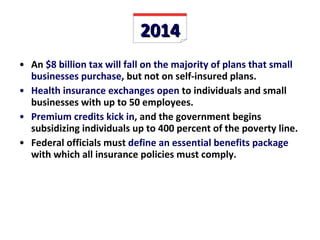
2014 An  $8 billion tax will fall on the majority of plans that small businesses purchase , but not on self-insured plans. Health insurance exchanges open  to individuals and small businesses with up to 50 employees. Premium credits kick in , and the government begins subsidizing individuals up to 400 percent of the poverty line. Federal officials must  define an essential benefits package  with which all insurance policies must comply. 
Individual mandate begins . Individuals without government-approved coverage are subject to a tax. Insurance reforms take effect , and insurers cannot impose coverage restrictions based on pre‐existing conditions. Modified community rating standards go into effect for individual or family coverage based on geography, age and smoking status. Insurers must offer coverage to anyone. The law also limits out-of-pocket cost-sharing and insurance plans must include government defined “essential benefits” and coverage levels. (2014  continued )
Employer mandate begins , requiring growing firms to provide insurance. The penalties are based on the number of full-time employees, whether the firm offers coverage and whether employees qualify for government subsidies. An employee qualifies for a subsidy if his or her household income is below 400 percent of the federal poverty line. Here are some scenarios: More than 50 full-time employees and company does not offer insurance , with one or more employees receiving premium subsidies. The penalty is $2,000 per full-time employee (minus the first 30 employees). More than 50 full-time employees and offers insurance  with one or more employees receiving premium subsidies. Penalty is the lesser of $3,000 per subsidized employee or $2,000 per full-time employee (minus the first 30 employees). ( 2014  continued)
(2014:  Employer  Mandate cont’d) More than 50 full-time employees and offers insurance , with no employees receiving premium subsidies. No penalty on employer. All non-grandfathered and Exchange health plans are required to meet federally mandated levels of coverage.  50 or fewer full-time employees : No penalty or requirement to offer insurance. Those who qualify for the employer tax credit must purchase a plan from the exchange. New counting requirements for part-time : Part-time employees’ hours will be converted into full-time equivalents for calculations of compliance and determination of penalties. For example, if six employees each work five hours per week, they will count as if the firm had one additional full-time employee. Return to Timeline
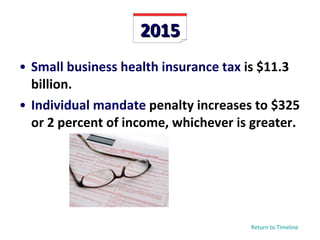
2015 Small business health insurance tax  is $11.3 billion. Individual mandate  penalty increases to $325 or 2 percent of income, whichever is greater. Return to Timeline
2016 Small business health insurance tax  is $11.3 billion. Individual mandate penalty  increases again, to $695 or 2.5 percent of income, whichever is greater. Return to Timeline
2017 Brand-name drug tax  increases to $3.5 billion. Small business health insurance tax  increases to $13.9 billion for 2017. Individual mandate  penalty is based on 2016 levels and will rise according to a cost-of-living adjustment. Return to Timeline
2018 Cadillac tax  begins on high-cost plans. Brand-name drug tax  increases to $4.2 billion. Small business health insurance tax  is $14.3 billion. Individual mandate  penalty is based on 2016 levels and will rise according to a cost-of-living adjustment. Return to Timeline
For more information on the healthcare reform and legislation, visit:  http://www.nfib.com/business-resources/see-healthcare … Here you’ll also find important information about the impact on small business and how  you  can join the discussion!

Healthcare Reform Timeline

  • 1.
    The Healthcare ReformTimeline Presented by What Changes to Expect from the new Healthcare Law
  • 2.
    When President Obamasigned the healthcare bill into law on March 23, 2010, the clock started to tick on a variety of changes. Whether it’s the new taxes or the changes to the insurance you buy in the small group and individual insurance markets, this timeline provides a quick glance at changes you can expect in coming years: 2010 2011 2012 2013 2014 2015 2016 2017 2018
  • 3.
    2010 A temporary small business tax credit is available for six years for some firms that provide qualified health coverage. The rules include: 1) Only firms with 10 or fewer employees receive full credit. Firms with 11 to 25 employees, credit is reduced. Firms with more than 25 employees get no credit. 2) Only firms that pay their workers an average of $25,000 or less are eligible for the full credit. The credit is reduced as the wage goes up, phasing out at $50,000. 3) Only firms covering 50 percent or more of insurance costs will be eligible. Beginning in 2014, if you qualify for the employer tax credit, you must purchase your plan in the exchange.
  • 4.
    A 10 percentexcise tax on indoor tanning services begins July 1. Insurance reforms begin. In June, temporary high-risk pools are created for uninsured adults with pre-existing conditions. For plan years beginning in late September, there will be prohibitions on lifetime and annual benefit spending limits, non-group plans will not be allowed to cancel coverage, plans must cover most preventive care and dependents will be allowed to stay on parents’ policies until age 26. ( 2010 continued) Return to Timeline
  • 5.
    2011 Employers willbe required to report employee health benefits on W-2s . Manufacturers and importers of brand-name drugs will begin paying a $2.5 billion tax. Consumer-driven account limits begin on over-the-counter medications. The penalty for using HSAs for non-qualified purchases doubles to 20 percent. Employers may voluntarily participate in federally subsidized long-term care programs. Participating firms’ employees will be automatically enrolled and subject to payroll deductions unless they opt out. Return to Timeline
  • 6.
    2012 Businesses willhave to send Form 1099s for every business-to-business transaction of $600 or more. Brand-name drug tax is $3 billion per year through 2016. Return to Timeline
  • 7.
    2013 2.3 percentexcise tax on medical devices begins. Threshold at which medical expenses as a percentage of income, are deductible increases to 10 percent, from 7.5 percent Medicare payroll tax on wages and self-employment income in excess of $200,000 ($250,000 joint) will increase. Medicare investment tax imposes 3.8 percent tax on investment income for higher-income taxpayers. Cafeteria plan Flexible Spending Accounts will be limited to a maximum of $2,500 Return to Timeline
  • 8.
    2014 An $8 billion tax will fall on the majority of plans that small businesses purchase , but not on self-insured plans. Health insurance exchanges open to individuals and small businesses with up to 50 employees. Premium credits kick in , and the government begins subsidizing individuals up to 400 percent of the poverty line. Federal officials must define an essential benefits package with which all insurance policies must comply. 
  • 9.
    Individual mandate begins. Individuals without government-approved coverage are subject to a tax. Insurance reforms take effect , and insurers cannot impose coverage restrictions based on pre‐existing conditions. Modified community rating standards go into effect for individual or family coverage based on geography, age and smoking status. Insurers must offer coverage to anyone. The law also limits out-of-pocket cost-sharing and insurance plans must include government defined “essential benefits” and coverage levels. (2014 continued )
  • 10.
    Employer mandate begins, requiring growing firms to provide insurance. The penalties are based on the number of full-time employees, whether the firm offers coverage and whether employees qualify for government subsidies. An employee qualifies for a subsidy if his or her household income is below 400 percent of the federal poverty line. Here are some scenarios: More than 50 full-time employees and company does not offer insurance , with one or more employees receiving premium subsidies. The penalty is $2,000 per full-time employee (minus the first 30 employees). More than 50 full-time employees and offers insurance with one or more employees receiving premium subsidies. Penalty is the lesser of $3,000 per subsidized employee or $2,000 per full-time employee (minus the first 30 employees). ( 2014 continued)
  • 11.
    (2014: Employer Mandate cont’d) More than 50 full-time employees and offers insurance , with no employees receiving premium subsidies. No penalty on employer. All non-grandfathered and Exchange health plans are required to meet federally mandated levels of coverage. 50 or fewer full-time employees : No penalty or requirement to offer insurance. Those who qualify for the employer tax credit must purchase a plan from the exchange. New counting requirements for part-time : Part-time employees’ hours will be converted into full-time equivalents for calculations of compliance and determination of penalties. For example, if six employees each work five hours per week, they will count as if the firm had one additional full-time employee. Return to Timeline
  • 12.
    2015 Small businesshealth insurance tax is $11.3 billion. Individual mandate penalty increases to $325 or 2 percent of income, whichever is greater. Return to Timeline
  • 13.
    2016 Small businesshealth insurance tax is $11.3 billion. Individual mandate penalty increases again, to $695 or 2.5 percent of income, whichever is greater. Return to Timeline
  • 14.
    2017 Brand-name drugtax increases to $3.5 billion. Small business health insurance tax increases to $13.9 billion for 2017. Individual mandate penalty is based on 2016 levels and will rise according to a cost-of-living adjustment. Return to Timeline
  • 15.
    2018 Cadillac tax begins on high-cost plans. Brand-name drug tax increases to $4.2 billion. Small business health insurance tax is $14.3 billion. Individual mandate penalty is based on 2016 levels and will rise according to a cost-of-living adjustment. Return to Timeline
  • 16.
    For more informationon the healthcare reform and legislation, visit: http://www.nfib.com/business-resources/see-healthcare … Here you’ll also find important information about the impact on small business and how you can join the discussion!