
33rd Annual Employment Law Seminar
OCTOBER 27 & 28, 2021 | MULTI-DAY WEBINAR
p a r s o n s b e h l e . c o m
BOISE | HELENA | IDAHO FALLS | LEHI | MISSOULA | RENO | SALT LAKE CITY
Utah’s Non-Compete Statute –
The Five-Year Anniversary
Derek Langton
801.536.6704 | dlangton@parsonsbehle.com
What We Know
3
The Post-Employment Restrictions Act
• The Act was enacted during the 2016 legislative session
• It has an effective date of May 10, 2016, and it only applies to non-
compete agreements entered into on or after May 10, 2016
• The most significant aspect of the Act is that a non-compete
provision covered by the Act cannot last more than one year “from
the day on which the employee is no longer employed by the
employer.” (Utah Code § 34-51-201(1))
• Importantly, a non-compete covenant “that violates this subsection is
void.” (Id.)
4
The Post-Employment Restrictions Act
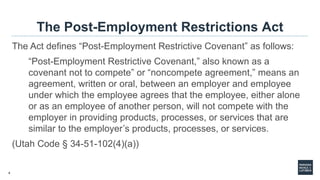
The Act defines “Post-Employment Restrictive Covenant” as follows:
“Post-Employment Restrictive Covenant,” also known as a
covenant not to compete” or “noncompete agreement,” means an
agreement, written or oral, between an employer and employee
under which the employee agrees that the employee, either alone
or as an employee of another person, will not compete with the
employer in providing products, processes, or services that are
similar to the employer’s products, processes, or services.
(Utah Code § 34-51-102(4)(a))
5
The Post-Employment Restrictions Act
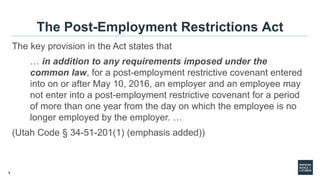
The key provision in the Act states that
… in addition to any requirements imposed under the
common law, for a post-employment restrictive covenant entered
into on or after May 10, 2016, an employer and an employee may
not enter into a post-employment restrictive covenant for a period
of more than one year from the day on which the employee is no
longer employed by the employer. …
(Utah Code § 34-51-201(1) (emphasis added))
6
The Post-Employment Restrictions Act
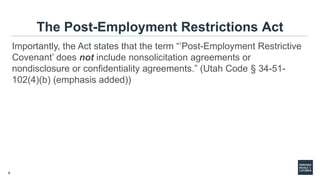
Importantly, the Act states that the term “ʽPost-Employment Restrictive
Covenant’ does not include nonsolicitation agreements or
nondisclosure or confidentiality agreements.” (Utah Code § 34-51-
102(4)(b) (emphasis added))
7
The Post-Employment Restrictions Act
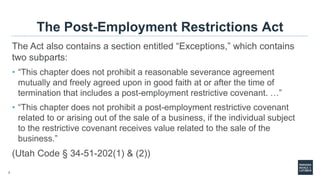
The Act also contains a section entitled “Exceptions,” which contains
two subparts:
• “This chapter does not prohibit a reasonable severance agreement
mutually and freely agreed upon in good faith at or after the time of
termination that includes a post-employment restrictive covenant. …”
• “This chapter does not prohibit a post-employment restrictive covenant
related to or arising out of the sale of a business, if the individual subject
to the restrictive covenant receives value related to the sale of the
business.”
(Utah Code § 34-51-202(1) & (2))
8
The Post-Employment Restrictions Act
The Act defines the term “sale of a business” to mean “a transfer of
the ownership by sale, acquisition, merger, or other method of the
tangible or intangible assets of a business entity, or a division or
segment of the business entity.” (Utah Code § 34-51-102(5))
9
The Post-Employment Restrictions Act
The Act also provides that “[i]f an employer seeks to enforce a post-
employment restrictive covenant through arbitration or by filing a civil
action and it is determined that the post-employment restrictive
covenant is unenforceable, the employer is liable for the employee’s:
(1) costs associated with arbitration;
(2) attorney fees and court costs; and
(3) actual damages.”
(Utah Code § 34-51-301)
10
The Post-Employment Restrictions Act
The Act was amended in 2018 to address post-employment restrictive
covenants involving employees in the broadcasting industry
Pursuant to the amendments, a post-employment restrictive covenant
(“PERC”) between a broadcasting employee and a broadcasting
company is valid only if (a) the employee is an exempt employee under
the FLSA, (b) the PERC “is part of a written employment contract of
reasonable duration, based on industry standards, the position, the
broadcasting employee’s experience, geography, and the parties’ unique
circumstances[,]” and (c) the employee is discharged for cause or for
breaching the employment contract (Utah Code § 34-51-201(2)(a))
11
The Post-Employment Restrictions Act
The 2018 amendments also provide that a PERC between a
broadcasting employee and a broadcasting company is enforceable
for no longer than the earlier of (1) one year after the day on which the
employee is no longer employed by the broadcasting company, or (2)
the day on which the original term of the employment contract
containing the PERC ends (Utah Code § 34-51-201(2)(b))
Also, a PERC between a broadcasting employee and a broadcasting
company that does not comply with the applicable subsection of the
Act is void (Utah Code § 34-51-201(2)(c))
12
The Post-Employment Restrictions Act
• In the more than five years since the Act went into effect, not even a
single case has been decided, either in Utah state or federal court, in
which the court has interpreted the meaning of any of the provisions
of the Act
• In fact, I have not found a single case anywhere in the country citing
to the Utah statute
What We Don’t Know
14
Questions About the Act
• Is there any circumstance under which an employer can enter into a
valid non-compete agreement with an employee that would extend
for more than one year after the end of the employee’s employment?
15
Questions About the Act
Let’s look again at the specific language of the “Exceptions” section:
• “This chapter does not prohibit a reasonable severance agreement
mutually and freely agreed upon in good faith at or after the time of
termination that includes a post-employment restrictive covenant. …”
• “This chapter does not prohibit a post-employment restrictive covenant
related to or arising out of the sale of a business, if the individual subject
to the restrictive covenant receives value related to the sale of the
business.”
(Utah Code § 34-51-202(1) & (2))
16
Questions About the Act
Let’s look again at the critical language in the key provision of the
statute:
“[F]or a post-employment restrictive covenant entered into on or
after May 10, 2016, an employer and an employee may not
enter into a post-employment restrictive covenant for a
period of more than one year from the day on which the
employee is no longer employed by the employer. …
(Emphasis added)
17
Questions About the Act
• How do we reconcile the fact that the title of the particular section is
“Exceptions”? That’s got to account for something, right?
• Not necessarily – the U.S. Supreme Court has explained that the
title of a statutory provision cannot limit the plain meaning of the text,
and instead can only be used when it sheds light on some
ambiguous word or phrase (See Pennsylvania Dept. of Corr. v.
Yeskey, 524 U.S. 206, 212 (1998); see also State v. Gallegos, 2007
UT 81, ¶ 16, 171 P.3d 426 (2007) (“The title of a statute is not part of
the text of a statute, and absent ambiguity, it is generally not used to
determine the statute’s intent.”))
18
Questions About the Act
Importantly, there is nothing in the text of the two subparts in the
“Exceptions” section – or, for that matter, anywhere else in the Act –
that says that you can have a valid post-employment restrictive
covenant that lasts more than one year from the last day of
employment
Put another way, there is no language in the text of the Act that
says that if a post-employment restrictive covenant falls within one
of the “Exceptions,” the one-year limitation does not apply
19
Questions About the Act
• What if the company’s non-solicitation-of-customers provision goes
beyond merely prohibiting solicitation of customers? For example,
what if the provision says that a departing employee cannot do
business, or enter into any agreements, with any of the company’s
customers?
• Some lawyers have argued that, if the non-solicitation-of-customers
provision goes beyond merely prohibiting solicitation of customers,
then it is effectively a non-compete provision, and is thus void
20
Questions About the Act
What if, in connection with the termination of an employee’s
employment, the company has the employee sign a settlement and
release agreement containing a post-employment restrictive covenant,
and containing a provision to repurchase (or redeem) some shares of
stock in the company that the employee owns?
Would the redemption of the stock fall within the “Exceptions”
provision involving a post-employment restrictive covenant “related
to or arising out of the sale of a business”?
21
Questions About the Act
Let’s look again at the Act’s definition of the term “sale of a business,”
which is defined to mean “a transfer of the ownership by sale,
acquisition, merger, or other method of the tangible or intangible
assets of a business entity, or a division or segment of the business
entity.” (Utah Code § 34-51-102(5))
Best Practices
23
Best Practices
1. If a non-solicitation-of-customers provision (along with a
confidentiality/non-disclosure provision) would be sufficient to
protect your business, then don’t require employees to sign a non-
compete
2. If your non-solicitation-of-customers provision prohibits more than
solicitation of customers (e.g., diverting, doing business with,
providing services or products to, etc.), then you should consider
limiting the provision to one year
3. Make sure your agreements are well-drafted
Recent Cases
25
Thank You
• Derek Langton
801.536.6704
dlangton@parsonsbehle.com

Utah's Non-Compete Statute - The Five-Year Anniversary

  • 1.
    33rd Annual EmploymentLaw Seminar OCTOBER 27 & 28, 2021 | MULTI-DAY WEBINAR p a r s o n s b e h l e . c o m BOISE | HELENA | IDAHO FALLS | LEHI | MISSOULA | RENO | SALT LAKE CITY Utah’s Non-Compete Statute – The Five-Year Anniversary Derek Langton 801.536.6704 | dlangton@parsonsbehle.com
  • 2.
  • 3.
    3 The Post-Employment RestrictionsAct • The Act was enacted during the 2016 legislative session • It has an effective date of May 10, 2016, and it only applies to non- compete agreements entered into on or after May 10, 2016 • The most significant aspect of the Act is that a non-compete provision covered by the Act cannot last more than one year “from the day on which the employee is no longer employed by the employer.” (Utah Code § 34-51-201(1)) • Importantly, a non-compete covenant “that violates this subsection is void.” (Id.)
  • 4.
    4 The Post-Employment RestrictionsAct The Act defines “Post-Employment Restrictive Covenant” as follows: “Post-Employment Restrictive Covenant,” also known as a covenant not to compete” or “noncompete agreement,” means an agreement, written or oral, between an employer and employee under which the employee agrees that the employee, either alone or as an employee of another person, will not compete with the employer in providing products, processes, or services that are similar to the employer’s products, processes, or services. (Utah Code § 34-51-102(4)(a))
  • 5.
    5 The Post-Employment RestrictionsAct The key provision in the Act states that … in addition to any requirements imposed under the common law, for a post-employment restrictive covenant entered into on or after May 10, 2016, an employer and an employee may not enter into a post-employment restrictive covenant for a period of more than one year from the day on which the employee is no longer employed by the employer. … (Utah Code § 34-51-201(1) (emphasis added))
  • 6.
    6 The Post-Employment RestrictionsAct Importantly, the Act states that the term “ʽPost-Employment Restrictive Covenant’ does not include nonsolicitation agreements or nondisclosure or confidentiality agreements.” (Utah Code § 34-51- 102(4)(b) (emphasis added))
  • 7.
    7 The Post-Employment RestrictionsAct The Act also contains a section entitled “Exceptions,” which contains two subparts: • “This chapter does not prohibit a reasonable severance agreement mutually and freely agreed upon in good faith at or after the time of termination that includes a post-employment restrictive covenant. …” • “This chapter does not prohibit a post-employment restrictive covenant related to or arising out of the sale of a business, if the individual subject to the restrictive covenant receives value related to the sale of the business.” (Utah Code § 34-51-202(1) & (2))
  • 8.
    8 The Post-Employment RestrictionsAct The Act defines the term “sale of a business” to mean “a transfer of the ownership by sale, acquisition, merger, or other method of the tangible or intangible assets of a business entity, or a division or segment of the business entity.” (Utah Code § 34-51-102(5))
  • 9.
    9 The Post-Employment RestrictionsAct The Act also provides that “[i]f an employer seeks to enforce a post- employment restrictive covenant through arbitration or by filing a civil action and it is determined that the post-employment restrictive covenant is unenforceable, the employer is liable for the employee’s: (1) costs associated with arbitration; (2) attorney fees and court costs; and (3) actual damages.” (Utah Code § 34-51-301)
  • 10.
    10 The Post-Employment RestrictionsAct The Act was amended in 2018 to address post-employment restrictive covenants involving employees in the broadcasting industry Pursuant to the amendments, a post-employment restrictive covenant (“PERC”) between a broadcasting employee and a broadcasting company is valid only if (a) the employee is an exempt employee under the FLSA, (b) the PERC “is part of a written employment contract of reasonable duration, based on industry standards, the position, the broadcasting employee’s experience, geography, and the parties’ unique circumstances[,]” and (c) the employee is discharged for cause or for breaching the employment contract (Utah Code § 34-51-201(2)(a))
  • 11.
    11 The Post-Employment RestrictionsAct The 2018 amendments also provide that a PERC between a broadcasting employee and a broadcasting company is enforceable for no longer than the earlier of (1) one year after the day on which the employee is no longer employed by the broadcasting company, or (2) the day on which the original term of the employment contract containing the PERC ends (Utah Code § 34-51-201(2)(b)) Also, a PERC between a broadcasting employee and a broadcasting company that does not comply with the applicable subsection of the Act is void (Utah Code § 34-51-201(2)(c))
  • 12.
    12 The Post-Employment RestrictionsAct • In the more than five years since the Act went into effect, not even a single case has been decided, either in Utah state or federal court, in which the court has interpreted the meaning of any of the provisions of the Act • In fact, I have not found a single case anywhere in the country citing to the Utah statute
  • 13.
  • 14.
    14 Questions About theAct • Is there any circumstance under which an employer can enter into a valid non-compete agreement with an employee that would extend for more than one year after the end of the employee’s employment?
  • 15.
    15 Questions About theAct Let’s look again at the specific language of the “Exceptions” section: • “This chapter does not prohibit a reasonable severance agreement mutually and freely agreed upon in good faith at or after the time of termination that includes a post-employment restrictive covenant. …” • “This chapter does not prohibit a post-employment restrictive covenant related to or arising out of the sale of a business, if the individual subject to the restrictive covenant receives value related to the sale of the business.” (Utah Code § 34-51-202(1) & (2))
  • 16.
    16 Questions About theAct Let’s look again at the critical language in the key provision of the statute: “[F]or a post-employment restrictive covenant entered into on or after May 10, 2016, an employer and an employee may not enter into a post-employment restrictive covenant for a period of more than one year from the day on which the employee is no longer employed by the employer. … (Emphasis added)
  • 17.
    17 Questions About theAct • How do we reconcile the fact that the title of the particular section is “Exceptions”? That’s got to account for something, right? • Not necessarily – the U.S. Supreme Court has explained that the title of a statutory provision cannot limit the plain meaning of the text, and instead can only be used when it sheds light on some ambiguous word or phrase (See Pennsylvania Dept. of Corr. v. Yeskey, 524 U.S. 206, 212 (1998); see also State v. Gallegos, 2007 UT 81, ¶ 16, 171 P.3d 426 (2007) (“The title of a statute is not part of the text of a statute, and absent ambiguity, it is generally not used to determine the statute’s intent.”))
  • 18.
    18 Questions About theAct Importantly, there is nothing in the text of the two subparts in the “Exceptions” section – or, for that matter, anywhere else in the Act – that says that you can have a valid post-employment restrictive covenant that lasts more than one year from the last day of employment Put another way, there is no language in the text of the Act that says that if a post-employment restrictive covenant falls within one of the “Exceptions,” the one-year limitation does not apply
  • 19.
    19 Questions About theAct • What if the company’s non-solicitation-of-customers provision goes beyond merely prohibiting solicitation of customers? For example, what if the provision says that a departing employee cannot do business, or enter into any agreements, with any of the company’s customers? • Some lawyers have argued that, if the non-solicitation-of-customers provision goes beyond merely prohibiting solicitation of customers, then it is effectively a non-compete provision, and is thus void
  • 20.
    20 Questions About theAct What if, in connection with the termination of an employee’s employment, the company has the employee sign a settlement and release agreement containing a post-employment restrictive covenant, and containing a provision to repurchase (or redeem) some shares of stock in the company that the employee owns? Would the redemption of the stock fall within the “Exceptions” provision involving a post-employment restrictive covenant “related to or arising out of the sale of a business”?
  • 21.
    21 Questions About theAct Let’s look again at the Act’s definition of the term “sale of a business,” which is defined to mean “a transfer of the ownership by sale, acquisition, merger, or other method of the tangible or intangible assets of a business entity, or a division or segment of the business entity.” (Utah Code § 34-51-102(5))
  • 22.
  • 23.
    23 Best Practices 1. Ifa non-solicitation-of-customers provision (along with a confidentiality/non-disclosure provision) would be sufficient to protect your business, then don’t require employees to sign a non- compete 2. If your non-solicitation-of-customers provision prohibits more than solicitation of customers (e.g., diverting, doing business with, providing services or products to, etc.), then you should consider limiting the provision to one year 3. Make sure your agreements are well-drafted
  • 24.
  • 25.
    25 Thank You • DerekLangton 801.536.6704 dlangton@parsonsbehle.com