Introduction to Micro
Captives & the 831(b) Election
Presenters:
• Tom Ullrich – Captive Resources
• Ernie Achtien – Captive Resources
• Matthew Howard – Moore, Ingram, Johnson & Steele
• Doug Butler – Moore, Ingram, Johnson & Steele
• Bill Johnson – Moore, Ingram, Johnson & Steele
• Joe Herbers – Pinnacle Actuarial Resources
• Rob Walling – Pinnacle Actuarial Resources
Today’s WebinarToday’s Webinar
 Overview of 831(b) Election
 Captive Structure
 Flow of Operations
 Premium Funding
 Financial Requirements
 Next Steps
831(b) Election831(b) Election
Under Section 831(b) of the Internal Revenue
Code, insurance companies that write $1.2 million or less
in annual premium only pay income tax on
investment income. This means that
underwriting profits can accumulate in the
insurance company on a
tax-deferred basis.
Qualifying FactorsQualifying Factors
 First & foremost : this is an insurance company
 $1.2 million ceiling on annual premium income
 Design the insurance to fit individual needs
 Pre-Tax earnings of at least $1.5 million
 Viable for closely held or public companies
How does the
captive work?
Micro CaptivesMicro Captives
7
Captive Insurance Companies
Presented by:
MATTHEW J. HOWARD, JD, LL.M.
MOORE INGRAM JOHNSON & STEELE, LLP
Emerson Overlook
326 Roswell St
Marietta GA 30060
(770) 795-5022; (850) 231-5995; cell: (404) 771-0202
mjhoward@mijs.com
88
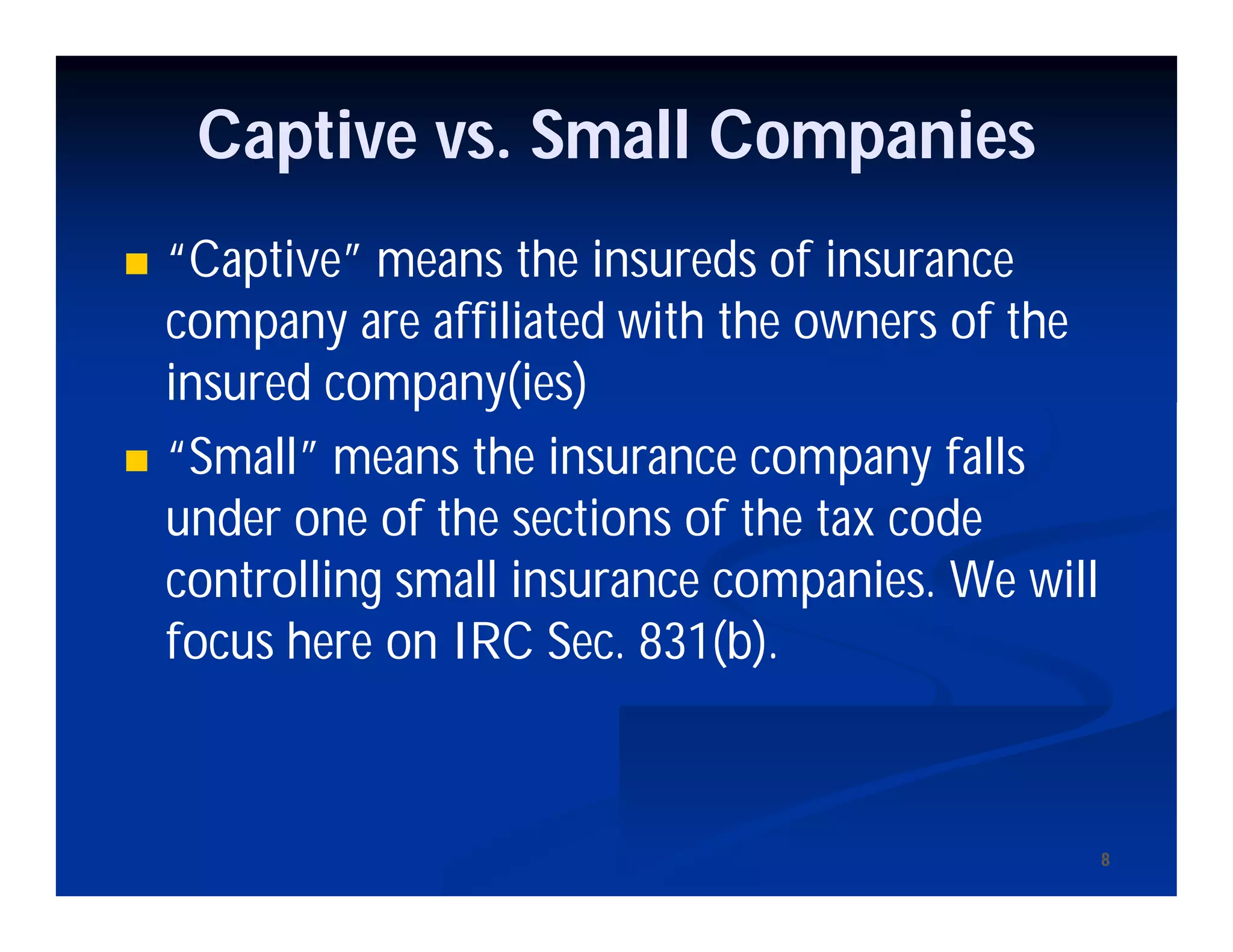
Captive vs. Small Companies
 “Captive” means the insureds of insurance
company are affiliated with the owners of the
insured company(ies)
 “Small” means the insurance company falls
under one of the sections of the tax code
controlling small insurance companies. We will
focus here on IRC Sec. 831(b).
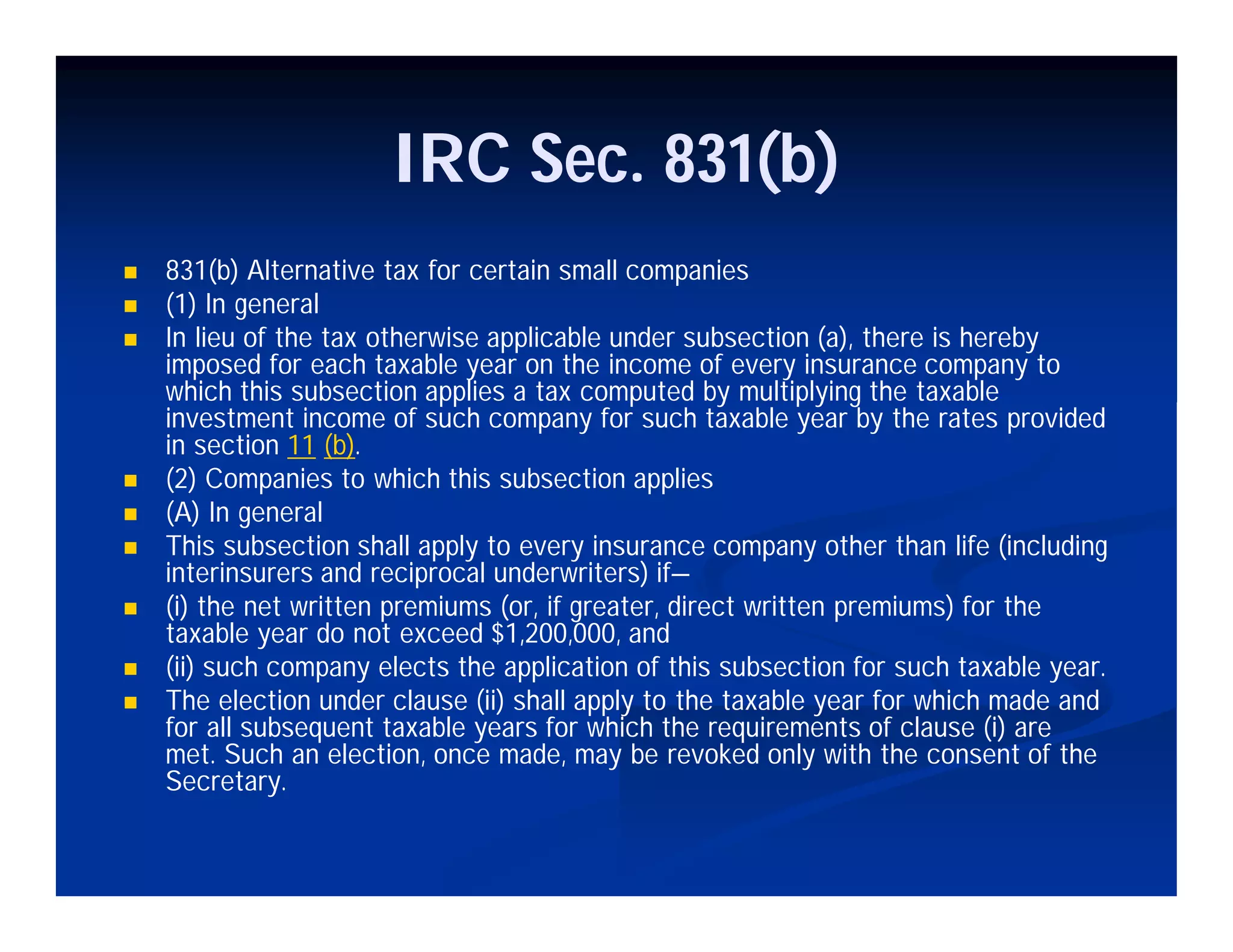
IRC Sec. 831(b)
 831(b) Alternative tax for certain small companies
 (1) In general
 In lieu of the tax otherwise applicable under subsection (a), there is hereby
imposed for each taxable year on the income of every insurance company to
which this subsection applies a tax computed by multiplying the taxable
investment income of such company for such taxable year by the rates provided
in section 11 (b).
 (2) Companies to which this subsection applies
 (A) In general
 This subsection shall apply to every insurance company other than life (including
interinsurers and reciprocal underwriters) if—
 (i) the net written premiums (or, if greater, direct written premiums) for the
taxable year do not exceed $1,200,000, and
 (ii) such company elects the application of this subsection for such taxable year.
 The election under clause (ii) shall apply to the taxable year for which made and
for all subsequent taxable years for which the requirements of clause (i) are
met. Such an election, once made, may be revoked only with the consent of the
Secretary.
1010
CIC Taxation
IRC 831(b) provides that:
 Insurance companies with less than $1.2
million of annual premium pay $0 income tax
on insurance profits.
 Investment income is taxed as income to C-
corporation
 831(b) must be timely elected and cannot be
revoked without the permission of the
Secretary
1111
 Profitable business pays up to $1,200,000 in
premiums each year
 Premiums may be deductible under sec. 162
Profitable
Business
Tax Treatment of Premiums
CIC
1212
Captive Insurance Company – 831(b)
Provides insurance
coverage for various
risks
$500k* to $1.2 million of
annual insurance
premiums
* Practical not statutory
Business CIC
Business
Owners
Business
Owners
13
Economic Family Doctrine
 Adopted by the IRS in 1977 (Rev. Rul. 77-316)
 Parent corporations and their subsidiaries form an
economic family.
 If the ultimate burden of loss is retained in the family, there
is no risk shifting or risk distribution (requirements to be
considered insurance as set forth by the Supreme Court in
Helvering v. LeGierse, 312 U.S. 531 (1941))
 Therefore, premium payments are treated as capital
contributions or dividends and are not deductible under
Sec. 162
14
Economic Family Doctrine
 IRS’ economic family doctrine was not accepted by the
courts (See Humana Inc., 881 F. 2d 247)
 IRS abandoned doctrine in Rev. Rul. 2001-31
 Adopted instead a facts and circumstances approach
for determining if transactions constitute insurance (See
Malone & Hyde, Inc., 62 F.3d 835, 76 AFTR2d 95-
5962 (CA-6, 1995), rev’g TCM 1993-585)
 IRS continued to apply facts and circumstances test
(See TAM 200149003, FSA 200202002, Notice 2002-
70)
15
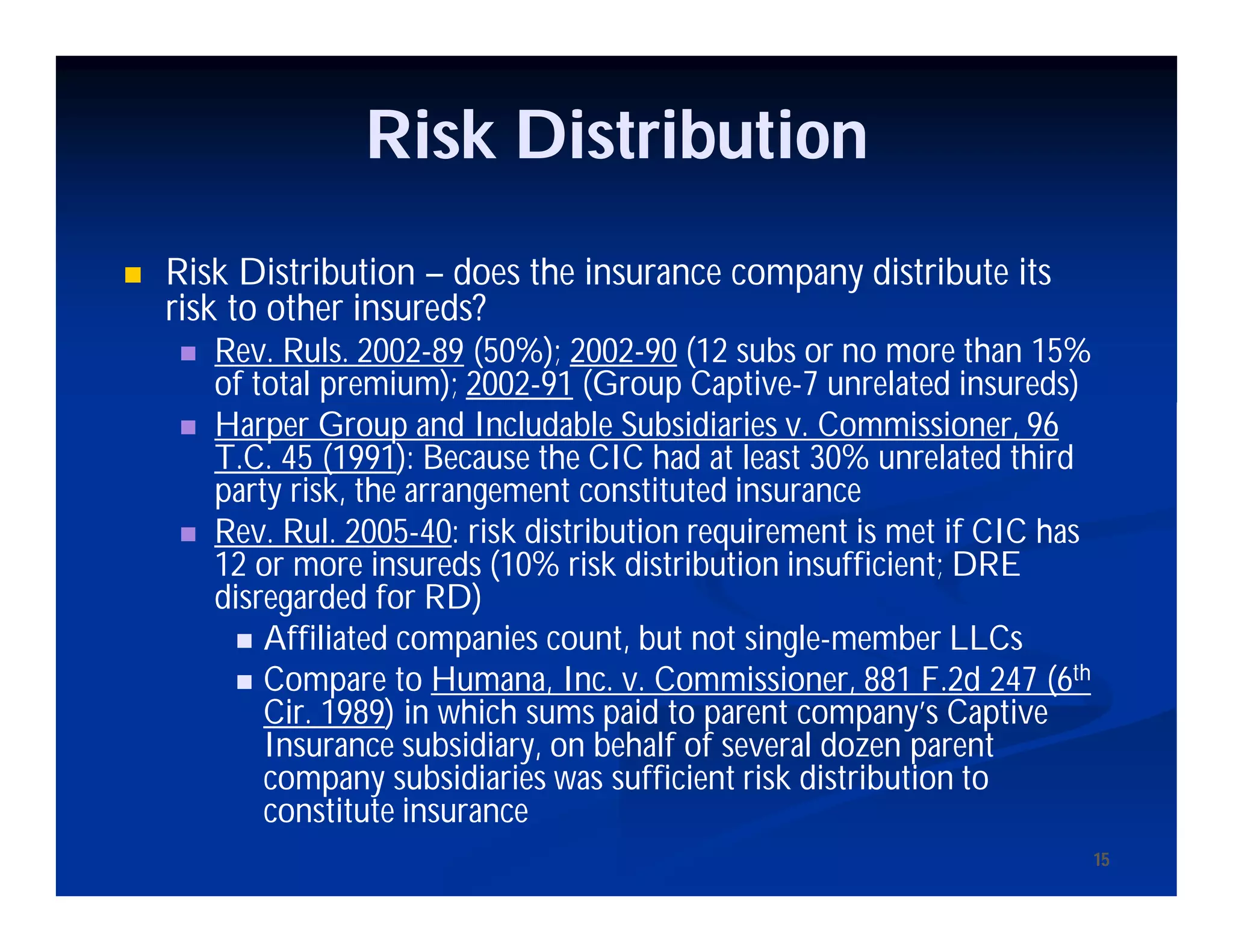
Risk Distribution
 Risk Distribution – does the insurance company distribute its
risk to other insureds?
 Rev. Ruls. 2002-89 (50%); 2002-90 (12 subs or no more than 15%
of total premium); 2002-91 (Group Captive-7 unrelated insureds)
 Harper Group and Includable Subsidiaries v. Commissioner, 96
T.C. 45 (1991): Because the CIC had at least 30% unrelated third
party risk, the arrangement constituted insurance
 Rev. Rul. 2005-40: risk distribution requirement is met if CIC has
12 or more insureds (10% risk distribution insufficient; DRE
disregarded for RD)
 Affiliated companies count, but not single-member LLCs
 Compare to Humana, Inc. v. Commissioner, 881 F.2d 247 (6th
Cir. 1989) in which sums paid to parent company’s Captive
Insurance subsidiary, on behalf of several dozen parent
company subsidiaries was sufficient risk distribution to
constitute insurance
15
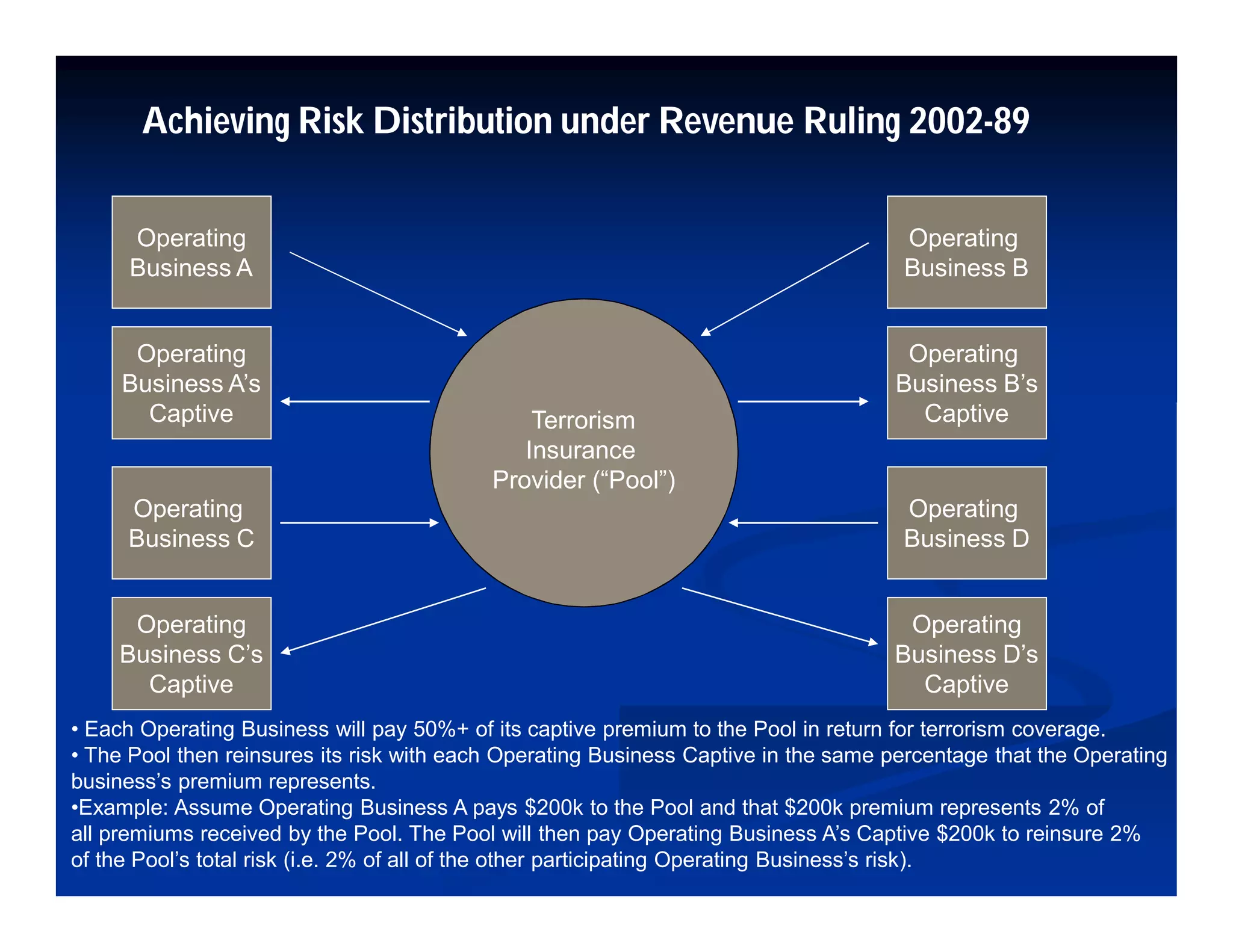
Achieving Risk Distribution under Revenue Ruling 2002-89
Operating
Business A
Terrorism
Insurance
Provider (“Pool”)
Operating
Business A’s
Captive
Operating
Business B
Operating
Business B’s
Captive
Operating
Business C’s
Captive
Operating
Business C
Operating
Business D
Operating
Business D’s
Captive
• Each Operating Business will pay 50%+ of its captive premium to the Pool in return for terrorism coverage.
• The Pool then reinsures its risk with each Operating Business Captive in the same percentage that the Operating
business’s premium represents.
•Example: Assume Operating Business A pays $200k to the Pool and that $200k premium represents 2% of
all premiums received by the Pool. The Pool will then pay Operating Business A’s Captive $200k to reinsure 2%
of the Pool’s total risk (i.e. 2% of all of the other participating Operating Business’s risk).
Achieving Risk Distribution under Revenue Ruling 2002-90
Related
Entity 2*
Related
Entity 4*
Related
Entity 3*
Related
Entity 1* Related
Entity 5*
Related
Entity 6*
Related
Entity 7*
Captive Insurance
Company (“Captive”)
•Related entities pay premiums directly to the Captive for various lines of P&C insurance.
•Each Related Entities premium cannot be less than 5% nor more than 15% of the total premiums received
by the Captive.
*Related entity must not be
considered a disregarded entity
1818
Recent IRS Guidance
 December 31, 2004 - IRS releases rulings
showing non-sham, bona fide captive insurance
companies (TAMs 200453012 & 200453013)
 Rev. Rul. 2005-40, 2005-2 CB 4. A company
that insures a single corporation cannot be an
“insurance company”, even if the insurer is
unrelated to the insured, premiums are arm’s
length and the insurer is adequately capitalized,
since there is no risk distribution.
Recent IRS Guidance (cont)
 Ltr. Rul. 200644047. An insurance subsidiary insured the risks of
its parent. Although various physicians performing work for the
parent were also insured, the Service concluded that the risks
insured were essentially that of the parent. (Rev. Rul. 2005-40)
 TAM 200816029. For purposes of applying Rev. Rul. 2005-40,
the common GP of several ltd. partnerships is treated as one
insured.
 PLR 200907006. Service concluded that there was adequate risk
distribution to warrant the company being treated as an
insurance company. (Rev. Rul. 2002-91)
Recent IRS Guidance (cont)
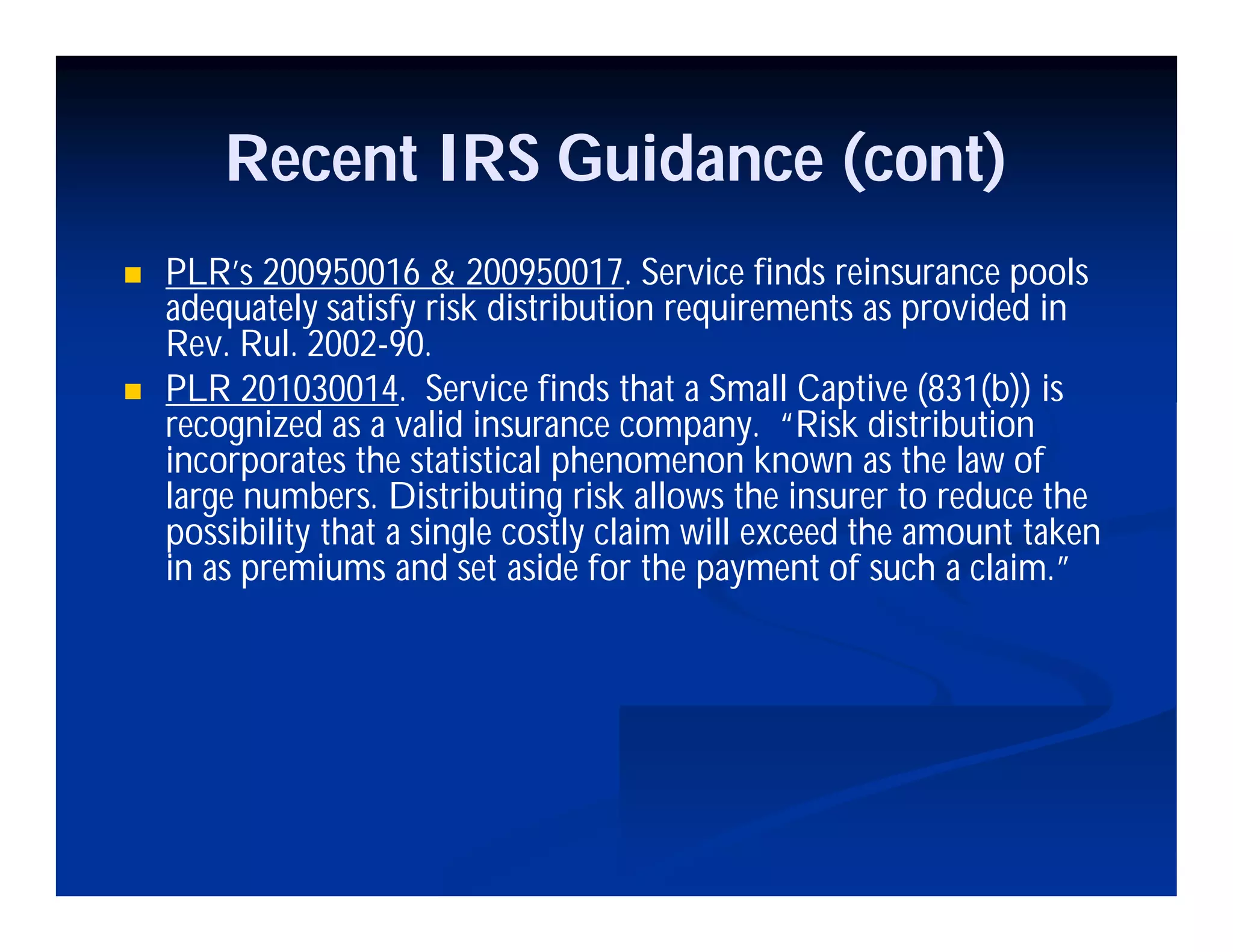
 PLR’s 200950016 & 200950017. Service finds reinsurance pools
adequately satisfy risk distribution requirements as provided in
Rev. Rul. 2002-90.
 PLR 201030014. Service finds that a Small Captive (831(b)) is
recognized as a valid insurance company. “Risk distribution
incorporates the statistical phenomenon known as the law of
large numbers. Distributing risk allows the insurer to reduce the
possibility that a single costly claim will exceed the amount taken
in as premiums and set aside for the payment of such a claim.”
2121
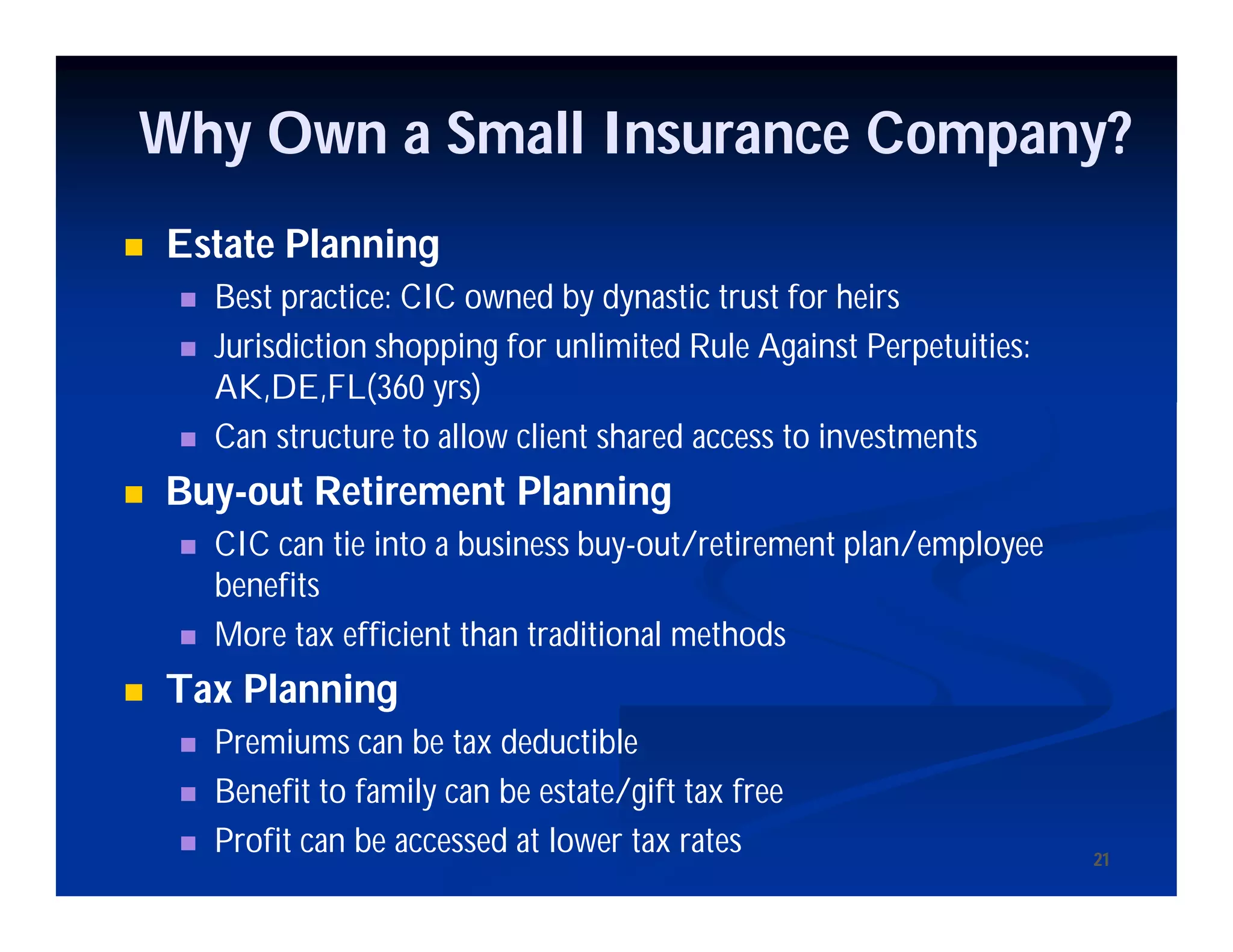
Why Own a Small Insurance Company?
 Estate Planning
 Best practice: CIC owned by dynastic trust for heirs
 Jurisdiction shopping for unlimited Rule Against Perpetuities:
AK,DE,FL(360 yrs)
 Can structure to allow client shared access to investments
 Buy-out Retirement Planning
 CIC can tie into a business buy-out/retirement plan/employee
benefits
 More tax efficient than traditional methods
 Tax Planning
 Premiums can be tax deductible
 Benefit to family can be estate/gift tax free
 Profit can be accessed at lower tax rates
2222
Risk Management Concept
Each business or practice has risks that it currently does
not insure against, including:
 Deductibles & co-payments in existing policies:
 Medical malpractice
 Excess Liability
 Environmental Liability
 E&O, D&O, and others
 Liability risks for which there is no coverage
 Employee claims, partnership liability, government liability, etc.
 Economic risks for which there is no coverage
 Loss of income, revenue cutbacks, loss of key person, loss of a
key contract, etc.
2323
CIC with Advanced Planning
Insurance coverage
$500k to $1.2 million
premiums
Business CIC
Owned by
Dynastic Trust for
Heirs
Business
Owners
Can be structured for
efficient estate planning,
retirement access and
partner buy outs, etc.
Investment LLC
for CIC
Assets
Shareholder
2424
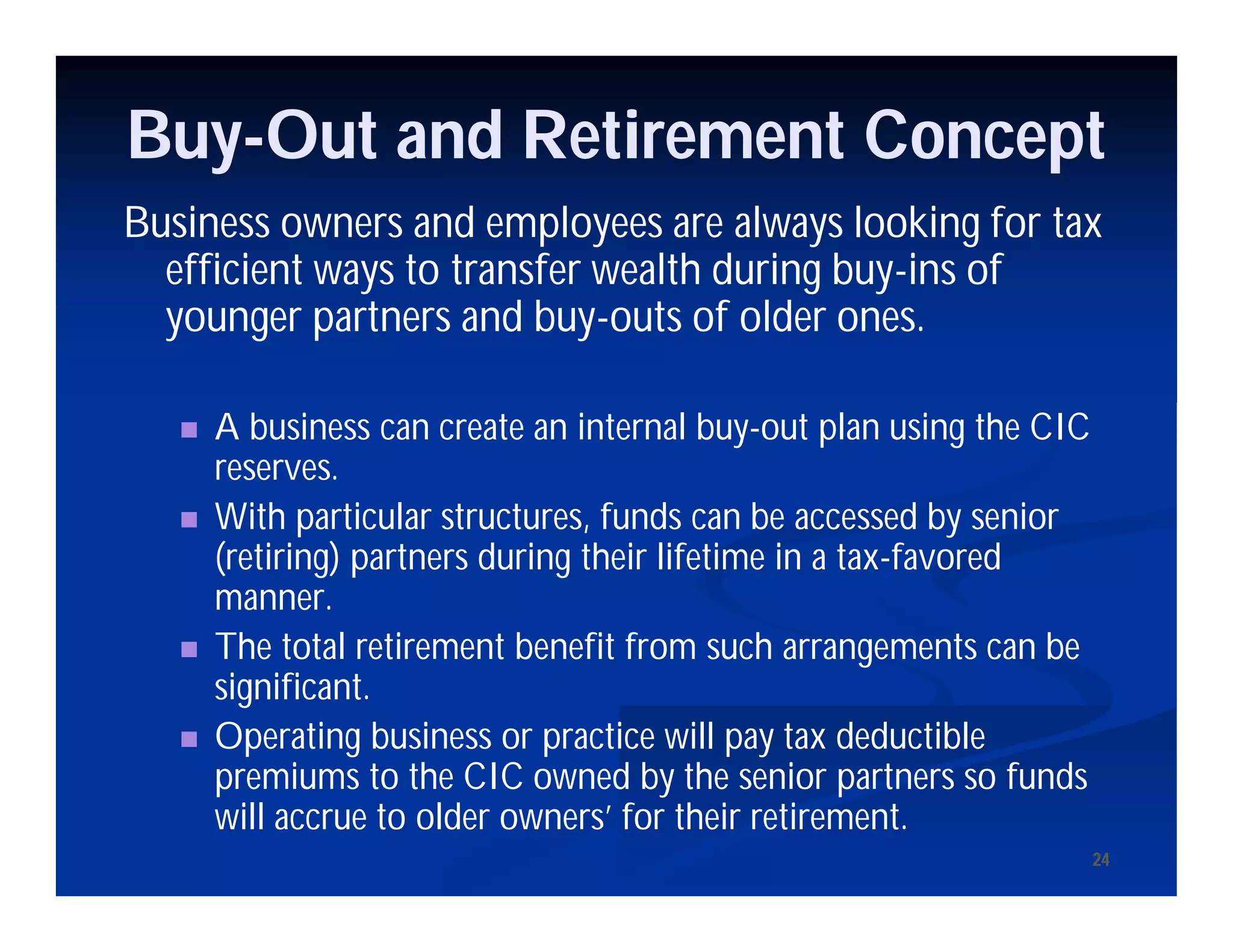
Buy-Out and Retirement Concept
Business owners and employees are always looking for tax
efficient ways to transfer wealth during buy-ins of
younger partners and buy-outs of older ones.
 A business can create an internal buy-out plan using the CIC
reserves.
 With particular structures, funds can be accessed by senior
(retiring) partners during their lifetime in a tax-favored
manner.
 The total retirement benefit from such arrangements can be
significant.
 Operating business or practice will pay tax deductible
premiums to the CIC owned by the senior partners so funds
will accrue to older owners’ for their retirement.
2525
Tax Planning Benefits
1. Deductibility of premiums §162/§212
 Assuming premiums are market comparable or can be
valued by an actuary
2. Taxation of CIC’s profits
 831(b) provides tax exemption from premium tax and from
underwriting profit.
 831 (b) must be elected timely and cannot be revoked
without permission of Secretary
 Federal Tax on investment income only
3. Retirement
 Certain investments and structures could allow client to
access CIC invested funds tax efficiently.
4. Estate/Gift Taxes
 Could transfer millions to heirs tax efficiently.
2626
 Premiums and policies must be market-comparable
 Actuarial support needed
 Insurance formalities complied with
 Risk distribution must be present
 Initial Capitalization required
 4:1 (premiums to capital) with certain minimums
 Gift tax return Form 709
The Ground Rules
27
Domicile Considerations
 Form CIC in US Domicile, which would include
several states such as KY, DE, HI, UT or MT.
 Favorable Captive legislation regarding fees and
investment options
 Minimize Premium Taxes and Ongoing Fees.
2828
Captive Insurance Company Policies
 Everything a business currently self-insures:
 Deductibles
 Excess losses above coverage limits
 Environmental Liability
 Loss of income as a result of:
 Losing key employee/salesperson
 Loss of license/professional risks (professionals)
 Loss of a key contract (Gov’t. contractors)
 Weather, terrorism, etc.
 Liability defense expenses:
 Employee lawsuits – sexual harassment, wrongful termination,
discrimination, etc.
 Environmental issues
 Professional claims
 Suggest Focus on First Party Liability
Examples of Captive Insurance
Policies Written
 Professional liability Gap Coverage
 HIPAA/Billing Audit Liability
 Contractual Liability
 Cyber Liability
 Environmental Liability
 Excess Environmental Liability
 Labor Shortage/Strike Loss
Reimbursement
 Employment Practices
 Employee Dishonesty
 Patent Infringement/Intellectual Property
 General Liability Gap
 Property Management Professional
 Professional Misconduct
 Product Recall
 FDA Administrative Actions Liability
 Product Liability Gap
 Directors and Officers Liability
 Punitive Damages
 Loss of Key Employee
 Wind Deductibles on Property
3030
Greater Leverage for Larger Clients
 Clients’ children (or trusts) can own CICs
 Each child (or trust) can own one CIC (children
under age 21 are attributed to their parent)
 Client can still be the manager of the CIC and
control the investments of CIC
 Effectively, this option saves current income taxes
(35%-47%) to client and future estate taxes (35%)
on net proceeds
 Children will only pay capital gains or dividend tax
rates (currently 15% federal) in future
3131
Highly Profitable Business
Insurance
Company #1
Trust for Child #1
or for Children
of Owner #1
Insurance
Company #2
Trust for Child #2
or for Children
of Owner #2
Insurance
Company #3
Trust for Child #3
or for Children
of Owner #3
Parent’s Business could pay up to $1.2 million per year into EACH child’s CIC or
into a CIC for each owner’s children. §1563 attribution rules apply . Children under
age 21 are attributed to the parent.
Multiple CIC Structure
3232
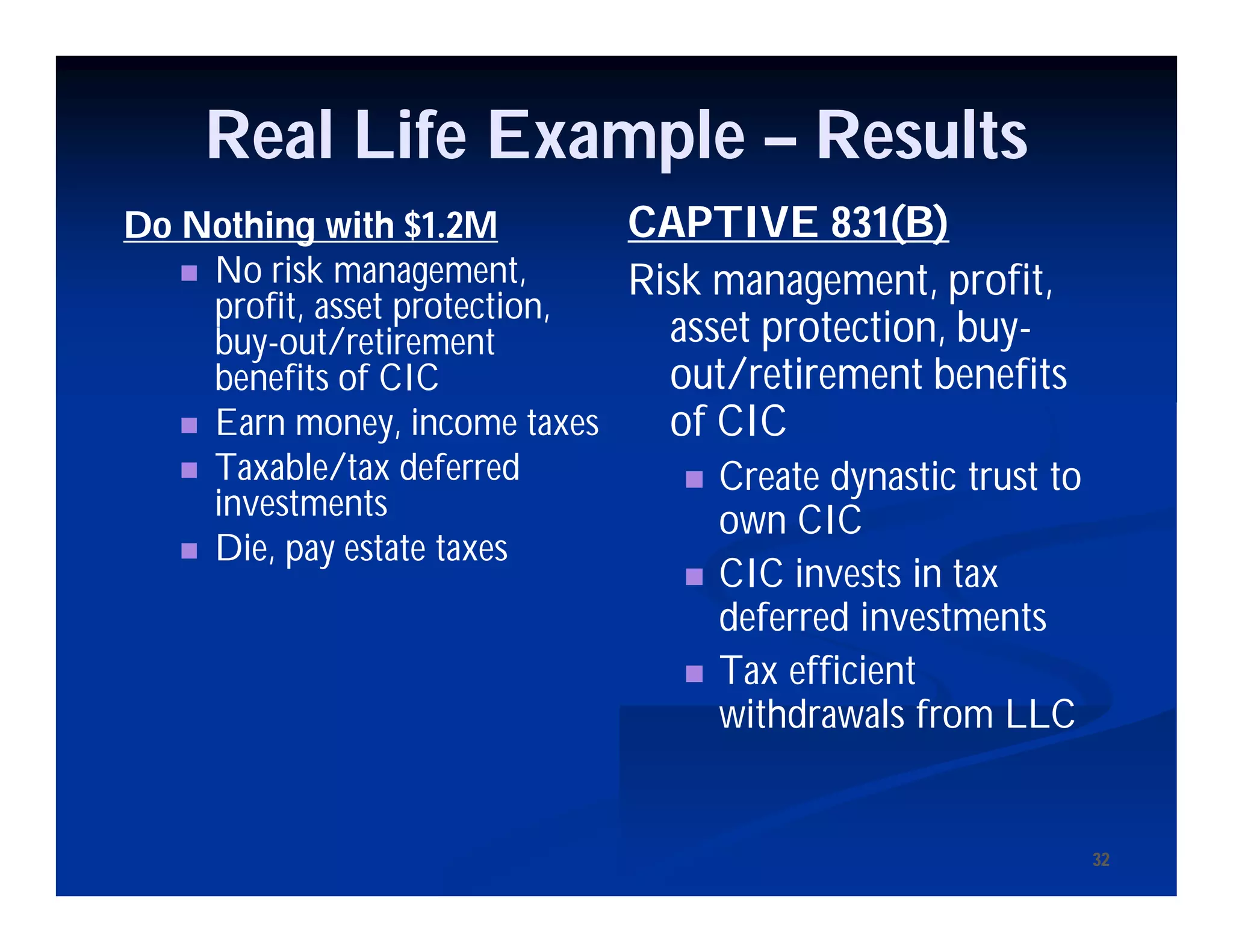
Real Life Example – Results
Do Nothing with $1.2M
 No risk management,
profit, asset protection,
buy-out/retirement
benefits of CIC
 Earn money, income taxes
 Taxable/tax deferred
investments
 Die, pay estate taxes
CAPTIVE 831(B)
Risk management, profit,
asset protection, buy-
out/retirement benefits
of CIC
 Create dynastic trust to
own CIC
 CIC invests in tax
deferred investments
 Tax efficient
withdrawals from LLC
Income Tax with No Captive
Filing Status Joint Joint Joint
Personal Exemptions 2 2 2
------------------------------------------------------
Ordinary Income 1,200,000 1,200,000 1,200,000
------------------------------------------------------
Adjusted Gross Income 1,200,000 1,200,000 1,200,000
------------------------------------------------------
Standard Deduction 11,600 11,600 9,650
------------------------------------------------------
Taxable Income 1,181,000 1,181,000 1,190,350
------------------------------------------------------
AMTI Net of Exemption 1,200,000 1,200,000 1,200,000
------------------------------------------------------
Schedule or Table Tax 383,222 383,222 435,439
Tentative Minimum Tax 332,500 332,500 332,500
------------------------------------------------------
Net Federal Tax 383,222 383,222 435,439
------------------------------------------------------
State Tax 71,560 71,560 71,560
------------------------------------------------------
Total Net Tax Liability 454,782 454,782 506,999
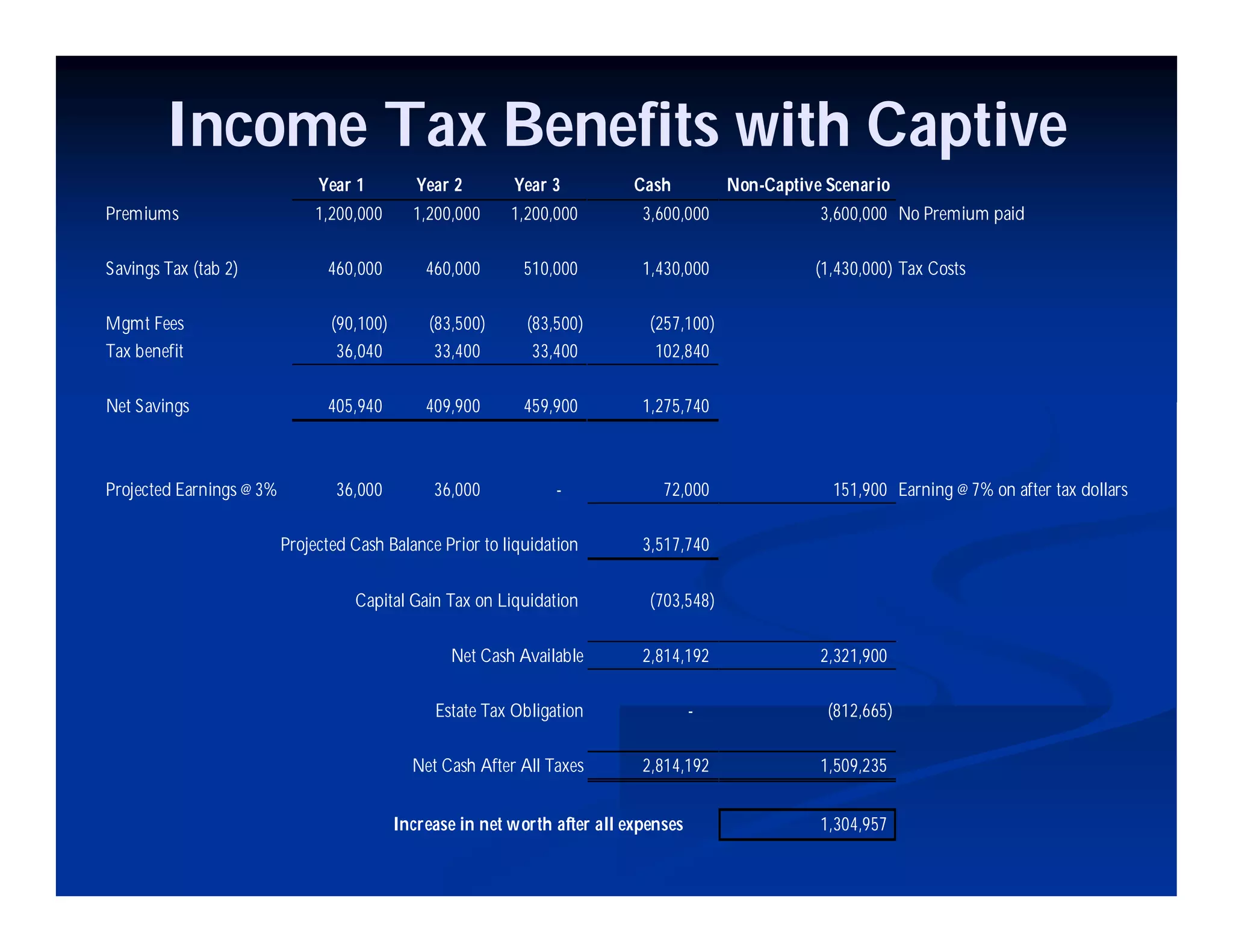
Income Tax Benefits with Captive
Year 1 Year 2 Year 3 Cash Non-Captive Scenario
Premiums 1,200,000 1,200,000 1,200,000 3,600,000 3,600,000 No Premium paid
Savings Tax (tab 2) 460,000 460,000 510,000 1,430,000 (1,430,000) Tax Costs
Mgmt Fees (90,100) (83,500) (83,500) (257,100)
Tax benefit 36,040 33,400 33,400 102,840
Net Savings 405,940 409,900 459,900 1,275,740
Projected Earnings @ 3% 36,000 36,000 - 72,000 151,900 Earning @ 7% on after tax dollars
Projected Cash Balance Prior to liquidation 3,517,740
Capital Gain Tax on Liquidation (703,548)
Net Cash Available 2,814,192 2,321,900
Estate Tax Obligation - (812,665)
Net Cash After All Taxes 2,814,192 1,509,235
Increase in net worth after all expenses 1,304,957
3535
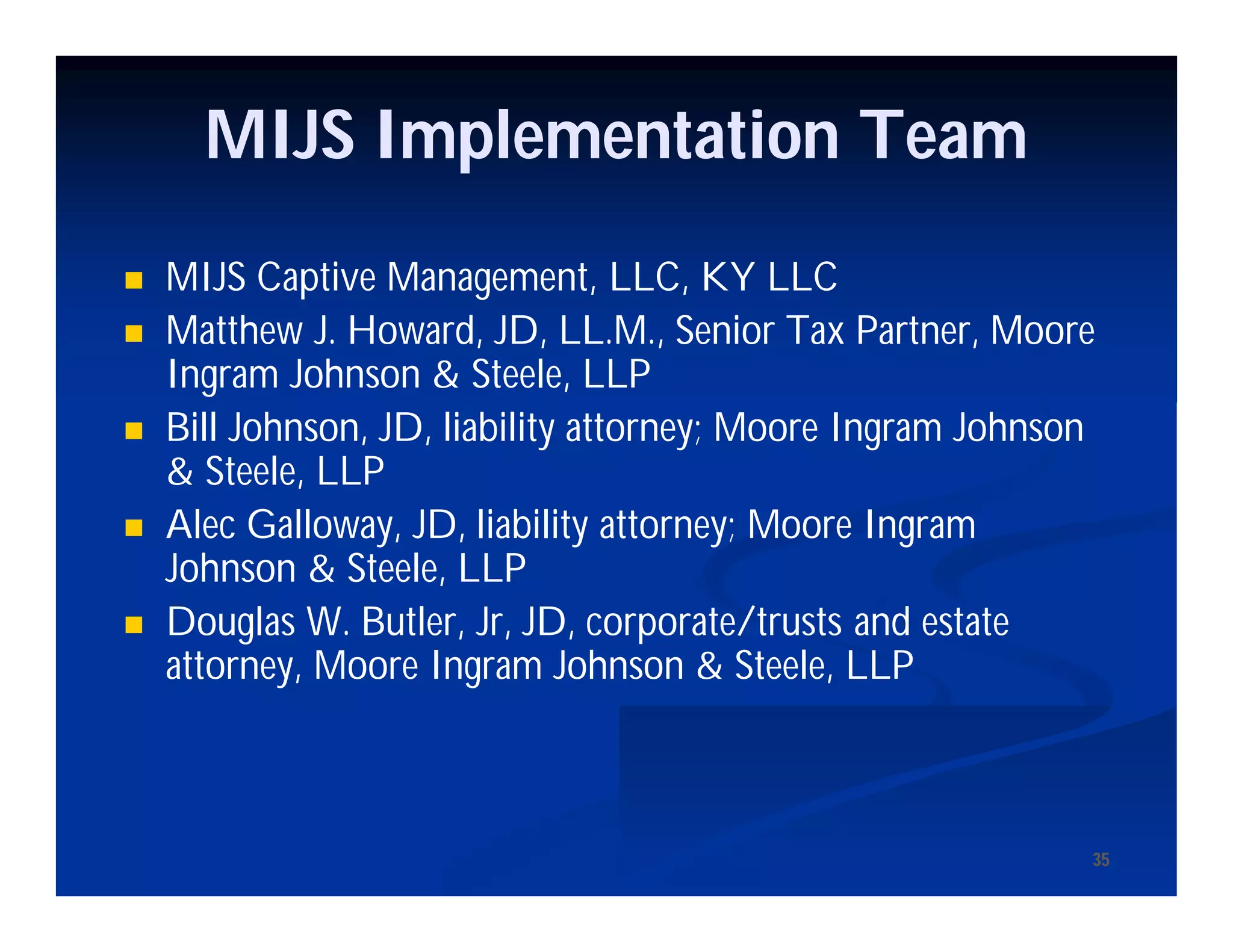
MIJS Implementation Team
 MIJS Captive Management, LLC, KY LLC
 Matthew J. Howard, JD, LL.M., Senior Tax Partner, Moore
Ingram Johnson & Steele, LLP
 Bill Johnson, JD, liability attorney; Moore Ingram Johnson
& Steele, LLP
 Alec Galloway, JD, liability attorney; Moore Ingram
Johnson & Steele, LLP
 Douglas W. Butler, Jr, JD, corporate/trusts and estate
attorney, Moore Ingram Johnson & Steele, LLP
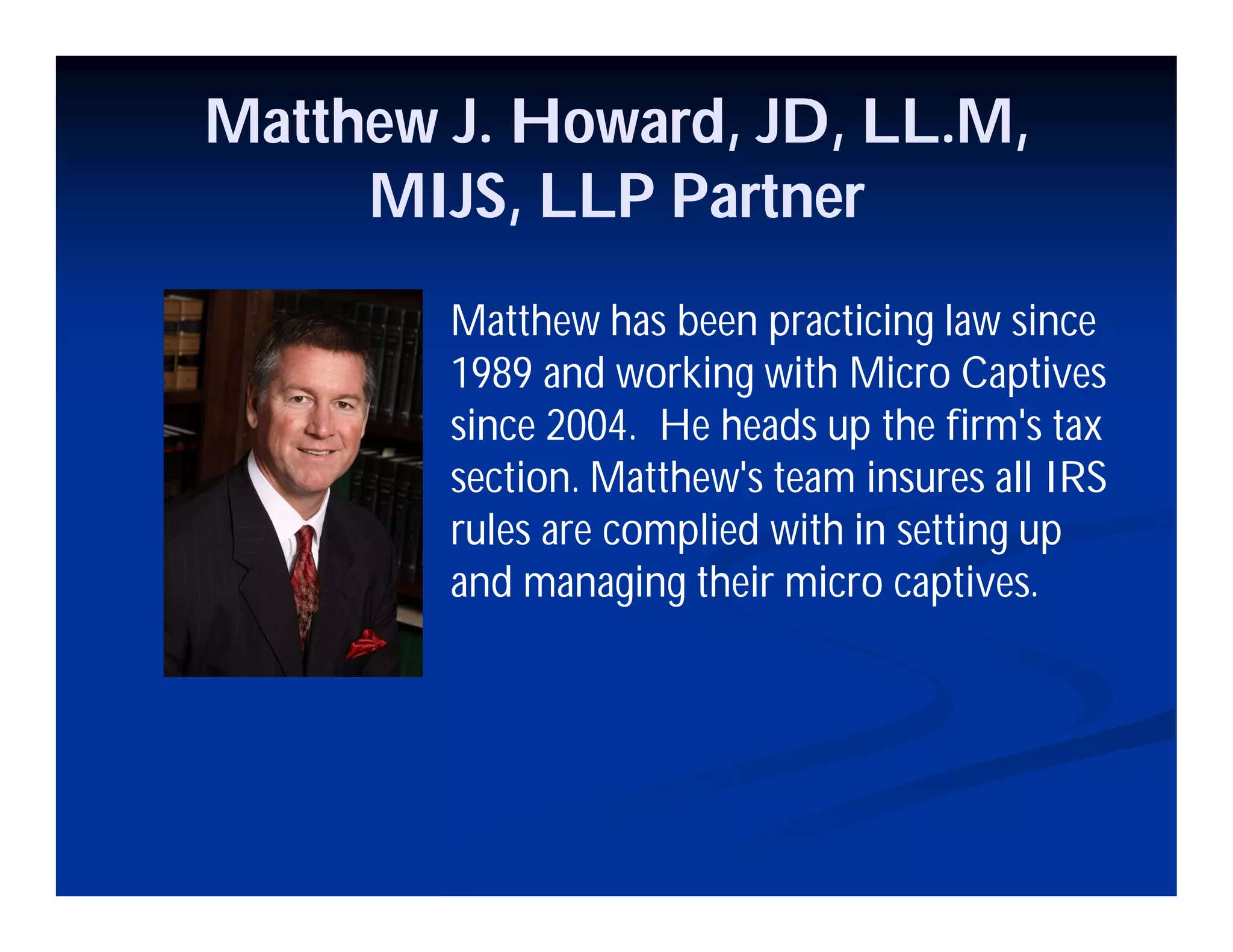
Matthew J. Howard, JD, LL.M,
MIJS, LLP Partner
Matthew has been practicing law since
1989 and working with Micro Captives
since 2004. He heads up the firm's tax
section. Matthew's team insures all IRS
rules are complied with in setting up
and managing their micro captives.
William R. Johnson
MIJS, LLP Partner
Bill has been a practicing attorney
since 1983 and involved with
insurance coverage and captive
insurance companies since that
time. He has been directly involved in
micro captives since 2006.
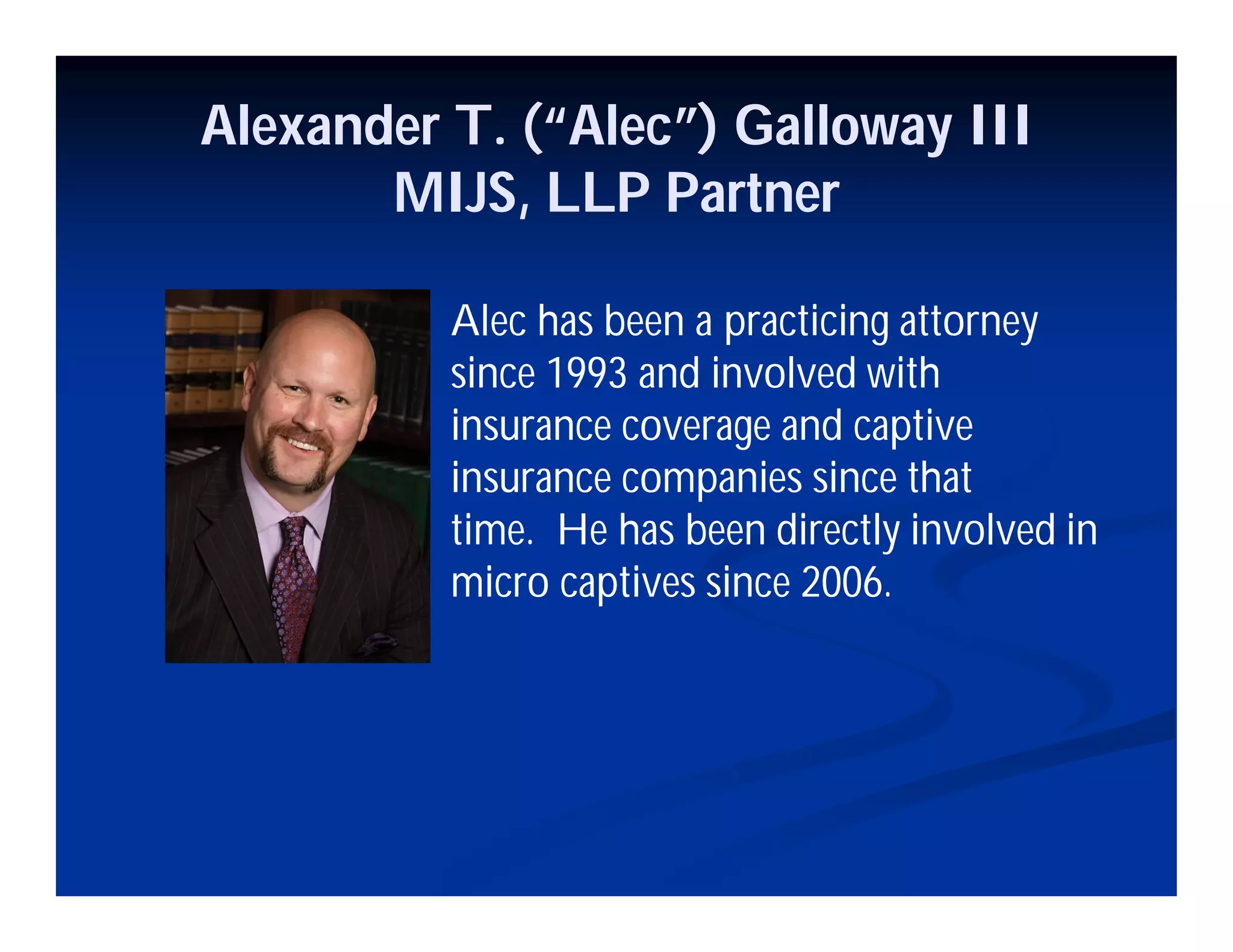
Alexander T. (“Alec”) Galloway III
MIJS, LLP Partner
Alec has been a practicing attorney
since 1993 and involved with
insurance coverage and captive
insurance companies since that
time. He has been directly involved in
micro captives since 2006.
Doug W. Butler
Doug worked in the life insurance
industry before becoming an attorney
in 2009. Since that time he has worked
in MIJS’s corporate and tax
departments and has been involved in
formation and management of all of
MIJS’s micro captive insurance
companies.
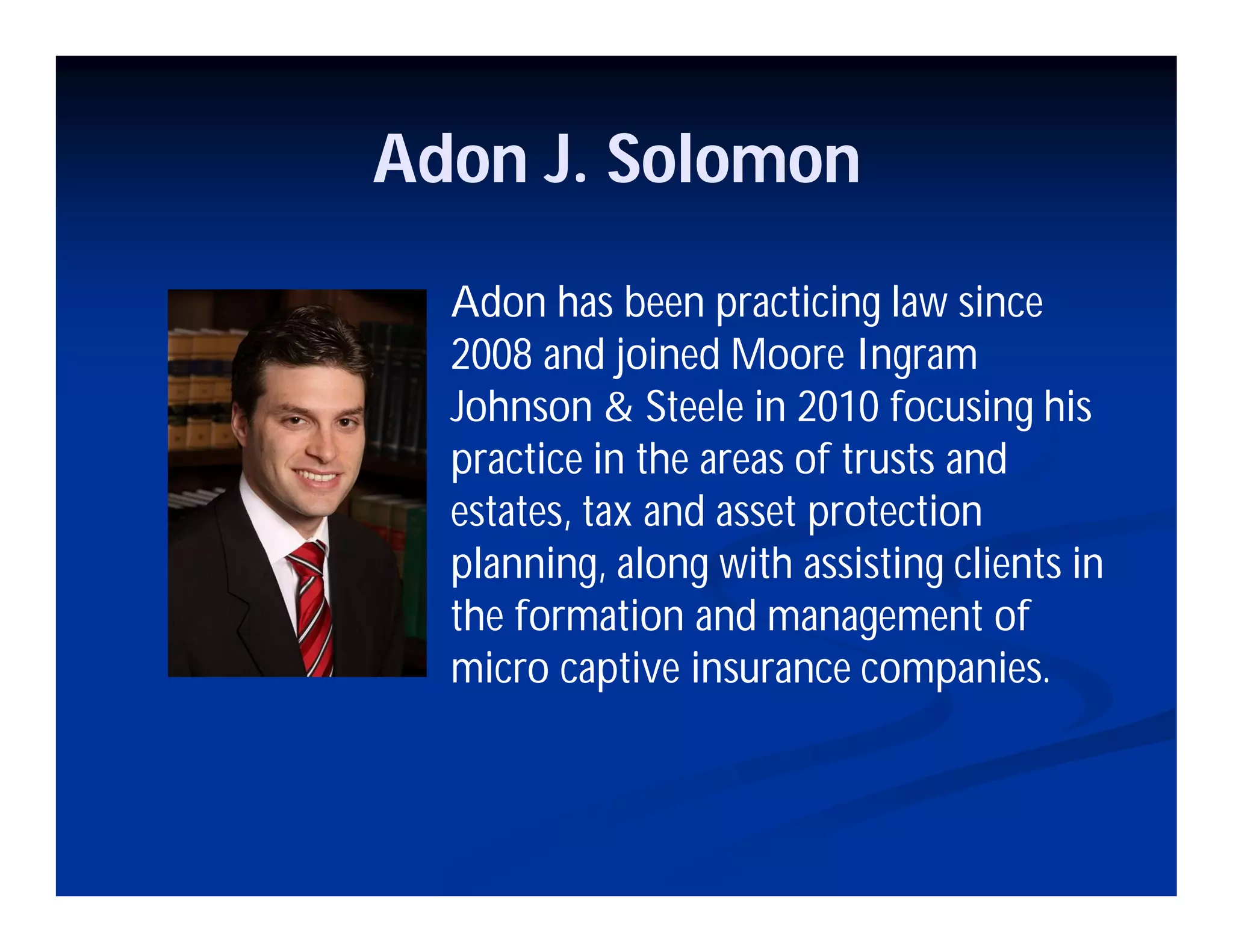
Adon J. Solomon
Adon has been practicing law since
2008 and joined Moore Ingram
Johnson & Steele in 2010 focusing his
practice in the areas of trusts and
estates, tax and asset protection
planning, along with assisting clients in
the formation and management of
micro captive insurance companies.
Bram L. Scharf
Bram was admitted to practice law in Florida on January
5, 1995. As part of the Captive Insurance Team at
MIJS, Bram prepares insurance policies and declaration
pages to suit the individual needs of the client.
Insured
Captive ResourcesCaptive Resources
 Independent consultant to the captive
 Coordinate/oversee all activities and service providers
 Underwriting coordination and assist in pricing development
 Financial services- oversee financial process and tax
reporting
 Board meeting facilitation
 Develop and implement program enhancements
 Legislative oversight
Captive FlowCaptive Flow
Broker
 Oversees insurance program
 Provides Current Policies to MIJS
 Bills premiums
 Prospect development
Insured
Pinnacle Actuarial Resources
 Leading U.S. Property & Casualty Actuarial Consulting Firm
 Actuary to all Captive Resources/Kensington group captives
 Key Personnel
Joe Herbers Rob Walling
Managing Principal Principal
 Microcaptive/831(b) Services
 Funding Studies to 831(b) and Pooling Mechanism
 Loss Reserve Analyses
 Statement of Actuarial Opinion and Other Regulatory Compliance
what is my
investment?
CapitalizationCapitalization
Capitalization
Cash or Letter of Credit (“LOC”)
Minimum 4:1 Ratio
$1,000,000 Premium
$250,000 Capital*
*State Requirements Vary
About the CaptiveAbout the Captive
 Annual Board meeting conducted via teleconference
 Focusing on DE as common domicile
 Owner of captive need not be insured corporation
 Investments individually managed, but must meet
regulatory guidelines
 Utilizing Ernst & Young for 831(b) tax preparation
 Utilizing Pinnacle Actuarial Resources for premium
support
what’s
next?
Underwriting ProcessUnderwriting Process
 Copies of All Current Policies
 Complete MIJS Application
 Company Brochures
 Current Financial Statements
(With Current Clients’ Consent we can have these forwarded by John Flanagan)
Data needed:Data needed:
Underwriting ProcessUnderwriting Process
Capitalization check received
Captive
decision completed
Policies
issued
831(b)
Funded
Premium Support
Presented
Actuarial ReviewPolicies ReviewedData collected
ExpensesExpenses
 Initial feasibility study at no charge
 Implementation costs: $85,000 to $90,000
 Annual costs: $80,000 to $85,000
 No additional fees for tax or estate planning work with
MIJS.
your
questions?
Micro Captive
53
Captive Insurance Companies:
Frequently Asked Questions
Presented By:
Matthew J. Howard, JD, LLM
Moore, Ingram, Johnson & Steele, LLP
5454
Frequently Asked Questions
 Q: What is the minimum number of affiliated entities
I need to have to achieve adequate risk distribution?
What happens if I do not have enough affiliated
entities? Can I still utilize a Micro-Captive?
 A: An insured with at least 7 entities can achieve
adequate risk distribution without invoving the risks
of other unrelated businesses. Most of our clients do
not have this structure and enter into our risk pool
with other companies. Only our clients participate in
our pool which allows us to maintain control.
5555
Frequently Asked Questions
 Q: Can my Micro-Captive insure the risks of
unaffiliated entities or entities affiliated with a
Group Captive program I participate in? Could
this help me achieve adequate risk distribution,
if allowed?
 A: Yes. Most of our Captives enter into a
reinsurance agreement whereby they agree to
insure the risks of unrelated businesses under a
policy of insurance which we have written.
5656
Frequently Asked Questions
 Q: Does my company need to pay the full $1.2M in premiums
a year to the Micro-Captive? What is the minimum amount
my company can pay for the Micro-Captive planning to make
sense? What if my company can pay over $1.2M in premiums?
 A: The election under IRC Sec 831(b), which permits
premium income to be tax free, requires that the annual net
premiums be $1.2M or less. The commitment is year to year
under a 12 month policy of insurance. Therefore the amount
paid by the operating company, as well as the insurance
coverage can change from year to year. There is no minimum
and a business can take up to three years grace period of
paying zero premium and keep the captive in place. We
believe over time that an average of $500K per year or more
makes the most economical sense.
5757
Frequently Asked Questions
 Q: Are there any requirements as to what type
of entity the Insured must be (C-Corp,
Partnership, LLC)? Does the Micro-Captive
have to be a C-Corp?
 A: No. The insured can be any type of entity. C
Corp, S-Corp, LLC tax as a partnership, LLC
taxed as a corp and even a sole proprietorship.
The Captive must be a C-Corp.
5858
Frequently Asked Questions
 Q: Who can be the owner of the Micro-Captive? Is
the Insured the owner? Can the Shareholders of the
Insured be the owners? Can key employees or other
individuals or entities be an owner?
 A: Anyone can own the Captive. Most of our clients
have their captive owned partially or entirely in a
dynasty trust for their heirs to take advantage of the
tremendous benefits in avoiding estate and gift tax
laws. A captive owned by an LLC with the key
employees as members of the LLC allows the
employer to create golden handcuffs for key
employees on a discriminatory basis.
5959
Frequently Asked Questions
 Q: Can an ESOP be used in connection with a
Micro-Captive? Can the Micro-Captive be owned by
the ESOP?
 A: Yes. It makes the most sense for a company that is
partially owned by an ESOP. Most ESOP owned
companies are S Corps and an S Corp owned 100%
by an ESOP is not subject to tax so the 831(b)
benefits are lost. The best way to structure
ownership of the captive is in a brother-sister
arrangement rather than parent-subsidiary.
6060
Frequently Asked Questions
 Q: Are there any limitations as to the type of
insurance risks or liabilities the Micro-Captive can
insure? Are there any types of businesses of an
Insured that would disqualify it from setting up a
Micro-Captive?
 A: A captive can insure any uninsured risk of any
operating business. As long as there exists a “fortuity
of loss” than such loss can be insured. Fortuity, a
contingency or uncertainty with respect to the risk
insured, is a requirement of all insurance contracts.
6161
Frequently Asked Questions
 Q: Can a Micro-Captive write policies to insure
fines levied by the state or Federal government
(such as OSHA or EPA fines)? Can the
policies insure punitive damages?
 A: Yes. These are all insurable and types of
policies we have written.
6262
Frequently Asked Questions
 Q: Can health insurance premiums be included in the
Micro-Captive planning? Would it be appropriate for
the Micro-Captive to provide Umbrella coverage or
excess Umbrella coverages?
 A: No, primarily for two reasons: 1. State laws require
certain regulations that would prohibit a micro
captive from insuring this risk; and 2. the micro
captive is too small to take on this much risk. A
micro Captive is also too small to take on umbrella
coverage, at least in the early years.
6363
Frequently Asked Questions
 Q: What is the role of an agent or broker when
setting up a Micro-Captive?
 A: They play a helpful role in helping us
identify uninsured risks of the business and
ongoing helping us coordinate the captive with
the commercial coveragees.
6464
Frequently Asked Questions
 Q: What can be done with the premiums received by
the Micro-Captive? Can these funds be invested? Are
their limitations as to the investments? How are
investments taxes to the Micro-Captive?
 A: The premiums received by the Captive are
invested by the Captive owners. We do not provide
investment advice but can certainly make needed
introductions to investment experts. The States we
work in, like Delaware, are very liberal in what the
captive can invest. The Captive does have to pay
income tax on investment income so tax free and tax
deferred investment are very popular.
6565
Frequently Asked Questions
 Q: What happens if I sell my company and I have a
Micro-Captive set up? What happens to the Micro-
Captive? Can a publicly traded company set up a
Micro-Captive?
 A: The Captive usually just ceases to be a licensed
insurer and is then a regular corporation with
investments. The Captive can be liquidated or can
acquire another business. Yes, a public company can
form a captive.
6666
Frequently Asked Questions
 Q: Who are the other members of the
reinsurance pool? Do we have the opportunity
to exclude members if we feel they are too
great a risk?
 A: Our other Captive clients who need risk
distribution. Yes, every participant gets basic
information about the other participants and
you can refuse to insure certain companies.
6767
Frequently Asked Questions
 Q: What is the difference between a Micro-Captive
domiciled in a US jurisdiction (such as Delaware)
versus a company domiciled offshore (such as in the
Cayman Island)
 A: The main difference is the State domiciles are
more strict and have more regulations to follow.
There is the opportunity for abuse with a micro
captive (unlike the large group Captives) and
therefore we like the idea of more regulation for a
micro captive.
6868
Frequently Asked Questions
 Q: Who handles the insurance claims made against
the Micro-Captive? Who manages the Micro-Captive
and ensure it functions correctly and remains in
compliance with all state and federal laws?
 A: Our management company, MIJS Captive
Management handles all claims and administration.
Captive Resources assists us with Board Meetings and
financial accounting. We coordinate the actuarial and
financial audits along with all State filings.
6969
Frequently Asked Questions
 Q: Are there additional capital contributions
required beyond the $250,000.00 initial capital?
 A: No.
7070
Frequently Asked Questions
 Q: What is an estimate of the typical ongoing
fees to maintain the Micro-Captive?
 A: $76,000/yr for everything including the
annual tax return and State premium tax.

Captive Resources Presentation – June 13, 2012

  • 1.
    Introduction to Micro Captives& the 831(b) Election
  • 2.
    Presenters: • Tom Ullrich– Captive Resources • Ernie Achtien – Captive Resources • Matthew Howard – Moore, Ingram, Johnson & Steele • Doug Butler – Moore, Ingram, Johnson & Steele • Bill Johnson – Moore, Ingram, Johnson & Steele • Joe Herbers – Pinnacle Actuarial Resources • Rob Walling – Pinnacle Actuarial Resources
  • 3.
    Today’s WebinarToday’s Webinar Overview of 831(b) Election  Captive Structure  Flow of Operations  Premium Funding  Financial Requirements  Next Steps
  • 4.
    831(b) Election831(b) Election UnderSection 831(b) of the Internal Revenue Code, insurance companies that write $1.2 million or less in annual premium only pay income tax on investment income. This means that underwriting profits can accumulate in the insurance company on a tax-deferred basis.
  • 5.
    Qualifying FactorsQualifying Factors First & foremost : this is an insurance company  $1.2 million ceiling on annual premium income  Design the insurance to fit individual needs  Pre-Tax earnings of at least $1.5 million  Viable for closely held or public companies
  • 6.
    How does the captivework? Micro CaptivesMicro Captives
  • 7.
    7 Captive Insurance Companies Presentedby: MATTHEW J. HOWARD, JD, LL.M. MOORE INGRAM JOHNSON & STEELE, LLP Emerson Overlook 326 Roswell St Marietta GA 30060 (770) 795-5022; (850) 231-5995; cell: (404) 771-0202 mjhoward@mijs.com
  • 8.
    88 Captive vs. SmallCompanies  “Captive” means the insureds of insurance company are affiliated with the owners of the insured company(ies)  “Small” means the insurance company falls under one of the sections of the tax code controlling small insurance companies. We will focus here on IRC Sec. 831(b).
  • 9.
    IRC Sec. 831(b) 831(b) Alternative tax for certain small companies  (1) In general  In lieu of the tax otherwise applicable under subsection (a), there is hereby imposed for each taxable year on the income of every insurance company to which this subsection applies a tax computed by multiplying the taxable investment income of such company for such taxable year by the rates provided in section 11 (b).  (2) Companies to which this subsection applies  (A) In general  This subsection shall apply to every insurance company other than life (including interinsurers and reciprocal underwriters) if—  (i) the net written premiums (or, if greater, direct written premiums) for the taxable year do not exceed $1,200,000, and  (ii) such company elects the application of this subsection for such taxable year.  The election under clause (ii) shall apply to the taxable year for which made and for all subsequent taxable years for which the requirements of clause (i) are met. Such an election, once made, may be revoked only with the consent of the Secretary.
  • 10.
    1010 CIC Taxation IRC 831(b)provides that:  Insurance companies with less than $1.2 million of annual premium pay $0 income tax on insurance profits.  Investment income is taxed as income to C- corporation  831(b) must be timely elected and cannot be revoked without the permission of the Secretary
  • 11.
    1111  Profitable businesspays up to $1,200,000 in premiums each year  Premiums may be deductible under sec. 162 Profitable Business Tax Treatment of Premiums CIC
  • 12.
    1212 Captive Insurance Company– 831(b) Provides insurance coverage for various risks $500k* to $1.2 million of annual insurance premiums * Practical not statutory Business CIC Business Owners Business Owners
  • 13.
    13 Economic Family Doctrine Adopted by the IRS in 1977 (Rev. Rul. 77-316)  Parent corporations and their subsidiaries form an economic family.  If the ultimate burden of loss is retained in the family, there is no risk shifting or risk distribution (requirements to be considered insurance as set forth by the Supreme Court in Helvering v. LeGierse, 312 U.S. 531 (1941))  Therefore, premium payments are treated as capital contributions or dividends and are not deductible under Sec. 162
  • 14.
    14 Economic Family Doctrine IRS’ economic family doctrine was not accepted by the courts (See Humana Inc., 881 F. 2d 247)  IRS abandoned doctrine in Rev. Rul. 2001-31  Adopted instead a facts and circumstances approach for determining if transactions constitute insurance (See Malone & Hyde, Inc., 62 F.3d 835, 76 AFTR2d 95- 5962 (CA-6, 1995), rev’g TCM 1993-585)  IRS continued to apply facts and circumstances test (See TAM 200149003, FSA 200202002, Notice 2002- 70)
  • 15.
    15 Risk Distribution  RiskDistribution – does the insurance company distribute its risk to other insureds?  Rev. Ruls. 2002-89 (50%); 2002-90 (12 subs or no more than 15% of total premium); 2002-91 (Group Captive-7 unrelated insureds)  Harper Group and Includable Subsidiaries v. Commissioner, 96 T.C. 45 (1991): Because the CIC had at least 30% unrelated third party risk, the arrangement constituted insurance  Rev. Rul. 2005-40: risk distribution requirement is met if CIC has 12 or more insureds (10% risk distribution insufficient; DRE disregarded for RD)  Affiliated companies count, but not single-member LLCs  Compare to Humana, Inc. v. Commissioner, 881 F.2d 247 (6th Cir. 1989) in which sums paid to parent company’s Captive Insurance subsidiary, on behalf of several dozen parent company subsidiaries was sufficient risk distribution to constitute insurance 15
  • 16.
    Achieving Risk Distributionunder Revenue Ruling 2002-89 Operating Business A Terrorism Insurance Provider (“Pool”) Operating Business A’s Captive Operating Business B Operating Business B’s Captive Operating Business C’s Captive Operating Business C Operating Business D Operating Business D’s Captive • Each Operating Business will pay 50%+ of its captive premium to the Pool in return for terrorism coverage. • The Pool then reinsures its risk with each Operating Business Captive in the same percentage that the Operating business’s premium represents. •Example: Assume Operating Business A pays $200k to the Pool and that $200k premium represents 2% of all premiums received by the Pool. The Pool will then pay Operating Business A’s Captive $200k to reinsure 2% of the Pool’s total risk (i.e. 2% of all of the other participating Operating Business’s risk).
  • 17.
    Achieving Risk Distributionunder Revenue Ruling 2002-90 Related Entity 2* Related Entity 4* Related Entity 3* Related Entity 1* Related Entity 5* Related Entity 6* Related Entity 7* Captive Insurance Company (“Captive”) •Related entities pay premiums directly to the Captive for various lines of P&C insurance. •Each Related Entities premium cannot be less than 5% nor more than 15% of the total premiums received by the Captive. *Related entity must not be considered a disregarded entity
  • 18.
    1818 Recent IRS Guidance December 31, 2004 - IRS releases rulings showing non-sham, bona fide captive insurance companies (TAMs 200453012 & 200453013)  Rev. Rul. 2005-40, 2005-2 CB 4. A company that insures a single corporation cannot be an “insurance company”, even if the insurer is unrelated to the insured, premiums are arm’s length and the insurer is adequately capitalized, since there is no risk distribution.
  • 19.
    Recent IRS Guidance(cont)  Ltr. Rul. 200644047. An insurance subsidiary insured the risks of its parent. Although various physicians performing work for the parent were also insured, the Service concluded that the risks insured were essentially that of the parent. (Rev. Rul. 2005-40)  TAM 200816029. For purposes of applying Rev. Rul. 2005-40, the common GP of several ltd. partnerships is treated as one insured.  PLR 200907006. Service concluded that there was adequate risk distribution to warrant the company being treated as an insurance company. (Rev. Rul. 2002-91)
  • 20.
    Recent IRS Guidance(cont)  PLR’s 200950016 & 200950017. Service finds reinsurance pools adequately satisfy risk distribution requirements as provided in Rev. Rul. 2002-90.  PLR 201030014. Service finds that a Small Captive (831(b)) is recognized as a valid insurance company. “Risk distribution incorporates the statistical phenomenon known as the law of large numbers. Distributing risk allows the insurer to reduce the possibility that a single costly claim will exceed the amount taken in as premiums and set aside for the payment of such a claim.”
  • 21.
    2121 Why Own aSmall Insurance Company?  Estate Planning  Best practice: CIC owned by dynastic trust for heirs  Jurisdiction shopping for unlimited Rule Against Perpetuities: AK,DE,FL(360 yrs)  Can structure to allow client shared access to investments  Buy-out Retirement Planning  CIC can tie into a business buy-out/retirement plan/employee benefits  More tax efficient than traditional methods  Tax Planning  Premiums can be tax deductible  Benefit to family can be estate/gift tax free  Profit can be accessed at lower tax rates
  • 22.
    2222 Risk Management Concept Eachbusiness or practice has risks that it currently does not insure against, including:  Deductibles & co-payments in existing policies:  Medical malpractice  Excess Liability  Environmental Liability  E&O, D&O, and others  Liability risks for which there is no coverage  Employee claims, partnership liability, government liability, etc.  Economic risks for which there is no coverage  Loss of income, revenue cutbacks, loss of key person, loss of a key contract, etc.
  • 23.
    2323 CIC with AdvancedPlanning Insurance coverage $500k to $1.2 million premiums Business CIC Owned by Dynastic Trust for Heirs Business Owners Can be structured for efficient estate planning, retirement access and partner buy outs, etc. Investment LLC for CIC Assets Shareholder
  • 24.
    2424 Buy-Out and RetirementConcept Business owners and employees are always looking for tax efficient ways to transfer wealth during buy-ins of younger partners and buy-outs of older ones.  A business can create an internal buy-out plan using the CIC reserves.  With particular structures, funds can be accessed by senior (retiring) partners during their lifetime in a tax-favored manner.  The total retirement benefit from such arrangements can be significant.  Operating business or practice will pay tax deductible premiums to the CIC owned by the senior partners so funds will accrue to older owners’ for their retirement.
  • 25.
    2525 Tax Planning Benefits 1.Deductibility of premiums §162/§212  Assuming premiums are market comparable or can be valued by an actuary 2. Taxation of CIC’s profits  831(b) provides tax exemption from premium tax and from underwriting profit.  831 (b) must be elected timely and cannot be revoked without permission of Secretary  Federal Tax on investment income only 3. Retirement  Certain investments and structures could allow client to access CIC invested funds tax efficiently. 4. Estate/Gift Taxes  Could transfer millions to heirs tax efficiently.
  • 26.
    2626  Premiums andpolicies must be market-comparable  Actuarial support needed  Insurance formalities complied with  Risk distribution must be present  Initial Capitalization required  4:1 (premiums to capital) with certain minimums  Gift tax return Form 709 The Ground Rules
  • 27.
    27 Domicile Considerations  FormCIC in US Domicile, which would include several states such as KY, DE, HI, UT or MT.  Favorable Captive legislation regarding fees and investment options  Minimize Premium Taxes and Ongoing Fees.
  • 28.
    2828 Captive Insurance CompanyPolicies  Everything a business currently self-insures:  Deductibles  Excess losses above coverage limits  Environmental Liability  Loss of income as a result of:  Losing key employee/salesperson  Loss of license/professional risks (professionals)  Loss of a key contract (Gov’t. contractors)  Weather, terrorism, etc.  Liability defense expenses:  Employee lawsuits – sexual harassment, wrongful termination, discrimination, etc.  Environmental issues  Professional claims  Suggest Focus on First Party Liability
  • 29.
    Examples of CaptiveInsurance Policies Written  Professional liability Gap Coverage  HIPAA/Billing Audit Liability  Contractual Liability  Cyber Liability  Environmental Liability  Excess Environmental Liability  Labor Shortage/Strike Loss Reimbursement  Employment Practices  Employee Dishonesty  Patent Infringement/Intellectual Property  General Liability Gap  Property Management Professional  Professional Misconduct  Product Recall  FDA Administrative Actions Liability  Product Liability Gap  Directors and Officers Liability  Punitive Damages  Loss of Key Employee  Wind Deductibles on Property
  • 30.
    3030 Greater Leverage forLarger Clients  Clients’ children (or trusts) can own CICs  Each child (or trust) can own one CIC (children under age 21 are attributed to their parent)  Client can still be the manager of the CIC and control the investments of CIC  Effectively, this option saves current income taxes (35%-47%) to client and future estate taxes (35%) on net proceeds  Children will only pay capital gains or dividend tax rates (currently 15% federal) in future
  • 31.
    3131 Highly Profitable Business Insurance Company#1 Trust for Child #1 or for Children of Owner #1 Insurance Company #2 Trust for Child #2 or for Children of Owner #2 Insurance Company #3 Trust for Child #3 or for Children of Owner #3 Parent’s Business could pay up to $1.2 million per year into EACH child’s CIC or into a CIC for each owner’s children. §1563 attribution rules apply . Children under age 21 are attributed to the parent. Multiple CIC Structure
  • 32.
    3232 Real Life Example– Results Do Nothing with $1.2M  No risk management, profit, asset protection, buy-out/retirement benefits of CIC  Earn money, income taxes  Taxable/tax deferred investments  Die, pay estate taxes CAPTIVE 831(B) Risk management, profit, asset protection, buy- out/retirement benefits of CIC  Create dynastic trust to own CIC  CIC invests in tax deferred investments  Tax efficient withdrawals from LLC
  • 33.
    Income Tax withNo Captive Filing Status Joint Joint Joint Personal Exemptions 2 2 2 ------------------------------------------------------ Ordinary Income 1,200,000 1,200,000 1,200,000 ------------------------------------------------------ Adjusted Gross Income 1,200,000 1,200,000 1,200,000 ------------------------------------------------------ Standard Deduction 11,600 11,600 9,650 ------------------------------------------------------ Taxable Income 1,181,000 1,181,000 1,190,350 ------------------------------------------------------ AMTI Net of Exemption 1,200,000 1,200,000 1,200,000 ------------------------------------------------------ Schedule or Table Tax 383,222 383,222 435,439 Tentative Minimum Tax 332,500 332,500 332,500 ------------------------------------------------------ Net Federal Tax 383,222 383,222 435,439 ------------------------------------------------------ State Tax 71,560 71,560 71,560 ------------------------------------------------------ Total Net Tax Liability 454,782 454,782 506,999
  • 34.
    Income Tax Benefitswith Captive Year 1 Year 2 Year 3 Cash Non-Captive Scenario Premiums 1,200,000 1,200,000 1,200,000 3,600,000 3,600,000 No Premium paid Savings Tax (tab 2) 460,000 460,000 510,000 1,430,000 (1,430,000) Tax Costs Mgmt Fees (90,100) (83,500) (83,500) (257,100) Tax benefit 36,040 33,400 33,400 102,840 Net Savings 405,940 409,900 459,900 1,275,740 Projected Earnings @ 3% 36,000 36,000 - 72,000 151,900 Earning @ 7% on after tax dollars Projected Cash Balance Prior to liquidation 3,517,740 Capital Gain Tax on Liquidation (703,548) Net Cash Available 2,814,192 2,321,900 Estate Tax Obligation - (812,665) Net Cash After All Taxes 2,814,192 1,509,235 Increase in net worth after all expenses 1,304,957
  • 35.
    3535 MIJS Implementation Team MIJS Captive Management, LLC, KY LLC  Matthew J. Howard, JD, LL.M., Senior Tax Partner, Moore Ingram Johnson & Steele, LLP  Bill Johnson, JD, liability attorney; Moore Ingram Johnson & Steele, LLP  Alec Galloway, JD, liability attorney; Moore Ingram Johnson & Steele, LLP  Douglas W. Butler, Jr, JD, corporate/trusts and estate attorney, Moore Ingram Johnson & Steele, LLP
  • 36.
    Matthew J. Howard,JD, LL.M, MIJS, LLP Partner Matthew has been practicing law since 1989 and working with Micro Captives since 2004. He heads up the firm's tax section. Matthew's team insures all IRS rules are complied with in setting up and managing their micro captives.
  • 37.
    William R. Johnson MIJS,LLP Partner Bill has been a practicing attorney since 1983 and involved with insurance coverage and captive insurance companies since that time. He has been directly involved in micro captives since 2006.
  • 38.
    Alexander T. (“Alec”)Galloway III MIJS, LLP Partner Alec has been a practicing attorney since 1993 and involved with insurance coverage and captive insurance companies since that time. He has been directly involved in micro captives since 2006.
  • 39.
    Doug W. Butler Dougworked in the life insurance industry before becoming an attorney in 2009. Since that time he has worked in MIJS’s corporate and tax departments and has been involved in formation and management of all of MIJS’s micro captive insurance companies.
  • 40.
    Adon J. Solomon Adonhas been practicing law since 2008 and joined Moore Ingram Johnson & Steele in 2010 focusing his practice in the areas of trusts and estates, tax and asset protection planning, along with assisting clients in the formation and management of micro captive insurance companies.
  • 41.
    Bram L. Scharf Bramwas admitted to practice law in Florida on January 5, 1995. As part of the Captive Insurance Team at MIJS, Bram prepares insurance policies and declaration pages to suit the individual needs of the client.
  • 42.
    Insured Captive ResourcesCaptive Resources Independent consultant to the captive  Coordinate/oversee all activities and service providers  Underwriting coordination and assist in pricing development  Financial services- oversee financial process and tax reporting  Board meeting facilitation  Develop and implement program enhancements  Legislative oversight
  • 43.
    Captive FlowCaptive Flow Broker Oversees insurance program  Provides Current Policies to MIJS  Bills premiums  Prospect development Insured
  • 44.
    Pinnacle Actuarial Resources Leading U.S. Property & Casualty Actuarial Consulting Firm  Actuary to all Captive Resources/Kensington group captives  Key Personnel Joe Herbers Rob Walling Managing Principal Principal  Microcaptive/831(b) Services  Funding Studies to 831(b) and Pooling Mechanism  Loss Reserve Analyses  Statement of Actuarial Opinion and Other Regulatory Compliance
  • 45.
  • 46.
    CapitalizationCapitalization Capitalization Cash or Letterof Credit (“LOC”) Minimum 4:1 Ratio $1,000,000 Premium $250,000 Capital* *State Requirements Vary
  • 47.
    About the CaptiveAboutthe Captive  Annual Board meeting conducted via teleconference  Focusing on DE as common domicile  Owner of captive need not be insured corporation  Investments individually managed, but must meet regulatory guidelines  Utilizing Ernst & Young for 831(b) tax preparation  Utilizing Pinnacle Actuarial Resources for premium support
  • 48.
  • 49.
    Underwriting ProcessUnderwriting Process Copies of All Current Policies  Complete MIJS Application  Company Brochures  Current Financial Statements (With Current Clients’ Consent we can have these forwarded by John Flanagan) Data needed:Data needed:
  • 50.
    Underwriting ProcessUnderwriting Process Capitalizationcheck received Captive decision completed Policies issued 831(b) Funded Premium Support Presented Actuarial ReviewPolicies ReviewedData collected
  • 51.
    ExpensesExpenses  Initial feasibilitystudy at no charge  Implementation costs: $85,000 to $90,000  Annual costs: $80,000 to $85,000  No additional fees for tax or estate planning work with MIJS.
  • 52.
  • 53.
    53 Captive Insurance Companies: FrequentlyAsked Questions Presented By: Matthew J. Howard, JD, LLM Moore, Ingram, Johnson & Steele, LLP
  • 54.
    5454 Frequently Asked Questions Q: What is the minimum number of affiliated entities I need to have to achieve adequate risk distribution? What happens if I do not have enough affiliated entities? Can I still utilize a Micro-Captive?  A: An insured with at least 7 entities can achieve adequate risk distribution without invoving the risks of other unrelated businesses. Most of our clients do not have this structure and enter into our risk pool with other companies. Only our clients participate in our pool which allows us to maintain control.
  • 55.
    5555 Frequently Asked Questions Q: Can my Micro-Captive insure the risks of unaffiliated entities or entities affiliated with a Group Captive program I participate in? Could this help me achieve adequate risk distribution, if allowed?  A: Yes. Most of our Captives enter into a reinsurance agreement whereby they agree to insure the risks of unrelated businesses under a policy of insurance which we have written.
  • 56.
    5656 Frequently Asked Questions Q: Does my company need to pay the full $1.2M in premiums a year to the Micro-Captive? What is the minimum amount my company can pay for the Micro-Captive planning to make sense? What if my company can pay over $1.2M in premiums?  A: The election under IRC Sec 831(b), which permits premium income to be tax free, requires that the annual net premiums be $1.2M or less. The commitment is year to year under a 12 month policy of insurance. Therefore the amount paid by the operating company, as well as the insurance coverage can change from year to year. There is no minimum and a business can take up to three years grace period of paying zero premium and keep the captive in place. We believe over time that an average of $500K per year or more makes the most economical sense.
  • 57.
    5757 Frequently Asked Questions Q: Are there any requirements as to what type of entity the Insured must be (C-Corp, Partnership, LLC)? Does the Micro-Captive have to be a C-Corp?  A: No. The insured can be any type of entity. C Corp, S-Corp, LLC tax as a partnership, LLC taxed as a corp and even a sole proprietorship. The Captive must be a C-Corp.
  • 58.
    5858 Frequently Asked Questions Q: Who can be the owner of the Micro-Captive? Is the Insured the owner? Can the Shareholders of the Insured be the owners? Can key employees or other individuals or entities be an owner?  A: Anyone can own the Captive. Most of our clients have their captive owned partially or entirely in a dynasty trust for their heirs to take advantage of the tremendous benefits in avoiding estate and gift tax laws. A captive owned by an LLC with the key employees as members of the LLC allows the employer to create golden handcuffs for key employees on a discriminatory basis.
  • 59.
    5959 Frequently Asked Questions Q: Can an ESOP be used in connection with a Micro-Captive? Can the Micro-Captive be owned by the ESOP?  A: Yes. It makes the most sense for a company that is partially owned by an ESOP. Most ESOP owned companies are S Corps and an S Corp owned 100% by an ESOP is not subject to tax so the 831(b) benefits are lost. The best way to structure ownership of the captive is in a brother-sister arrangement rather than parent-subsidiary.
  • 60.
    6060 Frequently Asked Questions Q: Are there any limitations as to the type of insurance risks or liabilities the Micro-Captive can insure? Are there any types of businesses of an Insured that would disqualify it from setting up a Micro-Captive?  A: A captive can insure any uninsured risk of any operating business. As long as there exists a “fortuity of loss” than such loss can be insured. Fortuity, a contingency or uncertainty with respect to the risk insured, is a requirement of all insurance contracts.
  • 61.
    6161 Frequently Asked Questions Q: Can a Micro-Captive write policies to insure fines levied by the state or Federal government (such as OSHA or EPA fines)? Can the policies insure punitive damages?  A: Yes. These are all insurable and types of policies we have written.
  • 62.
    6262 Frequently Asked Questions Q: Can health insurance premiums be included in the Micro-Captive planning? Would it be appropriate for the Micro-Captive to provide Umbrella coverage or excess Umbrella coverages?  A: No, primarily for two reasons: 1. State laws require certain regulations that would prohibit a micro captive from insuring this risk; and 2. the micro captive is too small to take on this much risk. A micro Captive is also too small to take on umbrella coverage, at least in the early years.
  • 63.
    6363 Frequently Asked Questions Q: What is the role of an agent or broker when setting up a Micro-Captive?  A: They play a helpful role in helping us identify uninsured risks of the business and ongoing helping us coordinate the captive with the commercial coveragees.
  • 64.
    6464 Frequently Asked Questions Q: What can be done with the premiums received by the Micro-Captive? Can these funds be invested? Are their limitations as to the investments? How are investments taxes to the Micro-Captive?  A: The premiums received by the Captive are invested by the Captive owners. We do not provide investment advice but can certainly make needed introductions to investment experts. The States we work in, like Delaware, are very liberal in what the captive can invest. The Captive does have to pay income tax on investment income so tax free and tax deferred investment are very popular.
  • 65.
    6565 Frequently Asked Questions Q: What happens if I sell my company and I have a Micro-Captive set up? What happens to the Micro- Captive? Can a publicly traded company set up a Micro-Captive?  A: The Captive usually just ceases to be a licensed insurer and is then a regular corporation with investments. The Captive can be liquidated or can acquire another business. Yes, a public company can form a captive.
  • 66.
    6666 Frequently Asked Questions Q: Who are the other members of the reinsurance pool? Do we have the opportunity to exclude members if we feel they are too great a risk?  A: Our other Captive clients who need risk distribution. Yes, every participant gets basic information about the other participants and you can refuse to insure certain companies.
  • 67.
    6767 Frequently Asked Questions Q: What is the difference between a Micro-Captive domiciled in a US jurisdiction (such as Delaware) versus a company domiciled offshore (such as in the Cayman Island)  A: The main difference is the State domiciles are more strict and have more regulations to follow. There is the opportunity for abuse with a micro captive (unlike the large group Captives) and therefore we like the idea of more regulation for a micro captive.
  • 68.
    6868 Frequently Asked Questions Q: Who handles the insurance claims made against the Micro-Captive? Who manages the Micro-Captive and ensure it functions correctly and remains in compliance with all state and federal laws?  A: Our management company, MIJS Captive Management handles all claims and administration. Captive Resources assists us with Board Meetings and financial accounting. We coordinate the actuarial and financial audits along with all State filings.
  • 69.
    6969 Frequently Asked Questions Q: Are there additional capital contributions required beyond the $250,000.00 initial capital?  A: No.
  • 70.
    7070 Frequently Asked Questions Q: What is an estimate of the typical ongoing fees to maintain the Micro-Captive?  A: $76,000/yr for everything including the annual tax return and State premium tax.