TOMATO BLOSSOM END ROT
Submitted by Course teacher
B. Muthulakshmi Dr. Parthasarathy. S
2015021084 Assistant Professor (Plant Pathology)
COLLEGE OF AGRICULTURAL TECHNOLOGY
(Affiliated to Tamil Nadu Agricultural University, Coimbatore-3)
Kullapuram (Po),ViaVaigai Dam, Theni-625 562
HISTORY
 The wild species originated in the Andes Mountains
of south America, probably mainly in Peru and
Ecuador, and is thought to have been domesticated in
pre colombia Mexico.
 The tomato was introduced to Europe by the spanish
in the early sixteenth century.
DISTRIBUTION
Worldwide distribution - Tomato growing areas
LOSSES
 Losses from this disorder vary from negligible to
severe, depending on the environmental conditions
BLOSSOM END ROT
 Blossom end rot is a physiological disorder of tomato fruits that
affects both greenhouse and field grown plants.
 It occur during long periods of drought during the early stages of
fruit development.
 However, it can also occur after periods of unusually heavy
rainfall.
 Blossom end rot also affects peppers and eggplant.
CAUSES
 Calcium deficiency has been shown to be a contributing
factor to the occurrence of blossom end rot.
 Failure of sufficient calcium to reach the blossom end of
the fruit early in fruit development causes the cells in
this area to die.
 It is common for secondary fungi and bacteria to invade
dead tissue on fruit affected with blossom end rot.
 These organisms are sometimes mistakenly assumed to
have caused the symptoms.
SYMPTOMS
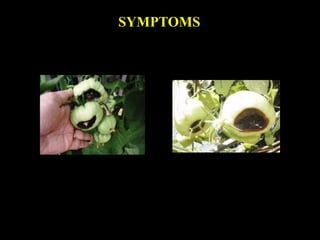
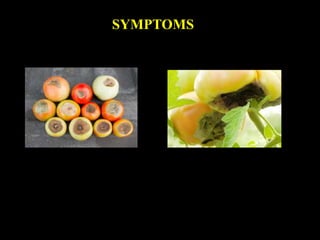
 The first evidence of blossom end rot consists of a brown or
waters soaked discoloration near the blossom end (opposite the
stem end) of the fruit.
 The discolored area enlarges and darkens until it covers 1/3 to
1/2 the surface of the fruit in severe cases.
 As the spots increase in size, the tissue becomes shrunken and
the area becomes flattened or concave.
 The skin of affected fruit becomes black and leathery in
appearance.
SYMPTOMS
SYMPTOMS
SYMPTOMS
 Fruit do not soft rot unless the spots are invaded by secondary
organisms.
 Tomatoes affected by blossom end rot grow slowly
and often ripen prematurely.
 Under certain conditions the outward symptoms may
be suppressed almost entirely, while the inner tissue
near the blossom end is completely discolored and
collapsed.
 Blossom end rot is most frequently observed on fruit
that is 1/2 to 2/3 its mature size.
MANAGEMENT
Cultural Control
 Maintain a uniform supply of soil moisture by
watering plants during drought and mulching to retain
soil moisture.
 Avoid using excessive amounts of ammonia forms of
nitrogen, which reduce calcium uptake. Use nitrate
forms of nitrogen instead. Avoid over fertilization
during early fruiting.
Maintain a soil pH of approximately 6.5
Liming helps to supply calcium.
 Do not subject plants to sudden and severe hardening
before transplanting
Chemical control
 Foliar applications of calcium can be used but they are not
always effective.
 Apply calcium chloride as a spray if the soil is deficient in
calcium and blossom end rot begins to develop.
 Sprays should be applied at weekly intervals until 3 or 4
applications have been made.
 Prolonged applications of calcium chloride may cause marginal
leaf burn.

TOMATO BLOSSOM END ROT

  • 1.
    TOMATO BLOSSOM ENDROT Submitted by Course teacher B. Muthulakshmi Dr. Parthasarathy. S 2015021084 Assistant Professor (Plant Pathology) COLLEGE OF AGRICULTURAL TECHNOLOGY (Affiliated to Tamil Nadu Agricultural University, Coimbatore-3) Kullapuram (Po),ViaVaigai Dam, Theni-625 562
  • 2.
    HISTORY  The wildspecies originated in the Andes Mountains of south America, probably mainly in Peru and Ecuador, and is thought to have been domesticated in pre colombia Mexico.  The tomato was introduced to Europe by the spanish in the early sixteenth century.
  • 3.
  • 4.
    LOSSES  Losses fromthis disorder vary from negligible to severe, depending on the environmental conditions
  • 5.
    BLOSSOM END ROT Blossom end rot is a physiological disorder of tomato fruits that affects both greenhouse and field grown plants.  It occur during long periods of drought during the early stages of fruit development.  However, it can also occur after periods of unusually heavy rainfall.  Blossom end rot also affects peppers and eggplant.
  • 6.
    CAUSES  Calcium deficiencyhas been shown to be a contributing factor to the occurrence of blossom end rot.  Failure of sufficient calcium to reach the blossom end of the fruit early in fruit development causes the cells in this area to die.  It is common for secondary fungi and bacteria to invade dead tissue on fruit affected with blossom end rot.  These organisms are sometimes mistakenly assumed to have caused the symptoms.
  • 7.
    SYMPTOMS  The firstevidence of blossom end rot consists of a brown or waters soaked discoloration near the blossom end (opposite the stem end) of the fruit.  The discolored area enlarges and darkens until it covers 1/3 to 1/2 the surface of the fruit in severe cases.  As the spots increase in size, the tissue becomes shrunken and the area becomes flattened or concave.  The skin of affected fruit becomes black and leathery in appearance.
  • 8.
  • 9.
  • 10.
    SYMPTOMS  Fruit donot soft rot unless the spots are invaded by secondary organisms.  Tomatoes affected by blossom end rot grow slowly and often ripen prematurely.  Under certain conditions the outward symptoms may be suppressed almost entirely, while the inner tissue near the blossom end is completely discolored and collapsed.  Blossom end rot is most frequently observed on fruit that is 1/2 to 2/3 its mature size.
  • 11.
    MANAGEMENT Cultural Control  Maintaina uniform supply of soil moisture by watering plants during drought and mulching to retain soil moisture.  Avoid using excessive amounts of ammonia forms of nitrogen, which reduce calcium uptake. Use nitrate forms of nitrogen instead. Avoid over fertilization during early fruiting.
  • 12.
    Maintain a soilpH of approximately 6.5 Liming helps to supply calcium.  Do not subject plants to sudden and severe hardening before transplanting
  • 13.
    Chemical control  Foliarapplications of calcium can be used but they are not always effective.  Apply calcium chloride as a spray if the soil is deficient in calcium and blossom end rot begins to develop.  Sprays should be applied at weekly intervals until 3 or 4 applications have been made.  Prolonged applications of calcium chloride may cause marginal leaf burn.