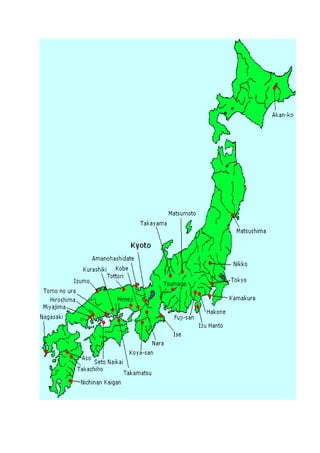
Tokyo is the capital city of Japan located on the island of Honshu. It was formed in 1943 from the merger of Tokyo city and prefecture. Tokyo has a population of over 13 million people and has the world's largest city economy. It is a major global financial center and is known for its electronics, publishing, and transportation industries. The Tokyo Metropolitan government administers the 23 special wards of Tokyo and other cities in the prefecture.
![Tokyo officially Tokyo Metropolis (東京都 Tōkyō-to) is one of the 47 prefectures of Japan. It is located on the eastern side of the main island HYPERLINK \"
http://en.wikipedia.org/wiki/Honsh%C5%AB\"
\o \"
Honshū\"
Honshū and includes the HYPERLINK \"
http://en.wikipedia.org/wiki/Izu_Islands\"
\o \"
Izu Islands\"
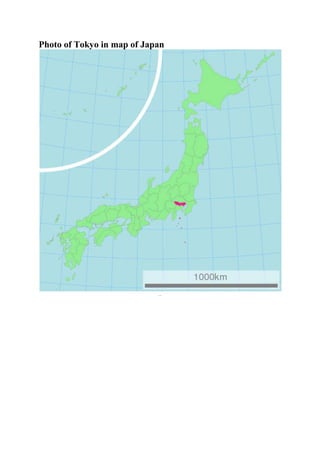
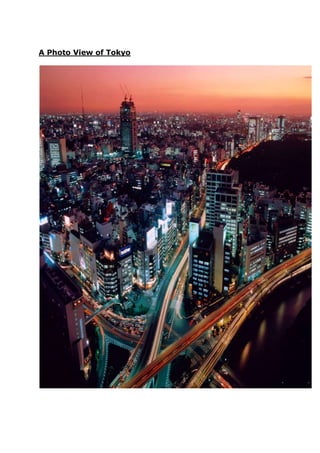
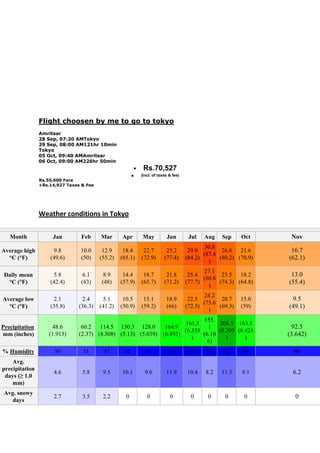
Izu Islands and Ogasawara Islands. Tokyo Metropolis was formed in 1943 from the merger of the former Tokyo Prefecture (Tokyo-fu) and the city of Tokyo. Tokyo is the capital of Japan, the center of the Greater Tokyo Area, and the largest metropolitan area of Japan. It is the seat of the Japanese government and the Imperial Palace, and the home of the Japanese Imperial Family.<br />The Tokyo Metropolitan government administers the twenty-three special wards of Tokyo, each governed as a city, that cover the area that was the city of Tokyo as well as 39 municipalities in the western part of the prefecture and the two outlying island chains. The population of the special wards is over 8 million people, with the total population of the prefecture exceeding 13 million. The prefecture is part of the world's most populous metropolitan area with 35 to 39 million people (depending on definition) and the world's largest metropolitan economy with a GDP of US$1.479 trillion at purchasing power parity in 2008.[3]<br />Tokyo was described by HYPERLINK \"
http://en.wikipedia.org/wiki/Saskia_Sassen\"
\o \"
Saskia Sassen\"
Saskia Sassen as one of the three \"
command centers\"
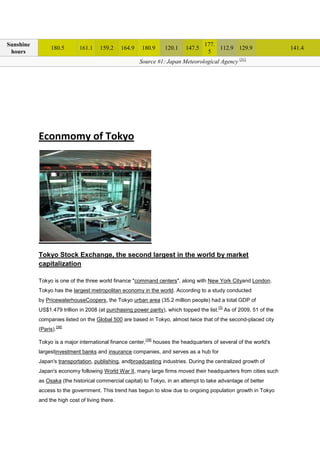
for the world economy, along with New York City andLondon.[4] This city is considered an alpha+ world city, listed by the GaWC's 2008 inventory[5] and ranked third among global cities byForeign Policy's 2010 Global Cities Index.[6] In 2009 Tokyo was named the world's most expensive city for expatriate employees, according to the Mercer and Economist Intelligence Unit cost-of-living surveys [7] and named the third Most Liveable City and the World’s Most Livable Megalopolis by the magazine <br />Photo of Tokyo in map of Japan<br />Air India<br />A Photo View of Tokyo<br />Flight choosen by me to go to tokyo<br />Amritsar28 Sep, 07:20 AMTokyo29 Sep, 08:00 AM121hr 10min<br />Tokyo05 Oct, 09:40 AMAmritsar06 Oct, 09:00 AM226hr 50min<br />Rs.70,527<br />(Incl. of taxes & fee)<br /> Rs.55,600 Fare +Rs.14,927 Taxes & Fee<br /> <br /> <br />Weather conditions in Tokyo<br />MonthJanFebMarAprMayJunJulAugSepOctNovDecYearAverage high °C (°F)9.8(49.6)10.0(50)12.9(55.2)18.4(65.1)22.7(72.9)25.2(77.4)29.0(84.2)30.8(87.4)26.8(80.2)21.6(70.9)16.7(62.1)12.3(54.1)19.7(67.5)Daily mean °C (°F)5.8(42.4)6.1(43)8.9(48)14.4(57.9)18.7(65.7)21.8(71.2)25.4(77.7)27.1(80.8)23.5(74.3)18.2(64.8)13.0(55.4)8.4(47.1)15.9(60.6)Average low °C (°F)2.1(35.8)2.4(36.3)5.1(41.2)10.5(50.9)15.1(59.2)18.9(66)22.5(72.5)24.2(75.6)20.7(69.3)15.0(59)9.5(49.1)4.6(40.3)12.5(54.5)Precipitation mm (inches)48.6(1.913)60.2(2.37)114.5(4.508)130.3(5.13)128.0(5.039)164.9(6.492)161.5(6.358)155.1(6.106)208.5(8.209)163.1(6.421)92.5(3.642)39.6(1.559)1,466.7(57.744)% Humidity50515762667375727266605363.1Avg. precipitation days (≥ 1.0 mm)4.65.89.510.19.611.910.48.211.39.16.23.8100.5Avg. snowy days2.73.52.2000000000.79.1Sunshine hours180.5161.1159.2164.9180.9120.1147.5177.5112.9129.9141.4171.11,847.2Source #1: Japan Meteorological Agency [31]<br />Econmomy of Tokyo<br />Tokyo Stock Exchange, the second largest in the world by market capitalization<br />Tokyo is one of the three world finance \"
command centers\"
, along with New York Cityand London. Tokyo has the largest metropolitan economy in the world. According to a study conducted by PricewaterhouseCoopers, the Tokyo urban area (35.2 million people) had a total GDP of US$1.479 trillion in 2008 (at purchasing power parity), which topped the list.[3] As of 2009, 51 of the companies listed on the Global 500 are based in Tokyo, almost twice that of the second-placed city (Paris).[38]<br />Tokyo is a major international finance center,[39] houses the headquarters of several of the world's largestinvestment banks and insurance companies, and serves as a hub for Japan's transportation, publishing, andbroadcasting industries. During the centralized growth of Japan's economy following World War II, many large firms moved their headquarters from cities such as Osaka (the historical commercial capital) to Tokyo, in an attempt to take advantage of better access to the government. This trend has begun to slow due to ongoing population growth in Tokyo and the high cost of living there.<br />Tokyo was rated by the Economist Intelligence Unit as the most expensive (highest cost-of-living) city in the world for 14 years in a row ending in 2006.[40] This analysis is for living a corporate executive lifestyle, with items like a detached house and several automobiles.[ HYPERLINK \"
http://en.wikipedia.org/wiki/Wikipedia:Citation_needed\"
\o \"
Wikipedia:Citation needed\"
citation needed]<br />The Tokyo Stock Exchange is Japan's largest stock exchange, and second largest in the world by market capitalization and fourth largest by share turnover. In 1990 at the end of the Japanese asset price bubble, it accounted for more than 60% of the world stock market value.[41] Tokyo had 8,460 ha (20,900 acres) of agricultural land as of 2003, HYPERLINK \"
http://en.wikipedia.org/wiki/Tokyo\"
\l \"
cite_note-41\"
[42] according to the Ministry of Agriculture, Forestry and Fisheries, placing it last among the nation's prefectures. The farmland is concentrated in Western Tokyo. Perishables such as vegetables, fruits, and flowers can be conveniently shipped to the markets in the eastern part of the prefecture. Japanese leaf spinach and spinach are the most important vegetables; as of 2000, Tokyo supplied 32.5% of the Japanese leaf spinach sold at its central produce market.<br />With 36% of its area covered by forest, Tokyo has extensive growths of HYPERLINK \"
http://en.wikipedia.org/wiki/Cryptomeria\"
\o \"
Cryptomeria\"
cryptomeria and Japanese cypress, especially in the mountainous western communities of Akiruno, Ōme, Okutama, Hachiōji, Hinode, and Hinohara. Decreases in the price of lumber, increases in the cost of production, and advancing old age among the forestry population have resulted in a decline in Tokyo's output. In addition, pollen, especially from cryptomeria, is a major allergen for the nearby population centers.<br />Tokyo Bay was once a major source of fish. Presently, most of Tokyo's fish production comes from the outer islands, such as Izu Ōshima and Hachijōjima. Skipjack tuna, HYPERLINK \"
http://en.wikipedia.org/wiki/Nori\"
\o \"
Nori\"
nori, and HYPERLINK \"
http://en.wikipedia.org/wiki/Carangidae\"
\o \"
Carangidae\"
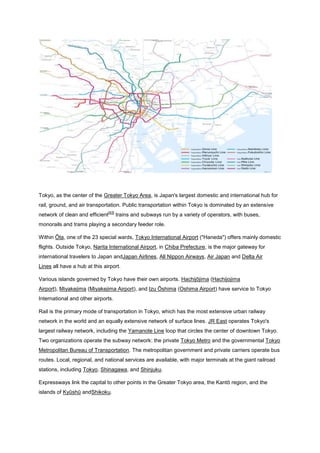
aji are among the ocean products.<br />Tourism in Tokyo is also a contributor to the economy.<br />Transportation in Tokyo<br />Tokyo, as the center of the Greater Tokyo Area, is Japan's largest domestic and international hub for rail, ground, and air transportation. Public transportation within Tokyo is dominated by an extensive network of clean and efficient HYPERLINK \"
http://en.wikipedia.org/wiki/Tokyo\"
\l \"
cite_note-42\"
[43] trains and subways run by a variety of operators, with buses, monorails and trams playing a secondary feeder role.<br />Within HYPERLINK \"
http://en.wikipedia.org/wiki/%C5%8Cta,_Tokyo\"
\o \"
Ōta, Tokyo\"
Ōta, one of the 23 special wards, Tokyo International Airport (\"
Haneda\"
) offers mainly domestic flights. Outside Tokyo, Narita International Airport, in Chiba Prefecture, is the major gateway for international travelers to Japan andJapan Airlines, All Nippon Airways, Air Japan and Delta Air Lines all have a hub at this airport.<br />Various islands governed by Tokyo have their own airports. HYPERLINK \"
http://en.wikipedia.org/wiki/Hachij%C5%8Djima\"
\o \"
Hachijōjima\"
Hachijōjima ( HYPERLINK \"
http://en.wikipedia.org/wiki/Hachijojima_Airport\"
\o \"
Hachijojima Airport\"
Hachijojima Airport), HYPERLINK \"
http://en.wikipedia.org/wiki/Miyakejima\"
\o \"
Miyakejima\"
Miyakejima ( HYPERLINK \"
http://en.wikipedia.org/wiki/Miyakejima_Airport\"
\o \"
Miyakejima Airport\"
Miyakejima Airport), and HYPERLINK \"
http://en.wikipedia.org/wiki/Izu_%C5%8Cshima\"
\o \"
Izu Ōshima\"
Izu Ōshima ( HYPERLINK \"
http://en.wikipedia.org/wiki/Oshima_Airport\"
\o \"
Oshima Airport\"
Oshima Airport) have service to Tokyo International and other airports.<br />Rail is the primary mode of transportation in Tokyo, which has the most extensive urban railway network in the world and an equally extensive network of surface lines. JR East operates Tokyo's largest railway network, including the HYPERLINK \"
http://en.wikipedia.org/wiki/Yamanote_Line\"
\o \"
Yamanote Line\"
Yamanote Line loop that circles the center of downtown Tokyo. Two organizations operate the subway network: the private Tokyo Metro and the governmental Tokyo Metropolitan Bureau of Transportation. The metropolitan government and private carriers operate bus routes. Local, regional, and national services are available, with major terminals at the giant railroad stations, including Tokyo, Shinagawa, and Shinjuku.<br />Expressways link the capital to other points in the Greater Tokyo area, the Kantō region, and the islands of HYPERLINK \"
http://en.wikipedia.org/wiki/Ky%C5%ABsh%C5%AB\"
\o \"
Kyūshū\"
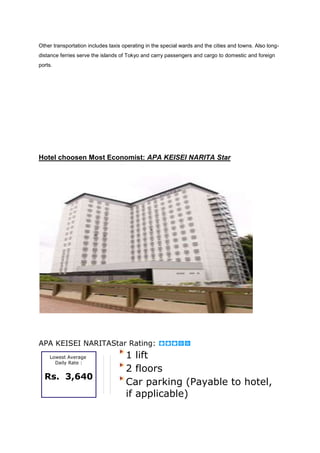
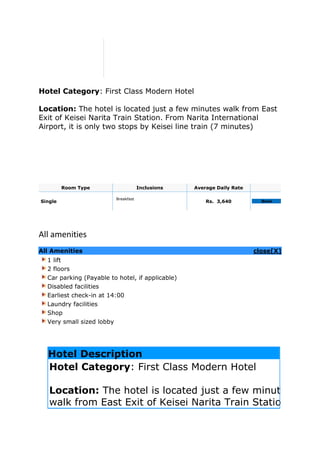
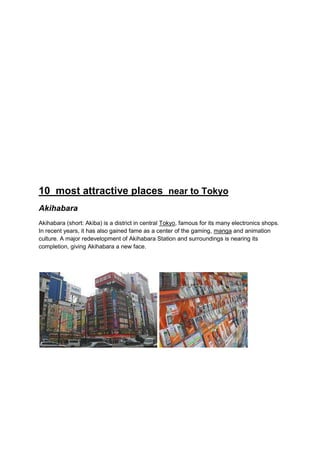
Kyūshū andShikoku.<br />Other transportation includes taxis operating in the special wards and the cities and towns. Also long-distance ferries serve the islands of Tokyo and carry passengers and cargo to domestic and foreign ports.<br />Hotel choosen Most Economist: APA KEISEI NARITA Star <br />APA KEISEI NARITAStar Rating: <br />Lowest Average Daily Rate :Rs. 3,640 1 lift2 floorsCar parking (Payable to hotel, if applicable)<br />Hotel Category: First Class Modern HotelLocation: The hotel is located just a few minutes walk from East Exit of Keisei Narita Train Station. From Narita International Airport, it is only two stops by Keisei line train (7 minutes) <br />Room TypeInclusionsAverage Daily Rate Single Breakfast Rs. 3,640Book<br />All amenities<br />All Amenitiesclose[X]1 lift2 floorsCar parking (Payable to hotel, if applicable)Disabled facilitiesEarliest check-in at 14:00Laundry facilitiesShopVery small sized lobbyHotel DescriptionHotel Category: First Class Modern HotelLocation: The hotel is located just a few minutes walk from East Exit of Keisei Narita Train Station. From Narita International Airport, it is only two stops by Keisei line train (7 minutes) and the regular complimentary shuttle bus services are also operated between the hotel and Airport terminals (about 30 minutes). From central Tokyo, it takes about 65 minutes by Keisei Line from Keisei Ueno Station or 70 minutes by JR line from JR Tokyo Terminal.Lobby: The lobby is medium in size, with some sitting places and decorated in modern style.Exterior: It is a 15 storied modern white building.Restaurant: There is a Japanese restaurant on the ground floor where the daily hot buffet breakfast is served. The restaurant is also opened for lunch and dinner, featuring casual Japanese dishes.General: A good value hotel near the middle of Narita town, offering guests a good chance to walk around the town. The hotel also offers complimentary entrance to their public bath which is located on the 2nd floor for relaxation. (03/10 YT).Rooms: All twin rooms are medium and singles are small in size. They are all furnished in simple modern style with the facilities such as 26 inches LCD television, direct dial phone, air-conditioning and the complimentary high speed internet access etc.The bathrooms are also small and kept clean and in excellent condition.Other Details1 kms to city centre10 kms to the nearest airport (narita)Close to the station (keisei narita st)1 minute walk to the nearest bus stopCheck-in/out InfoCheck-in time is 12PM, Check-out time is 12PM.Early check-in or late check-out is subject to availability and may be chargeable by the hotel. After booking you will be sent an email confirmation with hotel phone number. You can contact the hotel directly for early check-in or late check-out<br />10 most attractive places near to Tokyo<br />Akihabara<br />Akihabara (short: Akiba) is a district in central Tokyo, famous for its many electronics shops. In recent years, it has also gained fame as a center of the gaming, HYPERLINK \"
http://www.japan-guide.com/e/e2070.html\"
\t \"
_top\"
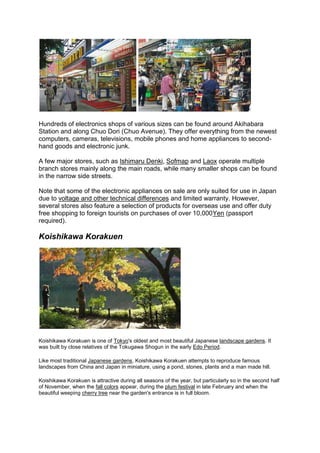
manga and animation culture. A major redevelopment of Akihabara Station and surroundings is nearing its completion, giving Akihabara a new face.<br /> <br /> <br />Hundreds of electronics shops of various sizes can be found around Akihabara Station and along Chuo Dori (Chuo Avenue). They offer everything from the newest computers, cameras, televisions, mobile phones and home appliances to second-hand goods and electronic junk.<br />A few major stores, such as HYPERLINK \"
http://www.japan-guide.com/e/e3003.html\"
\l \"
ishimaru\"
\t \"
_top\"
Ishimaru Denki, HYPERLINK \"
http://www.japan-guide.com/e/e3003.html\"
\l \"
sofmap\"
\t \"
_top\"
Sofmap and HYPERLINK \"
http://www.japan-guide.com/e/e3003.html\"
\l \"
laox\"
\t \"
_top\"
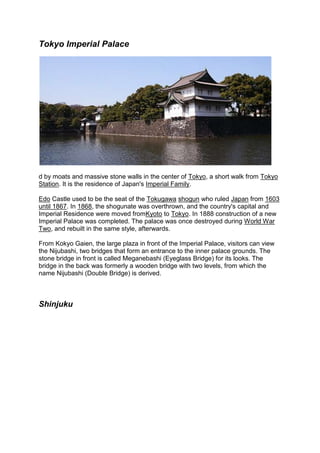
Laox operate multiple branch stores mainly along the main roads, while many smaller shops can be found in the narrow side streets.<br />Note that some of the electronic appliances on sale are only suited for use in Japan due to voltage and other technical differences and limited warranty. However, several stores also feature a selection of products for overseas use and offer duty free shopping to foreign tourists on purchases of over 10,000Yen (passport required).<br />Koishikawa Korakuen<br />Koishikawa Korakuen is one of Tokyo's oldest and most beautiful Japanese landscape gardens. It was built by close relatives of the Tokugawa Shogun in the early Edo Period.<br />Like most traditional Japanese gardens, Koishikawa Korakuen attempts to reproduce famous landscapes from China and Japan in miniature, using a pond, stones, plants and a man made hill.<br />Koishikawa Korakuen is attractive during all seasons of the year, but particularly so in the second half of November, when the fall colors appear, during the plum festival in late February and when the beautiful weeping cherry tree near the garden's entrance is in full bloom.<br />Tokyo Imperial Palace<br />d by moats and massive stone walls in the center of Tokyo, a short walk from Tokyo Station. It is the residence of Japan's Imperial Family.<br />Edo Castle used to be the seat of the Tokugawa shogun who ruled Japan from 1603 until 1867. In 1868, the shogunate was overthrown, and the country's capital and Imperial Residence were moved fromKyoto to Tokyo. In 1888 construction of a new Imperial Palace was completed. The palace was once destroyed during World War Two, and rebuilt in the same style, afterwards.<br />From Kokyo Gaien, the large plaza in front of the Imperial Palace, visitors can view the Nijubashi, two bridges that form an entrance to the inner palace grounds. The stone bridge in front is called Meganebashi (Eyeglass Bridge) for its looks. The bridge in the back was formerly a wooden bridge with two levels, from which the name Nijubashi (Double Bridge) is derived.<br />Shinjuku<br />Shinjuku is one of the 23 wards of Tokyo, but the name commonly refers just to the large entertainment, business and shopping area around Shinjuku Station.<br />Handling more than two million passengers each day, Shinjuku Station is Japan's busiest HYPERLINK \"
http://www.japan-guide.com/e/e2019.html\"
\t \"
_top\"
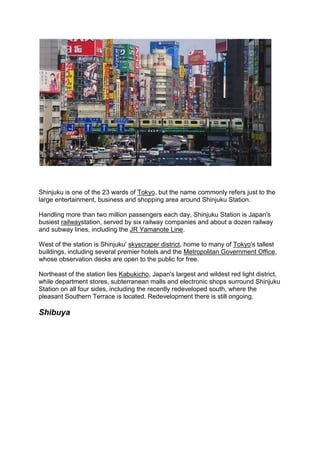
railwaystation, served by six railway companies and about a dozen railway and subway lines, including the JR Yamanote Line.<br />West of the station is Shinjuku' skyscraper district, home to many of Tokyo's tallest buildings, including several premier hotels and the Metropolitan Government Office, whose observation decks are open to the public for free.<br />Northeast of the station lies HYPERLINK \"
http://www.japan-guide.com/e/e3011.html\"
\l \"
kabukicho\"
\t \"
_top\"
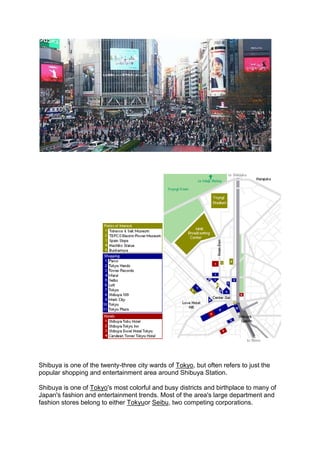
Kabukicho, Japan's largest and wildest red light district, while department stores, subterranean malls and electronic shops surround Shinjuku Station on all four sides, including the recently redeveloped south, where the pleasant Southern Terrace is located. Redevelopment there is still ongoing.<br />Shibuya<br />1485900316230<br />Shibuya is one of the twenty-three city wards of Tokyo, but often refers to just the popular shopping and entertainment area around Shibuya Station.<br />Shibuya is one of Tokyo's most colorful and busy districts and birthplace to many of Japan's fashion and entertainment trends. Most of the area's large department and fashion stores belong to either HYPERLINK \"
http://www.japan-guide.com/e/e3007.html\"
\l \"
tokyushopping\"
\t \"
_top\"
Tokyuor Seibu, two competing corporations.<br />A prominent landmark of Shibuya is the large intersection in front of the station ( HYPERLINK \"
http://www.japan-guide.com/e/e3007.html\"
\l \"
hachiko\"
\t \"
_top\"
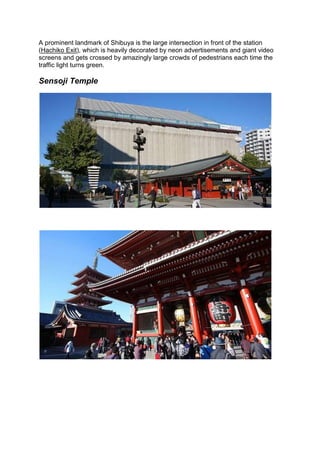
Hachiko Exit), which is heavily decorated by neon advertisements and giant video screens and gets crossed by amazingly large crowds of pedestrians each time the traffic light turns green.<br />Sensoji Temple<br />Sensoji (also known as Asakusa Kannon Temple) is a Buddhist temple located in HYPERLINK \"
http://www.japan-guide.com/e/e3004.html\"
\t \"
_top\"
Asakusa, the center of the shitamachi (lit. \"
low town\"
).<br />The legend says that in the year 628, two brothers fished a statue of HYPERLINK \"
http://www.japan-guide.com/e/e2055.html\"
\t \"
_top\"
Kannon, the goddess of mercy, out of the Sumida River, and even though they put the statue back into the river, it always returned to them. Consequently, Sensoji was built there for the goddess of Kannon. The temple was completed in 645, making it Tokyo's oldest temple.<br />Daiba<br />Daiba, literally meaning \"
fort\"
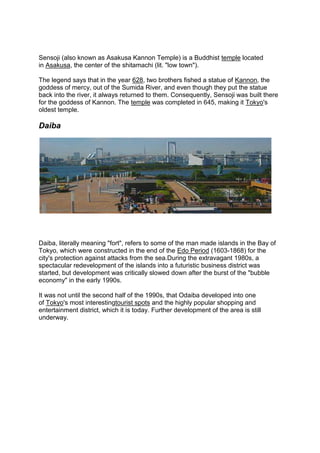
, refers to some of the man made islands in the Bay of Tokyo, which were constructed in the end of the Edo Period (1603-1868) for the city's protection against attacks from the sea.During the extravagant 1980s, a spectacular redevelopment of the islands into a futuristic business district was started, but development was critically slowed down after the burst of the \"
bubble economy\"
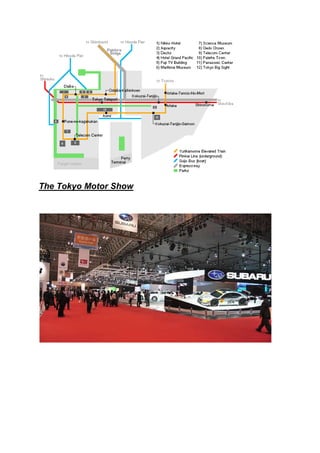
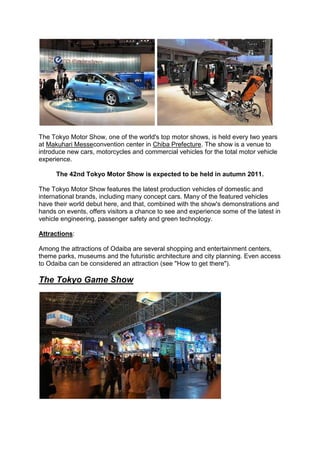
in the early 1990s.<br />It was not until the second half of the 1990s, that Odaiba developed into one of Tokyo's most interestingtourist spots and the highly popular shopping and entertainment district, which it is today. Further development of the area is still underway.<br />The Tokyo Motor Show<br /> <br />The Tokyo Motor Show, one of the world's top motor shows, is held every two years at HYPERLINK \"
http://www.japan-guide.com/e/e3046.html\"
\t \"
_top\"
Makuhari Messeconvention center in Chiba Prefecture. The show is a venue to introduce new cars, motorcycles and commercial vehicles for the total motor vehicle experience.<br />The 42nd Tokyo Motor Show is expected to be held in autumn 2011.<br />The Tokyo Motor Show features the latest production vehicles of domestic and international brands, including many concept cars. Many of the featured vehicles have their world debut here, and that, combined with the show's demonstrations and hands on events, offers visitors a chance to see and experience some of the latest in vehicle engineering, passenger safety and green technology.<br />Attractions:<br />Among the attractions of Odaiba are several shopping and entertainment centers, theme parks, museums and the futuristic architecture and city planning. Even access to Odaiba can be considered an attraction (see \"
How to get there\"
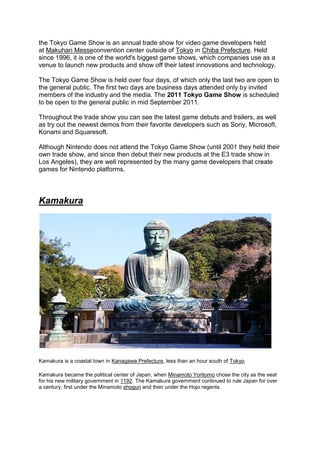
).<br />The Tokyo Game Show<br />the Tokyo Game Show is an annual trade show for video game developers held at HYPERLINK \"
http://www.japan-guide.com/e/e3046.html\"
\t \"
_top\"
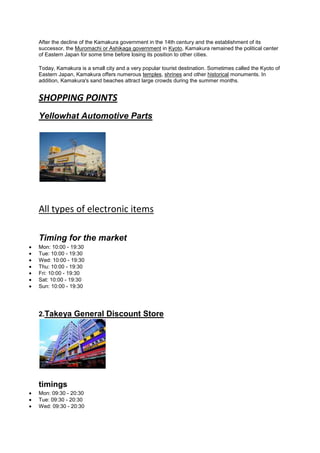
Makuhari Messeconvention center outside of Tokyo in Chiba Prefecture. Held since 1996, it is one of the world's biggest game shows, which companies use as a venue to launch new products and show off their latest innovations and technology.<br />The Tokyo Game Show is held over four days, of which only the last two are open to the general public. The first two days are business days attended only by invited members of the industry and the media. The 2011 Tokyo Game Show is scheduled to be open to the general public in mid September 2011.<br />Throughout the trade show you can see the latest game debuts and trailers, as well as try out the newest demos from their favorite developers such as Sony, Microsoft, Konami and Squaresoft.<br />Although Nintendo does not attend the Tokyo Game Show (until 2001 they held their own trade show, and since then debut their new products at the E3 trade show in Los Angeles), they are well represented by the many game developers that create games for Nintendo platforms.<br />Kamakura<br />Kamakura is a coastal town in Kanagawa Prefecture, less than an hour south of Tokyo.<br />Kamakura became the political center of Japan, when HYPERLINK \"
http://www.japan-guide.com/e/e2133.html\"
\t \"
_top\"
Minamoto Yoritomo chose the city as the seat for his new military government in 1192. The Kamakura government continued to rule Japan for over a century, first under the Minamoto shogun and then under the Hojo regents.<br />After the decline of the Kamakura government in the 14th century and the establishment of its successor, the HYPERLINK \"
http://www.japan-guide.com/e/e2134.html\"
\t \"
_top\"
Muromachi or Ashikaga government in Kyoto, Kamakura remained the political center of Eastern Japan for some time before losing its position to other cities.<br />Today, Kamakura is a small city and a very popular tourist destination. Sometimes called the Kyoto of Eastern Japan, Kamakura offers numerous temples, shrines and other historical monuments. In addition, Kamakura's sand beaches attract large crowds during the summer months.<br />SHOPPING POINTS<br />Yellowhat Automotive Parts<br />All types of electronic items<br />Timing for the market<br />Mon: 10:00 - 19:30<br />Tue: 10:00 - 19:30<br />Wed: 10:00 - 19:30<br />Thu: 10:00 - 19:30<br />Fri: 10:00 - 19:30<br />Sat: 10:00 - 19:30<br />Sun: 10:00 - 19:30<br />2. HYPERLINK \"
http://shops.japan-guide.com/shops/185\"
Takeya General Discount Store<br />timings<br />Mon: 09:30 - 20:30<br />Tue: 09:30 - 20:30<br />Wed: 09:30 - 20:30<br />Thu: 09:30 - 20:30<br />Fri: 09:30 - 20:30<br />Sat: 09:30 - 20:30<br />Sun: 09:30 - 20:30<br />Items available <br />Souvenirs <br />Cosmetics<br /> Women's Apparel <br />Men's Apparel<br /> Kids' Apparel<br /> Kimono & YukataShoes<br /> Bags HYPERLINK \"
http://shops.japan-guide.com/shops/categories/13\"
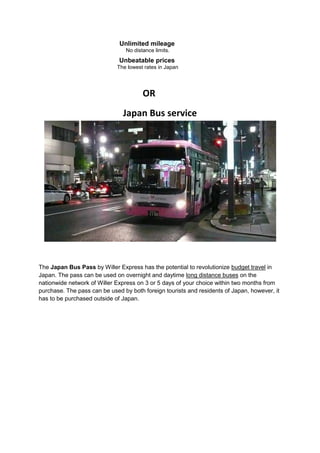
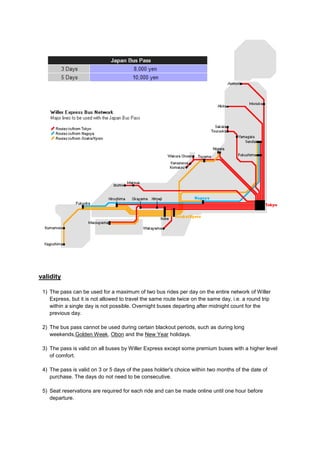
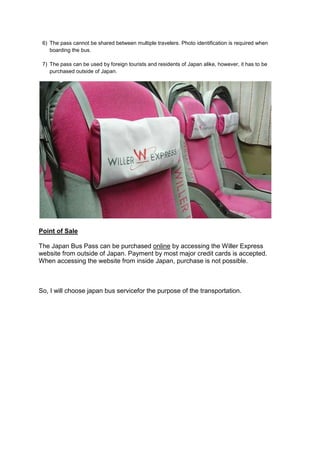
Jewelry & Accessories <br />Electronics <br />Toys & Games <br />Interior & Home Accesories<br /> Food Pharmacy <br />Department Store<br />Vehicle hired <br />Below prices are approximate and include mandatory insurance, ToCoo! use fee and tax! Exact rates and availability of car classes depend on the outlet.<br />Compact4,000 yen/dayBasic5,000 yen/dayStandard6,000 yen/dayLuxury10,000 yen/daySport11,000 yen/dayVan16,000 yen/day<br />Hundreds of outlets across Japan Including Hokkaido, Okinawa and all major airports.Various car classes Compact, mid-size, full-size, van, luxury, etc.Unlimited mileage No distance limits.Unbeatable prices The lowest rates in Japan<br /> OR<br />Japan Bus service<br />The Japan Bus Pass by Willer Express has the potential to revolutionize budget travel in Japan. The pass can be used on overnight and daytime long distance buses on the nationwide network of Willer Express on 3 or 5 days of your choice within two months from purchase. The pass can be used by both foreign tourists and residents of Japan, however, it has to be purchased outside of Japan.<br />validity<br />1)The pass can be used for a maximum of two bus rides per day on the entire network of Willer Express, but it is not allowed to travel the same route twice on the same day, i.e. a round trip within a single day is not possible. Overnight buses departing after midnight count for the previous day.2)The bus pass cannot be used during certain blackout periods, such as during long weekends, HYPERLINK \"
http://www.japan-guide.com/e/e2282.html\"
\t \"
_top\"
Golden Week, HYPERLINK \"
http://www.japan-guide.com/e/e2286.html\"
\t \"
_top\"
Obon and the New Year holidays.3)The pass is valid on all buses by Willer Express except some premium buses with a higher level of comfort.4)The pass is valid on 3 or 5 days of the pass holder's choice within two months of the date of purchase. The days do not need to be consecutive.5)Seat reservations are required for each ride and can be made online until one hour before departure.6)The pass cannot be shared between multiple travelers. Photo identification is required when boarding the bus.7)The pass can be used by foreign tourists and residents of Japan alike, however, it has to be purchased outside of Japan.<br />Point of Sale<br />The Japan Bus Pass can be purchased online by accessing the Willer Express website from outside of Japan. Payment by most major credit cards is accepted. When accessing the website from inside Japan, purchase is not possible.<br />So, I will choose japan bus servicefor the purpose of the transportation.<br />Cuisines of Tokyo<br />Rice Bowl <br />A bowl of plain cooked rice is served with most Japanese meals. Forbreakfast, it is sometimes mixed with a raw egg and soya sauce (tamago kake gohan) or enjoyed with HYPERLINK \"
http://www.japan-guide.com/e/e2045.html\"
\t \"
_top\"
natto or other toppings.<br />Domburi<br />A bowl of cooked rice with some other food put on top of the rice. Some of the most popular toppings are tempura (tendon), egg and chicken (oyakodon), tonkatsu (katsudon) and beef ( HYPERLINK \"
http://www.japan-guide.com/e/e2345.html\"
\t \"
_top\"
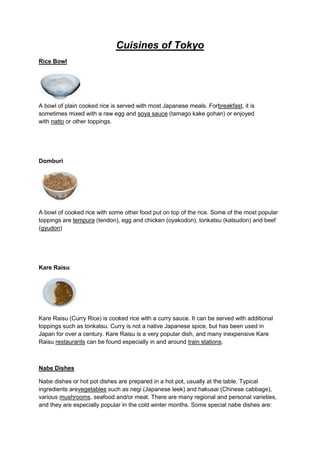
gyudon)<br />Kare Raisu<br />Kare Raisu (Curry Rice) is cooked rice with a curry sauce. It can be served with additional toppings such as tonkatsu. Curry is not a native Japanese spice, but has been used in Japan for over a century. Kare Raisu is a very popular dish, and many inexpensive Kare Raisu restaurants can be found especially in and around train stations.<br />Nabe Dishes<br />Nabe dishes or hot pot dishes are prepared in a hot pot, usually at the table. Typical ingredients arevegetables such as negi (Japanese leek) and hakusai (Chinese cabbage), various mushrooms, seafood and/or meat. There are many regional and personal varieties, and they are especially popular in the cold winter months. Some special nabe dishes are:<br />Oden A nabe dish prepared with various fish cakes, daikon, boiled eggs, konyaku and HYPERLINK \"
http://www.japan-guide.com/e/e2310.html\"
\t \"
_top\"
kombu seaweed, boiled over many hours in a soya sauce based soup<br /> Chanko Nabe Chanko nabe is traditionally the staple diet of sumo wrestlers. There are many varieties of chanko nabe. A few chanko nabe restaurants can be found around HYPERLINK \"
http://www.japan-guide.com/e/e3022.html\"
\t \"
_top\"
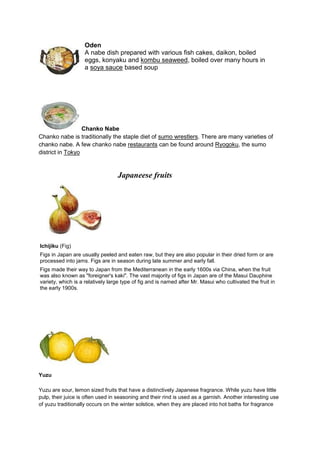
Ryogoku, the sumo district in Tokyo<br /> Japaneese fruitsIchijiku (Fig)Figs in Japan are usually peeled and eaten raw, but they are also popular in their dried form or are processed into jams. Figs are in season during late summer and early fall.Figs made their way to Japan from the Mediterranean in the early 1600s via China, when the fruit was also known as \"
foreigner's kaki\"
. The vast majority of figs in Japan are of the Masui Dauphine variety, which is a relatively large type of fig and is named after Mr. Masui who cultivated the fruit in the early 1900s.<br />YuzuYuzu are sour, lemon sized fruits that have a distinctively Japanese fragrance. While yuzu have little pulp, their juice is often used in seasoning and their rind is used as a garnish. Another interesting use of yuzu traditionally occurs on the winter solstice, when they are placed into hot baths for fragrance and various health benefits.Yuzu were introduced to Japan from China during the HYPERLINK \"
http://www.japan-guide.com/e/e2131.html\"
\t \"
_top\"
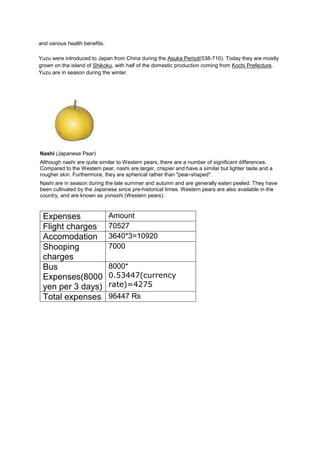
Asuka Period(538-710). Today they are mostly grown on the island of Shikoku, with half of the domestic production coming from Kochi Prefecture. Yuzu are in season during the winter.Nashi (Japanese Pear)Although nashi are quite similar to Western pears, there are a number of significant differences. Compared to the Western pear, nashi are larger, crispier and have a similar but lighter taste and a rougher skin. Furthermore, they are spherical rather than \"
pear-shaped\"
.Nashi are in season during the late summer and autumn and are generally eaten peeled. They have been cultivated by the Japanese since pre-historical times. Western pears are also available in the country, and are known as yonashi (Western pears).ExpensesAmountFlight charges70527Accomodation3640*3=10920Shooping charges7000Bus Expenses(8000 yen per 3 days) 8000* 0.53447(currency rate)=4275Total expenses96447 Rs <br />](https://image.slidesharecdn.com/tokyo-100928101804-phpapp01/85/A-Trip-to-Tokyo-1-320.jpg)



![Integricall 1 [autosaved]](https://cdn.slidesharecdn.com/ss_thumbnails/integricall1autosaved-110126033927-phpapp02-thumbnail.jpg?width=640&height=640&fit=bounds)


![[plan politika] Pemuda dan Politik Indonesia : In Search of Truly Youthful Un...](https://cdn.slidesharecdn.com/ss_thumbnails/insearchoftrulyyouthfulunderbow-110409211642-phpapp01-thumbnail.jpg?width=640&height=640&fit=bounds)


