INTRODUCTION TO
DECENTRALIZED FINANCE (DEFI)?
101blockchains.com
Why Learn Blockchain With Us?
Trusted Strategic Practical
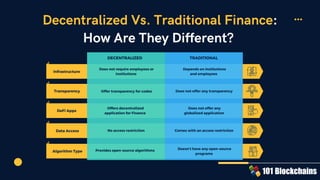
Decentralized Vs. Traditional Finance:
How Are They Different?
Infrastructure
Transparency
Data Access
DeFi Apps
DECENTRALIZED TRADITIONAL
Does not require employees or
institutions
Depends on institutions
and employees
Offer transparency for codes Does not offer any transparency
Does not offer any
globalized application
No access restriction Comes with an access restriction
Offers decentralized
application for Finance
Algorithm Type Provides open-source algorithms Doesn’t have any open-source
programs
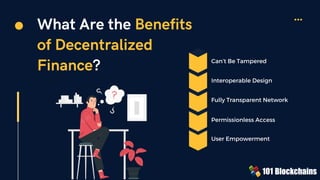
What Are the Benefits
of Decentralized
Finance? Can’t Be Tampered
Fully Transparent Network
Interoperable Design
Permissionless Access
User Empowerment
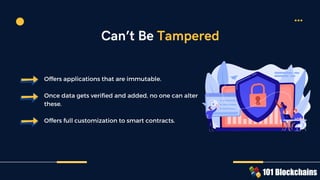
Offers applications that are immutable.
Once data gets verified and added, no one can alter
these.
Offers full customization to smart contracts.
Can’t Be Tampered
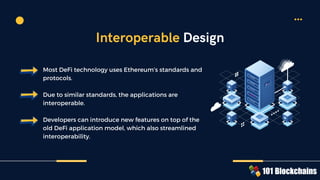
Most DeFi technology uses Ethereum’s standards and
protocols.
Due to similar standards, the applications are
interoperable.
Developers can introduce new features on top of the
old DeFi application model, which also streamlined
interoperability.
Interoperable Design
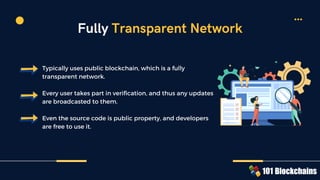
Typically uses public blockchain, which is a fully
transparent network.
Every user takes part in verification, and thus any updates
are broadcasted to them.
Even the source code is public property, and developers
are free to use it.
Fully Transparent Network
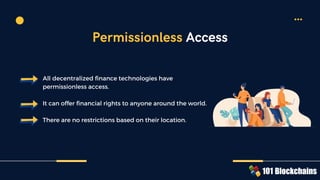
All decentralized finance technologies have
permissionless access.
It can offer financial rights to anyone around the world.
There are no restrictions based on their location.
Permissionless Access
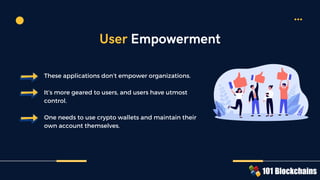
These applications don’t empower organizations.
It’s more geared to users, and users have utmost
control.
One needs to use crypto wallets and maintain their
own account themselves.
User Empowerment
8
5
%
1
5
%
It
e
m
2
9
5
%
It
e
m
1
5
%
9
0
%
1
0
%
8
0
%
2
0
%
7
5
%
2
5
%
5
0
%
5
0
%
5
5
%
4
5
%
60%
40%
Ite
m
2
70
%
Ite
m
1
30
%
6
5
%
3
5
%
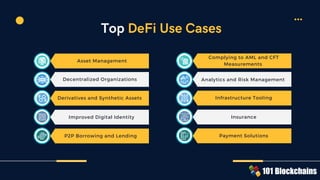
Top DeFi Use Cases
Asset Management
Derivatives and Synthetic Assets
Improved Digital Identity
P2P Borrowing and Lending
Complying to AML and CFT
Measurements
Decentralized Organizations
Infrastructure Tooling
Analytics and Risk Management
Payment Solutions
Insurance
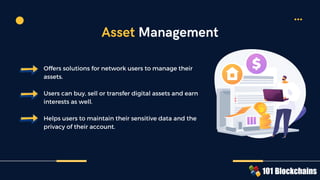
Offers solutions for network users to manage their
assets.
Users can buy, sell or transfer digital assets and earn
interests as well.
Helps users to maintain their sensitive data and the
privacy of their account.
Asset Management
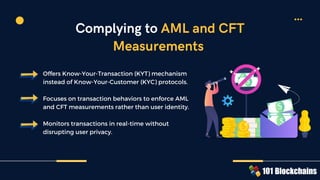
Offers Know-Your-Transaction (KYT) mechanism
instead of Know-Your-Customer (KYC) protocols.
Focuses on transaction behaviors to enforce AML
and CFT measurements rather than user identity.
Monitors transactions in real-time without
disrupting user privacy.
Complying to AML and CFT
Measurements
$
$
$
$
$
$
$
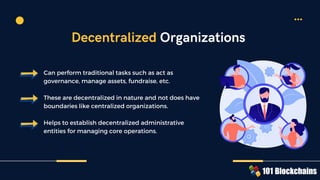
Can perform traditional tasks such as act as
governance, manage assets, fundraise, etc.
These are decentralized in nature and not does have
boundaries like centralized organizations.
Helps to establish decentralized administrative
entities for managing core operations.
Decentralized Organizations
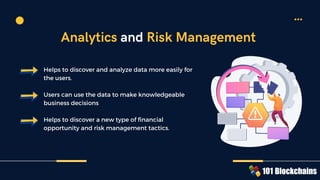
Helps to discover and analyze data more easily for
the users.
Users can use the data to make knowledgeable
business decisions
Helps to discover a new type of financial
opportunity and risk management tactics.
Analytics and Risk Management
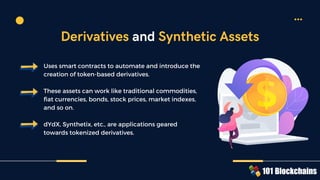
Uses smart contracts to automate and introduce the
creation of token-based derivatives.
These assets can work like traditional commodities,
fiat currencies, bonds, stock prices, market indexes,
and so on.
dYdX, Synthetix, etc., are applications geared
towards tokenized derivatives.
Derivatives and Synthetic Assets
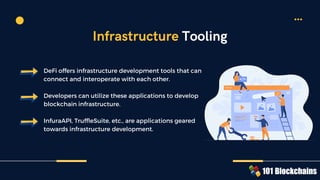
DeFi offers infrastructure development tools that can
connect and interoperate with each other.
Developers can utilize these applications to develop
blockchain infrastructure.
InfuraAPI, TruffleSuite, etc., are applications geared
towards infrastructure development.
Infrastructure Tooling
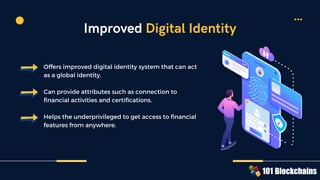
Offers improved digital identity system that can act
as a global identity.
Can provide attributes such as connection to
financial activities and certifications.
Helps the underprivileged to get access to financial
features from anywhere.
Improved Digital Identity
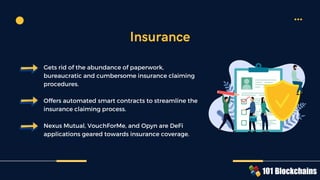
Gets rid of the abundance of paperwork,
bureaucratic and cumbersome insurance claiming
procedures.
Offers automated smart contracts to streamline the
insurance claiming process.
Nexus Mutual, VouchForMe, and Opyn are DeFi
applications geared towards insurance coverage.
Insurance
It’s created a new type of borrowing and lending
marketplace.
Offers peer-to-peer (P2P) networks for borrowing
and lending applications.
Compound and PoolTogether are DeFi applications
geared towards interest-based protocols.
P2P Borrowing and Lending
It can serve the underbanked and unbanked
population around the world.
It can offer safer, faster, and transparent solutions
compared to traditional systems.
Doesn’t require any middleman and can make
payments more transparent and simpler.
Payment Solutions
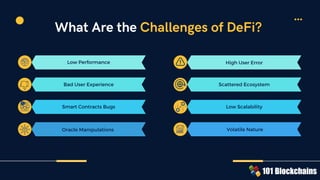
What Are the Challenges of DeFi?
Low Performance
Bad User Experience
Smart Contracts Bugs
Oracle Manipulations
High User Error
Scattered Ecosystem
Low Scalability
Volatile Nature
Suitable Blockchain Courses and
Masterclasses
Blockchain in Finance
Masterclass
https://academy.101blockchains.com/cour
ses/blockchain-in-finance
Central Bank Digital Currency
(CBDC) Masterclass
https://academy.101blockchains.com/courses/c
entral-bank-digital-currency
Enterprise Blockchains and
Trade Finance Course
https://academy.101blockchains.com/courses/ent
erprise-blockchains-and-trade-finance
Introduction to DeFi
Course
https://academy.101blockchains.com/cour
ses/defi-course
101 Blockchains Certifications
Certified Enterprise
Blockchain Professional
Certified Enterprise
Blockchain Architect
Certified Blockchain
Security Expert
https://academy.101blockchains.com/cour
ses/certified-enterprise-blockchain-
architect
https://academy.101blockchains.com/cours
es/certified-blockchain-security-expert
https://academy.101blockchains.com/
courses/blockchain-expert-
certification
Why You Must Go With 101 Blockchains
Certification Courses?
High-Quality Research Information
First-class Training Content
Interactive Exercises
Flexible Learning Using Modular
Approach
Access to Bonus Training Materials
Various Training Strategies for Faster
Learning
Tangible Proof of Course Completion
Weekly Hands-on Assignments
Professional Instructors
Premium Support
Free Resources
Enterprise Blockchains Fundamentals - Free Course
Blockchain Webinars
Blockchain Conferences
Trusted By 15,000+ Professionals!
Read real stories on Trustpilot and G2Crowd.
410 reviews
Thank You
101blockchains.com

Introduction to Decentralized Finance (DeFi)

  • 1.
    INTRODUCTION TO DECENTRALIZED FINANCE(DEFI)? 101blockchains.com
  • 2.
    Why Learn BlockchainWith Us? Trusted Strategic Practical
  • 3.
    Decentralized Vs. TraditionalFinance: How Are They Different? Infrastructure Transparency Data Access DeFi Apps DECENTRALIZED TRADITIONAL Does not require employees or institutions Depends on institutions and employees Offer transparency for codes Does not offer any transparency Does not offer any globalized application No access restriction Comes with an access restriction Offers decentralized application for Finance Algorithm Type Provides open-source algorithms Doesn’t have any open-source programs
  • 4.
    What Are theBenefits of Decentralized Finance? Can’t Be Tampered Fully Transparent Network Interoperable Design Permissionless Access User Empowerment
  • 5.
    Offers applications thatare immutable. Once data gets verified and added, no one can alter these. Offers full customization to smart contracts. Can’t Be Tampered
  • 6.
    Most DeFi technologyuses Ethereum’s standards and protocols. Due to similar standards, the applications are interoperable. Developers can introduce new features on top of the old DeFi application model, which also streamlined interoperability. Interoperable Design
  • 7.
    Typically uses publicblockchain, which is a fully transparent network. Every user takes part in verification, and thus any updates are broadcasted to them. Even the source code is public property, and developers are free to use it. Fully Transparent Network
  • 8.
    All decentralized financetechnologies have permissionless access. It can offer financial rights to anyone around the world. There are no restrictions based on their location. Permissionless Access
  • 9.
    These applications don’tempower organizations. It’s more geared to users, and users have utmost control. One needs to use crypto wallets and maintain their own account themselves. User Empowerment
  • 10.
    8 5 % 1 5 % It e m 2 9 5 % It e m 1 5 % 9 0 % 1 0 % 8 0 % 2 0 % 7 5 % 2 5 % 5 0 % 5 0 % 5 5 % 4 5 % 60% 40% Ite m 2 70 % Ite m 1 30 % 6 5 % 3 5 % Top DeFi UseCases Asset Management Derivatives and Synthetic Assets Improved Digital Identity P2P Borrowing and Lending Complying to AML and CFT Measurements Decentralized Organizations Infrastructure Tooling Analytics and Risk Management Payment Solutions Insurance
  • 11.
    Offers solutions fornetwork users to manage their assets. Users can buy, sell or transfer digital assets and earn interests as well. Helps users to maintain their sensitive data and the privacy of their account. Asset Management
  • 12.
    Offers Know-Your-Transaction (KYT)mechanism instead of Know-Your-Customer (KYC) protocols. Focuses on transaction behaviors to enforce AML and CFT measurements rather than user identity. Monitors transactions in real-time without disrupting user privacy. Complying to AML and CFT Measurements $ $ $ $ $ $ $
  • 13.
    Can perform traditionaltasks such as act as governance, manage assets, fundraise, etc. These are decentralized in nature and not does have boundaries like centralized organizations. Helps to establish decentralized administrative entities for managing core operations. Decentralized Organizations
  • 14.
    Helps to discoverand analyze data more easily for the users. Users can use the data to make knowledgeable business decisions Helps to discover a new type of financial opportunity and risk management tactics. Analytics and Risk Management
  • 15.
    Uses smart contractsto automate and introduce the creation of token-based derivatives. These assets can work like traditional commodities, fiat currencies, bonds, stock prices, market indexes, and so on. dYdX, Synthetix, etc., are applications geared towards tokenized derivatives. Derivatives and Synthetic Assets
  • 16.
    DeFi offers infrastructuredevelopment tools that can connect and interoperate with each other. Developers can utilize these applications to develop blockchain infrastructure. InfuraAPI, TruffleSuite, etc., are applications geared towards infrastructure development. Infrastructure Tooling
  • 17.
    Offers improved digitalidentity system that can act as a global identity. Can provide attributes such as connection to financial activities and certifications. Helps the underprivileged to get access to financial features from anywhere. Improved Digital Identity
  • 18.
    Gets rid ofthe abundance of paperwork, bureaucratic and cumbersome insurance claiming procedures. Offers automated smart contracts to streamline the insurance claiming process. Nexus Mutual, VouchForMe, and Opyn are DeFi applications geared towards insurance coverage. Insurance
  • 19.
    It’s created anew type of borrowing and lending marketplace. Offers peer-to-peer (P2P) networks for borrowing and lending applications. Compound and PoolTogether are DeFi applications geared towards interest-based protocols. P2P Borrowing and Lending
  • 20.
    It can servethe underbanked and unbanked population around the world. It can offer safer, faster, and transparent solutions compared to traditional systems. Doesn’t require any middleman and can make payments more transparent and simpler. Payment Solutions
  • 21.
    What Are theChallenges of DeFi? Low Performance Bad User Experience Smart Contracts Bugs Oracle Manipulations High User Error Scattered Ecosystem Low Scalability Volatile Nature
  • 22.
    Suitable Blockchain Coursesand Masterclasses Blockchain in Finance Masterclass https://academy.101blockchains.com/cour ses/blockchain-in-finance Central Bank Digital Currency (CBDC) Masterclass https://academy.101blockchains.com/courses/c entral-bank-digital-currency Enterprise Blockchains and Trade Finance Course https://academy.101blockchains.com/courses/ent erprise-blockchains-and-trade-finance Introduction to DeFi Course https://academy.101blockchains.com/cour ses/defi-course
  • 23.
    101 Blockchains Certifications CertifiedEnterprise Blockchain Professional Certified Enterprise Blockchain Architect Certified Blockchain Security Expert https://academy.101blockchains.com/cour ses/certified-enterprise-blockchain- architect https://academy.101blockchains.com/cours es/certified-blockchain-security-expert https://academy.101blockchains.com/ courses/blockchain-expert- certification
  • 24.
    Why You MustGo With 101 Blockchains Certification Courses? High-Quality Research Information First-class Training Content Interactive Exercises Flexible Learning Using Modular Approach Access to Bonus Training Materials Various Training Strategies for Faster Learning Tangible Proof of Course Completion Weekly Hands-on Assignments Professional Instructors Premium Support
  • 25.
    Free Resources Enterprise BlockchainsFundamentals - Free Course Blockchain Webinars Blockchain Conferences
  • 26.
    Trusted By 15,000+Professionals! Read real stories on Trustpilot and G2Crowd. 410 reviews
  • 27.