Downloaded 28 times
![MODELING OF REACTIVE SYSTEMS WITH FINITE AUTOMATA 5
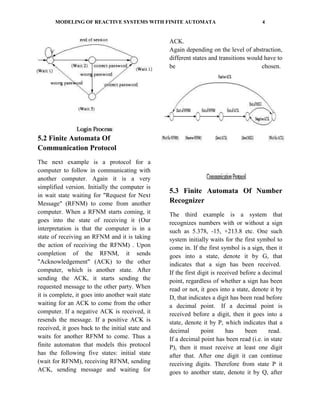
reading a digit and stays there as long as Conclusion
digits are read. This Q is an accepting state.
On the other hand if a digit has been read After completing this project we have found
before a decimal point, i.e. it is in state D, that finite automata is a part of many
then it can continue receiving digits and stay machine and by modeling reactive system
in D. D is another accepting state. If a with finite automata we have got a
decimal point is read while in D, then it goes diagrammatic representation of machines
to state P indicating that a decimal point has that how these machines work. Due to its
been read. This system can also be described advantages we use finite automata machine.
by a regular expression. Since these
numbers are represented by strings
Acknowledgement
consisting of a possible sign, followed by First of all I thank ALLAH, the Almighty,
zero or more digits, followed by a possible for bestowing me with determination and
decimal point, followed by one or more grit to undergo the project. I owe my
digits, they can be represented by the gratitude to many people for the guidance
following regular expression: they endowed me with. Foremost on the list
is Mr, Aihab Khan my supervisor, who was
(s+ + s- + ) ( d+.d+ + d+ + .d+ ),
sheer source of guidance and
where s+ and s- represent the positive and
encouragement. I am also gratified to my
negative signs, respectively and d belongs
family whose suggestions have helped me to
to { 0 , 1 , 2 , . . . , 9 } . This system can be
improve and render this project
modeled by the following finite automaton:
References:
[1]http://aidepot.com/FiniteStateMachines/FSM-
Background.html
[2]http://www.cs.umbc.edu/portal/help/theory/au
tomata_def.shtml
[3]http://www.informit.com/articles/article.aspx
?p=27792
[4]http://www.cs.odu.edu/~toida/nerzic/390tech
ed/regular/fa/intr_2_fa.html](https://image.slidesharecdn.com/final-130222125443-phpapp01/85/Modeling-of-reactive-system-with-finite-automata-5-320.jpg)

This document discusses modeling reactive systems using finite automata. It begins with background on finite automata and how they emerged in the 1950s to model real circuits. Finite automata are then described as useful for applications like text search, protocol verification, and compiler descriptions. The advantages of finite state machines include simplicity, predictability, ease of design/implementation/execution, and flexibility. Reactive systems are defined as systems that change actions/outputs in response to internal or external stimuli. To model a reactive system as a finite automaton, its states and state transitions triggered by events are identified. As an example, a simplified login process is modeled as a finite state machine to demonstrate this approach.


