 Teams
 In-class writing: What defines
your character?
 Group Discussions
 Choosing your prompt
 Formulating a tentative thesis
 Outlining your essay
 Introductions: Writing a directed
summary
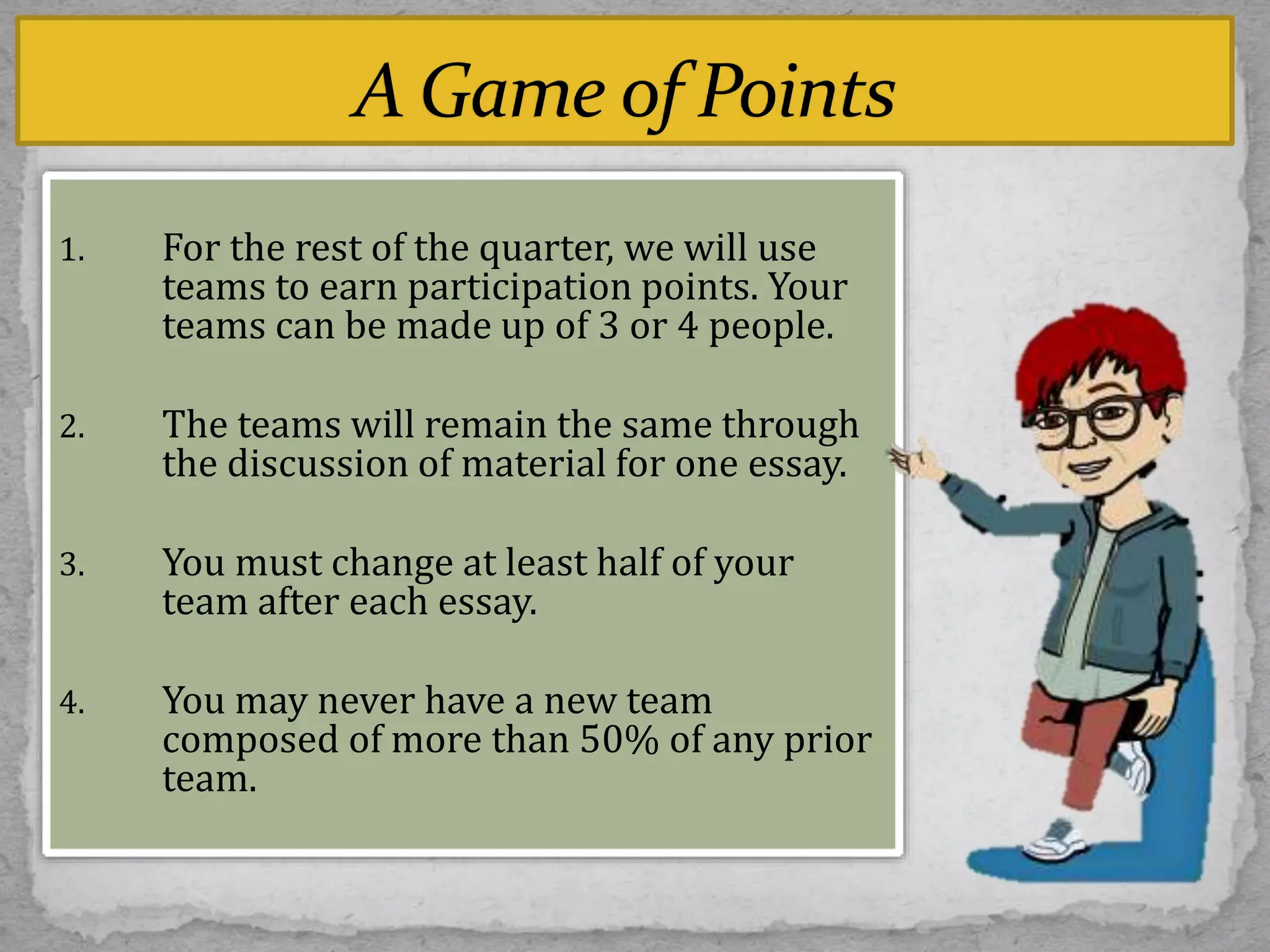
1. For the rest of the quarter, we will use
teams to earn participation points. Your
teams can be made up of 3 or 4 people.
2. The teams will remain the same through
the discussion of material for one essay.
3. You must change at least half of your
team after each essay.
4. You may never have a new team
composed of more than 50% of any prior
team.
The first team competition starts today. I
will put you into your first teams.
This group will last
through two class
discussions based on
writing essay #1,
practicing rhetorical
strategies, and one
class period dedicated
to a library research
activity: Class 8.
 Team 1
 Danerys: Gillian
 Danerys: Yee May
 Khal Drogo: Stella
 Viserys: Jia Yi
 Team 2
 Eddard: Marissa
 Robb: Briana
 Bran: Yen Linh
 Maester Luwin:
Jose S
• Team 6
• Robert: Jairo
• Cersei: Stephanie
• Petyr: Charles
• Catelyn: Uriel
• Arya: Eloise
• Team 7
• Eddard: Sam
• Catelyn: Kareem
• Robb: Kangming
• Tyrion: James P
• Jon: Trinity
• Team 3
• Sansa: Paulina
• Joffrey: Umer
• Sandor : Jonathan M
• Arya: Ruby
• Team 4
• Robert: Carlos
• Cersei: Liwei
• Jaime: Kristen
• Bran: Juan
• Sansa: Amanda
• Team 5
• Bron: Alfredo
• Tyrion: John L
• Jon: James H
• Samwell: Bianca
Sit with your
team
members in
class to
facilitate
ease of
group
discussions
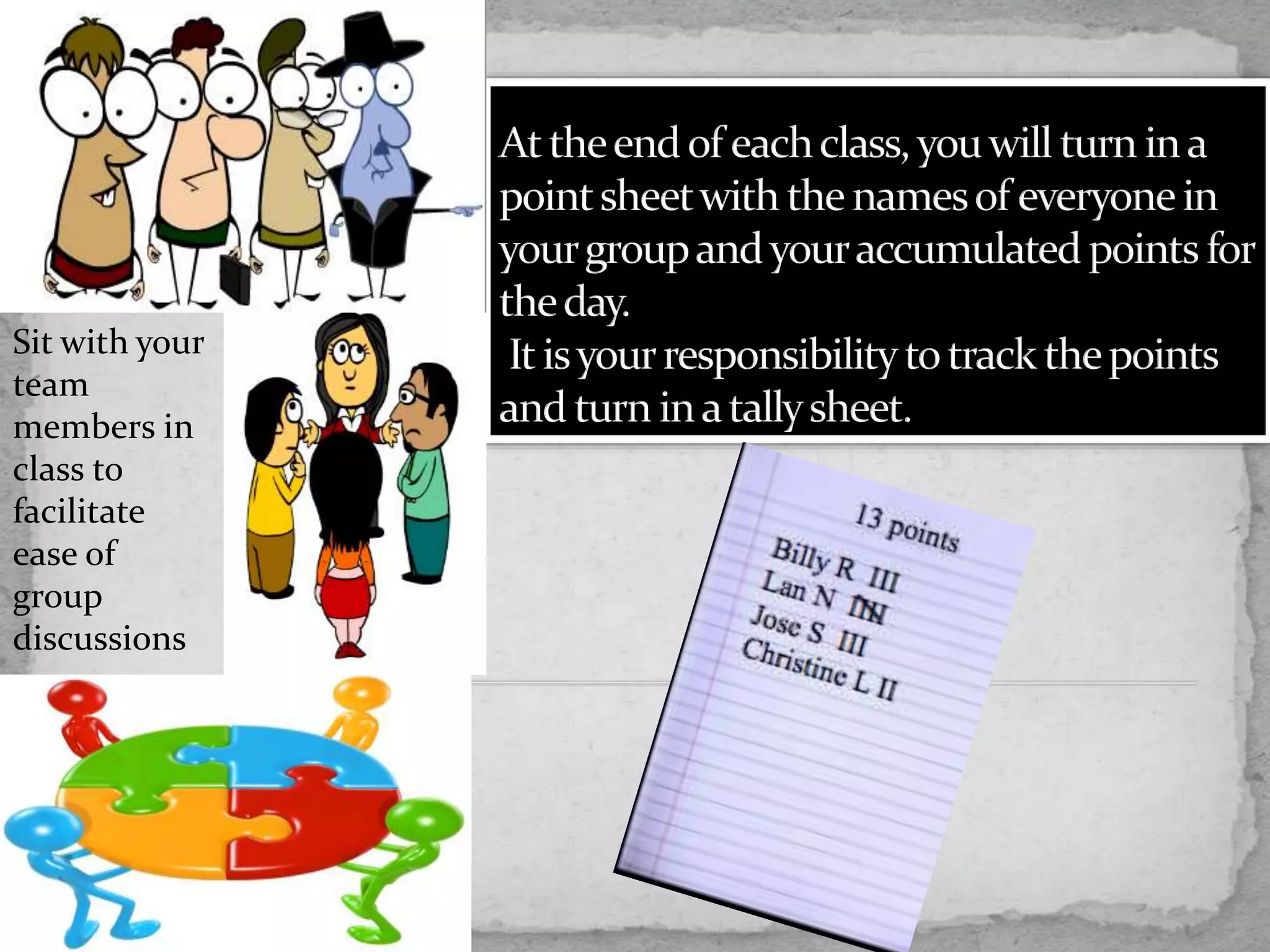
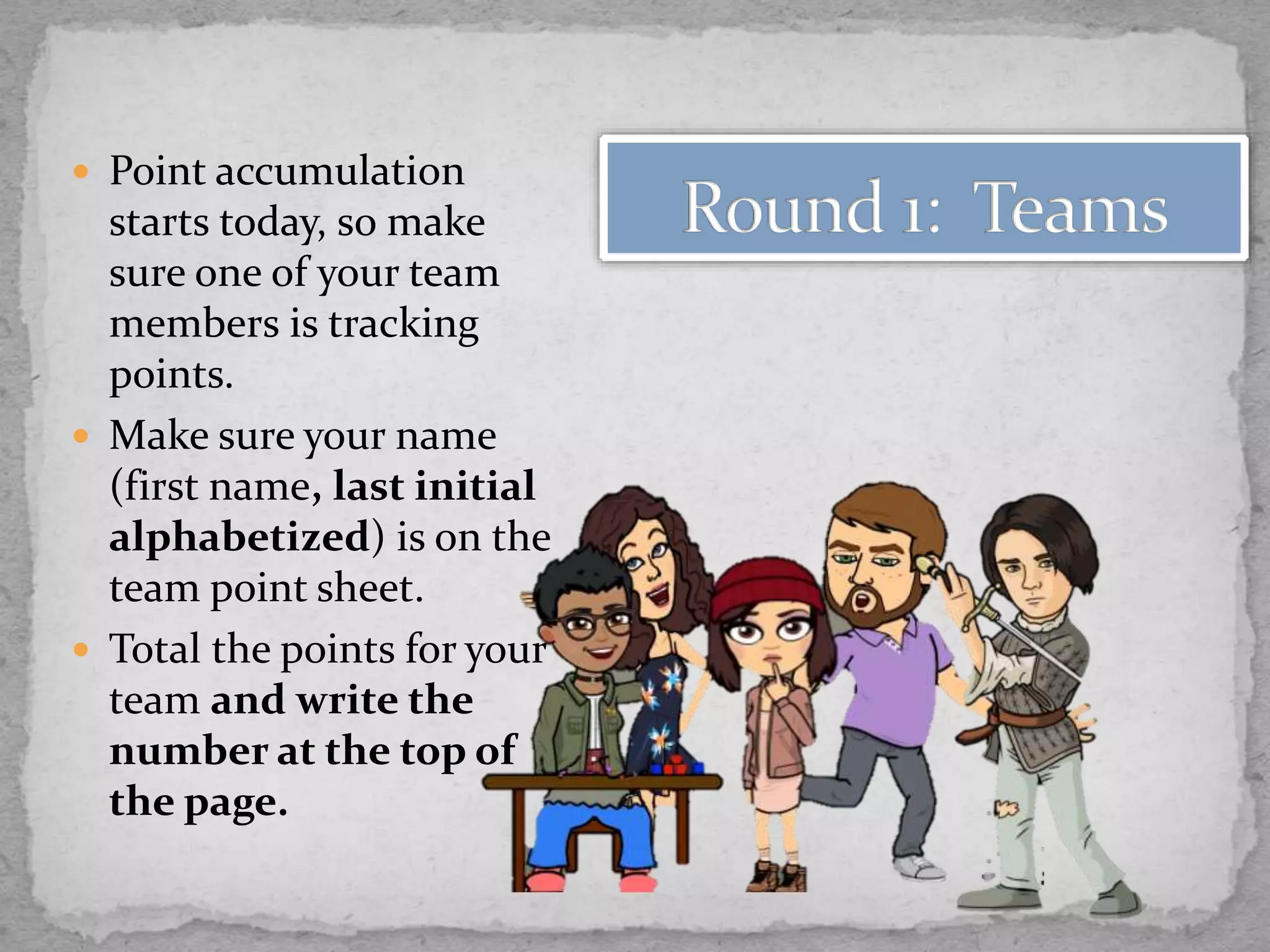
 Point accumulation
starts today, so make
sure one of your team
members is tracking
points.
 Make sure your name
(first name, last initial
alphabetized) is on the
team point sheet.
 Total the points for your
team and write the
number at the top of
the page.
 Points will be earned
for correct answers to
questions, meaningful
contributions to the
discussion , and
provocative questions.
Contributions to the
discussion via the slide
show also score one
point. Each team will
track their own points,
but cheating leads to
death (or loss of 25
participation points).
 Answers, comments,
and questions must
be posed in a manner
that promotes
learning. Those who
speak out of turn or
with maliciousness
will not receive
points for their
teams.
How do others perceive
your character?
How does your character see
him or herself?
If there is a difference, what
causes it?
What makes your character who he or she is?
Write out brief answers that explain or defend
his or her behavior and actions. Consider
these influences:
Culture
Family history
Personal history
Class/Occupation/Ass
ignment
Gender/Sex
Aspirations
 Write at least three questions that you would like to
ask other characters in your group. For instance, you
might ask why a character treats your character a
certain way, or you might ask about the motivation for
an action or behavior.
 Choose questions that will shed light on their
motivations and behavior. Try to make others question
their characters’ integrity, ambition, or other
motivation.
These questions will be the fodder
for your discussion today.
Jot down any discoveries you make
about your character.
In your groups,
discuss your
characters. Use
the writing you
have done so
far—that we did
in class today and
whatever other
writing you feel
appropriate—to
drive your
discussion
 Is he or she a minor or major character?
 Does your character grow during the
novel?
 Does your character reflect his or her
culture in a significant way?
 Does your character suffer internal or
external challenges that reveal his or her
ethics, morals, or nature.
 Could your character be read as a tragic
hero?
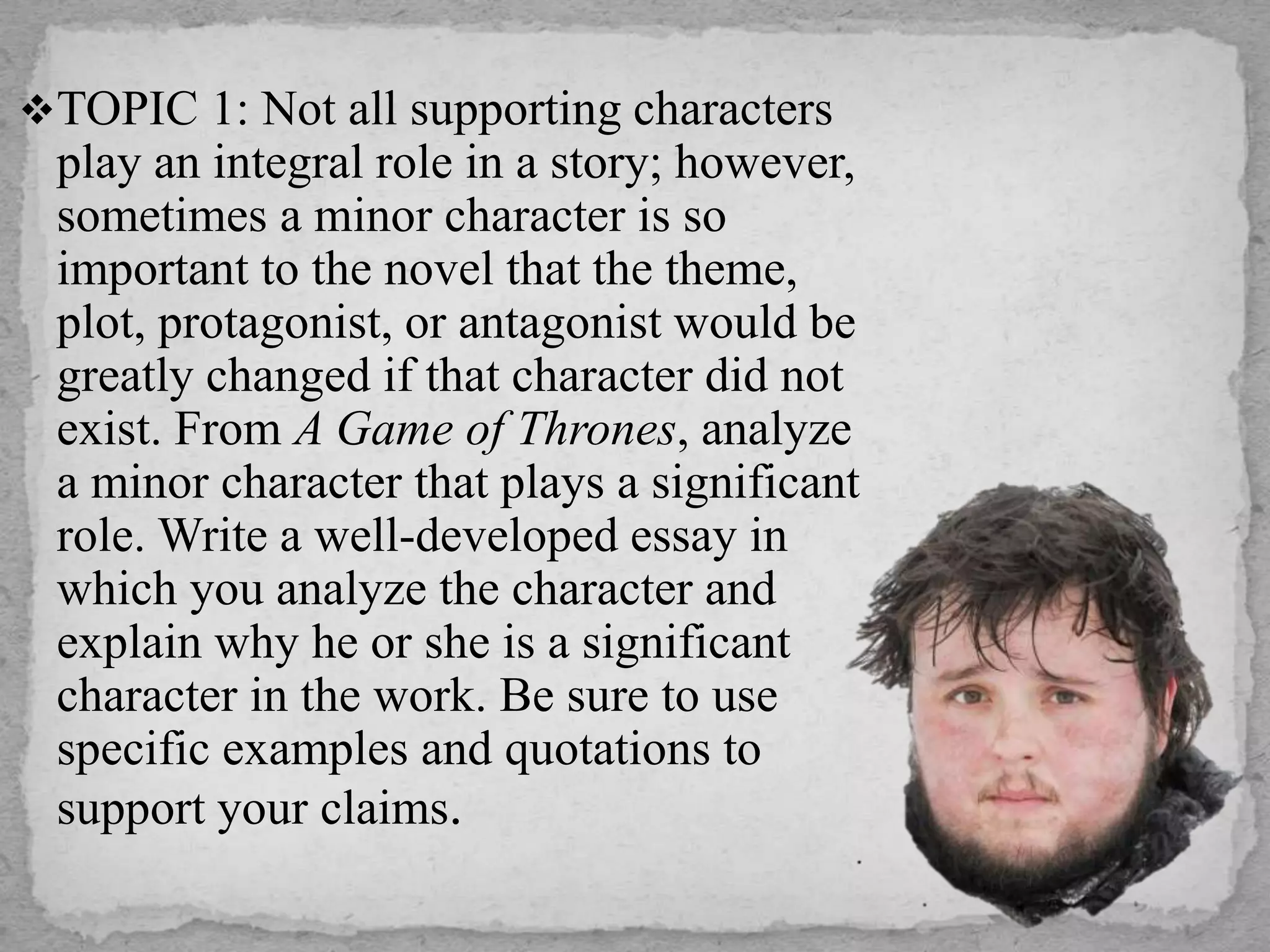
TOPIC 1: Not all supporting characters
play an integral role in a story; however,
sometimes a minor character is so
important to the novel that the theme,
plot, protagonist, or antagonist would be
greatly changed if that character did not
exist. From A Game of Thrones, analyze
a minor character that plays a significant
role. Write a well-developed essay in
which you analyze the character and
explain why he or she is a significant
character in the work. Be sure to use
specific examples and quotations to
support your claims.
 TOPIC 2: A dynamic character is
one who changes or grows
emotionally or psychologically
from the beginning of the novel
until end. Many novels have
multiple dynamic characters.
Choose one character from A
Game of Thrones and write a
well-developed essay in which
you prove that he or she is a
dynamic character. Be sure to use
specific examples and quotations
to support your claims.
 TOPIC 3: Often a character
reflects the culture of the
country in which he or she
lives, that is, he or she
exemplifies the skills, arts,
values, beliefs, and ideals of a
certain people or country. From
A Game of Thrones, choose a
character that embodies the
culture of the people he or she
represents. In a well-developed
essay, define the culture of one
character and show how that
character illustrates that culture.
 TOPIC 4: Analyze a character that
reveals his or her personality, ethics,
morals, and nature through the
challenges he or she faces. Think about
the different types of conflict that exist.
Conflict can be external, such as person
versus person, person versus nature, or
person versus society. Conflict can also
be internal, for example, person versus
self. How does your chosen character
experience conflict during the novel?
Keep in mind how conflict causes a
character to change throughout the
course of the story.
His ideas have been adopted, disputed, expanded, and
discussed for several centuries now. In a well-written
essay, analyze a character from Game of Thrones,
arguing for or against his or her status as a “tragic hero.”
TOPIC 5: Aristotle's ideas about
tragedy were recorded in his book
of literary theory titled Poetics. In
it, he has a great deal to say about
the structure, purpose, and
intended effect of tragedy.
1. Analyze a minor character that plays a significant role. Write a well-
developed essay in which you analyze the character and explain why
he or she is a significant character in the work.
2. Choose one character and write a well-developed essay in which
you prove that he or she is a dynamic character.
3. Choose a character that embodies the culture of the people he or she
represents. Define the culture of one character and show how that
character illustrates that culture.
4. Analyze a character that reveals his or her personality, ethics,
morals, and nature through the challenges he or she faces. How does
your chosen character experience and manage conflict?
5. In a well-written essay, analyze a character, arguing for or against
his or her status as a “tragic hero.”
Testing your Choice
 Your thesis is a statement or theory that you put
forward as a premise to be maintained or proved.
 It is also a map for your essay; that is, it tells the reader
what you are suggesting and why you believe your
theory is true.
 But your thesis does more than help the reader. A
good, clear working thesis (one that may not yet be
beautiful prose but that details your plan) can help you
outline your essay.
 Daenerys Targaryen is introduced as a timid child who
submits to her temperamental and abusive older brother,
Viserys. However, after marrying the head of a powerful
army, Daenerys is crowned queen of the tribe. Because of
this growth, Daenerys represents the dynamic character
archetype: a character who grows psychologically
throughout the plot. Daenerys showcases her dynamic
nature as she transforms from a docile child into a full-
fledged Khaleesi of the Dothraki through multiple
instances of defiance and cultural assimilation.
 [Jon] is faced with a myriad of conflicts, both external
and internal, which come from different sources: his
heritage, his loyalty, and his aspirations –which tackle
different aspects of his life. Jon Snow is the one
character that is constantly challenged to pick sides,
and, as a result, grows from these trials. These
conflicts bring out Jon’s priorities and values and
test his loyalty and result in the growing of Jon
from a distressed kid into a likable and honorable
man who appears to have found a place in this
world.
 If you don’t yet know which prompt to address, responding
to a couple of them by writing rough theses might help you
choose.
 Write out a rough thesis for at least one of the prompts: for
example, if you chose topic 4, you might start with “Jon
Snow reveals his personality, ethics, morals, and
nature when he faces his life challenges. He struggles
with both internal and external conflict: life at
Winterfell, life as a bastard, life on the wall, and his
struggle with honor, justice and duty. Jon changes as
he confronts each of these issues, growing from an
angry boy into an honorable man of the night’s
watch.”
 Of course, this working thesis is in its simplest form.
 You will likely change it significantly as you refine your
thoughts and ideas about your character.
 For example, instead of saying “Jon Snow reveals his
ethics, morals, and nature when he faces his life
challenges,” I might assert what kind of ethics,
morals, and nature that he reveals. I might even
limit my thesis to the two most fruitful categories.
 The more I understand about Jon and who he is based
on how he confronts his conflicts, the more specific I
would make my thesis.
 For now, a working thesis and a simple outline can
help you see which questions you can, or want to,
answer.
 They can also help you develop ideas about what you
will write before you launch into your project.
 Once you have your thesis (or theses
written), start sketching out a
working outline.
 Use your thesis to determine what
you will write.
 As you make your outline, briefly
consider which textual examples you
will use as support.
 Intro
 Thesis
 Internal Conflict
 Ethics
 Justice/fairness
 Morals
 Struggle with duty on the
wall
 Nature
 Mother/birth
 Wanting to be a ranger
 External Conflict
 Ethics
 Defending Samwell
 Morals
 Catelyn
 Nature
 Direwolves
 Conclusion
• A directed summary provides readers of your
paper with the information they need to
understand your argument and explanation.
• State the title and author of the literary work
near the beginning of the first paragraph,
perhaps in the first sentence. This is essential
so that the reader knows which work you are
discussing.
• Hook the reader. In the first sentences, write
what is particularly interesting about the
work. This thought-provoking information
must also be relevant to the topic you will
discuss in your essay.
• Assume that the reader is familiar with the
work about which you are writing. Do not
include too much plot summary in the
introduction or in the rest of the essay. Do
include the part of the story that will
support your thesis. This might or might not
include some aspect of your character
description
In A Game of Thrones by George R.R. Martin, a series of obscure
events in the kingdom’s capitol pull Eddard Stark of Winterfell
from his comfortable, although icy cold, zone and pit him against
charlatans and a rising coup d’état that threatens the safety of his
family. As this political time bomb ticks, the last surviving
descendants from the previous royal family, the Targaryens, are
scheming up a coup of their own. Amidst all this political
controversy, a particular bastard boy under the name of Jon Snow is
faced with obstacles of his own. Although Jon is the illegitimate son
of Eddard Stark, the lord of Winterfell, he still faces the ruthless
fate that his society’s status quo has chosen for people like him. The
whole novel is rife with conflict; however, Jon Snow clearly
becomes the epitome of conflict and self-reflection.
Example of the Directed Summary
Approach to the Introduction
• Use transitions throughout the introduction. Because
there are so many aspects of the work that have to be
included, the introduction can end up fragmented
and confusing. Make sure that it makes sense on its
own as a paragraph. Clearly transition from your
introduction into your thesis.
• State the thesis near the end of the introduction
(your introduction might be more than one
paragraph). The thesis should clearly state what the
essay will analyze/assert/argue and should be very
specific.
[Jon] is faced with a myriad of conflicts, both
external and internal, that come from different
sources: his heritage, his loyalty, and his
aspirations –which tackle different aspects of
his life. Jon Snow is the one character that is
constantly challenged to pick sides, and, as a
result, grows from these trials. These conflicts
bring out Jon’s priorities and values and test
his loyalty and result in the growing of Jon
from a distressed kid into a likable and
honorable man who finds his a place on the
wall with the night’s watch.
 Begin your directed summary.
 Consider what details you must
include to prepare the reader
for your essay.
 Try funneling your
introduction, that is, narrowing
your topic as you summarize
the relevant parts of the story.
The thesis will be the neck of
the funnel and will direct the
reader to your specific
argument.
 Read A Game of Thrones through
page 600
Post #10 Post your working thesis
and outline. Find evidence to
support your points. Include exact
quotations and citations in your
outline.
 Post #11 Directed summary
 Study Vocabulary list #3: Test
next class
 There will be NO WORD BANK

Ewrt 2 class 6

  • 2.
     Teams  In-classwriting: What defines your character?  Group Discussions  Choosing your prompt  Formulating a tentative thesis  Outlining your essay  Introductions: Writing a directed summary
  • 3.
    1. For therest of the quarter, we will use teams to earn participation points. Your teams can be made up of 3 or 4 people. 2. The teams will remain the same through the discussion of material for one essay. 3. You must change at least half of your team after each essay. 4. You may never have a new team composed of more than 50% of any prior team.
  • 4.
    The first teamcompetition starts today. I will put you into your first teams. This group will last through two class discussions based on writing essay #1, practicing rhetorical strategies, and one class period dedicated to a library research activity: Class 8.
  • 5.
     Team 1 Danerys: Gillian  Danerys: Yee May  Khal Drogo: Stella  Viserys: Jia Yi  Team 2  Eddard: Marissa  Robb: Briana  Bran: Yen Linh  Maester Luwin: Jose S • Team 6 • Robert: Jairo • Cersei: Stephanie • Petyr: Charles • Catelyn: Uriel • Arya: Eloise • Team 7 • Eddard: Sam • Catelyn: Kareem • Robb: Kangming • Tyrion: James P • Jon: Trinity • Team 3 • Sansa: Paulina • Joffrey: Umer • Sandor : Jonathan M • Arya: Ruby • Team 4 • Robert: Carlos • Cersei: Liwei • Jaime: Kristen • Bran: Juan • Sansa: Amanda • Team 5 • Bron: Alfredo • Tyrion: John L • Jon: James H • Samwell: Bianca
  • 6.
    Sit with your team membersin class to facilitate ease of group discussions
  • 7.
     Point accumulation startstoday, so make sure one of your team members is tracking points.  Make sure your name (first name, last initial alphabetized) is on the team point sheet.  Total the points for your team and write the number at the top of the page.
  • 8.
     Points willbe earned for correct answers to questions, meaningful contributions to the discussion , and provocative questions. Contributions to the discussion via the slide show also score one point. Each team will track their own points, but cheating leads to death (or loss of 25 participation points).  Answers, comments, and questions must be posed in a manner that promotes learning. Those who speak out of turn or with maliciousness will not receive points for their teams.
  • 10.
    How do othersperceive your character? How does your character see him or herself? If there is a difference, what causes it?
  • 11.
    What makes yourcharacter who he or she is? Write out brief answers that explain or defend his or her behavior and actions. Consider these influences: Culture Family history Personal history Class/Occupation/Ass ignment Gender/Sex Aspirations
  • 12.
     Write atleast three questions that you would like to ask other characters in your group. For instance, you might ask why a character treats your character a certain way, or you might ask about the motivation for an action or behavior.  Choose questions that will shed light on their motivations and behavior. Try to make others question their characters’ integrity, ambition, or other motivation. These questions will be the fodder for your discussion today. Jot down any discoveries you make about your character.
  • 13.
    In your groups, discussyour characters. Use the writing you have done so far—that we did in class today and whatever other writing you feel appropriate—to drive your discussion
  • 16.
     Is heor she a minor or major character?  Does your character grow during the novel?  Does your character reflect his or her culture in a significant way?  Does your character suffer internal or external challenges that reveal his or her ethics, morals, or nature.  Could your character be read as a tragic hero?
  • 18.
    TOPIC 1: Notall supporting characters play an integral role in a story; however, sometimes a minor character is so important to the novel that the theme, plot, protagonist, or antagonist would be greatly changed if that character did not exist. From A Game of Thrones, analyze a minor character that plays a significant role. Write a well-developed essay in which you analyze the character and explain why he or she is a significant character in the work. Be sure to use specific examples and quotations to support your claims.
  • 19.
     TOPIC 2:A dynamic character is one who changes or grows emotionally or psychologically from the beginning of the novel until end. Many novels have multiple dynamic characters. Choose one character from A Game of Thrones and write a well-developed essay in which you prove that he or she is a dynamic character. Be sure to use specific examples and quotations to support your claims.
  • 20.
     TOPIC 3:Often a character reflects the culture of the country in which he or she lives, that is, he or she exemplifies the skills, arts, values, beliefs, and ideals of a certain people or country. From A Game of Thrones, choose a character that embodies the culture of the people he or she represents. In a well-developed essay, define the culture of one character and show how that character illustrates that culture.
  • 21.
     TOPIC 4:Analyze a character that reveals his or her personality, ethics, morals, and nature through the challenges he or she faces. Think about the different types of conflict that exist. Conflict can be external, such as person versus person, person versus nature, or person versus society. Conflict can also be internal, for example, person versus self. How does your chosen character experience conflict during the novel? Keep in mind how conflict causes a character to change throughout the course of the story.
  • 22.
    His ideas havebeen adopted, disputed, expanded, and discussed for several centuries now. In a well-written essay, analyze a character from Game of Thrones, arguing for or against his or her status as a “tragic hero.” TOPIC 5: Aristotle's ideas about tragedy were recorded in his book of literary theory titled Poetics. In it, he has a great deal to say about the structure, purpose, and intended effect of tragedy.
  • 24.
    1. Analyze aminor character that plays a significant role. Write a well- developed essay in which you analyze the character and explain why he or she is a significant character in the work. 2. Choose one character and write a well-developed essay in which you prove that he or she is a dynamic character. 3. Choose a character that embodies the culture of the people he or she represents. Define the culture of one character and show how that character illustrates that culture. 4. Analyze a character that reveals his or her personality, ethics, morals, and nature through the challenges he or she faces. How does your chosen character experience and manage conflict? 5. In a well-written essay, analyze a character, arguing for or against his or her status as a “tragic hero.”
  • 25.
  • 26.
     Your thesisis a statement or theory that you put forward as a premise to be maintained or proved.  It is also a map for your essay; that is, it tells the reader what you are suggesting and why you believe your theory is true.  But your thesis does more than help the reader. A good, clear working thesis (one that may not yet be beautiful prose but that details your plan) can help you outline your essay.
  • 27.
     Daenerys Targaryenis introduced as a timid child who submits to her temperamental and abusive older brother, Viserys. However, after marrying the head of a powerful army, Daenerys is crowned queen of the tribe. Because of this growth, Daenerys represents the dynamic character archetype: a character who grows psychologically throughout the plot. Daenerys showcases her dynamic nature as she transforms from a docile child into a full- fledged Khaleesi of the Dothraki through multiple instances of defiance and cultural assimilation.
  • 28.
     [Jon] isfaced with a myriad of conflicts, both external and internal, which come from different sources: his heritage, his loyalty, and his aspirations –which tackle different aspects of his life. Jon Snow is the one character that is constantly challenged to pick sides, and, as a result, grows from these trials. These conflicts bring out Jon’s priorities and values and test his loyalty and result in the growing of Jon from a distressed kid into a likable and honorable man who appears to have found a place in this world.
  • 29.
     If youdon’t yet know which prompt to address, responding to a couple of them by writing rough theses might help you choose.  Write out a rough thesis for at least one of the prompts: for example, if you chose topic 4, you might start with “Jon Snow reveals his personality, ethics, morals, and nature when he faces his life challenges. He struggles with both internal and external conflict: life at Winterfell, life as a bastard, life on the wall, and his struggle with honor, justice and duty. Jon changes as he confronts each of these issues, growing from an angry boy into an honorable man of the night’s watch.”
  • 30.
     Of course,this working thesis is in its simplest form.  You will likely change it significantly as you refine your thoughts and ideas about your character.  For example, instead of saying “Jon Snow reveals his ethics, morals, and nature when he faces his life challenges,” I might assert what kind of ethics, morals, and nature that he reveals. I might even limit my thesis to the two most fruitful categories.
  • 31.
     The moreI understand about Jon and who he is based on how he confronts his conflicts, the more specific I would make my thesis.  For now, a working thesis and a simple outline can help you see which questions you can, or want to, answer.  They can also help you develop ideas about what you will write before you launch into your project.
  • 33.
     Once youhave your thesis (or theses written), start sketching out a working outline.  Use your thesis to determine what you will write.  As you make your outline, briefly consider which textual examples you will use as support.
  • 34.
     Intro  Thesis Internal Conflict  Ethics  Justice/fairness  Morals  Struggle with duty on the wall  Nature  Mother/birth  Wanting to be a ranger  External Conflict  Ethics  Defending Samwell  Morals  Catelyn  Nature  Direwolves  Conclusion
  • 36.
    • A directedsummary provides readers of your paper with the information they need to understand your argument and explanation. • State the title and author of the literary work near the beginning of the first paragraph, perhaps in the first sentence. This is essential so that the reader knows which work you are discussing.
  • 37.
    • Hook thereader. In the first sentences, write what is particularly interesting about the work. This thought-provoking information must also be relevant to the topic you will discuss in your essay. • Assume that the reader is familiar with the work about which you are writing. Do not include too much plot summary in the introduction or in the rest of the essay. Do include the part of the story that will support your thesis. This might or might not include some aspect of your character description
  • 38.
    In A Gameof Thrones by George R.R. Martin, a series of obscure events in the kingdom’s capitol pull Eddard Stark of Winterfell from his comfortable, although icy cold, zone and pit him against charlatans and a rising coup d’état that threatens the safety of his family. As this political time bomb ticks, the last surviving descendants from the previous royal family, the Targaryens, are scheming up a coup of their own. Amidst all this political controversy, a particular bastard boy under the name of Jon Snow is faced with obstacles of his own. Although Jon is the illegitimate son of Eddard Stark, the lord of Winterfell, he still faces the ruthless fate that his society’s status quo has chosen for people like him. The whole novel is rife with conflict; however, Jon Snow clearly becomes the epitome of conflict and self-reflection. Example of the Directed Summary Approach to the Introduction
  • 39.
    • Use transitionsthroughout the introduction. Because there are so many aspects of the work that have to be included, the introduction can end up fragmented and confusing. Make sure that it makes sense on its own as a paragraph. Clearly transition from your introduction into your thesis. • State the thesis near the end of the introduction (your introduction might be more than one paragraph). The thesis should clearly state what the essay will analyze/assert/argue and should be very specific.
  • 40.
    [Jon] is facedwith a myriad of conflicts, both external and internal, that come from different sources: his heritage, his loyalty, and his aspirations –which tackle different aspects of his life. Jon Snow is the one character that is constantly challenged to pick sides, and, as a result, grows from these trials. These conflicts bring out Jon’s priorities and values and test his loyalty and result in the growing of Jon from a distressed kid into a likable and honorable man who finds his a place on the wall with the night’s watch.
  • 41.
     Begin yourdirected summary.  Consider what details you must include to prepare the reader for your essay.  Try funneling your introduction, that is, narrowing your topic as you summarize the relevant parts of the story. The thesis will be the neck of the funnel and will direct the reader to your specific argument.
  • 42.
     Read AGame of Thrones through page 600 Post #10 Post your working thesis and outline. Find evidence to support your points. Include exact quotations and citations in your outline.  Post #11 Directed summary  Study Vocabulary list #3: Test next class  There will be NO WORD BANK