READING NONFICTION


  Types and Purposes
WHAT IS NONFICTION?
The subject of nonfiction is real
 The author writes about actual
  persons, places and events.
 The writer may just report facts

 The writer may also include personal
  opinions
 Often there is a mixture of both

 Readers must read critically
CRITICAL READING
Look at writer’s background
Look at writer’s purpose
Look at writer’s attitude
Look at writer’s audience
JOURNALISM

•Newspapers
•Magazines
•Online sources
TYPES OF JOURNALISM
          Interviews
          Columns
          Reviews
          Articles
          Editorials
          Editorial Cartoons
ESSAYS
TYPES OF ESSAYS
•Formal Essay
   •A prose discussion on a serious topic in a
   serious manner, usually rigidly structured
   and organized.

•Informal Essay
   •A prose discussion on any topic in a
   light, humorous, amusing manner; often
   loosely organized, rambling and casual in
   approach.
OTHER TYPES OF
      ESSAYS
Comparison and
Contrast Essays
Persuasive
Essays
Cause and Effect
Essays
PERSONAL
CHRONICLES
DIARIES AND
 JOURNALS
      Diaries: a private
      form of writing with
      no further intended
      audience
      Journals: varying
      styles and topics.
      Give a glimpse of
      the writer’s value of
      his or her world
LETTERS
Private Letters
Public Letter
Letters can
   Reveal character
   Express opinions
   Ask for information
   Give information
Audience and Purpose
influence tone.
AUTOBIOGRAPHY
Written by the subject for publication
Author has some purpose for writing
 To teach
 To arouse awareness

 To warn

 Simply to entertain
MEMOIRS
A TYPE OF AUTOBIOGRAPHICAL
WRITING, DEALING WITH THE
RECOLLECTIONS OF PROMINENT
PEOPLE OR PEOPLE WHO HAVE
BEEN A PART OF OR HAVE
WITNESSED SIGNIFICANT EVENTS.
CONSIDERED BOTH
AUTOBIOGRAPHICAL AND
HISTORICAL
BIOGRAPHY
     The accurate
     presentation of a life
     story from birth to death
     of an individual.
     Historical biographies
     include strands of an
     individual’s life
     interwoven with
     historical persons,
     places and events.
OTHER TYPES OF
  NONFICTION
        Speeches
        Historical Writing
        Science Writing
        Technical writing
        Writing online
        Miscellaneous
        writing
ELEMENTS OF
        NONFICTION
Characters, Plot, and Setting. Like
fiction, nonfiction has characters, plot,
and setting. However, these elements
are real, not made up. The main
character in an autobiography or
biography is called the subject. The
subject's words, thoughts, and actions
are presented.
MORE ELEMENTS
Purpose. Different types of nonfiction have
different purposes. Biographies and
autobiographies, for example, have the
purpose of informing the reader. They use
explanatory, descriptive, and narrative
paragraphs. Other types of nonfiction, such
as newspaper editorials, are intended to win
readers over to a certain opinion. They use
persuasive paragraphs. Sometimes a piece of
writing combines purposes.
AND MORE ELEMENTS
 Tone. The writer's attitude
 toward his or her subject matter
 is called tone. A writer's tone
 may be sympathetic, It may be
 bitter, It may be comic, hopeful,
 solemn, or anything the writer
 likes.
HOW TO READ
NONFICTION
      Try to separate Facts
      from Opinions.
      The writer has chosen
      facts that present a
      certain picture of the
      subject.
      Think about what
      might be missing as
      well as what is there.
MORE READING TIPS
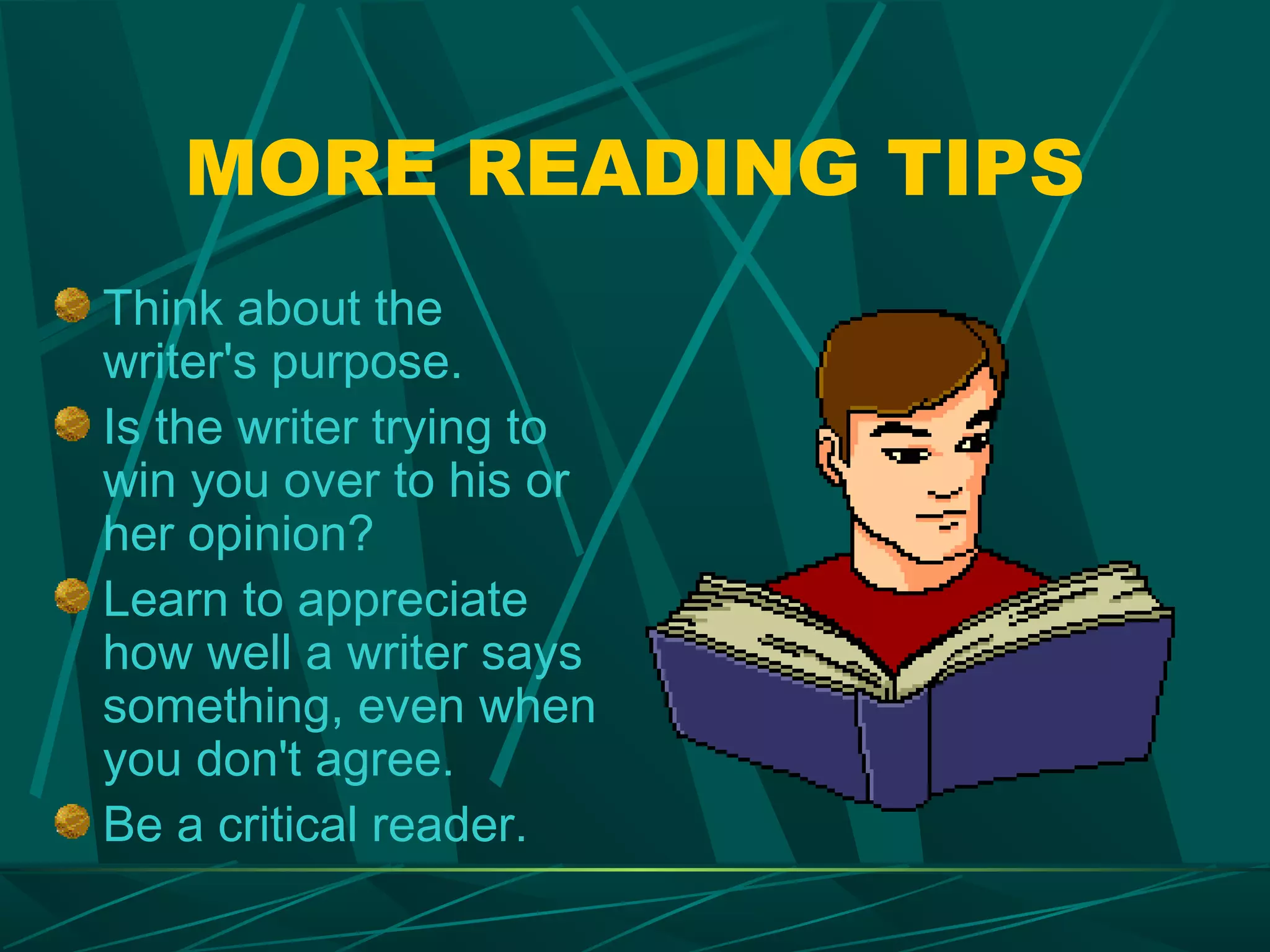
Think about the
writer's purpose.
Is the writer trying to
win you over to his or
her opinion?
Learn to appreciate
how well a writer says
something, even when
you don't agree.
Be a critical reader.
FINAL READING TIPS
          Be aware of the
          writer's tone.
          Frequently a writer
          reveals much about
          himself or herself by
          the tone he or she
          uses.
          This is especially
          important in
          autobiographical
          writing

Reading nonfiction

  • 1.
    READING NONFICTION Types and Purposes
  • 2.
    WHAT IS NONFICTION? Thesubject of nonfiction is real  The author writes about actual persons, places and events.  The writer may just report facts  The writer may also include personal opinions  Often there is a mixture of both  Readers must read critically
  • 3.
    CRITICAL READING Look atwriter’s background Look at writer’s purpose Look at writer’s attitude Look at writer’s audience
  • 4.
  • 5.
    TYPES OF JOURNALISM Interviews Columns Reviews Articles Editorials Editorial Cartoons
  • 6.
  • 7.
    TYPES OF ESSAYS •FormalEssay •A prose discussion on a serious topic in a serious manner, usually rigidly structured and organized. •Informal Essay •A prose discussion on any topic in a light, humorous, amusing manner; often loosely organized, rambling and casual in approach.
  • 8.
    OTHER TYPES OF ESSAYS Comparison and Contrast Essays Persuasive Essays Cause and Effect Essays
  • 9.
  • 10.
    DIARIES AND JOURNALS Diaries: a private form of writing with no further intended audience Journals: varying styles and topics. Give a glimpse of the writer’s value of his or her world
  • 11.
    LETTERS Private Letters Public Letter Letterscan  Reveal character  Express opinions  Ask for information  Give information Audience and Purpose influence tone.
  • 12.
    AUTOBIOGRAPHY Written by thesubject for publication Author has some purpose for writing  To teach  To arouse awareness  To warn  Simply to entertain
  • 13.
    MEMOIRS A TYPE OFAUTOBIOGRAPHICAL WRITING, DEALING WITH THE RECOLLECTIONS OF PROMINENT PEOPLE OR PEOPLE WHO HAVE BEEN A PART OF OR HAVE WITNESSED SIGNIFICANT EVENTS. CONSIDERED BOTH AUTOBIOGRAPHICAL AND HISTORICAL
  • 14.
    BIOGRAPHY The accurate presentation of a life story from birth to death of an individual. Historical biographies include strands of an individual’s life interwoven with historical persons, places and events.
  • 15.
    OTHER TYPES OF NONFICTION Speeches Historical Writing Science Writing Technical writing Writing online Miscellaneous writing
  • 16.
    ELEMENTS OF NONFICTION Characters, Plot, and Setting. Like fiction, nonfiction has characters, plot, and setting. However, these elements are real, not made up. The main character in an autobiography or biography is called the subject. The subject's words, thoughts, and actions are presented.
  • 17.
    MORE ELEMENTS Purpose. Differenttypes of nonfiction have different purposes. Biographies and autobiographies, for example, have the purpose of informing the reader. They use explanatory, descriptive, and narrative paragraphs. Other types of nonfiction, such as newspaper editorials, are intended to win readers over to a certain opinion. They use persuasive paragraphs. Sometimes a piece of writing combines purposes.
  • 18.
    AND MORE ELEMENTS Tone. The writer's attitude toward his or her subject matter is called tone. A writer's tone may be sympathetic, It may be bitter, It may be comic, hopeful, solemn, or anything the writer likes.
  • 19.
    HOW TO READ NONFICTION Try to separate Facts from Opinions. The writer has chosen facts that present a certain picture of the subject. Think about what might be missing as well as what is there.
  • 20.
    MORE READING TIPS Thinkabout the writer's purpose. Is the writer trying to win you over to his or her opinion? Learn to appreciate how well a writer says something, even when you don't agree. Be a critical reader.
  • 21.
    FINAL READING TIPS Be aware of the writer's tone. Frequently a writer reveals much about himself or herself by the tone he or she uses. This is especially important in autobiographical writing