TNM SYSTEM IN ENT
DR MUHAMMED SAHIR C
DLO
SHRI
CONTENT
INTRODUCTION
HISTORY
AIM OF TNM SYSTEM
DEFINITIONS OF TNM CATEGORIES
CANCER OF THE MUCOSAL LIP AND ORAL CAVITY
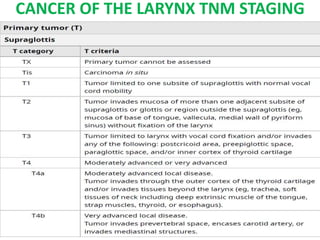
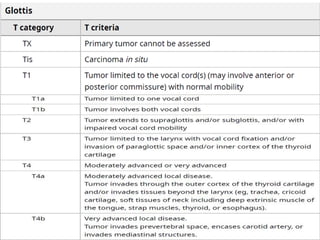
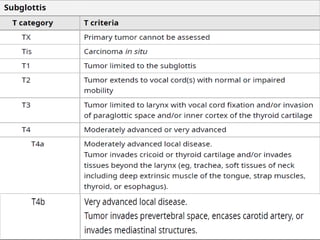
CANCER OF THE LARYNX TNM STAGING
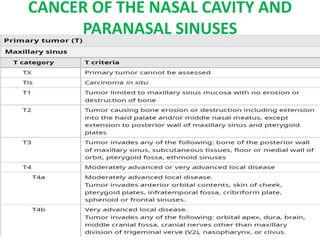
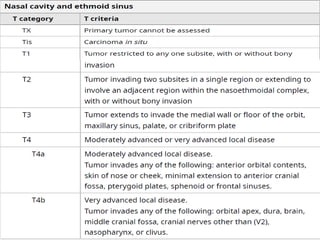
CANCER OF THE NASAL CAVITY AND PARANASAL SINUSES
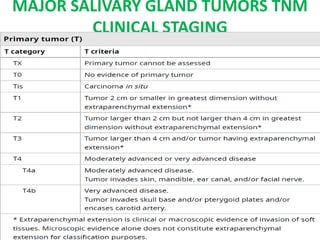
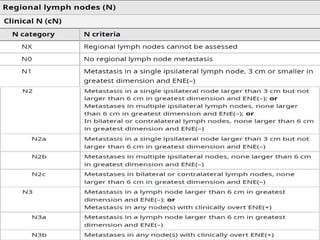
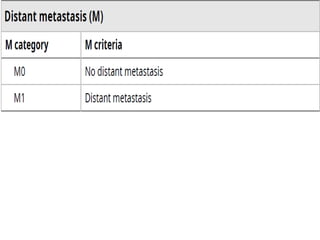
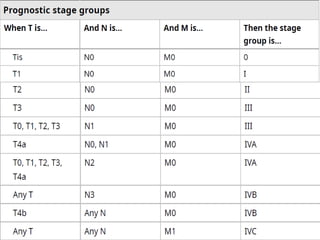
MAJOR SALIVARY GLAND TUMORS TNM CLINICAL
STAGING
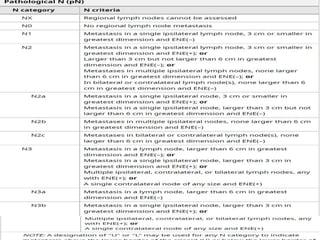
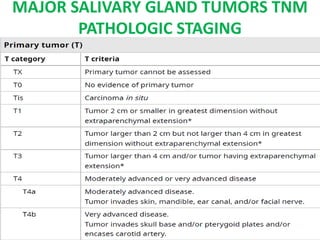
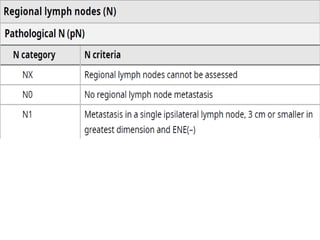
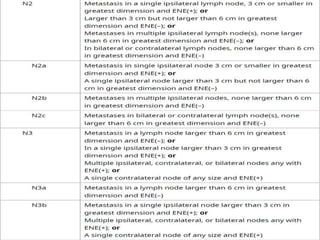
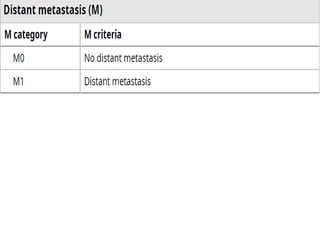
MAJOR SALIVARY GLAND TUMORS TNM PATHOLOGIC
STAGING
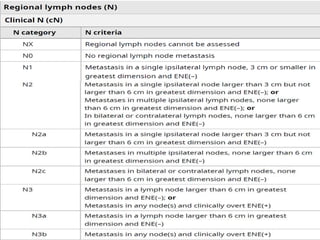
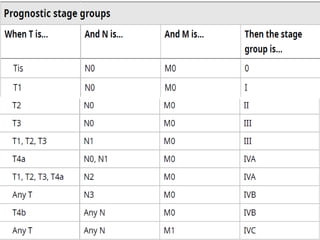
HYPOPHARYNGEAL CANCER TNM CLINICAL STAGING
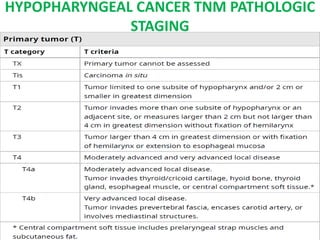
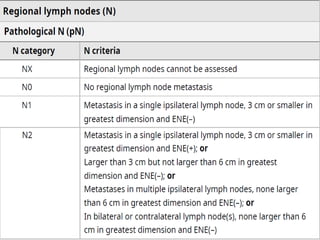
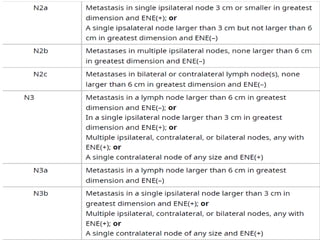
HYPOPHARYNGEAL CANCER TNM PATHOLOGIC STAGING
CONTENT
HPV-RELATED OROPHARYNGEAL CARCINOMA TNM
CLINICAL STAGING
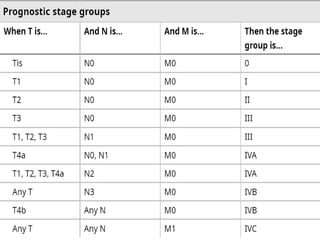
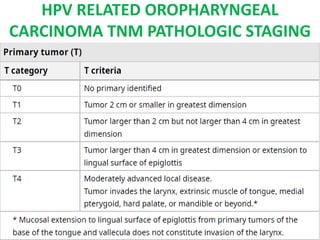
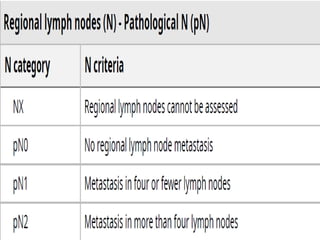
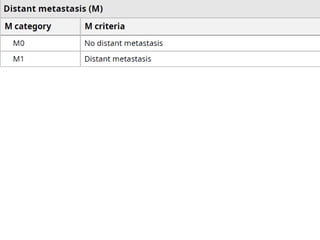
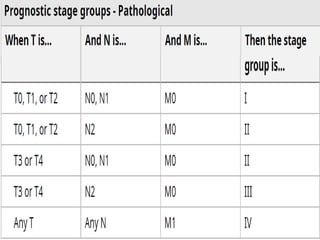
HPV -RELATED OROPHARYNGEAL CARCINOMA TNM
PATHOLOGIC STAGING
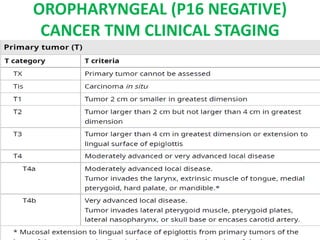
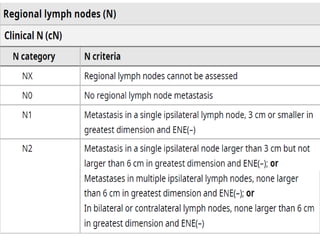
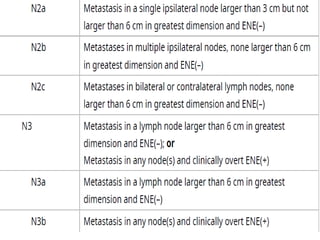
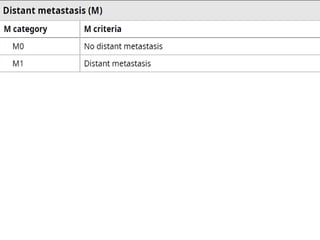
OROPHARYNGEAL (P16 NEGATIVE) CANCER TNM
CLINICAL STAGING
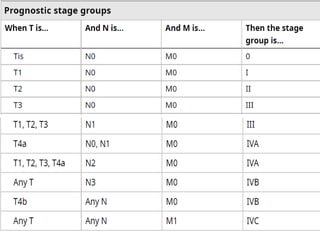
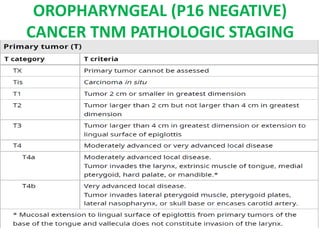
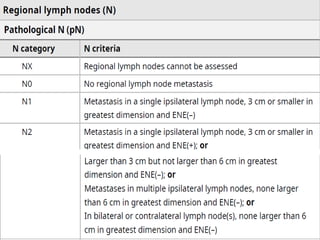
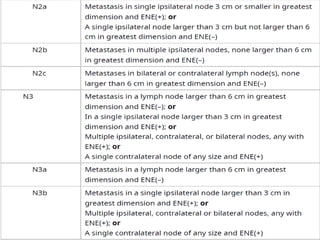
OROPHARYNGEAL (P16 NEGATIVE) CANCER TNM
PATHOLOGIC STAGING
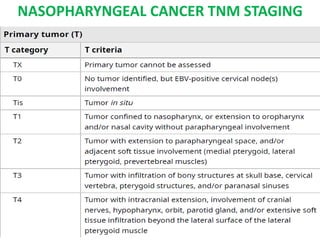
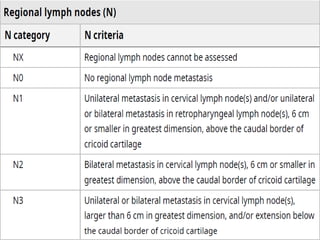
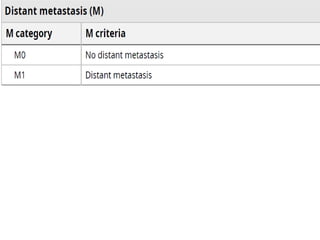
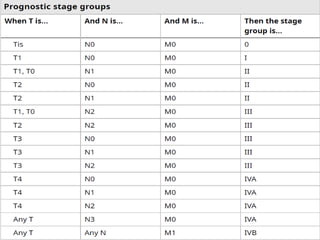
NASOPHARYNGEAL CANCER TNM STAGING
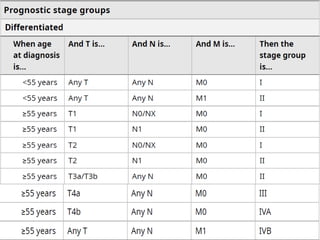
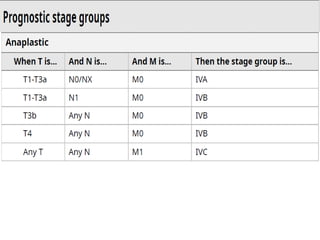
DIFFERENTIATED AND ANAPLASTIC THYROID
CARCINOMA TNM
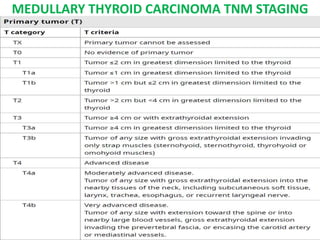
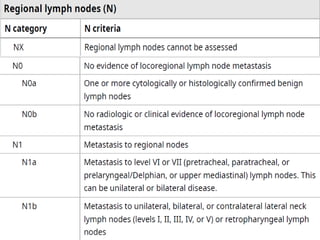
MEDULLARY THYROID CARCINOMA TNM STAGING
CONTENT
BENEFITS OF STAGING
LIMITATION OF ‘T’STAGING
LIMITATIONS OF N STAGING
LIMITATION OF STAGE GROUPING
CONCLUSION
INTRODUCTION
• TNM system describe a cancerous tumor’s
involvement at primary site {T}, spread to regional
lymph node{N}, and distant metastasis {M}.
• Strengths of the TNM staging system are its
simplicity , low cost, relative accuracy, objectivity,
universal acceptance and lack of need for special
technology
• Inconsistencies, observer variability and differences
in stage method contribute to potential bias.
HISTORY
American joint committee on cancer{AJCC} was
formed in 1959.
Unified previous classification systems.
In 1987 UICC &the AJCC TNM classifications were
unified.
AJCC continued to update a stage classification
system for all anatomic sites & subsites.
Most recent 8th edition was published in 2017.
AIM OF TNM STAGING
To Describe cancer in a uniform fashion.
To better understanding of prognosis & accurate
patient counseling.
To develop treatment protocol.
Useful for stratifying cancers for clinical research &
for measuring outcomes to various treatment
options.
DEFINITIONS OF TNM CATEGORIES
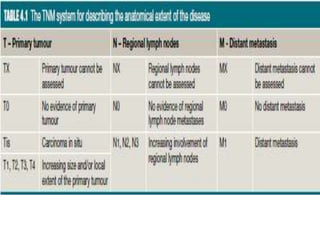
• T – Extent of primary tumor.
• 7 categories.
• Tx:-primary tumor cannot be assessed.
• To:-no evidence of primary tumor.
• Tis:- tumor in situ.
• T1,T2,T3 &T4.
• Within head & neck , size of the tumor generally
defines the T stage.
• Exception :- vocal fold mobility in CA larynx
• Depth of invasion is now included within AJCC 8th
edition staging system of oral cavity CA & is
considered a separate entity to tumor thickness.
• Modifiers ‘’a’’ [less severe] & ‘’b’’ [more severe] can
be used within some T categories – further describe
tumor
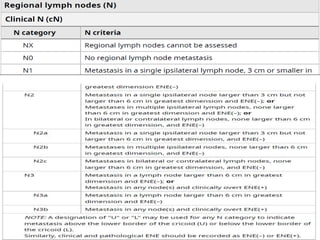
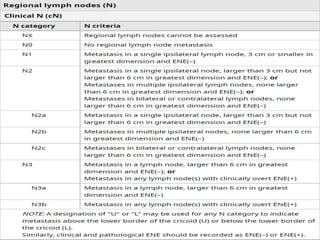
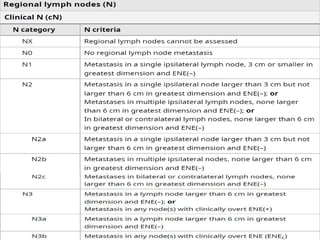
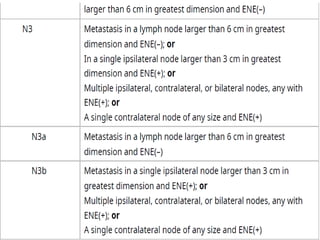
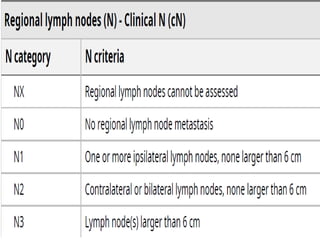
• N describe spread of cancer to regional lymph
nodes.
• 5 categories.
• Nx :- regional lymph nodes cannot be assessed.
• No,N1,N2,&N3.
• Basically described by size of the lymph node & is
modified by location of the involved nodes.
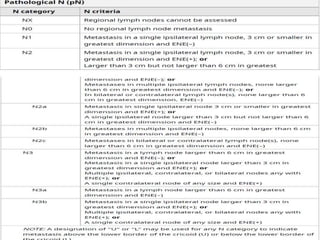
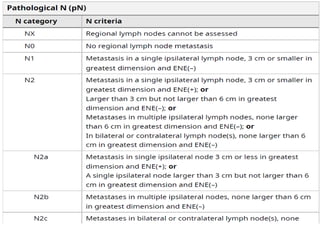
• Evaluation of surgically excised LN by a pathologist
can further affect N stage.
• Specifically ,8th edtn of AJCC includes additional
modifier of Extra-Nodal Extension[ENE] –denote
spread of tumor outside of the capsule of a LN on
HP sectioning.
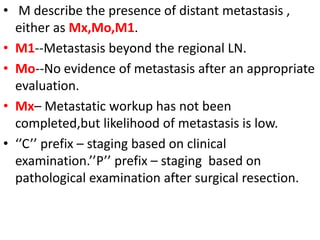
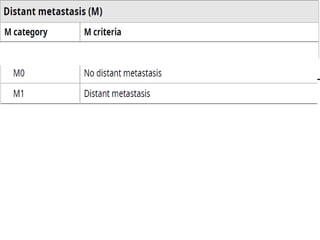
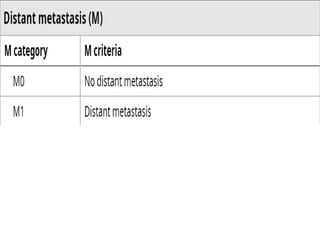
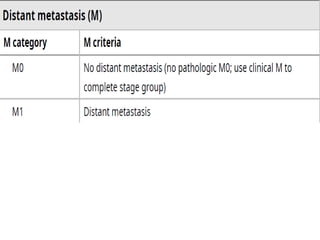
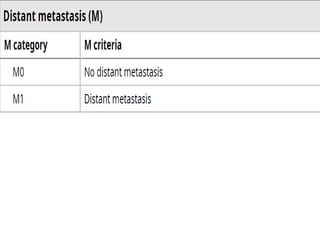
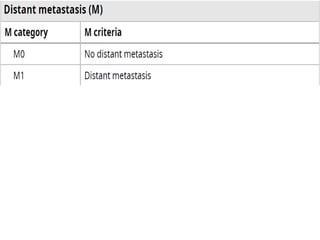
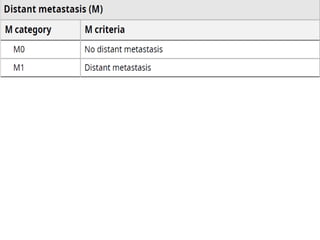
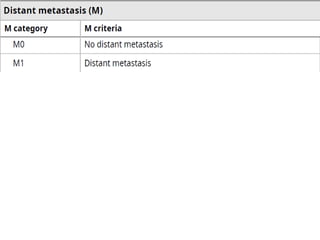
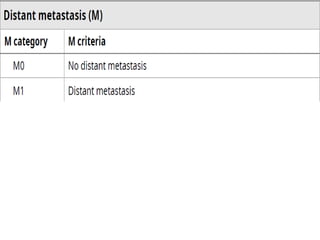
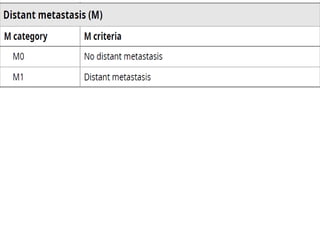
• M describe the presence of distant metastasis ,
either as Mx,Mo,M1.
• M1--Metastasis beyond the regional LN.
• Mo--No evidence of metastasis after an appropriate
evaluation.
• Mx– Metastatic workup has not been
completed,but likelihood of metastasis is low.
• ‘’C’’ prefix – staging based on clinical
examination.’’P’’ prefix – staging based on
pathological examination after surgical resection.
• Clinical classification [pretreatment clinical
classification,designated cTNM] is evidence
acquired before primary treatment.Based on
information available prior to first definitive
treatment
• Pathological classification [postsurgical
histopathological classification,designated pTNM]
• Clinical stage is essential to selecting & evaluating
primary therapy.
• Pathological stage gives information for estimating
prognosis and calculating end results
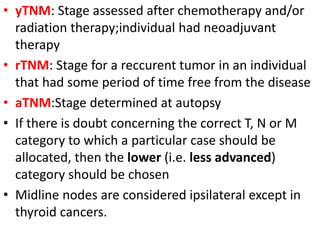
• yTNM: Stage assessed after chemotherapy and/or
radiation therapy;individual had neoadjuvant
therapy
• rTNM: Stage for a reccurent tumor in an individual
that had some period of time free from the disease
• aTNM:Stage determined at autopsy
• If there is doubt concerning the correct T, N or M
category to which a particular case should be
allocated, then the lower (i.e. less advanced)
category should be chosen
• Midline nodes are considered ipsilateral except in
thyroid cancers.
• Carcinomas arising in minor salivary glands of the
upper aerodigestive tract are classifed according to
the rules for tumours of their anatomic site of origin
(e.g. oral cavity).
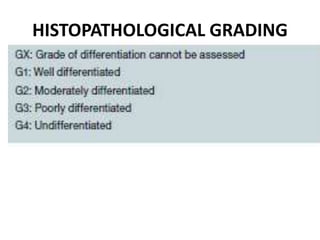
HISTOPATHOLOGICAL GRADING
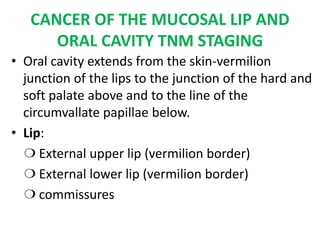
CANCER OF THE MUCOSAL LIP AND
ORAL CAVITY TNM STAGING
• Oral cavity extends from the skin-vermilion
junction of the lips to the junction of the hard and
soft palate above and to the line of the
circumvallate papillae below.
• Lip:
❍ External upper lip (vermilion border)
❍ External lower lip (vermilion border)
❍ commissures
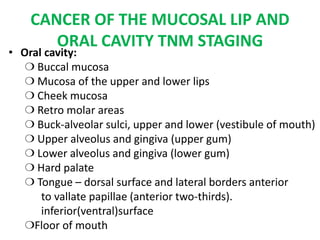
CANCER OF THE MUCOSAL LIP AND
ORAL CAVITY TNM STAGING
• Oral cavity:
❍ Buccal mucosa
❍ Mucosa of the upper and lower lips
❍ Cheek mucosa
❍ Retro molar areas
❍ Buck-alveolar sulci, upper and lower (vestibule of mouth)
❍ Upper alveolus and gingiva (upper gum)
❍ Lower alveolus and gingiva (lower gum)
❍ Hard palate
❍ Tongue – dorsal surface and lateral borders anterior
to vallate papillae (anterior two-thirds).
inferior(ventral)surface
❍Floor of mouth
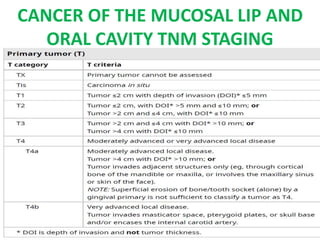
CANCER OF THE MUCOSAL LIP AND
ORAL CAVITY TNM STAGING
CANCER OF THE LARYNX
• Anatomical sites and subsites are:
 Supraglottis:
❍ Suprahyoid epiglottis (including tip, lingual [anterior],
and laryngeal surfaces)
❍ Aryepiglottic fold, laryngeal aspect
❍ Arytenoid
❍ Infrahyoid epiglottis
❍ Ventricular bands (false cords)
 Glottis:
❍ Vocal cords
❍ Anterior commissure
❍ Posterior commissure
 Subglottis.
CANCER OF THE LARYNX TNM STAGING
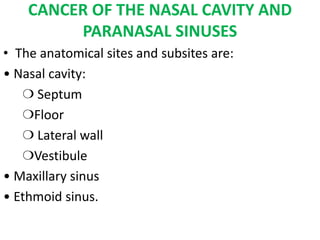
CANCER OF THE NASAL CAVITY AND
PARANASAL SINUSES
• The anatomical sites and subsites are:
• Nasal cavity:
❍ Septum
❍Floor
❍ Lateral wall
❍Vestibule
• Maxillary sinus
• Ethmoid sinus.
CANCER OF THE NASAL CAVITY AND
PARANASAL SINUSES
MAJOR SALIVARY GLAND TUMORS
• Classication applies only to carcinomas of the
major salivary glands. Tumours arising in minor
salivary glands(mucus-secreting glands in the lining
membrane of the upper aerodigestive tract) should
be staged according to their anatomic site of origin
(e.g. lip).
• Anatomical sites and subsites are
• Parotid gland
• Submandibular gland
• Sublingual gland.
MAJOR SALIVARY GLAND TUMORS TNM
CLINICAL STAGING
MAJOR SALIVARY GLAND TUMORS TNM
PATHOLOGIC STAGING
HYPOPHARYNGEAL CANCER
• Hypopharynx is that portion of the pharynx
extending from the plane of the superior border of
the hyoid bone(or floor of the vallecula) to the
plane corresponding to the lower border of the
cricoid cartilage.
• Includes the piriform sinuses, the postcricoid area
and the lateral and posterior pharyngeal walls.
 Postcricoid area (pharyngo-oesophageal
junction):Extends from the level of the arytenoid
cartilages and connecting folds to the inferior border of
the cricoid cartilage,thus forming the anterior wall of
the hypopharynx.
Piriform sinus: Extends from the pharyngo-epiglottic
fold to the upper end of the oesophagus. It is bounded
laterally by the thyroid cartilage and medially by the
hypopharyngeal surface of the aryepiglottic fold and
the arytenoid and cricoid cartilages.
Posterior pharyngeal wall: Extends from the superior
level of the hyoid bone (or floor of the vallecula) to the
level of the inferior border of the cricoid cartilage and
from the apex of one pyriform sinus to the other.
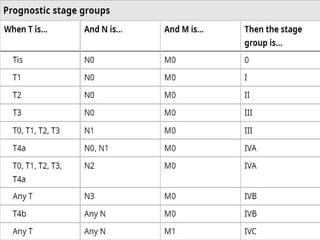
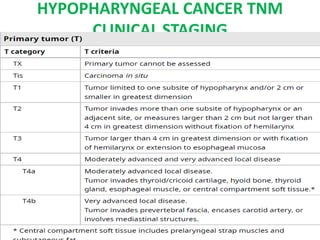
HYPOPHARYNGEAL CANCER TNM
CLINICAL STAGING
HYPOPHARYNGEAL CANCER TNM PATHOLOGIC
STAGING
OROPHARYNGEAL CARCINOMA TNM
CLINICAL STAGING
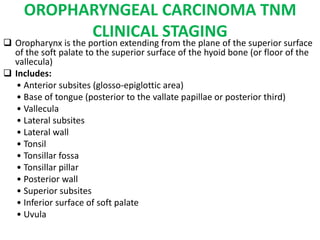
 Oropharynx is the portion extending from the plane of the superior surface
of the soft palate to the superior surface of the hyoid bone (or floor of the
vallecula)
 Includes:
• Anterior subsites (glosso-epiglottic area)
• Base of tongue (posterior to the vallate papillae or posterior third)
• Vallecula
• Lateral subsites
• Lateral wall
• Tonsil
• Tonsillar fossa
• Tonsillar pillar
• Posterior wall
• Superior subsites
• Inferior surface of soft palate
• Uvula
OROPHARYNGEAL CARCINOMA TNM
CLINICAL STAGING
• T categories in both p16-positive, HPV–associated
oropharyngeal carcinoma and p16-negative, non-HPV-
associated oropharyngeal carcinoma were equally valid
from a prognostic Standpoint
• p16-positive classification includes no carcinoma in situ
(Tis) (because of the non-aggressive pattern of invasive
of p16-positive oropharyngeal carcinoma &Lack of a
distinct basement membrane in the epithelium of
Waldeyer’s ring)
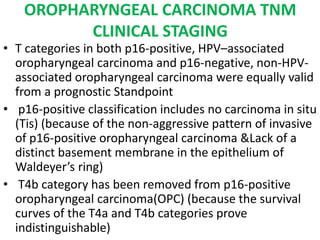
• T4b category has been removed from p16-positive
oropharyngeal carcinoma(OPC) (because the survival
curves of the T4a and T4b categories prove
indistinguishable)
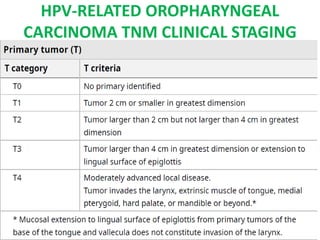
HPV-RELATED OROPHARYNGEAL
CARCINOMA TNM CLINICAL STAGING
HPV RELATED OROPHARYNGEAL
CARCINOMA TNM PATHOLOGIC STAGING
OROPHARYNGEAL (P16 NEGATIVE)
CANCER TNM CLINICAL STAGING
OROPHARYNGEAL (P16 NEGATIVE)
CANCER TNM PATHOLOGIC STAGING
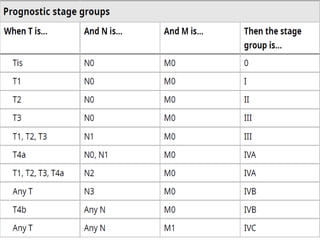
NASOPHARYNGEAL CANCER TNM
STAGING
• Nasopharynx begins anteriorly at the posterior
choana and extends along the plane of the airway
to the level of the free border of the soft palate.
Includes:
• Superior wall
• Posterior wall: from the level of the junction of the
hard and soft palates to the superior wall
• Lateral wall: including the fossa of Rosenmuller
• Floor: superior surface of the soft palate.
NASOPHARYNGEAL CANCER TNM
STAGING
• Two changes in nasopharynx T classifications
relating to anatomic markers rather than depth of
invasion.
• The previous T4 criteria used synonymous terms
‘masticator space’ and ‘infratemporal’, which are
now be replaced by a specific description of soft-
tissue involvement to avoid ambiguity.
• Adjacent muscle involvement (including medial
pterygoid, lateral pterygoid and prevertebral
muscles) are down-staged to T2 based on them
having a more favourable outcome.
NASOPHARYNGEAL CANCER TNM STAGING
THYROID CARCINOMA TNM
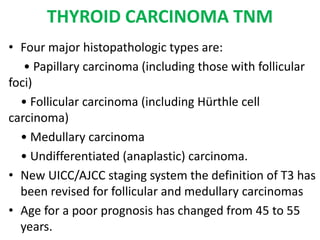
• Four major histopathologic types are:
• Papillary carcinoma (including those with follicular
foci)
• Follicular carcinoma (including Hürthle cell
carcinoma)
• Medullary carcinoma
• Undifferentiated (anaplastic) carcinoma.
• New UICC/AJCC staging system the definition of T3 has
been revised for follicular and medullary carcinomas
• Age for a poor prognosis has changed from 45 to 55
years.
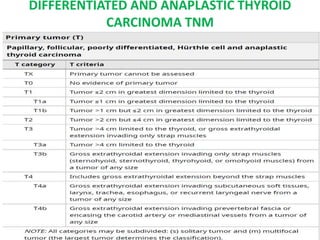
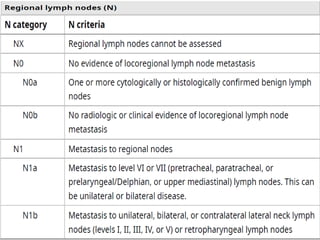
DIFFERENTIATED AND ANAPLASTIC THYROID
CARCINOMA TNM
MEDULLARY THYROID CARCINOMA TNM STAGING
BENEFITS OF STAGING
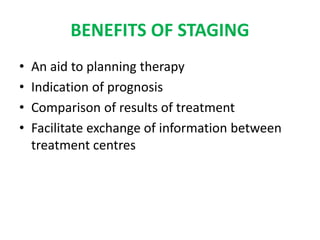
• An aid to planning therapy
• Indication of prognosis
• Comparison of results of treatment
• Facilitate exchange of information between
treatment centres
LIMITATIONS OF ‘T’ STAGING
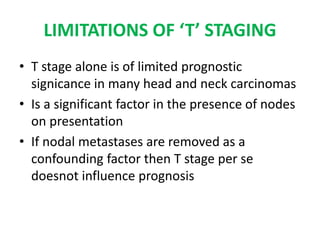
• T stage alone is of limited prognostic
signicance in many head and neck carcinomas
• Is a significant factor in the presence of nodes
on presentation
• If nodal metastases are removed as a
confounding factor then T stage per se
doesnot influence prognosis
LIMITATIONS OF ‘T’ STAGING
• Tumours of the larynx are classified according to the
number of anatomical surfaces involved. This has led
to several problems. For example, a large 3 cm tumour
of the supraglottis may remain T1, whereas in the
glottis this will almost certainly be a T3.
• Depth of invasion is not measured, but is of prognostic
and therapeutic importance. For example, a supercial
tumour of the vocal cord mucosa would be T1a. The
same tumour may be deeply infiltrating into the vocalis
muscle and yet the stage will remain T1a.
LIMITATIONS OF ‘T’ STAGING
• Crude system
• Tumor size not consistently related to
prognosis
• Debatable anatomical boudaries
• Can be difficult to accurately assess clinical
extent
• Inconsistencies and omissions
LIMITATIONS OF ‘N’ STAGING
• Palpable nodes do not always harbour tumour
• During clinical examination, the size of the node
should be measured with callipers, and allowance
made for the intervening soft tissues
• There is considerable inter- and intra-observer
error in estimating the size of the node by
palpation alone without a measuring device
LIMITATIONS OF ‘N’ STAGING
• Observer variability [presence of nodal
disease & size measurement]
• No inclusion of immunological status
• Importance of extra capsular spread
• N2 [B/L involvement] implies better prognosis
than N3[large nodes greater than 6cm]
LIMITATION OF STAGE GROUPING
• Attempts to increase the accuracy of staging
leads to greater complexity , hence
paradoxically to more errors and an increased
likelihood of non-compliance by the person
responsible for staging
• Advances in methods of collecting and
recording data will hopefully reduce these
errors
CONCLUSION
• Current TNM system relies on morphology of the
tumor[anatomical site &extent of disease]with
little or no attention given to patient factors
• AJCC Task Force maintains that any new system
should be comprehensive and easily applicable to
all the major sites.
• Changes in the TNM classification should and will
only occur , based on the appropriate collection ,
presentation & analysis of data , in the forum of
the UICC & AJCC
• Staging of head and neck cancer is a system
designed to express the relative severity, or extent
of the disease. It is meant to facilitate an estimation
of prognosis and provide useful information for
treatment decisions.
• Classification of the anatomical extent of head and
neck cancer as determined clinically and
histopathologically is called the TNM system.
• Radiological investigations to evaluate the primary
site should be performed prior to biopsy to avoid
the effect of upstaging from the oedema caused by
biopsy trauma.
• The clinical (pre-treatment) classification (cTNM)
based on examination, imaging, endoscopy and
biopsy should be clearly documented in the case file
only when all the information is collated.
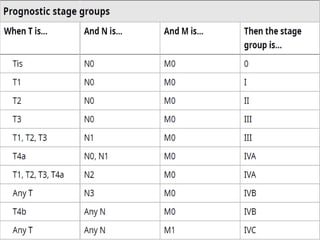
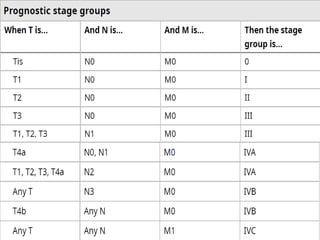
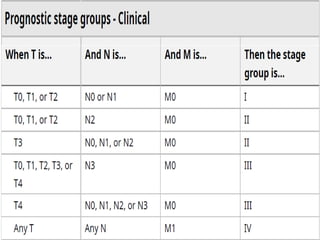
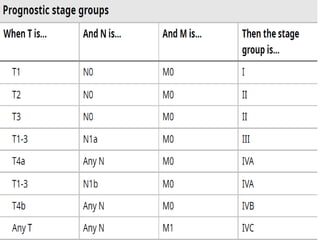
• Individual TNM classifications should be assembled
into four stage groups (Stages I to IV), each with
similar survival outcomes.
REFERENCE
• AJCC Cancer Staging Manual, Eighth Edition
(2017) published by Springer International
Publishing.
• Scott-Brown’s otorhinolaryngology head and
neck surgery[8th edtn]
• Disease of ear nose and throat by Dhingra [7th
edtn]
•THANK YOU

TNM SYSTEMS IN ENT.pptx

  • 1.
    TNM SYSTEM INENT DR MUHAMMED SAHIR C DLO SHRI
  • 2.
    CONTENT INTRODUCTION HISTORY AIM OF TNMSYSTEM DEFINITIONS OF TNM CATEGORIES CANCER OF THE MUCOSAL LIP AND ORAL CAVITY CANCER OF THE LARYNX TNM STAGING CANCER OF THE NASAL CAVITY AND PARANASAL SINUSES MAJOR SALIVARY GLAND TUMORS TNM CLINICAL STAGING MAJOR SALIVARY GLAND TUMORS TNM PATHOLOGIC STAGING HYPOPHARYNGEAL CANCER TNM CLINICAL STAGING HYPOPHARYNGEAL CANCER TNM PATHOLOGIC STAGING
  • 3.
    CONTENT HPV-RELATED OROPHARYNGEAL CARCINOMATNM CLINICAL STAGING HPV -RELATED OROPHARYNGEAL CARCINOMA TNM PATHOLOGIC STAGING OROPHARYNGEAL (P16 NEGATIVE) CANCER TNM CLINICAL STAGING OROPHARYNGEAL (P16 NEGATIVE) CANCER TNM PATHOLOGIC STAGING NASOPHARYNGEAL CANCER TNM STAGING DIFFERENTIATED AND ANAPLASTIC THYROID CARCINOMA TNM MEDULLARY THYROID CARCINOMA TNM STAGING
  • 4.
    CONTENT BENEFITS OF STAGING LIMITATIONOF ‘T’STAGING LIMITATIONS OF N STAGING LIMITATION OF STAGE GROUPING CONCLUSION
  • 5.
    INTRODUCTION • TNM systemdescribe a cancerous tumor’s involvement at primary site {T}, spread to regional lymph node{N}, and distant metastasis {M}. • Strengths of the TNM staging system are its simplicity , low cost, relative accuracy, objectivity, universal acceptance and lack of need for special technology • Inconsistencies, observer variability and differences in stage method contribute to potential bias.
  • 6.
    HISTORY American joint committeeon cancer{AJCC} was formed in 1959. Unified previous classification systems. In 1987 UICC &the AJCC TNM classifications were unified. AJCC continued to update a stage classification system for all anatomic sites & subsites. Most recent 8th edition was published in 2017.
  • 7.
    AIM OF TNMSTAGING To Describe cancer in a uniform fashion. To better understanding of prognosis & accurate patient counseling. To develop treatment protocol. Useful for stratifying cancers for clinical research & for measuring outcomes to various treatment options.
  • 8.
    DEFINITIONS OF TNMCATEGORIES • T – Extent of primary tumor. • 7 categories. • Tx:-primary tumor cannot be assessed. • To:-no evidence of primary tumor. • Tis:- tumor in situ. • T1,T2,T3 &T4.
  • 9.
    • Within head& neck , size of the tumor generally defines the T stage. • Exception :- vocal fold mobility in CA larynx • Depth of invasion is now included within AJCC 8th edition staging system of oral cavity CA & is considered a separate entity to tumor thickness. • Modifiers ‘’a’’ [less severe] & ‘’b’’ [more severe] can be used within some T categories – further describe tumor
  • 10.
    • N describespread of cancer to regional lymph nodes. • 5 categories. • Nx :- regional lymph nodes cannot be assessed. • No,N1,N2,&N3. • Basically described by size of the lymph node & is modified by location of the involved nodes. • Evaluation of surgically excised LN by a pathologist can further affect N stage. • Specifically ,8th edtn of AJCC includes additional modifier of Extra-Nodal Extension[ENE] –denote spread of tumor outside of the capsule of a LN on HP sectioning.
  • 11.
    • M describethe presence of distant metastasis , either as Mx,Mo,M1. • M1--Metastasis beyond the regional LN. • Mo--No evidence of metastasis after an appropriate evaluation. • Mx– Metastatic workup has not been completed,but likelihood of metastasis is low. • ‘’C’’ prefix – staging based on clinical examination.’’P’’ prefix – staging based on pathological examination after surgical resection.
  • 13.
    • Clinical classification[pretreatment clinical classification,designated cTNM] is evidence acquired before primary treatment.Based on information available prior to first definitive treatment • Pathological classification [postsurgical histopathological classification,designated pTNM] • Clinical stage is essential to selecting & evaluating primary therapy. • Pathological stage gives information for estimating prognosis and calculating end results
  • 14.
    • yTNM: Stageassessed after chemotherapy and/or radiation therapy;individual had neoadjuvant therapy • rTNM: Stage for a reccurent tumor in an individual that had some period of time free from the disease • aTNM:Stage determined at autopsy • If there is doubt concerning the correct T, N or M category to which a particular case should be allocated, then the lower (i.e. less advanced) category should be chosen • Midline nodes are considered ipsilateral except in thyroid cancers.
  • 15.
    • Carcinomas arisingin minor salivary glands of the upper aerodigestive tract are classifed according to the rules for tumours of their anatomic site of origin (e.g. oral cavity).
  • 16.
  • 17.
    CANCER OF THEMUCOSAL LIP AND ORAL CAVITY TNM STAGING • Oral cavity extends from the skin-vermilion junction of the lips to the junction of the hard and soft palate above and to the line of the circumvallate papillae below. • Lip: ❍ External upper lip (vermilion border) ❍ External lower lip (vermilion border) ❍ commissures
  • 18.
    CANCER OF THEMUCOSAL LIP AND ORAL CAVITY TNM STAGING • Oral cavity: ❍ Buccal mucosa ❍ Mucosa of the upper and lower lips ❍ Cheek mucosa ❍ Retro molar areas ❍ Buck-alveolar sulci, upper and lower (vestibule of mouth) ❍ Upper alveolus and gingiva (upper gum) ❍ Lower alveolus and gingiva (lower gum) ❍ Hard palate ❍ Tongue – dorsal surface and lateral borders anterior to vallate papillae (anterior two-thirds). inferior(ventral)surface ❍Floor of mouth
  • 19.
    CANCER OF THEMUCOSAL LIP AND ORAL CAVITY TNM STAGING
  • 24.
    CANCER OF THELARYNX • Anatomical sites and subsites are:  Supraglottis: ❍ Suprahyoid epiglottis (including tip, lingual [anterior], and laryngeal surfaces) ❍ Aryepiglottic fold, laryngeal aspect ❍ Arytenoid ❍ Infrahyoid epiglottis ❍ Ventricular bands (false cords)  Glottis: ❍ Vocal cords ❍ Anterior commissure ❍ Posterior commissure  Subglottis.
  • 25.
    CANCER OF THELARYNX TNM STAGING
  • 32.
    CANCER OF THENASAL CAVITY AND PARANASAL SINUSES • The anatomical sites and subsites are: • Nasal cavity: ❍ Septum ❍Floor ❍ Lateral wall ❍Vestibule • Maxillary sinus • Ethmoid sinus.
  • 33.
    CANCER OF THENASAL CAVITY AND PARANASAL SINUSES
  • 40.
    MAJOR SALIVARY GLANDTUMORS • Classication applies only to carcinomas of the major salivary glands. Tumours arising in minor salivary glands(mucus-secreting glands in the lining membrane of the upper aerodigestive tract) should be staged according to their anatomic site of origin (e.g. lip). • Anatomical sites and subsites are • Parotid gland • Submandibular gland • Sublingual gland.
  • 41.
    MAJOR SALIVARY GLANDTUMORS TNM CLINICAL STAGING
  • 45.
    MAJOR SALIVARY GLANDTUMORS TNM PATHOLOGIC STAGING
  • 50.
    HYPOPHARYNGEAL CANCER • Hypopharynxis that portion of the pharynx extending from the plane of the superior border of the hyoid bone(or floor of the vallecula) to the plane corresponding to the lower border of the cricoid cartilage. • Includes the piriform sinuses, the postcricoid area and the lateral and posterior pharyngeal walls.
  • 51.
     Postcricoid area(pharyngo-oesophageal junction):Extends from the level of the arytenoid cartilages and connecting folds to the inferior border of the cricoid cartilage,thus forming the anterior wall of the hypopharynx. Piriform sinus: Extends from the pharyngo-epiglottic fold to the upper end of the oesophagus. It is bounded laterally by the thyroid cartilage and medially by the hypopharyngeal surface of the aryepiglottic fold and the arytenoid and cricoid cartilages. Posterior pharyngeal wall: Extends from the superior level of the hyoid bone (or floor of the vallecula) to the level of the inferior border of the cricoid cartilage and from the apex of one pyriform sinus to the other.
  • 52.
  • 56.
    HYPOPHARYNGEAL CANCER TNMPATHOLOGIC STAGING
  • 61.
    OROPHARYNGEAL CARCINOMA TNM CLINICALSTAGING  Oropharynx is the portion extending from the plane of the superior surface of the soft palate to the superior surface of the hyoid bone (or floor of the vallecula)  Includes: • Anterior subsites (glosso-epiglottic area) • Base of tongue (posterior to the vallate papillae or posterior third) • Vallecula • Lateral subsites • Lateral wall • Tonsil • Tonsillar fossa • Tonsillar pillar • Posterior wall • Superior subsites • Inferior surface of soft palate • Uvula
  • 62.
    OROPHARYNGEAL CARCINOMA TNM CLINICALSTAGING • T categories in both p16-positive, HPV–associated oropharyngeal carcinoma and p16-negative, non-HPV- associated oropharyngeal carcinoma were equally valid from a prognostic Standpoint • p16-positive classification includes no carcinoma in situ (Tis) (because of the non-aggressive pattern of invasive of p16-positive oropharyngeal carcinoma &Lack of a distinct basement membrane in the epithelium of Waldeyer’s ring) • T4b category has been removed from p16-positive oropharyngeal carcinoma(OPC) (because the survival curves of the T4a and T4b categories prove indistinguishable)
  • 63.
  • 67.
  • 71.
  • 76.
  • 81.
    NASOPHARYNGEAL CANCER TNM STAGING •Nasopharynx begins anteriorly at the posterior choana and extends along the plane of the airway to the level of the free border of the soft palate. Includes: • Superior wall • Posterior wall: from the level of the junction of the hard and soft palates to the superior wall • Lateral wall: including the fossa of Rosenmuller • Floor: superior surface of the soft palate.
  • 82.
    NASOPHARYNGEAL CANCER TNM STAGING •Two changes in nasopharynx T classifications relating to anatomic markers rather than depth of invasion. • The previous T4 criteria used synonymous terms ‘masticator space’ and ‘infratemporal’, which are now be replaced by a specific description of soft- tissue involvement to avoid ambiguity. • Adjacent muscle involvement (including medial pterygoid, lateral pterygoid and prevertebral muscles) are down-staged to T2 based on them having a more favourable outcome.
  • 83.
  • 87.
    THYROID CARCINOMA TNM •Four major histopathologic types are: • Papillary carcinoma (including those with follicular foci) • Follicular carcinoma (including Hürthle cell carcinoma) • Medullary carcinoma • Undifferentiated (anaplastic) carcinoma. • New UICC/AJCC staging system the definition of T3 has been revised for follicular and medullary carcinomas • Age for a poor prognosis has changed from 45 to 55 years.
  • 88.
    DIFFERENTIATED AND ANAPLASTICTHYROID CARCINOMA TNM
  • 93.
  • 97.
    BENEFITS OF STAGING •An aid to planning therapy • Indication of prognosis • Comparison of results of treatment • Facilitate exchange of information between treatment centres
  • 98.
    LIMITATIONS OF ‘T’STAGING • T stage alone is of limited prognostic signicance in many head and neck carcinomas • Is a significant factor in the presence of nodes on presentation • If nodal metastases are removed as a confounding factor then T stage per se doesnot influence prognosis
  • 99.
    LIMITATIONS OF ‘T’STAGING • Tumours of the larynx are classified according to the number of anatomical surfaces involved. This has led to several problems. For example, a large 3 cm tumour of the supraglottis may remain T1, whereas in the glottis this will almost certainly be a T3. • Depth of invasion is not measured, but is of prognostic and therapeutic importance. For example, a supercial tumour of the vocal cord mucosa would be T1a. The same tumour may be deeply infiltrating into the vocalis muscle and yet the stage will remain T1a.
  • 100.
    LIMITATIONS OF ‘T’STAGING • Crude system • Tumor size not consistently related to prognosis • Debatable anatomical boudaries • Can be difficult to accurately assess clinical extent • Inconsistencies and omissions
  • 101.
    LIMITATIONS OF ‘N’STAGING • Palpable nodes do not always harbour tumour • During clinical examination, the size of the node should be measured with callipers, and allowance made for the intervening soft tissues • There is considerable inter- and intra-observer error in estimating the size of the node by palpation alone without a measuring device
  • 102.
    LIMITATIONS OF ‘N’STAGING • Observer variability [presence of nodal disease & size measurement] • No inclusion of immunological status • Importance of extra capsular spread • N2 [B/L involvement] implies better prognosis than N3[large nodes greater than 6cm]
  • 103.
    LIMITATION OF STAGEGROUPING • Attempts to increase the accuracy of staging leads to greater complexity , hence paradoxically to more errors and an increased likelihood of non-compliance by the person responsible for staging • Advances in methods of collecting and recording data will hopefully reduce these errors
  • 104.
    CONCLUSION • Current TNMsystem relies on morphology of the tumor[anatomical site &extent of disease]with little or no attention given to patient factors • AJCC Task Force maintains that any new system should be comprehensive and easily applicable to all the major sites. • Changes in the TNM classification should and will only occur , based on the appropriate collection , presentation & analysis of data , in the forum of the UICC & AJCC
  • 105.
    • Staging ofhead and neck cancer is a system designed to express the relative severity, or extent of the disease. It is meant to facilitate an estimation of prognosis and provide useful information for treatment decisions. • Classification of the anatomical extent of head and neck cancer as determined clinically and histopathologically is called the TNM system. • Radiological investigations to evaluate the primary site should be performed prior to biopsy to avoid the effect of upstaging from the oedema caused by biopsy trauma.
  • 106.
    • The clinical(pre-treatment) classification (cTNM) based on examination, imaging, endoscopy and biopsy should be clearly documented in the case file only when all the information is collated. • Individual TNM classifications should be assembled into four stage groups (Stages I to IV), each with similar survival outcomes.
  • 107.
    REFERENCE • AJCC CancerStaging Manual, Eighth Edition (2017) published by Springer International Publishing. • Scott-Brown’s otorhinolaryngology head and neck surgery[8th edtn] • Disease of ear nose and throat by Dhingra [7th edtn]
  • 108.