Title:
Be Kind Onli
ne
1.Why is it important to
be a responsible digital
citizen?
2. How can digital
citizenship affect our
online and offline lives?
3.
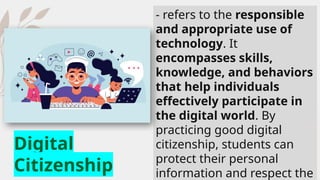
- refers tothe responsible
and appropriate use of
technology. It
encompasses skills,
knowledge, and behaviors
that help individuals
effectively participate in
the digital world. By
practicing good digital
citizenship, students can
protect their personal
information and respect the
Digital
Citizenship
4.
Digital Etiquette
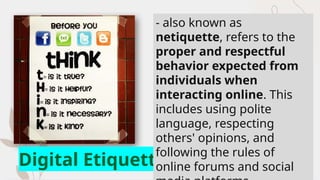
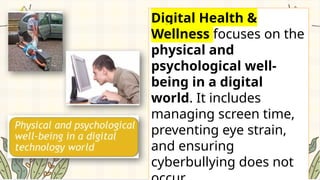
- alsoknown as
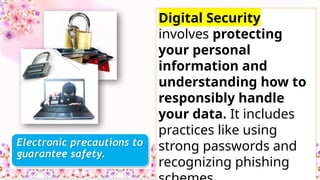
netiquette, refers to the
proper and respectful
behavior expected from
individuals when
interacting online. This
includes using polite
language, respecting
others' opinions, and
following the rules of
online forums and social
5.
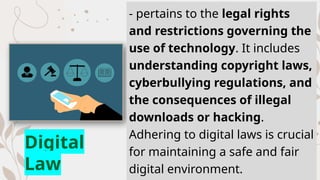
- pertains tothe legal rights
and restrictions governing the
use of technology. It includes
understanding copyright laws,
cyberbullying regulations, and
the consequences of illegal
downloads or hacking.
Adhering to digital laws is crucial
for maintaining a safe and fair
digital environment.
Digital
Law
6.
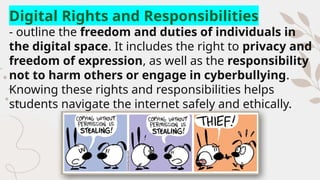
Digital Rights andResponsibilities
- outline the freedom and duties of individuals in
the digital space. It includes the right to privacy and
freedom of expression, as well as the responsibility
not to harm others or engage in cyberbullying.
Knowing these rights and responsibilities helps
students navigate the internet safely and ethically.
7.
- emphasizes thephysical and
psychological well-being of
individuals using
technology. It covers a range
of topics from managing
screen time to protecting
oneself from online
predators. Encouraging
balanced and mindful use of
technology can prevent issues
such as eye strain, poor
Digital Health
and Wellness
8.
- involves protectingone's
personal information and
data from unauthorized
access. Simple measures like
using strong passwords,
enabling two-factor
authentication, and being
cautious about sharing
personal information can
significantly enhance online
security. Understanding digital
Digital Security
TLE 8 –Gemini (Thursday - July 24, 2025, at 7:55-9:50am)
Task #1
Instructions:
1. Copy the Scenario and Questions assigned to your group (you knew
already which group you belong) in your notebook.
2. Read and understand the following scenario related to Digital
Citizenship and answer the question in your own personal view.
3. After making your task, let your parent/guardian signed (signature
over printed name) your output.
Happy Learning!
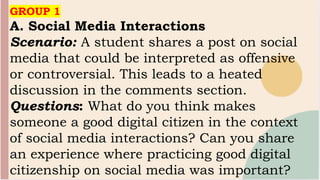
11.
GROUP 1
A. SocialMedia Interactions
Scenario: A student shares a post on social
media that could be interpreted as offensive
or controversial. This leads to a heated
discussion in the comments section.
Questions: What do you think makes
someone a good digital citizen in the context
of social media interactions? Can you share
an experience where practicing good digital
citizenship on social media was important?
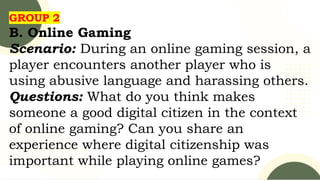
12.
GROUP 2
B. OnlineGaming
Scenario: During an online gaming session, a
player encounters another player who is
using abusive language and harassing others.
Questions: What do you think makes
someone a good digital citizen in the context
of online gaming? Can you share an
experience where digital citizenship was
important while playing online games?
13.
GROUP 3
C. EmailCommunication
Scenario: A student receives an email from
an unknown sender with a suspicious link.
The student needs to decide whether to open
the link or report the email.
Questions: What do you think makes
someone a good digital citizen when it comes
to email communication? Can you share an
experience where being a responsible digital
citizen in email communication was crucial?
14.
GROUP 4
D. OnlineLearning Platforms
Scenario: In an online class discussion
forum, a student posts a comment that is
respectful and constructive, even though they
disagree with the original post.
Questions: What do you think makes
someone a good digital citizen in the context
of online learning platforms? Can you share
an experience where digital citizenship was
important in an online learning environment?
15.
GROUP 5
E. ContentCreation and Sharing
Scenario: A student creates a video and
shares it online, ensuring that all content
used is original or properly credited to avoid
plagiarism.
Questions: What do you think makes
someone a good digital citizen when creating
and sharing content online? Can you share an
experience where practicing good digital
citizenship in content creation was important?
16.
Understanding Digital
Citizenship
Digital citizenshiprefers to the
responsible use of technology by anyone
who uses computers, the Internet, and
digital devices to engage with society on
any level. It encompasses a wide range of
behaviors and skills that are necessary for
effective and ethical participation in digital
environments.
Digital Access refersto
the equitable
distribution of
technology and online
resources. All students
should have equal
opportunities to use
technology for learning
and growth.
20.
Digital Commerce
involves buyingand
selling goods and
services online. It
includes
understanding safe
buying practices and
recognizing the
importance of secure
transactions.
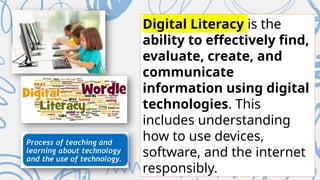
Digital Literacy isthe
ability to effectively find,
evaluate, create, and
communicate
information using digital
technologies. This
includes understanding
how to use devices,
software, and the internet
responsibly.
23.
Digital Etiquette refers
tothe standards of
conduct expected by
digital technology
users. Practicing good
digital manners helps
maintain a positive and
nurturing online
environment.
24.
Digital Law
encompasses thelegal
rights and restrictions
governing technology
use. It entails
understanding rules
regarding privacy,
intellectual property,
and behavior online.
25.
Digital Rights &
Responsibilities
highlightthe freedoms
extended to everyone
in the digital world,
along with the
responsibilities to use
these rights
appropriately and
ethically.
26.
Digital Health &
Wellnessfocuses on the
physical and
psychological well-
being in a digital
world. It includes
managing screen time,
preventing eye strain,
and ensuring
cyberbullying does not
27.
Digital Security
involves protecting
yourpersonal
information and
understanding how to
responsibly handle
your data. It includes
practices like using
strong passwords and
recognizing phishing
28.
What is aDigital Footprint?
- is the trail of data that individuals
leave behind when they use the
internet. This includes all the
information that is shared, both
intentionally and unintentionally,
through various online activities such as
social media interactions, website visits,
emails, and online shopping.
29.
Digital footprints canbe categorized into
two types:
Active Digital Footprints - These are the data
trails you leave intentionally, such as posts
on social media, blog entries, or any other
content you actively upload or share online.
Passive Digital Footprints - These are the
data trails you leave unintentionally, such as
cookies that track your browsing habits, IP
addresses, and other metadata collected by
websites and online services.
30.
Importance of DigitalFootprints
Privacy and Security - The data you
leave behind can be used to build a
profile about you, which can be
exploited for malicious purposes such
as identity theft or targeted cyber-attacks
(Solove, 2007).
31.
Importance of DigitalFootprints
Reputation Management - Your digital
footprint can affect your reputation.
Employers, colleges, and other entities
often search for online information about
candidates, and inappropriate content
can have negative consequences
(Berkelaar, 2014).
32.
Importance of DigitalFootprints
Personalization - Companies use digital
footprints to personalize user
experiences, such as recommending
products or content based on browsing
history (Turow, 2011).
33.
Managing Your DigitalFootprint
- involves being mindful of the information
you share online and taking steps to
protect your privacy.
Privacy Settings - Regularly review and
adjust the privacy settings on your social
media accounts and other online services to
control who can see your information.
34.
Managing Your DigitalFootprint
Search Yourself - Periodically search for
your own name on search engines to see what
information is publicly accessible.
Think Before You Post - Consider the long-
term impact of the content you share online.
Once something is posted, it can be difficult
to remove it completely.
35.
Digital Identity
- refersto the online persona that is
created through your digital footprints. It
encompasses all the information available
about you online, including social media
profiles, online transactions, and any other
digital interactions. Your digital identity can
influence how others perceive you and can
have real-world implications.
36.
Components of DigitalIdentity
Personal Information - This includes your
name, date of birth, address, and other
identifying details.
Professional Information - This includes
your employment history, professional skills,
and educational background, often found on
platforms like LinkedIn.
37.
Components of DigitalIdentity
Social Information - This includes your
social media activity, such as posts, likes,
comments, and the networks you are part of.
Behavioral Information - This includes
your browsing habits, purchase history, and
other online behaviors that can be tracked
and analyzed.
38.
Risks Associated withDigital Identity
Identity Theft - Cybercriminals can use your
personal information to steal your identity
and commit fraud (Newman & McNally,
2005).
Reputation Damage - Negative information
or inappropriate content associated with your
digital identity can harm your personal and
professional reputation.
39.
Risks Associated withDigital Identity
Data Exploitation - Companies can exploit
your digital identity for targeted advertising
and other commercial purposes without your
explicit consent (Acquisti & Gross, 2006).
40.
Protecting Your DigitalIdentity
Strong Passwords - Use strong, unique
passwords for different online accounts and
change them regularly.
Two-Factor Authentication - Enable two-
factor authentication (2FA) for an added layer
of security.
41.
Protecting Your DigitalIdentity
Be Skeptical of Phishing - Be cautious of
emails, messages, or websites that ask for
personal information.
Regular Monitoring - Keep an eye on your
online accounts for any suspicious activity.
42.
Worked Example
Guide questions:
Whatimpact did this have on the
student's digital footprint and identity?
How could the situation have been
handled better?
43.
Scenario: The MisunderstoodPhoto
Sarah, a high school student, posts a photo
on her Instagram account during a weekend
party with friends. In the background of the
photo, there are some students drinking from
red cups, which are commonly associated
with alcoholic beverages, although the cups
actually contain soda. Sarah captions the
photo, "Crazy night with the best people!
#PartyHard."
Digital Etiquette
Ignored Element- Sarah did not consider the
potential implications of the photo and the caption.
Digital etiquette involves thinking about how your
posts might be perceived by others and the
possible consequences.
Improvement - Sarah should have reviewed the
photo more carefully and chosen a caption that
accurately reflected the situation. She could have
avoided using a hashtag that implied reckless
behavior.
46.
Digital Rights andResponsibilities
Ignored Element - While Sarah had the right
to post the photo, she also had the
responsibility to ensure that her post did not
mislead or harm others.
Improvement - Sarah should have been more
mindful of her responsibilities as a digital
citizen, considering how her post might be
interpreted by different audiences.
47.
Digital Security
Ignored Element- Sarah did not consider
the privacy settings of her Instagram account.
The photo was publicly accessible, allowing
anyone to view and share it.
Improvement - Sarah could have used
privacy settings to limit the visibility of her
post to close friends only, reducing the risk of
misunderstandings and wider spread.
48.
Reputation Management
Ignored Element- Sarah did not think
about how the photo might affect her
reputation and the reputation of her
friends.
Improvement - Before posting, Sarah
should have considered the long-term
impact of the photo on her digital footprint
and reputation.
49.
How the SituationCould Have Been
Handled Better?
1. Think Before Posting
Sarah should have taken a moment to review
the photo and the caption, considering how
they might be perceived by others.
She could have chosen a different photo that
did not include the red cups or used a caption
that clearly indicated they were having a fun,
responsible time.
50.
How the SituationCould Have Been
Handled Better?
2. Use Privacy Settings
Sarah could have adjusted her privacy
settings to ensure that only her close
friends could see the post. This would have
limited the spread and potential for
misunderstandings.
51.
How the SituationCould Have Been
Handled Better?
3. Clear Communication
If Sarah realized the misunderstanding
early, she could have posted a follow-up
clarification, explaining that the cups
contained soda and not alcohol.
52.
How the SituationCould Have Been
Handled Better?
4. Seek Support
When the situation escalated, Sarah
could have sought support from a trusted
teacher or counselor to help address the
rumors and misunderstandings.
Scenario: Cyberbullying Incident
Maria,a high school student, starts receiving
hurtful messages on her social media accounts.
The messages come from anonymous accounts
and include insults about her appearance and
false rumors about her personal life. The
situation escalates when someone creates a fake
profile using her name and photos, posting
inappropriate content that further tarnishes her
reputation. Maria feels distressed and helpless,
unsure of how to stop the harassment.
Step 1: Identifyingthe Cyberbullying
Cyberbullying Characteristics
Hurtful Messages: Maria receives insulting messages
about her appearance and false rumors about her
personal life.
Anonymous Accounts: The messages come from
unidentified sources, making it difficult for Maria to
confront the bullies.
Fake Profile: Someone creates a fake profile using
Maria's name and photos, posting inappropriate
content to damage her reputation.
58.
Step 2: UnderstandingMaria's Protections Under the
Law
Protections Outlined in Republic Act No. 10627
Definition of Bullying: The law defines bullying to
include any severe or repeated use of written, verbal, or
electronic expression that causes physical or emotional
harm, fear, or damage to a person's reputation.
School Responsibility: Schools are required to adopt
policies to address bullying and cyberbullying. These
policies must include procedures for reporting,
investigating, and responding to bullying incidents.
59.
Step 2: UnderstandingMaria's Protections Under the
Law
Protections Outlined in Republic Act No. 10627
Reporting Mechanisms: The law mandates that
schools provide clear mechanisms for students to
report bullying incidents safely and confidentially.
Support and Intervention: Schools must offer
support and intervention programs for both victims
and perpetrators of bullying to promote behavioral
change and conflict resolution.
60.
Step 3: Maria'sResponsibilities and Steps to Take
Responsibilities and Actions Maria Should Take
Report the Incident: Maria should report the
cyberbullying to a trusted teacher, school counselor,
or administrator. She can provide screenshots or
other evidence of the hurtful messages and fake
profile.
Document the Bullying: Maria should keep a record
of all bullying incidents, including dates, times, and
descriptions of the messages and actions taken by
the bullies.
61.
Step 3: Maria'sResponsibilities and Steps to Take
Responsibilities and Actions Maria Should Take
Seek Support: Maria should seek emotional
support from friends, family, or a school counselor
to help cope with the stress and emotional impact
of the cyberbullying.
Avoid Retaliation: Maria should avoid responding
to the bullies or retaliating, as this could escalate
the situation.
62.
Step 4: School'sRole and Responsibilities
School's Responsibilities Under Republic Act No. 10627:
Investigate the Report: The school must promptly
investigate Maria's report of cyberbullying, ensuring
that the investigation is thorough and confidential.
Take Disciplinary Action: If the investigation
confirms the cyberbullying, the school should take
appropriate disciplinary action against the
perpetrators, in accordance with their anti-bullying
policy.
63.
Step 4: School'sRole and Responsibilities
School's Responsibilities Under Republic Act No. 10627:
Provide Support: The school should offer counseling
and support services to Maria to help her recover
from the emotional impact of the bullying.
Educate the Community: The school should
conduct awareness programs to educate students,
teachers, and parents about the dangers of
cyberbullying and the importance of respectful online
behavior.
Editor's Notes
#2 Being a responsible digital citizen helps protect yourself, respect others, and make the internet a safer and smarter place for everyone.
Digital citizenship affects your life both online and offline — shaping your safety, relationships, reputation, and even your future opportunities. Responsible behavior online reflects who you are in the real world.