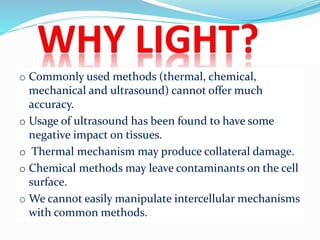

o Commonly used methods (thermal, chemical,
mechanical and ultrasound) cannot offer much
accuracy.
o Usage of ultrasound has been found to have some
negative impact on tissues.
o Thermal mechanism may produce collateral damage.
o Chemical methods may leave contaminants on the cell
surface.
o We cannot easily manipulate intercellular mechanisms
with common methods.
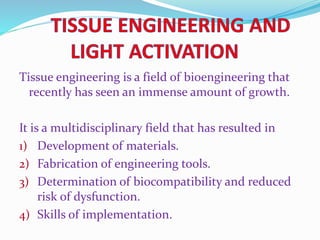
Tissue engineering is a field of bioengineering that
recently has seen an immense amount of growth.
It is a multidisciplinary field that has resulted in
1) Development of materials.
2) Fabrication of engineering tools.
3) Determination of biocompatibility and reduced
risk of dysfunction.
4) Skills of implementation.
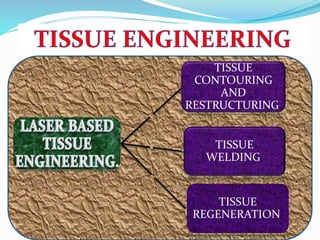
TISSUE
CONTOURING
AND
RESTRUCTURING.
TISSUE
WELDING.
TISSUE
REGENERATION.
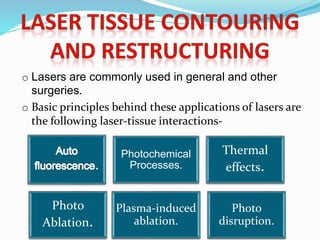
o Lasers are commonly used in general and other
surgeries.
o Basic principles behind these applications of lasers are
the following laser-tissue interactions-
.
.
Photochemical
Processes.
Thermal
effects.
Photo
Ablation.
Plasma-induced
ablation.
Photo
disruption.
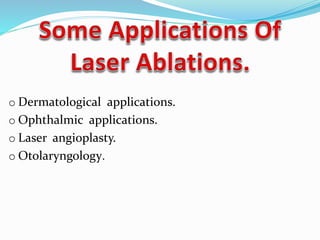
o Dermatological applications.
o Ophthalmic applications.
o Laser angioplasty.
o Otolaryngology.
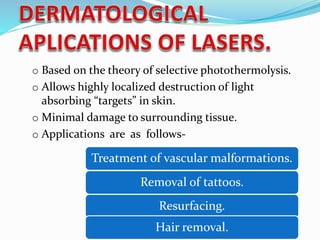
o Based on the theory of selective photothermolysis.
o Allows highly localized destruction of light
absorbing “targets” in skin.
o Minimal damage to surrounding tissue.
o Applications are as follows-
Removal of tattoos.
Treatment of vascular malformations.
Resurfacing.
Hair removal.
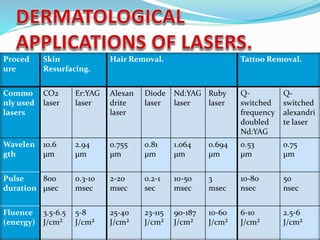
Proced
ure
Skin
Resurfacing.
Hair Removal. Tattoo Removal.
Commo
nly used
lasers
CO2
laser
Er:YAG
laser
Alexan
drite
laser
Diode
laser
Nd:YAG
laser
Ruby
laser
Q-
switched
frequency
doubled
Nd:YAG
Q-
switched
alexandri
te laser
Wavelen
gth
10.6
µm
2.94
µm
0.755
µm
0.81
µm
1.064
µm
0.694
µm
0.53
µm
0.75
µm
Pulse
duration
800
µsec
0.3-10
msec
2-20
msec
0.2-1
sec
10-50
msec
3
msec
10-80
nsec
50
nsec
Fluence
(energy)
3.5-6.5
J/cm²
5-8
J/cm²
25-40
J/cm²
23-115
J/cm²
90-187
J/cm²
10-60
J/cm²
6-10
J/cm²
2.5-6
J/cm²
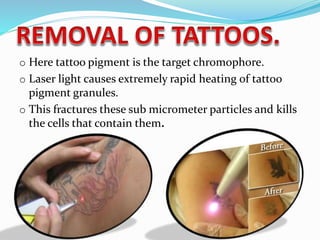
o Here tattoo pigment is the target chromophore.
o Laser light causes extremely rapid heating of tattoo
pigment granules.
o This fractures these sub micrometer particles and kills
the cells that contain them.
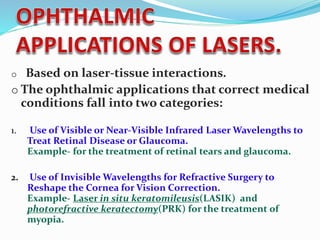
o Based on laser-tissue interactions.
o The ophthalmic applications that correct medical
conditions fall into two categories:
1. Use of Visible or Near-Visible Infrared Laser Wavelengths to
Treat Retinal Disease or Glaucoma.
Example- for the treatment of retinal tears and glaucoma.
2. Use of Invisible Wavelengths for Refractive Surgery to
Reshape the Cornea for Vision Correction.
Example- Laser in situ keratomileusis(LASIK) and
photorefractive keratectomy(PRK) for the treatment of
myopia.
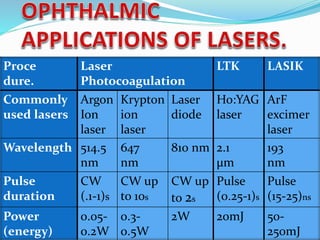
Proce
dure.
Laser
Photocoagulation
LTK LASIK
Commonly
used lasers
Argon
Ion
laser
Krypton
ion
laser
Laser
diode
Ho:YAG
laser
ArF
excimer
laser
Wavelength 514.5
nm
647
nm
810 nm 2.1
µm
193
nm
Pulse
duration
CW
(.1-1)s
CW up
to 10ѕ
CW up
to 2s
Pulse
(0.25-1)s
Pulse
(15-25)ns
Power
(energy)
0.05-
0.2W
0.3-
0.5W
2W 20mJ 50-
250mJ
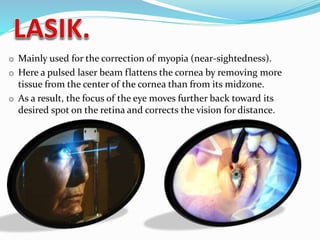
o Mainly used for the correction of myopia (near-sightedness).
o Here a pulsed laser beam flattens the cornea by removing more
tissue from the center of the cornea than from its midzone.
o As a result, the focus of the eye moves further back toward its
desired spot on the retina and corrects the vision for distance.
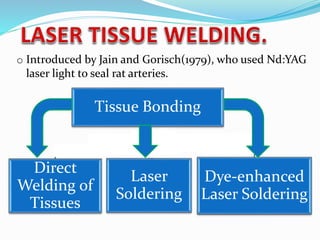
o Introduced by Jain and Gorisch(1979), who used Nd:YAG
laser light to seal rat arteries.
Tissue Bonding
Direct
Welding of
Tissues
Laser
Soldering
Dye-enhanced
Laser Soldering
o Microsurgery.
o Reduced inflammation.
o Faster healing.
o Watertight seal.
o Ease and speed of application.
o Moreover it can be used endoscopically and
laproscopically to extent the range of its applications
to cases where sutures or staples cannot be used.
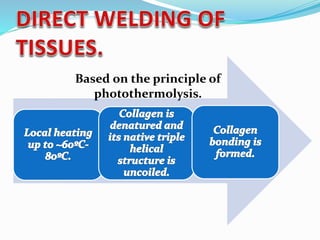
Based on the principle of
photothermolysis.
o Laser light is utilized to fuse a proteineous solder to
the tissue surface.
o It provides greater bond strength with less collateral
damage compared to direct welding.
o Commonly used lasers => CO2,Nd:YAG and CW.
o Solders used => Blood, egg-white albumin, proteins
derived from blood fibrinogen and other albumins.
o An appropriate dye that will enhance absorption of the
used laser is added to the solder.
o Takes advantage of strong absorption of light by the
selected dye and the efficient conversion of light into
heat by dye dispersed in the solder.
o Allowed the ability to use more common and relatively
inexpensive 808-nm diode laser with the help of a
biocompatible dye, indocyanine green(ICG).
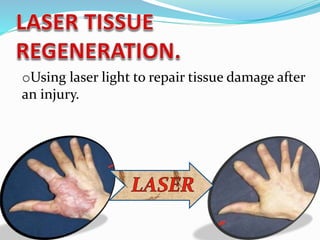
oUsing laser light to repair tissue damage after
an injury.
Computer-Aided Tissue Engineering.
New Laser Solders and Dyes to Assist
Soldering.
Mechanism of Tissue Ablation and
Welding.
Femtolaser Technology.
Introduction To Biophotonics
Paras N. Prasad
Laser Surgery and Medicine: Principles and Practice,
Wiley-Liss
Cutaneous Laser Surgery,
Mosby, St. Louis
Wikipedia
Dfygtruyiopiup[
Tyterwret
yu

Tissue engineering with light

  • 3.
    o Commonly usedmethods (thermal, chemical, mechanical and ultrasound) cannot offer much accuracy. o Usage of ultrasound has been found to have some negative impact on tissues. o Thermal mechanism may produce collateral damage. o Chemical methods may leave contaminants on the cell surface. o We cannot easily manipulate intercellular mechanisms with common methods.
  • 4.
    Tissue engineering isa field of bioengineering that recently has seen an immense amount of growth. It is a multidisciplinary field that has resulted in 1) Development of materials. 2) Fabrication of engineering tools. 3) Determination of biocompatibility and reduced risk of dysfunction. 4) Skills of implementation.
  • 5.
  • 6.
    o Lasers arecommonly used in general and other surgeries. o Basic principles behind these applications of lasers are the following laser-tissue interactions- . . Photochemical Processes. Thermal effects. Photo Ablation. Plasma-induced ablation. Photo disruption.
  • 7.
    o Dermatological applications. oOphthalmic applications. o Laser angioplasty. o Otolaryngology.
  • 8.
    o Based onthe theory of selective photothermolysis. o Allows highly localized destruction of light absorbing “targets” in skin. o Minimal damage to surrounding tissue. o Applications are as follows- Removal of tattoos. Treatment of vascular malformations. Resurfacing. Hair removal.
  • 9.
    Proced ure Skin Resurfacing. Hair Removal. TattooRemoval. Commo nly used lasers CO2 laser Er:YAG laser Alexan drite laser Diode laser Nd:YAG laser Ruby laser Q- switched frequency doubled Nd:YAG Q- switched alexandri te laser Wavelen gth 10.6 µm 2.94 µm 0.755 µm 0.81 µm 1.064 µm 0.694 µm 0.53 µm 0.75 µm Pulse duration 800 µsec 0.3-10 msec 2-20 msec 0.2-1 sec 10-50 msec 3 msec 10-80 nsec 50 nsec Fluence (energy) 3.5-6.5 J/cm² 5-8 J/cm² 25-40 J/cm² 23-115 J/cm² 90-187 J/cm² 10-60 J/cm² 6-10 J/cm² 2.5-6 J/cm²
  • 10.
    o Here tattoopigment is the target chromophore. o Laser light causes extremely rapid heating of tattoo pigment granules. o This fractures these sub micrometer particles and kills the cells that contain them.
  • 11.
    o Based onlaser-tissue interactions. o The ophthalmic applications that correct medical conditions fall into two categories: 1. Use of Visible or Near-Visible Infrared Laser Wavelengths to Treat Retinal Disease or Glaucoma. Example- for the treatment of retinal tears and glaucoma. 2. Use of Invisible Wavelengths for Refractive Surgery to Reshape the Cornea for Vision Correction. Example- Laser in situ keratomileusis(LASIK) and photorefractive keratectomy(PRK) for the treatment of myopia.
  • 12.
    Proce dure. Laser Photocoagulation LTK LASIK Commonly used lasers Argon Ion laser Krypton ion laser Laser diode Ho:YAG laser ArF excimer laser Wavelength514.5 nm 647 nm 810 nm 2.1 µm 193 nm Pulse duration CW (.1-1)s CW up to 10ѕ CW up to 2s Pulse (0.25-1)s Pulse (15-25)ns Power (energy) 0.05- 0.2W 0.3- 0.5W 2W 20mJ 50- 250mJ
  • 13.
    o Mainly usedfor the correction of myopia (near-sightedness). o Here a pulsed laser beam flattens the cornea by removing more tissue from the center of the cornea than from its midzone. o As a result, the focus of the eye moves further back toward its desired spot on the retina and corrects the vision for distance.
  • 14.
    o Introduced byJain and Gorisch(1979), who used Nd:YAG laser light to seal rat arteries. Tissue Bonding Direct Welding of Tissues Laser Soldering Dye-enhanced Laser Soldering
  • 15.
    o Microsurgery. o Reducedinflammation. o Faster healing. o Watertight seal. o Ease and speed of application. o Moreover it can be used endoscopically and laproscopically to extent the range of its applications to cases where sutures or staples cannot be used.
  • 16.
    Based on theprinciple of photothermolysis.
  • 17.
    o Laser lightis utilized to fuse a proteineous solder to the tissue surface. o It provides greater bond strength with less collateral damage compared to direct welding. o Commonly used lasers => CO2,Nd:YAG and CW. o Solders used => Blood, egg-white albumin, proteins derived from blood fibrinogen and other albumins.
  • 18.
    o An appropriatedye that will enhance absorption of the used laser is added to the solder. o Takes advantage of strong absorption of light by the selected dye and the efficient conversion of light into heat by dye dispersed in the solder. o Allowed the ability to use more common and relatively inexpensive 808-nm diode laser with the help of a biocompatible dye, indocyanine green(ICG).
  • 19.
    oUsing laser lightto repair tissue damage after an injury.
  • 20.
    Computer-Aided Tissue Engineering. NewLaser Solders and Dyes to Assist Soldering. Mechanism of Tissue Ablation and Welding. Femtolaser Technology.
  • 21.
    Introduction To Biophotonics ParasN. Prasad Laser Surgery and Medicine: Principles and Practice, Wiley-Liss Cutaneous Laser Surgery, Mosby, St. Louis Wikipedia
  • 22.