Tips and tricks to access and use academic
databases
Diana Alejandra Estrada Mendoza
Paola Edith Chairez Perea
Melanie Patricia Viguería Perez
Victoria Fierro Rodriguez
Claudia Elena Ávila Fierro
Moderator: Juan D. Machin-Mastromatteo, PhD
October 23rd, 2017, Universidad Autónoma de Chihuahua
1.1 What are academic and scientific
databases?
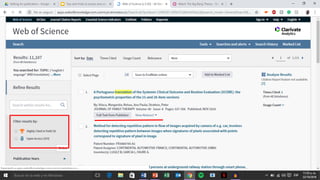
● Web of Science
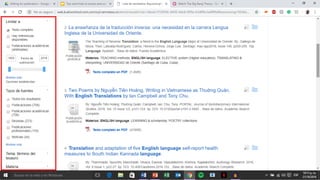
● Scopus
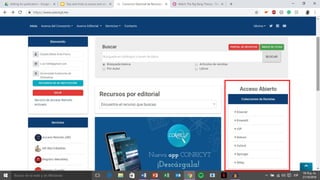
1.2 Which ones are we subscribed
to? ● Alliance of Crop, Soil and Environmental Science Societies
(ACSESS)
● American Association for the Advance of Science (AAAs)
● American Chemical Society (ACS)
● American Institute of Physics (AIP)
● American Mathematical Society (AMS)
● American Medical Association (JAMA)
● American Physical Society (APS)
● Annual Reviews
● BioOne
● Cambridge University Press
● Chemical Abstract Service (CAS)
● Clarivate Analytics (Web Of Science)
● EBSCO
● Elsevier
● Emerald
● Gale Cengage Learning
● IEEE
● Institute of Physics (IOP)
● Lippincott Williams & Wilkins
● National Academy of Sciences
● Nature
● ProQuest Dissertations & Theses
● Royal Society Publishing(RSP)
● Springer
● Wiley
1.3 Open Access
OA refers to research outputs distributed online and free of cost or other
limitations. Can be applied to all forms of published outputs (peer-reviewed,
academic journal articles, conference paper, theses, book chapters).
DIFFERENT DISTRIBUTION MECHANISMS:
1.Self archiving.
2.Open access journal (funded by article processing charges, academic
institution, deleyed open access).
3.Hybrid open access journals.
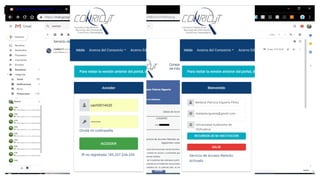
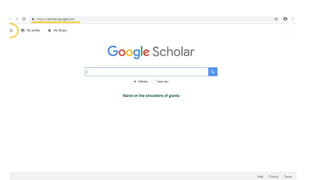
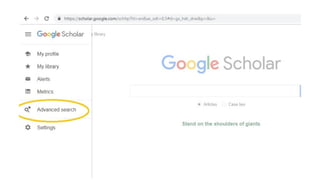
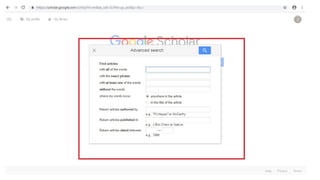
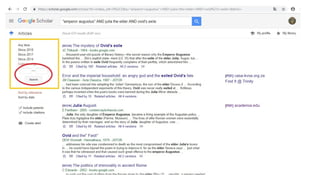
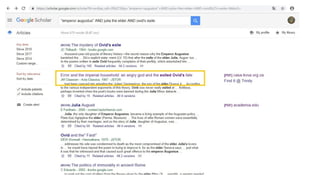
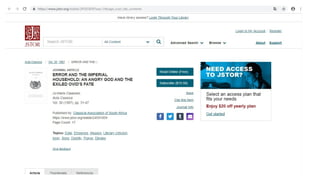
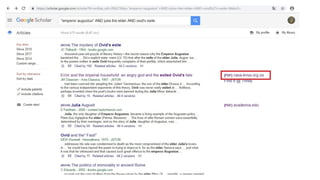
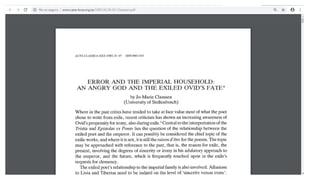
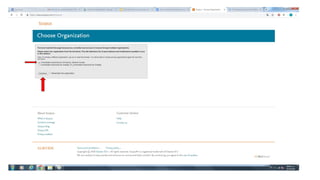
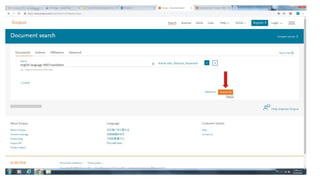
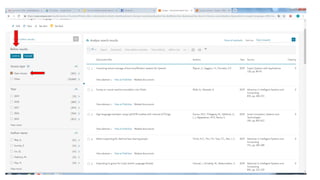
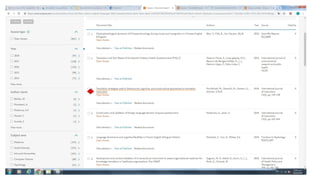
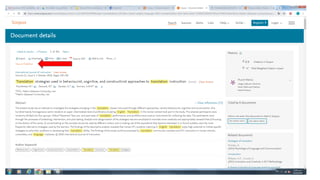
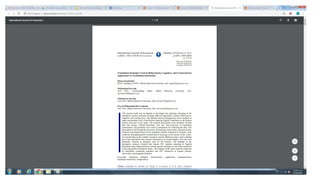
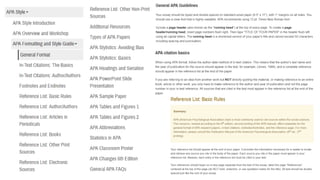
1.4 How to access databases
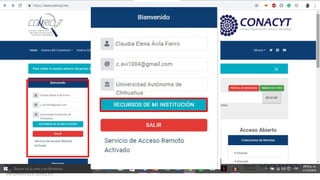
Remote Access
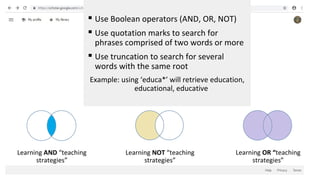
Learning OR “teaching
strategies”
Learning AND “teaching
strategies”
Learning NOT “teaching
strategies”
▪ Use Boolean operators (AND, OR, NOT)
▪ Use quotation marks to search for
phrases comprised of two words or more
▪ Use truncation to search for several
words with the same root
Example: using ‘educa*’ will retrieve education,
educational, educative
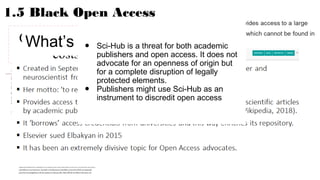
1.5 Black Open Access
Open Access at all
costs?
What’s sci-hub?● Sci-Hub is a threat for both academic
publishers and open access. It does not
advocate for an openness of origin but
for a complete disruption of legally
protected elements.
● Publishers might use Sci-Hub as an
instrument to discredit open access
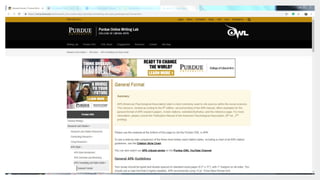
1.6 Advice for using
scientific literature. ▪ Use citations to support any
statement not commonly
accepted.
▪ All cited sources must also be in
the references.
▪ All references must be cited at
least once in the text.
Panel Discussion
2.1. Did you know about these databases before the course
(Editing for Publication)?
Panel Discussion
2.2. What are your overall experiences using such resources?
Panel Discussion
2.3. What would you recommend to teachers and other
students for incorporating and harnessing databases and
research within academic courses?
Panel Discussion
2.4. How access to a limited range of publications affects the
realm of research?
Panel Discussion
2.5. What is the importance of teaching all these topics we
have been discussing?
Thanks for your attention!

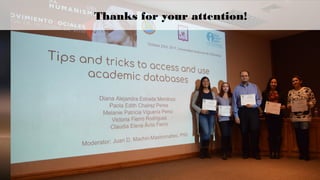
Tips and tricks to access and use academic databases

  • 1.
    Tips and tricksto access and use academic databases Diana Alejandra Estrada Mendoza Paola Edith Chairez Perea Melanie Patricia Viguería Perez Victoria Fierro Rodriguez Claudia Elena Ávila Fierro Moderator: Juan D. Machin-Mastromatteo, PhD October 23rd, 2017, Universidad Autónoma de Chihuahua
  • 2.
    1.1 What areacademic and scientific databases?
  • 4.
    ● Web ofScience ● Scopus
  • 5.
    1.2 Which onesare we subscribed to? ● Alliance of Crop, Soil and Environmental Science Societies (ACSESS) ● American Association for the Advance of Science (AAAs) ● American Chemical Society (ACS) ● American Institute of Physics (AIP) ● American Mathematical Society (AMS) ● American Medical Association (JAMA) ● American Physical Society (APS) ● Annual Reviews ● BioOne ● Cambridge University Press ● Chemical Abstract Service (CAS) ● Clarivate Analytics (Web Of Science) ● EBSCO ● Elsevier ● Emerald ● Gale Cengage Learning ● IEEE ● Institute of Physics (IOP) ● Lippincott Williams & Wilkins ● National Academy of Sciences ● Nature ● ProQuest Dissertations & Theses ● Royal Society Publishing(RSP) ● Springer ● Wiley
  • 6.
    1.3 Open Access OArefers to research outputs distributed online and free of cost or other limitations. Can be applied to all forms of published outputs (peer-reviewed, academic journal articles, conference paper, theses, book chapters). DIFFERENT DISTRIBUTION MECHANISMS: 1.Self archiving. 2.Open access journal (funded by article processing charges, academic institution, deleyed open access). 3.Hybrid open access journals.
  • 8.
    1.4 How toaccess databases
  • 9.
  • 13.
    Learning OR “teaching strategies” LearningAND “teaching strategies” Learning NOT “teaching strategies” ▪ Use Boolean operators (AND, OR, NOT) ▪ Use quotation marks to search for phrases comprised of two words or more ▪ Use truncation to search for several words with the same root Example: using ‘educa*’ will retrieve education, educational, educative
  • 27.
    1.5 Black OpenAccess Open Access at all costs? What’s sci-hub?● Sci-Hub is a threat for both academic publishers and open access. It does not advocate for an openness of origin but for a complete disruption of legally protected elements. ● Publishers might use Sci-Hub as an instrument to discredit open access
  • 28.
    1.6 Advice forusing scientific literature. ▪ Use citations to support any statement not commonly accepted. ▪ All cited sources must also be in the references. ▪ All references must be cited at least once in the text.
  • 30.
    Panel Discussion 2.1. Didyou know about these databases before the course (Editing for Publication)?
  • 31.
    Panel Discussion 2.2. Whatare your overall experiences using such resources?
  • 32.
    Panel Discussion 2.3. Whatwould you recommend to teachers and other students for incorporating and harnessing databases and research within academic courses?
  • 33.
    Panel Discussion 2.4. Howaccess to a limited range of publications affects the realm of research?
  • 34.
    Panel Discussion 2.5. Whatis the importance of teaching all these topics we have been discussing?
  • 35.
    Thanks for yourattention!

Editor's Notes

  • #6 Clarivate Analytics Web of Science Philosophical transactions The Royal Society FIRST JOURNAL EVER
  • #10 Remote access
  • #14 CLAUDIA EXPLAINS AND NOT OR :P
  • #27 EBSCO