
Time Series Analysis
… using an Event Streaming Platform
Dr. Mirko Kämpf - SA @ Confluent, Inc. - Team CEMEA
Meetup - Leipzig
Time Series Analysis
… using an Event Streaming Platform
Advanced time series analysis (TSA) requires very special data preparation procedures to convert raw data into
compatible formats.
In this presentation you will see typical processing patterns for TSA, from simple statistics to reconstruction of correlation
networks and interaction graphs.
The first case is relevant for anomaly detection and to protect safety.
Reconstruction of graphs from time series data is a very useful technique to better understand complex systems like
supply chains, material flows in factories, information flows within organizations, and especially in medical research.
With this motivation we will look at typical data aggregation patterns, how to apply analysis algorithms in the cloud, and
into a reference architecture for TSA on top of the Confluent Platform, which is baked by Apache Kafka.
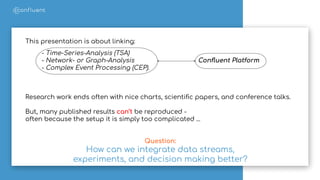
This presentation is about linking:
- Time-Series-Analysis (TSA)
- Network- or Graph-Analysis Confluent Platform
- Complex Event Processing (CEP).
Research work ends often with nice charts, scientific papers, and conference talks.
But, many published results can’t be reproduced -
often because the setup it is simply too complicated ...
Question:
How can we integrate data streams,
experiments, and decision making better?
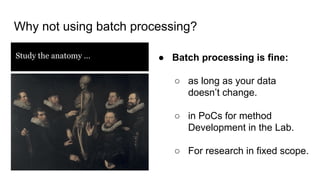
Why not using batch processing?
Study the anatomy … ● Batch processing is fine:
○ as long as your data
doesn’t change.
○ in PoCs for method
Development in the Lab.
○ For research in fixed scope.
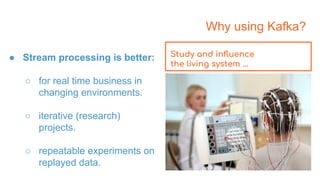
Why using Kafka?
Study the anatomy … Study and influence
the living system ...
● Stream processing is better:
○ for real time business in
changing environments.
○ iterative (research)
projects.
○ repeatable experiments on
replayed data.
From Events to Time Series ...
to Graphs … to Events …
for better Decisions
Let’s stream the title :
WHAT?
WHY?
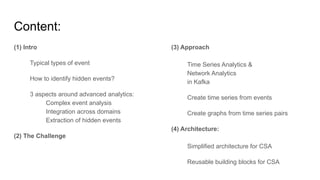
Content:
(1) Intro
Typical types of event
How to identify hidden events?
3 aspects around advanced analytics:
Complex event analysis
Integration across domains
Extraction of hidden events
(2) The Challenge
(3) Approach
Time Series Analytics &
Network Analytics
in Kafka
Create time series from events
Create graphs from time series pairs
(4) Architecture:
Simplified architecture for CSA
Reusable building blocks for CSA
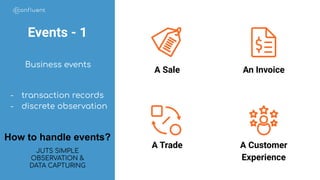
Events - 1
Business events
- transaction records
- discrete observation
A Sale
A Trade
An Invoice
A Customer
Experience
JUTS SIMPLE
OBSERVATION &
DATA CAPTURING
How to handle events?
Events
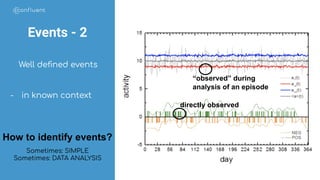
Events - 2
Well defined events
- in known context
Sometimes: SIMPLE
Sometimes: DATA ANALYSIS
How to identify events?
directly observed
“observed” during
analysis of an episode
Events
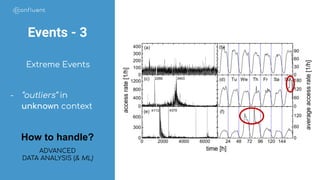
Events - 3
Extreme Events
- “outliers” in
unknown context
ADVANCED
DATA ANALYSIS (& ML)
How to handle?
1111
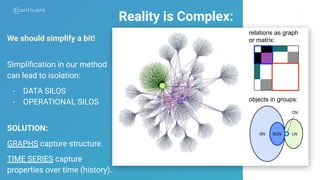
Reality is Complex:
We should simplify a bit!
Simplification in our method
can lead to isolation:
- DATA SILOS
- OPERATIONAL SILOS
SOLUTION:
GRAPHS capture structure.
TIME SERIES capture
properties over time (history).
relations as graph
or matrix:
objects in groups:
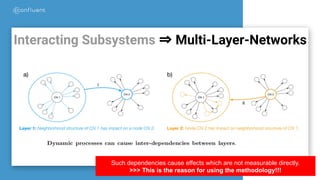
Interacting Subsystems ⇒ Multi-Layer-Networks
Such dependencies cause effects which are not measurable directly.
>>> This is the reason for using the methodology!!!
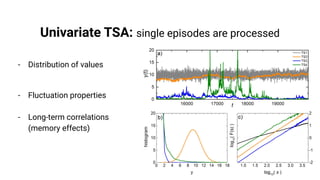
Univariate TSA: single episodes are processed
- Distribution of values
- Fluctuation properties
- Long-term correlations
(memory effects)
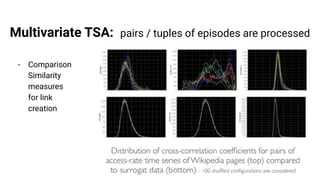
Multivariate TSA: pairs / tuples of episodes are processed
- Comparison
Similarity
measures
for link
creation
WHAT?
WHY?
Events
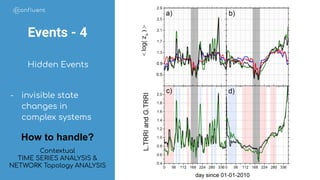
Events - 4
Hidden Events
- invisible state
changes in
complex systems
Contextual
TIME SERIES ANALYSIS &
NETWORK Topology ANALYSIS
How to handle?
Special procedures
established or under
construction
The events which make
people & the market
happy :-)
Complex Event AnalysisEvent Driven Architecture
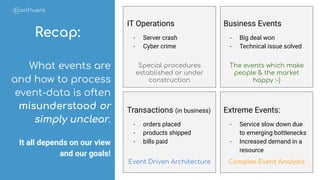
Recap:
IT Operations
- Server crash
- Cyber crime
Business Events
- Big deal won
- Technical issue solved
Transactions (in business)
- orders placed
- products shipped
- bills paid
Extreme Events:
- Service slow down due
to emerging bottlenecks
- Increased demand in a
resource
What events are
and how to process
event-data is often
misunderstood or
simply unclear.
It all depends on our view
and our goals!
Things become complicated:
Complex Event Analysis
Integration Across Domains
Extraction of Hidden Event
Complex Event Analysis
- time series analysis and ML reveal hidden events
- multi-stage processing is usually needed
METHODOLOGY
Integration Across Domains
- distributed event processing systems are used
- apps consume and produce events of different flavors
- Event-types and data structures my change over
ORGANIZATION & OPERATIONS
Extraction of Hidden Events
- requires Applied Data Analysis & Data Science
- embedding of Complex Algorithms in IT landscape
- integration of GPU/HPC and data pipelines
TECHNOLOGY & SCIENCE
22
The Challenge:
How can we combine unbound data assets and scientific methods?
A. you pipe the data to the place where it can be processed easily,
e.g., to the cloud or into special purpose systems.
B. you integrate complex algorithms in your processing pipeline.
23
Problems on ORGANIZATION level:
Legacy systems in the fab can’t be integrated without additional expensive servers.
Often, this data is unreachable.
Business data is managed by different teams using different technologies.
Data scientists play with some data in the cloud, and they all do really L❤VE
notebooks. But often, they don’t know CI/CD systems.
24
Kafka and its Ecosystem …
- are considered to be middleware, managed by IT people:
- researchers do not plan their experiments around such a technology.
- don’t offer ML / AI components:
- many people think, that a model has to be executed on the edge-device or in the cloud.
25
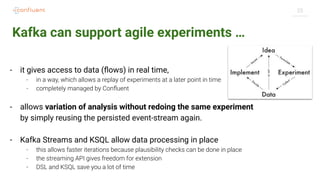
Kafka can support agile experiments …
- it gives access to data (flows) in real time,
- in a way, which allows a replay of experiments at a later point in time
- completely managed by Confluent
- allows variation of analysis without redoing the same experiment
by simply reusing the persisted event-stream again.
- Kafka Streams and KSQL allow data processing in place
- this allows faster iterations because plausibility checks can be done in place
- the streaming API gives freedom for extension
- DSL and KSQL save you a lot of time
Why not building on top of the right tools ???
27
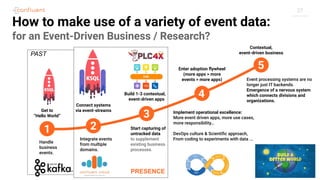
How to make use of a variety of event data:
for an Event-Driven Business / Research?
1
Get to
“Hello World”
Handle
business
events.
2
Connect systems
via event-streams
Integrate events
from multiple
domains.
3
Build 1-3 contextual,
event-driven apps
4
Enter adoption flywheel
(more apps > more
events > more apps)
5
Contextual,
event-driven business
Start capturing of
untracked data
to supplement
existing business
processes.
Implement operational excellence:
More event driven apps, more use cases,
more responsibility…
DevOps culture & Scientific approach,
From coding to experiments with data ...
Event processing systems are no
longer just IT backends.
Emergence of a nervous system
which connects divisions and
organizations.
PAST
PRESENCE
28
ADVANCED
TIME SERIES ANALYSIS &
NETWORK ANALYSIS
… and how both fit into Kafka.
29
METHODOLOGICAL aspects:
How do time series analysis and graphs fit into Kafka’s data model?
I think, Kafka is a messaging system? Or am I wrong?
Please, tell me, how can I use Kafka for advanced analytics
or even machine learning?
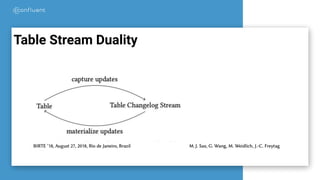
Table Stream Duality
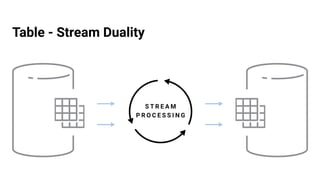
Table - Stream Duality
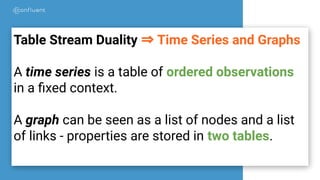
Table Stream Duality ⇒ Time Series and Graphs
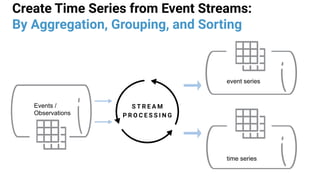
A time series is a table of ordered observations
in a fixed context.
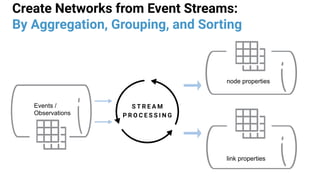
A graph can be seen as a list of nodes and a list
of links - properties are stored in two tables.
Create Time Series from Event Streams:
By Aggregation, Grouping, and Sorting
Events /
Observations
event series
time series
Create Networks from Event Streams:
By Aggregation, Grouping, and Sorting
Events /
Observations
node properties
link properties
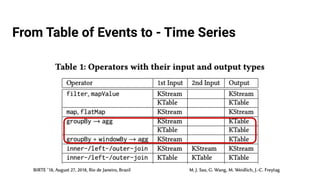
From Table of Events to - Time Series
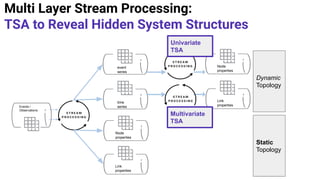
Multi Layer Stream Processing:
TSA to Reveal Hidden System Structures
Events /
Observations
event
series
time
series
Node
properties
Link
properties
Node
properties
Link
properties
Static
Topology
Dynamic
Topology
Multivariate
TSA
Univariate
TSA
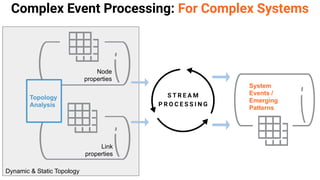
Dynamic & Static Topology
Complex Event Processing: For Complex Systems
System
Events /
Emerging
Patterns
Node
properties
Link
properties
Topology
Analysis
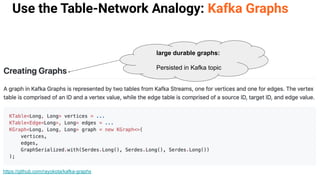
Use the Table-Network Analogy: Kafka Graphs
https://github.com/rayokota/kafka-graphs
large durable graphs:
Persisted in Kafka topic
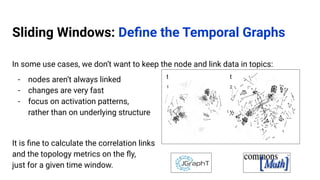
Sliding Windows: Define the Temporal Graphs
In some use cases, we don’t want to keep the node and link data in topics:
- nodes aren’t always linked
- changes are very fast
- focus on activation patterns,
rather than on underlying structure
It is fine to calculate the correlation links
and the topology metrics on the fly,
just for a given time window.
t
1
t
2
Back
to
Streams
...
Architecture:
Identify Patterns &
Buildingblocks
42
Let’s look into 3 examples:
(1) Linear flow ...
(2) Bi-directional flow ...
(3) Complex process flows ...
43
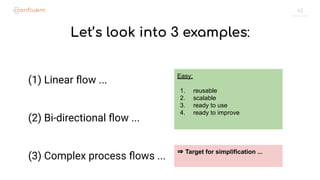
(1) Linear flow ...
(2) Bi-directional flow ...
(3) Complex process flows ...
Easy:
1. reusable
2. scalable
3. ready to use
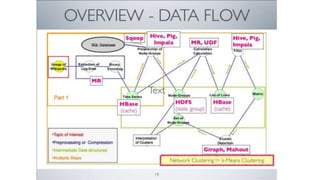
4. ready to improve
⇒ Target for simplification ...
Let’s look into 3 examples:
A Standardized Processing Procedure for Episodes
used for social media analysis on Hadoop:
- The predecessor of OpenTSx is Hadoop.TS
(https://www.researchgate.net/publication/269687614_Hadoop_TS_Large-Scale_Time-Series_Processing)
- Hadoop.TS used a variety of Hadoop ecosystem projects
(Sqoop, Flume, Hive, Spark, Yarn, HDFS, Solr, HBase, Impala, Mahout, Giraph)
- Managing the data flow at scale was possible, but complex.
46
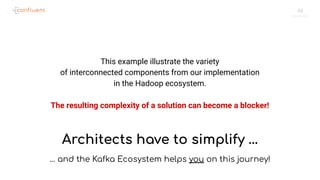
This example illustrate the variety
of interconnected components from our implementation
in the Hadoop ecosystem.
The resulting complexity of a solution can become a blocker!
Architects have to simplify …
… and the Kafka Ecosystem helps you on this journey!
47
Simplify
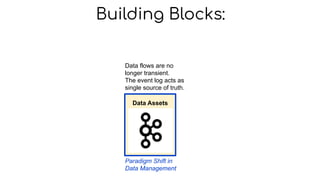
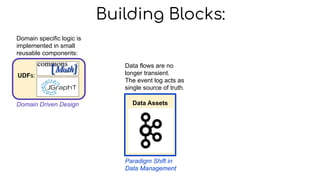
Data Assets
Building Blocks:
Data flows are no
longer transient.
The event log acts as
single source of truth.
Paradigm Shift in
Data Management
UDFs:
Data Assets
Building Blocks:
Domain specific logic is
implemented in small
reusable components:
Domain Driven Design
Data flows are no
longer transient.
The event log acts as
single source of truth.
Paradigm Shift in
Data Management
UDFs:
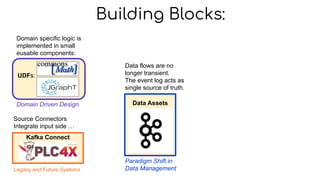
Kafka Connect
Data Assets
Building Blocks:
Source Connectors
Integrate input side …
Legacy and Future Systems
Domain specific logic is
implemented in small
eusable components:
Domain Driven Design
Data flows are no
longer transient.
The event log acts as
single source of truth.
Paradigm Shift in
Data Management
Kafka Connect
UDFs:
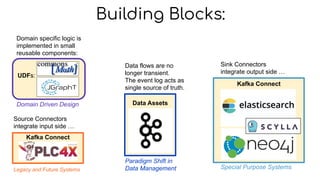
Kafka Connect
Data Assets
Building Blocks:
Source Connectors
integrate input side …
Legacy and Future Systems
Sink Connectors
integrate output side …
Special Purpose Systems
Domain specific logic is
implemented in small
reusable components:
Domain Driven Design
Data flows are no
longer transient.
The event log acts as
single source of truth.
Paradigm Shift in
Data Management
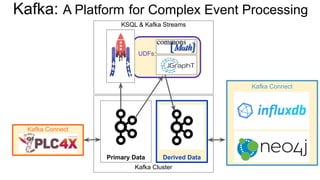
Kafka Connect
KSQL & Kafka Streams
UDFs:
Primary Data
Kafka Connect
Derived Data
Kafka Cluster
Kafka: A Platform for Complex Event Processing
53
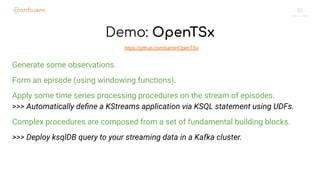
Demo: OpenTSx
Generate some observations.
Form an episode (using windowing functions).
Apply some time series processing procedures on the stream of episodes.
>>> Automatically define a KStreams application via KSQL statement using UDFs.
Complex procedures are composed from a set of fundamental building blocks.
>>> Deploy ksqlDB query to your streaming data in a Kafka cluster.
https://github.com/kamir/OpenTSx
54
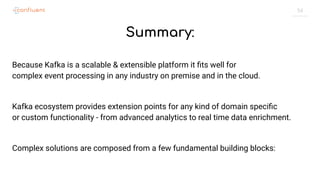
Summary:
Because Kafka is a scalable & extensible platform it fits well for
complex event processing in any industry on premise and in the cloud.
Kafka ecosystem provides extension points for any kind of domain specific
or custom functionality - from advanced analytics to real time data enrichment.
Complex solutions are composed from a few fundamental building blocks:
55
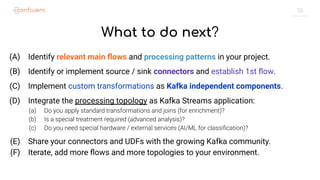
What to do next?
(A) Identify relevant main flows and processing patterns in your project.
(B) Identify or implement source / sink connectors and establish 1st flow.
(C) Implement custom transformations as Kafka independent components.
(D) Integrate the processing topology as Kafka Streams application:
(a) Do you apply standard transformations and joins (for enrichment)?
(b) Is a special treatment required (advanced analysis)?
(c) Do you need special hardware / external services (AI/ML for classification)?
(E) Share your connectors and UDFs with the growing Kafka community.
(F) Iterate, add more flows and more topologies to your environment.
56
THANK YOU !!!
mirko@confluent.io
@semanpix

Time series-analysis-using-an-event-streaming-platform -_v3_final

  • 1.
    Time Series Analysis …using an Event Streaming Platform Dr. Mirko Kämpf - SA @ Confluent, Inc. - Team CEMEA Meetup - Leipzig
  • 2.
    Time Series Analysis …using an Event Streaming Platform Advanced time series analysis (TSA) requires very special data preparation procedures to convert raw data into compatible formats. In this presentation you will see typical processing patterns for TSA, from simple statistics to reconstruction of correlation networks and interaction graphs. The first case is relevant for anomaly detection and to protect safety. Reconstruction of graphs from time series data is a very useful technique to better understand complex systems like supply chains, material flows in factories, information flows within organizations, and especially in medical research. With this motivation we will look at typical data aggregation patterns, how to apply analysis algorithms in the cloud, and into a reference architecture for TSA on top of the Confluent Platform, which is baked by Apache Kafka.
  • 3.
    This presentation isabout linking: - Time-Series-Analysis (TSA) - Network- or Graph-Analysis Confluent Platform - Complex Event Processing (CEP). Research work ends often with nice charts, scientific papers, and conference talks. But, many published results can’t be reproduced - often because the setup it is simply too complicated ... Question: How can we integrate data streams, experiments, and decision making better?
  • 4.
    Why not usingbatch processing? Study the anatomy … ● Batch processing is fine: ○ as long as your data doesn’t change. ○ in PoCs for method Development in the Lab. ○ For research in fixed scope.
  • 5.
    Why using Kafka? Studythe anatomy … Study and influence the living system ... ● Stream processing is better: ○ for real time business in changing environments. ○ iterative (research) projects. ○ repeatable experiments on replayed data.
  • 6.
    From Events toTime Series ... to Graphs … to Events … for better Decisions Let’s stream the title : WHAT? WHY?
  • 7.
    Content: (1) Intro Typical typesof event How to identify hidden events? 3 aspects around advanced analytics: Complex event analysis Integration across domains Extraction of hidden events (2) The Challenge (3) Approach Time Series Analytics & Network Analytics in Kafka Create time series from events Create graphs from time series pairs (4) Architecture: Simplified architecture for CSA Reusable building blocks for CSA
  • 8.
    Events - 1 Businessevents - transaction records - discrete observation A Sale A Trade An Invoice A Customer Experience JUTS SIMPLE OBSERVATION & DATA CAPTURING How to handle events?
  • 9.
    Events Events - 2 Welldefined events - in known context Sometimes: SIMPLE Sometimes: DATA ANALYSIS How to identify events? directly observed “observed” during analysis of an episode
  • 10.
    Events Events - 3 ExtremeEvents - “outliers” in unknown context ADVANCED DATA ANALYSIS (& ML) How to handle?
  • 11.
    1111 Reality is Complex: Weshould simplify a bit! Simplification in our method can lead to isolation: - DATA SILOS - OPERATIONAL SILOS SOLUTION: GRAPHS capture structure. TIME SERIES capture properties over time (history). relations as graph or matrix: objects in groups:
  • 12.
    Interacting Subsystems ⇒Multi-Layer-Networks Such dependencies cause effects which are not measurable directly. >>> This is the reason for using the methodology!!!
  • 13.
    Univariate TSA: singleepisodes are processed - Distribution of values - Fluctuation properties - Long-term correlations (memory effects)
  • 14.
    Multivariate TSA: pairs/ tuples of episodes are processed - Comparison Similarity measures for link creation
  • 15.
  • 16.
    Events Events - 4 HiddenEvents - invisible state changes in complex systems Contextual TIME SERIES ANALYSIS & NETWORK Topology ANALYSIS How to handle?
  • 17.
    Special procedures established orunder construction The events which make people & the market happy :-) Complex Event AnalysisEvent Driven Architecture Recap: IT Operations - Server crash - Cyber crime Business Events - Big deal won - Technical issue solved Transactions (in business) - orders placed - products shipped - bills paid Extreme Events: - Service slow down due to emerging bottlenecks - Increased demand in a resource What events are and how to process event-data is often misunderstood or simply unclear. It all depends on our view and our goals!
  • 18.
    Things become complicated: ComplexEvent Analysis Integration Across Domains Extraction of Hidden Event
  • 19.
    Complex Event Analysis -time series analysis and ML reveal hidden events - multi-stage processing is usually needed METHODOLOGY
  • 20.
    Integration Across Domains -distributed event processing systems are used - apps consume and produce events of different flavors - Event-types and data structures my change over ORGANIZATION & OPERATIONS
  • 21.
    Extraction of HiddenEvents - requires Applied Data Analysis & Data Science - embedding of Complex Algorithms in IT landscape - integration of GPU/HPC and data pipelines TECHNOLOGY & SCIENCE
  • 22.
    22 The Challenge: How canwe combine unbound data assets and scientific methods? A. you pipe the data to the place where it can be processed easily, e.g., to the cloud or into special purpose systems. B. you integrate complex algorithms in your processing pipeline.
  • 23.
    23 Problems on ORGANIZATIONlevel: Legacy systems in the fab can’t be integrated without additional expensive servers. Often, this data is unreachable. Business data is managed by different teams using different technologies. Data scientists play with some data in the cloud, and they all do really L❤VE notebooks. But often, they don’t know CI/CD systems.
  • 24.
    24 Kafka and itsEcosystem … - are considered to be middleware, managed by IT people: - researchers do not plan their experiments around such a technology. - don’t offer ML / AI components: - many people think, that a model has to be executed on the edge-device or in the cloud.
  • 25.
    25 Kafka can supportagile experiments … - it gives access to data (flows) in real time, - in a way, which allows a replay of experiments at a later point in time - completely managed by Confluent - allows variation of analysis without redoing the same experiment by simply reusing the persisted event-stream again. - Kafka Streams and KSQL allow data processing in place - this allows faster iterations because plausibility checks can be done in place - the streaming API gives freedom for extension - DSL and KSQL save you a lot of time
  • 26.
    Why not buildingon top of the right tools ???
  • 27.
    27 How to makeuse of a variety of event data: for an Event-Driven Business / Research? 1 Get to “Hello World” Handle business events. 2 Connect systems via event-streams Integrate events from multiple domains. 3 Build 1-3 contextual, event-driven apps 4 Enter adoption flywheel (more apps > more events > more apps) 5 Contextual, event-driven business Start capturing of untracked data to supplement existing business processes. Implement operational excellence: More event driven apps, more use cases, more responsibility… DevOps culture & Scientific approach, From coding to experiments with data ... Event processing systems are no longer just IT backends. Emergence of a nervous system which connects divisions and organizations. PAST PRESENCE
  • 28.
    28 ADVANCED TIME SERIES ANALYSIS& NETWORK ANALYSIS … and how both fit into Kafka.
  • 29.
    29 METHODOLOGICAL aspects: How dotime series analysis and graphs fit into Kafka’s data model? I think, Kafka is a messaging system? Or am I wrong? Please, tell me, how can I use Kafka for advanced analytics or even machine learning?
  • 30.
  • 31.
  • 32.
    Table Stream Duality⇒ Time Series and Graphs A time series is a table of ordered observations in a fixed context. A graph can be seen as a list of nodes and a list of links - properties are stored in two tables.
  • 33.
    Create Time Seriesfrom Event Streams: By Aggregation, Grouping, and Sorting Events / Observations event series time series
  • 34.
    Create Networks fromEvent Streams: By Aggregation, Grouping, and Sorting Events / Observations node properties link properties
  • 35.
    From Table ofEvents to - Time Series
  • 36.
    Multi Layer StreamProcessing: TSA to Reveal Hidden System Structures Events / Observations event series time series Node properties Link properties Node properties Link properties Static Topology Dynamic Topology Multivariate TSA Univariate TSA
  • 37.
    Dynamic & StaticTopology Complex Event Processing: For Complex Systems System Events / Emerging Patterns Node properties Link properties Topology Analysis
  • 38.
    Use the Table-NetworkAnalogy: Kafka Graphs https://github.com/rayokota/kafka-graphs large durable graphs: Persisted in Kafka topic
  • 39.
    Sliding Windows: Definethe Temporal Graphs In some use cases, we don’t want to keep the node and link data in topics: - nodes aren’t always linked - changes are very fast - focus on activation patterns, rather than on underlying structure It is fine to calculate the correlation links and the topology metrics on the fly, just for a given time window. t 1 t 2
  • 40.
  • 41.
  • 42.
    42 Let’s look into3 examples: (1) Linear flow ... (2) Bi-directional flow ... (3) Complex process flows ...
  • 43.
    43 (1) Linear flow... (2) Bi-directional flow ... (3) Complex process flows ... Easy: 1. reusable 2. scalable 3. ready to use 4. ready to improve ⇒ Target for simplification ... Let’s look into 3 examples:
  • 44.
    A Standardized ProcessingProcedure for Episodes used for social media analysis on Hadoop: - The predecessor of OpenTSx is Hadoop.TS (https://www.researchgate.net/publication/269687614_Hadoop_TS_Large-Scale_Time-Series_Processing) - Hadoop.TS used a variety of Hadoop ecosystem projects (Sqoop, Flume, Hive, Spark, Yarn, HDFS, Solr, HBase, Impala, Mahout, Giraph) - Managing the data flow at scale was possible, but complex.
  • 46.
    46 This example illustratethe variety of interconnected components from our implementation in the Hadoop ecosystem. The resulting complexity of a solution can become a blocker! Architects have to simplify … … and the Kafka Ecosystem helps you on this journey!
  • 47.
  • 48.
    Data Assets Building Blocks: Dataflows are no longer transient. The event log acts as single source of truth. Paradigm Shift in Data Management
  • 49.
    UDFs: Data Assets Building Blocks: Domainspecific logic is implemented in small reusable components: Domain Driven Design Data flows are no longer transient. The event log acts as single source of truth. Paradigm Shift in Data Management
  • 50.
    UDFs: Kafka Connect Data Assets BuildingBlocks: Source Connectors Integrate input side … Legacy and Future Systems Domain specific logic is implemented in small eusable components: Domain Driven Design Data flows are no longer transient. The event log acts as single source of truth. Paradigm Shift in Data Management
  • 51.
    Kafka Connect UDFs: Kafka Connect DataAssets Building Blocks: Source Connectors integrate input side … Legacy and Future Systems Sink Connectors integrate output side … Special Purpose Systems Domain specific logic is implemented in small reusable components: Domain Driven Design Data flows are no longer transient. The event log acts as single source of truth. Paradigm Shift in Data Management
  • 52.
    Kafka Connect KSQL &Kafka Streams UDFs: Primary Data Kafka Connect Derived Data Kafka Cluster Kafka: A Platform for Complex Event Processing
  • 53.
    53 Demo: OpenTSx Generate someobservations. Form an episode (using windowing functions). Apply some time series processing procedures on the stream of episodes. >>> Automatically define a KStreams application via KSQL statement using UDFs. Complex procedures are composed from a set of fundamental building blocks. >>> Deploy ksqlDB query to your streaming data in a Kafka cluster. https://github.com/kamir/OpenTSx
  • 54.
    54 Summary: Because Kafka isa scalable & extensible platform it fits well for complex event processing in any industry on premise and in the cloud. Kafka ecosystem provides extension points for any kind of domain specific or custom functionality - from advanced analytics to real time data enrichment. Complex solutions are composed from a few fundamental building blocks:
  • 55.
    55 What to donext? (A) Identify relevant main flows and processing patterns in your project. (B) Identify or implement source / sink connectors and establish 1st flow. (C) Implement custom transformations as Kafka independent components. (D) Integrate the processing topology as Kafka Streams application: (a) Do you apply standard transformations and joins (for enrichment)? (b) Is a special treatment required (advanced analysis)? (c) Do you need special hardware / external services (AI/ML for classification)? (E) Share your connectors and UDFs with the growing Kafka community. (F) Iterate, add more flows and more topologies to your environment.
  • 56.