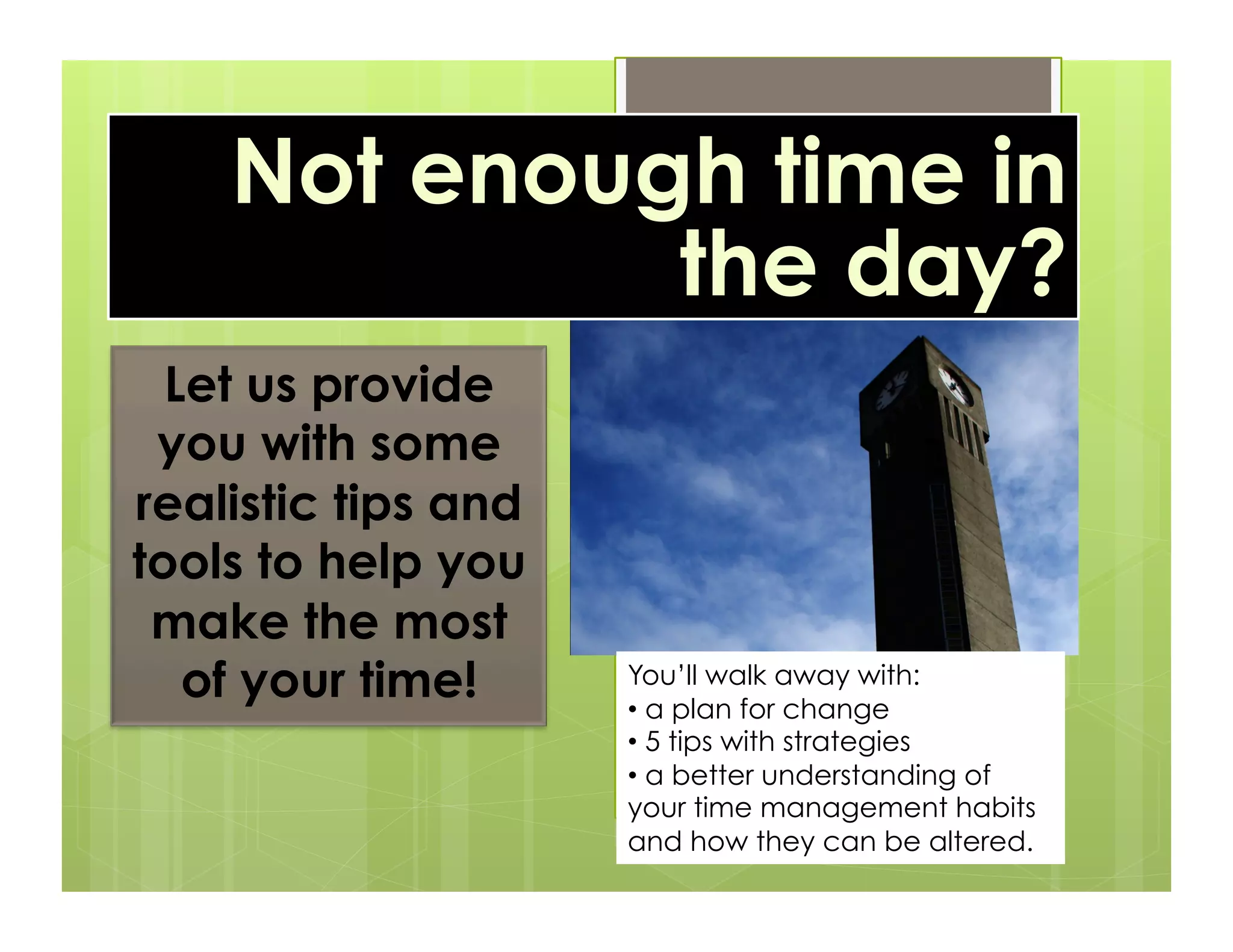
Let us provide
 you with some
realistic tips and
tools to help you
 make the most
   of your time!     You’ll walk away with:
                     •  a plan for change
                     •  5 tips with strategies
                     •  a better understanding of
                     your time management habits
                     and how they can be altered.
Think About It…
Let’s         We all struggle with

real   be     managing our time and
    istic     NO system is fool proof.
          …   As university students
              we don’t have the time
              to implement the often
              complicated advice of
              “experts.”

              So what are some tips
              we can use to change
              our habits and make
              our lives easier?
Tip 1: Visualize
success.

   Imagine someone who is really great
   at time management. What are they
   doing? How do they use their time?

   What personal qualities do you think
   are important to good time
   management?
Tip 2: Deal With
Procrastination
Some examples of how students
 procrastinate:
  Wasted time online
  Promises to work for an hour – but
  no follow through
  Being in an environment full of
  distractions
So how do we get around this?
Almost nobody can avoid procrastination entirely but we
  can lessen how much we procrastinate. Here are some
  helpful tips to consider:

      Turn off your cell phone. Everyone will still be there
       when you turn it back on.

      If you can, disconnect your internet (unless you need it
       for study).

      Choose a quiet environment where distractions are
       limited and don’t study for too long- one hour of
       focused studying/work is better than 5 hours of
       strained, unfocused effort.
Tip 3: Get Organized!
 Some examples of disorganization:
   Don’t remember due dates- didn’t write them
    down.
   Leaving big assignments to the last minute.
   No consistent way to keep track of
    assignments details, ideas, resources.


 Getting organized in a way that makes
  sense to you is the first step to relieving
  some stress!
Writing Things Down/Organizing
  Find a calendar, any calendar or
  organizer will do (digital or paper). This
  will be your master list.

  Carryaround a small notebook, scrap of
  paper or a notes app for your phone.
  Throughout your day, note down little
  reminders, ideas, resources that you
  come across.

 An example would be: “History Paper due
Sept. 30th”, “birthday gift for Harry”,
Dwight’s party on Saturday night.
But what do I do with all of
these lists?
          At
            the end of the day, take all the things
          you wrote down and transfer them to your
          calendar or organizer

          Writedown when you would like to
          accomplish the task but don’t go too
          crazy… don’t set yourself up for failure by
          trying to do too much in one time slot.

          Spacing things out makes actually doing
          them much easier. Chunk out the work for
          big assignments into smaller bits with
          deadlines for each. Our Assignment
          Calculator can help with this!
Tip 4: Study smarter – not harder!
    *Carry a book or an article
    that you need to read
    around with you and
    make use of time between
    classes to read.              *Find a few different
                                  quiet study areas around
                                  campus and your house
    *Study alone! Often we        so that you can get
    feel the need to study with   away from distractions
    friends but ask yourself      while also not getting
    “how much studying to I       bored of going to the
    actually get done with        same place everyday.
    friends?”- there is no
    substitute for quiet,
    focused study time
Tip 5: Be social!          Ha rd,
                     W ork rd!
                       lay Ha
                     P
                    You don’t have to give
                    up your social life to
                    be a good student.
                    Consider the social
                    events and habits that
                    are important for you
                    and add these into
                    your calendar.
Let’s Pause Here…
 Take a moment to think back on
 what we’ve talked about so far…

Tip 1: Visualize success.

Tip 2: Deal with procrastination.

Tip 3: Get organized

Tip 4: Study smarter, not harder.

Tip 5: Be social.
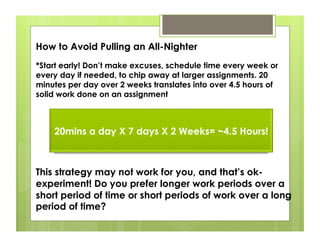
How to Avoid Pulling an All-Nighter
*Start early! Don’t make excuses, schedule time every week or
every day if needed, to chip away at larger assignments. 20
minutes per day over 2 weeks translates into over 4.5 hours of
solid work done on an assignment


    20mins a day X 7 days X 2 Weeks= ~4.5 Hours!


This strategy may not work for you, and that’s ok-
experiment! Do you prefer longer work periods over a
short period of time or short periods of work over a long
period of time?
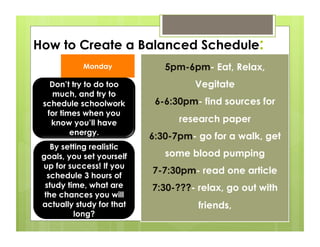
How to Create a Balanced Schedule:
            Monday            5pm-6pm- Eat, Relax,
   Don’t try to do too              Vegitate
   much, and try to
 schedule schoolwork        6-6:30pm- find sources for
  for times when you
   know you’ll have              research paper
         energy.
                           6:30-7pm- go for a walk, get
    By setting realistic
 goals, you set yourself      some blood pumping
 up for success! If you
   schedule 3 hours of
                           7-7:30pm- read one article
  study time, what are     7:30-???- relax, go out with
  the chances you will
 actually study for that             friends,
          long?
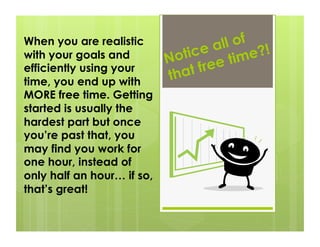
When you are realistic
                                   e al l of !
with your goals and         N otic e time?
efficiently using your
                            tha  t fre
time, you end up with
MORE free time. Getting
started is usually the
hardest part but once
you’re past that, you
may find you work for
one hour, instead of
only half an hour… if so,
that’s great!
Still feeling unsure?
   Talk to your professor or TA
   Talk to a Peer Academic Coach in the Chapman
    Learning Commons
   Talk to someone over in Counselling Services in
    Brock Hall
   Use the Assignment Calculator under the ‘What
    We Offer’ tab

   There
        are many other great resources listed at the
   bottom of this page

Time management toolkit

  • 1.
    Let us provide you with some realistic tips and tools to help you make the most of your time! You’ll walk away with: •  a plan for change •  5 tips with strategies •  a better understanding of your time management habits and how they can be altered.
  • 2.
  • 3.
    Let’s We all struggle with real be managing our time and istic NO system is fool proof. … As university students we don’t have the time to implement the often complicated advice of “experts.” So what are some tips we can use to change our habits and make our lives easier?
  • 4.
    Tip 1: Visualize success. Imagine someone who is really great at time management. What are they doing? How do they use their time? What personal qualities do you think are important to good time management?
  • 5.
    Tip 2: DealWith Procrastination Some examples of how students procrastinate:  Wasted time online  Promises to work for an hour – but no follow through  Being in an environment full of distractions
  • 6.
    So how dowe get around this? Almost nobody can avoid procrastination entirely but we can lessen how much we procrastinate. Here are some helpful tips to consider:   Turn off your cell phone. Everyone will still be there when you turn it back on.   If you can, disconnect your internet (unless you need it for study).   Choose a quiet environment where distractions are limited and don’t study for too long- one hour of focused studying/work is better than 5 hours of strained, unfocused effort.
  • 7.
    Tip 3: GetOrganized! Some examples of disorganization:   Don’t remember due dates- didn’t write them down.   Leaving big assignments to the last minute.   No consistent way to keep track of assignments details, ideas, resources. Getting organized in a way that makes sense to you is the first step to relieving some stress!
  • 8.
    Writing Things Down/Organizing  Find a calendar, any calendar or organizer will do (digital or paper). This will be your master list.   Carryaround a small notebook, scrap of paper or a notes app for your phone. Throughout your day, note down little reminders, ideas, resources that you come across. An example would be: “History Paper due Sept. 30th”, “birthday gift for Harry”, Dwight’s party on Saturday night.
  • 9.
    But what doI do with all of these lists?   At the end of the day, take all the things you wrote down and transfer them to your calendar or organizer   Writedown when you would like to accomplish the task but don’t go too crazy… don’t set yourself up for failure by trying to do too much in one time slot.   Spacing things out makes actually doing them much easier. Chunk out the work for big assignments into smaller bits with deadlines for each. Our Assignment Calculator can help with this!
  • 10.
    Tip 4: Studysmarter – not harder! *Carry a book or an article that you need to read around with you and make use of time between classes to read. *Find a few different quiet study areas around campus and your house *Study alone! Often we so that you can get feel the need to study with away from distractions friends but ask yourself while also not getting “how much studying to I bored of going to the actually get done with same place everyday. friends?”- there is no substitute for quiet, focused study time
  • 11.
    Tip 5: Besocial! Ha rd, W ork rd! lay Ha P You don’t have to give up your social life to be a good student. Consider the social events and habits that are important for you and add these into your calendar.
  • 12.
    Let’s Pause Here… Take a moment to think back on what we’ve talked about so far… Tip 1: Visualize success. Tip 2: Deal with procrastination. Tip 3: Get organized Tip 4: Study smarter, not harder. Tip 5: Be social.
  • 13.
    How to AvoidPulling an All-Nighter *Start early! Don’t make excuses, schedule time every week or every day if needed, to chip away at larger assignments. 20 minutes per day over 2 weeks translates into over 4.5 hours of solid work done on an assignment 20mins a day X 7 days X 2 Weeks= ~4.5 Hours! This strategy may not work for you, and that’s ok- experiment! Do you prefer longer work periods over a short period of time or short periods of work over a long period of time?
  • 14.
    How to Createa Balanced Schedule: Monday 5pm-6pm- Eat, Relax, Don’t try to do too Vegitate much, and try to schedule schoolwork 6-6:30pm- find sources for for times when you know you’ll have research paper energy. 6:30-7pm- go for a walk, get By setting realistic goals, you set yourself some blood pumping up for success! If you schedule 3 hours of 7-7:30pm- read one article study time, what are 7:30-???- relax, go out with the chances you will actually study for that friends, long?
  • 15.
    When you arerealistic e al l of ! with your goals and N otic e time? efficiently using your tha t fre time, you end up with MORE free time. Getting started is usually the hardest part but once you’re past that, you may find you work for one hour, instead of only half an hour… if so, that’s great!
  • 16.
    Still feeling unsure?   Talk to your professor or TA   Talk to a Peer Academic Coach in the Chapman Learning Commons   Talk to someone over in Counselling Services in Brock Hall   Use the Assignment Calculator under the ‘What We Offer’ tab   There are many other great resources listed at the bottom of this page

Editor's Notes

  • #5 Question: What personal qualities do you want to develop to improve your time management?
  • #11 Identify a good study space and a time slot each day.... (add this to your calendar to make it a commitment to yourself).
  • #12 What are the important social events and habits that you need to have time for?