NIT PATNA ENVIRONMENTAL SCIENCE SAVE THE  TIGER
Tiger  poaching Presented  by :  Uttam Kumar  (304/08) Pankaj Kumar  (305/08) Rupasha Rani  (306/08) Sujeet Kumar  (308/08) Rahul Kumar  (309/08) Mukesh Kumar  (310/08) Ranjeet Rana  (311/08) Pradeep Kumar  (312/08) Raman Kumar  (313/08)
Scientific Name :  Panthera tigris Class :  Mammalia Order :  Carnivora Family :  Felidae Estimated Remaining Population :  < 3,000 The Indian Tiger - Quick Facts
HISTORY Harappan   seals from  Indus Valley  Civilization and  Rock Paintings   of  Warli tribe  bears testimony to the presence of tigers since human civilization. It is believed that tigers evolved in northern China and Far East Asia approximately two million years ago. They then migrated through woodlands and along river systems into southwest Asia. In the south and southeast directions, tigers moved through continental southeast Asia, crossing into the Indonesian islands before they separated from mainland, and finally reached India.
2.  Habitat and Distribution :   In India, the tiger is found practically throughout the country, from the  Himalayas  to  Cape Comorin , except in Punjab, Kutch and the deserts of Rajasthan. In the northeast, its range extends into Burma. Tigers occupy a variety of habitats including tropical  evergreen  forests,  deciduous  forests,  mangrove  swamps,  thorn   forests and  grass  jungles.  3.Behavioural Characteristics :  Tigers are usually  solitary , except for females with cubs. They are territorial and males have discrete territories overlapping those of several females. Male territories are  mate oriented  while those of females are more  resource   oriented . Tigers use scent (spraying urine on the trees or other vegetation or deposited on a scrape), scratch (marking on tree trunks with claws) and scrape marks on the ground to maintain contact and advertise their presence to others.
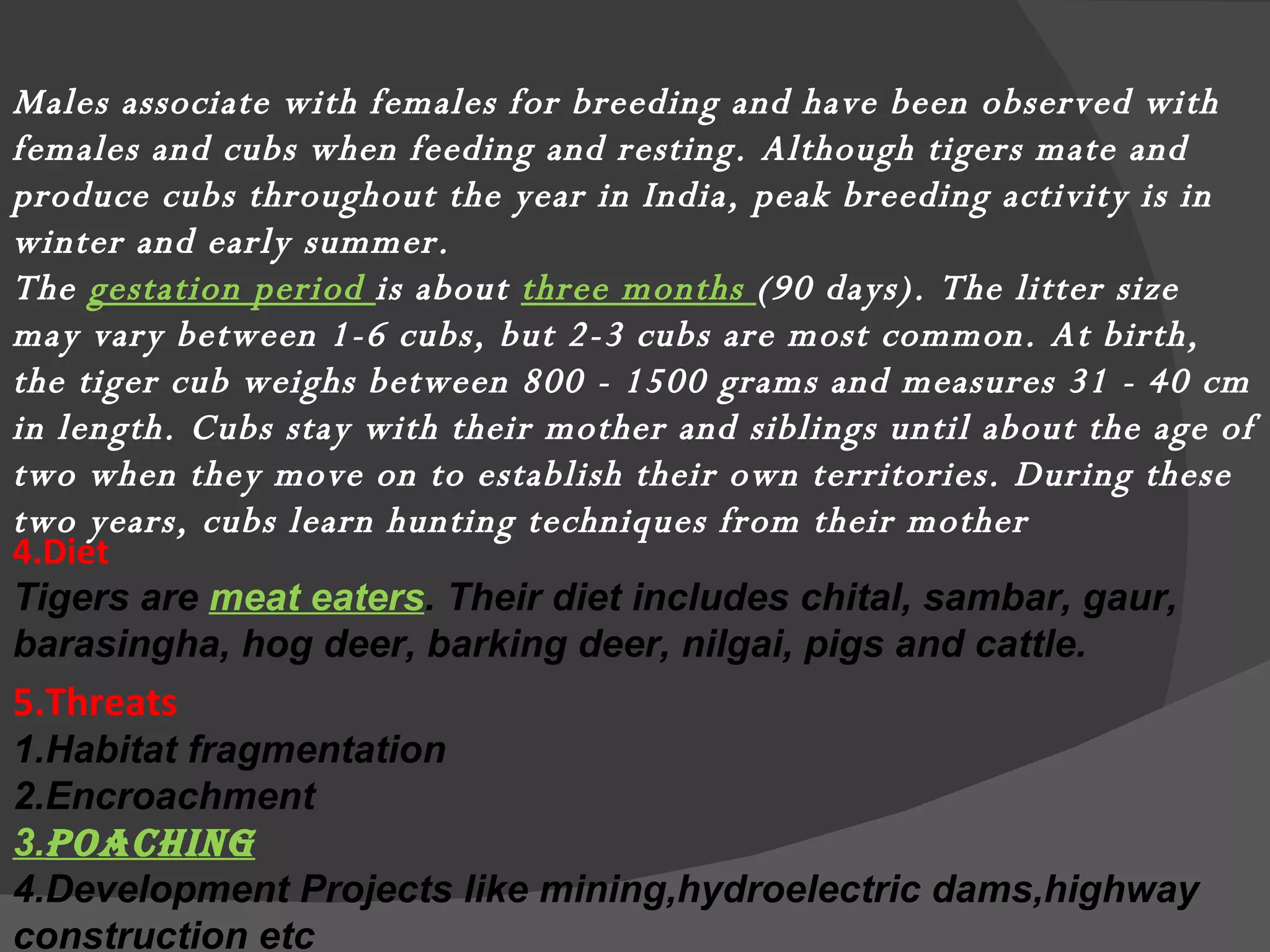
Males associate with females for breeding and have been observed with females and cubs when feeding and resting. Although tigers mate and produce cubs throughout the year in India, peak breeding activity is in winter and early summer.  The  gestation period  is about  three months  (90 days). The litter size may vary between 1-6 cubs, but 2-3 cubs are most common. At birth, the tiger cub weighs between 800 - 1500 grams and measures 31 - 40 cm in length. Cubs stay with their mother and siblings until about the age of two when they move on to establish their own territories. During these two years, cubs learn hunting techniques from their mother 4.Diet Tigers are  meat eaters . Their diet includes chital, sambar, gaur, barasingha, hog deer, barking deer, nilgai, pigs and cattle. 5.Threats 1.Habitat fragmentation 2.Encroachment 3. Poaching 4.Development Projects like mining,hydroelectric dams,highway construction etc
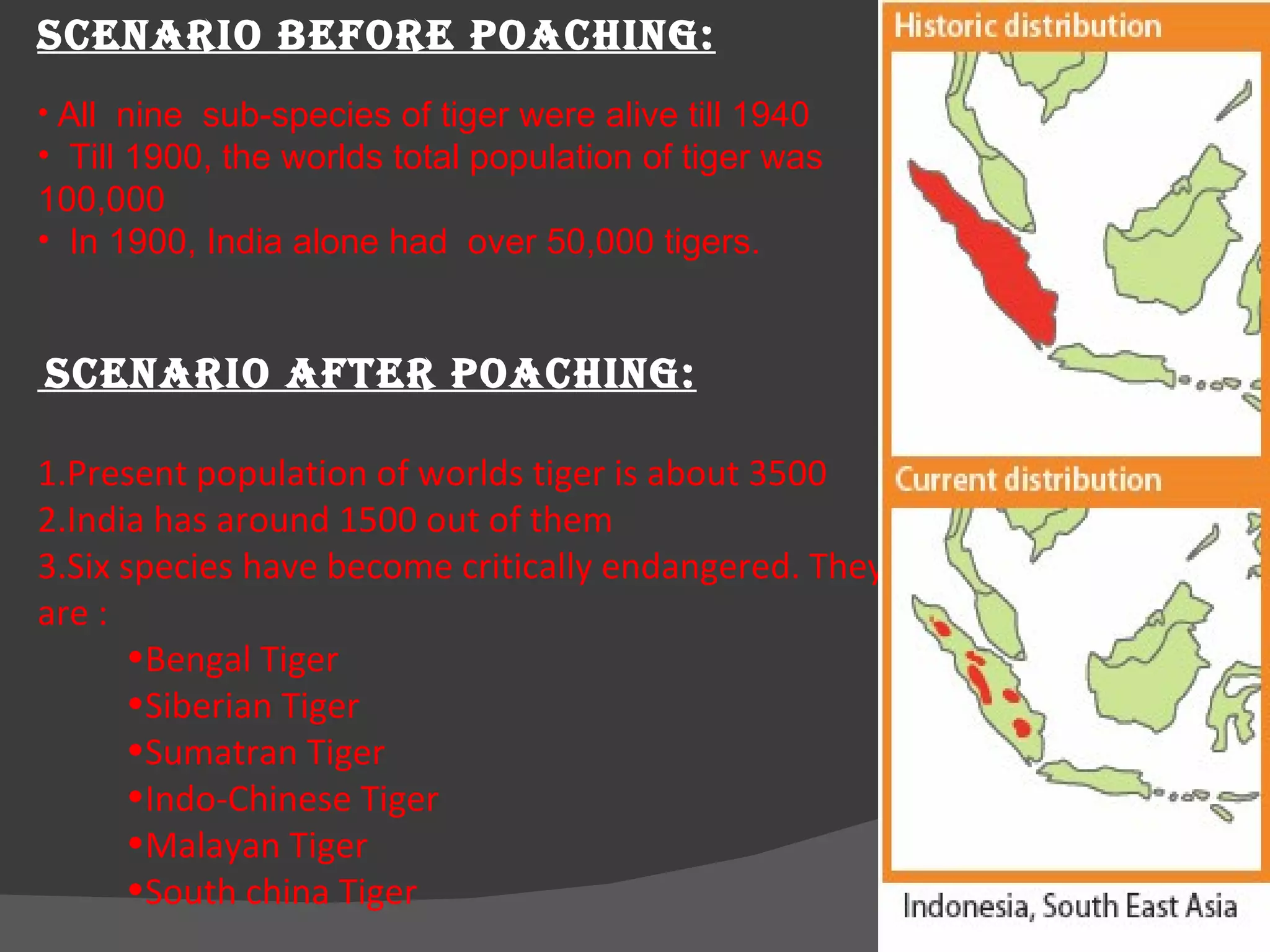
SCENARIO BEFORE POACHING: All  nine  sub-species of tiger were alive till 1940 Till 1900, the worlds total population of tiger was 100,000 In 1900, India alone had  over 50,000 tigers. SCENARIO AFTER POACHING: 1.Present population of worlds tiger is about 3500 2.India has around 1500 out of them 3.Six species have become critically endangered. They are : Bengal Tiger Siberian Tiger Sumatran Tiger Indo-Chinese Tiger Malayan Tiger South china Tiger
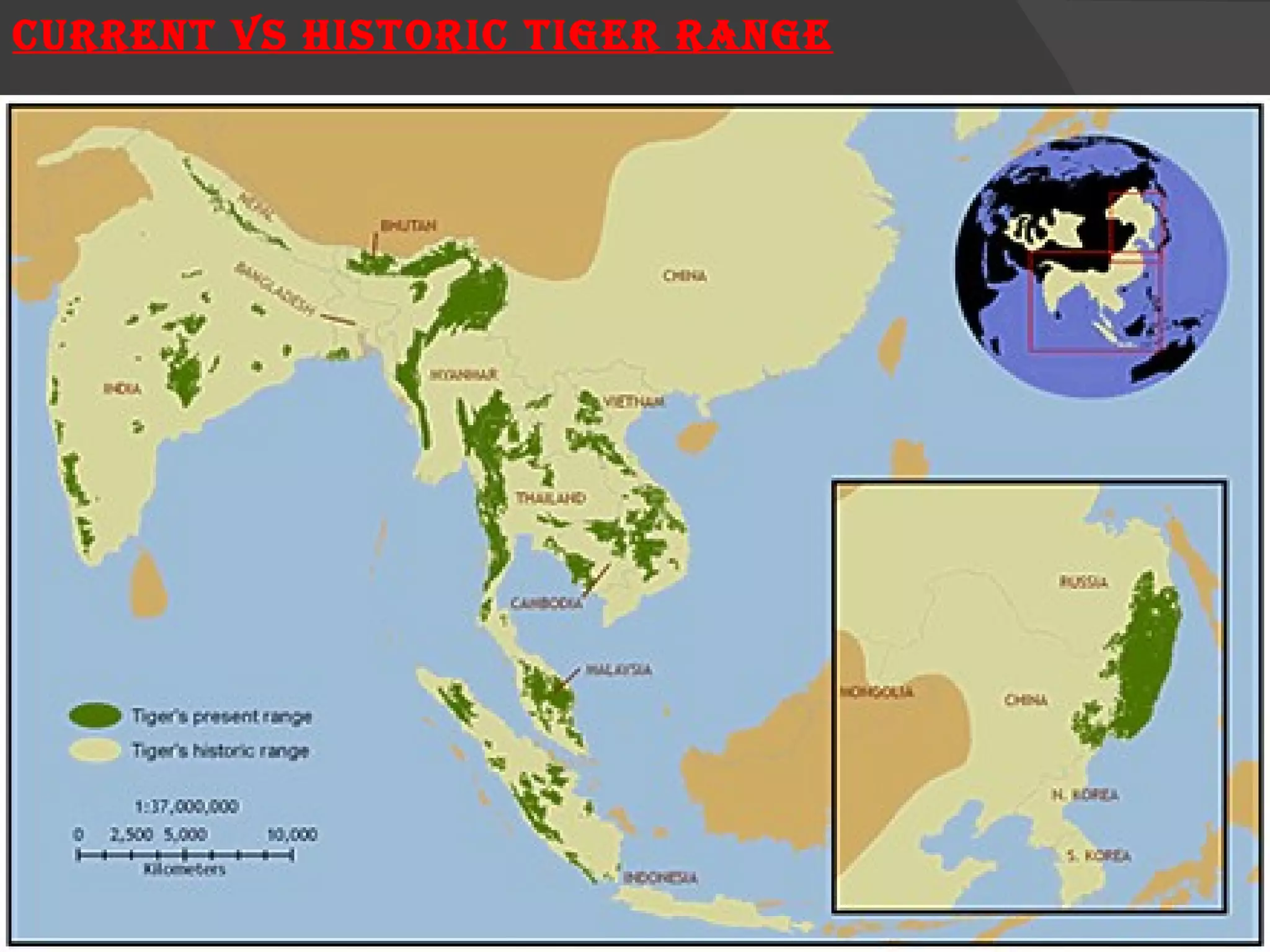
CURRENT VS HISTORIC TIGER RANGE
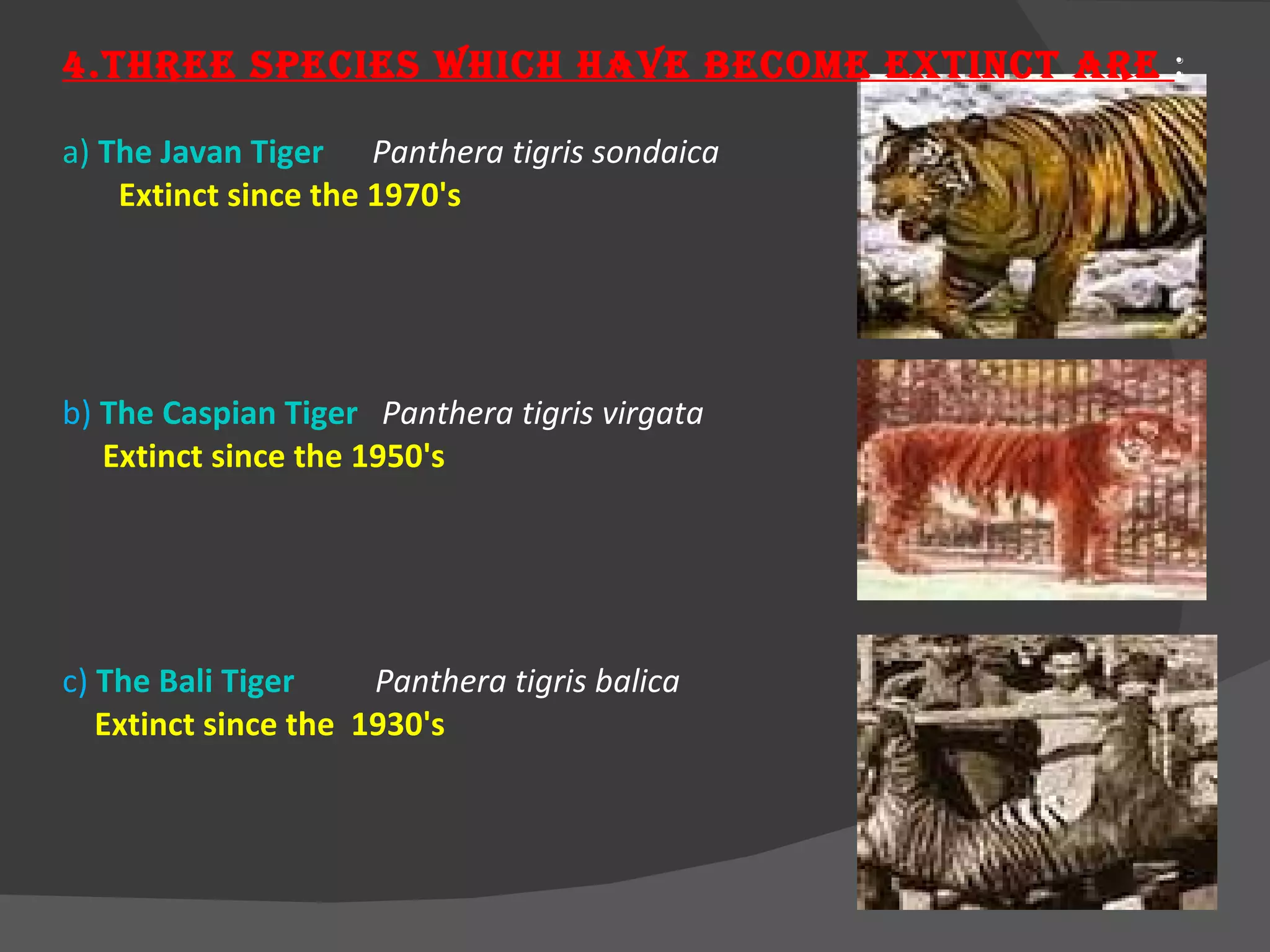
4.Three species which have become extinct are  : a)  The Javan Tiger   Panthera tigris sondaica Extinct since the 1970's b)  The Caspian Tiger   Panthera tigris virgata  Extinct since the 1950's c)   The Bali Tiger   Panthera tigris balica  Extinct since the  1930's
CAUSES OF POACHING: 1.MYTHS:  a)eating tigers  brain   will cure  pimples  and  laziness b)eating tigers  whiskers  will prevent  toothaches c)eating tigers  nose  will cure  epilepsy 2.APHRODISIACS: Eating dried tiger  penis  i mproves  male stamina   like Viagra and even lead to larger penis .This effect increases if these concocktions are created from  white tiger  penis. 3.HIGHLY  PROFITABLE  TRADE: a)  As per one estimate (1999) 10 gms. of tiger bones fetch a price of US$ 24.25 at the China-Vietnam border, i.e above Rs. 1 lakhs per kg. b) In Hong Kong black markets, venders sell a pound of powdered tiger humorous bone for over $1700. c)Lucrative market because traders pay only about $15 to each poacher and just 3-4 poachers are needed to poach a tiger. *IT MUST BE KEPT IN MIND THAT  THESE TREATMENTS ARE COMPLETELY UNPROVEN BY SCIENCE AND HAVE NO MEDICINAL VALUE.
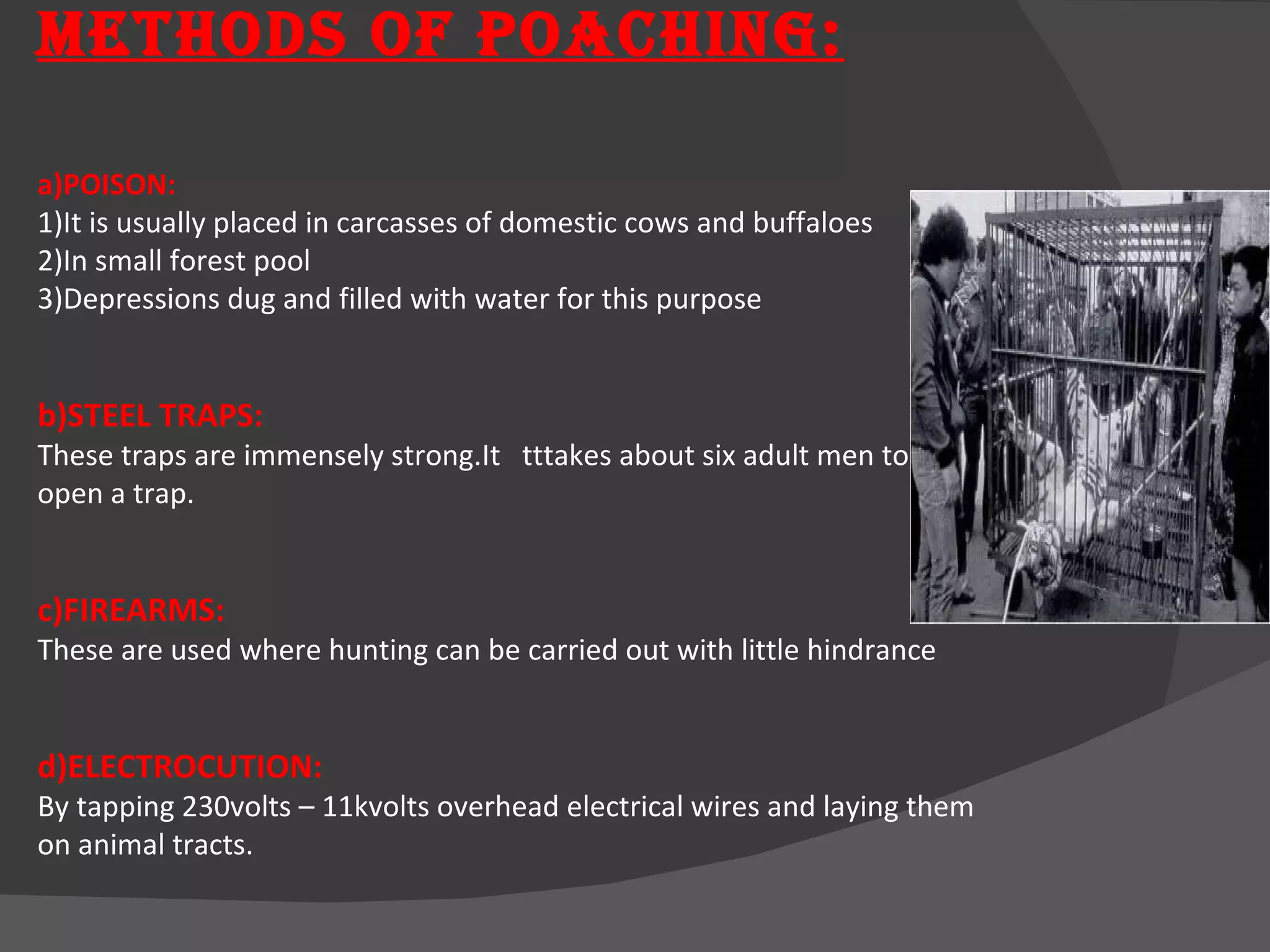
METHODS OF POACHING: a)POISON: 1)It is usually placed in carcasses of domestic cows and buffaloes  2)In small forest pool 3)Depressions dug and filled with water for this purpose b)STEEL TRAPS: These traps are immensely strong.It  tttakes about six adult men to  open a trap. c)FIREARMS: These are used where hunting can be carried out with little hindrance d)ELECTROCUTION: By tapping 230volts – 11kvolts overhead electrical wires and laying them  on animal tracts.
PREVENTIVE MEASURES: a)  Project Tiger  was lanched with much fanfare in  1973   due to which tiger reserves have increased from  9 to 37 b) The  Wiidlife (Protection) Act , 1972  was enacted to protect them(amended  in 1983,1986 and1991) c) The  Forest Conservation Act , 1980  was enacted to protect them. d) Out of 37 reserves  ,  special forces  are deployed for 13 and policies are under formulation to cover all   of them. e) A goal of  17 tigers per 100 sq km  of Project tiger area in Kazirangz and Corbett parks and 10 in others  have been set. f) Poaching has been made an  illegal offence  .There is a mandatory  imprisonment  of  three  years which may extend upto seven years.There is  a provision of  fine   also.
 
THANK YOU FOR  CREATING AWARENESS ABOUT MY LIFE AND EXTINCTION

Tiger Poaching

  • 1.
    NIT PATNA ENVIRONMENTALSCIENCE SAVE THE TIGER
  • 2.
    Tiger poachingPresented by : Uttam Kumar (304/08) Pankaj Kumar (305/08) Rupasha Rani (306/08) Sujeet Kumar (308/08) Rahul Kumar (309/08) Mukesh Kumar (310/08) Ranjeet Rana (311/08) Pradeep Kumar (312/08) Raman Kumar (313/08)
  • 3.
    Scientific Name : Panthera tigris Class : Mammalia Order : Carnivora Family : Felidae Estimated Remaining Population : < 3,000 The Indian Tiger - Quick Facts
  • 4.
    HISTORY Harappan seals from Indus Valley Civilization and Rock Paintings of Warli tribe bears testimony to the presence of tigers since human civilization. It is believed that tigers evolved in northern China and Far East Asia approximately two million years ago. They then migrated through woodlands and along river systems into southwest Asia. In the south and southeast directions, tigers moved through continental southeast Asia, crossing into the Indonesian islands before they separated from mainland, and finally reached India.
  • 5.
    2. Habitatand Distribution : In India, the tiger is found practically throughout the country, from the Himalayas to Cape Comorin , except in Punjab, Kutch and the deserts of Rajasthan. In the northeast, its range extends into Burma. Tigers occupy a variety of habitats including tropical evergreen forests, deciduous forests, mangrove swamps, thorn forests and grass jungles. 3.Behavioural Characteristics : Tigers are usually solitary , except for females with cubs. They are territorial and males have discrete territories overlapping those of several females. Male territories are mate oriented while those of females are more resource oriented . Tigers use scent (spraying urine on the trees or other vegetation or deposited on a scrape), scratch (marking on tree trunks with claws) and scrape marks on the ground to maintain contact and advertise their presence to others.
  • 6.
    Males associate withfemales for breeding and have been observed with females and cubs when feeding and resting. Although tigers mate and produce cubs throughout the year in India, peak breeding activity is in winter and early summer. The gestation period is about three months (90 days). The litter size may vary between 1-6 cubs, but 2-3 cubs are most common. At birth, the tiger cub weighs between 800 - 1500 grams and measures 31 - 40 cm in length. Cubs stay with their mother and siblings until about the age of two when they move on to establish their own territories. During these two years, cubs learn hunting techniques from their mother 4.Diet Tigers are meat eaters . Their diet includes chital, sambar, gaur, barasingha, hog deer, barking deer, nilgai, pigs and cattle. 5.Threats 1.Habitat fragmentation 2.Encroachment 3. Poaching 4.Development Projects like mining,hydroelectric dams,highway construction etc
  • 7.
    SCENARIO BEFORE POACHING:All nine sub-species of tiger were alive till 1940 Till 1900, the worlds total population of tiger was 100,000 In 1900, India alone had  over 50,000 tigers. SCENARIO AFTER POACHING: 1.Present population of worlds tiger is about 3500 2.India has around 1500 out of them 3.Six species have become critically endangered. They are : Bengal Tiger Siberian Tiger Sumatran Tiger Indo-Chinese Tiger Malayan Tiger South china Tiger
  • 8.
  • 9.
    4.Three species whichhave become extinct are : a) The Javan Tiger Panthera tigris sondaica Extinct since the 1970's b) The Caspian Tiger Panthera tigris virgata Extinct since the 1950's c) The Bali Tiger Panthera tigris balica Extinct since the 1930's
  • 10.
    CAUSES OF POACHING:1.MYTHS: a)eating tigers brain will cure pimples and laziness b)eating tigers whiskers will prevent toothaches c)eating tigers nose will cure epilepsy 2.APHRODISIACS: Eating dried tiger penis i mproves male stamina like Viagra and even lead to larger penis .This effect increases if these concocktions are created from white tiger penis. 3.HIGHLY PROFITABLE TRADE: a) As per one estimate (1999) 10 gms. of tiger bones fetch a price of US$ 24.25 at the China-Vietnam border, i.e above Rs. 1 lakhs per kg. b) In Hong Kong black markets, venders sell a pound of powdered tiger humorous bone for over $1700. c)Lucrative market because traders pay only about $15 to each poacher and just 3-4 poachers are needed to poach a tiger. *IT MUST BE KEPT IN MIND THAT THESE TREATMENTS ARE COMPLETELY UNPROVEN BY SCIENCE AND HAVE NO MEDICINAL VALUE.
  • 11.
    METHODS OF POACHING:a)POISON: 1)It is usually placed in carcasses of domestic cows and buffaloes 2)In small forest pool 3)Depressions dug and filled with water for this purpose b)STEEL TRAPS: These traps are immensely strong.It tttakes about six adult men to open a trap. c)FIREARMS: These are used where hunting can be carried out with little hindrance d)ELECTROCUTION: By tapping 230volts – 11kvolts overhead electrical wires and laying them on animal tracts.
  • 12.
    PREVENTIVE MEASURES: a) Project Tiger was lanched with much fanfare in 1973 due to which tiger reserves have increased from 9 to 37 b) The Wiidlife (Protection) Act , 1972 was enacted to protect them(amended in 1983,1986 and1991) c) The Forest Conservation Act , 1980 was enacted to protect them. d) Out of 37 reserves , special forces are deployed for 13 and policies are under formulation to cover all of them. e) A goal of 17 tigers per 100 sq km of Project tiger area in Kazirangz and Corbett parks and 10 in others have been set. f) Poaching has been made an illegal offence .There is a mandatory imprisonment of three years which may extend upto seven years.There is a provision of fine also.
  • 13.
  • 14.
    THANK YOU FOR CREATING AWARENESS ABOUT MY LIFE AND EXTINCTION

Editor's Notes

  • #6 2. Habitat and Distribution: In India, the tiger is found practically throughout the country, from the Himalayas to Cape Comorin, except in Punjab, Kutch and the deserts of Rajasthan. In the northeast, its range extends into Burma. Tigers occupy a variety of habitats including tropical evergreen forests, deciduous forests, mangrove swamps, thorn forests and grass jungles.