CASE STUDY
TIANJIN PLASTIC-FINANCING DECISION
PRESENTED BY: GROUP No.2
Rina Navadia (22-F-251)
Mehul Jain (22-F-232)
Sajith Nadar (22-F-353)
Prajakta Parkar (22-F-304)
Daksha Joshi (22-F-233)
Vinayak Phansekar (22-F-310)
Varsha Parmar (22-F-305)
Rupesh Sable (22-F-318)
Mahesh Pujari (22-F-312)
Vaibhav Sapkal (22-F-320)
Priyanka Metre (22-F-248)
Nidhi Singh (22-F-337)
Rupesh Shinde (22-F-333)
PART A:
SUMMARY OF CASE 1
FACTS OF CASE 2
PART B:
QUESTIONS & ANSWERS 6-21
TABLE OF CONTENTS
TIANJIN PLASTIC CASE
PART A: SUMMARY:
This is a sample text. Insert your desired text
here. This is a sample text. Insert your
desired text here. This is a sample text. This
is a sample text. Insert your desired text here.
Company Vision
This is a sample text. Insert your desired text
here. This is a sample text. Insert your
desired text here. This is a sample text. This
is a sample text. Insert your desired text here.
Presenter: Rina Navadia (22-F-251)
1
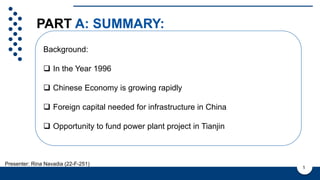
Background:
 In the Year 1996
 Chinese Economy is growing rapidly
 Foreign capital needed for infrastructure in China
 Opportunity to fund power plant project in Tianjin
PART A: SUMMARY:
This is a sample text. Insert your desired text
here. This is a sample text. Insert your
desired text here. This is a sample text. This
is a sample text. Insert your desired text here.
Company Vision
This is a sample text. Insert your desired text
here. This is a sample text. Insert your
desired text here. This is a sample text. This
is a sample text. Insert your desired text here.
Presenter: Rina Navadia (22-F-251)
2
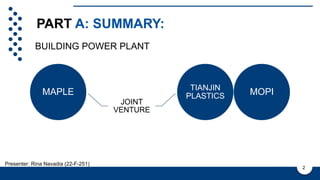
MAPLE
JOINT
VENTURE
TIANJIN
PLASTICS MOPI
BUILDING POWER PLANT
PART A: SUMMARY:
This is a sample text. Insert your desired text
here. This is a sample text. Insert your
desired text here. This is a sample text. This
is a sample text. Insert your desired text here.
Company Vision
This is a sample text. Insert your desired text
here. This is a sample text. Insert your
desired text here. This is a sample text. This
is a sample text. Insert your desired text here.
Presenter: Rina Navadia (22-F-251)
3
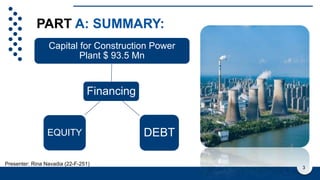
Financing
Capital for Construction Power
Plant $ 93.5 Mn
DEBT
EQUITY
PART A: SUMMARY:
This is a sample text. Insert your desired text
here. This is a sample text. Insert your
desired text here. This is a sample text. This
is a sample text. Insert your desired text here.
Company Vision
This is a sample text. Insert your desired text
here. This is a sample text. Insert your
desired text here. This is a sample text. This
is a sample text. Insert your desired text here.
Presenter: Rina Navadia (22-F-251)
4
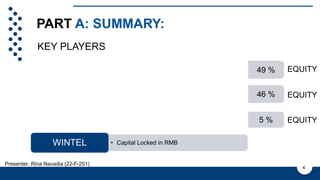
KEY PLAYERS
• Capital Locked in RMB
WINTEL
49 %
46 %
5 %
EQUITY
EQUITY
EQUITY
PART A: FEW FACTS:
TEXT.
Company Vision
5
Presenter: Rina Navadia (22-F-251)
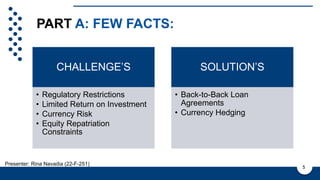
CHALLENGE’S
• Regulatory Restrictions
• Limited Return on Investment
• Currency Risk
• Equity Repatriation
Constraints
SOLUTION’S
• Back-to-Back Loan
Agreements
• Currency Hedging
PART B: QUESTIONS & ANSWERS
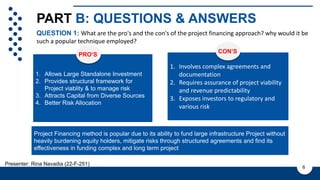
1. Allows Large Standalone Investment
2. Provides structural framework for
Project viablity & to manage risk
3. Attracts Capital from Diverse Sources
4. Better Risk Allocation This is a sample text. Insert your desired text
here. This is a sample text. Insert your
desired text here. This is a sample text. This
is a sample text. Insert your desired text here.
PROS
PRO’S
QUESTION 1: What are the pro's and the con's of the project financing approach? why would it be
such a popular technique employed?
6
1. Involves complex agreements and
documentation
2. Requires assurance of project viability
and revenue predictability
3. Exposes investors to regulatory and
various risk
CON’S
Project Financing method is popular due to its ability to fund large infrastructure Project without
heavily burdening equity holders, mitigate risks through structured agreements and find its
effectiveness in funding complex and long term project
Presenter: Rina Navadia (22-F-251)
PART B: QUESTIONS & ANSWERS
Company Vision
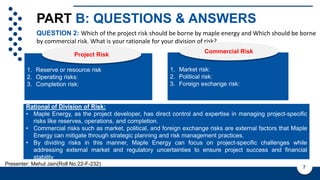
QUESTION 2: Which of the project risk should be borne by maple energy and Which should be borne
by commercial risk. What is your rationale for your division of risk?
7
Presenter: Mehul Jain(Roll No:22-F-232)
1. Reserve or resource risk
2. Operating risks:
3. Completion risk:
PROS
Project Risk
1. Market risk:
2. Political risk:
3. Foreign exchange risk:
Commercial Risk
Rational of Division of Risk:
• Maple Energy, as the project developer, has direct control and expertise in managing project-specific
risks like reserves, operations, and completion.
• Commercial risks such as market, political, and foreign exchange risks are external factors that Maple
Energy can mitigate through strategic planning and risk management practices.
• By dividing risks in this manner, Maple Energy can focus on project-specific challenges while
addressing external market and regulatory uncertainties to ensure project success and financial
stability
PART B: QUESTIONS & ANSWERS
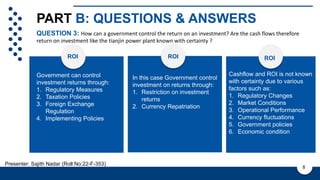
Government can control
investment returns through:
1. Regulatory Measures
2. Taxation Policies
3. Foreign Exchange
Regulation
4. Implementing Policies
GOVT CONTROL ON ROI
QUESTION 3: How can a government control the return on an investment? Are the cash flows therefore
return on investment like the tianjin power plant known with certainty ?
8
ROI
Presenter: Sajith Nadar (Roll No:22-F-353)
In this case Government control
investment on returns through:
1. Restriction on investment
returns
2. Currency Repatriation
Cashflow and ROI is not known
with certainty due to various
factors such as:
1. Regulatory Changes
2. Market Conditions
3. Operational Performance
4. Currency fluctuations
5. Government policies
6. Economic condition
ROI ROI
PART B: QUESTIONS & ANSWERS
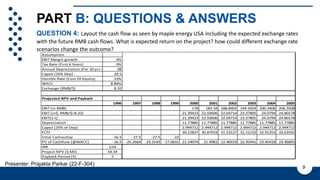
QUESTION 4: Layout the cash flow as seen by maple energy USA including the expected exchange rates
with the future RMB cash flows. What is expected return on the project? how could different exchange rate
scenarios change the outcome?
9
Presenter: Prajakta Parkar (22-F-304)
Assumption
EBIT Margin growth 3%
Tax Rate (First 6 Years) 0%
Annual Depreciation (For 10 yrs in RMB Mil)
98
Capex (25% Dep) 24.5
Hurrdle Rate (Cost Of Equity) 15%
WACC 8.84%
Exchange (RMB/$) 8.32
Projected NPV and Payback
1996 1997 1998 1999 2000 2001 2002 2003 2004 2005
EBIT (in RMB) 178 183.34 188.8402 194.5054 200.3406 206.3508
EBIT (in$, RMB/$=8.32) 21.39423 22.03606 22.69714 23.37805 24.0794 24.80178
EBIT(1-t) 21.39423 22.03606 22.69714 23.37805 24.0794 24.80178
Depreciation 11.77885 11.77885 11.77885 11.77885 11.77885 11.77885
Capex (25% of Dep) 2.944712 2.944712 2.944712 2.944712 2.944712 2.944712
FCFF 30.22837 30.87019 31.53127 32.21219 32.91353 33.63591
Intial Cashoutlay -16.5 -27.5 -27.5 -22
PV of Cashflow (@WACC) -16.5 -25.2664 -23.2143 -17.0631 21.54074 21.9981 22.46919 22.95441 23.45418 23.96895
IRR 11%
Project NPV ($ Mil) 54.34
Payback Period (Y) 5
PART B: QUESTIONS & ANSWERS
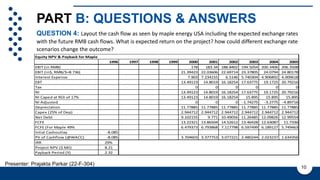
QUESTION 4: Layout the cash flow as seen by maple energy USA including the expected exchange rates
with the future RMB cash flows. What is expected return on the project? how could different exchange rate
scenarios change the outcome?
10
Presenter: Prajakta Parkar (22-F-304)
1996 1997 1998 1999 2000 2001 2002 2003 2004 2005
EBIT (in RMB) 178 183.34 188.8402 194.5054 200.3406 206.3508
EBIT (in$, RMB/$=8.736) 21.39423 22.03606 22.69714 23.37805 24.0794 24.80178
Interest Expense 7.903 7.234155 6.5146 5.740304 4.906892 4.009618
EBT 13.49123 14.8019 16.18254 17.63775 19.1725 20.79216
Tax 0 0 0 0 0 0
NI 13.49123 14.8019 16.18254 17.63775 19.1725 20.79216
NI Caped at ROI of 17% 13.49123 14.8019 16.18254 15.895 15.895 15.895
NI Adjusted 0 0 0 -1.74275 -3.2775 -4.89716
Depreciation 11.77885 11.77885 11.77885 11.77885 11.77885 11.77885
Capex (25% of Dep) 2.944712 2.944712 2.944712 2.944712 2.944712 2.944712
Net Debt 9.102155 9.771 10.49056 11.26485 12.09826 12.99554
FCFE 13.22321 13.86504 14.52612 13.46428 12.63087 11.7336
FCFE (For Maple 49% 6.479373 6.793868 7.117798 6.597499 6.189127 5.749463
Intial Cashoutlay -8.085
PV of Cashflow (@WACC) -8.085 3.704603 3.377753 3.077221 2.480244 2.023237 1.634356
IRR 29%
Project NPV ($ Mil) 8.21
Payback Period (Y) 2.32
Equity NPV & Payback for Maple
PART B: QUESTIONS & ANSWERS
QUESTION 5: How is the currency risk related to question of investment repatriation. Do some
solutions offered only handle one problem at the expense of the other
11
Presenter: Daksha Joshi (22-F-233)
Cashflow and ROI is not known
with certainty due to various
factors such as:
1. Regulatory Changes
2. Market Conditions
3. Operational Performance
4. Currency fluctuations
5. Government policies
6. Economic condition
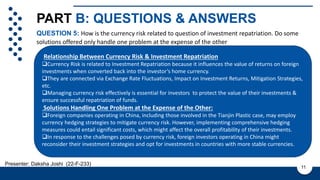
Relationship Between Currency Risk & Investment Repatriation
Currency Risk is related to Investment Repatriation because it influences the value of returns on foreign
investments when converted back into the investor’s home currency.
They are connected via Exchange Rate Fluctuations, Impact on Investment Returns, Mitigation Strategies,
etc.
Managing currency risk effectively is essential for investors to protect the value of their investments &
ensure successful repatriation of funds.
Solutions Handling One Problem at the Expense of the Other:
Foreign companies operating in China, including those involved in the Tianjin Plastic case, may employ
currency hedging strategies to mitigate currency risk. However, implementing comprehensive hedging
measures could entail significant costs, which might affect the overall profitability of their investments.
In response to the challenges posed by currency risk, foreign investors operating in China might
reconsider their investment strategies and opt for investments in countries with more stable currencies.
PART B: QUESTIONS & ANSWERS
QUESTION 6: Evaluate the solutions offered? What would you recommend?
12
Presenter: Vinayak Phansekar (22-F-310)
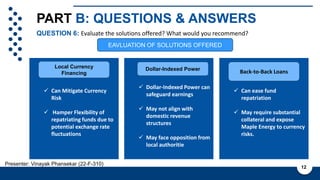
 Can Mitigate Currency
Risk
 Hamper Flexibility of
repatriating funds due to
potential exchange rate
fluctuations
 Dollar-Indexed Power can
safeguard earnings
 May not align with
domestic revenue
structures
 May face opposition from
local authoritie
 Can ease fund
repatriation
 May require substantial
collateral and expose
Maple Energy to currency
risks.
EAVLUATION OF SOLUTIONS OFFERED
Local Currency
Financing
Dollar-Indexed Power
Back-to-Back Loans
PART B: QUESTIONS & ANSWERS
QUESTION 6: Evaluate the solutions offered? What would you recommend?
13
Presenter: Vinayak Phansekar (22-F-310)
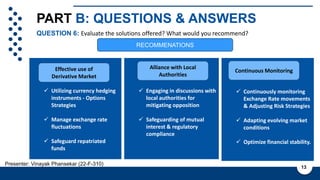
 Utilizing currency hedging
instruments - Options
Strategies
 Manage exchange rate
fluctuations
 Safeguard repatriated
funds
 Engaging in discussions with
local authorities for
mitigating opposition
 Safeguarding of mutual
interest & regulatory
compliance
 Continuously monitoring
Exchange Rate movements
& Adjusting Risk Strategies
 Adapting evolving market
conditions
 Optimize financial stability.
RECOMMENATIONS
Effective use of
Derivative Market
Alliance with Local
Authorities
Continuous Monitoring
PART B: QUESTIONS & ANSWERS
QUESTION 7: What are the typical causes of project failures or problems?
14
Presenter: Varsha Parmar (22-F-305)
Cashflow and ROI is not known
with certainty due to various
factors such as:
1. Regulatory Changes
2. Market Conditions
3. Operational Performance
4. Currency fluctuations
5. Government policies
6. Economic condition
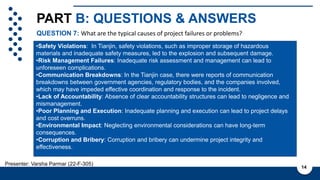
•Safety Violations: In Tianjin, safety violations, such as improper storage of hazardous
materials and inadequate safety measures, led to the explosion and subsequent damage.
•Risk Management Failures: Inadequate risk assessment and management can lead to
unforeseen complications.
•Communication Breakdowns: In the Tianjin case, there were reports of communication
breakdowns between government agencies, regulatory bodies, and the companies involved,
which may have impeded effective coordination and response to the incident.
•Lack of Accountability: Absence of clear accountability structures can lead to negligence and
mismanagement.
•Poor Planning and Execution: Inadequate planning and execution can lead to project delays
and cost overruns.
•Environmental Impact: Neglecting environmental considerations can have long-term
consequences.
•Corruption and Bribery: Corruption and bribery can undermine project integrity and
effectiveness.
PART B: QUESTIONS & ANSWERS
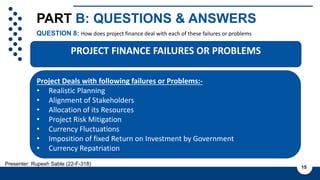
QUESTION 8: How does project finance deal with each of these failures or problems
15
Presenter: Rupesh Sable (22-F-318)
Project Deals with following failures or Problems:-
• Realistic Planning
• Alignment of Stakeholders
• Allocation of its Resources
• Project Risk Mitigation
• Currency Fluctuations
• Imposition of fixed Return on Investment by Government
• Currency Repatriation
PROJECT FINANCE FAILURES OR PROBLEMS
PART B: QUESTIONS & ANSWERS
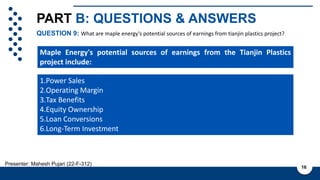
QUESTION 9: What are maple energy's potential sources of earnings from tianjin plastics project?
16
Presenter: Mahesh Pujari (22-F-312)
1.Power Sales
2.Operating Margin
3.Tax Benefits
4.Equity Ownership
5.Loan Conversions
6.Long-Term Investment
Maple Energy's potential sources of earnings from the Tianjin Plastics
project include:
PART B: QUESTIONS & ANSWERS
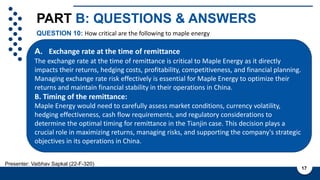
QUESTION 10: How critical are the following to maple energy
17
Presenter: Vaibhav Sapkal (22-F-320)
A. Exchange rate at the time of remittance
The exchange rate at the time of remittance is critical to Maple Energy as it directly
impacts their returns, hedging costs, profitability, competitiveness, and financial planning.
Managing exchange rate risk effectively is essential for Maple Energy to optimize their
returns and maintain financial stability in their operations in China.
B. Timing of the remittance:
Maple Energy would need to carefully assess market conditions, currency volatility,
hedging effectiveness, cash flow requirements, and regulatory considerations to
determine the optimal timing for remittance in the Tianjin case. This decision plays a
crucial role in maximizing returns, managing risks, and supporting the company's strategic
objectives in its operations in China.
PART B: QUESTIONS & ANSWERS
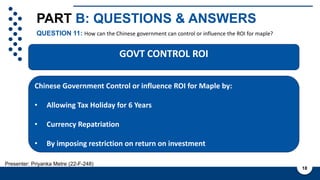
QUESTION 11: How can the Chinese government can control or influence the ROI for maple?
18
Presenter: Priyanka Metre (22-F-248)
Cashflow and ROI is not known
with certainty due to various
factors such as:
1. Regulatory Changes
2. Market Conditions
3. Operational Performance
4. Currency fluctuations
5. Government policies
6. Economic condition
Chinese Government Control or influence ROI for Maple by:
• Allowing Tax Holiday for 6 Years
• Currency Repatriation
• By imposing restriction on return on investment
GOVT CONTROL ROI
PART B: QUESTIONS & ANSWERS
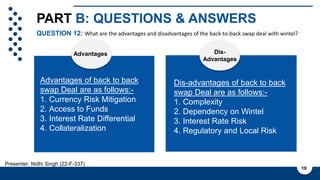
QUESTION 12: What are the advantages and disadvantages of the back-to-back swap deal with wintel?
19
Presenter: Nidhi Singh (22-F-337)
Advantages Dis-
Advantages
Advantages of back to back
swap Deal are as follows:-
1. Currency Risk Mitigation
2. Access to Funds
3. Interest Rate Differential
4. Collateralization
Dis-advantages of back to back
swap Deal are as follows:-
1. Complexity
2. Dependency on Wintel
3. Interest Rate Risk
4. Regulatory and Local Risk
PART B: QUESTIONS & ANSWERS
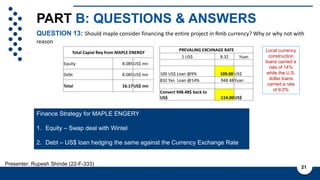
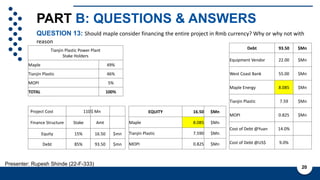
QUESTION 13: Should maple consider financing the entire project in Rmb currency? Why or why not with
reason
20
Presenter: Rupesh Shinde (22-F-333)
Tianjin Plastic Power Plant
Stake Holders
Maple 49%
Tianjin Plastic 46%
MOPI 5%
TOTAL 100%
Project Cost 110$ Mn
Finance Structure Stake Amt
Equity 15% 16.50 $mn
Debt 85% 93.50 $mn
EQUITY 16.50 $Mn
Maple 8.085 $Mn
Tianjin Plastic 7.590 $Mn
MOPI 0.825 $Mn
Debt 93.50 $Mn
Equipment Vendor 22.00 $Mn
West Coast Bank 55.00 $Mn
Maple Energy 8.085 $Mn
Tianjin Plastic 7.59 $Mn
MOPI 0.825 $Mn
Cost of Debt @Yuan 14.0%
Cost of Debt @US$ 9.0%
PART B: QUESTIONS & ANSWERS
QUESTION 13: Should maple consider financing the entire project in Rmb currency? Why or why not with
reason
21
Presenter: Rupesh Shinde (22-F-333)
Total Capial Req from MAPLE ENERGY
Equity 8.085US$ mn
Debt 8.085US$ mn
Total 16.17US$ mn
Local currency
construction
loans carried a
rate of 14%
while the U.S.
dollar loans
carried a rate
of 9.0%
PREVALING EXCHNAGE RATE
1 US$ 8.32 Yuan
100 US$ Loan @9% 109.00 US$
832 Yan Loan @14% 948.48Yuan
Convert 948.48$ back to
US$ 114.00US$
Finance Strategy for MAPLE ENGERY
1. Equity – Swap deal with Wintel
2. Debt – US$ loan hedging the same against the Currency Exchange Rate
THANK YOU!
TIANJIN PLASTIC CASE

Tianjin power plant case study. With solution

  • 1.
    CASE STUDY TIANJIN PLASTIC-FINANCINGDECISION PRESENTED BY: GROUP No.2 Rina Navadia (22-F-251) Mehul Jain (22-F-232) Sajith Nadar (22-F-353) Prajakta Parkar (22-F-304) Daksha Joshi (22-F-233) Vinayak Phansekar (22-F-310) Varsha Parmar (22-F-305) Rupesh Sable (22-F-318) Mahesh Pujari (22-F-312) Vaibhav Sapkal (22-F-320) Priyanka Metre (22-F-248) Nidhi Singh (22-F-337) Rupesh Shinde (22-F-333)
  • 2.
    PART A: SUMMARY OFCASE 1 FACTS OF CASE 2 PART B: QUESTIONS & ANSWERS 6-21 TABLE OF CONTENTS TIANJIN PLASTIC CASE
  • 3.
    PART A: SUMMARY: Thisis a sample text. Insert your desired text here. This is a sample text. Insert your desired text here. This is a sample text. This is a sample text. Insert your desired text here. Company Vision This is a sample text. Insert your desired text here. This is a sample text. Insert your desired text here. This is a sample text. This is a sample text. Insert your desired text here. Presenter: Rina Navadia (22-F-251) 1 Background:  In the Year 1996  Chinese Economy is growing rapidly  Foreign capital needed for infrastructure in China  Opportunity to fund power plant project in Tianjin
  • 4.
    PART A: SUMMARY: Thisis a sample text. Insert your desired text here. This is a sample text. Insert your desired text here. This is a sample text. This is a sample text. Insert your desired text here. Company Vision This is a sample text. Insert your desired text here. This is a sample text. Insert your desired text here. This is a sample text. This is a sample text. Insert your desired text here. Presenter: Rina Navadia (22-F-251) 2 MAPLE JOINT VENTURE TIANJIN PLASTICS MOPI BUILDING POWER PLANT
  • 5.
    PART A: SUMMARY: Thisis a sample text. Insert your desired text here. This is a sample text. Insert your desired text here. This is a sample text. This is a sample text. Insert your desired text here. Company Vision This is a sample text. Insert your desired text here. This is a sample text. Insert your desired text here. This is a sample text. This is a sample text. Insert your desired text here. Presenter: Rina Navadia (22-F-251) 3 Financing Capital for Construction Power Plant $ 93.5 Mn DEBT EQUITY
  • 6.
    PART A: SUMMARY: Thisis a sample text. Insert your desired text here. This is a sample text. Insert your desired text here. This is a sample text. This is a sample text. Insert your desired text here. Company Vision This is a sample text. Insert your desired text here. This is a sample text. Insert your desired text here. This is a sample text. This is a sample text. Insert your desired text here. Presenter: Rina Navadia (22-F-251) 4 KEY PLAYERS • Capital Locked in RMB WINTEL 49 % 46 % 5 % EQUITY EQUITY EQUITY
  • 7.
    PART A: FEWFACTS: TEXT. Company Vision 5 Presenter: Rina Navadia (22-F-251) CHALLENGE’S • Regulatory Restrictions • Limited Return on Investment • Currency Risk • Equity Repatriation Constraints SOLUTION’S • Back-to-Back Loan Agreements • Currency Hedging
  • 8.
    PART B: QUESTIONS& ANSWERS 1. Allows Large Standalone Investment 2. Provides structural framework for Project viablity & to manage risk 3. Attracts Capital from Diverse Sources 4. Better Risk Allocation This is a sample text. Insert your desired text here. This is a sample text. Insert your desired text here. This is a sample text. This is a sample text. Insert your desired text here. PROS PRO’S QUESTION 1: What are the pro's and the con's of the project financing approach? why would it be such a popular technique employed? 6 1. Involves complex agreements and documentation 2. Requires assurance of project viability and revenue predictability 3. Exposes investors to regulatory and various risk CON’S Project Financing method is popular due to its ability to fund large infrastructure Project without heavily burdening equity holders, mitigate risks through structured agreements and find its effectiveness in funding complex and long term project Presenter: Rina Navadia (22-F-251)
  • 9.
    PART B: QUESTIONS& ANSWERS Company Vision QUESTION 2: Which of the project risk should be borne by maple energy and Which should be borne by commercial risk. What is your rationale for your division of risk? 7 Presenter: Mehul Jain(Roll No:22-F-232) 1. Reserve or resource risk 2. Operating risks: 3. Completion risk: PROS Project Risk 1. Market risk: 2. Political risk: 3. Foreign exchange risk: Commercial Risk Rational of Division of Risk: • Maple Energy, as the project developer, has direct control and expertise in managing project-specific risks like reserves, operations, and completion. • Commercial risks such as market, political, and foreign exchange risks are external factors that Maple Energy can mitigate through strategic planning and risk management practices. • By dividing risks in this manner, Maple Energy can focus on project-specific challenges while addressing external market and regulatory uncertainties to ensure project success and financial stability
  • 10.
    PART B: QUESTIONS& ANSWERS Government can control investment returns through: 1. Regulatory Measures 2. Taxation Policies 3. Foreign Exchange Regulation 4. Implementing Policies GOVT CONTROL ON ROI QUESTION 3: How can a government control the return on an investment? Are the cash flows therefore return on investment like the tianjin power plant known with certainty ? 8 ROI Presenter: Sajith Nadar (Roll No:22-F-353) In this case Government control investment on returns through: 1. Restriction on investment returns 2. Currency Repatriation Cashflow and ROI is not known with certainty due to various factors such as: 1. Regulatory Changes 2. Market Conditions 3. Operational Performance 4. Currency fluctuations 5. Government policies 6. Economic condition ROI ROI
  • 11.
    PART B: QUESTIONS& ANSWERS QUESTION 4: Layout the cash flow as seen by maple energy USA including the expected exchange rates with the future RMB cash flows. What is expected return on the project? how could different exchange rate scenarios change the outcome? 9 Presenter: Prajakta Parkar (22-F-304) Assumption EBIT Margin growth 3% Tax Rate (First 6 Years) 0% Annual Depreciation (For 10 yrs in RMB Mil) 98 Capex (25% Dep) 24.5 Hurrdle Rate (Cost Of Equity) 15% WACC 8.84% Exchange (RMB/$) 8.32 Projected NPV and Payback 1996 1997 1998 1999 2000 2001 2002 2003 2004 2005 EBIT (in RMB) 178 183.34 188.8402 194.5054 200.3406 206.3508 EBIT (in$, RMB/$=8.32) 21.39423 22.03606 22.69714 23.37805 24.0794 24.80178 EBIT(1-t) 21.39423 22.03606 22.69714 23.37805 24.0794 24.80178 Depreciation 11.77885 11.77885 11.77885 11.77885 11.77885 11.77885 Capex (25% of Dep) 2.944712 2.944712 2.944712 2.944712 2.944712 2.944712 FCFF 30.22837 30.87019 31.53127 32.21219 32.91353 33.63591 Intial Cashoutlay -16.5 -27.5 -27.5 -22 PV of Cashflow (@WACC) -16.5 -25.2664 -23.2143 -17.0631 21.54074 21.9981 22.46919 22.95441 23.45418 23.96895 IRR 11% Project NPV ($ Mil) 54.34 Payback Period (Y) 5
  • 12.
    PART B: QUESTIONS& ANSWERS QUESTION 4: Layout the cash flow as seen by maple energy USA including the expected exchange rates with the future RMB cash flows. What is expected return on the project? how could different exchange rate scenarios change the outcome? 10 Presenter: Prajakta Parkar (22-F-304) 1996 1997 1998 1999 2000 2001 2002 2003 2004 2005 EBIT (in RMB) 178 183.34 188.8402 194.5054 200.3406 206.3508 EBIT (in$, RMB/$=8.736) 21.39423 22.03606 22.69714 23.37805 24.0794 24.80178 Interest Expense 7.903 7.234155 6.5146 5.740304 4.906892 4.009618 EBT 13.49123 14.8019 16.18254 17.63775 19.1725 20.79216 Tax 0 0 0 0 0 0 NI 13.49123 14.8019 16.18254 17.63775 19.1725 20.79216 NI Caped at ROI of 17% 13.49123 14.8019 16.18254 15.895 15.895 15.895 NI Adjusted 0 0 0 -1.74275 -3.2775 -4.89716 Depreciation 11.77885 11.77885 11.77885 11.77885 11.77885 11.77885 Capex (25% of Dep) 2.944712 2.944712 2.944712 2.944712 2.944712 2.944712 Net Debt 9.102155 9.771 10.49056 11.26485 12.09826 12.99554 FCFE 13.22321 13.86504 14.52612 13.46428 12.63087 11.7336 FCFE (For Maple 49% 6.479373 6.793868 7.117798 6.597499 6.189127 5.749463 Intial Cashoutlay -8.085 PV of Cashflow (@WACC) -8.085 3.704603 3.377753 3.077221 2.480244 2.023237 1.634356 IRR 29% Project NPV ($ Mil) 8.21 Payback Period (Y) 2.32 Equity NPV & Payback for Maple
  • 13.
    PART B: QUESTIONS& ANSWERS QUESTION 5: How is the currency risk related to question of investment repatriation. Do some solutions offered only handle one problem at the expense of the other 11 Presenter: Daksha Joshi (22-F-233) Cashflow and ROI is not known with certainty due to various factors such as: 1. Regulatory Changes 2. Market Conditions 3. Operational Performance 4. Currency fluctuations 5. Government policies 6. Economic condition Relationship Between Currency Risk & Investment Repatriation Currency Risk is related to Investment Repatriation because it influences the value of returns on foreign investments when converted back into the investor’s home currency. They are connected via Exchange Rate Fluctuations, Impact on Investment Returns, Mitigation Strategies, etc. Managing currency risk effectively is essential for investors to protect the value of their investments & ensure successful repatriation of funds. Solutions Handling One Problem at the Expense of the Other: Foreign companies operating in China, including those involved in the Tianjin Plastic case, may employ currency hedging strategies to mitigate currency risk. However, implementing comprehensive hedging measures could entail significant costs, which might affect the overall profitability of their investments. In response to the challenges posed by currency risk, foreign investors operating in China might reconsider their investment strategies and opt for investments in countries with more stable currencies.
  • 14.
    PART B: QUESTIONS& ANSWERS QUESTION 6: Evaluate the solutions offered? What would you recommend? 12 Presenter: Vinayak Phansekar (22-F-310)  Can Mitigate Currency Risk  Hamper Flexibility of repatriating funds due to potential exchange rate fluctuations  Dollar-Indexed Power can safeguard earnings  May not align with domestic revenue structures  May face opposition from local authoritie  Can ease fund repatriation  May require substantial collateral and expose Maple Energy to currency risks. EAVLUATION OF SOLUTIONS OFFERED Local Currency Financing Dollar-Indexed Power Back-to-Back Loans
  • 15.
    PART B: QUESTIONS& ANSWERS QUESTION 6: Evaluate the solutions offered? What would you recommend? 13 Presenter: Vinayak Phansekar (22-F-310)  Utilizing currency hedging instruments - Options Strategies  Manage exchange rate fluctuations  Safeguard repatriated funds  Engaging in discussions with local authorities for mitigating opposition  Safeguarding of mutual interest & regulatory compliance  Continuously monitoring Exchange Rate movements & Adjusting Risk Strategies  Adapting evolving market conditions  Optimize financial stability. RECOMMENATIONS Effective use of Derivative Market Alliance with Local Authorities Continuous Monitoring
  • 16.
    PART B: QUESTIONS& ANSWERS QUESTION 7: What are the typical causes of project failures or problems? 14 Presenter: Varsha Parmar (22-F-305) Cashflow and ROI is not known with certainty due to various factors such as: 1. Regulatory Changes 2. Market Conditions 3. Operational Performance 4. Currency fluctuations 5. Government policies 6. Economic condition •Safety Violations: In Tianjin, safety violations, such as improper storage of hazardous materials and inadequate safety measures, led to the explosion and subsequent damage. •Risk Management Failures: Inadequate risk assessment and management can lead to unforeseen complications. •Communication Breakdowns: In the Tianjin case, there were reports of communication breakdowns between government agencies, regulatory bodies, and the companies involved, which may have impeded effective coordination and response to the incident. •Lack of Accountability: Absence of clear accountability structures can lead to negligence and mismanagement. •Poor Planning and Execution: Inadequate planning and execution can lead to project delays and cost overruns. •Environmental Impact: Neglecting environmental considerations can have long-term consequences. •Corruption and Bribery: Corruption and bribery can undermine project integrity and effectiveness.
  • 17.
    PART B: QUESTIONS& ANSWERS QUESTION 8: How does project finance deal with each of these failures or problems 15 Presenter: Rupesh Sable (22-F-318) Project Deals with following failures or Problems:- • Realistic Planning • Alignment of Stakeholders • Allocation of its Resources • Project Risk Mitigation • Currency Fluctuations • Imposition of fixed Return on Investment by Government • Currency Repatriation PROJECT FINANCE FAILURES OR PROBLEMS
  • 18.
    PART B: QUESTIONS& ANSWERS QUESTION 9: What are maple energy's potential sources of earnings from tianjin plastics project? 16 Presenter: Mahesh Pujari (22-F-312) 1.Power Sales 2.Operating Margin 3.Tax Benefits 4.Equity Ownership 5.Loan Conversions 6.Long-Term Investment Maple Energy's potential sources of earnings from the Tianjin Plastics project include:
  • 19.
    PART B: QUESTIONS& ANSWERS QUESTION 10: How critical are the following to maple energy 17 Presenter: Vaibhav Sapkal (22-F-320) A. Exchange rate at the time of remittance The exchange rate at the time of remittance is critical to Maple Energy as it directly impacts their returns, hedging costs, profitability, competitiveness, and financial planning. Managing exchange rate risk effectively is essential for Maple Energy to optimize their returns and maintain financial stability in their operations in China. B. Timing of the remittance: Maple Energy would need to carefully assess market conditions, currency volatility, hedging effectiveness, cash flow requirements, and regulatory considerations to determine the optimal timing for remittance in the Tianjin case. This decision plays a crucial role in maximizing returns, managing risks, and supporting the company's strategic objectives in its operations in China.
  • 20.
    PART B: QUESTIONS& ANSWERS QUESTION 11: How can the Chinese government can control or influence the ROI for maple? 18 Presenter: Priyanka Metre (22-F-248) Cashflow and ROI is not known with certainty due to various factors such as: 1. Regulatory Changes 2. Market Conditions 3. Operational Performance 4. Currency fluctuations 5. Government policies 6. Economic condition Chinese Government Control or influence ROI for Maple by: • Allowing Tax Holiday for 6 Years • Currency Repatriation • By imposing restriction on return on investment GOVT CONTROL ROI
  • 21.
    PART B: QUESTIONS& ANSWERS QUESTION 12: What are the advantages and disadvantages of the back-to-back swap deal with wintel? 19 Presenter: Nidhi Singh (22-F-337) Advantages Dis- Advantages Advantages of back to back swap Deal are as follows:- 1. Currency Risk Mitigation 2. Access to Funds 3. Interest Rate Differential 4. Collateralization Dis-advantages of back to back swap Deal are as follows:- 1. Complexity 2. Dependency on Wintel 3. Interest Rate Risk 4. Regulatory and Local Risk
  • 22.
    PART B: QUESTIONS& ANSWERS QUESTION 13: Should maple consider financing the entire project in Rmb currency? Why or why not with reason 20 Presenter: Rupesh Shinde (22-F-333) Tianjin Plastic Power Plant Stake Holders Maple 49% Tianjin Plastic 46% MOPI 5% TOTAL 100% Project Cost 110$ Mn Finance Structure Stake Amt Equity 15% 16.50 $mn Debt 85% 93.50 $mn EQUITY 16.50 $Mn Maple 8.085 $Mn Tianjin Plastic 7.590 $Mn MOPI 0.825 $Mn Debt 93.50 $Mn Equipment Vendor 22.00 $Mn West Coast Bank 55.00 $Mn Maple Energy 8.085 $Mn Tianjin Plastic 7.59 $Mn MOPI 0.825 $Mn Cost of Debt @Yuan 14.0% Cost of Debt @US$ 9.0%
  • 23.
    PART B: QUESTIONS& ANSWERS QUESTION 13: Should maple consider financing the entire project in Rmb currency? Why or why not with reason 21 Presenter: Rupesh Shinde (22-F-333) Total Capial Req from MAPLE ENERGY Equity 8.085US$ mn Debt 8.085US$ mn Total 16.17US$ mn Local currency construction loans carried a rate of 14% while the U.S. dollar loans carried a rate of 9.0% PREVALING EXCHNAGE RATE 1 US$ 8.32 Yuan 100 US$ Loan @9% 109.00 US$ 832 Yan Loan @14% 948.48Yuan Convert 948.48$ back to US$ 114.00US$ Finance Strategy for MAPLE ENGERY 1. Equity – Swap deal with Wintel 2. Debt – US$ loan hedging the same against the Currency Exchange Rate
  • 24.

Editor's Notes

  • #2 jake-blucker-VEdLCjdUtRY-unsplash
  • #3 bruce-mars-8YG31Xn4dSw-unsplash
  • #25 christian-perner-1fEQTFhcEXU-unsplash