ALLAH
Presented By:
• Muhammad Umar
(University Of Central Punjab)
(Rawalpindi Campus)
• Thunder Bolt
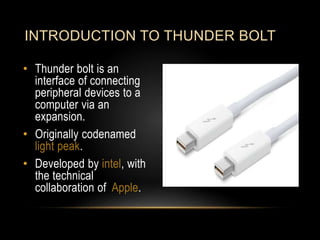
• Thunder bolt is an
interface of connecting
peripheral devices to a
computer via an
expansion.
• Originally codenamed
light peak.
• Developed by intel, with
the technical
collaboration of Apple.
INTRODUCTION TO THUNDER BOLT
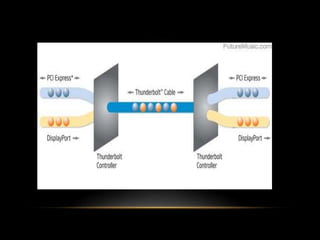
• Thunder bolt technology is a transformational I/O (input
output) innovation, supports data (PCI Express) and
HD display (display port) connections over a single
cable.
• Thunder bolt has the capability to deliver high
bandwidth, starting at 10 Gbps.
• Thunder bolt was developed as a way to reduce the
large number of ports on modern computers.
FEATURES
• Provide a standard low cost optical-based interconnect.
• Supports for key existing protocols (USB, PCI, etc).
• Support wide range of devices (handhelds, laptops,
PCs and more).
• Single, flexible cable that can carry any platform I/O.
• Higher bandwidth 10Gbps to 100 Gbps.
• Supports multiple existing I/O over a single cable.
• Smooth transition for today’s existing electrical I/O
protocols can connect to more devices with the
same cable.
• Longer, thinner cables and smaller connectors up to
100 meters on an optical-only cable.
• Enables I/O performance for the next generation.
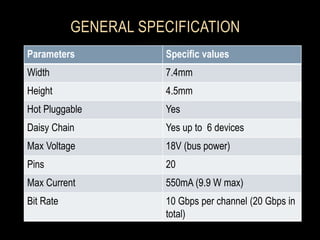
GENERAL SPECIFICATION
Parameters Specific values
Width 7.4mm
Height 4.5mm
Hot Pluggable Yes
Daisy Chain Yes up to 6 devices
Max Voltage 18V (bus power)
Pins 20
Max Current 550mA (9.9 W max)
Bit Rate 10 Gbps per channel (20 Gbps in
total)
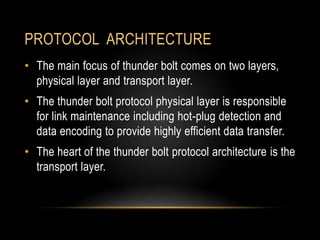
PROTOCOL ARCHITECTURE
• The main focus of thunder bolt comes on two layers,
physical layer and transport layer.
• The thunder bolt protocol physical layer is responsible
for link maintenance including hot-plug detection and
data encoding to provide highly efficient data transfer.
• The heart of the thunder bolt protocol architecture is the
transport layer.
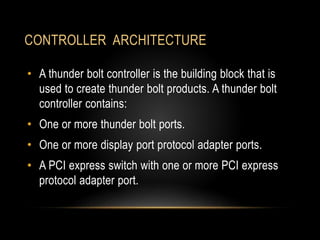
CONTROLLER ARCHITECTURE
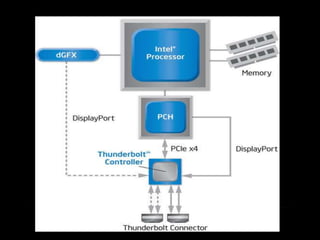
• A thunder bolt controller is the building block that is
used to create thunder bolt products. A thunder bolt
controller contains:
• One or more thunder bolt ports.
• One or more display port protocol adapter ports.
• A PCI express switch with one or more PCI express
protocol adapter port.
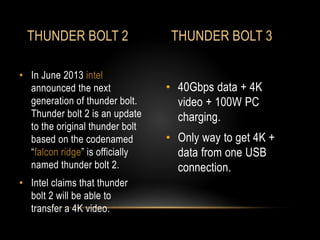
• 40Gbps data + 4K
video + 100W PC
charging.
• Only way to get 4K +
data from one USB
connection.
• In June 2013 intel
announced the next
generation of thunder bolt.
Thunder bolt 2 is an update
to the original thunder bolt
based on the codenamed
“falcon ridge” is officially
named thunder bolt 2.
• Intel claims that thunder
bolt 2 will be able to
transfer a 4K video.
THUNDER BOLT 2 THUNDER BOLT 3
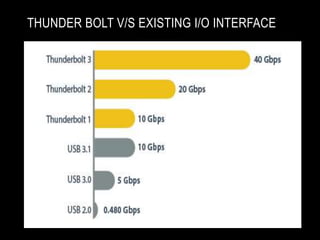
THUNDER BOLT V/S EXISTING I/O INTERFACE
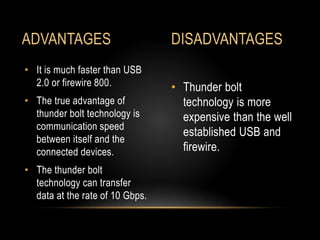
• Thunder bolt
technology is more
expensive than the well
established USB and
firewire.
• It is much faster than USB
2.0 or firewire 800.
• The true advantage of
thunder bolt technology is
communication speed
between itself and the
connected devices.
• The thunder bolt
technology can transfer
data at the rate of 10 Gbps.
ADVANTAGES DISADVANTAGES
CONCLUSION
• Thunder bolt is fast and balanced in performance.
• It simplifies device management with smart features
like daisy chain etc.
• Thunder bolt technology opens door to entirely new
system and product designs.
Thunder bolt || Computer Architecture

Thunder bolt || Computer Architecture

  • 1.
  • 2.
    Presented By: • MuhammadUmar (University Of Central Punjab) (Rawalpindi Campus)
  • 3.
  • 4.
    • Thunder boltis an interface of connecting peripheral devices to a computer via an expansion. • Originally codenamed light peak. • Developed by intel, with the technical collaboration of Apple. INTRODUCTION TO THUNDER BOLT
  • 5.
    • Thunder bolttechnology is a transformational I/O (input output) innovation, supports data (PCI Express) and HD display (display port) connections over a single cable. • Thunder bolt has the capability to deliver high bandwidth, starting at 10 Gbps. • Thunder bolt was developed as a way to reduce the large number of ports on modern computers.
  • 6.
    FEATURES • Provide astandard low cost optical-based interconnect. • Supports for key existing protocols (USB, PCI, etc). • Support wide range of devices (handhelds, laptops, PCs and more). • Single, flexible cable that can carry any platform I/O. • Higher bandwidth 10Gbps to 100 Gbps. • Supports multiple existing I/O over a single cable.
  • 7.
    • Smooth transitionfor today’s existing electrical I/O protocols can connect to more devices with the same cable. • Longer, thinner cables and smaller connectors up to 100 meters on an optical-only cable. • Enables I/O performance for the next generation.
  • 8.
    GENERAL SPECIFICATION Parameters Specificvalues Width 7.4mm Height 4.5mm Hot Pluggable Yes Daisy Chain Yes up to 6 devices Max Voltage 18V (bus power) Pins 20 Max Current 550mA (9.9 W max) Bit Rate 10 Gbps per channel (20 Gbps in total)
  • 9.
    PROTOCOL ARCHITECTURE • Themain focus of thunder bolt comes on two layers, physical layer and transport layer. • The thunder bolt protocol physical layer is responsible for link maintenance including hot-plug detection and data encoding to provide highly efficient data transfer. • The heart of the thunder bolt protocol architecture is the transport layer.
  • 11.
    CONTROLLER ARCHITECTURE • Athunder bolt controller is the building block that is used to create thunder bolt products. A thunder bolt controller contains: • One or more thunder bolt ports. • One or more display port protocol adapter ports. • A PCI express switch with one or more PCI express protocol adapter port.
  • 13.
    • 40Gbps data+ 4K video + 100W PC charging. • Only way to get 4K + data from one USB connection. • In June 2013 intel announced the next generation of thunder bolt. Thunder bolt 2 is an update to the original thunder bolt based on the codenamed “falcon ridge” is officially named thunder bolt 2. • Intel claims that thunder bolt 2 will be able to transfer a 4K video. THUNDER BOLT 2 THUNDER BOLT 3
  • 14.
    THUNDER BOLT V/SEXISTING I/O INTERFACE
  • 15.
    • Thunder bolt technologyis more expensive than the well established USB and firewire. • It is much faster than USB 2.0 or firewire 800. • The true advantage of thunder bolt technology is communication speed between itself and the connected devices. • The thunder bolt technology can transfer data at the rate of 10 Gbps. ADVANTAGES DISADVANTAGES
  • 16.
    CONCLUSION • Thunder boltis fast and balanced in performance. • It simplifies device management with smart features like daisy chain etc. • Thunder bolt technology opens door to entirely new system and product designs.