Three Types of
Volcanoes
 1. List and describe the three types of
volcanoes.
EXPLOSIVE HAZARDS
VISCOUS LAVA (High Viscosity)
 Cool temperature
 Composition:
silica-rich (granitic)
 Thick & gooey → Erupt violently; scattering
ash and fragments
widely
 Does not flow very far;
builds steep-sides;
often destroys volcanoes
Ex. rhyolithic & andesitic
lava→ stratovolcanoes
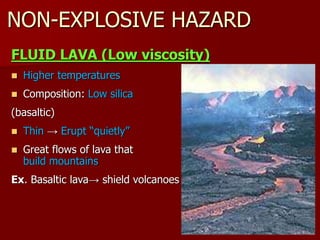
NON-EXPLOSIVE HAZARD
FLUID LAVA (Low viscosity)
 Higher temperatures
 Composition: Low silica
(basaltic)
 Thin → Erupt “quietly”
 Great flows of lava that
build mountains
Ex. Basaltic lava→ shield volcanoes
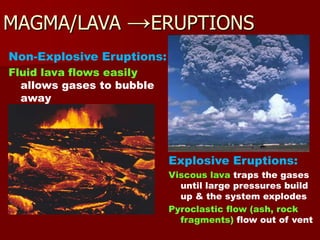
MAGMA/LAVA →ERUPTIONS
Non-Explosive Eruptions:
Fluid lava flows easily
allows gases to bubble
away
Explosive Eruptions:
Viscous lava traps the gases
until large pressures build
up & the system explodes
Pyroclastic flow (ash, rock
fragments) flow out of vent
EXPLOSIVE HAZARDS
PYROCLASTIC FLOW
Travels over 200 mph
Tephra = all ash & rock
fragments
– ash: pieces smaller than 2 mm;
travel farthest
– lapelli: small pieces between 2-66
mm
– volcanic bomb: pieces larger than
64 mm
Burns EVERYTHING in its path
ERUPTION HAZARDS
LAHAR
Water, mud &
ash that flow
like a river
Shield Volcanoes
• The magma inside a shield volcano is rich in iron
and magnesium and is very fluid.
• Since the magma is very fluid, the lava coming
out of the volcano tends to flow great distances.
• When shield volcanoes erupt, the flowing lava
gives the volcano the shape of a gently sloping
mountain.
Shield Volcanoes
 Eruptions of shield volcanoes are mild and
can occur several times.
 Mauna Loa in Hawaii is an example of a
shield volcano.
Shield Volcanoes
 Low silica level
 Low viscosity Lava
 High or low levels of gas
 Low to medium explosivity
 Flattened mound
 Resembles a warrior’s shield
Mauna Loa, Hawaii
Piton de la Fournaise
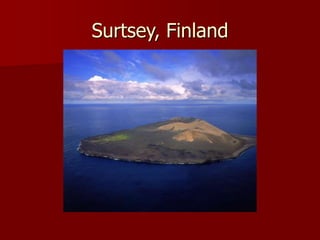
Surtsey, Finland
Composite Volcanoes
• The magma inside a composite volcano is rich in
silica and much thicker than magma from a
shield volcano.
• Gases get trapped inside this thicker magma.
• Eruptions from composite volcanoes can be
flowing lava or explosions. The explosive
eruptions come from the trapped gases and
produce cinders and ash.
Composite Volcanoes
• These different types of eruptions are what give
composite volcanoes their alternating layers of
lava and cinders.
• Composite volcanoes have much steeper slopes
than shield volcanoes.
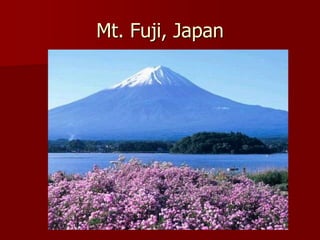
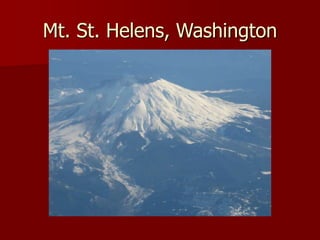
• Mount Fuji in Japan and Mount St. Helens in the
USA are examples of composite volcanoes.
Composite Volcanoes
 High in silica
 High viscosity magma
 High levels of gas
 Highly explosive
 Cone shaped
 Formed by layers of lava flow and ash
buildup
Mt. Rainier, Washington
Mt. Fuji, Japan
Mt. St. Helens, Washington
Cinder Cone Volcanoes
• The magma inside a cinder cone volcano has
large amounts of gas trapped in it.
• Eruptions from cinder cone volcanoes are
violent and explosive because of all the gas
trapped in the magma.
• The large amounts of hot ash and lava thrown
out of the vent fall to the ground forming the
cone shape that these volcanoes have.
Cinder Cone Volcanoes
• Cinder cone volcanoes are usually only
active for a short time and then become
dormant (inactive).
• Paricutin in Mexico is an example of a
cinder cone volcano.
Cinder cones
 Low silica lava
 High levels of gas
 “Fire-fountain” eruptions
 Commonly found on the flanks of shield
volcanoes
 Made from a pile of rock pieces
 Structurally weak
Pu'u ka Pele, Hawaii
(on the flanks of Mauna Loa)
Floreana Island, Galapagos
Puu OO, Hawaii
 2. Explain how volcanoes relate to plate
tectonics.
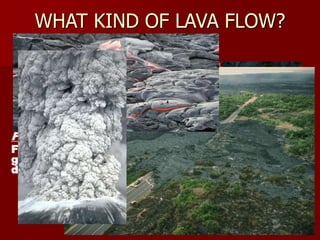
WHAT KIND OF LAVA FLOW?
Viscous lava
• thick (granitic – high silica
content)
• traps gas
• violent eruptions
• destroys mountains
Fluid lava
• thin ; flows far;
• allows gas to escape;
• quiet(non-violent) eruptions
• builds mountain
Fluid lava
Flows
great
distances
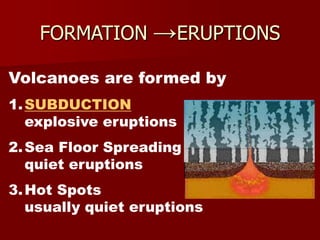
FORMATION →ERUPTIONS
Volcanoes are formed by
1.SUBDUCTION
explosive eruptions
2.Sea Floor Spreading
quiet eruptions
3.Hot Spots
usually quiet eruptions
VOLCANO FORMATION:
HOT SPOTS
 A fixed source of magma
rising beneath a plate
forming volcanic islands
 Magma can be basaltic or
granitic –so eruptions can
be explosive or “quiet”

Three-Types-of-Volcanoes.ppt

  • 1.
  • 2.
     1. Listand describe the three types of volcanoes.
  • 3.
    EXPLOSIVE HAZARDS VISCOUS LAVA(High Viscosity)  Cool temperature  Composition: silica-rich (granitic)  Thick & gooey → Erupt violently; scattering ash and fragments widely  Does not flow very far; builds steep-sides; often destroys volcanoes Ex. rhyolithic & andesitic lava→ stratovolcanoes
  • 4.
    NON-EXPLOSIVE HAZARD FLUID LAVA(Low viscosity)  Higher temperatures  Composition: Low silica (basaltic)  Thin → Erupt “quietly”  Great flows of lava that build mountains Ex. Basaltic lava→ shield volcanoes
  • 5.
    MAGMA/LAVA →ERUPTIONS Non-Explosive Eruptions: Fluidlava flows easily allows gases to bubble away Explosive Eruptions: Viscous lava traps the gases until large pressures build up & the system explodes Pyroclastic flow (ash, rock fragments) flow out of vent
  • 6.
    EXPLOSIVE HAZARDS PYROCLASTIC FLOW Travelsover 200 mph Tephra = all ash & rock fragments – ash: pieces smaller than 2 mm; travel farthest – lapelli: small pieces between 2-66 mm – volcanic bomb: pieces larger than 64 mm Burns EVERYTHING in its path
  • 7.
    ERUPTION HAZARDS LAHAR Water, mud& ash that flow like a river
  • 8.
    Shield Volcanoes • Themagma inside a shield volcano is rich in iron and magnesium and is very fluid. • Since the magma is very fluid, the lava coming out of the volcano tends to flow great distances. • When shield volcanoes erupt, the flowing lava gives the volcano the shape of a gently sloping mountain.
  • 9.
    Shield Volcanoes  Eruptionsof shield volcanoes are mild and can occur several times.  Mauna Loa in Hawaii is an example of a shield volcano.
  • 10.
    Shield Volcanoes  Lowsilica level  Low viscosity Lava  High or low levels of gas  Low to medium explosivity  Flattened mound  Resembles a warrior’s shield
  • 11.
  • 12.
    Piton de laFournaise
  • 13.
  • 14.
    Composite Volcanoes • Themagma inside a composite volcano is rich in silica and much thicker than magma from a shield volcano. • Gases get trapped inside this thicker magma. • Eruptions from composite volcanoes can be flowing lava or explosions. The explosive eruptions come from the trapped gases and produce cinders and ash.
  • 15.
    Composite Volcanoes • Thesedifferent types of eruptions are what give composite volcanoes their alternating layers of lava and cinders. • Composite volcanoes have much steeper slopes than shield volcanoes. • Mount Fuji in Japan and Mount St. Helens in the USA are examples of composite volcanoes.
  • 16.
    Composite Volcanoes  Highin silica  High viscosity magma  High levels of gas  Highly explosive  Cone shaped  Formed by layers of lava flow and ash buildup
  • 17.
  • 18.
  • 19.
    Mt. St. Helens,Washington
  • 20.
    Cinder Cone Volcanoes •The magma inside a cinder cone volcano has large amounts of gas trapped in it. • Eruptions from cinder cone volcanoes are violent and explosive because of all the gas trapped in the magma. • The large amounts of hot ash and lava thrown out of the vent fall to the ground forming the cone shape that these volcanoes have.
  • 21.
    Cinder Cone Volcanoes •Cinder cone volcanoes are usually only active for a short time and then become dormant (inactive). • Paricutin in Mexico is an example of a cinder cone volcano.
  • 22.
    Cinder cones  Lowsilica lava  High levels of gas  “Fire-fountain” eruptions  Commonly found on the flanks of shield volcanoes  Made from a pile of rock pieces  Structurally weak
  • 23.
    Pu'u ka Pele,Hawaii (on the flanks of Mauna Loa)
  • 24.
  • 25.
  • 26.
     2. Explainhow volcanoes relate to plate tectonics.
  • 27.
    WHAT KIND OFLAVA FLOW? Viscous lava • thick (granitic – high silica content) • traps gas • violent eruptions • destroys mountains Fluid lava • thin ; flows far; • allows gas to escape; • quiet(non-violent) eruptions • builds mountain Fluid lava Flows great distances
  • 28.
    FORMATION →ERUPTIONS Volcanoes areformed by 1.SUBDUCTION explosive eruptions 2.Sea Floor Spreading quiet eruptions 3.Hot Spots usually quiet eruptions
  • 29.
    VOLCANO FORMATION: HOT SPOTS A fixed source of magma rising beneath a plate forming volcanic islands  Magma can be basaltic or granitic –so eruptions can be explosive or “quiet”