APA STYLE
In-Text Citations and Reference Lists
Presentation Overview
• Why APA?
• Crediting Sources: What and Why
• Formatting In-Text Citations
• Formatting Reference Lists
• Resources
Why APA?
Different professions use different manuals
Modern Language Association (MLA)
American Psychological Association (APA)
Chicago Style
What does it mean to credit sources?
• Crediting sources gives an author or resource credit for
original information. Crediting sources in your paper
includes two parts:
• In-Text Citations:
• Reference List:
• The in-text citations and reference list should credit the
exact same sources.
Why credit sources?
• Acknowledge authors for their ideas
• Avoid plagiarism
• Increase credibility and transparency
• Join an ongoing academic discussion
• Become a part of a professional community
What should you credit?
• Any information that you learned from another source
including facts, statistics, opinions, theories, photographs,
and charts
• Credit these sources when you mention their information
in any way
• EXCEPTION: Information that is common knowledge
• Barack Obama is the president of the United States.
• The declaration of independence was signed July 12, 1898
In-Text Citation Format
• An in-text citation usually includes the following information:
• Author’s last name (no first name or initial)
• Publication date (year only—even for electronic sources)
• Page number
• The rest of the information about the source appears in the reference
list.
In-Text Citation Format
Author’s name and publication year at end of sentence
• People with bipolar disorder often have lower wages, higher
unemployment, work absenteeism, reliance on workmen’s
compensation, higher rates of divorce, lower levels of
educational attainment, higher arrest rates, and hospitalization
(Leahy, 2007).
Author’s name in the sentence immediately followed by year
• According to Leahy (2007), people with bipolar disorder often
have lower wages, higher unemployment, work absenteeism,
reliance on workmen’s compensation, higher rates of divorce,
lower levels of educational attainment, higher arrest rates, and
hospitalization.
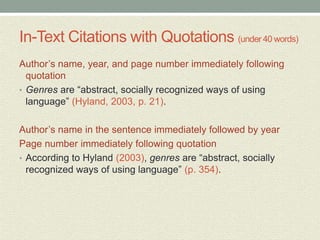
In-Text Citations with Quotations (under 40 words)
Author’s name, year, and page number immediately following
quotation
• Genres are “abstract, socially recognized ways of using
language” (Hyland, 2003, p. 21).
Author’s name in the sentence immediately followed by year
Page number immediately following quotation
• According to Hyland (2003), genres are “abstract, socially
recognized ways of using language” (p. 354).
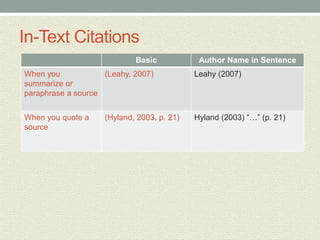
In-Text Citations
Basic Author Name in Sentence
When you
summarize or
paraphrase a source
(Leahy, 2007) Leahy (2007)
When you quote a
source
(Hyland, 2003, p. 21) Hyland (2003) “…” (p. 21)
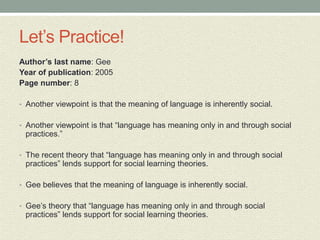
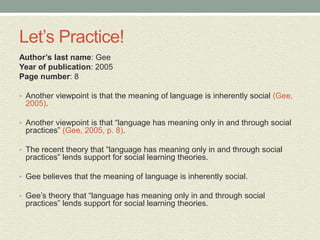
Let’s Practice!
Author’s last name: Gee
Year of publication: 2005
Page number: 8
• Another viewpoint is that the meaning of language is inherently social.
• Another viewpoint is that “language has meaning only in and through social
practices.”
• The recent theory that “language has meaning only in and through social
practices” lends support for social learning theories.
• Gee believes that the meaning of language is inherently social.
• Gee’s theory that “language has meaning only in and through social
practices” lends support for social learning theories.
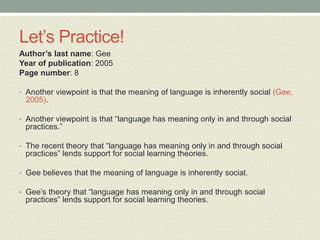
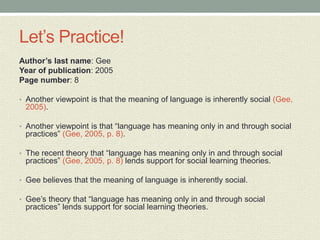
Let’s Practice!
Author’s last name: Gee
Year of publication: 2005
Page number: 8
• Another viewpoint is that the meaning of language is inherently social (Gee,
2005).
• Another viewpoint is that “language has meaning only in and through social
practices.”
• The recent theory that “language has meaning only in and through social
practices” lends support for social learning theories.
• Gee believes that the meaning of language is inherently social.
• Gee’s theory that “language has meaning only in and through social
practices” lends support for social learning theories.
Let’s Practice!
Author’s last name: Gee
Year of publication: 2005
Page number: 8
• Another viewpoint is that the meaning of language is inherently social (Gee,
2005).
• Another viewpoint is that “language has meaning only in and through social
practices” (Gee, 2005, p. 8).
• The recent theory that “language has meaning only in and through social
practices” lends support for social learning theories.
• Gee believes that the meaning of language is inherently social.
• Gee’s theory that “language has meaning only in and through social
practices” lends support for social learning theories.
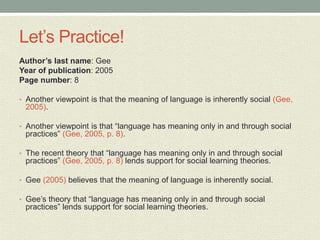
Let’s Practice!
Author’s last name: Gee
Year of publication: 2005
Page number: 8
• Another viewpoint is that the meaning of language is inherently social (Gee,
2005).
• Another viewpoint is that “language has meaning only in and through social
practices” (Gee, 2005, p. 8).
• The recent theory that “language has meaning only in and through social
practices” (Gee, 2005, p. 8) lends support for social learning theories.
• Gee believes that the meaning of language is inherently social.
• Gee’s theory that “language has meaning only in and through social
practices” lends support for social learning theories.
Let’s Practice!
Author’s last name: Gee
Year of publication: 2005
Page number: 8
• Another viewpoint is that the meaning of language is inherently social (Gee,
2005).
• Another viewpoint is that “language has meaning only in and through social
practices” (Gee, 2005, p. 8).
• The recent theory that “language has meaning only in and through social
practices” (Gee, 2005, p. 8) lends support for social learning theories.
• Gee (2005) believes that the meaning of language is inherently social.
• Gee’s theory that “language has meaning only in and through social
practices” lends support for social learning theories.
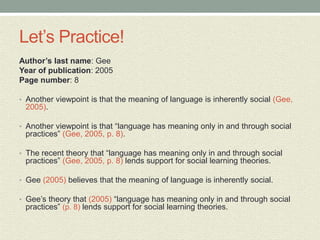
Let’s Practice!
Author’s last name: Gee
Year of publication: 2005
Page number: 8
• Another viewpoint is that the meaning of language is inherently social (Gee,
2005).
• Another viewpoint is that “language has meaning only in and through social
practices” (Gee, 2005, p. 8).
• The recent theory that “language has meaning only in and through social
practices” (Gee, 2005, p. 8) lends support for social learning theories.
• Gee (2005) believes that the meaning of language is inherently social.
• Gee’s theory that (2005) “language has meaning only in and through social
practices” (p. 8) lends support for social learning theories.
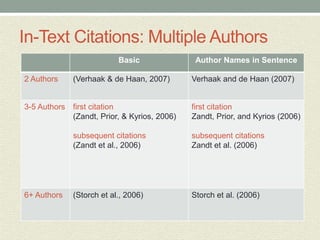
In-Text Citations: Multiple Authors
Basic Author Names in Sentence
2 Authors (Verhaak & de Haan, 2007) Verhaak and de Haan (2007)
3-5 Authors first citation
(Zandt, Prior, & Kyrios, 2006)
subsequent citations
(Zandt et al., 2006)
first citation
Zandt, Prior, and Kyrios (2006)
subsequent citations
Zandt et al. (2006)
6+ Authors (Storch et al., 2006) Storch et al. (2006)
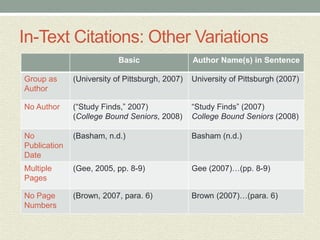
In-Text Citations: Other Variations
Basic Author Name(s) in Sentence
Group as
Author
(University of Pittsburgh, 2007) University of Pittsburgh (2007)
No Author (“Study Finds,” 2007)
(College Bound Seniors, 2008)
“Study Finds” (2007)
College Bound Seniors (2008)
No
Publication
Date
(Basham, n.d.) Basham (n.d.)
Multiple
Pages
(Gee, 2005, pp. 8-9) Gee (2007)…(pp. 8-9)
No Page
Numbers
(Brown, 2007, para. 6) Brown (2007)…(para. 6)
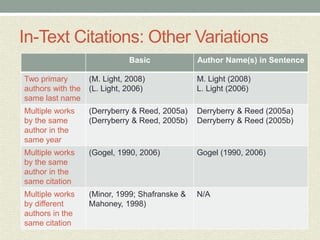
In-Text Citations: Other Variations
Basic Author Name(s) in Sentence
Two primary
authors with the
same last name
(M. Light, 2008)
(L. Light, 2006)
M. Light (2008)
L. Light (2006)
Multiple works
by the same
author in the
same year
(Derryberry & Reed, 2005a)
(Derryberry & Reed, 2005b)
Derryberry & Reed (2005a)
Derryberry & Reed (2005b)
Multiple works
by the same
author in the
same citation
(Gogel, 1990, 2006) Gogel (1990, 2006)
Multiple works
by different
authors in the
same citation
(Minor, 1999; Shafranske &
Mahoney, 1998)
N/A
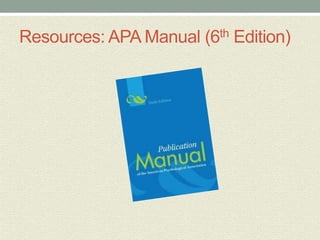
Resources: APA Manual (6th Edition)
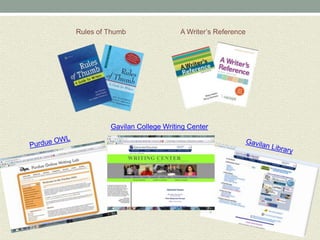
Rules of Thumb A Writer’s Reference
Gavilan College Writing Center

Three Is-Citation.pptx

  • 1.
    APA STYLE In-Text Citationsand Reference Lists
  • 2.
    Presentation Overview • WhyAPA? • Crediting Sources: What and Why • Formatting In-Text Citations • Formatting Reference Lists • Resources
  • 3.
    Why APA? Different professionsuse different manuals Modern Language Association (MLA) American Psychological Association (APA) Chicago Style
  • 4.
    What does itmean to credit sources? • Crediting sources gives an author or resource credit for original information. Crediting sources in your paper includes two parts: • In-Text Citations: • Reference List: • The in-text citations and reference list should credit the exact same sources.
  • 5.
    Why credit sources? •Acknowledge authors for their ideas • Avoid plagiarism • Increase credibility and transparency • Join an ongoing academic discussion • Become a part of a professional community
  • 6.
    What should youcredit? • Any information that you learned from another source including facts, statistics, opinions, theories, photographs, and charts • Credit these sources when you mention their information in any way • EXCEPTION: Information that is common knowledge • Barack Obama is the president of the United States. • The declaration of independence was signed July 12, 1898
  • 7.
    In-Text Citation Format •An in-text citation usually includes the following information: • Author’s last name (no first name or initial) • Publication date (year only—even for electronic sources) • Page number • The rest of the information about the source appears in the reference list.
  • 8.
    In-Text Citation Format Author’sname and publication year at end of sentence • People with bipolar disorder often have lower wages, higher unemployment, work absenteeism, reliance on workmen’s compensation, higher rates of divorce, lower levels of educational attainment, higher arrest rates, and hospitalization (Leahy, 2007). Author’s name in the sentence immediately followed by year • According to Leahy (2007), people with bipolar disorder often have lower wages, higher unemployment, work absenteeism, reliance on workmen’s compensation, higher rates of divorce, lower levels of educational attainment, higher arrest rates, and hospitalization.
  • 9.
    In-Text Citations withQuotations (under 40 words) Author’s name, year, and page number immediately following quotation • Genres are “abstract, socially recognized ways of using language” (Hyland, 2003, p. 21). Author’s name in the sentence immediately followed by year Page number immediately following quotation • According to Hyland (2003), genres are “abstract, socially recognized ways of using language” (p. 354).
  • 10.
    In-Text Citations Basic AuthorName in Sentence When you summarize or paraphrase a source (Leahy, 2007) Leahy (2007) When you quote a source (Hyland, 2003, p. 21) Hyland (2003) “…” (p. 21)
  • 11.
    Let’s Practice! Author’s lastname: Gee Year of publication: 2005 Page number: 8 • Another viewpoint is that the meaning of language is inherently social. • Another viewpoint is that “language has meaning only in and through social practices.” • The recent theory that “language has meaning only in and through social practices” lends support for social learning theories. • Gee believes that the meaning of language is inherently social. • Gee’s theory that “language has meaning only in and through social practices” lends support for social learning theories.
  • 12.
    Let’s Practice! Author’s lastname: Gee Year of publication: 2005 Page number: 8 • Another viewpoint is that the meaning of language is inherently social (Gee, 2005). • Another viewpoint is that “language has meaning only in and through social practices.” • The recent theory that “language has meaning only in and through social practices” lends support for social learning theories. • Gee believes that the meaning of language is inherently social. • Gee’s theory that “language has meaning only in and through social practices” lends support for social learning theories.
  • 13.
    Let’s Practice! Author’s lastname: Gee Year of publication: 2005 Page number: 8 • Another viewpoint is that the meaning of language is inherently social (Gee, 2005). • Another viewpoint is that “language has meaning only in and through social practices” (Gee, 2005, p. 8). • The recent theory that “language has meaning only in and through social practices” lends support for social learning theories. • Gee believes that the meaning of language is inherently social. • Gee’s theory that “language has meaning only in and through social practices” lends support for social learning theories.
  • 14.
    Let’s Practice! Author’s lastname: Gee Year of publication: 2005 Page number: 8 • Another viewpoint is that the meaning of language is inherently social (Gee, 2005). • Another viewpoint is that “language has meaning only in and through social practices” (Gee, 2005, p. 8). • The recent theory that “language has meaning only in and through social practices” (Gee, 2005, p. 8) lends support for social learning theories. • Gee believes that the meaning of language is inherently social. • Gee’s theory that “language has meaning only in and through social practices” lends support for social learning theories.
  • 15.
    Let’s Practice! Author’s lastname: Gee Year of publication: 2005 Page number: 8 • Another viewpoint is that the meaning of language is inherently social (Gee, 2005). • Another viewpoint is that “language has meaning only in and through social practices” (Gee, 2005, p. 8). • The recent theory that “language has meaning only in and through social practices” (Gee, 2005, p. 8) lends support for social learning theories. • Gee (2005) believes that the meaning of language is inherently social. • Gee’s theory that “language has meaning only in and through social practices” lends support for social learning theories.
  • 16.
    Let’s Practice! Author’s lastname: Gee Year of publication: 2005 Page number: 8 • Another viewpoint is that the meaning of language is inherently social (Gee, 2005). • Another viewpoint is that “language has meaning only in and through social practices” (Gee, 2005, p. 8). • The recent theory that “language has meaning only in and through social practices” (Gee, 2005, p. 8) lends support for social learning theories. • Gee (2005) believes that the meaning of language is inherently social. • Gee’s theory that (2005) “language has meaning only in and through social practices” (p. 8) lends support for social learning theories.
  • 17.
    In-Text Citations: MultipleAuthors Basic Author Names in Sentence 2 Authors (Verhaak & de Haan, 2007) Verhaak and de Haan (2007) 3-5 Authors first citation (Zandt, Prior, & Kyrios, 2006) subsequent citations (Zandt et al., 2006) first citation Zandt, Prior, and Kyrios (2006) subsequent citations Zandt et al. (2006) 6+ Authors (Storch et al., 2006) Storch et al. (2006)
  • 18.
    In-Text Citations: OtherVariations Basic Author Name(s) in Sentence Group as Author (University of Pittsburgh, 2007) University of Pittsburgh (2007) No Author (“Study Finds,” 2007) (College Bound Seniors, 2008) “Study Finds” (2007) College Bound Seniors (2008) No Publication Date (Basham, n.d.) Basham (n.d.) Multiple Pages (Gee, 2005, pp. 8-9) Gee (2007)…(pp. 8-9) No Page Numbers (Brown, 2007, para. 6) Brown (2007)…(para. 6)
  • 19.
    In-Text Citations: OtherVariations Basic Author Name(s) in Sentence Two primary authors with the same last name (M. Light, 2008) (L. Light, 2006) M. Light (2008) L. Light (2006) Multiple works by the same author in the same year (Derryberry & Reed, 2005a) (Derryberry & Reed, 2005b) Derryberry & Reed (2005a) Derryberry & Reed (2005b) Multiple works by the same author in the same citation (Gogel, 1990, 2006) Gogel (1990, 2006) Multiple works by different authors in the same citation (Minor, 1999; Shafranske & Mahoney, 1998) N/A
  • 20.
    Resources: APA Manual(6th Edition)
  • 21.
    Rules of ThumbA Writer’s Reference Gavilan College Writing Center

Editor's Notes

  • #4 English Studies Foreign Language and Literatures Social Sciences (Psychology, Sociology, Communications, etc.) Nursing History Arts Sciences
  • #5 When you present information in the body of your paper, you briefly identify its source. On a separate page at the end of your paper, you write a detailed list of the sources cited in your paper.
  • #7 (quotations, summaries, paraphrases)
  • #8 (required for quotations; optional for paraphrases)