Documenting
Sources
APA Style 6th Edition
Maria Azela L. Tamayo, PhD
Assistant Professor IV,
College of Arts and Sciences
What is APA style?
 American Psychological
Association Style is a set of rules to
credit sources by writing citations and
references which is preferred in the
social sciences and business.
The Fundamental Principles of Good
Writing: Documentation
 borrowing information from various
sources is not only an option – it is a
necessity
 one walks the fine line between the
proper documentation/attribution of
sources and plagiarism
Plagiarism – “the act of
passing off as one’s
own the ideas or
writings of another”
(http://www.georgetown.edu/honor/plagiarism.html
)
Why document sources?
 To establish the validity of findings and
facts included in the report
 To give proper credit to the creator of
the information
 To provide the audience with
information s/he might need or want
about the subject matter that you have
borrowed or obtained from another
source
How do you document?
Internal referencing at the
point of use (in-text
citation)
Full bibliographic
referencing at the end of the
text (references)
What should be documented?
 If you used someone else’s
ideas—cite the source
 If you received specific help from
someone in writing the paper—
acknowledge their inputs
 If you quoted someone’s words in
your own report—attribute in full
What should be documented?
*** If you quote verbatim 250 or
more successive words from
a published source, you
must obtain formal
permission to use that
material.
(Weisman, 1985)
What does APA
regulate?
Stylistics
In-text citations
References (a list of all
the sources used in the
paper)
APA Stylistics: Avoiding bias in
language
 Make adjustments to label
 Avoid gendered pronouns
APA does not recommend replacing “he”
with “he or she,” “she or he,” “(s)he,” “s/he,”
or alternating between “he” and “she”
because these substitutions are awkward
and can distract the reader from the point
you are trying to make.
 Find alternative descriptors
To avoid the bias of using gendered
pronouns:
 Rephrase the sentence.
 Use plural nouns or plural pronouns -
this way you can use “they” or “their”.
 Replace the pronoun with an article -
instead of “his,” use “the”.
 Drop the pronoun - many sentences
sound fine if you just omit the
troublesome “his” from the sentence.
 Replace the pronoun with a noun such
as “person,” “individual,” “child,”
“researcher,” etc.
APA Stylistics: Basics
Point of View and Voice
USE:
the third person point of view rather than
using the first person point of view or the
passive voice;
e.g., The study showed that…, NOT
I found out that….
the active voice rather than passive
voice;
e.g., The participants responded…, NOT
The participants have been asked….
Clarity and Conciseness
 For clarity, be specific rather than vague in
descriptions and explanations. Unpack details
accurately to provide adequate information to your
readers so they can follow the development of your
study.
Example:
POOR: “It was predicted that marital conflict
would predict behavior problems in
school-aged children.”
BETTER: “Results revealed that marital conflict
would predict behavior problems in
school-aged children. It was found that
the effect would be stronger for girls
than for boys. It was also stated that
older girls would be more affected by
marital conflict than younger girls.”
 To be more concise, particularly in
introductory material or abstracts, you
should pare out unnecessary words
and condense information when you
can.
“The study revealed marital conflict
would predict behavior problems in
children and that the effect was greater
for girls than for boys, particularly when
two different age groups of girls were
examined.”
Word choice
 Use terms like “participants” or “respondents”
(rather than “subjects”) to indicate how
individuals were involved in your research.
 Use terms like “children” or “community
members” to provide more detail about who
was participating in the study.
 Use phrases like “The evidence suggests...” or
“The study indicates...” rather than referring to
“proof” or “proves” because no single study
can prove a theory or hypothesis.
Avoid poetic language
Therefore, you should:
 minimize the amount of figurative
language used in an APA paper, such as
metaphors and analogies unless they are
helpful in conveying a complex idea.
 avoid rhyming schemes, alliteration, or
other poetic devices typically found in
verse.
 use simple, descriptive adjectives and
plain language that does not risk
confusing your meaning.
Language in an APA paper
is...
 clear: be specific in descriptions and
explanations.
 concise: condense information when
you can.
 plain: use simple, descriptive
adjectives and minimize the figurative
language.
General Document Format Guidelines
(APA Style)
 Margins – 1” on all sides
 Font – 12 pts. Times New Roman,
Courier or Arial
 Spacing – double
 Alignment – flush left
 Paragraph indentions – 5 to 7 spaces
 Pagination – 1” from the rightmost
edge; first line
 On standard size paper – 8 ½” x 11”
 Include a page header (short title &
page number) in the upper right-hand
of every page
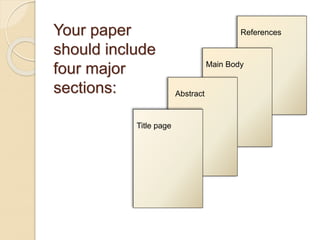
Your paper
should include
four major
sections:
References
Main Body
Abstract
Title page
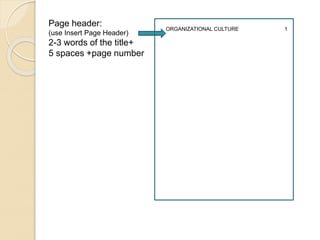
Page header:
(use Insert Page Header)
2-3 words of the title+
5 spaces +page number
ORGANIZATIONAL CULTURE 1
APA Tables
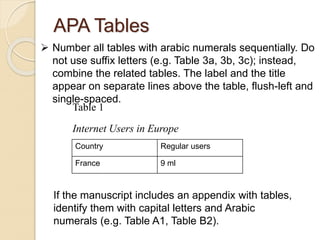
 Number all tables with arabic numerals sequentially. Do
not use suffix letters (e.g. Table 3a, 3b, 3c); instead,
combine the related tables. The label and the title
appear on separate lines above the table, flush-left and
single-spaced.
Table 1
Internet Users in Europe
Country Regular users
France 9 ml
If the manuscript includes an appendix with tables,
identify them with capital letters and Arabic
numerals (e.g. Table A1, Table B2).
APA Figures
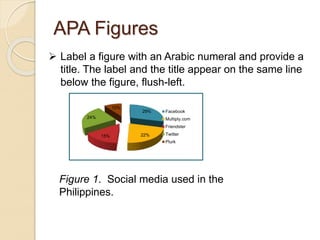
 Label a figure with an Arabic numeral and provide a
title. The label and the title appear on the same line
below the figure, flush-left.
Figure 1. Social media used in the
Philippines.
29%
22%
15%
24%
10%
Facebook
Multiply.com
Friendster
Twitter
Plurk
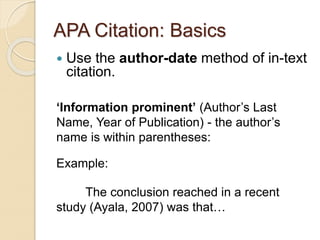
APA Citation: Basics
 Use the author-date method of in-text
citation.
‘Information prominent’ (Author’s Last
Name, Year of Publication) - the author’s
name is within parentheses:
Example:
The conclusion reached in a recent
study (Ayala, 2007) was that…
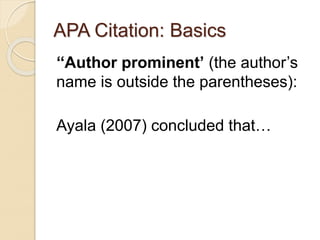
APA Citation: Basics
‘‘Author prominent’ (the author’s
name is outside the parentheses):
Ayala (2007) concluded that…
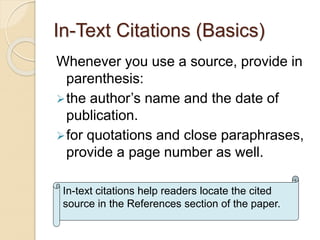
In-Text Citations (Basics)
Whenever you use a source, provide in
parenthesis:
the author’s name and the date of
publication.
for quotations and close paraphrases,
provide a page number as well.
In-text citations help readers locate the cited
source in the References section of the paper.
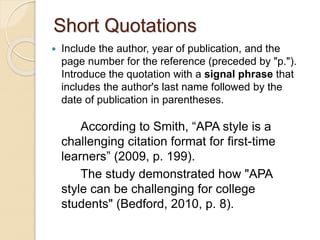
Short Quotations
 Include the author, year of publication, and the
page number for the reference (preceded by "p.").
Introduce the quotation with a signal phrase that
includes the author's last name followed by the
date of publication in parentheses.
According to Smith, “APA style is a
challenging citation format for first-time
learners” (2009, p. 199).
The study demonstrated how "APA
style can be challenging for college
students" (Bedford, 2010, p. 8).
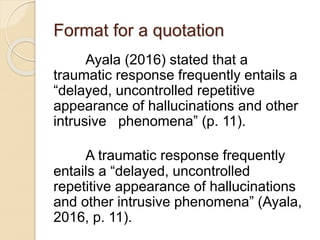
Format for a quotation
Ayala (2016) stated that a
traumatic response frequently entails a
“delayed, uncontrolled repetitive
appearance of hallucinations and other
intrusive phenomena” (p. 11).
A traumatic response frequently
entails a “delayed, uncontrolled
repetitive appearance of hallucinations
and other intrusive phenomena” (Ayala,
2016, p. 11).
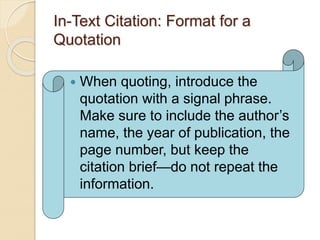
In-Text Citation: Format for a
Quotation
 When quoting, introduce the
quotation with a signal phrase.
Make sure to include the author’s
name, the year of publication, the
page number, but keep the
citation brief—do not repeat the
information.
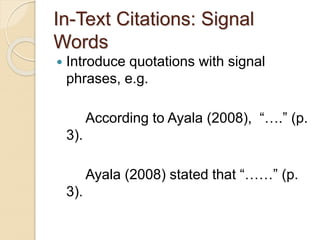
In-Text Citations: Signal
Words
 Introduce quotations with signal
phrases, e.g.
According to Ayala (2008), “….” (p.
3).
Ayala (2008) stated that “……” (p.
3).
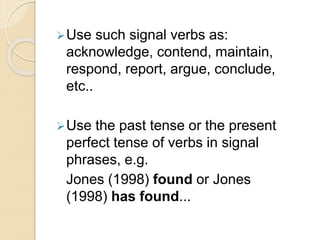
Use such signal verbs as:
acknowledge, contend, maintain,
respond, report, argue, conclude,
etc..
Use the past tense or the present
perfect tense of verbs in signal
phrases, e.g.
Jones (1998) found or Jones
(1998) has found...
Format for a summary or
paraphrase
provide the author’s last name and the
year of publication in parenthesis after
a summary or a paraphrase. You are
encouraged (but not required) to
also provide the page number.
Though feminist studies focus
solely on women's experiences,
they err by collectively perpetuating
the masculine-centered
impressions (Fussell, 2015).
In-text Citation: Two Authors
When citing a work with two authors, use
“and” in between authors’ name in the signal
phrase yet “&” between their names in
parenthesis, e.g.
Research conducted by Bedford and
Smith (2008) suggests college students
struggle when using APA style.
Research has suggested that college
students struggle when using APA style
because they do not acquire the necessary
resources or seek additional support on-
Example for a quotation
According to feminist researchers Raitt
and Tate (2007), “It is no longer true to
claim that women's responses to the war
have been ignored” (p. 2).
or
Some feminists researchers question
that “women's responses to the war have
been ignored” (Raitt & Tate, 2007, p. 2).
In-Text Citation: Three to Five
Authors
List all last names in signal phrase or brackets
for the first in-text citation. If you cite the
source again, use the first author's last name
with "et al."
(Kernis, Cornell, Sun, Berry, & Harlow,
2013)
(Kernis et al., 2013)
In-Text Citations: A work with 6 and
more authors
when citing a work with six and more
authors, identify the first author’s name
followed by “et al.”, e.g.
Smith et al. (2006) maintained
that….
(Smith et al., 2006)
In-Text Citations: A work of
unknown author
 Use the source’s full title in the signal phrase
and cite the first word of the title followed by
the year of publication in parenthesis. Put
titles of articles and chapters in quotation
marks; italicize titles of books and reports.
Google was involved in anti-competitive
practices ("Patent Trials," 2010, para. 3).
It was reported that Calgary's office vacancy
rate in the downtown core is almost 25% ("Calgary
Downtown Vacancy," 2016, para. 1).
In-Text Citation: Organization
as Author
when citing an organization, mention
the
organization the first time when you
cite the source in the signal phrase or
the parenthetical citation; e.g.,
According to the American
Psychological Association (2000), ...
Organization as Author
 If the organization has a well-known abbreviation,
include the abbreviation in brackets the first time
the source is cited and then use only the
abbreviation in
later citations; e.g.,
First citation:
(Mothers Against Drunk Driving [MADD], 2000)
Second citation: (MADD, 2000)
The Department of Education [DepEd] (2016)
confirmed that ...
DepEd (2016) revealed that…
In-Text Citation: Two or More Works
in the Same Parentheses
• when your parenthetical citation includes two
or more works, order them the same way
they appear in the reference list, separated
by a semi-colon.
(Berndt, 2002; Harlow, 2013)
In-Text Citation: The same last
name/the same name
 when citing authors with the same last
names, use first initials with the last names,
e.g.
(B. Kachru, 2012; Y. Kachru, 2015)
 when citing two or more works by the same
author published in the same year, use lower-
case letters (a, b, c) with the year of
publication to order the references, e.g.
Smith’s (2015a) study of adolescent
immigrants…
In-Text Citation: Personal
communication
• When citing interviews, letters, e-mails, etc.,
include initials and last name of the
person(s) and the full date of the
communication. Do not include personal
communication in the reference list.
A registered nurse explained how "elderly
patients with dementia may wander off the premises of
nursing homes" (J. McGill, personal communication,
October 12, 2015).
Plagiarism is a serious violation of academic
honesty policies at Bow Valley College (L. Peters,
personal communication, September 12, 2016).
Citing Indirect Sources
 If you use a source that was cited in
another source, name the original source
in your signal phrase. List the secondary
source in your reference list and include
the secondary source in the parentheses.
Moore (as cited in Maxwell, 2009, p. 25)
stated that…
Moore argued that... (as cited in Maxwell
, 2003, p. 102).
 Note: When citing material in
parentheses, set off the citation with a
In-Text Citations: Electronic
sources
 when citing an electronic document,
whenever possible, cite it in the
author-date style.
Kenneth (2000) explained...
In-Text Citations: Electronic
sources
Unknown author and unknown date
 If no author or date is given, use the
title in your signal phrase or the first
word or two of the title in the
parentheses and use the abbreviation
"n.d." (for "no date").
Another study of students and
research decisions discovered that
students succeeded with tutoring
("Tutoring and APA," n.d.).
In-Text Citations: Electronic
sources
If electronic source lacks page
numbers, locate and identify
paragraph number/ paragraph
heading. To cite paragraphs, use the
abbreviation “para.”
According to Smith (2007),
“students...” (Mind over Matter
section, para. 6).
Reference: Basics
 All lines after the first line of each
entry in your reference list should be
indented one-half inch from the left
margin. This is called hanging
indentation.
 Reference list entries should be
double-spaced and alphabetized by
the last name of the first author of
each work.
References: Basics
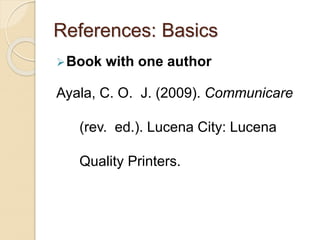
Book with one author
Ayala, C. O. J. (2009). Communicare
(rev. ed.). Lucena City: Lucena
Quality Printers.
Reference: Basics
 Use only the name of the publishing
company (do not include "Company" or
"Inc.“, “Ltd.” etc.).
 When referring to any work that is NOT a
journal, such as a book, article, or Web
page, capitalize only the first letter of the first
word of a title and subtitle, the first word after
a colon or a dash in the title, and proper
nouns.
 Do not capitalize the first letter of the second
word in a hyphenated compound word.
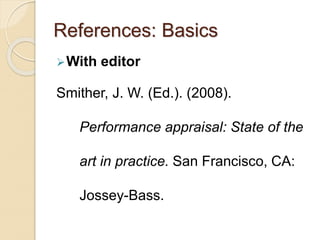
References: Basics
With editor
Smither, J. W. (Ed.). (2008).
Performance appraisal: State of the
art in practice. San Francisco, CA:
Jossey-Bass.
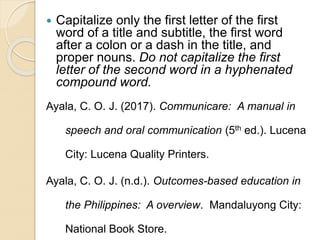
 Capitalize only the first letter of the first
word of a title and subtitle, the first word
after a colon or a dash in the title, and
proper nouns. Do not capitalize the first
letter of the second word in a hyphenated
compound word.
Ayala, C. O. J. (2017). Communicare: A manual in
speech and oral communication (5th ed.). Lucena
City: Lucena Quality Printers.
Ayala, C. O. J. (n.d.). Outcomes-based education in
the Philippines: A overview. Mandaluyong City:
National Book Store.
References: Basics
 Multiple Authors
Murray, R. B., Zentner, J. P., & Yakimo, R.
(2009). Health promotion strategies
through the life span. Upper Saddle
River, NJ: Pearson/ Prentice Hall.
References: Basics
 Multiple Editors
Baker, A., Dutton, S., & Kelly, D. (Eds.). (2004).
Composite materials for aircraft
structures (2nd ed.). Reston, VA:
American Institute of Aeronautics and
Astronautics.
References: Basics
 No author or editor
Merriam-Webster's collegiate dictionary (10th
ed.). (1993). Springfield, MA: Merriam-
Webster.
New concise world atlas. (2007). New York, NY:
Oxford University Press.
References: Basics
 Journal
Berndt, T. J. (2002). Friendship quality and
social development. Current Directions
in Psychological Science, 11, 7-10.
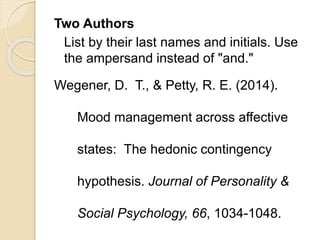
Two Authors
List by their last names and initials. Use
the ampersand instead of "and."
Wegener, D. T., & Petty, R. E. (2014).
Mood management across affective
states: The hedonic contingency
hypothesis. Journal of Personality &
Social Psychology, 66, 1034-1048.
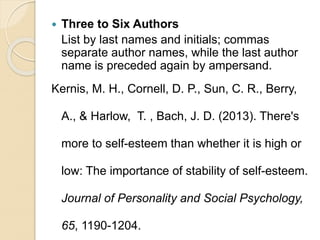
 Three to Six Authors
List by last names and initials; commas
separate author names, while the last author
name is preceded again by ampersand.
Kernis, M. H., Cornell, D. P., Sun, C. R., Berry,
A., & Harlow, T. , Bach, J. D. (2013). There's
more to self-esteem than whether it is high or
low: The importance of stability of self-esteem.
Journal of Personality and Social Psychology,
65, 1190-1204.
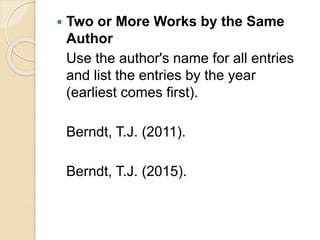
 Two or More Works by the Same
Author
Use the author's name for all entries
and list the entries by the year
(earliest comes first).
Berndt, T.J. (2011).
Berndt, T.J. (2015).
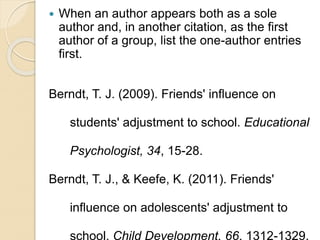
 When an author appears both as a sole
author and, in another citation, as the first
author of a group, list the one-author entries
first.
Berndt, T. J. (2009). Friends' influence on
students' adjustment to school. Educational
Psychologist, 34, 15-28.
Berndt, T. J., & Keefe, K. (2011). Friends'
influence on adolescents' adjustment to
school. Child Development, 66, 1312-1329.
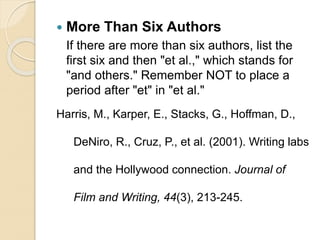
 More Than Six Authors
If there are more than six authors, list the
first six and then "et al.," which stands for
"and others." Remember NOT to place a
period after "et" in "et al."
Harris, M., Karper, E., Stacks, G., Hoffman, D.,
DeNiro, R., Cruz, P., et al. (2001). Writing labs
and the Hollywood connection. Journal of
Film and Writing, 44(3), 213-245.
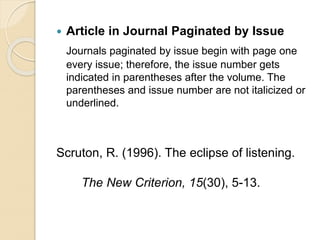
 Article in Journal Paginated by Issue
Journals paginated by issue begin with page one
every issue; therefore, the issue number gets
indicated in parentheses after the volume. The
parentheses and issue number are not italicized or
underlined.
Scruton, R. (1996). The eclipse of listening.
The New Criterion, 15(30), 5-13.
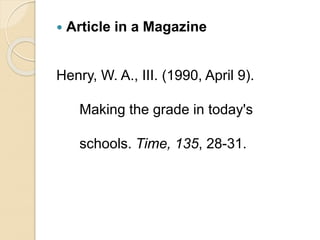
 Article in a Magazine
Henry, W. A., III. (1990, April 9).
Making the grade in today's
schools. Time, 135, 28-31.
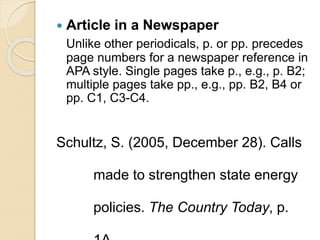
 Article in a Newspaper
Unlike other periodicals, p. or pp. precedes
page numbers for a newspaper reference in
APA style. Single pages take p., e.g., p. B2;
multiple pages take pp., e.g., pp. B2, B4 or
pp. C1, C3-C4.
Schultz, S. (2005, December 28). Calls
made to strengthen state energy
policies. The Country Today, p.
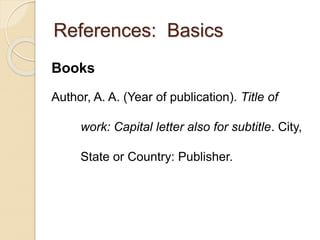
Books
Author, A. A. (Year of publication). Title of
work: Capital letter also for subtitle. City,
State or Country: Publisher.
References: Basics
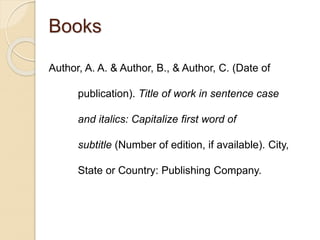
Author, A. A. & Author, B., & Author, C. (Date of
publication). Title of work in sentence case
and italics: Capitalize first word of
subtitle (Number of edition, if available). City,
State or Country: Publishing Company.
Books
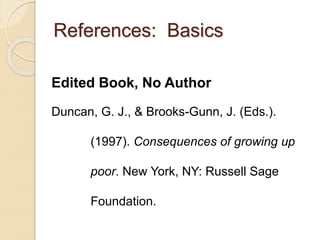
Edited Book, No Author
Duncan, G. J., & Brooks-Gunn, J. (Eds.).
(1997). Consequences of growing up
poor. New York, NY: Russell Sage
Foundation.
References: Basics
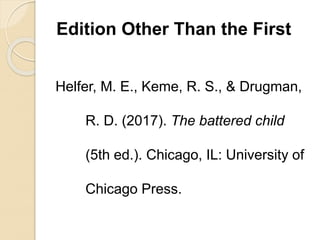
Edition Other Than the First
Helfer, M. E., Keme, R. S., & Drugman,
R. D. (2017). The battered child
(5th ed.). Chicago, IL: University of
Chicago Press.
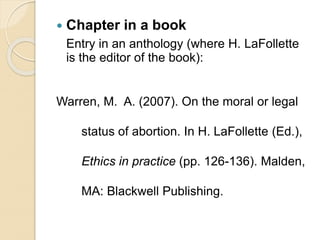
 Chapter in a book
Entry in an anthology (where H. LaFollette
is the editor of the book):
Warren, M. A. (2007). On the moral or legal
status of abortion. In H. LaFollette (Ed.),
Ethics in practice (pp. 126-136). Malden,
MA: Blackwell Publishing.
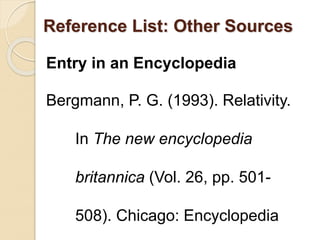
Reference List: Other Sources
Entry in an Encyclopedia
Bergmann, P. G. (1993). Relativity.
In The new encyclopedia
britannica (Vol. 26, pp. 501-
508). Chicago: Encyclopedia
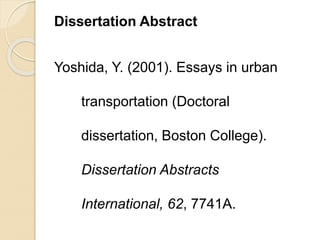
Dissertation Abstract
Yoshida, Y. (2001). Essays in urban
transportation (Doctoral
dissertation, Boston College).
Dissertation Abstracts
International, 62, 7741A.
Unpublished Thesis/Dissertation
Ayala, C. J. (2016). Research
productivity and utilization in
Philippine higher education
institutions. (Doctoral
dissertation). University of the
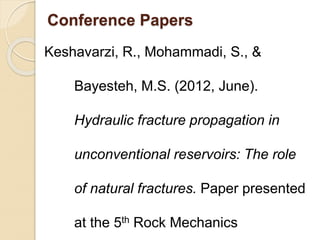
Conference Papers
Keshavarzi, R., Mohammadi, S., &
Bayesteh, M.S. (2012, June).
Hydraulic fracture propagation in
unconventional reservoirs: The role
of natural fractures. Paper presented
at the 5th Rock Mechanics
Unpublished symposium
Martins, J. R. (2004, April). Working with the
terminally ill: An integrated theoretical
model. In J. R. Tunon (Chair),
Cooperative health care in the 21st
century. Symposium conducted at the
meeting of the American Counseling
Association World Conference, San
Online Newspaper Article
Parker-Pope, T. (2008, May 6). Psychiatry
handbook linked to drug industry. The
New York Times. Retrieved from
http://www.nytimes.com
Electronic Sources
Article with DOI (digital object
identifier)
Brownlie, D. (2007). Toward effective poster
presentations: An annotated
bibliography. European Journal of
Marketing, 41(11/12), 1245-1283.
doi:10.1108/0309056071082
Electronic Sources
Article without DOI
Kenneth, I. A. (2000). A Buddhist
response to the nature of human
rights. Journal of Buddhist Ethics,
8. Retrieved from
http://www.cac.psu.edu/jbe/two.htm
Electronic Sources
Electronic Books
Electronic books may include books
found on personal websites, databases,
or even in audio form.
Glazer, H. (2011). High performance operations:
Leverage compliance to lower costs, increase
profits, and gain competitive advantage [Kindle
eBook version]. Retrieved from
http://www.amazon.com/High-Performance-
OperationsCompetitive-ebook/dp/
Electronic Books
If the work is not directly available online or
must be purchased, use "Available from,"
rather than "Retrieved from," and point readers
to where they can find it.
Glazer, H. (2011). High performance operations:
Leverage compliance to lower costs, increase
profits, and gain competitive advantage [Kindle
eBook version]. Available from
http://www.amazon.com/High-Performance-
OperationsCompetitive-ebook/dp/
Presentation from instructor, online
Smith, J. A. (2012). Biggest engineering
mistakes of the 21st century [Powerpoint
presentation]. Retrieved from
http://moodle.nait.ca/course/ view.
php?id=7076
Handout from instructor, offline
Smith, P. R. (2012). Robot boss battles
[Class handout]. Instrumentation
Engineering Technology, NAIT,
Edmonton, Canada.
Doctoral dissertation retrieved from
institutional database
Bernardi, R. A. (1990). Accounting
pronouncements, firm size, and firm
industry: Their effect on Altman's
bankruptcy prediction model. (Doctoral
dissertation). Retrieved from
http://www.vtu.edu/etd/
Dissertation/Master’s thesis retrieved
from the web
Patterson, G. W. (2003). A comparison of
multi-year instructional programs
(looping) and regular education
program utilizing scale scores in
reading. (Master’s thesis, University of
Florida). Retrieved from
Unpublished manuscript with a university
cited retrieved from institutional website,
no date
Colman, W. C. (n.d.). Comparisons of grade point
averages between men who join fraternities and
men who do not join fraternities at Shady Rock
University. Unpublished manuscript. Programs for
Higher Education, Nova Southeastern University.
Retrieved from
http://www.nova.edu/phe/phe_resources/
Doctoral dissertation retrieved from
ProQuest Dissertations and Theses
database
Johnson, S. (2004). Financial variables and
merger premiums: Evidence from bank
mergers. Available from ProQuest
Dissertations and Theses database.
(UMI No. 3025476)
 Identify a type source: Is it a book? A
journal article? A webpage?
 “Mirror” the sample.
 Make sure that the entries are listed
in the alphabetical order and the
subsequent lines are indented.
APA is a complex system of citation, which is
difficult to keep in mind. When compiling the
reference list, the strategy below might be useful:
Thank you!

MODULE (DOCUMENTING SOURCES AND APA FORMATTING STYLES)

  • 1.
    Documenting Sources APA Style 6thEdition Maria Azela L. Tamayo, PhD Assistant Professor IV, College of Arts and Sciences
  • 2.
    What is APAstyle?  American Psychological Association Style is a set of rules to credit sources by writing citations and references which is preferred in the social sciences and business.
  • 3.
    The Fundamental Principlesof Good Writing: Documentation  borrowing information from various sources is not only an option – it is a necessity  one walks the fine line between the proper documentation/attribution of sources and plagiarism
  • 4.
    Plagiarism – “theact of passing off as one’s own the ideas or writings of another” (http://www.georgetown.edu/honor/plagiarism.html )
  • 5.
    Why document sources? To establish the validity of findings and facts included in the report  To give proper credit to the creator of the information  To provide the audience with information s/he might need or want about the subject matter that you have borrowed or obtained from another source
  • 6.
    How do youdocument? Internal referencing at the point of use (in-text citation) Full bibliographic referencing at the end of the text (references)
  • 7.
    What should bedocumented?  If you used someone else’s ideas—cite the source  If you received specific help from someone in writing the paper— acknowledge their inputs  If you quoted someone’s words in your own report—attribute in full
  • 8.
    What should bedocumented? *** If you quote verbatim 250 or more successive words from a published source, you must obtain formal permission to use that material. (Weisman, 1985)
  • 9.
    What does APA regulate? Stylistics In-textcitations References (a list of all the sources used in the paper)
  • 10.
    APA Stylistics: Avoidingbias in language  Make adjustments to label  Avoid gendered pronouns APA does not recommend replacing “he” with “he or she,” “she or he,” “(s)he,” “s/he,” or alternating between “he” and “she” because these substitutions are awkward and can distract the reader from the point you are trying to make.  Find alternative descriptors
  • 11.
    To avoid thebias of using gendered pronouns:  Rephrase the sentence.  Use plural nouns or plural pronouns - this way you can use “they” or “their”.  Replace the pronoun with an article - instead of “his,” use “the”.  Drop the pronoun - many sentences sound fine if you just omit the troublesome “his” from the sentence.  Replace the pronoun with a noun such as “person,” “individual,” “child,” “researcher,” etc.
  • 12.
    APA Stylistics: Basics Pointof View and Voice USE: the third person point of view rather than using the first person point of view or the passive voice; e.g., The study showed that…, NOT I found out that…. the active voice rather than passive voice; e.g., The participants responded…, NOT The participants have been asked….
  • 13.
    Clarity and Conciseness For clarity, be specific rather than vague in descriptions and explanations. Unpack details accurately to provide adequate information to your readers so they can follow the development of your study. Example: POOR: “It was predicted that marital conflict would predict behavior problems in school-aged children.” BETTER: “Results revealed that marital conflict would predict behavior problems in school-aged children. It was found that the effect would be stronger for girls than for boys. It was also stated that older girls would be more affected by marital conflict than younger girls.”
  • 14.
     To bemore concise, particularly in introductory material or abstracts, you should pare out unnecessary words and condense information when you can. “The study revealed marital conflict would predict behavior problems in children and that the effect was greater for girls than for boys, particularly when two different age groups of girls were examined.”
  • 15.
    Word choice  Useterms like “participants” or “respondents” (rather than “subjects”) to indicate how individuals were involved in your research.  Use terms like “children” or “community members” to provide more detail about who was participating in the study.  Use phrases like “The evidence suggests...” or “The study indicates...” rather than referring to “proof” or “proves” because no single study can prove a theory or hypothesis.
  • 16.
    Avoid poetic language Therefore,you should:  minimize the amount of figurative language used in an APA paper, such as metaphors and analogies unless they are helpful in conveying a complex idea.  avoid rhyming schemes, alliteration, or other poetic devices typically found in verse.  use simple, descriptive adjectives and plain language that does not risk confusing your meaning.
  • 17.
    Language in anAPA paper is...  clear: be specific in descriptions and explanations.  concise: condense information when you can.  plain: use simple, descriptive adjectives and minimize the figurative language.
  • 18.
    General Document FormatGuidelines (APA Style)  Margins – 1” on all sides  Font – 12 pts. Times New Roman, Courier or Arial  Spacing – double  Alignment – flush left  Paragraph indentions – 5 to 7 spaces  Pagination – 1” from the rightmost edge; first line
  • 19.
     On standardsize paper – 8 ½” x 11”  Include a page header (short title & page number) in the upper right-hand of every page
  • 20.
    Your paper should include fourmajor sections: References Main Body Abstract Title page
  • 21.
    Page header: (use InsertPage Header) 2-3 words of the title+ 5 spaces +page number ORGANIZATIONAL CULTURE 1
  • 22.
    APA Tables  Numberall tables with arabic numerals sequentially. Do not use suffix letters (e.g. Table 3a, 3b, 3c); instead, combine the related tables. The label and the title appear on separate lines above the table, flush-left and single-spaced. Table 1 Internet Users in Europe Country Regular users France 9 ml If the manuscript includes an appendix with tables, identify them with capital letters and Arabic numerals (e.g. Table A1, Table B2).
  • 23.
    APA Figures  Labela figure with an Arabic numeral and provide a title. The label and the title appear on the same line below the figure, flush-left. Figure 1. Social media used in the Philippines. 29% 22% 15% 24% 10% Facebook Multiply.com Friendster Twitter Plurk
  • 24.
    APA Citation: Basics Use the author-date method of in-text citation. ‘Information prominent’ (Author’s Last Name, Year of Publication) - the author’s name is within parentheses: Example: The conclusion reached in a recent study (Ayala, 2007) was that…
  • 25.
    APA Citation: Basics ‘‘Authorprominent’ (the author’s name is outside the parentheses): Ayala (2007) concluded that…
  • 26.
    In-Text Citations (Basics) Wheneveryou use a source, provide in parenthesis: the author’s name and the date of publication. for quotations and close paraphrases, provide a page number as well. In-text citations help readers locate the cited source in the References section of the paper.
  • 27.
    Short Quotations  Includethe author, year of publication, and the page number for the reference (preceded by "p."). Introduce the quotation with a signal phrase that includes the author's last name followed by the date of publication in parentheses. According to Smith, “APA style is a challenging citation format for first-time learners” (2009, p. 199). The study demonstrated how "APA style can be challenging for college students" (Bedford, 2010, p. 8).
  • 28.
    Format for aquotation Ayala (2016) stated that a traumatic response frequently entails a “delayed, uncontrolled repetitive appearance of hallucinations and other intrusive phenomena” (p. 11). A traumatic response frequently entails a “delayed, uncontrolled repetitive appearance of hallucinations and other intrusive phenomena” (Ayala, 2016, p. 11).
  • 29.
    In-Text Citation: Formatfor a Quotation  When quoting, introduce the quotation with a signal phrase. Make sure to include the author’s name, the year of publication, the page number, but keep the citation brief—do not repeat the information.
  • 30.
    In-Text Citations: Signal Words Introduce quotations with signal phrases, e.g. According to Ayala (2008), “….” (p. 3). Ayala (2008) stated that “……” (p. 3).
  • 31.
    Use such signalverbs as: acknowledge, contend, maintain, respond, report, argue, conclude, etc.. Use the past tense or the present perfect tense of verbs in signal phrases, e.g. Jones (1998) found or Jones (1998) has found...
  • 32.
    Format for asummary or paraphrase provide the author’s last name and the year of publication in parenthesis after a summary or a paraphrase. You are encouraged (but not required) to also provide the page number. Though feminist studies focus solely on women's experiences, they err by collectively perpetuating the masculine-centered impressions (Fussell, 2015).
  • 33.
    In-text Citation: TwoAuthors When citing a work with two authors, use “and” in between authors’ name in the signal phrase yet “&” between their names in parenthesis, e.g. Research conducted by Bedford and Smith (2008) suggests college students struggle when using APA style. Research has suggested that college students struggle when using APA style because they do not acquire the necessary resources or seek additional support on-
  • 34.
    Example for aquotation According to feminist researchers Raitt and Tate (2007), “It is no longer true to claim that women's responses to the war have been ignored” (p. 2). or Some feminists researchers question that “women's responses to the war have been ignored” (Raitt & Tate, 2007, p. 2).
  • 35.
    In-Text Citation: Threeto Five Authors List all last names in signal phrase or brackets for the first in-text citation. If you cite the source again, use the first author's last name with "et al." (Kernis, Cornell, Sun, Berry, & Harlow, 2013) (Kernis et al., 2013)
  • 36.
    In-Text Citations: Awork with 6 and more authors when citing a work with six and more authors, identify the first author’s name followed by “et al.”, e.g. Smith et al. (2006) maintained that…. (Smith et al., 2006)
  • 37.
    In-Text Citations: Awork of unknown author  Use the source’s full title in the signal phrase and cite the first word of the title followed by the year of publication in parenthesis. Put titles of articles and chapters in quotation marks; italicize titles of books and reports. Google was involved in anti-competitive practices ("Patent Trials," 2010, para. 3). It was reported that Calgary's office vacancy rate in the downtown core is almost 25% ("Calgary Downtown Vacancy," 2016, para. 1).
  • 38.
    In-Text Citation: Organization asAuthor when citing an organization, mention the organization the first time when you cite the source in the signal phrase or the parenthetical citation; e.g., According to the American Psychological Association (2000), ...
  • 39.
    Organization as Author If the organization has a well-known abbreviation, include the abbreviation in brackets the first time the source is cited and then use only the abbreviation in later citations; e.g., First citation: (Mothers Against Drunk Driving [MADD], 2000) Second citation: (MADD, 2000) The Department of Education [DepEd] (2016) confirmed that ... DepEd (2016) revealed that…
  • 40.
    In-Text Citation: Twoor More Works in the Same Parentheses • when your parenthetical citation includes two or more works, order them the same way they appear in the reference list, separated by a semi-colon. (Berndt, 2002; Harlow, 2013)
  • 41.
    In-Text Citation: Thesame last name/the same name  when citing authors with the same last names, use first initials with the last names, e.g. (B. Kachru, 2012; Y. Kachru, 2015)  when citing two or more works by the same author published in the same year, use lower- case letters (a, b, c) with the year of publication to order the references, e.g. Smith’s (2015a) study of adolescent immigrants…
  • 42.
    In-Text Citation: Personal communication •When citing interviews, letters, e-mails, etc., include initials and last name of the person(s) and the full date of the communication. Do not include personal communication in the reference list. A registered nurse explained how "elderly patients with dementia may wander off the premises of nursing homes" (J. McGill, personal communication, October 12, 2015). Plagiarism is a serious violation of academic honesty policies at Bow Valley College (L. Peters, personal communication, September 12, 2016).
  • 43.
    Citing Indirect Sources If you use a source that was cited in another source, name the original source in your signal phrase. List the secondary source in your reference list and include the secondary source in the parentheses. Moore (as cited in Maxwell, 2009, p. 25) stated that… Moore argued that... (as cited in Maxwell , 2003, p. 102).  Note: When citing material in parentheses, set off the citation with a
  • 44.
    In-Text Citations: Electronic sources when citing an electronic document, whenever possible, cite it in the author-date style. Kenneth (2000) explained...
  • 45.
    In-Text Citations: Electronic sources Unknownauthor and unknown date  If no author or date is given, use the title in your signal phrase or the first word or two of the title in the parentheses and use the abbreviation "n.d." (for "no date"). Another study of students and research decisions discovered that students succeeded with tutoring ("Tutoring and APA," n.d.).
  • 46.
    In-Text Citations: Electronic sources Ifelectronic source lacks page numbers, locate and identify paragraph number/ paragraph heading. To cite paragraphs, use the abbreviation “para.” According to Smith (2007), “students...” (Mind over Matter section, para. 6).
  • 47.
    Reference: Basics  Alllines after the first line of each entry in your reference list should be indented one-half inch from the left margin. This is called hanging indentation.  Reference list entries should be double-spaced and alphabetized by the last name of the first author of each work.
  • 48.
    References: Basics Book withone author Ayala, C. O. J. (2009). Communicare (rev. ed.). Lucena City: Lucena Quality Printers.
  • 49.
    Reference: Basics  Useonly the name of the publishing company (do not include "Company" or "Inc.“, “Ltd.” etc.).  When referring to any work that is NOT a journal, such as a book, article, or Web page, capitalize only the first letter of the first word of a title and subtitle, the first word after a colon or a dash in the title, and proper nouns.  Do not capitalize the first letter of the second word in a hyphenated compound word.
  • 50.
    References: Basics With editor Smither,J. W. (Ed.). (2008). Performance appraisal: State of the art in practice. San Francisco, CA: Jossey-Bass.
  • 51.
     Capitalize onlythe first letter of the first word of a title and subtitle, the first word after a colon or a dash in the title, and proper nouns. Do not capitalize the first letter of the second word in a hyphenated compound word. Ayala, C. O. J. (2017). Communicare: A manual in speech and oral communication (5th ed.). Lucena City: Lucena Quality Printers. Ayala, C. O. J. (n.d.). Outcomes-based education in the Philippines: A overview. Mandaluyong City: National Book Store.
  • 52.
    References: Basics  MultipleAuthors Murray, R. B., Zentner, J. P., & Yakimo, R. (2009). Health promotion strategies through the life span. Upper Saddle River, NJ: Pearson/ Prentice Hall.
  • 53.
    References: Basics  MultipleEditors Baker, A., Dutton, S., & Kelly, D. (Eds.). (2004). Composite materials for aircraft structures (2nd ed.). Reston, VA: American Institute of Aeronautics and Astronautics.
  • 54.
    References: Basics  Noauthor or editor Merriam-Webster's collegiate dictionary (10th ed.). (1993). Springfield, MA: Merriam- Webster. New concise world atlas. (2007). New York, NY: Oxford University Press.
  • 55.
    References: Basics  Journal Berndt,T. J. (2002). Friendship quality and social development. Current Directions in Psychological Science, 11, 7-10.
  • 56.
    Two Authors List bytheir last names and initials. Use the ampersand instead of "and." Wegener, D. T., & Petty, R. E. (2014). Mood management across affective states: The hedonic contingency hypothesis. Journal of Personality & Social Psychology, 66, 1034-1048.
  • 57.
     Three toSix Authors List by last names and initials; commas separate author names, while the last author name is preceded again by ampersand. Kernis, M. H., Cornell, D. P., Sun, C. R., Berry, A., & Harlow, T. , Bach, J. D. (2013). There's more to self-esteem than whether it is high or low: The importance of stability of self-esteem. Journal of Personality and Social Psychology, 65, 1190-1204.
  • 58.
     Two orMore Works by the Same Author Use the author's name for all entries and list the entries by the year (earliest comes first). Berndt, T.J. (2011). Berndt, T.J. (2015).
  • 59.
     When anauthor appears both as a sole author and, in another citation, as the first author of a group, list the one-author entries first. Berndt, T. J. (2009). Friends' influence on students' adjustment to school. Educational Psychologist, 34, 15-28. Berndt, T. J., & Keefe, K. (2011). Friends' influence on adolescents' adjustment to school. Child Development, 66, 1312-1329.
  • 60.
     More ThanSix Authors If there are more than six authors, list the first six and then "et al.," which stands for "and others." Remember NOT to place a period after "et" in "et al." Harris, M., Karper, E., Stacks, G., Hoffman, D., DeNiro, R., Cruz, P., et al. (2001). Writing labs and the Hollywood connection. Journal of Film and Writing, 44(3), 213-245.
  • 61.
     Article inJournal Paginated by Issue Journals paginated by issue begin with page one every issue; therefore, the issue number gets indicated in parentheses after the volume. The parentheses and issue number are not italicized or underlined. Scruton, R. (1996). The eclipse of listening. The New Criterion, 15(30), 5-13.
  • 62.
     Article ina Magazine Henry, W. A., III. (1990, April 9). Making the grade in today's schools. Time, 135, 28-31.
  • 63.
     Article ina Newspaper Unlike other periodicals, p. or pp. precedes page numbers for a newspaper reference in APA style. Single pages take p., e.g., p. B2; multiple pages take pp., e.g., pp. B2, B4 or pp. C1, C3-C4. Schultz, S. (2005, December 28). Calls made to strengthen state energy policies. The Country Today, p.
  • 64.
    Books Author, A. A.(Year of publication). Title of work: Capital letter also for subtitle. City, State or Country: Publisher. References: Basics
  • 65.
    Author, A. A.& Author, B., & Author, C. (Date of publication). Title of work in sentence case and italics: Capitalize first word of subtitle (Number of edition, if available). City, State or Country: Publishing Company. Books
  • 66.
    Edited Book, NoAuthor Duncan, G. J., & Brooks-Gunn, J. (Eds.). (1997). Consequences of growing up poor. New York, NY: Russell Sage Foundation. References: Basics
  • 67.
    Edition Other Thanthe First Helfer, M. E., Keme, R. S., & Drugman, R. D. (2017). The battered child (5th ed.). Chicago, IL: University of Chicago Press.
  • 68.
     Chapter ina book Entry in an anthology (where H. LaFollette is the editor of the book): Warren, M. A. (2007). On the moral or legal status of abortion. In H. LaFollette (Ed.), Ethics in practice (pp. 126-136). Malden, MA: Blackwell Publishing.
  • 69.
    Reference List: OtherSources Entry in an Encyclopedia Bergmann, P. G. (1993). Relativity. In The new encyclopedia britannica (Vol. 26, pp. 501- 508). Chicago: Encyclopedia
  • 70.
    Dissertation Abstract Yoshida, Y.(2001). Essays in urban transportation (Doctoral dissertation, Boston College). Dissertation Abstracts International, 62, 7741A.
  • 71.
    Unpublished Thesis/Dissertation Ayala, C.J. (2016). Research productivity and utilization in Philippine higher education institutions. (Doctoral dissertation). University of the
  • 72.
    Conference Papers Keshavarzi, R.,Mohammadi, S., & Bayesteh, M.S. (2012, June). Hydraulic fracture propagation in unconventional reservoirs: The role of natural fractures. Paper presented at the 5th Rock Mechanics
  • 73.
    Unpublished symposium Martins, J.R. (2004, April). Working with the terminally ill: An integrated theoretical model. In J. R. Tunon (Chair), Cooperative health care in the 21st century. Symposium conducted at the meeting of the American Counseling Association World Conference, San
  • 74.
    Online Newspaper Article Parker-Pope,T. (2008, May 6). Psychiatry handbook linked to drug industry. The New York Times. Retrieved from http://www.nytimes.com Electronic Sources
  • 75.
    Article with DOI(digital object identifier) Brownlie, D. (2007). Toward effective poster presentations: An annotated bibliography. European Journal of Marketing, 41(11/12), 1245-1283. doi:10.1108/0309056071082 Electronic Sources
  • 76.
    Article without DOI Kenneth,I. A. (2000). A Buddhist response to the nature of human rights. Journal of Buddhist Ethics, 8. Retrieved from http://www.cac.psu.edu/jbe/two.htm Electronic Sources
  • 77.
    Electronic Books Electronic booksmay include books found on personal websites, databases, or even in audio form. Glazer, H. (2011). High performance operations: Leverage compliance to lower costs, increase profits, and gain competitive advantage [Kindle eBook version]. Retrieved from http://www.amazon.com/High-Performance- OperationsCompetitive-ebook/dp/
  • 78.
    Electronic Books If thework is not directly available online or must be purchased, use "Available from," rather than "Retrieved from," and point readers to where they can find it. Glazer, H. (2011). High performance operations: Leverage compliance to lower costs, increase profits, and gain competitive advantage [Kindle eBook version]. Available from http://www.amazon.com/High-Performance- OperationsCompetitive-ebook/dp/
  • 79.
    Presentation from instructor,online Smith, J. A. (2012). Biggest engineering mistakes of the 21st century [Powerpoint presentation]. Retrieved from http://moodle.nait.ca/course/ view. php?id=7076
  • 80.
    Handout from instructor,offline Smith, P. R. (2012). Robot boss battles [Class handout]. Instrumentation Engineering Technology, NAIT, Edmonton, Canada.
  • 81.
    Doctoral dissertation retrievedfrom institutional database Bernardi, R. A. (1990). Accounting pronouncements, firm size, and firm industry: Their effect on Altman's bankruptcy prediction model. (Doctoral dissertation). Retrieved from http://www.vtu.edu/etd/
  • 82.
    Dissertation/Master’s thesis retrieved fromthe web Patterson, G. W. (2003). A comparison of multi-year instructional programs (looping) and regular education program utilizing scale scores in reading. (Master’s thesis, University of Florida). Retrieved from
  • 83.
    Unpublished manuscript witha university cited retrieved from institutional website, no date Colman, W. C. (n.d.). Comparisons of grade point averages between men who join fraternities and men who do not join fraternities at Shady Rock University. Unpublished manuscript. Programs for Higher Education, Nova Southeastern University. Retrieved from http://www.nova.edu/phe/phe_resources/
  • 84.
    Doctoral dissertation retrievedfrom ProQuest Dissertations and Theses database Johnson, S. (2004). Financial variables and merger premiums: Evidence from bank mergers. Available from ProQuest Dissertations and Theses database. (UMI No. 3025476)
  • 85.
     Identify atype source: Is it a book? A journal article? A webpage?  “Mirror” the sample.  Make sure that the entries are listed in the alphabetical order and the subsequent lines are indented. APA is a complex system of citation, which is difficult to keep in mind. When compiling the reference list, the strategy below might be useful:
  • 86.