Thompson Sampling for Machine Learning
R.J. Mak
Greenhouse Group
PyData Amsterdam 2018
May, 26, 2018
Introduction
Group of online marketing
agencies, part of GroupM
Tech Hub
Creative Hub
Data Hub
Data Science Team
Data Technologist Team
Data Insights Team
Consumer Experience
Marketing Team
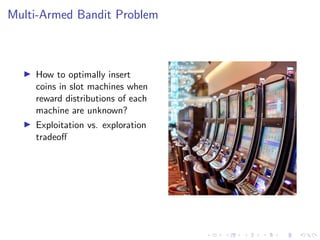
Multi-Armed Bandit Problem
How to optimally insert
coins in slot machines when
reward distributions of each
machine are unknown?
Exploitation vs. exploration
tradeoff
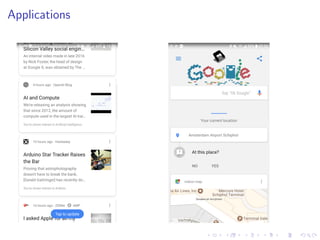
Applications
Any setting where data
(observations) are costly.
Pretty much any data
science project,
underemphasized.
Deep learning: most focus
on cases where data is
(nearly) abundant.
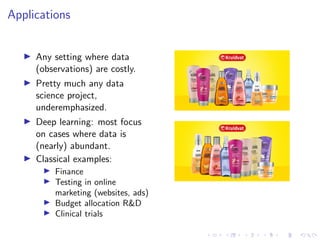
Classical examples:
Finance
Testing in online
marketing (websites, ads)
Budget allocation R&D
Clinical trials
Applications
Thompson Sampling: some history
Formulated by Thompson in 1933.
Allied scientists in World War II, proposed to drop the
Multi-armed bandit problem over Germany so that German
scientists could also waste their time on it.
1997 proof of convergence.
Asymptotic convergence results for contextual bandits were
published in 2011.
2012 proven to be optimal for the case of Bernoulli rewards
(Lai and Robbins lower bound for the cumulative regret).
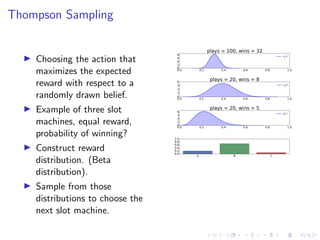
Thompson Sampling
Choosing the action that
maximizes the expected
reward with respect to a
randomly drawn belief.
Example of three slot
machines, equal reward,
probability of winning?
Construct reward
distribution. (Beta
distribution).
Sample from those
distributions to choose the
next slot machine.
Thompson sampling using numpy
1 import numpy as np
2
3 plays = np.array([100, 20, 20])
4 wins = np.array([32, 8, 5])
5 num_samples = 1000000
6
7 p_A_sample = np.random.beta(wins[0], plays[0] - wins[0], num_samples)
8 p_B_sample = np.random.beta(wins[1], plays[1] - wins[1], num_samples)
9 p_C_sample = np.random.beta(wins[2], plays[2] - wins[2], num_samples)
10
11 mab_wins = np.array([0.0, 0.0, 0.0])
12
13 for i in range(num_samples):
14 winner = np.argmax([p_A_sample[i], p_B_sample[i], p_C_sample[i]])
15 mab_wins[winner] += 1
16
17 mab_wins = mab_wins / num_samples
18
19 print(mab_wins)
Prediction probabilities vs. prediction distributions
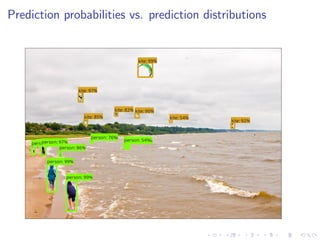
Prediction probabilities and prediction distributions both say
something about uncertainty, what’s the difference?
In the example of object detection, the probabilities are point
estimates of how likely the thing in the picture is a certain
object, for that specific picture. It captures the uncertainty
from the input image.
However, it does not capture the uncertainty from the data
used to train the model. This is what we want to capture with
a prediction distribution.
Prediction probabilities vs. prediction distributions
Traditional (frequentist) clinical trial
Purely random split test subjects into two groups, group A
gets the treatment, group B gets a placebo.
Often assumption of homogeneous group is made (same effect
for everybody), or, formally, a specific hypothesis needs to be
made at the start of the research about specific heterogeneity.
Medicine often has dangerous side effects for women (and
possibly children, or other minorities).
Time to market of new medicine also plays a role.
Maurits Kaptein (JADS): ”It is unethical to use randomized
controlled trials to personalize health-care”.
{patient, time, treatment, dose}
f
→ outcome
Edward
Python package for probabilistic modeling and inference
Build on top of Tensorflow
Bayesian neural networks
Non-Bayesian machine learning: point estimates of
coefficients and predictions
Bayesian: distributions of coefficients and predictions
Toy data set
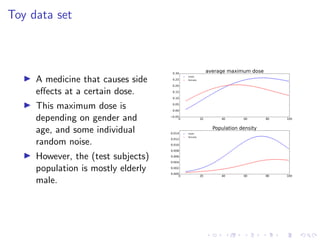
A medicine that causes side
effects at a certain dose.
This maximum dose is
depending on gender and
age, and some individual
random noise.
However, the (test subjects)
population is mostly elderly
male.
Edward in action
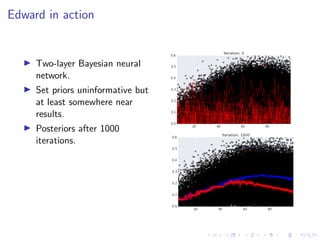
Two-layer Bayesian neural
network.
Set priors uninformative but
at least somewhere near
results.
Posteriors after 1000
iterations.
Edward results
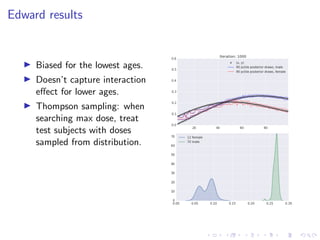
Biased for the lowest ages.
Doesn’t capture interaction
effect for lower ages.
Thompson sampling: when
searching max dose, treat
test subjects with doses
sampled from distribution.
Frequentist comparison
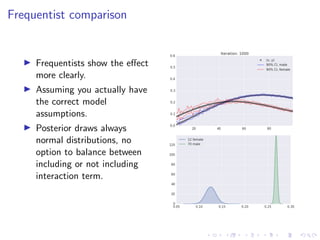
Frequentists show the effect
more clearly.
Assuming you actually have
the correct model
assumptions.
Posterior draws always
normal distributions, no
option to balance between
including or not including
interaction term.
Edward age as integer input
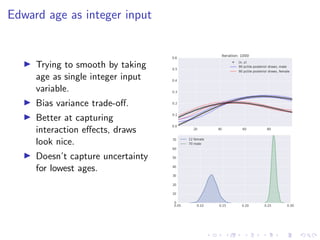
Trying to smooth by taking
age as single integer input
variable.
Bias variance trade-off.
Better at capturing
interaction effects, draws
look nice.
Doesn’t capture uncertainty
for lowest ages.
Frequentist vs. Bayesian neural network
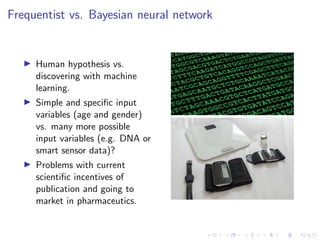
Human hypothesis vs.
discovering with machine
learning.
Simple and specific input
variables (age and gender)
vs. many more possible
input variables (e.g. DNA or
smart sensor data)?
Problems with current
scientific incentives of
publication and going to
market in pharmaceutics.
Data volume: data from practice
The biggest problem is acquiring sufficient data to find
specific relationships, interactions and effects.
What if every treatment could be used as a data point?
Remove the strict boundary between research and application.
Thompson sampling in daily use:
Continuously update distributions with data from practice.
Sample optimal treatment from distributions.
Practical and ethical challenges
Practical challenges.
Would you want to be treated according to a randomly
sampled belief or the most likely belief?
Would you always want to be in an experiment?
However, current system is unfair because:
Unfair towards effects and side effects for minorities, because
you need to wait until somebody comes with a hypothesis and
start researching.
Longer time for a medicine to go to market, unfair for patients
that cannot get the treatment (yet).
Conclusion
Consider the cost of data acquisition as an essential topic for
any data scientist.
Strategic design of data collection, consider Thompson
sampling.
Edward is definitely worth discovering.
There is no such thing as a free lunch!

Thompson Sampling for Machine Learning - Ruben Mak

  • 1.
    Thompson Sampling forMachine Learning R.J. Mak Greenhouse Group PyData Amsterdam 2018 May, 26, 2018
  • 2.
    Introduction Group of onlinemarketing agencies, part of GroupM Tech Hub Creative Hub Data Hub Data Science Team Data Technologist Team Data Insights Team Consumer Experience Marketing Team
  • 3.
    Multi-Armed Bandit Problem Howto optimally insert coins in slot machines when reward distributions of each machine are unknown? Exploitation vs. exploration tradeoff
  • 4.
    Applications Any setting wheredata (observations) are costly. Pretty much any data science project, underemphasized. Deep learning: most focus on cases where data is (nearly) abundant. Classical examples: Finance Testing in online marketing (websites, ads) Budget allocation R&D Clinical trials
  • 5.
  • 6.
    Thompson Sampling: somehistory Formulated by Thompson in 1933. Allied scientists in World War II, proposed to drop the Multi-armed bandit problem over Germany so that German scientists could also waste their time on it. 1997 proof of convergence. Asymptotic convergence results for contextual bandits were published in 2011. 2012 proven to be optimal for the case of Bernoulli rewards (Lai and Robbins lower bound for the cumulative regret).
  • 7.
    Thompson Sampling Choosing theaction that maximizes the expected reward with respect to a randomly drawn belief. Example of three slot machines, equal reward, probability of winning? Construct reward distribution. (Beta distribution). Sample from those distributions to choose the next slot machine.
  • 8.
    Thompson sampling usingnumpy 1 import numpy as np 2 3 plays = np.array([100, 20, 20]) 4 wins = np.array([32, 8, 5]) 5 num_samples = 1000000 6 7 p_A_sample = np.random.beta(wins[0], plays[0] - wins[0], num_samples) 8 p_B_sample = np.random.beta(wins[1], plays[1] - wins[1], num_samples) 9 p_C_sample = np.random.beta(wins[2], plays[2] - wins[2], num_samples) 10 11 mab_wins = np.array([0.0, 0.0, 0.0]) 12 13 for i in range(num_samples): 14 winner = np.argmax([p_A_sample[i], p_B_sample[i], p_C_sample[i]]) 15 mab_wins[winner] += 1 16 17 mab_wins = mab_wins / num_samples 18 19 print(mab_wins)
  • 9.
    Prediction probabilities vs.prediction distributions Prediction probabilities and prediction distributions both say something about uncertainty, what’s the difference? In the example of object detection, the probabilities are point estimates of how likely the thing in the picture is a certain object, for that specific picture. It captures the uncertainty from the input image. However, it does not capture the uncertainty from the data used to train the model. This is what we want to capture with a prediction distribution.
  • 10.
    Prediction probabilities vs.prediction distributions
  • 11.
    Traditional (frequentist) clinicaltrial Purely random split test subjects into two groups, group A gets the treatment, group B gets a placebo. Often assumption of homogeneous group is made (same effect for everybody), or, formally, a specific hypothesis needs to be made at the start of the research about specific heterogeneity. Medicine often has dangerous side effects for women (and possibly children, or other minorities). Time to market of new medicine also plays a role. Maurits Kaptein (JADS): ”It is unethical to use randomized controlled trials to personalize health-care”. {patient, time, treatment, dose} f → outcome
  • 12.
    Edward Python package forprobabilistic modeling and inference Build on top of Tensorflow Bayesian neural networks Non-Bayesian machine learning: point estimates of coefficients and predictions Bayesian: distributions of coefficients and predictions
  • 13.
    Toy data set Amedicine that causes side effects at a certain dose. This maximum dose is depending on gender and age, and some individual random noise. However, the (test subjects) population is mostly elderly male.
  • 14.
    Edward in action Two-layerBayesian neural network. Set priors uninformative but at least somewhere near results. Posteriors after 1000 iterations.
  • 15.
    Edward results Biased forthe lowest ages. Doesn’t capture interaction effect for lower ages. Thompson sampling: when searching max dose, treat test subjects with doses sampled from distribution.
  • 16.
    Frequentist comparison Frequentists showthe effect more clearly. Assuming you actually have the correct model assumptions. Posterior draws always normal distributions, no option to balance between including or not including interaction term.
  • 17.
    Edward age asinteger input Trying to smooth by taking age as single integer input variable. Bias variance trade-off. Better at capturing interaction effects, draws look nice. Doesn’t capture uncertainty for lowest ages.
  • 18.
    Frequentist vs. Bayesianneural network Human hypothesis vs. discovering with machine learning. Simple and specific input variables (age and gender) vs. many more possible input variables (e.g. DNA or smart sensor data)? Problems with current scientific incentives of publication and going to market in pharmaceutics.
  • 19.
    Data volume: datafrom practice The biggest problem is acquiring sufficient data to find specific relationships, interactions and effects. What if every treatment could be used as a data point? Remove the strict boundary between research and application. Thompson sampling in daily use: Continuously update distributions with data from practice. Sample optimal treatment from distributions.
  • 20.
    Practical and ethicalchallenges Practical challenges. Would you want to be treated according to a randomly sampled belief or the most likely belief? Would you always want to be in an experiment? However, current system is unfair because: Unfair towards effects and side effects for minorities, because you need to wait until somebody comes with a hypothesis and start researching. Longer time for a medicine to go to market, unfair for patients that cannot get the treatment (yet).
  • 21.
    Conclusion Consider the costof data acquisition as an essential topic for any data scientist. Strategic design of data collection, consider Thompson sampling. Edward is definitely worth discovering. There is no such thing as a free lunch!