+
This Course isabout the structure and
function of computers. Its purpose is to
present, as clearly and completely as
possible, the nature and characteristics of
modern-day computers. This task is a
challenging one for two reasons.
3.
+
First, there isa tremendous variety of products, from
single-chip microcomputers costing a few dollars to
supercomputers costing tens of millions of dollars,
that can rightly claim the name computer. Variety is
exhibited not only in cost, but also in size,
performance, and application.
Second, the rapid pace of change that has always
characterized computer technology continues with
no letup. These changes cover all aspects of
computer technology, from the underlying
integrated circuit technology used to construct
computer components to the increasing use of
parallel organization concepts in combining those
components.
4.
+
In spite ofthe variety and pace of change in
the computer field, certain fundamental
concepts apply consistently throughout. To be
sure, the application of these concepts
depends on the current state of technology
and the rice/performance objectives of the
designer. The intent of this course is to
provide a thorough discussion of the
fundamentals of computer organization and
architecture and to relate these to
contemporary computer design issues. This
chapter introduces the descriptive approach to
be taken.
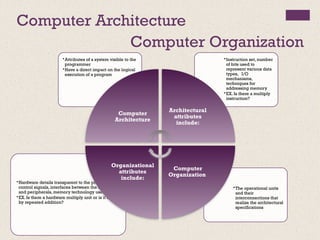
Computer Architecture
•The operationalunits
and their
interconnections that
realize the architectural
specifications
•Hardware details transparent to the programmer,
control signals, interfaces between the computer
and peripherals, memory technology used
•EX. Is there a hardware multiply unit or is it done
by repeated addition?
•Instruction set, number
of bits used to
represent various data
types, I/O
mechanisms,
techniques for
addressing memory
•EX. Is there a multiply
instruction?
•Attributes of a system visible to the
programmer
•Have a direct impact on the logical
execution of a program
Computer
Architecture
Architectural
attributes
include:
Computer
Organization
Organizational
attributes
include:
Computer Organization
7.
+
IBM System
IBMSystem/370 architecture
Was introduced in 1970
Included a number of models
Could upgrade to a more expensive, faster model without having to
abandon original software
New models are introduced with improved technology, but retain the
same architecture so that the customer’s software investment is
protected
Architecture has survived to this day as the architecture of IBM’s
mainframe product line
370 Architecture
8.
+
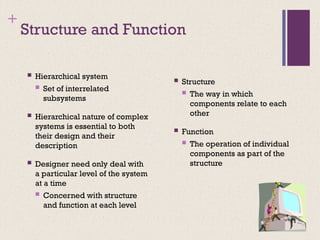
Structure and Function
Hierarchical system
Set of interrelated
subsystems
Hierarchical nature of complex
systems is essential to both
their design and their
description
Designer need only deal with
a particular level of the system
at a time
Concerned with structure
and function at each level
Structure
The way in which
components relate to each
other
Function
The operation of individual
components as part of the
structure
9.
+
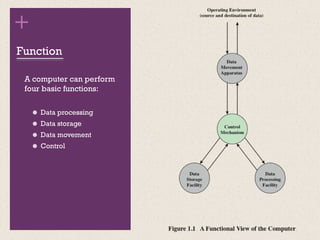
Function
A computercan perform
four basic functions:
● Data processing
● Data storage
● Data movement
● Control
+
CPU –controls the operation
of the computer and performs
its data processing functions
Main Memory – stores data
I/O – moves data between the
computer and its external
environment
System Interconnection –
some mechanism that provides
for communication among CPU,
main memory, and I/O
There are four
main structural
components
of the computer:
17.
+
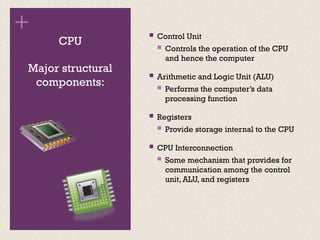
CPU
Control Unit
Controls the operation of the CPU
and hence the computer
Arithmetic and Logic Unit (ALU)
Performs the computer’s data
processing function
Registers
Provide storage internal to the CPU
CPU Interconnection
Some mechanism that provides for
communication among the control
unit, ALU, and registers
Major structural
components:
18.
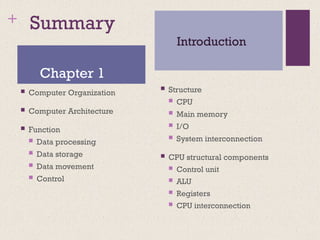
+ Summary
ComputerOrganization
Computer Architecture
Function
Data processing
Data storage
Data movement
Control
Structure
CPU
Main memory
I/O
System interconnection
CPU structural components
Control unit
ALU
Registers
CPU interconnection
Chapter 1
Introduction
19.
+
Internet Resources
- Website for book
http://WilliamStallings.com/COA/COA9e.html
Links to sites of interest
Links to sites for courses that use the book
Errata list for book
Information on other books by W. Stallings
http://WilliamStallings.com/StudentSupport.html
Math
How-to
Research resources
Misc
Editor's Notes
#1 Lecture slides prepared for “Computer Organization and Architecture”, 9/e, by William Stallings, Chapter 1 “Introduction”.
#5 Perkuliahan ini membahas tentang struktur dan fungsi komputer. Tujuannya adalah untuk menyajikan secara jelas dan lengkap mengenai sifat dan karakteristik komputer modern. Task ini menjadi tantangan karena dua alasan.
Pertama, terdapat beragam jenis komputer, mulai dari mikrokomputer dengan satu chip yang harganya hanya beberapa dolar hingga superkomputer yang bernilai puluhan juta dolar. Variasi ini tidak hanya terlihat dari segi biaya, tetapi juga dalam ukuran, kinerja, dan penerapannya.
Kedua, perkembangan teknologi komputer yang selalu bergerak cepat terus berlanjut tanpa henti. Perubahan ini mencakup semua aspek teknologi komputer, mulai dari teknologi sirkuit terpadu yang digunakan untuk membangun komponen komputer hingga meningkatnya penggunaan konsep organisasi paralel dalam menggabungkan komponen-komponen tersebut.
Meskipun terdapat banyak variasi dan perubahan yang cepat di bidang komputer, terdapat konsep-konsep fundamental yang tetap berlaku secara konsisten. Tentu saja, penerapan konsep-konsep ini bergantung pada perkembangan teknologi saat ini serta tujuan harga dan kinerja yang diinginkan oleh perancang.
Tujuan dari perkuliahan ini adalah memberikan pembahasan menyeluruh tentang dasar-dasar organisasi dan arsitektur komputer serta menghubungkannya dengan isu-isu desain komputer kontemporer. Bab ini memperkenalkan pendekatan deskriptif yang akan digunakan dalam pembahasan selanjutnya.
#6 Dalam mendeskripsikan komputer, sering kali dibuat perbedaan antara arsitektur komputer dan organisasi komputer. Meskipun sulit memberikan definisi yang tepat untuk kedua istilah ini, terdapat kesepakatan umum mengenai cakupan masing-masing (misalnya, lihat [VRAN80], [SIEW82], dan [BELL78a]); pandangan alternatif yang menarik disajikan dalam [REDD76].
Arsitektur komputer mengacu pada atribut-atribut sistem yang terlihat oleh pemrogram, atau dengan kata lain, atribut-atribut yang memiliki dampak langsung pada eksekusi logis suatu program.
Organisasi komputer, di sisi lain, mengacu pada unit-unit operasional dan interkoneksi antar unit yang mewujudkan spesifikasi arsitektural tersebut.
Contoh atribut arsitektur meliputi set instruksi, jumlah bit yang digunakan untuk merepresentasikan berbagai jenis data (misalnya angka, karakter), mekanisme I/O, dan teknik pengalamatan memori. Sementara itu, atribut organisasi mencakup detail perangkat keras yang tidak terlihat oleh pemrogram, seperti sinyal kontrol, antarmuka antara komputer dan periferal, serta teknologi memori yang digunakan.
Sebagai contoh, apakah sebuah komputer akan memiliki instruksi perkalian adalah masalah desain arsitektural. Namun, apakah instruksi tersebut akan diimplementasikan menggunakan unit khusus perkalian atau dengan mekanisme yang menggunakan unit penjumlahan secara berulang adalah masalah organisasi. Keputusan organisasi ini dapat didasarkan pada faktor-faktor seperti frekuensi penggunaan instruksi perkalian, kecepatan relatif dari kedua pendekatan, serta biaya dan ukuran fisik unit perkalian khusus.
Secara historis, dan hingga saat ini, perbedaan antara arsitektur dan organisasi tetap menjadi hal yang penting. Banyak produsen komputer menawarkan keluarga model komputer dengan arsitektur yang sama tetapi organisasi yang berbeda. Akibatnya, model-model dalam satu keluarga tersebut memiliki karakteristik harga dan kinerja yang bervariasi. Selain itu, sebuah arsitektur tertentu dapat bertahan selama bertahun-tahun dan mencakup berbagai model komputer, sementara organisasinya terus berkembang seiring dengan perkembangan teknologi.
#7 Salah satu contoh menonjol dari kedua fenomena ini adalah arsitektur IBM System/370. Arsitektur ini pertama kali diperkenalkan pada tahun 1970 dan mencakup berbagai model. Pelanggan dengan kebutuhan yang lebih sederhana dapat membeli model yang lebih murah dan lebih lambat, dan jika permintaan meningkat, mereka dapat meningkatkan ke model yang lebih mahal dan lebih cepat tanpa harus meninggalkan perangkat lunak yang sudah dikembangkan.
Selama bertahun-tahun, IBM terus memperkenalkan model-model baru dengan teknologi yang lebih canggih untuk menggantikan model lama, menawarkan kepada pelanggan kecepatan yang lebih tinggi, biaya yang lebih rendah, atau keduanya. Model-model terbaru ini tetap mempertahankan arsitektur yang sama, sehingga investasi pelanggan dalam perangkat lunak tetap terlindungi.
Menariknya, arsitektur System/370, dengan beberapa peningkatan, masih bertahan hingga saat ini sebagai arsitektur dari lini produk mainframe IBM.
#8 A computer is a complex system; contemporary computers contain millions of
Elementary electronic components. How, then, can one clearly describe them?
The key is to recognize the hierarchical nature of most complex systems, including
the computer [SIMO96]. A hierarchical system is a set of interrelated subsystems,
each of the latter, in turn, hierarchical in structure until we reach some lowest level
of elementary subsystem.
The hierarchical nature of complex systems is essential to both their design
and their description. The designer need only deal with a particular level of the
system at a time. At each level, the system consists of a set of components and
their interrelationships. The behavior at each level depends only on a simplified,
abstracted characterization of the system at the next lower level. At each level, the
designer is concerned with structure and function:
• Structure: The way in which the components are interrelated.
• Function: The operation of each individual component as part of the structure.
In terms of description, we have two choices: starting at the bottom and building
up to a complete description, or beginning with a top view and decomposing the
system into its subparts. Evidence from a number of fields suggests that the top-down
approach is the clearest and most effective [WEIN75].
The approach taken in this book follows from this viewpoint. The computer
system will be described from the top down. We begin with the major components
of a computer, describing their structure and function, and proceed to successively
lower layers of the hierarchy. The remainder of this section provides a very brief
overview of this plan of attack.
#9 Both the structure and functioning of a computer are, in essence, simple. Figure 1.1
depicts the basic functions that a computer can perform. In general terms, there are
only four:
• Data processing
• Data storage
• Data movement
• Control
The computer, of course, must be able to process data. The data may take a wide
variety of forms, and the range of processing requirements is broad. However, we
shall see that there are only a few fundamental methods or types of data processing.
It is also essential that a computer store data. Even if the computer is processing
data on the fly (i.e., data come in and get processed, and the results go out
immediately), the computer must temporarily store at least those pieces of data
that are being worked on at any given moment. Thus, there is at least a short-term
data storage function. Equally important, the computer performs a long-term data
storage function. Files of data are stored on the computer for subsequent retrieval
and update.
The computer must be able to move data between itself and the outside
world. The computer’s operating environment consists of devices that serve as
either sources or destinations of data. When data are received from or delivered to
a device that is directly connected to the computer, the process is known as input–
output (I/O), and the device is referred to as a peripheral. When data are moved
over longer distances, to or from a remote device, the process is known as data
communications.
Finally, there must be control of these three functions. Ultimately, this control
is exercised by the individual(s) who provides the computer with instructions. Within
the computer, a control unit manages the computer’s resources and orchestrates the
performance of its functional parts in response to those instructions.
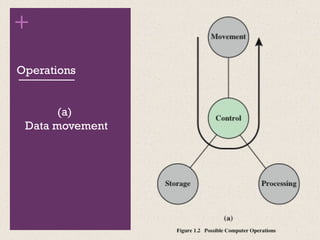
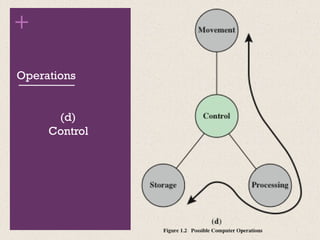
#10 At this general level of discussion, the number of possible operations that
can be performed is few. Figure 1.2 depicts the four possible types of operations.
The computer can function as a data movement device (Figure 1.2a), simply
transferring data from one peripheral or communication line to another.
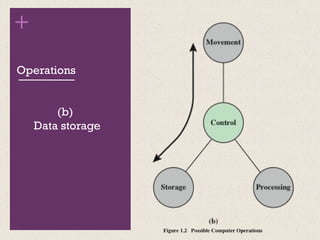
#11 It can also function as a data storage device (Figure 1.2b), with data transferred from
the external environment to computer storage (read) and vice versa (write).
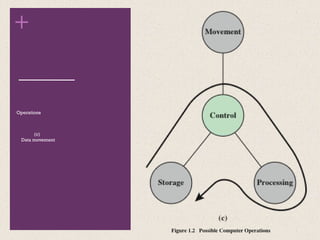
#12 The final two diagrams show operations involving data processing, on data either in
storage (Figure 1.2c)
#13 En route between storage and the external environment
(Figure 1.2d).
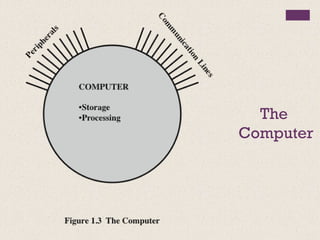
#14 Figure 1.3 is the simplest possible depiction of a computer. The computer interacts
in some fashion with its external environment. In general, all of its linkages to
the external environment can be classified as peripheral devices or communication
lines. We will have something to say about both types of linkages.
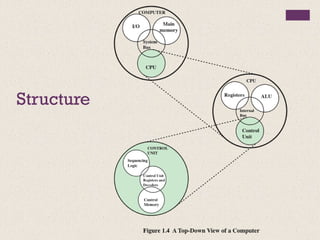
#15 But of greater concern in this book is the internal structure of the computer
itself, which is shown in Figure 1.4. There are four main structural components:
Central Processing Unit (CPU)
Main Memory
I/O
System Interconnection
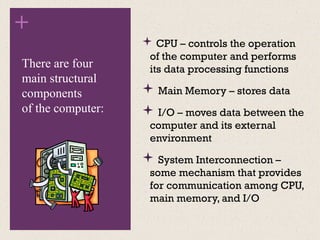
#16 There are four main structural components:
• Central processing unit (CPU): Controls the operation of the computer and
performs its data processing functions; often simply referred to as processor.
• Main memory: Stores data.
• I/O: Moves data between the computer and its external environment.
• System interconnection: Some mechanism that provides for communication
among CPU, main memory, and I/O. A common example of system interconnection
is by means of a system bus, consisting of a number of conducting
wires to which all the other components attach.
#17 There may be one or more of each of the aforementioned components.
Traditionally, there has been just a single processor. In recent years, there has been
increasing use of multiple processors in a single computer. Some design issues relating
to multiple processors crop up and are discussed as the text proceeds; Part Five
focuses on such computers.
Each of these components will be examined in some detail in Part Two.
However, for our purposes, the most interesting and in some ways the most complex
component is the CPU. Its major structural components are as follows:
• Control unit: Controls the operation of the CPU and hence the computer.
• Arithmetic and logic unit (ALU): Performs the computer’s data processing
functions.
• Registers: Provides storage internal to the CPU.
• CPU interconnection: Some mechanism that provides for communication
among the control unit, ALU, and registers.