Child Abuse and Neglect
Training for Educators, Part 3

Child Abuse and Neglect:
 What are Educators to
          Do?
          Fran Roberson, LCSW, LMFT
        Center for Children and Families,
                       Inc.
              Norman, Oklahoma
Action Steps


3. Respond to the child or youth.

5. Report to the appropriate
   authorities as required by law.
Responding to the Child or
          Youth
You first must know
  that:
• The child
  demonstrates
  incredible strength.
• You the listener are
  honored with the trust
  the child shows.
• You will need to
  respond with
  heightened sensitivity.
Guidelines Include:
• Listen, really listen, to what is being
  told to you.
• Reassure the child that he/she has
  done the right thing by telling you.
• Keep your own feelings under
  control.
• Use the child’s own vocabulary.
Guidelines Include:
• Do NOT promise not to tell.
• Tell the truth.
• Be specific.
• Assess the child’s immediate safety.
• Be supportive.
• Try to help the child regain control.
And for you the listener . . .
               • Be aware of
                 secondary trauma
                 and take care of
                 yourself.
               • Know that you
                 have done your
                 part, and that you
                 may have little
                 control beyond this
                 point.
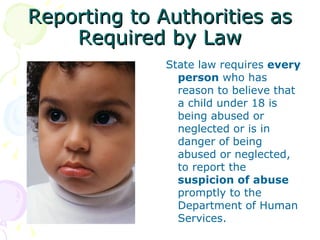
Reporting to Authorities as
    Required by Law
              State law requires every
                person who has
                reason to believe that
                a child under 18 is
                being abused or
                neglected or is in
                danger of being
                abused or neglected,
                to report the
                suspicion of abuse
                promptly to the
                Department of Human
                Services.
Failure to Report Suspected
      Abuse or Neglect

• Is a crime.
• No person is exempt from reporting
  suspected abuse.
• A person reporting in good faith is
  immune from both civil and criminal
  liability.
• By law, reporting child abuse is an
  individual responsibility.
What happens when I make
a report to the Department
of Human Services?
A Report of Suspicion of
Child Abuse or Neglect is . .
• A request for an
  assessment to
  determine safety or
  lack of safety for the
  child.
• The person reporting
  does not need proof to
  report.
• Assessment and
  validation of reports
  are the job of DHS or
  Law Enforcement.
Is My Report Confidential?

• Yes. DHS policy and state law
  require strict maintenance of the
  confidentiality of reports of child
  abuse and neglect.
How Do I Make a Report of
  Suspicion of Child Abuse or
            Neglect

• Contact DHS, Child Welfare Services
  in the county where the child is
  located, or

• Call the 24-hour hotline number:
            1.800.522.3511
What’s Important . . .

• It is critical to accurately reflect the nature
  and extent of the abuse or neglect.
• Names, addresses and whereabouts of the
  child and the child’s caregivers.
• Child’s age.
• Any positive test on the child for alcohol or
  other substances.
• Any other information regarding cause of
  injury or identity of responsible persons.
What Happens After I Make A
  Report of Suspected Child
      Abuse or Neglect?
Report is screened:
• Does it meet statutory requirements?
• Does it fall within the scope of DHS
  responsibility?

• If not screened out, there will be an
  assessment to explore the safety or
  lack of safety for the child.
Assignments for assessment are
  based on the potential risk to the
    children named in the report.

       There are 2 priority levels:

• Priority One:     indicates the child is in imminent
 danger of serious physical injury. Allegations of abuse
 and neglect may be severe and conditions extreme.
 The situation is responded to immediately, the same
 day of receipt of the report. If a complete assessment
 is not possible, a safety measure is put in place to
 ensure the child’s protection.
• (Priority One continued) A safety measure is an
  action taken that protects the child, such as
  protective child care, perpetrator leaves the
  home, or other similar protective actions.


• Priority Two:      indicates there is no imminent
  danger of serious injury but without intervention
  and safety measures it is likely the child will not
  be safe. Priority two assessments are initiated
  within two to 15 calendar days from the date the
  report is accepted for assessment.
In addition . . . .


Reports that meet the criteria
 for “serious abuse and
 neglect”, will be investigated.
After a report is accepted
    for assessment . .
• Child is seen first.
• Information is
  gathered.
• Family is
  interviewed.
• Others may also
  be interviewed
Assessments

• There are no findings for
  assessments.
• Safety plans are developed as
  determined after assessments.
A determination is made on
 findings from an investigation:
• Ruled out
• Unsubstantiated, services
  recommended.
• Substantiated, services
  recommended.
• Substantiated, court intervention
  recommended.
The District Attorney
will receive
investigative findings
and results of
assessments.

  Note: The District Attorney makes the
 decision about court mandated services
    based on DHS findings and their
            recommendations.
So, I reported suspicion of CAN
. . .what info can I learn about
    the results of my report?

• If the case was assigned for assessment or
  investigation or was screened out.
• If screened out, the reason for this
  decision.
• If assigned for investigation, investigative
  findings can be shared.

You are not entitled to details of the
  investigation or assessment.
Special Reporting Issues
    Related to Schools

• State law specifies that schools are
  not responsible for notifying parents
  that a child was interviewed at
  school regarding a CAN report. The
  task for notifying parents is the
  responsibility of DHS.
Special Reporting Issues
     Related to Schools
  School personnel, as well as medical,
  public health, mental health professionals,
  or any other professional person
  interacting with children should NOT
  delve into a child’s situation beyond
  determining whether there is a reason to
  believe the child is being abused or
  neglected or is in danger of being abused
  or neglected.
Educators’ task is to identify the suspicion of
  abuse or neglect in order to report to DHS.
Oklahoma Law is very clear that
professionals who maintain strict
   ethical guidelines related to
  confidentiality are required to
  report child abuse and neglect
just as every other person in the
               state.

    Duty to Report supercedes
    professional confidentiality
    codes when there is reason
      to believe that a child is
        abused or neglected.
Additional facts for you to
          know . . .

• Law enforcement is the only entity
  that can take a child into protective
  custody. Law enforcement and the
  Department of Human Services
  (DHS) work together when a child
  must be removed from a home. This
  action also requires a court order.
And . . .
• If you are unsatisfied with the way a
  report/assessment was handled, it is
  critical to provide feedback through
  the supervision structure of an
  investigating agency, i.e., the
  county’s child welfare supervisor,
  then follow the chain of command to
  County Director, etc.
• Law enforcement also has a chain of
  command.
Contact Fran Roberson at
the Center for Children and
  Families, Inc. for further
   questions or concerns.

froberson@ccfinorman.org
      405.364.1420

Third segment can in ok 2009 for otac

  • 1.
    Child Abuse andNeglect Training for Educators, Part 3 Child Abuse and Neglect: What are Educators to Do? Fran Roberson, LCSW, LMFT Center for Children and Families, Inc. Norman, Oklahoma
  • 2.
    Action Steps 3. Respondto the child or youth. 5. Report to the appropriate authorities as required by law.
  • 3.
    Responding to theChild or Youth You first must know that: • The child demonstrates incredible strength. • You the listener are honored with the trust the child shows. • You will need to respond with heightened sensitivity.
  • 4.
    Guidelines Include: • Listen,really listen, to what is being told to you. • Reassure the child that he/she has done the right thing by telling you. • Keep your own feelings under control. • Use the child’s own vocabulary.
  • 5.
    Guidelines Include: • DoNOT promise not to tell. • Tell the truth. • Be specific. • Assess the child’s immediate safety. • Be supportive. • Try to help the child regain control.
  • 6.
    And for youthe listener . . . • Be aware of secondary trauma and take care of yourself. • Know that you have done your part, and that you may have little control beyond this point.
  • 7.
    Reporting to Authoritiesas Required by Law State law requires every person who has reason to believe that a child under 18 is being abused or neglected or is in danger of being abused or neglected, to report the suspicion of abuse promptly to the Department of Human Services.
  • 8.
    Failure to ReportSuspected Abuse or Neglect • Is a crime. • No person is exempt from reporting suspected abuse. • A person reporting in good faith is immune from both civil and criminal liability. • By law, reporting child abuse is an individual responsibility.
  • 9.
    What happens whenI make a report to the Department of Human Services?
  • 10.
    A Report ofSuspicion of Child Abuse or Neglect is . . • A request for an assessment to determine safety or lack of safety for the child. • The person reporting does not need proof to report. • Assessment and validation of reports are the job of DHS or Law Enforcement.
  • 11.
    Is My ReportConfidential? • Yes. DHS policy and state law require strict maintenance of the confidentiality of reports of child abuse and neglect.
  • 12.
    How Do IMake a Report of Suspicion of Child Abuse or Neglect • Contact DHS, Child Welfare Services in the county where the child is located, or • Call the 24-hour hotline number: 1.800.522.3511
  • 13.
    What’s Important .. . • It is critical to accurately reflect the nature and extent of the abuse or neglect. • Names, addresses and whereabouts of the child and the child’s caregivers. • Child’s age. • Any positive test on the child for alcohol or other substances. • Any other information regarding cause of injury or identity of responsible persons.
  • 15.
    What Happens AfterI Make A Report of Suspected Child Abuse or Neglect? Report is screened: • Does it meet statutory requirements? • Does it fall within the scope of DHS responsibility? • If not screened out, there will be an assessment to explore the safety or lack of safety for the child.
  • 16.
    Assignments for assessmentare based on the potential risk to the children named in the report. There are 2 priority levels: • Priority One: indicates the child is in imminent danger of serious physical injury. Allegations of abuse and neglect may be severe and conditions extreme. The situation is responded to immediately, the same day of receipt of the report. If a complete assessment is not possible, a safety measure is put in place to ensure the child’s protection.
  • 17.
    • (Priority Onecontinued) A safety measure is an action taken that protects the child, such as protective child care, perpetrator leaves the home, or other similar protective actions. • Priority Two: indicates there is no imminent danger of serious injury but without intervention and safety measures it is likely the child will not be safe. Priority two assessments are initiated within two to 15 calendar days from the date the report is accepted for assessment.
  • 18.
    In addition .. . . Reports that meet the criteria for “serious abuse and neglect”, will be investigated.
  • 19.
    After a reportis accepted for assessment . . • Child is seen first. • Information is gathered. • Family is interviewed. • Others may also be interviewed
  • 20.
    Assessments • There areno findings for assessments. • Safety plans are developed as determined after assessments.
  • 21.
    A determination ismade on findings from an investigation: • Ruled out • Unsubstantiated, services recommended. • Substantiated, services recommended. • Substantiated, court intervention recommended.
  • 22.
    The District Attorney willreceive investigative findings and results of assessments. Note: The District Attorney makes the decision about court mandated services based on DHS findings and their recommendations.
  • 23.
    So, I reportedsuspicion of CAN . . .what info can I learn about the results of my report? • If the case was assigned for assessment or investigation or was screened out. • If screened out, the reason for this decision. • If assigned for investigation, investigative findings can be shared. You are not entitled to details of the investigation or assessment.
  • 24.
    Special Reporting Issues Related to Schools • State law specifies that schools are not responsible for notifying parents that a child was interviewed at school regarding a CAN report. The task for notifying parents is the responsibility of DHS.
  • 25.
    Special Reporting Issues Related to Schools School personnel, as well as medical, public health, mental health professionals, or any other professional person interacting with children should NOT delve into a child’s situation beyond determining whether there is a reason to believe the child is being abused or neglected or is in danger of being abused or neglected. Educators’ task is to identify the suspicion of abuse or neglect in order to report to DHS.
  • 26.
    Oklahoma Law isvery clear that professionals who maintain strict ethical guidelines related to confidentiality are required to report child abuse and neglect just as every other person in the state. Duty to Report supercedes professional confidentiality codes when there is reason to believe that a child is abused or neglected.
  • 27.
    Additional facts foryou to know . . . • Law enforcement is the only entity that can take a child into protective custody. Law enforcement and the Department of Human Services (DHS) work together when a child must be removed from a home. This action also requires a court order.
  • 28.
    And . .. • If you are unsatisfied with the way a report/assessment was handled, it is critical to provide feedback through the supervision structure of an investigating agency, i.e., the county’s child welfare supervisor, then follow the chain of command to County Director, etc. • Law enforcement also has a chain of command.
  • 29.
    Contact Fran Robersonat the Center for Children and Families, Inc. for further questions or concerns. froberson@ccfinorman.org 405.364.1420