Mandatory
Reporting
This training provides a
brief overview of your
responsibilities as a
mandatory reporter.
For my information,
please contact your
supervisor and refer to
this guide
What is a
mandatory
reporter?
 People who are required by law to
report suspected child abuse or
neglect.
 Also required to report suspected
abuse of elders or adults with
developmental disabilities.
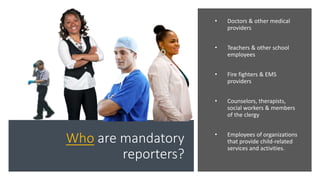
Who are mandatory
reporters?
• Doctors & other medical
providers
• Teachers & other school
employees
• Fire fighters & EMS
providers
• Counselors, therapists,
social workers & members
of the clergy
• Employees of organizations
that provide child-related
services and activities.
Who are mandatory
reporters?
• Doctors & other medical
providers
• Teachers & other school
employees
• Fire fighters & EMS
providers
• Counselors, therapists,
social workers & members
of the clergy
• Employees of organizations
that provide child-related
services and activities.
Who are mandatory
reporters?
• Doctors & other medical
providers
• Teachers & other school
employees
• Fire fighters & EMS
providers
• Counselors, therapists,
social workers & members
of the clergy
• Employees of organizations
that provide child-related
services and activities.
Who are mandatory
reporters?
• Doctors & other medical
providers
• Teachers & other school
employees
• Fire fighters & EMS
providers
• Counselors, therapists,
social workers & members
of the clergy
• Employees of organizations
that provide child-related
services and activities.
Responsibilities
of Mandatory
Reporters
Your Responsibilities
 You have a legal obligation for child protection.
 You must tell either the Department of Human
Services or your local law enforcement agency if:
 You suspect a child you have had contact with
is being abused.
 You suspect a person you have had contact
with has abused a child.
A word about
Confidentiality
Maintaining confidentiality is crucial
to the work we do with families.
However, mandatory reporting
requirements still apply to all of us.
Some more
things to
know:
There can be legal consequences for failing to make a
report.
It doesn’t matter how long ago the alleged abuse
happened.
Names of reporters are kept confidential and can only be
revealed by a court order.
You can not be sued for making a good-faith report.
It’s important for YOU to
understand your organization’s
policy on being a mandatory
reporter.
To respect and honor families,
always think about what you are
seeing and hearing in the context
of the family’s culture and your
own personal beliefs and bias.
What is child
abuse or
neglect?
Types of
child abuse
(these definitions
are for children 18
years or younger)
Physical abuse constitutes any physical injury, which has been
caused by methods other than accidental means, including any
injury which appears to be in variance with the explanation
given for the injury.
Physical
Abuse
Mental
Injury
Mental injury is any mental injury to a child that includes an observable
and substantial impairment of the child’s mental or psychological ability
to function caused by cruelty to the child. Whether intentional or
unintentional, cruelty refers to behaviors that communicate rejection or
are threatening, intimidating, disparaging or humiliating to the child or
young adult.
Child sexual abuse occurs when a person uses or attempts to use a child
for the person’s own sexual gratification. This includes incest, rape,
sodomy, sexual penetration, fondling, voyeurism and sexual contact
between two parties when one party is under 12 years old.
Sexual exploitation includes, but is not limited to:
Sexual exploitation Using children in a sexually explicit way for personal
gain. For example, to make money, to obtain food stamps or drugs, or to
gain status. It also includes using children in prostitution and using
children to create pornography.
Sexual Abuse &
Sexual
Exploitation
Types of
child abuse
(these definitions
are for children 18
years or younger)
As described in ORS chapter 163 and OFSN policy
Types of
child abuse
(these definitions
are for children 18
years or younger)
Neglect
Including but not limited to, the failure to provide adequate food,
clothing, shelter, supervision, protection, nurturing or medical
care that is likely to endanger the health or welfare of the
child.
Neglect can include: Permitting a child to enter or remain in or
upon premises where methamphetamines are being
manufactured.
Unlawful exposure to a controlled substance that subjects a
child to a substantial risk of harm to the child’s health or
safety, not including any form of state-legalized cannabis
Types of
child abuse
(these definitions
are for children 18
years or younger)
Threat of
Harm
Includes acts or circumstances that threaten the child with
harm or create a substantial risk of harm to the child's
health or welfare.
Including:
Unlawful exposure to the unlawful manufacturing of a
cannabinoid extract, that subjects a child to a substantial risk
of harm to the child’s health or safety”.
Types of
child abuse
(these definitions
are for children 18
years or younger)
Abandonment of a Child or Young Adult in Care
Abandonment means the willful forsaking of a child or young
adult, or the withdrawal or neglect of duties and obligations
owed a child or young adult residing in a home certified by
Child Welfare or ODDS.
Abandonment
Remain calm.
Listen carefully and empathetically.
Open-ended questions are okay,
but use your judgement.
Reassure the child.
Be sure the child is safe.
Reasons people don’t report
• Worry about what might happen to the child or
the family
• Concerns about maintaining confidentiality
• Fear of retaliation
• Wanting to avoid an unpleasant subject or
situation
• Uncertainty about the situation or their ability to
determine what has happened
• Unsure if a child’s disclosure is true
• Resignation, feeling like nothing will be done
IF IN DOUBT, MAKE THE
CALL.
1-855-503-
SAFE
Making the
Report
First steps
Report child abuse to the Oregon Child Abuse Hotline
(ORCAH) by calling: 1-855-503-SAFE (7233).
• Make the report as soon as possible.
• If the report is about a situation that took place at work,
consult with your supervisor and fill out an incident
report.
• You can also report child abuse by calling a local police
department, county sheriff, county juvenile department,
or Oregon State Police.​
If you think someone is being hurt or is in danger,
call 911 immediately.
What to expect when
you call
• Your call will be answered by a screener trained
in child protection. The screener will ask for your
name and contact information and will also
gather information about the child or children
you’re calling about.
• Let the screener know that you’re a mandatory
reporter.
What to expect when
you call
• Often the screener will need to contact other
people who know the child, such as physicians
or school staff people. This allows the screener
to get more complete picture of what has
taken place.
All information is considered within the context
of culture. Screeners must acknowledge,
respect, and honor the diversity of families.
Information to
provide
• Child’s name and age (date of birth, if known),
• Parent or caregiver’s full legal name(s),
• Preferred language
• Names and ages of any siblings or others living in
the home
• The family’s address
• School attended
• Any past abuse you’re aware of.
Let the screener know if the child or family is
affiliated with a tribe and has Native American
ancestry.
Information to
provide
• Any verbal disclosures of abuse made to you by the child.
Report the child’s exact words if possible.
• It’s OK if you don’t have a lot of personal details about the
child. Just report what you know.
• Details about any visible injuries - size, location, child’s
explanation. Example:
• “Johnny has a bruise on his face and he said his mom
hit him this morning.” vs “Johnny seems very
withdrawn.” or “Something is ‘off’ with this family.”
What happens next?
• You will be told if an assessment
will be done.
• Sometimes a screener will need
to gather more information and /
or consult with a supervisor
before this decision can be made.
• If an assessment is done, DHS is
usually required to notify you
whether contact was made,
whether the Department
determined that child abuse or
neglect occurred, and whether
services will be provided.
Take care of
yourself!
• Seeing or hearing about child abuse
is upsetting and difficult. Making a
report can be stressful.
• Seek support for yourself.
• Talk with your supervisor.
• Practice good self-care.
Mandatory reporting 2020

Mandatory reporting 2020

  • 1.
  • 2.
    This training providesa brief overview of your responsibilities as a mandatory reporter. For my information, please contact your supervisor and refer to this guide
  • 3.
    What is a mandatory reporter? People who are required by law to report suspected child abuse or neglect.  Also required to report suspected abuse of elders or adults with developmental disabilities.
  • 4.
    Who are mandatory reporters? •Doctors & other medical providers • Teachers & other school employees • Fire fighters & EMS providers • Counselors, therapists, social workers & members of the clergy • Employees of organizations that provide child-related services and activities.
  • 5.
    Who are mandatory reporters? •Doctors & other medical providers • Teachers & other school employees • Fire fighters & EMS providers • Counselors, therapists, social workers & members of the clergy • Employees of organizations that provide child-related services and activities.
  • 6.
    Who are mandatory reporters? •Doctors & other medical providers • Teachers & other school employees • Fire fighters & EMS providers • Counselors, therapists, social workers & members of the clergy • Employees of organizations that provide child-related services and activities.
  • 7.
    Who are mandatory reporters? •Doctors & other medical providers • Teachers & other school employees • Fire fighters & EMS providers • Counselors, therapists, social workers & members of the clergy • Employees of organizations that provide child-related services and activities.
  • 9.
  • 10.
    Your Responsibilities  Youhave a legal obligation for child protection.  You must tell either the Department of Human Services or your local law enforcement agency if:  You suspect a child you have had contact with is being abused.  You suspect a person you have had contact with has abused a child.
  • 11.
    A word about Confidentiality Maintainingconfidentiality is crucial to the work we do with families. However, mandatory reporting requirements still apply to all of us.
  • 12.
    Some more things to know: Therecan be legal consequences for failing to make a report. It doesn’t matter how long ago the alleged abuse happened. Names of reporters are kept confidential and can only be revealed by a court order. You can not be sued for making a good-faith report.
  • 13.
    It’s important forYOU to understand your organization’s policy on being a mandatory reporter. To respect and honor families, always think about what you are seeing and hearing in the context of the family’s culture and your own personal beliefs and bias.
  • 15.
  • 16.
    Types of child abuse (thesedefinitions are for children 18 years or younger) Physical abuse constitutes any physical injury, which has been caused by methods other than accidental means, including any injury which appears to be in variance with the explanation given for the injury. Physical Abuse Mental Injury Mental injury is any mental injury to a child that includes an observable and substantial impairment of the child’s mental or psychological ability to function caused by cruelty to the child. Whether intentional or unintentional, cruelty refers to behaviors that communicate rejection or are threatening, intimidating, disparaging or humiliating to the child or young adult.
  • 17.
    Child sexual abuseoccurs when a person uses or attempts to use a child for the person’s own sexual gratification. This includes incest, rape, sodomy, sexual penetration, fondling, voyeurism and sexual contact between two parties when one party is under 12 years old. Sexual exploitation includes, but is not limited to: Sexual exploitation Using children in a sexually explicit way for personal gain. For example, to make money, to obtain food stamps or drugs, or to gain status. It also includes using children in prostitution and using children to create pornography. Sexual Abuse & Sexual Exploitation Types of child abuse (these definitions are for children 18 years or younger) As described in ORS chapter 163 and OFSN policy
  • 18.
    Types of child abuse (thesedefinitions are for children 18 years or younger) Neglect Including but not limited to, the failure to provide adequate food, clothing, shelter, supervision, protection, nurturing or medical care that is likely to endanger the health or welfare of the child. Neglect can include: Permitting a child to enter or remain in or upon premises where methamphetamines are being manufactured.
  • 19.
    Unlawful exposure toa controlled substance that subjects a child to a substantial risk of harm to the child’s health or safety, not including any form of state-legalized cannabis Types of child abuse (these definitions are for children 18 years or younger) Threat of Harm Includes acts or circumstances that threaten the child with harm or create a substantial risk of harm to the child's health or welfare. Including: Unlawful exposure to the unlawful manufacturing of a cannabinoid extract, that subjects a child to a substantial risk of harm to the child’s health or safety”.
  • 20.
    Types of child abuse (thesedefinitions are for children 18 years or younger) Abandonment of a Child or Young Adult in Care Abandonment means the willful forsaking of a child or young adult, or the withdrawal or neglect of duties and obligations owed a child or young adult residing in a home certified by Child Welfare or ODDS. Abandonment
  • 21.
    Remain calm. Listen carefullyand empathetically. Open-ended questions are okay, but use your judgement. Reassure the child. Be sure the child is safe.
  • 22.
    Reasons people don’treport • Worry about what might happen to the child or the family • Concerns about maintaining confidentiality • Fear of retaliation • Wanting to avoid an unpleasant subject or situation • Uncertainty about the situation or their ability to determine what has happened • Unsure if a child’s disclosure is true • Resignation, feeling like nothing will be done
  • 23.
    IF IN DOUBT,MAKE THE CALL. 1-855-503- SAFE
  • 25.
  • 26.
    First steps Report childabuse to the Oregon Child Abuse Hotline (ORCAH) by calling: 1-855-503-SAFE (7233). • Make the report as soon as possible. • If the report is about a situation that took place at work, consult with your supervisor and fill out an incident report. • You can also report child abuse by calling a local police department, county sheriff, county juvenile department, or Oregon State Police.​ If you think someone is being hurt or is in danger, call 911 immediately.
  • 27.
    What to expectwhen you call • Your call will be answered by a screener trained in child protection. The screener will ask for your name and contact information and will also gather information about the child or children you’re calling about. • Let the screener know that you’re a mandatory reporter.
  • 28.
    What to expectwhen you call • Often the screener will need to contact other people who know the child, such as physicians or school staff people. This allows the screener to get more complete picture of what has taken place. All information is considered within the context of culture. Screeners must acknowledge, respect, and honor the diversity of families.
  • 29.
    Information to provide • Child’sname and age (date of birth, if known), • Parent or caregiver’s full legal name(s), • Preferred language • Names and ages of any siblings or others living in the home • The family’s address • School attended • Any past abuse you’re aware of. Let the screener know if the child or family is affiliated with a tribe and has Native American ancestry.
  • 30.
    Information to provide • Anyverbal disclosures of abuse made to you by the child. Report the child’s exact words if possible. • It’s OK if you don’t have a lot of personal details about the child. Just report what you know. • Details about any visible injuries - size, location, child’s explanation. Example: • “Johnny has a bruise on his face and he said his mom hit him this morning.” vs “Johnny seems very withdrawn.” or “Something is ‘off’ with this family.”
  • 31.
    What happens next? •You will be told if an assessment will be done. • Sometimes a screener will need to gather more information and / or consult with a supervisor before this decision can be made. • If an assessment is done, DHS is usually required to notify you whether contact was made, whether the Department determined that child abuse or neglect occurred, and whether services will be provided.
  • 32.
    Take care of yourself! •Seeing or hearing about child abuse is upsetting and difficult. Making a report can be stressful. • Seek support for yourself. • Talk with your supervisor. • Practice good self-care.

Editor's Notes

  • #3 Guide inserted below video before knowledge check.
  • #5 Need a better pic for “school staff” or janitor
  • #6 Need a better pic for “school staff” or janitor
  • #7 Need a better pic for “school staff” or janitor
  • #8 Need a better pic for “school staff” or janitor
  • #12 At OFSN, our policy states that: All OFSN employees are expected to be open, honest, and direct with families about professional and legal responsibility to report suspected abuse or neglect and discuss how reports will be made along side families and with transparency. When OFSN employees suspect abuse or neglect, they will discuss the process with the family and give the family the option of making the report or sitting with the employee to make the report. This applies only if there is no threat of harm or immediate danger.
  • #16 We will go over some of the main categories of abuse and neglect. You do NOT need to be an expert! If in doubt, make the call or talk with your supervisor and then make the call.