Special Protection of Children
Against Child Abuse, Exploitation
and Discrimination Act (RA 7610)
By: Ma. Juna V. Dieta
When do Rights Begin?
• Philippine Constitution, Article II, Sec. 12 - “The State
recognizes the sanctity of family life and shall protect
and strengthen the family as a basic and autonomous
social institution. It shall equally protect the life of
the mother and the life of the unborn from
conception…….”
When do Rights Begin ?
• PD 603, Article 3, # 1:
“ A child is endowed with the dignity and worth of a
human being from the moment of conception, as
generally accepted in medical parlance, and is
therefore entitled with the right to be born well”.
Who are considered Children?
• Children - persons below 18 years of
age or those over but are unable to to
fully take care of themselves or protect
themselves from abuse, neglect,
cruelty, exploitation or discrimination
because of a physical or mental
disability or condition.
What is the Rationale of RA 7610?
To give protection to persons
below 18 years of age or those over
but are unable to fully take care of
themselves or protect themselves
from abuse, cruelty and
exploitation.
Offenses Against Children under RA 7610
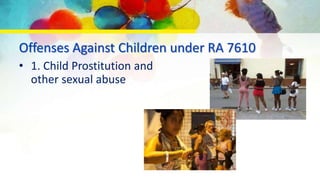
• 1. Child Prostitution and
other sexual abuse
Offenses Against Children under RA 7610
• 2. Attempt to commit child
prostitution
Offenses Against Children under RA 7610
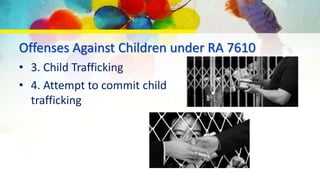
• 3. Child Trafficking
• 4. Attempt to commit child
trafficking
• 5. Child pornography and
indecent shows and
publication
• 6. Other Acts of Neglect, Abuse, Cruelty or
Exploitation and Other Conditions Prejudicial to the
Child’s Development
Other Acts of Abuse
• Any person who shall keep or have in his company a
minor, twelve (12) years or under or who is ten (10)
years or more his junior in any public or private place,
hotel, motel, beer joint, discotheque, cabaret, pension
house, sauna or massage parlor, beach and/or other
tourist resort or similar places.
Other Acts of Abuse
 Any person who shall use, coerce, force or
intimidate a street child or any other child to:
 beg or use begging as a means of living
 act as conduit or middleman in drug
trafficking or pushing
 conduct any illegal activities
Physical Abuse
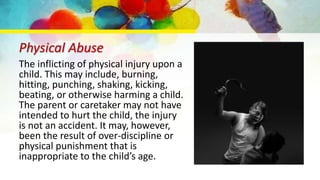
The inflicting of physical injury upon a
child. This may include, burning,
hitting, punching, shaking, kicking,
beating, or otherwise harming a child.
The parent or caretaker may not have
intended to hurt the child, the injury
is not an accident. It may, however,
been the result of over-discipline or
physical punishment that is
inappropriate to the child’s age.
Psychological/Emotional Abuse
• also known as: verbal abuse, mental abuse, and
psychological maltreatment
• Includes acts or the failures to act by parents or
caretakers that have caused or could cause, serious
behavioral, cognitive, emotional, or mental disorders
• Constantly blaming or putting down a child; excessive
yelling, shaming
Neglect
• the withdrawal of or failure to provide a child with
the basic necessities for physical growth and
development. This can include inappropriate clothing
for the weather, unhealthy food or no food at all, lack
of supervision, denial of medical care to a sick or
injured child or denial of love and affection.
Reporting
• A person who learns of facts or circumstances that
gives rise to the belief that a child has suffered abuse
may report the same, either orally or in writing, to
the Department, Police or any other law
enforcement agency or to the BCPC.
Duty of Government Workers to Report
• It shall be the duty of all teachers and administrators
in public schools, probation officers, government
lawyers, law enforcement officers, barangay officials,
corrections officers and other government officials
and employees whose work involves dealing with
children to report all incidents of possible child abuse
to the Department.
 Who may file a complaint?
 Offended Party
 Parents or Guardians
 Ascendant or collateral relative within 3rd degree of
consanguinity
 Officer, social worker or representative of a licensed
child-caring institution
 Officer or social worker of the DSWD
 Barangay Chairman, or
 Three (3) concerned, responsible citizens where the
offense was committed
Let Us All Help Prevent Child Abuse
THANK YOU!!!!

Ra 7610

  • 1.
    Special Protection ofChildren Against Child Abuse, Exploitation and Discrimination Act (RA 7610) By: Ma. Juna V. Dieta
  • 2.
    When do RightsBegin? • Philippine Constitution, Article II, Sec. 12 - “The State recognizes the sanctity of family life and shall protect and strengthen the family as a basic and autonomous social institution. It shall equally protect the life of the mother and the life of the unborn from conception…….”
  • 3.
    When do RightsBegin ? • PD 603, Article 3, # 1: “ A child is endowed with the dignity and worth of a human being from the moment of conception, as generally accepted in medical parlance, and is therefore entitled with the right to be born well”.
  • 4.
    Who are consideredChildren? • Children - persons below 18 years of age or those over but are unable to to fully take care of themselves or protect themselves from abuse, neglect, cruelty, exploitation or discrimination because of a physical or mental disability or condition.
  • 5.
    What is theRationale of RA 7610? To give protection to persons below 18 years of age or those over but are unable to fully take care of themselves or protect themselves from abuse, cruelty and exploitation.
  • 6.
    Offenses Against Childrenunder RA 7610 • 1. Child Prostitution and other sexual abuse
  • 7.
    Offenses Against Childrenunder RA 7610 • 2. Attempt to commit child prostitution
  • 8.
    Offenses Against Childrenunder RA 7610 • 3. Child Trafficking • 4. Attempt to commit child trafficking
  • 9.
    • 5. Childpornography and indecent shows and publication
  • 10.
    • 6. OtherActs of Neglect, Abuse, Cruelty or Exploitation and Other Conditions Prejudicial to the Child’s Development
  • 11.
    Other Acts ofAbuse • Any person who shall keep or have in his company a minor, twelve (12) years or under or who is ten (10) years or more his junior in any public or private place, hotel, motel, beer joint, discotheque, cabaret, pension house, sauna or massage parlor, beach and/or other tourist resort or similar places.
  • 12.
    Other Acts ofAbuse  Any person who shall use, coerce, force or intimidate a street child or any other child to:  beg or use begging as a means of living  act as conduit or middleman in drug trafficking or pushing  conduct any illegal activities
  • 13.
    Physical Abuse The inflictingof physical injury upon a child. This may include, burning, hitting, punching, shaking, kicking, beating, or otherwise harming a child. The parent or caretaker may not have intended to hurt the child, the injury is not an accident. It may, however, been the result of over-discipline or physical punishment that is inappropriate to the child’s age.
  • 14.
    Psychological/Emotional Abuse • alsoknown as: verbal abuse, mental abuse, and psychological maltreatment • Includes acts or the failures to act by parents or caretakers that have caused or could cause, serious behavioral, cognitive, emotional, or mental disorders • Constantly blaming or putting down a child; excessive yelling, shaming
  • 15.
    Neglect • the withdrawalof or failure to provide a child with the basic necessities for physical growth and development. This can include inappropriate clothing for the weather, unhealthy food or no food at all, lack of supervision, denial of medical care to a sick or injured child or denial of love and affection.
  • 16.
    Reporting • A personwho learns of facts or circumstances that gives rise to the belief that a child has suffered abuse may report the same, either orally or in writing, to the Department, Police or any other law enforcement agency or to the BCPC.
  • 17.
    Duty of GovernmentWorkers to Report • It shall be the duty of all teachers and administrators in public schools, probation officers, government lawyers, law enforcement officers, barangay officials, corrections officers and other government officials and employees whose work involves dealing with children to report all incidents of possible child abuse to the Department.
  • 18.
     Who mayfile a complaint?  Offended Party  Parents or Guardians  Ascendant or collateral relative within 3rd degree of consanguinity  Officer, social worker or representative of a licensed child-caring institution  Officer or social worker of the DSWD  Barangay Chairman, or  Three (3) concerned, responsible citizens where the offense was committed
  • 19.
    Let Us AllHelp Prevent Child Abuse
  • 20.