Civil Reporting
Ecclesiastical Reporting
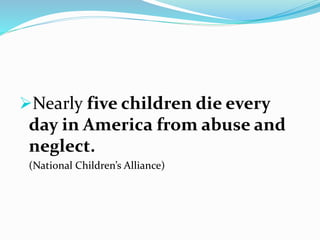
Nearly five children die every
day in America from abuse and
neglect.
(National Children’s Alliance)
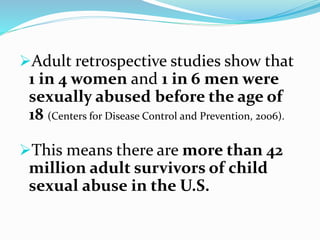
Adult retrospective studies show that
1 in 4 women and 1 in 6 men were
sexually abused before the age of
18 (Centers for Disease Control and Prevention, 2006).
This means there are more than 42
million adult survivors of child
sexual abuse in the U.S.
Only 5% of sexual abuse is
perpetrated by a stranger.
(Snyder, 2000).
 All states, the District of Columbia,
American Samoa, Guam, Puerto Rico, and
the U.S. Virgin Islands require certain
professionals ,and in some cases, the average
person to report physical abuse, neglect or
sexual abuse of minors.
 Approximately 26 States currently include
clergy among those professionals mandated
by law to report known or suspected
instances of child abuse or neglect.
 In approximately 18 states and Puerto Rico,
any person who suspects child abuse or
neglect is required to report. This inclusive
language appears to include clergy but may
be interpreted otherwise.
Get to Know Your State’s Laws
Find out what your state’s mandatory
reporting requires.
Inform your staff of your state’s laws.
Train your staff in what the law
requires.
Failure to Report
 Approximately 47 States, the District of
Columbia, American Samoa, Guam, the
Northern Mariana Islands, and the Virgin
Islands impose penalties on mandatory
reporters who knowingly or willfully fail to
make a report when they suspect that a child
is being abused or neglected.
 Many states classify failure to report as a
misdemeanor punishable with
imprisonment and substantial fines.
 A failure to report can also expose your
organization to liability.
What does the Book of Order say?
G-4.0302 Mandatory Reporting
“Any member of this church engaged in ordered ministry and
any certified Christian educator employed by this church or
its congregations, shall report to ecclesiastical and civil
legal authorities knowledge of harm, or the risk of harm,
related to the physical abuse, neglect, and/or sexual
molestation or abuse of a minor or an adult who lacks
mental capacity when (1) such information is gained
outside of a confidential communication as defined by G-
4.0301, (2) she or he is not bound by an obligation of
privileged communication under law. Or (3) she or he
reasonably believes that there is risk of future physical
harm or abuse. “
 WHO IS REQUIRED TO REPORT
 Ordered ministry: Teaching Elders, Ruling
Elders, Deacons and Certified Christian
Educators
 WHAT ARE THEY REQUIRED TO REPORT
 Harm or the risk of harm related to physical
abuse, neglect, sexual molestation or abuse
 Of a minor (anyone under 18 years of age)
 Or an adult who lacks mental capacity
REPORT INFORMATION WHEN
 such information is gained outside of a
confidential communication;
and
 you are not bound by an obligation of privileged
communication under law;
or
 you reasonably believe that there is risk of
future physical harm or abuse
TO WHOM TO MAKE THE REPORT
 To both church and civil legal authorities
Sexual Abuse Defined in the
Rules of Discipline (D-10.04001c)
 Sexual abuse of another person is any offense
involving sexual conduct in relation to
 any person under the age of eighteen years or anyone
over the age of eighteen years without the mental
capacity to consent;
or
 any person when the conduct includes force, threat,
coercion, intimidation, or misuse of ordered ministry or
position.
Confidentiality
See G-4.0301
A teaching or ruling elder commissioned to pastoral service
 may break confidentiality if given permission by confidant
 or if mandated to real confidential information
 “may reveal confidential information when she or he
reasonably believes that there is a risk of imminent bodily
harm to any person.”
Some states only recognize the Roman Catholic sacraments
of confession, penance and last rites as confidential .
Inform and train your staff in what
the Book of Order requires.
Mandatory
Sexual Misconduct Policy
 In G-3.0106 Administration of Mission
 A new section was added by the GA in 2010
 “All councils shall adopt and implement a sexual
misconduct policy.”
 The GA also approved a Sexual Misconduct Policy and
its Procedures which can be found at
 http://www.pcusa.org/resource/presbyterian-church-
us-sexual-misconduct-policy-an/
Implementing a Policy and
Mandatory Reporting
Your council should implement a policy:
1. so that your staff and congregation know how to comply
with state law reporting duties
 describe what the law requires.
 specify who to notify, how, and contact numbers.
2. so that your staff and congregation know how to comply
with the Book of Order reporting duties
 describe what the Book of Order requires.
 specify who to notify, how, and contact numbers.
Where Can I Find A Sample Policy?
Refer to:
http://www.presbyterianmission.org/ministries/
creating-safe-ministries/create-policies/
the PCUSA policy
your presbytery’s policy
 Church insurers often have sample policies on
their website.
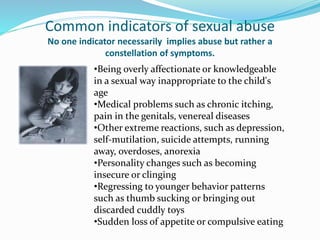
Common indicators of sexual abuse
No one indicator necessarily implies abuse but rather a
constellation of symptoms.
•Being overly affectionate or knowledgeable
in a sexual way inappropriate to the child's
age
•Medical problems such as chronic itching,
pain in the genitals, venereal diseases
•Other extreme reactions, such as depression,
self-mutilation, suicide attempts, running
away, overdoses, anorexia
•Personality changes such as becoming
insecure or clinging
•Regressing to younger behavior patterns
such as thumb sucking or bringing out
discarded cuddly toys
•Sudden loss of appetite or compulsive eating
 Being isolated or withdrawn
 Inability to concentrate
 Lack of trust or fear of someone they know well, such
as not wanting to be alone with a babysitter or child
minder
 Starting to wet again, day or night/nightmares
 Become worried about clothing being removed
 Suddenly drawing sexually explicit pictures
 Trying to be 'ultra-good' or perfect; overreacting to
criticism
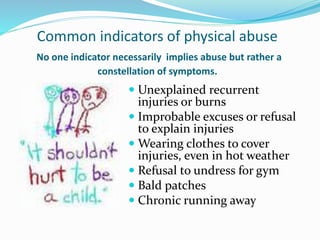
Common indicators of physical abuse
No one indicator necessarily implies abuse but rather a
constellation of symptoms.
 Unexplained recurrent
injuries or burns
 Improbable excuses or refusal
to explain injuries
 Wearing clothes to cover
injuries, even in hot weather
 Refusal to undress for gym
 Bald patches
 Chronic running away
 Fear of medical help or examination
 Self-destructive tendencies
 Aggression towards others
 Fear of physical contact – shrinking back if
touched
 Admitting that s/he has been punished but the
punishment is excessive (such as a child being
beaten every night to ‘make him study’)
 Fear of suspected abuser being contacted
Common indicators of emotional abuse
No one indicator necessarily implies abuse but rather a
constellation of symptoms.
 Physical, mental and emotional development lags
 Sudden speech disorders
 Continual self-depreciation ('I'm stupid, ugly,
worthless, etc')
 Overreaction to mistakes
 Extreme fear of any new situation
 Inappropriate response to pain ('I deserve this')
 Neurotic behavior (rocking, hair twisting, self-
mutilation)
 Extremes of passivity or aggression
Definition of Neglect
Harm or threatened harm to a child’s health or
welfare that occurs through either failure to
provide adequate food, clothing, shelter, or
medical care or placing a child at unreasonable
risk to the child’s health or welfare by failure to
intervene to eliminate that risk when the person is
able to do so and has or should have knowledge of
the risk.
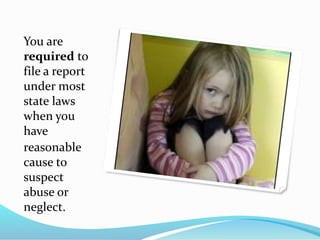
You are
required to
file a report
under most
state laws
when you
have
reasonable
cause to
suspect
abuse or
neglect.
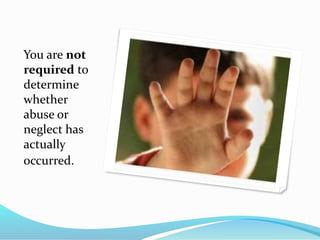
You are not
required to
determine
whether
abuse or
neglect has
actually
occurred.
There are NO excuses for not reporting
 You may believe that filing a report will not lead to any
benefit to the minor involved.
 You may believe that filing a report may actually place the
minor at an increased risk of abuse or neglect.
 You may be uncertain that abuse or neglect has actually
occurred.
 However, failure to report can lead to civil penalties
(criminal) and does not comply with mandatory reporting
duties of civil law or the Book of Order.
 REPORT IT!! And let the authorities investigate and
sort it out.
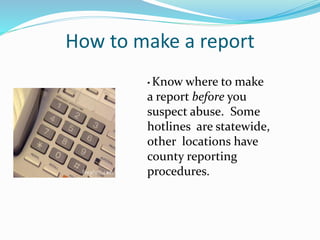
How to make a report
• Know where to make
a report before you
suspect abuse. Some
hotlines are statewide,
other locations have
county reporting
procedures.
You should be prepared to
provide, if known, the
following information when
making a verbal report:
 Child’s current address as well as past addresses ,if known,
and the address where the alleged incident happened if
different.
 If the alleged perpetrator lives with the child.
 Alleged victim’s full name, birth date, and race.
 Alleged perpetrator’s full name.
 If known, provide the relationship of the perpetrator to
the child.
 Statements of the child’s disclosure and context of the
disclosure. For example, was the child asked about the
injury, or did s/he volunteer the information?
 History of the child’s behavior and patterns of attendance
may be helpful to the investigation.
 Why you think the child is being abused, neglected and/or
maltreated.
Be sure to…
 Document your report
 Date and time of call
 Who you talked to
 What you reported
 What you were told would happen
You SHOULD NOT attempt to
investigate the matter yourself.
The official investigation could be nullified if the
child is asked leading questions or the alleged
perpetrator is pursued.
You can be charged with a crime if you investigate
when you already know or suspect abuse.
To sum up…
 You may be a mandatory reporter as per the
PCUSA Book of Order.
 In addition to civil authorities, report
suspected abuse to your presbytery.
 Know your state and county’s reporting
procedures before you need them.
 Document, document, document.
 Child abuse is a serious societal problem.
 Be part of the solution. Don’t ignore child
abuse.
PCUSA Hotline
 You can report incidents or seek information on a
PCUSA Abuse Prevention Helpline
 (866) 607-7233
 For more information visit the Safe Ministries page
 https://www.presbyterianmission.org/legal-
resources/creating-safe-ministries/
 For information on reporting:
 https://www.presbyterianmission.org/legal-
resources/creating-safe-ministries/#tab-2

Mandatory Reporting PowerPoint

  • 1.
  • 3.
    Nearly five childrendie every day in America from abuse and neglect. (National Children’s Alliance)
  • 4.
    Adult retrospective studiesshow that 1 in 4 women and 1 in 6 men were sexually abused before the age of 18 (Centers for Disease Control and Prevention, 2006). This means there are more than 42 million adult survivors of child sexual abuse in the U.S.
  • 5.
    Only 5% ofsexual abuse is perpetrated by a stranger. (Snyder, 2000).
  • 7.
     All states,the District of Columbia, American Samoa, Guam, Puerto Rico, and the U.S. Virgin Islands require certain professionals ,and in some cases, the average person to report physical abuse, neglect or sexual abuse of minors.
  • 8.
     Approximately 26States currently include clergy among those professionals mandated by law to report known or suspected instances of child abuse or neglect.
  • 9.
     In approximately18 states and Puerto Rico, any person who suspects child abuse or neglect is required to report. This inclusive language appears to include clergy but may be interpreted otherwise.
  • 10.
    Get to KnowYour State’s Laws Find out what your state’s mandatory reporting requires. Inform your staff of your state’s laws. Train your staff in what the law requires.
  • 11.
    Failure to Report Approximately 47 States, the District of Columbia, American Samoa, Guam, the Northern Mariana Islands, and the Virgin Islands impose penalties on mandatory reporters who knowingly or willfully fail to make a report when they suspect that a child is being abused or neglected.
  • 12.
     Many statesclassify failure to report as a misdemeanor punishable with imprisonment and substantial fines.
  • 13.
     A failureto report can also expose your organization to liability.
  • 15.
    What does theBook of Order say?
  • 16.
    G-4.0302 Mandatory Reporting “Anymember of this church engaged in ordered ministry and any certified Christian educator employed by this church or its congregations, shall report to ecclesiastical and civil legal authorities knowledge of harm, or the risk of harm, related to the physical abuse, neglect, and/or sexual molestation or abuse of a minor or an adult who lacks mental capacity when (1) such information is gained outside of a confidential communication as defined by G- 4.0301, (2) she or he is not bound by an obligation of privileged communication under law. Or (3) she or he reasonably believes that there is risk of future physical harm or abuse. “
  • 17.
     WHO ISREQUIRED TO REPORT  Ordered ministry: Teaching Elders, Ruling Elders, Deacons and Certified Christian Educators
  • 18.
     WHAT ARETHEY REQUIRED TO REPORT  Harm or the risk of harm related to physical abuse, neglect, sexual molestation or abuse  Of a minor (anyone under 18 years of age)  Or an adult who lacks mental capacity
  • 19.
    REPORT INFORMATION WHEN such information is gained outside of a confidential communication; and  you are not bound by an obligation of privileged communication under law; or  you reasonably believe that there is risk of future physical harm or abuse
  • 20.
    TO WHOM TOMAKE THE REPORT  To both church and civil legal authorities
  • 21.
    Sexual Abuse Definedin the Rules of Discipline (D-10.04001c)  Sexual abuse of another person is any offense involving sexual conduct in relation to  any person under the age of eighteen years or anyone over the age of eighteen years without the mental capacity to consent; or  any person when the conduct includes force, threat, coercion, intimidation, or misuse of ordered ministry or position.
  • 22.
    Confidentiality See G-4.0301 A teachingor ruling elder commissioned to pastoral service  may break confidentiality if given permission by confidant  or if mandated to real confidential information  “may reveal confidential information when she or he reasonably believes that there is a risk of imminent bodily harm to any person.” Some states only recognize the Roman Catholic sacraments of confession, penance and last rites as confidential .
  • 23.
    Inform and trainyour staff in what the Book of Order requires.
  • 24.
    Mandatory Sexual Misconduct Policy In G-3.0106 Administration of Mission  A new section was added by the GA in 2010  “All councils shall adopt and implement a sexual misconduct policy.”  The GA also approved a Sexual Misconduct Policy and its Procedures which can be found at  http://www.pcusa.org/resource/presbyterian-church- us-sexual-misconduct-policy-an/
  • 25.
    Implementing a Policyand Mandatory Reporting Your council should implement a policy: 1. so that your staff and congregation know how to comply with state law reporting duties  describe what the law requires.  specify who to notify, how, and contact numbers. 2. so that your staff and congregation know how to comply with the Book of Order reporting duties  describe what the Book of Order requires.  specify who to notify, how, and contact numbers.
  • 26.
    Where Can IFind A Sample Policy? Refer to: http://www.presbyterianmission.org/ministries/ creating-safe-ministries/create-policies/ the PCUSA policy your presbytery’s policy  Church insurers often have sample policies on their website.
  • 28.
    Common indicators ofsexual abuse No one indicator necessarily implies abuse but rather a constellation of symptoms. •Being overly affectionate or knowledgeable in a sexual way inappropriate to the child's age •Medical problems such as chronic itching, pain in the genitals, venereal diseases •Other extreme reactions, such as depression, self-mutilation, suicide attempts, running away, overdoses, anorexia •Personality changes such as becoming insecure or clinging •Regressing to younger behavior patterns such as thumb sucking or bringing out discarded cuddly toys •Sudden loss of appetite or compulsive eating
  • 29.
     Being isolatedor withdrawn  Inability to concentrate  Lack of trust or fear of someone they know well, such as not wanting to be alone with a babysitter or child minder  Starting to wet again, day or night/nightmares  Become worried about clothing being removed  Suddenly drawing sexually explicit pictures  Trying to be 'ultra-good' or perfect; overreacting to criticism
  • 30.
    Common indicators ofphysical abuse No one indicator necessarily implies abuse but rather a constellation of symptoms.  Unexplained recurrent injuries or burns  Improbable excuses or refusal to explain injuries  Wearing clothes to cover injuries, even in hot weather  Refusal to undress for gym  Bald patches  Chronic running away
  • 31.
     Fear ofmedical help or examination  Self-destructive tendencies  Aggression towards others  Fear of physical contact – shrinking back if touched  Admitting that s/he has been punished but the punishment is excessive (such as a child being beaten every night to ‘make him study’)  Fear of suspected abuser being contacted
  • 32.
    Common indicators ofemotional abuse No one indicator necessarily implies abuse but rather a constellation of symptoms.  Physical, mental and emotional development lags  Sudden speech disorders  Continual self-depreciation ('I'm stupid, ugly, worthless, etc')  Overreaction to mistakes  Extreme fear of any new situation  Inappropriate response to pain ('I deserve this')  Neurotic behavior (rocking, hair twisting, self- mutilation)  Extremes of passivity or aggression
  • 33.
    Definition of Neglect Harmor threatened harm to a child’s health or welfare that occurs through either failure to provide adequate food, clothing, shelter, or medical care or placing a child at unreasonable risk to the child’s health or welfare by failure to intervene to eliminate that risk when the person is able to do so and has or should have knowledge of the risk.
  • 35.
    You are required to filea report under most state laws when you have reasonable cause to suspect abuse or neglect.
  • 36.
    You are not requiredto determine whether abuse or neglect has actually occurred.
  • 37.
    There are NOexcuses for not reporting  You may believe that filing a report will not lead to any benefit to the minor involved.  You may believe that filing a report may actually place the minor at an increased risk of abuse or neglect.  You may be uncertain that abuse or neglect has actually occurred.  However, failure to report can lead to civil penalties (criminal) and does not comply with mandatory reporting duties of civil law or the Book of Order.  REPORT IT!! And let the authorities investigate and sort it out.
  • 38.
    How to makea report • Know where to make a report before you suspect abuse. Some hotlines are statewide, other locations have county reporting procedures.
  • 39.
    You should beprepared to provide, if known, the following information when making a verbal report:
  • 40.
     Child’s currentaddress as well as past addresses ,if known, and the address where the alleged incident happened if different.  If the alleged perpetrator lives with the child.  Alleged victim’s full name, birth date, and race.  Alleged perpetrator’s full name.  If known, provide the relationship of the perpetrator to the child.  Statements of the child’s disclosure and context of the disclosure. For example, was the child asked about the injury, or did s/he volunteer the information?  History of the child’s behavior and patterns of attendance may be helpful to the investigation.  Why you think the child is being abused, neglected and/or maltreated.
  • 41.
    Be sure to… Document your report  Date and time of call  Who you talked to  What you reported  What you were told would happen
  • 42.
    You SHOULD NOTattempt to investigate the matter yourself. The official investigation could be nullified if the child is asked leading questions or the alleged perpetrator is pursued. You can be charged with a crime if you investigate when you already know or suspect abuse.
  • 43.
    To sum up… You may be a mandatory reporter as per the PCUSA Book of Order.  In addition to civil authorities, report suspected abuse to your presbytery.  Know your state and county’s reporting procedures before you need them.  Document, document, document.  Child abuse is a serious societal problem.  Be part of the solution. Don’t ignore child abuse.
  • 44.
    PCUSA Hotline  Youcan report incidents or seek information on a PCUSA Abuse Prevention Helpline  (866) 607-7233  For more information visit the Safe Ministries page  https://www.presbyterianmission.org/legal- resources/creating-safe-ministries/  For information on reporting:  https://www.presbyterianmission.org/legal- resources/creating-safe-ministries/#tab-2