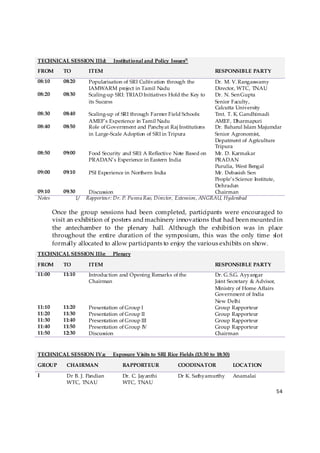

Proceedings of  
                                       
                        rd 
                       3 National Symposium on the 
            SYSTEM OF RICE INTENSIFICATION (SRI) IN INDIA 
           Policies, Institutions and Strategies for Scaling Up: 
             Mainstreaming SRI for Achieving Food Security  
                      While Reducing Water Conflicts 
                              1‐3 December 2008 


                    “THE WAY AHEAD” 


                                       Venue 
                        Tamil Nadu Agri cul tural  Uni ve rsity 
                          Coi mba tore , Ta mil Na du, India 
                                      Partners  
                Tamil Nadu Agricultural University (TNAU), Coimbatore 
                Department of Agriculture, Government of Tamil Nadu 
                  Department of Agriculture, Government of Tripura 
                   Directorate of Rice Research (DRR), Hyderabad 
                    Central Rice Research Institute (CRRI), Cuttack 
                    Directorate of Rice Development (DRD), Patna 
                    National Food Security Mission (NFSM), Delhi 
      National Bank for Agriculture and Rural Development (NABARD), Mumbai 
     Watershed Support Services & Activities Network (WASSAN), Secunderabad 
                        Sir Dorabji Tata Trust (SDTT), Mumbai 
           Acharya N.G. Ranga Agricultural University (ANGRAU), Hyderabad 
    World Wide Fund for Nature (WWF), (through WWF‐ICRISAT Project), Patancheru 
                                                                                   1 

 
Acknowledgement  
We thank Dr. Norman Uphoff, Mr. Philip J. Riddell, Ms . Manisha Aga rwal  and Tamil Nadu 
                                                                                                 rd
Agricul tural Uni ve rsity for their inputs and support in compiling these  proceedings of the  3  
Na tional Symposium. 


Supported  by 
ICRISAT‐WWF Project 


Edition 
June 2009 


Design and layout 
Sraban Dalai


Contact:   
Ms. Padma Reddy, 
ICRISAT ‐ WWF Project 
ICRISAT, Patancheru – 502 324 
Andhra Pradesh, India 
Tel: +91 40 3071 3762 
Email: p.reddy@cgiar.org 
Visit www.sri‐india.net for the s oft copy of the proceedings report 


                                                                                                      2 

 
Contents


  1.  BACKGROUND                                                                                                          5   
 
                      rd
  2. DAY 1: The 3  National Symposium on SRI                                                                              9 
  2.1: Inaugural Session                                                                                                  10       
  2.2: Technical Session I: Experience Sharing by Farmers                                                                 12             
  2.3: Technical Session II: SRI in India                                                                                 16             
       Sta tus of SRI i n India and Challenges Ahead                                                             16 
       Research on S RI in India and Priori ties  for the Future                                                17 
       SRI: Pro‐poor Opti on for Household Food Se curi ty & Resource Conse rvation              18                                   
       Jai Sri: Celebra ting Ci vil Socie ty Invol ve ment in SRI in India                                        19 
       Promotion of SRI unde r the Na tional Food Se curi ty Mission                                      20 
       Promoting  SRI in India : The Expe rience  of Si r Dorabji  Tata Trus t, Mumbai                   20 
       Fa rmer‐Le vel Problems , Cons traints and Innova tions  in SRI Cul ti va tion                         21 
       SRI Farm Imple ments and Ma chinery                                                                                22  
       Andhra  Pradesh: Ini tiati ves for SRI and Lessons                                                                 22 
   
3.  DAY 2:  Parallel Sessions                                                                                24 
3.1:  Technical Session IIIa: Research Studies                                                               24 
3.2:   Technical Session IIIb: Extension, Tools and Constraints                                              25 
3.3:   Technical Session IIIc: Economic Impact Assessment & Markets              26 
3.4:   Technical Session IIId: Institutional and Policy Issues                                  26 
           Popula risation of SRI Cul ti va tion through I AMWARM Proje ct in TN                27 
           Scaling up SRI: TRIAD Ini tiati ves Hold the  Ke y to its Success                    27 
             Food Se curity and SRI: A Refle cti ve Note  based on PRADAN’s Expe rience  
             in Easte rn India                                                                            27 
             Scaling up of SRI through Fa rme r Field Schools: AMEF’s Expe rience i n TN                  28 
           Role of Govt. and Pancha yat Raj Ins ti tutions in Large  s cale Adoption of 
            SRI in Tripura                                                                                29 
           Pe ople’s  Science  Ins ti tute  Expe rience in Northe rn India                                   30 
3.5  Technical Session IIIe: Plenary                                                                         33 
3.6  Technical Session IV (a): Exposure Viists to SRI Rice Fields                                            34 
 
 
                                                                                                                    3 

 
4. DAY 3                                                                                   35 
4.1:  Technical Session IV (b): Reflections on Field Visits                               35 
4.2:  Technical Session V: Other Countries’ Experiences and  
          Lessons Regarding SRI                                                           37 
4.3:  Technical Session VI: Panel Discussion on Policy, Institutions   
          and Strategies for Scaling Up                                                    39 
  
5. Valedictory Session                                                                     47              
6. Summary: The Way Ahead…                                                                 58 
7. Annexure                                                                                50 
     Workshop Programme                                                                    50 


                                                                                                    4 

 
1. Background 
The world is  facing water crisis.    It is estimated  that  more than  1.3 billion people face  drinking  water 
problems every day, and by 2025, about two‐thirds of the world's population ‐‐ about 5.5 billion people ‐
‐ will live in areas facing moderate to s evere water stress (UN, 1997: 19).  
Agriculture is  by far the biggest user of water. Of the 1% of total freshwater water resources on earth 
availa ble for human use, 80% is taken away by agriculture; irrigation a nd dry land farming thereby affect 
the  overall  availabilit y and  cycle  of water  in  most  river basins.  The largest water using crops are:  rice, 
sugarcane, and wheat.   
Rice, the most widely grown and consumed cereal crop, is the lifeline for more than half of the world’s 
population. Traditionally‐cultivated paddy crop takes about 3,000‐5,0 00 liters of water to produce 1 kg 
of rice. With the burgeoning population escalating consumer demand for more rice while the looming 
water crisis and  climate‐induced  changes  play  havoc with  the  periodicity and intensity  of  rainfall, rice 
cultivation is under serious threat. 
Rice being the largest single consumer of water, climate change is going to have profound implications 
on its cultivation. Lack of proper rainfall, depleting ground water levels, and low, even stagnant yields of 
rice are forcing rice‐growing farmers to switch to other crops.  
By 2050, it is estimated that per‐capita availability of water is going to be even further reduced, and if 
the current level of water‐intensive agriculture continues to be practiced, then by 2025 there may not 
be sufficient water in many countries to meet human needs. Indians i n particular will  have to face much 
tougher s ituations to maintain lifestyles and e ven lives.  
In India, the productivity of rice is already very low, and the area for growing rice cannot be increased 
further. Out of 560 rice‐growing districts in t he country, about 90 dis tricts are now producing less than 
1.5 t/ha of rough rice, which is half of the national average a nd much lower than the global average. If 
efforts are directed to increasing yield by just one ton per hectare on the rice‐cultivating area, then our 
country  can easily  increase its  production  to  40  million  tonnes,  enough  to  meet the  projected  food 
security requirements by 2030.  
Therefore any efforts that successfully reduce the water allocation for rice even by 20‐30% will help in 
averting both the food and water crises as farmers can continue to grow more rice with less water.  
While  addressing issues concerning the food crisis, Prof. M.S. Swaminathan has suggested ‘Bridging the 
Yield Gap Movement’.  SRI, a novel approach to rice production, which originated in Madagascar as part 
of civil society efforts to increase yields, constructively reduces the capital, fertiliser, labour and water 
inputs while increasing crop yields and promoting more abundance, diversity and activity of s oil biota in 
and around the  plants’ rhizosphere.  These  changed  practices  with reduced  inputs, supported  by  good 
aeration and  organic matter for the soil, lead to generally improved productivity, with average paddy 
yields of 7‐8 t onnes/hectare, a bout double the present world a verage of 3.8 t /ha.  
It  is reported  that  the  benefits  of  SRI  practices  have  been successfully  demonstrated in  36  countries 
across the globe. In India too, farmers and research institutions in several states – Tamil Nadu, Andhra 
Pradesh, Orissa, Tripura, Punjab, West Bengal, Chhattisgarh, K arnataka, Assam, Bihar, Himachal Pradesh, 
Uttaranchal, Jammu and Kashmir, Madhya Pradesh and others – have begun to increasingly adopt and 
promote SRI in paddy cultivation. 


                                                                                                                  5 

 
1.1 The System of Rice Intensification (SRI) 
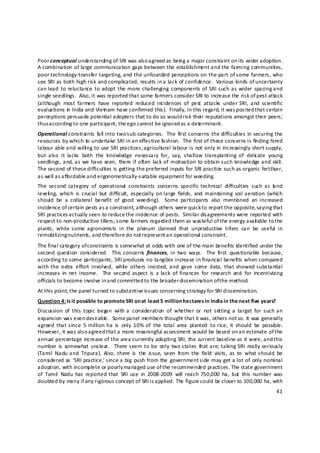
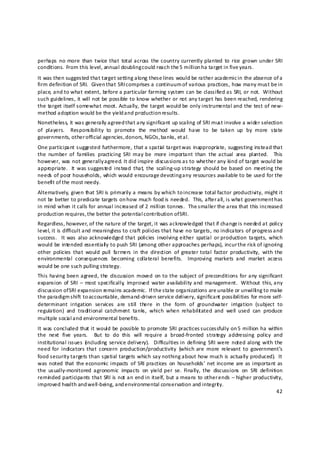
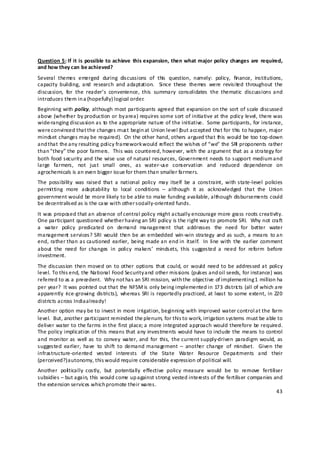
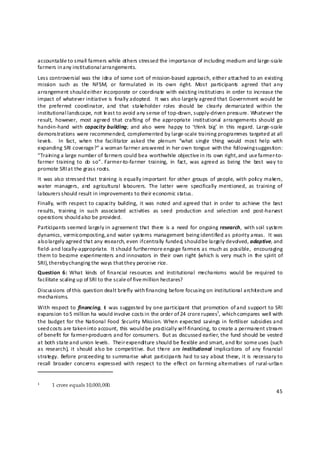
SRI  is  a  combination  of  several  practices  which  include  changes  in  nursery  management,  time  of 
transplanting, size  of  plant  population,  water and  weed  management, and  organic nutrient  provision.  
Its different way of cultivating rice crops remains more or le ss same as in the conventional method; it 
just alters certain a gronomic practices now used in standard rice cultivation. 
SRI  is  not  a  fixed  package  of  technical  specifications,  but  a  system  of  production  with  four  main 
components,  viz.,  soil  fertility  management,  planting 
methods,  weed  control,  and  water  (irrigation) 
management. Increasingly, SRI concepts and practices are 
being  adapted  to  rainfed  (unirrigated)  rice  production, 
and to  other  crops  besides  rice.  Several  field  practices 
have  been  developed  around  these  components.  Of 
them,  the  key  cultural  practices  foll owed  in  most cases 
are:  soil  nutrient  management  through  adequate  
application of  farmyard  manure  or compost made from 
any  vegetation  or  other  biomass,  transplanting  young 
seedlings  (8  to  12  days  old)  carefully,  quickly  and  with 
shallow, at wider spacing  (usually 25  x  25  cm to  begin), 
regular weeding with a mechanical weeder which aerates the soil as it removes weeds, and limited but 
regular irrigation to keep soil  wet  without continuous  flooding,  i.e.,  mostly aerobic  so  that  roots and 
beneficial soil organis ms can survive. Otherwise they s uffer from lack of oxygen. 
Rice  grown  under  SRI  management  has  larger  root  systems,  profuse  and  strong  tillers  with  bigger 
panicles and well‐fille d spikelets having higher grain weight. SRI rice plants can develop about 30 – 80 
tillers, and the yields are usually higher than before. The ‘secret’ (now public knowledge) behind this is 
that rice plants  do  best  when  young seedlings are transplanted  singly  and carefully  at  wider spacing; 
their roots grow larger in soil  that is kept well‐aerated with abundant and diverse soil micro‐organisms. 


1.2 SRI National Symposium – An Overview 
To  influence  policy  decisions  for  up‐scaling SRI  at a  national level, ICRISAT‐WWF  Dialog  Project’s  low‐
profile  initiatives  through  its  field  interventions  (at  strategic  locations  in  India),  research,  and  policy 
advocacy have paved the way for large‐scale adoption of SRI methodology at different levels in several 
states by various stakeholders.  With SRI being started in almost all the states of India under different 
agro‐climatic  zones,  a  continuous  effort  to  share, 
synthesize  and  document  the  experiences  while 
articulating  opportunities and  constraints to  up‐scale  SRI 
was felt important. Envisioning the importance of a farm‐
based approach like SRI for combating the food and water 
crises  while  taking  into  consideration  the  health  and 
sustainability  of  both  agroecosystems  and  natural 
ecosystems, the ICRISAT‐WWF project initiated a series of 
national‐level  symposia  on  SRI  in  India.  Appreciable 
efforts  have  gone  in to  paving  the  way  for  annual  SRI 
events to become an important national platform to strengthen SRI movement in the country.  

                                                                                                                      6 

 
The First National Symposium on SRI was organised in November 2006 at Hyderabad, Andhra Pradesh, 
hosted at  Acharya  N.G.  Ranga  Agricultural Universit y  (ANGRAU).  This  brought  farmers,  scie ntists, and 
civil s ociety organizations together on a broad scale for the first time in India.  
Built on the s uccess of the first one, a  Second National Symposium was held at Agartala in Tripura state 
during October 2007. This further expanded to include more policy makers, and it was instrumental in 
generating interest among governments, banks and private t rusts to invest in SRI by directly supporting 
the farmers in many s tates.  
These  events  brought  together  a  diverse  group  of 
concerned  individuals  and  agencies  to  share  the 
experiences,       concerns,     constraints,         farmers’ 
innovations,  research  priorities  and  policy  directions 
that  can  enhance  adoption  and  up‐scaling  of  SRI 
methods  to  attain  food  security  and  improve  the 
livelih oods of rural households, especially the poor and 
the marginal,  while avoiding  placing  further  stress  on 
the water  resources  that  are  critical  for  the  future  of 
ecosystems. 
The events  motivated many  researchers and  research institutes  to  initiate experimental  trials  on SRI 
across the country and facilit ated networking of like‐minded individuals and agencies for cross‐sharing 
of  experiences and  training support to  propagate  SRI in new areas.  The  most significant  outcome was 
the inclusion  of  SRI  methods  in  the  National  Food  Security  Mission  (NFSM)  program  as one  of  the 
options  to  improve  productivity  of  rice  in  food‐deficit  parts  of  the  country.  Representatives  of 
Government agencies  and  departments  clearly  emphasized  how  they  ‘want  SRI  to  be  placed centre‐
stage’.    They  also  clearly  laid  out plans  for  the  National  Food  Security  Mission  to  incorporate  SRI 
practices,  and  noted  that  SRI  has  to  be  encouraged  with  relevance  to  local conditions,  simultaneously 
engaging the local bodies in its promotion. 

            rd
1.3 The 3  National Symposium   
The most successful state in India in terms of SRI implementation and adoption ‐‐ Tamil Nadu ‐‐ played 
host  to  the 3 rd   National  Symposium  on  SRI.  The  venue  was  the  magnificent  Tamil  Nadu Agricultural 
University  (TNAU)  at  Coimbatore  from 1 st  to  3 rd   December  2008.  The  theme  of  the  Symposium was:  
Policies,  Institutions  and  Strategies  for  Scaling  Up  ‐  Mainstreaming  SRI  for  achieving  food  security 
while reducing water conflicts.  
Rice in Tamil Nadu is widely cultivated on over 21 lakh ha in 28 districts with an annual production of 80‐
85 lakh tonnes (rough rice) and an average yield of 4 t/ha. During 2007‐2008, SRI methods have been 
applied on 4.2 lakh ha ‐‐ about 20% of the total rice‐growing  rea.  
                                                              a
The energetic  commitment of scientists and  field  staff at  TNAU  and strong political support  from the 
state government has facilitated the fast spread of SRI in the state to the extent that it is included as a 
key  technological  intervention  in  the  World  Bank‐funded  IAMWARM  project  which  is  currently 
underway.  
Main objectives of the 3rd National Symposium as organized were:  
       i)        Sharing  of  Experiences:  which  involved  farmers,  promoters,  researchers,  and  state 
                 government officials in focusing on: 
                                                                                                          7 

 
-     the diversity of extension approaches; 
             -     the difficulties and constraints encountered by them; 
             -     new or improved tools; 
             -     innovations in crop establishment and management; a nd 
             -     organic farming. 
      ii)    Understanding Constraints and Opportunities: t his was intended to familiarize participants 
             with respect to current research findings regarding: 
             -     theoretical and conceptual issues in SRI (such as the roles of soil biology and micro‐
                   biology); 
             -     possible modifications to water, soil, nutrient, and weed management; 
             -     the quality of grain a nd straw as affected b y SRI; 
             -     varietal responses to different soil s and field conditions, etc, 
             -     innovations in farm implements and mechanization, a nd 
             -     economic impact a ssessments.  
                    
      iii)   Options for the Scaling up of SRI: this was explored through a high‐level panel discussion, 
             targeting  key issues  of policy,  development  strategies, institutional  mechanisms,  financial 
             resources and incentives, etc. 
 
The third s ymposium facilitated the convergence of ideas based on field experiences o f farmers, civil 
society and scientists from across the country to look critically at the results and to a ssess the 
performance of SRI methods. 


                                                                                                            8 

 
rd
2. DAY 1: The 3 National Symposium on SRI
Venue: Tamil Nadu Agricultural University, Coimbatore 

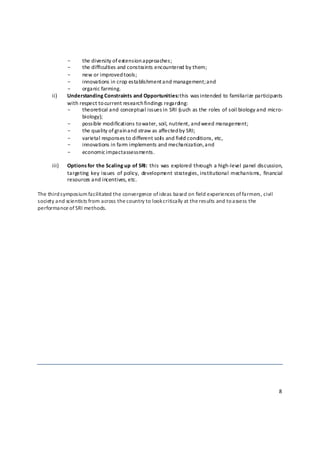
Monday  morning,  December  1:  The  pleasant  morning  weather  of  Coimbatore  added  to the  festive 
atmosphere  on  the  first  day  where  participants  from 
across  different  states  in  India  and  other  countries 
gathered  at  the  T      amil  Nadu  Agricultural  University 
(TNAU )  campus  for  registration  to  the  3 rd   National 
Symposium  on  SRI.  The  scope  of  participation,  350 
people  from  23  states  (including  union  territories) 
reflected the growth of interest and involvement with SRI 
in  India;  the  first  National  SRI  Symposium had  attracted 
150  participants  from  most  parts  of  India,  while  the 
second  symposium  attracted  250  participants  from 
almost all states and territories.  
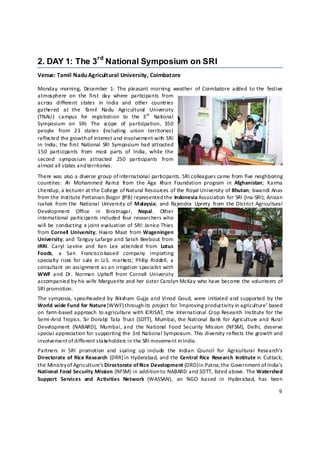
There was also a diverse group of international participants. SRI colleagues came from five neighboring 
countries:  A Mohammed  Ramzi  from  the  Aga  Khan  Foundation  program  in  Afghanistan;  Karma 
              li 
Lhendup, a lecturer at the College of Natural Resources of the Royal University of Bhutan; Iswandi Anas 
from the Institute Pertanian Bogor (IPB) represented the Indonesia Association for SRI (Ina‐SRI); Anizan 
Isahak  from  the  National  University  of  Malaysia;  and  Rajendra  Uprety  from  the District  Agricultural 
Development  Office  in  Biratnagar,  Nepal.  Other 
international  participants included  four  researchers  who 
will be  conducting  a  joint  evaluation  of  SRI:  Janice Thies 
from  Cornell   University;  Haaro  Maat  from Wageningen 
University; and  Tanguy Lafarge and  Sarah  Beebout from 
IRRI.  Caryl  Levine  and  Ken  Lee  attended  from  Lotus 
Foods,  a  San  Francisco‐based  company  importing 
specialty  rices  for  sale  in  U.S.  markets;  Phil ip  Riddell,  a 
consultant  on  assignment as an  irrigation specialist  with 
WWF  and  Dr.  Norman  Uphoff  from  Cornell  University 
accompanied by his wife Marguerite and her sister Carolyn McKay who have become the volunteers of 
SRI promotion.  
The symposia,  spearheaded  by  Biksham  Gujja and Vinod  Goud,  were  initiated and supported  by the 
World wide Fund for Nature (WWF) through its project for `Improving productivity in agriculture’ based 
on  farm‐based approach  to agriculture  with  ICRISAT,  the  International  Crop  Research  Institute  for the 
Semi‐Arid  Tropics.  Sir  Dorabji  Tata  Trust  (SDTT),  Mumbai, the  National  Bank  for  Agriculture and  Rural 
Development  (NABARD),  Mumbai, and  the  National  Food  Security  Mission  (NFSM),  Delhi,  deserve 
special appreciation for supporting the 3rd National Symposium. This diversity reflects the growth and 
involvement of different stakeholders in the SRI movement in India. 
Partners  in  SRI  promotion  and  scaling  up  include  the  Indian  Council  for  Agricultural  Research’s 
Directorate of  Rice Research  (DRR) in Hyderabad, and the Central Rice  Research  Institute  in  Cuttack; 
the Ministry o f Agriculture’s Directorate of Rice Development (DRD) in Patna; the Government of India’s 
National Food Security Mission (NFSM) in addition t o NABARD and SDTT, listed above. The Watershed 
Support  Services  and  Activities  Network  (WASSAN),   an  NGO  based  in  Hyderabad,  has  been 

                                                                                                               9 

 
instrumental  in scaling‐up activities;  as are the three hosts of  this and previous symposiums  ‐‐  TNAU, 
Acharya N.G Ranga Agricultural University (ANGRAU) in Hyderabad and the Tripura State Department of 
Agriculture – who continued as co‐sponsors. 


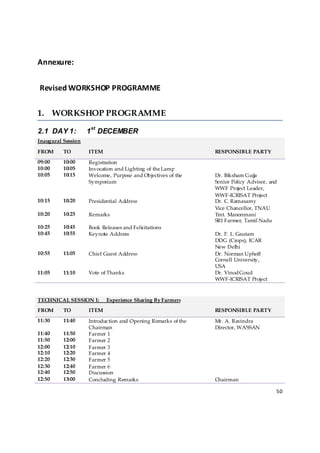
2.1 Inaugural Session  
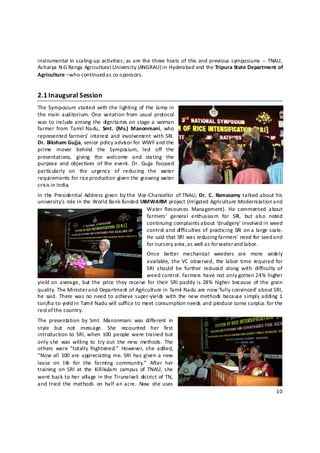
The Symposium started  with the lighting  of  the  lamp in 
the main  auditorium.  One  variation  from  usual  protocol 
was to  include among  the  dignitaries on stage a  woman 
farmer  from  Tamil  Nadu,  Smt.  (Ms.)  Manonmani,  who 
represented  farmers’  interest  and  involvement  with  SRI.  
Dr. Biksham Gujja, senior policy advis or for WWF and the 
prime  mover  behind  the  Symposium,  led  off  the 
presentations,  giving  the  welcome  and  stating  the 
purpose  and  objectives  of  the  event.  Dr.  Gujja  focused 
particularly  on  the  urgency  of  reducing  the  water 
requirements for rice production given the growing water 
crisis in India. 
In  the  Presidential  Address given  by the  Vice‐Chancellor  of  TNAU, Dr.  C.  Ramasamy  talked about  his 
university’s role in the World Bank‐funded IAMWARM project (Irrigated Agriculture Modernization a nd 
                                                  Water  Resources  Management).  He  commented  about 
                                                  farmers’  general  enthusiasm  for  SRI,  but  also  noted 
                                                  continuing complaints about ‘drudgery’ involved in weed 
                                                  control and  difficulties  of  practicing  SRI  on a large scale. 
                                                  He said that SRI was reducing farmers’ need for seed a nd 
                                                  for nursery area, a s well as for water and labor. 
                                                    Once  better  mechanical  weeders  are  more  widely 
                                                    available,  the  VC  observed,  the  labor  time  required  for 
                                                    SRI  should  be  further  reduced  along  with  difficulty  of 
                                                    weed control.  Farmers  have  not  only  gotten 24%  higher 
yield  on  average,  but  the  price  they  receive  for  their  SRI paddy is  28%  higher  because  of  the  grain 
quality. The Minister and Department of Agriculture in Tamil  Nadu are now ‘fully convinced’ about SRI, 
he  said.  There  was no  need  to achieve super‐yields  with  the  new  methods  because simply adding  1 
ton/ha to yield in Tamil Nadu will suffice to meet consumption needs and produce some surplus for the 
rest o f the country.  
The  presentation  by  Smt.  Manonmani  was  different  in 
style  but  not  message.  She  recounted  her  first 
introduction  to  SRI, when  100  people  were  trained  but 
only  she  was  willing  to  try  out  the  new  methods.  The 
others  were  “totally  frightened.”  However,  she  added, 
“Now  all  100 are  appreciating  me. SRI  has  given a  new 
lease  on  lif   for  the  farming  community.”  After  her 
             e
training  on  SRI  at  the  Killikulam  campus  of  TNAU,  she 
went  back to  her  vill age in the  Tirunelveli  district  of  TN, 
and tried  the  methods  on  half  an acre.  Now  she uses 
                                                                                                                10 

 
them on 50 acres (20 ha), she said. “What we must do is change the mindset of the people. That is most 
important.”  
“Because of my  results,  I  have  confidence now,”  she said 
proudly. “I can stand in front of you [over 300 people, most 
of  them  university‐educated]  and  tell  you  about  my 
experience. …  I  tell other  farmers, unless  you  work  hard, 
you cannot succeed.”  She said that her SRI yie lds have been 
as  high as  11  tons/ha, and that she  received an award  for 
this. “I am  ready  to train anybody in  SRI,  from any part of 
the  world.”  She  concluded  by  saying:  “Every  farmer  is 
saying  that  agricultural  work  does  not  pay,  that  it  only 
results  in  economic losses. But  I  don’t  agree.  With  SRI,  it 
can become  profitable.  Also,  we  must  remember  that  if 
agriculture  dies,  everyone  dies;  all life  forms  will  perish.” 
This  was  quite  an  admonit ion  for  participants  to  think 
about as the Symposium began.  
After  a  ceremony  of  felicitating  the SRI  proponents and  ‘releasing’ several newly‐published  books; SRI 
Experiences of Farmers in India, SRI Fact Sheets for several states, a Symposium special edition of the 
SRI  Newsletter, and  manuals  on  SRI,  the  Program Leader  for  Sustainable  Rice  Systems in the  Cornell 
International  Institute  for  Food,  Agriculture and Development  (CIIFAD),  Dr.  Norman  Uphoff,  the  Chief 
Guest  of  the  event,  addressed  the participants  of the  symposium.  Since  the  thoughts  which  he had 
shared in his paper for the Symposium on ‘What Is SRI?’ were too many to be covered in 10 minutes, he 
suggested that they be read and reflected on. He stressed that SRI is a work in progress: “We are not 
assembled to celebrate SRI, but rather to learn from each other’s experiences, good and bad.”  
                                                      While  SRI  is  usually  discussed  in  terms  of  specific 
                                                     practices that change a ge‐old common methods, he said, 
                                                     “It  is better  to  understand  SRI in  terms  of  the  multiple, 
                                                     scientifically‐sound reasons why these practices raise the 
                                                     productivity of land, labor, water and capital used in rice 
                                                     production.  These,  in  turn,  can  be summarized in  terms 
                                                     of a number of basic principles that make SRI a coherent 
                                                     system  of  resource  management,  and  ultimately 
                                                     constit ute  a  paradigm  for  improving  our  agricultural 
                                                     systems in the 21st century”.  
                                                He  commented  on three  ways  of  characterizing  SRI:  (a) 
                                                SRI  is  an  opportunity,  rather  than  a  technology;  it  is 
something continuall y evolving, particularly driven by farmer innovation, (b) SRI is a kind of ‘infection’ 
that  is  benign  and  beneficial,  spreading  and  activating  people  to  try  to  make  SRI  productivity 
enhancements  more  widely available,  and (c)  SRI  has  become  a  movement  which is  now worldwide, 
with thousands of people dedicated to benefiting producers, consumers and the environment all at the 
same time. SRI as been validated in 36 countries and continues to spread.  
Dr. G.S.G. Ayyangar, formerly Commissioner and Secretary of Agriculture in Tripura, now reassigned to 
central  government service, commented  from his  experience  overseeing  the  expansion  of  SRI  in that 
state,  that  SRI  is  not necessarily connected  to  either  big  or  small farms,  but is  scale‐neutral.  He was 

                                                                                                                   11 

 
particularly pleased that SRI i s being taken up by tribal farmers in his state, who are d oubling their yield 
with one‐third less labor per hectare. He commented that Green Revolution technolo gies, despite being 
promoted for 40 years, have not reached into the “nooks and crannies” of Tripura, where higher food 
production is most needed. While it is true that SRI methods cannot be used “in each and every plot,” 
they can be used practically anywhere, he said, “only not everywhere with the best results.” The most 
important thing, he added, is to have, get or c reate water control, so that s oils can be kept well‐drained. 
When a usual question was asked: “what varieties are best with SRI?” Dr. Ayyangar answered: “any and 
all.”  Some  are  better  than  others, of  course,  but  yield  increases are  attainable  from  practically  all 
varieties. Dr.  Gujja added  the idea  that  SRI “liberates  farmers  from  the constraints  of seed,”  because 
they  can  use  any  kind  of  variety,  modern  or  traditional,  hybrid  or  landrace.  “SRI  is  seed‐neutral,” 
although  we  should  help  farmers  find  what  varieties  perform best with  SRI  practices  under their own 
local climatic and soil conditions. SRI has the disadvantage of having no commercial interests, like seed 
companies, promoting it. However, hybrid seed producers should welcome SRI because by reducing the 
amount of  seed  needed  by as  much as  90%,  this  makes hybrid seed  more affordable  for  farmers who 
want to use it. 
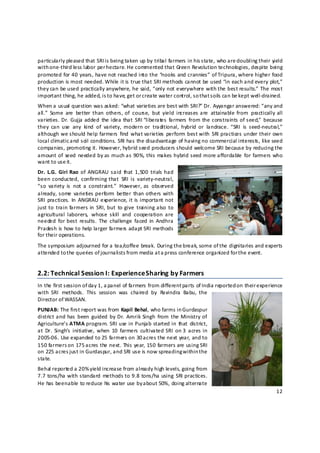
Dr.  L.G.  Giri  Rao  of  ANGRAU  said  that  1,500  trials  had 
been  conducted,  confirming  that  SRI  is  variety‐neutral, 
“so  variety  is  not  a  constraint.”  However, as  observed 
already, some  varieties perform  better  than  others  with 
SRI  practices.  In  ANGRAU  experience, it  is important  not 
just to  train  farmers  in  SRI,  but  to give  training also  to 
agricultural  laborers,  whose  skill  and  cooperation  are 
needed  for best  results.  The  challenge  faced  in  Andhra 
Pradesh is how to help larger farmers adapt SRI methods 
for their operations.  
The symposium adjourned for a tea/coffee break. During the break, some of the dignitaries and experts 
attended to t he queries of journalists from media at a press conference organized for the event.  


2.2: Technical Session I: Experience Sharing by Farmers  
In the first session of day 1, a panel of farmers from different parts of India reported o n their experience 
with  SRI  methods.  This  session  was  chaired  by  Ravindra  Babu,  the 
Director of WASSAN. 
PUNJAB: The first report was from Kapil Behal, who farms in Gurdaspur 
district and has  been  guided  by Dr.  Amrik Singh  from  the Ministry  of 
Agriculture’s  ATMA program.  SRI use in Punjab  started in  that  district, 
at  Dr.  Singh’s  initiative,  when  10  farmers  cultivated  SRI  on 3  acres  in 
2005‐06. Use expanded to 25 farmers on 30 acres the next year, and to 
150 farmers on 175 a cres the next. This year, 150 farmers are using SRI 
on 225 acres just in Gurdaspur, and SRI use is now spreading within t he 
state. 
Behal reported a 20% yield increase from already high levels, going from 
7.7 tons/ha with standard  methods  to 9.8  tons/ha using  SRI practices. 
He has been able to reduce his water use by about 50%, doing alternate 
                                                                                                               12 

 
wetting and drying during the season with 13 irrigations, having a maximum depth of 2.5 cm. Standard 
practices is to maintain standing water of 5 cm, requiring 25 irrigations. Summarizing the experience of 
Gurdaspur farmers, Behal reported that yield  increases of 20‐25% are attained with 75% less seed, 45‐
50% less water, and 25‐40% less fertilizer. Also, the rice crop matures 8‐10 days sooner than with usual 
cultivation methods. 
Behal  reported also  that  SRI  practices  were  giving better  grain  quality,  more  resistance  to  pests and 
diseases,  and  improvement  in  soil  health.  The  constraints  identified  from  farmer  experience  were: 
psychology  and  attitudes;  water  management  problems;  shortages  of  labor  for  certain  operations; 
inappropriate  design  of  available  cono  weeders;  limited  organic  matter  for  making  compost;  labor‐
intensity; a nd unreliable electricity for pumping water. 
ANDHRA  PRADESH: Nagaratnam  Naidu  reported his introduction  to  SRI methods  of  rice  cultivation in 
the year  2003  after  formal training  from  DRR and ANGRAU.  The  maximum  yields  recorded  from  his 
fields are 15  t/ha.  He  reported  60%  savings  in  water, and compared  with  28  kg  of  seeds/acre  sown 
before  he  uses  only  2  kg  of  seeds per  acre  under  SRI  method.  A  champion  and campaigner  of SRI, 
Nagaratnam  Naidu  is   being awarded  the Jagjivan  Ram  Kisan  Puruskar  2008  by  the Indian  Council  of 
Agriculture Research (ICAR). 
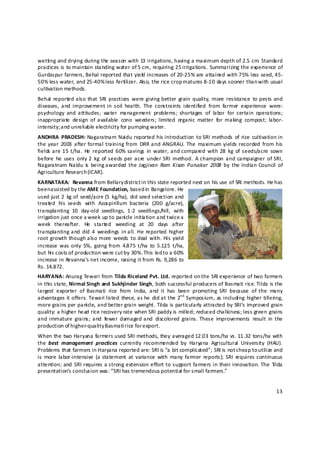
KARNATAKA:  Revanna from Bellary district i n this state reported next on his use of SRI methods. He has 
been assisted by the AME Foundation, based in Bangalore. He 
used  just 2  kg of  seed/acre (5  kg/ha),  did seed selection and 
treated  his  seeds  with  Azospirillum  bacteria  (200  g/acre), 
transplanting  10  day‐old  seedlings,  1‐2  seedlings/hill,  with 
irrigation just once a week up to panicle initia tion and twice a 
week  thereafter.  He  started  weeding  at  20  days  after 
transplanting  and  did  4  weedings  in all.  He  reported  higher 
root  growth  though also more  weeds  to  deal  with.  His  yield 
increase  was  only  5%,  going  from  4.875 t/ha  to  5.125  t/ha, 
but his costs of production were cut b y 30%.  This led to a 60% 
increase in Revanna’s net income, raising it from Rs. 9,286 to 
Rs. 14,872. 
HARYANA: Anurag Tewari from Tilda Riceland Pvt. Ltd. reported on the SRI experience of two farmers 
in this state, Nirmal Singh and Sukhjinder Singh, both successful producers of Basmati rice. Tilda is the 
largest  exporter  of  Basmati  rice  from  India,  and  it  has  been  promoting  SRI  because  of  the  many 
advantages it  offers.  Tewari listed  these, as  he  did at  the 2nd  Symposium, as including  higher  tillering, 
more grains per panicle, and better grain weight. Tilda is particularly attracted by SRI’s improved grain 
quality: a higher head rice recovery rate when SRI paddy is milled; reduced chalkiness; less green grains 
and  immature  grains;  and  fewer  damaged and  discolored  grains.  These  improvements  result  in  the 
production of higher‐quality Basmati rice for export. 
When the two Haryana farmers used SRI methods, they averaged 12.03 tons/ha vs. 11.32 tons/ha with 
the  best  management  practices  currently  recommended  by  Haryana  Agricultural  University  (HAU). 
Problems that farmers in Haryana reported are: SRI is “a bit complicated”; SRI is not c heap to utilize and 
is  more  labor‐intensive  (a statement  at  variance  with  many  farmer  reports);  SRI  requires  continuous 
attention;  and  SRI  requires a strong  extension  effort to support  farmers in  their innovation.  The  Tilda 
presentation’s conclusion was: “SRI has tremendous p otential for small farmers.” 


                                                                                                               13 

 
UTTARAKHAND: Rikeshwar Prasad from Tehri Garhwal district, who has been assisted in the use of SRI 
by the People’s Science Institute (PSI) in Dehradun, has only 0.1 ha of paddy land, not an uncommon 
situation this hill state. With c onventional methods, his previous paddy yield was 3.75 tons/ha. This gave 
him only 375 kg per year to feed his family of four, so they could not meet their basic staple food needs. 
With  SRI,  instead  of maintaining  6  inches of  water on  his  paddy  field, he  aims  for only  1  inch,  and  he 
needs to use only 1.25 kg of seed for his field, instead of 10 kg as he needed before.  
Rikeshwar reported on three years of experie nce usin g SRI methods, with yields of 6.25 tons, 9.35 tons, 
and 7 .81 tons/ha, i.e., more t han double what he produced before. He has also gotten 2‐2.5 t imes more 
straw fodder for his two buffaloes, an important consideration. He listed the following advantages: less 
water, less time required, i.e., needs less labour work, and less cost of production with much greater net 
income.  With  SRI,  he  was  able  to  reduce  his  costs  per  hectare  from  Rs.  21,700  to  Rs. 12,500.  Given 
higher  value of  production, his  net income from  paddy has  been  increased  almost ten‐fold ,  from Rs. 
2,750 previously to Rs. 27,600 per hectare now. 
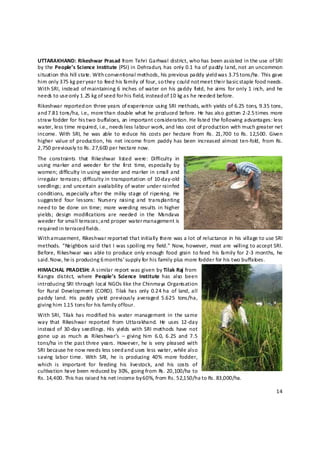
The  constraints  that  Rikeshwar  listed  were:  Difficulty  in 
using  marker  and  weeder  for  the  f rst  time,  especially  by 
                                          i
women; difficulty in using weeder and marker in small and 
irregular  terraces;  difficulty in  transportation  of  10‐day‐old 
seedlings; and  uncertain  availability of water  under rainfed 
conditions,  especially after the  milky  stage of  ripening.  He 
suggested  four  lessons:  Nursery  raising  and  transplanting 
need to  be done  on  time;  more  weeding  results  in  higher 
yields;  design  modifications  are  needed  in  the  M     andava 
weeder for small terraces; and proper water management is 
required in terraced fields.  
With amusement, Rikeshwar reported that initially there was a lot of reluctance in his village to use SRI 
methods.  “Neighbors said  that  I  was  spoiling  my  field.”  Now,  however,  most are  willing  to accept SRI. 
Before,  Rikeshwar  was able to produce only enough  food  grain  to feed  his  family for 2‐3 months,  he 
said. Now, he is producing 6 m onths’ supply for his family plus more fodder for his two buffalo es.  
HIMACHAL PRADESH: A similar report was given by Tilak Raj from  
Kangra  district,  where  People’s  Science  Institute  has  also  been 
introducing SRI through local NGOs like the Chinmaya Organisation 
for  Rural  Development  (CORD).  Tilak  has  only  0.24 ha  of  land, all 
paddy  land.  His  paddy  yield   previously  averaged  5.625  tons/ha, 
giving him 1.1 5 tons for his family of four.  
With  SRI,  Tilak  has modified  his  water  management  in  the  same 
way  that  Rikeshwar  reported  from  Uttarakhand.  He  uses  12‐day 
instead of  30‐day seedlings.  His  yields  with  SRI  methods  have  not 
gone  up  as  much  as  Rikeshwar’s  –  giving  him  6.0,  6.25  and  7.5 
tons/ha in the  past three  years.  However, he is  very  pleased  with 
SRI because he now needs less seed and uses less water, while also 
saving  labor  time.  With  SRI,  he  is  producing  40%  more  fodder, 
which  is  important  for  feeding  his  livestock,  and  his  costs  of 
cultivation have been reduced by 30%, going from Rs. 20,100/ha to 
Rs. 14,400. This has raised his  net income by 6 0%, from Rs. 52,150/ha to Rs. 83,000/ha. 

                                                                                                                  14 

 
The constraints that Tilak identified were: Due to excessive rainfall, the nursery can get spoile d; effort is 
required to operate the weeder; and marking of small and irregular fields is difficult. The lessons learned 
are: More fill ed seeds are obtained i n the SRI crop; there are fewer weeds in the crop; the crop is less 
subject to lodging; and when there is delay in growth of the crops, the crops can be damaged by cattle. 
He said that in his vil lage they are als o experimenting with adapting SRI methods to their wheat crop, a 
kind of ‘System of Wheat Intensification’ (SWI). 
GUJARAT: [This report was actually made on the second day in a parallel session, but it fits in here most 
appropriately.]  S.M.  Patwardhan  and  S.M.  Patel  from  the  BAIF  Development  Research  Foundation 
reported  on  farmer  experience  in  Dangs  district  in  this  state,  which  has thus  far  had  very  little SRI 
activity. BAIF is working with tribal populations in a remote area with irregular rainfall, where 70% of the 
households do not produce enough grain to feed themselves from their own land. Average paddy yields 
are 1 ton/ha. 
During the monsoon season, 17 farmers in Dangs agreed to try out SRI methods on .05 to .1 0 ha, with 
control plots  side‐by‐side.    These  farmers had a  yield  of 2.95  tons/ha  on their  control  paddy  plots, so 
they appear to be somewhat better situated than the average. Their SRI yields averaged 5.3 7 tons/ha, 
80%  more,  and  very  high  without  irrigation.  Of  much  interest  was a  slide showing  how  different rice 
varieties responded respectively to SRI practices under these rainfed c onditions: 
                           Conventional methods (kg/ha)             SRI methods (kg/ha)             Increase (%) 
    Local varieties                   1,853                                3,816                        106 
    Improved varieties                3,400                                5,390                          60 
    Hybrids                           3,094                                6,027                          95 
BAIF  reported  that  the  trials  had  been subject  to  a 10‐day dry  spell  at  5  days after  transplanting.  This 
caused  major losses in  the control plots,  while  in  the  SRI plots increases in  biomass  were  observed. 
Farmers’ observations were: SRI reduces seed requirements; with SRI there is an absolute necessity of 
weeding; with SRI, proper leveling of fields is very important; and farmers lack practice in using organic 
manures. Also, farmers observed that the use of organic matter alleviated water‐stress problems.  
TAMIL NADU: The most enthusiastic farmer report was from P. Baskaran, president of the SRI Farmers 
Association –Thumbal in Salem district. He reported that paddy yields have been 2.9 to 5.8 tons/ha in 
his area, but labor constraints and high costs have made 
paddy production less and less attractive. In August 2007, 
TNAU  staff  with  the  IAMWARM  project  introduced 
farmers in Thumbal village to SRI. “At first, nobody would 
come  forward  to  foll ow the  methods of  SRI.”    But more 
than  200  acres  were  planted  with  these  new  methods 
last year, and farmers found they could reduce their l abor 
requirements  by  30%  while  getting  higher  yields.  This 
year, about 90% will plant SRI without subsidy, Baskaran 
said. 
Because of their satisfaction with SRI, farmers in Thumbal 
formed  an  association  to  train  other  farmers  and 
promote the spread of SRI in their area. One goal of the 
Association is:  “Avoid  wastage  of  seeds  (we  feel  it’s  a  crime).”  The  Association  wants  also  to  help 
farmers reduce their costs of production and to increase their incomes.  

                                                                                                                    15 

 
Of particular interest in Baskaran’s presentation was a modification he reported in the use of the rotary 
weeder. With ‘the Raji method,’ the farmer stands in one row and ‘weeds’ in the adjacent one. He holds 
the rotary weeder differently with his hands, pushing and pulling the cones back and forth in the other 
row. From a standing position, he can cover 3.5‐4.5 meters with the Raji method, compared with 1‐1.5 
meters using the present weeding technique, where he just pushes the weeder up and down the rows 
across the field.  
This i nnovation, Baskaran reported, saves time and energy, reducing the manpower needed for weeding 
and saving money. It reduces the number of steps/100 m 2  from 338 t o 78, according to one a ccounting, 
and it reduces the  time  required to  weed such  an area  from  48  to  28  minutes.  The  number of  hours 
needed for weeding an acre is reduced by 43%, from 32.5 to 1 8.5.  
With  pride,  Baskaran  showed  pictures  of  visits  to  the  Thumbal  SRI  Farmers  Association  from  the 
Minister  of Agriculture,  the  Vice‐Chancellor  of  TNAU,  and  Dr.  T.  M.  Thiyagar ajan,  the  TNAU  faculty 
member  who  started  SRI  evaluation  in  2000  and  who  has  been  the  key  person  for  getting  SRI 
established in  Tamil  Nadu. Baskaran  said  that  in  the  past year,  2,500  farmers  have  visited  Thambal 
village to learn more about SRI methodology. He invited everyone at the symposium to visit  his villa ge 
and see their results in person. 
A  final  report  from Tamil  Nadu  was  titled: How  a Farmer Obtained  Higher  Productivity  in Paddy  by 
Adopting SRI Methods. The farmer referred to was K. Pitchai in Dindigul Dis trict, who, as explained by 
his agricultural laborer, could not come to the symposium in Coimbatore “due to his old age.” Ganesan 
said, “I have come to make a powerpoint presentation regarding the higher productivity obtained.” He 
described how they had achieved a yield of 14.2 tons/ha the previous season using SRI methods on 2 of 
the la ndowner’s 9 acres of ric e land. They used younger seedlings, wider spacing, water control, etc. The 
number  of  hills/m 2  was  20.  The  average  number  of  productive  panicles/hill  was 36.  The  number  of 
grains/panicle averaged 119.  
The cost/ha of SRI cultivation was calculated as declining 27%, from Rs. 31,750 to Rs. 23,325. Ganesan 
showed how with the higher yield and lower costs, Pitchai’s net profit had gone up by 125% ‐‐ from Rs. 
40,250 to Rs. 90.275. Even if these data might be overstated (and there was no evident reason to think 
that they were),  the  differences  Ganesan  reported were  of such a magnitude  that the agronomic and 
economic  advantages  of  SRI  methods  could  not  be  dismissed  by suggesting  they  were  just  due  to 
‘measurement errors.’   
With this review of SRI experience in  very diverse parts of India ‐‐ Punjab, Haryana, Himachal Pradesh 
and  Uttarakhand in the north; Tamil Nadu and Karnataka in the south; and Gujarat in the west  ‐‐ the 
Symposium adjourned for lunch, considerably later than scheduled, but with a  lot to think about. 
Once  the  group  sessions  had  been completed,  participants  were encouraged to  visit an  exhibition  of 
posters  and machinery innovations that  had  been mounted  in  the antechamber  to  the  plenary  hall.  
Although the exhibition was in place throughout the e ntire duration of the symposium, this was the only 
time slot formally allo cated to allow participants to enjoy the various exhibits on show. 


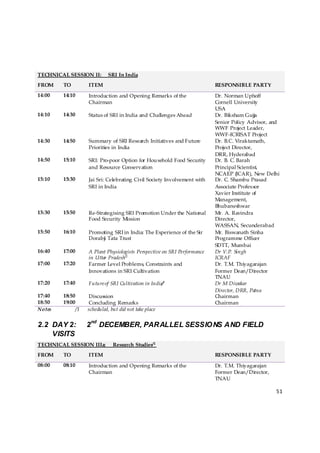
2.3: Technical Session II: SRI in India  
 This session chaired by Dr. Norman Uphoff was led off by Dr. Biksham Gujja from WWF with a paper 
on ‘Status of SRI in India and Challenges Ahead,’ showing a map of India with the 564 districts were rice 
is  grown denoted  in  light  green, and  the  218  districts  where  SRI  has  been already introduced, almost 

                                                                                                             16 

 
40%, indicated in dark green. This does not mean that SRI methods are used in the entire districts but 
that t he value of these methods has b een demonstrated. 
This cartographic survey showed  that  SRI  is now  present  in  all rice‐growing  states  of  India, and in all 
agro‐climatic zones. It has been utilized successfully in rainfed as well as irrigated areas, and by all types 
of  farmers, ranging from  less  than 0.2  ha  to  over 50  ha.  There  are 
national and  many state  initiatives now  underway to  promote  SRI’s 
further spread. However, the uptake of SRI has been much less than 
could  and  should  have  happened  by  now,  considering  that  the 
methods  increase  production  and  factor  productivity,  decrease  the 
need for water, and facilitate using less inputs and having lower costs 
of production, plus other benefits.  
Dr.  Biksham  proposed  setting  goals  to  move  the  SRI  enterprise 
forward, suggesting that we call for 2 0% of the rice‐sector area to be 
under  SRI  management  by  2015,  with  a  30%  reduction  in  current 
levels   of water  use  for  rice productio n. Given  higher  yields with  SRI, 
this should enable the country to meet its projected needs for greater 
rice output. Currently over 8 million ha of rice‐growing area produce 
less than 2 ton/ha. There is considerable potential for yield enhancement in such areas. [Thousands of 
households in eastern India assisted b y PRADAN have averaged 7 tons/ha yields with rainfed SRI there.] 
One  of  the constraints  most  often identified  has  been  the  greater  need  for  weed  control,  and  the 
imple ments  currently  available  are  not  always,  or  for  all  soil  conditions,  considered  effective and 
efficient by f rmers. Achieving better design and quality of weeders, and if possible their motorization, 
             a
would make a big contribution to both the acceleration of SRI adoption and accompanying water saving. 
To advance the national effort to utili ze SRI, there needs to be: more systematic learning from field‐level 
experience; better institutional mechanisms, communication and coordination; more collaboration with 
the private sector,  particularly  for implements and for  improved  market  opportunities;  and  improved 
natural resource and ecosystem management to ensure sustainability. 
Next, Dr. B.C. Viraktamath, head of the Directorate for Rice Research (DRR) of ICAR, spoke on ‘Research 
on  SRI  in  India  and Priorities  for  the  Future.’  Noting  that the  National  Food  Security  Mission has set a 
target of 10 million additional tons of rice production by 2011‐12, he listed these challenges for the rice 
sector:  plateauing  rice  yields,  declining  resource  base,  deteriorating  soil  health,  increasing 
environmental concerns, and increasing cost of cultivation, lowering profitability. Water in particular is 
becoming “a  critical  factor and  [it]  will  become scarcer and  scarcer.”  As  rice  crops  currently  consume 
about  40%  of  the  country’s  fresh  water,  improving 
water‐use efficiency in  rice production is “the  need  of 
the  hour.”  This  can  be  approached  through  genetics, 
trying  to  breed  more  water‐use  efficient  varieties and 
hybrids, or  through changes  in  management,  of  which 
SRI is perhaps the most promising option.  
Dr.  Viraktamath  reported  that  DRR  trials  showed  SRI 
with  a  16.6%  yield  advantage  over  ‘integrated  crop 
management’  (best management  practices),  with  a 46‐
48%  advantage  when  using  hybrids.  The  trials 
confirmed the benefits of using younger seedlings, and 

                                                                                                                  17 

 
SRI also had a measureable impact on soil biology, specifically microbial biomass carbon and microbial 
biomass  nitrogen.  Water  requirements  were  reduced  by  29%  on average.  Not  much  difference  was 
measured in nutrient use efficiency y for N, P and K, but there was significantly higher chlorophyll (SPAD 
values  were  40.08  in  SRI  rice  leaves  and 36.03  in  conventionally‐grown  leaves),  indicating  greater 
nitrogen  uptake.  Multi‐location  trials   over  four  seasons  showed an average  12.6% yield advantage  on 
average, though  20.5% advantage  in  kharif 2007.  Als o there  was  evidence of  greater  pest and  disease 
resistance when plants were grown by SRI methods. 
Dr. Viraktamath’s conclusions, based on DRR research evaluations, were: 
    • Performance of SRI is location‐specific, and varieties respond differentially to this method. 
    • SRI is a water‐saving and seed‐saving methodology. 
    • SRI can be a best option to promote hybrid rice, as hybrids perform considerably better under 
        SRI management, a nd it can help farmers save s ignificantly on hybrid seed costs. 
    • SRI has potential to improve s oil health and give environmental protection. 
    • Further  research  is needed to  understand the  factors  contributing to  higher  yield,  soil  health 
        parameters, a nd various a spects of sustainability. 
The presentation by Dr. B. C. Barah from ICAR’s National Centre for Agricultural Economics and Policy 
Research (NCAEP) on ‘SRI: A Pro‐Poor Option for Household Food Security and Resource Conservation,’ 
started  with  a  review  of  the  origins  and  methods of  SRI  before  focusing on  economic  issues.  Barah 
addressed  the  context  of  SRI  innovation  by  noting that  the  rate  of  rice  yield  increase in  Tamil  Nadu, 
which was 2.37% in 1 965‐79, accelerated to 4 .69% during the 1980s when the Green Revolution was in 
full sway, and then back to 1.01% from 1990‐2002. There has been a slow increase in  productivity since 
then. At the same time, the rice sector is increasingly dominated by small farmers. Those who cultivate 
less than 1 ha comprise 84% of rice f rmers in India and manage 54% of rice‐growing area. Medium rice 
                                         a
farmers, those  with 1 to  4 ha,  are 15%  of the total number and operate 40%  of  the  rice area. Large 
farmers, having more than 4 ha, are less than 1% of the total and control 6% of the rice area. Although 
there has been some expansion of the latter category in recent years, the rice sector is overwhelmingly 
constitute of small and medium farmers. Technological options need to take t his into consideration.  
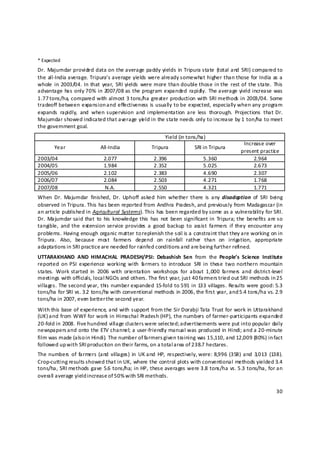
Dr. Barah offered data from four districts of Tamil Nadu (Coimbatore, Kanchipuram, Ramananthapuram, 
and Tanjore) comparing SRI vs. conventional methods. The data can be summarized as follows. Average 
yield increase using SRI methods was only 10% in this data set (5.65 vs. 5.12 tons/ha). However, farmer 
net income (gross income minus total costs) was 31% higher (Rs. 16,363 vs. 12,466). Barah’s data also 
showed a 29% reduction in water requirements (23.7 vs. 33.3 irrigations); labor inputs were 15% less 
(199  vs.  235  hours);  and  costs  of  production  were 17%  lower  (Rs.  15,400  vs.  18,400).  Another  slide 
showed a  41%  increase in  net  returns,  a more  inclusive  comparison  than net income  (Rs.  12,984  vs. 
9,263); and farmers’ cost  of  production  per  quintal  of  rice  produced was 29%  (Rs.  303  vs.  428).  Such 
figures help t o explain why SRI methods have been so rapidly accepted by many farmers in Tamil Nadu.      
Dr.  Barah  also  presented  figures  on  net  returns  in  the  four  Tamil  Nadu  districts  broken  down  by 
economic  status  of farmers.  An  analysis  of  these data  shows,  not surprisingly,  that  smaller  units  of 
production had higher returns per hectare. Such a pattern is common throughout the agriculture sector 
as smaller units of land are cultivated more intensively. However, the data als o showed SRI as giving the 
highest returns  to small and marginal  farmers,  supporting Dr.  Barah’s  characterization  of SRI as  ‘pro‐
poor.’ 


                                                                                                                 18 

 
Size o f farming operation                SRI (Rs.)           Conventional (Rs.)        SRI Advantage (%) 
Marginal farmers                           14,466                    8,174*                    76.9* 
Small farmers                              13,053                  10,100                      29.2 
Medium farmers                             12,345                    9,371                     31.7 
Large farmers                              11,030                    7,813                     41.2 
*  There  were  no  data  reporte d  from  Kanchipuram,  and  the  low  average  yield  (4,238)  reported  from  
Ramananthapuram suggests there we re some failures  of marginal farme rs’ conventional crops there. 
The next  presentation  was on  ‘Civil  Society  Involvement  in  SRI,’  presented by  Dr. C.  Shambu  Prasad, 
from the Xavier Institute of Management (XIMB) in Bhubaneswar. He started by emphasizing that non‐
government  organiz ations  (NGOs)  are  not a  homogeneous  lot,  varying  in size,  effectiveness,  origins, 
commitment,  etc.  They  operate at all levels,  from  grassroots  to  international,  and have many  kinds  of 
involvement in SRI: implementation, extension, training, resource centers, research, monitoring, policy 
advocacy,  etc.  The  category  also  includes  farmer  associations,  networks  of  many  sorts,  people’s 
movements, etc. 
This involvement is appropriate because SRI has civil ‐society origins, having been developed by a priest 
and initially promoted by an  indigenous  NGO in  Madagascar,  Association  Tefy  Saina.  It  has  since  been 
taken  up  most  often  by  NGOs,  universities,  and  community  organizations,  with  government  agencies 
coming into the SRI ‘a lliance’ relatively recently. SRI is knowledge‐intensive and entirely voluntary, so its 
promotion by civil society is more feasible than if large a mounts of capital were involved.  
An  analysis  of  the  membership  of the  SRI  Google‐group in India shows  that  60%  of its  membership  is 
from  civil‐society  organizatio ns  (CSOs)  broadly  defin ed,  and civil  society  has  given leadership  for SRI 
extension in West Bengal, Uttarakhand, Himachal Pradesh, Orissa, Bihar, Jharkhand, Karnataka, Assam, 
Madhya Pradesh and Andhra Pradesh. In Orissa, there are 23 organizations working in 46 blocks and 414 
villages to promote SRI, with over 5,000 farmers already involved in the SRI movement there. 
SRI expansion in India is now in what Dr. Shambu Prasad 
characterized as  a  Phase  2, where  civil society  is playing 
increasingly  diversif ed  and  creative  roles,  improving 
                      i
imple ments for SRI, extending the concepts and methods 
to other crops, adapting them to rain fed rice production, 
applying  SRI  to  traditional  varieties,  and  promoting 
organic  intensification  of  production,  also  supporting 
greater involvement  of  women, and  integrating  SRI into 
watershed  management,  natural  resource  management, 
and sustainable livelihoods. Various  institutional  models 
for  promotion  as  being  devised,  even  within  a  single 
NGO, e.g., PRADAN.  
Dr. Shambu Prasad described the emergence of an SRI people’s movement in Orissa, with rural people 
now  using  a  new  greeting  (“Jai  SRI”)  and  developing  songs,  poems,  dances,  etc.  to  cele brate  and 
publi cize the practices of SRI.  “Jai SRI” is a variation on the Indian Independence Movement salute: “ Jai 
Hind,’ and is a contraction for “Jaivik SRI” meaning ‘organic SRI.’  
Now  the  SRI  movement  in  India  seems to  be  entering  or will soon enter a  Phase 3, according  to Dr. 
Shambu. This in particular involves the challenges of scaling up. Civil‐society organizations will have to 
become  more  adept  at  working  with  government agencies,  research  institutions, and  private  sector, 
learning how to influence public policy and operate, often more indirectly, on a larger s cale.  
                                                                                                                19 

 
Special contributions that CSOs can make in the future may be to give attention and weight to cultural 
dimensions of SRI practice, while maintaining a vocal concern for equitable and sustainable outcomes. 
They can also help to document impacts, negative as well as positive, holistically, and to keep climate 
change issues on everyone’s agenda. A particular challenge will be for NGOs like IDE to work with the 
private s ector to improve the supply chain for SRI implements.  
In  conclusion,  SRI would  not  have  gotten  this  far, and  not so  quickly,  without  the involvement  of civil 
society actors, and SRI would be quite different qualitatively if its development and dissemination had 
been entirely in the hands of either the public or the private sector. The shape of SRI in the future will 
also b e determined at least in part by civil s ociety involvement. 
This presentation  was  followed  by an  NGO  contribution,  by  Mr.  A.  Ravindra,  Director  of  WASSAN, 
discussing  ‘Promotion  of  SRI  under  the  National  Food 
Security  Mission.’  NFSM  is a  large‐scale  Government  of 
India initiative that includes  SRI as  one  of  it s  rice‐sector 
components.  The  initial  target  was  to  extend  SRI 
practices  over 5  million  hectares  over a  five‐year  period 
(2007‐2012),  to  raise  rice  production  by  at  least  10 
million  tons.  But  Ravindra noted  that  the  Rs.  50  million 
($1 million) allocated for SRI demonstrations is less than 
2% of the NFSM funds allocated for the rice sector. While 
the  NFSM  documents say  that  farmer  field schools (FFS) 
will  be  used  to  spread  knowledge about  SRI,  relatively 
few resources a re earmarked for such activities.  
Most funding for SRI under NFSM thus far is allocated to subsidies for the distribution of implements. 
While  weeders and markers are indeed important for saving labor time and for getting best yield results 
with SRI, this approach reflects the government’s ‘input‐centric’ fixation in agricultural extension. That 
SRI  is  a  knowledge‐based  innovation  does  not seem  to have been well  comprehended.  SRI should  be 
promoted  in  different  ways  than  those  used  in  previous  extension  campaigns,  e.g.,  SRI  is  more 
effectively spread through farmer‐to‐farmer visitation, and with trained SRI farmers in ‘expert’ roles.  
A number of suggestions were made by Ravindra based on his analysis:  
– Membership  should  be provided  for  CSOs  on  national and state‐level  committees  that  plan and 
    oversee SRI campaigns, to incorporate their experience and perspectives.  
– State  or  Regional  Resource  Centers  for SRI  should  be  established,  following  the  precedent  of the 
    ‘learning alliance’ establi shed in Orissa, formally operating under the auspices of NFSM. 
– There should be p artnership of CSOs and farmer a ssociations with s tate‐level coordinating agencies. 
– Partnerships  were  recommended  with ATMA  at  the  dis trict  level,  involving  appropriate  financial 
    support t o CSOs. 
– Create  a  research  capacity  to  consolidate and advance SRI  knowledge and  practice  involving  KVKs 
    and various agricultural research institutions and state agricultural universities with s trong capacity.  
As  possible  ‘ways  ahead,’  Mr.  Ravin dra  suggested:  more  financial  outlays  to  support  SRI  extension 
activity;  redesign  of institutional  mechanisms  for  SRI  promotion such  as  under  NFSM;  geographically‐
focused  programs;  and  a  stronger  soil‐health  program  to  combat  decreasing  soil  fertility,  which 
currently dooms conventional agricultural development efforts. 
A presentation on ‘Promoting SRI in India: The Experience of the Sir Dorabji Tata Trust’ was made by Mr. 
Biswanath  Sinha,  SDTT  program  officer.  After  giving  background  on  the  Trust,  Biswanath projected a 
                                                                                                                20 

 
map of India, which s howed Human Development Index (HDI) scores by district across the country. This 
showed clearly that the greatest poverty and underdevelopment in India was evident in the eastern and 
some  northern states.  The  Trust accordingly is  focusing  its grants and support  in  these regions  of the 
country. It has also id entified SRI as o ne of the most potent and cost‐effective ways to counter poverty 
and food insecurity, starting t o fund the SRI work of five agencies promoting SRI in 2006.  
In January 2008, the Sir Dorabji Tata Trust made an allocation of Rs. 10.94 crores ($2.28 million) for a 
three‐year  program  supporting  SRI  work  in  eastern  and  northern  India .  The  strategy  has  four 
components: (a) reaching out to small and marginal farmers, (b) human resource development for SRI, 
particularly training master‐trainers,  (c)  awareness‐building  on  SRI,  (d) ensuring  cross‐learning among 
practitioners and SRI advocacy, and ( ) promoting innovation within SRI, e.g., applications to other crops 
                                     e
(Biswanath’s slide showed large panicles of finger millet).  
Currently,  there are 107 partner  organizations in  Uttarakhand,  Assam,  Bihar,  West  Bengal,  Jharkhand, 
Orissa,  Chhattisgarh  and  Madhya  Pradesh,  which  receive  some  SDTT  assistance  in  their  work  with 
30,198  small  farmers,  using SRI  on 6,635 acres  in  kharif season  2008.  Biswanath  noted that  the state 
governments  of  Orissa,  Uttarakhand  and  Assam  have  begun  ‘mainstreaming’  SRI  into  their  official 
agricultural programs. 
A table of results from Uttarakhand in the 2008 kharif season, with data from 6 taluks in Kumaon district 
and 7  taluks in Garhwal district, showed grain yields up 76% on average, and straw yields up 46% using 
SRI  methods.  Another  table  presenting  data  reported  by  five  NGOs  working  in  the  state  of  Assam 
showed  farmers  whose conventional  yields previously averaged  3.05  tons/ha  getting average  yields  of 
6.25 tons/ha when they used SRI. 
Major concerns of SDTT and partners included: weeders and markers need to be made more available; 
non‐availability of enough organic matter for fully organic production; in target areas, paddy cultivation 
is still  dependent on  rainfall ,  and  many areas  are  vulnerable  to  floods  (Assam,  Orissa)  or to  drought 
(northern  Jharkhand)  or  landslides  (Uttarakhand);  and  limited  labor  supply during the  peak period  of 
demand for labor during transplantation time.  
Future  plans included:  addressing  the  issue  of  marker and  weeder  supply;  dealing  with  the  issue  of 
organic  manure supply  and  soil  nutrient  supplementation; reaching  out to another  50,000 small and 
marginal farmers by next kharif season; initia ting SRI in 4 new states: Maharashtra, Manipur, Nagala nd 
and Meghalaya; and conducting soil nutrient studies in fields where SRI has been practiced over 5 years. 
SDTT  is  also  starting  a  complementary  initiative  on  ‘diversion‐based  irrigation’  (DBI)  to  introduce  or 
improve small‐scale  ystems, fed by s mall streams or rivers or by surface run‐off.  
                       s
In  his  presentation  on  ‘Farmer‐Level  Problems, 
Constraints and Innovations in SRI Cultivation’ Dr. T. M. 
Thiyagar ajan,  who  is  retired  from  the  TNAU  faculty, 
gave a review of technical issues with SRI. He has served 
as Head  of TNAU’s Rice  Research  Center at  Tirur  near 
Chennai; before that he was Dean of the TNAU campus 
at Killikulam, and before that Director of TNAU’s Center 
for  Crop  and  Soil  Management  Studies in  Coimbatore. 
He  has  recently  joined  the  WWF  program  as  a 
consultant  on  SRI,  having  been  the  first  Indian 
researcher to being working on this innovation as early 
as 2000.  
                                                                                                                21 

 
Dr. TMT focused on the four basic areas where SRI departs from standard rice‐growing practice: nursery 
management, transplanting, irrigation, and weeding.  In particular, his  presentation showed a number of 
nursery  and  weeder  innovations,  most  of  which  have  come  from  farmers  and  which  are  being 
documented and evaluated by the university and NGOs.  
Dr.  Aum  Sarma  spoke  briefly  about  ‘SRI  Farm  Implements  and  Machinery’  being  developed  at  the 
Agricultural Research  Institute  of  ANGRAU  in  Andhra Pradesh  for  use  with SRI.  He showed  pictures  of 
various markers and weeders, both manual a nd mechanical, which are being produced and sold by the 
Institute.  He  showed also a self‐propelled  (motorized)  four‐row  weeder,  which attracted considerable 
interest, although the present design is heavier and less ‘agile’ than desirable . Dr. Aum said t hat work is 
started on a paddy transplanter that can space 1‐2 s eedlings per hill, and work is continuing on a self‐
propelled weeder that can meet farmers’ specifications. [A farmer in Costa Rica has recently sent CIIFAD 
a report on a version of SRI that he has developed with mechanized transplanting, and with yields of 8 
tons/ha instead of 4.2 tons.] 
Dr. L.G. Giri Rao, Director of Extension at ANGRAU, in a presentation on “Andhra Pradesh: Initiatives for 
SRI  and  Lessons,”  reviewed  quickly  his  university’s  experience  extending  SRI  over  the  past  seven 
seasons,  dating  from  the  2003  kharif  season  when    his  predecessor,  Dr.  A.  Satyanarayana,  started 
evaluating and dissemination SRI in Andhra Pradesh s tate. ANGRAU staffs have engaged in many farmer 
workshops  and  scientific  meetings  to  promote  understanding  and  use  of  SRI  methods.  Dr.  Giri  Rao 
provided  data  from 1,043  on‐farm trials,  which  showed  a yield advantage  of  35%  (7.538 tons/ha  vs. 
5.733  tons/ha).  In addition to  higher  yield, crop maturity  was  advanced  by 7‐10  days,  which  is a real 
benefit to farmers.  
Dr. Giri Rao reviewed reasons why some farmers are still 
finding adoption of SRI methods difficult. Some complain 
about the ‘drudgery’ involved in SRI n ursery management 
and  transplanting  young  seedlings  (even  though  the 
number  of  seedlings  is  reduced  by  80‐90%),  using  a 
marker, and  manual  cono  weeding.  Weed management 
in SRI fields i s also considered difficult (a common view). 
Lack of standardized protocol means that different actors 
practice  SRI  differently  (although  many  see  this  as 
positive rather than negative). “Most of the farmers feel 
that  SRI  is  a  labor‐intensive  technology,”Dr.  Giri  Rao 
reported  (although  information  given  by  f rmers  from 
                                                  a
other states a nd data from Tamil Nadu reported by Dr. Barah earlier in the day showed SRI to be labor‐
saving). Because of these constraints, many farmers d iscontin ue SRI during their 2 nd year, he said. There 
is also a lack of skilled force available for transplanting and cono weeding.  
Dr.  Giri  Rao noted  that  SRI has the advantages  of cost‐effectiveness and  increased  yield  per  unit area 
over  conventional  paddy  cultivation.  He  urged  that extension,  research  and  policy  support  for  SRI  be 
given immediate attention. For scalin g up SRI, a stronger research data base on SRI is needed, he said, 
also large‐scale demonstrations, multi‐location trials, motorized cono weeders, and skill upgrading of SRI 
partners, including laborers. In conclusion, he noted that a seed rate of 5 kg/ha is quite sufficient and 
could save 400,000 tons of rice in Andhra Pradesh alone, worth about Rs. 300 crores. It was also now 
clear that  young seedlings  can  give more  yield,  and  that  a single seeding  per  hill is   enough  to  obtain 
good yields. Further, rice can be cultivated successfully with a lesser amount o f water than is now used. 

                                                                                                                22 

 
When Dr. Giri Rao finished, t he floor was open for questions and comments. Unfortunately, there was 
no  opportunity  to  discuss  and  reconcile  the  views  that  he  had  expressed  which  were  at  variance  with 
what  a  number  of  other  speakers  had  previously  reported.  Quite  a  diverse  set  of  comments  were 
elicited  by  the  afternoon’s  presentations  and  the  discussions  went  on  until  7, at  which  time  the 
Symposium adjourned  for  a  cultural  event of  modern  music  and  dance,  followed by  a  dinner  for  all 
participants. 


                                                                                                                23 

 
3. DAY 2: Parallel Sessions  
Next morning, the Symposium reconvened at 8 am, with participants meeting in one of four Technical 
sessions: 
(a)     Technical session  IIIa:  Research  Studies  especially with  respect  to  planting practice; agronomy 
         and chemical usage; 
(b)     Technical  session  IIIb:  Extension,  Tools  and  Constraints  in  terms  of  on‐farm  practices  and 
         technology  transfer  (including  the  need  or  otherwise  of subsidies);  adoption  by  indigenous 
         minorities; a nd the o ngoing mechanization c hallenge; 
(c)     Technical  session  IIIc:  Economic  Impact  Assessment  and  Market  including  the  differential 
         economic  efficiency  of  SRI  compared  with  tradition  production  practices;  commercial 
         opportunitie s  for  SRI  farmers;  the  role  of  banks  in  promoting  the  method;  and  potential 
         benefits that could a ccrue to social n etworking and    

(d)     Technical session IIId:  Institutional and Polic y  Issues  including a review  of local  successes; the 
         need  for  new arrangements that  unite  Government  and  other institutions; the challenges  of 
         taking  SRI  to  scale in  mountain areas;  possible communal  operations such  as  nurseries; the 
         potential  contribution  of  farmer  field  schools;  the need  for  incentives;  inadequate  machinery 
         (yet again!); and how to re‐attract “dis‐adopters”. 
The four parallel s essions was followed by a plenary session under Technical session III e. 

This Plenary  Session  was  chaired  by  Dr.  G.S.G.  Ayyangar,  IAS,  Joint  Secretary  and Advisor,  Ministry  of 
Home  Affairs  (Disaster  Management),  Govt.  of  India,  New  Delhi.  Dr.  Ayyangar  in  his  introductory 
remarks shared with the delegates his views and experiences with SRI in Tripura where he worked and 
was involved  in  the promotion  of  SRI among the  farmers of  that  State.   He  stated that although  he  is 
convinced of the advantages and benefits that would accrue to the farmers from the SRI method, SRI, he 
concluded, cannot be spread to every rice‐growing area in the country within economically viable costs 
due to certain obvious reasons. In this session, the Rapporteurs summed the gist of the presentations, 
discussions and conclusions of the previous four sessions which have been explained b elow: 


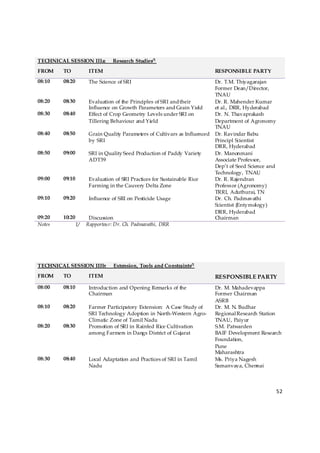
3.1: Technical Session IIIa: Research Studies 
This session chaired by Dr. T.M. Thiyagarajan, formerly Dean at the TNAU, had six paper presentations 
on: i) Evaluation of Principles of SRI and their Influence on Growth Parameters and Grain Yield of Rice 
by Principal Sscientist Dr. R. Mahender Kumar from DRR; ii) Effect of Crop Geometry Levels under SRI 
on  Tillering Behaviour  and Yield  of  Rice by  Dr.  N. Thavaprakash  from  Dept.  of  Agronomy,  TNAU;  iii) 
Grain Quality Parameters of Cultivars as Influenced by SRI in Rice by Principal Scientist Dr. N. Ravindra 
Babu from DRR; iv) System of Rice Intensification in Quality Seed Production of Paddy Variety ADT 39 
by  Dr.  Manonmani, Associate  Prof, Dept.  of  Seed  Science  and  Technology, TNAU;  v)  Evaluation  of SRI 
Practices  for  Sustainable  Rice  Farming  within  Cauvery  Delta  Zone  by  Dr.  R.  Rajendran,  Prof. 
(Agronomy), TRRI; and vi) Influence of SRI on Pesticide Usage in Rice by Dr. Ch. Padmavathi, Scientist 
(Entomology), DRR.  

                                                                                                                24 

 
           The conclusions of IIIa s ession a re: 
           i)     Integrated  Nutrient  Management was  found to  be  better and more appropriate  for  SRI 
                  rice production. 
           ii)    Crop  under  SRI  practice  was  found  to  be  greener  than  under  conventional  system, 
                  indicative of greater photosynthesis. 
           iii)   Tillering  was  found  to  initiate  around  15 th   day  after  planting  and  peak  tillering  was 
                  observed around 30 DAP. 
           iv)    Third‐leaf stage s eedlings were found to be better for transplanting.  
           v)     Leaf folder incidence was found to be heavier in  SRI rice. 
           vi)    SRI rice in kharif season performed well and recorded higher grain and straw yields than 
                  under r abi season. 
           vii)   There is need for conducting more detailed studies on profuse tillering, nutrient removal 
                  by the crop, appropriate water management, influence of wider spacing, and physiological 
                  aspects like shortening of crop duration for proper s cali ng up of SRI in the coming years. 
           viii) Difficulties in transplanting very young seedlings and intercultivation (weeding) operation 
                 was reported as most li miting factors of SRI. 


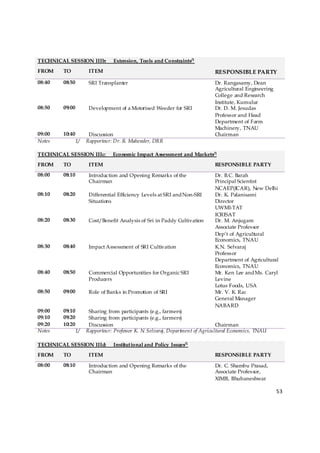
3.2: Technical Session IIIb: Extension, Tools and Constraints  
Dr. M. Mahadevappa, former Chairman with ASRB under ICAR, chaired this session in which four papers 
were presented  on: i)  Farmer‐Participatory  Extension:    A  Case  Study  of  SRI  Technology  Adoption  in 
North‐Western Agro‐climatic  Zone of Tamil Nadu  by Dr. M. N. Budhar of the Regional Research Station 
of TNAU; ii) Promotion of SRI in Rain‐fed Rice Cultivation among Farmers in Dangs District of Gujarat  
by S.M. Batwardan from the BAIF Development Research Foundation, Pune in the state of Maharashtra; 
iii)  SRI  Transplanter  by  Dr.  Rangasamy,  Dean  of  the  Agricultural  Engineering  College  and  Research 
Institue  (AEC  &  RI) in  Kumulur,  Trichy  district  of  Tamil  Nadu;  and  iv)  Development  of  a  Motorized 
Weeder for SRI by Dr. D. Manohar Jesudas, Prof. and Head of Dept. of Farm Machinery of the AEC & RI 
of TNAU in Coimbatore.  
           The conclusions of the papers presented in this s ession were: 
    i)     Increase in rice yield by 1 t / h a was recorded in SRI fields in Dharmapuri / Krishnagiri districts. 
    ii)    Difficulties in raising mat nursery, using markers and cono weeders were some of the expressed 
           constraints in adopting SRI. 
    iii)   Local  and  improved  varieties  and  hybrids  were  found  to  be  suitable  for  SRI  cultivation, and 
           average grain yields of 53.7 q / ha (5.35 tons/ha) were recorded under SRI compared to 29.5 q / 
           ha (2.95 tons/ha) under conventional cultivation in Maharashtra. 
    iv)    A motorised weeder to cover 2 to 3 rows is under successful experim entation at the TNAU and 
           would be released for use by farmers shortly.  It would cost a round Rs. 40,000 / unit and would 
           be suitable for use under different soil conditions.  It could be used to cover 1 ha / day with 2 
           labourers. 


                                                                                                                   25 

 
v)    Development of modified transplanter with adjustments to transplant 1 to 2 seedlings / hill in 
          several rows at a  time must be developed a s early as possible. 
    vi)   It was suggested to organize SRI exhibitions at village stations and to give daily briefings on SRI 
          through TV and CDs on SRI for reaching individual farmers. 
    vii) The cost of cultivation could b e reduced by 20 ‐ 30% b y adopting SRI method of rice farming 
    viii) Sarah  E.J.  Beebout, soil chemist  from  IRRI,  opined  that  farmer‐to‐farmer  extension works, and 
          NGOs could play key roles in e xtension activities of SRI promotion. 
        The Chairman of this session in his concluding remarks stated that in future, machinery would 
play greater roles for the success of SRI, and so cost‐effective machineries must be developed to carry 
out the different operations a t critical stages of crop growth. 


3.3: Technical Session IIIc: Economic Impact Assessment and Markets  
This s ession chaired by Dr. B.C. Barah, Principal Scientist of NCAEP of ICAR in New Delhi, had five papers 
on  i)  Differential  Efficiency  Levels  at  SRI  and  Non‐SRI  situations  by  Dr.  K.  Palanisami,  Director  of 
International Water Management Institute (IWMI) – TATA program at ICRISAT); ii) Impact Assessment of 
SRI Cultivation by Prof. K.N. Selvaraj of TNAU;  iv) Commercial Opportunities for Organic SRI Producers 
by Ken Lee from Lotus Foods of U.S.A.; and v) Role of Banks in Promotion of SRI  by V.K. Rao, General 
Manager of NABARD.  
The following salient conclusions were drawn after discussion on the papers presented in this session: 
          i)      It  was  stressed  to  develop  some  common  methodology  to  measure  the  economic 
                  impact of SRI on the farming community a t macro level, not just a t on‐farm level.  
          ii)     Packages of SRI practices must be perfected t o scale u p SRI suitably. 
          iii)                              ed and quantified using e conomic tools. 
                  Water saving must be analyz
          iv)     Indirect benefits like improvement in grain quality must be measured a lso. 
          v)      Higher prices were demanded for organic SRI rice products. 


3.4: Technical Session IIId: Institutional and Policy Issues  
Dr.  Shambu Prasad from  XIMB,  Bhubaneswar,  chaired this session in  which  the  six  papers  presented 
were:  i)  Popularisation  of  SRI  Cultivation  through  IAMWARM  Project  by  Dr.  M.V.  Rangaswamy, 
Director,  WTC  of  TNAU;  ii) Scaling  up  SRI:  TRIAD  Initiatives  Hold  the  Key  to  its  Success  by  Dr. 
                                
Nabarunsen Gupta, Culcutta  University;  iii) Scaling Up  of  SRI  through  Farmer  Field  Schools:  AMEF’s 
Experience  in  Tamil  Nadu  by  K.  Gandhimathi,  AMEF,  Dharmapuri;  iv)  Role  of  Government  and 
Panchayat  Raj  Institutions  in  Large‐Scale Adoption  of  SRI  in  Tripura  by Dr.  Baharul  Islam Majumdar, 
Dept.  of  Agriculture,  Tripura;  v)  Food  Security  and  SRI  :  A  Reflective  Note  based  on  PRADAN’s 
Experience in  Eastern  India by  Dinabandhu  Karmakar, PRADAN  in the  Purulia  district  of  West  Bengal; 
and vi) PSI Experience in Northern India by Debasish Sen from People’s Science Institute in Dehradun. 
Main points of  the papers  presented  in  this  session have  been summarized by  Dr.  Norman  Uphoff  as 
follows.   

                                                                                                                26 

 
TAMIL NADU/TNAU‐IAMWARM: The director of the Water Technology Center (WTC) of TNAU, Dr. M. 
V. Rangaswamy, reported on SRI experience under this World Bank‐funded project for himself and B.J. 
Pandian, head of the IAMWARM cell within the WTC. This project to modernize irrigation on >600,000 
ha within 63 sub‐basins, has a budget of Rs. 25 billion and includes plans to introduce SRI management 
on  250,000  ha.  TNAU  is  one  of  the  imple menting  partners  and  is  responsible  for  SRI  extension. 
Rangaswamy  said that maximum  SRI  yields of  14.2‐15.4  tons/ha  have  been achieved already.  Average 
yields in the area are 4.465 kg/ha. With SRI practices, not all being used or used as advised, nearly 25% 
of  farmers  have  gotten  a  20‐30%  increase  (to  5,300‐5,800  kg/ha),  while  21%  have  gotten  30‐40% 
increases (to 5,800‐6,250 kg/ha). Ten percent have gotten even larger increases.  
The conclusion to their written paper was: “The overall response to [SRI] from farmers in the sub‐basins 
is exceptional and  encouraging.  Thus,  SRI  has rejuvenated the declining interest in  rice  cultivation to 
many  rice  growers. With  the  positive  results  coming  from the various sub‐basins, it  is  time  for  us to 
channelize our efforts to achieve greater water productivity as well as grain productivity and a lso to take 
part in a second Green Revolu tion.” 
EASTERN  INDIA/TRIAD:  A  senior  faculty  member  from  Calcutta  University,  Dr.  Nabarun Sen  Gupta, 
reported  on a  private  sector approach  to  SRI  dissemination, through a company  called  Triad  Servic es, 
which is affiliated with the consulting firm BASIX. The program started with 33 farmers at Berhampur in 
Orissa in 2006/07, and 48 farmers at Srikakulam in AP in 2007/08, but it has expanded greatly this year. 
The program started with a grant of Rs. 200,000 for this action research. All varieties were found to give 
higher yields with SRI methods, 75% o n average in Berhampur, and 30% on average in Srikakulam. There 
was also an increase of 49‐75% in straw yield. BASIX figured out that a self‐sustaining program could be 
operated to spread SRI if participating small a nd marginal farmers paid a service fee of Rs. 300 (plus Rs. 
40 tax) for technical training and support. Farmers with successful use of SRI methods could recover this 
amount (about US$7.50) several times over.   
With 1,067 farmers enrolled i n 2008/09 in the s tates of Andhra Pradesh and Orissa, this fee is generating 
Rs. 382,000, which can cover the program’s costs of operation. Triad is not ‘cherry‐picking’ by working 
with larger farmers. In fact, it is working in areas of poverty. This year’s program also includes 970 small 
and marginal  farmers  in  Bihar and  1,050 such  farmers  in  Jharkhand.  TRIAD  provides  one  technician to 
service 400 farmers, being available at all critical periods of the crop cycle.  
Transplanting very young seedlings has been difficult  because of the unreliability of the monsoon rains. 
(TRIAD  is  working  with  rainfed  farmers.)  Mostly the seedlings  used have  been 18‐20  days, with  only a 
few able to plant 14‐15 day seedlings, as recommended. Als o, many find alternate wetting and drying 
difficult,  bein g  afraid  of  monsoon irregularity.  But  most  are  doing  2‐3  weedings  as  recommended. 
Farmers have seen the value of 1 seedling per hill which gave 490 tillers/hill vs. 400 or fewer when 2, 3, 
4 or 5 seedlings/hill were planted). Also it was seen that both grain a nd straw yield are higher with use 
of younger seedlings.  
Farmers assisted  by  TRIAD find  that  their SRI  paddy  receives a  better  price  because  of  higher  grain 
quality,  and they are starting  to  engage  in  collective  marketing, as  this  gives  them some  bargaining 
power  and cuts their costs  of marketing.  Getting  participating  farmers  organized  into collective‐action 
groups has become part of the TRIAD strategy. This private‐ ector initiative for SRI was somewhat of a 
                                                                 s
contrast to  most  of the  other presentations in  the parallel session,  which  came  from  NGOs  or  from a 
university or a state government. 
WEST BENGAL/PRADAN: Dinabandhu Karmarkar reported on the SRI experience of PRADAN, the NGO 
that he works with in Purulia district of West Bengal.  The communities with which P RADAN is engaged 
                                                                                                             27 

 
there have very poor soil resources and unreliable rainfall. There is crop failure in one out of every three 
years.  PRADAN  began its  own efforts  at  ‘rice  intensification’  in 2001  with younger seedlings  (25 days 
instead of much older), and 2‐3 seedlings per hill (instead of 7‐8). It e ncouraged greater use of chemical 
fertilizers as this was thought to be necessary given the soil quality, although it did try to get farmers to 
grow  legume  crops as  green  manures.  There  were,  however,  diffic ulties  in   getting  improved‐variety 
seeds  into  farmers’ hands, and  getting  them  the  right  doses  of  chemical  fertilizers.  Because  of  the 
unreliable monsoon,  farmers  often had to  plant  seedlings  that  were ‘too  old,’ but the  cost  of seed to 
grow large additional nurserie s was a deterrent. 
In December 2002, Dinabandhu met with Prof. Uphoff in Delhi and learned the details of SRI practice. 
Only four farmers in Purulia would try the new methods in 2003, but the results were good, and next 
year,  150 households began  using  SRI,  and PRADAN started  trying out the methods in  other  poverty‐
constrained d istricts in other states of eastern India. There were about 2,000 farmers using SRI methods 
in 2005, and 6,200 (with 632 hectares of SRI) in 2006. Last year, there were 10,400 farmers practicing 
SRI on 1,080 hectares. This year, the n umber is about 20,000. 
Primary  reasons  for  spread  were  (1)  Lower  seed  rate,  which  permitted  farmers  to  plant  additional 
nurseries, with little seed required, to have alternative nurseries to use for having young seedlings if the 
monsoon rain s are delayed; (2) Shorter time for nurseries, so that farmer can start them even as late as 
the middle  of  August if  the monsoon arrives  very  late;  (3) Extra root  growth,  which  enables  plants to 
exploit soil  moisture at  low  depths  during dry  spells; and (4)  Higher  yield,  which  can  help  marginal 
households, with  an average  holding  of  1  acre  (0.4 ha),  to attain  food security.  Yields  have  average  7 
tons/ha  even  without  irrigation,  and  a  few  yields  have  reached  12  to  14  tons  (one  even  15  tons 
measured  by an  IWMI  evaluation  team in 2004). In  Orissa, the  SRI yields have averaged  3.7 5  tons/ha, 
not 7.5 t/ha as in Purulia, but even that represents about a  doubling of current paddy yields 
Constraints to expansion which Dinabandhu reported were: (1) No possibilitie s for recommended water 
management  (alternate  wetting  and  drying)  for  lack  of  irrigation  facilities;  SRI  has  had  to  be 
reformulated for rainfed production; (2) Prolonged deep water during the monsoon damages rice‐plant 
roots,  so  farmers  have  to be  persuaded  not  to  horde  rain  water  in  their  fields;  (3)  Some  farmers 
adopting  wider spacing    (30  cm)  have  had low  tillering  due  to  soil  or  weather  conditions;  (4)  Other 
farmers  have  gone  for single‐seedling transplantation,  but  with  closer  spacing  than  recommended (15 
cm);  (5)  Many  farmers  failed  to  transplant at 12 days due to unavailability  of  rainfall and reverted to 
older seedlings; (6) Some farmers who have used the methods for several years have reported reduction 
in  yie lds  now,  indicating a need  to make  greater efforts  to collect and apply  more  organic matter  for 
these plots. 
This year in Purulia, the average SRI yield was lower because many farmers have modified SRI to such an 
extent  that it  does not  meet  SRI  expectations and  produce  the  expected yields.  This  can  undermine 
farmers’  interest  in  the  new  methods.  There  have  been  large  drop‐outs  in  one  particular  blo ck 
(Barabazar), with only 87 SRI users this year compared to 600 last year. In Gaya district (Bihar), 25% of 
the 4,352 families practicing SRI this year lost most of their crop due to drought, while the other 75% 
had to  make  great  efforts  to  pull their  crop  through  the season.  However,  we  noted  that  non‐SRI 
farmers in the area suffered even greater losses due to the adverse weather. Further modifications of 
SRI methods to succeed in these climate‐ and s oil‐limited conditions w ill need to be made. 
TAMIL  NADU/AME:  The  Agriculture‐Man‐Ecology  Foundation  based  in  Bangalore,  with  branches  in 
several  South  Indian state, made a report  on ‘Scaling  Up  of  SRI  through  Farmer  Field  Schools:  AMEF’s 
Experience in Tamilnadu,’ reported by Smt. K. Gandhimadhi. She said farmer‐volunteers for this effort 

                                                                                                               28 

 
were recruited through the 450 self‐help groups (SHGs) with which AME’s local NGO partner known as 
BEST was already working.  
Each  NGO  staff  member  worked  wit h  three  ‘farmer‐volunteers,’  who  were  given  15  days of  training. 
Each  farmer‐volunteer  then  worked  with  10  villages,  so  that there  were  30  villages  reached  per staff 
member.  Since  the Farmer Field  Schools  established  in  each  village  each  had  20 farmer  participants, 
there  were  600  farmers  (53.5%  of  them  women)  connected  indirectly  to  each  BEST  staff  member. 
Attendance in the Schools was 85%, and field days at the end of the FFS were very popular. 
In the Pudukkottai area where Ms. Gandhimadhi works, 105 farmers used SRI methods on 88 acres (35.2 
ha) this past season, using single seedlings 11 to 22 days old (not all planted young seedlings), following 
the ecological principles of cultivation presented in LEISA magazine. Farmers found collective nurseries 
practical, given the small number of seedlings involved, and they put bird perches up in their fields to 
attract birds that would feed on insects.  
The yield that Ms. Gandhimadhi reported, 12.25 t/ha, sounded too high for a n average. However, some 
SRI  plants  had  up  to  95  tillers, she said,  with 72  fertile tillers,  numbers  for  which there are  certainly 
precedents. Farmers’  costs of  production  were  reduced  by  55%, she  reported,  contributing  to  higher 
farmer net income.  
All farmers are persuaded now that they can get higher yields with younger seedlings, she concluded. It 
was interesting to see the contrasts between AME’s approach and the earlier TRIAD report. Each had a 
different  kind of  institutional  mode  –  NGO vs.  private sector  –  but  the same  goal: to  multiply  SRI use 
rapidly a nd at low cost. AMEF’s SRI project is supported by ICRISAT‐WWF. 
TRIPURA/DEPT.  OF  AGRICULTURE:  Dr.  Baharul  Majumdar, a senior  agronomist  in the  DOA  in  Tripura 
state, reported on ‘The Role of Government and Panchayati Raj Institutions in Large‐Scale Adoption of 
SRI,’ in which he has played an instrumental role. He noted that the state government had pledged in its 
2001‐2010 plans for Tripura development to achieve self‐sufficiency in food grains and thereby improve 
farmers’ economic condition by the end of the plan period. However, by 2005, halfway through the plan 
period, not much progress was made toward these goals. 
Dr. Majumdar began experimenting personally with SRI methods in 2000, and by 2002/03 he began on‐
farm trials, with 44 farmers, on just 0.2 ha (0.5 acre) each, only 8.8 ha in total. From this small beginning, 
next  year  he  got  88  farmers  to  try  the  methods, and in  2004/05,  there  were  440  farmers  using  SRI 
techniques on 0.4 ha (1 acre) each. This was again doubled to 880 farmers in 2005/06, for an area of 352 
hectares.  
At this point Dr. Majumdar was able to get the state government to give SRI its full backing, despite Dr. 
Majumdar described as “criticism, resistance, and opposition.” He showed pictures of the Secretary of 
Agriculture in an SRI field, talking with farmers, and of Dr. M.S. Swaminathan.  
One‐third  of  the state’s  agriculture budget was allocated  to  SRI  promotion;  with a threat to stop the 
salaries  of  any  officials  who  did  not  cooperate  (this  sanction  was invoked  for  10‐15  personnel). The 
growth of SRI use is shown in the table below, from Dr. Majumdar’s presentation: 
                                   No. of farmers             Area under SRI (ha)          % of rice‐growing area 
2005/06                                      880                          352                         0.14 
2006/07                                73,300                        14,678                           6.23 
2007/08                              162,485                         32,457                         13.77 
2008/09                              250,000*                      50,000*                          21.23 

                                                                                                                  29 

 
* Expected 
Dr.  Majumdar  provided data  on  the average  paddy yields  in  Tripura state  (total and  SRI) compared to 
the all‐India average. Tripura’s average yields were already somewhat higher than those for India as a 
whole  in  2003/04. In  that  year,  SRI yields  were more  than double those  in the  rest  of  the state.  This 
advantage  has  only 70%  in  2007/08  as the program  expanded  rapidly.  The average  yield increase was 
1.77 tons/ha, compared with almost 3 tons/ha greater production with SRI methods in 2003/04. Some 
tradeoff between expansion and effectiveness is usually to be expected, especially when any program 
expands  rapidly,  and  when  supervision  and  implementation  are  less  thorough.  Projections  that  Dr. 
Majumdar showed indicated that average yie ld in the state needs only to increase by 1 ton/ha to meet 
the government goal. 
                                                           Yield (in tons/ha) 
                                                                                               Increase over 
       Year                  All‐India              Tripura             SRI in Tripura 
                                                                                              present practic e 
2003/04                       2.077                  2.396                  5.360                  2.964 
2004/05                       1.984                  2.352                  5.025                  2.673 
2005/06                       2.102                  2.383                  4.690                  2.307 
2006/07                       2.084                  2.503                  4.271                  1.768 
2007/08                       N.A.                   2.550                  4.321                  1.771 
When  Dr.  Majumdar  finished,  Dr.  Uphoff  asked  him  whether  there  is  any  disadoption  of  SRI  being 
observed in Tripura. This has been reported from Andhra Pradesh, and previously from Madagascar (in 
an article published in Agricultural Systems). This has been regarded by some as a vulnerability for SRI. 
Dr.  Majumdar said that  to  his  knowledge this  has  not  been significant in  Tripura; the  benefits  are so 
tangible,  and  the  extension  service  provides  a  good  backup  to  assist  farmers  if  they  encounter any 
problems. Having enough organic matter to replenish the soil is a constraint that they are working on in 
Tripura.  Also,  because  most  farmers  depend  on  rainfall  rather  than  on  irrigation,  appropriate 
adaptations i n SRI practice are needed for rainfed conditions and are being further refined.  
UTTARAKHAND  AND  HIMACHAL  PRADESH/PSI:  Debashish  Sen  from  the  People’s  Science  Institute 
reported  on  PSI  experience  working  with  f rmers  to  introduce  SRI  in  these  two  northern  mountain 
                                                a
states.  Work  started  in  2006  with  orientation  workshops  for  about  1,000  farmers  and  district‐level 
meetings with officials, local NGOs and others. The first year, just 40 farmers tried out SRI methods in 25 
villages. The second year, this number expanded 15‐fold to 591 in 133 villages. Results were good: 5.3 
tons/ha for SRI vs. 3.2  tons/ha with conventional methods in 2006, the first year, and 5.4 tons/ha vs. 2.9 
tons/ha in 2007, even better the second year.  
With this base of experience, and with support from the Sir Dorabji Tata Trust for work in Uttarakhand 
(UK) and from WWF for work in Himachal Pradesh (HP), the numbers of farmer‐participants expanded 
20‐fold in 2008. Five hundred village clusters were selected; advertisements were put into popular daily 
newspapers a nd onto the ETV channel; a user‐friendly manual was produced in Hindi; and a 20‐minute 
film was made (also in Hindi). The number of farmers given training was 15,110, and 12,009 (80%) in fact 
followed up w ith SRI production on their farms, on a t otal a rea of 238.7 hectares. 
The numbers  of  farmers  (and  villages)  in  UK and  HP,  respectively, were: 8,996  (358)  and  3,013  (138). 
Crop‐cutting results s howed that in UK, where the control plots with conventional methods yielded 3.4 
tons/ha, SRI methods gave 5.6 tons/ha; in HP, these averages were 3.8 tons/ha vs. 5.3 tons/ha, for an 
overall average yield increase of 50% with SRI methods. 

                                                                                                              30 

 
Of  much  interest  to everyone  was  Debashish’s  report  on  farmer  experimentation with  applications  of 
SRI  concepts  and  methods  to  other  crops:  wheat;  mandwa,  a  small‐grained  millet  native  to  the 
Himalayan region; and rajma (kidney beans). The average increase in yield across seven trials was 57%. 
Debashish  presented  benefit‐cost analysis  for  different  kinds  of  cultivation and  crops,  which showed 
very substantial net profits (Rs./ha) that could be gained from changes in cultivation methods because 
of a combination of both increased yield and reduced costs of production. 
                                                       Conventional practice           SRI/SWI practice 
    Transplanting – local paddy variety                        8,450                        32,245 
    Transplanting – Basmati p addy variety                   35,125                         71,375 
    Direct sowing ‐ wheat                                      7,880                        25,270 
The most interesting  data  reported from  PSI  was  the  relatio nship  between  yield and  both  the age  of 
seedlings  and  the  number of  weedings, something  we  have seen in  factorial  trials.  This information 
came from a variety o f on‐farm experiences across the two s tates: 
      Age of seedlings            Yield (tons/ha)           Number of weedings             Yield (tons/ha) 
         >23 days                     4.0‐4.5                     One                          5.0‐5.5 
        16‐23 days                    5.5‐6.0                     Two                          6.0‐6.5 
        10‐15 days                    7.0‐7.5                    Three                         7.0‐7.5 
Because ambient temperatures in UK and HP are colder, given the higher elevations, the seedling age at 
which the fourth phyllochron begins is later by several days than for rice cultivation in the tropics a nd 
even  most  temperate areas.  Even  so,  we see  that  the advic e  to transplant  by  the 15 th  day and  to  do 
more than two mechanical weedings, to aerate the soil as well as control weeds, holds up in northern 
India. 
Debashish  reported on  the institutional  networking  that  PSI  has  done  to introduce  SRI  in  these  two 
states; cooperating  institutions  include  Vivekananda  Parvatiya  Krishi  Anushandhan  Sansthan  (VPKAS), 
Almora,  UK;  G.B.  Pant  University  of  Agriculture and  Technology,  Pantnagar,  UK;  the  Rice and  Wheat 
Research Centre, Malan, HP;  and the CSKHP Agriculture University, Kangra, HP. Provision has been made 
for  program  monitoring,  with  state‐level  panels  (Programme  Monitoring  Committees,  PMCs)  of 
experienced  persons  includin g  experts,  government  officials, scientists,  etc.  The  PMCs  work  through 
field  visits as  well  as  holding  meetings  with the  programme staff.  Programme  feedback is provided to 
top  government  officials  like  the  Chief  Secretary,  Agriculture  Secretary,  Rural  Development 
Commissioner, a nd Agriculture Directorate. 
Policy  advocacy  is  pursued  through  linkages  with  the  Agriculture  Department,  and  coordination  is 
sought with the national extension program (ATMA) which operates at district level,  with development 
projects, state agricultural universities, KVKs (extension centers) and other institutions. These efforts are 
reinforced  by  media  advocacy,  popularizing  SRI  through  newsletters,  local  newspapers,  magazines, 
national  journals,  radio,  TV, etc. and  also  by  state‐le vel  workshops with officials,  farmers, researchers 
and NGOs. 
Farmers  have  drawn  the  following conclusions  about  SRI  based  on  their experience  in  HP  and  UK, 
according  to  PSI:  Benefits:   Less seed  requirement; Saving  in  water;  Decreased  workload; Less  disease 
occurrence;  Less  lodging;  Higher  grain  yields;  Higher  grain  qualit y;  Increased  biomass  for  fodder; 
Improves soil  fertility.  Constraints:   Time‐bound  operations; Labor‐intensive  (this  seems at odds  with 
‘decreased workload’ as a benefit); Limited accessibil ity to weeders and markers; Limited accessibility to 


                                                                                                               31 

 
manure;  More  effort  required  to  operate  the  Mandava  weeder  for  small  terraces  and  clay  soils; 
Frequent unavailabili ty of water under rainfed conditions, especially a fter the milk‐rice stage. 
Concerns  that  Debashish  listed  were:  Lack of  adequate,  trained,  and  committed  master‐trainers  for 
capacity‐building  and  field  support activities;  Inadequacy  of  one‐time  training  (continued  and  timely 
field support is required); Selection of villages should be purposive as villages are scattered, and working 
with  them  is  difficult;  Rain fall  irregularity  (during  transplanting  and  drainage  periods)  presents 
continuing  problems;  Timely  availability  of  quality  equipment  is  needed  (weak  supply  chain)  and 
inadequate composting  material;  Limited  adoption,  conditioned  by  the  predominance  of small  plots, 
and poor quality land; Variability in adoption of practices (seedling age and spacing, water management, 
use  of  organic  nutrients  and  weeders).  These  things  can  be  addressed  but  require  innovation  and 
persistence. 
Areas  for  improvement  that  he  identified in  conclusion  were:  Improvements  in  the  recommended 
package  of  practices  (water,  nutrient,  and  labour,  management,  cost‐effective  equipment,  etc.); 
Capacity‐building strategy (e.g., village‐level resource persons and regular quality training); Research on 
other crops, on disease‐resistant and high‐tillering varieties, better equipment, etc.; Networking among 
stakeholders  (farmers,  CSOs,  government,  research  institutions, agriculture  universities,  media,  etc.);    
Policy framework (incentives, a ssured irrigatio n, outlets for equipment, market opportunities, etc.).  
Debashish’s c oncluding statement was: Farmers should be provided flexibility for adoption of different 
principles  under  SRI.  This  was  discussed  and  agreed,  that  SRI  should  never  be  pressed as  a  single 
package, but rather the reasons for the recommendations should be explained to farmers so that they 
can understand what a re the likely benefits from making certain changes in their practices.   
Summation points: 
i)      Networking among the stakeholders must be formed and/or s trengthened. 
ii)     Farmers s hould be given flexibility in adopting the SRI practices. 
iii)    Reasons for d rop‐outs from SRI cultivation must be analyzed, and effective steps like counseling 
        should be taken to prevent and/or bring back the drop‐outs. 
iv)     Raisin g community nurseries a s under TN IAMWARM Project s hould be encouraged. 
v)      Monitoring teams as under TN IAMWARM project should be established. 
vi)     Participatory SRI movement is to be promoted. 
vii)    As many Master Trainers as possible m ust be trained 
viii)   In  command areas  where  farmers  do not  have  control  over  water release, suitable  strategies 
        must be worked out t o manage SRI under such situations. 
ix)     Proper nutrient management has had little attention so far, simply recommending application of 
        as much organic matter as possible; more evaluation and mobilization of organic matter should 
        be provided for to ensure maximizing productivity a nd sustainability under SRI. 
x)      In water management, possibilities to adopt m icro‐irrigation s hould be pursued. 
xi)     Overall, s oil health must be attended to, improved a nd sustained. 
xii)    Strict protocol need to be adopted for organic SRI wherever practiced if farmers are to get the 
        benefit of a deserved price premium for higher quality products. 

                                                                                                              32 

 
xiii)        Governments should be encouraging SRI promotion and extension a t all levels. 
 The chairman of the session in his concluding remarks said that the SRI method of rice cultivation must 
be practiced with scie ntific temper in conformity with logic.  


3.5: Technical Session IIIe: Plenary  
In initiating the plenum discussion of the issues raised, the Chairman reminded participants that in order 
to meet food production targets, rice production in India has to increase by 2 million tonnes a nnually for 
the next 17 years!  In his view, achieving this target is more i mportant than the method(s) by which it is 
reached. SRI practices should contribute as much as p ossible to this goal. 
Given the pressing need to use water more sparingly and wisely, the  issue was raised about big dams 
and canals not being well used, noting that large areas of land remain fallow e ven where groundwater is 
plentiful.    A  major challenge  for  reducing  unnecessary and  wasteful  use  of  water  for  rice  and  other 
agricultural purposes is to make it more profitable for farmers to conserve water. One Department of 
Agriculture working mainly on community development approaches with farmers who enjoyed neither 
reliable  water,  nor  water  management  facilities,  and  who  hence  “thoroughly  mis used  and  wasted” 
water,  were  being shown the  benefits  of  SRI  from  a  water‐saving  perspective;  and  these  farmers  in 
doing so a chieved their highest yields on record.  
This i ntroduced the parallel issue of irrigation service delivery, which is generally poor in the country and 
making this more accountable and more effective is a precondition not only for the practice of SRI, but 
also for  the reduction  of  perceived risk  of inadequate  water supply in the eyes  of risk‐averse  farmers 
who  are  used  to  panic‐filling  of  their  fields  every time  water  is  available.    Localised service  delivery 
deriving from wells or traditional tanks was agreed to be a more reliable methods for irrigation. 
The discussion addressed the matter of securing adequate input supplies, especially of organic material 
for soil fertilisation. The challenge of increasin g paddy production by 2 million tons per year underscores 
the need for having more timely seed supply, appropriate fertilizer availabil ity, irrigation facilities, and 
reliable, easy‐to‐use  machinery.    It was  agreed  that,  with these  in place,  the  current challe nge  would 
actually be modest, and India could even become a net exporter. 
To  this  end,  there  was  consideration  of  the  extent  to  which  comprehensive  nutrient  management 
studies  can  be  superimposed  onto  other  SRI  trials.    The  potential  benefits,  it  was  felt,  could  be 
enormous  with  significant and  positive implications for  funding possibilities.  There are,  after  all,  much 
funding under rural development programs that could be tapped if SRI roll‐outs could be combined with 
management schemes. One participant drew the plenum’s attention to the potentia l multiple benefits 
of vermicomposting, an enterprise that whole  rural communities can participate in a nd benefit from. 
The discussion closed with several s uggestions or conclusions. 
        i)       It is necessary to initiate and s ustain the SRI debate at both state and national policy levels. 
        ii)      The dissemination s trategy should target medium as well as small farmers. 
        iii)     Research should be intensified with respect to s oil nutrients a nd micro‐biology. 
        iv)      Given that few locations are fully unsuitable, most being amenable to some benefit from an 
                 adaptation  of  SRI  principles  and  practices,  SRI scaling‐up  objectives  could  be  articulated 
                 broadly, to include climate change buffering and organic certification. 

                                                                                                                   33 

 
v)   Accordingly, it may be helpful also to specify some basic or minimum package of practices 
                 for SRI that reflects the generalizable principles. 
Presented  in  this  way,  SRI  promotion  could  establish  synergistic  relationships  between  policy and 
institutions.  But, it was agreed, this would be beyond the reach of NGOs and CBOs.  Only Government 
could do this, perhaps using a vehicle such as the National Food Security Mission or something similar, 
or  by  incorporating  the  methods  into  existing  initiatives,  such  as  these  addressing  watershed 
management. The challenge, as suggested by one participant, would be to converge a ll such ideas into a 
single operational package, from whic h the principal s ynergistic benefits go first of all to the farmers. 


3.6 Technical Session IV (a): Exposure Visits to SRI Rice Fields  
On  Tuesday  afternoon,  after  the  parallel  presentations  and  plenum  session,  the  participants  were 
divided into four groups to visit different locations within the Coimbatore region to see SRI in practice 
and to interact with farmers using the alternative methods a nd with professionals working with them. 
The area mainly comprised of the SRI paddy crops raised under the TN IAMWARM project in  the Aliyar 
sub basin region. Reports were made to the plenum on the following day. 
TECHNICAL SESSION IV (a): Exposure Visits to SRI Rice Fields (13:30 to 18:30) 
    GROUP             CHAIRMAN              RAPPORTEUR                COODINATOR               LOCATION 
      I          Dr B.J.Pandian         Dr. C. Jayanthi          Dr. K. Sathyamurthy     Annamalai 
                 TNAU                   WTC, TNAU 
      II         Dr S. Ramasamy         Dr. R. Rajendran         Dr. R.Krshna n          Kaliapuram 
                 Dept. of Agronomy 
                 TNAU 
      III        Dr T.M.Thiyagarajan    Dr. N.Maragatham         Dr. J.R. Kannan Babu    Pongaliyur 
                 Former Dean, TNAU 
      IV         Dr M.V.Rangasamy       Dr. S. Mahendran         Dr. Kumar               Thundu Kadavapthi 
                 Director, WTC, TNAU 


                                                                                                              34 

 
4. DAY 3
4.1: Technical Session IV (b): Reflections on Field Visits
This session  was  chaired  by  Dr.  Iswandi  Anas,  the  Director  of  Soil  Biotechnology  Laboratory  at  the 
Agricultural University of Bogor (IPB) Indonesia, a nd Coordinator of the Indonesian Association for SRI. 
Group I: Field visit to Annamalai 
Dr. B. J. Pandian shared refle ctions from the group of 56 delegates who visited the Annamalai area. In 
this area, most of the farmers had switched from paddy cultivation to coconut plantations for reasons of 
low returns and  labour shortages.  Here  the farmers are  bein g  motivated and  encouraged to return to 
rice cultivation  by the  introduction of  SRI  under the  IAMWARM  Project as SRI  requires  comparatively 
fewer number of labourers and the crop is yielding higher net income. As SRI cultivation is in transitional 
stage, the farmers could not a dopt all the components of SRI yet because of certain practical d ifficulties.  
After  introduction  of  SRI,  the  farmers  have reduced  their seed  rate to  10 kg/acre, although not  yet  2 
kg/acre as recommended under SRI; 65 kg/acre are normally used by farmers in the a rea. As this area is 
very near to the Parambikulam Dam, water is  available throughout the year, and farmers have not felt a 
need to follow alternate wetting and drying (AWD) as recommended for SRI. Farmers are transplanting 
two  seedlings/hill  in  rows  rather  than  single  seedlings/hill  in  square  planting,  mainly  due  to  the 
resistance  of  labourers  who  work  on  a  contract basis and  do not like  to adjust  to new practices. The 
farmers are using rice seedlings of 10 to 18 days old, some young but some older than the SRI norm. 
However,  most are using  the  rotary  weeder  for  weeding. The  farmers  expressed some  difficulty and 
drudgery  while  using  the  rotary  weeder  and  wanted 
motorised  weeder  implements  to  be  available.  Their 
productivity was,  however, higher  under this  partial  SRI 
cultivation than under conventional system. Field agents 
or  supervisors  (parawakars)  who  manage  the  gangs  of 
labourers  are  the  li nks  between  the  farmers  and  the 
labourers in this area. They are not yet convinced of the 
efficacy of the new practices. The non‐coconut plantation 
areas  can  be  brought  under  SRI  rice  in  due  course 
through encouragement as offered under TN IAMWAR M 
Project.  
Group II: Field visit to Kaliapuram 
 Dr. R. Rajendran, Professor of Agronomy, TNAU, and rapporteur of the 2nd  group of 50 dele gates who 
visited  Kaliapuram  area,  presented the  reflections of  that group.  In   this area, the  farmers  who  have 
adopted  SRI  cultivation under  TN  IAMWARM  Project, are  transplanting  rice seedlings  generally of  19 
days age in rows with 2 seedlings/hill, and not in square planting due to same local problems noted by 
the first  group.  The  farmer who  was  visited  had  recorded about 500  kg/acre  higher  yield  under  his 
partia l  SRI  than  what  he  used  to  harvest  under  conventional  system.  The  farmers  expressed  a 
willingness to try to adopt a ll the components of SRI during the next season of cultivation. 
Group II: Field visit to Pongaliyur  
 Dr. J.R.  Kannan  Babu, Professor,  TNAU,  presented the  refle ctions of  the  3rd   group  of  delegates  who 
visited the SRI fields under TN IAMWARM project in Pongaliyur village. Six acres of rice out of 180 acres 
                                                                                                             35 

 
under  rice in this area  have been  cultivated  under SRI.  The  farmer  visited has used 25  kg seeds/acre, 
planting 2 to 3 seedli ngs/hill and in rows. The farmers expressed the opinion that they could not foll ow 
SRI practices due to local problems and assured the visitors that they would adapt all the components of 
the SRI practices during the next season of rice cultivation. 
Group IV: Field visit to Thunda Kadavapathi 
Dr. J. Ravi. Professor, TNAU, presented the reflections of the 4 th  group of delegates who visited the SRI 
fields under TN IAMWARM Project in Thundu Kadavapatti village. In this area, about 1 40 acres are under 
SRI management out 1000 plus acres under rice cultivation. Eleven farmers are adopting SRI method of 
cultivation so far. Generally, small farmers are more willing to adopt SRI. As puddling and transplanting 
are to be done within a week, medium a nd large‐holding farmers are reluctant to adopt SRI cultivation.  
The farmers a dopting SRI have used 1 5 kg seeds/acre planting 20‐25 day‐old seedlings at 2 seedlings/hill 
in rows and not in square planting. These farmers also could not adopt all the components of SRI due to 
practical  difficulties and local labour  problems.  Labour  shortage and  non‐availabilit y  of  labour  timely 
were expressed as major challenges in adopting SRI. 
Discussion:  
Much of the plenum discussion that followed these reports on the previous day’s field visits comprised 
critiques  of the  visits  themselves  rather  than of  the  technical  and social  features  that  they  displayed.  
Nonetheless s everal i nteresting comments were made. 
i)     Farmer‐to‐farmer extension is more likely to be effective than that delivered by official extension 
       services;  ideally,  communication should  be  via  farmer  groups  –  with a  key  farmer  in the lead to 
       supervise the others. 
ii)    SRI  is a  matter  of  degree,  not an immutable thing; even  a  few  of  the  component  practices can 
       produce  benefits,  as  seen  in  the  vis its.  But  farmers  should   know  what  are  the  full  set  of 
       recommended practices and what are the benefits they forgo b y using only some of these.  There 
       is  reason  to  be  sympathetic  to  the  constraints 
       articulated  by individual  farmers, but even so,  it is 
       better  to  keep  moving  toward  more 
       comprehensive  adoption  of  the  component 
       practices.  There are two faces or facets of SRI – the 
       ideal and the  actual.  There  is ample  evidence  that 
       the  practices  work  together,  if  all  practices  are 
       utilized  and  are  used  as  recommended,  with 
       appropriate  adjustments  (timing,  spacing,  etc.)  to 
       local  conditions.    There  are  tradeoffs  for  farmers 
       not  doing  so,  which  they  should  be informed  of. 
       But  decisions on  what  to  do, how  much  and  how 
       well, remain up to the farmers themselves.  
iii)   Farmers  need  to  have  adequately  explained  to  them  the  SRI  principles  that  justify  the 
       recommended practices; at the same time, applications need to work within f rmers’ constraints 
                                                                                    a
       while building u p to full use of SRI in a s tep‐wise fashion. 
iv)    Hired la bour is a real problem i n many areas. Small farmers or owner‐operators have usually been 
       better  able  and  more  willing to  take  up  the  new  practices.   Labourers  claim  that  SRI  is  more 

                                                                                                                  36 

 
difficult, especially the transpla nting.  Also they do not like the fact that the landowner will gain 
       additional income from the method and they will not, despite the extra care and diligence that the 
       method  requires  of  them.    There is  a productivity  gain  that  derives  directly from  the  new skills 
       learned by the labourers.  These new skills should therefore be rewarded. One way to deal with 
       this  would  be  for  government  and/or  NGOs    to  offer  training  courses  for  labourers  on 
       transplanting and weeding, to award certificates of training, for which labouurers could expect to 
       be paid, say, 25% more per day for having had this train ing and being more skil led practitioners of 
       SRI  cultivation,  producing  greater  returns  for  their employers.    This would  create  more  buy‐in 
       from labourers and raise morale, as well as be equitable.  Although landowners may not initially 
       like  this  idea, there is evidence  that  they can  be  persuaded  to  entertain it as  they  benefit  from 
       more skilled labour under SRI. 
v)     There a re difficulties in getting farmers to reduce their seed rates to the low levels made possible 
       by  SRI.   Possibly state agencies  (such as  the  IAMWARM  project) could  provide  only 10  kg/ha to 
       their beneficiaries to encourage sparser planting, which will benefit everyone, rather than merely 
       trying t o encourage them to reduce their seeding rates. 
vi)    There is  difficulty  in  getting  hired  labourers  to  use  the  mechanical  weeders  (repetitive  strain 
       injury, usually to the back is being reported).  One farmer reportedly had to pay labourers double 
       to use the weeders.  (In the field visits the previous year, as part of the Agartala symposium, most 
       farmers  interviewed  reported  that  the  mechanical  weeders  reduced  labour  and  drudgery  of 
       weeding and were quit e enthusiastic about the innovation. Why this difference between Tripura 
       and Tamil Nadu receptions to this mechanization was not discussed.) 
vii)   Water  management  remains  a  major  constraint  on  wider adoption  of  SRI,  especially  where 
       surrounding  fields  remain  under wetland  rice.  Seepage  from neighboring  fields  keeps  SRI  fields 
       more  flooded  than  desired.  This  will   require  some  combination  of  hardware  (physical)  and 
       software  (organizational) solutions.  Use  of  rais ed  beds  for rice cultivation has many benefits  for 
       soil and water m anagement and can be one effective response to this problem. 
viii) Given the  wide  variety  of  responses encountered  with  respect  to how  many  and  which  of  SRI’s 
      component practices are being utilized, it is high time to establish some criteria for  what is and 
      what is not regarded as SRI.  What are the critic al practices and which are less important?  What is 
      the critical minimum for a farming system to “qualify” as SRI?  This is important because people 
      may write the method off (and some have most done so already) if they assess the new methods 
      on the basis of only partial or even poor application of the recommended methods.  
ix)    It is important to remember that the benefits of SRI do not all accrue at the farm level.  There are 
       also larger water resource allocation benefits that increase the economic efficiency of water use. 
       There are also  broader economic benefits in  terms  of  freeing  up  financial resources that do not 
       need  to  be  all ocated  to  subsidies  or  water  management  infrastructure  on  the  scale  presently 
       necessary to maintain o r expend wetland rice cultivation with conventional practices. 


4.2: Technical Session V: Other Countries’ Experiences and
Lessons regarding SRI
This session w as chaired by Dr. Norman Uphoff, Cornell University, U.S.A.  


                                                                                                                37 

 
 NEPAL:  Mr. Rajendra  Uprety,  Distric t  Agricultural  Development  Officer,  Nepal,  presented  Experiences 
with the SRI in Nepal. He reported that presently SRI is being practiced by about 6,000 farmers in 1,000 
ha, and that rice yield levels under SRI are 6.0  t/ha compared to 3.0 t/ha under conventional system. He 
said that  farmers  used  rice seedlings  of  9 to  11  days  old for  transplanting, and  they  use  the  rotary 
weeder several times, usually starting from 15 days. They have adopted spacings of 20 x 20 cm or 30 x 
30 cm. Farmers with their own lands are more willing to adopt SRI, while farmers cultivating on leased 
lands a re more reluctant.  
AFGHANISTAN:  Next,  Ali  Mohamed  Ramzi  from  Aga  Khan  Foundation  presented  the  report  on  SRI 
Experiences in Afghanistan. He reported that farmers have started adopting SRI by switching over from 
industry‐related crops to higher‐yielding rice crop under SRI cultivation. This has led to reduced demand 
for water for rice cultivation. Although the first year (2007), rice yields were lower from SRI fields than 
from  with conventional  practice,,  this  year (2008)  rice  productivity with  SRI methods  has increased to 
even  11  to  14  t/ha,  with  an  average  of  10.1  tons/ha  compared  to  yields  of  5  to  8  t/ha  from 
conventionally‐managed fields. SRI farmers are using 11‐day‐old seedlings at 1 seedling /hil l, and tiller 
counts  have  reached  even  133  tillers/hill  at 72  days.  (Why  Afghan  farmers,  who  do  not  have  a long 
tradition  of rice  cultivation are  accepting  recommended  practices more  readily  than  the Tamil  Nadu 
farmers visited the day before was not discussed.) 
Ramzi,  however,  reported  that  the  extension  staff  and  farmers  in  Baghlan  province  faced  some 
problems and constraints for getting SRI practices adopted: 
    i)       It was very hard a t first to convince farmers to follow wider spacing and t o transplant young 
             seedlings. 
    ii)      More labourers were required to transplant in square geometry. 
    iii)     Land leveling was difficult and required more time. 
    iv)      Large‐farm  farmers  were  not  interested  to adopt  SRI  as  they felt  that  it  would  be  time‐
             consumin g and labour‐intensive t o adopt SRI in large areas. 
    v)       Lack of sufficient organic manures for soil fertilization.  
    vi)      Farmers had no experience in green manuring.  
    vii)     Marking for transplanting was difficult in fields not leveled properly. 
Ramzi requested that early maturing rice varieties be developed or introduced to reduce the irrigation 
water  requirement,  and  that  trainin g  be  given  to  farmers  to  grow  green  manures  with  incentives 
provided to farmers t o encourage them to adopt SRI. 
BHUTAN: Mr. Karma Lhendup from the Colle ge of Natural Resources of the Royal University of Bhutan 
presented a report on SRI Experiences in Bhutan. Rice is grown in 50,000 ha in Bhutan during the main 
season from May to October, and the average rice yield is 3 t/ha. In SRI fields, IR 64 rice varie ty planted 
with a spacing of 24 x 24 cm has recorded yields 8.7  t/ha against 6.0 t/ha under conventional system. 
The weed Potamegeton distinctus has been a problem as a pernicious weed in  SRI rice fields. 
INDONESIA: Dr. Iswandi Anas, Director of the Soil Biotechnology Laboratory at the Agriculture University 
at Bogor (IPB), Indonesia, presented t he report on SRI Experiences in Indonesia.  
Indonesia was the second country where SRI was introduced after Madagascar. The introduction of SRI 
has permitted  rice  yields to  be increased to  8.0 t  /ha  from 4.8  t/ha.  The  Indonesian  Government has 
fixed a target of 5% in crease in food production yearly to achieve food securit y.  A large‐scale evaluation 
                                                                                                              38 

 
of  SRI  methods in  Eastern  Indonesia by  a  technical  assistance  team  supervised by  the  Japanese  firm 
Nippon  Koei,  over  nine  seasons  (2002‐2006)  with a  total of  12,133  on‐farm  comparison  trials  with 
9,249.1 ha, showed that Sri methods could increase average yield by 78%, from 4.4 to 7.7 t/ha, with a 
40% reduction in water requirements and 50% less chemical fertilizer. There is also a growing proportion 
of  SRI  practice  in  Indonesia  that  is   fully  organic.  Training  programmes  on  organic  SRI  have  been 
conducted for farmers regula rly over the past two years, funded by the Directorate of Land and Water 
Management in the Ministry of Agriculture. 
MALAYSIA:  Dr.  Anizan  Isahak  from the  National  University of  Malaysia  reported that  the Ministry  of 
Agriculture, Government of Malaysia, has drawn up a  programme to introduce SRI in Malaysia with the 
involvement of the university and research centers. She was optimistic that SRI system of rice cultivation 
will revolutionize rice farming in Malaysia.  


4.3: Technical Session VI: Panel Discussion on Policy,
Institutions and Strategies for Scaling-Up
This session facilitated by Dr. Biksham Gujja began by reminding everyone that to a large extent, SRI h as 
been well accepted by farmers and Governments in many countries,  particularly India, and furthermore 
it is spreading swiftly. This does not mean however, that all of its critics have been silenced or that all 
their doubts have been cleared. Debates on SRI will continue.  This session was intended to contribute 
to that debate, with p articular concern for the way ahead for SRI in India. 
The  panel  discussion  was  structured  by  focusing  on  two  sets  of  three  questions;  the  first  three 
constituting a  quick  survey  of  what  panelis ts  think  is  the  current  status  of  SRI  in  India  in  terms  of 
benefits and constraints, and the second set o f three addressing strategies and possible solutions.  After 
the panelists had  offered  their thoughts  on  these issues,  plenum participants  were  invited  to  do the 
same.  This combined process provided lists of different answers, some of which were very similar, with 
most a nswers lending themselves to clustering according to certain themes.  
Question 1:  Does any panel member feel that there is no merit in SRI? 
The panelists were unanimous in their a greement that there is merit i n SRI. 
 Question 2:  What is the single most important benefit of SRI?  
Responses  can  be  clustered  into  four  categories,  the  first  two  of  which  have  obvious similarities: 
Perceived Benefits, Productivity and Economic Factors, Environmental Considerations, and diverse other 
answers. 
As far as Perceived Benefits are concerned, it was noted that farmers report t hat they can use less seeds 
and hence  can afford  better  or  even  hybrid seeds.    The  increased self‐sufficiency that  they associate 
with  SRI  practice  means  that  they  can  rely  less  on  extensionists  and  other  experts,  while  their 
dependency on banks is reduced.  In fact, the barriers to entry were reported to be negligible compared 
to other rice production systems. 
On the output side, SRI can increase farmers’ household food security, whil e providing more biomass, 
which  means  more (and  better)  fodder  for  their  livestock.  All  this  can  increase  household  incomes, 
farmer confidence, and quality of lif  at the household level.  This in turn increases farmers’ interest in 
                                      e
rice production,  while  the  grassroots  adaptability  of  the  component  practices can inspire  farmer‐led 
innovations, both in h usbandry and machinery. 
                                                                                                                    39 

 
Productivity  benefits  largely  concerned  the  significant  increase  in  total  factor  productivity  that  SRI 
affords.  But the panel also identified indirect productive benefits in terms of: i) the typically improved 
quality  of  SRI  rice; and ii)  the  tendency  for  farmers  themselves  to  reclaim  control  of  the  productive 
process and b ecome innovators and c reators in their own right. 
Environmental  benefits  accrue  from  reduced  water  requirements  of  SRI;  its  organic  practice  that 
improves  soil  health,  microbial  activity  and  soil  biodiversity;  and  potential  for  reduced  green  house 
gases  (methane  is  fairly  certainly  reduced  when  paddy  fields are  no  longer  kept continuously  flooded; 
but  possibly  an  increase  in  nitrous  oxide  could  offset  these  gains).    These  effects  contribute  to 
sustainability while also causing farmers themselves to think about the environmental consequences of 
their farming systems. 
Other benefits included the fact that SRI seems to attract scientists away from their laboratories into the 
field.   In addition,  SRI  seems  to  be applicable  to  upland  rice  production as well as to  flatter areas; SRI 
offers  reduced  entry  barriers  and  can  furthermore  spread,  almost  by  itself,  without  needing  major 
infrastructural investments.   Finally,  its  reduced  relia nce  on  water  means  that it is better equipped to 
adapt to climate change 
Question 3: What are the two most significant constraints to SRI  up scaling? 
Responses  to  this question can  be  clustered  into six  categories: service delivery,  vested  interests and 
blinkered  perspectives,  knowledge  gaps,  conceptual  factors,  operational  constraints,  and  financial 
considerations.  Some  of  these  constraints  could  be  considered  at  odds  with  some  of  the  benefits 
identified under Question 1.  
Service  delivery  constraints  are  broad  ranging  and  multi‐level.    At  the  highest  institutional  level, 
inadequate  investments in sensitizing  or  informing policy  makers  result  in a  lack  of  political  will,  poor 
coordination  between  institutions,  and  institutional  lags  when  it   comes  to  the  adoption  of  new 
paradigms.  Old paradigms persist, and these tend to favour large “mega‐projects” that are not focused 
on benefiting farmers themselves; there is need not only to store water and make it  available, but also 
to  regulate its  flow,  monitor  its  use, and  facilitate  its  distribution.    As  result,  irrigation  water  use  is 
unregulated and  badly  managed.    Badly  needed is a new approach to  training,  an  approach  that has 
something  for  all  levels  of  the  institutional  cascade  while engendering  increased understanding and 
horizontal  cooperation  –  not least among  the extension and irrigation services  which  the participants 
agreed lack insight, capacity a nd the ability to innovate.  
Some blame  for this  could  be  attributed  to vested interests  among  the politicians and administrators.  
This  can  be  explained  in  part  by  the  poor  awareness‐raising  referred  to  above,  but  there  is  also 
resistance  on  the  part  of  officials and  academics, some  of  whom reportedly  cannot  accept  SRI  as  a 
science  (which it does  not  have  to  be  to  be effective).    Equally, seed and  fertiliser companies  have an 
interest in resisting adoption of SRI because it reduces demand for their wares. (Although by reducing 
seed  requirements  by  80‐90%,  SRI methods  make  the  cost  of  hybrid  seed  much  less,  so  this  could 
encourage its utilization.)  
Knowledge gaps were also considered to be a constraint on the uptake of SRI, with specific examples 
cited as follows: a lack of understanding of the relationship between temperature and planting depth; 
the uptake  of  nutrients  under  SRI and  the role  played  by  soil  organisms; the  effect  of  pH values; and 
what happens to the soils of different types when fields are drained.  These knowledge gaps arise from a 
lack of systematic research in various institutions and from poor synergy and cooperation between the 
institutions involved. 

                                                                                                                       40 

 
Poor conceptual understanding of SRI was also agreed as bein g a major constraint on its wider adoption.  
A combination of large communication gaps between the establishment and the farming communities, 
poor technology‐transfer targeting, and the unfounded perceptions on the part of some farmers, who 
see SRI as both high risk and complicated, results in a lack of confidence.  Various kinds of uncertainty 
can lead  to reluctance  to adopt  the  more challenging  components  of  SRI such as  wider  spacing and 
single seedlings.  Also, it was reported that some farmers consider SRI to increase the risk of pest attack 
(although  most  farmers  have  reported  reduced  incidences  of  pest  attacks  under  SRI,  and  scientific 
evaluations in  India and Vietnam have confirmed this).  Finally, in this regard, it was posited t hat certain 
perceptions persuade potential adopters that to do so would risk their reputations amongst their peers; 
thus a ccording to one participant, the ego cannot be ignored as a determinant. 
Operational constraints  fall into  two sub‐categories.   The  first concerns the  difficulties  in securing the 
resources by which to undertake SRI in an effective fashion.  The first of these concerns is fin ding hired 
labour able and willi ng to use SRI practices; agricultural labour is not only in increasingly short supply, 
but  also  it  lacks  both  the  knowledge  necessary  for,  say,  shallow  transplanting  of  delic ate  young 
seedlings, and, as  we  have  seen,  there if  often  lack  of  motivation  to obtain such  knowledge and  skill.  
The second of these difficulties is getting the preferred inputs for SRI practice such as organic fertiliser, 
as well as a ffordable and ergonometrically‐suitable equipment for weeding. 
The  second  category  of  operational  constraints  concerns  specific  technical  difficulties  such  as  la nd 
leveli ng,  which  is  crucial  but  difficult,  especially  on large  fields,  and  maintaining  soil aeration  (which 
should  be  a  collateral  benefit  of  good  weeding).    Some  participants  also  mentio ned  an  increased 
incidence of certain pests as a constraint, although others were quick to report the opposite, saying that 
SRI practices actually seen to reduce the incidence of pests.  Similar disagreements were reported with 
respect to non‐productive tillers; some farmers regarded them as wasteful of the energy avail able to the 
plants,  while  some  agronomists  in  the  plenum  claimed  that  unproductive  tillers  can  be  useful  in 
remobilizing nutrients, and therefore do not represent a n operational constraint. 
The final category of constraints is somewhat at odds with one of the main benefits id entified under the 
second  question  considered.    This concerns  finances,  in  two  ways.    The  first  questionable  because, 
according to some participants, SRI produces no tangible increase in financia l benefits when compared 
with  the  extra  effort  involved,  whil e  others  insisted,  and  gave  some  data,  that  showed  substantial 
increases  in  net  income.    The  second  aspect  is  a  lack  of  finances  for  research  and  for  incentivizing 
officials to become involve in and committed to the broader dissemination of the method. 
At this point, the panel turned to substantive issues concerning strategy for SRI dissemination. 
Question 4: Is it possible to promote SRI on at  least 5  million hectares in India in the next five years? 
Discussion  of  this  topic  began  with  a  consideration  of  whether  or  not  setting  a  target  for  such  an 
expansion was even d esirable .  Some panel members thought that it was, others not so. It was generally 
agreed  that since  5  million  ha  is  only  10%  of  the  total  area  planted  to  rice,  it  should  be  possible.  
However, it was also agreed that a more meaningful assessment would be based on an estimate of the 
annual percentage increase of the area currently adopting SRI, the current baseline as it were, and t his 
number  is  somewhat  unclear.    There seem  to be  only  two states  that are; taking SRI  really  seriously 
(Tamil  Nadu  and  Tripura).  Also,  there  is  the  issue,  seen  from  the  field  visits,  as  to  what  should  be 
considered as  ‘SRI  practice,’ since a big  push  from  the  government side may  get a lot  of  only nominal 
adoption, with incomplete or poorly managed use of the recommended practices. The state government 
of  Tamil  Nadu  has  reported  that  SRI  use  in  2008‐2009  will  reach  750,000  ha,  but  this  number  was 
doubted by many if any rigorous concept of SRI is applied. The figure could be closer to 100,000 ha, with 
                                                                                                                    41 

 
perhaps  no more  than  twice that  total across  the country currently planted  to  rice  grown  under SRI 
conditions.  From this level, annual doubling c ould reach the 5  million ha target in five years. 
It was then suggested that target setting along these lines would be rather academic in the absence of a 
firm definition of SRI.  Given that SRI comprises a continuum of various practices, how many must be in 
place, and to what extent, before a particular farming system can be classified as SRI, or not.  Without 
such guidelines, it will not be possible to know whether or not any target has been reached, rendering 
the target itself somewhat moot. Actually, the target would be only instrumental and the test of new‐
method adoption would be the yield and production results. 
Nonetheless, it was generally agreed that any significant up scaling of SRI must involve a wider selection 
of  players.    Responsibility  to  promote  the  method  would  have  to  be  taken  up  by  more  state 
governments, other o fficial agencies, donors, NGOs, banks, et a l. 
One participant suggested furthermore, that a spatial target was inappropria te, suggesting instead that 
the  number  of  families  practicing  SRI  may  be  more  important  than  the actual  area  planted.    This 
however, was not generally a greed. It did inspire discussions as to whether any kind of target would be 
appropriate.    It  was suggested  instead  that,  the  scaling‐up strategy  should  be based  on  meeting the 
needs of poor households, which would encourage d evoting any resources available to be used for the 
benefit of the most needy. 
Alternatively, given that SRI is primarily a means by which to increase total factor productivity, might it 
not be better to predicate targets on how much food is needed.  This, after a ll, is what government h as 
in mind when it calls for annual increased of 2 million tonnes.  The s maller the area that this increased 
production requires, the better the potential contribution of SRI. 
Regardless, however, of the nature of the target, it was acknowledged that if change is needed at policy 
level, it is difficult and meaningless to craft policies that have no targets, no indicators of progress a nd 
success.    It was  also  acknowledged  that  policies  involving either  spatial  or production  targets,  which 
would be intended essentiall y to push SRI (among other approaches perhaps), incur the risk of ignoring 
other  policies  that  would  pull  farmers  in  the  direction  of  greater total  factor  productivity,  with  the 
environmental  consequences  becoming  collateral  benefits.    Improving  markets  and  market  access 
would be one such pulling strategy. 
This having been agreed,  the  discussion  moved  on to the subject of  preconditions  for  any  significant 
expansion  of  SRI  –  most specifically,  improved  water availability and  management.   Without  this, any 
discussion of SRI expansion remains academic.  If the state organizations are u nable or unwilli ng to make 
the paradigm shift to accountable, demand‐driven service delivery, significant possibilities for more self‐
determinant  irrigation  services  are  still  there  in  the  form  of  groundwater  irrigation  (subject  to 
regulation)  and  traditional  catchment  tanks,  which  when  rehabilit ated  and  well  used  can  produce 
multiple socia l a nd environmental benefits. 
It was concluded that it would be possible to promote SRI practices successfully on 5 million ha within 
the  next  five  years.    But  to  do  this  will  require  a  broad‐fronted  strategy  addressing  policy  and 
institutional issues  ( ncluding  service delivery).    Difficulties in  defining  SRI were  noted along  with the 
                      i
need  for  indicators  that  concern  production/productivity  (which  are  more  relevant  to  government’s 
food security targets than spatial targets which say nothing about how much is actually produced).  It 
was noted  that  the economic  impacts  of  SRI  practices  on  households’  net income are as important  as 
the  usually‐monitored  agronomic  impacts  on  yield  per  se.  Finally,  the  discussions  on  SRI  definition 
remin ded participants that SRI is not an end in itself, but a means to other ends – higher productivity, 
improved health and well‐being, and environmental conservation and integrit y. 
                                                                                                                42 

 
Question  5: If  it  is  possible to  achieve  this expansion,  then  what major  policy  changes  are  required, 
and how they can  be achieved? 
Several  themes  emerged  during  discussions  of  this  question,  namely:  policy,  fin ance,  institutions, 
capacity  building,  and  research  and  adaptation.    Since  these  themes  were  revisited  throughout  the 
discussion,  for  the  reader’s  convenience,  this  summary  consolidates  the  thematic  discussions and 
introduces them in a (hopefully) logical order. 
Beginning with policy, although most participants agreed that expansion on the sort of scale discussed 
above (whether by production or by area) requires some sort of initiative at the policy level, there was 
wide‐ranging discussion as to the appropriate nature of the initiative.  Some participants, for instance, 
were convinced that the changes must begin at Union level (but accepted that for this to happen, major 
mindset changes may be required).  On the other hand, others argued that this would be too top‐down 
and t hat the any resulting policy framework would reflect the wishes of “we” the SRI proponents rather 
than “they” the poor farmers.  This was countered, however, with the argument that as a strategy for 
both  food security and  the wise use  of natural  resources,  Government  needs to support  medium and 
large  farmers,  not  just  small  ones,  as  water‐use  conservation  and  reduced  dependence  on 
agrochemicals is an even bigger issue for them than smaller farmers. 
The  possibility  was  raised  that  a  national  policy  may  itself  be  a  constraint,  with  state‐level  policies 
permitting  more  adaptability  to  local  conditions  –  although  it  as  acknowledged  that  the  Union 
government would be more likely to be able to make funding available, although disbursements could 
be decentralised as is the case with other s ocially‐oriented funds. 
It was proposed that an absence of central policy might actually encourage more grass roots creativity. 
One participant questioned whether having an SRI policy is the right way to promote SRI.  Why not craft 
a  water  policy  predicated  on  demand  management  that  addresses  the  need  for  better  water 
management services?  SRI  would  then  be  an embedded  win‐win  strategy  and as such, a means  to an 
end,  rather than as cautioned  earlier,  being  made an end in  itself.   In  line  with  the  earlier  comment 
about  the  need  for  changes  in  policy  makers’  mindsets,  this  suggested  a  need  for  reform  before 
investment. 
The discussion  then  moved on  to other  options  that  could,  or  would  need  to be addressed at  policy 
level. To this end, the National Food Security and other missions (pulses and oil seeds, for instance) was 
referred to as a precedent.  Why not has an SRI mission, with the objective of implementing 1  million ha 
per year?  It was poin ted out that the NFSM is only being implemented in 173 distric ts (all of which are 
apparently  rice‐growing  districts),  whereas  SRI is  reportedly  practiced,  at least  to some extent,  in  220 
districts across India a lready! 
Another option may be to invest in more irrigation, beginning with improved water control a t the farm 
level.  But, another participant reminded the plenum, for this to work, irrigation systems must be able to 
deliver water to the farms in the first place; a more integrated approach would therefore be required.  
The policy implication of this means that any investments would have to include the means to control 
and monitor  as  well as  to  convey  water, and  for  this,  the current supply‐driven  paradigm  would,  as 
suggested  earlier,  have  to  shift  to  demand  management  –  another  change  of  mindset.    Given  the 
infrastructure‐oriented  vested  interests  of  the  State  Water  Resource  Departments  and  their 
(perceived?) autonomy, this would require considerable expression of political will. 
Another  poli tically  costly,  but  potentially  effective  policy  measure  would  be  to  remove  fertili ser 
subsidies – but again, this would come up against strong vested interests of the fertiliser companies and 
the extension services which promote their wares. 
                                                                                                              43 

 
The final poli cy option suggested concerned promotion of agricultural research that acknowledges and 
benefits from external innovations and is pleased to evaluate them, rather than defending professional 
turf to the detriment of the broader d evelopment agenda. 
With respect to finance (which was also addressed under the 3 rd  question above), no one doubted that 
finance would be required, either for institutional establishment or for the incentivisation of potential 
SRI  farmers.  As  one  participant  suggested,  “Peanuts  of  investments  will  not  serve  the  purpose”, 
especially if it is decided to establish large‐scale field demonstrations that have a lot of costly overhead. 
The  promotion  strategy  would  need  to  be  efficient  and  effective  in  its  resource  use,  and  surely  a 
dedicated  budget.   It  was  noted  that  some  funds already exist, in  fact,  that  could  be  used  for  such 
extension  purposes, and  it  may be  possible to access  them  for  the purpose  of  SRI demonstration and 
promotion.   These  include, for instance, the  “Backward  Regions  Grant  Fund”  –  for  the  poorest  of the 
poor  (tribal areas),  or  the  funds  set aside  for  “Farm  innovation and  Technology  Transfer”.    But their 
remit s would have to be extended if they are cover SRI research and testing on‐farm.  Even if such funds 
can be accessed, they are not likely to be available for demonstrations on a wide scale. 
The general consensus was therefore that some sort of dedicated fund would be required; and although 
it  would  necessarily  be  centrally  administered  or  overseen,  ideally  it  should  be  accessed  on  a 
competitive b asis and disbursed at State or even District level. 
Such a funding facility would be ideal for financing research, demonstrations and capacity‐building a nd 
possibly for the provision of s ubsidies and incentives.  But with the exception perhaps of organic manure 
supplies,  there are  better  options  for  this,  options based  on  the  increased  value  of  SRI  production  as 
compared to traditional paddy cultivation.  As far as s ubsidies are concerned, it is understood that these 
are already available for organic manure. Since other inputs such as s eeds would be less under SRI, it is 
difficult  to  justify  additional  subsidies, especially as  the  methods are  potentially  more profitable  than 
traditional wetland rice.  
For SRI use to be sustainable, it should not depend on subsidies, rather generating sufficient benefits for 
farmers to want to continue. These benefits are multiple in nature.  Not only is it reasonable  to expect 
higher yields, SRI paddy grain is usually of better quality.  Rice millers, it was reported from Sri Lanka, 
will pay  around  10%  premium  for  SRI  paddy  because  there tends to  be  less chaff, less  shattering, and 
less  damaged  grains.    It  therefore  mills  better  and  sells  better.    Ideally  therefore,  the  market  itself 
should provide incentives, incentives that a re nonetheless tangible in real, financial terms to t he grower. 
Some participants  suggest that the state should  guarantee a premium  price  for  SRI  paddy.  This  would 
not be a subsidy, as t he quali ty of this paddy is such that mill ers should get more than 10% more mil led 
rice outturn, as just noted, because of reduced chaff and broken grains. Such a premium would be only 
fair to farmers who have produced a more valuable product. Further, SRI milled rice should be able to 
command  a higher  market  price,  which  should  be shared  with  the farmer producers,  because  there  is 
less  chalkiness  and  more  evenness  in  the  grains.  (This  was  reported  by  the  representative  of  Tilda 
Ricela nds in h is PPT presentation the first day; Tilda has found SRI rice to have less discoloration, fewer 
unripe grains, etc.) . The cost of a premium for SRI paddy would be borne by millers or agents who are 
making  more profit from  this  higher‐quality  paddy, and  the  better  remuneration would  give  farmers 
more incentive to switch to SRI production methods.   
Regardless  of  what funding  arrangements are eventually  provided, there  will be  various  institutional 
impli cations. [Superfluous statement] Some thought a national centre for SRI, perhaps in the form of a 
discrete directorate, would be advisable, while others objected that this would be establishing further 
bureaucracy.    Simila rly,  some  thought  that  any  institutional  strategy  should  be  focused  on  and 
                                                                                                                    44 

 
accountable to small farmers while others stressed the importance of including medium and large‐scale 
farmers in a ny institutional arrangements. 
Less controversial was the idea of some sort of mission‐based approach, either attached to an existing 
mission  such  as  the  NFSM,  or  formulated  in  its  own  right.  Most  participants  agreed  that  any 
arrangement should either in corporate or coordinate with existing institutions in order to increase the 
impact  of  whatever initiative  is  finally adopted.   It  was  also largely agreed that  Government  would  be 
the  preferred  coordinator,  and  that  stakeholder  roles  should  be  clearly  demarcated  within  the 
institutional l andscape, not le ast to avoid any sense of top‐down, supply‐driven pressure. Whatever the 
result,  however,  most  agreed  that  crafting  of  the appropriate  institutional  arrangements  should  go 
hand‐in‐hand  with  capacity  building;  and  also  were  happy  to  ‘think  big’  in  this  regard.  Large‐scale 
demonstrations were recommended, complemented by large‐scale training programmes targeted at all 
levels .    In  fact,  when  the  facilitator  asked  the  plenum  “what  single  thing  would  most  help  with 
expanding SRI coverage?” a woman farmer answered in her own tongue with the following suggestion: 
“Train ing a large number of farmers could be a worthwhile objective in its own right,  and use farmer‐to‐
farmer  training  to  do  so”.  Farmer‐to‐farmer  training,  in  fact,  was  agreed  as  being  the  best  way  to 
promote SRI at the grass roots. 
It  was  also stressed that  training  is equally important  for  other  groups  of  people, with poli cy makers, 
water  managers,  and  agricultural  la bourers.  The  latter  were  specifically  mentioned,  as  training  of 
labourers s hould result in improvements to their economic status. 
Finally,  with  respect  to capacity  building,  it  was  noted  and  agreed  that  in  order  to  achieve  the  best 
results,  training  in  such  associated  activities  as  seed  production  and  selection  and  post‐harvest 
operations should a lso be provided. 
Participants seemed  largely in agreement that  there  is a  need  for ongoing  research,  with soil  system 
dynamics, vermicomposting, and water systems management being identified as priority areas.  It was 
also largely agreed that any research, even if centrally funded, should be largely devolved, adaptive, and 
                                                
field‐ and locally‐appropriate.  It should furthermore engage farmers as much as possible,  encouraging 
them  to become  experimenters and innovators  in  their  own  right  (which is  very  much in  the  spirit  of 
SRI), thereby changing the ways that they perceive rice. 
Question  6:  What  kinds  of  financial  resources  and  institutional  mechanisms  would  be  required  to 
facilitate scaling up of SRI to the scale of five million hectares? 
Discussions of this question dealt brie fly with financing before focusing on institutional archit ecture and 
mechanisms. 
With  respect to  financing,  it   was suggested  by  one  participant  that  promotion  of and support to  SRI 
expansion to 5 million ha would involve costs in the order of 24 crore rupees1, which compares well with 
the budget for the National  Food  Security Mission.  When expected  savings in  fertiliser  subsidies and 
seed costs are taken into account, this would be practically self‐financing, to create a permanent stream 
of benefit for farmer‐producers and for consumers.  But as discussed earlier, the fund should be vested 
at both state and union levels.  Their expenditure should be flexible and smart, and for some uses (such 
as  research),  it  should  also be  competitive.  But  there  are  institutional  implications  of  any  financial 
strategy.  Before  proceeding  to summarise  what  participants  had to say about these, it is  necessary to 
recall  broader  concerns  expressed  with  respect  to  the  effect  on  farming alternatives  of  rural‐urban 


1     1 crore equals 10,000,000.
                                                                                                                  45 

 
migration.  Is it better, people wondered, to see SRI as a way to draw the migrants back to farm‐based 
livelih oods, or  i) should larger‐scale  farming  be  encouraged;  or ii) is  there a  pressing  need  for a  new 
generation of improved machinery that could replace or reduce the need for hired labour? 
With this in mind, the discussion addressed questions of training and capacity building.  It was stressed 
that training should be comprehensive, covering not only the basics s uch as transplanting and weeding, 
but also  how  SRI  farmers  might  interact  more  effectively  with  the  labour  market  and  the  practices 
involved in improved water management. After all, SRI cannot be fully and best utilized in the absence 
of water management facilities and skills. 
For  such  training  to  be  effective,  it should  be  demand‐driven,  and  hence  it  was suggested  that any 
promotional  activities should be village‐based and long‐term. Some participants suggested village‐based 
work over periods as long as three years.  The objective of such grassroots interactions would primarily 
to  raise  confidence by  means  of  small‐scale demonstrations.    Ideally such demonstrations  should  be 
based on partnerships between the support a gency (whether governmental or NGO) and the village and 
they should, inter alia , engage school children.  
It  was  even  suggested  that  partnerships  could  be  established  between  outside  companie s  and  the 
farmers.    However, on  this  subject, some  participants  noted  the significant  risk  of resistance  from the 
farm chemicals lobby and the seed industry. They can become partners only i f they accept the objectives 
as well as methods of SRI. 
To  be  most effective, any training, especially  of  hired labourers, should  be  rewarded  by  some  sort  of 
certification system,  so they  can  qualify  for better  remuneration  based on the  greater  skills  they have 
acquired and on the increased productivity their skill ed labor will confer on e mployers’ fields. As a la dy 
farmer expressed earlier, training should be widespread.  There should also be vertical initiatives along 
the lines  of improved  extension  services,  and  horizontal  initiatives  in  the  form  of  farmer‐to‐farmer 
training – this  involves horizontal diffusion, as one participant called the process, or spreading a benign 
‘infection’, as did suggested. 
 What are appropriate next steps…? 
The actual institutional architecture need not be large; neither should it be concerned with big‐budget 
style  ‘project  approaches.’    Instead,  an  effective  arrangement  might  be  comprised  of  a  national 
secretariat that pools and shares information  in  support  of state‐level and local‐level  initiatives,  while 
coordinating SRI promotion around the country.  Actual initiatives would ideally be generated at district 
level or below, but they could be proposed to the secretariat through the respective states under their 
fund  utilisation  strategies.   In  addition  to  field  demonstrations and  the  like,  typical  initiatives  would 
include  the facilitation  of  farm  tool/machinery  innovation; the  train ing and certification  of  labourers; 
and awareness‐raising, training and capacity‐building amongst state water resource department officials 
(which may have to be initiated at state level). 


                                                                                                                  46 

 
5. Valedictory Session
This  closing  session  of  the   Symposium  was   opportuni ty  for summari za tion  of  thinking  and 
e xperie nce sha red during the  prece ding session,   focusing  on “the  way ahead” and capped off 
by  the   closing  message   of  the   session’s   Chie f  Gues t,  ICAR’s  e x  Di re ctor‐Gene ral ,  Dr.  G.  P. 
Ga utam. The re  were  three se ts of closing rema rks , ea ch focusing on “the  wa y a head”. 

The  fi rs t  re marks  we re  gi ve n  by Dr.  Na tarajan, Di re ctor of  CSCMS,  TNAU,  who addressed  “the 
wa y  ahead”  in  terms   of  research,  e xtension,  manage ment,  up‐scaling  and  the   ongoing 
de velopment of appropriate  ma chine ry.  The  second set of  rema rks  was  gi ven by  Dr.  Norman 
Uphoff, the Chief Gues t, who sugges ted that pa rtici pants should think of SRI not as  a noun wi th 
a  pre cise  and  possibl y  restri cti ve  meaning, but  ra the r as  an  adjective  that applies  to  va rious 
combina tions of  techni cal pra cti ces  or  resul ts  (SRI  me thods,  principles,  phenotypes, e tc.).  He 
ended his  address by  outlining  his  pe rsonal   “wa y  ahead” by  mentioning  his  planned  visi ts  to 
va rious  sta tes  in India   to lea rn  more  about  e xpe rience a cross  the   country.   The   thi rd  cl osing 
address  was  provided  by Dr.  Biksham  Gujja   of  the   WWF‐ICRISAT  Proje ct,  who  called  for the 
es tablishment  of  a  spe cifi c  fund  to  support  a  va rie ty  of  i nitia ti ves  to  popula rize  SRI  use , 
includi ng the  de velopment of ne w and bette r machi ne ry, including motorised wee ders .  He also 
sugges ted  the   need  for  policy‐le vel  ini tiati ves   intended  to  coordinate ,  e ve n  uni te , 
administra ti ve  bureaus , research ins ti tutions, e xtension a gencies and the  like, in order to crea te 
and disseminate   clea r‐cut  messages  about  SRI tha t will   rea ch  throughout India’s   rice   fa rming 
communi ty. 

Dr.  Gautam’s   closing  message  reminded  Symposium  pa rti cipants  of  the   global  food  securi ty 
challenge  that  must be  me t in  the   context of  continuing popula tion pressure and increasingl y 
compromised na tural  resources .  He  provided a  wide ‐ranging ove rview of  techni cal issues and 
ini tiati ves , whi ch placed SRI wi thin a  broade r milieu of agri cul tural  innova tions .  He  pointed out 
tha t  othe r  innovations ,  IPM  for  i nstance ,  had  face d  uphill  s truggles ,  just  as  SRI  is   fa cing 
currentl y.   A fle xible  and adapti ve approa ch will  the refore be  vi tal .   He   closed  by  calling  for all 
s takeholde r agencies  to “pull togethe r” and de cla red the  willingness of his  own ins titution ICAR 
to  adopt  any  new  te chnology  tha t  helps  the  farme r.  The   3‐da y  e vent  closed  with  a   vote  of 
thanks by Prof. P. Muthukrishnan, who heads the De pt. of Agronomy in TNAU.  


                                                                                                                 47 

 
6. Summary: The Way Ahead 
Based on the panel and plenum dis cussions tha t took pla ce  unde r Te chni cal Session VI, the wa y 
ahead can be  summa rised as follows : 
      •     Gi ven tha t SRI comprises a range  of va rious te chni cal pra ctices , not all of which a re  
            ne cessaril y completel y sui table or adoptable a t some  loca tions , there  is a nee d to 
            es tablish some gene rall y a cceptable defini tion of wha t SRI is and is not.  This is not 
            for the  p urposes of a  stri ct approa ch wi th the  fa rmers , but ra the r is conside red 
            ne cessary for ta rge ting, monitoring and possibl y ce rtifi ca tion purposes .  
      •     Increased e fforts should be  made  to de velop innovati ve fa rm tools and ma chine ry 
            to re duce  both drudgery and dependence  on hi red labour.   Breakthroughs a re 
            pa rti cula rl y needed for land leveling, transplanting, a nd weeding/ae ra tion. 
      •     The  current national food securi ty agenda coupled with increasing demands msfr 
            upon sca rce wa te r resources  p rovides an opportune conte xt for the up‐s caling of 
            SRI ri ce.  Accordingl y, it would be  be nefi cial to se t a ta rge t of ha vi ng 5 million ha  of 
            ri ce  land unde r SRI culti va tion wi thin 5 yea rs – although there  is s cope for an 
            al te rnati ve  ta rge t based on producti on and producti vi ty. 
      •     To a chie ve  this goal  will re quire a  broad‐fronted, compre hensi ve  awa reness‐raising 
            and training programme  a t all le vels – not least incl uding s ta te  Wate r Resources 
            Agencies and ATMA. Such training should include  a ce rti fi cation process , espe cially 
            for agricultural laboure rs whose  greate r pa rticipa tion in the increased profi ts 
            a ccruing to SRI should be  fa cilita ted. 
      •     Inte rvention will also be  re qui red a t policy level .  This should be  based not onl y on 
            the  di rect be nefi ts of SRI ri ce in te rms  of profita bility and productivi ty; but also on 
            e xte rnalities such as the opportuni ty costs  of wa te r and devel opment finances  
            sa ved by the me thod. Poli cy ini tiati ves  should the refore conce rn not onl y 
            agri culture  and food se curi ty, but also wa te r and othe r na tural resource  
            ma nagement poli cies, and possibility e ne rgy poli cies. 
      •     Ins ti tutional structuri ng and capa ci ty‐building will be re quired.  In pa rti cula r i t would 
            be  good to se t up a  national SRI se creta riat as a  clearing house for information and 
            for the  coordina tion of SRI acti vi ties ,  unde rtaking ma cro‐mana geme nt of fund for 
            support of SRI dissemination and furthe r refinement (see next bullet).  Pa rtne rships  
            of one  sort or anothe r be tween sta te agencies , communi ties, NGOs , and the 
            commercial sector a re foreseen, while SRI promotion will requi re  prolonged on‐the ‐
            ground invol veme nt at communi ty level .  Such ins titutional a rrangements will , of 
            course ,  re qui re a de gree  of initial crafting, but shoul d be highl y adaptable to 
            condi tions  pe rtaining a t the  va rious le vels invol ved.  With this in mind, a  na tional 
            but highl y de centralised mission‐s tyle approa ch would be  advisable , pe rhaps  e ven 
            based on coope ra tion or incorpora tion into an e xisting mission such as the Na tional 
            Food Securi ty Mission. 
                                                                                                              48 

 
•          A dedi ca ted fund for SRI promoti on should be  es tablished.  Gi ven India ’s vi brant 
                      e conomy and budge ts already i n‐place , i t is  not e xpe cte d tha t donor support will be  
                      ne cessary, espe cially gi ven tha t SRI will produce  ve ry si gni ficant savings wi thin 
                      ce rtain e xisting funding a rrangements  such as the  current fe rtiliser subsidies, and 
                      the  be nefi ts to fa rme rs and to the e nvi ronment from subs tantial seed sa vings (80‐
                      90%) and i rri gati on wate r (25‐50%).  A fi gure of Rs . 2,400 Crores has  been suggested 
                      for such a fund, but the  a ctual fund and i ts ope ra tional aspects ha ve  ye t to be  
                                  2
                      designed.   
           •          All of these  sugges tions need to be  documente d in the form of a  proposal for 
                      dis cussion by the  government.  In orde r to increase potential buy‐in, i t will be  
                      essential to invol ve a gents of change wi thin gove rnment duri ng the pre parati on of 
                      the  proposal , whi ch can be gin immediatel y. 


2 The Cambodian business bi-monthly – ECONOMICS TODAY (www.etmcambodia.com) – whi ch has a
feature article on SRI in its Oct. 1-15, 2009 issue, Vol. 2, No. 48 – has calculated that the increased
producti on from SRI methods (with 100,000 farmers) at 1 ton/ha documented increase is $11 million, and
seed and fertilizer savings add another $2 million for farmers’ benefit – no accounting of value of water
saving, which would be substantial and monetizable in India – so that already there is annual $13 million
benefit – more than justifying the proposed allocation of $2 million a year for the next five years to bring
SRI knowledge to all farmers.
                                                                                                                 49 

 
Annexure: 


 Revised WORKSHOP PROGRAMME 


1. WORKSHOP PROGRAMME
                    st
2.1 DAY 1:          1 DECEMBER
Inaugural Session

FROM      TO        ITEM                                      RESPONSIBLE PARTY
09:00     10:00     Registration
10:00     10:05     Invocation and Lighting of the Lamp
10:05     10:15     Welcome, Purpose and Objectives of the    Dr. Biksham Gujja
                    Symposium                                 Senior Policy Advisor, and
                                                              WWF Project Leader,
                                                              WWF-ICRISAT Project
10:15     10:20     Presidential Address                      Dr. C. Ramasamy
                                                              Vice Chancellor, TNAU
10:20     10:25     Remarks                                   Tmt. Manonmani
                                                              SRI Farmer, Tamil Nadu
10:25     10:45     Book Releases and Felicitations
10:45     10:55     Keynote Address                           Dr. P. L. Gautam
                                                              DDG (Crops), ICAR
                                                              New Delhi
10:55     11:05     Chief Guest Address                       Dr. Norman Uphoff
                                                              Cornell University,
                                                              USA
11:05     11:10     Vote of Thanks                            Dr. Vinod Goud
                                                              WWF-ICRISAT Project
 

TECHNICAL SESSION I:       Experience Sharing By Farmers
FROM      TO        ITEM                                      RESPONSIBLE PARTY
11:30     11:40     Introduction and Opening Remarks of the   Mr. A. Ravindra
                    Chairman                                  Director, WASSAN
11:40     11:50     Farmer 1
11:50     12:00     Farmer 2
12:00     12:10     Farmer 3
12:10     12:20     Farmer 4
12:20     12:30     Farmer 5
12:30     12:40     Farmer 6
12:40     12:50     Discussion
12:50     13:00     Concluding Remarks                        Chairman

                                                                                       50 

 
TECHNICAL SESSION II:           SRI In India
FROM    TO           ITEM                                                   RESPONSIBLE PARTY
14:00   14:10        Introduction and Opening Remarks of the                Dr. Norman Uphoff
                     Chairman                                               Cornell University
                                                                            USA
14:10   14:30        Status of SRI in India and Challenges Ahead            Dr. Biksham Gujja
                                                                            Senior Policy Advisor, and
                                                                            WWF Project Leader,
                                                                            WWF-ICRISAT Project
14:30   14:50        Summary of SRI Research Initiatives and Future         Dr. B.C. Viraktamath,
                     Priorities in India                                    Project Director,
                                                                            DRR, Hyderabad
14:50   15:10        SRI: Pro-poor Option for Hou sehold Food Security      Dr. B. C. Barah
                     and Resource Conservation                              Principal Scientist,
                                                                            NCAEP (ICAR), New Delhi
15:10   15:30        Jai Sri: Celebrating Civil Society Involvement with    Dr. C. Shambu Prasad
                     SRI in India                                           Associate Professor
                                                                            Xavier Institute of
                                                                            Management,
                                                                            Bhubaneshwar
15:30   15:50        Re-Strategising SRI Promotion Under the National       Mr. A. Ravindra
                     Food Security Mission                                  Director,
                                                                            WASSAN, Secunderabad
15:50   16:10        Promoting SRI in India: The Experience of the Sir      Mr. Biswanath Sinha
                     Dorabji Tata Trust                                     Programme Officer
                                                                            SDTT, Mumbai
16:40   17:00        A Plant Physiologists Perspective on SRI Performance   Dr V.P. Singh
                     in Uttar Pradesh/1                                     ICRAF
17:00   17:20        Farmer Level Problems, Constraints and                 Dr. T.M. Thiyagarajan
                     Innovations in SRI Cultivation                         Former Dean/Director
                                                                            TNAU
17:20   17:40        Future of SRI Cultivation in India/1                   Dr M Diwakar
                                                                            Director, DRR, Patna
17:40   18:50        Discussion                                             Chairman
18:50   19:00        Concluding Remarks                                     Chairman
Notes           /1   scheduled, but did not take place

                         nd
2.2 DAY 2:           2        DECEMBER, PARALLEL SESSIO NS AND FIELD
    VISITS
TECHNICAL SESSION IIIa:          Research Studies/1
FROM    TO           ITEM                                                   RESPONSIBLE PARTY
08:00   08:10        Introduction and Opening Remarks of the                Dr. T.M. Thiyagarajan
                     Chairman                                               Former Dean/Director,
                                                                            TNAU

                                                                                                    51 

 
TECHNICAL SESSION IIIa:         Research Studies/1
FROM    TO            ITEM                                                  RESPONSIBLE PARTY
08:10   08:20         The Science of SRI                                    Dr. T.M. Thiyagarajan
                                                                            Former Dean/Director,
                                                                            TNAU
08:20   08:30         Evaluation of the Principles of SRI and their         Dr. R. Mahender Kumar
                      Influence on Growth Parameters and Grain Yield        et al., DRR, Hyderabad
08:30   08:40         Effect of Crop Geometry Levels under SRI on           Dr. N. Thavaprakash
                      Tillering Behaviour and Yield                         Department of Agronomy
                                                                            TNAU
08:40   08:50         Grain Quality Parameters of Cultivars as Influenced   Dr. Ravindar Babu
                      by SRI                                                Principl Scientist
                                                                            DRR, Hyderabad
08:50   09:00         SRI in Quality Seed Production of Paddy Variety       Dr. Manonmani
                      ADT39                                                 Associate Professor,
                                                                            Dep’t of Seed Science and
                                                                            Technology, TNAU
09:00   09:10         Evaluation of SRI Practices for Sustainable Rice      Dr. R. Rajendran
                      Farming in the Cauvery Delta Zone                     Professor (Agronomy)
                                                                            TRRI, Aduthurai, TN
09:10   09:20         Influence of SRI on Pesticide Usage                   Dr. Ch. Padmavathi
                                                                            Scientist (Entymology)
                                                                            DRR, Hyderabad
09:20   10:20         Discussion                                            Chairman
Notes           1/   Rapporteur: Dr. Ch. Padmavathi, DRR


TECHNICAL SESSION IIIb:         Extension, Tools and Constraints/1
FROM    TO            ITEM                                                  RESPONSIBLE PARTY
08:00   08:10         Introduction and Opening Remarks of the               Dr. M. Mahadevappa
                      Chairman                                              Former Chairman
                                                                            ASRB
08:10   08:20         Farmer Participatory Extension: A Case Study of       Dr. M. N. Budhar
                      SRI Technology Adoption in North-Western Agro-        Regional Research Station
                      Climatic Zone of Tamil Nadu                           TNAU, Paiyur
08:20   08:30         Promotion of SRI in Rainfed Rice Cultivation          S.M. Patwarden
                      among Farmers in Dangs District of Gujarat            BAIF Development Research
                                                                            Foundation,
                                                                            Pune
                                                                            Maharashtra
08:30   08:40         Local Adaptation and Practices of SRI in Tamil        Ms. Priya Nagesh
                      Nadu                                                  Samanvaya, Chennai


                                                                                                        52 

 
TECHNICAL SESSION IIIb:          Extension, Tools and Constraints/1
FROM    TO            ITEM                                                    RESPONSIBLE PARTY
08:40   08:50         SRI Transplanter                                        Dr. Rangasamy, Dean
                                                                              Agricultural Engineering
                                                                              College and Research
                                                                              Institute, Kumulur
08:50   09:00         Development of a Motorised Weeder for SRI               Dr. D. M. Jesudas
                                                                              Professor and Head
                                                                              Department of Farm
                                                                              Machinery, TNAU
09:00   10:40         Discussion                                              Chairman
Notes           1/   Rapporteur: Dr. R. Mahender, DRR

TECHNICAL SESSION IIIc:         Economic Impact Assessment and Markets/1
FROM    TO            ITEM                                                    RESPONSIBLE PARTY
08:00   08:10         Introduction and Opening Remarks of the                 Dr. B.C. Barah
                      Chairman                                                Principal Scientist
                                                                              NCAEP(ICAR), New Delhi
08:10   08:20         Differential Efficiency Levels at SRI and Non-SRI       Dr. K. Palanisami
                      Situations                                              Director
                                                                              UWMI-TAT
                                                                              ICRISAT
08:20   08:30         Cost/Benefit Analysis of Sri in Paddy Cultivation       Dr. M. Anjugam
                                                                              Associate Professor
                                                                              Dep’t of Agricultural
                                                                              Economics, TNAU
08:30   08:40         Impact Assessment of SRI Cultivation                    K.N. Selvaraj
                                                                              Professor
                                                                              Department of Agricultural
                                                                              Economics, TNAU
08:40   08:50         Commercial Opportunities for Organic SRI                Mr. Ken Lee and Ms. Caryl
                      Producers                                               Levine
                                                                              Lotus Foods, USA
08:50   09:00         Role of Banks in Promotion of SRI                       Mr. V. K. Rao
                                                                              General Manager
                                                                              NABARD
09:00   09:10         Sharing from participants (e.g., farmers)
09:10   09:20         Sharing from participants (e.g., farmers)
09:20   10:20         Discussion                                                Chairman
Notes           1/   Rapporteur: Professor K. N. Selvaraj, Department of Agricultural Economics, TNAU

TECHNICAL SESSION IIId:          Institutional and Policy Issues/1
FROM    TO            ITEM                                                    RESPONSIBLE PARTY
08:00   08:10         Introduction and Opening Remarks of the                 Dr. C. Shambu Prasad,
                      Chairman                                                Associate Professor,
                                                                              XIMB, Bhubaneshwar

                                                                                                         53 

 
TECHNICAL SESSION IIId:            Institutional and Policy Issues/1
FROM       TO            ITEM                                                  RESPONSIBLE PARTY
08:10      08:20         Popularisation of SRI Cultivation through the         Dr. M. V. Rangaswamy
                         IAMWARM project in Tamil Nadu                         Director, WTC, TNAU
08:20      08:30         Scaling-up SRI: TRIAD Initiatives Hold the Key to     Dr. N. Sen Gupta
                         its Success                                           Senior Faculty,
                                                                               Calcutta University
08:30      08:40         Scaling-up of SRI through Farmer Field Schools:       Tmt. T. K. Gandhimadi
                         AMEF’s Experience in Tamil Nadu                       AMEF, Dharmapuri
08:40      08:50         Role of Government and Panchyat Raj Institutions      Dr. Baharul Islam Majumdar
                         in Large-Scale Adoption of SRI in Tripura             Senior Agronomist,
                                                                               Depatment of Agriculture
                                                                               Tripura
08:50      09:00         Food Security and SRI: A Reflective Note Based on     Mr. D. Karmakar
                         PRADAN’s Experience in Eastern India                  PRADAN
                                                                               Purulia, West Bengal
09:00      09:10         PSI Experience in Northern India                      Mr. Debasish Sen
                                                                               People’s Science Institute,
                                                                               Dehradun
09:10      09:30         Discussion                                            Chairman
Notes              1/   Rapporteur: Dr. P. Punna Rao, Director, Extension, ANGRAU, Hyderabad

        Once the group sessions had been completed, participants were encouraged to
        visit an exhibition of posters and machinery innovations that had been mounted in
        the antechamber to the plenary hall. Although the exhibition was in place
        throughout the entire duration of the symposium, this was the only time slot
        formally allocated to allow participants to enjoy the various exhibits on show.
TECHNICAL SESSION IIIe:            Plenary

FROM       TO            ITEM                                                  RESPONSIBLE PARTY
11:00      11:10         Introduction and Opening Remarks of the               Dr. G.S.G. Ayyangar
                         Chairman                                              Joint Secretary & Advisor,
                                                                               Ministry of Home Affairs
                                                                               Government of India
                                                                               New Delhi
11:10      11:20         Presentation   of Group I                             Group Rapporteur
11:20      11:30         Presentation   of Group II                            Group Rapporteur 
11:30      11:40         Presentation   of Group III                           Group Rapporteur 
11:40      11:50         Presentation   of Group IV                            Group Rapporteur 
11:50      12:30         Discussion                                            Chairman


TECHNICAL SESSION IVa:             Exposure Visits to SRI Rice Fields (13:30 to 18:30)

GROUP        CHAIRMAN                    RAPPORTEUR            COODINATOR                LOCATION
I            Dr B. J. Pandian            Dr. C. Jayanthi       Dr K. Sathyamurthy        Anamalai
             WTC, TNAU                   WTC, TNAU
                                                                                                            54 

 
TECHNICAL SESSION IVa:     Exposure Visits to SRI Rice Fields (13:30 to 18:30)
GROUP     CHAIRMAN             RAPPORTEUR              COODINATOR                LOCATION
II        Dr S. Ramasamy       Dr. R. Rajendran        Dr R. Krshnan             Kaliapuram
          Dep’t of Agronomy
          TNAU
III       Dr. T.M.             Dr. N. Maragatham       Dr. J.R. Kannan Babu      Pongaliyur
          Thiyagarajan
          Former Dean, TNAU
IV        Dr. M.V Rangasamy
                  .            Dr. S. Mahendran        Dr. Kumar                 Thundu Kadavapthi
          Director, WTC
          TNAU

                   rd
2.3     DAY 3:    3 DECEMBER
TECHNICAL SESSION IVb:     Reflections on the Field Visits
FROM     TO      ITEM                                                  RESPONSIBLE PARTY
08:00    08:10   Introduction and Opening Remarks of the               Dr. Iswandi Anas
                 Chairman                                              Director, Soil Biotechnology
                                                                       Laboratory
                                                                       Agricultural Univ. of Bogor
                                                                       Indonesia; and Coordinator
                                                                       of Indonesian Associati on
                                                                       for SRI
08:10    08:25   Presentation of Group I                                Group Rapporteur
08:25    08:40   Presentation of Group II                               Group Rapporteur
08:40    08:55   Presentation of Group III                              Group Rapporteur
08:55    09:10   Presentation of Group IV                               Group Rapporteur
09:10    09:40   Discussion                                             Chairman
09:40    09:55   Observations and Concluding Remarks                    Chairman
09:55    10:00   Vote of Thanks


TECHNICAL SESSION V:     Other Countries’ Experiences & Lessons Regarding SRI
FROM     TO      ITEM                                                  RESPONSIBLE PARTY

10:30    10:35   Introduction and Opening Remarks of the               Dr. Norman Uphoff
                 Chairman                                              Cornell University, USA
10:35    10:45   Global Update on SRI                                  Chairman
10:45    10:55   SRI Experiences of Nepal                              Rajendra Uprety
                                                                       District Agric Dev’t Office
                                                                       Morang
10:55    11:05   SRI Experiences in Afghanistan                        Ali Mohamed Ramzi
                                                                       Aga Khan Foundation
11:05    11:15   SRI Experiences in Bhutan                             Karma Lhendup
                                                                       Royal University of Bhutan
11:15    11:25   SRI Experiences in Indonesia                          Dr. Iswandi Anas
                                                                       Coordinator of Indonesian
                                                                       Association for SRI
                                                                                                 55 

 
TECHNICAL SESSION V:           Other Countries’ Experiences & Lessons Regarding SRI
FROM      TO          ITEM                                                     RESPONSIBLE PARTY
11:25     11:35
11:35     11:45
11:45     12:40       Discussion                                               Chairman
12:40     12:55       Observations and Concluding Remarks                      Chairman
12:55     13:00       Vote of Thanks


TECHNICAL SESSION VI:           Panel Discussion on Policy, Institutions and Strategies for Scaling Up

FROM      TO          PARTICIPANTS

14:00     16:00       Facilitator:
                      •   Dr. Biksham Gujja, WWF-ICRISAT Project
                      Panel Members:
                      •   Dr. Norman Uphoff, CIIFAD (Cornell University), USA
                      •   Mr. Surjit K. Chaudhary, APC and Principle Secretary (Agriculture)
                          Government of Tamil Nadu
                      •   Dr. G. S. Ayyangar, IAS, Joint Secretary and Advisor, Ministry of Home Affairs
                          (Disaster Management), Government of India
                      •   Dr. T.M. Thiyagarajan, Former Dean, TNAU
                      •   Dr. Aravind Paddi, Director of Agriculture, Orissa
                      •   Mr. A. Ravindra Babu, Director, WASSAN
                      •   Mr. Biswanath Sinha, Programme Officer, SDTT
                      •   Dr. B. C. Barah, Principal Scientist, NCAEP (ICAR), New Delhi
                      •   Mr. Debashish Sen, Director, CPWM, PSI, Dehradun
                      •   Dr. C. Shambu Prasad, Associate Professor, XIMB, Orissa
                      •   Farmer
                      •   Farmer
                      •   Farmer
                      •   Farmer


Valedictory Session
FROM      TO          ITEM                                                     RESPONSIBLE PARTY

16:30     16:40       Opening Remarks by the Chairman                          Dr. C. Ramasamy,
                                                                               Vice-Chancellor
                                                                               TNAU
16:40     17:10       Concluding Remarks                                       Dr .S. Natarajan,
                                                                               Director, CSCMS, TNAU
                                                                               Dr. Norman Uphoff,
                                                                               Cornell University, USA
                                                                                                         56 

 
Valedictory Session
FROM      TO          ITEM                           RESPONSIBLE PARTY

                                                     Dr. Biksham Gujja,
                                                     Project Leader,
                                                     WWF-ICRISAT Project
17:10     17:40       Awards and Felicitations
17:40     18:00       Message from the Chief Guest   Mr. Surjit K. Chaudhary
                                                     APC and Principal Secretary
                                                     (Agriculture)
                                                     Government of Tamil Nadu
18:00     18:15       Vote of Thanks                 Prof. P. Muthukrishnan
                                                     Head, Department of
                                                     Agronomy, TNAU


                                                                              57 


Third National Symposium on SRI

  • 1.
    Proceedings of     rd  3 National Symposium on the  SYSTEM OF RICE INTENSIFICATION (SRI) IN INDIA  Policies, Institutions and Strategies for Scaling Up:  Mainstreaming SRI for Achieving Food Security   While Reducing Water Conflicts  1‐3 December 2008  “THE WAY AHEAD”    Venue  Tamil Nadu Agri cul tural  Uni ve rsity  Coi mba tore , Ta mil Na du, India  Partners   Tamil Nadu Agricultural University (TNAU), Coimbatore  Department of Agriculture, Government of Tamil Nadu  Department of Agriculture, Government of Tripura  Directorate of Rice Research (DRR), Hyderabad  Central Rice Research Institute (CRRI), Cuttack  Directorate of Rice Development (DRD), Patna  National Food Security Mission (NFSM), Delhi  National Bank for Agriculture and Rural Development (NABARD), Mumbai  Watershed Support Services & Activities Network (WASSAN), Secunderabad  Sir Dorabji Tata Trust (SDTT), Mumbai  Acharya N.G. Ranga Agricultural University (ANGRAU), Hyderabad  World Wide Fund for Nature (WWF), (through WWF‐ICRISAT Project), Patancheru  1   
  • 2.
    Acknowledgement   We thank Dr. Norman Uphoff, Mr. Philip J. Riddell, Ms . Manisha Aga rwal and Tamil Nadu  rd Agricul tural Uni ve rsity for their inputs and support in compiling these  proceedings of the  3   Na tional Symposium.  Supported  by  ICRISAT‐WWF Project  Edition  June 2009    Design and layout  Sraban Dalai   Contact:    Ms. Padma Reddy,  ICRISAT ‐ WWF Project  ICRISAT, Patancheru – 502 324  Andhra Pradesh, India  Tel: +91 40 3071 3762  Email: p.reddy@cgiar.org  Visit www.sri‐india.net for the s oft copy of the proceedings report                      2   
  • 3.
    Contents                  1.  BACKGROUND                   5      rd   2. DAY 1: The 3  National Symposium on SRI          9    2.1: Inaugural Session                  10          2.2: Technical Session I: Experience Sharing by Farmers                           12                2.3: Technical Session II: SRI in India                 16              Sta tus of SRI i n India and Challenges Ahead                                                             16  Research on S RI in India and Priori ties  for the Future                                                17  SRI: Pro‐poor Opti on for Household Food Se curi ty & Resource Conse rvation              18                                    Jai Sri: Celebra ting Ci vil Socie ty Invol ve ment in SRI in India                                        19  Promotion of SRI unde r the Na tional Food Se curi ty Mission                                      20  Promoting  SRI in India : The Expe rience  of Si r Dorabji  Tata Trus t, Mumbai                   20  Fa rmer‐Le vel Problems , Cons traints and Innova tions  in SRI Cul ti va tion                         21  SRI Farm Imple ments and Ma chinery                                                                                22   Andhra  Pradesh: Ini tiati ves for SRI and Lessons                    22      3.  DAY 2:  Parallel Sessions                24  3.1:  Technical Session IIIa: Research Studies           24  3.2:   Technical Session IIIb: Extension, Tools and Constraints      25  3.3:   Technical Session IIIc: Economic Impact Assessment & Markets              26  3.4:   Technical Session IIId: Institutional and Policy Issues                                  26             Popula risation of SRI Cul ti va tion through I AMWARM Proje ct in TN     27             Scaling up SRI: TRIAD Ini tiati ves Hold the  Ke y to its Success        27               Food Se curity and SRI: A Refle cti ve Note  based on PRADAN’s Expe rience                in Easte rn India                            27               Scaling up of SRI through Fa rme r Field Schools: AMEF’s Expe rience i n TN                  28             Role of Govt. and Pancha yat Raj Ins ti tutions in Large  s cale Adoption of              SRI in Tripura                                        29             Pe ople’s  Science  Ins ti tute  Expe rience in Northe rn India          30  3.5  Technical Session IIIe: Plenary                                                                    33  3.6  Technical Session IV (a): Exposure Viists to SRI Rice Fields      34      3   
  • 4.
    4. DAY 3                      35  4.1:  Technical Session IV (b): Reflections on Field Visits                             35  4.2:  Technical Session V: Other Countries’ Experiences and             Lessons Regarding SRI                                   37  4.3:  Technical Session VI: Panel Discussion on Policy, Institutions              and Strategies for Scaling Up                        39     5. Valedictory Session                                47               6. Summary: The Way Ahead…                          58  7. Annexure                     50       Workshop Programme                                             50                            4   
  • 5.
    1. Background  The world is  facing water crisis.   It is estimated  that  more than  1.3 billion people face  drinking  water  problems every day, and by 2025, about two‐thirds of the world's population ‐‐ about 5.5 billion people ‐ ‐ will live in areas facing moderate to s evere water stress (UN, 1997: 19).   Agriculture is  by far the biggest user of water. Of the 1% of total freshwater water resources on earth  availa ble for human use, 80% is taken away by agriculture; irrigation a nd dry land farming thereby affect  the  overall  availabilit y and  cycle  of water  in  most  river basins.  The largest water using crops are:  rice,  sugarcane, and wheat.    Rice, the most widely grown and consumed cereal crop, is the lifeline for more than half of the world’s  population. Traditionally‐cultivated paddy crop takes about 3,000‐5,0 00 liters of water to produce 1 kg  of rice. With the burgeoning population escalating consumer demand for more rice while the looming  water crisis and  climate‐induced  changes  play  havoc with  the  periodicity and intensity  of  rainfall, rice  cultivation is under serious threat.  Rice being the largest single consumer of water, climate change is going to have profound implications  on its cultivation. Lack of proper rainfall, depleting ground water levels, and low, even stagnant yields of  rice are forcing rice‐growing farmers to switch to other crops.   By 2050, it is estimated that per‐capita availability of water is going to be even further reduced, and if  the current level of water‐intensive agriculture continues to be practiced, then by 2025 there may not  be sufficient water in many countries to meet human needs. Indians i n particular will  have to face much  tougher s ituations to maintain lifestyles and e ven lives.   In India, the productivity of rice is already very low, and the area for growing rice cannot be increased  further. Out of 560 rice‐growing districts in t he country, about 90 dis tricts are now producing less than  1.5 t/ha of rough rice, which is half of the national average a nd much lower than the global average. If  efforts are directed to increasing yield by just one ton per hectare on the rice‐cultivating area, then our  country  can easily  increase its  production  to  40  million  tonnes,  enough  to  meet the  projected  food  security requirements by 2030.   Therefore any efforts that successfully reduce the water allocation for rice even by 20‐30% will help in  averting both the food and water crises as farmers can continue to grow more rice with less water.   While  addressing issues concerning the food crisis, Prof. M.S. Swaminathan has suggested ‘Bridging the  Yield Gap Movement’.  SRI, a novel approach to rice production, which originated in Madagascar as part  of civil society efforts to increase yields, constructively reduces the capital, fertiliser, labour and water  inputs while increasing crop yields and promoting more abundance, diversity and activity of s oil biota in  and around the  plants’ rhizosphere.  These  changed  practices  with reduced  inputs, supported  by  good  aeration and  organic matter for the soil, lead to generally improved productivity, with average paddy  yields of 7‐8 t onnes/hectare, a bout double the present world a verage of 3.8 t /ha.   It  is reported  that  the  benefits  of  SRI  practices  have  been successfully  demonstrated in  36  countries  across the globe. In India too, farmers and research institutions in several states – Tamil Nadu, Andhra  Pradesh, Orissa, Tripura, Punjab, West Bengal, Chhattisgarh, K arnataka, Assam, Bihar, Himachal Pradesh,  Uttaranchal, Jammu and Kashmir, Madhya Pradesh and others – have begun to increasingly adopt and  promote SRI in paddy cultivation.  5   
  • 6.
    1.1 The System of Rice Intensification (SRI)  SRI  is  a combination  of  several  practices  which  include  changes  in  nursery  management,  time  of  transplanting, size  of  plant  population,  water and  weed  management, and  organic nutrient  provision.   Its different way of cultivating rice crops remains more or le ss same as in the conventional method; it  just alters certain a gronomic practices now used in standard rice cultivation.  SRI  is  not  a  fixed  package  of  technical  specifications,  but  a  system  of  production  with  four  main  components,  viz.,  soil  fertility  management,  planting  methods,  weed  control,  and  water  (irrigation)  management. Increasingly, SRI concepts and practices are  being  adapted  to  rainfed  (unirrigated)  rice  production,  and to  other  crops  besides  rice.  Several  field  practices  have  been  developed  around  these  components.  Of  them,  the  key  cultural  practices  foll owed  in  most cases  are:  soil  nutrient  management  through  adequate   application of  farmyard  manure  or compost made from  any  vegetation  or  other  biomass,  transplanting  young  seedlings  (8  to  12  days  old)  carefully,  quickly  and  with  shallow, at wider spacing  (usually 25  x  25  cm to  begin),  regular weeding with a mechanical weeder which aerates the soil as it removes weeds, and limited but  regular irrigation to keep soil  wet  without continuous  flooding,  i.e.,  mostly aerobic  so  that  roots and  beneficial soil organis ms can survive. Otherwise they s uffer from lack of oxygen.  Rice  grown  under  SRI  management  has  larger  root  systems,  profuse  and  strong  tillers  with  bigger  panicles and well‐fille d spikelets having higher grain weight. SRI rice plants can develop about 30 – 80  tillers, and the yields are usually higher than before. The ‘secret’ (now public knowledge) behind this is  that rice plants  do  best  when  young seedlings are transplanted  singly  and carefully  at  wider spacing;  their roots grow larger in soil  that is kept well‐aerated with abundant and diverse soil micro‐organisms.  1.2 SRI National Symposium – An Overview  To  influence  policy  decisions  for  up‐scaling SRI  at a  national level, ICRISAT‐WWF  Dialog  Project’s  low‐ profile  initiatives  through  its  field  interventions  (at  strategic  locations  in  India),  research,  and  policy  advocacy have paved the way for large‐scale adoption of SRI methodology at different levels in several  states by various stakeholders.  With SRI being started in almost all the states of India under different  agro‐climatic  zones,  a  continuous  effort  to  share,  synthesize  and  document  the  experiences  while  articulating  opportunities and  constraints to  up‐scale  SRI  was felt important. Envisioning the importance of a farm‐ based approach like SRI for combating the food and water  crises  while  taking  into  consideration  the  health  and  sustainability  of  both  agroecosystems  and  natural  ecosystems, the ICRISAT‐WWF project initiated a series of  national‐level  symposia  on  SRI  in  India.  Appreciable  efforts  have  gone  in to  paving  the  way  for  annual  SRI  events to become an important national platform to strengthen SRI movement in the country.   6   
  • 7.
    The First National Symposium on SRI was organised in November 2006 at Hyderabad, Andhra Pradesh,  hosted at  Acharya  N.G. Ranga  Agricultural Universit y  (ANGRAU).  This  brought  farmers,  scie ntists, and  civil s ociety organizations together on a broad scale for the first time in India.   Built on the s uccess of the first one, a  Second National Symposium was held at Agartala in Tripura state  during October 2007. This further expanded to include more policy makers, and it was instrumental in  generating interest among governments, banks and private t rusts to invest in SRI by directly supporting  the farmers in many s tates.   These  events  brought  together  a  diverse  group  of  concerned  individuals  and  agencies  to  share  the  experiences,  concerns,  constraints,  farmers’  innovations,  research  priorities  and  policy  directions  that  can  enhance  adoption  and  up‐scaling  of  SRI  methods  to  attain  food  security  and  improve  the  livelih oods of rural households, especially the poor and  the marginal,  while avoiding  placing  further  stress  on  the water  resources  that  are  critical  for  the  future  of  ecosystems.  The events  motivated many  researchers and  research institutes  to  initiate experimental  trials  on SRI  across the country and facilit ated networking of like‐minded individuals and agencies for cross‐sharing  of  experiences and  training support to  propagate  SRI in new areas.  The  most significant  outcome was  the inclusion  of  SRI  methods  in  the  National  Food  Security  Mission  (NFSM)  program  as one  of  the  options  to  improve  productivity  of  rice  in  food‐deficit  parts  of  the  country.  Representatives  of  Government agencies  and  departments  clearly  emphasized  how  they  ‘want  SRI  to  be  placed centre‐ stage’.    They  also  clearly  laid  out plans  for  the  National  Food  Security  Mission  to  incorporate  SRI  practices,  and  noted  that  SRI  has  to  be  encouraged  with  relevance  to  local conditions,  simultaneously  engaging the local bodies in its promotion.  rd 1.3 The 3  National Symposium    The most successful state in India in terms of SRI implementation and adoption ‐‐ Tamil Nadu ‐‐ played  host  to  the 3 rd   National  Symposium  on  SRI.  The  venue  was  the  magnificent  Tamil  Nadu Agricultural  University  (TNAU)  at  Coimbatore  from 1 st  to  3 rd   December  2008.  The  theme  of  the  Symposium was:   Policies,  Institutions  and  Strategies  for  Scaling  Up  ‐  Mainstreaming  SRI  for  achieving  food  security  while reducing water conflicts.   Rice in Tamil Nadu is widely cultivated on over 21 lakh ha in 28 districts with an annual production of 80‐ 85 lakh tonnes (rough rice) and an average yield of 4 t/ha. During 2007‐2008, SRI methods have been  applied on 4.2 lakh ha ‐‐ about 20% of the total rice‐growing  rea.   a The energetic  commitment of scientists and  field  staff at  TNAU  and strong political support  from the  state government has facilitated the fast spread of SRI in the state to the extent that it is included as a  key  technological  intervention  in  the  World  Bank‐funded  IAMWARM  project  which  is  currently  underway.   Main objectives of the 3rd National Symposium as organized were:   i) Sharing  of  Experiences:  which  involved  farmers,  promoters,  researchers,  and  state  government officials in focusing on:  7   
  • 8.
    - the diversity of extension approaches;  - the difficulties and constraints encountered by them;  - new or improved tools;  - innovations in crop establishment and management; a nd  - organic farming.  ii) Understanding Constraints and Opportunities: t his was intended to familiarize participants  with respect to current research findings regarding:  - theoretical and conceptual issues in SRI (such as the roles of soil biology and micro‐ biology);  - possible modifications to water, soil, nutrient, and weed management;  - the quality of grain a nd straw as affected b y SRI;  - varietal responses to different soil s and field conditions, etc,  - innovations in farm implements and mechanization, a nd  - economic impact a ssessments.     iii) Options for the Scaling up of SRI: this was explored through a high‐level panel discussion,  targeting  key issues  of policy,  development  strategies, institutional  mechanisms,  financial  resources and incentives, etc.    The third s ymposium facilitated the convergence of ideas based on field experiences o f farmers, civil  society and scientists from across the country to look critically at the results and to a ssess the  performance of SRI methods.    8   
  • 9.
    rd 2. DAY 1:The 3 National Symposium on SRI Venue: Tamil Nadu Agricultural University, Coimbatore  Monday  morning,  December  1:  The  pleasant  morning  weather  of  Coimbatore  added  to the  festive  atmosphere  on  the  first  day  where  participants  from  across  different  states  in  India  and  other  countries  gathered  at  the  T amil  Nadu  Agricultural  University  (TNAU )  campus  for  registration  to  the  3 rd   National  Symposium  on  SRI.  The  scope  of  participation,  350  people  from  23  states  (including  union  territories)  reflected the growth of interest and involvement with SRI  in  India;  the  first  National  SRI  Symposium had  attracted  150  participants  from  most  parts  of  India,  while  the  second  symposium  attracted  250  participants  from  almost all states and territories.   There was also a diverse group of international participants. SRI colleagues came from five neighboring  countries:  A Mohammed  Ramzi  from  the  Aga  Khan  Foundation  program  in  Afghanistan;  Karma  li  Lhendup, a lecturer at the College of Natural Resources of the Royal University of Bhutan; Iswandi Anas  from the Institute Pertanian Bogor (IPB) represented the Indonesia Association for SRI (Ina‐SRI); Anizan  Isahak  from  the  National  University  of  Malaysia;  and  Rajendra  Uprety  from  the District  Agricultural  Development  Office  in  Biratnagar,  Nepal.  Other  international  participants included  four  researchers  who  will be  conducting  a  joint  evaluation  of  SRI:  Janice Thies  from  Cornell   University;  Haaro  Maat  from Wageningen  University; and  Tanguy Lafarge and  Sarah  Beebout from  IRRI.  Caryl  Levine  and  Ken  Lee  attended  from  Lotus  Foods,  a  San  Francisco‐based  company  importing  specialty  rices  for  sale  in  U.S.  markets;  Phil ip  Riddell,  a  consultant  on  assignment as an  irrigation specialist  with  WWF  and  Dr.  Norman  Uphoff  from  Cornell  University  accompanied by his wife Marguerite and her sister Carolyn McKay who have become the volunteers of  SRI promotion.   The symposia,  spearheaded  by  Biksham  Gujja and Vinod  Goud,  were  initiated and supported  by the  World wide Fund for Nature (WWF) through its project for `Improving productivity in agriculture’ based  on  farm‐based approach  to agriculture  with  ICRISAT,  the  International  Crop  Research  Institute  for the  Semi‐Arid  Tropics.  Sir  Dorabji  Tata  Trust  (SDTT),  Mumbai, the  National  Bank  for  Agriculture and  Rural  Development  (NABARD),  Mumbai, and  the  National  Food  Security  Mission  (NFSM),  Delhi,  deserve  special appreciation for supporting the 3rd National Symposium. This diversity reflects the growth and  involvement of different stakeholders in the SRI movement in India.  Partners  in  SRI  promotion  and  scaling  up  include  the  Indian  Council  for  Agricultural  Research’s  Directorate of  Rice Research  (DRR) in Hyderabad, and the Central Rice  Research  Institute  in  Cuttack;  the Ministry o f Agriculture’s Directorate of Rice Development (DRD) in Patna; the Government of India’s  National Food Security Mission (NFSM) in addition t o NABARD and SDTT, listed above. The Watershed  Support  Services  and  Activities  Network  (WASSAN),   an  NGO  based  in  Hyderabad,  has  been  9   
  • 10.
    instrumental  in scaling‐up activities;  as are the three hosts of this and previous symposiums  ‐‐  TNAU,  Acharya N.G Ranga Agricultural University (ANGRAU) in Hyderabad and the Tripura State Department of  Agriculture – who continued as co‐sponsors.  2.1 Inaugural Session   The Symposium started  with the lighting  of  the  lamp in  the main  auditorium.  One  variation  from  usual  protocol  was to  include among  the  dignitaries on stage a  woman  farmer  from  Tamil  Nadu,  Smt.  (Ms.)  Manonmani,  who  represented  farmers’  interest  and  involvement  with  SRI.   Dr. Biksham Gujja, senior policy advis or for WWF and the  prime  mover  behind  the  Symposium,  led  off  the  presentations,  giving  the  welcome  and  stating  the  purpose  and  objectives  of  the  event.  Dr.  Gujja  focused  particularly  on  the  urgency  of  reducing  the  water  requirements for rice production given the growing water  crisis in India.  In  the  Presidential  Address given  by the  Vice‐Chancellor  of  TNAU, Dr.  C.  Ramasamy  talked about  his  university’s role in the World Bank‐funded IAMWARM project (Irrigated Agriculture Modernization a nd  Water  Resources  Management).  He  commented  about  farmers’  general  enthusiasm  for  SRI,  but  also  noted  continuing complaints about ‘drudgery’ involved in weed  control and  difficulties  of  practicing  SRI  on a large scale.  He said that SRI was reducing farmers’ need for seed a nd  for nursery area, a s well as for water and labor.  Once  better  mechanical  weeders  are  more  widely  available,  the  VC  observed,  the  labor  time  required  for  SRI  should  be  further  reduced  along  with  difficulty  of  weed control.  Farmers  have  not  only  gotten 24%  higher  yield  on  average,  but  the  price  they  receive  for  their  SRI paddy is  28%  higher  because  of  the  grain  quality. The Minister and Department of Agriculture in Tamil  Nadu are now ‘fully convinced’ about SRI,  he  said.  There  was no  need  to achieve super‐yields  with  the  new  methods  because simply adding  1  ton/ha to yield in Tamil Nadu will suffice to meet consumption needs and produce some surplus for the  rest o f the country.   The  presentation  by  Smt.  Manonmani  was  different  in  style  but  not  message.  She  recounted  her  first  introduction  to  SRI, when  100  people  were  trained  but  only  she  was  willing  to  try  out  the  new  methods.  The  others  were  “totally  frightened.”  However,  she  added,  “Now  all  100 are  appreciating  me. SRI  has  given a  new  lease  on  lif   for  the  farming  community.”  After  her  e training  on  SRI  at  the  Killikulam  campus  of  TNAU,  she  went  back to  her  vill age in the  Tirunelveli  district  of  TN,  and tried  the  methods  on  half  an acre.  Now  she uses  10   
  • 11.
    them on 50 acres (20 ha), she said. “What we must do is change the mindset of the people. That is most  important.”   “Because of my  results,  I have  confidence now,”  she said  proudly. “I can stand in front of you [over 300 people, most  of  them  university‐educated]  and  tell  you  about  my  experience. …  I  tell other  farmers, unless  you  work  hard,  you cannot succeed.”  She said that her SRI yie lds have been  as  high as  11  tons/ha, and that she  received an award  for  this. “I am  ready  to train anybody in  SRI,  from any part of  the  world.”  She  concluded  by  saying:  “Every  farmer  is  saying  that  agricultural  work  does  not  pay,  that  it  only  results  in  economic losses. But  I  don’t  agree.  With  SRI,  it  can become  profitable.  Also,  we  must  remember  that  if  agriculture  dies,  everyone  dies;  all life  forms  will  perish.”  This  was  quite  an  admonit ion  for  participants  to  think  about as the Symposium began.   After  a  ceremony  of  felicitating  the SRI  proponents and  ‘releasing’ several newly‐published  books; SRI  Experiences of Farmers in India, SRI Fact Sheets for several states, a Symposium special edition of the  SRI  Newsletter, and  manuals  on  SRI,  the  Program Leader  for  Sustainable  Rice  Systems in the  Cornell  International  Institute  for  Food,  Agriculture and Development  (CIIFAD),  Dr.  Norman  Uphoff,  the  Chief  Guest  of  the  event,  addressed  the participants  of the  symposium.  Since  the  thoughts  which  he had  shared in his paper for the Symposium on ‘What Is SRI?’ were too many to be covered in 10 minutes, he  suggested that they be read and reflected on. He stressed that SRI is a work in progress: “We are not  assembled to celebrate SRI, but rather to learn from each other’s experiences, good and bad.”    While  SRI  is  usually  discussed  in  terms  of  specific  practices that change a ge‐old common methods, he said,  “It  is better  to  understand  SRI in  terms  of  the  multiple,  scientifically‐sound reasons why these practices raise the  productivity of land, labor, water and capital used in rice  production.  These,  in  turn,  can  be summarized in  terms  of a number of basic principles that make SRI a coherent  system  of  resource  management,  and  ultimately  constit ute  a  paradigm  for  improving  our  agricultural  systems in the 21st century”.   He  commented  on three  ways  of  characterizing  SRI:  (a)  SRI  is  an  opportunity,  rather  than  a  technology;  it  is  something continuall y evolving, particularly driven by farmer innovation, (b) SRI is a kind of ‘infection’  that  is  benign  and  beneficial,  spreading  and  activating  people  to  try  to  make  SRI  productivity  enhancements  more  widely available,  and (c)  SRI  has  become  a  movement  which is  now worldwide,  with thousands of people dedicated to benefiting producers, consumers and the environment all at the  same time. SRI as been validated in 36 countries and continues to spread.   Dr. G.S.G. Ayyangar, formerly Commissioner and Secretary of Agriculture in Tripura, now reassigned to  central  government service, commented  from his  experience  overseeing  the  expansion  of  SRI  in that  state,  that  SRI  is  not necessarily connected  to  either  big  or  small farms,  but is  scale‐neutral.  He was  11   
  • 12.
    particularly pleased that SRI i s being taken up by tribal farmers in his state, who are d oubling their yield  with one‐third less labor per hectare. He commented that Green Revolution technologies, despite being  promoted for 40 years, have not reached into the “nooks and crannies” of Tripura, where higher food  production is most needed. While it is true that SRI methods cannot be used “in each and every plot,”  they can be used practically anywhere, he said, “only not everywhere with the best results.” The most  important thing, he added, is to have, get or c reate water control, so that s oils can be kept well‐drained.  When a usual question was asked: “what varieties are best with SRI?” Dr. Ayyangar answered: “any and  all.”  Some  are  better  than  others, of  course,  but  yield  increases are  attainable  from  practically  all  varieties. Dr.  Gujja added  the idea  that  SRI “liberates  farmers  from  the constraints  of seed,”  because  they  can  use  any  kind  of  variety,  modern  or  traditional,  hybrid  or  landrace.  “SRI  is  seed‐neutral,”  although  we  should  help  farmers  find  what  varieties  perform best with  SRI  practices  under their own  local climatic and soil conditions. SRI has the disadvantage of having no commercial interests, like seed  companies, promoting it. However, hybrid seed producers should welcome SRI because by reducing the  amount of  seed  needed  by as  much as  90%,  this  makes hybrid seed  more affordable  for  farmers who  want to use it.  Dr.  L.G.  Giri  Rao  of  ANGRAU  said  that  1,500  trials  had  been  conducted,  confirming  that  SRI  is  variety‐neutral,  “so  variety  is  not  a  constraint.”  However, as  observed  already, some  varieties perform  better  than  others  with  SRI  practices.  In  ANGRAU  experience, it  is important  not  just to  train  farmers  in  SRI,  but  to give  training also  to  agricultural  laborers,  whose  skill  and  cooperation  are  needed  for best  results.  The  challenge  faced  in  Andhra  Pradesh is how to help larger farmers adapt SRI methods  for their operations.   The symposium adjourned for a tea/coffee break. During the break, some of the dignitaries and experts  attended to t he queries of journalists from media at a press conference organized for the event.   2.2: Technical Session I: Experience Sharing by Farmers   In the first session of day 1, a panel of farmers from different parts of India reported o n their experience  with  SRI  methods.  This  session  was  chaired  by  Ravindra  Babu,  the  Director of WASSAN.  PUNJAB: The first report was from Kapil Behal, who farms in Gurdaspur  district and has  been  guided  by Dr.  Amrik Singh  from  the Ministry  of  Agriculture’s  ATMA program.  SRI use in Punjab  started in  that  district,  at  Dr.  Singh’s  initiative,  when  10  farmers  cultivated  SRI  on 3  acres  in  2005‐06. Use expanded to 25 farmers on 30 acres the next year, and to  150 farmers on 175 a cres the next. This year, 150 farmers are using SRI  on 225 acres just in Gurdaspur, and SRI use is now spreading within t he  state.  Behal reported a 20% yield increase from already high levels, going from  7.7 tons/ha with standard  methods  to 9.8  tons/ha using  SRI practices.  He has been able to reduce his water use by about 50%, doing alternate  12   
  • 13.
    wetting and drying during the season with 13 irrigations, having a maximum depth of 2.5 cm. Standard  practices is to maintain standing water of 5 cm, requiring 25 irrigations. Summarizing the experience of  Gurdaspur farmers, Behal reported that yield  increases of 20‐25% are attained with 75% less seed, 45‐ 50% less water, and 25‐40% less fertilizer. Also, the rice crop matures 8‐10 days sooner than with usual  cultivation methods.  Behal  reported also that  SRI  practices  were  giving better  grain  quality,  more  resistance  to  pests and  diseases,  and  improvement  in  soil  health.  The  constraints  identified  from  farmer  experience  were:  psychology  and  attitudes;  water  management  problems;  shortages  of  labor  for  certain  operations;  inappropriate  design  of  available  cono  weeders;  limited  organic  matter  for  making  compost;  labor‐ intensity; a nd unreliable electricity for pumping water.  ANDHRA  PRADESH: Nagaratnam  Naidu  reported his introduction  to  SRI methods  of  rice  cultivation in  the year  2003  after  formal training  from  DRR and ANGRAU.  The  maximum  yields  recorded  from  his  fields are 15  t/ha.  He  reported  60%  savings  in  water, and compared  with  28  kg  of  seeds/acre  sown  before  he  uses  only  2  kg  of  seeds per  acre  under  SRI  method.  A  champion  and campaigner  of SRI,  Nagaratnam  Naidu  is   being awarded  the Jagjivan  Ram  Kisan  Puruskar  2008  by  the Indian  Council  of  Agriculture Research (ICAR).  KARNATAKA:  Revanna from Bellary district i n this state reported next on his use of SRI methods. He has  been assisted by the AME Foundation, based in Bangalore. He  used  just 2  kg of  seed/acre (5  kg/ha),  did seed selection and  treated  his  seeds  with  Azospirillum  bacteria  (200  g/acre),  transplanting  10  day‐old  seedlings,  1‐2  seedlings/hill,  with  irrigation just once a week up to panicle initia tion and twice a  week  thereafter.  He  started  weeding  at  20  days  after  transplanting  and  did  4  weedings  in all.  He  reported  higher  root  growth  though also more  weeds  to  deal  with.  His  yield  increase  was  only  5%,  going  from  4.875 t/ha  to  5.125  t/ha,  but his costs of production were cut b y 30%.  This led to a 60%  increase in Revanna’s net income, raising it from Rs. 9,286 to  Rs. 14,872.  HARYANA: Anurag Tewari from Tilda Riceland Pvt. Ltd. reported on the SRI experience of two farmers  in this state, Nirmal Singh and Sukhjinder Singh, both successful producers of Basmati rice. Tilda is the  largest  exporter  of  Basmati  rice  from  India,  and  it  has  been  promoting  SRI  because  of  the  many  advantages it  offers.  Tewari listed  these, as  he  did at  the 2nd  Symposium, as including  higher  tillering,  more grains per panicle, and better grain weight. Tilda is particularly attracted by SRI’s improved grain  quality: a higher head rice recovery rate when SRI paddy is milled; reduced chalkiness; less green grains  and  immature  grains;  and  fewer  damaged and  discolored  grains.  These  improvements  result  in  the  production of higher‐quality Basmati rice for export.  When the two Haryana farmers used SRI methods, they averaged 12.03 tons/ha vs. 11.32 tons/ha with  the  best  management  practices  currently  recommended  by  Haryana  Agricultural  University  (HAU).  Problems that farmers in Haryana reported are: SRI is “a bit complicated”; SRI is not c heap to utilize and  is  more  labor‐intensive  (a statement  at  variance  with  many  farmer  reports);  SRI  requires  continuous  attention;  and  SRI  requires a strong  extension  effort to support  farmers in  their innovation.  The  Tilda  presentation’s conclusion was: “SRI has tremendous p otential for small farmers.”  13   
  • 14.
    UTTARAKHAND: Rikeshwar Prasad from Tehri Garhwal district, who has been assisted in the use of SRI  by the People’s Science Institute (PSI) in Dehradun, has only 0.1 ha of paddy land, not an uncommon  situation this hill state. With c onventional methods, his previous paddy yield was 3.75 tons/ha. This gave  him only 375 kg per year to feed his family of four, so they could not meet their basic staple food needs.  With  SRI, instead  of maintaining  6  inches of  water on  his  paddy  field, he  aims  for only  1  inch,  and  he  needs to use only 1.25 kg of seed for his field, instead of 10 kg as he needed before.   Rikeshwar reported on three years of experie nce usin g SRI methods, with yields of 6.25 tons, 9.35 tons,  and 7 .81 tons/ha, i.e., more t han double what he produced before. He has also gotten 2‐2.5 t imes more  straw fodder for his two buffaloes, an important consideration. He listed the following advantages: less  water, less time required, i.e., needs less labour work, and less cost of production with much greater net  income.  With  SRI,  he  was  able  to  reduce  his  costs  per  hectare  from  Rs.  21,700  to  Rs. 12,500.  Given  higher  value of  production, his  net income from  paddy has  been  increased  almost ten‐fold ,  from Rs.  2,750 previously to Rs. 27,600 per hectare now.  The  constraints  that  Rikeshwar  listed  were:  Difficulty  in  using  marker  and  weeder  for  the  f rst  time,  especially  by  i women; difficulty in using weeder and marker in small and  irregular  terraces;  difficulty in  transportation  of  10‐day‐old  seedlings; and  uncertain  availability of water  under rainfed  conditions,  especially after the  milky  stage of  ripening.  He  suggested  four  lessons:  Nursery  raising  and  transplanting  need to  be done  on  time;  more  weeding  results  in  higher  yields;  design  modifications  are  needed  in  the  M andava  weeder for small terraces; and proper water management is  required in terraced fields.   With amusement, Rikeshwar reported that initially there was a lot of reluctance in his village to use SRI  methods.  “Neighbors said  that  I  was  spoiling  my  field.”  Now,  however,  most are  willing  to accept SRI.  Before,  Rikeshwar  was able to produce only enough  food  grain  to feed  his  family for 2‐3 months,  he  said. Now, he is producing 6 m onths’ supply for his family plus more fodder for his two buffalo es.   HIMACHAL PRADESH: A similar report was given by Tilak Raj from   Kangra  district,  where  People’s  Science  Institute  has  also  been  introducing SRI through local NGOs like the Chinmaya Organisation  for  Rural  Development  (CORD).  Tilak  has  only  0.24 ha  of  land, all  paddy  land.  His  paddy  yield   previously  averaged  5.625  tons/ha,  giving him 1.1 5 tons for his family of four.   With  SRI,  Tilak  has modified  his  water  management  in  the  same  way  that  Rikeshwar  reported  from  Uttarakhand.  He  uses  12‐day  instead of  30‐day seedlings.  His  yields  with  SRI  methods  have  not  gone  up  as  much  as  Rikeshwar’s  –  giving  him  6.0,  6.25  and  7.5  tons/ha in the  past three  years.  However, he is  very  pleased  with  SRI because he now needs less seed and uses less water, while also  saving  labor  time.  With  SRI,  he  is  producing  40%  more  fodder,  which  is  important  for  feeding  his  livestock,  and  his  costs  of  cultivation have been reduced by 30%, going from Rs. 20,100/ha to  Rs. 14,400. This has raised his  net income by 6 0%, from Rs. 52,150/ha to Rs. 83,000/ha.  14   
  • 15.
    The constraints that Tilak identified were: Due to excessive rainfall, the nursery can get spoile d; effort is  required to operate the weeder; and marking of small and irregular fields is difficult. The lessons learned  are: More fill ed seeds are obtained in the SRI crop; there are fewer weeds in the crop; the crop is less  subject to lodging; and when there is delay in growth of the crops, the crops can be damaged by cattle.  He said that in his vil lage they are als o experimenting with adapting SRI methods to their wheat crop, a  kind of ‘System of Wheat Intensification’ (SWI).  GUJARAT: [This report was actually made on the second day in a parallel session, but it fits in here most  appropriately.]  S.M.  Patwardhan  and  S.M.  Patel  from  the  BAIF  Development  Research  Foundation  reported  on  farmer  experience  in  Dangs  district  in  this  state,  which  has thus  far  had  very  little SRI  activity. BAIF is working with tribal populations in a remote area with irregular rainfall, where 70% of the  households do not produce enough grain to feed themselves from their own land. Average paddy yields  are 1 ton/ha.  During the monsoon season, 17 farmers in Dangs agreed to try out SRI methods on .05 to .1 0 ha, with  control plots  side‐by‐side.    These  farmers had a  yield  of 2.95  tons/ha  on their  control  paddy  plots, so  they appear to be somewhat better situated than the average. Their SRI yields averaged 5.3 7 tons/ha,  80%  more,  and  very  high  without  irrigation.  Of  much  interest  was a  slide showing  how  different rice  varieties responded respectively to SRI practices under these rainfed c onditions:    Conventional methods (kg/ha)  SRI methods (kg/ha)  Increase (%)  Local varieties  1,853  3,816  106  Improved varieties  3,400  5,390    60  Hybrids  3,094  6,027    95  BAIF  reported  that  the  trials  had  been subject  to  a 10‐day dry  spell  at  5  days after  transplanting.  This  caused  major losses in  the control plots,  while  in  the  SRI plots increases in  biomass  were  observed.  Farmers’ observations were: SRI reduces seed requirements; with SRI there is an absolute necessity of  weeding; with SRI, proper leveling of fields is very important; and farmers lack practice in using organic  manures. Also, farmers observed that the use of organic matter alleviated water‐stress problems.   TAMIL NADU: The most enthusiastic farmer report was from P. Baskaran, president of the SRI Farmers  Association –Thumbal in Salem district. He reported that paddy yields have been 2.9 to 5.8 tons/ha in  his area, but labor constraints and high costs have made  paddy production less and less attractive. In August 2007,  TNAU  staff  with  the  IAMWARM  project  introduced  farmers in Thumbal village to SRI. “At first, nobody would  come  forward  to  foll ow the  methods of  SRI.”    But more  than  200  acres  were  planted  with  these  new  methods  last year, and farmers found they could reduce their l abor  requirements  by  30%  while  getting  higher  yields.  This  year, about 90% will plant SRI without subsidy, Baskaran  said.  Because of their satisfaction with SRI, farmers in Thumbal  formed  an  association  to  train  other  farmers  and  promote the spread of SRI in their area. One goal of the  Association is:  “Avoid  wastage  of  seeds  (we  feel  it’s  a  crime).”  The  Association  wants  also  to  help  farmers reduce their costs of production and to increase their incomes.   15   
  • 16.
    Of particular interest in Baskaran’s presentation was a modification he reported in the use of the rotary  weeder. With ‘the Raji method,’ the farmer stands in one row and ‘weeds’ in the adjacent one. He holds  the rotary weeder differently with his hands, pushing and pulling the cones back and forth in the other  row. From a standing position, he can cover 3.5‐4.5 meters with the Raji method, compared with 1‐1.5  meters using the present weeding technique, where he just pushes the weeder up and down the rows  across the field.   This i nnovation, Baskaran reported, saves time and energy, reducing the manpower needed for weeding  and saving money. It reduces the number of steps/100 m 2 from 338 t o 78, according to one a ccounting,  and it reduces the  time  required to  weed such  an area  from  48  to  28  minutes.  The  number of  hours  needed for weeding an acre is reduced by 43%, from 32.5 to 1 8.5.   With  pride,  Baskaran  showed  pictures  of  visits  to  the  Thumbal  SRI  Farmers  Association  from  the  Minister  of Agriculture,  the  Vice‐Chancellor  of  TNAU,  and  Dr.  T.  M.  Thiyagar ajan,  the  TNAU  faculty  member  who  started  SRI  evaluation  in  2000  and  who  has  been  the  key  person  for  getting  SRI  established in  Tamil  Nadu. Baskaran  said  that  in  the  past year,  2,500  farmers  have  visited  Thambal  village to learn more about SRI methodology. He invited everyone at the symposium to visit  his villa ge  and see their results in person.  A  final  report  from Tamil  Nadu  was  titled: How  a Farmer Obtained  Higher  Productivity  in Paddy  by  Adopting SRI Methods. The farmer referred to was K. Pitchai in Dindigul Dis trict, who, as explained by  his agricultural laborer, could not come to the symposium in Coimbatore “due to his old age.” Ganesan  said, “I have come to make a powerpoint presentation regarding the higher productivity obtained.” He  described how they had achieved a yield of 14.2 tons/ha the previous season using SRI methods on 2 of  the la ndowner’s 9 acres of ric e land. They used younger seedlings, wider spacing, water control, etc. The  number  of  hills/m 2  was  20.  The  average  number  of  productive  panicles/hill  was 36.  The  number  of  grains/panicle averaged 119.   The cost/ha of SRI cultivation was calculated as declining 27%, from Rs. 31,750 to Rs. 23,325. Ganesan  showed how with the higher yield and lower costs, Pitchai’s net profit had gone up by 125% ‐‐ from Rs.  40,250 to Rs. 90.275. Even if these data might be overstated (and there was no evident reason to think  that they were),  the  differences  Ganesan  reported were  of such a magnitude  that the agronomic and  economic  advantages  of  SRI  methods  could  not  be  dismissed  by suggesting  they  were  just  due  to  ‘measurement errors.’    With this review of SRI experience in  very diverse parts of India ‐‐ Punjab, Haryana, Himachal Pradesh  and  Uttarakhand in the north; Tamil Nadu and Karnataka in the south; and Gujarat in the west  ‐‐ the  Symposium adjourned for lunch, considerably later than scheduled, but with a  lot to think about.  Once  the  group  sessions  had  been completed,  participants  were encouraged to  visit an  exhibition  of  posters  and machinery innovations that  had  been mounted  in  the antechamber  to  the  plenary  hall.   Although the exhibition was in place throughout the e ntire duration of the symposium, this was the only  time slot formally allo cated to allow participants to enjoy the various exhibits on show.  2.3: Technical Session II: SRI in India    This session chaired by Dr. Norman Uphoff was led off by Dr. Biksham Gujja from WWF with a paper  on ‘Status of SRI in India and Challenges Ahead,’ showing a map of India with the 564 districts were rice  is  grown denoted  in  light  green, and  the  218  districts  where  SRI  has  been already introduced, almost  16   
  • 17.
    40%, indicated in dark green. This does not mean that SRI methods are used in the entire districts but  that t he value of these methods has b een demonstrated.  This cartographic survey showed that  SRI  is now  present  in  all rice‐growing  states  of  India, and in all  agro‐climatic zones. It has been utilized successfully in rainfed as well as irrigated areas, and by all types  of  farmers, ranging from  less  than 0.2  ha  to  over 50  ha.  There  are  national and  many state  initiatives now  underway to  promote  SRI’s  further spread. However, the uptake of SRI has been much less than  could  and  should  have  happened  by  now,  considering  that  the  methods  increase  production  and  factor  productivity,  decrease  the  need for water, and facilitate using less inputs and having lower costs  of production, plus other benefits.   Dr.  Biksham  proposed  setting  goals  to  move  the  SRI  enterprise  forward, suggesting that we call for 2 0% of the rice‐sector area to be  under  SRI  management  by  2015,  with  a  30%  reduction  in  current  levels   of water  use  for  rice productio n. Given  higher  yields with  SRI,  this should enable the country to meet its projected needs for greater  rice output. Currently over 8 million ha of rice‐growing area produce  less than 2 ton/ha. There is considerable potential for yield enhancement in such areas. [Thousands of  households in eastern India assisted b y PRADAN have averaged 7 tons/ha yields with rainfed SRI there.]  One  of  the constraints  most  often identified  has  been  the  greater  need  for  weed  control,  and  the  imple ments  currently  available  are  not  always,  or  for  all  soil  conditions,  considered  effective and  efficient by f rmers. Achieving better design and quality of weeders, and if possible their motorization,  a would make a big contribution to both the acceleration of SRI adoption and accompanying water saving.  To advance the national effort to utili ze SRI, there needs to be: more systematic learning from field‐level  experience; better institutional mechanisms, communication and coordination; more collaboration with  the private sector,  particularly  for implements and for  improved  market  opportunities;  and  improved  natural resource and ecosystem management to ensure sustainability.  Next, Dr. B.C. Viraktamath, head of the Directorate for Rice Research (DRR) of ICAR, spoke on ‘Research  on  SRI  in  India  and Priorities  for  the  Future.’  Noting  that the  National  Food  Security  Mission has set a  target of 10 million additional tons of rice production by 2011‐12, he listed these challenges for the rice  sector:  plateauing  rice  yields,  declining  resource  base,  deteriorating  soil  health,  increasing  environmental concerns, and increasing cost of cultivation, lowering profitability. Water in particular is  becoming “a  critical  factor and  [it]  will  become scarcer and  scarcer.”  As  rice  crops  currently  consume  about  40%  of  the  country’s  fresh  water,  improving  water‐use efficiency in  rice production is “the  need  of  the  hour.”  This  can  be  approached  through  genetics,  trying  to  breed  more  water‐use  efficient  varieties and  hybrids, or  through changes  in  management,  of  which  SRI is perhaps the most promising option.   Dr.  Viraktamath  reported  that  DRR  trials  showed  SRI  with  a  16.6%  yield  advantage  over  ‘integrated  crop  management’  (best management  practices),  with  a 46‐ 48%  advantage  when  using  hybrids.  The  trials  confirmed the benefits of using younger seedlings, and  17   
  • 18.
    SRI also had a measureable impact on soil biology, specifically microbial biomass carbon and microbial  biomass  nitrogen.  Water requirements  were  reduced  by  29%  on average.  Not  much  difference  was  measured in nutrient use efficiency y for N, P and K, but there was significantly higher chlorophyll (SPAD  values  were  40.08  in  SRI  rice  leaves  and 36.03  in  conventionally‐grown  leaves),  indicating  greater  nitrogen  uptake.  Multi‐location  trials   over  four  seasons  showed an average  12.6% yield advantage  on  average, though  20.5% advantage  in  kharif 2007.  Als o there  was  evidence of  greater  pest and  disease  resistance when plants were grown by SRI methods.  Dr. Viraktamath’s conclusions, based on DRR research evaluations, were:  • Performance of SRI is location‐specific, and varieties respond differentially to this method.  • SRI is a water‐saving and seed‐saving methodology.  • SRI can be a best option to promote hybrid rice, as hybrids perform considerably better under  SRI management, a nd it can help farmers save s ignificantly on hybrid seed costs.  • SRI has potential to improve s oil health and give environmental protection.  • Further  research  is needed to  understand the  factors  contributing to  higher  yield,  soil  health  parameters, a nd various a spects of sustainability.  The presentation by Dr. B. C. Barah from ICAR’s National Centre for Agricultural Economics and Policy  Research (NCAEP) on ‘SRI: A Pro‐Poor Option for Household Food Security and Resource Conservation,’  started  with  a  review  of  the  origins  and  methods of  SRI  before  focusing on  economic  issues.  Barah  addressed  the  context  of  SRI  innovation  by  noting that  the  rate  of  rice  yield  increase in  Tamil  Nadu,  which was 2.37% in 1 965‐79, accelerated to 4 .69% during the 1980s when the Green Revolution was in  full sway, and then back to 1.01% from 1990‐2002. There has been a slow increase in  productivity since  then. At the same time, the rice sector is increasingly dominated by small farmers. Those who cultivate  less than 1 ha comprise 84% of rice f rmers in India and manage 54% of rice‐growing area. Medium rice  a farmers, those  with 1 to  4 ha,  are 15%  of the total number and operate 40%  of  the  rice area. Large  farmers, having more than 4 ha, are less than 1% of the total and control 6% of the rice area. Although  there has been some expansion of the latter category in recent years, the rice sector is overwhelmingly  constitute of small and medium farmers. Technological options need to take t his into consideration.   Dr. Barah offered data from four districts of Tamil Nadu (Coimbatore, Kanchipuram, Ramananthapuram,  and Tanjore) comparing SRI vs. conventional methods. The data can be summarized as follows. Average  yield increase using SRI methods was only 10% in this data set (5.65 vs. 5.12 tons/ha). However, farmer  net income (gross income minus total costs) was 31% higher (Rs. 16,363 vs. 12,466). Barah’s data also  showed a 29% reduction in water requirements (23.7 vs. 33.3 irrigations); labor inputs were 15% less  (199  vs.  235  hours);  and  costs  of  production  were 17%  lower  (Rs.  15,400  vs.  18,400).  Another  slide  showed a  41%  increase in  net  returns,  a more  inclusive  comparison  than net income  (Rs.  12,984  vs.  9,263); and farmers’ cost  of  production  per  quintal  of  rice  produced was 29%  (Rs.  303  vs.  428).  Such  figures help t o explain why SRI methods have been so rapidly accepted by many farmers in Tamil Nadu.       Dr.  Barah  also  presented  figures  on  net  returns  in  the  four  Tamil  Nadu  districts  broken  down  by  economic  status  of farmers.  An  analysis  of  these data  shows,  not surprisingly,  that  smaller  units  of  production had higher returns per hectare. Such a pattern is common throughout the agriculture sector  as smaller units of land are cultivated more intensively. However, the data als o showed SRI as giving the  highest returns  to small and marginal  farmers,  supporting Dr.  Barah’s  characterization  of SRI as  ‘pro‐ poor.’      18   
  • 19.
    Size o f farming operation  SRI (Rs.)  Conventional (Rs.)  SRI Advantage (%)  Marginal farmers  14,466      8,174*    76.9*  Small farmers  13,053  10,100  29.2  Medium farmers  12,345    9,371  31.7  Large farmers  11,030    7,813  41.2  *  There  were  no  data  reporte d  from  Kanchipuram,  and  the  low  average  yield  (4,238)  reported  from   Ramananthapuram suggests there we re some failures  of marginal farme rs’ conventional crops there.  The next  presentation  was on  ‘Civil  Society  Involvement  in  SRI,’  presented by  Dr. C.  Shambu  Prasad,  from the Xavier Institute of Management (XIMB) in Bhubaneswar. He started by emphasizing that non‐ government  organiz ations  (NGOs)  are  not a  homogeneous  lot,  varying  in size,  effectiveness,  origins,  commitment,  etc.  They  operate at all levels,  from  grassroots  to  international,  and have many  kinds  of  involvement in SRI: implementation, extension, training, resource centers, research, monitoring, policy  advocacy,  etc.  The  category  also  includes  farmer  associations,  networks  of  many  sorts,  people’s  movements, etc.  This involvement is appropriate because SRI has civil ‐society origins, having been developed by a priest  and initially promoted by an  indigenous  NGO in  Madagascar,  Association  Tefy  Saina.  It  has  since  been  taken  up  most  often  by  NGOs,  universities,  and  community  organizations,  with  government  agencies  coming into the SRI ‘a lliance’ relatively recently. SRI is knowledge‐intensive and entirely voluntary, so its  promotion by civil society is more feasible than if large a mounts of capital were involved.   An  analysis  of  the  membership  of the  SRI  Google‐group in India shows  that  60%  of its  membership  is  from  civil‐society  organizatio ns  (CSOs)  broadly  defin ed,  and civil  society  has  given leadership  for SRI  extension in West Bengal, Uttarakhand, Himachal Pradesh, Orissa, Bihar, Jharkhand, Karnataka, Assam,  Madhya Pradesh and Andhra Pradesh. In Orissa, there are 23 organizations working in 46 blocks and 414  villages to promote SRI, with over 5,000 farmers already involved in the SRI movement there.  SRI expansion in India is now in what Dr. Shambu Prasad  characterized as  a  Phase  2, where  civil society  is playing  increasingly  diversif ed  and  creative  roles,  improving  i imple ments for SRI, extending the concepts and methods  to other crops, adapting them to rain fed rice production,  applying  SRI  to  traditional  varieties,  and  promoting  organic  intensification  of  production,  also  supporting  greater involvement  of  women, and  integrating  SRI into  watershed  management,  natural  resource  management,  and sustainable livelihoods. Various  institutional  models  for  promotion  as  being  devised,  even  within  a  single  NGO, e.g., PRADAN.   Dr. Shambu Prasad described the emergence of an SRI people’s movement in Orissa, with rural people  now  using  a  new  greeting  (“Jai  SRI”)  and  developing  songs,  poems,  dances,  etc.  to  cele brate  and  publi cize the practices of SRI.  “Jai SRI” is a variation on the Indian Independence Movement salute: “ Jai  Hind,’ and is a contraction for “Jaivik SRI” meaning ‘organic SRI.’   Now  the  SRI  movement  in  India  seems to  be  entering  or will soon enter a  Phase 3, according  to Dr.  Shambu. This in particular involves the challenges of scaling up. Civil‐society organizations will have to  become  more  adept  at  working  with  government agencies,  research  institutions, and  private  sector,  learning how to influence public policy and operate, often more indirectly, on a larger s cale.   19   
  • 20.
    Special contributions that CSOs can make in the future may be to give attention and weight to cultural  dimensions of SRI practice, while maintaining a vocal concern for equitable and sustainable outcomes.  They can also help to document impacts, negative as well as positive, holistically, and to keep climate  change issues on everyone’s agenda. A particular challenge will be for NGOs like IDE to work with the  private s ector to improve the supply chain for SRI implements.   In  conclusion, SRI would  not  have  gotten  this  far, and  not so  quickly,  without  the involvement  of civil  society actors, and SRI would be quite different qualitatively if its development and dissemination had  been entirely in the hands of either the public or the private sector. The shape of SRI in the future will  also b e determined at least in part by civil s ociety involvement.  This presentation  was  followed  by an  NGO  contribution,  by  Mr.  A.  Ravindra,  Director  of  WASSAN,  discussing  ‘Promotion  of  SRI  under  the  National  Food  Security  Mission.’  NFSM  is a  large‐scale  Government  of  India initiative that includes  SRI as  one  of  it s  rice‐sector  components.  The  initial  target  was  to  extend  SRI  practices  over 5  million  hectares  over a  five‐year  period  (2007‐2012),  to  raise  rice  production  by  at  least  10  million  tons.  But  Ravindra noted  that  the  Rs.  50  million  ($1 million) allocated for SRI demonstrations is less than  2% of the NFSM funds allocated for the rice sector. While  the  NFSM  documents say  that  farmer  field schools (FFS)  will  be  used  to  spread  knowledge about  SRI,  relatively  few resources a re earmarked for such activities.   Most funding for SRI under NFSM thus far is allocated to subsidies for the distribution of implements.  While  weeders and markers are indeed important for saving labor time and for getting best yield results  with SRI, this approach reflects the government’s ‘input‐centric’ fixation in agricultural extension. That  SRI  is  a  knowledge‐based  innovation  does  not seem  to have been well  comprehended.  SRI should  be  promoted  in  different  ways  than  those  used  in  previous  extension  campaigns,  e.g.,  SRI  is  more  effectively spread through farmer‐to‐farmer visitation, and with trained SRI farmers in ‘expert’ roles.   A number of suggestions were made by Ravindra based on his analysis:   – Membership  should  be provided  for  CSOs  on  national and state‐level  committees  that  plan and  oversee SRI campaigns, to incorporate their experience and perspectives.   – State  or  Regional  Resource  Centers  for SRI  should  be  established,  following  the  precedent  of the  ‘learning alliance’ establi shed in Orissa, formally operating under the auspices of NFSM.  – There should be p artnership of CSOs and farmer a ssociations with s tate‐level coordinating agencies.  – Partnerships  were  recommended  with ATMA  at  the  dis trict  level,  involving  appropriate  financial  support t o CSOs.  – Create  a  research  capacity  to  consolidate and advance SRI  knowledge and  practice  involving  KVKs  and various agricultural research institutions and state agricultural universities with s trong capacity.   As  possible  ‘ways  ahead,’  Mr.  Ravin dra  suggested:  more  financial  outlays  to  support  SRI  extension  activity;  redesign  of institutional  mechanisms  for  SRI  promotion such  as  under  NFSM;  geographically‐ focused  programs;  and  a  stronger  soil‐health  program  to  combat  decreasing  soil  fertility,  which  currently dooms conventional agricultural development efforts.  A presentation on ‘Promoting SRI in India: The Experience of the Sir Dorabji Tata Trust’ was made by Mr.  Biswanath  Sinha,  SDTT  program  officer.  After  giving  background  on  the  Trust,  Biswanath projected a  20   
  • 21.
    map of India, which s howed Human Development Index (HDI) scores by district across the country. This  showed clearly that the greatest poverty and underdevelopment in India was evident in the eastern and  some  northern states. The  Trust accordingly is  focusing  its grants and support  in  these regions  of the  country. It has also id entified SRI as o ne of the most potent and cost‐effective ways to counter poverty  and food insecurity, starting t o fund the SRI work of five agencies promoting SRI in 2006.   In January 2008, the Sir Dorabji Tata Trust made an allocation of Rs. 10.94 crores ($2.28 million) for a  three‐year  program  supporting  SRI  work  in  eastern  and  northern  India .  The  strategy  has  four  components: (a) reaching out to small and marginal farmers, (b) human resource development for SRI,  particularly training master‐trainers,  (c)  awareness‐building  on  SRI,  (d) ensuring  cross‐learning among  practitioners and SRI advocacy, and ( ) promoting innovation within SRI, e.g., applications to other crops  e (Biswanath’s slide showed large panicles of finger millet).   Currently,  there are 107 partner  organizations in  Uttarakhand,  Assam,  Bihar,  West  Bengal,  Jharkhand,  Orissa,  Chhattisgarh  and  Madhya  Pradesh,  which  receive  some  SDTT  assistance  in  their  work  with  30,198  small  farmers,  using SRI  on 6,635 acres  in  kharif season  2008.  Biswanath  noted that  the state  governments  of  Orissa,  Uttarakhand  and  Assam  have  begun  ‘mainstreaming’  SRI  into  their  official  agricultural programs.  A table of results from Uttarakhand in the 2008 kharif season, with data from 6 taluks in Kumaon district  and 7  taluks in Garhwal district, showed grain yields up 76% on average, and straw yields up 46% using  SRI  methods.  Another  table  presenting  data  reported  by  five  NGOs  working  in  the  state  of  Assam  showed  farmers  whose conventional  yields previously averaged  3.05  tons/ha  getting average  yields  of  6.25 tons/ha when they used SRI.  Major concerns of SDTT and partners included: weeders and markers need to be made more available;  non‐availability of enough organic matter for fully organic production; in target areas, paddy cultivation  is still  dependent on  rainfall ,  and  many areas  are  vulnerable  to  floods  (Assam,  Orissa)  or to  drought  (northern  Jharkhand)  or  landslides  (Uttarakhand);  and  limited  labor  supply during the  peak period  of  demand for labor during transplantation time.   Future  plans included:  addressing  the  issue  of  marker and  weeder  supply;  dealing  with  the  issue  of  organic  manure supply  and  soil  nutrient  supplementation; reaching  out to another  50,000 small and  marginal farmers by next kharif season; initia ting SRI in 4 new states: Maharashtra, Manipur, Nagala nd  and Meghalaya; and conducting soil nutrient studies in fields where SRI has been practiced over 5 years.  SDTT  is  also  starting  a  complementary  initiative  on  ‘diversion‐based  irrigation’  (DBI)  to  introduce  or  improve small‐scale  ystems, fed by s mall streams or rivers or by surface run‐off.   s In  his  presentation  on  ‘Farmer‐Level  Problems,  Constraints and Innovations in SRI Cultivation’ Dr. T. M.  Thiyagar ajan,  who  is  retired  from  the  TNAU  faculty,  gave a review of technical issues with SRI. He has served  as Head  of TNAU’s Rice  Research  Center at  Tirur  near  Chennai; before that he was Dean of the TNAU campus  at Killikulam, and before that Director of TNAU’s Center  for  Crop  and  Soil  Management  Studies in  Coimbatore.  He  has  recently  joined  the  WWF  program  as  a  consultant  on  SRI,  having  been  the  first  Indian  researcher to being working on this innovation as early  as 2000.   21   
  • 22.
    Dr. TMT focused on the four basic areas where SRI departs from standard rice‐growing practice: nursery  management, transplanting, irrigation, and weeding.  In particular, his  presentation showed a number of  nursery and  weeder  innovations,  most  of  which  have  come  from  farmers  and  which  are  being  documented and evaluated by the university and NGOs.   Dr.  Aum  Sarma  spoke  briefly  about  ‘SRI  Farm  Implements  and  Machinery’  being  developed  at  the  Agricultural Research  Institute  of  ANGRAU  in  Andhra Pradesh  for  use  with SRI.  He showed  pictures  of  various markers and weeders, both manual a nd mechanical, which are being produced and sold by the  Institute.  He  showed also a self‐propelled  (motorized)  four‐row  weeder,  which attracted considerable  interest, although the present design is heavier and less ‘agile’ than desirable . Dr. Aum said t hat work is  started on a paddy transplanter that can space 1‐2 s eedlings per hill, and work is continuing on a self‐ propelled weeder that can meet farmers’ specifications. [A farmer in Costa Rica has recently sent CIIFAD  a report on a version of SRI that he has developed with mechanized transplanting, and with yields of 8  tons/ha instead of 4.2 tons.]  Dr. L.G. Giri Rao, Director of Extension at ANGRAU, in a presentation on “Andhra Pradesh: Initiatives for  SRI  and  Lessons,”  reviewed  quickly  his  university’s  experience  extending  SRI  over  the  past  seven  seasons,  dating  from  the  2003  kharif  season  when    his  predecessor,  Dr.  A.  Satyanarayana,  started  evaluating and dissemination SRI in Andhra Pradesh s tate. ANGRAU staffs have engaged in many farmer  workshops  and  scientific  meetings  to  promote  understanding  and  use  of  SRI  methods.  Dr.  Giri  Rao  provided  data  from 1,043  on‐farm trials,  which  showed  a yield advantage  of  35%  (7.538 tons/ha  vs.  5.733  tons/ha).  In addition to  higher  yield, crop maturity  was  advanced  by 7‐10  days,  which  is a real  benefit to farmers.   Dr. Giri Rao reviewed reasons why some farmers are still  finding adoption of SRI methods difficult. Some complain  about the ‘drudgery’ involved in SRI n ursery management  and  transplanting  young  seedlings  (even  though  the  number  of  seedlings  is  reduced  by  80‐90%),  using  a  marker, and  manual  cono  weeding.  Weed management  in SRI fields i s also considered difficult (a common view).  Lack of standardized protocol means that different actors  practice  SRI  differently  (although  many  see  this  as  positive rather than negative). “Most of the farmers feel  that  SRI  is  a  labor‐intensive  technology,”Dr.  Giri  Rao  reported  (although  information  given  by  f rmers  from  a other states a nd data from Tamil Nadu reported by Dr. Barah earlier in the day showed SRI to be labor‐ saving). Because of these constraints, many farmers d iscontin ue SRI during their 2 nd year, he said. There  is also a lack of skilled force available for transplanting and cono weeding.   Dr.  Giri  Rao noted  that  SRI has the advantages  of cost‐effectiveness and  increased  yield  per  unit area  over  conventional  paddy  cultivation.  He  urged  that extension,  research  and  policy  support  for  SRI  be  given immediate attention. For scalin g up SRI, a stronger research data base on SRI is needed, he said,  also large‐scale demonstrations, multi‐location trials, motorized cono weeders, and skill upgrading of SRI  partners, including laborers. In conclusion, he noted that a seed rate of 5 kg/ha is quite sufficient and  could save 400,000 tons of rice in Andhra Pradesh alone, worth about Rs. 300 crores. It was also now  clear that  young seedlings  can  give more  yield,  and  that  a single seeding  per  hill is   enough  to  obtain  good yields. Further, rice can be cultivated successfully with a lesser amount o f water than is now used.  22   
  • 23.
    When Dr. Giri Rao finished, t he floor was open for questions and comments. Unfortunately, there was  no  opportunity to  discuss  and  reconcile  the  views  that  he  had  expressed  which  were  at  variance  with  what  a  number  of  other  speakers  had  previously  reported.  Quite  a  diverse  set  of  comments  were  elicited  by  the  afternoon’s  presentations  and  the  discussions  went  on  until  7, at  which  time  the  Symposium adjourned  for  a  cultural  event of  modern  music  and  dance,  followed by  a  dinner  for  all  participants.                                                      23   
  • 24.
    3. DAY 2: Parallel Sessions   Next morning, the Symposium reconvened at 8 am, with participants meeting in one of four Technical  sessions:  (a) Technical session  IIIa:  Research  Studies  especially with  respect  to  planting practice; agronomy  and chemical usage;  (b) Technical  session  IIIb:  Extension,  Tools  and  Constraints  in  terms  of  on‐farm  practices  and  technology  transfer  (including  the  need  or  otherwise  of subsidies);  adoption  by  indigenous  minorities; a nd the o ngoing mechanization c hallenge;  (c) Technical  session  IIIc:  Economic  Impact  Assessment  and  Market  including  the  differential  economic  efficiency  of  SRI  compared  with  tradition  production  practices;  commercial  opportunitie s  for  SRI  farmers;  the  role  of  banks  in  promoting  the  method;  and  potential  benefits that could a ccrue to social n etworking and    (d) Technical session IIId:  Institutional and Polic y  Issues  including a review  of local  successes; the  need  for  new arrangements that  unite  Government  and  other institutions; the challenges  of  taking  SRI  to  scale in  mountain areas;  possible communal  operations such  as  nurseries; the  potential  contribution  of  farmer  field  schools;  the need  for  incentives;  inadequate  machinery  (yet again!); and how to re‐attract “dis‐adopters”.  The four parallel s essions was followed by a plenary session under Technical session III e.  This Plenary  Session  was  chaired  by  Dr.  G.S.G.  Ayyangar,  IAS,  Joint  Secretary  and Advisor,  Ministry  of  Home  Affairs  (Disaster  Management),  Govt.  of  India,  New  Delhi.  Dr.  Ayyangar  in  his  introductory  remarks shared with the delegates his views and experiences with SRI in Tripura where he worked and  was involved  in  the promotion  of  SRI among the  farmers of  that  State.   He  stated that although  he  is  convinced of the advantages and benefits that would accrue to the farmers from the SRI method, SRI, he  concluded, cannot be spread to every rice‐growing area in the country within economically viable costs  due to certain obvious reasons. In this session, the Rapporteurs summed the gist of the presentations,  discussions and conclusions of the previous four sessions which have been explained b elow:  3.1: Technical Session IIIa: Research Studies  This session chaired by Dr. T.M. Thiyagarajan, formerly Dean at the TNAU, had six paper presentations  on: i) Evaluation of Principles of SRI and their Influence on Growth Parameters and Grain Yield of Rice  by Principal Sscientist Dr. R. Mahender Kumar from DRR; ii) Effect of Crop Geometry Levels under SRI  on  Tillering Behaviour  and Yield  of  Rice by  Dr.  N. Thavaprakash  from  Dept.  of  Agronomy,  TNAU;  iii)  Grain Quality Parameters of Cultivars as Influenced by SRI in Rice by Principal Scientist Dr. N. Ravindra  Babu from DRR; iv) System of Rice Intensification in Quality Seed Production of Paddy Variety ADT 39  by  Dr.  Manonmani, Associate  Prof, Dept.  of  Seed  Science  and  Technology, TNAU;  v)  Evaluation  of SRI  Practices  for  Sustainable  Rice  Farming  within  Cauvery  Delta  Zone  by  Dr.  R.  Rajendran,  Prof.  (Agronomy), TRRI; and vi) Influence of SRI on Pesticide Usage in Rice by Dr. Ch. Padmavathi, Scientist  (Entomology), DRR.   24   
  • 25.
      The conclusions of IIIa s ession a re:  i) Integrated  Nutrient  Management was  found to  be  better and more appropriate  for  SRI  rice production.  ii) Crop  under  SRI  practice  was  found  to  be  greener  than  under  conventional  system,  indicative of greater photosynthesis.  iii) Tillering  was  found  to  initiate  around  15 th   day  after  planting  and  peak  tillering  was  observed around 30 DAP.  iv) Third‐leaf stage s eedlings were found to be better for transplanting.   v) Leaf folder incidence was found to be heavier in  SRI rice.  vi) SRI rice in kharif season performed well and recorded higher grain and straw yields than  under r abi season.  vii) There is need for conducting more detailed studies on profuse tillering, nutrient removal  by the crop, appropriate water management, influence of wider spacing, and physiological  aspects like shortening of crop duration for proper s cali ng up of SRI in the coming years.  viii) Difficulties in transplanting very young seedlings and intercultivation (weeding) operation  was reported as most li miting factors of SRI.  3.2: Technical Session IIIb: Extension, Tools and Constraints   Dr. M. Mahadevappa, former Chairman with ASRB under ICAR, chaired this session in which four papers  were presented  on: i)  Farmer‐Participatory  Extension:    A  Case  Study  of  SRI  Technology  Adoption  in  North‐Western Agro‐climatic  Zone of Tamil Nadu  by Dr. M. N. Budhar of the Regional Research Station  of TNAU; ii) Promotion of SRI in Rain‐fed Rice Cultivation among Farmers in Dangs District of Gujarat   by S.M. Batwardan from the BAIF Development Research Foundation, Pune in the state of Maharashtra;  iii)  SRI  Transplanter  by  Dr.  Rangasamy,  Dean  of  the  Agricultural  Engineering  College  and  Research  Institue  (AEC  &  RI) in  Kumulur,  Trichy  district  of  Tamil  Nadu;  and  iv)  Development  of  a  Motorized  Weeder for SRI by Dr. D. Manohar Jesudas, Prof. and Head of Dept. of Farm Machinery of the AEC & RI  of TNAU in Coimbatore.     The conclusions of the papers presented in this s ession were:  i) Increase in rice yield by 1 t / h a was recorded in SRI fields in Dharmapuri / Krishnagiri districts.  ii) Difficulties in raising mat nursery, using markers and cono weeders were some of the expressed  constraints in adopting SRI.  iii) Local  and  improved  varieties  and  hybrids  were  found  to  be  suitable  for  SRI  cultivation, and  average grain yields of 53.7 q / ha (5.35 tons/ha) were recorded under SRI compared to 29.5 q /  ha (2.95 tons/ha) under conventional cultivation in Maharashtra.  iv) A motorised weeder to cover 2 to 3 rows is under successful experim entation at the TNAU and  would be released for use by farmers shortly.  It would cost a round Rs. 40,000 / unit and would  be suitable for use under different soil conditions.  It could be used to cover 1 ha / day with 2  labourers.  25   
  • 26.
    v) Development of modified transplanter with adjustments to transplant 1 to 2 seedlings / hill in  several rows at a  time must be developed a s early as possible.  vi) It was suggested to organize SRI exhibitions at village stations and to give daily briefings on SRI  through TV and CDs on SRI for reaching individual farmers.  vii) The cost of cultivation could b e reduced by 20 ‐ 30% b y adopting SRI method of rice farming  viii) Sarah  E.J.  Beebout, soil chemist  from  IRRI,  opined  that  farmer‐to‐farmer  extension works, and  NGOs could play key roles in e xtension activities of SRI promotion.    The Chairman of this session in his concluding remarks stated that in future, machinery would  play greater roles for the success of SRI, and so cost‐effective machineries must be developed to carry  out the different operations a t critical stages of crop growth.  3.3: Technical Session IIIc: Economic Impact Assessment and Markets   This s ession chaired by Dr. B.C. Barah, Principal Scientist of NCAEP of ICAR in New Delhi, had five papers  on  i)  Differential  Efficiency  Levels  at  SRI  and  Non‐SRI  situations  by  Dr.  K.  Palanisami,  Director  of  International Water Management Institute (IWMI) – TATA program at ICRISAT); ii) Impact Assessment of  SRI Cultivation by Prof. K.N. Selvaraj of TNAU;  iv) Commercial Opportunities for Organic SRI Producers  by Ken Lee from Lotus Foods of U.S.A.; and v) Role of Banks in Promotion of SRI  by V.K. Rao, General  Manager of NABARD.   The following salient conclusions were drawn after discussion on the papers presented in this session:  i) It  was  stressed  to  develop  some  common  methodology  to  measure  the  economic  impact of SRI on the farming community a t macro level, not just a t on‐farm level.   ii) Packages of SRI practices must be perfected t o scale u p SRI suitably.  iii) ed and quantified using e conomic tools.  Water saving must be analyz iv) Indirect benefits like improvement in grain quality must be measured a lso.  v) Higher prices were demanded for organic SRI rice products.  3.4: Technical Session IIId: Institutional and Policy Issues   Dr.  Shambu Prasad from  XIMB,  Bhubaneswar,  chaired this session in  which  the  six  papers  presented  were:  i)  Popularisation  of  SRI  Cultivation  through  IAMWARM  Project  by  Dr.  M.V.  Rangaswamy,  Director,  WTC  of  TNAU;  ii) Scaling  up  SRI:  TRIAD  Initiatives  Hold  the  Key  to  its  Success  by  Dr.    Nabarunsen Gupta, Culcutta  University;  iii) Scaling Up  of  SRI  through  Farmer  Field  Schools:  AMEF’s  Experience  in  Tamil  Nadu  by  K.  Gandhimathi,  AMEF,  Dharmapuri;  iv)  Role  of  Government  and  Panchayat  Raj  Institutions  in  Large‐Scale Adoption  of  SRI  in  Tripura  by Dr.  Baharul  Islam Majumdar,  Dept.  of  Agriculture,  Tripura;  v)  Food  Security  and  SRI  :  A  Reflective  Note  based  on  PRADAN’s  Experience in  Eastern  India by  Dinabandhu  Karmakar, PRADAN  in the  Purulia  district  of  West  Bengal;  and vi) PSI Experience in Northern India by Debasish Sen from People’s Science Institute in Dehradun.  Main points of  the papers  presented  in  this  session have  been summarized by  Dr.  Norman  Uphoff  as  follows.    26   
  • 27.
    TAMIL NADU/TNAU‐IAMWARM: The director of the Water Technology Center (WTC) of TNAU, Dr. M.  V. Rangaswamy, reported on SRI experience under this World Bank‐funded project for himself and B.J.  Pandian, head of the IAMWARM cell within the WTC. This project to modernize irrigation on >600,000  ha within 63 sub‐basins, has a budget of Rs. 25 billion and includes plans to introduce SRI management  on  250,000  ha. TNAU  is  one  of  the  imple menting  partners  and  is  responsible  for  SRI  extension.  Rangaswamy  said that maximum  SRI  yields of  14.2‐15.4  tons/ha  have  been achieved already.  Average  yields in the area are 4.465 kg/ha. With SRI practices, not all being used or used as advised, nearly 25%  of  farmers  have  gotten  a  20‐30%  increase  (to  5,300‐5,800  kg/ha),  while  21%  have  gotten  30‐40%  increases (to 5,800‐6,250 kg/ha). Ten percent have gotten even larger increases.   The conclusion to their written paper was: “The overall response to [SRI] from farmers in the sub‐basins  is exceptional and  encouraging.  Thus,  SRI  has rejuvenated the declining interest in  rice  cultivation to  many  rice  growers. With  the  positive  results  coming  from the various sub‐basins, it  is  time  for  us to  channelize our efforts to achieve greater water productivity as well as grain productivity and a lso to take  part in a second Green Revolu tion.”  EASTERN  INDIA/TRIAD:  A  senior  faculty  member  from  Calcutta  University,  Dr.  Nabarun Sen  Gupta,  reported  on a  private  sector approach  to  SRI  dissemination, through a company  called  Triad  Servic es,  which is affiliated with the consulting firm BASIX. The program started with 33 farmers at Berhampur in  Orissa in 2006/07, and 48 farmers at Srikakulam in AP in 2007/08, but it has expanded greatly this year.  The program started with a grant of Rs. 200,000 for this action research. All varieties were found to give  higher yields with SRI methods, 75% o n average in Berhampur, and 30% on average in Srikakulam. There  was also an increase of 49‐75% in straw yield. BASIX figured out that a self‐sustaining program could be  operated to spread SRI if participating small a nd marginal farmers paid a service fee of Rs. 300 (plus Rs.  40 tax) for technical training and support. Farmers with successful use of SRI methods could recover this  amount (about US$7.50) several times over.    With 1,067 farmers enrolled i n 2008/09 in the s tates of Andhra Pradesh and Orissa, this fee is generating  Rs. 382,000, which can cover the program’s costs of operation. Triad is not ‘cherry‐picking’ by working  with larger farmers. In fact, it is working in areas of poverty. This year’s program also includes 970 small  and marginal  farmers  in  Bihar and  1,050 such  farmers  in  Jharkhand.  TRIAD  provides  one  technician to  service 400 farmers, being available at all critical periods of the crop cycle.   Transplanting very young seedlings has been difficult  because of the unreliability of the monsoon rains.  (TRIAD  is  working  with  rainfed  farmers.)  Mostly the seedlings  used have  been 18‐20  days, with  only a  few able to plant 14‐15 day seedlings, as recommended. Als o, many find alternate wetting and drying  difficult,  bein g  afraid  of  monsoon irregularity.  But  most  are  doing  2‐3  weedings  as  recommended.  Farmers have seen the value of 1 seedling per hill which gave 490 tillers/hill vs. 400 or fewer when 2, 3,  4 or 5 seedlings/hill were planted). Also it was seen that both grain a nd straw yield are higher with use  of younger seedlings.   Farmers assisted  by  TRIAD find  that  their SRI  paddy  receives a  better  price  because  of  higher  grain  quality,  and they are starting  to  engage  in  collective  marketing, as  this  gives  them some  bargaining  power  and cuts their costs  of marketing.  Getting  participating  farmers  organized  into collective‐action  groups has become part of the TRIAD strategy. This private‐ ector initiative for SRI was somewhat of a  s contrast to  most  of the  other presentations in  the parallel session,  which  came  from  NGOs  or  from a  university or a state government.  WEST BENGAL/PRADAN: Dinabandhu Karmarkar reported on the SRI experience of PRADAN, the NGO  that he works with in Purulia district of West Bengal.  The communities with which P RADAN is engaged  27   
  • 28.
    there have very poor soil resources and unreliable rainfall. There is crop failure in one out of every three  years.  PRADAN  began its own efforts  at  ‘rice  intensification’  in 2001  with younger seedlings  (25 days  instead of much older), and 2‐3 seedlings per hill (instead of 7‐8). It e ncouraged greater use of chemical  fertilizers as this was thought to be necessary given the soil quality, although it did try to get farmers to  grow  legume  crops as  green  manures.  There  were,  however,  diffic ulties  in   getting  improved‐variety  seeds  into  farmers’ hands, and  getting  them  the  right  doses  of  chemical  fertilizers.  Because  of  the  unreliable monsoon,  farmers  often had to  plant  seedlings  that  were ‘too  old,’ but the  cost  of seed to  grow large additional nurserie s was a deterrent.  In December 2002, Dinabandhu met with Prof. Uphoff in Delhi and learned the details of SRI practice.  Only four farmers in Purulia would try the new methods in 2003, but the results were good, and next  year,  150 households began  using  SRI,  and PRADAN started  trying out the methods in  other  poverty‐ constrained d istricts in other states of eastern India. There were about 2,000 farmers using SRI methods  in 2005, and 6,200 (with 632 hectares of SRI) in 2006. Last year, there were 10,400 farmers practicing  SRI on 1,080 hectares. This year, the n umber is about 20,000.  Primary  reasons  for  spread  were  (1)  Lower  seed  rate,  which  permitted  farmers  to  plant  additional  nurseries, with little seed required, to have alternative nurseries to use for having young seedlings if the  monsoon rain s are delayed; (2) Shorter time for nurseries, so that farmer can start them even as late as  the middle  of  August if  the monsoon arrives  very  late;  (3) Extra root  growth,  which  enables  plants to  exploit soil  moisture at  low  depths  during dry  spells; and (4)  Higher  yield,  which  can  help  marginal  households, with  an average  holding  of  1  acre  (0.4 ha),  to attain  food security.  Yields  have  average  7  tons/ha  even  without  irrigation,  and  a  few  yields  have  reached  12  to  14  tons  (one  even  15  tons  measured  by an  IWMI  evaluation  team in 2004). In  Orissa, the  SRI yields have averaged  3.7 5  tons/ha,  not 7.5 t/ha as in Purulia, but even that represents about a  doubling of current paddy yields  Constraints to expansion which Dinabandhu reported were: (1) No possibilitie s for recommended water  management  (alternate  wetting  and  drying)  for  lack  of  irrigation  facilities;  SRI  has  had  to  be  reformulated for rainfed production; (2) Prolonged deep water during the monsoon damages rice‐plant  roots,  so  farmers  have  to be  persuaded  not  to  horde  rain  water  in  their  fields;  (3)  Some  farmers  adopting  wider spacing    (30  cm)  have  had low  tillering  due  to  soil  or  weather  conditions;  (4)  Other  farmers  have  gone  for single‐seedling transplantation,  but  with  closer  spacing  than  recommended (15  cm);  (5)  Many  farmers  failed  to  transplant at 12 days due to unavailability  of  rainfall and reverted to  older seedlings; (6) Some farmers who have used the methods for several years have reported reduction  in  yie lds  now,  indicating a need  to make  greater efforts  to collect and apply  more  organic matter  for  these plots.  This year in Purulia, the average SRI yield was lower because many farmers have modified SRI to such an  extent  that it  does not  meet  SRI  expectations and  produce  the  expected yields.  This  can  undermine  farmers’  interest  in  the  new  methods.  There  have  been  large  drop‐outs  in  one  particular  blo ck  (Barabazar), with only 87 SRI users this year compared to 600 last year. In Gaya district (Bihar), 25% of  the 4,352 families practicing SRI this year lost most of their crop due to drought, while the other 75%  had to  make  great  efforts  to  pull their  crop  through  the season.  However,  we  noted  that  non‐SRI  farmers in the area suffered even greater losses due to the adverse weather. Further modifications of  SRI methods to succeed in these climate‐ and s oil‐limited conditions w ill need to be made.  TAMIL  NADU/AME:  The  Agriculture‐Man‐Ecology  Foundation  based  in  Bangalore,  with  branches  in  several  South  Indian state, made a report  on ‘Scaling  Up  of  SRI  through  Farmer  Field  Schools:  AMEF’s  Experience in Tamilnadu,’ reported by Smt. K. Gandhimadhi. She said farmer‐volunteers for this effort  28   
  • 29.
    were recruited through the 450 self‐help groups (SHGs) with which AME’s local NGO partner known as  BEST was already working.   Each  NGO  staff member  worked  wit h  three  ‘farmer‐volunteers,’  who  were  given  15  days of  training.  Each  farmer‐volunteer  then  worked  with  10  villages,  so  that there  were  30  villages  reached  per staff  member.  Since  the Farmer Field  Schools  established  in  each  village  each  had  20 farmer  participants,  there  were  600  farmers  (53.5%  of  them  women)  connected  indirectly  to  each  BEST  staff  member.  Attendance in the Schools was 85%, and field days at the end of the FFS were very popular.  In the Pudukkottai area where Ms. Gandhimadhi works, 105 farmers used SRI methods on 88 acres (35.2  ha) this past season, using single seedlings 11 to 22 days old (not all planted young seedlings), following  the ecological principles of cultivation presented in LEISA magazine. Farmers found collective nurseries  practical, given the small number of seedlings involved, and they put bird perches up in their fields to  attract birds that would feed on insects.   The yield that Ms. Gandhimadhi reported, 12.25 t/ha, sounded too high for a n average. However, some  SRI  plants  had  up  to  95  tillers, she said,  with 72  fertile tillers,  numbers  for  which there are  certainly  precedents. Farmers’  costs of  production  were  reduced  by  55%, she  reported,  contributing  to  higher  farmer net income.   All farmers are persuaded now that they can get higher yields with younger seedlings, she concluded. It  was interesting to see the contrasts between AME’s approach and the earlier TRIAD report. Each had a  different  kind of  institutional  mode  –  NGO vs.  private sector  –  but  the same  goal: to  multiply  SRI use  rapidly a nd at low cost. AMEF’s SRI project is supported by ICRISAT‐WWF.  TRIPURA/DEPT.  OF  AGRICULTURE:  Dr.  Baharul  Majumdar, a senior  agronomist  in the  DOA  in  Tripura  state, reported on ‘The Role of Government and Panchayati Raj Institutions in Large‐Scale Adoption of  SRI,’ in which he has played an instrumental role. He noted that the state government had pledged in its  2001‐2010 plans for Tripura development to achieve self‐sufficiency in food grains and thereby improve  farmers’ economic condition by the end of the plan period. However, by 2005, halfway through the plan  period, not much progress was made toward these goals.  Dr. Majumdar began experimenting personally with SRI methods in 2000, and by 2002/03 he began on‐ farm trials, with 44 farmers, on just 0.2 ha (0.5 acre) each, only 8.8 ha in total. From this small beginning,  next  year  he  got  88  farmers  to  try  the  methods, and in  2004/05,  there  were  440  farmers  using  SRI  techniques on 0.4 ha (1 acre) each. This was again doubled to 880 farmers in 2005/06, for an area of 352  hectares.   At this point Dr. Majumdar was able to get the state government to give SRI its full backing, despite Dr.  Majumdar described as “criticism, resistance, and opposition.” He showed pictures of the Secretary of  Agriculture in an SRI field, talking with farmers, and of Dr. M.S. Swaminathan.   One‐third  of  the state’s  agriculture budget was allocated  to  SRI  promotion;  with a threat to stop the  salaries  of  any  officials  who  did  not  cooperate  (this  sanction  was invoked  for  10‐15  personnel). The  growth of SRI use is shown in the table below, from Dr. Majumdar’s presentation:    No. of farmers  Area under SRI (ha)  % of rice‐growing area  2005/06         880        352    0.14  2006/07    73,300  14,678    6.23  2007/08  162,485  32,457  13.77  2008/09  250,000*  50,000*   21.23  29   
  • 30.
    * Expected  Dr.  Majumdar  provided data on  the average  paddy yields  in  Tripura state  (total and  SRI) compared to  the all‐India average. Tripura’s average yields were already somewhat higher than those for India as a  whole  in  2003/04. In  that  year,  SRI yields  were more  than double those  in the  rest  of  the state.  This  advantage  has  only 70%  in  2007/08  as the program  expanded  rapidly.  The average  yield increase was  1.77 tons/ha, compared with almost 3 tons/ha greater production with SRI methods in 2003/04. Some  tradeoff between expansion and effectiveness is usually to be expected, especially when any program  expands  rapidly,  and  when  supervision  and  implementation  are  less  thorough.  Projections  that  Dr.  Majumdar showed indicated that average yie ld in the state needs only to increase by 1 ton/ha to meet  the government goal.    Yield (in tons/ha)  Increase over  Year  All‐India  Tripura  SRI in Tripura  present practic e  2003/04  2.077  2.396  5.360  2.964  2004/05  1.984  2.352  5.025  2.673  2005/06  2.102  2.383  4.690  2.307  2006/07  2.084  2.503  4.271  1.768  2007/08  N.A.  2.550  4.321  1.771  When  Dr.  Majumdar  finished,  Dr.  Uphoff  asked  him  whether  there  is  any  disadoption  of  SRI  being  observed in Tripura. This has been reported from Andhra Pradesh, and previously from Madagascar (in  an article published in Agricultural Systems). This has been regarded by some as a vulnerability for SRI.  Dr.  Majumdar said that  to  his  knowledge this  has  not  been significant in  Tripura; the  benefits  are so  tangible,  and  the  extension  service  provides  a  good  backup  to  assist  farmers  if  they  encounter any  problems. Having enough organic matter to replenish the soil is a constraint that they are working on in  Tripura.  Also,  because  most  farmers  depend  on  rainfall  rather  than  on  irrigation,  appropriate  adaptations i n SRI practice are needed for rainfed conditions and are being further refined.   UTTARAKHAND  AND  HIMACHAL  PRADESH/PSI:  Debashish  Sen  from  the  People’s  Science  Institute  reported  on  PSI  experience  working  with  f rmers  to  introduce  SRI  in  these  two  northern  mountain  a states.  Work  started  in  2006  with  orientation  workshops  for  about  1,000  farmers  and  district‐level  meetings with officials, local NGOs and others. The first year, just 40 farmers tried out SRI methods in 25  villages. The second year, this number expanded 15‐fold to 591 in 133 villages. Results were good: 5.3  tons/ha for SRI vs. 3.2  tons/ha with conventional methods in 2006, the first year, and 5.4 tons/ha vs. 2.9  tons/ha in 2007, even better the second year.   With this base of experience, and with support from the Sir Dorabji Tata Trust for work in Uttarakhand  (UK) and from WWF for work in Himachal Pradesh (HP), the numbers of farmer‐participants expanded  20‐fold in 2008. Five hundred village clusters were selected; advertisements were put into popular daily  newspapers a nd onto the ETV channel; a user‐friendly manual was produced in Hindi; and a 20‐minute  film was made (also in Hindi). The number of farmers given training was 15,110, and 12,009 (80%) in fact  followed up w ith SRI production on their farms, on a t otal a rea of 238.7 hectares.  The numbers  of  farmers  (and  villages)  in  UK and  HP,  respectively, were: 8,996  (358)  and  3,013  (138).  Crop‐cutting results s howed that in UK, where the control plots with conventional methods yielded 3.4  tons/ha, SRI methods gave 5.6 tons/ha; in HP, these averages were 3.8 tons/ha vs. 5.3 tons/ha, for an  overall average yield increase of 50% with SRI methods.  30   
  • 31.
    Of  much  interest to everyone  was  Debashish’s  report  on  farmer  experimentation with  applications  of  SRI  concepts  and  methods  to  other  crops:  wheat;  mandwa,  a  small‐grained  millet  native  to  the  Himalayan region; and rajma (kidney beans). The average increase in yield across seven trials was 57%.  Debashish  presented  benefit‐cost analysis  for  different  kinds  of  cultivation and  crops,  which showed  very substantial net profits (Rs./ha) that could be gained from changes in cultivation methods because  of a combination of both increased yield and reduced costs of production.    Conventional practice  SRI/SWI practice  Transplanting – local paddy variety    8,450  32,245  Transplanting – Basmati p addy variety  35,125  71,375  Direct sowing ‐ wheat    7,880  25,270  The most interesting  data  reported from  PSI  was  the  relatio nship  between  yield and  both  the age  of  seedlings  and  the  number of  weedings, something  we  have seen in  factorial  trials.  This information  came from a variety o f on‐farm experiences across the two s tates:  Age of seedlings  Yield (tons/ha)  Number of weedings  Yield (tons/ha)  >23 days  4.0‐4.5  One  5.0‐5.5  16‐23 days  5.5‐6.0  Two  6.0‐6.5  10‐15 days  7.0‐7.5  Three  7.0‐7.5  Because ambient temperatures in UK and HP are colder, given the higher elevations, the seedling age at  which the fourth phyllochron begins is later by several days than for rice cultivation in the tropics a nd  even  most  temperate areas.  Even  so,  we see  that  the advic e  to transplant  by  the 15 th  day and  to  do  more than two mechanical weedings, to aerate the soil as well as control weeds, holds up in northern  India.  Debashish  reported on  the institutional  networking  that  PSI  has  done  to introduce  SRI  in  these  two  states; cooperating  institutions  include  Vivekananda  Parvatiya  Krishi  Anushandhan  Sansthan  (VPKAS),  Almora,  UK;  G.B.  Pant  University  of  Agriculture and  Technology,  Pantnagar,  UK;  the  Rice and  Wheat  Research Centre, Malan, HP;  and the CSKHP Agriculture University, Kangra, HP. Provision has been made  for  program  monitoring,  with  state‐level  panels  (Programme  Monitoring  Committees,  PMCs)  of  experienced  persons  includin g  experts,  government  officials, scientists,  etc.  The  PMCs  work  through  field  visits as  well  as  holding  meetings  with the  programme staff.  Programme  feedback is provided to  top  government  officials  like  the  Chief  Secretary,  Agriculture  Secretary,  Rural  Development  Commissioner, a nd Agriculture Directorate.  Policy  advocacy  is  pursued  through  linkages  with  the  Agriculture  Department,  and  coordination  is  sought with the national extension program (ATMA) which operates at district level,  with development  projects, state agricultural universities, KVKs (extension centers) and other institutions. These efforts are  reinforced  by  media  advocacy,  popularizing  SRI  through  newsletters,  local  newspapers,  magazines,  national  journals,  radio,  TV, etc. and  also  by  state‐le vel  workshops with officials,  farmers, researchers  and NGOs.  Farmers  have  drawn  the  following conclusions  about  SRI  based  on  their experience  in  HP  and  UK,  according  to  PSI:  Benefits:   Less seed  requirement; Saving  in  water;  Decreased  workload; Less  disease  occurrence;  Less  lodging;  Higher  grain  yields;  Higher  grain  qualit y;  Increased  biomass  for  fodder;  Improves soil  fertility.  Constraints:   Time‐bound  operations; Labor‐intensive  (this  seems at odds  with  ‘decreased workload’ as a benefit); Limited accessibil ity to weeders and markers; Limited accessibility to  31   
  • 32.
    manure;  More  effort required  to  operate  the  Mandava  weeder  for  small  terraces  and  clay  soils;  Frequent unavailabili ty of water under rainfed conditions, especially a fter the milk‐rice stage.  Concerns  that  Debashish  listed  were:  Lack of  adequate,  trained,  and  committed  master‐trainers  for  capacity‐building  and  field  support activities;  Inadequacy  of  one‐time  training  (continued  and  timely  field support is required); Selection of villages should be purposive as villages are scattered, and working  with  them  is  difficult;  Rain fall  irregularity  (during  transplanting  and  drainage  periods)  presents  continuing  problems;  Timely  availability  of  quality  equipment  is  needed  (weak  supply  chain)  and  inadequate composting  material;  Limited  adoption,  conditioned  by  the  predominance  of small  plots,  and poor quality land; Variability in adoption of practices (seedling age and spacing, water management,  use  of  organic  nutrients  and  weeders).  These  things  can  be  addressed  but  require  innovation  and  persistence.  Areas  for  improvement  that  he  identified in  conclusion  were:  Improvements  in  the  recommended  package  of  practices  (water,  nutrient,  and  labour,  management,  cost‐effective  equipment,  etc.);  Capacity‐building strategy (e.g., village‐level resource persons and regular quality training); Research on  other crops, on disease‐resistant and high‐tillering varieties, better equipment, etc.; Networking among  stakeholders  (farmers,  CSOs,  government,  research  institutions, agriculture  universities,  media,  etc.);     Policy framework (incentives, a ssured irrigatio n, outlets for equipment, market opportunities, etc.).   Debashish’s c oncluding statement was: Farmers should be provided flexibility for adoption of different  principles  under  SRI.  This  was  discussed  and  agreed,  that  SRI  should  never  be  pressed as  a  single  package, but rather the reasons for the recommendations should be explained to farmers so that they  can understand what a re the likely benefits from making certain changes in their practices.    Summation points:  i) Networking among the stakeholders must be formed and/or s trengthened.  ii) Farmers s hould be given flexibility in adopting the SRI practices.  iii) Reasons for d rop‐outs from SRI cultivation must be analyzed, and effective steps like counseling  should be taken to prevent and/or bring back the drop‐outs.  iv) Raisin g community nurseries a s under TN IAMWARM Project s hould be encouraged.  v) Monitoring teams as under TN IAMWARM project should be established.  vi) Participatory SRI movement is to be promoted.  vii) As many Master Trainers as possible m ust be trained  viii) In  command areas  where  farmers  do not  have  control  over  water release, suitable  strategies  must be worked out t o manage SRI under such situations.  ix) Proper nutrient management has had little attention so far, simply recommending application of  as much organic matter as possible; more evaluation and mobilization of organic matter should  be provided for to ensure maximizing productivity a nd sustainability under SRI.  x) In water management, possibilities to adopt m icro‐irrigation s hould be pursued.  xi) Overall, s oil health must be attended to, improved a nd sustained.  xii) Strict protocol need to be adopted for organic SRI wherever practiced if farmers are to get the  benefit of a deserved price premium for higher quality products.  32   
  • 33.
    xiii) Governments should be encouraging SRI promotion and extension a t all levels.   The chairman of the session in his concluding remarks said that the SRI method of rice cultivation must  be practiced with scie ntific temper in conformity with logic.   3.5: Technical Session IIIe: Plenary   In initiating the plenum discussion of the issues raised, the Chairman reminded participants that in order  to meet food production targets, rice production in India has to increase by 2 million tonnes a nnually for  the next 17 years!  In his view, achieving this target is more i mportant than the method(s) by which it is  reached. SRI practices should contribute as much as p ossible to this goal.  Given the pressing need to use water more sparingly and wisely, the  issue was raised about big dams  and canals not being well used, noting that large areas of land remain fallow e ven where groundwater is  plentiful.    A  major challenge  for  reducing  unnecessary and  wasteful  use  of  water  for  rice  and  other  agricultural purposes is to make it more profitable for farmers to conserve water. One Department of  Agriculture working mainly on community development approaches with farmers who enjoyed neither  reliable  water,  nor  water  management  facilities,  and  who  hence  “thoroughly  mis used  and  wasted”  water,  were  being shown the  benefits  of  SRI  from  a  water‐saving  perspective;  and  these  farmers  in  doing so a chieved their highest yields on record.   This i ntroduced the parallel issue of irrigation service delivery, which is generally poor in the country and  making this more accountable and more effective is a precondition not only for the practice of SRI, but  also for  the reduction  of  perceived risk  of inadequate  water supply in the eyes  of risk‐averse  farmers  who  are  used  to  panic‐filling  of  their  fields  every time  water  is  available.    Localised service  delivery  deriving from wells or traditional tanks was agreed to be a more reliable methods for irrigation.  The discussion addressed the matter of securing adequate input supplies, especially of organic material  for soil fertilisation. The challenge of increasin g paddy production by 2 million tons per year underscores  the need for having more timely seed supply, appropriate fertilizer availabil ity, irrigation facilities, and  reliable, easy‐to‐use  machinery.    It was  agreed  that,  with these  in place,  the  current challe nge  would  actually be modest, and India could even become a net exporter.  To  this  end,  there  was  consideration  of  the  extent  to  which  comprehensive  nutrient  management  studies  can  be  superimposed  onto  other  SRI  trials.    The  potential  benefits,  it  was  felt,  could  be  enormous  with  significant and  positive implications for  funding possibilities.  There are,  after  all,  much  funding under rural development programs that could be tapped if SRI roll‐outs could be combined with  management schemes. One participant drew the plenum’s attention to the potentia l multiple benefits  of vermicomposting, an enterprise that whole  rural communities can participate in a nd benefit from.  The discussion closed with several s uggestions or conclusions.  i) It is necessary to initiate and s ustain the SRI debate at both state and national policy levels.  ii) The dissemination s trategy should target medium as well as small farmers.  iii) Research should be intensified with respect to s oil nutrients a nd micro‐biology.  iv) Given that few locations are fully unsuitable, most being amenable to some benefit from an  adaptation  of  SRI  principles  and  practices,  SRI scaling‐up  objectives  could  be  articulated  broadly, to include climate change buffering and organic certification.  33   
  • 34.
    v) Accordingly, it may be helpful also to specify some basic or minimum package of practices  for SRI that reflects the generalizable principles.  Presented  in  this  way,  SRI  promotion  could  establish  synergistic  relationships  between  policy and  institutions.  But, it was agreed, this would be beyond the reach of NGOs and CBOs.  Only Government  could do this, perhaps using a vehicle such as the National Food Security Mission or something similar,  or  by  incorporating  the  methods  into  existing  initiatives,  such  as  these  addressing  watershed  management. The challenge, as suggested by one participant, would be to converge a ll such ideas into a  single operational package, from whic h the principal s ynergistic benefits go first of all to the farmers.  3.6 Technical Session IV (a): Exposure Visits to SRI Rice Fields   On  Tuesday  afternoon,  after  the  parallel  presentations  and  plenum  session,  the  participants  were  divided into four groups to visit different locations within the Coimbatore region to see SRI in practice  and to interact with farmers using the alternative methods a nd with professionals working with them.  The area mainly comprised of the SRI paddy crops raised under the TN IAMWARM project in  the Aliyar  sub basin region. Reports were made to the plenum on the following day.  TECHNICAL SESSION IV (a): Exposure Visits to SRI Rice Fields (13:30 to 18:30)  GROUP  CHAIRMAN  RAPPORTEUR  COODINATOR  LOCATION  I  Dr B.J.Pandian  Dr. C. Jayanthi  Dr. K. Sathyamurthy   Annamalai  TNAU  WTC, TNAU  II  Dr S. Ramasamy  Dr. R. Rajendran  Dr. R.Krshna n  Kaliapuram  Dept. of Agronomy  TNAU  III  Dr T.M.Thiyagarajan  Dr. N.Maragatham  Dr. J.R. Kannan Babu  Pongaliyur  Former Dean, TNAU  IV  Dr M.V.Rangasamy  Dr. S. Mahendran  Dr. Kumar  Thundu Kadavapthi  Director, WTC, TNAU  34   
  • 35.
    4. DAY 3 4.1:Technical Session IV (b): Reflections on Field Visits This session  was  chaired  by  Dr.  Iswandi  Anas,  the  Director  of  Soil  Biotechnology  Laboratory  at  the  Agricultural University of Bogor (IPB) Indonesia, a nd Coordinator of the Indonesian Association for SRI.  Group I: Field visit to Annamalai  Dr. B. J. Pandian shared refle ctions from the group of 56 delegates who visited the Annamalai area. In  this area, most of the farmers had switched from paddy cultivation to coconut plantations for reasons of  low returns and  labour shortages.  Here  the farmers are  bein g  motivated and  encouraged to return to  rice cultivation  by the  introduction of  SRI  under the  IAMWARM  Project as SRI  requires  comparatively  fewer number of labourers and the crop is yielding higher net income. As SRI cultivation is in transitional  stage, the farmers could not a dopt all the components of SRI yet because of certain practical d ifficulties.   After  introduction  of  SRI,  the  farmers  have reduced  their seed  rate to  10 kg/acre, although not  yet  2  kg/acre as recommended under SRI; 65 kg/acre are normally used by farmers in the a rea. As this area is  very near to the Parambikulam Dam, water is  available throughout the year, and farmers have not felt a  need to follow alternate wetting and drying (AWD) as recommended for SRI. Farmers are transplanting  two  seedlings/hill  in  rows  rather  than  single  seedlings/hill  in  square  planting,  mainly  due  to  the  resistance  of  labourers  who  work  on  a  contract basis and  do not like  to adjust  to new practices. The  farmers are using rice seedlings of 10 to 18 days old, some young but some older than the SRI norm.  However,  most are using  the  rotary  weeder  for  weeding. The  farmers  expressed some  difficulty and  drudgery  while  using  the  rotary  weeder  and  wanted  motorised  weeder  implements  to  be  available.  Their  productivity was,  however, higher  under this  partial  SRI  cultivation than under conventional system. Field agents  or  supervisors  (parawakars)  who  manage  the  gangs  of  labourers  are  the  li nks  between  the  farmers  and  the  labourers in this area. They are not yet convinced of the  efficacy of the new practices. The non‐coconut plantation  areas  can  be  brought  under  SRI  rice  in  due  course  through encouragement as offered under TN IAMWAR M  Project.   Group II: Field visit to Kaliapuram   Dr. R. Rajendran, Professor of Agronomy, TNAU, and rapporteur of the 2nd  group of 50 dele gates who  visited  Kaliapuram  area,  presented the  reflections of  that group.  In   this area, the  farmers  who  have  adopted  SRI  cultivation under  TN  IAMWARM  Project, are  transplanting  rice seedlings  generally of  19  days age in rows with 2 seedlings/hill, and not in square planting due to same local problems noted by  the first  group.  The  farmer who  was  visited  had  recorded about 500  kg/acre  higher  yield  under  his  partia l  SRI  than  what  he  used  to  harvest  under  conventional  system.  The  farmers  expressed  a  willingness to try to adopt a ll the components of SRI during the next season of cultivation.  Group II: Field visit to Pongaliyur    Dr. J.R.  Kannan  Babu, Professor,  TNAU,  presented the  refle ctions of  the  3rd   group  of  delegates  who  visited the SRI fields under TN IAMWARM project in Pongaliyur village. Six acres of rice out of 180 acres  35   
  • 36.
    under  rice in this area  have been cultivated  under SRI.  The  farmer  visited has used 25  kg seeds/acre,  planting 2 to 3 seedli ngs/hill and in rows. The farmers expressed the opinion that they could not foll ow  SRI practices due to local problems and assured the visitors that they would adapt all the components of  the SRI practices during the next season of rice cultivation.  Group IV: Field visit to Thunda Kadavapathi  Dr. J. Ravi. Professor, TNAU, presented the reflections of the 4 th  group of delegates who visited the SRI  fields under TN IAMWARM Project in Thundu Kadavapatti village. In this area, about 1 40 acres are under  SRI management out 1000 plus acres under rice cultivation. Eleven farmers are adopting SRI method of  cultivation so far. Generally, small farmers are more willing to adopt SRI. As puddling and transplanting  are to be done within a week, medium a nd large‐holding farmers are reluctant to adopt SRI cultivation.   The farmers a dopting SRI have used 1 5 kg seeds/acre planting 20‐25 day‐old seedlings at 2 seedlings/hill  in rows and not in square planting. These farmers also could not adopt all the components of SRI due to  practical  difficulties and local labour  problems.  Labour  shortage and  non‐availabilit y  of  labour  timely  were expressed as major challenges in adopting SRI.  Discussion:   Much of the plenum discussion that followed these reports on the previous day’s field visits comprised  critiques  of the  visits  themselves  rather  than of  the  technical  and social  features  that  they  displayed.   Nonetheless s everal i nteresting comments were made.  i) Farmer‐to‐farmer extension is more likely to be effective than that delivered by official extension  services;  ideally,  communication should  be  via  farmer  groups  –  with a  key  farmer  in the lead to  supervise the others.  ii) SRI  is a  matter  of  degree,  not an immutable thing; even  a  few  of  the  component  practices can  produce  benefits,  as  seen  in  the  vis its.  But  farmers  should   know  what  are  the  full  set  of  recommended practices and what are the benefits they forgo b y using only some of these.  There  is  reason  to  be  sympathetic  to  the  constraints  articulated  by individual  farmers, but even so,  it is  better  to  keep  moving  toward  more  comprehensive  adoption  of  the  component  practices.  There are two faces or facets of SRI – the  ideal and the  actual.  There  is ample  evidence  that  the  practices  work  together,  if  all  practices  are  utilized  and  are  used  as  recommended,  with  appropriate  adjustments  (timing,  spacing,  etc.)  to  local  conditions.    There  are  tradeoffs  for  farmers  not  doing  so,  which  they  should  be informed  of.  But  decisions on  what  to  do, how  much  and  how  well, remain up to the farmers themselves.   iii) Farmers  need  to  have  adequately  explained  to  them  the  SRI  principles  that  justify  the  recommended practices; at the same time, applications need to work within f rmers’ constraints  a while building u p to full use of SRI in a s tep‐wise fashion.  iv) Hired la bour is a real problem i n many areas. Small farmers or owner‐operators have usually been  better  able  and  more  willing to  take  up  the  new  practices.   Labourers  claim  that  SRI  is  more  36   
  • 37.
    difficult, especially the transpla nting.  Also they do not like the fact that the landowner will gain  additional income from the method and they will not, despite the extra care and diligence that the  method  requires  of  them.    There is  a productivity  gain  that  derives  directly from  the  new skills  learned by the labourers.  These new skills should therefore be rewarded. One way to deal with  this  would  be  for  government  and/or  NGOs    to  offer  training  courses  for  labourers  on  transplanting and weeding, to award certificates of training, for which labouurers could expect to  be paid, say, 25% more per day for having had this train ing and being more skil led practitioners of  SRI  cultivation,  producing  greater  returns  for  their employers.    This would  create  more  buy‐in  from labourers and raise morale, as well as be equitable.  Although landowners may not initially  like  this  idea, there is evidence  that  they can  be  persuaded  to  entertain it as  they  benefit  from  more skilled labour under SRI.  v) There a re difficulties in getting farmers to reduce their seed rates to the low levels made possible  by  SRI.   Possibly state agencies  (such as  the  IAMWARM  project) could  provide  only 10  kg/ha to  their beneficiaries to encourage sparser planting, which will benefit everyone, rather than merely  trying t o encourage them to reduce their seeding rates.  vi) There is  difficulty  in  getting  hired  labourers  to  use  the  mechanical  weeders  (repetitive  strain  injury, usually to the back is being reported).  One farmer reportedly had to pay labourers double  to use the weeders.  (In the field visits the previous year, as part of the Agartala symposium, most  farmers  interviewed  reported  that  the  mechanical  weeders  reduced  labour  and  drudgery  of  weeding and were quit e enthusiastic about the innovation. Why this difference between Tripura  and Tamil Nadu receptions to this mechanization was not discussed.)  vii) Water  management  remains  a  major  constraint  on  wider adoption  of  SRI,  especially  where  surrounding  fields  remain  under wetland  rice.  Seepage  from neighboring  fields  keeps  SRI  fields  more  flooded  than  desired.  This  will   require  some  combination  of  hardware  (physical)  and  software  (organizational) solutions.  Use  of  rais ed  beds  for rice cultivation has many benefits  for  soil and water m anagement and can be one effective response to this problem.  viii) Given the  wide  variety  of  responses encountered  with  respect  to how  many  and  which  of  SRI’s  component practices are being utilized, it is high time to establish some criteria for  what is and  what is not regarded as SRI.  What are the critic al practices and which are less important?  What is  the critical minimum for a farming system to “qualify” as SRI?  This is important because people  may write the method off (and some have most done so already) if they assess the new methods  on the basis of only partial or even poor application of the recommended methods.   ix) It is important to remember that the benefits of SRI do not all accrue at the farm level.  There are  also larger water resource allocation benefits that increase the economic efficiency of water use.  There are also  broader economic benefits in  terms  of  freeing  up  financial resources that do not  need  to  be  all ocated  to  subsidies  or  water  management  infrastructure  on  the  scale  presently  necessary to maintain o r expend wetland rice cultivation with conventional practices.  4.2: Technical Session V: Other Countries’ Experiences and Lessons regarding SRI This session w as chaired by Dr. Norman Uphoff, Cornell University, U.S.A.   37   
  • 38.
     NEPAL:  Mr. Rajendra  Uprety, Distric t  Agricultural  Development  Officer,  Nepal,  presented  Experiences  with the SRI in Nepal. He reported that presently SRI is being practiced by about 6,000 farmers in 1,000  ha, and that rice yield levels under SRI are 6.0  t/ha compared to 3.0 t/ha under conventional system. He  said that  farmers  used  rice seedlings  of  9 to  11  days  old for  transplanting, and  they  use  the  rotary  weeder several times, usually starting from 15 days. They have adopted spacings of 20 x 20 cm or 30 x  30 cm. Farmers with their own lands are more willing to adopt SRI, while farmers cultivating on leased  lands a re more reluctant.   AFGHANISTAN:  Next,  Ali  Mohamed  Ramzi  from  Aga  Khan  Foundation  presented  the  report  on  SRI  Experiences in Afghanistan. He reported that farmers have started adopting SRI by switching over from  industry‐related crops to higher‐yielding rice crop under SRI cultivation. This has led to reduced demand  for water for rice cultivation. Although the first year (2007), rice yields were lower from SRI fields than  from  with conventional  practice,,  this  year (2008)  rice  productivity with  SRI methods  has increased to  even  11  to  14  t/ha,  with  an  average  of  10.1  tons/ha  compared  to  yields  of  5  to  8  t/ha  from  conventionally‐managed fields. SRI farmers are using 11‐day‐old seedlings at 1 seedling /hil l, and tiller  counts  have  reached  even  133  tillers/hill  at 72  days.  (Why  Afghan  farmers,  who  do  not  have  a long  tradition  of rice  cultivation are  accepting  recommended  practices more  readily  than  the Tamil  Nadu  farmers visited the day before was not discussed.)  Ramzi,  however,  reported  that  the  extension  staff  and  farmers  in  Baghlan  province  faced  some  problems and constraints for getting SRI practices adopted:  i) It was very hard a t first to convince farmers to follow wider spacing and t o transplant young  seedlings.  ii) More labourers were required to transplant in square geometry.  iii) Land leveling was difficult and required more time.  iv) Large‐farm  farmers  were  not  interested  to adopt  SRI  as  they felt  that  it  would  be  time‐ consumin g and labour‐intensive t o adopt SRI in large areas.  v) Lack of sufficient organic manures for soil fertilization.   vi) Farmers had no experience in green manuring.   vii) Marking for transplanting was difficult in fields not leveled properly.  Ramzi requested that early maturing rice varieties be developed or introduced to reduce the irrigation  water  requirement,  and  that  trainin g  be  given  to  farmers  to  grow  green  manures  with  incentives  provided to farmers t o encourage them to adopt SRI.  BHUTAN: Mr. Karma Lhendup from the Colle ge of Natural Resources of the Royal University of Bhutan  presented a report on SRI Experiences in Bhutan. Rice is grown in 50,000 ha in Bhutan during the main  season from May to October, and the average rice yield is 3 t/ha. In SRI fields, IR 64 rice varie ty planted  with a spacing of 24 x 24 cm has recorded yields 8.7  t/ha against 6.0 t/ha under conventional system.  The weed Potamegeton distinctus has been a problem as a pernicious weed in  SRI rice fields.  INDONESIA: Dr. Iswandi Anas, Director of the Soil Biotechnology Laboratory at the Agriculture University  at Bogor (IPB), Indonesia, presented t he report on SRI Experiences in Indonesia.   Indonesia was the second country where SRI was introduced after Madagascar. The introduction of SRI  has permitted  rice  yields to  be increased to  8.0 t  /ha  from 4.8  t/ha.  The  Indonesian  Government has  fixed a target of 5% in crease in food production yearly to achieve food securit y.  A large‐scale evaluation  38   
  • 39.
    of  SRI  methods in Eastern  Indonesia by  a  technical  assistance  team  supervised by  the  Japanese  firm  Nippon  Koei,  over  nine  seasons  (2002‐2006)  with a  total of  12,133  on‐farm  comparison  trials  with  9,249.1 ha, showed that Sri methods could increase average yield by 78%, from 4.4 to 7.7 t/ha, with a  40% reduction in water requirements and 50% less chemical fertilizer. There is also a growing proportion  of  SRI  practice  in  Indonesia  that  is   fully  organic.  Training  programmes  on  organic  SRI  have  been  conducted for farmers regula rly over the past two years, funded by the Directorate of Land and Water  Management in the Ministry of Agriculture.  MALAYSIA:  Dr.  Anizan  Isahak  from the  National  University of  Malaysia  reported that  the Ministry  of  Agriculture, Government of Malaysia, has drawn up a  programme to introduce SRI in Malaysia with the  involvement of the university and research centers. She was optimistic that SRI system of rice cultivation  will revolutionize rice farming in Malaysia.   4.3: Technical Session VI: Panel Discussion on Policy, Institutions and Strategies for Scaling-Up This session facilitated by Dr. Biksham Gujja began by reminding everyone that to a large extent, SRI h as  been well accepted by farmers and Governments in many countries,  particularly India, and furthermore  it is spreading swiftly. This does not mean however, that all of its critics have been silenced or that all  their doubts have been cleared. Debates on SRI will continue.  This session was intended to contribute  to that debate, with p articular concern for the way ahead for SRI in India.  The  panel  discussion  was  structured  by  focusing  on  two  sets  of  three  questions;  the  first  three  constituting a  quick  survey  of  what  panelis ts  think  is  the  current  status  of  SRI  in  India  in  terms  of  benefits and constraints, and the second set o f three addressing strategies and possible solutions.  After  the panelists had  offered  their thoughts  on  these issues,  plenum participants  were  invited  to  do the  same.  This combined process provided lists of different answers, some of which were very similar, with  most a nswers lending themselves to clustering according to certain themes.   Question 1:  Does any panel member feel that there is no merit in SRI?  The panelists were unanimous in their a greement that there is merit i n SRI.   Question 2:  What is the single most important benefit of SRI?   Responses  can  be  clustered  into  four  categories,  the  first  two  of  which  have  obvious similarities:  Perceived Benefits, Productivity and Economic Factors, Environmental Considerations, and diverse other  answers.  As far as Perceived Benefits are concerned, it was noted that farmers report t hat they can use less seeds  and hence  can afford  better  or  even  hybrid seeds.    The  increased self‐sufficiency that  they associate  with  SRI  practice  means  that  they  can  rely  less  on  extensionists  and  other  experts,  while  their  dependency on banks is reduced.  In fact, the barriers to entry were reported to be negligible compared  to other rice production systems.  On the output side, SRI can increase farmers’ household food security, whil e providing more biomass,  which  means  more (and  better)  fodder  for  their  livestock.  All  this  can  increase  household  incomes,  farmer confidence, and quality of lif  at the household level.  This in turn increases farmers’ interest in  e rice production,  while  the  grassroots  adaptability  of  the  component  practices can inspire  farmer‐led  innovations, both in h usbandry and machinery.  39   
  • 40.
    Productivity  benefits  largely concerned  the  significant  increase  in  total  factor  productivity  that  SRI  affords.  But the panel also identified indirect productive benefits in terms of: i) the typically improved  quality  of  SRI  rice; and ii)  the  tendency  for  farmers  themselves  to  reclaim  control  of  the  productive  process and b ecome innovators and c reators in their own right.  Environmental  benefits  accrue  from  reduced  water  requirements  of  SRI;  its  organic  practice  that  improves  soil  health,  microbial  activity  and  soil  biodiversity;  and  potential  for  reduced  green  house  gases  (methane  is  fairly  certainly  reduced  when  paddy  fields are  no  longer  kept continuously  flooded;  but  possibly  an  increase  in  nitrous  oxide  could  offset  these  gains).    These  effects  contribute  to  sustainability while also causing farmers themselves to think about the environmental consequences of  their farming systems.  Other benefits included the fact that SRI seems to attract scientists away from their laboratories into the  field.   In addition,  SRI  seems  to  be applicable  to  upland  rice  production as well as to  flatter areas; SRI  offers  reduced  entry  barriers  and  can  furthermore  spread,  almost  by  itself,  without  needing  major  infrastructural investments.   Finally,  its  reduced  relia nce  on  water  means  that it is better equipped to  adapt to climate change  Question 3: What are the two most significant constraints to SRI  up scaling?  Responses  to  this question can  be  clustered  into six  categories: service delivery,  vested  interests and  blinkered  perspectives,  knowledge  gaps,  conceptual  factors,  operational  constraints,  and  financial  considerations.  Some  of  these  constraints  could  be  considered  at  odds  with  some  of  the  benefits  identified under Question 1.   Service  delivery  constraints  are  broad  ranging  and  multi‐level.    At  the  highest  institutional  level,  inadequate  investments in sensitizing  or  informing policy  makers  result  in a  lack  of  political  will,  poor  coordination  between  institutions,  and  institutional  lags  when  it   comes  to  the  adoption  of  new  paradigms.  Old paradigms persist, and these tend to favour large “mega‐projects” that are not focused  on benefiting farmers themselves; there is need not only to store water and make it  available, but also  to  regulate its  flow,  monitor  its  use, and  facilitate  its  distribution.    As  result,  irrigation  water  use  is  unregulated and  badly  managed.    Badly  needed is a new approach to  training,  an  approach  that has  something  for  all  levels  of  the  institutional  cascade  while engendering  increased understanding and  horizontal  cooperation  –  not least among  the extension and irrigation services  which  the participants  agreed lack insight, capacity a nd the ability to innovate.   Some blame  for this  could  be  attributed  to vested interests  among  the politicians and administrators.   This  can  be  explained  in  part  by  the  poor  awareness‐raising  referred  to  above,  but  there  is  also  resistance  on  the  part  of  officials and  academics, some  of  whom reportedly  cannot  accept  SRI  as  a  science  (which it does  not  have  to  be  to  be effective).    Equally, seed and  fertiliser companies  have an  interest in resisting adoption of SRI because it reduces demand for their wares. (Although by reducing  seed  requirements  by  80‐90%,  SRI methods  make  the  cost  of  hybrid  seed  much  less,  so  this  could  encourage its utilization.)   Knowledge gaps were also considered to be a constraint on the uptake of SRI, with specific examples  cited as follows: a lack of understanding of the relationship between temperature and planting depth;  the uptake  of  nutrients  under  SRI and  the role  played  by  soil  organisms; the  effect  of  pH values; and  what happens to the soils of different types when fields are drained.  These knowledge gaps arise from a  lack of systematic research in various institutions and from poor synergy and cooperation between the  institutions involved.  40   
  • 41.
    Poor conceptual understanding of SRI was also agreed as bein g a major constraint on its wider adoption.   A combination of large communication gaps between the establishment and the farming communities,  poor technology‐transfer targeting, and the unfounded perceptions on the part of some farmers, who  see SRI as both high risk and complicated, results in a lack of confidence.  Various kinds of uncertainty  can lead  to reluctance to adopt  the  more challenging  components  of  SRI such as  wider  spacing and  single seedlings.  Also, it was reported that some farmers consider SRI to increase the risk of pest attack  (although  most  farmers  have  reported  reduced  incidences  of  pest  attacks  under  SRI,  and  scientific  evaluations in  India and Vietnam have confirmed this).  Finally, in this regard, it was posited t hat certain  perceptions persuade potential adopters that to do so would risk their reputations amongst their peers;  thus a ccording to one participant, the ego cannot be ignored as a determinant.  Operational constraints  fall into  two sub‐categories.   The  first concerns the  difficulties  in securing the  resources by which to undertake SRI in an effective fashion.  The first of these concerns is fin ding hired  labour able and willi ng to use SRI practices; agricultural labour is not only in increasingly short supply,  but  also  it  lacks  both  the  knowledge  necessary  for,  say,  shallow  transplanting  of  delic ate  young  seedlings, and, as  we  have  seen,  there if  often  lack  of  motivation  to obtain such  knowledge and  skill.   The second of these difficulties is getting the preferred inputs for SRI practice such as organic fertiliser,  as well as a ffordable and ergonometrically‐suitable equipment for weeding.  The  second  category  of  operational  constraints  concerns  specific  technical  difficulties  such  as  la nd  leveli ng,  which  is  crucial  but  difficult,  especially  on large  fields,  and  maintaining  soil aeration  (which  should  be  a  collateral  benefit  of  good  weeding).    Some  participants  also  mentio ned  an  increased  incidence of certain pests as a constraint, although others were quick to report the opposite, saying that  SRI practices actually seen to reduce the incidence of pests.  Similar disagreements were reported with  respect to non‐productive tillers; some farmers regarded them as wasteful of the energy avail able to the  plants,  while  some  agronomists  in  the  plenum  claimed  that  unproductive  tillers  can  be  useful  in  remobilizing nutrients, and therefore do not represent a n operational constraint.  The final category of constraints is somewhat at odds with one of the main benefits id entified under the  second  question  considered.    This concerns  finances,  in  two  ways.    The  first  questionable  because,  according to some participants, SRI produces no tangible increase in financia l benefits when compared  with  the  extra  effort  involved,  whil e  others  insisted,  and  gave  some  data,  that  showed  substantial  increases  in  net  income.    The  second  aspect  is  a  lack  of  finances  for  research  and  for  incentivizing  officials to become involve in and committed to the broader dissemination of the method.  At this point, the panel turned to substantive issues concerning strategy for SRI dissemination.  Question 4: Is it possible to promote SRI on at  least 5  million hectares in India in the next five years?  Discussion  of  this  topic  began  with  a  consideration  of  whether  or  not  setting  a  target  for  such  an  expansion was even d esirable .  Some panel members thought that it was, others not so. It was generally  agreed  that since  5  million  ha  is  only  10%  of  the  total  area  planted  to  rice,  it  should  be  possible.   However, it was also agreed that a more meaningful assessment would be based on an estimate of the  annual percentage increase of the area currently adopting SRI, the current baseline as it were, and t his  number  is  somewhat  unclear.    There seem  to be  only  two states  that are; taking SRI  really  seriously  (Tamil  Nadu  and  Tripura).  Also,  there  is  the  issue,  seen  from  the  field  visits,  as  to  what  should  be  considered as  ‘SRI  practice,’ since a big  push  from  the  government side may  get a lot  of  only nominal  adoption, with incomplete or poorly managed use of the recommended practices. The state government  of  Tamil  Nadu  has  reported  that  SRI  use  in  2008‐2009  will  reach  750,000  ha,  but  this  number  was  doubted by many if any rigorous concept of SRI is applied. The figure could be closer to 100,000 ha, with  41   
  • 42.
    perhaps  no more  than twice that  total across  the country currently planted  to  rice  grown  under SRI  conditions.  From this level, annual doubling c ould reach the 5  million ha target in five years.  It was then suggested that target setting along these lines would be rather academic in the absence of a  firm definition of SRI.  Given that SRI comprises a continuum of various practices, how many must be in  place, and to what extent, before a particular farming system can be classified as SRI, or not.  Without  such guidelines, it will not be possible to know whether or not any target has been reached, rendering  the target itself somewhat moot. Actually, the target would be only instrumental and the test of new‐ method adoption would be the yield and production results.  Nonetheless, it was generally agreed that any significant up scaling of SRI must involve a wider selection  of  players.    Responsibility  to  promote  the  method  would  have  to  be  taken  up  by  more  state  governments, other o fficial agencies, donors, NGOs, banks, et a l.  One participant suggested furthermore, that a spatial target was inappropria te, suggesting instead that  the  number  of  families  practicing  SRI  may  be  more  important  than  the actual  area  planted.    This  however, was not generally a greed. It did inspire discussions as to whether any kind of target would be  appropriate.    It  was suggested  instead  that,  the  scaling‐up strategy  should  be based  on  meeting the  needs of poor households, which would encourage d evoting any resources available to be used for the  benefit of the most needy.  Alternatively, given that SRI is primarily a means by which to increase total factor productivity, might it  not be better to predicate targets on how much food is needed.  This, after a ll, is what government h as  in mind when it calls for annual increased of 2 million tonnes.  The s maller the area that this increased  production requires, the better the potential contribution of SRI.  Regardless, however, of the nature of the target, it was acknowledged that if change is needed at policy  level, it is difficult and meaningless to craft policies that have no targets, no indicators of progress a nd  success.    It was  also  acknowledged  that  policies  involving either  spatial  or production  targets,  which  would be intended essentiall y to push SRI (among other approaches perhaps), incur the risk of ignoring  other  policies  that  would  pull  farmers  in  the  direction  of  greater total  factor  productivity,  with  the  environmental  consequences  becoming  collateral  benefits.    Improving  markets  and  market  access  would be one such pulling strategy.  This having been agreed,  the  discussion  moved  on to the subject of  preconditions  for  any  significant  expansion  of  SRI  –  most specifically,  improved  water availability and  management.   Without  this, any  discussion of SRI expansion remains academic.  If the state organizations are u nable or unwilli ng to make  the paradigm shift to accountable, demand‐driven service delivery, significant possibilities for more self‐ determinant  irrigation  services  are  still  there  in  the  form  of  groundwater  irrigation  (subject  to  regulation)  and  traditional  catchment  tanks,  which  when  rehabilit ated  and  well  used  can  produce  multiple socia l a nd environmental benefits.  It was concluded that it would be possible to promote SRI practices successfully on 5 million ha within  the  next  five  years.    But  to  do  this  will  require  a  broad‐fronted  strategy  addressing  policy  and  institutional issues  ( ncluding  service delivery).    Difficulties in  defining  SRI were  noted along  with the  i need  for  indicators  that  concern  production/productivity  (which  are  more  relevant  to  government’s  food security targets than spatial targets which say nothing about how much is actually produced).  It  was noted  that  the economic  impacts  of  SRI  practices  on  households’  net income are as important  as  the  usually‐monitored  agronomic  impacts  on  yield  per  se.  Finally,  the  discussions  on  SRI  definition  remin ded participants that SRI is not an end in itself, but a means to other ends – higher productivity,  improved health and well‐being, and environmental conservation and integrit y.  42   
  • 43.
    Question  5: If  it is  possible to  achieve  this expansion,  then  what major  policy  changes  are  required,  and how they can  be achieved?  Several  themes  emerged  during  discussions  of  this  question,  namely:  policy,  fin ance,  institutions,  capacity  building,  and  research  and  adaptation.    Since  these  themes  were  revisited  throughout  the  discussion,  for  the  reader’s  convenience,  this  summary  consolidates  the  thematic  discussions and  introduces them in a (hopefully) logical order.  Beginning with policy, although most participants agreed that expansion on the sort of scale discussed  above (whether by production or by area) requires some sort of initiative at the policy level, there was  wide‐ranging discussion as to the appropriate nature of the initiative.  Some participants, for instance,  were convinced that the changes must begin at Union level (but accepted that for this to happen, major  mindset changes may be required).  On the other hand, others argued that this would be too top‐down  and t hat the any resulting policy framework would reflect the wishes of “we” the SRI proponents rather  than “they” the poor farmers.  This was countered, however, with the argument that as a strategy for  both  food security and  the wise use  of natural  resources,  Government  needs to support  medium and  large  farmers,  not  just  small  ones,  as  water‐use  conservation  and  reduced  dependence  on  agrochemicals is an even bigger issue for them than smaller farmers.  The  possibility  was  raised  that  a  national  policy  may  itself  be  a  constraint,  with  state‐level  policies  permitting  more  adaptability  to  local  conditions  –  although  it  as  acknowledged  that  the  Union  government would be more likely to be able to make funding available, although disbursements could  be decentralised as is the case with other s ocially‐oriented funds.  It was proposed that an absence of central policy might actually encourage more grass roots creativity.  One participant questioned whether having an SRI policy is the right way to promote SRI.  Why not craft  a  water  policy  predicated  on  demand  management  that  addresses  the  need  for  better  water  management services?  SRI  would  then  be  an embedded  win‐win  strategy  and as such, a means  to an  end,  rather than as cautioned  earlier,  being  made an end in  itself.   In  line  with  the  earlier  comment  about  the  need  for  changes  in  policy  makers’  mindsets,  this  suggested  a  need  for  reform  before  investment.  The discussion  then  moved on  to other  options  that  could,  or  would  need  to be addressed at  policy  level. To this end, the National Food Security and other missions (pulses and oil seeds, for instance) was  referred to as a precedent.  Why not has an SRI mission, with the objective of implementing 1  million ha  per year?  It was poin ted out that the NFSM is only being implemented in 173 distric ts (all of which are  apparently  rice‐growing  districts),  whereas  SRI is  reportedly  practiced,  at least  to some extent,  in  220  districts across India a lready!  Another option may be to invest in more irrigation, beginning with improved water control a t the farm  level.  But, another participant reminded the plenum, for this to work, irrigation systems must be able to  deliver water to the farms in the first place; a more integrated approach would therefore be required.   The policy implication of this means that any investments would have to include the means to control  and monitor  as  well as  to  convey  water, and  for  this,  the current supply‐driven  paradigm  would,  as  suggested  earlier,  have  to  shift  to  demand  management  –  another  change  of  mindset.    Given  the  infrastructure‐oriented  vested  interests  of  the  State  Water  Resource  Departments  and  their  (perceived?) autonomy, this would require considerable expression of political will.  Another  poli tically  costly,  but  potentially  effective  policy  measure  would  be  to  remove  fertili ser  subsidies – but again, this would come up against strong vested interests of the fertiliser companies and  the extension services which promote their wares.  43   
  • 44.
    The final poli cy option suggested concerned promotion of agricultural research that acknowledges and  benefits from external innovations and is pleased to evaluate them, rather than defending professional  turf to the detriment of the broader d evelopment agenda.  With respect to finance (which was also addressed under the 3rd  question above), no one doubted that  finance would be required, either for institutional establishment or for the incentivisation of potential  SRI  farmers.  As  one  participant  suggested,  “Peanuts  of  investments  will  not  serve  the  purpose”,  especially if it is decided to establish large‐scale field demonstrations that have a lot of costly overhead.  The  promotion  strategy  would  need  to  be  efficient  and  effective  in  its  resource  use,  and  surely  a  dedicated  budget.   It  was  noted  that  some  funds already exist, in  fact,  that  could  be  used  for  such  extension  purposes, and  it  may be  possible to access  them  for  the purpose  of  SRI demonstration and  promotion.   These  include, for instance, the  “Backward  Regions  Grant  Fund”  –  for  the  poorest  of the  poor  (tribal areas),  or  the  funds  set aside  for  “Farm  innovation and  Technology  Transfer”.    But their  remit s would have to be extended if they are cover SRI research and testing on‐farm.  Even if such funds  can be accessed, they are not likely to be available for demonstrations on a wide scale.  The general consensus was therefore that some sort of dedicated fund would be required; and although  it  would  necessarily  be  centrally  administered  or  overseen,  ideally  it  should  be  accessed  on  a  competitive b asis and disbursed at State or even District level.  Such a funding facility would be ideal for financing research, demonstrations and capacity‐building a nd  possibly for the provision of s ubsidies and incentives.  But with the exception perhaps of organic manure  supplies,  there are  better  options  for  this,  options based  on  the  increased  value  of  SRI  production  as  compared to traditional paddy cultivation.  As far as s ubsidies are concerned, it is understood that these  are already available for organic manure. Since other inputs such as s eeds would be less under SRI, it is  difficult  to  justify  additional  subsidies, especially as  the  methods are  potentially  more profitable  than  traditional wetland rice.   For SRI use to be sustainable, it should not depend on subsidies, rather generating sufficient benefits for  farmers to want to continue. These benefits are multiple in nature.  Not only is it reasonable  to expect  higher yields, SRI paddy grain is usually of better quality.  Rice millers, it was reported from Sri Lanka,  will pay  around  10%  premium  for  SRI  paddy  because  there tends to  be  less chaff, less  shattering, and  less  damaged  grains.    It  therefore  mills  better  and  sells  better.    Ideally  therefore,  the  market  itself  should provide incentives, incentives that a re nonetheless tangible in real, financial terms to t he grower.  Some participants  suggest that the state should  guarantee a premium  price  for  SRI  paddy.  This  would  not be a subsidy, as t he quali ty of this paddy is such that mill ers should get more than 10% more mil led  rice outturn, as just noted, because of reduced chaff and broken grains. Such a premium would be only  fair to farmers who have produced a more valuable product. Further, SRI milled rice should be able to  command  a higher  market  price,  which  should  be shared  with  the farmer producers,  because  there  is  less  chalkiness  and  more  evenness  in  the  grains.  (This  was  reported  by  the  representative  of  Tilda  Ricela nds in h is PPT presentation the first day; Tilda has found SRI rice to have less discoloration, fewer  unripe grains, etc.) . The cost of a premium for SRI paddy would be borne by millers or agents who are  making  more profit from  this  higher‐quality  paddy, and  the  better  remuneration would  give  farmers  more incentive to switch to SRI production methods.    Regardless  of  what funding  arrangements are eventually  provided, there  will be  various  institutional  impli cations. [Superfluous statement] Some thought a national centre for SRI, perhaps in the form of a  discrete directorate, would be advisable, while others objected that this would be establishing further  bureaucracy.    Simila rly,  some  thought  that  any  institutional  strategy  should  be  focused  on  and  44   
  • 45.
    accountable to small farmers while others stressed the importance of including medium and large‐scale  farmers in a ny institutional arrangements.  Less controversial was the idea of some sort of mission‐based approach, either attached to an existing  mission  such as  the  NFSM,  or  formulated  in  its  own  right.  Most  participants  agreed  that  any  arrangement should either in corporate or coordinate with existing institutions in order to increase the  impact  of  whatever initiative  is  finally adopted.   It  was  also largely agreed that  Government  would  be  the  preferred  coordinator,  and  that  stakeholder  roles  should  be  clearly  demarcated  within  the  institutional l andscape, not le ast to avoid any sense of top‐down, supply‐driven pressure. Whatever the  result,  however,  most  agreed  that  crafting  of  the appropriate  institutional  arrangements  should  go  hand‐in‐hand  with  capacity  building;  and  also  were  happy  to  ‘think  big’  in  this  regard.  Large‐scale  demonstrations were recommended, complemented by large‐scale training programmes targeted at all  levels .    In  fact,  when  the  facilitator  asked  the  plenum  “what  single  thing  would  most  help  with  expanding SRI coverage?” a woman farmer answered in her own tongue with the following suggestion:  “Train ing a large number of farmers could be a worthwhile objective in its own right,  and use farmer‐to‐ farmer  training  to  do  so”.  Farmer‐to‐farmer  training,  in  fact,  was  agreed  as  being  the  best  way  to  promote SRI at the grass roots.  It  was  also stressed that  training  is equally important  for  other  groups  of  people, with poli cy makers,  water  managers,  and  agricultural  la bourers.  The  latter  were  specifically  mentioned,  as  training  of  labourers s hould result in improvements to their economic status.  Finally,  with  respect  to capacity  building,  it  was  noted  and  agreed  that  in  order  to  achieve  the  best  results,  training  in  such  associated  activities  as  seed  production  and  selection  and  post‐harvest  operations should a lso be provided.  Participants seemed  largely in agreement that  there  is a  need  for ongoing  research,  with soil  system  dynamics, vermicomposting, and water systems management being identified as priority areas.  It was  also largely agreed that any research, even if centrally funded, should be largely devolved, adaptive, and    field‐ and locally‐appropriate.  It should furthermore engage farmers as much as possible,  encouraging  them  to become  experimenters and innovators  in  their  own  right  (which is  very  much in  the  spirit  of  SRI), thereby changing the ways that they perceive rice.  Question  6:  What  kinds  of  financial  resources  and  institutional  mechanisms  would  be  required  to  facilitate scaling up of SRI to the scale of five million hectares?  Discussions of this question dealt brie fly with financing before focusing on institutional archit ecture and  mechanisms.  With  respect to  financing,  it   was suggested  by  one  participant  that  promotion  of and support to  SRI  expansion to 5 million ha would involve costs in the order of 24 crore rupees1, which compares well with  the budget for the National  Food  Security Mission.  When expected  savings in  fertiliser  subsidies and  seed costs are taken into account, this would be practically self‐financing, to create a permanent stream  of benefit for farmer‐producers and for consumers.  But as discussed earlier, the fund should be vested  at both state and union levels.  Their expenditure should be flexible and smart, and for some uses (such  as  research),  it  should  also be  competitive.  But  there  are  institutional  implications  of  any  financial  strategy.  Before  proceeding  to summarise  what  participants  had to say about these, it is  necessary to  recall  broader  concerns  expressed  with  respect  to  the  effect  on  farming alternatives  of  rural‐urban                                                                              1 1 crore equals 10,000,000. 45   
  • 46.
    migration.  Is it better, people wondered, to see SRI as a way to draw the migrants back to farm‐based  livelih oods, or  i) should larger‐scale farming  be  encouraged;  or ii) is  there a  pressing  need  for a  new  generation of improved machinery that could replace or reduce the need for hired labour?  With this in mind, the discussion addressed questions of training and capacity building.  It was stressed  that training should be comprehensive, covering not only the basics s uch as transplanting and weeding,  but also  how  SRI  farmers  might  interact  more  effectively  with  the  labour  market  and  the  practices  involved in improved water management. After all, SRI cannot be fully and best utilized in the absence  of water management facilities and skills.  For  such  training  to  be  effective,  it should  be  demand‐driven,  and  hence  it  was suggested  that any  promotional  activities should be village‐based and long‐term. Some participants suggested village‐based  work over periods as long as three years.  The objective of such grassroots interactions would primarily  to  raise  confidence by  means  of  small‐scale demonstrations.    Ideally such demonstrations  should  be  based on partnerships between the support a gency (whether governmental or NGO) and the village and  they should, inter alia , engage school children.   It  was  even  suggested  that  partnerships  could  be  established  between  outside  companie s  and  the  farmers.    However, on  this  subject, some  participants  noted  the significant  risk  of resistance  from the  farm chemicals lobby and the seed industry. They can become partners only i f they accept the objectives  as well as methods of SRI.  To  be  most effective, any training, especially  of  hired labourers, should  be  rewarded  by  some  sort  of  certification system,  so they  can  qualify  for better  remuneration  based on the  greater  skills  they have  acquired and on the increased productivity their skill ed labor will confer on e mployers’ fields. As a la dy  farmer expressed earlier, training should be widespread.  There should also be vertical initiatives along  the lines  of improved  extension  services,  and  horizontal  initiatives  in  the  form  of  farmer‐to‐farmer  training – this  involves horizontal diffusion, as one participant called the process, or spreading a benign  ‘infection’, as did suggested.   What are appropriate next steps…?  The actual institutional architecture need not be large; neither should it be concerned with big‐budget  style  ‘project  approaches.’    Instead,  an  effective  arrangement  might  be  comprised  of  a  national  secretariat that pools and shares information  in  support  of state‐level and local‐level  initiatives,  while  coordinating SRI promotion around the country.  Actual initiatives would ideally be generated at district  level or below, but they could be proposed to the secretariat through the respective states under their  fund  utilisation  strategies.   In  addition  to  field  demonstrations and  the  like,  typical  initiatives  would  include  the facilitation  of  farm  tool/machinery  innovation; the  train ing and certification  of  labourers;  and awareness‐raising, training and capacity‐building amongst state water resource department officials  (which may have to be initiated at state level).              46   
  • 47.
    5. Valedictory Session This closing  session  of  the   Symposium  was   opportuni ty  for summari za tion  of  thinking  and  e xperie nce sha red during the  prece ding session,   focusing  on “the  way ahead” and capped off  by  the   closing  message   of  the   session’s   Chie f  Gues t,  ICAR’s  e x  Di re ctor‐Gene ral ,  Dr.  G.  P.  Ga utam. The re  were  three se ts of closing rema rks , ea ch focusing on “the  wa y a head”.  The  fi rs t  re marks  we re  gi ve n  by Dr.  Na tarajan, Di re ctor of  CSCMS,  TNAU,  who addressed  “the  wa y  ahead”  in  terms   of  research,  e xtension,  manage ment,  up‐scaling  and  the   ongoing  de velopment of appropriate  ma chine ry.  The  second set of  rema rks  was  gi ven by  Dr.  Norman  Uphoff, the Chief Gues t, who sugges ted that pa rtici pants should think of SRI not as  a noun wi th  a  pre cise  and  possibl y  restri cti ve  meaning, but  ra the r as  an  adjective  that applies  to  va rious  combina tions of  techni cal pra cti ces  or  resul ts  (SRI  me thods,  principles,  phenotypes, e tc.).  He  ended his  address by  outlining  his  pe rsonal   “wa y  ahead” by  mentioning  his  planned  visi ts  to  va rious  sta tes  in India   to lea rn  more  about  e xpe rience a cross  the   country.   The   thi rd  cl osing  address  was  provided  by Dr.  Biksham  Gujja   of  the   WWF‐ICRISAT  Proje ct,  who  called  for the  es tablishment  of  a  spe cifi c  fund  to  support  a  va rie ty  of  i nitia ti ves  to  popula rize  SRI  use ,  includi ng the  de velopment of ne w and bette r machi ne ry, including motorised wee ders .  He also  sugges ted  the   need  for  policy‐le vel  ini tiati ves   intended  to  coordinate ,  e ve n  uni te ,  administra ti ve  bureaus , research ins ti tutions, e xtension a gencies and the  like, in order to crea te  and disseminate   clea r‐cut  messages  about  SRI tha t will   rea ch  throughout India’s   rice   fa rming  communi ty.  Dr.  Gautam’s   closing  message  reminded  Symposium  pa rti cipants  of  the   global  food  securi ty  challenge  that  must be  me t in  the   context of  continuing popula tion pressure and increasingl y  compromised na tural  resources .  He  provided a  wide ‐ranging ove rview of  techni cal issues and  ini tiati ves , whi ch placed SRI wi thin a  broade r milieu of agri cul tural  innova tions .  He  pointed out  tha t  othe r  innovations ,  IPM  for  i nstance ,  had  face d  uphill  s truggles ,  just  as  SRI  is   fa cing  currentl y.   A fle xible  and adapti ve approa ch will  the refore be  vi tal .   He   closed  by  calling  for all  s takeholde r agencies  to “pull togethe r” and de cla red the  willingness of his  own ins titution ICAR  to  adopt  any  new  te chnology  tha t  helps  the  farme r.  The   3‐da y  e vent  closed  with  a   vote  of  thanks by Prof. P. Muthukrishnan, who heads the De pt. of Agronomy in TNAU.             47   
  • 48.
    6. Summary: The Way Ahead  Based on the panel and plenum dis cussions tha t took place  unde r Te chni cal Session VI, the wa y  ahead can be  summa rised as follows :  • Gi ven tha t SRI comprises a range  of va rious te chni cal pra ctices , not all of which a re   ne cessaril y completel y sui table or adoptable a t some  loca tions , there  is a nee d to  es tablish some gene rall y a cceptable defini tion of wha t SRI is and is not.  This is not  for the  p urposes of a  stri ct approa ch wi th the  fa rmers , but ra the r is conside red  ne cessary for ta rge ting, monitoring and possibl y ce rtifi ca tion purposes .   • Increased e fforts should be  made  to de velop innovati ve fa rm tools and ma chine ry  to re duce  both drudgery and dependence  on hi red labour.   Breakthroughs a re  pa rti cula rl y needed for land leveling, transplanting, a nd weeding/ae ra tion.  • The  current national food securi ty agenda coupled with increasing demands msfr  upon sca rce wa te r resources  p rovides an opportune conte xt for the up‐s caling of  SRI ri ce.  Accordingl y, it would be  be nefi cial to se t a ta rge t of ha vi ng 5 million ha  of  ri ce  land unde r SRI culti va tion wi thin 5 yea rs – although there  is s cope for an  al te rnati ve  ta rge t based on producti on and producti vi ty.  • To a chie ve  this goal  will re quire a  broad‐fronted, compre hensi ve  awa reness‐raising  and training programme  a t all le vels – not least incl uding s ta te  Wate r Resources  Agencies and ATMA. Such training should include  a ce rti fi cation process , espe cially  for agricultural laboure rs whose  greate r pa rticipa tion in the increased profi ts  a ccruing to SRI should be  fa cilita ted.  • Inte rvention will also be  re qui red a t policy level .  This should be  based not onl y on  the  di rect be nefi ts of SRI ri ce in te rms  of profita bility and productivi ty; but also on  e xte rnalities such as the opportuni ty costs  of wa te r and devel opment finances   sa ved by the me thod. Poli cy ini tiati ves  should the refore conce rn not onl y  agri culture  and food se curi ty, but also wa te r and othe r na tural resource   ma nagement poli cies, and possibility e ne rgy poli cies.  • Ins ti tutional structuri ng and capa ci ty‐building will be re quired.  In pa rti cula r i t would  be  good to se t up a  national SRI se creta riat as a  clearing house for information and  for the  coordina tion of SRI acti vi ties ,  unde rtaking ma cro‐mana geme nt of fund for  support of SRI dissemination and furthe r refinement (see next bullet).  Pa rtne rships   of one  sort or anothe r be tween sta te agencies , communi ties, NGOs , and the  commercial sector a re foreseen, while SRI promotion will requi re  prolonged on‐the ‐ ground invol veme nt at communi ty level .  Such ins titutional a rrangements will , of  course ,  re qui re a de gree  of initial crafting, but shoul d be highl y adaptable to  condi tions  pe rtaining a t the  va rious le vels invol ved.  With this in mind, a  na tional  but highl y de centralised mission‐s tyle approa ch would be  advisable , pe rhaps  e ven  based on coope ra tion or incorpora tion into an e xisting mission such as the Na tional  Food Securi ty Mission.  48   
  • 49.
    A dedi ca ted fund for SRI promoti on should be  es tablished.  Gi ven India ’s vi brant  e conomy and budge ts already i n‐place , i t is  not e xpe cte d tha t donor support will be   ne cessary, espe cially gi ven tha t SRI will produce  ve ry si gni ficant savings wi thin  ce rtain e xisting funding a rrangements  such as the  current fe rtiliser subsidies, and  the  be nefi ts to fa rme rs and to the e nvi ronment from subs tantial seed sa vings (80‐ 90%) and i rri gati on wate r (25‐50%).  A fi gure of Rs . 2,400 Crores has  been suggested  for such a fund, but the  a ctual fund and i ts ope ra tional aspects ha ve  ye t to be   2 designed.    • All of these  sugges tions need to be  documente d in the form of a  proposal for  dis cussion by the  government.  In orde r to increase potential buy‐in, i t will be   essential to invol ve a gents of change wi thin gove rnment duri ng the pre parati on of  the  proposal , whi ch can be gin immediatel y.                                                                                          2 The Cambodian business bi-monthly – ECONOMICS TODAY (www.etmcambodia.com) – whi ch has a feature article on SRI in its Oct. 1-15, 2009 issue, Vol. 2, No. 48 – has calculated that the increased producti on from SRI methods (with 100,000 farmers) at 1 ton/ha documented increase is $11 million, and seed and fertilizer savings add another $2 million for farmers’ benefit – no accounting of value of water saving, which would be substantial and monetizable in India – so that already there is annual $13 million benefit – more than justifying the proposed allocation of $2 million a year for the next five years to bring SRI knowledge to all farmers. 49   
  • 50.
    Annexure:   Revised WORKSHOP PROGRAMME  1. WORKSHOP PROGRAMME st 2.1 DAY 1: 1 DECEMBER Inaugural Session FROM TO ITEM RESPONSIBLE PARTY 09:00 10:00 Registration 10:00 10:05 Invocation and Lighting of the Lamp 10:05 10:15 Welcome, Purpose and Objectives of the Dr. Biksham Gujja Symposium Senior Policy Advisor, and WWF Project Leader, WWF-ICRISAT Project 10:15 10:20 Presidential Address Dr. C. Ramasamy Vice Chancellor, TNAU 10:20 10:25 Remarks Tmt. Manonmani SRI Farmer, Tamil Nadu 10:25 10:45 Book Releases and Felicitations 10:45 10:55 Keynote Address Dr. P. L. Gautam DDG (Crops), ICAR New Delhi 10:55 11:05 Chief Guest Address Dr. Norman Uphoff Cornell University, USA 11:05 11:10 Vote of Thanks Dr. Vinod Goud WWF-ICRISAT Project   TECHNICAL SESSION I: Experience Sharing By Farmers FROM TO ITEM RESPONSIBLE PARTY 11:30 11:40 Introduction and Opening Remarks of the Mr. A. Ravindra Chairman Director, WASSAN 11:40 11:50 Farmer 1 11:50 12:00 Farmer 2 12:00 12:10 Farmer 3 12:10 12:20 Farmer 4 12:20 12:30 Farmer 5 12:30 12:40 Farmer 6 12:40 12:50 Discussion 12:50 13:00 Concluding Remarks Chairman 50   
  • 51.
    TECHNICAL SESSION II: SRI In India FROM TO ITEM RESPONSIBLE PARTY 14:00 14:10 Introduction and Opening Remarks of the Dr. Norman Uphoff Chairman Cornell University USA 14:10 14:30 Status of SRI in India and Challenges Ahead Dr. Biksham Gujja Senior Policy Advisor, and WWF Project Leader, WWF-ICRISAT Project 14:30 14:50 Summary of SRI Research Initiatives and Future Dr. B.C. Viraktamath, Priorities in India Project Director, DRR, Hyderabad 14:50 15:10 SRI: Pro-poor Option for Hou sehold Food Security Dr. B. C. Barah and Resource Conservation Principal Scientist, NCAEP (ICAR), New Delhi 15:10 15:30 Jai Sri: Celebrating Civil Society Involvement with Dr. C. Shambu Prasad SRI in India Associate Professor Xavier Institute of Management, Bhubaneshwar 15:30 15:50 Re-Strategising SRI Promotion Under the National Mr. A. Ravindra Food Security Mission Director, WASSAN, Secunderabad 15:50 16:10 Promoting SRI in India: The Experience of the Sir Mr. Biswanath Sinha Dorabji Tata Trust Programme Officer SDTT, Mumbai 16:40 17:00 A Plant Physiologists Perspective on SRI Performance Dr V.P. Singh in Uttar Pradesh/1 ICRAF 17:00 17:20 Farmer Level Problems, Constraints and Dr. T.M. Thiyagarajan Innovations in SRI Cultivation Former Dean/Director TNAU 17:20 17:40 Future of SRI Cultivation in India/1 Dr M Diwakar Director, DRR, Patna 17:40 18:50 Discussion Chairman 18:50 19:00 Concluding Remarks Chairman Notes /1 scheduled, but did not take place nd 2.2 DAY 2: 2 DECEMBER, PARALLEL SESSIO NS AND FIELD VISITS TECHNICAL SESSION IIIa: Research Studies/1 FROM TO ITEM RESPONSIBLE PARTY 08:00 08:10 Introduction and Opening Remarks of the Dr. T.M. Thiyagarajan Chairman Former Dean/Director, TNAU 51   
  • 52.
    TECHNICAL SESSION IIIa: Research Studies/1 FROM TO ITEM RESPONSIBLE PARTY 08:10 08:20 The Science of SRI Dr. T.M. Thiyagarajan Former Dean/Director, TNAU 08:20 08:30 Evaluation of the Principles of SRI and their Dr. R. Mahender Kumar Influence on Growth Parameters and Grain Yield et al., DRR, Hyderabad 08:30 08:40 Effect of Crop Geometry Levels under SRI on Dr. N. Thavaprakash Tillering Behaviour and Yield Department of Agronomy TNAU 08:40 08:50 Grain Quality Parameters of Cultivars as Influenced Dr. Ravindar Babu by SRI Principl Scientist DRR, Hyderabad 08:50 09:00 SRI in Quality Seed Production of Paddy Variety Dr. Manonmani ADT39 Associate Professor, Dep’t of Seed Science and Technology, TNAU 09:00 09:10 Evaluation of SRI Practices for Sustainable Rice Dr. R. Rajendran Farming in the Cauvery Delta Zone Professor (Agronomy) TRRI, Aduthurai, TN 09:10 09:20 Influence of SRI on Pesticide Usage Dr. Ch. Padmavathi Scientist (Entymology) DRR, Hyderabad 09:20 10:20 Discussion Chairman Notes 1/ Rapporteur: Dr. Ch. Padmavathi, DRR TECHNICAL SESSION IIIb: Extension, Tools and Constraints/1 FROM TO ITEM RESPONSIBLE PARTY 08:00 08:10 Introduction and Opening Remarks of the Dr. M. Mahadevappa Chairman Former Chairman ASRB 08:10 08:20 Farmer Participatory Extension: A Case Study of Dr. M. N. Budhar SRI Technology Adoption in North-Western Agro- Regional Research Station Climatic Zone of Tamil Nadu TNAU, Paiyur 08:20 08:30 Promotion of SRI in Rainfed Rice Cultivation S.M. Patwarden among Farmers in Dangs District of Gujarat BAIF Development Research Foundation, Pune Maharashtra 08:30 08:40 Local Adaptation and Practices of SRI in Tamil Ms. Priya Nagesh Nadu Samanvaya, Chennai 52   
  • 53.
    TECHNICAL SESSION IIIb: Extension, Tools and Constraints/1 FROM TO ITEM RESPONSIBLE PARTY 08:40 08:50 SRI Transplanter Dr. Rangasamy, Dean Agricultural Engineering College and Research Institute, Kumulur 08:50 09:00 Development of a Motorised Weeder for SRI Dr. D. M. Jesudas Professor and Head Department of Farm Machinery, TNAU 09:00 10:40 Discussion Chairman Notes 1/ Rapporteur: Dr. R. Mahender, DRR TECHNICAL SESSION IIIc: Economic Impact Assessment and Markets/1 FROM TO ITEM RESPONSIBLE PARTY 08:00 08:10 Introduction and Opening Remarks of the Dr. B.C. Barah Chairman Principal Scientist NCAEP(ICAR), New Delhi 08:10 08:20 Differential Efficiency Levels at SRI and Non-SRI Dr. K. Palanisami Situations Director UWMI-TAT ICRISAT 08:20 08:30 Cost/Benefit Analysis of Sri in Paddy Cultivation Dr. M. Anjugam Associate Professor Dep’t of Agricultural Economics, TNAU 08:30 08:40 Impact Assessment of SRI Cultivation K.N. Selvaraj Professor Department of Agricultural Economics, TNAU 08:40 08:50 Commercial Opportunities for Organic SRI Mr. Ken Lee and Ms. Caryl Producers Levine Lotus Foods, USA 08:50 09:00 Role of Banks in Promotion of SRI Mr. V. K. Rao General Manager NABARD 09:00 09:10 Sharing from participants (e.g., farmers) 09:10 09:20 Sharing from participants (e.g., farmers) 09:20 10:20 Discussion Chairman Notes 1/ Rapporteur: Professor K. N. Selvaraj, Department of Agricultural Economics, TNAU TECHNICAL SESSION IIId: Institutional and Policy Issues/1 FROM TO ITEM RESPONSIBLE PARTY 08:00 08:10 Introduction and Opening Remarks of the Dr. C. Shambu Prasad, Chairman Associate Professor, XIMB, Bhubaneshwar 53   
  • 54.
    TECHNICAL SESSION IIId: Institutional and Policy Issues/1 FROM TO ITEM RESPONSIBLE PARTY 08:10 08:20 Popularisation of SRI Cultivation through the Dr. M. V. Rangaswamy IAMWARM project in Tamil Nadu Director, WTC, TNAU 08:20 08:30 Scaling-up SRI: TRIAD Initiatives Hold the Key to Dr. N. Sen Gupta its Success Senior Faculty, Calcutta University 08:30 08:40 Scaling-up of SRI through Farmer Field Schools: Tmt. T. K. Gandhimadi AMEF’s Experience in Tamil Nadu AMEF, Dharmapuri 08:40 08:50 Role of Government and Panchyat Raj Institutions Dr. Baharul Islam Majumdar in Large-Scale Adoption of SRI in Tripura Senior Agronomist, Depatment of Agriculture Tripura 08:50 09:00 Food Security and SRI: A Reflective Note Based on Mr. D. Karmakar PRADAN’s Experience in Eastern India PRADAN Purulia, West Bengal 09:00 09:10 PSI Experience in Northern India Mr. Debasish Sen People’s Science Institute, Dehradun 09:10 09:30 Discussion Chairman Notes 1/ Rapporteur: Dr. P. Punna Rao, Director, Extension, ANGRAU, Hyderabad Once the group sessions had been completed, participants were encouraged to visit an exhibition of posters and machinery innovations that had been mounted in the antechamber to the plenary hall. Although the exhibition was in place throughout the entire duration of the symposium, this was the only time slot formally allocated to allow participants to enjoy the various exhibits on show. TECHNICAL SESSION IIIe: Plenary FROM TO ITEM RESPONSIBLE PARTY 11:00 11:10 Introduction and Opening Remarks of the Dr. G.S.G. Ayyangar Chairman Joint Secretary & Advisor, Ministry of Home Affairs Government of India New Delhi 11:10 11:20 Presentation of Group I Group Rapporteur 11:20 11:30 Presentation of Group II  Group Rapporteur  11:30 11:40 Presentation of Group III  Group Rapporteur  11:40 11:50 Presentation of Group IV  Group Rapporteur  11:50 12:30 Discussion Chairman TECHNICAL SESSION IVa: Exposure Visits to SRI Rice Fields (13:30 to 18:30) GROUP CHAIRMAN RAPPORTEUR COODINATOR LOCATION I Dr B. J. Pandian Dr. C. Jayanthi Dr K. Sathyamurthy Anamalai WTC, TNAU WTC, TNAU 54   
  • 55.
    TECHNICAL SESSION IVa: Exposure Visits to SRI Rice Fields (13:30 to 18:30) GROUP CHAIRMAN RAPPORTEUR COODINATOR LOCATION II Dr S. Ramasamy Dr. R. Rajendran Dr R. Krshnan Kaliapuram Dep’t of Agronomy TNAU III Dr. T.M. Dr. N. Maragatham Dr. J.R. Kannan Babu Pongaliyur Thiyagarajan Former Dean, TNAU IV Dr. M.V Rangasamy . Dr. S. Mahendran Dr. Kumar Thundu Kadavapthi Director, WTC TNAU rd 2.3 DAY 3: 3 DECEMBER TECHNICAL SESSION IVb: Reflections on the Field Visits FROM TO ITEM RESPONSIBLE PARTY 08:00 08:10 Introduction and Opening Remarks of the Dr. Iswandi Anas Chairman Director, Soil Biotechnology Laboratory Agricultural Univ. of Bogor Indonesia; and Coordinator of Indonesian Associati on for SRI 08:10 08:25 Presentation of Group I Group Rapporteur 08:25 08:40 Presentation of Group II  Group Rapporteur 08:40 08:55 Presentation of Group III  Group Rapporteur 08:55 09:10 Presentation of Group IV  Group Rapporteur 09:10 09:40 Discussion Chairman 09:40 09:55 Observations and Concluding Remarks Chairman 09:55 10:00 Vote of Thanks TECHNICAL SESSION V: Other Countries’ Experiences & Lessons Regarding SRI FROM TO ITEM RESPONSIBLE PARTY 10:30 10:35 Introduction and Opening Remarks of the Dr. Norman Uphoff Chairman Cornell University, USA 10:35 10:45 Global Update on SRI Chairman 10:45 10:55 SRI Experiences of Nepal Rajendra Uprety District Agric Dev’t Office Morang 10:55 11:05 SRI Experiences in Afghanistan Ali Mohamed Ramzi Aga Khan Foundation 11:05 11:15 SRI Experiences in Bhutan Karma Lhendup Royal University of Bhutan 11:15 11:25 SRI Experiences in Indonesia Dr. Iswandi Anas Coordinator of Indonesian Association for SRI 55   
  • 56.
    TECHNICAL SESSION V: Other Countries’ Experiences & Lessons Regarding SRI FROM TO ITEM RESPONSIBLE PARTY 11:25 11:35 11:35 11:45 11:45 12:40 Discussion Chairman 12:40 12:55 Observations and Concluding Remarks Chairman 12:55 13:00 Vote of Thanks TECHNICAL SESSION VI: Panel Discussion on Policy, Institutions and Strategies for Scaling Up FROM TO PARTICIPANTS 14:00 16:00 Facilitator: • Dr. Biksham Gujja, WWF-ICRISAT Project Panel Members: • Dr. Norman Uphoff, CIIFAD (Cornell University), USA • Mr. Surjit K. Chaudhary, APC and Principle Secretary (Agriculture) Government of Tamil Nadu • Dr. G. S. Ayyangar, IAS, Joint Secretary and Advisor, Ministry of Home Affairs (Disaster Management), Government of India • Dr. T.M. Thiyagarajan, Former Dean, TNAU • Dr. Aravind Paddi, Director of Agriculture, Orissa • Mr. A. Ravindra Babu, Director, WASSAN • Mr. Biswanath Sinha, Programme Officer, SDTT • Dr. B. C. Barah, Principal Scientist, NCAEP (ICAR), New Delhi • Mr. Debashish Sen, Director, CPWM, PSI, Dehradun • Dr. C. Shambu Prasad, Associate Professor, XIMB, Orissa • Farmer • Farmer • Farmer • Farmer Valedictory Session FROM TO ITEM RESPONSIBLE PARTY 16:30 16:40 Opening Remarks by the Chairman Dr. C. Ramasamy, Vice-Chancellor TNAU 16:40 17:10 Concluding Remarks Dr .S. Natarajan, Director, CSCMS, TNAU Dr. Norman Uphoff, Cornell University, USA 56   
  • 57.
    Valedictory Session FROM TO ITEM RESPONSIBLE PARTY Dr. Biksham Gujja, Project Leader, WWF-ICRISAT Project 17:10 17:40 Awards and Felicitations 17:40 18:00 Message from the Chief Guest Mr. Surjit K. Chaudhary APC and Principal Secretary (Agriculture) Government of Tamil Nadu 18:00 18:15 Vote of Thanks Prof. P. Muthukrishnan Head, Department of Agronomy, TNAU           57