ANGRAU Initiatives for SRI and  Lessons from Andhra Pradesh Dr.   L.G.GIRI RAO   Director of Extension   ANGRAU, Hyderabad
FACTS Water requirement for human and industrial needs is increasing Consequently, water availability for agriculture will become a scarcer commodity in future Demand for rice growing is increasing with increasing population Rice is a water-intensive crop Hence, any activity that can produce more rice with less water will be  important for sustainable water and food security Solution ? System of Rice Intensification (SRI) can improve the productivity of land, labour, capital and water simultaneously National goal: Bring 25% of irrigated area under SRI, to increase production by 20 million tons and reduce water requirement by 25%
6 KEY SRI PRINCIPLES Young seedlings Careful transplanting Wider spacing Water management Weeding Compost
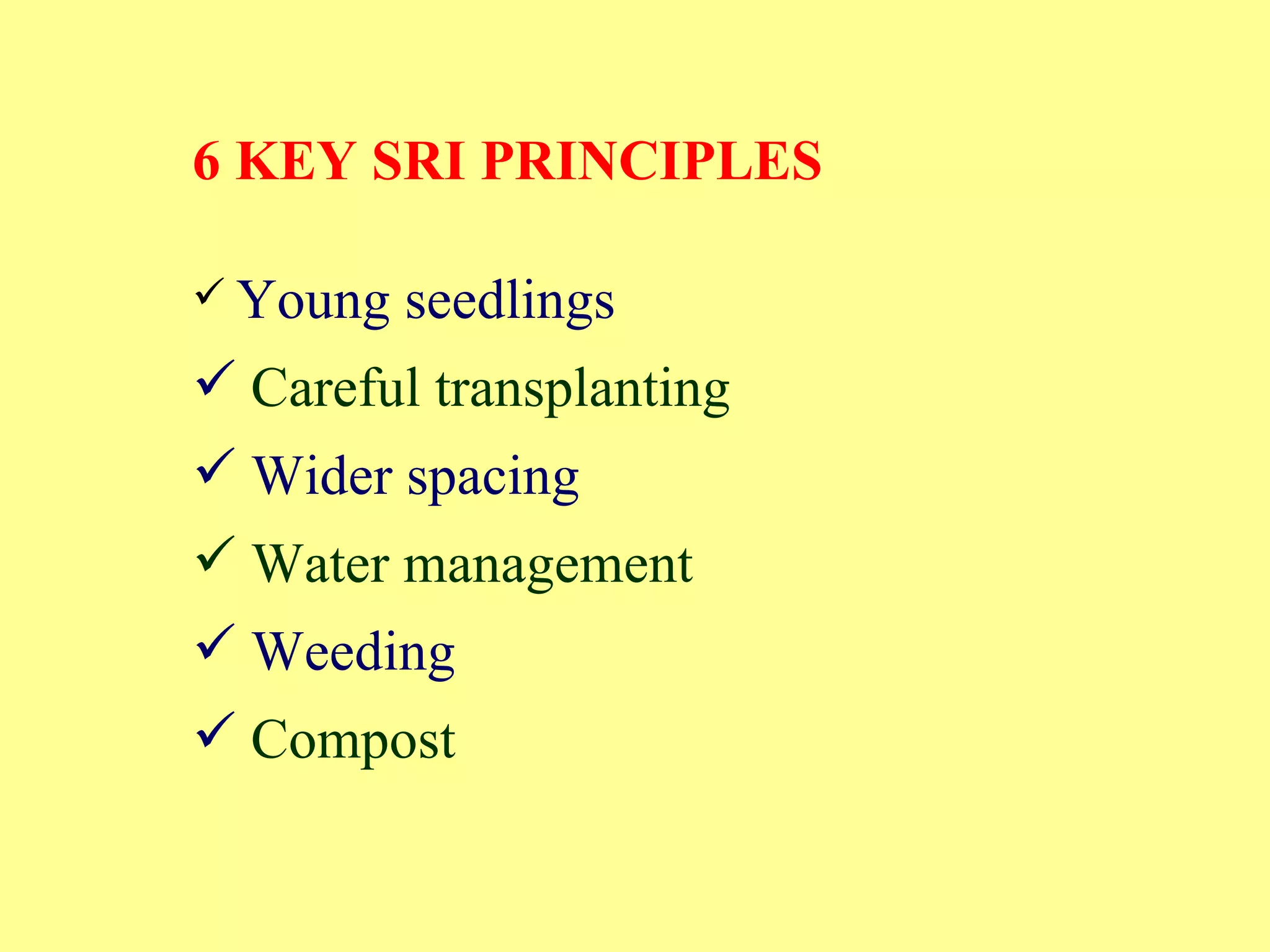
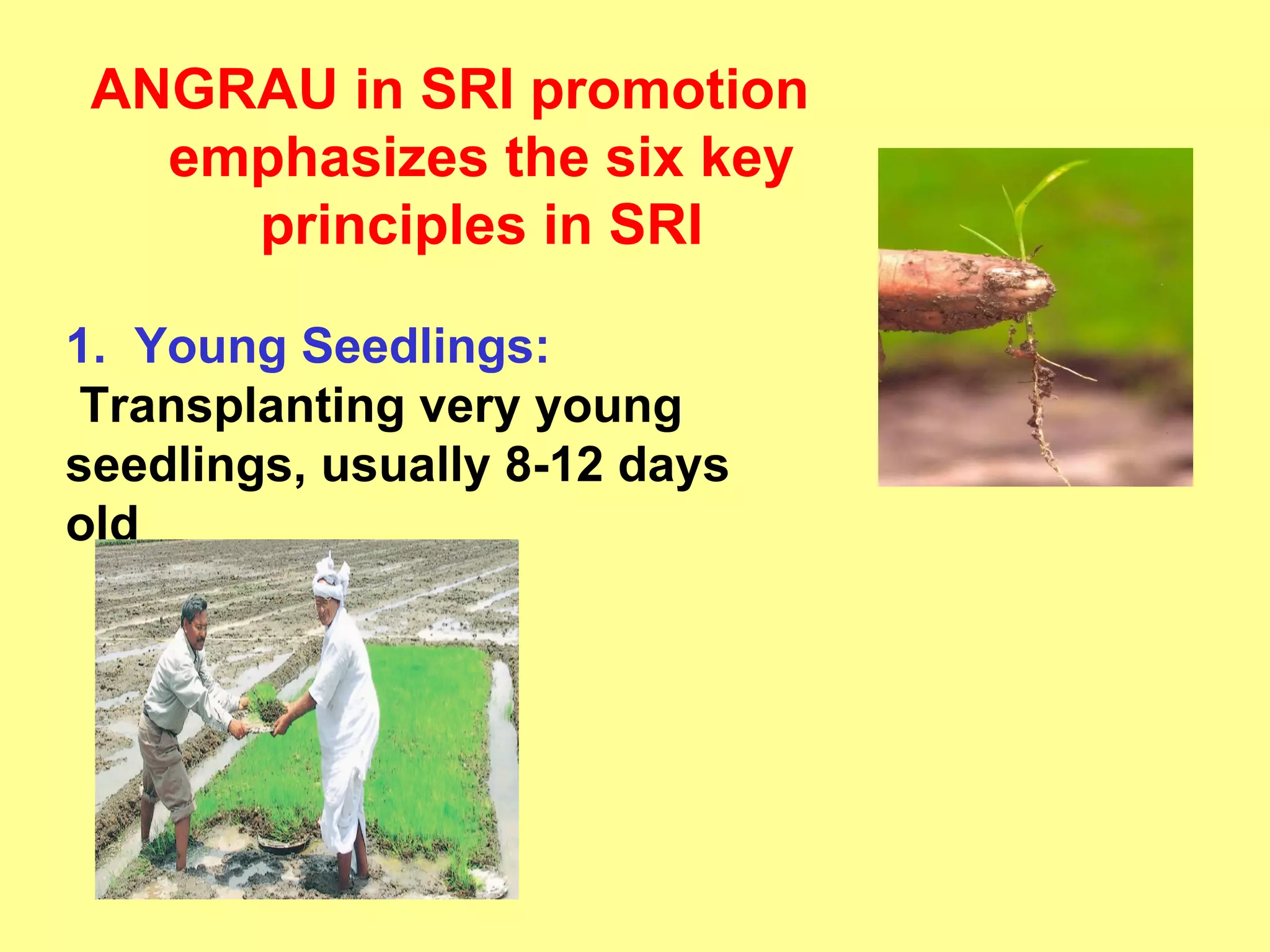
ANGRAU in SRI promotion emphasizes the six key principles in SRI 1.  Young Seedlings: Transplanting very young seedlings, usually 8-12 days old
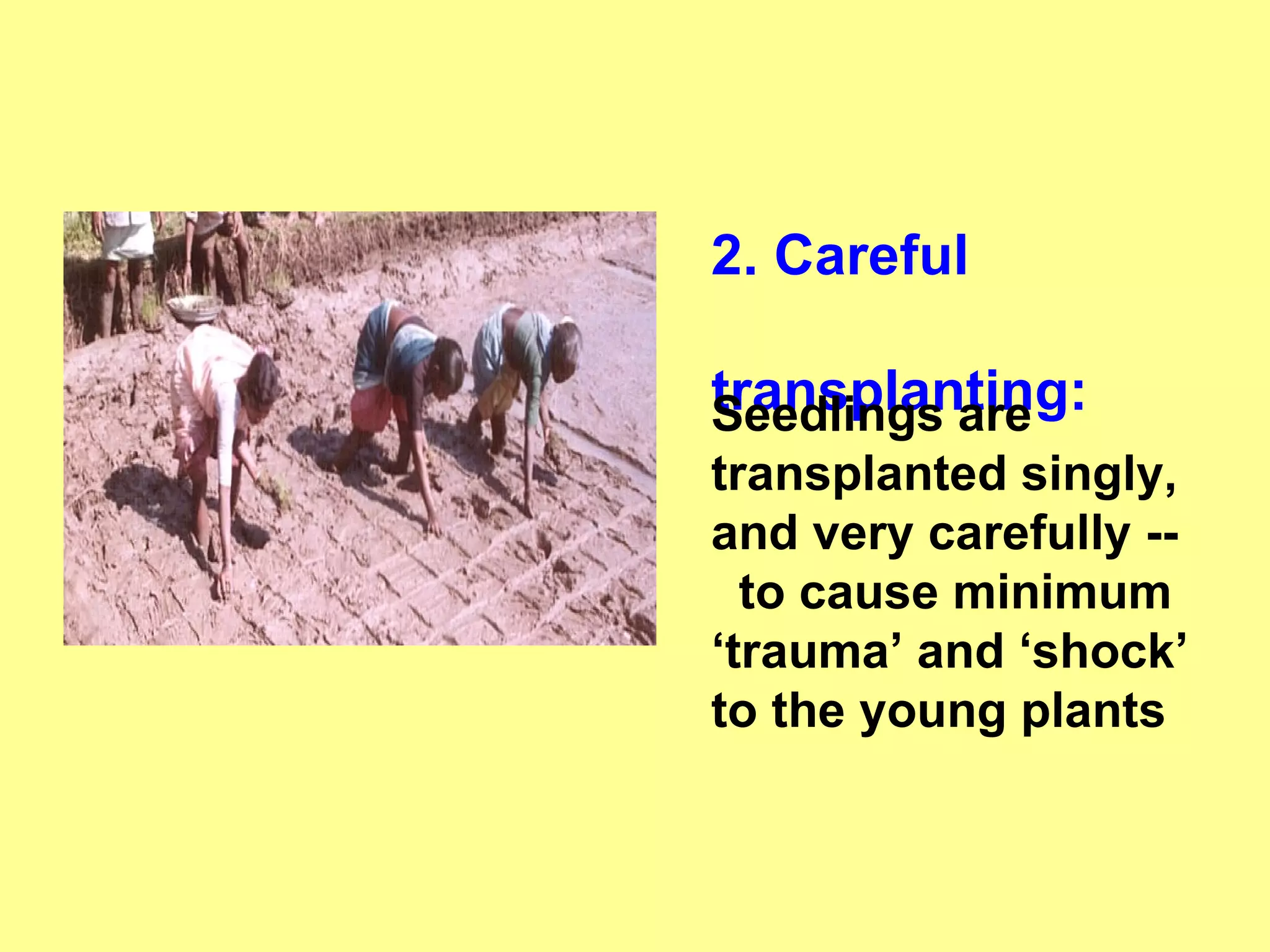
2. Careful    transplanting: Seedlings are transplanted singly,  and very carefully --  to cause minimum ‘trauma’ and ‘shock’ to the young plants
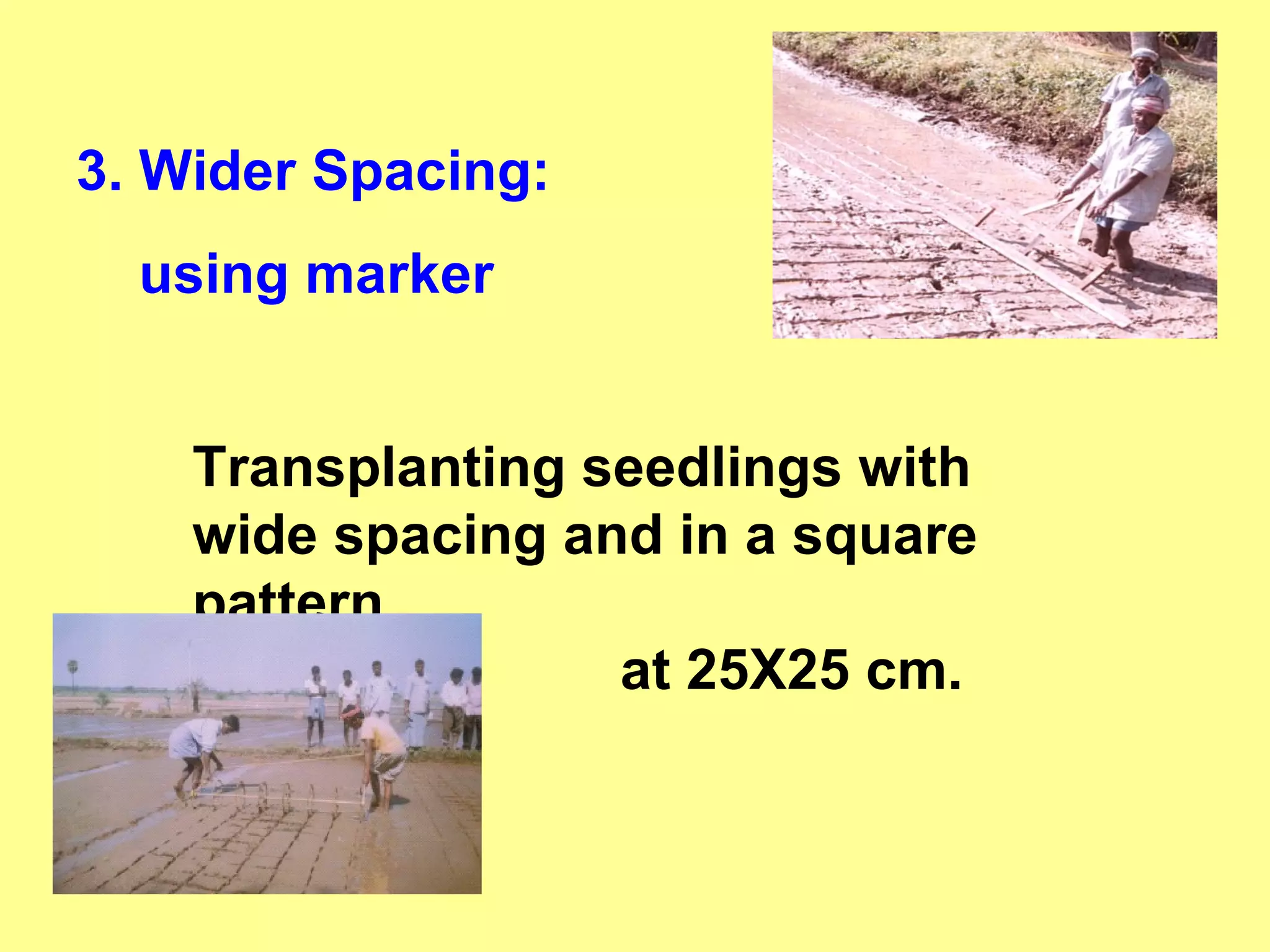
3. Wider Spacing:  using marker Transplanting seedlings with wide spacing and in a square pattern,    at 25X25 cm.
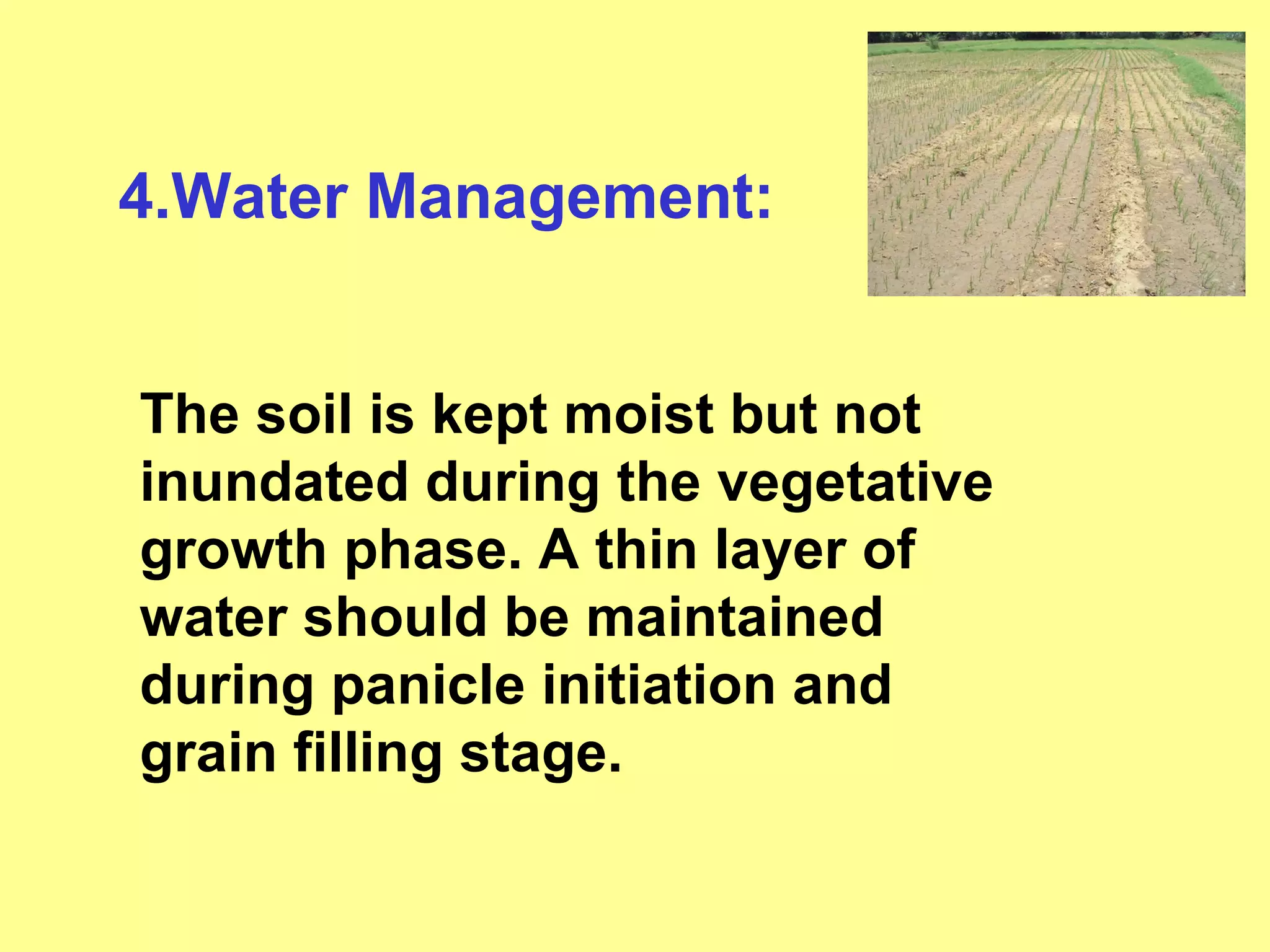
4.Water Management: The soil is kept moist but not inundated during the vegetative growth phase. A thin layer of water should be maintained during panicle initiation and grain filling stage.
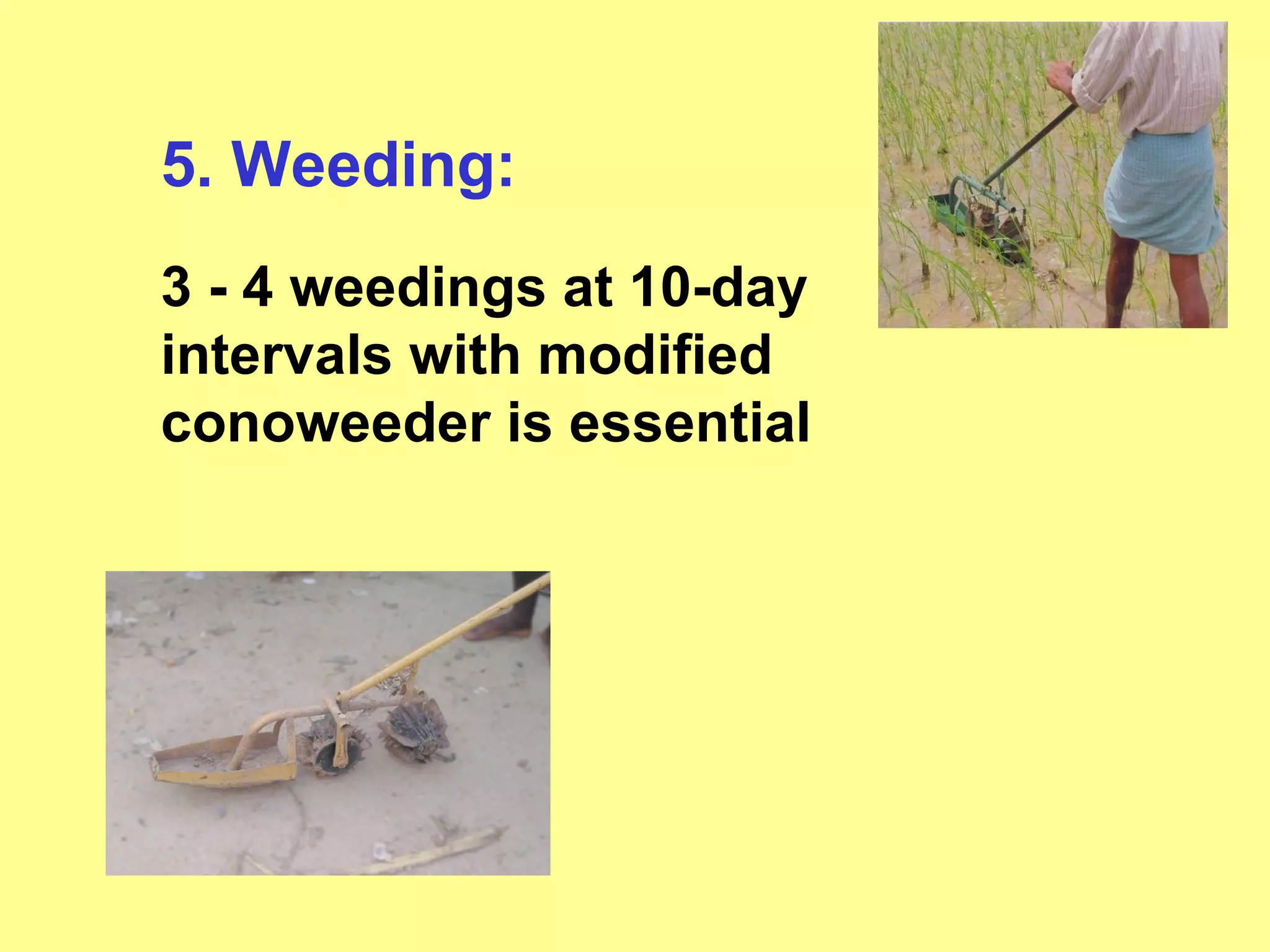
5. Weeding: 3 - 4 weedings at 10-day intervals with modified conoweeder is essential
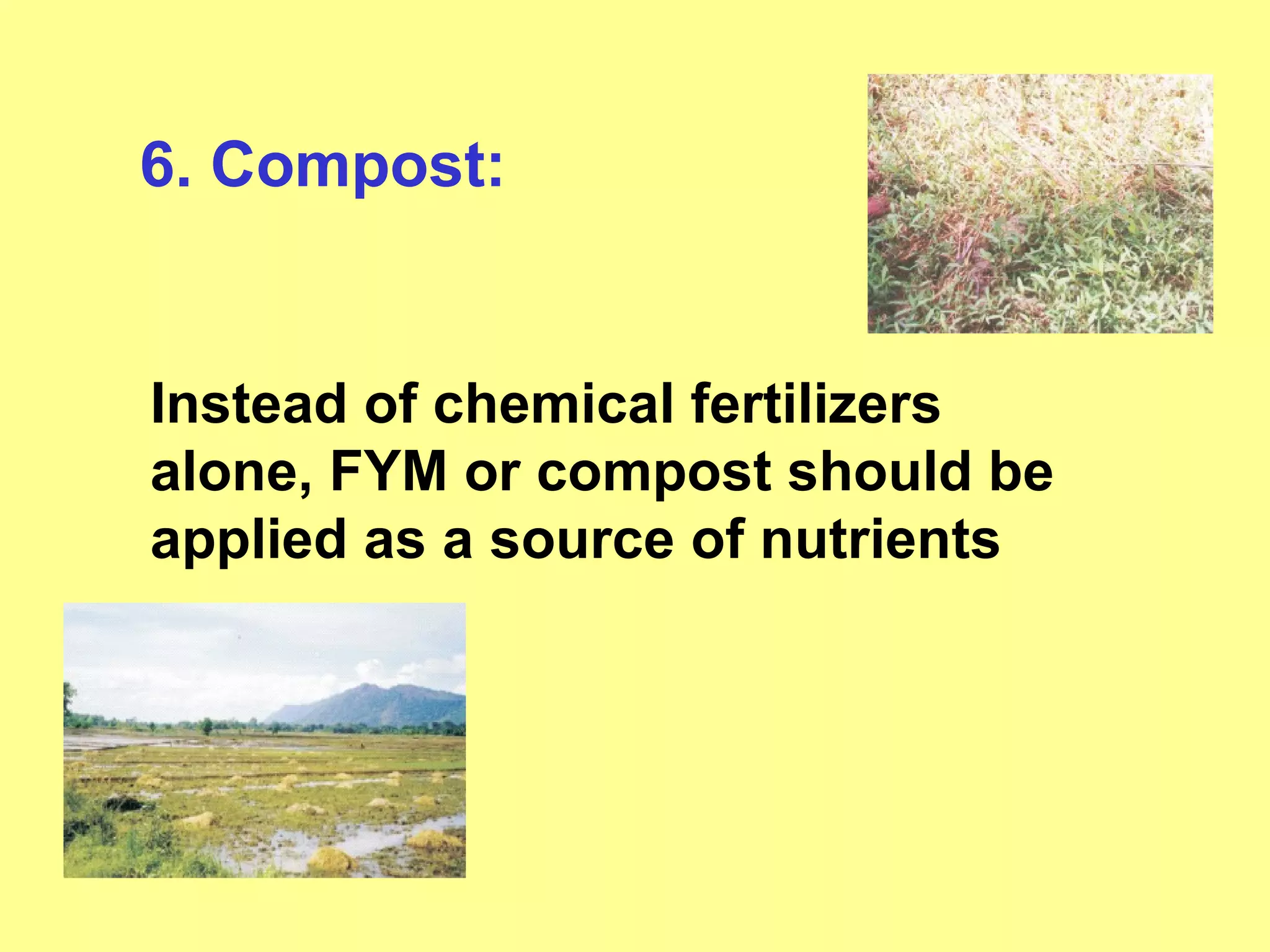
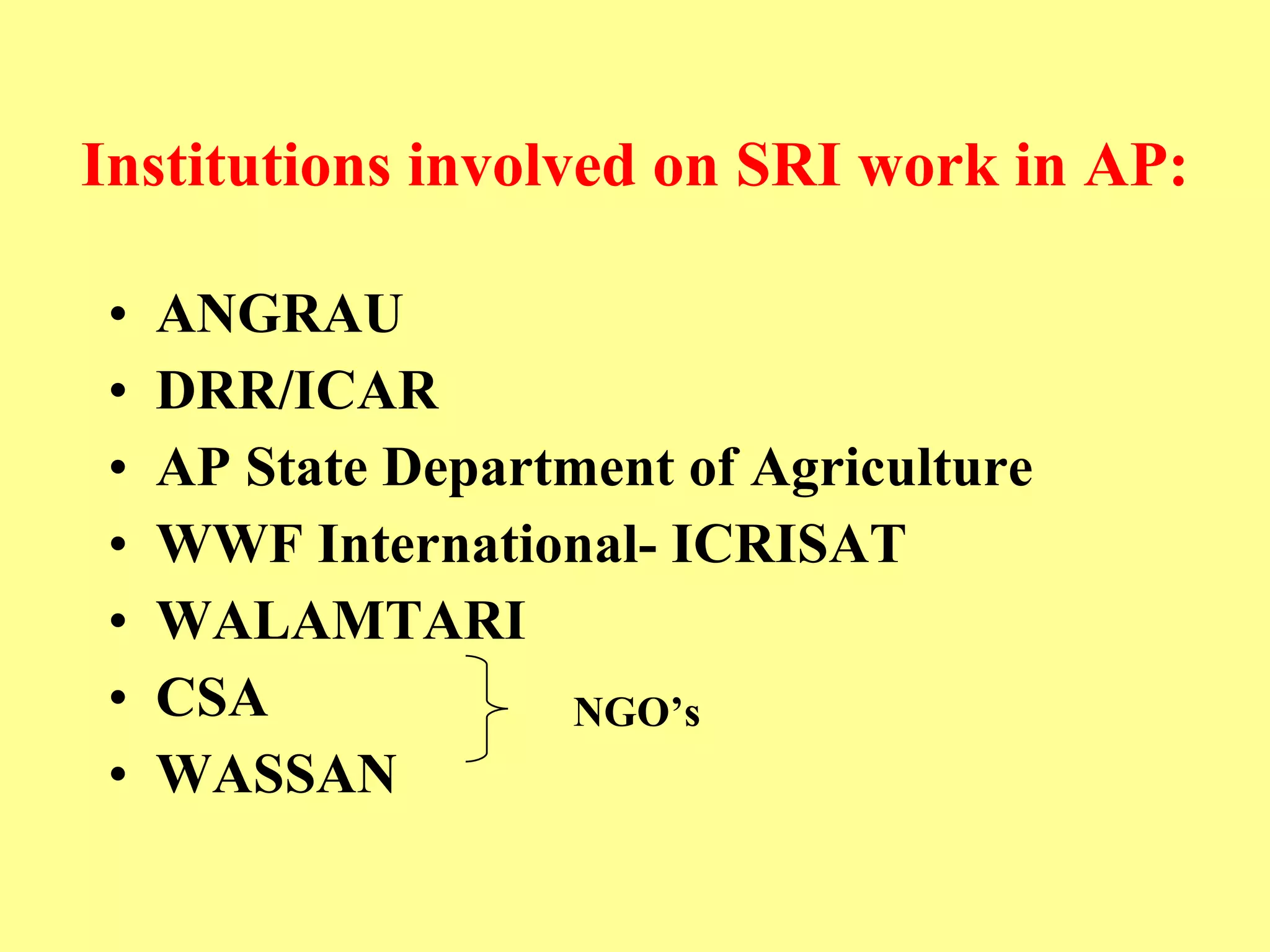
6. Compost: Instead of chemical fertilizers alone, FYM or compost should be applied as a source of nutrients
Institutions involved on SRI work in AP: ANGRAU  DRR/ICAR  AP State Department of Agriculture  WWF International- ICRISAT WALAMTARI CSA WASSAN   NGO’s
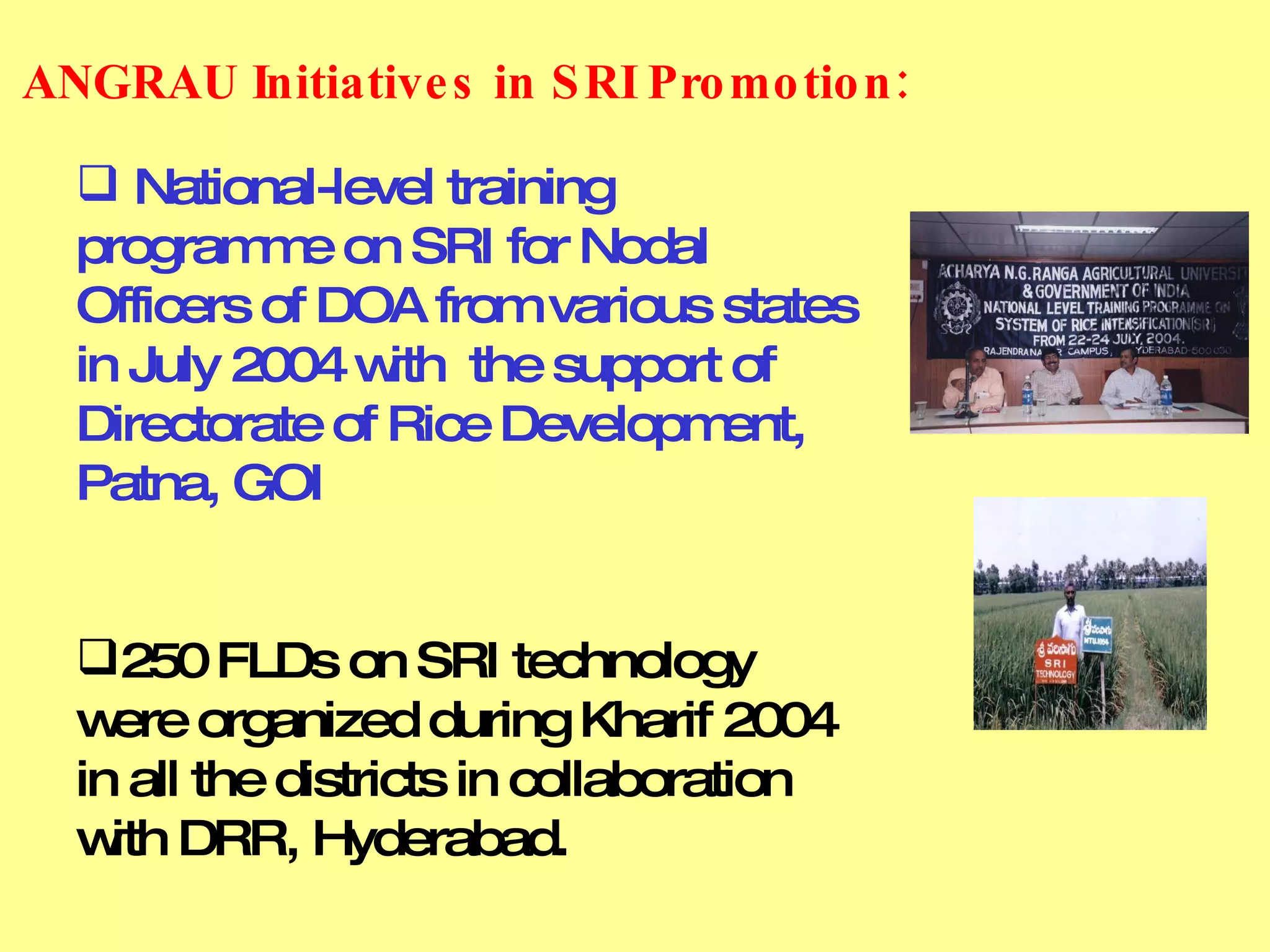
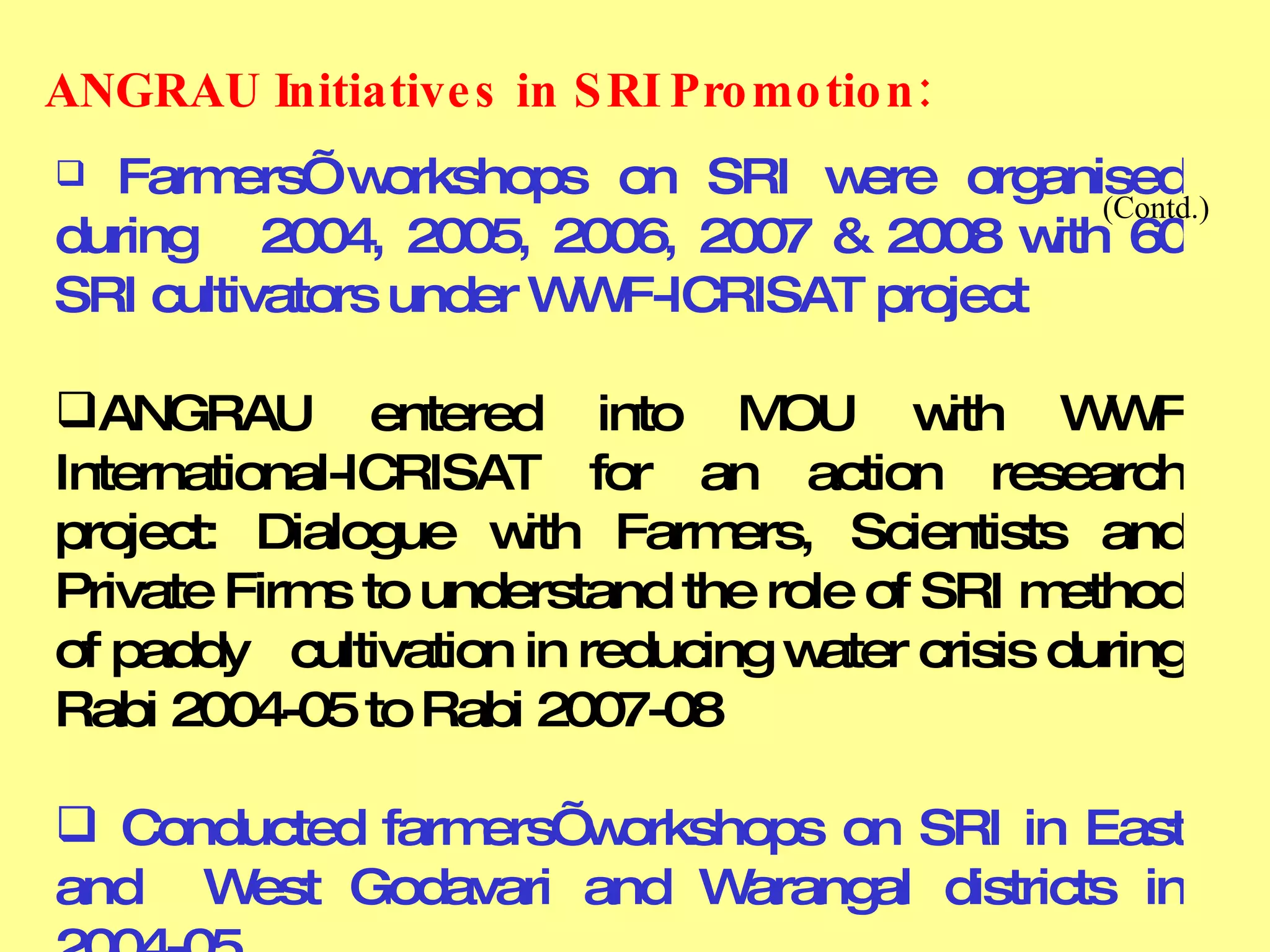
National-level training programme on SRI for Nodal Officers of DOA from various states in July 2004 with  the support of Directorate of Rice Development, Patna, GOI 250 FLDs on SRI technology were organized during Kharif 2004 in all the districts in collaboration with DRR, Hyderabad. ANGRAU Initiatives in SRI Promotion:
Farmers’ workshops on SRI were organised during  2004, 2005, 2006, 2007 & 2008 with 60 SRI cultivators under WWF-ICRISAT project ANGRAU entered into MOU with WWF International-ICRISAT for an action research project: Dialogue with Farmers, Scientists and Private Firms to understand the role of SRI method of paddy  cultivation in reducing water crisis during Rabi 2004-05 to Rabi 2007-08 Conducted farmers’ workshops on SRI in East and  West Godavari and Warangal districts in 2004-05 ANGRAU Initiatives in SRI Promotion:       (Contd.)
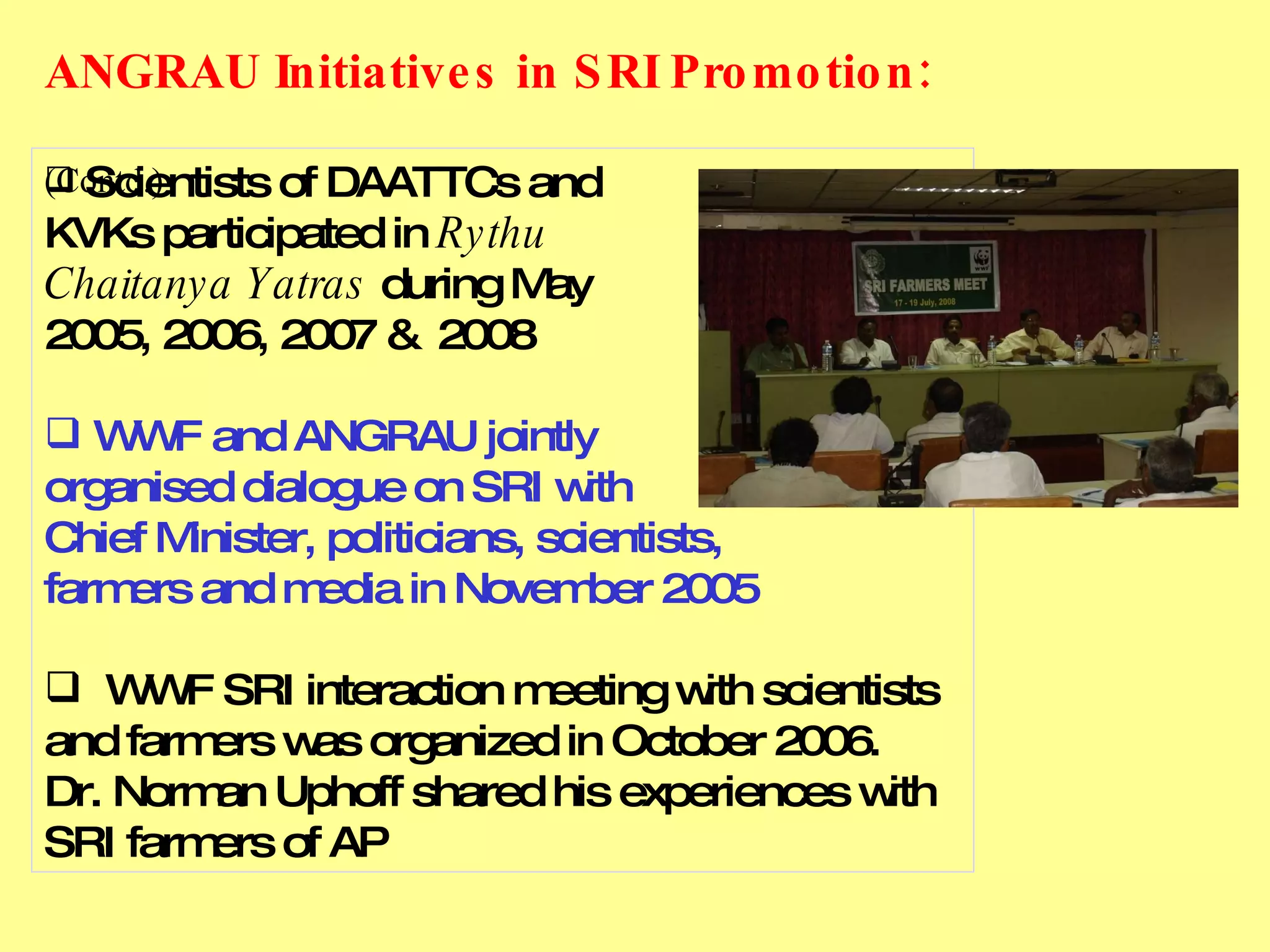
Scientists of DAATTCs and  KVKs participated in  Rythu  Chaitanya Yatras  during May  2005, 2006, 2007 &  2008 WWF and ANGRAU jointly  organised dialogue on SRI with  Chief Minister, politicians, scientists, farmers and media in November 2005 WWF SRI interaction meeting with scientists and farmers was organized in October 2006.  Dr. Norman Uphoff shared his experiences with SRI farmers of AP ANGRAU Initiatives in SRI Promotion:     (Contd.)
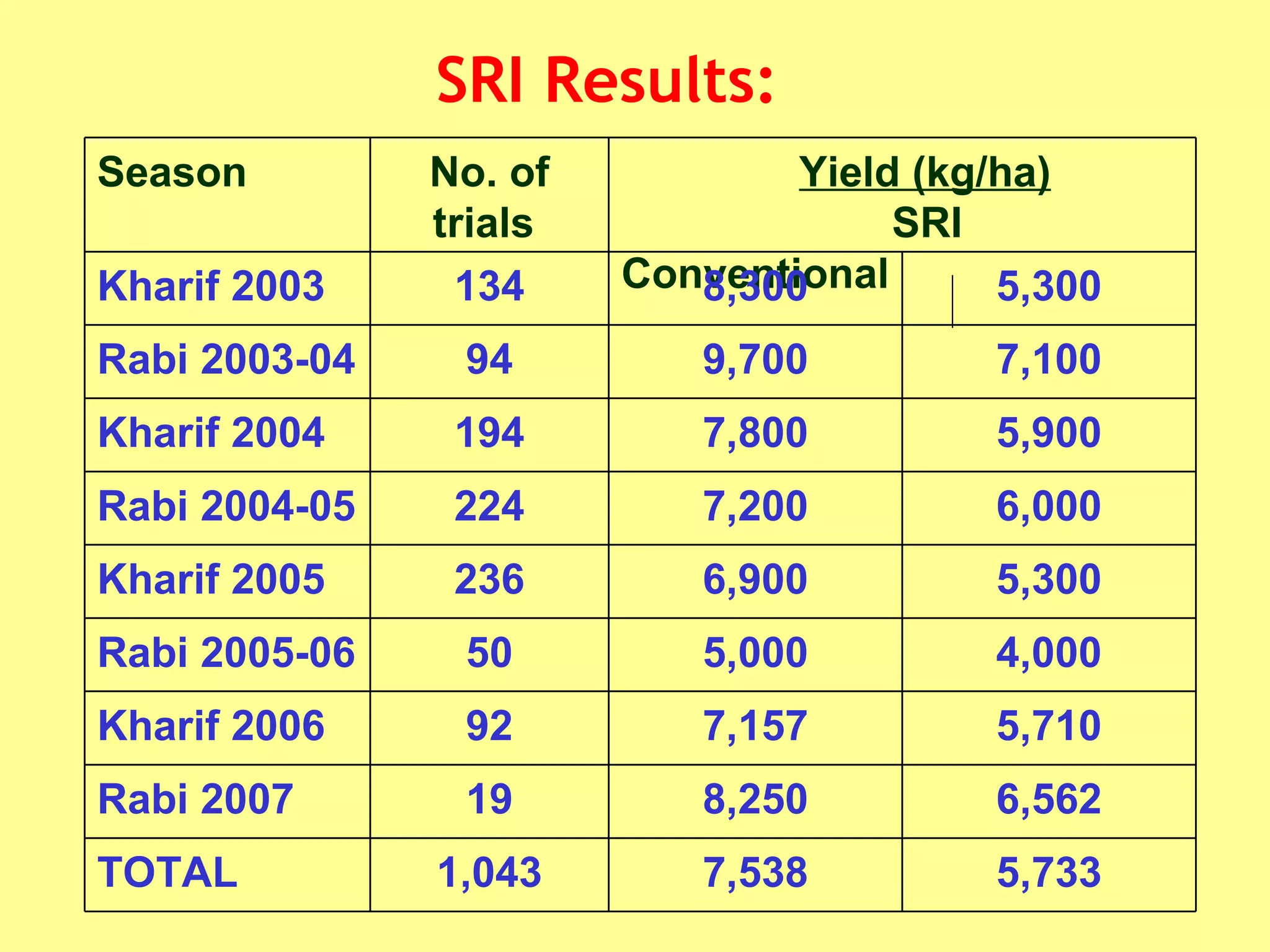
Several on-farm demonstrations conducted through DAATTCs & KVKs on SRI OFDs at 1,043 locations in AP: gave positive impact in terms of plant growth, yield and net returns – with an average yield advantage of 36% Capacity-building programmes and farmers’ meetings were organized Hosted and helped organise 1st National Symposium on SRI in Hyderabad in November 2006 Co-sponsored 2nd National Symposium on SRI in Tripura in October 2007 ANGRAU Initiatives in SRI Promotion:         (Contd.)
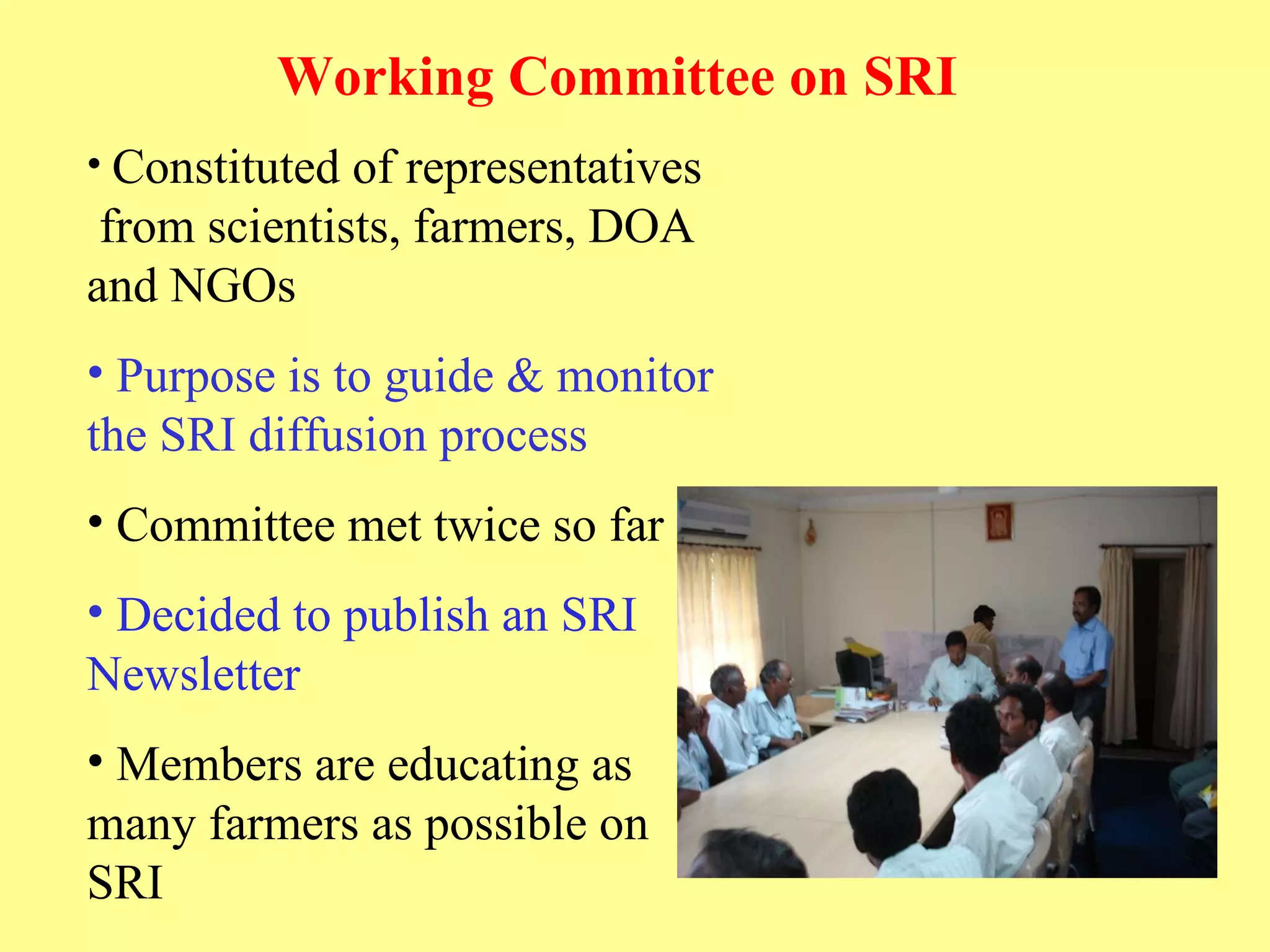
Working Committee on SRI   Constituted of representatives  from scientists, farmers, DOA and NGOs  Purpose is to guide & monitor the SRI diffusion process  Committee met twice so far Decided to publish an SRI Newsletter   Members are educating as many farmers as possible on SRI
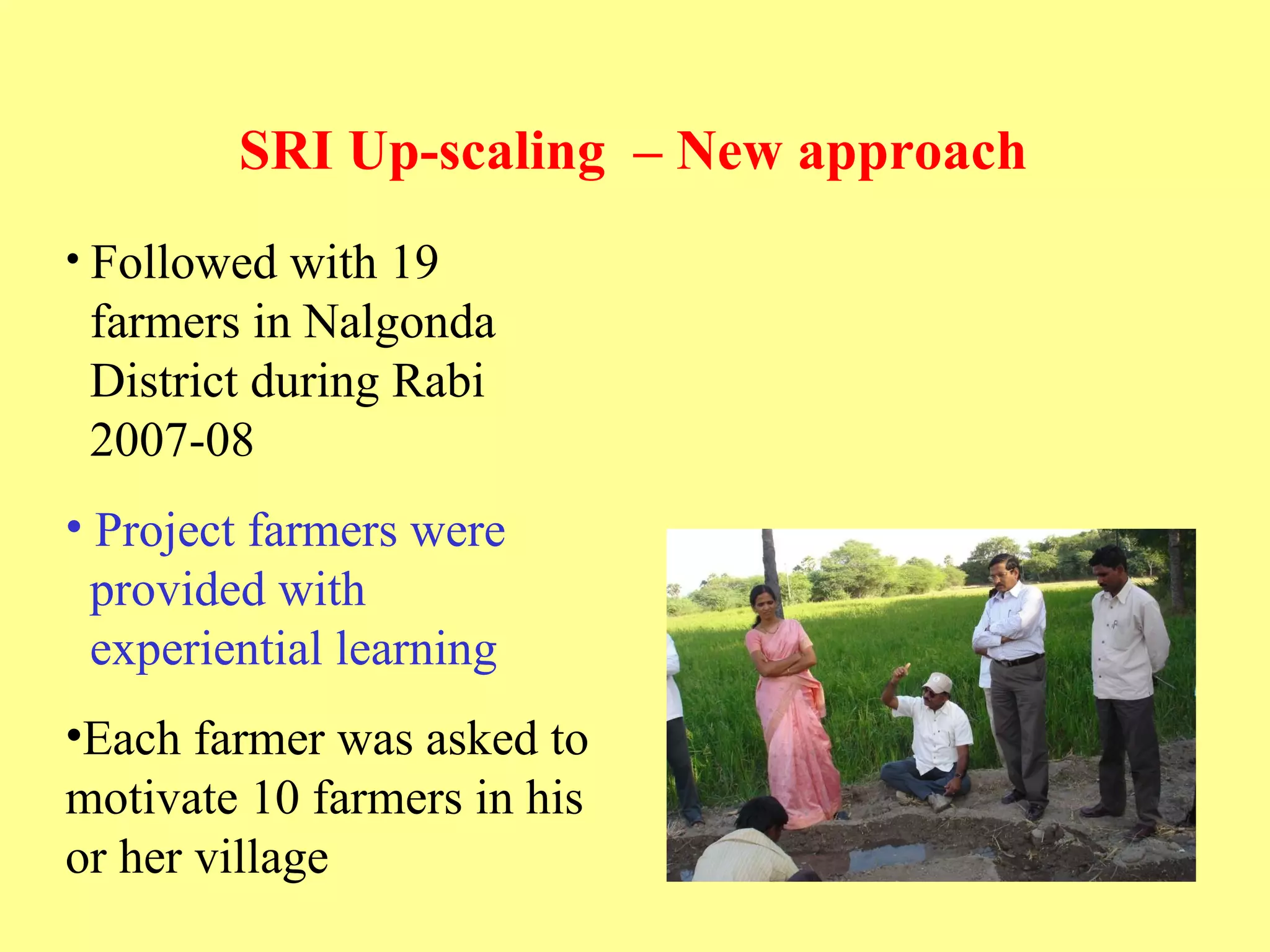
SRI Up-scaling  – New approach   Followed with 19    farmers in Nalgonda    District during Rabi    2007-08  Project farmers were    provided with    experiential learning  Each farmer was asked to motivate 10 farmers in his or her village
SRI Results:   Season No. of trials  Yield (kg/ha) SRI  Conventional  Kharif 2003 134 8,300 5,300 Rabi 2003-04 94 9,700 7,100 Kharif 2004 194 7,800 5,900 Rabi 2004-05 224 7,200 6,000 Kharif 2005 236 6,900 5,300 Rabi 2005-06 50 5,000 4,000 Kharif 2006  92 7,157 5,710 Rabi 2007 19 8,250 6,562 TOTAL 1,043 7,538 5,733
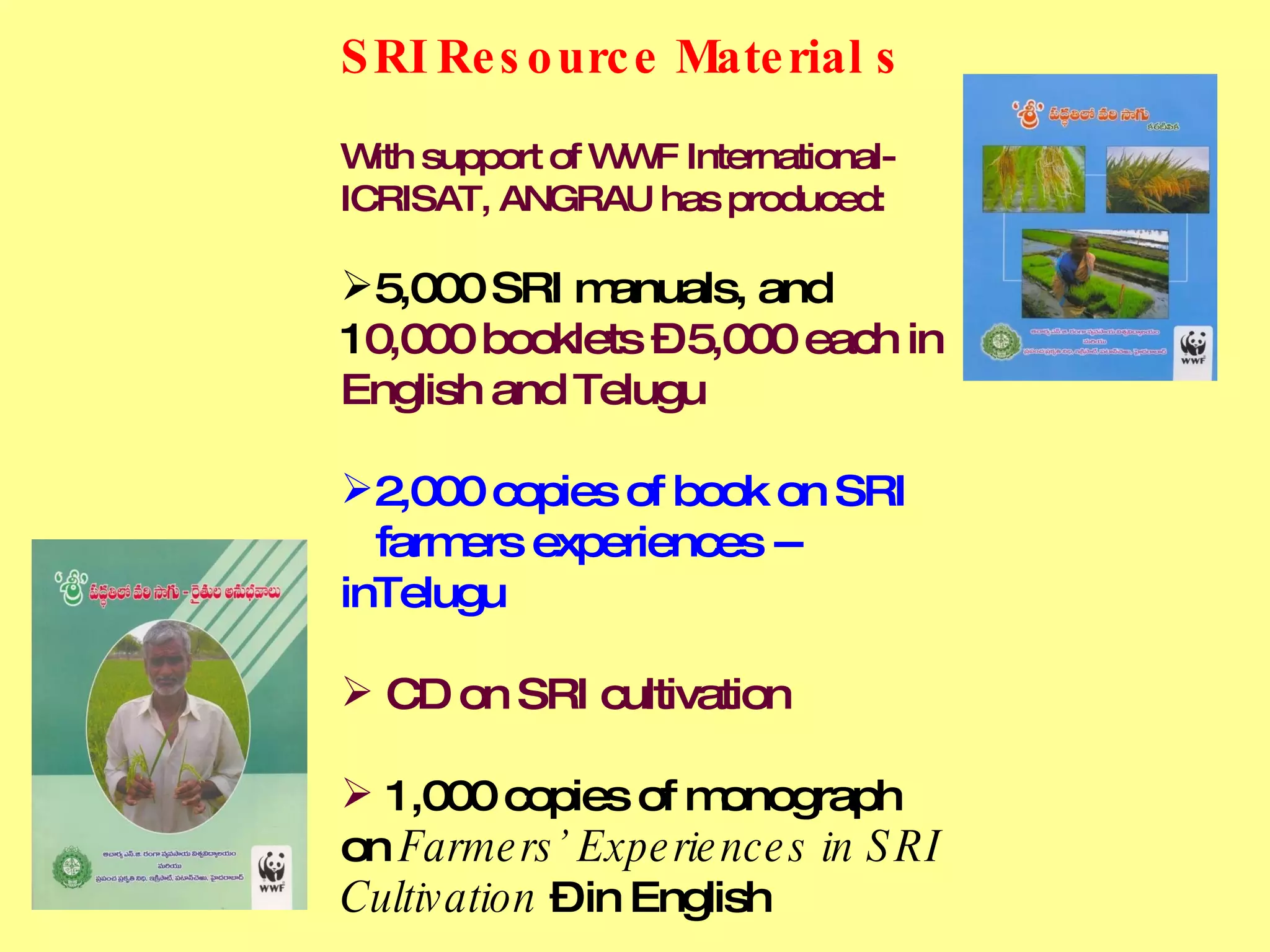
SRI Resource Material s With support of WWF International- ICRISAT, ANGRAU has produced:  5,000 SRI manuals, and  1 0,000 booklets – 5,000 each in English and Telugu 2,000 copies of book on SRI    farmers experiences -- inTelugu CD on SRI cultivation 1,000 copies of monograph on  Farmers’ Experiences in SRI Cultivation  – in English
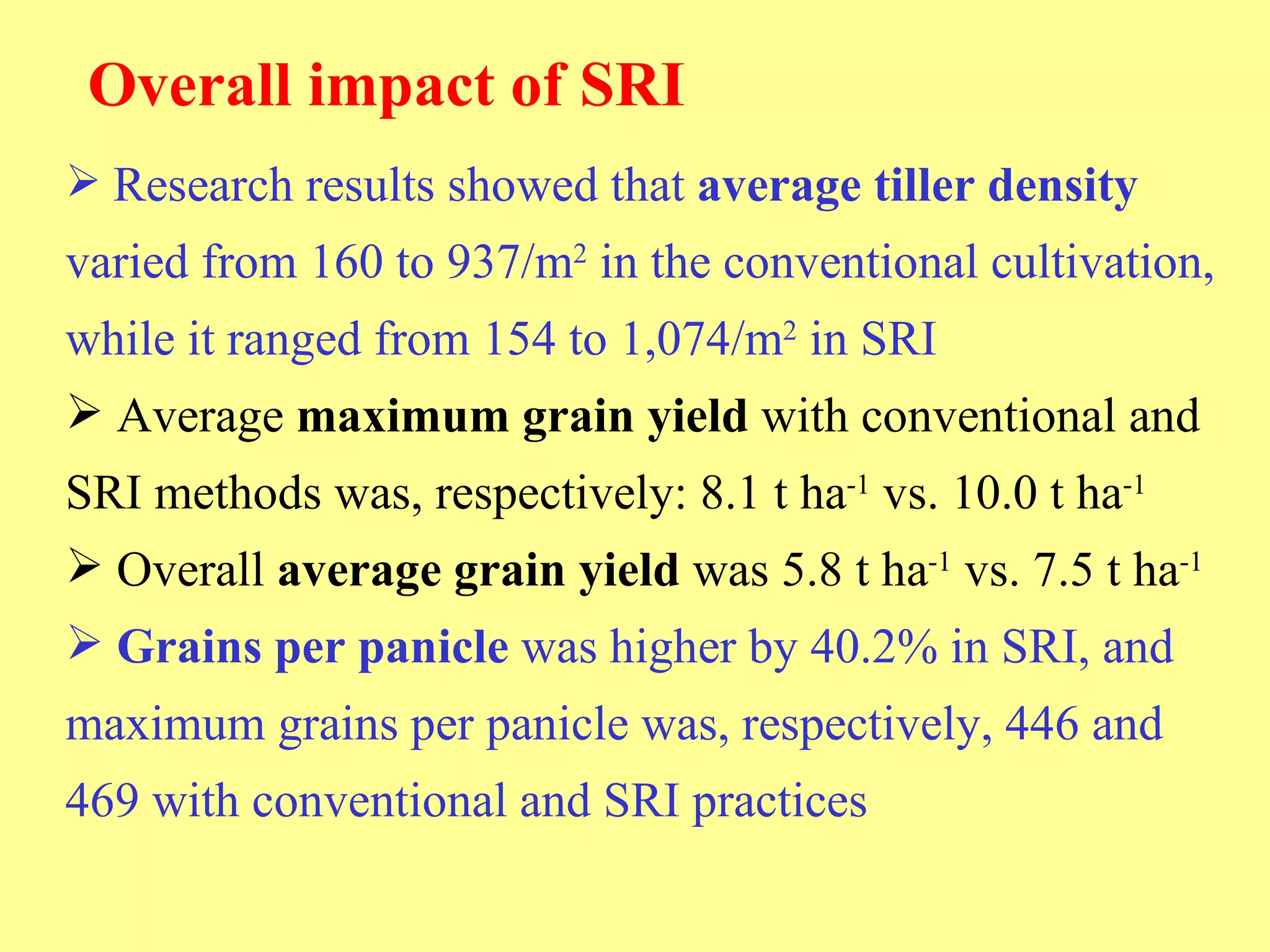
Overall impact of SRI Research results showed that  average tiller density  varied from 160 to 937/m 2  in the conventional cultivation, while it ranged from 154 to 1,074/m 2  in SRI Average  maximum grain yield  with conventional and SRI methods was, respectively: 8.1 t ha -1  vs. 10.0 t ha -1 Overall  average grain yield  was 5.8 t ha -1  vs. 7.5 t ha -1   Grains per panicle  was higher by 40.2% in SRI, and maximum grains per panicle was, respectively, 446 and 469 with conventional and SRI practices
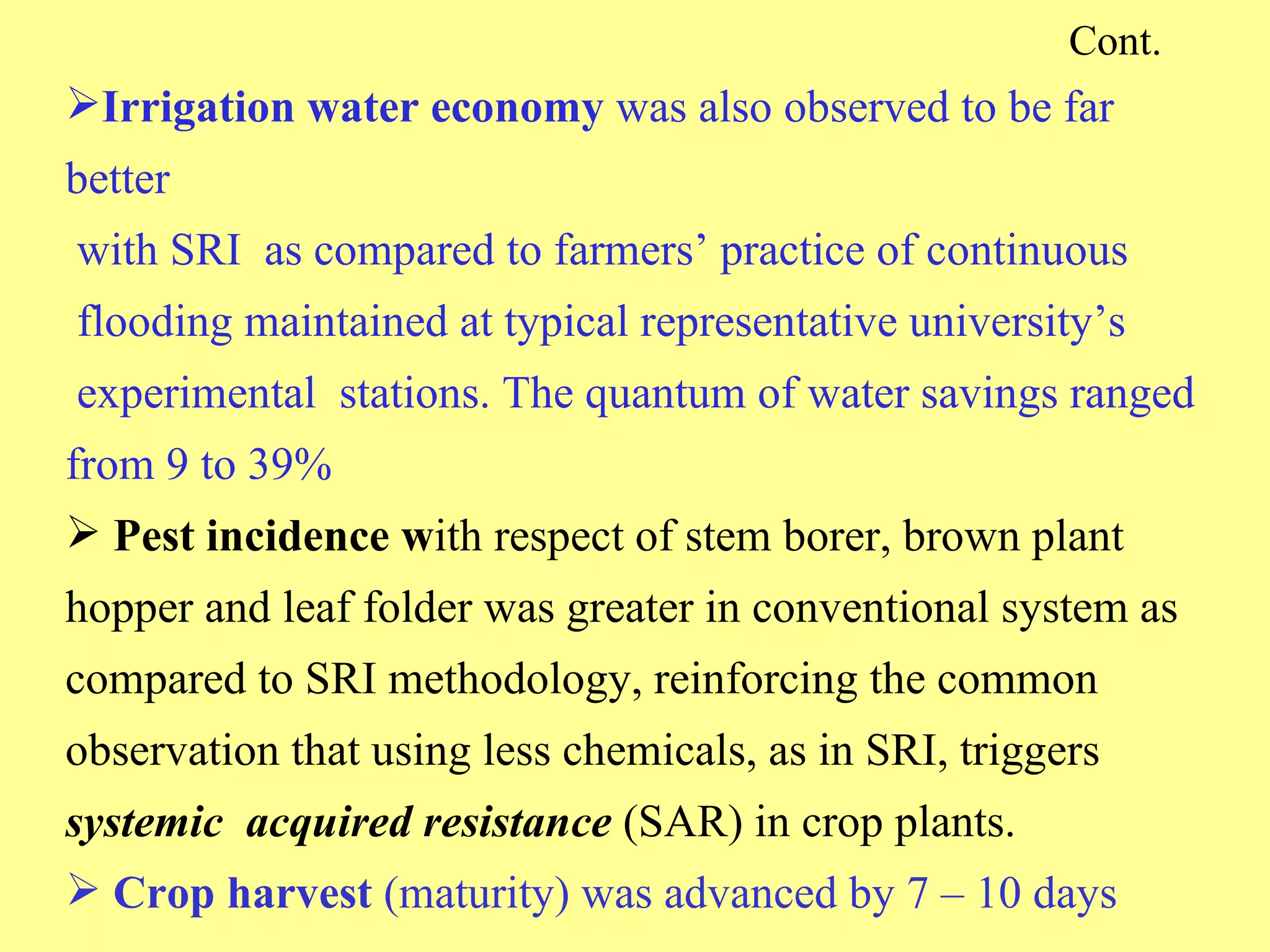
Cont. Irrigation water economy  was also observed to be far better   with SRI  as compared to farmers’ practice of continuous   flooding maintained at typical representative university’s   experimental  stations. The quantum of water savings ranged from 9 to 39%  Pest incidence w ith respect of stem borer, brown plant hopper and leaf folder was greater in conventional system as compared to SRI methodology, reinforcing the common observation that using less chemicals, as in SRI, triggers  systemic  acquired resistance  (SAR) in crop plants. Crop harvest  (maturity) was advanced by 7 – 10 days
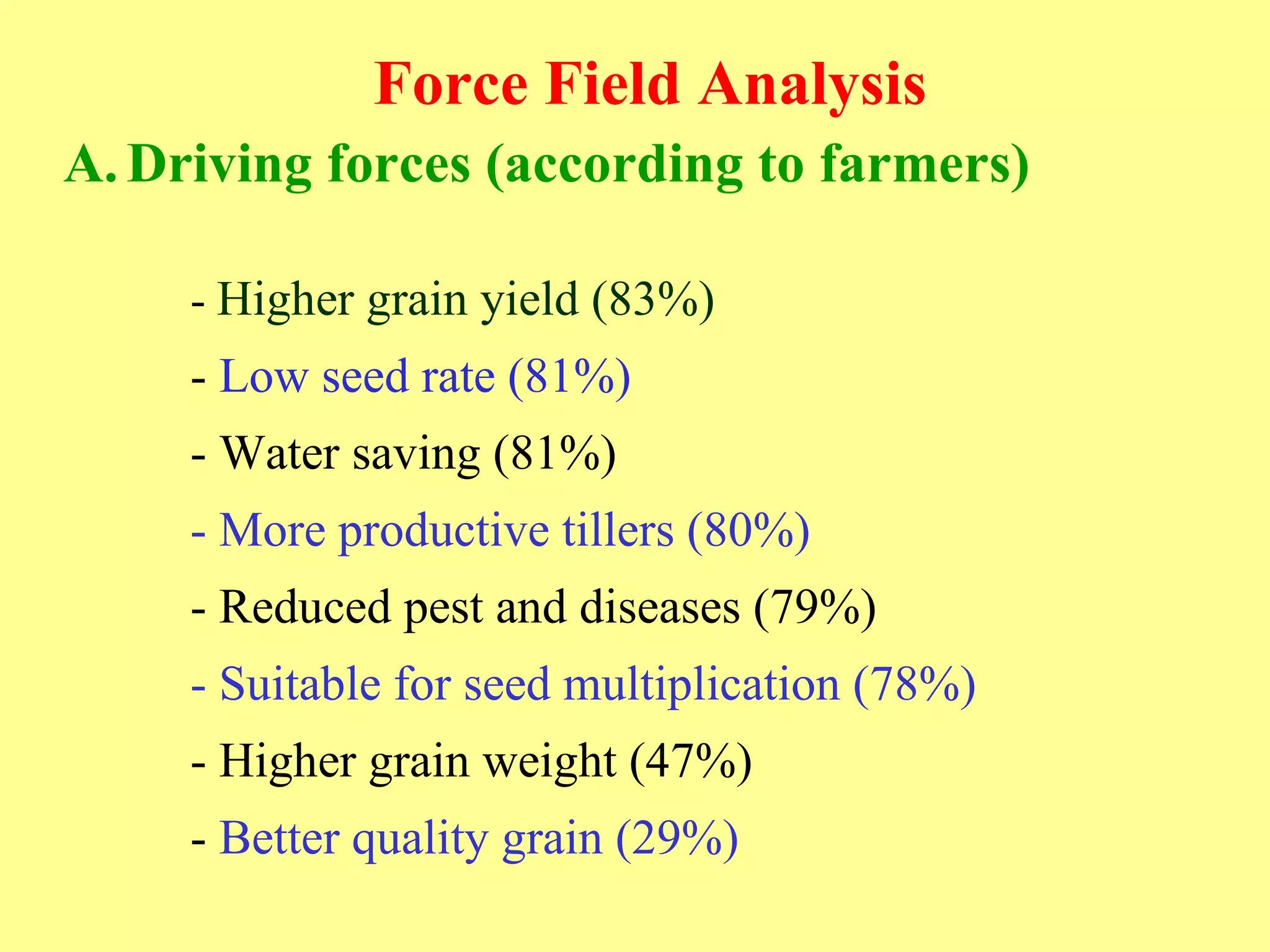
Force Field Analysis Driving forces (according to farmers) -  Higher grain yield (83%) -  Low seed rate (81%) - Water saving (81%) - More productive tillers (80%) - Reduced pest and diseases (79%) - Suitable for seed multiplication (78%) - Higher grain weight (47%) -  Better quality grain (29%)
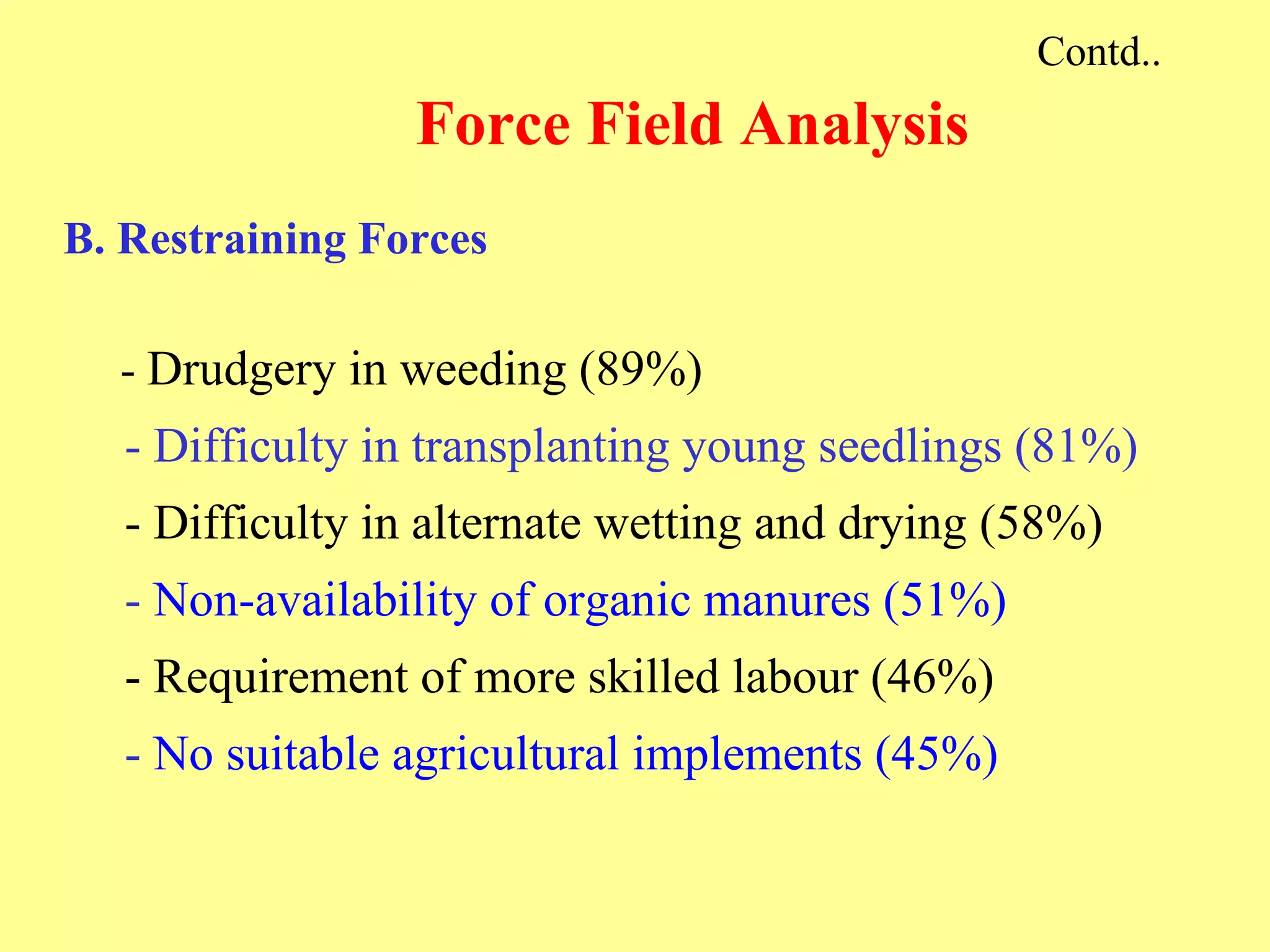
Contd.. Force Field Analysis B. Restraining Forces -  Drudgery in weeding (89%) - Difficulty in transplanting young seedlings (81%) - Difficulty in alternate wetting and drying (58%) -  Non-availability of organic manures (51%) - Requirement of more skilled labour (46%) -  No suitable agricultural implements (45%)
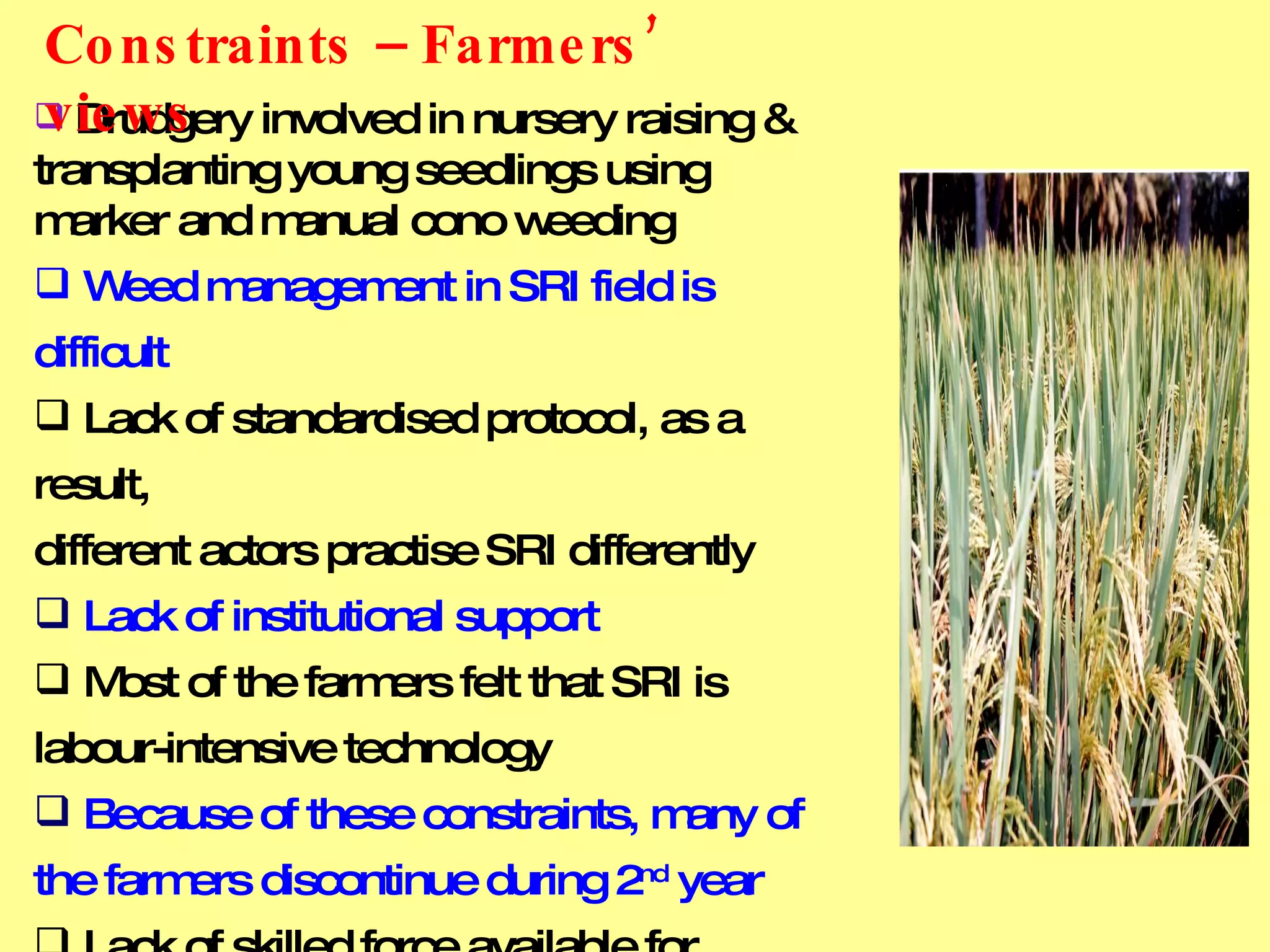
Drudgery involved in nursery raising & transplanting young seedlings using marker and manual cono weeding Weed management in SRI field is difficult Lack of standardised protocol, as a result, different actors practise SRI differently Lack of institutional support Most of the farmers felt that SRI is labour-intensive technology Because of these constraints, many of  the farmers discontinue during 2 nd  year Lack of skilled force available for transplanting and cono weeding Constraints – Farmers’ views
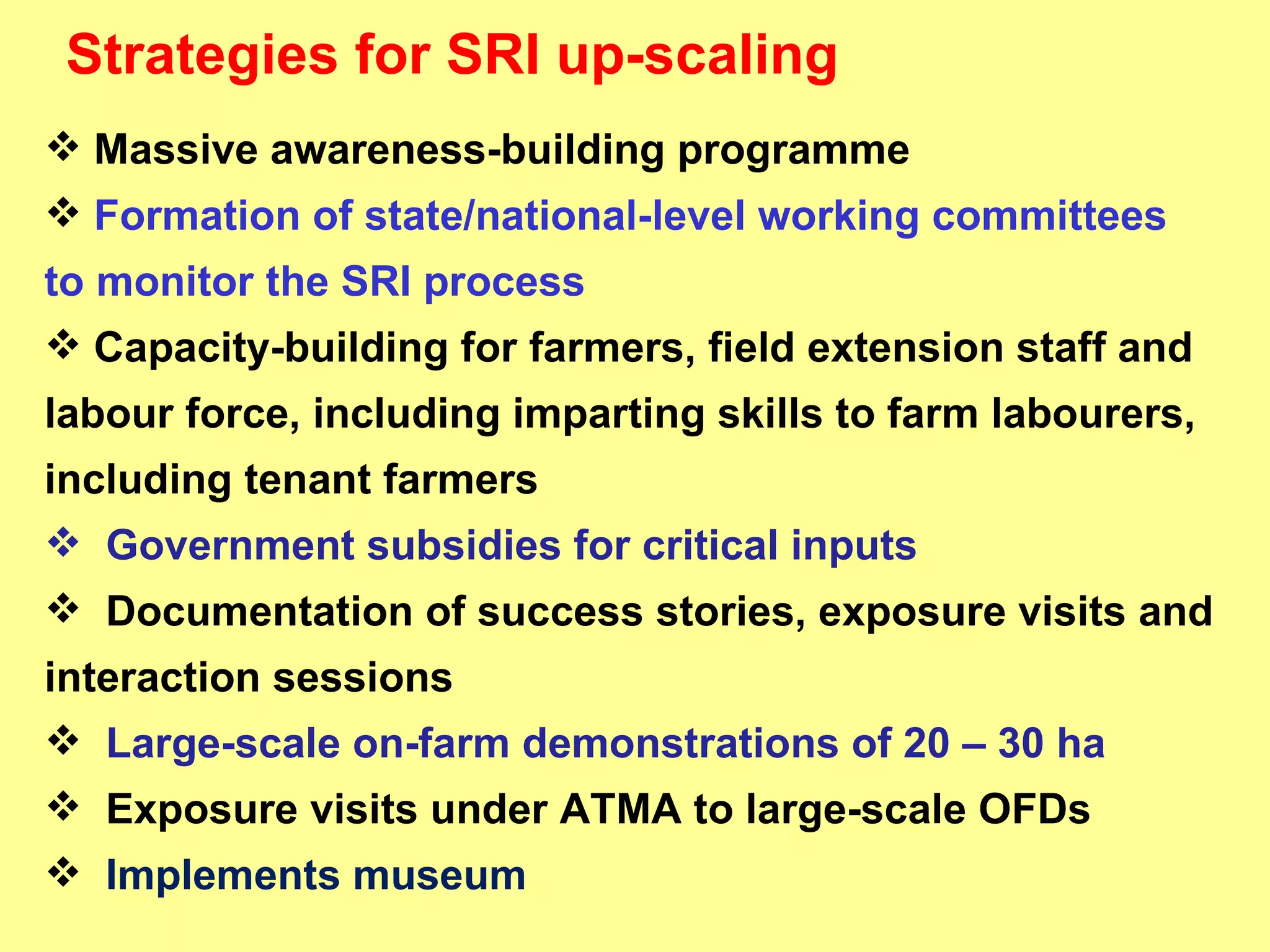
Massive awareness-building programme Formation of state/national-level working committees to monitor the SRI process Capacity-building for farmers, field extension staff and  labour force, including imparting skills to farm labourers, including tenant farmers Government subsidies for critical inputs  Documentation of success stories, exposure visits and interaction sessions Large-scale on-farm demonstrations of 20 – 30 ha Exposure visits under ATMA to large-scale OFDs Implements museum Strategies for SRI up-scaling
Impact of SRI   on Rice Farming Community 2 kg of seed rate is sufficient to save:  0.4 million tonnes  of rice in AP alone --  worth about Rs. 300 crores Young seedlings can give more yield   Single seedling per hill is enough for obtaining good yield  Rice can be cultivated with less amount of water than now used
Conclusions:   SRI has the advantages of cost-effectiveness and increased yields per unit area over conventional paddy cultivation Extension, research and policy support for SRI must be given immediate attention For scaling up SRI, strong research data base on SRI, large-scale demonstrations, multi-location trials, motorised cono weeder, and skills upgrading of SRI partners including labourers are needed
THANK YOU

0848 ANGRAU Initiatives for SRI and Lessons from Andhra Pradesh

  • 1.
    ANGRAU Initiatives forSRI and Lessons from Andhra Pradesh Dr. L.G.GIRI RAO Director of Extension ANGRAU, Hyderabad
  • 2.
    FACTS Water requirementfor human and industrial needs is increasing Consequently, water availability for agriculture will become a scarcer commodity in future Demand for rice growing is increasing with increasing population Rice is a water-intensive crop Hence, any activity that can produce more rice with less water will be important for sustainable water and food security Solution ? System of Rice Intensification (SRI) can improve the productivity of land, labour, capital and water simultaneously National goal: Bring 25% of irrigated area under SRI, to increase production by 20 million tons and reduce water requirement by 25%
  • 3.
    6 KEY SRIPRINCIPLES Young seedlings Careful transplanting Wider spacing Water management Weeding Compost
  • 4.
    ANGRAU in SRIpromotion emphasizes the six key principles in SRI 1. Young Seedlings: Transplanting very young seedlings, usually 8-12 days old
  • 5.
    2. Careful transplanting: Seedlings are transplanted singly, and very carefully -- to cause minimum ‘trauma’ and ‘shock’ to the young plants
  • 6.
    3. Wider Spacing: using marker Transplanting seedlings with wide spacing and in a square pattern, at 25X25 cm.
  • 7.
    4.Water Management: Thesoil is kept moist but not inundated during the vegetative growth phase. A thin layer of water should be maintained during panicle initiation and grain filling stage.
  • 8.
    5. Weeding: 3- 4 weedings at 10-day intervals with modified conoweeder is essential
  • 9.
    6. Compost: Insteadof chemical fertilizers alone, FYM or compost should be applied as a source of nutrients
  • 10.
    Institutions involved onSRI work in AP: ANGRAU DRR/ICAR AP State Department of Agriculture WWF International- ICRISAT WALAMTARI CSA WASSAN NGO’s
  • 11.
    National-level training programmeon SRI for Nodal Officers of DOA from various states in July 2004 with the support of Directorate of Rice Development, Patna, GOI 250 FLDs on SRI technology were organized during Kharif 2004 in all the districts in collaboration with DRR, Hyderabad. ANGRAU Initiatives in SRI Promotion:
  • 12.
    Farmers’ workshops onSRI were organised during 2004, 2005, 2006, 2007 & 2008 with 60 SRI cultivators under WWF-ICRISAT project ANGRAU entered into MOU with WWF International-ICRISAT for an action research project: Dialogue with Farmers, Scientists and Private Firms to understand the role of SRI method of paddy cultivation in reducing water crisis during Rabi 2004-05 to Rabi 2007-08 Conducted farmers’ workshops on SRI in East and West Godavari and Warangal districts in 2004-05 ANGRAU Initiatives in SRI Promotion: (Contd.)
  • 13.
    Scientists of DAATTCsand KVKs participated in Rythu Chaitanya Yatras during May 2005, 2006, 2007 & 2008 WWF and ANGRAU jointly organised dialogue on SRI with Chief Minister, politicians, scientists, farmers and media in November 2005 WWF SRI interaction meeting with scientists and farmers was organized in October 2006. Dr. Norman Uphoff shared his experiences with SRI farmers of AP ANGRAU Initiatives in SRI Promotion: (Contd.)
  • 14.
    Several on-farm demonstrationsconducted through DAATTCs & KVKs on SRI OFDs at 1,043 locations in AP: gave positive impact in terms of plant growth, yield and net returns – with an average yield advantage of 36% Capacity-building programmes and farmers’ meetings were organized Hosted and helped organise 1st National Symposium on SRI in Hyderabad in November 2006 Co-sponsored 2nd National Symposium on SRI in Tripura in October 2007 ANGRAU Initiatives in SRI Promotion: (Contd.)
  • 15.
    Working Committee onSRI Constituted of representatives from scientists, farmers, DOA and NGOs Purpose is to guide & monitor the SRI diffusion process Committee met twice so far Decided to publish an SRI Newsletter Members are educating as many farmers as possible on SRI
  • 16.
    SRI Up-scaling – New approach Followed with 19 farmers in Nalgonda District during Rabi 2007-08 Project farmers were provided with experiential learning Each farmer was asked to motivate 10 farmers in his or her village
  • 17.
    SRI Results: Season No. of trials Yield (kg/ha) SRI Conventional Kharif 2003 134 8,300 5,300 Rabi 2003-04 94 9,700 7,100 Kharif 2004 194 7,800 5,900 Rabi 2004-05 224 7,200 6,000 Kharif 2005 236 6,900 5,300 Rabi 2005-06 50 5,000 4,000 Kharif 2006 92 7,157 5,710 Rabi 2007 19 8,250 6,562 TOTAL 1,043 7,538 5,733
  • 18.
    SRI Resource Materials With support of WWF International- ICRISAT, ANGRAU has produced: 5,000 SRI manuals, and 1 0,000 booklets – 5,000 each in English and Telugu 2,000 copies of book on SRI farmers experiences -- inTelugu CD on SRI cultivation 1,000 copies of monograph on Farmers’ Experiences in SRI Cultivation – in English
  • 19.
    Overall impact ofSRI Research results showed that average tiller density varied from 160 to 937/m 2 in the conventional cultivation, while it ranged from 154 to 1,074/m 2 in SRI Average maximum grain yield with conventional and SRI methods was, respectively: 8.1 t ha -1 vs. 10.0 t ha -1 Overall average grain yield was 5.8 t ha -1 vs. 7.5 t ha -1 Grains per panicle was higher by 40.2% in SRI, and maximum grains per panicle was, respectively, 446 and 469 with conventional and SRI practices
  • 20.
    Cont. Irrigation watereconomy was also observed to be far better with SRI as compared to farmers’ practice of continuous flooding maintained at typical representative university’s experimental stations. The quantum of water savings ranged from 9 to 39% Pest incidence w ith respect of stem borer, brown plant hopper and leaf folder was greater in conventional system as compared to SRI methodology, reinforcing the common observation that using less chemicals, as in SRI, triggers systemic acquired resistance (SAR) in crop plants. Crop harvest (maturity) was advanced by 7 – 10 days
  • 21.
    Force Field AnalysisDriving forces (according to farmers) - Higher grain yield (83%) - Low seed rate (81%) - Water saving (81%) - More productive tillers (80%) - Reduced pest and diseases (79%) - Suitable for seed multiplication (78%) - Higher grain weight (47%) - Better quality grain (29%)
  • 22.
    Contd.. Force FieldAnalysis B. Restraining Forces - Drudgery in weeding (89%) - Difficulty in transplanting young seedlings (81%) - Difficulty in alternate wetting and drying (58%) - Non-availability of organic manures (51%) - Requirement of more skilled labour (46%) - No suitable agricultural implements (45%)
  • 23.
    Drudgery involved innursery raising & transplanting young seedlings using marker and manual cono weeding Weed management in SRI field is difficult Lack of standardised protocol, as a result, different actors practise SRI differently Lack of institutional support Most of the farmers felt that SRI is labour-intensive technology Because of these constraints, many of the farmers discontinue during 2 nd year Lack of skilled force available for transplanting and cono weeding Constraints – Farmers’ views
  • 24.
    Massive awareness-building programmeFormation of state/national-level working committees to monitor the SRI process Capacity-building for farmers, field extension staff and labour force, including imparting skills to farm labourers, including tenant farmers Government subsidies for critical inputs Documentation of success stories, exposure visits and interaction sessions Large-scale on-farm demonstrations of 20 – 30 ha Exposure visits under ATMA to large-scale OFDs Implements museum Strategies for SRI up-scaling
  • 25.
    Impact of SRI on Rice Farming Community 2 kg of seed rate is sufficient to save: 0.4 million tonnes of rice in AP alone -- worth about Rs. 300 crores Young seedlings can give more yield Single seedling per hill is enough for obtaining good yield Rice can be cultivated with less amount of water than now used
  • 26.
    Conclusions: SRI has the advantages of cost-effectiveness and increased yields per unit area over conventional paddy cultivation Extension, research and policy support for SRI must be given immediate attention For scaling up SRI, strong research data base on SRI, large-scale demonstrations, multi-location trials, motorised cono weeder, and skills upgrading of SRI partners including labourers are needed
  • 27.