
Nanotechnology
for Site Remediation
Marti Otto
Office of Superfund Remediation
and Technology Innovation
U.S. Environmental Protection Agency
Washington, D.C. 20460
OECD Conference on
Potential Environmental Benefits
of Nanotechnology:
Fostering Safe Innovation-Led Growth
15-17 July 2009
OECD Conference Centre
Paris, France
2
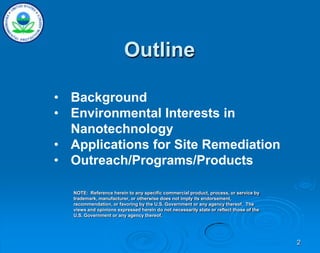
• Background
• Environmental Interests in
Nanotechnology
• Applications for Site Remediation
• Outreach/Programs/Products
NOTE: Reference herein to any specific commercial product, process, or service by
trademark, manufacturer, or otherwise does not imply its endorsement,
recommendation, or favoring by the U.S. Government or any agency thereof. The
views and opinions expressed herein do not necessarily state or reflect those of the
U.S. Government or any agency thereof.
Outline
33
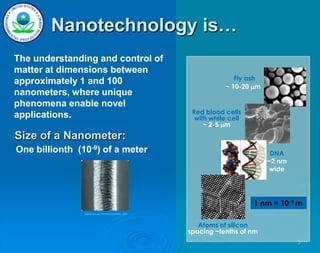
One billionth (10-9) of a meter
3
DNA
~2 nm
wide
Red blood cells
with white cell
~ 2-5 mm
Fly ash
~ 10-20 mm
Atoms of silicon
spacing ~tenths of nm
1 nm = 10-9 m
The understanding and control of
matter at dimensions between
approximately 1 and 100
nanometers, where unique
phenomena enable novel
applications.
Mazur Group, HarvardUniversity, 2008
Nanotechnology is…
Size of a Nanometer:
5
Properties of
Nanoscale Materials
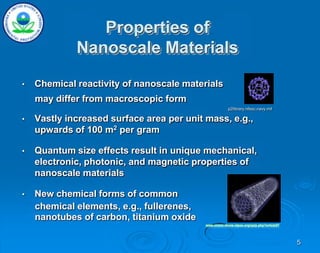
• Chemical reactivity of nanoscale materials
may differ from macroscopic form
• Vastly increased surface area per unit mass, e.g.,
upwards of 100 m2 per gram
• Quantum size effects result in unique mechanical,
electronic, photonic, and magnetic properties of
nanoscale materials
• New chemical forms of common
chemical elements, e.g., fullerenes,
nanotubes of carbon, titanium oxide
www.cnano-rhone-alpes.org/spip.php?article57
p2library.nfesc.navy.mil
8
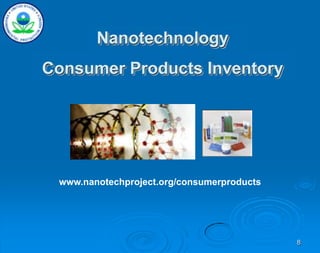
Nanotechnology
Consumer Products Inventory
www.nanotechproject.org/consumerproducts
9
Environmental Interests in
Nanotechnology
Applications
Potential for improved environmental protection
– Clean up past environmental problems
– Improve present processes
– Prevent future environmental problems
Implications
Potential to adversely affect human health or the environment
– Potential toxicity, potential exposure, fate & transport
– Potential impacts for regulatory responsibilities
10
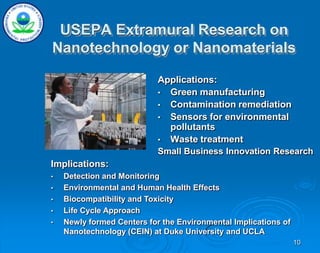
USEPA Extramural Research on
Nanotechnology or Nanomaterials
Applications:
• Green manufacturing
• Contamination remediation
• Sensors for environmental
pollutants
• Waste treatment
Small Business Innovation Research
Implications:
• Detection and Monitoring
• Environmental and Human Health Effects
• Biocompatibility and Toxicity
• Life Cycle Approach
• Newly formed Centers for the Environmental Implications of
Nanotechnology (CEIN) at Duke University and UCLA
www.sciencejobs.com
11
USEPA’s Nanomaterial
Research Strategy
In the near term, EPA will focus on:
- Environmental fate, transport, transformation
- Exposure
- Monitoring and detection methods
- Effects assessment methods
12
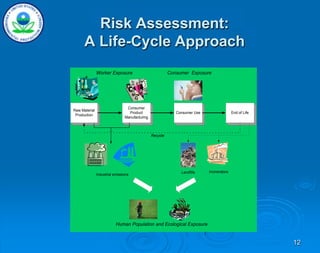
Risk Assessment:
A Life-Cycle Approach
Raw Material
Production
Consumer
Product
Manufacturing
Consumer Use End of Life
Worker Exposure Consumer Exposure
Recycle
Landfills Incinerators
Human Population and Ecological Exposure
Industrial emissions
13
Nanotechnology Applications
for
Site Remediation
http://yosemite.epa.gov/r10/cleanup.nsf/sites/CleanCare?OpenDocument
14
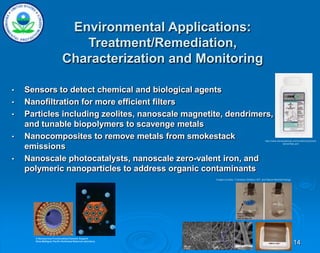
• Sensors to detect chemical and biological agents
• Nanofiltration for more efficient filters
• Particles including zeolites, nanoscale magnetite, dendrimers,
and tunable biopolymers to scavenge metals
• Nanocomposites to remove metals from smokestack
emissions
• Nanoscale photocatalysts, nanoscale zero-valent iron, and
polymeric nanoparticles to address organic contaminants
Images courtesy / Francesco Stellacci, MIT, and Nature Nanotechnology
http://www.nanoscalecorp.com/content.php/chem
decon/fast_act/
Environmental Applications:
Treatment/Remediation,
Characterization and Monitoring
A Nanoporous Functionalized Ceramic Support
Shas Mattigod, Pacific Northwest National Laboratory
15
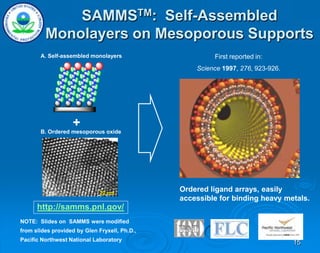
SAMMSTM: Self-Assembled
Monolayers on Mesoporous Supports
20 nm
A. Self-assembled monolayers
B. Ordered mesoporous oxide
+
First reported in:
Science 1997, 276, 923-926.
http://samms.pnl.gov/
Ordered ligand arrays, easily
accessible for binding heavy metals.
NOTE: Slides on SAMMS were modified
from slides provided by Glen Fryxell, Ph.D.,
Pacific Northwest National Laboratory
20 nm
16
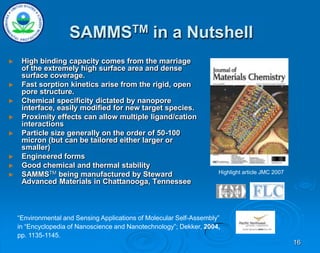
SAMMSTM in a Nutshell
High binding capacity comes from the marriage
of the extremely high surface area and dense
surface coverage.
Fast sorption kinetics arise from the rigid, open
pore structure.
Chemical specificity dictated by nanopore
interface, easily modified for new target species.
Proximity effects can allow multiple ligand/cation
interactions
Particle size generally on the order of 50-100
micron (but can be tailored either larger or
smaller)
Engineered forms
Good chemical and thermal stability
SAMMSTM being manufactured by Steward
Advanced Materials in Chattanooga, Tennessee
“Environmental and Sensing Applications of Molecular Self-Assembly”
in “Encyclopedia of Nanoscience and Nanotechnology”; Dekker, 2004,
pp. 1135-1145.
Highlight article JMC 2007
17
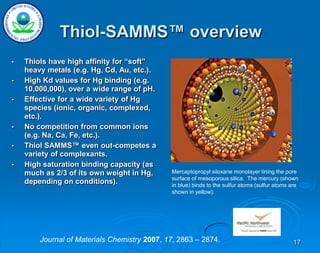
Thiol-SAMMS™ overview
• Thiols have high affinity for “soft”
heavy metals (e.g. Hg, Cd, Au, etc.).
• High Kd values for Hg binding (e.g.
10,000,000), over a wide range of pH.
• Effective for a wide variety of Hg
species (ionic, organic, complexed,
etc.).
• No competition from common ions
(e.g. Na, Ca, Fe, etc.).
• Thiol SAMMS™ even out-competes a
variety of complexants.
• High saturation binding capacity (as
much as 2/3 of its own weight in Hg,
depending on conditions).
Mercaptopropyl siloxane monolayer lining the pore
surface of mesoporous silica. The mercury (shown
in blue) binds to the sulfur atoms (sulfur atoms are
shown in yellow).
Journal of Materials Chemistry 2007, 17, 2863 – 2874.
18
SAMMS™ Projects
1. Large scale industrial demonstration
– 10 gpm continuous flow
– 450,000+ gallons treated for Hg contamination
– Reduced [Hg] from input ~25 ppb down to <10 ppt.
2. ISIS demonstration at Couer-Rochester mine
– >85% Hg removed in 72 hours
– Rotating drums provide excellent mixing with very low power
consumption
– Can be solar powered
Photo courtesy of Steward
Advanced Materials
19
Additional SAMMS™ Projects
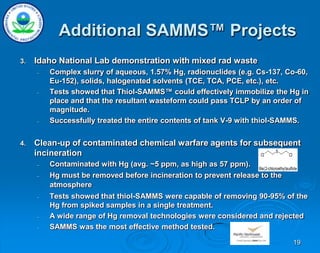
3. Idaho National Lab demonstration with mixed rad waste
– Complex slurry of aqueous, 1.57% Hg, radionuclides (e.g. Cs-137, Co-60,
Eu-152), solids, halogenated solvents (TCE, TCA, PCE, etc.), etc.
– Tests showed that Thiol-SAMMS™ could effectively immobilize the Hg in
place and that the resultant wasteform could pass TCLP by an order of
magnitude.
– Successfully treated the entire contents of tank V-9 with thiol-SAMMS.
4. Clean-up of contaminated chemical warfare agents for subsequent
incineration
– Contaminated with Hg (avg. ~5 ppm, as high as 57 ppm).
– Hg must be removed before incineration to prevent release to the
atmosphere
– Tests showed that thiol-SAMMS were capable of removing 90-95% of the
Hg from spiked samples in a single treatment.
– A wide range of Hg removal technologies were considered and rejected
– SAMMS was the most effective method tested.
Cl
S
Cl
Bis(2-chloroethyl)sulfide
20
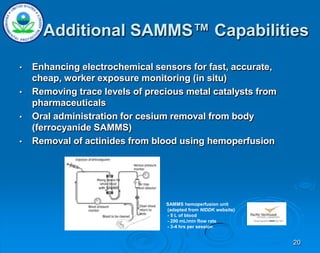
Additional SAMMS™ Capabilities
• Enhancing electrochemical sensors for fast, accurate,
cheap, worker exposure monitoring (in situ)
• Removing trace levels of precious metal catalysts from
pharmaceuticals
• Oral administration for cesium removal from body
(ferrocyanide SAMMS)
• Removal of actinides from blood using hemoperfusion
SAMMS hemoperfusion unit
(adapted from NIDDK website)
- 5 L of blood
- 200 mL/min flow rate
- 3-4 hrs per session
21
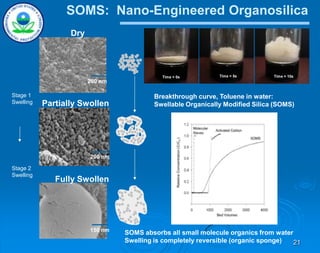
200 nm
200 nm
150 nm
Dry
Fully Swollen
Partially Swollen
Time = 0s Time = 5s Time = 10s
SOMS: Nano-Engineered Organosilica
Stage 1
Swelling
Stage 2
Swelling
Breakthrough curve, Toluene in water:
Swellable Organically Modified Silica (SOMS)
SOMS absorbs all small molecule organics from water
Swelling is completely reversible (organic sponge)
22
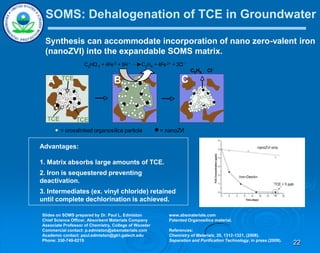
C2HCl 3 + 4Fe 0 + 5H+ C2H6 + 4Fe 2+ + 3Cl -
A B C
TCE
TCE
TCE
C2H6 Cl-
= crosslinked organosilica particle = nanoZVI
SOMS: Dehalogenation of TCE in Groundwater
Synthesis can accommodate incorporation of nano zero-valent iron
(nanoZVI) into the expandable SOMS matrix.
Advantages:
1. Matrix absorbs large amounts of TCE.
2. Iron is sequestered preventing
deactivation.
3. Intermediates (ex. vinyl chloride) retained
until complete dechlorination is achieved.
Slides on SOMS prepared by Dr. Paul L. Edmiston
Chief Science Officer, Absorbent Materials Company
Associate Professor of Chemistry, College of Wooster
Commercial contact: p.edmiston@absmaterials.com
Academic contact: paul.edmiston@gtri.gatech.edu
Phone: 330-749-0219
www.absmaterials.com
Patented Organosilica material.
References:
Chemistry of Materials, 20, 1312-1321, (2008).
Separation and Purification Technology, in press (2009).
23
Environmental
Environmental
Nanotechnology
PUBLISHED BY
THE AMERICAN
CHEMICAL SOCIETY
Science & Technology
Wei-xianZhang,Lehigh
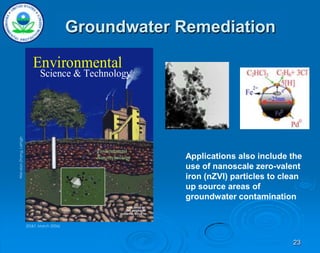
Applications also include the
use of nanoscale zero-valent
iron (nZVI) particles to clean
up source areas of
groundwater contamination
(ES&T, March 2006)
Groundwater Remediation
24
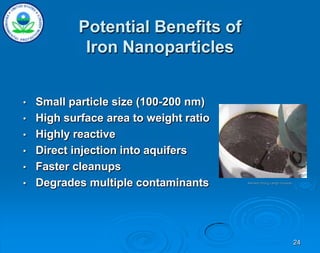
• Small particle size (100-200 nm)
• High surface area to weight ratio
• Highly reactive
• Direct injection into aquifers
• Faster cleanups
• Degrades multiple contaminants Wei-Xian Zhang, Lehigh University
Potential Benefits of
Iron Nanoparticles
25
nZVI - Limitations
• Site location
• Geologic conditions
• Concentration of contaminants
• Challenge to monitor the distribution of the
injected nanoparticles
• Issues of potential toxicity and safety
26
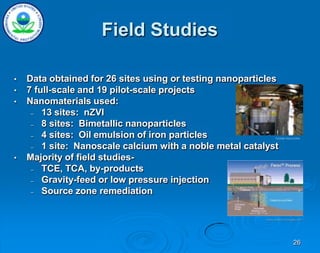
• Data obtained for 26 sites using or testing nanoparticles
• 7 full-scale and 19 pilot-scale projects
• Nanomaterials used:
– 13 sites: nZVI
– 8 sites: Bimetallic nanoparticles
– 4 sites: Oil emulsion of iron particles
– 1 site: Nanoscale calcium with a noble metal catalyst
• Majority of field studies-
– TCE, TCA, by-products
– Gravity-feed or low pressure injection
– Source zone remediation
Field Studies
www.arstechnologies.com
Golder Associates
27
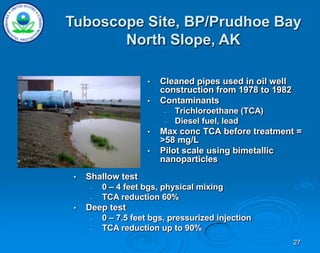
• Cleaned pipes used in oil well
construction from 1978 to 1982
• Contaminants
– Trichloroethane (TCA)
– Diesel fuel, lead
• Max conc TCA before treatment =
>58 mg/L
• Pilot scale using bimetallic
nanoparticles
Tuboscope Site, BP/Prudhoe Bay
North Slope, AK
• Shallow test
– 0 – 4 feet bgs, physical mixing
– TCA reduction 60%
• Deep test
– 0 – 7.5 feet bgs, pressurized injection
– TCA reduction up to 90%
28
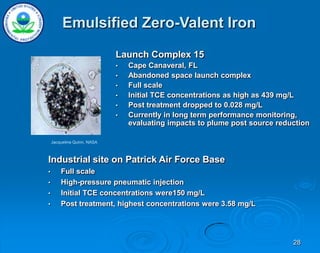
Launch Complex 15
• Cape Canaveral, FL
• Abandoned space launch complex
• Full scale
• Initial TCE concentrations as high as 439 mg/L
• Post treatment dropped to 0.028 mg/L
• Currently in long term performance monitoring,
evaluating impacts to plume post source reduction
Jacqueline Quinn, NASA
Industrial site on Patrick Air Force Base
• Full scale
• High-pressure pneumatic injection
• Initial TCE concentrations were150 mg/L
• Post treatment, highest concentrations were 3.58 mg/L
Emulsified Zero-Valent Iron
30
• Superfund fact sheet on nanotechnology for site remediation and
information on test sites
http://clu-in.org/542f08009
• Series of Internet Seminars on Nanotechnology and Superfund
http://clu-in.org/training
• Issues area on CLU-IN website
http://clu-in.org/nano
• EPA nanotechnology websites
– OPPT: http://epa.gov/oppt/nano/
– ORD/NCER: http://epa.gov/ncer/nano/index.html
– OSWER: http://epa.gov/swerrims/nanotechnology/index.htm
• Workshops/Conferences on Environmental Applications and
Implications of Nanotechnology
– http://www.frtr.gov/nano
– http://esc.syrres.com/nanotech/
– http://www.epa.gov/OSP/hstl/Nanotech%20Proceedings.pdf
– http://www.emsus.com/nanotechconf/
Outreach/Programs/Products
31
Take-Home Messages
• Nanotechnology is a very powerful new mixture of
disciplines that is changing our industries and our lives
• Applications are currently being developed and
implemented, including promising environmental
technologies (e.g., innovative applications for waste site
remediation and wastewater treatment)
• Needs:
– Research
• Potential toxicity
• Fate, transport, transformation
• Monitoring techniques
• Fine-tuning the applications
– Outreach
32
Marti Otto
USEPA
Office of Superfund Remediation
and Technology Innovation
703.603.8853
Otto.martha@epa.gov
For More Information
Focus of This Session
33
• State-of-the-art of the technology
• Potential environmental benefits
• Concerns and issues
(i.e., challenges for implementation)
• Policy considerations

Thiol SAMMS 44049960

  • 1.
    Nanotechnology for Site Remediation MartiOtto Office of Superfund Remediation and Technology Innovation U.S. Environmental Protection Agency Washington, D.C. 20460 OECD Conference on Potential Environmental Benefits of Nanotechnology: Fostering Safe Innovation-Led Growth 15-17 July 2009 OECD Conference Centre Paris, France
  • 2.
    2 • Background • EnvironmentalInterests in Nanotechnology • Applications for Site Remediation • Outreach/Programs/Products NOTE: Reference herein to any specific commercial product, process, or service by trademark, manufacturer, or otherwise does not imply its endorsement, recommendation, or favoring by the U.S. Government or any agency thereof. The views and opinions expressed herein do not necessarily state or reflect those of the U.S. Government or any agency thereof. Outline
  • 3.
    33 One billionth (10-9)of a meter 3 DNA ~2 nm wide Red blood cells with white cell ~ 2-5 mm Fly ash ~ 10-20 mm Atoms of silicon spacing ~tenths of nm 1 nm = 10-9 m The understanding and control of matter at dimensions between approximately 1 and 100 nanometers, where unique phenomena enable novel applications. Mazur Group, HarvardUniversity, 2008 Nanotechnology is… Size of a Nanometer:
  • 4.
    5 Properties of Nanoscale Materials •Chemical reactivity of nanoscale materials may differ from macroscopic form • Vastly increased surface area per unit mass, e.g., upwards of 100 m2 per gram • Quantum size effects result in unique mechanical, electronic, photonic, and magnetic properties of nanoscale materials • New chemical forms of common chemical elements, e.g., fullerenes, nanotubes of carbon, titanium oxide www.cnano-rhone-alpes.org/spip.php?article57 p2library.nfesc.navy.mil
  • 5.
  • 6.
    9 Environmental Interests in Nanotechnology Applications Potentialfor improved environmental protection – Clean up past environmental problems – Improve present processes – Prevent future environmental problems Implications Potential to adversely affect human health or the environment – Potential toxicity, potential exposure, fate & transport – Potential impacts for regulatory responsibilities
  • 7.
    10 USEPA Extramural Researchon Nanotechnology or Nanomaterials Applications: • Green manufacturing • Contamination remediation • Sensors for environmental pollutants • Waste treatment Small Business Innovation Research Implications: • Detection and Monitoring • Environmental and Human Health Effects • Biocompatibility and Toxicity • Life Cycle Approach • Newly formed Centers for the Environmental Implications of Nanotechnology (CEIN) at Duke University and UCLA www.sciencejobs.com
  • 8.
    11 USEPA’s Nanomaterial Research Strategy Inthe near term, EPA will focus on: - Environmental fate, transport, transformation - Exposure - Monitoring and detection methods - Effects assessment methods
  • 9.
    12 Risk Assessment: A Life-CycleApproach Raw Material Production Consumer Product Manufacturing Consumer Use End of Life Worker Exposure Consumer Exposure Recycle Landfills Incinerators Human Population and Ecological Exposure Industrial emissions
  • 10.
  • 11.
    14 • Sensors todetect chemical and biological agents • Nanofiltration for more efficient filters • Particles including zeolites, nanoscale magnetite, dendrimers, and tunable biopolymers to scavenge metals • Nanocomposites to remove metals from smokestack emissions • Nanoscale photocatalysts, nanoscale zero-valent iron, and polymeric nanoparticles to address organic contaminants Images courtesy / Francesco Stellacci, MIT, and Nature Nanotechnology http://www.nanoscalecorp.com/content.php/chem decon/fast_act/ Environmental Applications: Treatment/Remediation, Characterization and Monitoring A Nanoporous Functionalized Ceramic Support Shas Mattigod, Pacific Northwest National Laboratory
  • 12.
    15 SAMMSTM: Self-Assembled Monolayers onMesoporous Supports 20 nm A. Self-assembled monolayers B. Ordered mesoporous oxide + First reported in: Science 1997, 276, 923-926. http://samms.pnl.gov/ Ordered ligand arrays, easily accessible for binding heavy metals. NOTE: Slides on SAMMS were modified from slides provided by Glen Fryxell, Ph.D., Pacific Northwest National Laboratory 20 nm
  • 13.
    16 SAMMSTM in aNutshell High binding capacity comes from the marriage of the extremely high surface area and dense surface coverage. Fast sorption kinetics arise from the rigid, open pore structure. Chemical specificity dictated by nanopore interface, easily modified for new target species. Proximity effects can allow multiple ligand/cation interactions Particle size generally on the order of 50-100 micron (but can be tailored either larger or smaller) Engineered forms Good chemical and thermal stability SAMMSTM being manufactured by Steward Advanced Materials in Chattanooga, Tennessee “Environmental and Sensing Applications of Molecular Self-Assembly” in “Encyclopedia of Nanoscience and Nanotechnology”; Dekker, 2004, pp. 1135-1145. Highlight article JMC 2007
  • 14.
    17 Thiol-SAMMS™ overview • Thiolshave high affinity for “soft” heavy metals (e.g. Hg, Cd, Au, etc.). • High Kd values for Hg binding (e.g. 10,000,000), over a wide range of pH. • Effective for a wide variety of Hg species (ionic, organic, complexed, etc.). • No competition from common ions (e.g. Na, Ca, Fe, etc.). • Thiol SAMMS™ even out-competes a variety of complexants. • High saturation binding capacity (as much as 2/3 of its own weight in Hg, depending on conditions). Mercaptopropyl siloxane monolayer lining the pore surface of mesoporous silica. The mercury (shown in blue) binds to the sulfur atoms (sulfur atoms are shown in yellow). Journal of Materials Chemistry 2007, 17, 2863 – 2874.
  • 15.
    18 SAMMS™ Projects 1. Largescale industrial demonstration – 10 gpm continuous flow – 450,000+ gallons treated for Hg contamination – Reduced [Hg] from input ~25 ppb down to <10 ppt. 2. ISIS demonstration at Couer-Rochester mine – >85% Hg removed in 72 hours – Rotating drums provide excellent mixing with very low power consumption – Can be solar powered Photo courtesy of Steward Advanced Materials
  • 16.
    19 Additional SAMMS™ Projects 3.Idaho National Lab demonstration with mixed rad waste – Complex slurry of aqueous, 1.57% Hg, radionuclides (e.g. Cs-137, Co-60, Eu-152), solids, halogenated solvents (TCE, TCA, PCE, etc.), etc. – Tests showed that Thiol-SAMMS™ could effectively immobilize the Hg in place and that the resultant wasteform could pass TCLP by an order of magnitude. – Successfully treated the entire contents of tank V-9 with thiol-SAMMS. 4. Clean-up of contaminated chemical warfare agents for subsequent incineration – Contaminated with Hg (avg. ~5 ppm, as high as 57 ppm). – Hg must be removed before incineration to prevent release to the atmosphere – Tests showed that thiol-SAMMS were capable of removing 90-95% of the Hg from spiked samples in a single treatment. – A wide range of Hg removal technologies were considered and rejected – SAMMS was the most effective method tested. Cl S Cl Bis(2-chloroethyl)sulfide
  • 17.
    20 Additional SAMMS™ Capabilities •Enhancing electrochemical sensors for fast, accurate, cheap, worker exposure monitoring (in situ) • Removing trace levels of precious metal catalysts from pharmaceuticals • Oral administration for cesium removal from body (ferrocyanide SAMMS) • Removal of actinides from blood using hemoperfusion SAMMS hemoperfusion unit (adapted from NIDDK website) - 5 L of blood - 200 mL/min flow rate - 3-4 hrs per session
  • 18.
    21 200 nm 200 nm 150nm Dry Fully Swollen Partially Swollen Time = 0s Time = 5s Time = 10s SOMS: Nano-Engineered Organosilica Stage 1 Swelling Stage 2 Swelling Breakthrough curve, Toluene in water: Swellable Organically Modified Silica (SOMS) SOMS absorbs all small molecule organics from water Swelling is completely reversible (organic sponge)
  • 19.
    22 C2HCl 3 +4Fe 0 + 5H+ C2H6 + 4Fe 2+ + 3Cl - A B C TCE TCE TCE C2H6 Cl- = crosslinked organosilica particle = nanoZVI SOMS: Dehalogenation of TCE in Groundwater Synthesis can accommodate incorporation of nano zero-valent iron (nanoZVI) into the expandable SOMS matrix. Advantages: 1. Matrix absorbs large amounts of TCE. 2. Iron is sequestered preventing deactivation. 3. Intermediates (ex. vinyl chloride) retained until complete dechlorination is achieved. Slides on SOMS prepared by Dr. Paul L. Edmiston Chief Science Officer, Absorbent Materials Company Associate Professor of Chemistry, College of Wooster Commercial contact: p.edmiston@absmaterials.com Academic contact: paul.edmiston@gtri.gatech.edu Phone: 330-749-0219 www.absmaterials.com Patented Organosilica material. References: Chemistry of Materials, 20, 1312-1321, (2008). Separation and Purification Technology, in press (2009).
  • 20.
    23 Environmental Environmental Nanotechnology PUBLISHED BY THE AMERICAN CHEMICALSOCIETY Science & Technology Wei-xianZhang,Lehigh Applications also include the use of nanoscale zero-valent iron (nZVI) particles to clean up source areas of groundwater contamination (ES&T, March 2006) Groundwater Remediation
  • 21.
    24 • Small particlesize (100-200 nm) • High surface area to weight ratio • Highly reactive • Direct injection into aquifers • Faster cleanups • Degrades multiple contaminants Wei-Xian Zhang, Lehigh University Potential Benefits of Iron Nanoparticles
  • 22.
    25 nZVI - Limitations •Site location • Geologic conditions • Concentration of contaminants • Challenge to monitor the distribution of the injected nanoparticles • Issues of potential toxicity and safety
  • 23.
    26 • Data obtainedfor 26 sites using or testing nanoparticles • 7 full-scale and 19 pilot-scale projects • Nanomaterials used: – 13 sites: nZVI – 8 sites: Bimetallic nanoparticles – 4 sites: Oil emulsion of iron particles – 1 site: Nanoscale calcium with a noble metal catalyst • Majority of field studies- – TCE, TCA, by-products – Gravity-feed or low pressure injection – Source zone remediation Field Studies www.arstechnologies.com Golder Associates
  • 24.
    27 • Cleaned pipesused in oil well construction from 1978 to 1982 • Contaminants – Trichloroethane (TCA) – Diesel fuel, lead • Max conc TCA before treatment = >58 mg/L • Pilot scale using bimetallic nanoparticles Tuboscope Site, BP/Prudhoe Bay North Slope, AK • Shallow test – 0 – 4 feet bgs, physical mixing – TCA reduction 60% • Deep test – 0 – 7.5 feet bgs, pressurized injection – TCA reduction up to 90%
  • 25.
    28 Launch Complex 15 •Cape Canaveral, FL • Abandoned space launch complex • Full scale • Initial TCE concentrations as high as 439 mg/L • Post treatment dropped to 0.028 mg/L • Currently in long term performance monitoring, evaluating impacts to plume post source reduction Jacqueline Quinn, NASA Industrial site on Patrick Air Force Base • Full scale • High-pressure pneumatic injection • Initial TCE concentrations were150 mg/L • Post treatment, highest concentrations were 3.58 mg/L Emulsified Zero-Valent Iron
  • 26.
    30 • Superfund factsheet on nanotechnology for site remediation and information on test sites http://clu-in.org/542f08009 • Series of Internet Seminars on Nanotechnology and Superfund http://clu-in.org/training • Issues area on CLU-IN website http://clu-in.org/nano • EPA nanotechnology websites – OPPT: http://epa.gov/oppt/nano/ – ORD/NCER: http://epa.gov/ncer/nano/index.html – OSWER: http://epa.gov/swerrims/nanotechnology/index.htm • Workshops/Conferences on Environmental Applications and Implications of Nanotechnology – http://www.frtr.gov/nano – http://esc.syrres.com/nanotech/ – http://www.epa.gov/OSP/hstl/Nanotech%20Proceedings.pdf – http://www.emsus.com/nanotechconf/ Outreach/Programs/Products
  • 27.
    31 Take-Home Messages • Nanotechnologyis a very powerful new mixture of disciplines that is changing our industries and our lives • Applications are currently being developed and implemented, including promising environmental technologies (e.g., innovative applications for waste site remediation and wastewater treatment) • Needs: – Research • Potential toxicity • Fate, transport, transformation • Monitoring techniques • Fine-tuning the applications – Outreach
  • 28.
    32 Marti Otto USEPA Office ofSuperfund Remediation and Technology Innovation 703.603.8853 Otto.martha@epa.gov For More Information
  • 29.
    Focus of ThisSession 33 • State-of-the-art of the technology • Potential environmental benefits • Concerns and issues (i.e., challenges for implementation) • Policy considerations