Prof. LONGE Olumide Babatope
Distinguished Fulbright Fellow & Heidelberg Nobel Laureate Forum Fellow
Dean, Caleb Business School
Caleb University
Lagos, Nigeria
BASIC DEFINITIONS
 Legacies -
Something left or handed down by a predecessor.
 Illegality
The illegality of a transaction, either because of public policy under the
common law, or because of legislation, potentially means no action
directly concerning the deal will be heard by the courts
 Passivism
Accepting or allowing what happens or what others do, without active
response or resistance
- God the Almighty says in the Quran: "And fear tumult or oppression,
which affects not in particular (only) those of you who do wrong: and
know that God is strict in punishment." (Quran 8:25).
- See how God the Merciful is warning us that misconduct doesn't just
affect the ones that do it, but it has a wider range.
EFFECT OF PASSIVISM
- The Companions asked the Messenger of God, "Will we be
destroyed even if the righteous ones are amongst us?" Prophet
Muhammad replied, "Yes, if corruption increases." It was also
reported that God ordered Angle Gabriel to destroy a village that
had become extremely corrupted, but Gabriel asked God, "O God,
in this village is your servant that constantly prays to You",
- God replied, "Start with him! For his face never changed with
disapproval to what had been going on." Because this righteous
man was passive, he too was punished with the sinners.
- Omar ibn Al-Khattab said, "If a sin is committed in private, it
only harms the one that does it, but if it is committed in public
and no one objects and changes it, it will harm everyone!“
- Is. 39: 8 - Then Hezekiah said to Isaiah, "This message you have
given me from the LORD is good." For the king was thinking, "At
least there will be peace and security during my lifetime."
COGNITIVE DISTORTIONS
 Most of us are so focused on getting somewhere or
obtaining something that we forget that productivity
and happiness  lives in the way we see the world, our
beliefs about ourselves, about others and the way we
think. What you think and how you think will
determine your path.
 Cognitive distortions (So — how we think) are simply
ways that our mind convinces us of something that
isn’t really true. These inaccurate thoughts are
usually used to reinforce negative thinking or
emotions — telling ourselves things that sound
rational and accurate, but really only serve to keep
us feeling bad about ourselves by playing broken
records. There are many cognitive distortions.
COMMON COGNITIVE
DISTORTIONS.
 Filtering - We take the negative details and magnify
them, while filtering out all positive aspects of a
situation. For instance, a person may pick out a
single, unpleasant detail and dwell on it exclusively,
so that their vision of reality becomes darkened or
distorted.
 Polarized (“Black and White”) : In polarized thinking,
things are either “black or white": We have to be
perfect, or we’re a failure; there is no middle ground.
 Overgeneralization: Coming to a general conclusion
based on a single incident or piece of evidence. If
something bad happens once, for example, we may
expect it to happen over and over again.
COMMON COGNITIVE
DISTORTIONS(CONTD)
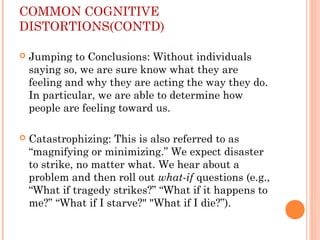
 Jumping to Conclusions: Without individuals
saying so, we are sure know what they are
feeling and why they are acting the way they do.
In particular, we are able to determine how
people are feeling toward us.
 Catastrophizing: This is also referred to as
“magnifying or minimizing.” We expect disaster
to strike, no matter what. We hear about a
problem and then roll out what-if questions (e.g.,
“What if tragedy strikes?” “What if it happens to
me?” “What if I starve?" "What if I die?”).
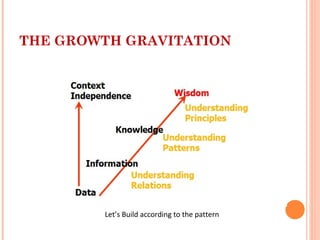
THE GROWTH GRAVITATION
Let’s Build according to the pattern
CRITICAL COMPETENCIES FOR A
NEW THOUGHT PATTERN
1. Personal responsibility,
2. Ability to act in principled, ethical fashion,
3. Skills in oral and written communication,
4. Interpersonal and team skills,
5. Skills in critical thinking and problem-solving,
6. Respect for people different from oneself,
7. Ability to change,
8. Ability and desire for lifelong learning.
NUGGETS FOR TEACHERS IN THE AGE
OF NEW THINKING
 Educate to produce “Intentional Learners who can adapt to
new environments, integrate knowledge from different sources,
and continue learning throughout their lives. Intentional
Learners are Empowered, Informed and Responsible
 Becoming an intentional learner means: developing self-
awareness about the reason for study, the learning process itself,
and how education is used
 Intentional learners are integrative thinkers who see connections
in seemingly disparate information to inform their decisions.
PRODUCE CRITICAL THINKERS
 “… is the intellectually disciplined process of actively and skillfully
conceptualizing, applying, analyzing, synthesizing, and/or evaluating
information gathered from, or generated by, observation, experience,
reflection, reasoning, or communication, as a guide to belief and action”
Strong critical thinkers demonstrate the following characteristics:
 inquisitiveness with regard to a wide range of issues
 concern to become and remain well-informed
 alertness to opportunities to use critical thinking
 open-mindedness regarding divergent world views
 flexibility in considering alternatives and opinions
 understanding of the opinions of other people
 fair-mindedness in appraising reasoning
 honesty in facing one’s own biases, prejudices, stereotypes, or egocentric
tendencies
 prudence in suspending, making or altering judgments
 willingness to reconsider and revise views where honest reflection
suggests that change is warranted
It is in the human mind – its in how we think .
Alan Webber
It has been a pleasure speaking to you all -
Happy Independence Day & Thank you for
your attention

Thinking Differently - Edves Catalyst 2018

  • 1.
    Prof. LONGE OlumideBabatope Distinguished Fulbright Fellow & Heidelberg Nobel Laureate Forum Fellow Dean, Caleb Business School Caleb University Lagos, Nigeria
  • 2.
    BASIC DEFINITIONS  Legacies- Something left or handed down by a predecessor.  Illegality The illegality of a transaction, either because of public policy under the common law, or because of legislation, potentially means no action directly concerning the deal will be heard by the courts  Passivism Accepting or allowing what happens or what others do, without active response or resistance - God the Almighty says in the Quran: "And fear tumult or oppression, which affects not in particular (only) those of you who do wrong: and know that God is strict in punishment." (Quran 8:25). - See how God the Merciful is warning us that misconduct doesn't just affect the ones that do it, but it has a wider range.
  • 3.
    EFFECT OF PASSIVISM -The Companions asked the Messenger of God, "Will we be destroyed even if the righteous ones are amongst us?" Prophet Muhammad replied, "Yes, if corruption increases." It was also reported that God ordered Angle Gabriel to destroy a village that had become extremely corrupted, but Gabriel asked God, "O God, in this village is your servant that constantly prays to You", - God replied, "Start with him! For his face never changed with disapproval to what had been going on." Because this righteous man was passive, he too was punished with the sinners. - Omar ibn Al-Khattab said, "If a sin is committed in private, it only harms the one that does it, but if it is committed in public and no one objects and changes it, it will harm everyone!“ - Is. 39: 8 - Then Hezekiah said to Isaiah, "This message you have given me from the LORD is good." For the king was thinking, "At least there will be peace and security during my lifetime."
  • 4.
    COGNITIVE DISTORTIONS  Mostof us are so focused on getting somewhere or obtaining something that we forget that productivity and happiness  lives in the way we see the world, our beliefs about ourselves, about others and the way we think. What you think and how you think will determine your path.  Cognitive distortions (So — how we think) are simply ways that our mind convinces us of something that isn’t really true. These inaccurate thoughts are usually used to reinforce negative thinking or emotions — telling ourselves things that sound rational and accurate, but really only serve to keep us feeling bad about ourselves by playing broken records. There are many cognitive distortions.
  • 5.
    COMMON COGNITIVE DISTORTIONS.  Filtering- We take the negative details and magnify them, while filtering out all positive aspects of a situation. For instance, a person may pick out a single, unpleasant detail and dwell on it exclusively, so that their vision of reality becomes darkened or distorted.  Polarized (“Black and White”) : In polarized thinking, things are either “black or white": We have to be perfect, or we’re a failure; there is no middle ground.  Overgeneralization: Coming to a general conclusion based on a single incident or piece of evidence. If something bad happens once, for example, we may expect it to happen over and over again.
  • 6.
    COMMON COGNITIVE DISTORTIONS(CONTD)  Jumpingto Conclusions: Without individuals saying so, we are sure know what they are feeling and why they are acting the way they do. In particular, we are able to determine how people are feeling toward us.  Catastrophizing: This is also referred to as “magnifying or minimizing.” We expect disaster to strike, no matter what. We hear about a problem and then roll out what-if questions (e.g., “What if tragedy strikes?” “What if it happens to me?” “What if I starve?" "What if I die?”).
  • 7.
    THE GROWTH GRAVITATION Let’sBuild according to the pattern
  • 8.
    CRITICAL COMPETENCIES FORA NEW THOUGHT PATTERN 1. Personal responsibility, 2. Ability to act in principled, ethical fashion, 3. Skills in oral and written communication, 4. Interpersonal and team skills, 5. Skills in critical thinking and problem-solving, 6. Respect for people different from oneself, 7. Ability to change, 8. Ability and desire for lifelong learning.
  • 9.
    NUGGETS FOR TEACHERSIN THE AGE OF NEW THINKING  Educate to produce “Intentional Learners who can adapt to new environments, integrate knowledge from different sources, and continue learning throughout their lives. Intentional Learners are Empowered, Informed and Responsible  Becoming an intentional learner means: developing self- awareness about the reason for study, the learning process itself, and how education is used  Intentional learners are integrative thinkers who see connections in seemingly disparate information to inform their decisions.
  • 10.
    PRODUCE CRITICAL THINKERS “… is the intellectually disciplined process of actively and skillfully conceptualizing, applying, analyzing, synthesizing, and/or evaluating information gathered from, or generated by, observation, experience, reflection, reasoning, or communication, as a guide to belief and action” Strong critical thinkers demonstrate the following characteristics:  inquisitiveness with regard to a wide range of issues  concern to become and remain well-informed  alertness to opportunities to use critical thinking  open-mindedness regarding divergent world views  flexibility in considering alternatives and opinions  understanding of the opinions of other people  fair-mindedness in appraising reasoning  honesty in facing one’s own biases, prejudices, stereotypes, or egocentric tendencies  prudence in suspending, making or altering judgments  willingness to reconsider and revise views where honest reflection suggests that change is warranted
  • 11.
    It is inthe human mind – its in how we think . Alan Webber
  • 12.
    It has beena pleasure speaking to you all - Happy Independence Day & Thank you for your attention