NAME:AKASH RANJAN
CLASS:8
SEC:B
INDEX
 AGRICULTURE
 TYPES OF AGRICULTURE IN INDIA
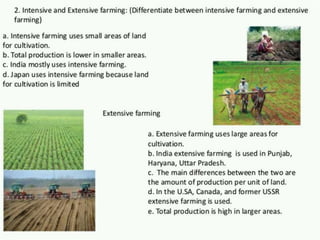
 DIFFERENCE BETWEEN
INTENSIVE AND EXTENSIVE
AGRICULTURE
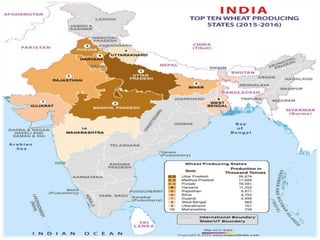
 MAP
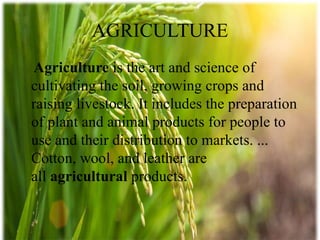
AGRICULTURE
Agriculture is the art and science of
cultivating the soil, growing crops and
raising livestock. It includes the preparation
of plant and animal products for people to
use and their distribution to markets. ...
Cotton, wool, and leather are
all agricultural products.
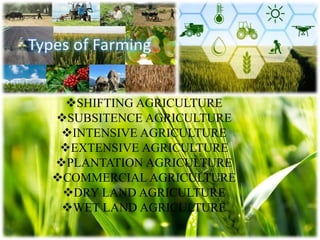
SHIFTING AGRICULTURE
SUBSITENCE AGRICULTURE
INTENSIVE AGRICULTURE
EXTENSIVE AGRICULTURE
PLANTATION AGRICULTURE
COMMERCIAL AGRICULTURE
DRY LAND AGRICULTURE
WET LAND AGRICULTURE
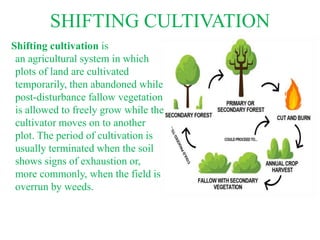
SHIFTING CULTIVATION
Shifting cultivation is
an agricultural system in which
plots of land are cultivated
temporarily, then abandoned while
post-disturbance fallow vegetation
is allowed to freely grow while the
cultivator moves on to another
plot. The period of cultivation is
usually terminated when the soil
shows signs of exhaustion or,
more commonly, when the field is
overrun by weeds.
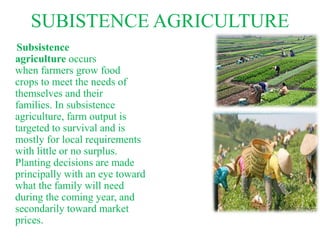
SUBISTENCE AGRICULTURE
Subsistence
agriculture occurs
when farmers grow food
crops to meet the needs of
themselves and their
families. In subsistence
agriculture, farm output is
targeted to survival and is
mostly for local requirements
with little or no surplus.
Planting decisions are made
principally with an eye toward
what the family will need
during the coming year, and
secondarily toward market
prices.
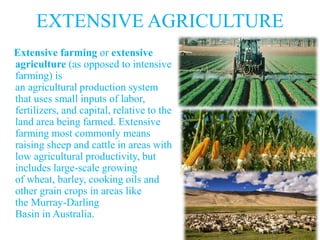
EXTENSIVE AGRICULTURE
Extensive farming or extensive
agriculture (as opposed to intensive
farming) is
an agricultural production system
that uses small inputs of labor,
fertilizers, and capital, relative to the
land area being farmed. Extensive
farming most commonly means
raising sheep and cattle in areas with
low agricultural productivity, but
includes large-scale growing
of wheat, barley, cooking oils and
other grain crops in areas like
the Murray-Darling
Basin in Australia.
PLANTATION AGRICULTURE
Plantation agriculture: This style is
often used for crops which require a
lot of growing space and a long
period, such as rubber, tea, coconut,
coffee, cocoa, spices, and fruits.
Plantations are only capable of
producing a single crop. Plantation
agriculture is practised in Kerala,
Assam, Karnataka, and
Maharashtra.
Sunflower plantation
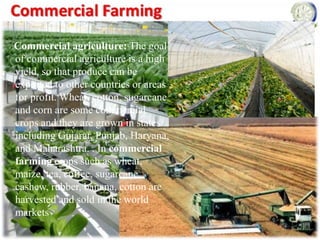
Commercial agriculture: The goal
of commercial agriculture is a high
yield, so that produce can be
exported to other countries or areas
for profit. Wheat, cotton, sugarcane,
and corn are some commercial
crops and they are grown in states
including Gujarat, Punjab, Haryana,
and Maharashtra. . In commercial
farming crops such as wheat,
maize, tea, coffee, sugarcane,
cashew, rubber, banana, cotton are
harvested and sold in the world
markets
Dry land farming: As the name
suggests, dry land farming is practised in
the more arid and desert-like areas of the
country, including northwest and central
India. Crops such as gramjowar, bajra,
and peas have lower water requirements
and can therefore be grown in these
conditions. 68 per cent of the cultivated
area in Indian agriculture comes
under dryland, which contributes about
44 per cent of the total food production
and plays a critical role in India's food
security. A vast majority of the small
scale farmers depend on the dry regions
for their livelihood
DRY LAND AGRICULTURE
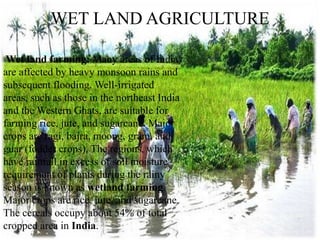
Wet land farming: Many areas of India
are affected by heavy monsoon rains and
subsequent flooding. Well-irrigated
areas, such as those in the northeast India
and the Western Ghats, are suitable for
farming rice, jute, and sugarcane. Major
crops are ragi, bajra, moong, gram, and
guar (fodder crops). The regions, which
have rainfall in excess of soil moisture
requirement of plants during the rainy
season is known as wetland farming.
Major crops are rice, jute, and sugarcane.
The cereals occupy about 54% of total
cropped area in India.
WET LAND AGRICULTURE
Agriculture
Agriculture

Agriculture

  • 1.
  • 3.
    INDEX  AGRICULTURE  TYPESOF AGRICULTURE IN INDIA  DIFFERENCE BETWEEN INTENSIVE AND EXTENSIVE AGRICULTURE  MAP
  • 4.
    AGRICULTURE Agriculture is theart and science of cultivating the soil, growing crops and raising livestock. It includes the preparation of plant and animal products for people to use and their distribution to markets. ... Cotton, wool, and leather are all agricultural products.
  • 5.
    SHIFTING AGRICULTURE SUBSITENCE AGRICULTURE INTENSIVEAGRICULTURE EXTENSIVE AGRICULTURE PLANTATION AGRICULTURE COMMERCIAL AGRICULTURE DRY LAND AGRICULTURE WET LAND AGRICULTURE
  • 6.
    SHIFTING CULTIVATION Shifting cultivationis an agricultural system in which plots of land are cultivated temporarily, then abandoned while post-disturbance fallow vegetation is allowed to freely grow while the cultivator moves on to another plot. The period of cultivation is usually terminated when the soil shows signs of exhaustion or, more commonly, when the field is overrun by weeds.
  • 7.
    SUBISTENCE AGRICULTURE Subsistence agriculture occurs whenfarmers grow food crops to meet the needs of themselves and their families. In subsistence agriculture, farm output is targeted to survival and is mostly for local requirements with little or no surplus. Planting decisions are made principally with an eye toward what the family will need during the coming year, and secondarily toward market prices.
  • 9.
    EXTENSIVE AGRICULTURE Extensive farmingor extensive agriculture (as opposed to intensive farming) is an agricultural production system that uses small inputs of labor, fertilizers, and capital, relative to the land area being farmed. Extensive farming most commonly means raising sheep and cattle in areas with low agricultural productivity, but includes large-scale growing of wheat, barley, cooking oils and other grain crops in areas like the Murray-Darling Basin in Australia.
  • 11.
    PLANTATION AGRICULTURE Plantation agriculture:This style is often used for crops which require a lot of growing space and a long period, such as rubber, tea, coconut, coffee, cocoa, spices, and fruits. Plantations are only capable of producing a single crop. Plantation agriculture is practised in Kerala, Assam, Karnataka, and Maharashtra. Sunflower plantation
  • 12.
    Commercial agriculture: Thegoal of commercial agriculture is a high yield, so that produce can be exported to other countries or areas for profit. Wheat, cotton, sugarcane, and corn are some commercial crops and they are grown in states including Gujarat, Punjab, Haryana, and Maharashtra. . In commercial farming crops such as wheat, maize, tea, coffee, sugarcane, cashew, rubber, banana, cotton are harvested and sold in the world markets
  • 13.
    Dry land farming:As the name suggests, dry land farming is practised in the more arid and desert-like areas of the country, including northwest and central India. Crops such as gramjowar, bajra, and peas have lower water requirements and can therefore be grown in these conditions. 68 per cent of the cultivated area in Indian agriculture comes under dryland, which contributes about 44 per cent of the total food production and plays a critical role in India's food security. A vast majority of the small scale farmers depend on the dry regions for their livelihood DRY LAND AGRICULTURE
  • 14.
    Wet land farming:Many areas of India are affected by heavy monsoon rains and subsequent flooding. Well-irrigated areas, such as those in the northeast India and the Western Ghats, are suitable for farming rice, jute, and sugarcane. Major crops are ragi, bajra, moong, gram, and guar (fodder crops). The regions, which have rainfall in excess of soil moisture requirement of plants during the rainy season is known as wetland farming. Major crops are rice, jute, and sugarcane. The cereals occupy about 54% of total cropped area in India. WET LAND AGRICULTURE