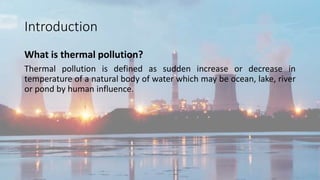
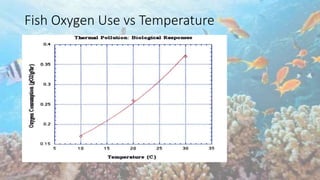
This presentation discusses thermal pollution, which is defined as a sudden increase or decrease in the temperature of a natural body of water caused by human activity. The document outlines various causes of thermal pollution including power plants, industrial facilities, soil erosion, and hydroelectric power generation. Effects of thermal pollution include reduced dissolved oxygen, changes in water properties, increased toxicity, and disruption of biological activities and damage to organisms. Control measures that can help mitigate thermal pollution are also presented such as cooling towers, cooling ponds, spray ponds, and artificial lakes. The document concludes with suggestions for individuals and students to help prevent thermal pollution through education and awareness efforts.