
NOTES from Nicola Morgan
• This is a free resource for parents of young people aged 11+ about the
positives and negatives of screens, smartphones and social media
• It is different from a Powerpoint I’d create if I were presenting it! My talks
have less text, more images, and in my spoken words I deliver a great deal
of explanation and background psychology.
• If I’m about to visit your school, please don’t show this first.
• Please only show in a private family setting, not to a wider audience in
school or elsewhere. Do ask if you want permission for that.
• My website has a free Life Online Parent Pack and many other resources.
Copyright © Nicola Morgan 2018 – free to share but : 1. Credit me 2. Do not
alter or make money from it 3. Don’t show to more than a family group.
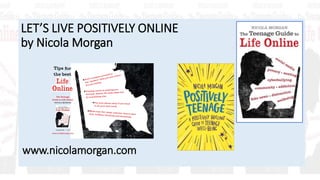
LET’S LIVE POSITIVELY ONLINE
by Nicola Morgan
www.nicolamorgan.com
What do I know?
• My work on human psychology/brain – 20+ years
• My expertise comes from wide research and deep knowledge, not
opinion or personal experience
• But I am also a heavy user of tech – possibly a bit addicted…
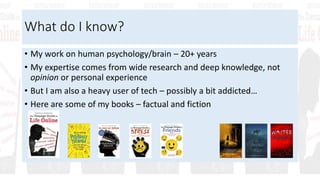
• Here are some of my books – factual and fiction
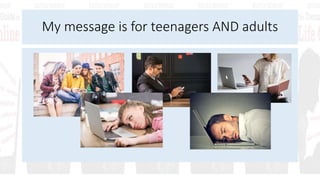
My message is for teenagers AND adults
“Young people – ALWAYS on their phones!”
This comment annoys me!
Many people of all ages spend
too much time on their devices.
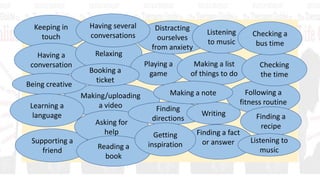
Besides, what does “on our phone” mean?
• Think of some things people do on their phones and then click to the
next screen
Keeping in
touch
Having a
conversation
Relaxing
Making/uploading
a video
Being creative
Learning a
language
Supporting a
friend
Asking for
help
Finding
directions
Reading a
book
Playing a
game
Finding a fact
or answer
Distracting
ourselves
from anxiety
Writing
Making a list
of things to do
Listening
to music
Following a
fitness routine
Checking
the time
Checking a
bus time
Getting
inspiration
Having several
conversations
Finding a
recipe
Making a note
Listening to
music
Booking a
ticket
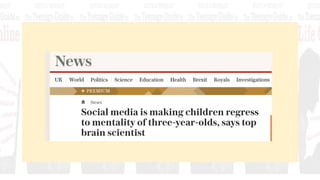
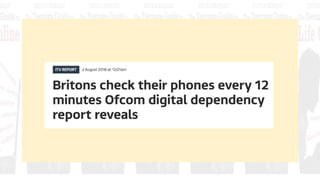
Then there are the pointless headlines
Discuss the headlines that follow.
Why do you think I say they are “pointless”?
Adults need to recognise the positives
Can you think of any before you click to the next slide?
The Teenage Guide to Life Online discusses positives
in great detail – you might be surprised at what I found!
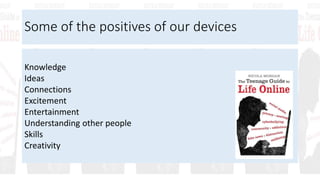
Some of the positives of our devices
Knowledge
Ideas
Connections
Excitement
Entertainment
Understanding other people
Skills
Creativity
We need to know the genuine negatives
I’m going to discuss four of them
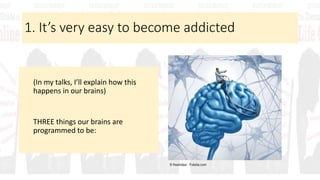
1. It’s very easy to become addicted
(In my talks, I’ll explain how this
happens in our brains)
THREE things our brains are
programmed to be:
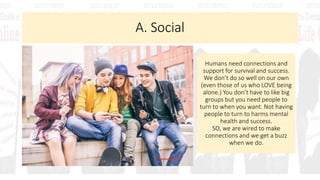
A. Social
Humans need connections and
support for survival and success.
We don’t do so well on our own
(even those of us who LOVE being
alone.) You don’t have to like big
groups but you need people to
turn to when you want. Not having
people to turn to harms mental
health and success.
SO, we are wired to make
connections and we get a buzz
when we do.
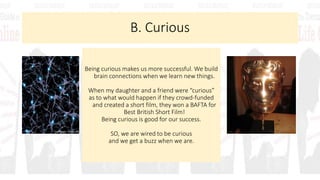
B. Curious
Being curious makes us more successful. We build
brain connections when we learn new things.
When my daughter and a friend were “curious”
as to what would happen if they crowd-funded
and created a short film, they won a BAFTA for
Best British Short Film!
Being curious is good for our success.
SO, we are wired to be curious
and we get a buzz when we are.
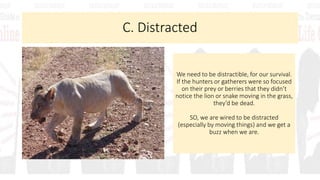
C. Distracted
We need to be distractible, for our survival.
If the hunters or gatherers were so focused
on their prey or berries that they didn’t
notice the lion or snake moving in the grass,
they’d be dead.
SO, we are wired to be distracted
(especially by moving things) and we get a
buzz when we are.
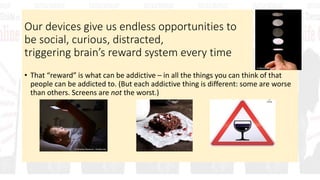
Our devices give us endless opportunities to
be social, curious, distracted,
triggering brain’s reward system every time
• That “reward” is what can be addictive – in all the things you can think of that
people can be addicted to. (But each addictive thing is different: some are worse
than others. Screens are not the worst.)
Do you think you might be a bit addicted?
Think about your phone/tablet/screen
I’m going to ask you some questions. When I say “screen” or device” I
mean ANY device you use to go online, play games or message people.
How to score:
0 for “Never or rarely”
1 for “Sometimes”
2 for “Often”
Do you:
1. Stay on screen longer than you planned to?
2. Rush your work so you can go on screen? (Or have to rush because you
spent too long on screen.)
3. Check your messages before something you ought to be doing?
4. Snap/act annoyed if someone tries to interrupt your screen time?
5. Check your phone last thing before sleep? (Or sleep with it on.)
0 = never/rarely 1 = sometimes 2 = Often
6. Try but fail to cut down your screen time?
7. Feel cross with yourself or guilty about how much time you spend on
screen?
8. Go to sleep later than you should, because of your screen use?
9. Be late or almost late for things because you were on your screen
too long?
10. Check your phone as soon as you wake up?
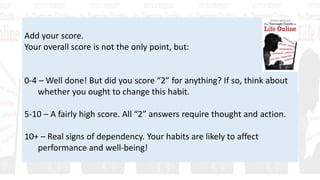
Add your score.
Your overall score is not the only point, but:
0-4 – Well done! But did you score “2” for anything? If so, think about
whether you ought to change this habit.
5-10 – A fairly high score. All “2” answers require thought and action.
10+ – Real signs of dependency. Your habits are likely to affect
performance and well-being!
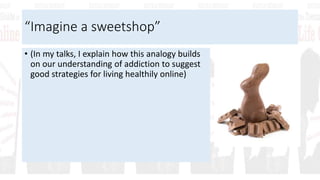
“Imagine a sweetshop”
• (In my talks, I explain how this analogy builds
on our understanding of addiction to suggest
good strategies for living healthily online)
2. Poor concentration
This is the 2nd possible problem with screens
Lots of research shows:
• (In my talks I discuss what the research shows about distraction of
screens)
• Screens give lots of opportunities to be distracted… (Discuss this)
3. Self-esteem and mental health
Research shows (and I discuss this in the talks I do):
• Using social media a bit can be good for mental health
• Using it too much can be bad for mental health
Problems come from (explained in detail in my talks):
• Everybody else’s “perfect” lives and photos
• “Online disinhibition effect” – phrase coined by John Suler
• Need for “likes” and affirmation
• Anxiety is raised by bad news stories: “bad maths”
The
Goldilocks
effect
4. Some healthy things we’re doing less
I think this is almost the most important problem.
Before going to the next slide, what healthy things do you think
research shows we do less of these days compared to ten years ago?
There are five things but you might be able to think of more.
4. Some healthy things we’re doing less
• Physical activity / going outside
• Reading books / reading for pleasure
• Face-to-face interaction
• Sleep
• Nothing – mind-wandering / day-dreaming
(My website has lots of info about why these things are important)
Other possible problems (research discussed in my talks)
Research suggests (though not proven):
• Weaker conversation skills – we have to learn good conversation skills
and if we’re doing it less we may not be so good at it
• Shallower conversations when it matters – it seems that when phones
are present, we don’t talk about deep stuff
• Lower empathy? There’s some evidence that empathy levels have
dropped in the last 20 years but we don’t know this is because of
phones etc
• Misunderstandings – it’s so easy to misunderstand people when we
can’t see their faces or hear their voices! Has this happened to you?
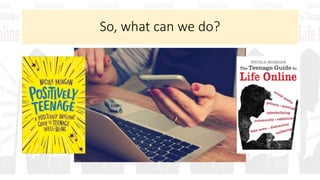
So, what can we do?
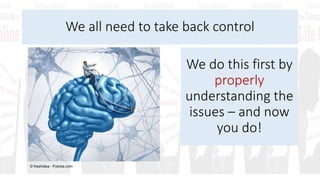
We all need to take back control
We do this first by
properly
understanding the
issues – and now
you do!
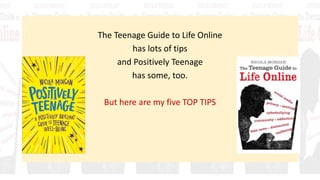
The Teenage Guide to Life Online
has lots of tips
and Positively Teenage
has some, too.
But here are my five TOP TIPS
TOP TIP 1:
When we want to do our best work,
put phone/social media completely out of sight.
Practise UNI-TASKING.
TOP TIP 2:
Forget the statistics and theories:
if being online is making you feel bad,
switch off and do something else.
Balance your life: have plenty of time OFF-line
TOP TIP 3:
Remind yourself (often) that what you see online
is not the whole reality.
Look around you, at the real people you know.
They are reality.
TOP TIP 4:
Make lots of time for:
Sleep
Exercise
Face-to-face chat
Reading for pleasure and other hobbies
Thinking and dreaming
TOP TIP 5:
Let’s do this together:
SUPPORT YOUR FRIENDS and FAMILY.
When we’re trying to break habits,
teaming up with others and
creating good guidelines for us all is really helpful.
Consider family or group digital detox
and switch-off screen times.
Three times when phones should be OFF
ADULTS, TOO
1. At meal times with friends or family
2. 1.5 hours before bed (and until morning)
3. When someone wants to talk to us
Thank you for listening – now,
switch off your screen and go and
do something else!
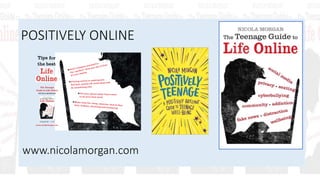
POSITIVELY ONLINE
www.nicolamorgan.com

Life Online Parent Pack Powerpoint

  • 1.
    NOTES from NicolaMorgan • This is a free resource for parents of young people aged 11+ about the positives and negatives of screens, smartphones and social media • It is different from a Powerpoint I’d create if I were presenting it! My talks have less text, more images, and in my spoken words I deliver a great deal of explanation and background psychology. • If I’m about to visit your school, please don’t show this first. • Please only show in a private family setting, not to a wider audience in school or elsewhere. Do ask if you want permission for that. • My website has a free Life Online Parent Pack and many other resources. Copyright © Nicola Morgan 2018 – free to share but : 1. Credit me 2. Do not alter or make money from it 3. Don’t show to more than a family group.
  • 2.
    LET’S LIVE POSITIVELYONLINE by Nicola Morgan www.nicolamorgan.com
  • 3.
    What do Iknow? • My work on human psychology/brain – 20+ years • My expertise comes from wide research and deep knowledge, not opinion or personal experience • But I am also a heavy user of tech – possibly a bit addicted… • Here are some of my books – factual and fiction
  • 4.
    My message isfor teenagers AND adults
  • 5.
    “Young people –ALWAYS on their phones!” This comment annoys me! Many people of all ages spend too much time on their devices.
  • 6.
    Besides, what does“on our phone” mean? • Think of some things people do on their phones and then click to the next screen
  • 7.
    Keeping in touch Having a conversation Relaxing Making/uploading avideo Being creative Learning a language Supporting a friend Asking for help Finding directions Reading a book Playing a game Finding a fact or answer Distracting ourselves from anxiety Writing Making a list of things to do Listening to music Following a fitness routine Checking the time Checking a bus time Getting inspiration Having several conversations Finding a recipe Making a note Listening to music Booking a ticket
  • 8.
    Then there arethe pointless headlines Discuss the headlines that follow. Why do you think I say they are “pointless”?
  • 12.
    Adults need torecognise the positives Can you think of any before you click to the next slide? The Teenage Guide to Life Online discusses positives in great detail – you might be surprised at what I found!
  • 13.
    Some of thepositives of our devices Knowledge Ideas Connections Excitement Entertainment Understanding other people Skills Creativity
  • 14.
    We need toknow the genuine negatives I’m going to discuss four of them
  • 15.
    1. It’s veryeasy to become addicted (In my talks, I’ll explain how this happens in our brains) THREE things our brains are programmed to be:
  • 16.
    A. Social Humans needconnections and support for survival and success. We don’t do so well on our own (even those of us who LOVE being alone.) You don’t have to like big groups but you need people to turn to when you want. Not having people to turn to harms mental health and success. SO, we are wired to make connections and we get a buzz when we do.
  • 17.
    B. Curious Being curiousmakes us more successful. We build brain connections when we learn new things. When my daughter and a friend were “curious” as to what would happen if they crowd-funded and created a short film, they won a BAFTA for Best British Short Film! Being curious is good for our success. SO, we are wired to be curious and we get a buzz when we are.
  • 18.
    C. Distracted We needto be distractible, for our survival. If the hunters or gatherers were so focused on their prey or berries that they didn’t notice the lion or snake moving in the grass, they’d be dead. SO, we are wired to be distracted (especially by moving things) and we get a buzz when we are.
  • 19.
    Our devices giveus endless opportunities to be social, curious, distracted, triggering brain’s reward system every time • That “reward” is what can be addictive – in all the things you can think of that people can be addicted to. (But each addictive thing is different: some are worse than others. Screens are not the worst.)
  • 20.
    Do you thinkyou might be a bit addicted?
  • 21.
    Think about yourphone/tablet/screen I’m going to ask you some questions. When I say “screen” or device” I mean ANY device you use to go online, play games or message people. How to score: 0 for “Never or rarely” 1 for “Sometimes” 2 for “Often”
  • 22.
    Do you: 1. Stayon screen longer than you planned to? 2. Rush your work so you can go on screen? (Or have to rush because you spent too long on screen.) 3. Check your messages before something you ought to be doing? 4. Snap/act annoyed if someone tries to interrupt your screen time? 5. Check your phone last thing before sleep? (Or sleep with it on.)
  • 23.
    0 = never/rarely1 = sometimes 2 = Often 6. Try but fail to cut down your screen time? 7. Feel cross with yourself or guilty about how much time you spend on screen? 8. Go to sleep later than you should, because of your screen use? 9. Be late or almost late for things because you were on your screen too long? 10. Check your phone as soon as you wake up?
  • 24.
    Add your score. Youroverall score is not the only point, but: 0-4 – Well done! But did you score “2” for anything? If so, think about whether you ought to change this habit. 5-10 – A fairly high score. All “2” answers require thought and action. 10+ – Real signs of dependency. Your habits are likely to affect performance and well-being!
  • 25.
    “Imagine a sweetshop” •(In my talks, I explain how this analogy builds on our understanding of addiction to suggest good strategies for living healthily online)
  • 26.
    2. Poor concentration Thisis the 2nd possible problem with screens Lots of research shows: • (In my talks I discuss what the research shows about distraction of screens) • Screens give lots of opportunities to be distracted… (Discuss this)
  • 27.
    3. Self-esteem andmental health Research shows (and I discuss this in the talks I do): • Using social media a bit can be good for mental health • Using it too much can be bad for mental health Problems come from (explained in detail in my talks): • Everybody else’s “perfect” lives and photos • “Online disinhibition effect” – phrase coined by John Suler • Need for “likes” and affirmation • Anxiety is raised by bad news stories: “bad maths” The Goldilocks effect
  • 28.
    4. Some healthythings we’re doing less I think this is almost the most important problem. Before going to the next slide, what healthy things do you think research shows we do less of these days compared to ten years ago? There are five things but you might be able to think of more.
  • 29.
    4. Some healthythings we’re doing less • Physical activity / going outside • Reading books / reading for pleasure • Face-to-face interaction • Sleep • Nothing – mind-wandering / day-dreaming (My website has lots of info about why these things are important)
  • 30.
    Other possible problems(research discussed in my talks) Research suggests (though not proven): • Weaker conversation skills – we have to learn good conversation skills and if we’re doing it less we may not be so good at it • Shallower conversations when it matters – it seems that when phones are present, we don’t talk about deep stuff • Lower empathy? There’s some evidence that empathy levels have dropped in the last 20 years but we don’t know this is because of phones etc • Misunderstandings – it’s so easy to misunderstand people when we can’t see their faces or hear their voices! Has this happened to you?
  • 31.
  • 32.
    We all needto take back control We do this first by properly understanding the issues – and now you do!
  • 33.
    The Teenage Guideto Life Online has lots of tips and Positively Teenage has some, too. But here are my five TOP TIPS
  • 34.
    TOP TIP 1: Whenwe want to do our best work, put phone/social media completely out of sight. Practise UNI-TASKING.
  • 35.
    TOP TIP 2: Forgetthe statistics and theories: if being online is making you feel bad, switch off and do something else. Balance your life: have plenty of time OFF-line
  • 36.
    TOP TIP 3: Remindyourself (often) that what you see online is not the whole reality. Look around you, at the real people you know. They are reality.
  • 37.
    TOP TIP 4: Makelots of time for: Sleep Exercise Face-to-face chat Reading for pleasure and other hobbies Thinking and dreaming
  • 38.
    TOP TIP 5: Let’sdo this together: SUPPORT YOUR FRIENDS and FAMILY. When we’re trying to break habits, teaming up with others and creating good guidelines for us all is really helpful. Consider family or group digital detox and switch-off screen times.
  • 39.
    Three times whenphones should be OFF ADULTS, TOO 1. At meal times with friends or family 2. 1.5 hours before bed (and until morning) 3. When someone wants to talk to us
  • 40.
    Thank you forlistening – now, switch off your screen and go and do something else!
  • 41.