Succession Planning
The Right People, For the right job,
At the right time
MHRM UMT
PRESENTED to: PROF.Waheed Asghar
www.website.com
PRESENTATION
Dr. Parul Deshwal*
Group Members Student I.D
Sonia Kanwal s2022277014
Title
TITLE
Samina Nawaz s2022277023
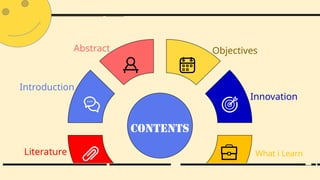
Objectives
Innovation
What i Learn
Abstract
Introduction
Literature
CONTENTS
www.website.com
PART 1
Abstract
Abstract
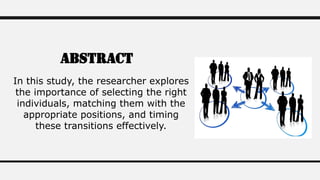
In this study, the researcher explores
the importance of selecting the right
individuals, matching them with the
appropriate positions, and timing
these transitions effectively.
 Today’s environments are changing rapidlythatorganizations
are facing serious unpredictability and uncertainty, which
sometimes causes instability in the business operations
 In this dynamic environment, organizations need to rely on
the most important assets: “their people”
 Organizations need to strategize to motivate and connect
their employees in order to create competitive advantage
and achieving higher profitability.
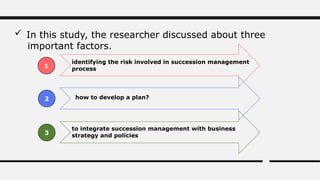
 In this study, the researcher discussed about three
important factors.
identifying the risk involved in succession management
process
how to develop a plan?
to integrate succession management with business
strategy and policies
1
2
3
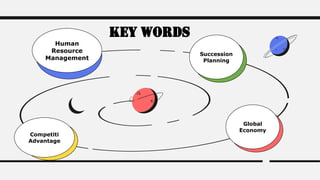
key words
Human
Resource
Management
Competiti
Advantage
Global
Economy
Succession
Planning
www.website.com
PART 2
Introduction
Introduction
 Organization’s future plans may change by some reasons
such as retirements, promotions within the organization,
serious illness, death or any voluntary departure from the
organization to follow a career elsewhere.
 To cover such changes, organizations must have a key
employees’ replacement plan. Succession planning is
considered as a suitable effort in this regards.
The aim Succession Planning
 The researcher the only purpose of succession planning was
to tag and identify the needed successors to replace their
ancestors for a specific job.
 In this study,researcher discussed about two way succession
planning.
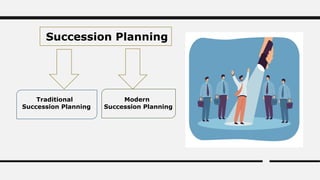
Succession Planning
Traditional
Succession Planning
Modern
Succession Planning
Traditional
Succession Planning
 Traditionally, succession planning links
with replacement planning.
 Replacement planning is a form of risk
management which focus on the
replacing the key executive, exactly
before leaving the organizations.
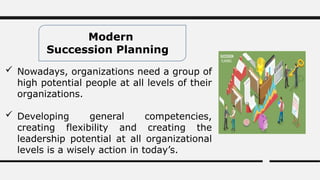
Modern
Succession Planning
 Nowadays, organizations need a group of
high potential people at all levels of their
organizations.
 Developing general competencies,
creating flexibility and creating the
leadership potential at all organizational
levels is a wisely action in today’s.
www.website.com
PART 3
Literature
Literarture
“Systematic succession planning occurs when an organization
adopts specific procedures to insure the identification,
development and long-term retention of talented individuals.
(Rothwell and Kazanas (2003)
Others have referred to it as a strategic, systematic, and
deliberate activity to ensure an organization's future capability
to fill vacancies without patronage or favoritism.
(Other Authors)
 Succession Management or Succession Planning is left to
the last moment when the process should start with the
selection and retention of employees occupying key roles
within the business.
 Having the right people positioned for succession ensures
short-term success and the longevity of your business.
 Succession Planning is the preparation for the replacement
of one high ranking employee by another, usually prompted
by retirement or resignation.
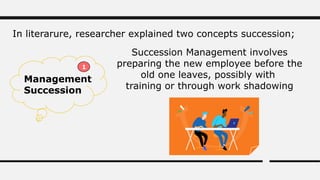
In literarure, researcher explained two concepts succession;
Management
Succession
Succession Management involves
preparing the new employee before the
old one leaves, possibly with
training or through work shadowing
1
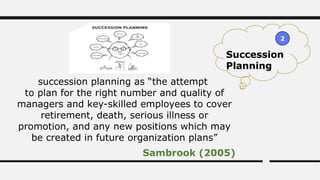
Succession
Planning
2
succession planning as “the attempt
to plan for the right number and quality of
managers and key-skilled employees to cover
retirement, death, serious illness or
promotion, and any new positions which may
be created in future organization plans”
Sambrook (2005)
www.website.com
PART 4
Objectives
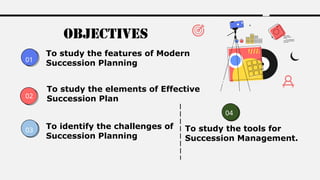
To study the features of Modern
Succession Planning
01
02
04
Objectives
01
To study the elements of Effective
Succession Plan
03
To identify the challenges of
Succession Planning
To study the tools for
Succession Management.
The features of Modern
Succession Planning
 succession planning as 'a process by which one or more
successors are identified for key posts (or groups of
similar key posts), and career moves and/or
development activities are planned for these
successors.
 Successors may be fairly,ready to do the job (short-
term successors) or seen as having longer-term
potential (long_x0002_term successors).
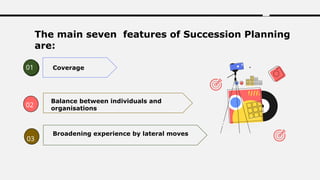
The main seven features of Succession Planning
are:
Coverage
Balance between individuals and
organisations
Broadening experience by lateral moves
01
02
03
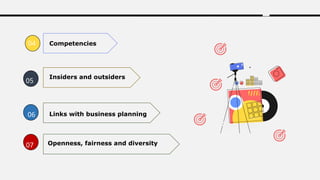
Competencies
Links with business planning
Openness, fairness and diversity
Insiders and outsiders
04
05
06
07
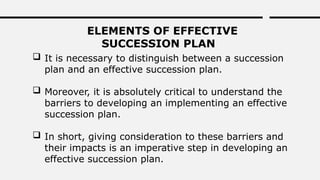
ELEMENTS OF EFFECTIVE
SUCCESSION PLAN
 It is necessary to distinguish between a succession
plan and an effective succession plan.
 Moreover, it is absolutely critical to understand the
barriers to developing an implementing an effective
succession plan.
 In short, giving consideration to these barriers and
their impacts is an imperative step in developing an
effective succession plan.
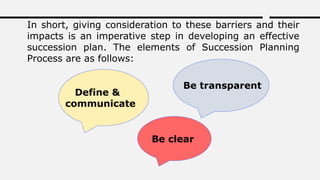
In short, giving consideration to these barriers and their
impacts is an imperative step in developing an effective
succession plan. The elements of Succession Planning
Process are as follows:
Define &
communicate
Be transparent
Be clear
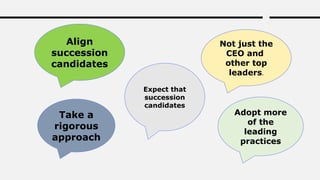
Align
succession
candidates
Expect that
succession
candidates
Take a
rigorous
approach
Not just the
CEO and
other top
leaders.
Adopt more
of the
leading
practices
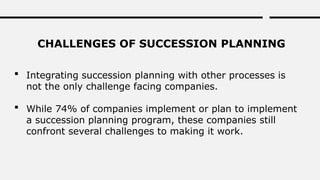
CHALLENGES OF SUCCESSION PLANNING
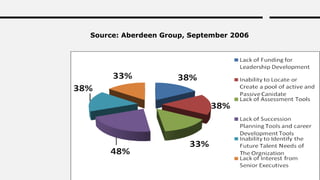
 Integrating succession planning with other processes is
not the only challenge facing companies.
 While 74% of companies implement or plan to implement
a succession planning program, these companies still
confront several challenges to making it work.
These challenges fall under two categories;
challenges with the
process
Challenges with making the process work
include inability to locate or create a
pool of active and passive candidates and lack
of interest from senior executives
These challenges fall under two categories;
challenges with the
technology
lack of assessment tools and lack of
succession planning tools and career
development tools
were indicated in the study as examples of
technology challenges
Source: Aberdeen Group, September 2006
SUCCESSION MANAGEMENT TOOLS
 As retaining good quality employees has become critical
to the business, high performance firms are using
various tools to select and retain best brains in their
respective industries.
 Fulmer and Conger (2005) have opined that the
following tools are vital for the succession management
plan of the organization.
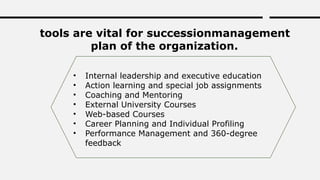
tools are vital for successionmanagement
plan of the organization.
• Internal leadership and executive education
• Action learning and special job assignments
• Coaching and Mentoring
• External University Courses
• Web-based Courses
• Career Planning and Individual Profiling
• Performance Management and 360-degree
feedback
www.website.com
PART 5
Innovation
Innovation
In this study we know about
actively managing succession is
key to achieving strategic viability
and also about 7 elements andtools
of succession planning
www.website.com
PART 6
What We
Learned
What We learned
After analysis this study, we learned there is no one model
for succession planning and there are no hard-and-fast rules
and also Every organization is different and what has been
described above has been drawn mainly from the experience
of large organizations. Modern succession management is
not only about finding replacements but its also an ongoing
process of identifying and developing a desired talent base
for all the levels of management.
THANKS
FOR
Attension

Presentation SUCCESSIONAL PLANnNING.pptx

  • 1.
    Succession Planning The RightPeople, For the right job, At the right time MHRM UMT PRESENTED to: PROF.Waheed Asghar www.website.com PRESENTATION Dr. Parul Deshwal*
  • 2.
    Group Members StudentI.D Sonia Kanwal s2022277014 Title TITLE Samina Nawaz s2022277023
  • 3.
  • 4.
  • 5.
    Abstract In this study,the researcher explores the importance of selecting the right individuals, matching them with the appropriate positions, and timing these transitions effectively.
  • 6.
     Today’s environmentsare changing rapidlythatorganizations are facing serious unpredictability and uncertainty, which sometimes causes instability in the business operations  In this dynamic environment, organizations need to rely on the most important assets: “their people”  Organizations need to strategize to motivate and connect their employees in order to create competitive advantage and achieving higher profitability.
  • 7.
     In thisstudy, the researcher discussed about three important factors. identifying the risk involved in succession management process how to develop a plan? to integrate succession management with business strategy and policies 1 2 3
  • 8.
  • 9.
  • 10.
    Introduction  Organization’s futureplans may change by some reasons such as retirements, promotions within the organization, serious illness, death or any voluntary departure from the organization to follow a career elsewhere.  To cover such changes, organizations must have a key employees’ replacement plan. Succession planning is considered as a suitable effort in this regards.
  • 11.
    The aim SuccessionPlanning  The researcher the only purpose of succession planning was to tag and identify the needed successors to replace their ancestors for a specific job.  In this study,researcher discussed about two way succession planning.
  • 12.
  • 13.
    Traditional Succession Planning  Traditionally,succession planning links with replacement planning.  Replacement planning is a form of risk management which focus on the replacing the key executive, exactly before leaving the organizations.
  • 14.
    Modern Succession Planning  Nowadays,organizations need a group of high potential people at all levels of their organizations.  Developing general competencies, creating flexibility and creating the leadership potential at all organizational levels is a wisely action in today’s.
  • 15.
  • 16.
    Literarture “Systematic succession planningoccurs when an organization adopts specific procedures to insure the identification, development and long-term retention of talented individuals. (Rothwell and Kazanas (2003) Others have referred to it as a strategic, systematic, and deliberate activity to ensure an organization's future capability to fill vacancies without patronage or favoritism. (Other Authors)
  • 17.
     Succession Managementor Succession Planning is left to the last moment when the process should start with the selection and retention of employees occupying key roles within the business.  Having the right people positioned for succession ensures short-term success and the longevity of your business.  Succession Planning is the preparation for the replacement of one high ranking employee by another, usually prompted by retirement or resignation.
  • 18.
    In literarure, researcherexplained two concepts succession; Management Succession Succession Management involves preparing the new employee before the old one leaves, possibly with training or through work shadowing 1
  • 19.
    Succession Planning 2 succession planning as“the attempt to plan for the right number and quality of managers and key-skilled employees to cover retirement, death, serious illness or promotion, and any new positions which may be created in future organization plans” Sambrook (2005)
  • 20.
  • 21.
    To study thefeatures of Modern Succession Planning 01 02 04 Objectives 01 To study the elements of Effective Succession Plan 03 To identify the challenges of Succession Planning To study the tools for Succession Management.
  • 22.
    The features ofModern Succession Planning  succession planning as 'a process by which one or more successors are identified for key posts (or groups of similar key posts), and career moves and/or development activities are planned for these successors.  Successors may be fairly,ready to do the job (short- term successors) or seen as having longer-term potential (long_x0002_term successors).
  • 23.
    The main sevenfeatures of Succession Planning are: Coverage Balance between individuals and organisations Broadening experience by lateral moves 01 02 03
  • 24.
    Competencies Links with businessplanning Openness, fairness and diversity Insiders and outsiders 04 05 06 07
  • 25.
    ELEMENTS OF EFFECTIVE SUCCESSIONPLAN  It is necessary to distinguish between a succession plan and an effective succession plan.  Moreover, it is absolutely critical to understand the barriers to developing an implementing an effective succession plan.  In short, giving consideration to these barriers and their impacts is an imperative step in developing an effective succession plan.
  • 26.
    In short, givingconsideration to these barriers and their impacts is an imperative step in developing an effective succession plan. The elements of Succession Planning Process are as follows: Define & communicate Be transparent Be clear
  • 27.
    Align succession candidates Expect that succession candidates Take a rigorous approach Notjust the CEO and other top leaders. Adopt more of the leading practices
  • 28.
    CHALLENGES OF SUCCESSIONPLANNING  Integrating succession planning with other processes is not the only challenge facing companies.  While 74% of companies implement or plan to implement a succession planning program, these companies still confront several challenges to making it work.
  • 29.
    These challenges fallunder two categories; challenges with the process Challenges with making the process work include inability to locate or create a pool of active and passive candidates and lack of interest from senior executives
  • 30.
    These challenges fallunder two categories; challenges with the technology lack of assessment tools and lack of succession planning tools and career development tools were indicated in the study as examples of technology challenges
  • 31.
  • 32.
    SUCCESSION MANAGEMENT TOOLS As retaining good quality employees has become critical to the business, high performance firms are using various tools to select and retain best brains in their respective industries.  Fulmer and Conger (2005) have opined that the following tools are vital for the succession management plan of the organization.
  • 33.
    tools are vitalfor successionmanagement plan of the organization. • Internal leadership and executive education • Action learning and special job assignments • Coaching and Mentoring • External University Courses • Web-based Courses • Career Planning and Individual Profiling • Performance Management and 360-degree feedback
  • 34.
  • 35.
    Innovation In this studywe know about actively managing succession is key to achieving strategic viability and also about 7 elements andtools of succession planning
  • 36.
  • 37.
    What We learned Afteranalysis this study, we learned there is no one model for succession planning and there are no hard-and-fast rules and also Every organization is different and what has been described above has been drawn mainly from the experience of large organizations. Modern succession management is not only about finding replacements but its also an ongoing process of identifying and developing a desired talent base for all the levels of management.
  • 38.