Theory X
and
Theory Y
DOUGLAS MCGREGOR’s
Outline
of the
Presentation Proponent’s
Background
Definitions Assumptions
ofTheory X
1 2 3
2
Outline
of the
Presentation Assumptions
ofTheory X
Implications Principles of Scientific
Management
4 5 6
3
Proponent’s
Background
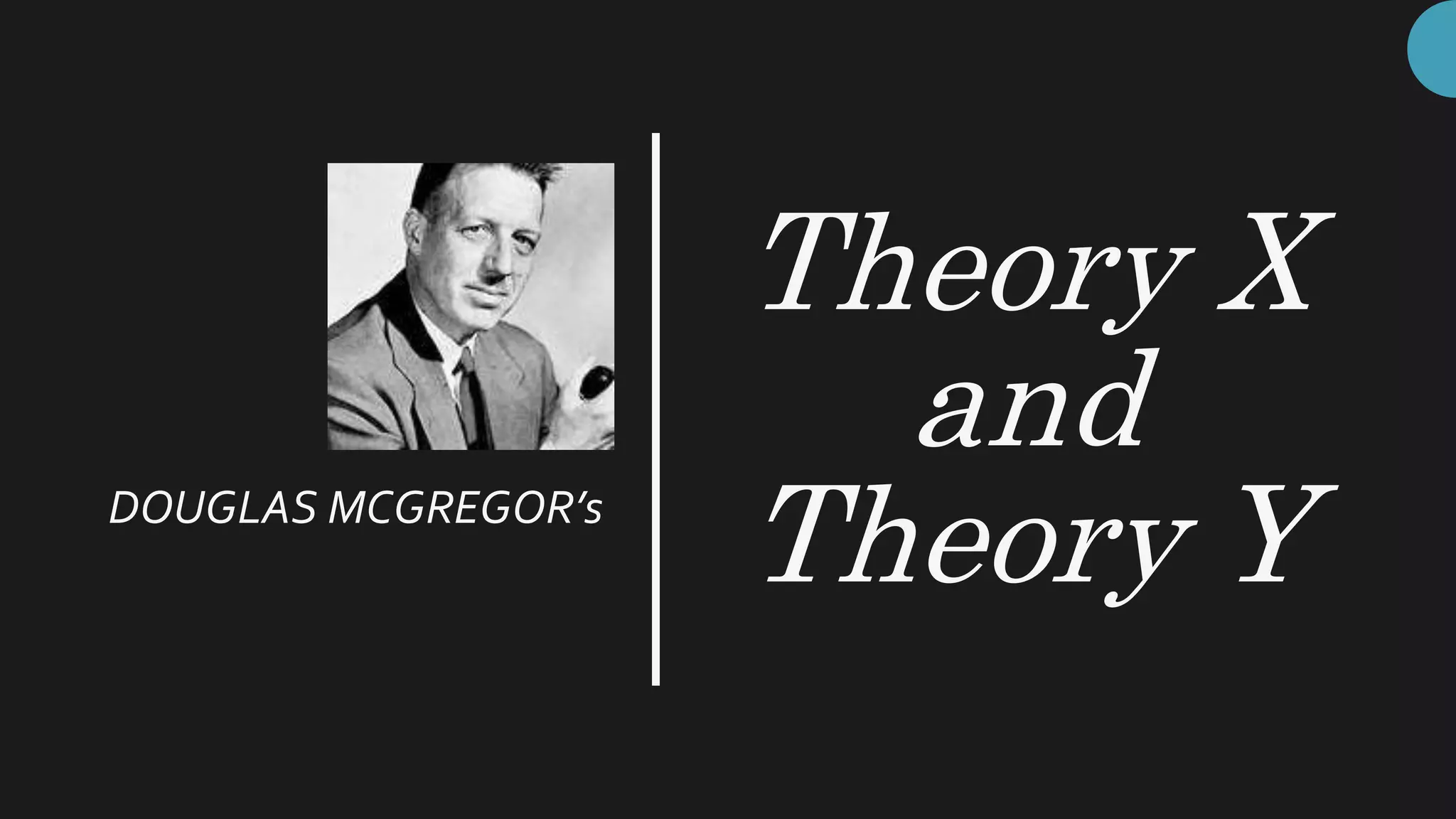
Douglas
Murray
McGregor
-American
management
professor at the MIT
Sloan School of
Management
-He also taught at
the Indian Institute
of Management
Calcutta.
-He is best known for
hisTheory X and
TheoryY as
presented in his book
‘The Human Side of
Enterprise’ (1960)
-McGregor was a
student of Abraham
Maslow.
-He has contributed
much to the
development of the
management and
motivational theory.
4
DEFINITIONS
TheoryX and theoryY are part of
motivational theories. Both the
theories, which are very different from
each other, are used by managers to
motivate their employees.Theory X
gives importance to supervision, while
theoryY stresses on rewards and
recognition.
-EconomicTimes 2021-
Theory X and Theory Y suggesting two
aspects of human behavior at work, or in
other words, two different views of
individuals (employees): one of which is
negative, called as Theory X and the other is
positive, so called as Theory Y.
https://www.managementstudyguide.com/
DEFINITIONS
DEFINITIONS
TheoryX andTheoryY refer to two
styles of management – authoritarian
(TheoryX) and participative (Theory
Y).
- https://www.mindtools.com/-
Assumptions
of Theory X
This style of management
assumes that workers:
Dislike their work. Avoid responsibility and
need constant direction.
Have to be controlled,
forced and threatened
to deliver work.
Need to be supervised
at every step.
Employees generally
dislike responsibilities.
Employees resist
change.
8
Assumptions
of Theory Y
This style of management
assumes that workers:
Happy to work on their
own initiative.
More involved in decision
making.
Self-motivated to
complete their tasks.
Seek and accept
responsibility, and
need little direction.
View work as fulfilling and
challenging.
Solve problems
creatively and
imaginatively.
9
Implications
• Thus, we can say that Theory X presents a pessimistic view of
employees’ nature and behavior at work, while Theory Y presents an
optimistic view of the employees’ nature and behavior at work. If we
correlate it with Maslow’s theory, we can say that Theory X is based on
the assumption that the employees emphasize on the physiological
needs and the safety needs; while Theory X is based on the assumption
that the social needs, esteem needs and the self-actualization needs
dominate the employees.
• Quite a few organizations use Theory X today. Theory X
encourages use of tight control and supervision. It implies that
employees are reluctant to organizational changes. Thus, it does
not encourage innovation.
• Many organizations are using Theory Y techniques. Theory Y
implies that the managers should create and encourage a work
environment which provides opportunities to employees to take
initiative and self-direction. Employees should be given
opportunities to contribute to organizational well-being.
• Theory Y encourages decentralization of authority, teamwork and
participative decision making in an organization. Theory Y searches
and discovers the ways in which an employee can make significant
contributions in an organization. It harmonizes and matches
employees’ needs and aspirations with organizational needs and
aspirations.
10
Principles of
Scientific
Management
Applying the principles of scientific
management to improve
employee motivation:
Decentralization
and delegation
Job enlargement:
Participative
management
Performance
appraisals 11

Theory x

  • 1.
  • 2.
  • 3.
    Outline of the Presentation Assumptions ofTheoryX Implications Principles of Scientific Management 4 5 6 3
  • 4.
    Proponent’s Background Douglas Murray McGregor -American management professor at theMIT Sloan School of Management -He also taught at the Indian Institute of Management Calcutta. -He is best known for hisTheory X and TheoryY as presented in his book ‘The Human Side of Enterprise’ (1960) -McGregor was a student of Abraham Maslow. -He has contributed much to the development of the management and motivational theory. 4
  • 5.
    DEFINITIONS TheoryX and theoryYare part of motivational theories. Both the theories, which are very different from each other, are used by managers to motivate their employees.Theory X gives importance to supervision, while theoryY stresses on rewards and recognition. -EconomicTimes 2021-
  • 6.
    Theory X andTheory Y suggesting two aspects of human behavior at work, or in other words, two different views of individuals (employees): one of which is negative, called as Theory X and the other is positive, so called as Theory Y. https://www.managementstudyguide.com/ DEFINITIONS
  • 7.
    DEFINITIONS TheoryX andTheoryY referto two styles of management – authoritarian (TheoryX) and participative (Theory Y). - https://www.mindtools.com/-
  • 8.
    Assumptions of Theory X Thisstyle of management assumes that workers: Dislike their work. Avoid responsibility and need constant direction. Have to be controlled, forced and threatened to deliver work. Need to be supervised at every step. Employees generally dislike responsibilities. Employees resist change. 8
  • 9.
    Assumptions of Theory Y Thisstyle of management assumes that workers: Happy to work on their own initiative. More involved in decision making. Self-motivated to complete their tasks. Seek and accept responsibility, and need little direction. View work as fulfilling and challenging. Solve problems creatively and imaginatively. 9
  • 10.
    Implications • Thus, wecan say that Theory X presents a pessimistic view of employees’ nature and behavior at work, while Theory Y presents an optimistic view of the employees’ nature and behavior at work. If we correlate it with Maslow’s theory, we can say that Theory X is based on the assumption that the employees emphasize on the physiological needs and the safety needs; while Theory X is based on the assumption that the social needs, esteem needs and the self-actualization needs dominate the employees. • Quite a few organizations use Theory X today. Theory X encourages use of tight control and supervision. It implies that employees are reluctant to organizational changes. Thus, it does not encourage innovation. • Many organizations are using Theory Y techniques. Theory Y implies that the managers should create and encourage a work environment which provides opportunities to employees to take initiative and self-direction. Employees should be given opportunities to contribute to organizational well-being. • Theory Y encourages decentralization of authority, teamwork and participative decision making in an organization. Theory Y searches and discovers the ways in which an employee can make significant contributions in an organization. It harmonizes and matches employees’ needs and aspirations with organizational needs and aspirations. 10
  • 11.
    Principles of Scientific Management Applying theprinciples of scientific management to improve employee motivation: Decentralization and delegation Job enlargement: Participative management Performance appraisals 11