THEORIES, MODELS
AND FRAMEWORKS
SUPPORTING
HUMAN-COMPUTER
INTERACTIONS AND
NURSING
INFORMATICS
HUMAN-COMPUTER
INTERACTION
HCI, concerned with interactions between people and
computers, is an area of study concentrated on by human
factors experts (Staggers, 2002).
HCI is defined as the study of how people design, implement,
and evaluate interactive computer systems in the context of
users’ tasks and work (Nelson & Staggers, 2014).
Human factor is important.
HUMAN-COMPUTER
INTERACTION
Human factors
- is a discipline that optimizes relationships between technology and
humans (Kantowitz & Sorkin, 1983; McCormick & Sanders, 1982).
THEORIES SUPPORTING
NURSING INFORMATICS
 Nursing theories are about nursing practice — a nurse’s interactions or
relationships with individuals, groups, or communities (also known as
patients or clients) focused on applying the nursing process.
 Novice to Expert. Patricia Benner and other nurse educators adapted this
model to explain how nursing students and professional nurses acquired
nursing skills.
 Computer science is the study of algorithms for solving computation
problems.
 Information science focuses on the gathering, manipulation,
classification, storage, and retrieval of recorded knowledge.
THEORIES SUPPORTING
NURSING INFORMATICS
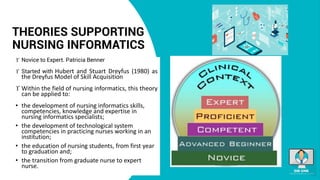
 Novice to Expert. Patricia Benner
 Started with Hubert and Stuart Dreyfus (1980) as
the Dreyfus Model of Skill Acquisition
 Within the field of nursing informatics, this theory
can be applied to:
• the development of nursing informatics skills,
competencies, knowledge and expertise in
nursing informatics specialists;
• the development of technological system
competencies in practicing nurses working in an
institution;
• the education of nursing students, from first year
to graduation and;
• the transition from graduate nurse to expert
nurse.
THEORIES SUPPORTING
NURSING INFORMATICS
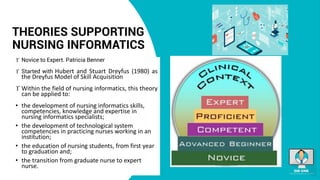
 Novice to Expert. Patricia Benner
 Started with Hubert and Stuart Dreyfus (1980) as
the Dreyfus Model of Skill Acquisition
 Within the field of nursing informatics, this theory
can be applied to:
• the development of nursing informatics skills,
competencies, knowledge and expertise in
nursing informatics specialists;
• the development of technological system
competencies in practicing nurses working in an
institution;
• the education of nursing students, from first year
to graduation and;
• the transition from graduate nurse to expert
nurse.
THEORIES SUPPORTING
NURSING INFORMATICS
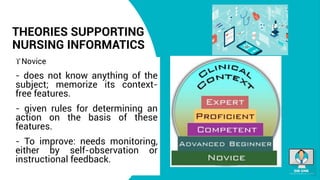
Novice
- does not know anything of the
subject; memorize its context-
free features.
- given rules for determining an
action on the basis of these
features.
- To improve: needs monitoring,
either by self-observation or
instructional feedback.
THEORIES SUPPORTING
NURSING INFORMATICS
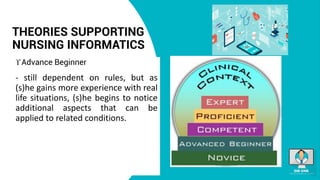
Advance Beginner
- still dependent on rules, but as
(s)he gains more experience with real
life situations, (s)he begins to notice
additional aspects that can be
applied to related conditions.
THEORIES SUPPORTING
NURSING INFORMATICS
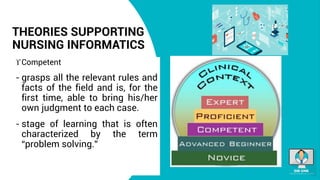
Competent
- grasps all the relevant rules and
facts of the field and is, for the
first time, able to bring his/her
own judgment to each case.
- stage of learning that is often
characterized by the term
“problem solving.”
THEORIES SUPPORTING
NURSING INFORMATICS
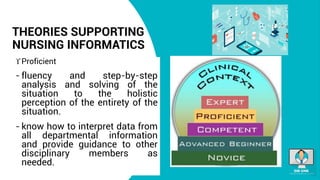
Proficient
- fluency and step-by-step
analysis and solving of the
situation to the holistic
perception of the entirety of the
situation.
- know how to interpret data from
all departmental information
and provide guidance to other
disciplinary members as
needed.
THEORIES SUPPORTING
NURSING INFORMATICS
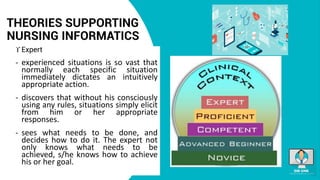
 Expert
- experienced situations is so vast that
normally each specific situation
immediately dictates an intuitively
appropriate action.
- discovers that without his consciously
using any rules, situations simply elicit
from him or her appropriate
responses.
- sees what needs to be done, and
decides how to do it. The expert not
only knows what needs to be
achieved, s/he knows how to achieve
his or her goal.
 The study of behavior—the processes driving actions—is the
focus of the Behavioral and Social sciences.
 Change processes entail not only structures and ways of doing
tasks, but also the performance, expectations, and perceptions
of all involved parties.
 Learning is a process of acquiring knowledge, skills, attitudes,
or values through study, experience, or teaching.
MODELS IN NURSING INFORMATICS
 Models are representations of some aspect of the real world.
 The foundations of nursing informatics are the core phenomena and
nursing-informatics models.
 Core phenomena are data, information, knowledge, and wisdom and the
transformations that each of these undergo.
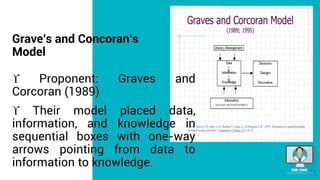
Grave’s and Concoran’s
Model
 Proponent: Graves and
Corcoran (1989)
 Their model placed data,
information, and knowledge in
sequential boxes with one-way
arrows pointing from data to
information to knowledge.
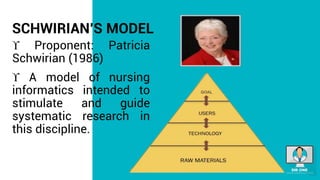
SCHWIRIAN’S MODEL
 Proponent: Patricia
Schwirian (1986)
 A model of nursing
informatics intended to
stimulate and guide
systematic research in
this discipline.
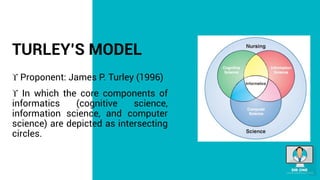
TURLEY’S MODEL
 Proponent: James P. Turley (1996)
 In which the core components of
informatics (cognitive science,
information science, and computer
science) are depicted as intersecting
circles.
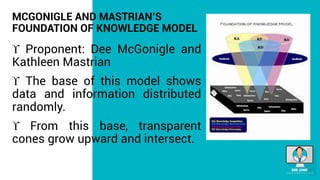
MCGONIGLE AND MASTRIAN’S
FOUNDATION OF KNOWLEDGE MODEL
 Proponent: Dee McGonigle and
Kathleen Mastrian
 The base of this model shows
data and information distributed
randomly.
 From this base, transparent
cones grow upward and intersect.
E. TECHNOLOGICAL COMPETENCY AS CARING IN
NURSING: A MODEL FOR PRACTICE
 Proponent: Rozzano C. Locsin, PhD, RN, FAAN
 A conceptual model that presents the link
between technology and caring in nursing as
coexisting harmoniously. (Locsin, 1995)
E. TECHNOLOGICAL COMPETENCY AS CARING IN
NURSING: A MODEL FOR PRACTICE
1. Grounded in the harmonious coexistence
between technology and caring in nursing.
2. Dimension of Technological Value in the theory
a. Technology as completing human beings
b. Technology as machine technologies
c. Technologies that mimic human beings and
human activities
3. Technological Competency as caring in nursing
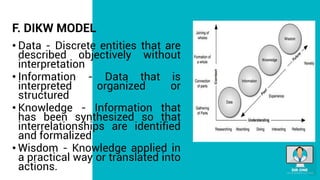
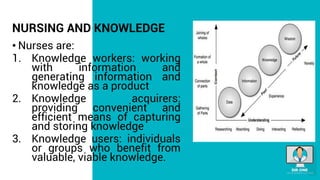
F. DIKW MODEL
• Data - Discrete entities that are
described objectively without
interpretation
• Information - Data that is
interpreted organized or
structured
• Knowledge - Information that
has been synthesized so that
interrelationships are identified
and formalized
• Wisdom - Knowledge applied in
a practical way or translated into
actions.
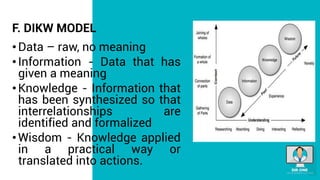
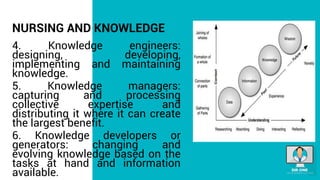
F. DIKW MODEL
•Data – raw, no meaning
•Information - Data that has
given a meaning
•Knowledge - Information that
has been synthesized so that
interrelationships are
identified and formalized
•Wisdom - Knowledge applied
in a practical way or
translated into actions.
NURSING AND KNOWLEDGE
• Nurses are:
1. Knowledge workers: working
with information and
generating information and
knowledge as a product
2. Knowledge acquirers:
providing convenient and
efficient means of capturing
and storing knowledge
3. Knowledge users: individuals
or groups who benefit from
valuable, viable knowledge.
NURSING AND KNOWLEDGE
4. Knowledge engineers:
designing, developing,
implementing and maintaining
knowledge.
5. Knowledge managers:
capturing and processing
collective expertise and
distributing it where it can create
the largest benefit.
6. Knowledge developers or
generators: changing and
evolving knowledge based on the
tasks at hand and information
available.
FRAMEWORKS IN NURSING INFORMATICS
 Nursing frameworks were proposed to illustrate dynamic
interactions occurring between nurses, computers, and enabling
elements that optimize a user’s ability to process information via
computers.
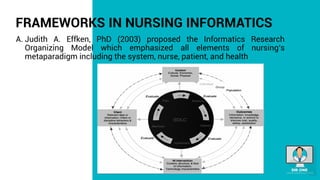
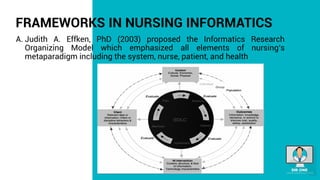
A. Judith A. Effken, PhD (2003) proposed the Informatics Research
Organizing Model which emphasized all elements of nursing’s
metaparadigm including the system, nurse, patient, and health
FRAMEWORKS IN NURSING INFORMATICS
A. Judith A. Effken, PhD (2003) proposed the Informatics Research
Organizing Model which emphasized all elements of nursing’s
metaparadigm including the system, nurse, patient, and health
FRAMEWORKS IN NURSING INFORMATICS
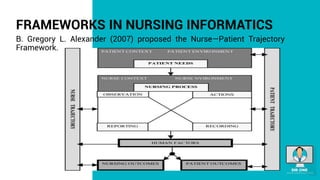
B. Gregory L. Alexander (2007) proposed the Nurse—Patient Trajectory
Framework.
FRAMEWORKS IN NURSING INFORMATICS

THEORIES-MODELS-AND-FRAMEWORKS-SUPPORTING-NURSING-INFORMATICS.pdf

  • 1.
  • 2.
    HUMAN-COMPUTER INTERACTION HCI, concerned withinteractions between people and computers, is an area of study concentrated on by human factors experts (Staggers, 2002). HCI is defined as the study of how people design, implement, and evaluate interactive computer systems in the context of users’ tasks and work (Nelson & Staggers, 2014). Human factor is important.
  • 3.
    HUMAN-COMPUTER INTERACTION Human factors - isa discipline that optimizes relationships between technology and humans (Kantowitz & Sorkin, 1983; McCormick & Sanders, 1982).
  • 4.
    THEORIES SUPPORTING NURSING INFORMATICS Nursing theories are about nursing practice — a nurse’s interactions or relationships with individuals, groups, or communities (also known as patients or clients) focused on applying the nursing process.  Novice to Expert. Patricia Benner and other nurse educators adapted this model to explain how nursing students and professional nurses acquired nursing skills.  Computer science is the study of algorithms for solving computation problems.  Information science focuses on the gathering, manipulation, classification, storage, and retrieval of recorded knowledge.
  • 5.
    THEORIES SUPPORTING NURSING INFORMATICS Novice to Expert. Patricia Benner  Started with Hubert and Stuart Dreyfus (1980) as the Dreyfus Model of Skill Acquisition  Within the field of nursing informatics, this theory can be applied to: • the development of nursing informatics skills, competencies, knowledge and expertise in nursing informatics specialists; • the development of technological system competencies in practicing nurses working in an institution; • the education of nursing students, from first year to graduation and; • the transition from graduate nurse to expert nurse.
  • 6.
    THEORIES SUPPORTING NURSING INFORMATICS Novice to Expert. Patricia Benner  Started with Hubert and Stuart Dreyfus (1980) as the Dreyfus Model of Skill Acquisition  Within the field of nursing informatics, this theory can be applied to: • the development of nursing informatics skills, competencies, knowledge and expertise in nursing informatics specialists; • the development of technological system competencies in practicing nurses working in an institution; • the education of nursing students, from first year to graduation and; • the transition from graduate nurse to expert nurse.
  • 7.
    THEORIES SUPPORTING NURSING INFORMATICS Novice -does not know anything of the subject; memorize its context- free features. - given rules for determining an action on the basis of these features. - To improve: needs monitoring, either by self-observation or instructional feedback.
  • 8.
    THEORIES SUPPORTING NURSING INFORMATICS AdvanceBeginner - still dependent on rules, but as (s)he gains more experience with real life situations, (s)he begins to notice additional aspects that can be applied to related conditions.
  • 9.
    THEORIES SUPPORTING NURSING INFORMATICS Competent -grasps all the relevant rules and facts of the field and is, for the first time, able to bring his/her own judgment to each case. - stage of learning that is often characterized by the term “problem solving.”
  • 10.
    THEORIES SUPPORTING NURSING INFORMATICS Proficient -fluency and step-by-step analysis and solving of the situation to the holistic perception of the entirety of the situation. - know how to interpret data from all departmental information and provide guidance to other disciplinary members as needed.
  • 11.
    THEORIES SUPPORTING NURSING INFORMATICS Expert - experienced situations is so vast that normally each specific situation immediately dictates an intuitively appropriate action. - discovers that without his consciously using any rules, situations simply elicit from him or her appropriate responses. - sees what needs to be done, and decides how to do it. The expert not only knows what needs to be achieved, s/he knows how to achieve his or her goal.
  • 12.
     The studyof behavior—the processes driving actions—is the focus of the Behavioral and Social sciences.  Change processes entail not only structures and ways of doing tasks, but also the performance, expectations, and perceptions of all involved parties.  Learning is a process of acquiring knowledge, skills, attitudes, or values through study, experience, or teaching.
  • 13.
    MODELS IN NURSINGINFORMATICS  Models are representations of some aspect of the real world.  The foundations of nursing informatics are the core phenomena and nursing-informatics models.  Core phenomena are data, information, knowledge, and wisdom and the transformations that each of these undergo.
  • 14.
    Grave’s and Concoran’s Model Proponent: Graves and Corcoran (1989)  Their model placed data, information, and knowledge in sequential boxes with one-way arrows pointing from data to information to knowledge.
  • 15.
    SCHWIRIAN’S MODEL  Proponent:Patricia Schwirian (1986)  A model of nursing informatics intended to stimulate and guide systematic research in this discipline.
  • 16.
    TURLEY’S MODEL  Proponent:James P. Turley (1996)  In which the core components of informatics (cognitive science, information science, and computer science) are depicted as intersecting circles.
  • 17.
    MCGONIGLE AND MASTRIAN’S FOUNDATIONOF KNOWLEDGE MODEL  Proponent: Dee McGonigle and Kathleen Mastrian  The base of this model shows data and information distributed randomly.  From this base, transparent cones grow upward and intersect.
  • 18.
    E. TECHNOLOGICAL COMPETENCYAS CARING IN NURSING: A MODEL FOR PRACTICE  Proponent: Rozzano C. Locsin, PhD, RN, FAAN  A conceptual model that presents the link between technology and caring in nursing as coexisting harmoniously. (Locsin, 1995)
  • 19.
    E. TECHNOLOGICAL COMPETENCYAS CARING IN NURSING: A MODEL FOR PRACTICE 1. Grounded in the harmonious coexistence between technology and caring in nursing. 2. Dimension of Technological Value in the theory a. Technology as completing human beings b. Technology as machine technologies c. Technologies that mimic human beings and human activities 3. Technological Competency as caring in nursing
  • 20.
    F. DIKW MODEL •Data - Discrete entities that are described objectively without interpretation • Information - Data that is interpreted organized or structured • Knowledge - Information that has been synthesized so that interrelationships are identified and formalized • Wisdom - Knowledge applied in a practical way or translated into actions.
  • 21.
    F. DIKW MODEL •Data– raw, no meaning •Information - Data that has given a meaning •Knowledge - Information that has been synthesized so that interrelationships are identified and formalized •Wisdom - Knowledge applied in a practical way or translated into actions.
  • 22.
    NURSING AND KNOWLEDGE •Nurses are: 1. Knowledge workers: working with information and generating information and knowledge as a product 2. Knowledge acquirers: providing convenient and efficient means of capturing and storing knowledge 3. Knowledge users: individuals or groups who benefit from valuable, viable knowledge.
  • 23.
    NURSING AND KNOWLEDGE 4.Knowledge engineers: designing, developing, implementing and maintaining knowledge. 5. Knowledge managers: capturing and processing collective expertise and distributing it where it can create the largest benefit. 6. Knowledge developers or generators: changing and evolving knowledge based on the tasks at hand and information available.
  • 24.
    FRAMEWORKS IN NURSINGINFORMATICS  Nursing frameworks were proposed to illustrate dynamic interactions occurring between nurses, computers, and enabling elements that optimize a user’s ability to process information via computers.
  • 25.
    A. Judith A.Effken, PhD (2003) proposed the Informatics Research Organizing Model which emphasized all elements of nursing’s metaparadigm including the system, nurse, patient, and health FRAMEWORKS IN NURSING INFORMATICS
  • 26.
    A. Judith A.Effken, PhD (2003) proposed the Informatics Research Organizing Model which emphasized all elements of nursing’s metaparadigm including the system, nurse, patient, and health FRAMEWORKS IN NURSING INFORMATICS
  • 27.
    B. Gregory L.Alexander (2007) proposed the Nurse—Patient Trajectory Framework. FRAMEWORKS IN NURSING INFORMATICS