Name : Ravi Rajyaguru
Roll No : 28
M.A : Sem -4
Paper : ( 13) The new literature
Enrolment No : PG15101032
Email id.: rajyagururavi24@gmail.com
Submitted To : Department of English
MaharajaKrishnakumarsinhji
Bhavnagar University
Themes in The Da Vinci Code
• FULL TITLE · The Da Vinci Code
• AUTHOR · Dan Brown
• TYPE OF WORK · Novel
• GENRE · Thriller
• LANGUAGE · English
• TIME AND PLACE WRITTEN ·
Early twenty-first century; the United States
• DATE OF FIRST PUBLICATION · March 2003
• PUBLISHER · Doubleday
• NARRATOR · Third-person, anonymous,
omniscient narrator
• POINT OF VIEW · The narrator speaks from the
point of view of several characters, describing
what they see and hear. The narrator also
provides background information and pieces
of knowledge unknown to other characters.
• THE FALSE CONFLICT BETWEEN FAITH AND
KNOWLEDGE
• THE SUBJECTIVITY OF HISTORY
• THE INTELLIGENCE OF WOMEN
• MANIPULATION
• SECRETS
• ART
Themes
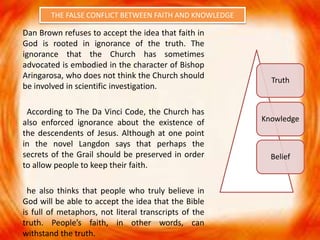
Dan Brown refuses to accept the idea that faith in
God is rooted in ignorance of the truth. The
ignorance that the Church has sometimes
advocated is embodied in the character of Bishop
Aringarosa, who does not think the Church should
be involved in scientific investigation.
According to The Da Vinci Code, the Church has
also enforced ignorance about the existence of
the descendents of Jesus. Although at one point
in the novel Langdon says that perhaps the
secrets of the Grail should be preserved in order
to allow people to keep their faith.
he also thinks that people who truly believe in
God will be able to accept the idea that the Bible
is full of metaphors, not literal transcripts of the
truth. People’s faith, in other words, can
withstand the truth.
THE FALSE CONFLICT BETWEEN FAITH AND KNOWLEDGE
Truth
Knowledge
Belief
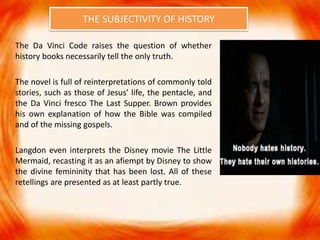
The Da Vinci Code raises the question of whether
history books necessarily tell the only truth.
The novel is full of reinterpretations of commonly told
stories, such as those of Jesus’ life, the pentacle, and
the Da Vinci fresco The Last Supper. Brown provides
his own explanation of how the Bible was compiled
and of the missing gospels.
Langdon even interprets the Disney movie The Little
Mermaid, recasting it as an afiempt by Disney to show
the divine femininity that has been lost. All of these
retellings are presented as at least partly true.
THE SUBJECTIVITY OF HISTORY
Characters in The Da Vinci Code ignore the power of women at
their peril.
Throughout the novel, Sophie is underestimated. She is able to
sneak into the Louvre and give Langdon a secret message,
saving him from arrest, because Fache does not believe her to
be capable of doing her job.
Fache specifically calls Sophie a “female cryptologist” when he
is expressing his doubts about Sophie and Langdon’s ability to
evade Interpol. When interpreting one of the clues hidden in
the rose box, Langdon and Teabing leave Sophie out,
completely patronizing her.
When she is finally allowed to see the clue, she immediately
understands how to interpret it. Sophie saves Langdon from
arrest countless times.
THE INTELLIGENCE OF WOMEN
Even though we know there's a guy called the
Teacher pulling some of the strings behind the scenes
of our story, it's not till the very end that we realize
he's a bad guy…and that he's been masquerading as a
good guy the entire time.
When Langdon and Sophie discover that Teabing's
the Teacher, we realize that his treachery goes even
further than we knew, and that he'd been the one
plotting everything from the very beginning. His
ability to manipulate people comes from years of
planning, an intricate knowledge of his subjects, and a
deviousness that will stop at nothing.
MANIPULATION
Nothing adds intrigue like a good secret, and The Da
Vinci Code is chock full of 'em. There are secrets that
have been passed down for generations in a secret
society created for that very purpose, secrets
embedded in famous masterpieces, and secrets that
aren't actually so very secret at all (if it's in metaphor
form, is it still a secret?).
Then there's the question of whether people are
better off with the secrets remaining secret, or if the
truth should be revealed no matter what the cost.
SECRETS
Brown uses descriptions of
works of fine art to prove that
art can tell stories that history
tends to obscure. These works
of art include Da Vinci’s Last
Supper, Madonna of the Rocks,
and Mona Lisa, which hide
symbols of goddess worship and
the story of the Magdalene; the
Church of Saint-Sulpice, which
still contains an obelisk, a sign of
pagan worship; and tarot cards,
which hide themes of pagan
mythology. These art objects are
constantly viewed by people
who see them without seeing
their hidden meanings.
ART

Themes in The Da Vinci Code

  • 1.
    Name : RaviRajyaguru Roll No : 28 M.A : Sem -4 Paper : ( 13) The new literature Enrolment No : PG15101032 Email id.: rajyagururavi24@gmail.com Submitted To : Department of English MaharajaKrishnakumarsinhji Bhavnagar University Themes in The Da Vinci Code
  • 2.
    • FULL TITLE· The Da Vinci Code • AUTHOR · Dan Brown • TYPE OF WORK · Novel • GENRE · Thriller • LANGUAGE · English • TIME AND PLACE WRITTEN · Early twenty-first century; the United States
  • 3.
    • DATE OFFIRST PUBLICATION · March 2003 • PUBLISHER · Doubleday • NARRATOR · Third-person, anonymous, omniscient narrator • POINT OF VIEW · The narrator speaks from the point of view of several characters, describing what they see and hear. The narrator also provides background information and pieces of knowledge unknown to other characters.
  • 4.
    • THE FALSECONFLICT BETWEEN FAITH AND KNOWLEDGE • THE SUBJECTIVITY OF HISTORY • THE INTELLIGENCE OF WOMEN • MANIPULATION • SECRETS • ART Themes
  • 5.
    Dan Brown refusesto accept the idea that faith in God is rooted in ignorance of the truth. The ignorance that the Church has sometimes advocated is embodied in the character of Bishop Aringarosa, who does not think the Church should be involved in scientific investigation. According to The Da Vinci Code, the Church has also enforced ignorance about the existence of the descendents of Jesus. Although at one point in the novel Langdon says that perhaps the secrets of the Grail should be preserved in order to allow people to keep their faith. he also thinks that people who truly believe in God will be able to accept the idea that the Bible is full of metaphors, not literal transcripts of the truth. People’s faith, in other words, can withstand the truth. THE FALSE CONFLICT BETWEEN FAITH AND KNOWLEDGE Truth Knowledge Belief
  • 6.
    The Da VinciCode raises the question of whether history books necessarily tell the only truth. The novel is full of reinterpretations of commonly told stories, such as those of Jesus’ life, the pentacle, and the Da Vinci fresco The Last Supper. Brown provides his own explanation of how the Bible was compiled and of the missing gospels. Langdon even interprets the Disney movie The Little Mermaid, recasting it as an afiempt by Disney to show the divine femininity that has been lost. All of these retellings are presented as at least partly true. THE SUBJECTIVITY OF HISTORY
  • 7.
    Characters in TheDa Vinci Code ignore the power of women at their peril. Throughout the novel, Sophie is underestimated. She is able to sneak into the Louvre and give Langdon a secret message, saving him from arrest, because Fache does not believe her to be capable of doing her job. Fache specifically calls Sophie a “female cryptologist” when he is expressing his doubts about Sophie and Langdon’s ability to evade Interpol. When interpreting one of the clues hidden in the rose box, Langdon and Teabing leave Sophie out, completely patronizing her. When she is finally allowed to see the clue, she immediately understands how to interpret it. Sophie saves Langdon from arrest countless times. THE INTELLIGENCE OF WOMEN
  • 8.
    Even though weknow there's a guy called the Teacher pulling some of the strings behind the scenes of our story, it's not till the very end that we realize he's a bad guy…and that he's been masquerading as a good guy the entire time. When Langdon and Sophie discover that Teabing's the Teacher, we realize that his treachery goes even further than we knew, and that he'd been the one plotting everything from the very beginning. His ability to manipulate people comes from years of planning, an intricate knowledge of his subjects, and a deviousness that will stop at nothing. MANIPULATION
  • 9.
    Nothing adds intriguelike a good secret, and The Da Vinci Code is chock full of 'em. There are secrets that have been passed down for generations in a secret society created for that very purpose, secrets embedded in famous masterpieces, and secrets that aren't actually so very secret at all (if it's in metaphor form, is it still a secret?). Then there's the question of whether people are better off with the secrets remaining secret, or if the truth should be revealed no matter what the cost. SECRETS
  • 10.
    Brown uses descriptionsof works of fine art to prove that art can tell stories that history tends to obscure. These works of art include Da Vinci’s Last Supper, Madonna of the Rocks, and Mona Lisa, which hide symbols of goddess worship and the story of the Magdalene; the Church of Saint-Sulpice, which still contains an obelisk, a sign of pagan worship; and tarot cards, which hide themes of pagan mythology. These art objects are constantly viewed by people who see them without seeing their hidden meanings. ART