Theme 1: A Difficult past, How The Americas ChangedPowerPoint by Ben Ely
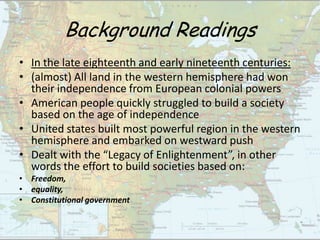
Background ReadingsIn the late eighteenth and early nineteenth centuries:(almost) All land in the western hemisphere had won their independence from European colonial powersAmerican people quickly struggled to build a society based on the age of independenceUnited states built most powerful region in the western hemisphere and embarked on westward pushDealt with the “Legacy of Enlightenment”, in other words the effort to build societies based on: Freedom, equality, Constitutional government
(cont.) Background ReadingsAge of independence pertained to not only the United States, but Canada and Latin America as wellCharacterized byMass Migration“Explosive” economic growth.Economic stagnationCivil warEthnic voilenceClass conflictBattles of Racial/sexual equality
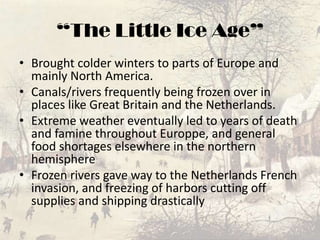
“The Little Ice Age”Brought colder winters to parts of Europe and mainly North America.Canals/rivers frequently being frozen over in places like Great Britain and the Netherlands.Extreme weather eventually led to years of death and famine throughout Europpe, and general food shortages elsewhere in the northern hemisphereFrozen rivers gave way to the Netherlands French invasion, and freezing of harbors cutting off supplies and shipping drastically
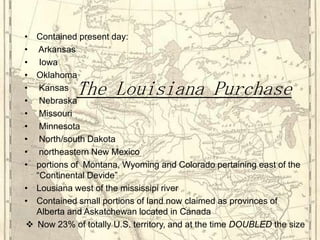
Contained present day: Arkansas IowaOklahoma Kansas Nebraska Missouri Minnesota North/south Dakota northeastern New Mexicoportions of  Montana, Wyoming and Colorado pertaining east of the “Continental Devide”Lousiana west of the mississipi riverContained small portions of land now claimed as provinces of Alberta and Askatchewan located in CanadaNow 23% of totally U.S. territory, and at the time DOUBLED the sizeThe Louisiana Purchase
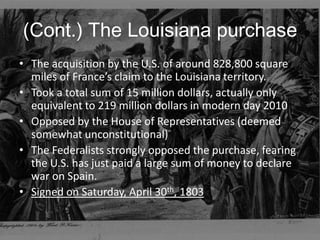
(Cont.) The Louisiana purchaseThe acquisition by the U.S. of around 828,800 square miles of France’s claim to the Louisiana territory.Took a total sum of 15 million dollars, actually only equivalent to 219 million dollars in modern day 2010Opposed by the House of Representatives (deemed somewhat unconstitutional)The Federalists strongly opposed the purchase, fearing the U.S. has just paid a large sum of money to declare war on Spain.Signed on Saturday, April 30th, 1803
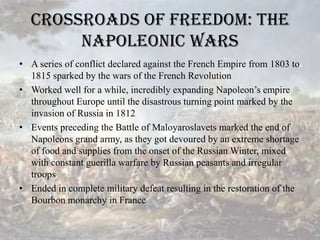
Crossroads of Freedom: The Napoleonic warsA series of conflict declared against the French Empire from 1803 to 1815 sparked by the wars of the French RevolutionWorked well for a while, incredibly expanding Napoleon’s empire throughout Europe until the disastrous turning point marked by the invasion of Russia in 1812Events preceding the Battle of Maloyaroslavets marked the end of Napoleons grand army, as they got devoured by an extreme shortage of food and supplies from the onset of the Russian Winter, mixed with constant guerilla warfare by Russian peasants and irregular troopsEnded in complete military defeat resulting in the restoration of the Bourbon monarchy in France
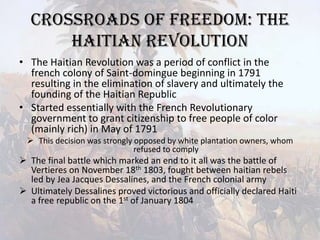
Crossroads of Freedom: The Haitian RevolutionThe Haitian Revolution was a period of conflict in the french colony of Saint-domingue beginning in 1791 resulting in the elimination of slavery and ultimately the founding of the Haitian RepublicStarted essentially with the French Revolutionary government to grant citizenship to free people of color (mainly rich) in May of 1791This decision was strongly opposed by white plantation owners, whom refused to comply
The final battle which marked an end to it all was the battle of Vertiereson November 18th 1803, fought between haitian rebels led by Jea Jacques Dessalines, and the French colonial army
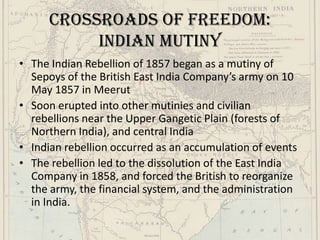
Ultimately Dessalines proved victorious and officially declared Haiti a free republic on the 1st of January 1804Crossroads of Freedom: Indian MutinyThe Indian Rebellion of 1857 began as a mutiny of Sepoys of the British East India Company’s army on 10 May 1857 in MeerutSoon erupted into other mutinies and civilian rebellions near the Upper Gangetic Plain (forests of Northern India), and central IndiaIndian rebellion occurred as an accumulation of eventsThe rebellion led to the dissolution of the East India Company in 1858, and forced the British to reorganize the army, the financial system, and the administration in India.

Theme 1 Ben Ely Hist141

  • 1.
    Theme 1: ADifficult past, How The Americas ChangedPowerPoint by Ben Ely
  • 2.
    Background ReadingsIn thelate eighteenth and early nineteenth centuries:(almost) All land in the western hemisphere had won their independence from European colonial powersAmerican people quickly struggled to build a society based on the age of independenceUnited states built most powerful region in the western hemisphere and embarked on westward pushDealt with the “Legacy of Enlightenment”, in other words the effort to build societies based on: Freedom, equality, Constitutional government
  • 3.
    (cont.) Background ReadingsAgeof independence pertained to not only the United States, but Canada and Latin America as wellCharacterized byMass Migration“Explosive” economic growth.Economic stagnationCivil warEthnic voilenceClass conflictBattles of Racial/sexual equality
  • 4.
    “The Little IceAge”Brought colder winters to parts of Europe and mainly North America.Canals/rivers frequently being frozen over in places like Great Britain and the Netherlands.Extreme weather eventually led to years of death and famine throughout Europpe, and general food shortages elsewhere in the northern hemisphereFrozen rivers gave way to the Netherlands French invasion, and freezing of harbors cutting off supplies and shipping drastically
  • 5.
    Contained present day:Arkansas IowaOklahoma Kansas Nebraska Missouri Minnesota North/south Dakota northeastern New Mexicoportions of Montana, Wyoming and Colorado pertaining east of the “Continental Devide”Lousiana west of the mississipi riverContained small portions of land now claimed as provinces of Alberta and Askatchewan located in CanadaNow 23% of totally U.S. territory, and at the time DOUBLED the sizeThe Louisiana Purchase
  • 6.
    (Cont.) The LouisianapurchaseThe acquisition by the U.S. of around 828,800 square miles of France’s claim to the Louisiana territory.Took a total sum of 15 million dollars, actually only equivalent to 219 million dollars in modern day 2010Opposed by the House of Representatives (deemed somewhat unconstitutional)The Federalists strongly opposed the purchase, fearing the U.S. has just paid a large sum of money to declare war on Spain.Signed on Saturday, April 30th, 1803
  • 7.
    Crossroads of Freedom:The Napoleonic warsA series of conflict declared against the French Empire from 1803 to 1815 sparked by the wars of the French RevolutionWorked well for a while, incredibly expanding Napoleon’s empire throughout Europe until the disastrous turning point marked by the invasion of Russia in 1812Events preceding the Battle of Maloyaroslavets marked the end of Napoleons grand army, as they got devoured by an extreme shortage of food and supplies from the onset of the Russian Winter, mixed with constant guerilla warfare by Russian peasants and irregular troopsEnded in complete military defeat resulting in the restoration of the Bourbon monarchy in France
  • 8.
    Crossroads of Freedom:The Haitian RevolutionThe Haitian Revolution was a period of conflict in the french colony of Saint-domingue beginning in 1791 resulting in the elimination of slavery and ultimately the founding of the Haitian RepublicStarted essentially with the French Revolutionary government to grant citizenship to free people of color (mainly rich) in May of 1791This decision was strongly opposed by white plantation owners, whom refused to comply
  • 9.
    The final battlewhich marked an end to it all was the battle of Vertiereson November 18th 1803, fought between haitian rebels led by Jea Jacques Dessalines, and the French colonial army
  • 10.
    Ultimately Dessalines provedvictorious and officially declared Haiti a free republic on the 1st of January 1804Crossroads of Freedom: Indian MutinyThe Indian Rebellion of 1857 began as a mutiny of Sepoys of the British East India Company’s army on 10 May 1857 in MeerutSoon erupted into other mutinies and civilian rebellions near the Upper Gangetic Plain (forests of Northern India), and central IndiaIndian rebellion occurred as an accumulation of eventsThe rebellion led to the dissolution of the East India Company in 1858, and forced the British to reorganize the army, the financial system, and the administration in India.