A Difficult Past--How
 America’s Changed

       Brooke Soto
        M. Arguello
America’s in 19th
                    Century
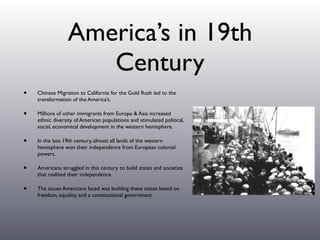
•   Chinese Migration to California for the Gold Rush led to the
    transformation of the America’s.

•   Millions of other immigrants from Europe & Asia increased
    ethnic diversity of American populations and stimulated political,
    social, economical development in the western hemisphere.

•   In the late 19th century, almost all lands of the western
    hemisphere won their independence from European colonial
    powers.

•   Americans struggled in this century to build states and societies
    that realized their independence.

•   The issues Americans faced was building these states based on
    freedom, equality, and a constitutional government.
America’s in 19th
   Century
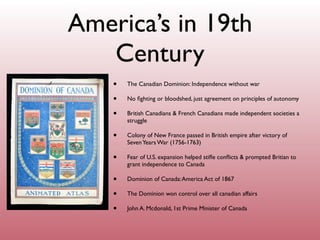
    •   The Canadian Dominion: Independence without war

    •   No fighting or bloodshed, just agreement on principles of autonomy

    •   British Canadians & French Canadians made independent societies a
        struggle

    •   Colony of New France passed in British empire after victory of
        Seven Years War (1756-1763)

    •   Fear of U.S. expansion helped stifle conflicts & prompted Britian to
        grant independence to Canada

    •   Dominion of Canada: America Act of 1867

    •   The Dominion won control over all canadian affairs

    •   John A. Mcdonald, 1st Prime Minister of Canada
Little Ice Age
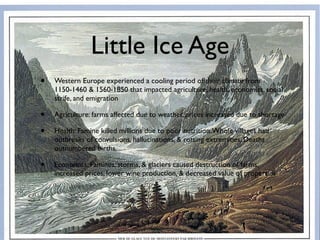
•   Western Europe experienced a cooling period of their climate from
    1150-1460 & 1560-1850 that impacted agriculture, health, economics, social
    strife, and emigration

•   Agriculture: farms affected due to weather, prices increased due to shortage

•   Health: Famine killed millions due to poor nutrition. Whole villages had
    outbreaks of convulsions, hallucinations, & rotting extremities. Deaths
    outnumbered births.

•   Economics: Famines, storms, & glaciers caused destruction of farms,
    increased prices, lower wine production, & decreased value of properties
Frontiers of the
                     Americas
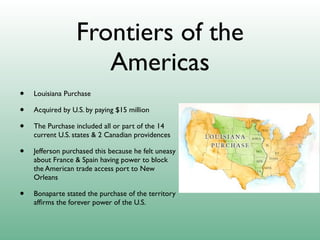
•   Louisiana Purchase

•   Acquired by U.S. by paying $15 million

•   The Purchase included all or part of the 14
    current U.S. states & 2 Canadian providences

•   Jefferson purchased this because he felt uneasy
    about France & Spain having power to block
    the American trade access port to New
    Orleans

•   Bonaparte stated the purchase of the territory
    affirms the forever power of the U.S.
Frontiers of the
               Americas
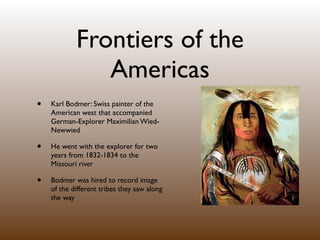
•   Karl Bodmer: Swiss painter of the
    American west that accompanied
    German-Explorer Maximilian Wied-
    Newwied

•   He went with the explorer for two
    years from 1832-1834 to the
    Missouri river

•   Bodmer was hired to record image
    of the different tribes they saw along
    the way
Crossroads of Freedom

•   Bloodies single day in American history is what
    we refer to when we see the date September
    17, 1862

•   This war killed more than 6,000 soldiers

•   McPherson gives detail into the battle & the
    impact & consequences that were created.
Crossroads of Freedom
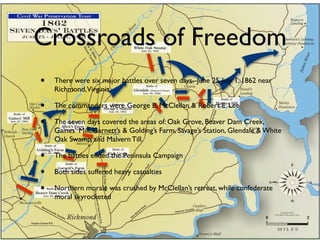
•   There were six major battles over seven days--June 25-July 1, 1862 near
    Richmond, Virginia

•   The commanders were George B. McClellan & Robert E. Lee

•   The seven days covered the areas of: Oak Grove, Beaver Dam Creek,
    Gaines’ Mill, Garnett’s & Golding’s Farm, Savage’s Station, Glendale & White
    Oak Swamp, and Malvern Till.

•   The battles ended the Peninsula Campaign

•   Both sides suffered heavy casualties

•   Northern morale was crushed by McClellan’s retreat, while confederate
    moral skyrocketed
Crossroads of Freedom
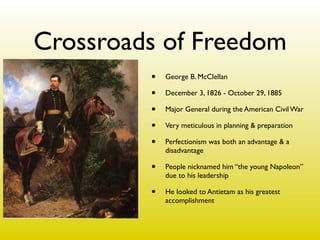
         •   George B. McClellan

         •   December 3, 1826 - October 29, 1885

         •   Major General during the American Civil War

         •   Very meticulous in planning & preparation

         •   Perfectionism was both an advantage & a
             disadvantage

         •   People nicknamed him “the young Napoleon”
             due to his leadership

         •   He looked to Antietam as his greatest
             accomplishment
Crossroads of Freedom
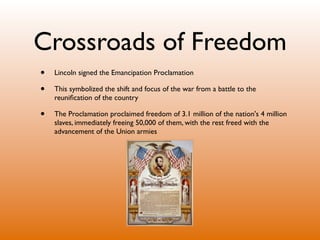
•   Lincoln signed the Emancipation Proclamation

•   This symbolized the shift and focus of the war from a battle to the
    reunification of the country

•   The Proclamation proclaimed freedom of 3.1 million of the nation's 4 million
    slaves, immediately freeing 50,000 of them, with the rest freed with the
    advancement of the Union armies

America's changedpwrpnt

  • 1.
    A Difficult Past--How America’s Changed Brooke Soto M. Arguello
  • 2.
    America’s in 19th Century • Chinese Migration to California for the Gold Rush led to the transformation of the America’s. • Millions of other immigrants from Europe & Asia increased ethnic diversity of American populations and stimulated political, social, economical development in the western hemisphere. • In the late 19th century, almost all lands of the western hemisphere won their independence from European colonial powers. • Americans struggled in this century to build states and societies that realized their independence. • The issues Americans faced was building these states based on freedom, equality, and a constitutional government.
  • 3.
    America’s in 19th Century • The Canadian Dominion: Independence without war • No fighting or bloodshed, just agreement on principles of autonomy • British Canadians & French Canadians made independent societies a struggle • Colony of New France passed in British empire after victory of Seven Years War (1756-1763) • Fear of U.S. expansion helped stifle conflicts & prompted Britian to grant independence to Canada • Dominion of Canada: America Act of 1867 • The Dominion won control over all canadian affairs • John A. Mcdonald, 1st Prime Minister of Canada
  • 4.
    Little Ice Age • Western Europe experienced a cooling period of their climate from 1150-1460 & 1560-1850 that impacted agriculture, health, economics, social strife, and emigration • Agriculture: farms affected due to weather, prices increased due to shortage • Health: Famine killed millions due to poor nutrition. Whole villages had outbreaks of convulsions, hallucinations, & rotting extremities. Deaths outnumbered births. • Economics: Famines, storms, & glaciers caused destruction of farms, increased prices, lower wine production, & decreased value of properties
  • 5.
    Frontiers of the Americas • Louisiana Purchase • Acquired by U.S. by paying $15 million • The Purchase included all or part of the 14 current U.S. states & 2 Canadian providences • Jefferson purchased this because he felt uneasy about France & Spain having power to block the American trade access port to New Orleans • Bonaparte stated the purchase of the territory affirms the forever power of the U.S.
  • 6.
    Frontiers of the Americas • Karl Bodmer: Swiss painter of the American west that accompanied German-Explorer Maximilian Wied- Newwied • He went with the explorer for two years from 1832-1834 to the Missouri river • Bodmer was hired to record image of the different tribes they saw along the way
  • 7.
    Crossroads of Freedom • Bloodies single day in American history is what we refer to when we see the date September 17, 1862 • This war killed more than 6,000 soldiers • McPherson gives detail into the battle & the impact & consequences that were created.
  • 8.
    Crossroads of Freedom • There were six major battles over seven days--June 25-July 1, 1862 near Richmond, Virginia • The commanders were George B. McClellan & Robert E. Lee • The seven days covered the areas of: Oak Grove, Beaver Dam Creek, Gaines’ Mill, Garnett’s & Golding’s Farm, Savage’s Station, Glendale & White Oak Swamp, and Malvern Till. • The battles ended the Peninsula Campaign • Both sides suffered heavy casualties • Northern morale was crushed by McClellan’s retreat, while confederate moral skyrocketed
  • 9.
    Crossroads of Freedom • George B. McClellan • December 3, 1826 - October 29, 1885 • Major General during the American Civil War • Very meticulous in planning & preparation • Perfectionism was both an advantage & a disadvantage • People nicknamed him “the young Napoleon” due to his leadership • He looked to Antietam as his greatest accomplishment
  • 10.
    Crossroads of Freedom • Lincoln signed the Emancipation Proclamation • This symbolized the shift and focus of the war from a battle to the reunification of the country • The Proclamation proclaimed freedom of 3.1 million of the nation's 4 million slaves, immediately freeing 50,000 of them, with the rest freed with the advancement of the Union armies

Editor's Notes