1
TABLE OF CONTENTS
Pages 5-54. Dimitri Antonio Vallejo • Who are the Sherden: Reassessing the Identity of the Ancient Sherden 'Sea
Peoples', 1300-900 BCE
Pages 55-89. Heidi Katter • Evading the Map: The Power of Cartographic Ignorance at the
White Earth and Red Lake Ojibwe Reservations
Pages 90-115. Zachary Wallis • “From the Cape of Bona Speranza to the Streights of
Magellan:” A History of the East India Company’s Tripartite Sovereignty
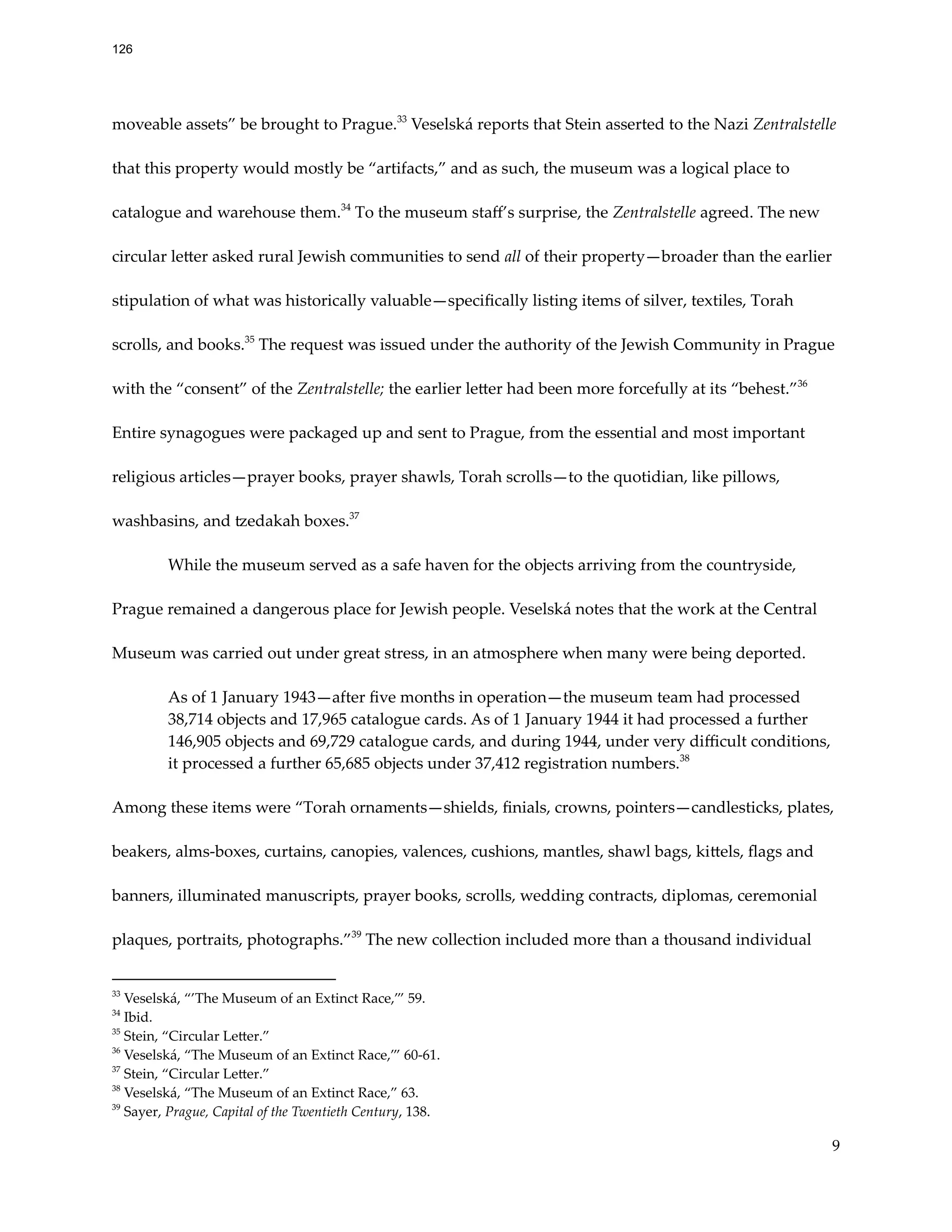
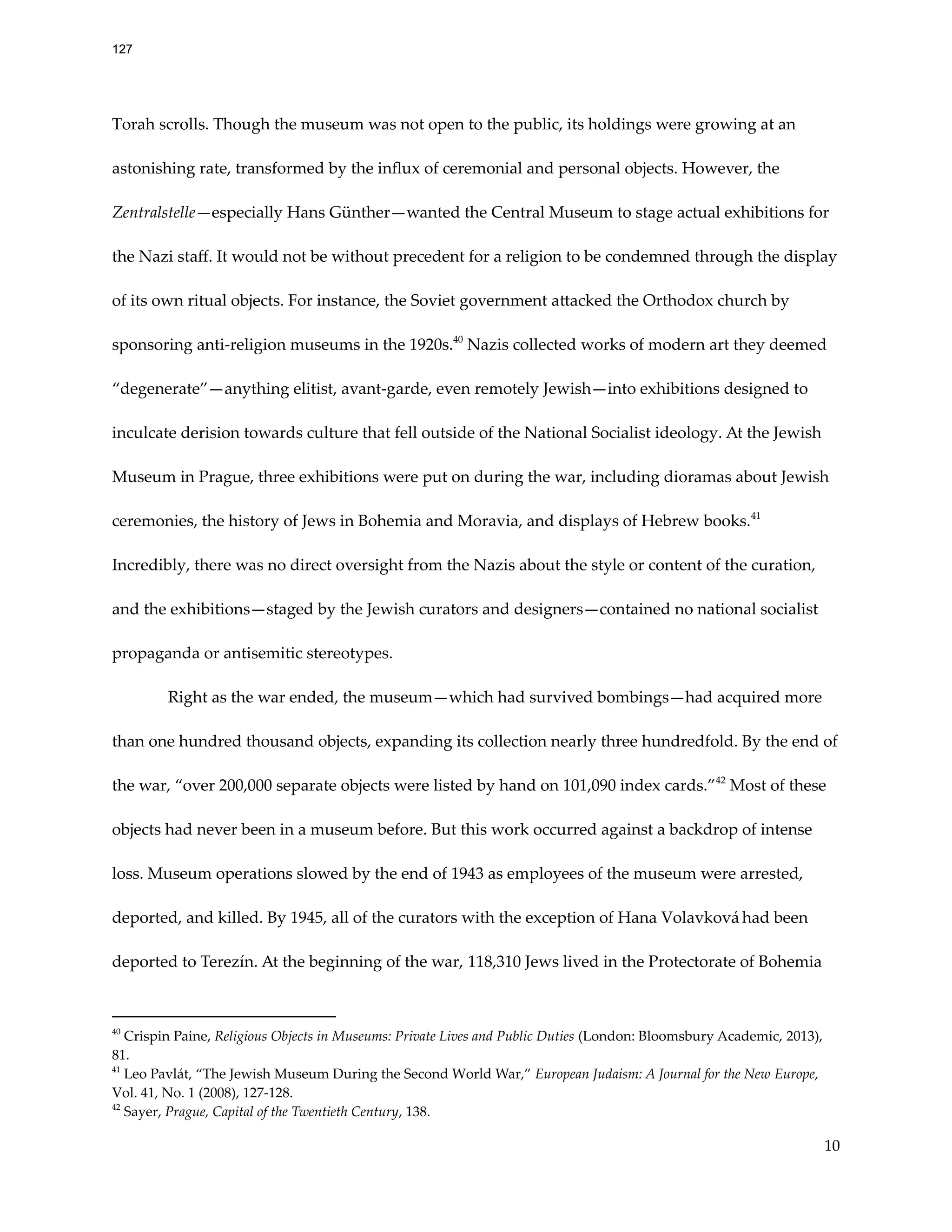
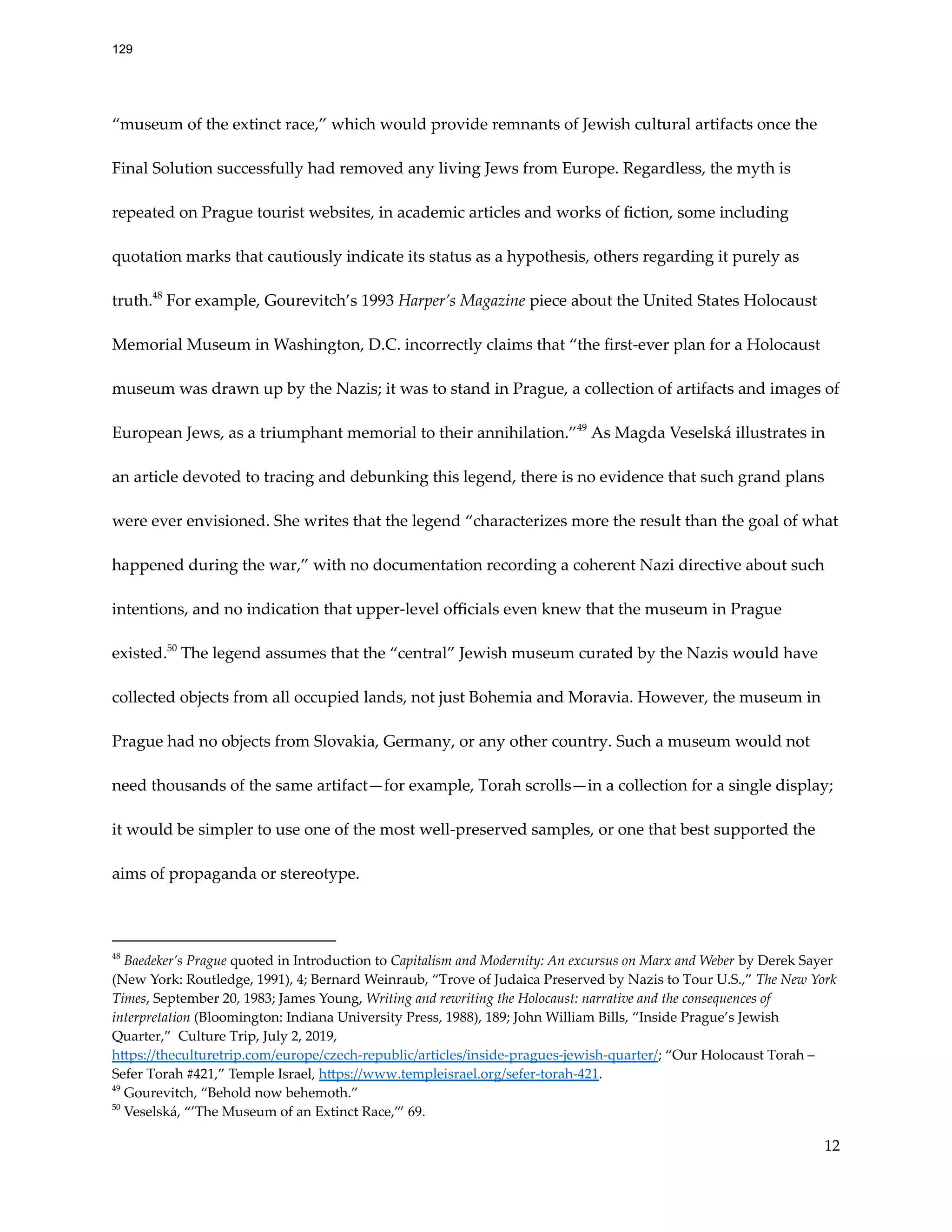
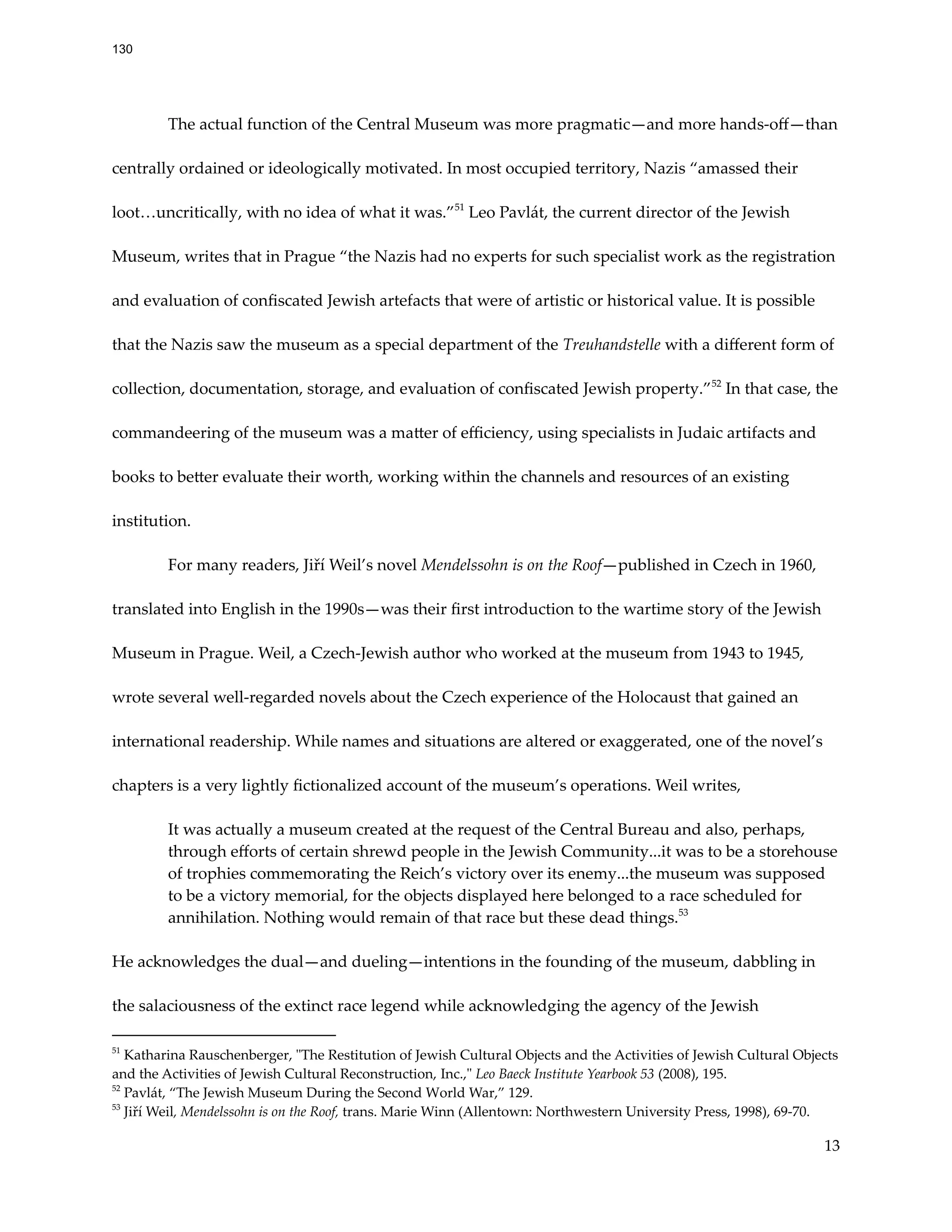
Pages 116-187. Olivia Noble • Near and Not Lost: The International Memorialization of the Czech
Holocaust Torahs
Pages 188-253. Avital Smotrich-Barr • Goodwill Ambassadors or Ideological Warriors?
Cultural Diplomacy and the American-Soviet Exhibit Exchanges in the USSR 1959-1976
2
LETTER FROM THE EDITOR
Dear Readers,
Thank you for reading the Fall 2020 edition of The Yale Historical Review (YHR). I write this
letter from the somewhat curious position as a soon-to-be graduate from Yale. For the first time in
four years, I will no longer be a member of the YHR.
In August 2017, I walked into Payne Whitney amid hundreds of undergraduates and found the
booth that opened my eyes to a passion I never knew I would have: student publishing. Since then,
the YHR has become foundational to my time at Yale. Beyond defining my college experience,
the YHR has shaped my postgraduate trajectory. And, thanks to this journal, I have formed
friendships that will last far longer than any publication cycle and learned lessons that no class could
teach.
Although collaborating remotely since March 2020, the creativity and brilliance of my peers has
continued to guide this journal’s growth. Even as the YHR has expanded its scope over the past
months, we have upheld our same rigorous double peer-review process. Due to an increase in
submissions, we had a record sub-3% acceptance rate in this cycle. The five featured authors
embody our core commitment to intellectual diversity and excellence. Heidi Katter, Olivia Noble,
Avital Smotrich-Barr, Dimitri Vallejo, and Zachary Wallis have all produced original, engaging
scholarly work.
In addition to these authors, YHR editors have spent hours polishing these pieces for a wider
audience. The very existence of this edition speaks to the dedication of scores of students, faculty,
and staff who are committed to providing platforms for students to explore their passions and
express themselves.
As I prepare to leave this journal, I know that I will likely never again find a community quite like
the one the YHR has provided me over these “bright college years.” By nature, the YHR depends
upon the cycle of students arriving in Payne Whitney for the Extracurricular Bazaar and leaving at
Old Campus on Commencement. This movement and mixing of new ideas and people make the
journal so dynamic, so special.
Writing these final lines on moving away from New Haven brings tears to my eyes. But I find solace
knowing that in only a few months, other first years will wander over to that booth with a cardboard
poster that reads The Yale Historical Review.
Sincerely,
Henry Maxwell Jacob, Editor in Chief
3
About the Journal
Please visit our website, https://www.yalehistoricalreview.org,
for more information on what our editorial board has done in
the past, is currently working on, and plans to complete in the
future.
4
Who are the Sherden: Reassessing the Identity of the Ancient Sherden ‘Sea Peoples’, 1300-
900 BCE
Author:
Dimitri Antonio Vallejo
Primary Editors:
Daniel Blatt, SM '21
Mathis Bitton, ES '23
Secondary Editors:
Grace Blaxill, PC '23
Isabella Smeets, MC '25
Cynthia Lin, PC '23
Zahra Yarali, SM '24
5
INTRODUCTION
The Late Bronze Age collapse (1225-1175 BCE) was a period of chaotic violence, erupting
rather suddenly and unexpectedly, with an irreversible impact on the ancient world. Three major
geopolitical developments in the century leading up to the collapse exacerbated this unprecedented
disaster. First, many devastating earthquakes and volcanoes rocked the Eastern Mediterranean in the
fifty years before the collapse, likely obliterating economic stability in the region and leading to the
abandonment of countless settlements; these seismic events coincided with a three hundred year long
drought that undoubtedly contributed to an abject famine. Second, the security of the vital yet delicate
Eastern Mediterranean trade routes depended on the two millennia of Cretan Minoan naval
hegemony—with the thalassocracy’s disappearance, sea vessels lost a critical risk-mitigating
component to their already hazardous voyages. Even minor disruptions to this trade threatened
existential disaster for ancient Bronze Age civilizations because the key technological achievement of
the era—bronze—is an alloy that necessitates combining copper with imported tin. While copper is
abundant in the Eastern Mediterranean, tin is a relatively scarce resource on the European continent;
in fact, sufficient quantities of tin are found only in present-day Afghanistan and Cornwall. Third, the
land-based Egyptian New Kingdom and the Hittite Empire of Asia Minor—both of which dominated
the Eastern Mediterranean for centuries—integrated the western territories of the disintegrating
Mittani polity situated between them. These dual annexations forced the two powers into a direct
rivalry that substantially intensified conflict in the region. Just as the 7th century Byzantine-Sassanid
wars resulted in protracted military exhaustion, so did these far earlier conflicts between the Egyptian
and Hittite polities result in periods of debilitation; and, just as the Byzantines and Sassanids were
further weakened by plagues wreaking havoc upon their societies, so were the Egyptians and Hittites
hindered by the economic instability, insecure supply chains, natural disasters, and widespread famines
that often reduced their power projection to mediocrity. Despite these existential challenges, the
6
Egyptian and Hittite polities seemed undeterred from continuing their imperial ascensions. Imagine
the confusion and horror the peoples of the Eastern Mediterranean suffered when alien marauders
with long beards, horned helmets, and terrifying battle cries burst from the sea to violently dismantle
what little stability remained of civilization. Within less than fifty years, the Egyptian and Hittite
polities were either permanently fractured and reduced to minimal influence or dismantled altogether.
This was the arrival of the Sea Peoples.
The title ‘Sea Peoples’ refers to a comprehensive theoretical narrative concerning an alleged
seafaring confederation of nine distinct groups that together devastated the Eastern Mediterranean
polities through a series of raids and invasions at the end of the Late Bronze Age. The Sea Peoples
are often blamed, in part or in whole, for the collapse of the palace culture of the Late Bronze Age,
which started a Dark Age in ancient history lasting three centuries. They are also considered ancestors
of many groups that appear in first millennium BCE sources—such as the Philistines, the Israelite
tribe of Dan, the Nuragic people of Sardinia, and others. Additionally, the destabilizing influence of
the Sea Peoples on Egyptian and Hittite authority allowed Phoenician cities to flourish without
needing to appease the demands of imperial extraction; this flexibility, while relatively short-lived,
granted these same Phoenicians the institutional power to sail west and colonize key areas of the
Mediterranean, establishing more reliable routes for trade and communication.i
The invasion of the
Sea Peoples remains one of the most notorious and controversial periods in Egyptian history due to
its narrative emphasis on an unprecedented mass migration and coordination of ancient nations.ii
The Sea Peoples theoretical narrative was first articulated in 1855 by Emmanuel de Rougé—
then curator of the Louvre—when he published his interpretative translations of battles recorded on
the walls of the Medinet Habu archeological site in Egypt.iii
Many of the conquered peoples depicted
at Medinet Habu were referred to as ‘peoples of the sea’iv
by de Rougé and, in 1867, he published a
manuscript that postulated geographic locations for them, as well.v
De Rougé was appointed as the
7
Chair of Egyptian Philology and Archeology at the Collège de France where he was ultimately
succeeded by Gaston Maspero in 1874; about twenty years later, Maspero expanded the work of de
Rogué by proposing a detailed theory of maritime migrations in which he coined the term ‘Sea
Peoples.’vi
At a time when the competition for territory and economic advantage among European
Powers was sweltering, Maspero’s idea of population migrations would have felt comfortably familiar
to its general audience. Thus, after its endorsement by additional scholars such as Eduard Meyer,vii
Maspero’s Sea Peoples narrative became accepted as the predominant theory amongst ancient
historians and Egyptologists for the next two centuries.
Starting in the late 20th century, the Sea Peoples theory received an influx of criticism by
scholars such as Robert Drews, Ann Killebrew, Neil Silberman, Marc Van de Mieroop, and Claude
Vandersleyen. Although later connecting the Sea Peoples invasions to the Aegean, Drews initially
claims that there are no references to migrations in the Egyptian sources. He ultimately concludes the
Sea Peoples narrative is a conjecture based on an interpretation of the inscriptions rather than on the
inscriptions themselves.viii
Killebrew adds that the Sea Peoples narrative is too broad and should not
encompass the entirety of peoples mentioned in Egyptian sources because references to the sea are
only made to three of the nine groups.ix
Silberman furthers a criticism of speculative interpretation by
suggesting that the predominant Sea Peoples theory is fundamentally reliant on a ‘Victorian narrative’,
one whose political and social ideologies have influenced the interpretation of Egyptian evidence to
reflect modern conceptual frameworks.x
Van de Mieroop highlights inconsistencies in the narrative,
including chronological and evidential contradictions. For example, identical attacks on the Nile Delta
are described as sudden and sequential events in Egyptian accounts despite chroniclers dating them
thirty years apart and mentioning some of these aggressors as mercenaries or prisoners in the Egyptian
army fighting against the Hittites in northern Syria around that very time.xi
As an example of more
direct lingual interpretation, Vandersleyen rejects the translation of ‘w3d-wr’ and ‘p3 ym’xii
as referring
8
to a salt water sea; instead, he proposes that the terms reference sweet water while the phrase ‘iww
hryw-ib w3d-wr’xiii
does not necessarily refer to islands.xiv
Although these issues with the inherent
conjecture of the Sea Peoples theory are extensive, they are not sufficient for completely disregarding
the potential of its theoretical framework.
The Sea Peoples theory ties otherwise independent peoples together and, consequently, creates
a framework that forces a foreign and maritime national identity on to each of the associated groups.
As noted by Silberman, this narrative was influenced by the ideologies of the time in which the theory
was first postulated. In addition to the issue of presentism, Van de Mieroop extends the problematic
uncertainty of speculative interpretation to the primary sources themselves by suggesting the
Egyptians were simply comprehending events through their own limited framework. It is entirely
possible that the Egyptians “could envision threats to their territory only in terms of major armies
attacking them,”xv
as Van de Mieroop contends, and that this bias in Egyptian records was reaffirmed
by similarities in the major power rivalries within Europe at the time of the theory’s inception.
Nevertheless, the Egyptians clearly name and depict multiple distinct groups in various inscriptions
and visual representations. Despite the clear challenges in utilizing the Sea Peoples theory to set the
narrative structure that contextualizes the Late Bronze Age, named groups of so-called ‘Sea Peoples’
such as the Sherden did exist in some capacity. This treatment would not be unlike utilizing the term
‘Indians’ to refer to the diverse native populations of the American continents. The examination of
Sherden identity—as a people, nation, ethnicity, culture, or label—thus remains an important object
of historical consideration.
The Sherden—or Shardana, as an alternative translation—were one of the nine groups
associated with the Sea Peoples’ invasions of the Egyptian New Kingdom. The history of the Sherden
is reliant upon various Egyptian inscriptions and visual representations, as opposed to a robust and
objective historical narrative. The reconstruction of the Sherden timeline is therefore heavily
9
dependent on scholarly interpretation. Nevertheless, historians and scholars largely agree on a Sherden
presence in Egypt at the middle of the 13th century BCE that persists continually until at least the
mid-12th century BCE. The Sherden are often perceived as foreign invaders of Egypt alongside the
Libyans and other alleged Sea Peoples during the reign of Pharaoh Ramesses II (1279-1213 BCE).
They are then recorded as allies to Ramesses II in his conflict against the Hittites; and they appear
again as aggressors during yet another invasion of Egypt, likely under the reign of Merenptah (1213-
1203 BCE). Ultimately, the Sherden are depicted as supporters of both Egypt and her many enemies
at the time of Ramesses III (1186-1155 BC). The frequency of references to the Sherden decreases
during the subsequent reigns of Ramesses III’s successors.
The primary objective of my research is to reassess the identity and origins of the Sherden. As
opposed to other origin theories, I will argue that the Sherden likely emerged from the northern
Egyptian Delta region because much of the evidence suggests that the name is a typecast
categorization, ultimately turned classification, rather than a cultural or national identity. The evidence
also contextualizes peripheral unrest in the Delta and supports the postulation that Egyptian authority
in the region was, at the very least, partially insecure. I support my contention with direct examinations
of every relevant source associated with the Sherden—such as wall reliefs, stelae inscriptions, clay
tablets, and papyri.
In such an extensive reassessment, it is imperative to deconstruct the major labels attached to
the Sherden—such as Sardinian, Aegean, Syrian, or Asiatic—in order to comprehend the implications
that various interpretations have on the development of these diverse Sherden identity theories. I will
also seek to dispel any notion of a Sherden cultural association with the broader Sea Peoples narrative
by demonstrating that the Sherden were likely supporters or exploiters of the invasions of other alleged
Sea Peoples rather than an integrated member of an alleged confederacy. Lastly, I will conclude that
the Sherden eventually integrated into Egyptian society through a centralized assimilation policy
10
initiated by Ramesses III and perpetuated by his successors. It is important to note that one scholar,
Alessandra Nibbi, argued the Sea Peoples at large originated from the Delta region primarily due to
her assertion that the Egyptians did not have a word to describe a sea or the Mediterranean. I must
be clear that I disagree with Nibbi’s key premise as well as her broad conclusion, and that my argument
is mostly independent from her analyses; a discussion of our divergent perspectives will follow later
in this paper.
The following paper will be divided into two sections: first, I will review Sherden
historiography by discussing the proposed origin theories; and second, I will outline my interpretation
of the Sherden narrative, including my theory on their origination in the northern Egyptian Delta
region and eventual assimilation into Egyptian society. The conclusion of this paper will provide
potential avenues for further research and representation of a distinct Sherden identity within a
comprehensive examination of Mediterranean historiography. Revealing the identity of the Sherden
indirectly provides context for the broader ancient Mediterranean world: if the Sherden sailed from
Sardinia while maintaining the capacity to militarily challenge dominant empires in the Eastern
Mediterranean, then their level of institutional centralization, technological prowess, and intersocial
communication would prove lightyears beyond any expectations of their hypothesized geographical
origins. The determination of Sherden identity will ultimately reveal either a sense of unprecedented
interconnectedness amongst the civilizations of the Bronze Age, or a world of isolation and
individuality interrupted by a sudden mass migration of peoples all around the same time. Either way,
examining these various interactions with the Sherden helps to establish a less ambiguous picture of
an often overlooked subject in antiquity.
11
SHERDEN HISTORIOGRAPHY
The following section is an in-depth analysis of the contentions proposed by the many
historians, archeologists, and scholars who have dedicated significant portions of their research to
revealing the identity of the Sherden or the Sea Peoples at large. Although there are numerous theories
relating the Sherden to countless different locations and cultures, many of them are no more than
claims often devoid of substantial evidence or any semblance of explanation. Some of these authors
have connected the Sherden to ancient cultures in Iberia or the Balkans, while others have constructed
elaborate schemes in an effort to form textual, archaeological, and visual evidence into a coherent
whole; but such postulations often depend on hasty generalizations and appeals to ignorance as well
as unsubstantiated premises. Since the academic community has paid little attention to such
unsupported assertions, no discussion of such claims will follow in this paper.
This section’s analysis concentrates on deconstructing the postulations regarding Sherden
identity, many of which have helped to shape the course of Sherden historiography. Four theories
warrant considerable attention due to their impact on this Sherden historiographic identity: Sardinia,
the Aegean, northern Syria, and western Asia Minor. By pointing out flaws in each hypothesis while
utilizing their acceptable premises, this paper will support the proposal that the term Sherden is a label
that refers to natives of the northern Delta region who were forcibly assimilated into Egyptian
society.xvi
Sardinian Origin Theory
The first correlation between the Sherden and a home territory was presented by the
Egyptologist Emmanuel de Rougé in the mid-19th century. Relying on the etymology of their name,
de Rougé proposed that the Sherden originally sailed from their homeland of Sardinia to join forces
with sea marauders and Libyan contingents before challenging Egyptian forces.xvii
The use of
12
etymology in de Rougé’s Sardinia-Sherden thesis is the primary form of evidence for the connection;
however, the theory itself is based on a fallacious argument.
A large part of de Rougé’s contention relies on an assumption concerning the Nora Stone.
Discovered in the late 18th century on the southern coast of Sardinia, the Nora Stone was inscribed
by the Phoenicians in the 9th century BCE and is the first written reference to the island as
“Sardinia.”xviii
The third line of the Nora Stone follows as: “bšrdn š”—translations by epigraphic
specialists in Semitic languages agree that it refers to the inhabitants of Sardinia.xix
The similarity
between the Nora Stone transliteration and the Egyptian inscriptions referring to Sherden as “šrdn”
strongly suggests that the Phoenicians deliberately connected the inhabitants of Sardinia to the
Sherden. Falsely assuming this correlation as a causal relationship, de Rougé concludes that the
Phoenicians named Sardinia after the Sherden due to these weak etymological similarities.
Despite the near certain intent of the Phoenicians to connect the Sardinians to the Sherden,
de Rougé’s argument does not consider the possibility that the Sherden settled in Sardinia following
their involvement in the Eastern Mediterranean at the time of the Sea Peoples narrative. It also does
not address the possibility that the Phoenicians provided Sardinia with its name simply because the
native Nuragic cultures visually resembled the depictions of Sherden on Egyptian wall reliefs. De
Rougé’s conclusion identifying Sardinia as the origin of the Sherden therefore remains dependent on
fallacious etymological assumptions.
Notwithstanding the questionable foundations on which the Sardinian origin thesis developed,
many scholars have continued to present additional evidence in the hopes of strengthening a
correlation between the two peoples. Robert Drews, renowned scholar of Bronze Age Greece,
supported de Rougé’s etymological interpretation by contending the word “Sherden” itself to mean
“a man from Sardinia.”xx
As additional support for a Western Mediterranean origin theory, Drews
claims that round shields did not exist in the Eastern Mediterranean until the late thirteenth century
13
BCE; since the Sea Peoples narrative coincides with the first appearance of round shields in warfare,
Drews concludes that the technology must derive from foreign westerns, particularly with the
migration of Sherden from Sardinia since only they were depicted in Egyptian sources as utilizing such
unprecedented technology.
By concluding that the utilization of round shields in the Eastern Mediterranean is evidence
of direct foreign influence, Drews is forced to interpret Sherden appearances in the Battle of Qadesh as
entirely of ethnic typification. The wall reliefs of the Qadesh stelae (Figure 1), as well as those at the
Sun Temple of Abu Simbel constructed shortly after the battle (Figure 2), contain the alleged first
depictions of Sherden. This claim is based on unique visual characteristics that resurface in later wall
reliefs, one of which is labeled as “Sherden.”xxi
The rendering in both wall reliefs include three to four
soldiers utilizing identical rounded shields with circular embossments or painted designs lining the
borders and center of the shields in a cyclical fashion. The figures are depicted wielding uniform spears
while wearing the same short kilts with fabric dangling downward from the middle end. It is also
important to note that two of the three soldiers in the Qadesh stela are wearing dissimilar horned
helmets, with the third portrayed as using the same headgear but without horns.
14
Figure 1 (left): Wall relief from the Qadesh stela at the Ramesseum, Thebes. This likely represents a storming of an Amurru fortress
while on campaign.
Image and interpretation are from [Nancy K. Sandars, The Sea Peoples: Warriors of the Ancient Mediterranean 1250-1150 BC (London:
Thames & Hudson, 1978) 30].
Figure 2 (right): Wall relief in the Sun Temple of Abu Simbel in the south of Upper Egypt. This likely represents personal guards of
Ramesses II. These individuals are often interpreted as Sherden.
Image and interpretation are from [Henry Breasted, The Temples of Lower Nubia: Report of the Work of the Egyptian Expedition, Season of
1905-’06 (Chicago: University of Chicago Press, 1906)c 2].
Considering the close timing of a Sherden defeat and subsequent imprisonment at the hands
of Ramesses II,xxii
it is likely that the captured Sherden soldiers present at the Battle of Qadesh are the
same Sherden captives who were hauled off to Egypt after losing to the Pharaoh two years earlier.
However, due to the irregular characteristics previously identified, not all of the visual depictions in
these wall reliefs should be assumed as sufficiently linked to the Sherden. Even if all of the individuals
depicted in the visual representations are Sherden, and even if they are sufficiently connected to
Sardinia, the argument would still depend on the assumption that the technology was developed in
Sardinia and only later transferred to the Eastern Mediterranean. While this hypothesis remains a
possibility, the antithesis is equally as plausible. The presence of rounded shields in the Eastern
Mediterranean at this time is therefore insufficient to justify assertions of Sherden as foreign
influencers.
Aside from etymological and visual interpretations, physical evidence has also served to
strengthen the resolve of Sardinia-Sherden proponents. The archeologist Roger Grosjean uncovered
statue menhirs on the island of Corsica depicting individuals that closely resemble the representations
of the alleged Sherden in Ramesses III’s Medinet Habu wall reliefs.xxiii
15
Two archaeological sites, Cauria and Scalsa
Murta, were excavated in Corsica where
archaeologists uncovered statue-menhirs that
look eerily similar to the Sherden in the Medinet
Habu depictions; they date to between 1400 and
1000 BCE and are clearly militaristic.
The top image is from [Grosjean, 47]. The bottom image is from
[Nancy K. Sandars, The Sea Peoples: Warriors of the Ancient
Mediterranean 1250-1150 BC (London: Thames & Hudson, 1978),
103].
The existence of a network between Sardinia and the Eastern Mediterranean was suggested by the
archeologist Birgitta Hallager with her discovery of Mycenaean pottery—in the traditional style of the
Late Bronze Age—on the island of Sardinia.xxiv
A few years later, the academic Joseph Shaw uncovered
Sardinian pottery in southern Crete, indicating a reciprocal relationship between the two regions.xxv
The archeologist Margaret Guido corroborated these hypotheses with her discovery of oxhide ingots
inscribed with Cypro-Minoan markings found inside native Nuraghe establishments in Sardinia. She
then connected her findings to similar oxhide ingots previously discovered in Crete.xxvi
Guido also
suggested similarities between Egyptian visual representations of the Sherden and the Nuragic self-
depictions.
16
Above are three statue ingots created by the Nuragic peoples of Sardinia. The statue ingots show the Nuraghe with full combat-
readiness in a similar fashion to the Sherden. Note the similarities in horned helmets, short kilts, rounded shields, and swords to the
Egyptian representations.
[National Archeological Museum, Cagliari]—they are representative of depictions by Guido.
Furthermore, the archeologist Adam Zertal suggests that the El-Ahwat settlement in Canaan may be
evidence of a Sherden community in the region, in part due to architectural similarities to native
Nuraghe structures in Sardinia.xxvii
With regard to the Corsican statue menhirs, they lack sufficient similarities to the Medinet
Habu wall reliefs for a conclusive assertion that they depict the same individuals; there are major
differences between the two representations—such as the obvious size disparity in horn length and
the utilization of non-leather heavy armor. The existence of Mycenaean pottery in Sardinia and the
potentially Sardinian oxhide ingots in Crete certainly suggests some sort of connection between the
two regions. The absence of substantial quantities of Mycenaean pottery in Sardinia, however,
indicates a minor trade relationship at best, and surely not a mass migration or transfusion of
peoples.xxviii
In addition, the very origin of these oxhide ingots is disputed,xxix
and even if identified as
Sardinian, the small quantity does not prove an ongoing relationship between Crete and Sardinia—
17
their presence may simply indicate the fascination of a few traders or adventurers with some rare
artifacts.xxx
Lastly, as the archeologist Alfonso Stiglitz points out, the Nuragic features of the El-Ahwat
settlement are associated with Nuraghe culture centuries prior to the construction; the Sardinian
population responsible for its establishment would therefore have wandered for centuries before
settling.xxxi
The Sardinian-Sherden theories receive considerable attention in the academic community due
to the exciting and profound implications they would infer, if true. This paper has thus directed the
largest portion of this section to a discussion of these hypotheses. The analysis above has
demonstrated fundamental flaws in the hypotheses’ contentions that will hopefully free future
perceptions of the Sherden from the etymological, visual, and archeological interpretations that first
bound them to Sardinia.
Aegean Origin Theory
The Minoans of Crete were, perhaps, the first major seafaring Mediterranean civilization.
Lasting for over a millennium, the Minoan navy effectively controlled the Eastern Mediterranean and
secured peaceful trade throughout the region.xxxii
In the middle of the 15th century BCE, however,
Minoan naval supremacy met its end as their home island of Crete likely succumbed to a series of
devastating natural disasters.xxxiii
The historian Michael Wood argues that the Mycenaeans were free to
terrorize the Eastern Mediterranean with coastal raids after the collapse of Minoan stability. Wood
claims these Mycenaeans as the true identity of the Sea Peoples, including the Sherden.xxxiv
In support of his postulations, Wood makes references to specific passages in the Tanis II and
Aswan stelae. Located about a thousand kilometers from one another, the Tanis II and Aswan stelae
were both constructed during the reign of Ramesses II to honor the many victories in his first two
years as Egyptian Pharaoh. The Sherden appear alongside other aggressors in these inscriptions; for
18
instance, the inscription on Face A of the Tanis II stela, which largely recounts military victories over
the Nubians and Libyans,xxxv
contains a narrative description of Sherden as follows:
Whose might has crossed the Great Green Sea, so that the Isles-in-the-Midst are in
fear of him. They come to him, bearing the tribute of their chiefs, his renown has
seized their minds. As for the Sherden of the rebellious mind, whom none could ever
fight against, who came bold-hearted, they sailed in, in warships from the midst of the
Sea, those whom none could withstand; but he plundered them by the victories of his
valiant arm, they being carried off to Egypt.xxxvi
Near the end of the stela, the inscription describes a brief engagement between Ramesses II and the
“Sherden of the rebellious mind,” the latter of which were described as “bold-hearted” as well as
relatively invincible in their naval aptitude. The stanza, “warships from the midst of the Sea,”
references an earlier description of invaders who “crossed the Great Green Sea” and threatened the
northern territories of Egypt. The Aswan stela, as opposed to the Tanis II stela, does not explicitly
reference the Sherden by name:
I cause Egypt to go on campaigns, their minds filled with his plans. They sit in the
shade of his strong arm, and they fear no foreign country. He has destroyed the
warriors of the Great Green, the Delta slumbers and can sleep.xxxvii
Nevertheless, the similarities between the two stelae strongly suggests that the Sherden are the
“warriors of the Great Green.” Since many scholars—including Wood—have interpreted the “Great
Green Sea” as a reference to the Mediterranean, it is often concluded that the “Sherden” in the Tanis
stela and the “warriors of the Great Green” in the Aswan stela are invaders of Egypt and the Delta
regions. The origins of the “Sherden” are foreign to the territory of Ramesses II and, as such, should
be associated with the broader Sea Peoples narrative. In addition to the aforementioned
interpretations, Wood considers the “Isles-in-the-Midst” analogous to the Aegean and its countless
islands.xxxviii
The proposed association between the Great Green Sea and the Sherden is not substantial
evidence of an origin theory beyond lands closely associated with Egypt. The interpretation of the
“Great Green Sea” as referring to the Mediterranean has been disputed by the archaeologist
19
Alessandra Nibbi, who argues the reference is an allusion to the Nile Delta region.xxxix
However, the
widespread panning of Nibbi’s premises has led most scholars to disregard her theory as misinformed;
it is simply too outrageous to accept that the Egyptians lacked a word for the Mediterranean or for
sea. While in agreement with the scholarly community that ymxl
certainly refers to the Mediterranean
or to sea, it is nevertheless necessary to append their determination. Given the qualifiers Nibbi points
out in the Wenamun textxli
used to refer directly to specific geographic locations, the descriptor of
“Great Green” preceding ym modifies or, at the very least, specifies an association with a broader sea.
The absence of ym from the stanza in the Aswan stela further suggests the “Great Green” as
referencing a region separate from the waters of the Mediterranean. If the origins of the Sherden were,
in fact, from the Aegean and if the “Great Green Sea” references a region distinct from the
Mediterranean, then the depiction of the Sherden sailing “in warships from the midst of the Sea”
seems to allude to the Mediterranean. That is, the Sherden sailed from the Mediterranean into the
region known as the “Great Green Sea.” While this interpretation is likely accurate, this paper will also
hypothesize that the Sherden were not foreign invaders and instead simply utilized, or allied with,
these foreign “warships from the midst of the Sea” in a resistance against Ramesses II.
Ultimately, the Aegean-Sherden theory relies on too little evidence to present a compelling
correlation. Nonetheless, this research is not sufficient to dismiss the entirety of the Aegean origin
theory in relation to other groups associated with the Sea Peoples narrative.
Northern Syrian Origin Theory
The term Syria, when used in ancient dialogue, refers to the whole of the modern Levantine
coast—from the southern tip of modern Israel to just north of the modern city of Antakya. Most of
the region was considered an integrated province of the Egyptian empire at its zenith in the 15th
20
century BCE; the archeologist Nancy Sandars claims that the Sherden homeland exists at the
northernmost extent of Egyptian influence in Syria.xlii
Sandars centers her argument on interpreting Egyptian depictions of Sherden at Medinet
Habu. The temple at Medinet Habu in Thebes uses visual renderings on wall reliefs often accompanied
by detailed inscriptions to honor the many victories of Ramesses III (1186-1155 BCE) against the Sea
Peoples and other engagements with the Libyans, as well as with the Hittites and their allies. A relief
on the outer side of the east wall of Medinet Habu describes a battle in the eighth year of Ramesses
III’s reign against “the northern countries,” and many of the aggressors were imprisoned once the
Egyptians achieved victory.xliii
Many Hittite and Mitanni chiefs as well as four groups commonly
associated with the Sea Peoples, including the Sherden, were among the captives.xliv
This relief offers
Sherden historiography its only definitive visual representation—one figure is explicitly labeled as
“Sherden of the sea.”xlv
Figure d is labeled as “Sherden of the Sea”
The image is from [Alessandra Nibbi, The Sea Peoples and Egypt (Oxford: Noyes Publications, 1975) plate 1].
This depiction includes a horned helmet with a raised sun-disk in the center as well as earrings and a
long beard to characterize the Sherden individual. This single captioned image of the Sherden
influenced subsequent evaluations and interpretations, all of which search for similar characteristics
in other visual representations.
21
Sandars rejects any Mycenaean association with the utilization of horned helmets in warfare—
claiming such attire as “alien to the Aegean.”xlvi
Instead, she contends that the horned helmet is an
iconological mark of divinity native to Asia Minor, Mesopotamia, and northern Syria; horns were
worn, according to Sandars, as an indication of the strength and greatness of an individual god. The
discovery of a Ugarit stela depicting the deity Baal wearing the short kilt of the Sherden as well as their
iconic helmet further suggests a Syrian cultural influence; Sandars also presents further archeological
evidence of “characteristic dress and accouterments” discovered in northern Syria, particularly in
Ugarit. In addition, Sandars points out that the weaponry utilized by the Sherden should not be
considered a recent development in Eastern Mediterranean warfare; rather, the long sword with a
tapering blade often associated with the Sherden is simply an altered version of a Canaanite dagger
from earlier centuries. Lastly, Sandars introduces a small bronze figure into Sherden historiography:
discovered within Enkomi valley in Cyprus, the ‘ingot god’ has familiar characteristics to Egyptian
representations of Sherden—such as the long spear, horned helmet, short kilt, and rounded shield.
22
Enkomi statue: [Cyprus Archaeological Museum, Nicosia]. Actual Ugarit stela depicting Baal: [Musée Du Louvre, Paris].
Sandars thereby proposes that the Sherden are indigenous to the northern Syria region; she
also theorizes that the Sherden left Ugarit following the city’s devastation in the 12th century BCE,
took refuge in Cyprus, and then migrated to Sardinia where they provided the island with its name.xlvii
Sandars’ northern Syrian hypothesis certainly highlights an array of previously ignored
evidence with regard to the identity of the Sherden. The apparent utilization of characteristics often
uniquely associated with the Sherden—horned helmets, long spears, and short kilts—by the peoples
of northern Syria indicates that the introduction of such technologies into the mainstream warfare of
the Eastern Mediterranean did not require a foreign cultural influence, as proponents of the Sardinian-
Sherden origin hypothesis frequently suggest. Nevertheless, the appearance of such characteristic attire
23
in Syria is not sufficient to conclude the existence of Sherden warriors; rather, horned helmets, long
spears, and short kilts are simply necessary for confirming a Sherden presence in any region.
Even if the Sherden did originate in Syria, the suggestion that they migrated from Ugarit to
Cyprus, then to Sardinia, and then again back to Egypt, is no more than an attempt to correlate the
ingot god and the Ugarit stela to Sherden visual historiography. Sandars does not explain how a mass
migration of the Sherden then returned to terrorize the Eastern Mediterranean in coordination with
other raiding groups and polities. Sandars’ argument thus relies on implausible assumptions.
Asia Minor Origin Theory
Situated in a sprawling western Asia Minor valley known as the Sardanion plain is Mount
Sardena and the city of Sardis. This location is best known as the geographic home of the Lydians
described in Herodotus’s Histories on early Achaemenid conquests. It is in this location that the
historian Gaston Maspero claimed the origin of the Sherden.xlviii
Maspero hypothesized that the
Sherden were in the process of migrating to Sardinia at the time of the Sea Peoples narrative, thereby
explaining their association with the groups.xlix
The interpretation of the Sardanion plain as the original homeland of the Sherden, however,
remains an exclusively etymological argument, and such logic is no better used in this context than it
is in the original Sardinian-Sherden hypothesis. In fact, it demands a greater explanation due to the
inherent lack of literary or archeological evidence referring to Sherden stemming from the region and
its surrounding cultures. To resolve such a dilemma, Maspero proposes the possibility that such
peoples may have had different words for referring to the Sherden. However, such an argument
contradicts the foundations on which the etymological association proceeds. The attempt to link the
Sherden with the Sardanion plain, and therefore potentially with the Lydians, remains reliant on
contradictory premises.
24
Despite the immediate faults in Maspero’s contention, the archeologist Margaret Guido
fervently advocated for a hypothesis linking the Sherden to western Asia Minor. Guido suggested that
the region of Hermos, located on the western coast of Asia Minor, is the most likely location of
Sherden origin. She did so for two reasons: first, she cites the etymological argument proposed by
Maspero that links Sardis and the Sardanion plain to the Sherden; and second, Guido claims Hermos
is a region of Asia Minor beyond the direct influences of both Hittite and Mycenaean cultural circles,
thus explaining the lack of literary evidence for the existence of the Sherden in the area.l
Although
Guido remedies the basic contradictions present in Maspero’s contention, she fails to provide any
further evidence in support of a western Asia Minor origin hypothesis aside from extending the
etymological argument to another region. Even if the Sherden were associated with the city of Sardis,
it would require historians to accept the unlikely assumption that Lydian records intentionally neglect
distinctive Sherden characteristics, especially depictions of armor and weaponry in visual
representations. Theories linking the Sherden to Asia Minor thus rely on unreasonable interpretations
of scarce evidence.
THE IDENTITY THEORY REASSESSED
This section will demonstrate that the totality of evidence suggests the term Sherden is an
appellative for the natives of the northern Egyptian Delta region; following their clashes with the
Pharaoh, these Delta natives integrated into Egyptian society through both military conscription and
forced resettlement. This section will explore key evidence for supporting its Northern Delta-Sherden
origin thesis—such as the Amarna letters, Tanis II stela, Aswan stela, material from Battle of Qadesh,
the Great Karnak Inscription, the Athribis stela, material from Medinet Habu, the Great Harris
Papyrus, the Wilbour Papyrus, the Adoption Papyrus, the Papyrus Amiens, and the Anastasi I Papyrus.
25
These sources will be presented in chronological order to illustrate the known history of the Sherden
with respect to the evolution of their social identity.
In Sherden historiography, much attention is focused on three Amarna letters addressed to
the Egyptian Pharaoh Akhenaten (1353–1336 BCE) by King Rib-Hadda of Byblos. The first posited
mention of the Sherden appears in these letters, but with the name “sirdanu.” These letters were found
in the company of roughly three hundred and eighty clay tablet sources written in Akkadian and
discovered at el-Amarna by Egyptian peasants.li
About fifty of these letters were composed by Rib-
Hadda himself, and they outline his pleas for increased military aid while often referencing the
encroaching Hittite and Mitanni polities. For example, in the first letter, Rib-Hadda recounts a plot to
overthrow him—including an attempt on his life:
May the king, my lord, know that the war of ‘Abdi-Ashirta is severe, and he has taken
all my cities for himself. Gubla and Batruna remain to me, and he strives to take the
two towns. He said to the men of Gubla, “Kill your lord and be joined to the ‘Apiru
like Ammiya.” And so they became traitors to me. A man with a bronze dagger: pat-
ra attacked me, but I killed him. A Sirdanu whom I know got away to ‘Abdi-Ashirta.
At his order was this deed done! I have stayed like this in my city and done nothing. I
am unable to go out into the countryside, and I have written to the palace, but you do
not reply to me. I was struck 9 times.lii
According to Rib-Hadda, the failed assassination was orchestrated and supported by Abdi-Asirta of
Amurruliii
south of Byblos; furthermore, “a sirdanu” is referenced in the letter as an individual
defecting to Rib-Hadda’s enemies. It is likely that Rib-Hadda and the Pharaoh must ascribe some level
of significance to a “sirdanu” individual. Otherwise, there would be no practical benefit for Rib-Hadda
to reference a “sirdanu” in his dramaticized letter that aims to persuade the policy of the Pharaoh.
After a considerable length of time, Rib-Hadda once again speaks of the “sirdanu” in two
additional letters that both recount the same events:
Pahura has committed an enormity against me. He sent Suteans and they killed
sirdanu-people. And he brought 3 men into Egypt. How long has the city been enraged
at me! And indeed the city keeps saying, ‘A deed that has not been done since the time
immemorial has been done to us!’ So may the king heed the words of his servant and
send back the men, lest the city revolt.liv
26
Pihura sent Suteans; they killed Sirdanu-people, took 3 men, and brought them into
Egypt. If the king, my lord, does not send them [back], there is surely going to be a
revolt against me. If the king, my lord, loves his loyal servant, then send [back] the 3
men that I may live and guard the city for the king. And as to the king's writing, “Guard
yourself,” with what am I to guard? Send the 3 men whom Pihura brought in and then
I will survive: ‘Abdi-Ashirta, Yattin-Hadda, ‘Abdi-Milki. What are the sons of ‘Abdi-
Ashirta that they have taken the land of the king for themselves? May the king send
archers to take them.lv
This time, however, Rib-Hadda complains about a mercenary contingent of “Suteans” whom, he
claims, have slaughtered “sirdanu-people”lvi
and abducted three men while in Byblos. The “Suteans”
are noted several times throughout the Amarna letters, often grouped with other social classes such
as the ‘Apiru.lvii
The continual references to the threatening “Suteans” are likely no more than an
attempt by Rib-Hadda to invoke them as an enemy known to the Egyptians while simultaneously
incriminating Pahura—the Egyptian commissioner accused of the alleged crimes against Byblos. Rib-
Hadda warns of an impending revolt against Egyptian overlordship if the three seized men remain
unreturned. The three men are not detailed to the same extent as the “sirdanu-people” nor the
“Suteans” despite the negative impact of their forceful capture; it is therefore likely that the term
“sirdanu-people” further attests to their role as significant members of a societal administration
recognizable to the Pharaoh. The inclusion of murdered “sirdanu-people,” to stress the affronts
committed by these “Suteans,” indicates that the former class occupies a particularly significant and
symbolic role in the administration of Byblos’s local enforcement. It does not seem likely, given this
context, that “sirdanu” suggests a unique nationality foreign to the Pharaoh’s recognition.
With respect to the conclusions drawn from the Amarna letters, the term “sirdanu” likely
refers to a class of exceptionallviii
warriors often responsible for enforcing the codes of Byblos.
Moreover, as “sirdanu” is directly referenced by name in these letters sent to persuade Egyptian policy,
the crucial role that this class executes in supporting the kings of Byblos should be recognizable and
27
understandable to the Pharaohs. Unfortunately, there is no further literary record directly discussing
any “sirdanu.”
The connection between “sirdanu” and Sherden is primarily linguistic; more specifically, they
sound the same: “sirdanu” is likely pronounced as Sherdanulix
(sher-dahn-oo) whereas Sherden (sher-
dehn) has an additional translation as Shardana (shar-dahn-ah). This linguistic similarity explains why
the Sherden of the century following the Amarna letters are often attributed with the warrior prowess
of the “sirdanu-people.”
These three Amarna letters, if representative of the Sherden of later literary records,
demonstrate that the word is not linked to ethnicity. In the context of rampant assassinations and
unchecked violence described within the letters, the direct invocation of a Sherden suggests the term
refers to an elite class of soldier or another relevant high-ranking member of society. An etymological
association between “sirdanu” and “Sherden,” however, is not conclusive evidence of the terms’
interconnection.
This paper reinterprets the Tanis II and Aswan stelae as key sources in support of a northern
Delta identity. The stelae were both constructed during the reign of Ramesses II to honor the many
victories in his first two years as Egyptian Pharaoh. It is therefore not surprising that the inscriptions
on the Tanis II stela largely recount military victories over the Nubians and Libyans, with both peoples
ultimately absorbed into the Egyptian army. As suggested previously, other scholars have interpreted
the “Great Green Sea” and the “Isles-in-the-Midst” as the Mediterranean and Aegean, respectively; in
actuality, they reference a distinct region.lx
While the term ym refers to the Mediterranean or to sea,
any preceding qualifier modifies this broad association. In this case, the inclusion of “Great Green”
as an antecedent descriptor modifies the ym reference.
Following the same line of logic, the inclusion of the “Great Green” in the Aswan stela
alongside a reference to the Delta must strengthen their association, especially since there is an absence
28
of ym from the very same stanza. The natural flooding and great expanse of the Delta—with its visual
resemblance to a green swamp—suggests that it is separate from, or an extension of, the
Mediterranean in Egyptian linguistics. “Great Green” would be superior at describing the swampy
foliage of the Delta than the clear waters of the Mediterranean. Even the Egyptians themselves
confirmed the association of “Great Green” with the Delta. According to Egyptologists Ian Shaw and
Richard H. Wilkinson, the Egyptian god of fertility Wadj-wer—whose name ‘w3d-wr’ is analogous
with the “Great Green”—exists as a personification of the northernmost Nile Delta region.lxi
Thus,
the use of “Great Green” as a geographic descriptor likely alludes to the Nile Delta region.
When the Sherden are recorded as sailing “in warships from the midst of the Sea”, they are
not entering the Nile from the Mediterranean. Instead, it is likely that the Sherden simply utilized or
allied with foreign warships in resistance against Ramesses II. The suggestion that the Sherden were
under the tutelage of Egyptian power is supported by a reference to the Sherden in the Tanis stela as
“of the rebellious mind.” It would be unclear how such a group may rebel against an overlord they do
not have. Furthermore, since the Tanis stela illustrates that “they sailed in, in warships from the midst
of the Sea,” the Sherden likely “sailed in” from this northern Nile Delta region and into Lower Egypt
using these foreign warships. This interpretation also explains why they would need to be “carried off
to Egypt” after their defeat. It was not the first time the Sherden raided Egypt, given that “none could
ever fight against them,” which would indicate the stelae are recording the first time a Pharaoh was
successfully able to defeat them. The word Sherden may therefore refer to an excellent fighter of some
sort—a word that should likely be attached to the natives of the Delta and, perhaps at an earlier date,
the exceptional warrior “sirdanu” of Rib-Hadda’s letters.lxii
If not foreigners themselves, the Sherden may have been loosely integrated Egyptian subjects
on the fringe of central authority—namely, the northern Delta region. In both stelae, the story of the
“Great Green” is preceded by an incorporation of defeated peoples into Egyptian forces and followed
29
by a migration of peoples into Egyptian territory. Given the surrounding context of the narrative, as
well as the description of the Sherden as “of the rebellious mind” and the interpretation of the “Great
Green” as referring to the Nile Delta region, the Sherden warriors of the Great Green were likely
peripheral Egyptian subjects who revolted at the instigation of a foreign invasion or migration. The
Amarna letters had already expressed the decline of Egyptian power over northern Syria nearly a
century prior to the reign of Ramesses II, and the weakening of centralized authority may have
prompted these revolts.
Unrest in the Delta likely contributed in preventing Ramesses II from challenging his
competitors’ continual expansions into the Levant early in his reign. Nevertheless, once these
challenges to proximal Egyptian authority were subdued, Ramesses II turned his attention north and
initiated the Battle of Qadesh. This engagement between Ramesses II and Hittite king Muwatalli was
decisive in determining which ruler would achieve supremacy in the region. The Battle of Qadesh is
also of considerable interest due to the comprehensive Egyptian documentation of the encounter.
These excellent records—which include inscriptions as well as wall reliefs—allow scholars to explore
various dimensions of the conflict, including stated motivations and the immense scale of participating
militaries.
The visual representations of the Battle of Qadesh help to gain insight into the early role of
Sherden in Egyptian military and society. It is, however, more astute to focus on Sherden appearances
within the official Egyptian record of victory over the Hittites, including any potential implications.
This record is known as the Poem of Pentaur—a short inscription found on the walls of the Karnak
Temple. The Sherden appear in the Poem among the list of allied peoples supporting the Egyptian
cause:
Now then, his majesty had prepared his infantry, his chariotry, and the Sherden of his
majesty’s capturing,...in the Year 5, 2nd month of the third season, day 9, his majesty
passed the fortress of Sile.lxiii
30
These Sherden are described as captured soldiers fighting alongside regular troops and chariot units.
It is also important to note that the word Sherden deliberately appears between tactical units with no
established connection to ethnicity, which suggests that the term Sherden is a reference to an
additional tactical unit.
The overall context of Egyptian military genius should also inform any interpretation of the
Sherden in the Poem. The Egyptians recorded that their victory at Qadesh was due to the innovation
and bravery of Ramesses II. Despite the dubious credibility of such claims,lxiv
it is clear that the
lightweight chariots utilized by the Egyptian forces were quite advantageous in securing leverage
during the conflict. That is, the innovative tactics and technologies of the Egyptian military likely
ensured the success of any victory, draw, or ordered retreat.lxv
With respect to the structural location
of Sherden in the Poem of Pentaur, the inclusion of Sherden in the Battle of Qadesh therefore suggests
a classist categorization instead of an ethnic one.
Although the records concerning the Battle of Qadesh do not help to identify the origins of
the Sherden directly, their inclusion in Sherden historiography is crucial in understanding the activities
of the Sherden. The records assert that the Sherden, at this time, should be considered closely
associated with military engagements as both enemies and captive allies of the Egyptians.
Consequently, Ramesses II’s use of Sherden warriors during the Battle of Qadesh should be analyzed
as a mechanism for labeling a new class of warriors.
More than half a century after the Battle of Qadesh, the Sherden once again make an
appearance in Egyptian literary records; this time, however, they are categorized alongside confirmed
ancient peoples. The Great Karnak Inscription and the Athribis stela both recount an invasion of
Egyptian-claimed territory by the Libyan king Meryey. In the following excerpt from the Great Karnak
Inscription, the Sherden appear as allies to the Libyans and alleged Sea Peoples:
31
The wretched, fallen chief of Libya, Meryey, son of Ded has fallen upon the country
of Tehenu with his bowmen—Sherden, Shekelesh, Ekwesh, Luka, Teresh, taking the
best of every warrior and every man of war of his country.lxvi
Since the Great Karnak Inscription is heavily dedicated to the campaigns of Merenptah against many
groups connected to the Sea Peoples narrative, the appearance of the Sherden alongside these groups
suggests their direct association—at least in the perceptions of Egyptian sources.
The wording of the Athribis stela, however, suggests an alternative interpretation of the
Sherden. While the Great Karnak Inscription lists the Sherden alongside other so-called Sea Peoples
and Libyans, the Athribis stela separates them by recording their defeat in the inscription’s closing
words.lxvii
The deliberate separation between the Sherden and other peoples in the structure of the
stela suggests that the Sherden were a distinct group from the Libyans and Sea Peoples. The Great
Karnak Inscription nevertheless treats these entities as relatively homogeneous while proclaiming
victory over the invading Libyans and their allies, the latter of which are identified as “northerners
coming from all lands.” Importantly, the descriptor “northerners” identifies a point of origin as north
of Lower Egypt, particularly the Delta region and beyond because Lower Egypt (Memphis) was where
the Pharaoh and his bureaucracy projected their authority. The Great Karnak Inscription likely groups
the Sherden with Libyan allies through the use of the term “northerners” as a vehicle for establishing
their foreignity. Furthermore, the stanza, “of the countries of the sea, whom had brought the wretched
fallen chief of Libya,”lxviii
reiterates the narrative asserted previously in the Tanis II stela by once again
noting naval support provided by these same Libyan allies to the Libyans and Sherden. While the
Libyan allies may include other peoples indigenous to the North African region, they most certainly
include the groups commonly associated with the so-called Sea Peoples. As a result of these narrative
interpretations, there are two scenarios that may explain the events recorded in the Great Karnak
Inscription and the Athribis stela.
32
First, it is possible that Merenptah embarked on a quest to annex the entire Delta region of
Egypt during his reign. The invasions recounted by both of these sources are, in fact, a Libyan attempt
to aid the “northerners”lxix
“of the countries”lxx
from indefinitely falling to Egyptian authority. The
choice to detail the campaign as a foreign invasion legitimizes the Pharaoh’s imperialist war effort.
Second, Merenptah faced a Libyan invasion—supported by foreigners already at odds with
the Pharaoh—that instigated, or was instigated by, a Sherden revolt in one of the northern peripheries
of Egyptian influence. The result of the conflict was the defeat of the Libyan invasion and the slaughter
of Sherden.
In either scenario, the Sherden were northern Delta natives. In the events recounted by the
Great Karnak Inscription and the Athribis stela, however, the Sherden either faced an invasion or they
rose up in revolt against Egyptian hegemony. Even if the Sea Peoples narrative maintains some level
of credence, the Sherden should not be considered Sea Peoples themselves.
The presence of the Sherden in all source material disappears for the twenty years between
the reigns of Merenptah and Ramesses III (1186-1155 BCE). The Sherden then rapidly resurfaced
within inscriptions and reliefs at the Medinet Habu temple in Thebes. The Medinet Habu records
contain the only captioned depiction of Sherden—with horned helmets, long spears, and short kilts—
that subsequently provide Sherden historiography with a primary outline of how Sherden are visually
illustrated.
Aside from these visual markers, Medinet Habu contains additional reliefs and inscriptions
critical to the analysis of Sherden identity. One is a 75-line inscription on the inner west wall of the
second court that recounts an attack in the Nile Delta during the eighth year of Ramesses III’s reign:
The foreign countries made a conspiracy in their islands, All at once the lands were
removed and scattered in the fray. No land could stand before their arms: from Hatti,
Qode, Carchemish, Arzawa and Alashiya on, being cut off [i.e. destroyed] at one time.
A camp was set up in Amurru. They desolated its people, and its land was like that
which has never come into being. They were coming forward toward Egypt, while the
flame was prepared before them. Their confederation was the Peleset, Tjeker,
33
Shekelesh, Denyen and Weshesh, lands united. They laid their hands upon the land as
far as the circuit of the earth, their hearts confident and trusting: ‘Our plans will
succeed!’lxxi
The aggressors are described as “foreign countries” whose “confederation was the Peleset, Tjeker,
Shekelesh, Denyen, and Weshesh.” They obliterated Hittite forces and traditional local allies. While
two of the invaders explicitly named are associated with the Sea Peoples narrative, the Sherden are not
mentioned throughout the inscription. Nevertheless, an additional inscription on the interior of the
first court’s west wall describes a similar invasion of Egypt at this time and also serves as the basis for
the Sea Peoples narrative.
Inscription (excerpt): Thou puttest great terror of me in the hearts of their chiefs; the fear and dread of me before them; that I may
carry off their warriors (phrr), bound in my grasp, to lead them to thy ka, O my august father, – – – – –. Come, to [take] them, being:
Peleset (Pw-r'-s'-t), Denyen (D'-y-n-yw-n'), Shekelesh (S'-k-rw-s). Thy strength it was which was before me, overthrowing their seed,
– thy might, O lord of gods.
Inscription is from [Breasted(a), 48] and image is from [Epigraphic Survey(a), plate 44].
34
The visual representation accompanying the inscription depicts Ramesses III leading three
lines of captives to confront two Egyptian deities—Amon and Mut. The relief is accompanied by a
caption in the voice of Ramesses III where he pleads to Amon to “take them, being: Peleset, Denyen,
[and] Shekelesh.”lxxii
It is probable that Ramesses III’s three lines of prisoners in the visual
representation are analogous to the groups mentioned in its inscription. There are no key differences
between these three groups, except the bottom one displays hair darker than the other two. The kilts
worn by all of the prisoners, however, have a symmetrical cross-shape as well as three pieces of fabric
dangling from each. These kilts will appear once more in a later victory procession.
Visual representations of the Sherden also seem to appear in Medinet Habu wall reliefs. A land
army accompanying the invasion of the Delta was defeated by Ramesses III in the same year and,
aside from these engagements with the groups associated with the Sea Peoples, the Medinet Habu
reliefs recount conflicts with Libya and the Hittite sphere of influence. Within the visual depictions of
these battles, the iconic horned helmet with a raised sun-disk in between is clearly worn by numerous
supporters of the Egyptian cause. This visualization suggests that Egyptian sources deliberately sought
to convey the presence and support of Sherden warriors in these conflicts.
35
Gathered from multiple sites throughout Medinet Habu, the series of representations above depicts the Sherden as allies of the
Egyptians. A) The Sherden, one of whom is illustrated with a short beard, are shown in battle with the Sea Peoples; B) The Sherden
are depicted in conflict with the Libyan forces at odds with Egypt during the fifth and eleventh years of Ramesses III; C and D)
Sherden are shown fighting the Sea Peoples during the eighth year of Ramesses III; E) A large Sherden force is depicted storming a
Hittite fortress in Syria.
Image A is from [Epigraphic Survey(a), plate 34], B from [Ibid., plate 18], C from [Ibid., plate 34], D from [Ibid., plate 94], and E
from [Ibid., plate 39].
36
On the east wall of the first court, the Sherden are depicted in conflict with Libyan forces
hostile to Egypt during the fifth and eleventh years of Ramesses III.lxxiii
The Sherden are also
represented in a relief on the north wall of the first court as storming a Hittite fortress in Syria. The
Great Harris Papyrus, discovered behind Medinet Habu near its northwest wall and composed during
the reign of Ramesses IV (1155-1149 BCE), documented the final victories of Ramesses III over the
invasions of the groups associated with the Sea Peoples—including the Denyen, Tjeker, Peleset,
Sherden, and Weshesh. It recounts the same campaign depicted at Medinet Habu.
I extended all the boundaries of Egypt; I overthrew those who invaded them from
their lands. I slew the Denyen in their isles, the Thekel and the Peleset were made
ashes. The Sherden and the Weshesh of the sea, they were made as those that exist
not, taken captive at one time, brought as captives to Egypt, like the sand of the shore.
I settled them in strongholds, bound in my name. Numerous were their classes like
hundred-thousands. I taxed them all, in clothing and grain from the storehouses and
granaries each year.lxxiv
I planted the whole land with trees and verdure, and I made the people dwell in their
shade. I made the woman of Egypt to go to the place she desired, for no stranger nor
any one upon the road molested her. I made the infantry and chariotry to dwell at
home loin my time; the Sherden and Kehek were in their towns, lying the length of
their backs; they had no fear, for there was no enemy from Kush, nor foe from Syria.
Their bows and their weapons reposed in their magazines, while they were satisfied
and drunk with joy. Their wives were with them, their children at their side; they looked
not behind them, but their hearts were confident, for I was with them as the defense
and protection of their limbs. I sustained alive the whole land, whether foreigners,
common folk, citizens, or people, male or female.lxxv
I made Egypt into many classes, consisting of: butlers of the palace, great princes,
numerous infantry, and chariotry, by the hundred-thousand; Sherden, and Kehek,
without number; attendants by the ten-thousand; and serf-laborers of Egypt.lxxvi
These three excerpts reveal a major shift in the Sherden narrative. The Sherden are integrated into
multiple dimensions of Egyptian society, making them “as those that exist not,” which permanently
changes the meaning of the word. While previous sources may arguably treat the Sherden as a loose
ethnic group, the coupling of the terms “Sherden and Kehek” between distinct “classes” suggests a
deliberate class status. This transition is similar to the evolution of the term ‘Latin’ from describing an
ethnicity to referencing a class status during the Roman Republic.
37
Evidence for a policy of assimilation into Egyptian society also arises around this time. The
Great Harris Papyrus states that the Sherden and Weshesh “were made as those that exist not,”
seeming to recount their obliteration. Instead of a physical destruction of the Sherden, the phrasing
of this line likely indicates a forced integration of Sherden into Egyptian society, not simply a cultural
destruction. Corroborating this hypothesis, the Papyrus later attests to a massive assimilation
campaign: “brought as captives to Egypt, like the sand of the shore. I settled them in strongholds,
bound in my name. Numerous were their classes like hundred-thousands. I taxed them all, in clothing
and grain from the storehouses and granaries each year.” Successfully achieving such an extensive and
organized resettlement agreement would have required a detailed assimilation—or Egyptianization—
strategy.
The Onomasticon of Amenope,lxxvii
a collection of papyri compiled together over various
Egyptian dynasties, contains evidence of such an organized strategy. The giant papyrus provides
insight into the Egyptian politics of 11th century BCE, documenting numerous lists that group items,
places, and peoples together into different categories. The Sherden are listed as individuals within the
papyrus, but remain scattered across distinct classifications; this deliberate organization indicates a
calculated effort by the Egyptian bureaucracy to assimilate the Sherden into the diverse facets of
Egyptian society.
Another wall relief at Medinet Habu provides a visualization of Egyptianization in action. The
interior of the first court’s south wall illustrates the diverse army of Ramesses III on a parade.lxxviii
38
Note the group of individuals second from the top left.
The image is from [Epigraphic Survey(b), plate 62].
Of considerable interest is the second to top left representation of six soldiers—three of which are
shown in an identical fashion with matching spears, kilts, and horned helmets with raised sun-disks in
between. The other three figures—the two at the back of the line and the one leading the march—are
represented quite differently; they have short patterned kilts with dangling fabric, mismatching
headgear, and varying weaponry all dissimilar to the identical three. The former three soldiers are
Sherden infantry, alliedlxxix
to the Egyptians and marching in procession with the rest of Ramesses III’s
court. The wall relief’s visual representation of the Sherden is a unique depiction. First, it includes an
Egyptian blowing a horn toward the line—likely a drill instructor. Second, it renders a group that is
nonuniform in their individual characteristics: the latter two soldiers behind the Sherden support the
potential drill instructor, with one wielding a whip. These two visualizations point to a narrative of
39
Egyptianization—a cultural conditioning exercise teaching the Sherden how to march in an Egyptian
procession.
Following the reign of Ramesses IV, the Sherden are further assimilated into Egyptian society
under Ramesses V (1149-1145 BCE). The Wilbour Papyrus contains a great deal of data on land
allotments, agriculture, and taxation.lxxx
One hundred and nine Sherden are listed by the Wilbour
Papyrus as either owners or workers of land along with “standard-bearers of the Sherden” and
“retainers of the Sherden.” Since standard-bearers and retainers are typically represented alongside
soldiers, this linguistic association uses the term Sherden to evoke a form of warrior class.
The Wilbour Papyrus also contains records of fifty-nine land allotments to the Sherden, forty-
two of which are defined as five arouras—significantly greater than the average. The legitimacy
accompanying the ability to hold land presupposes the Sherden’s near full integration into Egyptian
society. It is likely that the Sherden occupied a higher status in Egyptian society at this time. The
Sherden begin to disappear from record after the Wilbour Papyrus, perhaps because the word mostly
fell out of use due to the success of Egyptianization policies.
A short proclamation known as the Adoption Papyrus, dated to the reign of Ramesses XI
(1107-1078 BCE), mentions two Sherden serving as legal witnesses to several adoptions, including the
adoption of an Egyptian woman by her husband as his daughter.lxxxi
Witnesses were required by
Egyptian legal code to legitimize this sort of agreement, and the deliberate inclusion of the term
Sherden necessitates at least a local understanding and recognition of the term’s significance to the
participants. It is likely that the terms of the agreement would need to be interpreted at some point,
since the document extensively outlines potential methods of possession distribution in the process
of freeing multiple slaves of the aforementioned couple. These freed slaves may require a witness to
testify to their legal freedom. In the event of a disagreement, the arrangement may demand
interpretation; any uncertainty could void its terms. It is therefore likely that these individuals are
40
deliberately described as Sherden to aid in their identification and, more importantly, due to a
traditional respect for their positions in society.
It is also possible that the term Sherden is intended as a label for a specific region in Egypt at
this time. The last mention of a Sherden individual is in the Papyrus Amiens during the 20th dynasty.
Although the papyrus is merely a record of trade income in the form of grain, the document lists
locations of territory within Upper and Middle Egypt associated with Sherden landowners—
specifically the Wadkhet region not far from Thebes. Alongside the mention of the “houses…founded
for the people of the Sherden” is an area designated exclusively for those “who were brought on
account of their crimes.”lxxxii
This reference may indicate the resettlement of Sherden during the reign
of Ramesses III. Considering the past tense of the passage, it appears that the Sherden have fully
assimilated into Egyptian society by this point. Therefore, while this construction is remembered for
its foundational purposes and not for its current occupiers, it may nevertheless explain the reference
to Sherden in the Adoption Papyrus.
The last identified use of the word Sherden in any literary records is found in the Anastasi I
Papyrus, which was written to train Egyptian scribes. The document largely concerns itself with the
reign of Egyptian Pharaoh Amenemope (1001-984 BCE), offering methods in which communications
and announcements may be drafted. These examples are presented in a satirical manner and much of
the text proposes ridiculous provisions and events. In one passage, the Anastasi I Papyrus recounts
an Egyptian campaign to Phoenicia (or Canaan) with the intention of suppressing local uprisings. Of
the nineteen hundred soldiers sent to repress the rebellions, five hundred and twenty are identified as
Sherden.lxxxiii
It is unclear whether this expedition actually took place and if so, whether the Sherden
were actually involved. Nevertheless, it is evident that the use of the word Sherden corroborates an
awareness of their association to military tradition—even if it was included for satirical purposes.
41
Regardless of whether the Sherden of the Delta possessed the capabilities to traverse the
distance of the Mediterranean and settle in Sardinia, the uninterrupted evolution of Nuragic culture
does not prove that a significant population transfusion transpired during the era in question.lxxxiv
The
island of Sardinia and the Nuragic peoples are entirely unrelated to the Sherden. The Phoenicians
likely named the native islanders ‘Sardinians’ because the individuals resembled the Sherden depicted
by Egyptians when assembled in full battle-gear. The uncanny resemblance of bronze Nuragic statues
to the visual representations of Sherden at Medinet Habu likely serves as the erroneous connection
the Phoenicians assumed when inscribing the Nora Stone and naming the island of Sardinia.lxxxv
The
title of Sardinian would fit the peoples of the island, given that the word should delineate a warrior of
unique fighting quality and act under the assumption that the Phoenicians intended the word
‘Sardinian’ to be related to the Egyptian term ‘Sherden.’ Mycenaean pottery, oxhide ingots, and little
bronze statues are explained by preexisting Mediterranean trade networks. The conclusion that the
Sherden originated from Sardinia is therefore unfounded.
It is likely that the Sherden were initially a native peoples occupying remote regions within the
northern Delta territory, one that was thereafter integrated and Egyptianized by Pharaohs. During the
height of Sherden appearances, the official capital of the Egyptian New Kingdom was at Pi-Ramesses
in the northwest of the Delta. Following its decommission, the capital moved several kilometers
westward to Tanis. Although Pi-Ramesses was one of the largest cities in ancient Egypt, its
prominence does not indicate undisputed Egyptian authority within the Delta region. Rather, Pi-
Ramesses attests to an Egyptian interest in stabilizing this crucial strategic territory. As for the frequent
appearances of Sherden in Egyptian sources shortly following the transition to Pi-Ramesses during
the reign of Ramesses II, they most likely reflect the rapid extension of Egyptian authority into hostile
territories.
42
Since the late New Kingdom focused on its northeastern frontier, the establishment of Pi-
Ramesses may have served to solidify control over Egyptian vassals in the Levantine region. The city’s
geographic location also aimed to secure its immediate surroundings, especially once the capital moved
several kilometers westward from Pi-Ramesses to Tanis. An interest in solidifying control over the
Delta appears plausible because the region remained relatively undeveloped in comparison to the
south, at least in areas distant from branches of the Nile. These disparities likely complicated the
Pharaohs’ centralization efforts.lxxxvi
The Delta’s natives, which the Egyptian sources grouped together
as Sherden, resisted the centralizing authority in Pi-Ramesses and were supportedlxxxvii
by other
Egyptian enemies. These Sherden displayed unique fighting abilities that led the Egyptian military to
adopt similar techniques by establishing a ‘Sherden-unit’ in their army. While all the members of the
unit fought in the style of the Sherden, they themselves were not necessarily Delta Nile natives. The
term eventually became synonymous with the elite fighting unit and, as the Sherden of the Delta were
integrated into Egyptian society, the word ‘Sherden’ entirely lost its broad, semi-ethnic identifier.
Instead, the term became a marker of status and class before falling into disuse after some centuries.
The Phoenicians’ association of the Sherden with Sardinia on the Nora Stone extends the use of the
word to describe the fighting prowess of the Nuragic peoples. The name Sardinia was never meant to
suggest that the natives were related to an ethnic group from the East, and especially not to a group
responsible for joining the raids of the so-called Sea Peoples on Egypt. The Sherden of the Sea are, in
fact, of the Delta—and, later, of Egypt herself.
CONCLUSION
My research has identified the term Sherden as a label used by Egyptian sources to refer to
natives of the northern Delta region. I argued that these Sherden were ultimately forced to assimilate
into the Egyptian polity. Nevertheless, I recognize that certain elements of my argument are open to
43
criticism, particularly as more research is conducted on the late Egyptian New Kingdom. For instance,
if it is determined that the Egyptian Pharaohs of the Late Bronze Age maintained centralized authority
over the entirety of the Delta—including the peripheral swampy regions—then it is less likely that the
natives would be depicted so differently from their southern neighbors. Other projects could examine
the technological capabilities of the Egyptian fleet and focus upon its ability to traverse the open
waters of the Eastern Mediterranean. I would be specifically interested in looking for the existence of
trade missions between Minoans, northern Syrians, and the Egyptians; such a route would prove a
level of interconnectedness sufficient to support a more distant Sherden origin theory. In the
meantime, practical evidence does not allow for a migratory transfusion at the scale of the Sherden
invasion narrative.
As I stated in the introduction of this paper, it is of great importance that the origins of the
so-called Sea Peoples are thoroughly studied so as to better comprehend the degree to which they
influenced regions critical to the history of civilization. The Sherden did not sail from Sardinia, nor
did they maintain the capacity to challenge dominant empires in the Eastern Mediterranean. It is
therefore not necessary to postulate how they would have traversed such a considerable distance. The
Sherden did not need to possess an advanced and unprecedented knowledge of the surrounding world.
Instead, when prompted, the groups that the Egyptians referred to as the Sherden likely coordinated
their efforts with their immediate neighbors and those neighbors’ allies.
This examination of Sherden identity supports the idea that the Eastern Mediterranean
remained in a state of communicative isolation vis-à-vis other regions, despite the existence of trade
relations between various polities scattered across the Mediterranean. This study into the origin and
identity of the Sherden hopefully will influence the perspective from which future scholars approach
this challenging topic. In the end, piecing together history—such as the Sea Peoples narrative—often
invites a reflection on current ideologies. It is therefore imperative that historians of each generation
44
re-examine this paper’s narrative, and that of the Sea Peoples, so that these interpretations do not
remain in “the Victorian ages.”lxxxviii
45
BIBLIOGRAPHY
Primary Sources
Breasted, James H. Ancient Records of Egypt, Volume 3. Chicago: University of Chicago Press, 1906.
(b)
Breasted, James H. Ancient Records of Egypt, Volume 4. Chicago: University of Chicago Press, 1906.
(a)
Breasted, James H. The Temples of Lower Nubia: Report of the Work of the Egyptian Expedition, Season of
1905-’06. Chicago: University of Chicago Press, 1906. (c)
Epigraphic Survey, Medinet Habu I: Earlier Historical Records of Ramses III. Chicago: University Press
of Chicago, 1930. (a)
Epigraphic Survey, Medinet Habu II: Later Historical Records of Ramses III. Chicago: University Press
of Chicago, 1930. (b)
Gardiner, Alan H. Ancient Egyptian Onomastica I. Oxford: Oxford University Press, 1947.
Gardiner, Alan H. Ramesside Administrative Documents. Oxford: Oxford University Press, 1948.
Gardiner, Alan H. The Wilbour Papyrus. Oxford: Oxford University Press, 1941.
Kitchen, K.A. Ramesside Inscriptions, 2. Oxford: B.H. Blackwell LTD, 1996.
Moran, William L. The Amarna Letters. London: Johns Hopkins University Press, 1992.
Pritchard, James. Ancient Near Eastern Texts. Princeton: Princeton University Press, 1969.
The Adoption Papyrus (Papyrus Ashmolean Museum 1945.96), translated by Janet H. Johnson, in
Mistress of the House, Mistress of Heaven: Women in Ancient Egypt, edited by Anne K. Capel and Glenn
E. Markoe (New York: Hudson Hills Press, 1996), p. 183.
Museumslxxxix
National Archeological Museum, Cagliari
Cyprus Archaeological Museum, Nicosia
Musée Du Louvre, Paris
Secondary Sources
46
Benz, Brendon. The Land Before the Kingdom of Israel: A History of the Southern Levant and the People who
Populated It. New York: Eisenbrauns, 2016.
Casson, Lionel. The Ancient Mariners, 2nd ed. Princeton: Princeton University Press, 1991.
Chabas, F. Etudes sur l’antiquite historique. Paris: Maisonneuve, 1873.
Cross, Frank M. “An Interpretation of the Nora Stone,” Bulletin of the American Schools of Oriental
Research, 208 (December 1972): 13-9.
Cruz-Uribe, Eugene. “A New Look at the Adoption Papyrus” The Journal of Egyptian Archaeology,
74 (August 1988): 220-223.
De Rougé, Emmanuel. “Extraits d'un mémoire sur les attaques dirigées contre l'Egypte par les
peuples de la Méditerranée vers le quatorzième siècle avant notre ère” Revue Archéologique, 16
(December 1867): 35-45.
De Rogué, Emmanuel. Notice de Quelques Textes Hiéroglyphiques Récemment Publiés par M. Greene. Paris:
Thunot, 1885.
De Rougé, Emmanuel. Oeuvres Diverses IV. Paris: Lausanne Rencontre, 1867.
Desborough, V.R. d’A. The Last Mycenaeans and Their Successors. Eugene: Wipf & Stock, 1966.
Dothan, Moshe and Dothan, Trude. People of the Sea: The Search for the Philistines. New York:
Scribner, 1992.
Drews, Robert. “Herodotus 1.94, the Drought ca. 1200 B.C., and the Origin of the Etruscans”
Zeitschrift für Alte Geschichte, 41 (January 1992): 14-39.
Drews, Robert. The End of the Bronze Age (Princeton: Princeton University Press, 1993).
Eyre, C. J. “The Adoption Papyrus in Social Context,” Journal of Egyptian Archaeology, 78 (1992):
207-221.
Fischer, Peter M. and Bürge, Theresa. eds. “Sea Peoples” Up-to-Date: New Research on Transformations
in the Eastern Mediterranean in the 13th–11th Centuries BCE. Vienna: Verlag der Österreichischen
Akademie der Wissenschaften, 2017.
Fox, Robin Lane. Traveling Heroes in the Epic Age of Homer. New York: Vintage, 2008.
Grosjean, Roger. La Corse avant l’histoire. Paris: Klincksieck, 1996.
Guido, Margaret. Sardinia. London: Thames and Hudson, 1963.
Hall, Henry R. “The Peoples of the Sea. A chapter of the history of Egyptology.” Recueil d'Études
égyptologiques Dédiées à la Mémoire de Jean-François Champollion, 5 (September 1922): 297–329.
47
Hallager, Birgitta Pålsson. “Crete and Italy in the Late Bronze Age III Period” American Journal of
Archaeology, 89 (April 1985): 293-305.
Heltzer, Michael. The Internal Organization of the Kingdom of Ugarit. Wiesbaden: Reichert, 1982.
Hasel, Michael. Domination and Resistance: Egyptian Military Activity in the Southern Levant, 1300–1185
B.C. Leiden: Brill, 1998.
Killebrew, Ann E. The Philistines and Other ‘Sea Peoples’ in Text and Archaeology. Atlanta: Society of
Biblical Literature, 2013.
MacGillivray, J.A. Minotaur: Sir Arthur Evans and the Archaeology of the Minoan Myth. New York: Hill
& Wang, 2000.
Manassa, Colleen. Imagining the Past: Historical Fiction in New Kingdom Egypt. Oxford: Oxford
University Press, 2013.
Maspero, Gaston. “Review of F. Chabas’ Etudes.” Revue Critique d’Histoire et de Littérature (1873):
81-86
Maspero, Gaston. The Struggle of the Nations. London: Society for Promoting Christian Knowledge,
1896.
Moore, M., and Kelle, B. Biblical History and Israel’s Past: The Changing Study of the Bible and History.
New York: Eerdmans, 2011.
Muhly, J.D. “The Role of Cyprus in the Economy of the Eastern Mediterranean During the
Second Millenium B.C.,” Acts of the International Archaeological Symposium ‘Cyprus Between the Orient
and Occident,’ 5 (1986): 45-60.
Müller, Wilhelm Max. “Notes on the ‘peoples of the sea’ of Merenptah.” Proceedings of the Society of
Biblical Archæology, 10 (January 1888): 147–154.
Nibbi, Alessandra. “The City of Dor and Wenamun,” Discussions in Egyptology 35 (1996): 76-95.
Nibbi, Alessandra. The Sea Peoples and Egypt. Oxford: Noyes Publications, 1975.
Nibbi, Alessandra. The Sea–Peoples: a Re-examination of the Egyptian Sources. Oxford: Nibbi, 1972.
Nibbi, Alessandra. “Wenamun without Cyprus,” Discussions in Egyptology 53 (2002): 71-74.
Peckham, Brian. “The Nora Inscription” Orientalia 41 (October 1972) 457-68.
Rainey, Anson F. The El-Amarna Correspondence (2 vol. set): A New Edition of the Cuneiform. Leiden:
Brill, 2014.
Ralby, Aaron. “Battle of Kadesh, c. 1274 BCE: Clash of Empires” Atlas of Military History. New
York: Parragon, 2013.
48
Roebuck, Carl. The World of Ancient Times. New York: Simon & Schuster, 1966.
Sandars, Nancy K. The Sea Peoples: Warriors of the Ancient Mediterranean 1250-1150 BC. London:
Thames & Hudson, 1978.
Schiavo, Fulvia Lo., et al., Oxhide Ingots in the Mediterranean and Central Europe. Rome: CNR, 2009.
Shaw, Joseph W. “Kommos in Southern Crete: an Aegean Barometer for East-West
Interconnections” Eastern Mediterranean: Cyprus-Dodecanese-Crete (May 1998): 13- 27.
Shaw, Ian and Nicholson, Paul. The British Museum Dictionary of Ancient Egypt. The American University
in Cairo Press: 1995.
Silberman, Neil A. “The Sea Peoples, the Victorians, and Us,” Mediterranean Peoples in Transition:
Essays in Honor of Trude Dothan. Jerusalem: Israel Exploration Society, 1998.
Stiglitz, Alfonso. “La Sardegna e l'Egitto: il progetto Shardana” AEgyptica, 1 (September 2010): 59-
68.
Van de Mieroop, Marc. A History of Ancient Egypt. Oxford: Wiley-Blackwell, 2011.
Vandersleyen, Claude. “Les sens de Ouadj-Our (W’d-Wr)” Akten Müchen. Hamburg: 1991.
Vandersleyen, Claude. The Land of Israel: Cross-Roads of Civilizations. Leuven: Uitgeverij Peeters,
1985.
Wilkinson, Richard H. The Complete Gods and Goddesses of Ancient Egypt. New York: Thames & Hudson,
2003.
Wood, Michael. In Search of the Trojan War. London: University of California Press, 1985.
Woudhuizen, Frederik C. The Ethnicity of the Sea Peoples. Rotterdam: Woudhuizen, 2006.
Zertal, Adam. El-Ahwat: A Fortified Site from the Early Iron Age Near Nahal 'Iron, Israel. Leiden: Brill,
2011.
49
i
Some Phoenician colonies were partly responsible for ending the Greek Dark Ages by
encouraging poleis synoecism; other Phoenician colonies were so successful that their institutional
expansions far outpaced the relative influence of their respective metropoles—Carthage, initially
founded by the Phoenician city of Tyre, was one such colony.
ii
Wilhelm Max Müller, “Notes on the ‘peoples of the sea’ of Merenptah.” Proceedings of the
Society of Biblical Archæology, 10 (January 1888): 147-154. Also see Henry R. Hall, “The Peoples
of the Sea. A chapter of the history of Egyptology.” Recueil d'Études égyptologiques Dédiées à la
Mémoire de Jean-François Champollion, 5 (September 1922): 297–329.
iii
Emmanuel de Rogué, Notice de Quelques Textes Hiéroglyphiques Récemment Publiés par M.
Greene (Paris: Thunot, 1885).
iv
Ibid. De Rogué translates hieroglyphic inscriptions as “peuples de la mer” or, in English,
‘peoples of the sea’. Utilizing his translation, he concludes it likely that the individuals in the
inscription belong to nations from islands or coasts of the archipelago.
v
Emmanuel de Rougé, “Extraits d'un mémoire sur les attaques dirigées contre l'Egypte par les
peuples de la Méditerranée vers le quatorzième siècle avant notre ère” Revue Archéologique, 16
(December 1867): 35-45.
vi
Gaston Maspero, The Struggle of the Nations (London: Society for Promoting Christian
Knowledge, 1896).
vii
Robert Drews, “Herodotus 1.94, the Drought ca. 1200 B.C., and the Origin of the Etruscans”
Zeitschrift für Alte Geschichte, 41 (January 1992): 14-39 at 22: “Adopted by Eduard Meyer for the
second edition of his Geschichted es Altertums, the theory won general acceptance among
Egyptologists and orientalists.”
viii
Robert Drews, The End of the Bronze Age (Princeton: Princeton University Press, 1993) 48-61.
ix
Ann E. Killebrew, The Philistines and Other ‘Sea Peoples’ in Text and Archaeology (Atlanta:
Society of Biblical Literature, 2013) 2-32.
x
Neil A. Silberman, “The Sea Peoples, the Victorians, and Us,” Mediterranean Peoples in
Transition: Essays in Honor of Trude Dothan (Jerusalem: Israel Exploration Society, 1998) 268–
75 at 272.
xi
Marc Van de Mieroop, A History of Ancient Egypt (Oxford: Wiley-Blackwell, 2011) 250-5.
xii
James Henry Breasted, Ancient Records of Egypt, 4 (Chicago: University of Chicago Press,
1906)a 44: “of the sea.”
xiii
Ibid., 201: “islands situated in the middle of the sea.”
xiv
Claude Vandersleyen, The Land of Israel: Cross-Roads of Civilizations (Leuven: Uitgeverij
Peeters, 1985) 53.
xv
Van de Mieroop, 253.
xvi
Much of the literature related to Sherden historiography is written in French, German, and
Italian—the latter of which has largely contributed to recent theorizing in the Sardinian Origin
Theory. While I must acknowledge my inability to directly interpret and interact with all of these
texts, I am confident that I mitigate this language obstacle by enlisting multiple colleagues to
translate the most crucial references. For other texts, I cite scholars who have clearly addressed
and summarized their arguments.
xvii
For further reading on the origins of the Sardinian-Sherden thesis, see Frederik C. Woudhuizen,
The Ethnicity of the Sea Peoples (Rotterdam: 2006) 112. Woudhuizen cites Emmanuel de Rougé,
Oeuvres Diverses IV (Paris: Lausanne Rencontre, 1867) 39.
50
xviii
Robin Lane Fox, Traveling Heroes in the Epic Age of Homer (New York: Vintage, 2008) 382:
likely inscribed between 825 and 780 BCE.
xix
Brian Peckham, “The Nora Inscription” Orientalia 41 (October 1972): 457-68. Also see Frank
M. Cross, “An Interpretation of the Nora Stone,” Bulletin of the American Schools of Oriental
Research 208 (December 1972): 13-9.
xx
Drews (1993), 152: the use of the qualifier “from” solidifies the notion that the Sherden came
“from” Sardinia and did not travel there afterwards; thus, resolving the fallacy in de Rougé’s
correlation.
xxi
See the discussion on Medinet Habu on page 23 in the Syrian Origin Theory section.
xxii
The defeat is recorded in the Tanis II and Aswan stelae, a discussion of which follows later.
xxiii
Woudhuizen, 113: a full archeological survey of the statue-menhirs is found in the citation of
Roger Grosjean, La Corse avant l’histoire (Paris: Klincksieck, 1996) 35-194. A discussion of the
Medinet Habu site follows later in this paper.
xxiv
For the full archaeological survey of Mycenaean pottery in the Nuraghe Antigori on the
southern Sardinian coast, see Birgitta Pålsson Hallager, “Crete and Italy in the Late Bronze Age
III Period” American Journal of Archaeology, 89 (April 1985): 293-305 at 304. Also see Moshe
Dothan and Trude Dothan, People of the Sea: The Search for the Philistines (New York: Scribner,
1992) 214.
xxv
For the full archaeological survey of Sardinian pottery in the Cretan town of Kommos, see
Joseph W. Shaw, “Kommos in Southern Crete: an Aegean Barometer for East-West
Interconnections” Eastern Mediterranean: Cyprus-Dodecanese-Crete (May 1998): 13- 27.
xxvi
For further analysis of the oxhide ingots discovered in Sardinia, see Margaret Guido, Sardinia
(London: Thames and Hudson, 1963) 110-111.
xxvii
For the full archaeological survey of El-Ahwat, see Adam Zertal, El-Ahwat: A Fortified Site
from the Early Iron Age Near Nahal 'Iron, Israel (Haifa: Brill, 2011).
xxviii
For further reading on Mycenaean pottery and trade relations with the Mediterranean, see V.R.
d’A Desborough, The Last Mycenaeans and Their Successors (Eugene: Wipf & Stock, 1966).
xxix
J.D. Muhly, “The Role of Cyprus in the Economy of the Eastern Mediterranean During the
Second Millenium B.C.,” Acts of the International Archaeological Symposium ‘Cyprus Between
the Orient and Occident,’ 5 (1986): 45-60 at 55-6. Also see Fulvia Lo Schiavo, et al., Oxhide
Ingots in the Mediterranean and Central Europe (Rome: CNR, 2009) 307.
xxx
Nancy K. Sandars, The Sea Peoples: Warriors of the Ancient Mediterranean 1250-1150 BC
(London: Thames & Hudson, 1978) 101.
xxxi
For further discussion on the unlikelihood of Sardinians at El-Ahwat, see Alfonso Stiglitz, “La
Sardegna e l'Egitto: il progetto Shardana” AEgyptica, 1 (September 2010): 59-68.
xxxii
Lionel Casson, The Ancient Mariners, 2nd ed. (Princeton: Princeton University Press, 1991)
30-44, specifically at 33: the influence of a Minoan naval presence on the ancient Mediterranean
including the impact of the civilization’s eventual demise. In contrast to the Minoans, the Egyptian
fleet largely consisted of ships unfit for Mediterranean transportation and were rarely found outside
the Nile.
xxxiii
J.A. MacGillivray, Minotaur: Sir Arthur Evans and the Archaeology of the Minoan Myth
(New York: Hill & Wang, 2000): evidence for potential volcanic and tsunami natural disasters.
xxxiv
Michael Wood, In Search of the Trojan War (London: University of California Press, 1985)
190-8.
xxxv
The Nubians and Libyans were later absorbed into the Egyptian army. The incorporation of
foreigners into military institutions is often an indicator of aggressive expansionism. The Romans
51
are famous for honing this assimilation technique by reducing enemies to allied client states before
imposing annexation.
xxxvi
Tanis Stela II. K.A. Kitchen, Ramesside Inscriptions, 2 (Oxford: B.H. Blackwell LTD, 1996)
120.
xxxvii
Aswan stela. Kitchen, 181-3.
xxxviii
Wood, 193-5. “Isles-in-the-Midst” refers to a location from which the invaders of Egypt in
the early 13th century BCE sailed.
xxxix
Alessandra Nibbi, The Sea–Peoples: a Re-examination of the Egyptian Sources (Oxford:
Nibbi, 1972).
xl
Egyptian word for ‘Mediterranean’ or ‘Sea’ or ‘Mediterranean Sea’.
xli
Alessandra Nibbi, “Wenamun without Cyprus,” Discussions in Egyptology 53 (2002): 71-74.
Also see Alessandra Nibbi, “The City of Dor and Wenamun,” Discussions in Egyptology 35
(1996): 76-95. Nibbi suggests internal bodies of water, instead of the Mediterranean, as the
location of Wenamun routes. Her hypothesis is due to the deliberate inclusion of qualifying words
immediately before ym.
xlii
For further analysis of northern Syrians and their connection to the Sherden, see Sandars, 50,
105-106, 160-161, and 199: while visual self-depictions of northern Syrians are strikingly similar
to that of the Sherden, their creation does not match with the historical timeline according to the
Egyptians.
xliii
Breasted(a), 44.
xliv
Although the Great Karnak Inscription is dated as year five of Ramesses III’s reign, Breasted
credits F. Chabas, Etudes sur l’antiquite historique (Paris: Maisonneuve, 1873) 253 for pointing
out that the text includes events dated to the eighth year. As a result, it is erroneous to definitively
distinguish events in year five from events in year eight.
xlv
Breasted(a), 76.
xlvi
Sandars, 106.
xlvii
Sandars, 160-161: the horned helmet, short kilt, round shield, and spear or sword are all
characteristics Sandars identifies with the Sherden.
xlviii
For a detailed summary of Maspero’s stance, see Drews (1993) 56-60: he cites Gaston
Maspero, “Review of F. Chabas’ Etudes.” Revue Critique d’Histoire et de Littérature (1873): 81-
86 at 83.
xlix
Maspero (1896). Maspero’s hypothesis contrasts with Sandars’ similar migration theory
because, unlike Maspero, Sandars proposes that the Sherden migrated long before the arrival of
any so-called Sea Peoples.
l
Guido, 187-191.
li
William L. Moran, The Amarna Letters (London: Johns Hopkins University Press, 1992) xv:
these same peasants sold many of their findings on the black market because they were secretly
digging into the archive. It is unknown how many countless letters were ultimately lost.
lii
EA 81; Moran, 150-1. If “sirdanu” is to be associated with Sherden, it would appear to be in
relation to the patron of an assassin of sorts. It is not conclusive evidence of anything besides a
word—difficult to translate—used to describe a man.
liii
The title ‘of’ is used instead of ‘ruler’ or ‘king’ because, according to recent research, Abdi-
Asirta was likely not king nor ruler of Amurru. The land itself was deeply decentralized and Abdi-
Asirta appeared to be working to consolidate his influence over the mostly independent polities.
Brendon Benz, The Land Before the Kingdom of Israel: A History of the Southern Levant and the
People who Populated It (New York: Eisenbrauns, 2016) 141-166.
52
liv
EA 122; Moran, 201-2.
lv
EA 123; Ibid.
lvi
Sirdanu is likely singular; sirdanu-people is likely plural.
lvii
EA 195; Moran, 190. Also see Colleen Manassa, Imagining the Past: Historical Fiction in New
Kingdom Egypt (Oxford: Oxford University Press, 2013) 5, 75, and 107: “the biblical word
‘Hebrew,’ like Habiru, denotes a social category, not an ethnic group.” Also see M. Moore and B.
Kelle, Biblical History and Israel’s Past: The Changing Study of the Bible and History (New York:
Eerdmans, 2011) 125: “most modern scholars see the 'Apiru/Habiru as potentially one element in
an early Israel composed of many different peoples, including nomadic Shasu, the biblical
Midianites, Kenites, and Amalekites, runaway slaves from Egypt, and displaced peasants and
pastoralists.”
lviii
The fighting prowess of the sirdanu-people is further illustrated by vague references detailing
them as “hand-to-hand fighters or skirmishers” as well as “chariot fighters” and “guardians.”
Drews (1993), 154-155. Also see Michael Heltzer, The Internal Organization of the Kingdom of
Ugarit (Wiesbaden: Reichert, 1982) 127.
lix
Anson F. Rainey, The El-Amarna Correspondence (2 vol. set): A New Edition of the Cuneiform
(Leiden: Brill, 2014) 1298.
lx
While the “Great Green” and “Isles-in-the-Midst” both refer to the Delta, as this paper argues
later, perhaps the terms are distinguished by weather patterns that alter water levels. That is, “Great
Green” refers to the Delta when dry and traversable by foot, whereas “Isles-in-the-Midst” refers
to the Delta when only some pockets of land are visible while surrounded by the swampy (perhaps
misty) waters of a flooded Delta. It is also possible that these terms indicate distinct biomes within
the Delta persistent with the above description.
lxi
Certain texts, such as Papyrus Ramessesum VI, may refer to travel across the “Great Green” by
foot and between edges of lakes, suggesting the region as a landmass rather than as a body of
water. See Richard H. Wilkinson, The Complete Gods and Goddesses of Ancient Egypt. (New
York: Thames & Hudson, 2003) 130–131; also see Ian Shaw and Paul Nicholson. The British
Museum Dictionary of Ancient Egypt. (The American University in Cairo Press: 1995) 115; also
see Claude Vandersleyen, “Les sens de Ouadj-Our (W’d-Wr)”, Akten Müchen (Hamburg: 1991)
345-52.
lxii
The Sherden may have improved the Egyptian military by demonstrating infantry innovations
sufficient to counter the relatively invincible chariotry. See Drews (1993), 178 and 184. Also see
Sandars, 29.
lxiii
Poem of Pentaur. James Pritchard, Ancient Near Eastern Texts (Princeton: Princeton University
Press, 1969) 255-56.
lxiv
The outcome at Qadesh is ambiguous, with interpretations ranging from an Egyptian victory to
defeat. See Michael Hasel, Domination and Resistance: Egyptian Military Activity in the Southern
Levant, 1300–1185 B.C. (Leiden: Brill, 1998) 155.
lxv
Aaron Ralby, “Battle of Kadesh, c. 1274 BCE: Clash of Empires” Atlas of Military History
(New York: Parragon, 2013) 54–55.
lxvi
Great Karnak Inscription. James Henry Breasted, Ancient Records of Egypt, 3 (Chicago:
University of Chicago Press, 1906)b 243. The Sherden are grouped with Libyans and other
“northern peoples.”
lxvii
Athribis stela. Ibid., 597-602.
lxviii
Ibid.
lxix
Great Karnak Inscription. Ibid., 243.
53
lxx
Athribis stela. Ibid., 597-602.
lxxi
Great Karnak Inscription. Breasted(a), 37-38. See footnotes 44 & 66.
lxxii
Breasted(a), 48. Also see Epigraphic Survey, Medinet Habu I: Earlier Historical Records of
Ramses III (Chicago: University Press of Chicago, 1930)a, plate 44.
lxxiii
Epigraphic Survey, Medinet Habu II: Later Historical Records of Ramses III (Chicago:
University Press of Chicago, 1930)b, plate 72.
lxxiv
Great Harris Papyrus. Breasted(a), 201.
lxxv
Ibid., 204-5.
lxxvi
Ibid., 200.
lxxvii
Onomasticon of Amenope. Alan H. Gardiner, Ancient Egyptian Onomastica I (Oxford: Oxford
University Press, 1947) 171-209. For further analysis of the insight provided by the Onomasticon
on Egyptian society, see Dothan 214.
lxxviii
Epigraphic Survey(b), plate 62.
lxxix
Because the Sherden maintain their arms, it is highly unlikely that they are captives. In
addition, an inscription on Ibid., plate 29 translates to: “Issuing Equipment to His Troops for the
Campaign against the Sea Peoples.” This notes Sherden as allies to Ramesses III alongside
Nubians. Both Sherden and Nubians therefore occupy equal standing within Egyptian society, at
least from the perspective of the sources.
lxxx
Wilbour Papyrus. Alan H. Gardiner, The Wilbour Papyrus (Oxford: Oxford University Press,
1941).
lxxxi
The adoption circumvented the 1/3rd inheritance limitation Egyptian legal codes placed on
wives regarding their husband’s estate. See The Adoption Papyrus (Papyrus Ashmolean Museum
1945.96), translated by Janet H. Johnson, in Mistress of the House, Mistress of Heaven: Women in
Ancient Egypt, edited by Anne K. Capel and Glenn E. Markoe (New York: Hudson Hills Press,
1996), 183. Also see Eugene Cruz-Uribe, “A New Look at the Adoption Papyrus” The Journal of
Egyptian Archaeology 74 (August 1988) 220-223. Also see C. J. Eyre, “The Adoption Papyrus in
Social Context,” The Journal of Egyptian Archaeology, 78 (1992): 207-221.
lxxxii
Papyrus Amiens. Alan H. Gardiner, Ramesside Administrative Documents (Oxford: Oxford
University Press, 1948) 7, 40-41, 53, and 80.
lxxxiii
Anastasi I Papyrus. Kitchen, 255.
lxxxiv
Guido, 20-21: the transition from Early Nuragic to Full Nuragic culture takes place with the
arrival of the Phoenicians; if the Sherden arrived in Sardinia earlier, they would no doubt impact
the development of native culture in a similar fashion as did the Phoenicians.
lxxxv
The Enkomi statue, as the only one of its kind, is likely a depiction of warriors familiar to the
Mycenaeans because the statue uniquely wears notably Greek greaves.
lxxxvi
Carl Roebuck, The World of Ancient Times (New York: Simon & Schuster, 1966) 51-53.
lxxxvii
Supported: i) the Sherden received coordinated foreign aid from Egyptian enemies; or ii)
Egypt faced territorial challenges from several decentralized peoples, and the Egyptians could only
envision these destabilizing threats through a self-imposed fictitious framework that relies on the
existence of relatively organized external invasion. Van de Mieroop, 255.
lxxxviii
Silberman, 272. “Victorian ages” alludes to the modern frameworks and ideologies that bias
the interpretation and creation of historical narratives, as the Sea Peoples theory was developed in
the 1800s.
lxxxix
The images of museum artifacts are licensed as Wikimedia Commons.
54
Evading the Map: The Power of Cartographic Ignorance at the White Earth and Red Lake
Ojibwe Reservation
Author:
Heidi Katter
Editors:
Oona Holahan BF ’21
Louie Lu BR ‘23
55
In July 1889, the United States government sent a commission to northwestern Minnesota to
counsel with the Ojibwe of the White Earth and Red Lake Reservations. The object of these visits
was straightforward: to negotiate the terms of the newly established Nelson Act, An act for the relief
and civilization of the Chippewa Indians in the State of Minnesota. The ambiguous title fails to convey its
insidious intentions. The commission was charged to “negotiate…for the complete cession and
relinquishment in writing of all [the Ojibwe’s] title and interest in and to all the reservations…except
the White Earth and Red Lake Reservations.” The lands of White Earth and Red Lake would “be
allotted…in severalty…in conformity with” the General Allotment Act of 1887, also known as the
Dawes Act. Any lands remaining after granting Ojibwe individual allotments would “be disposed of
by the United States to actual settlers only under the provisions of the homestead law.”lxxxix
Even
though the Ojibwe at White Earth and Red Lake retained the “privilege” of remaining on their
reservations, the Nelson Act powerfully advanced settler colonialism as the federal government
infiltrated Ojibwe territory.
The terms of the act met different degrees of success upon the two reservations. The White Earth
Ojibwe, after thorough negotiation, complied with the act. In the council minutes documenting the
commission’s meetings with members of White Earth, Chief Wob-on-ah-quod proclaimed, “If I was
a young man and had the advantages now thrown open to these young men…I should actually
overflow with joy.” Another elder, John Johnson, agreed to sign because of the opportunity “to
conquer poverty by our exertions” in assuming a sedentary, agricultural existence upon allotted
lands. Although some Ojibwe expressed concern that “there would hardly be enough land” for
everyone to receive his or her respective allotment, by the end of the meetings, the White Earth
Ojibwe agreed to the assimilatory project.lxxxix
The Red Lakers, in contrast, remained staunchly opposed to the act throughout their councils with
the commission. Statements such as “your mission here is a failure” and “we do not believe it is to
our interest to comply with [your] request” frequent the elders’ speech. The Red Lakers not only
expressed their resentment of the act, but they also succeeded in resisting some of its terms. Chief
May-dway-gon-on-ind dug in his heels, saying “I will never consent to the allotment plan. I wish to
lay out a reservation here where we can remain with our bands forever.”lxxxix
And indeed, the Red
Lake Ojibwe never consented to allotment, nor were they forced to. Red Lakers ceded almost three
million acres during the negotiations, but they continued to hold their unceded lands in common—
Red Lake remains one of the only reservations nationwide that successfully resisted allotment.lxxxix
56
Analyzing maps of Minnesota from this period clarifies the political divergence between White
Earth and Red Lake during the Nelson Act negotiations. On the following pages, figures 1–4 show
the territorial stakes of this divergence. These figures, depicting General Land Office (GLO) and
atlas maps from the mid to late nineteenth century, illuminate how gridded township plats indicating
Euro-American legibility—via surveying—unfurl across the White Earth Reservation. The Red Lake
Reservation, however, eludes the grid, and the varied visual representations of Red Lake itself reveal
the degree to which the United States government remained ignorant of the reservation’s
topography and ecosystems. Robert Proctor and Londa Schiebinger coined the term “agnotology”
to describe the process of the creation of ignorance. Proctor argues how ignorance “can be a form
of resistance to...dangerous knowledge.”lxxxix
Drawing upon Proctor’s argument, this paper posits
that federal ignorance of Red Lake lands empowered the Ojibwe people to “resist” federal incursion
into and settler colonialism of their territory. This essay employs the framework of agnotology to
interrogate how and why Red Lake evaded the map compared to White Earth, and to demonstrate
how this cartographic invisibility accorded Red Lakers power in their negotiations with the federal
government.
The images and captions in this paper narrate the argument as much as the text, so please carefully
consider each image and caption while reading. Figures 1–4 comprise a nineteen-year period. The
first two figures invite the reader to explore the surveying differences at White Earth and Red Lake
between 1866 and 1885. Figure 3, published in 1874, provides a more intimate view of northwestern
Minnesota than the first two maps. Figure 4 is a 1878 map that easily locates White Earth and Red
Lake for the viewer, serving as a useful reference point for the rest of the essay.
57
Figure 1: The grid upon this map shows which lands the federal government chose to survey by
1866. The ancestral lands of the White Earth Ojibwe, particularly around Lake Mille Lacs (dark grey
lake in east central Minnesota), were already surveyed by this point. The Ojibwe’s removal to the
White Earth Reservation in 1867 suggests that federal knowledge of their ancestral lands enabled its
expropriation. The pink lines drawn in parallel on the map, enhanced by the author, represent
railroad land grants; that is, land the railroads could sell to prospective settlers. Note how the surveys
appear to facilitate the anticipated railroad routes. The White Earth Reservation, its approximate
location represented by black diagonal lines, resides just beyond the farthest extent of surveys in
Becker County. Outlined in black in the far north of Minnesota, Red Lake remains outside the
purview of surveys and railroad interests. Image citation: U.S. General Land Office, Sketch of the
58
Public Surveys in the State of Minnesota [map], 1:1,140,480 (Washington, D.C.: U.S. General Land Office,
1866).
Figure 2: This county atlas map, produced almost twenty years after the map in figure 1, shows how
public surveys encompassed the region south and west of Red Lake—called the Red River Valley—
but not Red Lake itself. The borders of White Earth and Red Lake have been enhanced by the
author. Notice, once again, how the trajectory of railroad lines (sprawling black lines) corresponds to
which lands were surveyed. Compared to Red Lake, the White Earth Reservation experiences close
encounters with railroad lines. Note how different the lakes at Red Lake appear on this map
compared to the map in 1866, highlighting the degree to which this region remained little known to
Euro-Americans. That the lands east of Red Lake also remained unsurveyed suggests they possessed
59
similarities that made them unappealing to contemporary economic and settlement interests. Image
citation: H.R. Page & Co., Map of Minnesota [map], 1:1,260,000 (Chicago, IL: H.R. Page & Co., 1885).
Figure 3: This atlas map, from 1874, reiterates the themes of figures 1 and 2. The borders of White
Earth and Red Lake have been accentuated by the author. This map shows more clearly the process
by which the White Earth Reservation was surveyed: its northeastern portion was yet to be surveyed
in the mid-1870s. Considering how far north surveys had extended into the Red River Valley (far
western portion of Minnesota), the more gradual survey process at White Earth and other northern
regions in the state suggests the lands held less interest for Euro-Americans. The representation of
tree cover surrounding Red Lake and extending east reveals the Euro-Americans’ expectations for
what comprised these northern lands, even though they had not been surveyed. Image citation: A.T.
Andreas, Map of Northern Minnesota, 1874 [map], 1:760,320 (Chicago, IL: A.T. Andreas, 1874).
60
Figure 4: This GLO map from 1878 sheds light on the same trends and themes introduced in the
first three figures. This map clearly shows the locations and sizes of Red Lake and White Earth.
Image citation: U.S. General Land Office, Map 8 – Minnesota, Wisconsin, Michigan [map], 1:1,267,200
(New York: Julius Bien, 1878).
When viewing figures 1–4, it is tempting to explain the differences between White Earth and Red
Lake’s legibility in terms of geographic isolation. In the far north of Minnesota, Red Lake lay out of
easy grasp of Euro-American settlers, so this seems a reasonable assumption. White Earth was first
surveyed in the 1870s; Red Lake not until the 1890s.lxxxix
In fact, one of the Nelson Act
commissioners told the Red Lakers that “it would be impossible to make the individual allotments”
for their reservation in the same manner as for White Earth, as “your reservation has not been
surveyed.”lxxxix
But the concept of “isolation” itself requires explanation. Isolation is historically
produced and malleable, and it has as much to do with the broader logic of settler colonialism as it
does with physical distance. How did Red Lake become isolated, while White Earth became legible
and appropriable? What factors were involved in producing this isolation?
Reading the GLO and county atlas maps alongside other historical sources exposes the converging
factors that resulted in Red Lake’s perceived isolation. The environmental differences between
White Earth and Red Lake, the varying political situations of the Ojibwe bands (at the two
reservations), and the evolving Euro-American interests in the economic potential of Minnesota’s
61
northern lands all defined the United States’ territorial ignorance of Red Lake in the mid to late
nineteenth century. As geographic knowledge enables expropriation, the absence of this knowledge
afforded Red Lakers greater autonomy than the White Earth Ojibwe. This historically produced
isolation, and ignorance, of Red Lake emerges as the differentiating factor between the White Earth
and Red Lake Ojibwe in their meetings with the Nelson Act commissioners.
Scholars have studied the effects of the Nelson Act at White Earth and Red Lake, but none has
delivered a large-scale comparison between the two reservations, nor has anyone heavily consulted
cartographic sources to inform their research. In The White Earth Tragedy: Ethnicity Dispossession at a
Minnesota Anishinaabe Reservation, 1889-1920, Melissa Meyer interrogates the long-term effects of
allotment at White Earth. She argues that the opening of reservation lands to Euro-American
settlement enabled the rapid dispossession of the Ojibwe, leading over eighty percent of lands to be
in the hands of Euro-American homesteaders, speculators, and timber tycoons by 1909.lxxxix
Anton
Treuer, in Warrior Nation: A History of the Red Lake Ojibwe, frames his narrative of Red Lake around
exceptional leaders in the Ojibwe band’s past. While he discusses a variety of factors that defined
Red Lake’s historical trajectory, Treuer emphasizes the persevering, “warrior” character of the Red
Lake people as setting Red Lake apart from other Ojibwe bands and reservations in Minnesota.lxxxix
This paper draws upon these existing narratives while intervening with a cartographic bend to
facilitate a comparison between the White Earth and Red Lake Ojibwe Reservations.
The opening section of this essay details the environmental differences between the lands inhabited
by the White Earth and Red Lake Ojibwe. The following section highlights how Red Lakers’
ancestral lands were less “isolated” than the White Earth Ojibwe’s in the early nineteenth century
owing to the fur trade, and how this changed with the advent of settler colonialism in the American
West. The increased “isolation” of Red Lake following the fur trade underscores how historical
forces, rather than physical distance, produced Euro-American ignorance of Red Lake lands. The
final section employs maps to track how settler colonialism, railroad expansion, environmental
conditions, and differing federal legibility of White Earth and Red Lake lands all contributed to the
divergence between the Red Lakers’ and White Earth Ojibwe’s responses during the Nelson Act
negotiations in 1889.
Forests and Fields
The White Earth and Red Lake Reservations reside in different ecosystems. When Francis
Marschner compiled the original survey notes of Minnesota into a vegetation map of the state in the
62
early twentieth century, he crafted a source that illuminated the environmental contexts of White
Earth and Red Lake in the era of the Nelson Act . Upon the map in figure 5, White Earth straddles
three distinct ecozones—grasslands, deciduous forests, and coniferous forests. When the United
States government relocated the Mississippi Band of Chippewa Indians (Ojibwe) to White Earth in
1867, federal agents established a reservation that spanned the three ecosystems to facilitate the
Ojibwe’s transition from a hunter-gathering to agricultural lifestyle; in other words, to prepare the
Ojibwe to assimilate to a Westernized, settler existence.lxxxix
In contrast, the Red Lakers’ ancestral
homelands (and eventual reservation) occupied a region rich in coniferous forests, though the
western edge of their reservation transitioned to the grasslands that comprise the fertile-soiled Red
River Valley. While in the 1880s White Earth consisted of forests and fields, Red Lake was largely
forested. Figures 5 and 6 provide visual detail of the ecosystem divisions within each reservation.
63
Figure 5: This zoomed-in view of the Marschner map shows the different environmental conditions
at White Earth and Red Lake. The bright green lines, applied by the author, delimit the visible
sections of White Earth and Red Lake. The lower left corner of the image shows White Earth,
encompassing terrain represented in yellows, reds, greens, and blues. Red Lake largely occupies
territory of greys, pinks, and blues. The yellow inside Red Lake borders is generally confined to the
west of the lakes. Yellows represent grasslands; reds and greens hardwood forests; and greys, pinks,
and blues coniferous ecosystems. Image citation: F.J. Marschner, The Original Vegetation Map of
Minnesota [map], 1:500,000 (St. Paul, MN: North Central Forest Experiment Station, Forest Service,
U.S. Dept. of Agriculture, 1930). This is a 1974 colored version of the 1930 original.
Figure 6: The Marschner map assists in understanding which lands were of interest to Euro-
Americans in the mid nineteenth century. The locations of White Earth and Red Lake have been
64
applied to this map by the author. White Earth is shown on the map as a gray square southwest of
the larger Red Lake Reservation. The yellows represent the grasslands—which would yield
agricultural harvests—and these lands extended to the Red River Valley west of Red Lake.
Minnesota’s far northern forests did not become of great interest to Euro-Americans until
lumbering intensified in the late nineteenth century. Reading this map alongside railroad maps and
land surveys of Minnesota explains how environmental conditions contributed to the different
experiences of the Ojibwe at White Earth and Red Lake. Image citation: F.J. Marschner, The Original
Vegetation Map of Minnesota [map], 1:500,000 (St. Paul, MN: North Central Forest Experiment
Station, Forest Service, U.S. Dept. of Agriculture, 1930). This is a 1974 colored version of the 1930
original.
Understanding the environmental differences between the two reservations lays the groundwork for
evaluating their differing visibility on federal maps. Not only do forests and fields create different
experiences in traversing the landscape, but they also hold more or less interest to Euro-Americans
depending on contemporary economic incentives. Tracing Ojibwe-Euro-American encounters and
their relationships to the land from the fur trade to the reservation era elucidates the role the
environment played in Red Lake’s evading the map.
1800s-1850s: The Fur Trade and Exploring the Mississippi “To Its Very Sources”
The map William Clark completed in 1810 (that hangs in the Beinecke Rare Book and Manuscript
Library) shows Red Lake with detailed interest. Lewis and Clark never ventured as far north as
Minnesota, but Clark drew on existing geographical sources to fill in information about regions he
never visited. While geometrically inaccurate on Clark’s map, the lake is clearly labelled “Red Lake.”
When viewing figure 7, notice how a swarm of other words surround the lake: some indicate
latitudes, others list “NW Co.,” and others name lakes that form a chain leading southeast from Red
Lake. The presence of locations marked as “NW Co.”—representing the North West Company, a
fur trade company headquartered in Montreal—reveals the degree to which Euro-American
geographic knowledge of Red Lake in the period converged with fur trade interests.lxxxix
65
Figure 7: This zoomed-in view of Clark’s 1810 map shows Red Lake and surrounding waterways.
The labels, such as “NW Co.,” indicate the fur trade knowledge that led to Red Lake’s appearance
on the map. Notice how the chain of lakes running southeast from Red Lake conveys the experience
of navigating the region (as opposed to surveying it for land commodification). Image citation:
William Clark, Clark’s Map of 1810 [map], no scale given, from Lewis and Clark Expedition Maps
and Receipt, Yale Collection of Western Americana, Beinecke Rare Book and Manuscript Library.
Euro-American geographic knowledge of Red Lake from the fur trade emerged from navigating the
land. Before the fur trade became economically extinct in the 1840s, the northern forests of
Minnesota abounded with trading posts where Ojibwe trappers exchanged furs for items such as
guns. Relations between early fur traders (especially of French origin) and the Ojibwe resulted in a
new ethnic group called the métis, or mixed bloods. The Ojibwe, métis, and European traders
coexisted in what Richard White terms the “middle ground.”lxxxix
The middle ground describes the
process by which Europeans and Ojibwe depended on each other for resources and survival, and
the geographic information that adorns European maps from this period grew out of these
partnerships.lxxxix
The chain of lakes on Clark’s map linking Red Lake to nearby lakes did not develop
from a settler colonial desire to survey the land. Rather, fur trade companies created maps to
navigate the waterways to manage the outposts that facilitated their economic success. In this way,
66
Red Lake’s visibility on fur trade-era maps did not threaten the Ojibwe’s autonomy. While Red
Lake’s forested ecosystems came under European and Euro-American scrutiny for the resources
they could provide, the extraction of furs did not coincide with the national project of legibility for
land commodification.
In the final years of the fur trade, the Louisiana Purchase redefined the United States’ geographic
interest in Minnesota. The parties sent to traverse this northern region were tasked with exploring
the “Mississippi river…to its very sources.”lxxxix
The first of such explorers, Zebulon Pike, heeded
orders from Thomas Jefferson “to make a survey of the river Mississippi to its source” in 1805.lxxxix
Similar expeditions soon followed, and maps and travel narratives of the expeditions illuminate the
type of geographic knowledge the federal government desired. Figures 8–10 show maps produced
by Henry Schoolcraft in the 1830s and Joseph Nicollet in the 1840s that illustrate their attempts at
depicting the geometric accuracy of the curvature of the Mississippi and its tributaries. The negative
space surrounding the waterways on these maps indicates the degree to which these early
expeditions focused more on surveying the immediate waterways and their banks than on the
interior lands.
67
Figure 8: This map, prepared by Henry Schoolcraft from his 1830s travels along the Mississippi
River, highlights the federal government’s interest in documenting the geometric accuracy of the
river and its surrounding waterways. On one of the peninsulas extending into Leech Lake,
Schoolcraft marks the presence of an Ojibwe village, thereby making the group visible in this early
survey of Western territory. Notice the absence of Red Lake from the map. Image citation: Henry R.
Schoolcraft, Sketch of the Sources of the Mississippi River [map], no scale given, in Narrative of an expedition
through the upper Mississippi to Itasca Lake (New York: Harper & Brothers, 1834).
68
Figure 9: This close-up image of Joseph Nicollet’s survey of the Mississippi River region elucidates
the extensive geographic knowledge accumulated about the Upper Mississippi as opposed to Red
Lake (waterways not nearly as detailed at Red Lake). Nicollet labels the land at Red Lake as
“Chipeway Country”—the federal government used “Chippewa” to refer to the Ojibwe—while the
absence of this descriptor in the Upper Mississippi suggests this land lost its status as “Indian
country” during the early surveys. Image citation: J.N. Nicollet and J.C. Frémont, Map of the
hydrological basin of the Mississippi River [map], 1:600,000 (Washington, D.C.: U.S. Congress, Senate,
1842).
In addition to maps, travel narratives convey the other types of knowledge collected. The War
Department “directed [Schoolcraft]” to record “all the statistical facts he [could] procure” about the
Indigenous peoples occupying the lands adjacent to the Mississippi River.lxxxix
Schoolcraft’s 1830s
expedition served as a surveillance mission to record the contemporary Ojibwe occupants of the
land. Upon closer inspection, figure 8 lists the precise location of an Ojibwe village near the
headwaters of the Mississippi River. The identity of the Ojibwe Schoolcraft encountered in this
region sheds light on their future dispossession: they are the Mississippi Band of Chippewa Indians,
the band that experienced a forced relocation to the White Earth Reservation in 1867.lxxxix
By
69
marking them on his map in his “survey” of national territory, Schoolcraft initiated the project of
legibility that would enable their removal.
Schoolcraft not only documented the Ojibwe’s presence, but he also co-opted their geographic
knowledge. He hired them as guides, “request[ing] [them] to delineate maps of the country” and
asking them “to furnish the requisite number of hunting canoes and guides.”lxxxix
By guiding
Schoolcraft to Lake Itasca, where he “erect[ed] a flag staff” to claim the land for the United States,
the Mississippi Band Ojibwe became unwitting partners in their own dispossession.lxxxix
Other
contemporary maps, such as those prepared by Nicollet, feature Ojibwe place names alongside
English and French names (see figure 9). Although this may signify Nicollet’s respect for the
Indigenous inhabitants, the visibility of Ojibwe names nevertheless indicates their complicity in
working with the federal government to document the land.
Unlike the Mississippi Band Ojibwe, the Red Lakers lay outside the federal government’s immediate
geographic interest. Schoolcraft’s map in his 1834 narrative does not even show Red Lake. And
while Nicollet features Red Lake, the detail of the upper Mississippi River region does not carry over
to Red Lake or to the waterways surrounding the lake. Nicollet does note the “Indian Village” at
Red Lake, but the map gives the impression that the Red Lakers remain isolated. After all, on figure
9 “Chipeway Country” labels Red Lake, while the intricately depicted waterways of the Upper
Mississippi region no longer bear such an epithet. A different Schoolcraft map (created with “Lieut.
J. Allen” in 1832) recognizes Red Lake’s heritage as a fur trading hub by documenting a chain of
lakes reminiscent to what appears on Clark’s map and labeling it “Traders Route to R. Lake” (see
figure 10). These depictions highlight the degree to which Red Lake remained in the federal
government’s consciousness because of its historical fur trade prowess. Nevertheless, the dawning
era of Western settler colonialism led the federal government to favor the Mississippi River regions
instead of the forested lands of northern Minnesota.
70
Figure 10: This Schoolcraft map shows Red Lake (upper left corner). Notice how its geometric
shape differs significantly from the portrayal on Clark’s map and Nicollet’s map. These geometric
inconsistencies indicate that Euro-American agents did not visit Red Lake to make precise survey
measurements. Schoolcraft instead uses a string of lakes to describe the “Traders route to R. Lake,”
recognizing the region’s value during the fur trade. Image citation: Henry R. Schoolcraft and J. Allen,
Map of the Route passed over by an Expedition into the Indian Country in 1832 to the Source of the Mississippi
[map], no scale given, in Schoolcraft and Allen—expedition to northwest Indians (Washington, D.C.: Gale &
Seaton, 1834).
A travel narrative from 1824 suggests that Red Lake posed challenges for travel that diminished
interest in visiting the region and its inhabitants in the early years of surveying. While Major Long,
who led the expedition discussed in the narrative, was “proposed to travel along the northern
boundary of the United States to Lake Superior,” local settlers informed him “that such an
undertaking would be impracticable; the whole country from Red Lake to…Lake Superior, being
71
covered with small lagoons and marshes” that would impede travel by horse.lxxxix
Such insight
suggests that not geographic isolation, but rather environmental conditions, made Red Lake less
enticing for Euro-Americans to visit in the era of surveys. Moreover, William Keating (the author of
the 1824 travel narrative) writes that instead of fur trading, the region west of Red Lake must “with a
view to the future improvement of the country” focus on producing “agricultural resources.”lxxxix
The Euro-Americans’ evolving designs for the land slowly erased Red Lake from cartographic
consciousness.
The Mississippi Band and Red Lake Ojibwe experienced differing relations with Euro-American
entities in the first half of the nineteenth century. While the Mississippi Band engaged in councils
with Euro-American expeditions, Red Lakers sent offerings to these meetings but refrained from
visiting. As Schoolcraft recounts, a Red Lake man sent the federal party a peace pipe “as a token of
friendship” in “remembrance of the power that permitted traders to come into their country to
supply them with goods.”lxxxix
As Red Lakers lived out the final years of middle ground trading
relations, removed from initial federal surveys, the Mississippi Band Ojibwe unified to assist the
federal project of documenting their ancestral lands. The early years of settler colonialism
contributed to both Euro-American knowledge of Mississippi Band lands and ignorance of Red
Lake territory.
1860s-1889: Railroads Carving a “Route Through Her Own Valleys”
Before railroads wended their way across the Minnesota terrain, a system of oxcart trails traversed
the landscape when the earliest Euro-American settlers began to populate Minnesota. Assessing the
trails’ routes alongside Marschner’s vegetation map of Minnesota underscores Keating’s conjecture
that the future of the country’s “improvement” lay in its “agricultural resources.” While some trails,
such as the Woods Trail, briefly cross the Upper Mississippi, most trails hug the western border of
Minnesota and entirely bypass Red Lake (see figure 11). The trails, termed the “Red River Trails,”
have the Red River Valley as their destination: a region, according to Marschner’s map, of “prairie”
and “wet prairie” that lent itself to agricultural pursuits (see figure 6). Oxcarts bounced along these
trails, delivering agricultural yields to the burgeoning Minneapolis-St. Paul markets. The object of
these trails foreshadowed the function of railroads in succeeding years.
72
Figure 11: This map reconstructs the routes of the oxcart trails that preceded the earliest railroads in
Minnesota. When viewed alongside the Marschner map (figure 6), it is clear that the trails traverse
the grasslands that yielded agricultural produce. Notice how some of the trails cross lands near the
Mississippi Band Ojibwe’s homelands (along the Mississippi River near Crow Wing River and
Brainerd on this map). All trails steer clear of Red Lake. Image citation: Rhoda R. Gilman, Carolyn
Gilman, Deborah M. Stultz, Red River Trails [map], no scale given, in The Red River Trails: Oxcart
Routes Between St. Paul and the Selkirk Settlement, 1820-1870 (St. Paul: Minnesota Historical Society
Press, 1979).
73
Soon after Minnesota gained statehood in 1858, Governor Alexander Ramsey praised the benefits of
railroads in his Inaugural Address. Ramsey declared that “a railroad to the Pacific from some proper
point in the Mississippi valley, is already regarded as too important to be longer delayed. It would be
most advantageous to…Minnesota…that the question should be determined in favor of the route
through her own valleys.”lxxxix
Ramsey’s quote anticipates the geographic route the transcontinental
line would take to the Pacific Ocean as the young state helped build the national empire from coast
to coast.
The oxcart trails also defined the railroads’ routes. While Minnesota contributed to the
transcontinental railroad goal, the railroads also functioned locally to deliver prospective
homesteaders to farmlands and to shuttle produce to Minneapolis-St. Paul and Eastern markets. In
Nature’s Metropolis: Chicago and the Great West, William Cronon argues that the railroads’ ability to
forge “intimate linkages” between city and country allowed Chicago to emerge as an economic
power.lxxxix
The agricultural produce, such as grain, streaming in from the hinterlands empowered
Chicago, and this model can also be applied to Minneapolis and St. Paul in the mid nineteenth
century. When the federal government passed the Homestead Act in 1862—granting anyone willing
to settle and farm 160-acre plots of land in the West—Minnesota’s population exponentially
increased by forty-five percent in three years.lxxxix
The converging demographic shifts and railroad
expansion in the state determined the rapidity and patterns of settlement.
The process by which the land was surveyed and granted to railroads came to bear on the
experiences of the Mississippi Band and Red Lake Ojibwe in the 1860s and 1870s. In 1864,
Congress passed the Pacific Railroad Act, granting the Northern Pacific Railroad (based in St. Paul)
a large tract of public land on which to construct its transcontinental line.lxxxix
The act also allowed
the railroad company to sell acreage to settlers on either side of its to-be-constructed line as
reimbursement for the enterprise.lxxxix
The railroad land grant and terms of the Homestead Act
required the land to be officially surveyed, and therefore legible, to the federal government. The
initial, exploratory surveys that the Mississippi Band Ojibwe participated in decades earlier reached
new heights in the 1860s to appease white land hunger and railroad developments.
Turning to figure 1, it is clear that the Mississippi Band’s ancestral lands were fully legible to the
federal government by 1866. When read alongside a map of the railroad lines completed in
Minnesota by 1870 (figure 12), the surveys appear to facilitate the routes of the railroads. The
Ojibwe’s legibility also enabled dispossession, and the Mississippi Band was relocated to the White
74
Earth Reservation (that lay just beyond the farthest extent of the surveys) only a year after this 1866
map was prepared.lxxxix
By relocating the Mississippi Band to White Earth, the federal government
divorced the Ojibwe from the ancestral lands they willingly shared with explorers decades earlier.
Figure 12: This map shows the railroad lines that were completed by 1870 in Minnesota. Notice how
closely the railroads encroached upon the Mississippi Band Ojibwe’s ancestral lands. For clarity,
75
their ancestral lands lay near Lake Mille Lacs (round lake in east central Minnesota). Compare to
figure 1 to view in context of surveys and railroad land grants. Image citation: Richard S. Prosser,
State of Minnesota Railroad Lines Constructed End of 1870 [map], in Rails to the Northern Star: A Minnesota
Railroad Atlas (Minneapolis: University of Minnesota Press, 2007).
In the milieu of rapid Euro-American settlement and railroad expansion, the federal government
resorted to an assimilatory reservation policy in its establishment of White Earth. While granting the
White Earth Ojibwe a swath of land encompassing grasslands served to encourage their transition to
agriculture, setting aside agricultural lands for the Ojibwe’s benefit also placed the White Earth
Ojibwe in the line of fire. By the 1870s, the Northern Pacific Railroad passed less than twenty miles
south of White Earth and Euro-American settlements sprang up along the line, leading to white
encroachment at the reservation.lxxxix
An 1887 map advertising the Northern Pacific Railroad’s lands
for sale near the reservation shows White Earth at the top of the map, and the extension of the
railroad’s land grant within reservation borders highlights the shaky security the reservation offered
its inhabitants in a region under high demand from railroads and settlers (see figures 13 and 13a). A
Northern Pacific Railroad guide book, The Great Northwest, even features the White Earth
Reservation as a tourist destination. The book urges Euro-Americans to visit “this beautiful
reservation, as fair a country as the sun ever shone upon,” stressing that visitors “are always received
with kindness.”lxxxix
The reservation’s proximity to lands conducive to settler agriculture, in addition
to ploys by the railroad to entice Euro-Americans to the lands in and around the reservation,
exposes the power Euro-American land interests had in endangering Indigenous land sovereignty.
76
Figure 13: This 1887 map shows lands for sale by the Northern Pacific Railroad to encourage
settlement along its line. Orange coloring denotes lands for sale. Notice the White Earth Reservation
at the top of the map; the railroad’s land grant extends into the reservation (more clearly visible in
figure 13a). This map underscores that White Earth land was highly coveted by Euro-Americans,
and consequently made visible and available for commodification through the joint pursuits of
railroad companies and public surveys. Image citation: Northern Pacific Railroad Land Department,
Map of Becker and Otter Tail Counties, Minnesota [map] (St. Paul: Land Department, Northern Pacific
Railroad, 1887).
77
Figure 13a: This close-up view of the 1887 map clearly shows the orange lands for sale abutting the
southern border of White Earth. The dashed “staircase” line running within reservation boundaries
represents the Northern Pacific’s land grant. Image citation: Northern Pacific Railroad Land
Department, Map of Becker and Otter Tail Counties, Minnesota [map] (St. Paul: Land Department,
Northern Pacific Railroad, 1887).
The extension of the Northern Pacific’s land grant into the reservation encouraged the surveying of
reservation lands, which made the White Earth Ojibwe legible twice over: once on their ancestral
lands and once again on their reservation. The surveyors first arrived at White Earth in the early
1870s—coinciding with Northern Pacific Railroad developments in the region. By 1877, Indian
agent Lewis Stowe wrote to the Surveyor General of Minnesota requesting the “latest map of
Minnesota,” as he was “very anxious to procure one with the reservation surveyed thereon.”lxxxix
By
“procur[ing]” a surveyed map of the reservation, White Earth Indian agents acquired knowledge of
what land existed and how it was/could be used (see figure 14). This quantified legibility of White
Earth—noting every tree, brook, and clearing upon the reservation—empowered the federal
government and enabled the commissioners to coerce the Ojibwe into taking individual land
allotments in 1889.
78
Figure 14: This excerpted view of a township plat at White Earth (from 1871) showcases the extent
of knowledge the federal government accumulated about the land. The survey documents the
precise locations of tree-covered regions, and the grid facilitated the quantification of land that made
allotment possible and easy to monitor. Image citation: “Survey Details – BLM GLO Records,”
Township 144 N – 41 W, Original Survey (1871), Bureau of Land Management, General Land
Office Records, U.S. Department of the Interior, Accessed November 8, 2019,
https://glorecords.blm.gov/details/survey/default.aspx?dm_id=234111&sid=ryx0vnfb.gal#survey
DetailsTabIndex=0.
According to the council minutes during the Nelson Act negotiations, though, some of the White
Earth Ojibwe not only complied with the act but also endorsed it. Wob-on-ah-quod’s response, that
he would “overflow with joy” at the terms, appears too positive considering their history of
dispossession.lxxxix
Nevertheless, reevaluating mid-nineteenth-century GLO and county atlas maps,
and situating these maps in the long history of Ojibwe participation in federal survey processes,
gestures to an explanation. As explorers like Schoolcraft exploited Mississippi Band Ojibwe
geographic knowledge for federal purposes, Ojibwe sovereignty gradually slipped away until gridded
surveys displaced Ojibwe presence on the land. Once within the realm of “known” territory, the
White Earth Ojibwe could no longer use territorial ignorance as a form of resistance to federal
incursion. For the White Earth Ojibwe, receiving allotments became an opportunity to reinsert
themselves into the territorial narrative after relocation, albeit under the terms and using the
standards of land commodification. County atlases from the early twentieth century, such as the one
shown in figure 15, feature White Earth Ojibwe as owning parcels of land, highlighting the visibility
that results from reclaiming land in the form of allotments. Nevertheless, although surveying
79
empowered White Earth Ojibwe to receive individual land allotments, the legibility surveying
afforded also paved the way for expropriation—something that White Earth Ojibwe faced in the
years following the Nelson Act.
Figure 15: Although difficult to discern, Ojibwe names label some of the allotments surrounding this
lake at White Earth in a 1911 county atlas. This reveals that allotment (somewhat) empowered the
White Earth Ojibwe to reclaim land, albeit under federal terms. Image citation: Standard Atlas of
Becker County, Minnesota (Chicago, IL: Ogle & Co., 1911), 97.
While agricultural and railroad interests defined the White Earth Ojibwe’s experiences leading up to
the Nelson Act, environmental circumstances dictated the Red Lakers’ interactions with Euro-
American influences. Red Lakers, following the fur trade legacy, remained largely removed from
Euro-American entanglements. As most of Red Lake land lay in pine forests, the land did not attract
the interests of those traversing the oxcart trails west of the reservation. Returning to the GLO and
county atlas maps of the mid nineteenth century reinforces that the federal government remained
largely ignorant of Red Lake lands (see figures 1-4).
80
One particular moment in Red Lake history reveals the degree to which their environmental
situation determined their path leading up to the Nelson Act. Red Lakers, unlike the White Earth
Ojibwe, always remained on their ancestral lands, but they nevertheless ceded millions of acres
through treaties. In 1863, the federal government approached the Red Lake Band and pressured
them to cede their lands stretching west of Red Lake into the Red River Valley.lxxxix
When reading
this treaty alongside Marschner’s vegetation map and the map of the oxcart trails, the agricultural
promise of the Red River Valley appears to have determined the federal government’s desire for the
lands (see figures 6 and 11). The Red Lakers ceded the lands and in so doing agreed to occupy their
remaining homelands in what officially became their reservation.lxxxix
Red Lakers experienced
dispossession as did the White Earth Ojibwe, but by inhabiting lands less conducive to settler
agriculture, they remained out of federal consciousness for a longer duration.
Revisiting figures 1–4 undermines the assumption that Red Lake remained unsurveyed because it
was geographically isolated. After Red Lakers ceded lands in the Red River Valley, GLO and atlas
maps reveal how quickly the grid extended into the ceded lands. Figures 16 and 17 also show how
quickly the railroads followed suit: their focus on tapping into agricultural resources and extending
to the Pacific coast made traversing the prairie lands of the Red River Valley more relevant than the
pinelands of Red Lake. The Red River Valley resides equally as far away as Red Lake, challenging the
use of geographic isolation to explain how Red Lake eluded the grid. If anything, the argument
presented in the 1824 travel narrative—that the forested and swampy environment at Red Lake
“rendered [the land] impenetrable”—appears a more suitable explanation for why Red Lake evaded
surveys until the 1890s.lxxxix
Red Lake’s perceived isolation emerges as a historical and environmental,
rather than a geographical, construct.
81
Figure 16: This 1879 map of the Northern Pacific’s railway line highlights the railroad’s goal of
reaching the western seaboard. In this process, the lands west of Minneapolis and St. Paul also
became subsumed into the national market by providing agricultural produce for metropolitan areas.
Image citation: Northern Pacific Railroad Company, Map of the Northern Pacific Railroads and
Connections [map], 1:7,500,000 (Chicago, IL: Rand McNally, 1879).
Figure 17: Another transcontinental railroad line, the Great Northern, prepared a map in German in
1892 to attract prospective settlers west. While the line stretches to the West, the abundance of
regional lines in the Red River Valley (see the inset featuring the valley) reveals that the regions just
south and west of Red Lake drew settlers’ interest. On the map, Red Lake itself lies just beyond the
area of interest, whereas White Earth is subsumed by railroads. Image citation: Great Northern
Railway Company, Great Northern Railway line and connections [map], 1:2,730,000 (St. Paul, MN: Great
Northern Eisenbahn, 1892).
The lack of decent infrastructure—even roads—to Red Lake illuminates the challenges facing the
federal government in gaining knowledge of the land. While the government’s disinterest in the land
fostered ignorance, the absence of navigable roads reinforced this ignorance. Figure 18 features an
1870s survey conducted at White Earth, which shows a “Red Lake Wagon Road” running through
some of the township plats. Red Lake remained so removed from the railroad that the White Earth
Agency delivered Red Lake’s mail on a weekly basis. In White Earth’s council minutes in 1889,
Kesh-ke-we-gah-bowe complains that the road to Red Lake is “a very bad one,” leading him to
repair his wagon weekly to “carry…the mail.”lxxxix
That White Earth Ojibwe struggled to reach Red
Lake via their road underscores the multiplicity of factors leading to Red Lake’s territorial invisibility.
82
Figure 18: This close-up image of a township surveyed at White Earth in 1874 shows the “Red Lake
Wagon Road” that served as the main avenue to Red Lake. In contrast to the railroad lines
appearing along the borders of White Earth, Red Lake remained spared of this encroachment. The
most accessible route to Red Lake was along this “very bad” wagon road. Image citation: “Survey
Details – BLM GLO Records,” Township 144 N – 39 W, Original Survey (1874), Bureau of Land
Management, General Land Office Records, U.S. Department of the Interior, Accessed November
8, 2019,
https://glorecords.blm.gov/details/survey/default.aspx?dm_id=115193&sid=zcvrcb5d.ep5#survey
DetailsTabIndex=1.
Federal ignorance of Red Lake lands fueled the Red Lakers’ resistance to the Nelson Act,
empowering them to stand by their ancestral and emotional connections to land more than the
White Earth Ojibwe. Whereas several of the White Earth Ojibwe greeted the act with enthusiasm,
the Red Lakers successfully resisted allotment because their connection to and sovereignty of their
ancestral lands had never been shattered. In the council minutes, comments such as “I love my
reservation very much” and “we own the land in common whenever we are a community” divulge
the Red Lakers’ gratitude and appreciation for their land in its contemporary condition.lxxxix
And
without survey knowledge of the reservation, the federal commission could only agree that allotting
the reservation in the same manner as White Earth would indeed be “impossible.”lxxxix
Shaped by
environmental conditions, changing Euro-American designs for the land, and political differences at
the two reservations, the historically produced isolation of Red Lake emerges as the differentiating
factor between the Red Lake and White Earth Ojibwe during the Nelson Act negotiations.
83
Escaping Notice: The Land as Producing Ignorance
Comparing the White Earth and Red Lake Ojibwe’s ancestral and reservation lands suggests that the
land itself also possesses agency over the process of becoming visible. While the upper reaches of
the Mississippi River invited early surveyors into the White Earth Ojibwe’s homelands, Red Lake
remained largely “impenetrable” except to those adept at navigating “the principal streams in bark
canoes.”lxxxix
If federal maps reveal Euro-American ignorance of Red Lake lands, then Red Lakers’ experiences
highlight the degree to which the land cloaked itself in an aura of mystery—so that even its
inhabitants remained ignorant of some goings-on upon the land. When the Ojibwe first settled at
Red Lake around 1760, they ousted its contemporary inhabitants, the Dakota, through violent
conflict. Yet, unknown to the Ojibwe, a secret village of Dakota continued to dwell at Red Lake for
the following sixty years.lxxxix
Historian William W. Warren recounts how the Dakota “built a high
embankment of earth” and “took every means in their power to escape the notice of the
Ojibways.”lxxxix
The land facilitated the protection of the Dakota and the ignorance of the Red Lake
Ojibwe until 1820, at which time the Ojibwe routed the village.lxxxix
In succeeding decades, the transition from fur trading to settler agriculture, the federal survey
project, and railroad expansion converged to shift white attention away from the Red Lake region.
White Earth instead faced the brunt of Euro-American incursion in the mid nineteenth century,
with some Ojibwe viewing allotments as a way of attaining agency in a landscape legible to and
commodified by federal powers. While Euro-American interests and Red Lake Ojibwe solidarity
contributed to the historical agnotology of Red Lake on the eve of the Nelson Act, the survival of
the undetected Dakota village for six decades stresses that the land itself also staked a claim in its
persistent evasion of the map.
84
Bibliography
Primary Sources
An act for the relief and civilization of the Chippewa Indians in the State of Minnesota. Public Law. U.S. Statutes
at Large 24 (1889): 642-646.
An Act granting Lands to aid in the Construction of a Railroad and Telegraph Line from Lake Superior to Puget's
Sound, on the Pacific Coast, by the Northern Route. Public Law. U.S. Statutes at Large 13 (1864):
365-372.
An Act to secure Homesteads to actual Settlers on the Public Domain. Public Law. U.S. Statutes at Large 12
(1862): 392-393.
Andreas, A.T. Map of Northern Minnesota, 1874. Map. 1:760,320. Chicago: A.T. Andreas, 1874. David
Rumsey Historical Map Collection.
Clark, William. Clark’s Map of 1810. Map. No scale given. 1810. Lewis and Clark Expedition Maps
and Receipt. Yale Collection of Western Americana. Beinecke Rare Book and Manuscript
Library. New Haven, CT.
Description of lands and country along the line of the Northern Pacific Railroad. Chicago: Rand, McNally &
Co., 1884. Yale Collection of Western Americana. Beinecke Rare Book and Manuscript
Library. New Haven, CT.
Great Northern Railway Company. Great Northern Railway line and connections. Map. 1:2,730,000. St.
Paul, MN: Great Northern Eisenbahn, 1892. David Rumsey Historical Map Collection.
Keating, William. Narrative of an expedition to the sources of St. Peter’s River, Lake Winnepeek, Lake of the
Woods, etc. Volume 2. Philadelphia: H.C. Carey & I. Lea, 1824. Yale Collection of Western
Americana. Beinecke Rare Book and Manuscript Library. New Haven, CT.
Marschner, F.J. The Original Vegetation Map of Minnesota. Map. 1:500,000. St. Paul: North Central
Forest Experiment Station, Forest Service, U.S. Department of Agriculture, 1930.
85
National Archives at Kansas City, MO. Record Group 75. Records of the Bureau of Indian Affairs.
Department of the Interior.
Red Lake Councils, “Minutes of Councils Called to Accept the Act of 1889,” Box 50, White
Earth Agency.
White Earth Councils, “Minutes of Councils Called to Accept the Act of 1889,” Box 50,
White Earth Agency.
Nicollet, J.N and J.C. Frémont. Map of hydrological basin of the Mississippi River. Map. 1:600,000.
Washington, D.C.: U.S. Congress, Senate, 1842.
Northern Pacific Railroad Company. Map of the Northern Pacific Railroads and Connections. Map.
1:7,500,000. Chicago, IL: Rand McNally, 1879. David Rumsey Historical Map Collection.
Northern Pacific Railroad Land Department. Map of Becker and Otter Tail Counties, Minnesota. Map. St.
Paul: Land Department, Northern Pacific Railroad, 1887. Yale Collection of Western
Americana. Beinecke Rare Book and Manuscript Library. New Haven, CT.
Page, H.R. & Co. Map of Minnesota. Map. 1:1,260,000. Chicago, IL: H.R. Page & Co., 1885.
Pike, Zebulon. An account of a voyage up the Mississippi River, from St. Louis to its source; made under the
orders of the War Department by Lieut. Pike of the United States Army, in the years 1805 and 1806. In
The Boston Review 4, Appendix, pp. 25-52. Boston: Munroe and Francis, 1807. Yale Collection
of Western Americana. Beinecke Rare Book and Manuscript Library. New Haven, CT.
Ramsey, Alexander. Inaugural Address. St. Paul: Minnesotian and Times Printing Company, 1860.
Schoolcraft, Henry R. and J. Allen. Map of the Route passed over by an Expedition into the Indian Country in
1832 to the Source of the Mississippi. Map. No scale given. In Schoolcraft and Allen—expedition to
northwest Indians. Washington, D.C.: Gale & Seaton, 1834. Beinecke Rare Book and
Manuscript Library. New Haven, CT.
Schoolcraft, Henry R. Narrative of an expedition through the upper Mississippi to Itasca Lake. New York:
Harper & Brothers, 1834. Yale Collection of Western Americana. Beinecke Rare Book and
Manuscript Library. New Haven, CT.
86
Schoolcraft, Henry R. Sketch of the Sources of the Mississippi River. Map. No scale given. In Narrative of an
expedition through the upper Mississippi to Itasca Lake. New York: Harper & Brothers, 1834. Yale
Collection of Western Americana. Beinecke Rare Book and Manuscript Library. New Haven,
CT.
Standard Atlas of Becker County, Minnesota. Chicago: A. Ogle & Co., 1911. Yale Collection of Western
Americana. Beinecke Rare Book and Manuscript Library. New Haven, CT.
Stowe, Lewis. Letter Book. 1876-1877. Yale Collection of Western Americana. Beinecke Rare Book
and Manuscript Library. New Haven, CT.
“Survey Details – BLM GLO Records.” Township 144 N – 41 W. Original Survey (1871). Bureau of
Land Management. General Land Office Records. U.S. Department of the Interior.
Accessed November 8, 2019.
URL:https://glorecords.blm.gov/details/survey/default.aspx?dm_id=234111&sid=ryx0vnf
b.gal #surveyDetailsTabIndex=1.
“Survey Details – BLM GLO Records.” Township 144 N – 39 W. Original Survey (1874). Bureau of
Land Management. General Land Office Records. U.S. Department of the Interior.
Accessed November 8, 2019.
URL:https://glorecords.blm.gov/details/survey/default.aspx?dm_id=115193&sid=zcvrcb5
d.ep5 #surveyDetailsTabIndex=1.
“Survey Details – BLM GLO Records.” Township 154 N – 38 W. Original Survey (1892).
Bureau of Land Management. General Land Office Records. U.S. Department of the
Interior. Accessed November 8, 2019.
URL:https://glorecords.blm.gov/details/survey/default.aspx?dm_id=49167&sid=a1xfoecp.
cvt.
The Great Northwest: A guide-book and itinerary for the use of tourists and travelers over the lines of the Northern
Pacific Railroad, its branches and allied lines. St. Paul: W.C. Riley, 1889. Yale Collection of
Western Americana. Beinecke Rare Book and Manuscript Library. New Haven, CT.
“Treaty between the United States of America and the Chippewa Indians of the Mississippi:
concluded March 19, 1867; ratification advised, with amendment, April 8, 1867; amendment
87
accepted April 8, 1867; proclaimed April 18, 1867.” Treaties between the US and the Indians, No.
196, Washington, D.C., 1867.
“Treaty between the United States of America and the Red Lake and Pembina bands of Chippewas:
concluded March 2, 1863: ratification advised by Senate with amendments March 1, 1864:
amendments accepted April 12, 1864: proclaimed May 5, 1864.” Washington, D.C., s.n.,
1864.
U.S. Congress. House. Report intended to illustrate a map of the hydrological basin of the upper Mississippi River,
made by J.N. Nicollet, while in employ under the Bureau of the Corps of Topographical Engineers. January
11, 1845, 28th Cong., 2nd sess., 1845, S. Vol. 2, serial 464, p. 3.
U.S. General Land Office. Map 8 – Minnesota, Wisconsin, Michigan. Map. 1:1,267,200. New York: Julius
Bien, 1878. David Rumsey Historical Map Collection.
U.S. General Land Office. Sketch of the Public Surveys in the State of Minnesota. Map. 1:1,140,480.
Washington, D.C.: U.S. General Land Office, 1866. David Rumsey Historical Map
Collection.
Secondary Sources
Cronon, William. Nature’s Metropolis: Chicago and the Great West. New York: W.W. Norton & Co.,
1991.
Gilman, Rhoda R., Carolyn Gilman and Deborah M. Stultz. Red River Trails: Oxcart Routes Between St.
Paul and the Selkirk Settlement, 1820-1870. St. Paul: Minnesota Historical Society Press, 1979.
Hoffbeck, Steven R. “Frontier Hotelkeeper: John Wesley Speelman and Buena Vista, Minnesota.”
Unpublished manuscript, Minnesota History Center, 1989.
Meyer, Melissa L. The White Earth Tragedy: Ethnicity and Dispossession at a Minnesota Anishinaabe
Reservation, 1889-1920. Lincoln: University of Nebraska Press, 1994.
88
Proctor, Robert N. and Londa Schiebinger, eds. Agnotology: The Making & Unmaking of Ignorance.
Stanford: Stanford University Press, 2008.
Prosser, Richard S. Rails to the North Star: A Minnesota Railroad Atlas. Minneapolis: University of
Minnesota Press, 2007.
Treuer, Anton. Warrior Nation: A History of the Red Lake Ojibwe. St. Paul: Minnesota Historical Society
Press, 2015.
Warren, William W. History of the Ojibway People. St. Paul: Minnesota Historical Society, 1885.
White, Richard. The Middle Ground: Indians, Empires, and Republics in the Great Lakes Region, 1650- 1815.
20th anniversary ed. New York: Cambridge University Press, 2011.
Wills, Jocelyn. Boosters, Hustlers, and Speculators: Entrepreneurial Culture and the Rise of Minneapolis and St.
Paul, 1849-1883. St. Paul: Minnesota Historical Society Press, 2005.
89
“From the Cape of Bona Speranza to the Streights of Magellan:”
A History of the East India Company’s Tripartite Sovereignty
Author:
Zach Wallis
Primary Editors:
Matthew Sáenz, DP '21
Varun Sikand, BF '22
Secondary Editors:
Jared Brunner, PM '22
Margaret Hedeman, BF '22
Calvin Chai-Onn, TD '23
90
On August 15th
, 1947, the United Kingdom granted full self-government to India and
Pakistan in conformity with the Indian Independence Act. Buried in the Act, among stipulations for
Partition and military matters lies Clause 7(2), which states that upon assent, the “Royal Style and
Titles of the words "Indiae Imperator" and the words "Emperor of India"” would no longer be
used.lxxxix
It had only been seventy-one years since Queen Victoria accepted Prime Minister Benjamin
Disraeli’s offer to become Empress of India, and seventy years since she was crowned as such. The
title of Empress or Emperor of India is peculiar; it had no direct antecedent, as no English or British
monarch had ever held the title of Emperor or Empress. But in South Asia, it was the East India
Companylxxxix
who had laid the groundwork for Victoria to become Empress of India.
This paper deals with the East India Company’s sovereignty, the very thing which would
transfer to the British government in 1858.lxxxix
The East India Company had unique power and
authority, as it defied traditional conceptions of Westphalian sovereignty—the modern European
construction of sovereignty in which a government possesses the exclusive right to wield absolute
force and exercise political authority within the borders of its territory without interference from
other states. Instead, the East India Company drew on three sources of authority: the Crown, which
granted and renewed its charters, the Mughal Empire,lxxxix
which held its administrative titles, and
itself. This tripartite sovereignty left the East India Company with the legal powers and diplomatic
autonomy to go beyond their commercial mandate and become a territorial political force in South
Asia.
In this light, the East India Company’slxxxix
composite sovereignty underwent constant
change during its two-hundred-seventy-four-year existence. Beginning as a mere corporation, it was
borne from the financial motivations of English merchants wishing to involve themselves in Indian
Ocean trade. During its existence, however, the East India Company became a political power in its
own right, subjugating the Indian subcontinent by 1818 through a combination of diplomacy and, in
91
more recent years, military force. Though the creation of Company Rule over India took 218 years,
the British Parliament had already discharged them of their actual sovereign powers, having done so
in 1773 with Lord North’s Regulating Act.lxxxix
Part I: Historiographical Concerns
This paper begins at the intersection of two historiographical traditions: East India Company
Studies and Mughal Studies.lxxxix
The two traditions are inescapably intertwined in any discussion of
the East India Company’s sovereignty, as the EIC operated within the Mughal Empire’s jurisdiction,
and economically and politically orbited from its genesis. This relationship was a consistent part of
the EIC’s political history, going all the way up to the First War of Independence with Emperor
Bahadur Shah II’s (r. 1837-1857) deposition and exile. There is, however, a tendency towards
provincializing the Mughals in traditional historical narratives, insofar as first-hand European
accounts and even some academic literature exclude, in differing ways, autochthonous South Asian
history and/or actors. Especially in older literature, the Mughals are often a static afterthought,
something that simply existed before the Company, only to fade away before the EIC’s ascendancy.
Moreover, this paper challenges an anachronistic element within Company Studies:
periodization. Traditional Company Studies divides the EIC’s history into two stages, referred to as
the ‘trading’ and ‘imperial’ eras. These two eras are framed as almost completely independent of
each other. The ‘trading’ era lasted from the Company’s creation until the 1757 Battle of Plassey and
the 1765 Treaty of Allahabad, “in which the Mughal Emperor formally acknowledged British
dominance in the region by granting the Company the diwani, or ‘right’ to collect the revenues of
Bengal, Bihar, and Orissa.”lxxxix
Many commentators have depicted this period in Company history as
commercial and apolitical. The ‘imperial’ era followed the ‘trading’ era, lasting until the First War of
Independence in 1858, and it has been framed as being non-commercial and political. It is
imperative to note, however, how this periodization perpetuates a Eurocentric view of South Asian
92
history. By basing any periodization solely around the East India Company’s own history, South
Asia, as a subject with its own history, is necessarily reduced to a paradigmatic afterthought. In
reality, this is not the case, as the Company and the Mughals coexisted in South Asia from the EIC’s
inception until the First War of Independence. Eschewing this Eurocentric periodization is thus
necessary in any analysis of the Company.
This periodization presents an issue when analyzing a subject which involves both eras. The
East India Company’s sovereignty did experience a great deal of change between 1756 and 1766, but
the idea that an overnight transition from ‘trading’ to ‘empire’ occurred is categorically false. Thus,
this paper presents a selective but holistic investigation into the Company’s sovereignty, consciously
reworking traditional periodization. I make use of Sanjay Subrahmanyam’s temporal schema, with
the period before the Battle of Plassey defined as the ‘Age of Contained Conflict,’ where Europeans
had little terrestrial military power, and thus existed firmly in the Mughal’s orbit.lxxxix
Using this
framework, the constraints on the Company’s actions become apparent, as their dependency on
cooperation with the Mughal Empire becomes clear. The period following the Battle of Plassey and
the Treaty of Allahabad consumes only a short part of this study, for it did not take long for the
British government to establish a Governor-General in Calcutta, establishing oversight over the
Company’s actions. In any case, the period between 1765 and 1773 was marked by the newfound
political, economic, and social reality the Company found itself in, grappling with how to best
“defend, govern, and exploit [its] vast empire.”lxxxix
During this entire period, however, the Company’s relationship with South Asian actors,
analyzed through the former’s sovereignty, was more interactive than many histories may suggest.
Early modern South Asia was neither despotic nor constitutional; the area possessed its own
modalities, dominated in many ways by the Mughals and their patrimonial-bureaucratic political
culture. In fact, prior to the 1740s, the Company’s role was that of an insignificant South Asian
93
actor, which has been exaggerated in Eurocentric historiography.lxxxix
The decision to trace the
Company’s sovereignty is not to see history from the modern point-of-view, where the EIC became
the preeminent South Asian political and military power, but instead to reflect on how the EIC
inserted itself as an English, and later British, corporation, into foreign power structures.
Subrahmanyam’s periodization is valuable because it accepts a priori the Company’s political and
military insignificance for the majority of the narrative herein, creating a gap where the EIC, as a
subject, is not defined by Plassey and the Raj, but rather by its historical actions and related
processes.
Part II: Genesis, 1600-1621
The East India Company was a joint-stock corporation founded on December 31st
, 1600,
after Queen Elizabeth I of England granted a charter to a group of merchants, establishing ‘The
Governor and Company of Merchants of London, Trading into the East-Indies.’lxxxix
In a survey of
the EIC’s history, Philip Lawson identifies two parts of the original charter, which both
distinguished the Company from other English trading concerns, such as the Muscovy or Levant
Companies, and vested the new corporation with a unique mandate vis-à-vis other East India firms.
lxxxix
First, the charter restricted Company activities to trade and profit, forbidding it from engaging in
conquest or colonization. In comparison to the Vereenigde Oostindische Compagnie, or Dutch East India
Company, which was founded in 1602, the EIC was compelled by its charter to avoid conflict. In
practice, the Company inconsistently obeyed this restriction, engaging in limited violence with the
Dutch and Portuguese while often using diplomacy, as when the Company acquired the land that
would later become Madras.lxxxix
Second, and most importantly, Elizabeth I’s charter granted the
Company’s merchants the exclusive right to trade in the Indian Ocean for a fifteen-year period. This
right would be renewed in subsequent charters, and it would allow the Company the right to
prosecute ‘interlopers,’ those who independently engaged in Asian trade. The monopoly over Indian
94
Ocean trade granted the Company its own exclusive territorial jurisdiction and sphere of influence,
making the EIC the ‘supreme power’ over English commerce in the area.
Early Company business in the Indian Ocean centered around a series of factories, or
warehouses, located at regular stopping points. Resident factors administered factories and engaged
in semi-autonomous diplomacy with local actors, guided by commands from London but decisively
influenced by local developments, a situation necessitated by the long communicatory delays
between Britain and South and East Asia. The 1621 Lawes or Standing Orders of the East India Company
lists two factories, at Bantam and Surat, which were the “principall Factories,” upon which all other
factories depended.lxxxix
Whereas Bantam was responsible for administering the valuable spice trade
from modern-day Southeast Asia, Surat was charged with northwest Indian Ocean commerce. Both
were administrative centers and exercised limited sovereignty over other Company factories with
regard to bureaucratic and commercial matters. Among the specific factories or marketplaces
dependent upon Surat’s governance was the “Court of the great Mogull.”lxxxix
Establishing trading privileges at Surat had been no easy task, as Mughal domination of the
northern subcontinent meant that most of the ports were under their suzerainty. The Company had
to convince the Court to grant them trading privileges in the form of a farman. Mughal historian
John Richards defined a farman as “a formal, written, edict issued by the Mughal Emperor under his
personal seal,” which was essential if the East India Company were to trade in Mughal ports.lxxxix
The
Company, in order to secure a farman, adopted the tactic of promoting a direct relationship between
the English Crown and the Emperor. In 1608, King James I (r.1603-1625) sent William Hawkins as
an ambassador to the Court of Jahangir (r. 1605-1627) to secure approval for the establishment of
permanent Company factories in Mughal territory. This embassy failed and ultimately returned
empty-handed due to a strong Portuguese presence at the Mughal Court.
95
The Company, in response to the failure of the first English embassy, changed its tactics,
employing a policy roughly equal to gunboat diplomacy. In both 1613 and 1615, Company ships
defeated Portuguese naval forces downstream from Surat. The Mughal Court, which lacked a navy
of its own and used the sea power of its clients to police trade, accepted the Portuguese defeat and
acknowledged the English as a new Indian Ocean naval power. To that end, in 1617, the Mughal
Emperor granted a farman to the EIC, allowing its merchants to establish factories within the Mughal
Empire’s territories. In obtaining the farman, the Company violated its charter and demonstrated its
autonomy from the English Crown, using force to secure concessions and become entangled in
Mughal politics.
At this point, the Company was still in its corporate and sovereign infancy, with its powers
firmly rooted in its charter. In 1607, the Crown declared that the Company could expect a
“perpetual succession,” hinting at what Philip Stern terms “corporate immortality.”lxxxix
Though an
unrealistic proposition in hindsight, this “perpetual succession” marked the beginning of a move
away from the Crown’s influence, as the EIC was confident that their charter, which granted them a
monopoly over English Indian Ocean trade, would be renewed in perpetuity. Though this eternal
inviolability did not occur, the Company began to build its own institutions with confidence. These
institutions, outlined for instance in the Lawes or Standing Orders, detailed complex commercial
practices and an inchoate politico-commercial bureaucracy, founded jointly upon the Court of
Committees, the executive leadership council based in London, and the factory system.lxxxix
During the Company’s first twenty years, it also established a relationship with the Mughals,
as trading in South Asia would be made much easier with the Empire’s sanction.
The Mughal Empire and its institutions present a non-European form of sovereignty, distinct from
the English Crown. During the reign of James I, the King and his ministers were England’s ultimate
sovereign power, with James’ relationship with the House of Commons of England proving fraught.
96
In contrast, Stephen Blake frames Mughal sovereignty in Weberian terms, describing it as a
‘patrimonial-bureaucratic empire.’lxxxix
Though the nature of Mughal sovereignty substantially
changed over the course of its existence, Blake outlines a basic theoretical structure, using the Ain-i-
Akbari as his textual guide. Blake’s Mughal sovereignty possesses greater historicity towards the
beginning of the Empire’s existence, especially during the reign of Akbar I (r. 1556-1605), during
which the Ain-i-Akbari was written. The use of Blake’s structure is not meant to immerse an
Oriental framework on Mughal history, positing it as a congealed unity. Instead, it bridges a gap
between the earlier and later Mughal by pointing out continuities in bureaucratic and administrative
structures.
The Mughal Empire’s sovereignty was composed of patrimonial notions of authority and a
fluid bureaucracy comprised of extra-patrimonial officials. Patrimonial authority functioned as if the
Emperor was at the head of an immensely large household.lxxxix
The Emperor exercised military and
legal power in an absolute fashion, with his bureaucrats owing obedience to the person, not the
office.lxxxix
In order to exercise authority, all members of the administration were compensated fairly
and incapable of maintaining anti-imperial bases of political power or alliances.lxxxix
Thus, the
bureaucracy was founded upon giving temporary appointments to administrators or vassals, such as
that of the diwan, which Richards described as a “fiscal or revenue officer.”lxxxix
By rotating
appointments and regularly demanding symbolic acts of fealty, Mughal Emperors maintained the
personal loyalty of their administrators and vassals who depended on the sovereign for their
position. This system was not sustainable, and it eventually contributed to the collapse of Mughal
power, as later Emperors often could not and/or did not rotate their subjects between positions.
Thus, for much of the Mughal Empire’s existence, this system of sovereignty, where patrimonial
leadership mixed with a complex and dynamic bureaucracy, organized the state’s governance.
97
Blake’s theorization, however, should not be wholly accepted. Sovereignty is a European
concept which finds “no direct coeval or parallel in Mughal intellectual culture, where no equivalent
term merited similar theoretical discussion.”lxxxix
Thus, there is a certain level of Eurocentricity, and
therefore anachronism and reductionism, which comes with the use of the word. In the context of
this paper, nevertheless, the word ‘sovereignty’ is not utilized in an application of the European
concept to the Mughal context but rather as a term reduced to its invocation of ‘supreme power or
authority,’ a concept present in South Asian intellectual discourses.lxxxix
The reading of Blake
presented above does not infer a European-style sovereignty, but, to borrow Abhishek Kaicker’s
description, rather a “discourse.”lxxxix
Power and authority, removed from the specificities of the
Mughal bureaucratic and administrative system, were attributed by intellectuals to the ruler, who
possessed “the divine endorsement to rule” and “the supreme power to ensure the greatest virtue of
justice.”lxxxix
In reality, the Mughal Emperor’s authority drew from his ability to command the respect of
his subjects, which was, in turn, ideationally supported by his ability to maintain peace and justice.
Following this logic, authority wrought stability. For instance, to flip C. A. Bayly’s logic, “corporate
groups” and “social classes,” who played key roles in the “commercialization” and
“decentralization” of South Asia during the 18th
century, shifted their loyalties to the British upon
the Mughal Emperor’s increasing inability to maintain the stability central to their pursuits.lxxxix
This
stability, connected to authority, also applied to finance, as it was the main factor in ensuring the
elite’s claim to power, which affected patronage and the ability to dispense valuable offices to their
subjects. The EIC functioned here as a facilitator of foreign trade. They were an outsider, but their
commercial outlook allowed them, like the other European trading companies, to obtain grants and
titles from the Mughal Court.
98
For instance, after defeating the nawab, or local administrator of Bengal, in a short conflict,
Company administrator Job Charnock established a settlement on the Hughli River in 1690.lxxxix
Despite Charnock’s death in 1693, the Company later acquired the title of zamindar over the
settlement, or the right to exercise direct control over the peasantry of a certain areas.lxxxix
Although
these accorded rights and responsibilities may seem inauspicious, the three towns, Sutanuti,
Govindpur, and Kalikata, which later conglomerated to form Calcutta, eventually became the
headquarters of the Company’s Indian operations and a major component of the EIC’s
enterprise.lxxxix
The title of zamindar and its related legitimacy was located within Mughal sovereignty. It was
downstream from the cascading structure of power, directly descendant from the Mughal Emperor.
The Company was not zamindar of Sutanuti, Govindpur, and Kalikata independently of the Mughal
Empire; rather, the title was part of an existent patrimonial-bureaucratic structure of power. The
rights and responsibilities of being zamindar were only valid in relation to Mughal sovereignty and
authority at-large, and thus the title itself placed the Company into the Empire’s bureaucracy, while
still remaining attached to the English Crown via its charter.
Part III: Ascendancy, 1621–1719
Between 1621, when the Lawes or Standing Orders was published, and 1688, the Company
expanded its own sovereign jurisdiction, separate from the Crown, which made it unique among
other contemporary English colonial endeavors. Stern writes:
Bombay and St. Helena were the only seventeenth-century Company settlements chartered by
the English Crown; the rest would find their foundations in Asian, not English, grants and
treaties. Furthermore, unlike many Atlantic proprietors, the Company owed its corporate
existence not to its colonial patents but rather an antecedent charter; any colonial grants had
to be read in the context of the other rights and responsibilities embodied in a series of royal
patents to the Company.lxxxix
Moreover, P.J. Marshall describes the Company’s expansion in India as ‘sub-imperialism,’ writing
about how “the growth of territorial empire in India was neither planned nor directed from Britain.
99
Ignorance about Indian conditions and slowness of communications meant that no effective control
could be exercised from home. The role of the British in India was determined by men in India.”lxxxix
Both Stern and Marshall describe, as such, the Company’s autochthonous sovereignty as largely
independent from the Crown and driven by diplomacy conducted by local administrators in India.
This mode of governance and administration was a hallmark of the period following the Company’s
founding, as it began to foster its own independent sources of power and authority in South Asia.
Administratively, the EIC began actively building an independent judicial system for its early
territories. Gerald Auniger, Bombay’s second governor, replaced the island’s existing Portuguese
legal code with a Company equivalent between 1670 and 1672, and established a court system to
cover both civil and criminal cases.lxxxix
Thereafter, George Wilcox was dispatched from London to
Bombay to be appointed chief judge. He believed that laws should be “as neare as possible,
according to the Custome and constitution of England,” but only in the absence of existing
Company or local law.lxxxix
This jurisprudence gave priority to both Company and local South Asian
law. The development of Company jurisprudence points to a desire to provide government services
for its subjects, long predating the state-building narrative integral to the ‘imperial’ era’s
periodization.
Likewise, the Company also asserted its sovereign political jurisdiction both in London and
in South Asia. The Restoration monarchs, Charles II (r. 1660-1685) and James II (r. 1685-1688),
both endorsed the EIC, viewing the Company as a “means to secure wealth and independence” by
way of an aggressive commercial policy.lxxxix
Charles II reaffirmed the Company’s commercial
monopoly for the “whole and intire of the said East-Indies, and all places where any Trade is to be
held from the Cape of Bona Speranza to the Streights of Magellan.”lxxxix
This monopolistic approach
was also apparent in the Company’s diplomacy, as, for instance, in 1682, whereupon the arrival in
London of two ambassadors from the Javanese Sultanate of Banten, Sir Josiah Child, the Governor
100
of the EIC, instructed the duo that all negotiations would be conducted with the Company. Child’s
reasoning cited that the Crown had invested the Company with “all Affaires in that nature.”lxxxix
During the Restoration era, the monarchs protected the Company’s charter, renewing it regularly,
and giving the Company room to build administrative and diplomatic structures imperative for the
development of its sovereignty.
The Glorious Revolution brought unprecedented change for the Company’s sovereignty.
Nineteenth-century Company historiographer John Bruce posited the Glorious Revolution marked
the beginning of a process whereby Parliament slowly eroded the EIC’s sovereignty, thus paving the
way for the 1858 Government of India Act.lxxxix
Although Bruce’s approaches the subject from a
teleological standpoint, opposition to the Company in England began, with the elite denouncing the
EIC’s ‘tyranny’ and calling for less restrictive membership regulations. One 1690 treatise in favor of
a new joint-stock corporation charged the EIC with being “cultivated, cherished and influenced by
the Hand of Tyranny and Arbitrary Power, watered with the Tears, Groans, and Estates of the
Subjects of England, and hath grown up to an unbounded Despotick Power.”lxxxix
Labeling the Company as a tyrant implied the elite posited EIC’s sovereignty as arising from
their monopoly over English Indian Ocean trade. Explicit recognition of the Company’s commercial
sovereignty implicitly legitimized its existence, despite the negative characterization. In the eyes of
the Company’s opposition, the Company’s sovereignty was absolute and despotic. Detractors
desired to rigidly define the Company’s subordinate position to the English Crown, thus giving them
the power to affect the English Indian Ocean commerce, while criticizing the “despotic” EIC
regime. In practice, administrative and diplomatic consolidation in the Company’s South Asian
holdings supported this exclusive jurisdiction. Though EIC’s detractors portrayed the Company’s
sovereignty negatively, its sovereignty nonetheless existed.
101
Increasing opposition to the Company’s perceived tyranny resulted in a political conflict
which almost led to its demise. In 1694, the House of Commons passed a resolution proclaiming
that all Englishmen “have equal right to trade to the East Indies, unless prohibited by act of
Parliament.”lxxxix
Parliament sought to eradicate the Company’s monopoly, which was the foundation
of its sovereignty, and establish jurisdiction over its operations. This tactic worked, as in 1695, the
Company and an upstart corporation founded by interlopers applied for a Parliamentary charter,
which, in effect, became a bidding war. The new corporation promised a £2,000,000 loan, which led
Parliament, in light of an ongoing war with France, to charter it in 1698, with the Company receiving
only a guarantee that the government would respect a clause in its charter giving it three-years notice
before dissolution.lxxxix
The Company, desperate to protect its own interests, went onto the attack,
buying a plurality of the new corporation’s shares and lobbying Parliament for a variety of charter-
related guarantees. By 1701, the struggle between the two corporations in Parliament resulted in an
agreement which would see them eventually united in 1709 under Godolphin’s Award.
The political struggle in the 1690s and early 1700s cannot be understated with respect to the
Company’s relationship to the English state. Parliament’s new responsibilities for the management
of Indian Ocean trade forced the Company to practice greater cooperation with the English, and
later British state, as a means to protect their charter. Godolphin’s Award and its prior political
build-up provided precedence that allowed Parliament oversight over the new United Company’s
affairs and limited the Company’s charter to eighteen years, ensuring periodic review of its clauses.
Moreover, Stern notes that “Godolphin’s Award permanently grafted the Company’s capital stock
into the national debt,” thus making it, as MP and Company lobbyist Charles Davenant predicted,
part of the British state.lxxxix
Symbolically, the United Company’s new motto signified this altered
relationship, with “auspicio regis et senatus angliae” signifying a submissive relationship to the Crown
and to Parliament, and, most importantly, one that gave prerogative to the state.lxxxix
102
Davenant’s proposition that the Company was part of the English state is correct, insofar as
Parliament’s influence grew vis-à-vis the EIC’s jurisdiction and sovereignty. This, however, was not
without an active response on behalf of the EIC, as the new United Company prospered. Their
acquisition of the zamindari motivated the construction of Fort William, finished in 1706, to provide
for then-nascent Calcutta’s defence. From the eighteenth century’s onset, Bengal increasingly
became the hub for Company commerce, aided by the acquisition of a new, widely respected,
powerful farman. John Surman was dispatched by the Company in 1714 with the aim of receiving a
farman from the Court of Farrukhsiyar (r. 1713-1719), and securing specific requests including:
trading concessions, greater security for British goods, immunity from the demands of other Mughal
vassals and tributaries regarding Calcutta, perpetual zamindari rights over the area surrounding
Calcutta, and the right to legal jurisdiction over any Mughal subject who broke Company law within
their jurisdiction in Bengal.lxxxix
The list of demands exemplifies the Company’s attempt to
consolidate its commercial and political sovereignty, especially in Bengal. After a three-year wait and
at high financial cost, Surman eventually received three farmans from Farrukhsiyar, “giving the
Company the right to trade free of customs duty in Bengal, Gujarat … and the Deccan (including
the Carnatic).”lxxxix
The farmans, in addition to duty free trade, also replaced customs payment
obligations with a fixed annual payment, a condition quite beneficial to the EIC’s commercial
objectives.
With the creation of the United Company and Surman’s acquisition of Farrukhsiyar’s farman,
the EIC’s sovereignty evolved into its tripartite form. Its evolution took over 100 years, and was not
yet fully developed, with mid-eighteenth-century conflicts making the Company a South Asian
territorial power. Despite this, the modalities of the Company’s tripartite sovereignty assumed form
by the 1720s. The Company’s disputes with the English government resulted in a renewed charter,
which confirmed the EIC’s monopolistic jurisdiction over Indian Ocean trade. This grant gave the
103
Company jurisdiction over Britishlxxxix
persons throughout the Indian Ocean world. Company-
Mughal relations also stabilized, with the latter entering a period of decline and the Company’s
acquisition of Farrukhsiyar’s charter, which expanded their commercial and political privileges
throughout South Asia and, most importantly, in Bengal. The Company’s own autochthonous
sovereignty lay within the administration of their holdings, particularly in Bombay, Madras, and
Calcutta. The Company’s autochthonous administrative practices, including the use of EIC in the
Presidencies and the collection of taxes from white and non-white residents in Calcutta, made the
corporation the undisputable sovereign controller of its territories, though its control was
inextricably linked to the British Crown and the Mughal Empire.
Part IV: Qua Sovereign, 1719-1765
In 1719, Emperor Farrukhsiyar was deposed and executed, bringing to completion a slow,
thirty-year erosion of Mughal imperial power, and, consequently, the empire’s ability to influence the
Indian Ocean trade .lxxxix
After Auraungzeb’s (r.1658-1707) death, the Mughal bureaucracy lost much
of its ability to govern its territories, as four wars of succession fragmented the Empire. The system
of revolving appointments to administrative offices ended, allowing individual Mughal officeholders
to consolidate power and essentially become independent rulers. In Bengal, for instance, nawab
Murshid Quli Khan (r.1717-1727) consolidated a number of important offices and reformed the tax
collection system, thus creating a de facto sovereign state, albeit one that paid homage to the Mughal
Emperor.lxxxix
For the Company, the Mughal Empire’s decentralization, coupled with the rise of the
Marathas in western India, initiated confrontation with local rulers, who were, at this time, generally
intransigent to the EIC’s goals of commercial domination and the consolidation of local power.lxxxix
Murshid Quli Khan’s death brought with it growing conflict between an ascendant Company,
buoyed by commercial strength and increasingly integrated into Bengal’s economy, and the local
nawabs.lxxxix
Tension between the Company in Bengal and local nawabs eventually erupted into
104
conflict, with Robert Clive’s forces eventually winning on behalf of EIC domination over
northeastern South Asia by 1765, partly due to his victory at the decisive 1757 Battle of Plassey, as
well as Hector Munro’s at Buxar in 1764.
The Company also experienced a changing relationship with the British government during
this time period. The EIC became an integral part of the British state’s financial apparatus, operating
as a moneylender in exchange for the maintenance of its commercial monopoly. Liquidity for these
loans and occasional gifts came from short-term, fixed interest bonds floated by the EIC, which
brought City of London merchants into the Company’s financial networks.lxxxix
The EIC’s
relationship with the British government was thus stable throughout the first half of the eighteenth
century, owing to, as Lucy Sutherland describes, the Company’s need for Parliament to renew its
charter and Parliament’s need for Company aid in public finance.lxxxix
The Company’s ability to direct
its own actions in Britain, however, was increasingly restrained, as the increasingly one-sided
relationship with Parliament made masking the latter’s control over EIC jurisdiction impossible.
Between 1717 and the Carnatic Wars (1746-1763), the Company enjoyed autonomy in South
Asia. Supported by favourable trading conditions, a stable relationship with the British government,
and a relatively strong financial and military position in an increasingly chaotic Indian subcontinent,
the EIC possessed its own independent sovereignty, albeit one established upon shaky foundations.
The Company was sovereign over its South Asian holdings, structured since the turn of the
eighteenth century into three Presidencies – Bengal, Madras, and Bombay – which became the
geographic centers of British commerce and expansion. Its relationship with the dying Mughal state
only helped to legitimize its position commercially and especially politically, as, by virtue of its
farman, the Company’s administrative and trade practices were further legitimized.lxxxix
This period of relative stability and unprecedented Company sovereignty, which lasted from
1717, when Surman received the farmans from Farrukhsiyar, ended with the beginning of the
105
Carnatic Wars in 1746. These conflicts, which pitted the EIC against their French counterpart, the
Compagnie française pour le commerce des Indes orientales, were “a seventeen-year struggle […] to exclude
the other from trading in India by obtaining a preponderant exclusive influence in three major
Indian governments in the east of the subcontinent – in the Carnatic, the Deccan and Bengal.”lxxxix
Ultimately, the Carnatic Wars resulted in the destruction of French power in South Asia, leaving the
EIC as the only East India Company with the ability to wield considerable terrestrial military power.
Towards the end of the Anglo-French conflicts, however, the nawab of Bengal, Siraj ud-Daulah
(r.1756-1757), seized Calcutta and Fort William, prompting a British response, which ultimately
culminated in the Battle of Plassey and the nawab’s replacement with Mir Jafar (r.1757-1760; 1764-
1765). Another spasm of conflict, known as the Bengal War, which lasted from 1759 to 1764 and
was contested by the British and a coalition of Indian forces, including those of the weak Mughal
Emperor, ended in a decisive Company victory. The 1765 Treaty of Allahabad, which concluded the
Bengal War, saw the Company made diwan of Bengal, Bihar, and Orissa by the defeated Emperor
Shah Alam II (r.1760-1788); moreover, the Company also became the suzerain over nawab
Muhammad Ali Khan Wallajah (r. 1749-1795) of the Carnatic.lxxxix
The Treaty of Allahabad consigned to the Company a new set of sovereign responsibilities.
The Treaty of Allahabad made the Company a territorial imperial power, rather than merely a
commercial one. This new sovereignty was borne not out of necessity but rather out of an
‘unpremeditated’ response to challenges posed by the rise of a French rival, the decline of central
Mughal power, and a short-sighted interpretation of Company goals.lxxxix
Importantly, the London-
based Directorate and the Company’s South Asian leadership had different perceptions of the
Company sovereign interest. For the Directorate, a traditional policy of defence, especially against
incursions that threatened the Company’s commercial position, had been in place for much of the
EIC’s history. In a written defense of its wars, the Company cited that they had entered the war
106
“merely in Support of Mahmud Ally, and in Defence of their commercial Rights, Security to those,
and a reasonable Indemnification for their Losses.”lxxxix
Conversely, Clive’s aggressive interpretation
of the Company’s sovereign interest was not antithetical in the greater context of the EIC’s history.
The Company had long been pursuing a belligerent diplomatic program in pursuit of commercial
and political grants in South Asia. In this light, Clive’s actions and the Company’s growing political
responsibilities in India after 1765 hint at continuity, instead of change, in their sovereign policy. For
165 years, the Company’s South Asian policy showed striking continuity; their politics were almost
entirely independent from the British government and they largely did as they pleased, including
with respect to warfare.
In any case, the EIC had moved away from the hallmarks of both aforementioned
periodizations. Regarding the traditional view, the Company had exited its commercial phase, as “Its
funding base had been radically changed in 1765 with the acquisition of the diwani and extensive
territorial power in Bengal, [which] … had to be protected.”lxxxix
Thus, there emerged newfound
military prerogatives that became central to the Company’s sovereignty; whereas it had derived its
profits before the Treaty of Allahabad largely from commerce, it now controlled a relative gold mine
in the form of tax collection over a populous and wealthy area. In Subrahmanyam’s view, the EIC,
by defeating the Mughals and their confederates in a terrestrial conflict, had progressed past the ‘Age
of Contained Conflict.’lxxxix
No longer was the Company merely an imperialistic commercial
enterprise with a dispersed collection of small South Asian territories; now, the EIC was a genuine
terrestrial military and imperial power with a sizeable domain, unconstrained by existential threats to
its ability to generate revenue.
Part V: Deletion, 1765-1773
After the 1690s, and through 1765, British politics affected but did not change the
Company’s sovereignty in South Asia. The relationship between the Company and Parliament was
107
placed on stable but ultimately precarious grounds, but this did not stop the Company’s from
pursuing trade through its South Asian commercial operations or within its holdings. Though the
size and scope of Company titles and holdings changed dramatically after 1765, the Company
nonetheless possessed Mughal concessions for over a century and had been zamindar of Calcutta
since the turn of the eighteenth century.
What changed after 1765 was not the structure of the Company’s sovereignty, which
remained the same basic form as before. The tripartite composite sovereignty, consisting of British,
Mughal, and autochthonous components, had existed in maturity for over fifty years. Its modalities
were adapted to the specific geographic setting, but its integral elements remained grounded in a
pattern that gave the Company a great deal of operative freedom, especially in diplomacy and
administration. The British government ensured the Company’s monopoly over Indian Ocean trade
and its basic jurisdiction, Mughal concessions and titles gave the EIC commercial and political
legitimacy within South Asia, and the Company’s own state-building efforts in its holdings prior to
Plassey advanced its autochthonous authority.
Instead, the scale of Company sovereignty changed dramatically after 1765. Becoming diwan
of Bengal, Bihar, and Orissa launched the Company into an administrative position over its own
state, the wealthiest area on the subcontinent.lxxxix
The 1765 Treaty of Allahabad, which made the
EIC diwan, and an associated treaty with the nawab of Oudh that imposed a British garrison and an
alliance, gave the Company “over some 20 million people in Bengal together with access to a
revenue of about £3 million, and it took British influence nearly up to Delhi.”lxxxix
Moreover, the
British paid the nawab of the Carnatic an annual payment for the defense of his territory, thus
ensuring their effective dominion over his territory. With these various obligations, the Company
secured for itself a fief stretching from the Ganges Delta to north-central India, as well as a client
state in subcontinent’s southeast.
108
Though the EIC’s London leadership often professed following the Treaty of Allahabad that
“the Company’s priorities remained commercial rather than territorial or political,” with more
territory and greater financial obligations came added responsibilities for administration.lxxxix
These
responsibilities lay almost entirely under the jurisdiction of those in India; London, owing largely to
the sheer distance between Britain and South Asia, “had little knowledge of local conditions, no
precedents to guide them, and no administrative blueprint to apply to their empire.”lxxxix
Thus, the
task fell largely to Robert Clive, with the prerogative of creating a system by which the EIC could
exploit their new source of revenue, as collecting tax and rent required a bureaucratic system capable
of doing so.lxxxix
In other words, Mughal office priorities, such as the diwan now held by the
Company, rapidly outstripped commercial prerogatives, which necessitated a restructuring of the
EIC’s South Asian administration and bureaucracy. With this in mind, Clive established a ‘dual
system,’ where the Company assigned to itself a largely supervisory role, while maintaining the
existing South Asian administrative and bureaucratic structures. Relative to the Company’s
sovereignty, this new revenue source required the construction of a means of exploitation, which, in
practice, meant the continuation of local governance. The only real change in this regard was that
the East India Company, rather than a nawab, reaped the benefits, bolstering, for a short time, the
Company’s own autochthonous sovereignty.
The Company’s tripartite sovereignty, however, came under new and decisive threats. As H.
V. Bowen writes, “the acquisition of a territorial empire in India administered a powerful external
shock to the East India Company in Britain.”lxxxix
Wild speculation on the Company’s stock, wrought
by the potential growth associated with the conquest of a new territories, and conflicts over the East
India Company’s management begot massive institutional change that resulted, by 1773, in the end
of the EIC’s sovereignty.
109
Following the conquest of Bengal, Bihar, and Orissa, Parliament had allowed the Company
to retain its sovereignty over its new territories in exchange for an annual tribute of £400,000. A new
financial motive arose for greater Parliament oversight and control over the East India Company,
however—a situation compounded by a government facing monetary issues resultant from the
Seven Years War (1756-1763).lxxxix
Seeking a greater share of Company profits from South Asia,
Parliament launched its first inquiry into the EIC’s affairs in 1767, which, in Philip Lawson’s view,
“foreshadowed much of the ground covered in the important parliamentary investigations of the
next two decades.”lxxxix
The relative failure of the 1767 inquiry, the inability of the Company to
reform itself to better manage own affairs, and the financial prerogatives of the British state all
boiled over in 1773 with Lord North’s Regulating Act, which affected both the Directorate and the
EIC’s South Asian governance.lxxxix
The Regulating Act introduced the office of Governor-General, who would be responsible
for overseeing all three Presidencies, and a Supreme Court; its effect on the Company’s sovereignty
was devastating. Not only did it open the way for a string of subsequent India Acts and charter
revisions, which further limited the Company’s autonomy, but it also marked the end of the
sovereign East India Company. Parliament used its powers to enforce strict oversight over EIC
operations and to absolve the Company of some of its administrative responsibilities. Simply, the
Company no longer possessed supreme power or authority over its holdings or its administrations,
thus losing its sovereignty as defined at the onset of this paper. William Pitt’s India Act of 1784
followed shortly after, following an abortive motion by Lord North to begin the Company’s
dissolution, and a bill, proposed by the Fox-North coalition, which would have subordinated EIC
administration to the British government and completely overhauled its constitution.lxxxix
The 1784
India Act was similar to the Fox-North bill, except that it stayed away from charter reform, focusing
instead on keeping the Company intact while instituting further political and diplomatic oversight,
110
both in London and in South Asia. The result was that the Company was now a subject of the
British government, having entirely lost its autonomy.lxxxix
Part VI: Conclusion
In the end, the Company’s sovereignty was destroyed as a result of the expansion of its
scope. The Treaty of Allahabad put the Company into an unprecedented administrative and political
position, one that was in open contradiction with its charter as a mercantile corporation and in direct
opposition with Parliament’s fiscal concerns. Parliament, using its prerogative assumed during the
creation of the United Company, decisively solved this contradiction by absolving the Company
from its autochthonous administrative sovereignty and from the authority associated with its Mughal
offices.
James Turner Johnson, in his 2014 work Sovereignty: Moral and Historical Perspectives, mistakes
the sovereign commercial-political relationship between Europeans and non-Europeans, and, in the
process, shows the value of analyzing the Company’s tripartite sovereignty. He notes that
“[European] Trading relations with other parts of the world began in the form of an organized
reciprocity, but this changed to hegemonic relations first in the conquest, settlement, and
fortification of centers designed to support trade and exploration […].”lxxxix
The Company’s
sovereignty cannot be grounded in either organized reciprocity or hegemonic relations. Drawing on
sovereignty from its charter, Mughal concessions and farmans, and its own administrative and
diplomatic practices, the Company independently asserted itself in South Asia through sovereign
adaptation, always armed with the goal of expanding their revenue and, eventually, seizing territory.
This atypical process defies Johnson’s typification of European sovereignty in an imperial context.
The Company was neither a political equal of the Mughal Empire or a hegemon-in-waiting; it was
defined by its flexible, tripartite sovereignty, adapted to ever-changing political circumstances.
111
Although the Company retained de jure administrative control over India after 1773, it lost its
sovereignty. As mentioned at the onset, the Company’s sovereign was never Westphalian, insofar as
it never administrated territory independent of the grants of either Britain or the Mughal Empire. Its
role as a corporation went beyond its original charter, developing into a politico-territorial state.
Outside of its charter, its farmans, and its holdings, it was little else beyond a collection of capital,
merchants, and employees, and, when Queen Victoria became Empress of India, she was doing so
as the successor of the Company; she was a sovereign whose powers were administered by Britain’s
Parliament, with her role in India confirmed by a patchwork of treaties and holdings descendant
from the Mughal Empire and the East India Company.
Bibliography
Documents & Laws:
An Act for Establishing Certain Regulations for the Better Management of the Affairs of the East
India Company, as well in India as in Europe, 1773, 13 Geo. 3, c. 63.
Charles II, King of England, and England and Wales. Sovereign. A proclamation
for the restraining all his majesties subjects but the East- India Company, to trade to the East-Indies.
London, 1681. The Making of the Modern World, http://tinyurl.
galegroup.com/tinyurl/9PUTc9. Accessed 7 Mar. 2019.
Child, Josiah, et al. A discourse concerning trade, and that in particular of the East-Indies,
wherein several weighty propositions are fully discussed, and the state of the
East-India Company is faithfully stated. London, 1689. The Making of the Modern World,
http://tinyurl.galegroup.com/tinyurl/9PT5A1. Accessed 7 Mar. 2019.
Davenant, Charles. An essay on the East-India-trade. By the author of The essay upon wayes and
means. London, 1696. The Making of the Modern World, http://tinyurl.galegroup.com/
tinyurl/9VhD67. Accessed 17 Mar. 2019.
East India Company. The Conduct of the East-India Company, with respect to their wars, &c.
London, 1767. The Making of the Modern World, http://tinyurl.galegroup.com/tinyurl/
9R4oo7. Accessed 10 Mar. 2019.
Indian Independence Act, 1947, 10 & 11 Geo. 6, c. 30.
Reasons humbly offered against grafting or splicing, and for dissolving this present East-India
Company, or, joint-stock: and erecting and establishing a new national joint-stock or company. More
extensive and universal, on a better constitution of settlement. London, 1690. The Making of the
Modern World, http://tinyurl.galegroup.com/tinyurl/9QAyP7. Accessed 8 Mar. 2019.
The Governor and Company of Merchants of London, Trading into the East-Indies. Lawes or
112
Standing Orders, Made and Ordeyned by the Governor and Company of Marchants of London Trading to
the East-Indyes, For the Better Governing of the Affaires and Actions of Said Company Heere in England
Residing. London, 1621. The Making of the Modern World,
http://tinyurl.galegroup.com/tinyurl/9EB832. Accessed 23 Feb. 2019.
Studies:
Alam, Muzaffar. “A Muslim State in a Non-Muslim Context.” Essay. In Mirror for the Muslim
Prince, edited by Mehzrad Boroujerdi, 160–89. Syracuse, NY: Syracuse University Press,
2013.
Ali, M. Athar. “The Mughal Polity—A Critique of Revisionist Approaches.” Modem Asian
Studies 27, no. 4 (1993): 699–710.
Ali, M. Athar. "Towards an Interpretation of the Mughal Empire." In The State in India, 1000-
1700, edited by Hermann Kulke, 263-77. Delhi: Oxford University Press, 1995.
Askari, Syed Hasan. “Mughal Naval Weakness and Aurangzeb's Attitude Towards the Traders
and Pirates on the Western Coast.” Proceedings of the Indian History Congress 24 (1961): 162–70.
Bayly, C. A. Indian Society and the Making of the British Empire. Cambridge:
Cambridge University Press, 1988.
Bayly, C. A. Rulers, Townsmen and Bazaars: North Indian Society in the Age of British
Expansion, 1770-1870. 3rd ed. Oxford: Oxford University Press, 2012.
Blake, Stephen P. "The Patrimonial-Bureaucratic Empire of the Mughals." The Journal of Asian
Studies 39, no. 1 (November 1979): 77-94.
Bowen, H. V. The Business of Empire: The East India Company and Imperial Britain, 1756-
1833. Cambridge: Cambridge University Press, 2006.
Bryant, G. J. The Emergence of British Power in India, 1600-1784: A Grand Strategic
Interpretation. Woodbridge, Suffolk: Boydell Press, 2013.
Bryant, G.J. "Pacification in the Early British Raj, 1755–85." The Journal of Imperial and
Commonwealth History 14, no. 1 (1985): 3-19.
Chakrabarty, Dipesh. "Postcoloniality and the Artifice of History: Who Speaks for "Indian"
Pasts?" Representations 37, no. Special Issue: Imperial Fantasies and Postcolonial Histories
(Winter 1992): 1-26.
Fisher, Michael H. “Diplomacy in India, 1526–1858.” Essay. In Britain's Oceanic Empire:
Atlantic and Indian Ocean Worlds, c. 1550-1850, edited by H. V. Bowen, Elizabeth Mancke, and
John G. Reid, 249–81. Cambridge: Cambridge University Press, 2012.
Horwitz, Henry. "The East India Trade, the Politicians, and the Constitution: 1689-
1702." Journal of British Studies 17, no. 2 (Spring 1978): 1-18.
Johnson, James Turner. Sovereignty: Moral and Historical Perspectives. Washington, DC:
Georgetown University Press, 2014.
Kaicker, Abhishek. The King and the People: Sovereignty and Popular Politics in Mughal Delhi.
Oxford: Oxford University Press, 2020.
Keith, Arthur Berriedale. A Constitutional History of India, 1600-1935. Abingdon: Routledge,
2018.
Lawson, Philip. The East India Company: A History. New York, NY: Longman, 1993.
113
Lawson, Philip. “Parliament and the First East India Inquiry, 1767.” Parliamentary History 1,
no. 1 (1982): 99–114.
Marshall, P.J. "The British in Asia: Trade to Domination, 1700-1765." In The Oxford History of
the British Empire: The Eighteenth Century, edited by P.J. Marshall, 487-507. Vol. II. The Oxford
History of the British Empire. Oxford: Oxford University Press, 1998.
Richards, John F. The Mughal Empire. Vol. 5. The New Cambridge History of India.
Cambridge: Cambridge University Press, 1993.
Stern, Philip J. “Company, State, and Empire: Governance and Regulatory Frameworks in Asia.”
Essay. In In Britain's Oceanic Empire: Atlantic and Indian Ocean Worlds, c. 1550-1850, edited by
H. V. Bowen, Elizabeth Mancke, and John G. Reid, 130–50. Cambridge: Cambridge
University Press, 2012.
Stern, Philip J. "History and Historiography of the English East India Company: Past, Present,
and Future!" History Compass 7, no. 4 (July 2009): 1146-180.
Stern, Philip J. The Company-State: Corporate Sovereignty and the Early Modern Foundations
of the British Empire in India. Oxford: Oxford University Press, 2011.
Subrahmanyam, Sanjay. Penumbral Visions: Making Polities in Early Modern South India. New
Delhi: Oxford University Press, 2001.
Sutherland, Lucy S. The East India Company in Eighteenth-Century Politics. Oxford: Clarendon
Press, 1952.
114
115
Near and Not Lost: The International Memorialization of the Czech Holocaust Torahs
Author:
Olivia Noble
Primary Editors:
Jisoo Choi, DP '22
Esther Reichek, BF '23
Secondary Editors:
Aaron Jenkins, SY '22
Daniel Ma, BF '23
Daniyal Mirza, SY '24
Katie Painter, TD '23
116
Introduction
A Torah in South Texas
In a small synagogue south of San Antonio, a Torah sits in a brightly lit display case to the side of
the sanctuary. The scroll is open to a passage from the book of Exodus, the familiar Hebrew text of a
song Miriam and Moses sang after escaping Egypt and crossing the Red Sea. All Torahs, including
this one, are handmade—the calligraphy copied, the wooden rollers carved and polished, the pages
of parchment stitched together one by one. This scroll, however, was made many decades ago,
thousands of miles away from Texas, in a country that no longer exists. So why is this Torah here, in
a temple on the Gulf Coast, behind glass? A small handwri en sign in the front of the case provides
an answer:
This Torah, from Domažlice, Czechoslovakia, was one of the few that survived
the Holocaust. It was confiscated by the Nazis during World War II, and was
rescued after the war by the Westminister [sic] Synagogue in London, England.
It is on permanent loan to Temple Beth El, and its acquisition and display was
made possible through the generosity of Dorothy and Harry Trodlier.
Rabbi Kenneth D. Roseman, the rabbi-emeritus of this Corpus Christi congregation, wrote about the
spiritual significance of having an artifact from the Holocaust in the temple: “It is not only the
physical scroll that has come to rest in South Texas. I believe that the souls of all the Jews of
Domažlice, the people who read from this Torah...whose lives were mercilessly cut short, have also
migrated to our city and into our congregation.”1
The gravity of this display was not lost on me when I first came across the Torah as an
eight-year-old, but much of the Torah’s history was. For many years, I imagined that it had been
smuggled out by an emigrating family, or ripped from the clutches of Nazis, a dramatic saga in the
style of a movie like Monuments Men. To my surprise, however, I learned that the Domažlice Torah
1
Kenneth D. Roseman, Of Tribes and Tribulations, (Wipf & Stock Publishers: 2014), 24.
117
in my temple was not one of only a few, as the placard had suggested. It was one of 1,564 Torah
scrolls collected by the Jewish Museum in Prague in an unlikely and bizarre moment of cooperation
between Nazi officials and Jewish curators. After the war, the Torahs were purchased by a London
synagogue and distributed throughout the world to commemorate the Jews who perished in the
Czech lands. Today, there are Czech Torahs in museums and universities, temples and synagogues,
presidential libraries and even Windsor Castle.
Relatively little has been written about the story of the Czech Torah scrolls, despite recent
academic and popular interest in tracing the provenance of Jewish property stolen by the Nazis in
the Second World War. Surprisingly, two of the books that focus exclusively on the Czech Torahs are
picture books for children: The Tattooed Torah, and I Am A Holocaust Torah.2
Other texts about the
Torahs are usually brief, occasionally inaccurate, and often geared towards a popular audience.
Academic analyses are few and far between. The scrolls feature mostly as footnotes in other articles,
specifically those about the wartime history of the Jewish Museum in Prague3
—issues of restitution,
national identity, political ideology, and exhibit design are examined, but the Torahs are often
excluded. Only two books give attention to the comprehensive story of the Torah scrolls, widening
their chronologies to include what happened before and after World War II. The first, The Second Life
of Czech Torah Scrolls, was created as a bilingual Czech-English catalogue to accompany a 2006
exhibit at the Jewish Museum in Prague.4
Basic information about the Jewish religion and ritual
practices occupies much of the slender publication before the book begins to narrate the history of
4
Dana Veselská, The Second Life of the Czech Torah Scrolls (Prague: Jewish Museum in Prague, 2006).
3
See Hana Volavková, translated by K. E. Lichtenecker. A Story of the Jewish Museum in Prague (Prague: Artia, 1968);
Dirk Rupnow, “From Final Depository to Memorial: The History and Significance of the Jewish Museum in Prague,”
European Judaism: A Journal for the New Europe Vol. 37, No. 1 (Spring 2004), 142-159; Leo Pavlat, “The Jewish Museum
During the Second World War,” European Judaism: A Journal for the New Europe, Vol. 41, No. 1 (Spring 2008), 124-130.
2
Jo Gershman, The Tattooed Torah (URJ Books, 1983); Alex J. Goldman, I Am a Holocaust Torah: The Story of the Saving of
1,564 Torahs Stolen by the Nazis (Gefen Books, 2000).
1
118
the Torahs, and it focuses on describing items in the museum’s collection rather than examining
Torahs’ wider history abroad. The other book, Philippa Bernard’s Out of the Midst of the Fire, was
written in 2005 to replace the smaller informational pamphlets provided to visitors and recipients of
the scrolls by the Memorial Scrolls Trust, the London group that distributed the Torahs.5
Bernard
focuses on the personalities that rescued and restored the scrolls, but there is little mention of the use
of the scrolls abroad. Both sources, then, are more institutional self-portraits than dispassionate
analytical works. They reference the Torahs’ memorial significance, but do not examine the origin of
that designation or its influence on the scrolls’ current use.
Nearly a century has elapsed since the beginning of World War II, and most people first
encounter the history of the Holocaust through books, movies, statues, or museum displays. As
years go on, we hear from witnesses and survivors—the primary sources—less and less. As
journalist Philip Gourevitch notes in his essay about the United States Holocaust Memorial Museum
(USHMM), “what we cannot remember directly, we must imagine through representation…our
response is less immediately to the event than to the medium that has conveyed it to us.”6
There are
thousands of monuments, museums, and memorials about the Holocaust across the globe; the ways
they represent the past have real power over how and who we remember, and each deserves its own
attention. James Young, a scholar of Judaic and Near Eastern Studies and an expert on Holocaust
commemoration, emphasizes the importance of establishing a memorial’s “biography”—clarifying
and recording the “activity that brought them into being, the constant give and take between
memorials and viewers,” and the ways in which institutions shape and create those histories.7
7
James E. Young, The Texture of Memory (New Haven: Yale University Press, 1994), ix.
6
Philip Gourevitch, “Behold now behemoth: The Holocaust Memorial Museum,” Harper’s Magazine (1993).
5
Philippa Bernard, Out of the Midst of the Fire (London: Westminster Synagogue, 2005).
2
119
This essay provides a biography of the Torahs as instruments of commemoration. The first
chapter tells the story of how they were saved during World War II at the Jewish Museum in Prague.
The second describes their acquisition by a London congregation, and how members of that
synagogue created and realized a restitutive memorial project. The next section situates this
memorial within the context of other categories of Holocaust commemoration, linking it to a more
recent trend of decentralized memorials. The final section describes the design, layout, and impact of
the Czech Memorial Scrolls Museum in London.
The scrolls’ identities have evolved and overlapped: they have been liturgical texts, museum
pieces, object survivors, heirless property, and decentralized Holocaust memorials—in use, on
display, in hiding, lost, found. Tracing the memorial Torahs’ provenance, preservation, and use
reveals a distinctive history that illuminates their remarkable significance.
3
120
Origins
The Jewish Museum in Prague and the Second World War
The memorial scrolls are defined by the history of the Jewish Museum in Prague, whose
scope changed fundamentally under Nazi occupation during World War II. The story chronicles the
remarkable series of events that allowed the museum to acquire and protect an enormous quantity
of objects—including more than a thousand Torah scrolls—from Jewish communities in
Czechoslovakia. Understanding the wider circumstances of the Jewish Museum explains the first
sparks of a commemorative impulse after the war, and debunks a persistent and pernicious legend
about how the scrolls were collected.
Prague’s Jewish Town, where the Jewish Museum stands today, is now a wealthy shopping
district with high-end fashion outposts and upscale restaurants. In the last half of the nineteenth
century Josefov—the Jewish Quarter—was populated mostly by the ultra-Orthodox and the most
impoverished of the Jewish community.8
Derek Sayer, a historian of Czechoslovakia, writes that in
the nineteenth century, the Quarter was known for “overcrowding, the squalor, the filth, the disease,
the absences of light, of air, of sanitation.”9
In 1894, urban planners on Prague’s city council called
for the demolition of the slums and rebuilding of a newer, cleaner Josefov.10
Their plans, however,
meant tearing down two-thirds of the synagogues in the quarter.
Eager to preserve ritual objects from the demolished synagogues, Solomon Hugo Leiben, a
historian, and August Stein, a city councilor, assembled a collection of items and founded
Prague’s Jewish Museum in 1906. For the first few decades of the museum’s existence, it was small
but well attended; in 1929, the museum had 13,000 paying visitors.11
The collection had roughly a
11
Ibid., 233.
10
Rybár, Jewish Prague, 90.
9
Derek Sayer, Prague, Capital of the Twentieth Century: A Surrealist History (Princeton: Princeton University Press,
2013), 52.
8
Ctibor Rybár, Jewish Prague: Gloses on history and kultur: a guidebook (TV Spektrum, Akropolis Publishers, 1991), 73.
4
121
thousand articles, divided equally between archival materials, fine art, and Jewish ritual objects.
However, no Torah scrolls were included in the original holdings. Most of these objects were silver,
such as menorahs, Kiddush cups, and spice boxes.12
The scope and scale of the museum transformed radically during World War II. The Munich
Agreement in 1938 completely reshaped the borders of the formerly independent republic of
Czechoslovakia. Land was ceded to Germany and Hungary before converting Slovakia into a
nominally autonomous state and establishing a protectorate in the Czech lands of Bohemia and
Moravia. Of all the European capitals, Prague was under Nazi occupation the longest.13
In 1939, the
Nazis created an office in Prague called the Zentralstelle für jüdische Auswanderung, or the Central
Office for Jewish Emigration, modelled on a similar administrative office in Vienna. The Zentralstelle,
the brainchild of Adolf Eichmann, was designed to acquire the property of Jewish people forced
from their homes and businesses.14
This policy of emigration would later become one of
extermination. As in other countries, the Prague Zentralstelle enlisted the help of the Council of the
Jewish Religious Community in Prague to efficiently carry out their goals.
Even after the invasion in 1939, the Jewish Museum in Prague remained open. This was
unusual: in 1938, the Jewish museums in Frankfurt and Vienna were both closed and quickly
destroyed.15
In a guidebook written during this time, the Jewish Museum in Prague described its
collection as primarily artistic, deemphasizing the religious significance of its collection. However,
there were no clear motivations or precedents for the Nazi administration in Prague to permit such a
15
Ibid., 44.
14
Magda Veselská, “‘The Museum of an Extinct Race’ – Fact vs. Legend,” Judaica Bohemiae 2 (2014), 43.
13
Sayer, Prague, Capital of the Twentieth Century, 8.
12
Leo Pavlát, “The Jewish Museum During the Second World War,” European Judaism: A Journal for the New Europe,
Vol. 41, No. 1 (Spring 2008), 124.
5
122
museum to continue its work.16
Apart from the silver, the ceremonial contents of a Jewish museum
would not have been immediately valuable in the hands of new Nazi owners.
However, some items of Jewish cultural heritage possessed fetishistic magnetism for
members of the Nazi elite. Jewish Museum historian Magda Veselská notes that Hebrew books were
considered a specifically “sought-after article,” fitting into an ideological inclination for
Gegnerforschung, or “studying the enemy.”17
Ceremonial objects “were not nearly as
well-documented in Nazi administrative records as Jewish books and archives,” possibly because
they were often destroyed.18
Historian Alon Confino argues that on Kristallnacht, the Nazis
specifically destroyed Torahs as a way to symbolically purge Germany of Jewish influence: “burning
the Bible was a way to visualize Judaism, to make tangible the enemy that was being destroyed.”19
While Jewish museums were closed, libraries of Hebrew-language literature in Germany survived
immediate destruction, their collections shipped instead to the pseudo-academic Institute for
Research on the Jewish Question in Frankfurt.20
It is possible that the museum functioned as a
storehouse for these kinds of books, as well as the silver objects, which had basic monetary value.
Editor and diplomat Ctibor Rybár hypothesizes that “in the concentrating of Jewish cultural
monuments the Nazis saw not only an easy way of becoming rich, but also a possibility of misusing
them for anti-Jewish propaganda…or perhaps as a means of pressure in the course of negotiations
with the allies.”21
Veselská also suggests that SS-Sturmbannführer Hans Günther, the director of
21
Rybár, Jewish Prague, 235.
20
Julie-Marthe Cohen, “Theft and Restitution of Judaica in the Netherlands During and After the Second World
War,” in Neglected Witnesses: The Fate of Jewish Ceremonial Objects during the Second World War and After (Amsterdam:
Jewish Historical Museum, 2011), 201.
19
Alon Confino, A World without Jews: The Nazi Imagination from Persecution to Genocide (New Haven: Yale University
Press, 2014), 121.
18
Julie-Marthe Cohen, “Introduction,” in Neglected Witnesses: The Fate of Jewish Ceremonial Objects during the Second
World War and After (Amsterdam: Jewish Historical Museum, 2011), 19.
17
Ibid., 51.
16
Veselská, “‘The Museum of an Extinct Race,’” 45.
6
123
Prague’s Zentralstelle, fancied himself a man of culture and scholarship, and that overseeing the
museum was his pet project.22
In 1941, Jewish religious practices in the Protectorate were banned. The Nazis began
deporting Jews to Terezín, an Austro-Hungarian fortress converted into a hybrid transit camp and
ghetto. The Jewish community in Prague “was compelled to set up a Treuhandstelle [trust office] for
overseeing the confiscated assets of Jewish deportees,” with requisitioned property to be stored
within the Jewish museum, including the now-empty synagogues in the complex.23
Notably, the last
entry in the museum’s visitors’ book was dated November 24th, 1941, just as the first regular
transports to Terezín had begun.24
The Jewish Museum was no longer a public institution. While the
museum would continue to curate exhibitions throughout the war, these were only on display for
Nazi officials and their guests. In 1942, the museum was rebranded by the Nazis as the “Central
Jewish Museum.”25
In the spring of 1942, the deputy of the Protectorate’s Zentralstelle, Nazi officer Karl Rahm,
asked the Jewish community to circulate a letter requiring all books and “historic and historically
valuable” objects from outlying communities be sent to Prague to be sorted, organized, and
warehoused in the museum.26
In the summer of that year, boxes and parcels from twenty-nine
provincial communities arrived in Prague.27
Some communities sent one or two museum-worthy
objects, such as military medals or historical letters from their local archives. But in other areas,
where the deportations were becoming increasingly intense, the instructions in the letter were
27
Pavlát, “The Jewish Museum During the Second World War,” 125.
26
Dr. Karel Stein, “Circular Letter: 3 August 1942,” reproduced in Magda Veselská, Archa paměti: Cesta pražského
židovského muzea pohnutým 20. stoletím [The Ark of Memory: The Journey of the Jewish Museum in the Turbulent 20th
Century (Prague: The Jewish Museum in Prague, 2012), 65.
25
Sayer, Prague, Capital of the Twentieth Century, 138.
24
Pavlát, “The Jewish Museum During the Second World War,” 124.
23
Ibid., 47-48.
22
Veselská, “‘The Museum of an Extinct Race,’” 63, 66-67.
7
124
interpreted much more broadly: some communities shipped everything they could to Prague, not
only documents and objects from local museums and archives. The resulting catalogue of items
includes musical instruments, paintings, or chandeliers, and more mundane possessions, like
typewriters, tablecloths, binoculars, and buckets.28
These objects were not necessarily of clear historic
or academic interest; most of them had never been in a museum collection before. This assortment of
objects suggests that the owners wanted to protect their belongings from looting or ransacking in
their absence, and that they planned to return and restart the kind of life—both religious and the
secular—that would require those possessions. Later that year, the Jewish museum began to receive
massive shipments from towns and villages in the Protectorate, more than a hundred crates from
Brno alone.29
Under the guise of an instructive sent by the Nazis and interpreted loosely by the local
Jewish communities, the property was unpacked, catalogued, and stored in the defunct museum.30
After these unexpected shipments arrived in the middle of 1942, “a new concept for a central
museum emerged” among the Jewish workers at the museum.31
These conversations involved the
original founders of the museum, leaders of the Jewish Community in Prague, and museum
staff—importantly, however, without the participation of Nazi officials.32
The loose interpretations of
the circular letter in the outlying communities inspired Karel Stein, a Jewish lawyer and member of
the Rural Affairs department of the Treuhandstelle, to find a way to take advantage of the enormous
volume of materials coming to Prague. He petitioned the Nazi Zentralstelle to send out another
circular letter, one that would cast a wider net. In the summer of 1942, Stein requested that “all
32
Ibid., 125.
31
Pavlát, “The Jewish Museum During the Second World War,” 128.
30
A small number of German Jewish communities voluntarily gifted objects to the Frankfurt Jewish Museum in 1938,
after a pogrom, but during Kristallnacht, the museum was razed and Torah scrolls from local synagogues were
hacked to pieces before being burned; see Katharina Rauschenberger, “The Judaica Collection of Frankfurt’s Museum
Jüdische Altertümer and Its Worldwide Dispersion After 1945,” in Neglected Witnesses (Amsterdam: Jewish Historical
Museum, 2011).
29
Veselská, “The Museum of an Extinct Race,’” 53.
28
Hana Volavková, A Story of the Jewish Museum in Prague (Prague: Artia, 1968), 28.
8
125
moveable assets” be brought to Prague.33
Veselská reports that Stein asserted to the Nazi Zentralstelle
that this property would mostly be “artifacts,” and as such, the museum was a logical place to
catalogue and warehouse them.34
To the museum staff’s surprise, the Zentralstelle agreed. The new
circular letter asked rural Jewish communities to send all of their property—broader than the earlier
stipulation of what was historically valuable—specifically listing items of silver, textiles, Torah
scrolls, and books.35
The request was issued under the authority of the Jewish Community in Prague
with the “consent” of the Zentralstelle; the earlier letter had been more forcefully at its “behest.”36
Entire synagogues were packaged up and sent to Prague, from the essential and most important
religious articles—prayer books, prayer shawls, Torah scrolls—to the quotidian, like pillows,
washbasins, and tzedakah boxes.37
While the museum served as a safe haven for the objects arriving from the countryside,
Prague remained a dangerous place for Jewish people. Veselská notes that the work at the Central
Museum was carried out under great stress, in an atmosphere when many were being deported.
As of 1 January 1943—after five months in operation—the museum team had processed
38,714 objects and 17,965 catalogue cards. As of 1 January 1944 it had processed a further
146,905 objects and 69,729 catalogue cards, and during 1944, under very difficult conditions,
it processed a further 65,685 objects under 37,412 registration numbers.38
Among these items were “Torah ornaments—shields, finials, crowns, pointers—candlesticks, plates,
beakers, alms-boxes, curtains, canopies, valences, cushions, mantles, shawl bags, kittels, flags and
banners, illuminated manuscripts, prayer books, scrolls, wedding contracts, diplomas, ceremonial
plaques, portraits, photographs.”39
The new collection included more than a thousand individual
39
Sayer, Prague, Capital of the Twentieth Century, 138.
38
Veselská, “The Museum of an Extinct Race,” 63.
37
Stein, “Circular Letter.”
36
Veselská, “The Museum of an Extinct Race,’” 60-61.
35
Stein, “Circular Letter.”
34
Ibid.
33
Veselská, “’The Museum of an Extinct Race,’” 59.
9
126
Torah scrolls. Though the museum was not open to the public, its holdings were growing at an
astonishing rate, transformed by the influx of ceremonial and personal objects. However, the
Zentralstelle—especially Hans Günther—wanted the Central Museum to stage actual exhibitions for
the Nazi staff. It would not be without precedent for a religion to be condemned through the display
of its own ritual objects. For instance, the Soviet government attacked the Orthodox church by
sponsoring anti-religion museums in the 1920s.40
Nazis collected works of modern art they deemed
“degenerate”—anything elitist, avant-garde, even remotely Jewish—into exhibitions designed to
inculcate derision towards culture that fell outside of the National Socialist ideology. At the Jewish
Museum in Prague, three exhibitions were put on during the war, including dioramas about Jewish
ceremonies, the history of Jews in Bohemia and Moravia, and displays of Hebrew books.41
Incredibly, there was no direct oversight from the Nazis about the style or content of the curation,
and the exhibitions—staged by the Jewish curators and designers—contained no national socialist
propaganda or antisemitic stereotypes.
Right as the war ended, the museum—which had survived bombings—had acquired more
than one hundred thousand objects, expanding its collection nearly three hundredfold. By the end of
the war, “over 200,000 separate objects were listed by hand on 101,090 index cards.”42
Most of these
objects had never been in a museum before. But this work occurred against a backdrop of intense
loss. Museum operations slowed by the end of 1943 as employees of the museum were arrested,
deported, and killed. By 1945, all of the curators with the exception of Hana Volavková had been
deported to Terezín. At the beginning of the war, 118,310 Jews lived in the Protectorate of Bohemia
42
Sayer, Prague, Capital of the Twentieth Century, 138.
41
Leo Pavlát, “The Jewish Museum During the Second World War,” European Judaism: A Journal for the New Europe,
Vol. 41, No. 1 (2008), 127-128.
40
Crispin Paine, Religious Objects in Museums: Private Lives and Public Duties (London: Bloomsbury Academic, 2013),
81.
10
127
and Moravia; around 26,000 emigrated before 1941.43
In 1945, only 14,000 Jews remained alive in
Czech territories, with a significant proportion of the surviving Czech Jewish population emigrating
to Israel. As German historian Dirk Rupnow states, the Jewish Museum’s improbable “growth of the
collection…was a direct reflection of the deportations of the Jewish communities in the
Protectorate,” a strange “alliance between museums and death.”44
In the introduction to The Cultures of Collecting, art historian John Elsner writes, “when
bureaucracy underwrites the totalizing impulse, collecting is at its most dangerous. The Holocaust
can be seen as a collection of Jews.”45
In this case, however, the collection of objects was done by the
Jews: local communities and museum staff hijacked Nazis’ pseudoscientific interests and greed to
save objects from theft and destruction. Extraordinarily, items from all 153 pre-war Jewish
communities that existed prior to World War II were preserved in Prague.46
The work of the
museum staff and the provincial communities embodied “saving in its strongest sense, not just
casual keeping but conscious rescuing from extinction—collection as salvation,” an act of cultural
resistance.47
A notorious legend about the museum’s wartime purpose has obscured the genuine story of
resistance. The myth complicates the historical record of the objects’ provenance, and erases some
people who had agency in the process of the Torahs’ memorialization. Intended to explain the
unlikely fact that the collection and museum facilities were not destroyed, the legend purports that
Hitler, Eichmann, or high-ranking Nazi officials in Berlin collected and preserved items to create a
47
Elsner, Cultures of Collecting, 1.
46
Rybár, Jewish Prague, 235.
45
John Elsner and Roger Cardinal, ed. Cultures of Collecting (London: Reaktion Books, 1994), 4.
44
Dirk Rupnow, "From Final Depository to Memorial: The History and Significance of the Jewish Museum in
Prague,” European Judaism: A Journal for the New Europe Vol. 37, No. 1 (2004), 146.
43
“The Holocaust in Bohemia and Moravia.” Holocaust Encyclopedia. Washington: United States Holocaust Memorial
Museum. https://encyclopedia.ushmm.org/content/en/article/the-holocaust-in-bohemia-and-moravia. Web.
11
128
“museum of the extinct race,” which would provide remnants of Jewish cultural artifacts once the
Final Solution successfully had removed any living Jews from Europe. Regardless, the myth is
repeated on Prague tourist websites, in academic articles and works of fiction, some including
quotation marks that cautiously indicate its status as a hypothesis, others regarding it purely as
truth.48
For example, Gourevitch’s 1993 Harper’s Magazine piece about the United States Holocaust
Memorial Museum in Washington, D.C. incorrectly claims that “the first-ever plan for a Holocaust
museum was drawn up by the Nazis; it was to stand in Prague, a collection of artifacts and images of
European Jews, as a triumphant memorial to their annihilation.”49
As Magda Veselská illustrates in
an article devoted to tracing and debunking this legend, there is no evidence that such grand plans
were ever envisioned. She writes that the legend “characterizes more the result than the goal of what
happened during the war,” with no documentation recording a coherent Nazi directive about such
intentions, and no indication that upper-level officials even knew that the museum in Prague
existed.50
The legend assumes that the “central” Jewish museum curated by the Nazis would have
collected objects from all occupied lands, not just Bohemia and Moravia. However, the museum in
Prague had no objects from Slovakia, Germany, or any other country. Such a museum would not
need thousands of the same artifact—for example, Torah scrolls—in a collection for a single display;
it would be simpler to use one of the most well-preserved samples, or one that best supported the
aims of propaganda or stereotype.
50
Veselská, “’The Museum of an Extinct Race,’” 69.
49
Gourevitch, “Behold now behemoth.”
48
Baedeker’s Prague quoted in Introduction to Capitalism and Modernity: An excursus on Marx and Weber by Derek Sayer
(New York: Routledge, 1991), 4; Bernard Weinraub, “Trove of Judaica Preserved by Nazis to Tour U.S.,” The New York
Times, September 20, 1983; James Young, Writing and rewriting the Holocaust: narrative and the consequences of
interpretation (Bloomington: Indiana University Press, 1988), 189; John William Bills, “Inside Prague’s Jewish
Quarter,” Culture Trip, July 2, 2019,
https://theculturetrip.com/europe/czech-republic/articles/inside-pragues-jewish-quarter/; “Our Holocaust Torah –
Sefer Torah #421,” Temple Israel, https://www.templeisrael.org/sefer-torah-421.
12
129
The actual function of the Central Museum was more pragmatic—and more hands-off—than
centrally ordained or ideologically motivated. In most occupied territory, Nazis “amassed their
loot…uncritically, with no idea of what it was.”51
Leo Pavlát, the current director of the Jewish
Museum, writes that in Prague “the Nazis had no experts for such specialist work as the registration
and evaluation of confiscated Jewish artefacts that were of artistic or historical value. It is possible
that the Nazis saw the museum as a special department of the Treuhandstelle with a different form of
collection, documentation, storage, and evaluation of confiscated Jewish property.”52
In that case, the
commandeering of the museum was a matter of efficiency, using specialists in Judaic artifacts and
books to better evaluate their worth, working within the channels and resources of an existing
institution.
For many readers, Jiří Weil’s novel Mendelssohn is on the Roof—published in Czech in 1960,
translated into English in the 1990s—was their first introduction to the wartime story of the Jewish
Museum in Prague. Weil, a Czech-Jewish author who worked at the museum from 1943 to 1945,
wrote several well-regarded novels about the Czech experience of the Holocaust that gained an
international readership. While names and situations are altered or exaggerated, one of the novel’s
chapters is a very lightly fictionalized account of the museum’s operations. Weil writes,
It was actually a museum created at the request of the Central Bureau and also, perhaps,
through efforts of certain shrewd people in the Jewish Community...it was to be a storehouse
of trophies commemorating the Reich’s victory over its enemy...the museum was supposed
to be a victory memorial, for the objects displayed here belonged to a race scheduled for
annihilation. Nothing would remain of that race but these dead things.53
He acknowledges the dual—and dueling—intentions in the founding of the museum, dabbling in
the salaciousness of the extinct race legend while acknowledging the agency of the Jewish
53
Jiří Weil, Mendelssohn is on the Roof, trans. Marie Winn (Allentown: Northwestern University Press, 1998), 69-70.
52
Pavlát, “The Jewish Museum During the Second World War,” 129.
51
Katharina Rauschenberger, "The Restitution of Jewish Cultural Objects and the Activities of Jewish Cultural Objects
and the Activities of Jewish Cultural Reconstruction, Inc.," Leo Baeck Institute Yearbook 53 (2008), 195.
13
130
community. Many of Weil’s characters find their work humiliating, if not sacrilegious: “all the
objects that had formerly been used for worship…lost their original purpose and now became
merchandise, exhibition pieces that would never come to life again in a living faith.”54
In this
fictional account, the legend is attractive for its macabre thrill and literary irony—it is quite possible
that Weil advanced the myth in the words of his characters without actually believing in it himself.
But repeating the legend outside of a novel—affording Nazis credit for being more clever, powerful,
or disturbing than they actually were—ignores the real resourcefulness and agency both of the
museum employees and the wider Jewish community in the Protectorate.
The work of the museum was first interpreted in a loosely memorial context in the postwar
period. Hana Volavková was the only curator who survived the war; she became the director of the
Jewish Museum in 1945, when it was briefly returned to the ownership of the Council of the Jewish
Religious Community in Prague.55
Volavková wrote in her book, A Story of the Jewish Museum in
Prague, that the museum could be viewed “reverentially as a unique posthumous memorial that its
creators built for themselves.”56
Volavková saw the museum collection as a whole as a reminder of
the resistance of the workers, a cultural and intellectual project that maintained professionalism,
dignity, and a sense of normalcy during a time of desecration and inhumanity. She wrote that “mass
murder lies in the background of the museum and its collections are not only a symbol, but also a
very real memorial to those who were murdered.”57
It seems she was willing to extend the Jewish
Museum’s commemorative meaning to include all those who were murdered in the Protectorate, but
her original motivations were inspired by her personal remembrance of her colleagues. Magda
57
Magda Veselská, “Jewish Museums in the Former Czechoslovakia,” in Neglected Witnesses, in Neglected Witnesses:
The Fate of Jewish Ceremonial Objects during the Second World War and After (Amsterdam: Jewish Historical Museum,
2011), 138.
56
Volavková, A Story of the Jewish Museum in Prague, 72.
55
Rybár, Jewish Prague, 237.
54
Weil, Mendelssohn is on the Roof, 69-70.
14
131
Veselská notes in an essay that Volavková’s book was “intended as an elegy, not a factual analysis of
wartime events”: this version of Volavková’s conceptualization of the whole museum as a memorial
was rhetorical and personal.58
Volavková also designed and oversaw the installation of a more formal, traditional
memorial to commemorate all Czech victims. The memorial she designed simply lists in red and
black ink the 77,297 names of Jews of Bohemia and Moravia who died, with birth and death dates,
on an inner wall of the Pinkas Synagogue, one of the buildings of the Jewish Museum’s complex. As
she imagined it,
Those who during the war were degraded into numbers and transports again received a
home and a human face. They are freed by the humble script, written with piety, by an
anonymous art that is almost medieval.59
Naming all of the Jewish victims returns a feature of individuality that had been denied. From a
distance, the sheer number of names blurs into abstraction, an overwhelming visual texture of static.
The lists look like the dense handwritten texture of a Torah scroll. Some believe that “the monument
[in Prague] was the largest grave inscription in the world,” rivaled only by Edwin Lutyens’ Thiepval
Memorial in France, which lists 72,000 men whose bodies were never recovered during the Battle of
the Somme during the first World War.60
Leo Pavlát, the current director of the Jewish Museum, states that “the museum as a whole,
by some cruel fate, had become the only large memorial to the several generations of Czech and
Moravian Jews.”61
But this memorial came under threat almost as soon as the war ended. In the
political turmoil of the post-war period, the museum struggled to relocate, maintain, and safely store
its enormous collection. The museum was nationalized in 1950 following the communist coup in
61
Pavlát, “The Jewish Museum During the Second World War,” 129.
60
Sayer, Prague, Capital of the Twentieth Century, 137.
59
Hana Volavková, quoted in Rybár, Jewish Prague, 276.
58
Ibid., 125.
15
132
Czechoslovakia—a “forced donation”—and its functions were curtailed by the secular and
increasingly antisemitic ideology of the new regime.62
The communist interpretation of World War II
preferred to blur any racial or religious distinctions, imagining a victory of a unified proletariat over
the fascists, obfuscating any specific mention of Jewish victims.63
As the museum’s assets were now
held by the state, “the former owners of these objects, the Jewish communities from which they
derived, could not reclaim them,” but could only borrow their own objects through temporary
loans.64
Some objects, like Torah scrolls, were made available to the small number of Jewish
communities that re-established after the war. However, more than eighty synagogues were razed
by the Czechoslovakian communist government, many more than the Nazis had torn down during
the war.65
The State Jewish Museum in Prague continued doing research about cemeteries,
synagogues, and other Jewish sites during this period, in the face of continued interference from the
secret police.66
Its publication, Judaica Bohemia, was only printed in foreign languages, not intended
for domestic readership.
The museum, and the memorial within it, were closed to the public in 1968. The museum
remained shuttered for two decades, ostensibly because of water damage, but in fact because the
Jewish Museum had become ideologically incompatible with the communist regime.67
The ideology
had staying power: Derek Sayer transcribed a sign (written in English) posted in the vestibule of the
Jewish Museum in 1992.
67
Gruber, Virtually Jewish, 78.
66
Gruber, Virtually Jewish, 81.
65
Ruth Ellen Gruber, Virtually Jewish: Reinventing Jewish Culture in Europe (Oakland: University of California Press,
2002), 78.
64
Veselská, “Jewish Museums in the Former Czechoslovakia,” 127.
63
A number of communist bureaucrats in the Czechoslovakian party were sentenced to death in the notorious
Slánský Trial in the 1950s, at least in part because of their Jewish heritage; see Meir Cotic, The Prague Trial: The First
Anti-Zionist Show Trial in the Communist Bloc, (New York: Herzel Press, 1987).
62
Ibid.
16
133
After more than twenty years the State Jewish Museum is opening to the public the Pinkas
Synagogue in Prague. In the fifties its walls bore the names of almost 80,000 victims of the
Second World War, from Bohemia and Moravia. In the course of the reconstruction, which
took place from 1969 to 1989, those names were removed and the Museum intends to
proceed with their renewal immediately, which cannot proceed without the personal
assistance of the public.68
Communism had fallen in the USSR in 1991. In Czechoslovakia, the Velvet Revolution had ushered
in democracy. The museum was restored to the ownership of the Jewish Community of Prague in
1994, and re-opened to the public the next year. Nevertheless, the sign’s wording—unconsciously,
Sayer believes—imitates a trope of communist post-war propaganda. The notice, put up by a Jewish
museum, directed at a foreign audience, speaks only of general victims of World War II, not Jews.
These semantic tics are also apparent in some of the Czech articles about the history of the Jewish
museum in Prague, even ones published as late as the 2000s. In The Second Life of the Torah Scrolls,
Dana Veselská describes the communist period as one of “rapid change,” with no discussion of the
many manifestations of antisemitism under that regime.69
Importantly, as Sayer writes, it was “only
as Jews, that these families and individuals were classified, counted, transported, and
exterminated.”70
Given the political situation in post-war Czechoslovakia, it was clear that the potential to
return the Torahs to Jewish communities was difficult if not impossible, and opportunities for an
enduring and appropriately Jewish memorial were slim. The unlikely story of the objects’
safeguarding, at once morbid and triumphant, was obscured by the legend of the museum of the
extinct race. It would take an international effort to continue this commemorative impulse born in
Prague, preserving both the scrolls and the historical record.
70
Sayer, Prague, Capital of the Twentieth Century, 141-142.
69
Veselská, “The Museum of an Extinct Race,” 33.
68
Sayer, Prague, Capital of the Twentieth Century, 140-141.
17
134
A Strange Exodus
From Prague to London
Though the scrolls originated in the territories of Bohemia and Moravia and were kept for many
years in the museum complex in Prague, the Torahs’ memorial identity was established and upheld
in England. In the 1960s in a synagogue in London, these Torahs were described, treated, and
disseminated as memorials. Unlike other contemporary restitution efforts operating at the time,
which never defined their objectives as commemorative, the people involved in the purchase and
distribution of the Torahs called themselves the Memorial Scrolls Committee from the very first
years of their project. Various concepts for commemoration were suggested, but the primary
memorial venture they settled on was innovative. The Committee envisioned the repair and
widespread distribution of Torah scrolls, both those that were damaged and those fit for religious
use, to Jewish communities and some secular locations around the globe.
The Torahs were rediscovered—fortuitously but accidentally—when a man named Eric
Estorick visited Prague in 1963. As a fine art dealer, he habitually visited Eastern and Central Europe
to purchase works of modern art. He consulted Artia, the official Czechoslovakian organization for
cultural materials, and expressed interest in procuring Judaica for his father. An Artia representative
took him twenty minutes outside of Prague. Warehoused in the damp and untended Michele
Synagogue and still wrapped in plastic bags with their wartime tags were over a thousand Torah
scrolls from the Jewish Museum. The current conditions of their storage left them exposed to water
and mold, with some of the scrolls fusing together in the damp. Regular Torah readings would
allow air to circulate, keeping the parchment in good condition and allowing a Torah to be used for
many decades, even centuries: most of the scrolls in the Jewish Museum were from the nineteenth
18
135
century, but some were much older, the very earliest dating back to 1690.71
Seeking a patron to bring
the Torahs out of Czechoslovakia, Estorick reached out to an acquaintance, the London
philanthropist Ralph Yablon, a member of the Westminster Synagogue.72
Yablon volunteered to pay
for the Torahs and their shipment to Westminster Synagogue, so long as the scrolls were fit to use.
Before they were purchased, Yablon sent his friend Dr. Chimen Abramsky, a professor of Hebrew at
University College London and a Sotheby’s consultant for the sales of Hebrew books and ritual
objects, to examine them. He visited Prague for twelve days to evaluate the scrolls’ condition as best
he could, appraising about five hundred. Abramsky estimated that “two-thirds were kosher, or
could be made so.”73
The focus on the scrolls’ Jewish utility, both in Abramsky’s original evaluation and
subsequent appraisals, illustrates the clear religious rationale of the project. Torahs that are not
kosher are called pasul, or defective, and cannot be used during services unless they are properly
repaired. Disqualifying flaws can include the oxidation of ink, tears of a certain length, or the
misspelling of certain words. The religious laws governing the creation, care, and disposal of Torah
scrolls are exacting, intended to treat a text bearing the name of God with proper reverence.74
In the
hierarchy of Jewish ritual objects, the parchment of the Torah scroll—excluding the wooden
rollers—is of the highest echelon, as it bears the name of God. Because of this, a scroll damaged
74
Even today, Torahs are prepared by trained scribes, called sofers, with the same materials and methods used
hundreds of years ago. Torah scrolls are made of sixty-two individual sheets of parchment, the outer layer of treated
and dried skin from a kosher animal—when properly prepared, parchment is more flexible and durable than paper.
The exact text of the five books of Moses is copied using the quill of a kosher animal—usually a turkey—with four
columns of text on each sheet, then hand-sewn with sinew, and bound to wooden rollers. The process can take over a
year to complete.
73
Correspondence from Ralph Yablon to Harold Reinhart, 5 December 1963. Memorial Scrolls Trust Archive
[uncatalogued]. Czech Memorial Scrolls Museum, London, England [hereafter MST.]
72
The congregation had recently separated from the West London Synagogue, the original Reform congregation in
the United Kingdom. Westminster Synagogue was and is still based in Kent House, a property in the neighborhood
of Knightsbridge that had once been an aristocratic residence; see Bernard, Out of the Midst of the Fire, 27-28.
71
Bernard, Out of the Midst of the Fire, 35.
19
136
beyond use must be ritually buried, traditionally within a genizah, or an earthenware container in a
Jewish cemetery. Continued attention on the quantity of Torahs that could be made kosher
underlines an expectation that Yablon, Abramsky, and Estorick made at the very beginning: that
these objects would not remain in disrepair, but would be restored and put to use in a synagogue
again. A secular museum institution making such an appraisal and purchase might not take these
repairs into consideration, perhaps even valuing the damage as a better testament to a historical
period of destruction. The scrolls were shipped to London in the first months of 1964, and for the
first time in over two decades, the Torahs were back in private, Jewish ownership.75
But the
Westminster Synagogue was not a professional museum with conservators, specialists, or
pre-existing resources for a conservation project of this magnitude. When the scrolls arrived in
London, they were unpacked by volunteers from the congregation.76
Artia had agreed to the price of 180,000 Czech crowns for the 1,564 Torahs, roughly
equivalent to $30,000 at the time of the sale. Newspapers reported that the proceeds were intended
to help restore the Czechoslovakian post-war Jewish communities, but it is doubtful that any of the
money went towards that cause.77
The Czechoslovakian government, in need of foreign currency,
had turned down a “ludicrously low” offer from the Israeli government attempting to purchase the
Torah scrolls.78
Significantly, the curators at the now State Jewish Museum in Prague were not
consulted about the sale—their collection, after all, had become state property. Prayer books and
Torah scrolls were the “most vulnerable items, since most of them, from the perspective of the
non-specialist, had no unique or significant marks or features (being of similar appearance and
78
Ibid., 26.
77
Ibid., 33.
76
Ibid., 32.
75
Bernard, Out of the Midst of the Fire, 26.
20
137
containing the same text).”79
Reportedly, surviving curator Hana Volavková was not pleased, as she
wanted to maintain the integrity of the collection as a whole.80
An air of annoyance surrounding the
sale persists in writings from the Jewish Museum in Prague to this day; The Second Life of the Torah
Scrolls—which presumably considers this eventual “second life” to be a positive one—still describes
the sale as an “irreplaceable loss” to the museum.81
Unlike a government or museum with competing interests and opinions to manage, the
Memorial Scroll Committee was directed by a small group. Historian Philippa Bernard, a founding
member of the Westminster Congregation, calls them the “Triumvirate”: Frank Waley, a founding
member of the Westminster congregation; the synagogue’s rabbi, Dr. Harold Reinhart; and Leo
Bernard, another member of the congregation. They made the day-to-day decisions, occasionally
seeking the input of other figures like Sir Seymour Karminski, Westminster Synagogue’s president,
and Ralph Yablon, the philanthropist himself.82
The written minutes of the Committee and
typewritten correspondence among the main planners often leave the most basic guiding premises
unmentioned, specifically the fact that distribution would be their central mission. Because they
were friends and fellow members of the congregation, many of the preliminary decisions were
settled ad hoc, either in person or over the telephone, a theory suggested by the absence of early
documentation in the archive and supported by current Memorial Scrolls Trust chairman, Jeffrey
Ohrenstein.83
The donor, Yablon, passed his legal ownership of the scrolls to the trustees on the
Committee. The Torahs were also to be sent out on permanent loan, making the enterprise distinctly
non-commercial. Recipients were asked to cover the costs of shipment, but the Trust ultimately
83
Jeffrey Ohrenstein, conversation with author, January 3, 2019.
82
Bernard, Out of the Midst of the Fire, 38-42.
81
Ibid., 47.
80
Ibid., 45.
79
Dana Veselská, The Second Life of the Czech Torah Scrolls (Prague: Jewish Museum in Prague, 2006), 46. Similar
sentiments are expressed in Magda Veselská’s article in Neglected Witnesses.
21
138
owned the full collection of the scrolls. Unintentionally, this also built in a prospect for cyclical
distribution, which would occur in later decades: when a Torah was no longer of use, it was to be
sent back to London, where it could be sent out to a new location. These loans were not made
contractually, but in good faith.
The enterprise imagined by the Committee was similar in many ways to the work of the
Jewish Cultural Reconstruction, Inc. (JCR), organized by the United States military in 1949. The JCR
effectively established a precedent that the valid inheritor of heirless European property was the
whole of international Jewry. Comprising twelve independent international Jewish organizations, it
was led by groups in the United States, focusing on Jewish cultural property—mostly books and
ceremonial objects—found in the American Zone of post-war Germany.84
No such enterprise existed
in the Czech territories after the war, or in any Soviet-occupied zones; the resettlement of Jewish
property from Prague had no governmental support.85
Unlike the Memorial Scrolls project, the JCR
was consistently involved in national and international politics.86
American Jewish organizations
wanted to prevent German institutions, like museums, from inheriting Jewish property that had
been looted by the Nazis. They focused their attention on removing objects—primarily books, but
also fine art, Judaica, and Torah scrolls—from Europe.87
This included the six hundred Torahs found
in an Offenbach warehouse, originally collected by the Nazis in their Institute for the Study of the
87
Ibid., 195.
86
Dana Herman, “’A Brand Plucked Out of the Fire’: The Distribution of Heirless Jewish Cultural Property by Jewish
Cultural Reconstruction, Inc., 1947-1952,” in Neglected Witnesses: The Fate of Jewish Ceremonial Objects during the Second
World War and After (Amsterdam: Jewish Historical Museum, 2011), 30.
85
Ibid., 197.
84
Rauschenberger, "The Restitution of Jewish Cultural Objects,” 197.
22
139
Jewish Question.88
The JCR intended to transplant “heirless”89
property from Germany to
international locations with
vibrant communities—centres of Jewish life in which these ritual objects and books would be
circulated and used…. [H]ow much material each community would receive was
commensurate, in part, with the Jewish population in the community, the recipient
organisations’ long-term stability and their ability to care for the material.90
In 1949, the director of the JCR believed that this meant the objects should only go to New York City
or Israel.91
Eventually, its scope was widened to include Great Britain, Europe, and other
international locations.92
Items were incorporated into museums and study centers, new libraries,
reintroduced to religious use in synagogues, or disposed of according to Jewish law. A wide and
varied community had rights and claims to European Jewish culture, and the items were used
however the individual communities saw fit. None of the Torahs or ritual objects distributed by the
JCR were considered memorial objects, either individually or collectively—in fact, most of the
Torahs they dispensed went to Israel, and the majority were buried.93
The Memorial Scrolls Committee at Westminster Synagogue first met on February 10th
, 1964.
First, the scrolls were to be carefully reappraised and renumbered according to a new in-house
system to fix some discrepancies in the original inventory from Prague. The Torahs were then to be
classified by quality, recorded as “kasher [sic], repairable, some columns usable, or completely
93
Burial was the primary outcome for damaged ritual objects in America, as well: “Those objects that could not be
distributed due to irreparable damage were set aside for burial by the Synagogue Council of America…at the Beth El
Cemetery in Paramus, New Jersey, on 13th
January 1952. The date was chosen for its proximity to the 10th
of Teveth, a
historic day of mourning and fasting proclaimed as a memorial to the Jewish victims of persecution in all eras. A
tombstone was dedicated ten months later, over the graves of the buried religious objects.” See Herman, “’A Brand
Plucked Out of the Fire’,” in Neglected Witnesses, 42-43.
92
Herman, “’A Brand Plucked Out of the Fire’,” 31.
91
Rauschenberger, "The Restitution of Jewish Cultural Objects,” 200.
90
Herman, “’A Brand Plucked Out of the Fire’,” 33.
89
A legal debate in Germany arose over ownership of some of the cultural material between the JCR and small,
recongregated Jewish communities in Germany; see Ayaka Takei, “The “Gemeinde Problem”: The Jewish Restitution
Successor Organization and the Postwar Jewish Communities in Germany, 1947-1954,” Holocaust and Genocide Studies,
Volume 16, Issue 2 (2002), 266–288.
88
Rauschenberger, "The Restitution of Jewish Cultural Objects,” 198.
23
140
spoiled.”94
An Orthodox sofer, David Brand, offered his services to the Memorial Scrolls project,
eventually moving his family into the Kent House property to oversee the repairs of Torahs for
many years. The conservation was carried out according to religious rules.95
Similar to the ideals of
the JCR, the Torahs would be sent where they would “be most cherished and used,” a decidedly
subjective metric that the Committee admitted would “give rise to priority considerations which will
be difficult to perceive and define.”96
Additionally, the Committee wanted to “retain a small
reasonable number of Scrolls as our own perpetual Museum and memorial to the perished
congregations.”97
The fact that this quantity was to be reasonably small indicates that the Committee
viewed the distribution process, and not the development of a center in London, as the primary
undertaking.
The Committee temporarily considered distributing a greater number of Torahs to Jewish
confederations of synagogues in different countries, which would then allocate them as they saw fit.
Ultimately, they decided to personally vet the applications, accepting only requests in the form of
letters from synagogues on official stationary and not from private individuals.98
A call for formal
applications was sent out to various publications with wide Jewish readership, such as the Jewish
Telegraphic Agency, The New York Times, and The Jewish Chronicle.99
In 1965, Waley noted that
“hundreds of requests for scrolls have come to us from all over the world.”100
Waley wrote to
Reinhart in early 1965, stating essential points the Committee needed to consider were
1. Should Reform or Liberal congregations have preference over Orthodox as they appear to
have a better chance of surviving?
100
MST, correspondence from Frank Waley to Harold Reinhart, 24 February 1965.
99
MST, correspondence from Frank Waley to The Jewish Chronicle, 6 April 1965.
98
MST, notes from Committee Meeting, 28 April 1965.
97
Ibid.
96
MST, Memorial Scrolls Committee Minutes, 20 February 1965.
95
Bernard, Out of the Midst of the Fire, 57-59.
94
MST, Scrolls Committee Minutes, 11 August 1964.
24
141
2. Should youth and teaching organizations have preference as they bring up the next
generation of Jews? 101
Ensuring continuous use in a new, stable environment was a clear priority. The comments also
belied an implicit bias towards Progressive Judaism, the British version of what would be called
Reform Judaism in the United States. Waley stated that, on some of these matters, he has “quite
decided views, on others none at all,” adding that he believed “each country which has absorbed
any central European refugees should have a Memorial Scroll whether they have asked for one or
not.”102
In a letter to Rabbi Reinhart six days later, Sir Seymour Karminski outlined his ideas of what
principles should be used to sort through the applicants. Karminski first prioritized “congregations
with substantial Czech connections, in Israel or elsewhere,” then “refounded European
congregations (e.g. in Holland) who are short of scrolls” and new congregations in the United States.
He gave the example of a new synagogue in Maryland.103
Many of these new communities did not
have Torah scrolls of their own, and buying a new Torah scroll for a congregation could be
prohibitively expensive.
Most of the Torahs were allocated to synagogues or Jewish institutions, but distribution was
not limited to Jewish spaces exclusively. In an early meeting, the Committee probed whether the
more damaged Torahs could “be used for museums or libraries, or must they be destroyed
according to ritual.”104
In response, Abramsky wrote that “with regard to the posul Torahs the Din
[the Jewish Law] says that they should be buried, but this is not obligatory, they can be used also as
museums [sic] pieces or as decorative pieces for Simchat Torah….there are many Torahs amongst
104
MST, Memorial Scrolls Committee Minutes, 20 February 1965.
103
MST, correspondence from Sir Seymour Karminski to Harold Reinhart, 26 February 1965.
102
MST, correspondence from Frank Waley to Harold Reinhart, 24 February 1965.
101
MST, correspondence from Frank Waley to Harold Reinhart, 24 February 1965.
25
142
the posul that are very decorative and will be esteemed as such by the non-Jews also.”105
The
Committee, even in the early days, turned away from a strict definition of restitution, expressing
inklings that a memorial Torah’s worth was not solely defined by viability of ceremonial use.
In April of 1965, after receiving seventy-six applications for Czech Torahs, Abramsky wrote
a memorandum to Yablon “regarding the applications for the Torahs in Kent House, and their
ultimate destination.”106
This memorandum exemplifies the parameters and guidelines the
Committee established when evaluating the applications. Abramsky first listed the seventeen
“applications from Reform or Liberal Synagogues and Congregations,” mostly from the United
States and Britain, followed by South Africa and Amsterdam.107
Thirty-eight applications came from
Orthodox congregations in Britain, Israel, and other countries. Abramsky noted “this group is a very
mixed bag and each one needs careful consideration” to sort “genuine claims” from ones that were
“a political organization and can only be treated as such.”108
A page is spent detailing the validity
and political and cultural bent of specific colleges, communities, and yeshivas, more intense
attention than is given to any of the Reform communities. Requests to purchase Torahs were
resolutely denied: Abramsky described these offers as coming from “unprincipled schnorrers,” and
that their “applications all have the character of chutzpah.”109
The documents indicate a pattern of
precedents for assessing the Torahs’ new homes. The Committee never made an explicit list of what
would disqualify an application, but it is clear that use for personal benefit would be inappropriate.
109
MST, “Draft memorandum to Mr. R. Yablon regarding the applications for the Torahs in Kent House, and their
Ultimate Destination,” from Chimen Abramsky, 15 April 1965.
108
Ibid.
107
Ibid.
106
MST, “Draft memorandum to Mr. R. Yablon regarding the applications for the Torahs in Kent House, and their
Ultimate Destination,” from Chimen Abramsky, 15 April 1965.
105
MST, “Draft memorandum to Mr. R. Yablon regarding the applications for the Torahs in Kent House, and their
Ultimate Destination,” from Chimen Abramsky, 15 April 1965.
26
143
For example, Abramsky contemptuously denied an application from a German Jew in Holland, who
Abramsky suspected was misrepresenting himself as a Czech Holocaust survivor.110
The allocation of scrolls to Israel ignited one of the most intense debates about the priorities
of distribution. Even within Westminster Synagogue, a Progressive congregation, opinions about
Israel’s political and religious positions differed. To some, like Abramsky, Israel was the more
specific inheritor of the cultural property of Jewish Europe, especially as so many Czech Jews had
emigrated there. Abramsky wrote that the “most important memorial that can be erected to the six
million Jews killed in Europe is to help build up the rising and struggling communities of Israel,”
which often lacked basic religious materials.111
He argued that the Israeli government was focused
more on defense, and could not afford to spend on cultural matters. As such, the “allocation of a
large number of Torahs to Israel will be the best memorial both to the fallen Czech Jews...and will be
a very great honour to the Westminster Synagogue.”112
Others were not so keen, especially given the
Orthodox bent of the Israeli Ministry of Religious Affairs. Karminski himself, who had regarded the
application from the Israeli Ministry of Defense as “important,” stated that “in Israel I would give
special help to the new Reform and Liberal Congregations, who will need all the help they can get. I
would put the Ministry of Religious Affairs in Israel right at the bottom of our list!”113
Some Israeli officials believed the country had a dominant claim to the Torahs as the locus of
post-Holocaust Jewish life. In March of 1964, David Glass, the Israeli Minister of Culture, voiced his
opinion that “ALL the Torah scrolls under discussion be consigned for distribution in Israel,” and
that the Committee had agreed to give the Ministry legal ownership and the authority to decide
113
MST, Correspondence from Sir Seymour Karminski to Harold Reinhart, 26 February 1965.
112
Ibid.
111
Ibid.
110
MST, “Draft memorandum to Mr. R. Yablon regarding the applications for the Torahs in Kent House, and their
Ultimate Destination,” from Chimen Abramsky, 15 April 1965..
27
144
which Israeli congregation would receive a scroll.114
These, however, were not the terms of the
agreement: Rabbi Reinhart pledged that some, but not all, Torahs would be made available.115
Rabbi
Reinhart disputed each point in a letter to Glass, in which he bitingly commented that “the capacity
of the human mind for ‘remembering’ what it wishes, is limitless.”116
The Memorial Scrolls
Committee clarified their offer to send fifty Torahs to Israel, which were sent in November of 1964.
This shipment did not stop the requests for a greater number: Frank Waley described being
“subjected to an invasion by… the Israeli Government who demand I commandeer a ship and sail
forthwith with all the Sifre Torah to be handed over to the Israeli government on arrival.”117
There were even more complications after the memorial scrolls reached the promised land.
In 1965, the Committee in London received a letter from Kehilat Shalom, a Reform synagogue in
Israel. The synagogue was concerned: while it was on the list of approved congregations that the
Committee had given to the Israeli ministry, it had not yet received a Torah. The rabbi of Kehilat
Shalom suspected a political motivation. He wrote to the Committee that Dr. Zerach Warhaftig, the
Minister of Religious Affairs, “had made repeated statements indicating his opposition to
Progressive Judaism” in Israel.118
In fact, Warhaftig had a more specific contention, one that
challenged the Torahs’ commemorative purpose altogether. In February of 1966, Warhaftig, wrote a
letter to Rabbi Reinhart, saying that he found the “regrettable discrepancy in the appraisals,” and
that the subsequent quality of the Torahs was “most disappointing.”119
Even though there were 130
synagogues in Israel without Torahs, only two out of the fifty sent from London were deemed
119
MST, Correspondence from Dr. Zerach Warhaftig to Harold Reinhart, 14 February 1966.
118
MST, Correspondence from Rabbi Melvin R. Zager to Frank Waley, 12 July 1965.
117
MST, Correspondence from Frank Waley to Rabbi Harold Reinhart, 12 March 1965.
116
Ibid.
115
MST, Correspondence from Harold Reinhart to David Glass, 25 March 1964.
114
MST, Correspondence from David Glass to Harold Reinhart, 4 March 1964.
28
145
appropriate for religious use, with thirty-three of the scrolls classified as “irreparable.”120
Warhaftig
wrote that “disqualified Scrolls have been duly deposited in our Guenizah [sic].”121
It was not only a private dispute. The Jerusalem Post catapulted the story into the public eye.
The headlines were not flattering: “Religious Ministry rejects 33 scrolls: Sifre Torah from London no
good.”122
The Memorial Scrolls Committee was horrified that scrolls had been buried without their
consent, that their experts were called into question, and that the misunderstanding had made it so
quickly to the newspapers. Reinhart was given an opportunity to write a press statement after he
travelled to Israel and met privately with Warhaftig in March of 1966, but his statement was edited
without his approval after he had flown back to London.123
The new headline was “Some of gift Tora
[sic] scrolls found usable: Progressive group to get one,” with that article bearing a subheading,
“PROMISE BROKEN.”124
Additionally, the congregation’s name was recorded in the article as
“Westminster Progressive Synagogue,” inserting a denominational adjective not actually present. In
April, Reinhart wrote another angry letter to Warhaftig, stating outright that
Prejudice is operating in the matter of the Scrolls. An ideological war which is being waged,
is lamentably insinuated into the business of the sacred Scrolls. This seems to be apparent in
all the publicity, where statements are repeatedly mixtures of “requests from ‘Progressives;”
with “unfitness of Scrolls”.125
Reinhart also took offense with mentions of the cost, “an utterly callous estimate of the Czech
memorial Scrolls, every one of which is a sacred treasure, not only because it is a copy of our Torah
but also because it is a brand from the burning126
, which sears our very soul.”127
Correspondence
127
Ibid.
126
A Biblical phrase from Amos 4:11, which refers to something that is miraculously saved at the very last instant.
125
MST, Correspondence from Harold Reinhart to Dr. Zerach Warhaftig, 18 April 1966.
124
MST, clip of article from The Jerusalem Post, n. d.
123
MST, “Confidential Report on Meeting in Israel with Dr. Warhaftig” by Harold Reinhart, 8 March 1966.
122
MST, clip of article from The Jerusalem Post, n. d.
121
Ibid.
120
MST, Correspondence from Dr. Zerach Warhaftig to Harold Reinhart, 14 February 1966.
29
146
from the Israeli government continuously emphasized the scroll’s exclusively religious value. To
Reinhart and the Committee in London, however, the Czech Torahs were “doubly sacred” because
they served as memorial objects in addition to religious texts. Their commemorative power was not
secondary, but equally sacred. A later letter from Warhaftig revealed that the thirty-three pasul
Torahs were not buried. The misunderstanding had come from a supposed mistranslation of
Hebrew into English.128
However, it was clear that the Ministry of Religious Affairs still believed that
the damaged Torahs should be buried, and had no use apart from their ritual reading in a synagogue.
After this public scandal, it was clear that the Committee needed to underscore and codify
the Czech Torahs’ memorial value. As the result of this spat, Abramsky wrote to Yablon in March of
1966 that
the Committee should have a different form of publicity and write-ups about the Sifrei
Torah, namely that they are remnants of destroyed Jewish communities in Czechoslovakia,
and each Torah, whether kosher or posul, should serve as a memorial to the Jewish
communities in Czechoslovakia.129
Presented with the risk that the Torahs would be buried and removed from use, Abramsky
advocated for asserting clearly and loudly that the Torahs had a non-religious commemorative value
that was distinct from their intrinsic sacrality as holy books. By this point, the kosher Torahs had
been distributed: 58 to Britain, 21 to North America, 50 to Israel, 8 to Europe, and 11 to Australia,
New Zealand, and South Africa. The Committee wrote an interim statement, emphasizing that they
would “not rest until the sacred ‘brands from the burning’ shall have found their most appropriate
homes, to memorialize the martyrs and to bring light to future generations.”130
This marks a turning
point: in asserting the power of the Torahs’ commemorative significance, the Committee established
a clear standard that defined their primary purpose.
130
MST, Interim Statement, 19 July 1966.
129
MST, Correspondence from Chimen Abramsky to Ralph Yablon, 25 March 1966.
128
MST, Correspondence from Zerach Warhaftig to Harold Reinhart, 5 April 1966.
30
147
As the Torahs spread to their new locations, some to Jewish communities, some to secular
museums and libraries, there was a flurry of discussion about the appropriate use of the scrolls as
memorials. An article in the Central Conference of American Rabbis’ Journal—a Reform
publication—considered whether a Torah should be kept in “a museum case or in [the] ark,” the
most sacred space in the synagogue.131
Torahs are to be handled and stored with utmost respect, so
the Rabbinic analysis evaluated which setting would afford the scroll the most reverence. In the
journal, Solomon Freehof worried that placing a pasul Torah in a display case with other Judaica
might equate the scroll with less important objects. He recommended placing even a damaged Torah
in the ark, so the scroll will be included in the regular course of worship: “Whenever the Ark will be
open for the Torah reading, the congregation will rise in respect for all the scrolls in the Ark and this
scroll, now permanently rescued from captivity, will thus be honored among them.”132
In 1988, an
incensed reader wrote a letter to the editor of The Jewish Chronicle about the “shameful revelation
that Czech scrolls appropriated as memorials are to be found at Westminster Abbey, in the Royal
Library at Windsor Castle,” and other secular spaces like university libraries.133
From his
perspective, the practice was “totally contrary to the basic code of Jewish law, which prescribes that
holy scrolls should be deposited within the arks of synagogues” or buried in a genizah. Two
spokespeople of the Memorial Scrolls Committee responded in the Chronicle, highlighting the fact
that while most resided within Jewish institutions, “some 800 have already been restored and sent to
congregations all over the world, including the communities mentioned” in the letter.134
The
Torahs—even the damaged ones—had utility and worth as memorials.
134
MST, Photocopy of letter in The Jewish Chronicle by Ruth Shaffer and Constance Stuart, 22 July 1988.
133
MST, Photocopy of letter in The Jewish Chronicle by Simon Goodman, 1988.
132
Ibid.
131
MST, Photocopy of article from the CCAR Journal, Solomon B. Freehof, winter 1975, 72-75.
31
148
Commemorative Outliers
The Czech Torah Scrolls in Context
When one thinks of other Holocaust memorials—the six glass smokestacks in Boston, the bronze
statues of concentration camp victims in a San Francisco park, Berlin’s arresting labyrinth of abstract
blocks near the Brandenburg Gate, statues and sculptures in various city centers from New York
City to Jerusalem—it does not seem that a group of Torah scrolls scattered across the world would
fall into the same category. The genre of Holocaust memorial employs a repertoire of symbols and
materials. The previous examples are imposing, designed objects that are focal points in their
respective spaces, even if the design resists realistic representation, traditional forms, or obvious
aesthetic appeal. They are located in visible public places of national significance where people can
visit or encounter as they walk by. The Czech scrolls present an intriguing case study because they
do not constitute a conventional memorial: they are not national, central, monumental, figurative, or
even outdoors. Their original, intrinsic function is religious, yet for many years, they were museum
pieces. Today, however, the Czech Torahs are primarily and fundamentally commemorative,
drawing on the forms and techniques of a more recent and nontraditional approach to remembrance
called the decentralized memorial.
States have historically been the agents and benefactors of memorial-making. The field of
memorial studies frequently engages with memorials within a single national context, and this is
true for Holocaust memorials, as well. Historian Harold Marcuse describes James Young’s seminal
work on Holocaust memorials as “geographic analyses,” examining “artifacts of specific national
cultures.”135
National frameworks, however, often lead to generalized interpretations of significance.
In Europe, Holocaust memorials function as a form of atonement and national penance. In Israel,
135
Harold Marcuse, “Holocaust Memorials: The Emergence of a Genre,” The American Historical Review, Vol. 115, No.
1 (February 2010), 54.
32
149
they represent the victory of the Jewish nation-state. In America, they assert civic values of
tolerance.136
In this case, though, a single national analysis cannot be established. The scrolls were
distributed to synagogues and institutions in the sixties, predating the more widespread acceptance
of Jewish features in Holocaust memorials, which only became prevalent in the 1980s.137
They were
distributed by a private, religious institution. The Torahs had no role to play in post-war
Czechoslovakian patriotic mythmaking and created only the smallest of splashes in the cultural life
of London. Though many scrolls are now found in the United States, there are too many
countervailing locations for the Torahs to solely represent one national group or a single
denominational identity.
While national frameworks dominate academic texts, the early history of Holocaust
memorials reveals more international impulses—the violence of World War II had little respect for
borders. The earliest memorials were created by survivors of concentration camps in the places
where they were held captive. Eighteen “countries of origin of the victims were listed” by survivors
on a chimney of the crematorium at a memorial made in 1946 in Flossenbürg, Germany.138
Memorials like these were not organized by the state; moreover, the survivors represented many
nationalities. By the time European states became involved in Holocaust memorial projects in the
1950s, competitions for memorial design, such as one in Buchenwald in 1952, were open to foreign
artists and architects.139
In the Eastern Bloc, monuments and memorials were ideologically
transnational. In East Germany and Soviet states, memorials emphasized not Jewish suffering but
“international solidarity” among communist governments.140
Soil and ash from multiple
140
Ibid., 74.
139
Ibid.
138
Ibid., 70.
137
Ibid., 58.
136
Marcuse, “Holocaust Memorials,” 55.
33
150
concentration camp sites were incorporated in more traditional monuments in Hamburg, Frankfurt,
New York, and Paris.141
Marcuse writes that these memorials held “collections of relics from
Holocaust sites to establish their legitimacy and represent the transnational scope of the
Holocaust.”142
Transnational memorials like these symbolically gathered many places in one new
commemorative space, an accumulation that spoke to the extensive geography of genocide.
In the 1980s, Germany served as a laboratory for new commemorative forms. To many
artists and designers, especially in countries that had perpetrated atrocities, the old styles of
commemoration no longer felt appropriate—triumphal arches and bronzes of leaders too definitive,
too proud, too much like forms used by fascist governments to glorify their rule. James Young
coined the term “counter-monuments” to describe a group of avant-garde works that sit somewhere
between monument and performance art, grappling with the prevailing historical narrative in
intellectually inventive and formally innovative ways.143
American conceptual artist Sol LeWitt
installed Black Form Dedicated to the Missing Jews, a dark, unlabeled cinder block structure, in the
middle of a baroque plaza in Münster, Germany.144
In Harburg, an intentionally austere Monument
against Fascism was plated with lead, inviting viewers to inscribe their names as a visual public
pledge.145
As more people signed their name, the pillar was lowered into the ground, eventually
until nothing of the column remained. These monuments were designed to be transgressive. Instead
of uncritically celebrating a historic achievement, they rejected triumphal design and invited the
community to recognize and participate in a more critical reconsideration of the past.
145
Young, “The Counter-Monument,” 274-276.
144
Ibid., 269.
143
James E. Young, “The Counter-Monument: Memory against Itself in Germany Today,” Critical Inquiry 18, no. 2
(January 1, 1992), 267–96.
142
Marcuse, “Holocaust Memorials,” 67.
141
Marcuse, “Holocaust Memorials,” 68.
34
151
But counter-monuments were not the only contribution from this fertile commemorative
period. West German activists in the 1980s developed another type of non-traditional
commemorative form, the “decentralized memorial.” Initially, the contemporary decentralized
memorial was used by activists like artist Joseph Beuys, who spread a democratic and ecological
message through an art installation that intended to plant seven thousand oak trees in 1982.146
Soon,
however, this dispersed approach was used to critique the country’s fascist past; other projects
placed signposts, plaques, and buses throughout German cities.147
Historian Jennifer Allen writes,
Their monuments contrasted starkly with traditional national commemorative forms, both
official and popular: they were small, inconspicuous, and decentralized, composed of
hundreds—even thousands—of component parts scattered across European landscapes.
And they took deliberate aim at both the topographical and temporal boundaries of
commemoration. They pushed memorial practices inward into mundane spaces as well as
outward across national borders. They refused to relegate commemorative acts to moments
of exception and worked to make them, instead, a more central part of the rhythms of
everyday life.148
The Memorial Scrolls project is a natural member of this category; the Czech Torahs can best be
understood as “transgenerational, living monuments that have grown from below and ramified over
expansive geographies.”149
The Stolpersteine or Stumbling Stone project is perhaps the definitional example of a
decentralized Holocaust memorial, captivating both popular and academic attention. In 1992, artist
Gunter Demnig began to replace cobblestones at specific street addresses in Germany with small
brass plaques that identified the Holocaust victims who used to live there. The project, now
comprising more than seventy thousand stones in many countries across Europe, traces the contours
149
Ibid., 147.
148
Allen, “National Commemoration,” 119.
147
“Two From Berlin,” The New Yorker, October 20, 2003,
https://www.newyorker.com/magazine/2003/10/27/two-from-berlin.
146
Jennifer L. Allen, "National Commemoration in an Age of Transnationalism," The Journal of Modern History 91, no. 1
(March 2019), 122.
35
152
of a historical past which is now invisible: it shows where Jews no longer are. The memorial does not
create a single cohesive space with the memorial at its center, like a traditional sculpture or statue
might. Rather, the Stumbling Stones have become a facet of the urban environment. Pedestrians are
forced to reckon with the absence of Jews as they walk through the city. The Stumbling Stone model
has spread to other countries as an inexpensive, participatory model that documents the geography
of a forgotten past.150
In the last two decades, memorial markers were installed to commemorate
Argentinian desaparecidos; in Russia, the victims of Stalin’s purges; in New England, slaves.151
These
decentralized memorials highlight something that has been forgotten in a landscape, making new
sites of memory by revealing old ones.
The Czech Torahs, however, do not derive their memorial meaning from their contemporary
geographic locations. French historian Pierre Nora created the term lieu de mémoire, or site of
memory, to define a “significant entity…which by dint of human will or the work of time has
become a symbolic element of the memorial heritage of any community” which can assume new
meanings over time.152
The French tricolor flag, cathedrals, archives, and traditional memorials are
all sites of memory.153
The Torahs in their original use in Czech towns were not sites of memory; that
designation developed after the war in London. Nora describes “portable lieux, of which the people
of memory, the Jews, have given a major example in the Tablets of the Law; there are the
topographical ones, which owe everything to the specificity of their location and to being rooted in
the ground.”154
He continues, “statues or monuments to the dead, for instance, owe their meaning to
their intrinsic existence; even though their location is far from arbitrary, one could justify relocating
154
Nora, “Between Memory and History,” 22.
153
Pierre Nora, “Between Memory and History: Les Lieux de Mémoire,” Representations, no. 26 (1989): 7–24.
152
Pierre Nora, "From Lieux de mémoire to Realms of Memory," Realms of Memory: Rethinking the French Past, Vol. I:
Conflicts and Divisions (New York: Columbia University Press, 1996), xvii.
151
Ibid., 139-142.
150
Allen, "National Commemoration," 119.
36
153
them without altering their meaning.”155
The Torahs do not map out the past situation of Jewish
communities in a single country before the Holocaust; their placement today is more emblematic of
the postwar Jewish diaspora. Topographical, historical locations define the memorial meaning of
Stolpersteine and many other decentralized memorials. The Czech scrolls, however, are lieux de
mémoire that can be transplanted and disseminated, carrying their commemorative value with them.
Crucially, decentralized memorials also offer uncommon opportunities for involvement in
the project of remembrance. Most rely on public placement to reach an unsuspecting audience, but
some projects involve people in the design as well as the viewing. One positive impact of the
Stolpersteine’s multiplication of memorials is the “massive transnational network of participants it
has created. Each stone requires a sponsor; a financier; someone to research the victim’s life;
someone to make the stone, to advertise its installation, and to lay it; and, finally, guests to attend the
installation ceremony,” making it the largest “grassroots memorial” in existence.156
Stolpersteine and
other decentralized memorials offer a specific pathway of participation, usually in their installation,
as well as creating more opportunities for viewers or visitors to encounter them. Public involvement
was also a motivation for the National Memorial for Peace and Justice in Montgomery, Alabama,
which memorializes victims of white supremacy in America, specifically those killed by lynch mobs.
The memorial-museum complex incorporates traditional features of memorials, like bronze
sculptures, but the focal point of the museum is a space with eight hundred six-foot tall steel blocks
suspended over visitors, each representing a county in the United States where lynching occurred.157
On its website, the memorial is described as
157
Campbell Robertson, “A Lynching Memorial Is Opening. The Country Has Never Seen Anything Like It,” The New
York Times, April, 2018.
156
Allen, "National Commemoration," 132.
155
Nora, “Between Memory and History,” 22.
37
154
more than a static monument. In the six-acre park surrounding the memorial is a field of
identical monuments, waiting to be claimed and installed in the counties they represent.
Over time, the national memorial will serve as a report on which parts of the country have
confronted the truth of this terror and which have not.158
This project is designed to correct a region’s relationship with the majority’s narrative of its history,
especially in the American South, where the memorial landscape is saturated with monuments that
glorify the history of the Confederacy. The planned dispersal of the blocks extends the participation
in this reckoning while commemorating victims who had been forgotten. Making a decentralized
memorial creates more instances for viewers to come across a memorial site, but also to engage in
their creation by placing some of the tangible responsibilities of remembrance on the user.
The Czech memorial scrolls are by definition participatory, from their original mode of
distribution to their current use. Transportable and transplantable, each Torah reaches a different
community; their proliferation allows for each community to create its own customs and approaches
to commemoration. There are as many uses as there are Torahs, yet there are notable trends in the
ways the scrolls are used as memorials.
One way is the return of the scrolls to predominantly Jewish settings: Torahs are once again
incorporated into a religious space, a symbolic expression of the act of remembrance. Cultural
theorist Jan Assmann writes that “the term ‘memory’ is not a metaphor but a metonym based on
material contact between a remembering mind and a reminding object.”159
Jewish services interact
with the Torah in a tactile way. In addition to the hagbah in the service, where the scroll is held aloft
for the congregation to see, worshippers often touch the Torah mantle with their fingers, the fringe
of a tallis, or the spine of their prayer book. The process of dressing and undressing the Torah for
159
Jan Assmann, “Communicative and Cultural Memory,” Cultural Memory Studies: An International
Interdisciplinary Handbook, ed. Astrid Erll and Ansgar Nunning (Berlin: Walter de Gruyter, 2008), 111.
158
Equal Justice Initiative (EJI), “The National Memorial for Peace and Justice.” Eji.org.
https://museumandmemorial.eji.org/memorial.
38
155
reading, called gelilah, is also an inherently physical process, especially if the scrolls are large or
particularly heavy. Interaction with a memorial Torah is much more tangible than what would
normally be allowed in a museum or memorial. Czech Holocaust survivor Frank Steiner, in a 1981
lecture about the scrolls, wrote that he “did not want that people look at the Czech Torah as a ‘dead
although respected Museum item’….we wanted to honor the Czech Jews.”160
Theodor Adorno
famously wrote that “the German word museal [museum-like] has unpleasant overtones. It describes
objects to which the observer no longer has a vital relationship and which are in the process of
dying. They owe their preservation more to historical respect than to the needs of the present.”161
The Torahs today do serve a purpose—even damaged scrolls can be stored in an ark or brought out
of a display case for special occasions. The Torahs were a genuine part of the pre-war Jewish life in
Bohemia and Moravia as a whole, objects that were used by the communities that are being
remembered. The simple fact of the scrolls’ return and integration into Jewish spaces and ritual
practice is commemorative.
Specific services and ceremonies foreground the Torahs’ memorial significance and foster
involvement in the rituals of remembrance. In their initial 2016 email newsletter, the Memorial
Scrolls Trust wrote that “it was always hoped, and it is now written into the new Loan Conditions,
that every Memorial scroll-holding community holds an annual commemorative service dedicated
to the Jews associated with their Memorial scroll.”162
The Westminster Synagogue, for instance,
holds a service every year on the date of the deportations of the Jews of Horažďovice and Přeštice.163
New Jersey rabbi Norman Patz writes “Our congregation’s custom is to read six names of victims of
163
MST, “WS Czech Scrolls Commemorative Service” flyer, 2019.
162
Jeffrey Ohrenstein, “Welcome from the Chairman,” Memorial Scrolls Trust Newsletter, issue 1, April 2016,
https://www.memorialscrollstrust.org/index.php/newsletter/88-newsletter-1.
161
Theodor W. Adorno, Prisms, trans. Samuel and Shierry Weber (Cambridge: MIT Press, 1981), 173.
160
MST, Typescript for a speech by Frank Steiner, 1981.
39
156
the Holocaust each week in our Kaddish list. Each week includes two names” from Dvůr Králové,
the listed town of origin.164
Torahs are incorporated into rituals of Jewish mourning, from weekly
recitations of the Kaddish prayer or significant days of solemnity or remembrance, such as Yom
Kippur, the Day of Atonement, or Yom HaShoah, Holocaust Remembrance Day. Congregations also
incorporate the Torahs into celebrations and events not at all related to mourning, like Bar and Bat
Mitzvah ceremonies, or anniversaries of the original loan of their Torah scroll.165
Services and
ceremonies also impress the memorial intent for the “handful that have gone to non-Jewish
recipients,” including a dedication ceremony at a Catholic hospital in the Bronx and a procession
and presentation of the scroll to the U. S. Naval Academy.166
In some communities, the Torah provides a prompt to learn more and connect with the
heritage and history of Czech Jews. Other commemorative projects focus more specifically on the
Jewish communities where their scrolls originate. For instance, a group of congregations with
Torahs attributed to the Slavkov community helped fund the research and publication of a book
called The Jews of Austerlitz, the German name of the town.167
The Jewish community of Nottingham,
England installed a stone memorial in Slavkov’s Jewish cemetery; the town then converted an old
school into a small Jewish museum. One girl from Nottingham held her bat mitzvah ceremony in
Slavkov in 2005.168
A number of American and British congregations “have visited the Czech towns
from where their Memorial Scroll came, have worked with the local community to pay tribute to
their Jews and have undertaken various activities, including the laying of Stolpersteine” and
168
Brady Haran, “Hana’s tribute to Slavkov Jews,” BBC News, June 10, 2005,
http://news.bbc.co.uk/2/hi/uk_news/england/4078856.stm.
167
Veselská, The Second Life, 60.
166
Ibid.; also Bernard, Out of the Midst of the Fire, 70.
165
Memorial Scrolls Trust Newsletter, issue 4, Winter 2016-2017,
https://www.memorialscrollstrust.org/index.php/newsletter/91-newsletter-4.
164
Norman Patz, “The Czech Scroll Gathering at Temple Emanuel in New York City,” Memorial Scrolls Trust
Newsletter, issue 10, Summer 2019, https://memorialscrollstrust.org/index.php/newsletter/121-mstnewsletter-10.
40
157
repairing gravestones.169
For instance, a Pennsylvania congregation held a ceremony and recited the
kaddish prayer after installing a plaque dedicated to the Jews of Světlá nad Sázavou in 2015.170
In the
words of Jeffrey Ohrenstein, these trips have “[inspired] the Czech towns of origin in a process of
reconciliation with their Jewish history and appropriate recognition of their lost Jewish community,”
widening the commemorative community to include non-Jewish Czechs.171
In the last few decades, the internet has provided an important tool and platform for
connecting communities with scrolls to one another, as well as facilitating research about the scrolls’
places of origin. In 1999, the Czech Torah Network website was created by a non-profit group to
help conduct a census of the scrolls’ United States locations.172
The website became a platform where
congregations with Czech scrolls could share research, increasing the institutional memory
surrounding both individual scrolls and heightening the awareness that each individual Torah is a
member of a larger commemorative network. The Memorial Scrolls Trust began to send quarterly
newsletters so recipients could learn of other memorial scroll projects in 2016, and encouraged
congregations and institutions to create a webpage about their Torah’s origin and current use.173
The
Memorial Scrolls Trust created a Facebook page in 2018, which has around 1,500 followers and posts
articles, videos, and photographs about the Czech scrolls.174
In one case, shares and comments of a
post helped locate one of their missing Torahs.175
The Czech Memorial Scroll project began an earnest attempt by a Jewish institution to create
memorials while returning ceremonial objects to communities that would use and cherish them.
175
Jeffrey Ohrenstein, “MISSING TORAH FOUND,” Facebook post, November 17, 2019,
https://www.facebook.com/pg/memorial.s.trust/posts/?ref=page_internal.
174
“The Memorial Scrolls Trust,” Facebook, https://www.facebook.com/memorial.s.trust/.
173
Memorial Scrolls Trust Newsletter, issue 1, April 2016.
172
The Czech Torah Network website, http://www.czechtorah.org/home.php.
171
Shelley Laddie, Memorial Scrolls Trust Newsletter, issue 2, Summer 2016.
170
Memorial Scrolls Trust Newsletter, issue 7, Winter 2018.
169
Memorial Scrolls Trust Newsletter, issue 1, April 2016.
41
158
Unintentionally, this effort established the earliest and most widespread decentralized Holocaust
memorial. Unlike other decentralized memorials, the Torahs are portable sites of memory,
representative of their Czech towns of origin but not physically limited to those places. They are not
signposts or plaques in urban spaces, but religious texts relocated internationally to primarily
private, Jewish spaces that prompt diverse commemorative practices. The memorial Torahs are not
inert, forgotten, or unused: the scrolls have proven adaptable, meaningful, and productive sites of
memory, creating a worldwide community of remembrance.
42
159
Evidence and Embroidery
Sharing a Memorial’s History
No words, as eloquently could express
In Awe, the faith of true humanity
As do this congregation of the Scrolls
The mute avowal of the deathless Word
The earthly mirror of eternal Truth176
no smoking
windows open
use bins
appoint to places: pairs
remove polethine & paper
any numbers or writing on paper to be kept
do not lose any ticket or contents — all to be secure
tidy Scroll
dust Scroll & handles & where mould wipe with tissue
tie securely both ends
OUR number to be tied visible front end
replace on shelf exactly at right number
P.S. Overalls and old clothes are recommended.177
Both passages were written by Rabbi Reinhart in 1964 when the Torahs first arrived in Westminster.
The first is an excerpt of a formal poem which he composed and shared with the congregation in a
newsletter, while the second is a more casual memorandum sent out to members who had
volunteered to unpack the Torahs when the shipments arrived from Prague. The two texts reveal an
essential tension present even at the very beginning of the project: the need to reconcile the profound
emotional impact with the pragmatic demands that the artifacts presented. The dispersion of the
Torahs from London across the globe meant that each location could choose what, if any, context the
Torah was presented in. In the absence of clear guidelines for display, questions emerged: did the
scrolls honor the Jews of Bohemia and Moravia, or were they more generalized, symbolic Holocaust
memorials? How specific did the memorial have to be? Many years of correspondence between Ruth
177
MST, “The Czech Scrolls” instructions by Harold Reinhart, 23 August 1964.
176
MST, untitled poem by Harold Reinhart, 1964.
43
160
Shaffer,178
the unofficial secretary of the Memorial Scrolls Committee, and Frank Steiner, a Czech
Holocaust survivor and amateur historian, illuminate the difficulties of stipulating how a memorial
should be interpreted.
Frank Steiner made it his life’s work to accentuate and educate about the Czech history of
the Torah scrolls, especially in American synagogues, where more than one thousand had found
new homes. This work was deeply personal: Steiner wrote that he and his wife were “dedicated to
research concerning the histories of the Czech Torahs...it is all in memory of our loved ones and all
the Jews who perished in the Hollocaust [sic].”179
In the 1980s and 1990s, Steiner and his wife
travelled to various locations—Hawaii, South America, even Corpus Christi, Texas—giving lectures
and talks in Jewish congregations about the history of their Torahs. In notes prepared for a speech in
1981, Steiner sketched a general outline about the “CZECH story.”180
The speech initially established
the most basic background information. As to the history of Czechoslovakia, he wrote, “Republic
new — Oct. 28 — 1918 — using ABC latin not russian type — GERMAN spoken mostly by jews.”
Steiner also listed well-known Jews who were born in Czech territories, like Franz Kafka, Gustav
Mahler, and Sigmund Freud, before providing specifics about the history of the local Torah’s town
of origin.181
Steiner continually worried that the memorial scrolls’ significance was being
overgeneralized. In a 1985 letter, he noted that the larger Jewish immigrant populations “are of
Polish or Russian origin…and after the emotional ceremony look at this Scroll as a Holocaust
memento ref. ALL JEWS who perished.”182
This typewritten line has been indignantly underlined.
182
MST, Correspondence from Frank Steiner to Ruth Shaffer, 14 June 1985.
181
MST, Typescript for a speech by Frank Steiner, 1981.
180
MST, Typescript for a speech by Frank Steiner, 1981.
179
MST, Correspondence from Frank Steiner to Ruth Shaffer, 4 March 1987.
178
Shaffer was the daughter of the Yiddish poet Sholem Asch.
44
161
Steiner noted how emotion drove the impulse to respond to the Torah as more broadly
commemorative, instead of one that memorialized a specific Czech community.183
As a corrective, he
suggested that “once a year when saying kaddish184
-- name the community by its name.”185
Steiner
also commented on the additions of new Torah covers: “Many Temples made a circus...disfiguring
the Torah with a new cover they made with huge name of their relatives whose honor they
secured...horrible sight in a number of cases.”186
It is easy to see why emphasizing figures in the new
congregation instead of the Czech people being remembered would cause offense.
In an early letter, the Memorial Scrolls Committee noted that “the historic significance of the
Scrolls” needed to be recorded and emphasized.187
It considered producing certificates with
“relevant information as fully as possible,” a “metal plate with some brief inscription,” and a
“Memorial Book which will…contain description, source and destination of each Scroll in so far as
possible.”188
In the end, Torahs were affixed with a brass plaque on the wooden roller, identifying
them by number as one of Westminster Synagogue’s “Czech Memorial Scrolls.”189
Originally, the
Committee sent recipients an informational four-page booklet written by Rabbi Harold Reinhart.
The booklet offered a description of the role of Sifrei Torah in Jewish services, a brief history, and a
strongly-worded justification of the memorial effort: “To keep them in store, rolled up and unused
indefinitely, would be tantamount to passive vandalism.”190
The booklet, though, was not required
190
MST, “Sifre Torah,” booklet by Harold Reinhart, undated. The text had originally appeared in the 1964 journal
Common Ground, published by the London Council of Christians and Jews. Memorial Scrolls Trust Archive
[uncatalogued]. Czech Memorial Scrolls Museum, London, England.
189
Bernard, Out of the Midst of the Fire, 46.
188
Ibid.
187
MST, Correspondence from Harold Reinhart, Ralph Yablon, and Leonard Bernard to Frank Waley, 19 May 1965.
186
Ibid.
185
MST, Correspondence from Steiner to Shaffer, 25 June 1985.
184
A Jewish prayer recited for the dead.
183
MST, Correspondence from Frank Steiner to Ruth Shaffer, 15 January 1991.
45
162
reading: there were no assurances that such materials would always be accessible to people who
came across the Torahs.
The Committee’s early considerations of congregations’ longevity were becoming
increasingly pertinent. When synagogues merged or changed names or temple administration came
and went, these changeovers meant that not everyone was aware of where their Torah was, or where
it came from. Often, synagogues would call and ask for information they had already been given.  In
1985, Steiner wrote to Ruth Shaffer, saying “again [the temple] lost the material and when a new
rabbi or president of the Temple takes over — they are ignorant about the Torah’s origin….these
people recklessly loose [sic] the history of these sacred Scrolls.”191
Only one week later, after
receiving a call from a Maryland synagogue with a Czech Memorial Torah but no clue as to where it
came from, Steiner wrote again with increasing distress. He claimed that neither the Nazis or
communists “destroyed the information” about the Torahs, but that this casual carelessness was
“DESTROYING this precious identification by neglect.”192
The very fact of Steiner’s repeated letters
indicates that he believed that the Memorial Scrolls Committee had the responsibility to disseminate
history along with the Torahs, and had both the authority and duty to improve the situation.
The intensity of Steiner’s devotion to remembering the Torahs’ origins was informed by
other fears, as well. In Czechoslovakia, commemoration was under threat. In letters to Shaffer,
Steiner reported that the communist government had cancelled plans to install a plaque in a hotel
near a Prague train station that would commemorate the wartime deportations,
giving as a reason ‘new aggression of Israel in the Yom Kipur [sic] war’ — saying such a
plaque would offend the feelings of the working people. What on Earth has deportation of
poor Jews from CSR [Czechoslovakia] by Hitler to do with the Yom Kippur War is beyond
me.193
193
MST, Correspondence from Frank Steiner to Ruth Shaffer, 12 January 1986.
192
Ibid.
191
MST, Correspondence from Steiner to Shaffer, 10 June 1985.
46
163
The communist authorities had repeatedly balked at overtly Jewish commemorative efforts,
removing the names of Czech Jews who had died from the walls of the Pinkas Synagogue. Steiner
observed that some of the people listed in the memorial were now considered “Zionist
troublemakers….dangerous enemy elements,” and that Hana Volavková, the old curator of the
Jewish Museum herself, had been recently designated a “non-person” by the regime.194
Steiner
bemoaned that the Czechoslovakian government “systematically and purposefully were destroying
all mementos ref. Jewish historical war-time facts and memorials.”195
Steiner suggested several measures that would anchor the historical origins of the Torahs in
their new locations. First, he recommended the installation of “a PERMANENT little Memorial
plaque in their place of worship giving the known name of the city or town it came from, etc.” that
would be more visible than the small tag on the Torah itself.196
Steiner also wanted to create a
publicly-available catalog of Torahs and the towns they came from, an enduring resource so the
Committee would not have to field so many inquiries. The Committee held the original typewritten
catalogue of Torahs and towns that was made in wartime by the Jewish Museum in Prague. Steiner
travelled to England to copy this list and cross-reference it with the Committee’s own inventory. He
completed his work in November of 1985. With his list completed, Steiner stated that the most
essential next step would be to “have ready the individual history of each town” when curious
congregations wrote or called.197
Steiner also ran into obstacles ensuring that the historical
hometown of each Torah was properly recorded. The labels of “Original Community” or “Original
Synagogue” are problematic, because Torahs from many smaller villages were collected in larger
197
MST, Correspondence from Steiner to Shaffer, 16 January 1992.
196
MST, Correspondence from Steiner to Shaffer, 28 May 1985.
195
Ibid.
194
Ibid.
47
164
towns before being shipped to Prague.198
Scrolls became associated with the towns or cities where
they were first logged, and not their actual place of origin. Any connection of an international
congregation with an “original” Czech town would have been an approximation at best, and the list
Steiner created was not ever disseminated. He continued to receive queries from congregations for
years to come.
Steiner also wanted to avoid giving ammunition to Holocaust deniers who might seize upon
inaccuracies and claim that the larger historical details were equally fabricated. Steiner also worried
about presenting a Hollywood version of Holocaust history, amplifying sensationalism for wider
emotional appeal or perverse fascination. He mentioned in his letters that some congregations had
reproduced lore from the Czechoslovakian communist press about the Torahs’ provenance, stories
that were exaggerated or totally invented. Some claimed, Steiner reported, that the Nazis had ripped
the Torahs from Jewish people’s arms, that “American armies saved these from burning
synagogues...SS [men] machine gunned these Torah[s].”199
Steiner also noted the proliferation of the
myth of “the museum of the extinct race.” He observed that newspapers, reporting on Torahs
arriving in their local communities, widely reiterated this legend, and that even Jewish children’s
books misrepresented the story.200
In his eyes, it ran counter to common sense: “Logic tells me that
even crazy Nazis could not believe that Jews all over the world were extinct.”201
In 1992, Steiner
pointed out that this myth could have been unintentionally propagated by the original booklet
written by Rabbi Reinhart in 1964, where the “legend of the extinct race” was mentioned in passing.
In the booklet, though, the legend was couched in the phrases “it is said” and “it is believed.”202
202
MST, “Sifre Torah,” booklet by Harold Reinhart.
201
MST, Correspondence from Steiner to Shaffer, 16 January 1992.
200
Ibid.
199
Ibid.
198
Ibid.
48
165
Steiner implies, however, that the Memorial Scrolls Trust had a hand in spreading the rumor about
the museum.  
Ruth Shaffer responded in 1992, saying that she acknowledged people’s tendency to
“embroider” the story of the Torahs.203
Although people’s misrepresentations of the story upset her,
Shaffer said that, “on the other hand there are many many who do appreciate and feel very
emotionally and humble regarding the scroll,” and described a moving telephone call that she
believed as emblematic of a general trend of response to the Torahs.204
She reported that “it took
quite five or six minutes before the man could tell me what he phoned about. He was crying like a
child—so overcome with emotion. We just have to [take] the good with the bad.”205
Shaffer wrote
that for “an undertaking such as this scattered all over the world,” the positive emotional impact of
the memorial was amplified to such an extent that it outweighed the potential negative
consequences of inaccuracy.206
Shaffer, though, believed that the “defunct race” theory could be
valid, going on to write that “many articles and historical books...will interpret that period of the
Nazis in Prague in many many ways.”207
Shaffer thought historical interpretations would be handled
by scholars, not by the Memorial Scrolls Trust: their role was more tightly tied to the emotional
impact of the memorial.
The Committee in London interpreted the Torahs as commemorative objects, but for several
decades, prioritized the distribution of the scrolls over the sharing of their complete history. As
historian Michael Imort writes, decentralized memorials are often “incomplete or open in the sense
that they offer no in situ contextualization or interpretation frameworks and thus challenge the
207
Ibid.
206
Ibid.
205
Ibid
204
Ibid
203
MST, Correspondence from Ruth Shaffer to Frank Steiner, 29 January 1992.
49
166
beholder to engage with them.”208
The letters between Ruth Shaffer and Frank Steiner show how
difficult it was to balance that engagement so viewers would be both moved and informed. In the
pre-internet era, the ties between the scrolls and their origins, difficult to pin down and even more
challenging to maintain, often came undone.
208
Michael Imort, “Stumbling Blocks: A Decentralized Memorial to Holocaust Victims,” in Memorialization in Germany
since 1945, ed. William John Niven, Chloe E. M. Paver (New York: Palgrave Macmillan, 2010), 240.
50
167
A Museum Again
The Memorial Museum in London
One of the original objectives mentioned in the initial meeting of the Memorial Scrolls
Committee was to “retain a small reasonable number of Scrolls as our own perpetual Museum and
memorial to the perished congregations.”209
Even in 1963, Ralph Yablon wrote that he had “always
felt that Kent House could ultimately become the centre for Judaica in London and the housing of
these Scrolls suitably with love and care might make the beginning of that kind of effort.”210
In a 1964
letter, the Council of Jewish Communities in Prague wrote to London. They approved of plans that
the Committee had shared with them, but had not been “informed as to whether it [Kent House] is
to be a Memorial solely devoted to the former Czech Jewish communities, or whether it is to be
linked with other similar exhibitions.”211
The Council suggested creating displays that would
illuminate the historical background of the Torahs, and offered documents from their collections to
help create a “fuller picture.”212
Its assistance aimed to make the memorial more like a museum,
incorporating primary sources and displays. The Committee had always intended to arrange a
display or another sort of educational center on the premises of the Westminster Synagogue, but
initially, Kent House served only as the hub of the distribution of the memorial scrolls. It took two
decades before a museum was founded and some of the scrolls were situated within the
environment of a formal exhibit.
The collection of Torahs in London, even in their damaged and disorganized state, attracted
visitors from the week when they arrived. During the early months of the project, several dignitaries
and important guests were given tours of the ongoing process. Philippa Bernard writes that
212
Ibid.
211
MST, Correspondence from Dr. Ehrmann and Dr. Heitlinger, Council of the Jewish Communities in Prague, to the
Memorial Scrolls Committee, 11 February 1964.
210
MST, Correspondence from Ralph Yablon to Harold Reinhart, 5 December 1963.
209
MST, Memorial Scrolls Committee Minutes, 20 February 1965.
51
168
American tourists, Czech diplomats, theological students, and schoolchildren came to visit the
scrolls in Kent House.213
In 1964, Dr. Ivan M. J. Jelinek, a Czech broadcaster with the BBC, visited the
synagogue while the Torahs were being sorted and classified. He wrote a summary of his
experience, which he translated into English:
We entered a large room. Already from the door I could see the strong wooden
shelves reaching up to the ceiling...from each scroll protruded strangely leg-like…I
was astonished and shaken...I looked through the two doors back and forth at the
same monotonous yet indescribably moving multiplication of shelves and scrolls,
arranged in the same position as hundreds of dead bodies in transparent shrouds.214
Even at such an early stage in the project, seeing the scrolls in person and in so great a number had a
clear impact.
Despite these original inclinations, it took two decades before the creation of a formal
museum or memorial space in London was seriously considered. The process of repair and
redistribution had taken priority, but by the 1980s the majority of the scrolls had been sent out. The
proximate cause of the museum’s organization in 1987 was the widespread success and international
interest in The Precious Legacy, a travelling exhibition created by Czechoslovakia’s State Jewish
Museum and the Smithsonian Museum. It featured the objects that had been accumulated by the
museum during wartime and was visited by over one and a half million people215
Notably, no Torah
scrolls were included. In the 1980s, museums devoted to the Holocaust had been established; The
Precious Legacy exhibit provided further proof of interest in this Czech history. Not included were
the more than a thousand Torahs collected by the Memorial Scrolls project—no Torahs were
included in the Precious Legacy exhibit. The curator of this exhibit, Anna Cohn, visited London to
215
Grace Cohen Grossman, “The Skirball Museum JCR Research Project: Records and Recollections,” in Neglected
Witnesses: The Fate of Jewish Ceremonial Objects during the Second World War and After (Amsterdam: Jewish Historical
Museum, 2011), 327.
214
MST, Correspondence and typescript of radio program from Ivan M. J. Jelinek to Harold Reinhart, 25 June 1964.
213
Bernard, Out of the Midst of the Fire, 76.
52
169
consult about a“somewhat vague conception of a museum to house the residue of the scrolls when
distribution is completed.”216
Cohn reportedly “[felt] that the Museum could be outstanding,” and
proposed two plans for the design, but members of the Memorial Scrolls Trust—Ruth Shaffer, in
particular—had other thoughts.217
The idea of a museum did not seem quite appropriate; it appeared rather that the
scrolls themselves, their appurtenances and the large archive of correspondence
should be displayed in the context of the continuing work of repair and distribution.
Following much discussion and thought, our present plan is to keep the rooms
where they now are, and using the master bedroom and the long hall for visual
display of the story of the scrolls and the work done — and still being done — on
them. Display of a nucleus of the scrolls would be in the large front room...218
Philippa Bernard writes that “members were even wary of the word “museum,” finding it a
little pretentious.”219
While the members chose a smaller scale for the exhibit in Kent House, the
situation of artifacts within a historical narrative constitutes a museum, regardless of size; today, it is
called the Czech Memorial Scrolls Museum. They rejected Cohn’s designs—which would require
intensive and expensive renovations—and opted to do everything in-house, creating a “modest
display” that could be accommodated in the top floor of Kent House.220
The display was to be called
The Czech Memorial Scrolls Centre, and was designed and opened in the same place in 1988.221
Subsequent notes indicated that the display should “not attempt to rival existing museums, in Israel
and elsewhere, which take the Holocaust as a whole as their theme.”222
The advantage, then, of
examining the Holocaust through a much smaller lens—only the Czech story, focusing on the Torah
scrolls—would simplify some of these problems. For example, in 2004, Memorial Scrolls Committee
222
MST, “Memorial Scrolls: Museum Notes for Discussion,” n.d.
221
Ibid., 81.
220
Bernard, Out of the Midst of the Fire, 80.
219
Bernard, Out of the Midst of the Fire, 80.
218
MST, Minutes of the Committee of the Memorial Scrolls Trust, 23 October 1986.
217
MST, “Report to Committee,” 7 September 1986.
216
MST, Correspondence from Frank Steiner to Ruth Shaffer, 4 March 1987.
53
170
contrasted the scope of the museum from “multi-million-dollar Holocaust Museums,” which they
described as “so overwhelming and traumatising that children and their parents do not want to
absorb their content and message.”223
The exhibit would limit its focus to the scrolls’ “origin, their
wartime fate, their recovery from Prague, their restoration and redistribution, their new homes.”224
The more modest design had at its core the “continuing work” being done in London.225
The
intention, expressed by Ruth Shaffer, was to “facilitate the ongoing restoration and redistribution
program and the interest of visitors in seeing the Scrolls in situ”— not in their original sites, but
within the setting of the memorial project.226
The first room of the exhibition originally featured the
scribe, David Brand, at work. When he passed away, his desk and tools remained in the first room of
the museum. Nowadays, it is not unusual for art galleries to make some parts of the conservation
process available to visitors, but the centrality of restoration efforts in such a small museum was
unusual at that time. In 2003, the Committee discussed the number of scrolls still at the Kent House
property in London and specifically “the need to balance the duty of the Trust to distribute the
scrolls, together with the necessity to keep enough for the museum display.”227
Some believed that
the museum did not need any great number, but others “felt that the display was part of the purpose
of the Trust...pictures of the scrolls would not suffice.”228
Shaffer had written that it was not “possible
for anyone to appreciate the significance of the miracle of the Czech scrolls without coming here and
seeing them with their own eyes.”229
A minimum of fifty scrolls was established.230
The project of
230
MST, Minutes of the Committee of the Memorial Scrolls Trust, July 24 2003.
229
MST, typescript of speech “Story of the Miracle of the Czech Scrolls” by Ruth Shaffer, n. d.
228
Ibid.
227
MST, Minutes of the Committee of the Memorial Scrolls Trust, July 24 2003.
226
MST, “Memorial Scrolls: Museum Notes for Discussion,” n.d.
225
MST, “Memorial Scrolls: Museum Notes for Discussion,” n.d.
224
Ibid.
223
MST, “The Process of Renewal for the Memorial Scrolls,” 2004.
54
171
repair and distribution preceded the creation of the museum, and established the focus of the
exhibition.
To get to the Czech Scrolls Museum, visitors take a service elevator from the elegant foyer of
Kent House to the third floor. Regular guided tours are led every Wednesday morning, and other
visits are organized by appointment only.231
Though entry is free of charge, no more than five
hundred guests come each year.232
Ruth Shaffer once complained that a travel agency put the
museum on their itinerary, sending “two coach loads of tourists. Our ability to cater for this was
stretched to the full — and we soon had to abandon that idea.”233
A consistent limitation that the
museum has faced is its size, both in square footage and staff: the museum can only accommodate at
most a dozen visitors at once. Efforts are being made to digitize records and photographs of the
objects in the collection and to keep a map of the locations of some of the scrolls on the website, so
those who cannot travel to London can examine the collection from afar.
The museum situates the Torah scrolls within a wider story of “the pre-war life of the Czech
communities, the destruction of those communities, the post-war pattern of Jewish life as reflected in
the redistribution of the scrolls.”234
The exhibit begins in a corridor, the walls presenting infographics
that describe Jewish life in Bohemia and Moravia, and the timeline of World War II. Maps and
reproductions of photographs illustrate the locations of Jewish communities. The next room displays
David Brand’s tools and work-desk, with placards describing the process of making a Torah. In the
same room are embroidered Torah binders in plexiglass pull-out drawers, accompanied by Torah
pointers, mantles, crowns, and breastplates in vitrines. Some of these Torah binders, also called
wimpels, came with the scrolls purchased in the sixties; others were borrowed later from the Jewish
234
MST, “Memorial Scrolls: Museum Notes for Discussion,” n.d.
233
MST, Typescript of speech “Story of the Miracle of the Czech Scrolls” by Ruth Shaffer.
232
Jeffrey Ohrenstein, Chairman, Memorial Scrolls Trust, e-mail message to the author, 16 March 2019.
231
Czech Memorial Scrolls Museum, London, England. Visited January 2019.
55
172
Museum in Prague. Made in honor of a boy’s circumcision, these ceremonial strips of cloth were
used to keep a Torah scroll closed securely. The wimpels display a colorful variety of textiles, regional
needlework styles, and text in Czech, German, Yiddish, and Hebrew. Torah binders were often
embroidered with dates, family names, and other biographical information, which provide clues as
to the locations and age of some Central European Jewish communities. The display of the Torah
binders demonstrates the Torahs’ use not only as religious texts, but also as an element of the
material culture of Jewish communities in the Austro-Hungarian Empire and Czechoslovakia before
the war. Including the binders in the museum situates the Torahs within a longer trajectory of
Jewish history that precedes the Holocaust.
In the next room, black and white photographs of the staff of the Jewish Museum in Prague
honor those who worked there during the war. These are exhibited next to portraits of the leading
figures of the Memorial Scrolls Committee, cultivating a sense of continuity between the two
institutions. The museum ends in a chilly room. In its early days, the museum featured some of
these “tragic broken scrolls” draped in torn prayer shawls and arranged in artful disarray on a black
plinth.235
Now, an austere glass case protects shelves of the most damaged scrolls, ones that are too
fragile to travel or even unroll. This is the focal point of the exhibit; often, tour guides photograph
visitors in front of the case, and post pictures to the museum’s Facebook page.
A key consideration when analyzing the display of Holocaust artifacts is emplacement,
which religious studies professor Oren Stier defines as “how, why, and under what conditions are
Holocaust-era artifacts situated, and how is the Holocaust engaged” in different memorial and
museum settings.236
While the Torahs are all over the world, the museum presents an important
236
Oren Baruch Stier, Holocaust Icons: Symbolizing the Shoah in History and Memory (New Brunswick: Rutgers
University Press, 2015), 36.
235
Bernard, Out of the Midst of the Fire, 82.
56
173
documented example with a large number of scrolls in a setting designed by the organization that
initially treated them as memorial objects.
The first level of emplacement of the Torahs in the Czech Memorial Scrolls Museum is
national. At the official opening ceremony in 1988, speakers combined religious feelings with civic
sentiments. England’s Chief Rabbi, Lord Jakobovits, spoke about the “indomitable faith of Jews” and
his uncle’s work as a librarian at the Jewish Museum in Prague.237
Another speaker reflected with
patriotic pride that no better “resting place could be devised for the Scrolls than Westminster, the
heart of the commonwealth, the ancient seat of parliamentary democracy, the home of the sovereign,
the city which stood as a beacon light to the suffering and the oppressed.”238
The speaker’s
assumptions, however, raise the question: Why was a chance foreign capital the sensible home for a
collection of Czech Torah scrolls? In retrospect, though, it might be equally unexpected for there still
to be a Jewish Museum in Prague. Journalist Ruth Ellen Gruber writes about places in Central and
Eastern Europe that have become “virtually Jewish.” These locations embrace the vestiges of Jewish
culture—often in an exaggerated or kitschy way, intended to attract tourists—in places where there
are no longer visible populations of practicing Jews. The Jewish Museum in Prague, Gruber claims,
is one such location: hundreds of thousands visit every year, and more than one million tourists
sightsee and wander in the Jewish quarter more generally, but the current Jewish population in the
Czech Republic is in the low thousands.239
In these locations, Jewish history is incomprehensible
outside of the overwhelming reality of genocide. Gruber writes,
In today’s Europe all Jewish museums are—to one degree or another—Holocaust museums
of a sort; what is presented is inevitably viewed through the backward lens of the Shoah. In
parts of Europe, every pre-war object display is a “survivor.”240
240
Gruber, Virtually Jewish, 155.
239
Gruber, Virtually Jewish, 126.
238
MST, Press Release: Solemn Assembly, August 1988.
237
MST, Press Release: Solemn Assembly, August 1988.
57
174
This period of devastating loss overshadows any other content about Jewish history that predates
World War II or describes Jewish culture in the post-war period. A museum in London, then, might
avoid this backdrop, and provide a more neutral setting to present this history.
The museum rejects a narrative that ends totemically in destruction. A few floors down in
Kent House, the Westminster Synagogue holds regular services that include two memorial scrolls.241
The Memorial Scrolls Museum is actually, not virtually, Jewish—one exits not through a gift shop,
but through the space of an active, contemporary congregation. This is distinctly different from the
commission for the USHMM, who were continually concerned that their exhibition would be ‘too
Jewish’ for the National Mall and an American audience.242
The emphasis on Jewish survival is
exemplified by the diasporic memorial network itself: the last image visitors see before leaving the
museum is a map marking the locations of the Torahs that were able to be salvaged and have been
sent to other locations, primarily Jewish communities, around the world. Jeffrey Ohrenstein, current
chairman of the Memorial Scrolls Trust, stresses that
our Torah Scrolls are not strictly “Holocaust Scrolls” as they were not written, during or for
the Holocaust. They are Memorial Scrolls, survivors and silent witnesses of the Shoah,
representing all the lost communities destroyed by the Nazis and their supporters in
Bohemia and Moravia, as well as other countries.243
The question of how artifacts are positioned in museum spaces is perhaps just as important
as the location of the museum itself. The Torahs were stowed and restored at Kent House before the
museum came into existence. In similar museums, though, curators often have the opposite
problem—it is hard to find such items for their displays as “the injured, dispossessed, and expelled
243
Jeffrey Ohrenstein (chairman, Memorial Scrolls Trust), correspondence with author, March 2019.
242
Edward T. Linenthal, Preserving Memory: The Struggle to Create America’s Holocaust Museum (New York: Columbia
University Press, 2001), 257.
241
MST, “WS Czech Scrolls Commemorative Service” flyer, 2019.
58
175
are left object-poor.”244
In 1988, the USHMM requested donations of “documents, letters, diaries,
original works of art, articles of clothing, photographs and other objects that were created in the
camps, in ghettos or in hiding,” resulting in the acquisition of more than ten thousand objects,
dubbed “object survivors” by the curators.245
Some of the exhibit designers, dissatisfied with items
they saw as trivial and uninspiring, travelled to Europe to find impactful but authentic artifacts,
finding many in countries behind the Iron Curtain.246
Institutions like the United States Holocaust Memorial Museum were influenced by the
curation at the Auschwitz-Birkenau Memorial Museum in Poland, which displays enormous piles of
shoes and other articles collected from victims before they were murdered.247
Artifacts like these
have evidentiary power to represent the terrible scale of human loss, but their display can also be a
dehumanizing spectacle. Paul Williams, a professor of museum studies, describes how the “canon of
Holocaust victims’ objects…clothing, money, jewelry, eyeglasses, watches, hair” is the result of the
industrial process of Nazi murder, constituting “‘byproducts’ of…genocide.”248
The resultant
meaning of these objects is derived from the murder, “reducing [the object] to its period of greatest
suffering.”249
The context of their use ended when their owners perished; the traumatic event reifies
the everyday objects as artifacts with both historical and emotional gravity. But what is the impact of
these artifacts on a historical understanding of the past? James Young asks,
What precisely does the sight of concentration-camp artifacts awaken in viewers? … That
visitors respond more directly to objects than to verbalized concepts is clear. But beyond
affect, what does our knowledge of these objects—a bent spoon, children’s shoes, crusty old
striped uniforms—have to do with our knowledge of historical events?250
250
Young, The Texture of Memory, 132.
249
Williams, Memorial Museums, 29.
248
Williams, Memorial Museums, 29.
247
Linenthal, “Interior Space: The Mood of Memory,” in Preserving Memory, 168-216.
246
Linenthal, Preserving Memory, 146.
245
Linenthal, Preserving Memory, 145.
244
Paul Williams, Memorial Museums: The Global Rush to Commemorate Atrocities (London: Bloomsbury Academic,
2008), 25.
59
176
Like Frank Steiner, Young is dubious that an exclusively emotional reaction is a useful educational
tool, critical that nuanced historical awareness can come from interactions with such objects. Young
continues, “these artifacts...force us to recall the victims as the Germans have remembered them to
us...these remnants remind us not of the lives that once animated them, so much as the brokenness
of lives.”251
In most cases, after all, the original collecting was done by Nazis.
In historian Edward Linenthal’s history of the United States Holocaust Memorial Museum,
he argues that the display of artifacts is even more fraught when relocated to international
museums. The USHMM displays piles of shoes on loan from a museum at Majdanek. Linenthal
writes that artifacts become “domesticated” in the museum setting when removed from their
original locations in concentration camps.252
Their presence is still solemn and affecting, but is made
safer and less horrifying within the space of the museum. The artifacts are “props in a larger story”
that the museum creates; they are chosen, placed, and explained by the museum’s curators, not
displayed where they were left historically, as in Majdanek.253
Even if the objects are irrefutably
genuine, the scene as a whole is less authentic. Linenthal argues that removing evidence from the
scene of the crime inherently reduces the intensity of a viewer’s experience.
Other scholars believe that the display and relocation of specific kinds of Holocaust artifacts
can be constructive. Oren Stier writes about the use of railway cars used for deportations as symbols
of the Holocaust in both commemorative and museum settings, examining their emplacement both
within an exhibit and within the wider context of the country. Before considering questions of
location, however, Stier clarifies that questions of appropriate use also are reliant on the kind of
artifact in how directly they are defined by victims’ experiences. Stier creates a new vocabulary
253
Linenthal, Preserving Memory, 162.
252
Linenthal, Preserving Memory, 162.
251
Young, The Texture of Memory, 132.
60
177
within the category of object survivors: “remnants” are left over from the crimes and “indicate the
absence of the human bearers,” while “relics” are more gruesome, literal remnants, like human hair.
The third category are “unique objects related more obliquely to human experiences [in the
Holocaust]: desecrated Torahs scrolls would be included.”254
Interestingly, artifacts he places in this
third category are all linked in their connection to saving and preservation: Stier mentions a Danish
rescue boat displayed on the USHMM and items saved in a milk can in the Warsaw Ghetto.255
Young
and Linenthal’s concerns are confined to remnants and relics; according to Stier’s taxonomy, the
Czech Torah scrolls would instead fall into the third category.
The Czech scrolls are unique artifacts; they can and should be treated differently with regard
to their exhibition and memorialization. Usually, other Holocaust artifacts like shoes or suitcases
would only have been used privately, by a single person; perhaps a wedding ring passed down as a
family heirloom would have had a longer lifespan. But Torahs are intrinsically public and
multigenerational: each was read from and handled and used by a Jewish community over the
course of decades, even centuries. Mending and restoration over the course of decades would have
been a natural component of the Torah’s use. In this way, the Torahs differ from other articles like
concentration camp prisoners’ uniforms, which were left in disrepair at the USHMM because their
damaged condition better “tells a story”256
or the controversial repainting of a railway car that called
into question its authenticity.257
“Domestication” is not a concern. Most people would be horrified to
wear the shoes of Holocaust victims; the Torahs, because they represent more than just death, have
been rightfully assimilated into common use, and are regarded not with revulsion but with
reverence.
257
Steir, Holocaust Icons, 48.
256
Linenthal, Preserving Memory, 161.
255
Ibid.
254
Steir, Holocaust Icons, 35.
61
178
Even the Torahs that are too damaged to be used, the ones that constitute the core of the
Memorial Scrolls exhibit, are framed within the wider story of the memorial scroll project’s success.
However, as it was made clear in the planning documents for the Czech Memorial Scrolls Museum,
the focus is not in representing the devastation of the Holocaust or Nazi crimes; after all, part of the
damage happened in the post-war period. The Torah only aims to clarify the story of the scrolls and
their memorial value.
In this setting, the quantity of damaged Torahs—even as the intentionally solemn center of
the museum—represents more than tragedy. Originally, the presentation of the damaged Torahs
was more aestheticized: a centerpiece on a black plinth arranged with “some of the tragic broken
scrolls, some wrapped in damaged tallit, their parchment burned or disfigured, their rollers
broken.”258
The current, more neutral presentation in a glass exhibit case situates even the most
damaged scrolls in an objective setting. Their quantity, unlike the shoes at the USHMM or
Majdanek, is not suggestive of the scale of death and destruction, but a practical point of comparison
for visualizing the hundreds of Torahs that have been saved and restored. The Torahs provide
evidence in a multivalent way: they convey an emotional example of irreparable Jewish culture, but
also testify to the much larger impact of the wider memorial project. The Torahs displayed within
the narrative created by the museum foreground Jewish people’s involvement with the scrolls’ use,
recovery, and restoration.
The Czech Memorial Scrolls Museum sets their artifacts within an objective and instructive
historical chronology, resolving Frank Steiner’s complaints about the memorial’s historical
specificity, and James Young’s more general concern about the limits of an artifact’s explanatory
power. The museum demonstrates that the Torahs have historic meaning and religious value that
258
Bernard, Out of the Midst of the Fire, 83,
62
179
predate and outlast the incursion of Nazis into Czechoslovakia. In London, focusing on these unique
artifacts, there are no demands to speak to the entire Holocaust, and no reduction of the people’s
lives to featureless tragedy. The story that the Torahs tell is not confined to the 1930s and 1940s:
while the scrolls were displaced by the Nazis, they were created, used, preserved, and then
reclaimed by Jews. Maintaining a clear awareness of the Torah’s history, as established by the
museum, means that they are not a signifier of trauma, and sets an example for memorial use in
other places.
63
180
Conclusion
Looking Forward
By 1985, there were no longer any scrolls that could be made kosher, but still “many hundreds of
congregations requested a scroll as a MEMORIAL.”259
It seemed that the Memorial Scrolls
Committee had successfully promoted the value of the Torahs as commemorative objects. Even more
interest was raised after a film made by the NBC and the Jewish Theological Seminary of America,
called The Odyssey of the Czech Torah Scrolls, was broadcast in the United States in 1984.260
Much of the work of the Czech Memorial Scrolls Trust since the late 1980s has been devoted
to tracking down Torahs which have been misplaced. Memorial Torahs are lost more often than one
might expect: Jewish communities dissolve, move, or merge, changing their telephone number and
moving to new buildings. Other times, those who funded the donation of the Torah in the first place
consider it their own property, even though the scrolls were given out on permanent loan and
legally remain the property of the Trust. In one case that almost went to court, a donor took a
memorial Torah along when moving to a retirement community in Florida.261
In other cases, the
provenance of the scrolls is simply forgotten—while older members in a congregation may have
known that one of their Torahs was a part of the Memorial Scrolls network, newer temple
administrators or clergy may not recall its particular history. Some temples even apply for a Czech
Torah not knowing that they already have one. The Torahs’ mobility—what made them so suitable
to save, relocate, and distribute—now factors into the risk of being lost a second time.
There are more examples that demonstrate how people treat the Czech Memorial Torahs with
attention, reverence, and respect. When a new Jewish community arose in the Moravian town of
Olomouc, third largest community in the Czech Republic, the Memorial Scrolls Trust organized the
261
MST, internal memo, 27 February 1992.
260
Bernard, Out of the Midst of the Fire, 78.
259
MST, Typescript of interview with Ruth Shaffer, 1985. Emphasis in the original.
64
181
return of a Torah from a synagogue in Foster City, California. This return was the first example of a
memorial Torah being restituted to its original location, where in 2007 it was read by Czech Jews for
the first time in decades.262
In the fall of 2018, when wildfires tore through California, a rabbi
disobeyed an evacuation order to rescue his synagogue’s Torahs, one of which was a Czech
memorial scroll.263
In February of 2019, more than seventy memorial Torahs were assembled in
Temple Emanu-El in Manhattan for a celebration that included speeches and a ceremonial
procession.264
It was the first time that some of the Torahs had been together in the same space in
fifty years.265
The history of the Czech scrolls reveals an unusual life cycle. Pierre Nora writes, “lieux de
mémoire only exist because of their capacity for metamorphosis, an endless recycling of their
meaning and an unpredictable proliferation of their ramifications.”266
The scrolls have assumed
various identities and served different purposes, accumulating new layers of significance as they
moved from Prague to London and beyond. The history of the Czech Memorial Torahs is still being
written, branching and multiplying as the commemorative project develops and changes in its many
locations. The memorial scrolls have created a cultural community of memorialization: hundreds of
people were involved in the saving, repairing, distributing, and exhibiting of these Torahs, and
many more see them, read from them, and learn from them today. The Torahs have shown
266
Nora, “Between Memory and History,” 19.
265
Sandee Brawarsky. “Torahs As ‘Silent Witnesses’: Exhibition marks reunion of rescued scrolls from what is now the
Czech Republic,” The New York Jewish Week, 12 February 2019. Web.
https://jewishweek.timesofisrael.com/torahs-as-silent-witnesses/
264
Memorial Scrolls Trust Newsletter, issue 10, Summer 2019,
https://memorialscrollstrust.org/index.php/newsletter/121-mstnewsletter-10.
263
Josefin Dolsten, “How a rabbi saved 4 Torah scrolls from being destroyed in the California wildfires,” The Jewish
Telegraphic Agency, 12 November 2018. Web.
https://www.jta.org/2018/11/12/united-states/how-a-rabbi-saved-4-torah-scrolls-from-being-destroyed-in-the-californi
a-wildfires
262
Lianne Kolirin. “Torah scroll that survived the Nazis returns home,” The Jewish Chronicle, 29 September 2017. Web.
https://www.thejc.com/news/uk-news/torah-scroll-that-survived-the-nazis-returns-home-1.445261
65
182
themselves to be adept at hibernation and reappearance: their decentralization should not be cause
for concern, but an opportunity for new and continued use. These Torahs—religious texts, Central
European Jewish cultural artifacts, decentralized Holocaust memorials—are profoundly connected,
not only from generation to generation, but from place to place.
66
183
Bibliography
Adorno, Theodor W. Prisms. Translated by Samuel and Shierry Weber. Cambridge: MIT Press, 1981.
Allen, Jennifer L. "National Commemoration in an Age of Transnationalism." The Journal of Modern
History 91, no. 1 (March 2019): 109-148. https://doi.org/10.1086/701580
Assmann, Jan. “Communicative and Cultural Memory.” Cultural Memory Studies: An International
Interdisciplinary Handbook, edited by Astrid Erll and Ansgar Nunning. Berlin: Walter de
Gruyter, 2008: 109-188.
Baedeker’s Prague, quoted in Derek Sayer, Capitalism and Modernity: An excursus on Marx and Weber.
New York: Routledge, 1991.
Bernard, Phillipa. Out of the Midst of the Fire. London: Westminster Synagogue, 2005.
Bills, John William. “Inside Prague’s Jewish Quarter,” Culture Trip. July 2, 2019,
https://theculturetrip.com/europe/czech-republic/articles/inside-pragues-jewish-quarter/.
Brawarsky, Sandee. “Torahs As ‘Silent Witnesses’: Exhibition marks reunion of rescued scrolls from
what is now the Czech Republic.” The New York Jewish Week. February 12, 2019. Web.
Cohen, Julie-Marthe and Felicitas Heimann-Jelinek, editors, et. al. Neglected Witnesses: The Fate of
Jewish Ceremonial Objects during the Second World War and After. Amsterdam: Jewish Historical
Museum, 2011.
Confino, Alon. A World without Jews: The Nazi Imagination from Persecution to Genocide. New Haven:
Yale University Press, 2014.
Dolsten, Josefin. “How a rabbi saved 4 Torah scrolls from being destroyed in the California
wildfires.” The Jewish Telegraphic Agency. November 12, 2018. Web.
Elsner, John and Roger Cardinal, ed. Cultures of Collecting. London: Reaktion Books, 1994.
Equal Justice Initiative (EJI). “The National Memorial for Peace and Justice.” Eji.org.
https://museumandmemorial.eji.org/memorial.
Gershman, Jo. The Tattooed Torah. URJ Books: 1983.
Goldman, Alex J. I Am a Holocaust Torah: The Story of the Saving of 1,564 Torahs Stolen by the Nazis.
Gefen Books: 2000.
Gourevitch, Philip. “Behold now behemoth: The Holocaust Memorial Museum.” Harper’s Magazine.
July 1993. Web.
67
184
Grimes, Ronald L. “Sacred objects in museum spaces.” Studies in Religion 21.4 (1992): 419 – 430.
Gruber, Ruth Ellen. Virtually Jewish: Reinventing Jewish Culture in Europe. Oakland: University of
California Press, 2002.
Haran, Brady. “Hana’s tribute to Slavkov Jews.” BBC News. June 10, 2005.
http://news.bbc.co.uk/2/hi/uk_news/england/4078856.stm.
Holocaust Encyclopedia. “The Holocaust in Bohemia and Moravia.” Washington: United States
Holocaust Memorial Museum.
https://encyclopedia.ushmm.org/content/en/article/the-holocaust-in-bohemia-and-moravia.
Imort, Michael. “3.6: Stumbling Blocks: A Decentralized Memorial to Holocaust Victims.” In
Memorialization in Germany since 1945, edited by William John Niven and Chloe E. M. Paver,
233-242. New York: Palgrave Macmillan, 2010.
Kolirin, Lianne. “Torah scroll that survived the Nazis returns home.” The Jewish Chronicle, 29
September 2017. Web.
Linenthal, Edward T. Preserving Memory: The Struggle to Create America’s Holocaust Museum. New
York: Columbia University Press, 2001.
Marcuse, Harold. “Holocaust Memorials: The Emergence of a Genre.” The American Historical
Review, Vol. 115, No. 1 (February 2010): 53-89.
Memorial Scrolls Trust Archive [uncatalogued]. Czech Memorial Scrolls Museum, London, England.
Memorial Scrolls Trust Newsletters. Memorial Scrolls Trust,
https://www.memorialscrollstrust.org/index.php/newsletter.
Nora, Pierre. “Between Memory and History: Les Lieux de Mémoire.” Representations no. 26 (1989):
7–24.
Nora, Pierre. "From Lieux de mémoire to Realms of Memory," Realms of Memory: Rethinking the French
Past, Vol. I: Conflicts and Divisions. New York: Columbia University Press, 1996.
“Our Holocaust Torah – Sefer Torah #421,” Temple Israel,
https://www.templeisrael.org/sefer-torah-421.
Paine, Crispin. Religious Objects in Museums: Private Lives and Public Duties. London: Bloomsbury
Academic, 2013.
Pavlat, Leo. “The Jewish Museum During the Second World War.” European Judaism: A Journal for the
New Europe, Vol. 41, No. 1 (Spring 2008): 124-130.
68
185
Rauschenberger, Katharina. "The Restitution of Jewish Cultural Objects and the Activities of Jewish
Cultural Objects and the Activities of Jewish Cultural Reconstruction, Inc." Leo Baeck Institute
Yearbook 53 (2008): 191-211.
Roseman, Kenneth D. Of Tribes and Tribulations. Wipf & Stock Publishers: 2014.
Rupnow, Dirk. "From Final Depository to Memorial: The History and Significance of the Jewish
Museum in Prague.” European Judaism: A Journal for the New Europe Vol. 37, No. 1 (Spring
2004): 142-159.
Rybár, Ctibor. Jewish Prague: Gloses on history and kultur: a guidebook. TV Spektrum, Akropolis
Publishers, 1991.
Sayer, Derek. Prague, Capital of the Twentieth Century: A Surrealist History. Princeton: Princeton
University Press, 2013.
Stier, Oren Baruch. Holocaust Icons: Symbolizing the Shoah in History and Memory. New Brunswick:
Rutgers University Press, 2015.
Takei, Ayaka. “The “Gemeinde Problem”: The Jewish Restitution Successor Organization and the
Postwar Jewish Communities in Germany, 1947-1954.” Holocaust and Genocide Studies,
Volume 16, Issue 2 (2002): 266–288. https://doi.org/10.1093/hgs/16.2.266.
Veselská, Dana. The Second Life of the Czech Torah Scrolls. Prague: Jewish Museum in Prague, 2006.
Veselská, Magda. “’The Museum of an Extinct Race’ – Fact vs. Legend.” Judaica Bohemiae 2 (2014):
41-85.
Veselská, Magda. Archa paměti: Cesta pražského židovského muzea pohnutým 20. stoletím [The Ark of
Memory: The Prague Jewish Museum's Journey through the Turbulent Twentieth Century].
Prague: Academia and židovské museum v Praze, 2012.
Volavková, Hana. Translated by K. E. Lichtenecker. A Story of the Jewish Museum in Prague. Prague:
Artia, 1968.
Weil, Jiří. Mendelssohn is on the Roof. Translated by Marie Winn. Allentown: Northwestern University
Press, 1998.
Weinraub, Bernard. “Trove of Judaica Preserved by Nazis to Tour U.S.” The New York Times.
September 20, 1983.
Williams, Paul. Memorial Museums: The Global Rush to Commemorate Atrocities. London: Bloomsbury
Academic, 2008.
69
186
Young, James E. “The Counter-Monument: Memory against Itself in Germany Today.” Critical
Inquiry 18, no. 2 (January 1, 1992): 267–96.
Young, James E. The Texture of Memory. New Haven: Yale University Press, 1994.
Young, James E. Writing and rewriting the Holocaust: narrative and the consequences of interpretation.
Bloomington: Indiana University Press, 1988.
70
187
Goodwill Ambassadors or Ideological Warriors?
Cultural Diplomacy and the American-Soviet Exhibit Exchanges in the USSR
1959-1976
Crowds waiting to enter a USIA exhibit in Leningrad.
National Archives II, College Park, Maryland.
Author:
Avital Smotrich-Barr
Primary Editors:
Hubert Pach, SY '22
Kevin Xiao, PM '23
Secondary Editors:
Daniel Blokh, TD '24
Emma Gray, SY '21
Maya Ingram, '23 MC
Sharmaine Koh Mingli, SM ‘22
188
189
Abstract
From 1959 to 1991, the United States Information Agency (USIA) sent a total of
nineteen exhibits to the Soviet Union as part of a series of larger Cultural Exchange
Agreements. This paper examines seven of those exhibits, starting with the 1959 American
National Exhibition in Moscow and exploring two groupings of smaller travelling exhibits,
one each in the early and mid-sixties, before ending with the 1976 bicentennial USA–200
Years exhibit. The paper seeks to fill a gap in historical scholarship, which almost uniformly
focuses analysis of the exhibit program solely on the 1959 National Exhibition and depicts
the exhibits as static pieces of propaganda. The paper argues that the exhibits were evolving
and dynamic spaces in which guides and visitors engaged in far-ranging conversations that
allowed the USIA to both influence and collect data on Soviet public opinion. Guides were
unique in their ability to reach Soviet audiences in a meaningful and personal way, but their
individual agency made them unpredictable. Organizers encouraged free dialogue between
guides and visitors during periods of American confidence, but fell back on more predictably
scripted messages during periods of uncertainty.
190
Contents
1 Introduction
3 History and Historiography of the USIA’s Exhibit Exchange Program
5 The Guides
1959
14 Interrupting the Soviet Monologue: The American National Exhibition in Moscow
1961-1962
22 Shaping Conversations: The First Small Traveling Exhibits in the Soviet Union
1966-1967
32 Hostility and Hospitality: Exhibiting During the Vietnam War
1976
43 A Renewed Faith: USA – 200 Years
49 Conclusion
52 Bibliographic Essay
58. Acknowledgments
59. Bibliography
191
Introduction
In 1966, a twenty-fiveyear old Russian engineer in Rostov-on-Don insisted that the
North Vietnamese could not have committed any aggression against the South that would
justify American intervention.1
Perhaps, he was asserting his own opinion or parroting an
argument in the Soviet press. Either way, he would have been surprised to discover that his
comment found its way back to Washington, D.C. The engineer, a visitor at Hand Tools–USA,
one of many United States Information Agency (USIA) exhibits held in the Soviet Union, had
been talking to a young American guide who staffed the show of American tools.
When the USIA’s exhibit program began in 1959, the Soviet Union was a closed
society, and the USIA struggled to reach ordinary Soviet citizens. Voice of America (VOA)
broadcasts were jammed, and Amerika magazine was rarely distributed. In this context, the
ease and openness with which exhibit guides could speak with Soviet visitors — and the
USIA’s ability to collect data from those conversations — was nothing short of extraordinary.
The exhibit program was an experiment in communicating American values and realities to
Soviet citizens that also provided an unexpected opportunity for the USIA to gather
information on Soviet opinions. The young, college-educated guides were both interpreters of
the exhibits’ physical displays and, much like the displays themselves, captivating windows
into American life.
The history of the American-Soviet exhibit exchange program under the auspices of
the USIA was one of evolving goals, strategies, and measures of success that, taken
together, reveal much about America’s self-image: the USIA fluctuated between the
1 A. L. Grisby, “Hand Tools USA Exhibit – Rostov-on-Don, October 2-8, 1966,” October 1966, RG 306, A1 1039,
Box 39, Records Concerning Exhibits in Foreign Countries; 1955-1967, USSR [Folder 1/2], National Archives II,
College Park, Maryland.
192
national confidence and profound anxiety that characterized the United States during the Cold
War. Basking in the United States’ perceived victory during Nixon and Khrushchev’s “Kitchen
Debate” at the 1959 American National Exhibition in Moscow, the America reflected in USIA
exhibit reports when it launched its first traveling exhibits in the early 1960s — Plastics,
Transportation, and Medicine–USA — was proud of its material wealth and convinced of its
moral superiority. American exhibitors’ confidence wavered during the turbulent
mid-sixties, when USIA officials, concerned by American vulnerabilities surrounding
Vietnam, urged guides at the Hand Tools and Industrial Design–USA exhibits to constrain
conversation to topics closely related to the subject matter of the displays. This lack of faith
— that the United States would come off favorably were Soviet citizens to be confronted
with the bare facts of American life and politics — had receded by the 1976 USA–200 Years
exhibit, and organizers were again confident that the United States’ accomplishments
outweighed its faults.
Drawing primarily on original interviews conducted with former guides and archival
research on reports compiled by USIA officials over the course of each exhibit, this paper
examines the USIA’s shifting understanding of the exhibit program’s role in American
foreign policy. The paper advances two arguments. First, although the exhibits, especially the
1959 American National Exhibition, are often presented in historical scholarship as static
cultural objects, they were part of an evolving and iterative program. Exhibitors’ goals and
strategies changed throughout the six-week showing of the National Exhibition and
continued to shift over the course of the exhibit programs’ over thirty-year run. While the
1959 Exhibition has received significant attention in historical scholarship on the USIA and
American cultural diplomacy, the traveling exhibits that followed are
193
rarely addressed. This gap in the historiography reinforces a one-dimensional view of the
Exhibition. The traveling exhibits provided an outlet for USIA personnel to experiment with
different approaches to the challenge of representing American life and to refine successful
tactics used in the National Exhibition. Second, the young American guides who
accompanied the exhibits, and were originally intended to play a supporting role, became
essential to the exhibit program. As a result, officials were constantly reassessing and
renegotiating the guides’ roles within the exhibits. Guides are discussed in USIA reports not
just as popular displays, but also as important catalysts for meaningful dialogue with Soviet
visitors.
History and Historiography of the USIA’s Exhibit Exchange Program
The USIA was officially established on August 1, 1953, with the mission of “telling
America’s story to the world.”2
The agency worked to fulfill this mission through a variety of
means: organizing exchanges, distributing informational movies and pamphlets through
American embassies, and broadcasting directly to international audiences through VOA. In
January 1958, in a “significant first step in the improvement of mutual understanding”
between their two “peoples,” the United States and the Soviet Union signed an exchange
agreement “in the cultural, technical, and educational fields.”3
The agreement addressed radio
broadcasts and the distribution of magazines as well as exchanges of students and
2 “Records of the United States Information Agency (RG 306),” National Archives and Records Administration, ,
accessed May 2018, https://www.archives.gov/research/foreign-policy/related-records/rg- 306.
3 “Joint US-USSR Communique on Agreement on Exchanges,” RG 306 UD 1048, Box 2, Reaction File,
Office of Research and Intelligence Headquarters Subject Files 1955-1970, National Archives II, College Park,
Maryland
194
specialists, all of which was overseen, on the American side, by either the State
Department or the United States Information Agency (USIA).
A vital part of this exchange, the USIA exhibit program, began with the American
National Exhibition in Moscow in 1959 and continued through the Soviet Union’s collapse in
1991. The exhibits provided Soviets with small windows into American life, industry, and
consumer culture and were staffed by 20- to 35-year-old Russian-speaking American guides
who explained the displays to Soviet visitors. USIA personnel highly valued the exhibits,
lobbying continually for congressional appropriations and negotiating with their Soviet
counterparts to keep the exhibits running by leveraging other aspects of the cultural exchange
that Soviets found beneficial. Its themes tried to strike a delicate balance, powerfully
conveying the benefits of the American system without eliciting Soviet charges of propaganda.
As a result, exhibits such as “Plastics” or “Hand Tools” focused on material aspects of
American society and aimed to convey messages of American freedom, innovation, or
prosperity.
Adhering to a strict policy of reciprocity, Soviets held an equal number of exhibits in
cities across the United States, although they never garnered the same attention or
attendance as American exhibits in the Soviet Union.4
Margot Mininni, a former guide who
attended several Soviet exhibits — one in Baltimore on women and another in the Midwest
on sports — remembered the themes as effectively highlighting areas in which the Soviet
Union excelled. Americans, however, were less interested in learning about the Soviet Union
than Soviets were in learning about the United States. Moreover, the Soviet guides, who
Mininni suspected had been recruited from the KGB, were widely seen as
4 This sentiment was consistently expressed by guides across all seven interviews conducted by the author.
195
ineffective at engaging Americans in conversation.5
They were older and responded to
visitors with well-rehearsed, polished answers, in stark contrast with the young Americans
who staffed exhibits in the Soviet Union.6
Technical reciprocity belied American advantages.
The Soviet-American exhibit exchange program presented the USIA with a powerful
propaganda opportunity in the information-starved Soviet Union and a new forum in which
to gauge Soviet public opinion.
In the exhibit program’s over-thirty-year run, the USIA put on nineteen different
exhibits in cities across the USSR from Odessa in modern Ukraine to Vladivostok on the Sea
of Japan. Historical scholarship on the exhibit program, however, centers almost exclusively
on the 1959 American National Exhibition in Moscow with little to no mention of the smaller
traveling exhibits in the three decades that followed.7
Historians focus on the 1959
Exhibition’s expansive display of American consumer culture and the confidence it
demonstrated in that American-made goods could convey both the country’s immense wealth
and the superiority of its system of capitalist democracy and freedom of choice.8
The so-
5 Margot Mininni, in discussion with the author, September 14, 2018.
6 Ibid.
7 Nicholas Cull’s otherwise exhaustive bureaucratic history of the United States Information Agency (USIA),
The Cold War and the United States Information Agency: American Propaganda and Public Diplomacy, 1945-1989, briefly touches
on the 1959 American National Exhibition and debates surrounding what some officials saw as an over-emphasis on
consumer culture, but does not address the USIA’s later traveling exhibits in the Soviet Union. Jack Masey and
Morgan Conway Lloyd’s Cold War Confrontations: U.S. Exhibitions and Their Role in the Cultural Cold War similarly focuses
on the American National Exhibition, describing the role of architects and designers in crafting the Exhibition as well
as the organizers’ efforts to solicit donations of displays from private companies. Cold War Confrontations does address
some of the smaller traveling exhibits, but it provides only short synopses and says nothing on their import. Both The
Cold War and the United States Information Agency and Cold War Confrontations mention the importance of the guides who
accompanied the exhibits, but neither delve more deeply into the topic. These texts’ approach to the exhibit program
is indicative of historical scholarship as a whole.
8 Organizers also hoped to encourage Soviet consumer desire to achieve policy goals. In October 1958, in an
early planning paper for the Exhibition, Director of Exhibits Robert Sivard wrote under the heading “Objectives of the
Moscow Exhibit” that “expansion of demand for consumer goods creating additional pressure on the regime [was] the
most effective way to bring about modification of the economic plan at the expense of the aggressive potential.” In
other words, he saw the Exhibition as an opportunity to introduce Soviet consumers to a wide range of American
consumer goods and thus pressure the Soviet government to redirect its limited capital towards satisfying citizens’
material wants rather than building up its military. See
196
called “Kitchen Debate” is central to this narrative. In a now famous photograph of the
debate, Soviet Premier Nikita Khrushchev and American Vice President Richard Nixon lean
against a railing near one of several model kitchens in the large consumer goods section of the
National Exhibition. The debate, captured in dramatic images and film, seized Americans’
imaginations. It strayed from American bases surrounding the Soviet Union to the benefits of
dishwashers and from the ongoing conference in Geneva to the Exhibition’s American
bathing suit models. The model home in which the most heated moments of the Kitchen
Debate took place had been a topic of contention even before the Exhibition opened, with
the Soviet press insisting that it was far beyond the reach of working class Americans. The
debate thus provided Nixon with an opportunity to publicly disavow those claims.
Nevertheless, the exchange was more of a verbal battle in which neither leader conceded a
point.9
Nixon stressed the importance of free choice, but he did not clearly articulate why that
choice mattered.10
The Kitchen Debate is remembered today as an American diplomatic
victory, and the National Exhibition, despite being filled with exhibits on modern art and
architecture, photography, and books, is known primarily for its consumer goods displays.
Yet, USIA officials resisted this focus on consumer goods. USIA psychologist Ralph
K. White observed that guides did not primarily talk about the displays, but instead answered
questions “about what was uppermost in people’s minds,” namely the day-to-day
“Office of International Trade Fairs Supplement to Gorki Park, Moscow, Planning Paper,” October 6, 1958, RG 306,
P 351, Box 7, Records Relating to the American National Exhibition in Moscow 1956-1965, American National
Exhibition in Moscow Folder 2, National Archives II, College Park, Maryland.
9 “The Two Worlds: a Day-Long Debate,” The New York Times, July 25, 1959, accessed 2018,
https://timesmachine.nytimes.com/timesmachine/1959/07/25/.
10 Harrison E. Salisbury, “Nixon and Khrushchev Argue in Public As U.S. Exhibit Opens,” The New York Times, July 25,
1959, accessed 2018, https://timesmachine.nytimes.com/timesmachine/1959/07/25/.
197
realities of American life.11
Regardless, he wrote in his report on the Exhibition, that in future
shows, “[he] would hope for somewhat less of all [the] external, material things” and a greater
focus on “the comfort and humanness of everyday life” as well as “more on the meaning of
American democracy” and the workings of the American political system.12
In the New York
Times, Richard G. Cushing, the director of the Office of Public Information of the USIA,
went further in emphasizing the need to express American ideals and culture over
consumption. He highlighted “cultural displays, reflecting [American] freedom of the spirit
and of the creative imagination” as the primary successes of the Exhibition.13
Thus, the
American National Exhibition cannot be understood solely through the displays of consumer
goods that have become so dominant in the widely accepted Kitchen Debate-centric narrative
of the Exhibition.
Some historians have begun to move away from this emphasis on the consumerist
freedom of choice, and focus instead on the controversy and domestic debate over freedom
of expression that surrounded the Exhibition’s display of abstract art.14
United States
Information Agency (USIA) officials, supported by President Dwight D. Eisenhower,
11 “Report on American Exhibition in Moscow: Visitors’ Reactions to the American Exhibit In Moscow, A Preliminary
Report,” September 28, 1959, RG 306, P 351, Box 7, P-47-59, National Archives II, College Park, Maryland.
12 Ibid.
13 Richard G. Cushing, “Our Exhibit in Moscow,” The New York Times, August 23, 1959, accessed 2018,
https://timesmachine.nytimes.com/timesmachine/1959/08/23/.
14 For example, Michael L. Krenn’s Fall-Out Shelters for the Human Spirit makes a compelling argument for the
importance of the art exhibit at the American National Exhibition as a piece of propaganda, focusing heavily on the
battle over form, abstract versus more representational art, but he misses much of the underlying conflict over what
type of American identity the show’s proponents and detractors hoped to show to the world and fails to address later
USIA exhibits in the Soviet Union. Andrew Wulf’s U.S International Exhibitions During the Cold War: Winning Hearts and
Minds through Cultural Diplomacy also briefly
addresses the modern art pavilion at the American National Exhibition before turning to the “living dioramas” of
model American homes that have become so important in a Kitchen Debate-centric narrative of the Exhibition. He
too, fails to address the traveling exhibits. Nicholas J. Cull’s The Cold War and the United States Information Agency and Jack
Masey and Morgan Conway Lloyd’s Cold War Confrontations similarly situate the art exhibit within the National
Exhibition, although still privileging a Kitchen Debate centric narrative of the Exhibition.
198
hoped for the exhibit to encompass the full range of post-World War I American artistic
expression. They believed that highlighting the diversity of American art would be an effective
form of propaganda. By including art that contained social criticism, they hoped to convince
Soviets of the degree of freedom possible in a democratic system. Conversely, members of the
House Un-American Activities Committee (HUAC) believed that by exhibiting artwork that
focused on the darker underbelly of American capitalism in Moscow, the USIA abetted Soviet
authorities in asserting their own system’s superiority. HUAC Chairman Representative Francis
E. Walter, claiming to speak for “Mr. and Mrs. America,” argued for showcasing only America’s
greatness, natural beauty, and rich history.15
The exhibit that eventually opened at the National
Exhibition landed somewhere between these two approaches, displaying a wide range of
artwork, including critical pieces alongside a few more traditional paintings.
Historians adopting either of these lenses ignore their similarity. If the narrative of the
Kitchen Debate and the displays of consumer goods were that American capitalist democracy
created freedom of choice for its citizens, the message of the abstract art exhibit was that it
allowed for freedom of expression. Both lenses rely heavily on how physical artifacts
communicated American values to Soviet citizens. By focusing on the static displays and the image
of America they presented, historians miss the more dynamic interactions the exhibits facilitated
and the critical role of the guides in reaching Soviet audiences. Guides were central to provoking
reflection and introspection among visitors.
As the USIA made this realization, it began to prioritize guides over the displays and
15 The American National Exhibition, Moscow, July 1959 (The Record of Certain Artists and an Appraisal of Their Works Selected for
Display): Hearings before the Committee on Un-American Activities, House of Representatives, Eighty-sixth Congress, First Session. July 1,
1959 (Washington, D.C.: United States Government Printing Office., 1959), 900.
199
ostensible themes of the exhibits. An extended view of the exhibit program, which moves
beyond the dominant image of the National Exhibition as a symbol of American material
wealth to examine the less-covered traveling exhibits, reveals the USIA’s discovery of the
guides’ power as propaganda tools.
The Guides
USIA officials valued guides as a way to access the seemingly impenetrable Soviet
Union and offset the advantage Soviets gained from the relative ease with which Soviet
propagandists could infiltrate the United States’ significantly more open society.
Revelations, in the early 1950s, of the existence of Communist spy rings only fueled officials’
fears. Eisenhower’s 1956 People-to-People program, also run under the auspices of the USIA,
provides an interesting comparison to the guide model of mobilizing ordinary citizens for
government propaganda. It called on citizens and corporations to help humanize America for
millions of Soviets who had never met an American and might imagine the greedy, war-
mongering capitalists described by their government’s propaganda. People-to-People was
predicated on the Eisenhower administration’s belief that Soviets would be unreceptive to
anything they perceived as government propaganda, but that they would be open to individual
contact and more willing to trust the opinions of Americans with whom they had personal
relationships. Eisenhower and then USIA director Theodore Streibert emphasized that
“Americans would be goodwill ambassadors, not ideological warriors” in a program intended
to promote mutual understanding.16
The
16 Kenneth Osgood, Total Cold War: Eisenhower's Secret Propaganda Battle at Home and Abroad (Lawrence,
Kansas: University Press of Kansas, 2006), 233.
200
People-to-People program’s power came from its claim to be non-governmental, independently
funded, and reliant only on the personal initiative of American citizens.
The USIA’s exhibit program, by contrast, was overtly government-run and funded
through congressional appropriations. Nonetheless, young, Russian-speaking American guides
were able to achieve the same access to Soviet populations that Eisenhower had sought in his
People-to-People program. They operated relatively autonomously, were able to relate to
Soviet visitors on a personal level, and maintained independent credibility despite their
positions as temporary employees of the United States government. Kathleen Rose, a guide on
the 1976 Photography–USA exhibit and a self-described “sixties person” who participated in
campus protests and lived on a commune before joining the guide staff, felt
“uncomfortable… being perceived as an official government [representative].”17
Rose tried to
be as truthful as possible, even if that meant discussing the United States’ failures, and she was
surprised to find that to be perhaps “the biggest propaganda tool” because visitors were
“impressed” that “every day [she got] up and criticize[d] [her] country and then the next day
[she was] still [t]here.”18
Guides spent long, exhausting days on the exhibit floor explaining
displays, arguing with hecklers, and, more than anything, having conversations with Soviet
citizens, most of whom had never before seen an American.
The guides came from diverse backgrounds and were selected for their ability to
answer questions thoughtfully and think on their feet. According to John Aldriedge, a
former guide who later helped in the USIA recruiting process and served as director of
three exhibits, the variety among the guides was an “intentional” attempt to create a
17 Kathleen Rose, in discussion with the author, June 20, 2018.
18 Ibid.
201
representative mix of gender, race, ethnicity, and age.19
Many guides joined the staff directly
out of college or graduate school, but Aldriedge joked that they “needed a few people who
had actually paid an electric bill or bought bread”, since those were the types of issues about
which Soviet visitors were curious. Guides of all ages tended to hear about the exhibit
program through word of mouth and joined because they saw it as an exciting opportunity to
practice Russian and travel. Despite the stress of working the exhibit floor, guides often
returned to work on later exhibits or took on administrative roles. Many even went on to have
longer careers in the Foreign Service.20
Training for the guides evolved over the course of the exhibit program. Jane Picker, a
guide on the 1962 Medicine exhibit, remembered only two or three days of training in
Washington during which guides were warned to expect to be followed and reminded that
although they were “free to answer any questions [Soviet visitors] asked with [their] own
opinions… [they] should never comment on any kind of internal affairs of the Soviet
government.”21
John Aldriedge served five years later on the 1966 Hand Tools exhibit and
remembered a more involved three-part training that included trips to American
manufacturers to see how the tools on display were made.22
Guides also received basic
information on America so that they would be better able to answer questions such as “How
many square meters in an average apartment?” or “How much is a kilogram of bread?”23
19 John Aldriege in discussion with the author, July 16, 2018.
20 John Beyrle, a guide who later served as Ambassador of the United States to both Bulgaria and the Russian Federation
in the mid-2000s, is one example, but many other guides went on to Foreign Service careers as
well. John Beyrle, in discussion with the author, July 9, 2018. Also see “Interviews of Former American Exhibit Guides,”
U.S. Department of State, accessed Summer 2018, https://2009- 2017.state.gov/p/eur/ci/rs/c26659.htm.
21 Jane Picker, in discussion with the author, July 12, 2018.
22 John Aldriege, in discussion with the author, July 16, 2018.
23 Ibid.
202
In later years, training included role playing in which experienced guides posed as
Russian visitors and asked questions about American history, literature, or politics to test new
guides’ knowledge and help them practice thinking on their feet. Although these same
categories remained a part of the guide training well into the 1970s, Kathleen Rose remembers
fearing that she did not know enough about the minutiae of photographic techniques to
satisfy curious Soviet visitors. She felt that USIA officials had constructed the training on the
assumption that Soviets would be more interested in the United States generally than in any
specific exhibit display. In her experience, role-playing was emphasized, and guides, reminded
that they were representing America, were instructed on how handle themselves in
“potentially volatile situations.”24
Over the course of each exhibit, research officers conducted periodic interviews with
the guides, asking them to relay their interactions with Soviet visitors.25
Officials collected
these and other observations to file weekly reports to the embassy that were then sent on to
the State Department. These reports captured a shift from a relatively minimal review of
Soviet public opinion at the American National Exhibition to an extensive analysis of Soviet
views of American foreign policy at Hand Tools-USA and an even more comprehensive
catalogue of Soviet sentiments at USA–200 Years. Reports also revealed the value USIA
officials placed on guides’ conversations with visitors and their potential to shape Soviets’
views of the United States and Soviet Union. Conversations fluctuated between tightly
constrained exchanges on the subject matter of the exhibits and far- reaching discussions of
American and Soviet life. These conversations took place in a changing Soviet context.
Whereas the goal of the 1959 American National Exhibition was
24 Kathleen Rose, in discussion with the author, June 20, 2018.
25 Jocelyn Greene, in discussion with the author, July 9, 2018.
203
to shake Soviets’ seemingly unshakable faith in their ideological system, by the USIA’s 1976
bicentennial exhibit, visitors were surprisingly open to assimilating American perspectives.
While USIA officials came to take for granted the guides’ role in influencing and gathering
information on otherwise unreachable Soviet populations, these officials only began to
recognize guides’ immense potential during the USIA’s first exhibition in Sokolniki Park,
Moscow.
As previously discussed, historical scholarship on the USIA exhibit program focuses
almost exclusively on the American National Exhibition in Moscow and portrays the
Exhibition as a static set of displays conveying simple messages about American freedoms. In
reality, the USIA lacked clarity in defining what constituted success, and often seemed more
reactive than deliberate in shaping the exhibit program. USIA officials stumbled only
accidentally on the value of the guides, defining these guides’ role through trial and error. As a
result, the National Exhibition evolved over its six-week showing to focus on challenging
Soviet preconceptions about America rather than simply asserting the value of American
freedom of choice or freedom of expression. Recognizing this initial shift is essential to
understanding the ways in which the exhibits continued to evolve in the years that followed.
204
1959
Interrupting the Soviet Monologue: The American National Exhibition in Moscow
A little after 9:00 pm on September 4, 1959 the lights were turned out at Sokolniki. The visitors
did not want to go. They hung back as much as they could, begging a last look at the Sears, Roebuck
catalog, trying for one more conversation, one more question, one more contact, one more glimpse.
– Leslie Brady, Counselor for Cultural Affairs26
The 1959 American National Exhibition in Moscow, a one and a half month
showcase of American life, sought to overwhelm Soviet visitors with the United States’
immense material wealth and cultural diversity. As organizers battled to achieve the
contradictory goals of humanizing America and demonstrating, undeniably, the country’s
material and cultural superiority over the Soviet Union, USIA officials themselves seemed
overwhelmed by the expansive vision of America they had created. The Agency’s mission of
“telling America’s story to the world” could encompass everything from vacuum cleaners to
high art, a message of free consumer choice to a broad call for open dialogue in the civic
sphere, and at the Exhibition it did. When the National Exhibition opened in Moscow on July
25, 1959, Soviet citizens swarmed through its pavilions, eager for a small window into
American life. Visitors entered a grassy wedge of Sokolniki Park, where the fair was held,
through a large gold geodesic dome modeled on Buckminster Fuller’s design. They were
greeted by a series of seven screens flashing images of typical Americans’ daily routines.
Clusters of umbrella-shaped structures on either side of the dome housed Edward Steichen’s
Family of Man photography exhibit and a series of photographs on American architecture. In a
vast curved glass pavilion, visitors wandered
26 “Six Weeks of Sokolniki,” September 11, 1959, RG 306, P 351, Box 7, Records Relating to the American National
Exhibition in Moscow 1956-1965, Exhibits – American National Exhibition, Moscow, 1959 (Cables), National
Archives II, College Park, Maryland.
205
between exhibits that displayed everything from books to beauty products. The exhibition
contained model kitchens and living rooms stocked with the newest appliances and most
recent styles of furniture. It included a fashion show and featured American citizens selected
to represent the “typical” American. And everywhere there was a plethora of toys, televisions
and other American products with colorful advertisements that likely added to Soviet visitors’
excitement.
The USIA hoped that this abundance of Americana would convey the wealth,
diversity, cultural leadership and, above all, freedom of the American people, but they
provided little interpretation to help Soviet visitors navigate the bewildering assortment of
displays. Although the American National Exhibition in Moscow is often portrayed as the
culmination of more than a decade of the USIA’s international exhibition efforts, it was
America’s first foray into exhibiting in the Soviet Union.27
A close reading of reports written
over the course of the Exhibition shows that the USIA’s goals and understanding of what
constituted success evolved throughout its showing. Organizers’ confidence in the United
States’ moral and material leadership, however, never wavered.
As with any government-funded program, the USIA sought to provide evidence of
success, and it began to assess the efficacy of the American National Exhibition before
officials had truly determined its goals. The USIA collected data through a wide variety of
different avenues. Attendance numbers were estimated at exhibition entrances, as were the
numbers of the huge crowds who waited in line for hours to enter. Voting machines
demonstrating the mechanisms of American democracy collected visitor feedback, asking
Soviets to rank
27 Cull, for example, refers to the American National Exhibition as the “apotheosis of all that the United States had
achieved in its international exhibition program to date.” See Nicholas Cull, The Cold War and the United States Information
Agency: American Propaganda and Public Diplomacy, 1945-1989 (Cambridge: Cambridge University Press, 2008), 164.
206
their favorite displays and overall impressions. Comment books invited visitors to express
their appreciation or vent frustrations. Guides, as well as USIA and Embassy officials,
circulated through the vast crowds, listening to visitors’ comments and conversing with them
freely.
Evaluating the feedback he received from these diverse assessment methods, USIA
psychologist Ralph White concluded that the Exhibition was not the overwhelming success
depicted in American newspapers, and many of the guides and other members of the
Exhibition staff agreed with his appraisal. Despite high attendance, through positive results
from the voting machines and favorable notes in comment books, White concluded that “in
popularity the success of the Exhibit was moderate and somewhat equivocal.”28
He believed
that attendance could indicate anything from genuine curiosity to a visitor’s desire to mock the
Exhibition. In White’s analysis, the most fruitful data came when guides engaged visitors in
direct conversation.29
He wrote that more than half of overheard comments were negative and
suggested that it was important to “analyze candidly, without complacency, the reasons for…
disappointment in Soviet reaction” in order to “do an even better job in another possible
exhibit in the USSR.”30
Organizers, then, remained unconvinced that Soviet visitors had been
impressed by the jumble of displays in Sokolniki and saw evoking a more positive Soviet
response as a relevant goal for future exhibits.
The American National Exhibition included much of what museum studies scholar
Andrew Wulf conceptualizes as “living dioramas.”31
In the model house and numerous
28 “Report on American Exhibition in Moscow: Visitors’ Reactions to the American Exhibit In Moscow, A Preliminary
Report,” September 28, 1959, RG 306, P 351.
29 Ibid.
30 Ibid.
31 Andrew James Wulf, U.S. International Exhibitions during the Cold War: Winning Hearts and Minds through Cultural Diplomacy
(Lanham: Rowman & Littlefield, 2015), 118.
207
kitchen displays, Soviet visitors could see “American goods being used by ‘real’ Americans in
picture-perfect scenographies.”32
General Mills representatives baked Betty Crocker cakes,
“typical” American families were selected to pose in the model home, and American models
displayed the latest trends in a dramatic fashion show.33
Hired to provide basic information on the displays, guides were not initially
conceptualized as part of this group of representative Americans, but the far-ranging
conversations they had with Soviet citizens soon made them integral to the Exhibition’s
message of American greatness. Following the logic of Eisenhower’s People-to-People
program, USIA officials saw the guides’ ability to connect with Soviet visitors on a personal
level as an important propaganda asset. Ralph White recognized that the guides “increased
good will” simply through “the warmth of the visitors’ human contact with [them],”
something missing from Voice of America broadcasts.34
For White and other USIA staff
members, each guide’s ability to establish “rapport with the audience” through humor,
politeness and a dedication to answering even hecklers “factually and reasonably” allowed for
their “tremendous effectiveness.”35
The USIA saw the American National Exhibition as the
successful beginning of an effort to close a gap in the “much more effective” area of “face-
to-face grass-roots propaganda.”36
USIA officials believed Americans had “been playing
second fiddle to the Communists” for too long.37
One of the goals of the Exhibition was to
challenge Soviet propaganda that had long characterized
32 Ibid.
33 Jack Masey and Conway Lloyd Morgan, Cold War Confrontations: U.S. Exhibitions and Their Role in the Cultural Cold War,
(Baden, Switzerland: Lars Müller Publishers, 2008), 217; Wulf, U.S. International Exhibitions during the Cold War, 135.
34 “Report on American Exhibition in Moscow: Visitors’ Reactions to the American Exhibit,” September 28,
1959.
35 Ibid.
36 Ibid.
37 Ibid.
208
Americans as greedy, warmongering capitalists by exposing Soviet citizens to ordinary
Americans. Guides gave the USIA access to an otherwise inaccessible population, and at
least one USIA official argued that the guides’ “contribution to piercing the Iron Curtain
[could not] be overestimated.”38
As their conversations with visitors strayed from simple messages of American
freedom of choice and freedom of expression, guides moved beyond their role as interpreters
of the displays. By answering questions on life in the United States and sharing personal
stories, guides became living displays that gave Soviet visitors the taste of America they
craved. Sarah Carey, who served as a guide at the American National Exhibition, said in a
State Department interview that the exhibit was “just a vehicle” for the guides; “these bright
young kids who had broad liberal arts educations [and] who were allowed to talk freely… [on
topics that] ranged from atheism to space to material wealth.”39
Cultural Attaché Hans Tuch
explicitly picked up on this idea when he wrote that the “American guides at the exhibition…
themselves represented possibly the best ‘exhibit’ of America.”40
He described the guides as “a
group of intelligent, attractive, informed young people” and argued that they could
“communicate to Soviet visitors what is meant by the ‘American way of life’ better than any
display of goods could alone.”41
Ironically, given the overpowering display of American material and cultural strength
at the National Exhibition, USIA officials found that the exhibit’s greatest success was not
awing visitors or convincing them of American superiority, but inspiring them to
38 “POST MORTEM on Sokolniki,” October 6, 1959, RG 306, P 351, Box 7, Records Relating to the American
National Exhibition in Moscow 1956-1965, Exhibits – American National Exhibition, Moscow, 1959 (Cables),
National Archives II, College Park, Maryland.
39 Sarah Carey (Chairman of the Board for the Eurasia Foundation and Partner, Squire, Sanders & Dempsey,
LLP, Exhibit Guide, 1959), interview by Ian Kelly, U.S. Department of State, The American Exhibits to the U.S.S.R.:
1959-1993, October 1, 2008, https://2009-2017.state.gov/p/eur/ci/rs/110891.htm.
40 “POST MORTEM on Sokolniki,” October 6, 1959, RG 306, P 351.
41 Ibid.
209
think more critically. By definition, propaganda encourages individuals to think and act in a
certain way and oversimplifies nuanced issues. Yet at the Exhibition, the most successful
American propaganda emerged as a sort of anti-propaganda.
USIA officials saw any indication that the exhibit had given Soviets something new to
think about as a success. They appeared not to care whether visitors had been impressed by
the wealth of Americana or had internalized the intended messages of American freedom.
Tuch’s argument that “whether many people were convinced or believed or liked everything
they saw or heard [was] relatively unimportant” was representative of many USIA officials’
opinions.42
What was important to these officials was that by “inevitably” showing Soviets a
“glimpse of life outside their own” the Exhibition gave them a new perspective against which
to compare that presented by their government and allowed them to form more nuanced
understandings of the United States.43
For Tuch and others, the Exhibition marked the
beginning of “a dialogue between Americans and Soviets” that for the first time interrupted
“the constant monologue which [was] Soviet propaganda.”44
This goal was stated even more
explicitly in White’s preliminary report, when he wrote that “if [Soviet citizens] beg[an] to
break down the black-and-white picture of the world that their propaganda ha[d] inculcated,
and recognize[d] that [Americans were] maybe grey instead of black, a great deal of the force
in Communist propaganda [would be] taken away.”45
To officials viewing the black and white
world constructed by Soviet propaganda, any independent thought on the part of Soviet
citizens was potentially subversive and thus beneficial to the United States.
42 “POST MORTEM on Sokolniki,” October 6, 1959.
43 Ibid.
44 Ibid.
45 “Report on American Exhibition in Moscow: Visitors’ Reactions to the American Exhibit,” September 28, 1959.
210
The USIA saw evidence that the Exhibition had begun to undermine the Soviet
system in the phenomenon, described by one official, of Soviets approaching Americans
beyond the boundaries of the exhibit to “[conduct] short information gathering session[s]”
with seemingly “no fear.”46
This official believed that the “habit may have been acquired by
Moscow residents at [the] Exhibition,” and registered his hope that it would have a lasting
impact. That the Exhibition could have contributed to this visibly freer public sphere spoke,
for USIA administrators, to the success of the guides as a form of diplomacy. In a similar
vein, another official wrote about a widespread rumor that the American Exhibition had led
to the introduction of installment buying plans in Moscow. He asserted that there was “no
factual basis” to the rumor, but believed it was significant that “the Exhibition should have
had enough impact so that the people len[t] credence to such a rumor.”47
To him, the
veracity of the rumor was less important than its proof that the American Exhibition had
captured Soviet citizens’ imaginations.
Over the course of the National Exhibition’s six-week showing, USIA officials
continually reassessed their goals. As Counselor for Cultural Affairs Leslie Brady writes, the
reports “had as aim the translation of a bit of the spirit of Sokolniki, through anecdote or
observation” with “no attempt to evaluate” for fear of losing their “full freshness.”48
In
practice, this meant that research officers reported on attendance numbers and comment
book entries, as well as compiling their own observations with those made by Embassy
officials and guides. Contrary to Brady’s assertion, they did analyze their findings, but they
resisted generalizing the implications of those findings until the end of the National
Exhibition. Early reports on Sokolniki focused almost entirely on official Soviet reception
46 “Six Weeks of Sokolniki,” September 11, 1959, RG 306, P 351.
47 Ibid.
48 “Six Weeks of Sokolniki,” September 11, 1959.
211
of the Exhibition, noting challenges such as negative press coverage, limits on ticket
accessibility, agitation, police interference, and Soviet attempts to create competing exhibits
to draw away the American Exhibition’s audience.49
Officials began to identify successes,
indicating the popularity of the automobiles, books, and model home as well as the
controversy surrounding the art exhibit, but shied away from stating if one type of interest —
popularity or controversy — was more desirable. By the fourth and fifth weeks of the
Exhibition, reports largely documented conversations that took place on the exhibit floor.50
This shift in officials’ focus can be partially attributed to warming relations between the US
and USSR after the announcement, during the Exhibition’s second week, of Soviet Premier
Nikita Khrushchev and American President Dwight D. Eisenhower’s intentions to exchange
visits to each other’s countries. Yet the shift also reflected internal decisions to prioritize
more self-reflective information gathering.51
At its heart, the 1959 National Exhibition was an experiment in communicating the
American way of life — a concept as complex as the overwhelming confusion of displays
— to Soviet citizens amidst the underlying tensions of the Cold War. As the weeks went on,
several key features would emerge that were carried throughout the exhibit program. Both a
strong reliance on the guides and the practice of sending “various members of the embassy…
to attend the Exhibition and to keep their eyes and ears open” would carry over
49 “Seven Days of Sokolniki,” August 3, 1959, RG 306, P 351, Box 7, Records Relating to the American National
Exhibition in Moscow 1956-1965, Exhibits – American National Exhibition, Moscow, 1959 (Cables), National
Archives II, College Park, Maryland.
50 “Five Weeks of Sokolniki,” September 8, 1959, RG 306, P 351, Box 7, Records Relating to the American National
Exhibition in Moscow 1956-1965, Exhibits – American National Exhibition, Moscow, 1959
(Cables), National Archives II, College Park, Maryland.
51 “Two Weeks of Sokolniki,” August 13, 1959, RG 306, P 351, Box 7, Records Relating to the American National
Exhibition in Moscow 1956-1965, Exhibits – American National Exhibition, Moscow, 1959 (Cables), National
Archives II, College Park, Maryland.
212
to the later traveling exhibits.52
Comment books also became an important source of
information about Soviet visitors and a staple in future exhibits.53
Most importantly, USIA
officials’ focus at the National Exhibition on creating grey space in Soviets’ black-and- white
ideological worldview would continue to shift towards an even greater emphasis on
provoking critical reflection among visitors at the USIA’s first traveling exhibits.
1961-1962
Shaping Conversations: The First Small Traveling Exhibits in the Soviet Union
It was winter so it was a lot of talking with Russians sitting on park benches in the snow eating ice
cream… None of them had ever traveled abroad; none of them had ever met an American before.
Most of them had never met a foreigner before… And they were just very curious… we felt they didn't
understand the danger that they might be in by befriending us, so we would try and see them at times
and places when we were not likely to be followed.
– Jane Picker, Guide, Medicine–USA54
In November 1959, the United States and Soviet Union renewed their agreement on
cultural, technical, and educational exchanges, which also provided for the exchange of
traveling exhibits between the two superpowers. In return for allowing the Soviet Union to
send its own exhibits to cities across the United States, Americans would put on three exhibits
— Plastics, Transportation, and Medicine — in the USSR. Beginning in 1961 and continuing into
1962, the exhibits ran for nine weeks each, with three-week
52 “Three Weeks of Sokolniki,” August 20, 1959, RG 306, P 351, Box 7, Records Relating to the American National
Exhibition in Moscow 1956-1965, Exhibits – American National Exhibition, Moscow, 1959 (Cables), National
Archives II, College Park, Maryland.
53 “Two Weeks of Sokolniki,” August 13, 1959, RG 306, P 351.
54 Jane Picker, in discussion with the author, July 12, 2018.
213
showings in three different cities. As with the 1959 Exhibition, the stated goal of these
exhibits was to “[contribute] to a lessening of international tension,” and “provide the Soviet
public with concrete and accurate information on the United States.”55
Soviets would see a
small glimpse of America and meet real Americans, who organizers, learning from the
experiences of the 1959 National Exhibition, believed could not only provide visitors with
basic information on the United States, but also convince them of the essential humanity of its
people. Although the traveling exhibits were vulnerable to Soviet criticisms that such small
shows could not accurately represent as large and powerful a country as the United States, at
least one official on Plastics–USA believed that “the small, moveable exhibit ha[d] one great
advantage” in that it “allow[ed] the US to tell its story and show its products — to leave a
concrete imprint — on the inhabitants of provincial cities who otherwise would have no
opportunity to experience directly anything of the American way of life.”56
Over the course of
the Plastics and Transportation exhibits, USIA officials began to clarify the goals of the exhibit
program. Reports still drew on attendance records, comments left by visitors, and
conversations relayed by guides to argue that these exhibits had been a success. Cultural
Attaché Hans Tuch and Research Officer Alexander Park, however, now defined success
based on each exhibit’s potential to prompt visitors to think critically about the negative
aspects of Soviet society. Interactions between visitors and guides at Plastics and Transportation
confirmed for USIA officials the importance of guides in reaching Soviet audiences. The
USIA’s basic conceptualization that such far-
55 “Section IX. Exchange of Exhibitions,” Third Supplemental Appropriation Bill, 1961, 520-521.
56 “Summary and Evaluation of Kiev Showing of Plastics USA Exhibit,” July 11, 1961, RG 59, Box 2635,
861.191-BA/4-1161, General Records of the Department of State, Central Decimal File, 1960-63, National
Archives II, College Park, Maryland.
214
ranging conversations would take place without explicit cultivation, however, would be
challenged by Medicine–USA.
Exhibitors at Plastics and Transportation hoped to prompt critical reflection among
visitors. Plastics, which displayed everything from kiddie pools to medical equipment and
operating machinery, opened in Kiev in early June 1961 before moving to Moscow in July of
the same year and then on to Tbilisi, Georgia. In addition to more predictable displays such as
plastic toys or prosthetics, Plastics included a small section on the use of plastics in modern art.
From the start, the art exhibit became “the principal focus of controversy,” and Tuch wrote
that comments such as “‘This insults humanity’ [or] ‘It’s monkey smearing’… summarize[d]
the sentiment” of most visitors.57
These negative comments were strikingly similar to those
heard in Moscow in 1959 and could not have been entirely unexpected, suggesting that
organizers saw value in shocking Soviet visitors even if they were consistently “most
displeased with the abstract art.”58
The USIA’s decision to include a modern art section in the
Plastics exhibit demonstrated its commitment to creating
thought-provoking displays and its belief that the controversy the modern art had aroused at
the National Exhibition had been beneficial.
Even as the USIA adapted its exhibiting techniques to smaller, movable contexts, guides
remained essential to the program. Guides, like the objects they presented, were snapshots of
American life who captivated the attention of Soviet visitors. Hans Tuch saw “the presence of
Russian speaking guides” at Plastics–USA in Kiev as an “even greater
57 “‘Plastics – USA’ Exhibition in Kiev – Second Week,” June 9, 1961, RG 59, Box 2635, 861.191-BA/4- 1161, General
Records of the Department of State, Central Decimal File, 1960-63, National Archives II, College Park, Maryland.
58 “Summary and Evaluation of Kiev Showing of Plastics USA Exhibit,” July 11, 1961, RG 59, Box 2635.
215
advantage” for the exhibit than the superior quality of American consumer goods.59
He noted
that “visitors tend[ed] to congregate and linger wherever guides appear[ed]” and wrote that
“the feeling of the visitors [was] perhaps best summed up” by a woman’s comment that they
“didn’t come to see the exhibit; [they] came to see [Americans].”60
A similar pattern emerged
during the Transportation–USA showings. After discussing the relative popularity of displays
like the Ford Thunderbird or the travel trailer, Alexander Park wrote that “the real hits of the
transport exhibit [were], of course, the young Americans who [had] come to Stalingrad to
demonstrate the devices and to explain the models on display,” adding that “their appearance
anywhere on the floor [was] a signal for the formation of great clusters of visitors.”61
This
popularity would create opportunities for more meaningful interactions with visitors.
As the value of conversations between visitors and guides became clear, USIA
officials paid careful attention to the way other aspects of the exhibits affected these
interactions. Over the course of the Kiev showing of Plastics, for example, Tuch suggested
that the introduction of a microphone increased the political nature of questioning and led to
a “consequent decrease in rapport” between guides and visitors.62
During Transportation,
microphones were also seen as contributing to “a formal and impersonal atmosphere”, and
exhibit platforms had a similar effect, increasing visitor attention to a given display but hurting
the “rapport which [arose] in direct face-to-face conversation.”63
59 Ibid.
60 “‘Plastics – US’ Exhibition in Kiev – First Week,” June 2, 1961,
61 “‘Transportation USA’ Exhibition – Stalingrad,” October 30, 1961, RG 59, Box 1065, 511.612/5–261,
General Records of the Department of State, Central Decimal File, 1960-63, National Archives II, College Park,
Maryland.
62 “Summary and Evaluation of Kiev Showing of Plastics USA Exhibit,” July 11, 1961.
63 “Transportation USA in Stalingrad Second Week,” November 9, 1961, RG 59, Box 1065, 511.612/5–261, General
Records of the Department of State, Central Decimal File, 1960-63, National Archives II, College Park, Maryland.
216
Based on their experiences during the National Exhibition two years earlier, USIA officials
believed that guides’ rapport with visitors allowed for the open-ended conversations essential
to undermining negative Soviet propaganda on the United States, so these effects could not be
ignored.
The guides’ ability to draw large crowds of visitors into conversation made them
especially effective bridges from the static exhibit displays to the wider context of American
society. Guides had been trained to answer technical questions about the exhibit from the
“resistance to temperature and pressure” of various plastics to “their application to advanced
industrial processes.”64
Exhibit displays, however, only served as the starting point for
conversation, and guides were often asked a myriad of questions on American life. At Plastics,
for example, “visitors asked the prices of all sorts of products,” beginning by asking about
those on display before moving to items like meat or eggs that were not represented in the
exhibit but were highly valued and hard to obtain in the Soviet Union.65
This interest soon
turned to more generalized discussions of trade and the divide between Soviets’ desire for
American consumer goods and the Soviet government’s desire for industrial knowhow.66
At
Transportation, as well, visitors often “initiated conversations… by questioning guides about
their personal life experiences” or by asking them questions about the availability or use of the
products on display.67
Guides spent seventy-five to eighty percent of their time answering
these types of questions, which, at their heart, were “about how Americans live, how they
solve their problems and how they
64 “First Week of PLASTICS U.S.A.,” July 14, 1961, RG 59, Box 2636, 861.191-MO/7-161, General
Records of the Department of State, Central Decimal File, 1960-63, National Archives II, College Park, Maryland.
65 Ibid.
66 Ibid.
67 “‘Transportation USA’ Exhibition – Stalingrad,” October 30, 1961, RG 59, Box 1065.
217
view the outside world.”68
These ostensibly personal questions served as an entry point for
broader conversations about American society.
At their most effective, conversations with guides prompted visitors to reflect on their
own society as well. USIA officials spent much time dissecting “pattern[s] of visitor curiosity”
and highlighting evidence that the exhibits had provoked reflection among visitors on the
Soviet Union’s shortcomings.69
During Plastics–USA in Kiev, Hans Tuch recorded as a success
the fact that “after hearing an explanation of the American system of unemployment
compensation,” a man who had been unemployed for two months complained that the Soviet
Union did not have equivalent programs.70
Tuch later noted that “discussion of racial
discrimination in America ha[d] also led to several heated affirmations and denials of
discrimination against Jews,” an association he again saw as positive.71
Writing on the Moscow
showing of Plastics, Park similarly suggested that the displays and guides changed visitors’
thinking about both the United States and the Soviet Union. He argues, for example, that “the
space chair and suit… undoubtedly created a focus for increased visitor interest in the
American and Soviet space programs.”72
Yet given the opportunity to inspect real American
equipment, Soviet visitors were forced to reflect not only on the relative merits of the two
space programs, but also on broader social questions. Most visitors were proud of Soviet Yuri
Gagarin’s April 1961 flight and unimpressed by American Alan Shepard’s flight a month later,
but also commented on the frustrating secrecy of their own program. Park claims this as a
success, noting a Soviet
68 Ibid.
69 “First Week of PLASTICS U.S.A.,” July 14, 1961, RG 59, Box 2636.
70 “‘Plastics – USA’ Exhibition in Kiev – First Week,” June 2, 1961, RG 59, Box 2635.
71 “‘Plastics – USA’ Exhibition in Kiev – Second Week,” June 9, 1961, RG 59, Box 2635.
72 “First Week of PLASTICS U.S.A.,” July 14, 1961, RG 59, Box 2636.
218
visitor’s admission that “he knew ‘more about American satellites than [the Soviet
Union’s] own.’”73
Medicine–USA, the third in the series of traveling exhibits negotiated in the 1961
Cultural Agreement, forced the USIA to further define its goals and reassess the best ways to
achieve them. Soviet reception of the exhibit surprised USIA officials. In their report on the
first week of the exhibit in Moscow, Research Officers Irving Wechsler and Andrew
Falkiewicz wrote that “the experience of Medicine USA [had] differed sharply from that of
previous American exhibitions.”74
The exhibit, they believed, did “what no previous exhibition
[had] done: drawn an audience largely interested in the subject matter of the show” rather than
one primarily interested in “satisfy[ing] curiosity about the US and its personal representatives
— the guides.”75
This shift in visitor interest led to fewer conversations unrelated to exhibit
material and forced USIA officials to directly address their goals for the exhibit program. Less
technical displays still elicited questions similar to those asked at earlier exhibits. Jane Picker,
for example, was assigned to answer questions about drug regulation in the United States at
the model drugstore display. Instead, Soviets pelted her with questions that ranged from why
she wasn’t married to whether Americans
73 Ibid.; Efforts to reframe or avoid conversations on American shortcomings and pivot to the Soviet system’s
limitations were not always successful. Research Officer Alexander Park argued that guides serving on Transportation
– USA in Stalingrad had “made some progress in replying to… questions and accusations” on the topic of racial
discrimination by emphasizing the progress the US had made, but that they were not “wholly convincing.” Moreover,
the only African-American guide who served on the Transportation exhibit was “accused directly of being an
American propaganda tool,” and guides had been even less successful in “getting a real hearing for the American point
of view” on issues relating to foreign affairs. Neither guides nor administrators, however, understood why these efforts
had been less successful. See “‘Transportation USA’ Exhibition – Stalingrad,” October 30, 1961 and “Transportation
USA in Stalingrad Second Week,” November 9, 1961, RG 59, Box 1065.
74 “First Week of ‘Medicine – USA’ Exhibition in Moscow,” March 23, 1962, RG 59, Box 1066,
511.612/11–3061, General Records of the Department of State, Central Decimal File, 1960-63, National Archives II,
College Park, Maryland.
75 Ibid.
219
bought rubbing alcohol to drink.76
These types of questions, however, were much fewer in
number, and it was “not possible to provide reports comparable to those growing out of
previous exhibitions,” giving research officers the space to reflect more thoroughly on the
impact of exhibiting decisions.
The unexpected visitor response to Medicine–USA highlighted for USIA officials the
importance of conversations between visitors and guides that reached beyond a confined
discussion of the displays. After the shock of the first Medicine showing in Moscow, exhibit
organizers made minor changes to the exhibit layout and structure that, although not “of a
kind or magnitude that would make the Kiev showing of ‘Medicine USA’ parallel to the
experience of ‘Plastics USA’ or ‘Transportation USA’” nonetheless moved the exhibit “in that
direction.”77
In Kiev, the continued lack of conversation on topics beyond the displays made
intelligence on Soviet opinion “comparatively sparse,” so Wechsler and Falkiewicz focused
their analysis on the guides themselves.78
The Kiev reports, somewhat self-consciously, noted
that although there was “more analysis of the impact of the crowds on the guides than of the
guides on the crowds… the complex interplay of crowds, guides, and displays [was] a vital
factor in thinking about almost any aspect of the exhibition.”79
The authors of the Medicine reports stressed the human element of the exhibit,
recording the way “the far more pleasant surroundings and site of the exhibition in Kiev”
76 Jane Picker, in discussion with the author, July 12, 2018.
77 “SOVEX: Report on Medicine – USA Exhibition in Kiev,” May 15, 1962, RG 59, Box 1066, 511.612/4–
262, General Records of the Department of State, Central Decimal File, 1960-63, National Archives II, College Park,
Maryland.
78 Ibid.
79 “Transmittal of Second Report on Kiev Showing of ‘Medicine – USA’ Exhibit,” June 4, 1962, RG 59, Box 1066,
511.612/4–262, General Records of the Department of State, Central Decimal File, 1960-63, National Archives II,
College Park, Maryland.
220
as well as “the onset of Spring” influenced both the guides and visitors.80
They also began to
understand the potential pitfalls of relying on relatively untrained young people to represent
America. The authors argue that “there is a very strong tendency for the guides… to relish, to
seek out, and to be most simulated and feel most rewarded by those interchanges with Soviet
visitors that are, broadly put, propagandistic.”81
They go on in increasingly flowery language to
describe the temptation to “see [oneself] as tinged with the missionaries’ dedication, the
Crusaders’ cause, and even the Scarlet Pimpernel’s mission, bringing in the light of truth,
smiting Evil, subverting the forces of darkness and freeing the captive minds.”82
Moreover,
USIA research officers saw that “battle fatigue” from the “inescapable frustrations and
irritations of life in the Soviet Union” led to increased “combativeness among the guides” and
a “noticeable tendency” for them to give “spiels” rather than answer individual Soviets’
questions.83
The guides’ greatest strength was their ability to avoid the appearance of
propaganda by relating to visitors on an individual level, explaining America through personal
stories rather than broad generalizations. When they instead turned to exaggerated or dramatic
language to expound on American greatness, they lost much of their value.
Yet, as USIA officials increasingly understood how much agency guides had over
their interactions with Soviet visitors, they found benefits as well. Guides began to “exercise
selectivity in the questions they react[ed] to, and the lines of inquiry they tacitly invite[d]…
more deliberately manag[ing] the dialogue between themselves and the
80 “SOVEX: Report on Medicine – USA Exhibition in Kiev,” May 15, 1962, RG 59, Box 1066.
81 Ibid.
82 Ibid.
83 “Transmittal of Second Report on Kiev Showing of ‘Medicine – USA’ Exhibit,” June 4, 1962.
221
visitors.”84
The guides’ control over the conversation meant that “non-medical guides” who
had grown “a trifle bored with technical matters” often redirected the conversation towards
topics unrelated to the exhibit material and spent more time answering those types of
questions.85
As guides realized that they could assert some control over the direction of the
conversations, they avoided topics in which, because of the strength of Soviet sentiment,
“there [was] usually little headway to be made.”86
Germany was one example of a topic guides
tended to avoid. Collective memories of World War II were still fresh and visitors
passionately believed Soviet propaganda that American support of West Germany was
equivalent to re-arming the fascists who had wrought so much destruction in their country.
Guides’ ability to redirect exchanges towards broader discussions of American life or away
from fruitless conversations could only support the USIA’s goal of provoking critical
reflection.
Identifying these pitfalls and advantages helped USIA officials to clarify the guides’
roles as representatives of America and to establish the displays as loci of interaction between
guides and Soviet visitors. The physical artifacts that populated USIA exhibits initiated,
shaped, and in many ways, limited, the content and tenor of the conversations that took place.
Wechsler and Falkiewicz saw the guides’ “primary mission” as providing “insights into
important aspects of US life… counteract[ing] confusions and stereotypes, [and] correct[ing]
misinformation.”87
The best guides, they wrote, were “adept at manipulating the subject-
matter of the exhibit,” and “utilize[d] the implications of the display and apparatus to suggest
broader aspects of the US and to counter negative
84 Ibid.
85 Ibid.; “Transmittal of Second Report on Kiev Showing of ‘Medicine – USA’ Exhibit,” June 4, 1962, RG 59, Box
1066.
86 “SOVEX: Report on Medicine – USA Exhibition in Kiev,” May 15, 1962.
87 “SOVEX: Report on Medicine – USA Exhibition in Kiev,” May 15, 1962.
222
assumptions on the part of the questioners.”88
The authors registered their hope that such an
“exploitation of the exhibition” might be “a technique upon which all guides relied.”89
USIA
officials had highlighted guides’ ability to use the displays as the basis for all- embracing
conversations on American society as early as Plastics–USA, but it wasn’t until Medicine, when
this practice no longer emerged organically, that they explicitly articulated it as a successful
strategy for influencing Soviet audiences.
1966-1967
Hostility and Hospitality: Exhibiting During the Vietnam War
We were just worried about remembering how to conjugate our Russian verbs on the go… That
was the hard part. As far as what we thought about Vietnam… we didn't have to worry about it.
– John Aldriedge, Guide, Hand Tools–USA90
In 1966, at the height of the Vietnam War, the USIA exhibit program came close to
unraveling. Just days after the USIA concluded cultural exchange negotiations with the Soviet
Union, a coalition of organizations including the Committee for a SANE Nuclear Policy,
Women Strike for Peace, and Students for a Democratic Society organized anti-war
demonstrations in cities across the United States as part of the second Days of International
Protest.91
USIA organizers faced the very real possibility that both Soviet
88 “Transmittal of Second Report on Kiev Showing of ‘Medicine – USA’ Exhibit,” June 4, 1962.
89 Ibid.
90 John Aldriege, in discussion with the author, July 16, 2018.
91 “Introduction,” in An Index to the Microfilm Edition of America in Protest: Records of Anti-Vietnam War Organizations, Part 2:
National Coordinating Committee to End the War in Vietnam, 1964-1967, ed. Alissa
223
visitors and the young American guides staffing the exhibits would be vocally critical of US
policy in Vietnam.
American Ambassador Foy Kohler opened the first Hand Tools–USA exhibit with a
speech focused on peace and mutual understanding, but the lead-up to that exhibit had been
fraught with diplomatic setbacks.92
Hand Tools, first negotiated in the 1964-1965 Cultural
Exchange Agreement, was originally set to open in November of 1965. The Soviets stalled,
however, citing “the situation in Viet-nam” as reasoning for what amounted to a unilateral
cancellation of the exhibit.93
Although Kohler protested this violation of the agreement, a
showing of Hand Tools in the USSR would not be scheduled until after negotiations for the
1966-1967 Cultural Exchange Agreement were concluded in mid- March 1966.94
In early
August 1966, after more delays from the Soviets, Hand Tools finally opened in Kharkov, a
Ukrainian industrial center south of Moscow.95
Industrial Design–USA, the second exhibit
negotiated in the 1966-1967 Cultural Exchange, faced similar challenges, opening after delays
and amid Soviet protests that hurt attendance during its first week.96
The two exhibits’ subject matter was hardly controversial. Hand Tools featured a
range of hand and small power tools “available for use in industry, in construction work,
De Rosa, (Primary Source Media, 2008), accessed February 2019,
http://microformguides.gale.com/Data/Download/9150000C.pdf.
92 “‘Hand Tools – USA’ Exhibit Opens in Soviet Union,” RG 306, P458, Box 7, EXH Exhibits
(U.S.S.R.), Regional Subject Files 1965-1970, National Archives II, College Park, Maryland.
93 R. T. Davies, “Item for White House Report,” September 7, 1965, RG 306, P458, Box 7, EXH Hand Tools 1965,
Regional Subject Files 1965-1970, National Archives II, College Park, Maryland.
94 Wallace W. Littell, “Result of Ambassador Kohler’s Protest to Gromyko re Cancellation of the ‘Hand Tools –
USA’ Exhibit,” August 23, 1965, RG 306, P458, Box 7, EXH Hand Tools 1965, Regional Subject Files 1965-1970,
National Archives II, College Park, Maryland.; “Joint U.S. – Soviet Communique on the
Exchanges Agreement For 1966-67,” March 19, 1966, RG 306, P458, Box 7, EXH Exhibits (U.S.S.R.) 1965, Regional
Subject Files 1965-1970, National Archives II, College Park, Maryland.
95 “Possible Soviet Blockage of U.S. Exhibit under Exchanges Program,” RG 306, P458, Box 7, EXH
Exhibits (U.S.S.R.) 1965, Regional Subject Files 1965-1970, National Archives II, College Park, Maryland. 96 R. T.
Davies, Letter to John A. Armitage, June 20, 1967, RG 306, P458, Box 8, EXH Industrial Design, Regional Subject
Files 1965-1970, National Archives II, College Park, Maryland.
224
and in the American home.”97
The exhibit also included an introductory film, a library of
books related to hand tools, and live demonstrations of the tools’ use. Industrial Design
contained a wider range of products, from cable connectors and razors to automobiles,
aircraft propeller blades, and fire hydrants. The exhibit again included a library and an
introductory film, this one showing a whirlwind overview of the United States and the way in
which designers had shaped the built environment.
Although USIA officials chose the “Hand Tools” and “Industrial Design” themes
partially to avoid Soviet accusations that the exhibits were propagandistic, organizers had a
clear and carefully defined message they hoped to convey.98
Officials ambitiously believed that
the subject would convey to Soviet visitors not only “the increased availability of leisure time
due to an ever-decreasing work-week,” but would also depict America as a “‘classless’ society
where people in the professions [did] not consider it beneath their dignity to… [work] with
their own hands” and workers were paid high wages.99
Industrial Design stressed American
innovation, comparing “the clumsy wood-and-brass prototype of the late nineteenth century
to the continuous-band plastic razor of [the mid-1960s]” and arguing that it was America’s
system of capitalist democracy that made this innovation possible.100
97 “Special International Exhibitions (Fourth Annual Report),” RG 306, P458, Box 6, EXH Exhibits (U.S.) (General),
Regional Subject Files 1965-1970, National Archives II, College Park, Maryland.
98 Letter from Yale W. Richmond to Assistant Director Richard T. Davies, August 28, 1967 RG 306, P458,
Box 6, EXH Exhibits (U.S.) (General), Regional Subject Files 1965-1970, National Archives II, College Park,
Maryland.
99 “‘Hand Tools’ — Comments and Suggestions,” Letter from Robert C. Hickok to Francis Mason, October
12, 1965, RG 306, P458, Box 7, EXH Hand Tools 1965, Regional Subject Files 1965-1970, National Archives II,
College Park, Maryland.
100 “Advance Release for Thursday A.M.’s, February 16, 1967: Design Show Will Give Soviets Glimpse of
American Products,” RG 306, P458, Box 7, EXH Industrial Design 2/3, Regional Subject Files 1965- 1970,
National Archives II, College Park, Maryland.
225
Guides, and the unique perspectives they brought to conversations with visitors,
remained an essential part of the exhibit program’s appeal even in the tense political climate of
the mid-sixties. In the first week of Hand Tools in Kharkov, Evaluation Officer Lafayette
Grisby noted “that quite a few [visitors] admit[ed] that they [were] really not interested in the
tools but came primarily to talk with guides in order to learn more about life in America.”101
At least one Hand Tools guide believed that these conversations were “the whole point” of the
exhibits, allowing Soviet visitors to “go from one guide to another and hear a different
story.”102
In his parting speech to Industrial Design guides the next year, Assistant Director R. T.
Davies concurred, emphasizing that guides were “the important part of all [American]
exhibits” [emphasis added] since they were able to have “more or less free interchange of
views on various aspects of American life.”103
The Vietnam War, however, tested this
commitment to open dialogue.
Anxieties about Vietnam and especially its ramifications for America’s image abroad
led USIA officials to attempt to limit the conversations that guides could have with visitors. In
the same speech in which he stressed Soviets’ desire for knowledge about America, R. T.
Davies warned Hand Tools guides that although they would certainly experience hospitality in
the Soviet Union, they would also experience “hostility… enforced through a system of
surveillance, espionage, informing, and provocation.”104
He gave Industrial Design guides a
similar speech on the vulnerabilities they would face in the
101 A. L. Grisby, “Audience Attitudes at Hand Tools – USA Exhibit, August 8-14, 1966,” August 26, 1966, RG 306, A1
1039, Box 39, USSR [Folder 1/2], Records Concerning Exhibits in Foreign Countries; 1955- 1967, National Archives
II, College Park, Maryland.
102 John Aldridge, in discussion with the author, July 2018.
103 R. T. Davies, “Final Talk with Washington Group of Industrial Design Guides,” February 9, 1967, RG 306,
P458, Box 7, EXH Industrial Design 2/3, Regional Subject Files 1965-1970, National Archives II,
College Park, Maryland.
104 “Remarks made by R. T. Davies to Exhibit Guides for Hand Tools – USA,” July 5, 1966, RG 306, P458, Box 7,
EXH Exhibits (U.S.S.R.) 1965, Regional Subject Files 1965-1970, National Archives II, College Park, Maryland.
226
Soviet Union, but his speech to the Hand Tools guides was particularly notable.105
Straying
from the USIA’s usual hands-off approach with the guides, Davies warned them not to
“polemicize with exhibit visitors about Viet-nam.”106
And he continued:
There is one question you will be asked, particularly with regard to U.S. bombing of
objectives in North Viet-Nam, but also in connection with other aspects of US
operations in Viet-Nam. That question is, ‘But what do you personally, think about
it?’… If you do not feel you can answer them in consonance with and in support of
current United States policy in Viet-Nam, now, during this training course, is the time
to make that known. Any of you who considers he cannot in good conscience say, in
answer to such a question, ‘I support the policy of my government,’ should not
accompany this exhibit to the USSR.107
It is perhaps unsurprising that a government should require its employees to publicly support
its policies. Nonetheless, former guides looking back on the transcript of these remarks were
surprised. Of the seven guides interviewed for this paper, who together served on a total of
nine different exhibits spanning thirty-one years, all remembered receiving little to no
ideological direction from USIA officials during the extensive training they received prior to
arriving in the USSR. John Aldridge, who served as a guide on the Hand Tools exhibit, did not
remember ever hearing this speech and contended that there was a range of guide opinion
even if most “guides were basically against Vietnam.”108
That likely contributed to Davies’s
concerns. Davies’s warning revealed that USIA officials feared the damage American guides
could do to the United States’ image abroad at least as much as they feared Soviet hostility
and propaganda.
105 R. T. Davies, “Final Talk with Washington Group of Industrial Design Guides,” February 9, 1967, RG 306,
P458, Box 7.
106 USIA Exhibits organizers were very aware of guides’ youth and worried that attempts to control their
actions could have inverse effects to those intended. See Letter to John A. Armitage, June 1, 1966, RG 306 P458, Box
7, EXH Exhibits (U.S.S.R.) 1965, Regional Subject Files 1965-1970, National Archives II, College Park, Maryland.;
“Remarks made by R. T. Davies to Exhibit Guides for Hand Tools – USA,” July 5, 1966.
107 “Remarks made by R. T. Davies to Exhibit Guides for Hand Tools – USA,” July 5, 1966.
108 John Aldridge, in discussion with the author, July 2018.
227
There is a clear disconnect between guides’ memories of the exhibit and the thinking
of USIA officials as revealed in archival documents. Whether or not Davies’ warning was
internalized by the guides, or even delivered to them, his reluctance to allow the same
unconstrained conversation on the topic of Vietnam that the USIA otherwise encouraged was
reflected in the writings of other officials as well. In a series of written exchanges with Soviet
Affairs Officer Alexander Barmine, Counselor for Cultural Affairs Ernest Wiener urged
special caution on the topic of Vietnam, an “issue so central and so sensitive” that he believed
“extensive discussion [could] hardly fail to lead to trouble.”109
Guides at Hand Tools and
Industrial Design should be trained to state briefly the position of the U.S. Government before
pivoting away from the topic, or else avoid commenting on the war entirely.110
Wiener’s
suggestion that guides “turn the conversation… back to subjects more closely related to the
theme of the exhibit” marks a strong departure from previous practice.111
During earlier
exhibits, the theme functioned as a starting point for broader dialogues, and candid
conversation on topics unrelated to the displays was seen as an indication of an exhibit’s
success. Although guides at Hand Tools continued to build off the displays, they were
encouraged to focus on the contrived official narrative of a classless American society in
which workers were paid high wages and professionals had the leisure time and do-it-yourself
mindset to spend that time on home improvement projects. Policy Officer Marlin W. Remick
displayed an attitude similar to Wiener’s in his note to Industrial Design Evaluation Officer
Hans Holzapfel. Genuine conversation was less important to Remick than the guides’ ability
to “counter [Soviet] arguments or the
109 Ernest G. Wiener, Letter to Alexander G. Barmine, RG 306, P458, Box 7, EXH Exhibits (U.S.S.R.) 1965, Regional
Subject Files 1965-1970, National Archives II, College Park, Maryland.
110 Ibid..
111 “Remarks made by R. T. Davies to Exhibit Guides for Hand Tools – USA,” July 5, 1966.
228
effects of such arguments” with pre-packaged messages of American greatness “before
moving on to other, more pleasant topics.”112
As the USIA shifted away from the open-
ended dialogue that earlier officials had portrayed as the exhibits’ primary value, exhibition
spaces became sites to rehash ideas that only highlighted irreconcilable differences
between the US and USSR.
Whereas in earlier reports Evaluation Officers attempted to capture Soviet opinion
through anecdotes of individual Soviet citizens influenced by the exhibit, reports from the
1966-1967 exhibits presented the American message and Soviet response as separate, binary,
and irreconcilable. This structure suggested that there was little room for conversation —
one was either convinced of the American position or opposed to it.
Lafayette Grisby’s Hand Tools reports, for example, clearly delineated conflicting Soviet and
American stances, especially on the subject of Vietnam. At the Kharkov showing, he
aggregated visitors’ questions, dismissively referring to them as “all of the expected
questions and comments” before turning to what he saw as an American victory:
The guides appear to have been largely successful in making crowds understand at
least several points. They are: (1) if any of its friends or allies is attacked, the U.S., not
unlike the USSR, is obligated to render whatever aid is deemed necessary; (2) at the
start of World War II many persons said that Europe was far away and that the Nazi
invasion was none of America’s business; (3) most citizens in any country would
answer their government’s call to war; (4) many American families have had loved
ones killed and wounded in the various wars of this century and fully know what war
is like.113
These points were impersonal, structured to refute general Soviet propaganda rather than
engage an individual with specific and valid concerns. They addressed broader claims like the
idea that “Vietnam is too far away to be of any major concern to the U.S.” but ignored
112 Marlin W. Remick, Letter to Hans Holzapfel, March 21, 1967, RG 306, P458, Box 8, EXH Industrial Design 2/3,
Regional Subject Files 1965-1970, National Archives II, College Park, Maryland.
113 A. L. Grisby, “Audience Attitudes at Hand Tools – USA Exhibit, August 8-14, 1966,” August 26, 1966,
RG 306, A1 1039, Box 39.
229
more intimate questions like “Would you serve in Vietnam?”114
Grisby’s focus on
impersonal exchanges was perhaps reflective of the USIA’s fear that freer conversation
could undermine American efforts to justify the war in Vietnam.
American anxieties over Vietnam also led to a greater focus on understanding Soviet
public opinion about American foreign policy. If the primary goal of earlier exhibits was to
provoke critical reflection and prompt Soviets to reexamine the limitations and disadvantages
of their own system, the main focus of the exhibits negotiated under the 1966 Cultural
Exchange Agreement was information gathering. The USIA still focused on finding and
highlighting deficiencies in the Soviet system, but less so on the ways in which the exhibits or
guides might provoke self-reflection among the visitors. At the Kharkov and Rostov-on-Don
showings, the exhibit itself appeared to be a secondary concern. Four and a half pages of
Grisby’s six-page Kharkov report covered Soviet opinions on subjects as far reaching as
Vietnam, Germany, China, Hiroshima and Nagasaki, the space race, former Soviet Premier
Nikita Khrushchev, President Lyndon B. Johnson, former President John F. Kennedy, and
race relations in the United States.115
Grisby’s report on Rostov-on- Don was similarly
devoted to cataloguing Soviet opinions.116
Grisby focused especially on what visitors’
questions revealed about Soviet perceptions of the United States. For instance, questions on
American atrocities in Vietnam revealed the success of Soviet newspapers in disseminating
that information, and questions on American support for the president’s Vietnam policy
displayed Soviet visitors’ belief that ordinary Americans opposed the war but were powerless
to influence their corrupt government.
114 Ibid.
115 Ibid.
116 A. L. Grisby, “Hand Tools USA Exhibit – Rostov-on-Don, October 2-8, 1966,” October 28, 1966, RG 306, A1
1039, Box 39, USSR [Folder 1/2], Records Concerning Exhibits in Foreign Countries; 1955- 1967, National
Archives II, College Park, Maryland.
230
The intelligence gathered in these reports informed USIA efforts beyond the exhibits,
including VOA broadcasts and Amerika articles. The Evaluation Officer for Industrial Design,
Hans Holzapfel, was instructed to “cover the same topics as those covered by Lafayette
Grisby at the Hand Tools exhibit, but of course… add any additional topics of current
interest to the Agency.”117
USIA officials responded to his reports with suggestions for
additional information to collect. For example, Amerika editor John Jacobs asked that
Holzapfel obtain more specific information from the guides on the magazine’s distribution,
and Policy Officer Marlin W. Remick requested that he “continue to report as specifically as
possible on… alleged U.S.-Chinese collusion” since the agency was “concerned” by the
possible success of Soviet attempts to “promote anti-Americanism” with this allegation.118
The fact that Evaluation Officers tailored the data they collected to specific agency needs is a
clear indicator that by 1966 such collection had become central, not simply incidental, to the
exhibit program.
Despite their focus on gathering information, the reports also reflected the USIA’s
need to distance itself from the Central Intelligence Agency (CIA).119
In instructions to
Holzapfel, Assistant Director R. T. Davies emphasized that guides should be told that the
USIA’s interviewing practices had “absolutely nothing to do with intelligence or the CIA”
and claimed instead that the “USIA, particularly including VOA, need[ed] to know the
questions and attitudes of Soviet citizens in order to continue to improve its programs and
117 R. T. Davies, Letter to Hans Holzapfel, February 23, 1967, RG 306, P 458, Box 8, EXH Industrial Design 2/3,
Regional Subject Files 1965-1970, National Archives II, College Park, Maryland.
118 John Jacobs, Letter to Jerry Verner, forwarded to Hans Holzapfel, 1967, RG 306, P 458, Box 8, EXH
Industrial Design 2/3, Regional Subject Files 1965-1970, National Archives II, College Park, Maryland.; Marlin W.
Remick, Letter to Hans Holzapfel, March 21, 1967, RG 306, P458, Box 8.
119 The USIA even tried to avoid the term “Research Officer” because it might sound suspicious to Soviet
officials sensitive to the threat of American spies. Instead, Jocelyn Greene, a former Research Officer on the 1978
Agriculture–USA exhibit, remembered being called “Assistant to the Director” or some equally innocuous title. See
Jocelyn Greene, in discussion with the author, July 9, 2018.
231
activities for the Soviet Union” and that interviews also “enable[d the USIA] to better prepare
the guides of future exhibits for the questions they [were] likely to encounter.”120
While
technically true, this statement obscured the fact that guides provided politically valuable
information that allowed the USIA to target certain Soviet attitudes. In fact, Davies explicitly
contradicted his own claim, writing of the need for exhibits to retain an Evaluation Officer
despite tightening budgets because their reports were so “greatly appreciated by the
Department and the intelligence community.”121
Reports, then, were not only useful in
evaluating exhibit performance and providing valuable information for future USIA projects
and objectives, but also, perhaps, for members of the wider intelligence community.
Uneasy with the unpredictability of open dialogue, USIA officials sought diplomatic
victories through safer avenues with less likelihood of leading to criticism of American policy
in Vietnam. One such approach was a renewed emphasis on the United States’ material
wealth. Hand Tools, like earlier exhibits, was designed to impress visitors. Evaluation Officer
Lafayette Grisby asserted that “the residents of Kharkov came out in large numbers to see the
exhibit… expressing admiration for the diversity and quality of the tools on display.”122
The
attention Grisby paid to attendance numbers and the appeal of the tools’ “diversity and
quality” reflected the exhibit program’s shift towards a more forthright attempt to emphasize
the value of consumer choice and saturate Soviet
120 R. T. Davies, Letter to Hans Holzapfel, February 23, 1967, RG 306, P 458, Box 8.; Davies wrote that “some guides
might… be entertaining suspicions about the interviewing-reporting function” after “the notoriety recently accorded
the National Student Association tie-in with CIA financing.” Although the National Student Association (NSA) was
not associated with the USIA exhibit program, revelations about CIA financing of the group contributed to a larger
culture of suspicion and fear.
121 R. T. Davies, Letter to Herbert Fredman, “Evaluation Officer for Industrial Design Exhibit,” December
21, 1966, RG 306, P 458, Box 8, EXH Industrial Design 2/3, Regional Subject Files 1965-1970, National Archives II,
College Park, Maryland.; The same letter also suggests the importance of an Evaluations officer at a time when the
USIA increasingly had to justify its expensive exhibit program to Congress.
122 A. L. Grisby, “Audience Attitudes at Hand Tools – USA Exhibit, August 8-14, 1966,” August 26, 1966.
232
consciousness with American consumer goods.123
In a prepared statement for an Armenian
Moscow News reporter at the Yerevan, Armenia showing of Hand Tools, Director Fritz Berliner
and senior staff member Jerry Verner, a former guide who worked at the 1959 American
National Exhibition in Moscow, wrote that the goal of the exhibit was to “show a cross
section of how and with what [American] people live.”124
Berliner and Verner especially
highlighted the “with what” aspect of this goal, stressing hand tools’ ability to lighten
workloads as well as improve both the quality and cost of various products.125
In private, USIA officials were even more frank in their focus on material wealth as a
political tool. When a staunchly anti-communist constituent wrote to Republican
Congressman John Duncan of Tennessee’s second district, irate after hearing an
announcement that 179 American firms would be participating in Industrial Design in Moscow,
Duncan reached out to the USIA for an explanation.126
In his response, USIA General
Counsel Richard Schmidt reassured the congressman that the firms involved would simply be
showcasing their products and not, as the constituent wrote, “trading with the Communists
who accuse us of genocide.”127
He then cited the high numbers of Soviet visitors reached by
the USIA’s exhibits and stated the agency’s belief that by “further acquaint[ing] the Soviet
people with the vast material and social benefits available… under [the American] free-
enterprise system,” the exhibits contributed to “the increasing pressure
123 Ibid.
124 Fritz D. Berliner, Letter to Nikita Moravsky and John A. Armitage, December 12, 1966, RG 306, P 458, Box 7,
EXH Hand Tools 1965, Regional Subject Files 1965-1970, National Archives II, College Park, Maryland.
125 Ibid.
126 G. R. Schettler, Letter to John J. Duncan, February 28, 1967, RG 306, P 458, Box 8, EXH Industrial Design 2/3,
Regional Subject Files 1965-1970, National Archives II, College Park, Maryland.
127 Richard M. Schmidt, Jr., Letter to John J. Duncan, March 29, 1967, RG 306, P 458, Box 8, EXH Industrial Design
2/3, Regional Subject Files 1965-1970, National Archives II, College Park, Maryland.; G.
R. Schettler, Letter to John J. Duncan, February 28, 1967, RG 306, P 458, Box 8.
233
of the Soviet people on their government for more and better consumer goods.”128
If
Soviets began to demand high-quality American-style goods, the logic went, the USSR
would need to redirect funds away from its military to satisfy citizens’ desires. The
consumption-driven diplomacy of the 1959 American National Exhibition in Moscow
had returned in full force.
1976
A Renewed Faith: USA – 200 Years
There was a sense of wonder… there were 10,000 people a day standing in lines stretched as far as
the eye could see in all kinds of weather just to engage with this strange creature who came from a
different planet really… Our very presence there scored propaganda points.
– Mike Hurley, Guide, USA – 200 Years129
“One of the most significant events of the Bicentennial Year in the USSR and one of
the most successful exhibits ever undertaken by USIA in [that] country,” the United States
Information Agency’s USA–200 Years exhibit ran for five weeks in Sokolniki Park in
Moscow.130
Parallels with the American National Exhibition went beyond the location.
Counselor for Press and Cultural Affairs Raymond E. Benson asserted that no exhibit had
“made such an impact… [since] the famous 1959 ‘kitchen debate’ show.”131
USA–200 Years
was half of the exchange; the Soviet Union would send an exhibit on the 60t
h
128 Richard M. Schmidt, Jr., Letter to John J. Duncan, March 29, 1967, RG 306, P 458, Box 8.
129 Mike Hurley, in discussion with the author, October 12, 2018.
130 “Final Report: USA 200 Years, Moscow, USSR,” RG 306, P 232, Box 19, USA – 200 Years, Moscow
Bicentennial Exhibit: Nov. 11 – Dec. 13, 1976, Final Report, Vol. 1, Final Reports 1867-1985, National Archives II,
College Park, Maryland.
131 Ibid.
234
anniversary of the Bolshevik Revolution to Los Angeles in November of 1977. The USA–
200 Years exhibit “portrayed the U.S. struggle to establish an independent nation and
presented… ‘America: As a Land, as a People and as an Idea.’”132
For twenty-eight days in
November and December of 1976, Soviet visitors learned about American history and read
Russian translations of founding documents such as the Constitution, Bill of Rights, and
Declaration of Independence. They listened to jazz, rock, and country music on stereo
headsets and walked through busts of famous Americans. They saw cars, model airplanes,
telephones, television sets, and other American inventions. Some even used voting machines
to cast votes on real American ballots.
All but three of the thirty guides who accompanied USA–200 Years had staffed
previous exhibits, and a report claims that these “exhibit veterans had not witnessed such
excitement over an American exhibit in the Soviet Union since the first one in 1959.”133
Yet,
creating excitement was not the primary goal of the exhibit. Instead, the exhibit was seen as a
space in which the USIA could both collect information on visitors’ opinions on subjects
from blue jeans to American-Soviet relations and influence Soviet visitors to think critically
about their country. By the USA–200 Years exhibit, the reliance on the guides and focus on
conversation that had evolved over the course of prior exhibits was formally integrated into
the structure of the program.
The report on USA–200 Years was visually polished, highly structured, and written in
a tone that suggested certainty. This change in the publication signaled the USIA’s renewed
confidence in America’s moral superiority and faith in the efficacy of their program.
Beginning with its table of contents, the report divided the information into
132 “USSR: ‘USA–200 Years’ Exhibit — Soviet Visitor Reactions,” May 27, 1977, RG 306, P 142, Box 45, R-10-77,
Research Reports; 1960-1999, National Archives II, College Park, Maryland.
133 Ibid.
235
sections on attendance, guides, and physical organization, as well as visitors’ questions on
Soviet domestic and international issues, American domestic and international issues, and
USIA programs. In the sections that followed, the report focused primarily on the Soviet
visitors and their opinions on various issues, pausing only briefly to reflect on the ways in
which the exhibit displays or guides effectively shaped interactions with visitors. Whereas in
previous reports, USIA research officers posed questions on the best way to structure the
displays or the most effective means for guides to communicate their points, this report
confidently asserts the successes of the exhibit and particularly of the guides.
Although the actual content of USA–200 Years was similar to that of previous shows,
officials seemed to think that it was not. One USIA administrator referred to the exhibit as a
“milestone” because it “marked an important departure from the product- oriented shows of
the past.”134
He believed that “for perhaps the first time, gadgetry took a back seat to the
things that really [made] America what it [was] — its geographical setting, its heterogeneous
population, and its basic political philosophy of a republican government responsible to its
own citizens.”135
Given the physical similarity of the 200 Years exhibit to earlier shows — it
contained the same mix of gleaming automobiles and cultural reference points that had
previously proved so successful — this assessment reflects more on the ways in which the
exhibit was used than on its actual form. It suggests that, as exhibit organizers put increasing
emphasis on the guides, physical displays faded from their awareness. USA–200 Years
definitively rejected the focus on a consumerist message of freedom of choice that had
resurfaced in the turbulent sixties and institutionalized the USIA’s use of the exhibit space to
facilitate conversation and information gathering.
134 “Final Report: USA 200 Years, Moscow, USSR,” RG 306, P 232, Box 19.
135 Ibid.
236
At USA–200 Years, organizers unambiguously acknowledged guides’ unique ability to
reach Soviet citizens. Guides were once again encouraged to engage in open dialogue with
Soviet visitors, but they were also called upon to fill the intelligence role they had played
during the Vietnam War. The “Role of guides” was discussed in its own subheading under
the section of the report on “Response to [the] exhibit” — a fact that neatly illustrates the
institutional value placed on the guides.136
The research officer who authored the report
wrote that “the thirty Russian-speaking guides were probably the most important and
interesting components of the entire exhibit” for the “vast majority” of Soviet visitors and
“unquestionably… the main attraction.”137
He then went on to argue that, in contrast with
the skepticism with which they approached anything they read in newspapers, visitors were
“by and large receptive” to what guides had to say.138
The research officer explicitly identified
the propaganda value of the guides, writing that they were “an extremely persuasive source of
information.”139
Moreover, he suggested that this persuasiveness stemmed from their
“frank[ness]” and ability to incorporate their “own personal experience” in answers to
visitors, lending credence to their statements on American life more generally.140
The way in which the guides and their personal stories served as catalysts for broader
conversation echoed experiences at exhibits as early as the 1961 showings of Transportation–
USA, but in 1976, the report emphasized the desirability of the trend and its centrality to the
USIA’s goal of provoking critical reflection among Soviet visitors. The report did not detail
specific interactions between visitors and guides as earlier ones had,
136 “USSR: ‘USA–200 Years’ Exhibit — Soviet Visitor Reactions,” May 27, 1977, RG 306, P 142, Box 45.
137 Ibid.
138 Ibid.
139 Ibid.
140 Ibid.
237
but instead described general trends in visitors’ questions and the reception of common
answers given by the guides. The author found it “most encouraging” that “visitors
received and accepted new information” with “eagerness” and only rarely “openly
disagreed with what a guide had to say on almost any American domestic issue.”141
This
openness to the American perspective was depicted as yet more evidence of the
effectiveness of the guides.
Perhaps due to warming relations between the US and USSR, a new sense of
openness pervaded much of the USA–200 Years exhibit. The report’s author wrote that
“visitors were extremely friendly and often surprisingly outspoken in discussing their own
country with exhibit guides.”142
Their “willingness to bring up such sensitive topics as
Solzhenitsyn and emigration” surprised even those guides who had previously worked on
other USIA exhibits.143
The author wrote, however, that “perhaps the strongest impression”
USIA staff took away from the exhibit was that the “majority” of visitors “seemed to have a
positive image of the United States in spite of the bleak picture of American life presented by
Soviet media.”144
This freer atmosphere and more positive view of the United States shaped
the nature of the conversations that took place on the exhibit floor. According to the USIA
report, “the most heated discussions took place among the visitors themselves while guides
looked on noncommittally.”145
Many of the more animated debates began with a visitor
defending a guide against questions they deemed “rude or unintelligent.”146
The report
suggested that visitors were especially likely
141 Ibid.
142 Ibid.
143 Ibid.
144 Ibid.
145 Ibid.
146 Ibid.
238
to debate each other when one “made outlandish claims about life in the Soviet Union which
those around them would not allow to pass.”147
Soviet visitors were less likely to argue when
a fellow visitor made negative remarks on the Soviet Union. The report mentioned, for
example, a Soviet visitor who came to the exhibit with the express purpose of obtaining a
Bible and claimed that Bibles were “impossible to obtain in the Soviet Union.”148
The author
noted that “although he made this statement in front of several Soviet young people, they
made no attempt to interrupt or ridicule him.”149
The American exhibit, then, not only
created an opportunity for dialogue between Soviet and American citizens, but also created
public space for candid conversation and even debate among Soviets themselves.
147 Ibid.
148 Ibid.
149 Ibid.
239
Conclusion
The USIA relied on guides to move beyond simple messages of American freedom
conveyed by physical artifacts during periods of confidence, but retreated to the surety of
these messages and displays during moments of national anxiety. In the first three years of the
USIA’s exhibit program, the shows evolved from static pieces of propaganda with impressive
physical displays conveying simple messages about American freedom and prosperity to
dynamic spaces organized to facilitate conversation. The young American guides who
accompanied the exhibits had proven themselves essential to this transformation.
Conversations between visitors and guides often began with questions related to the exhibit
displays or the guides’ personal lives, but they soon expanded to address a wide gamut of
issues concerning both the United States and the Soviet Union.
Research officers had begun to recognize the immense value of informal conversation by the
end of the 1959 American National Exhibition in Moscow, but they did not clearly articulate
guides’ ability to shape these conversations as a propaganda strategy until the 1962 Medicine–
USA exhibit. Guides’ ability to connect with visitors on a personal level and maintain their
independence even within the context of the explicitly government-run exhibit program lent
them a credibility not accorded to permanent government spokespeople. Through their
conversations with visitors, guides were able to prompt critical reflection on the Soviet
Union’s faults and humanize Soviets’ views of Americans.
In the mid-1960s, as the United States faced the domestic and international crises
precipitated by the Vietnam War, the USIA attempted to constrain guides’ ability to speak
freely on the subject of Vietnam. Organizers feared that conversations of the same openness
that had characterized earlier exhibits would undermine the American attempts to
240
justify the war. USIA officials expected guides to counter Soviet charges rather than engage
visitors in more nuanced conversations. Guides, however, remained central to the exhibit
program. Conversations, where they occurred, became important sites for the USIA to gather
information on the desires and opinions of ordinary Soviet citizens, especially with regards to
American foreign policy.
By the American bicentennial USA–200 Years exhibit, the USIA had returned to the
model it had refined during the early years of the exhibit program of using the physical
displays as prompts for more open conversation. Officials also expanded the guides’
information gathering role. Reports were filled with information on Soviets’ opinions on
everything from the correct balance between order and freedom to visitors’ favorite music
genres. The bicentennial exhibit and American guides also created a public space for Soviets
to relatively freely express their opinions and, in a departure from past exhibits, debate each
other.
The USIA exhibit program continued strong until the Soviet Union’s collapse in
1991, with its final exhibit, Design–USA, closing earlier that same year. The longevity of the
program speaks to its power as a tool of cultural diplomacy. The exhibit program, with its
odd mix of American bravado and humility, complicated an accepted understanding of
propaganda: not only bold displays of American greatness, but also open-ended conversation
intended to provoke reflection and thoughtfulness. It also complicated common narratives of
who fought the United States’ battles in the Cold War: not CIA operatives or government
bureaucrats, but young Americans, fresh out of college or graduate school and excited by the
adventure of traveling through the Soviet Union. While the
241
United States and Soviet Union fought for global domination and nuclear supremacy,
Americans and Soviets were chatting relatively amicably about power tools and jeans.
242
Bibliographic Essay
I was first introduced to the United States Information Agency (USIA)’s exhibit
program in the spring of 2018, when I came across an article written by Izabella Tabarovsky
for the Wilson Quarterly, a publication edited by the Wilson Center, a non- partisan policy
forum and research center. Tabarovsky is originally from Novosibirsk, Siberia and wrote about
the Photography–USA exhibit that came to her hometown in 1977, highlighting Soviets’
overwhelming desire for human contact. Tabarovsky was too young in 1977 to attend the
exhibit, but in the fall of 2016 she had interviewed several of the American guides who had
accompanied Photography–USA to Novosibirsk. After reading her article I became fascinated
by the guides, and especially by the suggestion that guides’ criticism of United States policy in
Vietnam became effective propaganda for American free speech. I was fortunate enough to
talk with Tabarovsky over the phone and then meet her in person. Through her and other
unexpected channels I was put in touch with Kathleen Rose and John Beyrle, two of the
guides who had served on that 1977 Photography exhibit. These former guides were still in
touch with other USIA exhibit guides with whom they had overlapped in the program or had
met later in life and bonded with over their shared experiences. I was eventually able to
interview seven former guides.
As a young American in my early twenties, only a few years younger than many of the
guides had been, looking towards graduation with a mix of excitement and apprehension, I
cannot help but be in awe of the experiences these guides had. Serving as an exhibit guide
was an exciting opportunity to travel to a foreign country, one often depicted as the United
States’ mortal enemy. It was also an immense responsibility to represent their country to
people who knew even less about the United States than the
243
guides knew about the Soviet Union. Given the limits of an undergraduate thesis and my
focus on official USIA analysis of the exhibits, I was only able to include a fraction of the
wealth of stories I heard in my interviews with guides. The Wilson Center, the State
Department, the Association for Diplomatic Studies & Training, and others have attempted
to capture the stories of these informal ambassadors, but nothing can compare to the
experience of meeting them in person or talking over the phone, hearing their stories first
hand, and getting a glimpse into the close ties and sense of community that still holds them all
together sixty years after the inaugural American National Exhibition in Moscow and twenty-
eight years after the exhibit program’s end. Hearing their stories deepened my curiosity about
the program and began to reframe my research. I was especially intrigued that guides
uniformly told me that they were given complete autonomy to express their own views on
American life and politics and wanted to find out if this hands-off approach was an official
policy.
In addition to the guides, each USIA exhibit that toured the Soviet Union was also
accompanied by a Research Officer tasked with collecting information on the exhibit and
visitors and debriefing the guides. Research Officers compiled weekly reports throughout
each exhibit’s three-week stay in a given city and forwarded the reports to the State
Department, National Security Council, and Central Intelligence Agency through the
American Embassy in Moscow. This paper is centered on an analysis of the reports, housed
at the National Archives at College Park. The reports gave me a window into official thinking
behind the exhibit program and provided another anchor for my research. While the USIA
archives cannot reveal how this information was ultimately used, the
244
reports provide important insights into USIA officials’ goals for the exhibit program and
assessment of its success.
I originally situated my research at the intersection of two larger bodies of literature on
cultural diplomacy and the spread of American consumer culture. In the first grouping,
Nicholas Cull’s The Cold War and the United States Information Agency was essential in shaping my
understanding of the broader project of American cultural diplomacy and the United States
Information Agency’s role within that project. Cull describes his book as a “biography of an
idea,” cataloguing the successes and failures of the United States Information Agency (USIA)
in its effort to influence world opinion to reflect positively on American policy and culture.
He begins with the USIA’s inception in 1953 and follows its evolution until the agency’s last
remaining functions were subsumed into the State Department in 1999. Although he spent
relatively little time on the exhibit program itself, Cull’s book helped me to understand the
larger political and institutional context in which the exhibits took place. Beginning with a
grasp on the USIA’s wider priorities and goals allowed me to investigate the more specific
priorities and goals of the exhibit program.
Victoria De Grazia’s Irresistible Empire provided a framework for thinking about the spread of
American consumer culture through the lens of imperialism. She argues that America’s mass
production-driven consumer culture pushed for an understanding of rights that privileged the
freedom to choose over a state-guaranteed minimum standard of living. Although De Grazia
primarily addresses the spread of America’s Market Empire into Western Europe, her book
provided me with a model for understanding the mechanisms by which American products
entered Europe and drove consumer demands. As I initially understood it, much of the
USIA’s exhibit program was focused on saturating Soviet
245
consciousness with American consumer goods and emphasizing the value of consumer
choice, attempting to tie capitalism and freedom of consumption to American freedoms
more generally.
As I continued to research, I found that the exhibits’ role in furthering the spread of
American consumer culture was well covered. Jack Masey and Conway Lloyd Morgan’s Cold
War Confrontations: U.S. Exhibitions and Their Role in the Cultural Cold War documented US
participation in international exhibitions and world fairs as well as individual exhibits put on
by the United States Information Agency (USIA). It focused specifically on the role of
architects and designers in crafting America’s image abroad, but it also addressed the
importance of America’s “wealth of consumer goods.”150
Andrew Wulf’s U.S International
Exhibitions During the Cold War: Winning Hearts and Minds through Cultural Diplomacy, which
traces American exhibiting over the course of the twentieth century, also focuses its analysis
of the American National Exhibition in Moscow on the plethora of consumer goods on
display and the “living dioramas” of model American homes that became so important in the
common narrative of the Exhibition.151
Laura Belmonte’s Selling the American Way even more
explicitly addresses this theme, arguing that the American National Exhibition in Moscow
exemplified the way in which “American propagandists” linked “the material advantages and
intangible values of democratic capitalism.”152
150 Jack Masey and Conway Lloyd Morgan, Cold War Confrontations: U.S. Exhibitions and Their Role in the Cultural Cold War,
(Baden, Switzerland: Lars Müller Publishers, 2008), 158.
151 Andrew James Wulf, U.S. International Exhibitions during the Cold War: Winning Hearts and Minds
through Cultural Diplomacy (Lanham: Rowman & Littlefield, 2015), 134.
152 Laura A. Belmonte, Selling the American Way: U.S. Propaganda and the Cold War (Philadelphia, PA: University of
Pennsylvania Press, 2010), 88.
246
Increasingly, as I read more about the importance of American consumer culture in
secondary sources on the exhibit program, I became less convinced that the image of the
exhibits reflected in USIA reports merited this emphasis. Three gaps began to emerge that I
hope this paper will begin to fill. The first is simple. Although the 1959 American National
Exhibition in Moscow has received significant attention in literature on the USIA and
American cultural diplomacy, the traveling exhibits that followed are rarely addressed. For
example, although Masey and Morgan’s Cold War Confrontations contains an in- depth analysis
of the 1959 American National Exhibition in Moscow, the book provides only short synopses
on the traveling exhibits and says nothing on their import. The traveling exhibits provided an
outlet for USIA exhibits personnel to experiment with different approaches to the challenge
of representing American life and to refine successful tactics used in the 1959 National
Exhibition. The American National Exhibition was the USIA’s first attempt at exhibiting in
the Soviet Union and must be understood in that broader context.
This brings me to the second gap I hope to address, which is that the exhibits,
especially the National Exhibition, are often presented in the literature as static cultural
objects rather than as an evolving and iterative program. Although many discuss the evolution
of the United States’ exhibiting in World Fairs prior to 1959, all present the American
National Exhibition as the culmination of these efforts and, to use Andrew Wulf’s
characterization, a “carefully planned bombardment.”153
USIA reports reveal, however, that
exhibitors’ goals and strategies changed throughout the six-week showing of the American
National Exhibition and continued to shift over the course of the exhibit programs’ over
thirty-year run. Moreover, the 25- to 35-year-old American guides who
153 Wulf, U.S. International Exhibitions during the Cold War, 97.
247
accompanied the exhibits were not just expected to explain the displays, but became a
driving purpose behind the exhibit program. As a result, officials were constantly
reassessing and renegotiating the guides’ roles within the exhibits.
Which brings me to the third and final gap I hope to fill. All of the authors I’ve
encountered in my research have mentioned the popularity of the guides and their centrality
to the exhibit program. In weekly USIA reports, however, the guides are discussed not just as
popular displays, but also as important catalysts for meaningful dialogue with Soviet visitors.
Officials hoped the exhibits would provoke critical reflection and prompt Soviets to
reexamine the limitations and disadvantages of their own system. To do this, they relied on
the guides’ ability to transition from the objects on display to broader statements on American
society. Although the popular appeal of USIA exhibits and their ability to showcase America’s
material wealth certainly remained factors in official decision-making, the reports reveal the
increasing emphasis on facilitating conversation between visitors and guides to disrupt and
even undermine Soviet ideological frameworks.
My focus remains in dialogue with the historical scholarship discussed thus far, yet it
also enters a conversation on person-to-person diplomacy most often raised in the context of
non-governmental programs such as sister city networks or individual student exchanges. The
exhibit program is unique in its combination of close governmental oversight and individual
freedom for guides to express their own views and connect with Soviets in a meaningful and
personal way.
248
Acknowledgments
I would first like to thank my advisor, Professor Beverly Gage, who helped guide this
project from the very beginning, read multiple drafts, and provided insightful feedback at key
points in the process. I am incredibly grateful for her support and knowledge.
A number of other faculty and staff were also instrumental in supporting me in
writing this thesis. In particular, Professor David Engerman generously offered his time to
talk through the arc of my paper and directed me towards potential secondary source
material. Barbara Riley, the Timothy Dwight College Writing Tutor, provided thoughtful
edits on my drafts and took the time to help me untangle my arguments.
A special thank you goes to Izabella Tabarovsky, whose article “Walking in Each
Other’s Shoes, Through the Iron Curtain and Back,” introduced me to the exhibit program
and who launched me on this journey. Additionally, none of this could have happened
without John Aldriedge, John Beyrle, Jocelyn Greene, Mike Hurley, Margot Mininni, Jane
Picker, and Kathleen Rose — former guides who welcomed me into their homes or took the
time to talk with me about their experiences. Their stories and the community they have
created were the inspiration for this project and continued to drive me throughout the writing
process.
I would also like to thank my friends and siblings for putting up with and supporting
me this past year, as I talked incessantly about the exhibit program. And last, but certainly
not least, I would like to thank my parents, who valiantly tried to remind me to enjoy the
process.
249
Bibliography
Primary Sources
Interviews
Aldriege, John. In discussion with the author. July 16, 2018.
Beyrle, John. In discussion with the author. July 9, 2018.
Greene, Jocelyn. In discussion with the author. July 9, 2018.
Hurley, Mike. In discussion with the author. October 12, 2018.
Mininni, Margot. In discussion with the author. September 14, 2018.
Picker, Jane. In discussion with the author. July 12, 2018.
Rose, Kathleen. In discussion with the author. June 20, 2018.
Carey, Sarah. (Chairman of the Board for the Eurasia Foundation and Partner, Squire,
Sanders & Dempsey, LLP, Exhibit Guide, 1959). Interview by Ian Kelly. U.S.
Department of State. The American Exhibits to the U.S.S.R.: 1959-1993. October 1,
2008. https://2009-2017.state.gov/p/eur/ci/rs/110891.htm.
Newspapers and Periodicals
Salisbury, Harrison E. “Nixon and Khrushchev Argue in Public As U.S. Exhibit Opens.”
The New York Times, July 25, 1959. Accessed 2018.
https://timesmachine.nytimes.com/timesmachine/1959/07/25/.
Cushing, Richard G. “Our Exhibit in Moscow.” The New York Times. August 23, 1959.
Accessed 2018, https://timesmachine.nytimes.com/timesmachine/1959/08/23/.
“The Two Worlds: a Day-Long Debate.” The New York Times. July 25, 1959. Accessed
2018. https://timesmachine.nytimes.com/timesmachine/1959/07/25/.
Archival Material / National Archives II, College Park, Maryland
General Records of the Department of State (Record Group 59)
Central Decimal File, 1960-63
Records of the United States Information Agency (Record Group 306)
A1 1039, Records Concerning Exhibits in Foreign Countries; 1955-1967 P
142, Research Reports; 1960-1999
P 232, Final Reports 1867-1985
P 351, Records Relating to the American National Exhibition in Moscow 1956-
1965
P458, Regional Subject Files 1965-1970
UD 1048, Reaction File, Office of Research and Intelligence Headquarters Subject
Files 1955-1970
250
Other
“Budget of the United States Government - Appendix.” FRASER. Accessed February
2019. https://fraser.stlouisfed.org/title/233.
“Section IX. Exchange of Exhibitions,” Third Supplemental Appropriation Bill, 1961, 520- 521.
The American National Exhibition, Moscow, July 1959 (The Record of Certain Artists and an Appraisal
of Their Works Selected for Display): Hearings before the Committee on Un-American Activities,
House of Representatives, Eighty-sixth Congress, First Session. July 1, 1959. Washington, D.C.:
United States Government Printing Office., 1959.
Secondary Sources
Belmonte, Laura A. Selling the American Way: U.S. Propaganda and the Cold War.
Philadelphia, PA: University of Pennsylvania Press, 2008.
Caute, David. The Dancer Defects: The Struggle for Cultural Supremacy During the Cold War. Oxford:
Oxford University Press, 2003.
“Chronology: American Exhibits to the U.S.S.R.” U.S. Department of State. Accessed
March 2018. https://2009-2017.state.gov/p/eur/ci/rs/c26473.htm.
Cull, Nicholas John. The Cold War and the United States Information Agency: American Propaganda
and Public Diplomacy, 1945-1989. Cambridge: Cambridge University Press, 2008.
de Grazia, Victoria. Irresistible Empire: America's Advance through Twentieth-century Europe.
Cambridge, MA: Belknap Press of Harvard Univ. Pr., 2006.
Gaddis, John Lewis. The Cold War: A New History. London: Penguin Books, 2007. Haddow,
Robert H. Pavilions of Plenty: Exhibiting American Culture Abroad in the 1950s.
Washington, DC: Smithsonian Institution Press, 1997.
“Interviews of Former American Exhibit Guides,” U.S. Department of State, accessed
Summer 2018, https://2009-2017.state.gov/p/eur/ci/rs/c26659.htm.
“Introduction.” In An Index to the Microfilm Edition of America in Protest: Records of Anti-Vietnam
War Organizations, Part 2: National Coordinating Committee to End the War in Vietnam,
1964-1967. Ed. Alissa De Rosa. Primary Source Media, 2008. Accessed February 2019.
http://microformguides.gale.com/Data/Download/ 9150000C.pdf.
251
Krenn, Michael L. Fall-Out Shelters for the Human Spirit: American Art and the Cold War.
Chapel Hill, North Carolina: University of North Carolina Press, 2005.
Masey, Jack, and Conway Lloyd. Morgan. Cold War Confrontations: U.S. Exhibitions and Their
Role in the Cultural Cold War. Baden, Switzerland: Lars Müller Publishers, 2008.
Mickiewicz, Ellen. "Efficacy and Evidence: Evaluating U.S. Goals at the American
National Exhibition in Moscow, 1959." Journal of Cold War Studies13, no. 4
(November 22, 2011): 138-71. doi:10.1162/jcws_a_00171.
Osgood, Kenneth. Total Cold War: Eisenhower's Secret Propaganda Battle at Home and Abroad.
Lawrence, Kansas: University Press of Kansas, 2006.
“Records of the United States Information Agency (RG 306).” National Archives and
Records Administration. Accessed May 2018.
https://www.archives.gov/research/foreign-policy/related-records/rg-306.
Saunders, Frances Stonor. Who Paid the Piper?: The CIA and the Cultural Cold War.
London: Granta Books, 1999.
Snyder, David J. Reasserting America in the 1970s: U.S. Public Diplomacy and the Rebuilding of
America's Image Abroad. Edited by Hallvard Notaker and Giles Scott-Smith.
Manchester: Manchester University Press, 2016.
Tabarovsky, Izabella. “‘A Tribe of Exhibit People’: American Guides Recall Soviet Journey.”
Wilson Quarterly. June 28, 2017. Accessed March 2018.
https://wilsonquarterly.com/quarterly/the-lasting-legacy-of-the-cold-war/a-tribe-of-
exhibit-people-american-guides-recall-soviet-journey/.
———. “Walking in Each Other's Shoes, Through the Iron Curtain and Back.” Wilson
Quarterly. June 28, 2017. Accessed March 2018.
https://www.wilsonquarterly.com/quarterly/the-lasting-legacy-of-the-cold-
war/walking-in-each-others-shoes-through-the-iron-curtain-and-back/.
“U.S.-Soviet Cultural Exchange Agreement, 1958-60.” Passing Through the Iron Curtain.
June 20, 2012. Accessed Spring 2019.
https://librariesandcoldwarculturalexchange.wordpress.com/how-the-other-half-
lives-the-role-of-libraries-and-librarians-in-cultural-exchange/u-s-soviet-cultural-
exchange-agreement-1958-9/.
Von Eschen, Penny M. Satchmo Blows up the World: Jazz Ambassadors Play the Cold War.
Cambridge, MA: Harvard University Press, 2009.
https://ebookcentral.proquest.com/lib/yale-
ebooks/detail.action?docID=3300383.
252
Wulf, Andrew James. U.S. International Exhibitions during the Cold War: Winning Hearts and Minds
through Cultural Diplomacy. Lanham: Rowman & Littlefield, 2015.
253

The Yale Historical Review Fall 2020 Issue

  • 1.
  • 2.
    TABLE OF CONTENTS Pages5-54. Dimitri Antonio Vallejo • Who are the Sherden: Reassessing the Identity of the Ancient Sherden 'Sea Peoples', 1300-900 BCE Pages 55-89. Heidi Katter • Evading the Map: The Power of Cartographic Ignorance at the White Earth and Red Lake Ojibwe Reservations Pages 90-115. Zachary Wallis • “From the Cape of Bona Speranza to the Streights of Magellan:” A History of the East India Company’s Tripartite Sovereignty Pages 116-187. Olivia Noble • Near and Not Lost: The International Memorialization of the Czech Holocaust Torahs Pages 188-253. Avital Smotrich-Barr • Goodwill Ambassadors or Ideological Warriors? Cultural Diplomacy and the American-Soviet Exhibit Exchanges in the USSR 1959-1976 2
  • 3.
    LETTER FROM THEEDITOR Dear Readers, Thank you for reading the Fall 2020 edition of The Yale Historical Review (YHR). I write this letter from the somewhat curious position as a soon-to-be graduate from Yale. For the first time in four years, I will no longer be a member of the YHR. In August 2017, I walked into Payne Whitney amid hundreds of undergraduates and found the booth that opened my eyes to a passion I never knew I would have: student publishing. Since then, the YHR has become foundational to my time at Yale. Beyond defining my college experience, the YHR has shaped my postgraduate trajectory. And, thanks to this journal, I have formed friendships that will last far longer than any publication cycle and learned lessons that no class could teach. Although collaborating remotely since March 2020, the creativity and brilliance of my peers has continued to guide this journal’s growth. Even as the YHR has expanded its scope over the past months, we have upheld our same rigorous double peer-review process. Due to an increase in submissions, we had a record sub-3% acceptance rate in this cycle. The five featured authors embody our core commitment to intellectual diversity and excellence. Heidi Katter, Olivia Noble, Avital Smotrich-Barr, Dimitri Vallejo, and Zachary Wallis have all produced original, engaging scholarly work. In addition to these authors, YHR editors have spent hours polishing these pieces for a wider audience. The very existence of this edition speaks to the dedication of scores of students, faculty, and staff who are committed to providing platforms for students to explore their passions and express themselves. As I prepare to leave this journal, I know that I will likely never again find a community quite like the one the YHR has provided me over these “bright college years.” By nature, the YHR depends upon the cycle of students arriving in Payne Whitney for the Extracurricular Bazaar and leaving at Old Campus on Commencement. This movement and mixing of new ideas and people make the journal so dynamic, so special. Writing these final lines on moving away from New Haven brings tears to my eyes. But I find solace knowing that in only a few months, other first years will wander over to that booth with a cardboard poster that reads The Yale Historical Review. Sincerely, Henry Maxwell Jacob, Editor in Chief 3
  • 4.
    About the Journal Pleasevisit our website, https://www.yalehistoricalreview.org, for more information on what our editorial board has done in the past, is currently working on, and plans to complete in the future. 4
  • 5.
    Who are theSherden: Reassessing the Identity of the Ancient Sherden ‘Sea Peoples’, 1300- 900 BCE Author: Dimitri Antonio Vallejo Primary Editors: Daniel Blatt, SM '21 Mathis Bitton, ES '23 Secondary Editors: Grace Blaxill, PC '23 Isabella Smeets, MC '25 Cynthia Lin, PC '23 Zahra Yarali, SM '24 5
  • 6.
    INTRODUCTION The Late BronzeAge collapse (1225-1175 BCE) was a period of chaotic violence, erupting rather suddenly and unexpectedly, with an irreversible impact on the ancient world. Three major geopolitical developments in the century leading up to the collapse exacerbated this unprecedented disaster. First, many devastating earthquakes and volcanoes rocked the Eastern Mediterranean in the fifty years before the collapse, likely obliterating economic stability in the region and leading to the abandonment of countless settlements; these seismic events coincided with a three hundred year long drought that undoubtedly contributed to an abject famine. Second, the security of the vital yet delicate Eastern Mediterranean trade routes depended on the two millennia of Cretan Minoan naval hegemony—with the thalassocracy’s disappearance, sea vessels lost a critical risk-mitigating component to their already hazardous voyages. Even minor disruptions to this trade threatened existential disaster for ancient Bronze Age civilizations because the key technological achievement of the era—bronze—is an alloy that necessitates combining copper with imported tin. While copper is abundant in the Eastern Mediterranean, tin is a relatively scarce resource on the European continent; in fact, sufficient quantities of tin are found only in present-day Afghanistan and Cornwall. Third, the land-based Egyptian New Kingdom and the Hittite Empire of Asia Minor—both of which dominated the Eastern Mediterranean for centuries—integrated the western territories of the disintegrating Mittani polity situated between them. These dual annexations forced the two powers into a direct rivalry that substantially intensified conflict in the region. Just as the 7th century Byzantine-Sassanid wars resulted in protracted military exhaustion, so did these far earlier conflicts between the Egyptian and Hittite polities result in periods of debilitation; and, just as the Byzantines and Sassanids were further weakened by plagues wreaking havoc upon their societies, so were the Egyptians and Hittites hindered by the economic instability, insecure supply chains, natural disasters, and widespread famines that often reduced their power projection to mediocrity. Despite these existential challenges, the 6
  • 7.
    Egyptian and Hittitepolities seemed undeterred from continuing their imperial ascensions. Imagine the confusion and horror the peoples of the Eastern Mediterranean suffered when alien marauders with long beards, horned helmets, and terrifying battle cries burst from the sea to violently dismantle what little stability remained of civilization. Within less than fifty years, the Egyptian and Hittite polities were either permanently fractured and reduced to minimal influence or dismantled altogether. This was the arrival of the Sea Peoples. The title ‘Sea Peoples’ refers to a comprehensive theoretical narrative concerning an alleged seafaring confederation of nine distinct groups that together devastated the Eastern Mediterranean polities through a series of raids and invasions at the end of the Late Bronze Age. The Sea Peoples are often blamed, in part or in whole, for the collapse of the palace culture of the Late Bronze Age, which started a Dark Age in ancient history lasting three centuries. They are also considered ancestors of many groups that appear in first millennium BCE sources—such as the Philistines, the Israelite tribe of Dan, the Nuragic people of Sardinia, and others. Additionally, the destabilizing influence of the Sea Peoples on Egyptian and Hittite authority allowed Phoenician cities to flourish without needing to appease the demands of imperial extraction; this flexibility, while relatively short-lived, granted these same Phoenicians the institutional power to sail west and colonize key areas of the Mediterranean, establishing more reliable routes for trade and communication.i The invasion of the Sea Peoples remains one of the most notorious and controversial periods in Egyptian history due to its narrative emphasis on an unprecedented mass migration and coordination of ancient nations.ii The Sea Peoples theoretical narrative was first articulated in 1855 by Emmanuel de Rougé— then curator of the Louvre—when he published his interpretative translations of battles recorded on the walls of the Medinet Habu archeological site in Egypt.iii Many of the conquered peoples depicted at Medinet Habu were referred to as ‘peoples of the sea’iv by de Rougé and, in 1867, he published a manuscript that postulated geographic locations for them, as well.v De Rougé was appointed as the 7
  • 8.
    Chair of EgyptianPhilology and Archeology at the Collège de France where he was ultimately succeeded by Gaston Maspero in 1874; about twenty years later, Maspero expanded the work of de Rogué by proposing a detailed theory of maritime migrations in which he coined the term ‘Sea Peoples.’vi At a time when the competition for territory and economic advantage among European Powers was sweltering, Maspero’s idea of population migrations would have felt comfortably familiar to its general audience. Thus, after its endorsement by additional scholars such as Eduard Meyer,vii Maspero’s Sea Peoples narrative became accepted as the predominant theory amongst ancient historians and Egyptologists for the next two centuries. Starting in the late 20th century, the Sea Peoples theory received an influx of criticism by scholars such as Robert Drews, Ann Killebrew, Neil Silberman, Marc Van de Mieroop, and Claude Vandersleyen. Although later connecting the Sea Peoples invasions to the Aegean, Drews initially claims that there are no references to migrations in the Egyptian sources. He ultimately concludes the Sea Peoples narrative is a conjecture based on an interpretation of the inscriptions rather than on the inscriptions themselves.viii Killebrew adds that the Sea Peoples narrative is too broad and should not encompass the entirety of peoples mentioned in Egyptian sources because references to the sea are only made to three of the nine groups.ix Silberman furthers a criticism of speculative interpretation by suggesting that the predominant Sea Peoples theory is fundamentally reliant on a ‘Victorian narrative’, one whose political and social ideologies have influenced the interpretation of Egyptian evidence to reflect modern conceptual frameworks.x Van de Mieroop highlights inconsistencies in the narrative, including chronological and evidential contradictions. For example, identical attacks on the Nile Delta are described as sudden and sequential events in Egyptian accounts despite chroniclers dating them thirty years apart and mentioning some of these aggressors as mercenaries or prisoners in the Egyptian army fighting against the Hittites in northern Syria around that very time.xi As an example of more direct lingual interpretation, Vandersleyen rejects the translation of ‘w3d-wr’ and ‘p3 ym’xii as referring 8
  • 9.
    to a saltwater sea; instead, he proposes that the terms reference sweet water while the phrase ‘iww hryw-ib w3d-wr’xiii does not necessarily refer to islands.xiv Although these issues with the inherent conjecture of the Sea Peoples theory are extensive, they are not sufficient for completely disregarding the potential of its theoretical framework. The Sea Peoples theory ties otherwise independent peoples together and, consequently, creates a framework that forces a foreign and maritime national identity on to each of the associated groups. As noted by Silberman, this narrative was influenced by the ideologies of the time in which the theory was first postulated. In addition to the issue of presentism, Van de Mieroop extends the problematic uncertainty of speculative interpretation to the primary sources themselves by suggesting the Egyptians were simply comprehending events through their own limited framework. It is entirely possible that the Egyptians “could envision threats to their territory only in terms of major armies attacking them,”xv as Van de Mieroop contends, and that this bias in Egyptian records was reaffirmed by similarities in the major power rivalries within Europe at the time of the theory’s inception. Nevertheless, the Egyptians clearly name and depict multiple distinct groups in various inscriptions and visual representations. Despite the clear challenges in utilizing the Sea Peoples theory to set the narrative structure that contextualizes the Late Bronze Age, named groups of so-called ‘Sea Peoples’ such as the Sherden did exist in some capacity. This treatment would not be unlike utilizing the term ‘Indians’ to refer to the diverse native populations of the American continents. The examination of Sherden identity—as a people, nation, ethnicity, culture, or label—thus remains an important object of historical consideration. The Sherden—or Shardana, as an alternative translation—were one of the nine groups associated with the Sea Peoples’ invasions of the Egyptian New Kingdom. The history of the Sherden is reliant upon various Egyptian inscriptions and visual representations, as opposed to a robust and objective historical narrative. The reconstruction of the Sherden timeline is therefore heavily 9
  • 10.
    dependent on scholarlyinterpretation. Nevertheless, historians and scholars largely agree on a Sherden presence in Egypt at the middle of the 13th century BCE that persists continually until at least the mid-12th century BCE. The Sherden are often perceived as foreign invaders of Egypt alongside the Libyans and other alleged Sea Peoples during the reign of Pharaoh Ramesses II (1279-1213 BCE). They are then recorded as allies to Ramesses II in his conflict against the Hittites; and they appear again as aggressors during yet another invasion of Egypt, likely under the reign of Merenptah (1213- 1203 BCE). Ultimately, the Sherden are depicted as supporters of both Egypt and her many enemies at the time of Ramesses III (1186-1155 BC). The frequency of references to the Sherden decreases during the subsequent reigns of Ramesses III’s successors. The primary objective of my research is to reassess the identity and origins of the Sherden. As opposed to other origin theories, I will argue that the Sherden likely emerged from the northern Egyptian Delta region because much of the evidence suggests that the name is a typecast categorization, ultimately turned classification, rather than a cultural or national identity. The evidence also contextualizes peripheral unrest in the Delta and supports the postulation that Egyptian authority in the region was, at the very least, partially insecure. I support my contention with direct examinations of every relevant source associated with the Sherden—such as wall reliefs, stelae inscriptions, clay tablets, and papyri. In such an extensive reassessment, it is imperative to deconstruct the major labels attached to the Sherden—such as Sardinian, Aegean, Syrian, or Asiatic—in order to comprehend the implications that various interpretations have on the development of these diverse Sherden identity theories. I will also seek to dispel any notion of a Sherden cultural association with the broader Sea Peoples narrative by demonstrating that the Sherden were likely supporters or exploiters of the invasions of other alleged Sea Peoples rather than an integrated member of an alleged confederacy. Lastly, I will conclude that the Sherden eventually integrated into Egyptian society through a centralized assimilation policy 10
  • 11.
    initiated by RamessesIII and perpetuated by his successors. It is important to note that one scholar, Alessandra Nibbi, argued the Sea Peoples at large originated from the Delta region primarily due to her assertion that the Egyptians did not have a word to describe a sea or the Mediterranean. I must be clear that I disagree with Nibbi’s key premise as well as her broad conclusion, and that my argument is mostly independent from her analyses; a discussion of our divergent perspectives will follow later in this paper. The following paper will be divided into two sections: first, I will review Sherden historiography by discussing the proposed origin theories; and second, I will outline my interpretation of the Sherden narrative, including my theory on their origination in the northern Egyptian Delta region and eventual assimilation into Egyptian society. The conclusion of this paper will provide potential avenues for further research and representation of a distinct Sherden identity within a comprehensive examination of Mediterranean historiography. Revealing the identity of the Sherden indirectly provides context for the broader ancient Mediterranean world: if the Sherden sailed from Sardinia while maintaining the capacity to militarily challenge dominant empires in the Eastern Mediterranean, then their level of institutional centralization, technological prowess, and intersocial communication would prove lightyears beyond any expectations of their hypothesized geographical origins. The determination of Sherden identity will ultimately reveal either a sense of unprecedented interconnectedness amongst the civilizations of the Bronze Age, or a world of isolation and individuality interrupted by a sudden mass migration of peoples all around the same time. Either way, examining these various interactions with the Sherden helps to establish a less ambiguous picture of an often overlooked subject in antiquity. 11
  • 12.
    SHERDEN HISTORIOGRAPHY The followingsection is an in-depth analysis of the contentions proposed by the many historians, archeologists, and scholars who have dedicated significant portions of their research to revealing the identity of the Sherden or the Sea Peoples at large. Although there are numerous theories relating the Sherden to countless different locations and cultures, many of them are no more than claims often devoid of substantial evidence or any semblance of explanation. Some of these authors have connected the Sherden to ancient cultures in Iberia or the Balkans, while others have constructed elaborate schemes in an effort to form textual, archaeological, and visual evidence into a coherent whole; but such postulations often depend on hasty generalizations and appeals to ignorance as well as unsubstantiated premises. Since the academic community has paid little attention to such unsupported assertions, no discussion of such claims will follow in this paper. This section’s analysis concentrates on deconstructing the postulations regarding Sherden identity, many of which have helped to shape the course of Sherden historiography. Four theories warrant considerable attention due to their impact on this Sherden historiographic identity: Sardinia, the Aegean, northern Syria, and western Asia Minor. By pointing out flaws in each hypothesis while utilizing their acceptable premises, this paper will support the proposal that the term Sherden is a label that refers to natives of the northern Delta region who were forcibly assimilated into Egyptian society.xvi Sardinian Origin Theory The first correlation between the Sherden and a home territory was presented by the Egyptologist Emmanuel de Rougé in the mid-19th century. Relying on the etymology of their name, de Rougé proposed that the Sherden originally sailed from their homeland of Sardinia to join forces with sea marauders and Libyan contingents before challenging Egyptian forces.xvii The use of 12
  • 13.
    etymology in deRougé’s Sardinia-Sherden thesis is the primary form of evidence for the connection; however, the theory itself is based on a fallacious argument. A large part of de Rougé’s contention relies on an assumption concerning the Nora Stone. Discovered in the late 18th century on the southern coast of Sardinia, the Nora Stone was inscribed by the Phoenicians in the 9th century BCE and is the first written reference to the island as “Sardinia.”xviii The third line of the Nora Stone follows as: “bšrdn š”—translations by epigraphic specialists in Semitic languages agree that it refers to the inhabitants of Sardinia.xix The similarity between the Nora Stone transliteration and the Egyptian inscriptions referring to Sherden as “šrdn” strongly suggests that the Phoenicians deliberately connected the inhabitants of Sardinia to the Sherden. Falsely assuming this correlation as a causal relationship, de Rougé concludes that the Phoenicians named Sardinia after the Sherden due to these weak etymological similarities. Despite the near certain intent of the Phoenicians to connect the Sardinians to the Sherden, de Rougé’s argument does not consider the possibility that the Sherden settled in Sardinia following their involvement in the Eastern Mediterranean at the time of the Sea Peoples narrative. It also does not address the possibility that the Phoenicians provided Sardinia with its name simply because the native Nuragic cultures visually resembled the depictions of Sherden on Egyptian wall reliefs. De Rougé’s conclusion identifying Sardinia as the origin of the Sherden therefore remains dependent on fallacious etymological assumptions. Notwithstanding the questionable foundations on which the Sardinian origin thesis developed, many scholars have continued to present additional evidence in the hopes of strengthening a correlation between the two peoples. Robert Drews, renowned scholar of Bronze Age Greece, supported de Rougé’s etymological interpretation by contending the word “Sherden” itself to mean “a man from Sardinia.”xx As additional support for a Western Mediterranean origin theory, Drews claims that round shields did not exist in the Eastern Mediterranean until the late thirteenth century 13
  • 14.
    BCE; since theSea Peoples narrative coincides with the first appearance of round shields in warfare, Drews concludes that the technology must derive from foreign westerns, particularly with the migration of Sherden from Sardinia since only they were depicted in Egyptian sources as utilizing such unprecedented technology. By concluding that the utilization of round shields in the Eastern Mediterranean is evidence of direct foreign influence, Drews is forced to interpret Sherden appearances in the Battle of Qadesh as entirely of ethnic typification. The wall reliefs of the Qadesh stelae (Figure 1), as well as those at the Sun Temple of Abu Simbel constructed shortly after the battle (Figure 2), contain the alleged first depictions of Sherden. This claim is based on unique visual characteristics that resurface in later wall reliefs, one of which is labeled as “Sherden.”xxi The rendering in both wall reliefs include three to four soldiers utilizing identical rounded shields with circular embossments or painted designs lining the borders and center of the shields in a cyclical fashion. The figures are depicted wielding uniform spears while wearing the same short kilts with fabric dangling downward from the middle end. It is also important to note that two of the three soldiers in the Qadesh stela are wearing dissimilar horned helmets, with the third portrayed as using the same headgear but without horns. 14
  • 15.
    Figure 1 (left):Wall relief from the Qadesh stela at the Ramesseum, Thebes. This likely represents a storming of an Amurru fortress while on campaign. Image and interpretation are from [Nancy K. Sandars, The Sea Peoples: Warriors of the Ancient Mediterranean 1250-1150 BC (London: Thames & Hudson, 1978) 30]. Figure 2 (right): Wall relief in the Sun Temple of Abu Simbel in the south of Upper Egypt. This likely represents personal guards of Ramesses II. These individuals are often interpreted as Sherden. Image and interpretation are from [Henry Breasted, The Temples of Lower Nubia: Report of the Work of the Egyptian Expedition, Season of 1905-’06 (Chicago: University of Chicago Press, 1906)c 2]. Considering the close timing of a Sherden defeat and subsequent imprisonment at the hands of Ramesses II,xxii it is likely that the captured Sherden soldiers present at the Battle of Qadesh are the same Sherden captives who were hauled off to Egypt after losing to the Pharaoh two years earlier. However, due to the irregular characteristics previously identified, not all of the visual depictions in these wall reliefs should be assumed as sufficiently linked to the Sherden. Even if all of the individuals depicted in the visual representations are Sherden, and even if they are sufficiently connected to Sardinia, the argument would still depend on the assumption that the technology was developed in Sardinia and only later transferred to the Eastern Mediterranean. While this hypothesis remains a possibility, the antithesis is equally as plausible. The presence of rounded shields in the Eastern Mediterranean at this time is therefore insufficient to justify assertions of Sherden as foreign influencers. Aside from etymological and visual interpretations, physical evidence has also served to strengthen the resolve of Sardinia-Sherden proponents. The archeologist Roger Grosjean uncovered statue menhirs on the island of Corsica depicting individuals that closely resemble the representations of the alleged Sherden in Ramesses III’s Medinet Habu wall reliefs.xxiii 15
  • 16.
    Two archaeological sites,Cauria and Scalsa Murta, were excavated in Corsica where archaeologists uncovered statue-menhirs that look eerily similar to the Sherden in the Medinet Habu depictions; they date to between 1400 and 1000 BCE and are clearly militaristic. The top image is from [Grosjean, 47]. The bottom image is from [Nancy K. Sandars, The Sea Peoples: Warriors of the Ancient Mediterranean 1250-1150 BC (London: Thames & Hudson, 1978), 103]. The existence of a network between Sardinia and the Eastern Mediterranean was suggested by the archeologist Birgitta Hallager with her discovery of Mycenaean pottery—in the traditional style of the Late Bronze Age—on the island of Sardinia.xxiv A few years later, the academic Joseph Shaw uncovered Sardinian pottery in southern Crete, indicating a reciprocal relationship between the two regions.xxv The archeologist Margaret Guido corroborated these hypotheses with her discovery of oxhide ingots inscribed with Cypro-Minoan markings found inside native Nuraghe establishments in Sardinia. She then connected her findings to similar oxhide ingots previously discovered in Crete.xxvi Guido also suggested similarities between Egyptian visual representations of the Sherden and the Nuragic self- depictions. 16
  • 17.
    Above are threestatue ingots created by the Nuragic peoples of Sardinia. The statue ingots show the Nuraghe with full combat- readiness in a similar fashion to the Sherden. Note the similarities in horned helmets, short kilts, rounded shields, and swords to the Egyptian representations. [National Archeological Museum, Cagliari]—they are representative of depictions by Guido. Furthermore, the archeologist Adam Zertal suggests that the El-Ahwat settlement in Canaan may be evidence of a Sherden community in the region, in part due to architectural similarities to native Nuraghe structures in Sardinia.xxvii With regard to the Corsican statue menhirs, they lack sufficient similarities to the Medinet Habu wall reliefs for a conclusive assertion that they depict the same individuals; there are major differences between the two representations—such as the obvious size disparity in horn length and the utilization of non-leather heavy armor. The existence of Mycenaean pottery in Sardinia and the potentially Sardinian oxhide ingots in Crete certainly suggests some sort of connection between the two regions. The absence of substantial quantities of Mycenaean pottery in Sardinia, however, indicates a minor trade relationship at best, and surely not a mass migration or transfusion of peoples.xxviii In addition, the very origin of these oxhide ingots is disputed,xxix and even if identified as Sardinian, the small quantity does not prove an ongoing relationship between Crete and Sardinia— 17
  • 18.
    their presence maysimply indicate the fascination of a few traders or adventurers with some rare artifacts.xxx Lastly, as the archeologist Alfonso Stiglitz points out, the Nuragic features of the El-Ahwat settlement are associated with Nuraghe culture centuries prior to the construction; the Sardinian population responsible for its establishment would therefore have wandered for centuries before settling.xxxi The Sardinian-Sherden theories receive considerable attention in the academic community due to the exciting and profound implications they would infer, if true. This paper has thus directed the largest portion of this section to a discussion of these hypotheses. The analysis above has demonstrated fundamental flaws in the hypotheses’ contentions that will hopefully free future perceptions of the Sherden from the etymological, visual, and archeological interpretations that first bound them to Sardinia. Aegean Origin Theory The Minoans of Crete were, perhaps, the first major seafaring Mediterranean civilization. Lasting for over a millennium, the Minoan navy effectively controlled the Eastern Mediterranean and secured peaceful trade throughout the region.xxxii In the middle of the 15th century BCE, however, Minoan naval supremacy met its end as their home island of Crete likely succumbed to a series of devastating natural disasters.xxxiii The historian Michael Wood argues that the Mycenaeans were free to terrorize the Eastern Mediterranean with coastal raids after the collapse of Minoan stability. Wood claims these Mycenaeans as the true identity of the Sea Peoples, including the Sherden.xxxiv In support of his postulations, Wood makes references to specific passages in the Tanis II and Aswan stelae. Located about a thousand kilometers from one another, the Tanis II and Aswan stelae were both constructed during the reign of Ramesses II to honor the many victories in his first two years as Egyptian Pharaoh. The Sherden appear alongside other aggressors in these inscriptions; for 18
  • 19.
    instance, the inscriptionon Face A of the Tanis II stela, which largely recounts military victories over the Nubians and Libyans,xxxv contains a narrative description of Sherden as follows: Whose might has crossed the Great Green Sea, so that the Isles-in-the-Midst are in fear of him. They come to him, bearing the tribute of their chiefs, his renown has seized their minds. As for the Sherden of the rebellious mind, whom none could ever fight against, who came bold-hearted, they sailed in, in warships from the midst of the Sea, those whom none could withstand; but he plundered them by the victories of his valiant arm, they being carried off to Egypt.xxxvi Near the end of the stela, the inscription describes a brief engagement between Ramesses II and the “Sherden of the rebellious mind,” the latter of which were described as “bold-hearted” as well as relatively invincible in their naval aptitude. The stanza, “warships from the midst of the Sea,” references an earlier description of invaders who “crossed the Great Green Sea” and threatened the northern territories of Egypt. The Aswan stela, as opposed to the Tanis II stela, does not explicitly reference the Sherden by name: I cause Egypt to go on campaigns, their minds filled with his plans. They sit in the shade of his strong arm, and they fear no foreign country. He has destroyed the warriors of the Great Green, the Delta slumbers and can sleep.xxxvii Nevertheless, the similarities between the two stelae strongly suggests that the Sherden are the “warriors of the Great Green.” Since many scholars—including Wood—have interpreted the “Great Green Sea” as a reference to the Mediterranean, it is often concluded that the “Sherden” in the Tanis stela and the “warriors of the Great Green” in the Aswan stela are invaders of Egypt and the Delta regions. The origins of the “Sherden” are foreign to the territory of Ramesses II and, as such, should be associated with the broader Sea Peoples narrative. In addition to the aforementioned interpretations, Wood considers the “Isles-in-the-Midst” analogous to the Aegean and its countless islands.xxxviii The proposed association between the Great Green Sea and the Sherden is not substantial evidence of an origin theory beyond lands closely associated with Egypt. The interpretation of the “Great Green Sea” as referring to the Mediterranean has been disputed by the archaeologist 19
  • 20.
    Alessandra Nibbi, whoargues the reference is an allusion to the Nile Delta region.xxxix However, the widespread panning of Nibbi’s premises has led most scholars to disregard her theory as misinformed; it is simply too outrageous to accept that the Egyptians lacked a word for the Mediterranean or for sea. While in agreement with the scholarly community that ymxl certainly refers to the Mediterranean or to sea, it is nevertheless necessary to append their determination. Given the qualifiers Nibbi points out in the Wenamun textxli used to refer directly to specific geographic locations, the descriptor of “Great Green” preceding ym modifies or, at the very least, specifies an association with a broader sea. The absence of ym from the stanza in the Aswan stela further suggests the “Great Green” as referencing a region separate from the waters of the Mediterranean. If the origins of the Sherden were, in fact, from the Aegean and if the “Great Green Sea” references a region distinct from the Mediterranean, then the depiction of the Sherden sailing “in warships from the midst of the Sea” seems to allude to the Mediterranean. That is, the Sherden sailed from the Mediterranean into the region known as the “Great Green Sea.” While this interpretation is likely accurate, this paper will also hypothesize that the Sherden were not foreign invaders and instead simply utilized, or allied with, these foreign “warships from the midst of the Sea” in a resistance against Ramesses II. Ultimately, the Aegean-Sherden theory relies on too little evidence to present a compelling correlation. Nonetheless, this research is not sufficient to dismiss the entirety of the Aegean origin theory in relation to other groups associated with the Sea Peoples narrative. Northern Syrian Origin Theory The term Syria, when used in ancient dialogue, refers to the whole of the modern Levantine coast—from the southern tip of modern Israel to just north of the modern city of Antakya. Most of the region was considered an integrated province of the Egyptian empire at its zenith in the 15th 20
  • 21.
    century BCE; thearcheologist Nancy Sandars claims that the Sherden homeland exists at the northernmost extent of Egyptian influence in Syria.xlii Sandars centers her argument on interpreting Egyptian depictions of Sherden at Medinet Habu. The temple at Medinet Habu in Thebes uses visual renderings on wall reliefs often accompanied by detailed inscriptions to honor the many victories of Ramesses III (1186-1155 BCE) against the Sea Peoples and other engagements with the Libyans, as well as with the Hittites and their allies. A relief on the outer side of the east wall of Medinet Habu describes a battle in the eighth year of Ramesses III’s reign against “the northern countries,” and many of the aggressors were imprisoned once the Egyptians achieved victory.xliii Many Hittite and Mitanni chiefs as well as four groups commonly associated with the Sea Peoples, including the Sherden, were among the captives.xliv This relief offers Sherden historiography its only definitive visual representation—one figure is explicitly labeled as “Sherden of the sea.”xlv Figure d is labeled as “Sherden of the Sea” The image is from [Alessandra Nibbi, The Sea Peoples and Egypt (Oxford: Noyes Publications, 1975) plate 1]. This depiction includes a horned helmet with a raised sun-disk in the center as well as earrings and a long beard to characterize the Sherden individual. This single captioned image of the Sherden influenced subsequent evaluations and interpretations, all of which search for similar characteristics in other visual representations. 21
  • 22.
    Sandars rejects anyMycenaean association with the utilization of horned helmets in warfare— claiming such attire as “alien to the Aegean.”xlvi Instead, she contends that the horned helmet is an iconological mark of divinity native to Asia Minor, Mesopotamia, and northern Syria; horns were worn, according to Sandars, as an indication of the strength and greatness of an individual god. The discovery of a Ugarit stela depicting the deity Baal wearing the short kilt of the Sherden as well as their iconic helmet further suggests a Syrian cultural influence; Sandars also presents further archeological evidence of “characteristic dress and accouterments” discovered in northern Syria, particularly in Ugarit. In addition, Sandars points out that the weaponry utilized by the Sherden should not be considered a recent development in Eastern Mediterranean warfare; rather, the long sword with a tapering blade often associated with the Sherden is simply an altered version of a Canaanite dagger from earlier centuries. Lastly, Sandars introduces a small bronze figure into Sherden historiography: discovered within Enkomi valley in Cyprus, the ‘ingot god’ has familiar characteristics to Egyptian representations of Sherden—such as the long spear, horned helmet, short kilt, and rounded shield. 22
  • 23.
    Enkomi statue: [CyprusArchaeological Museum, Nicosia]. Actual Ugarit stela depicting Baal: [Musée Du Louvre, Paris]. Sandars thereby proposes that the Sherden are indigenous to the northern Syria region; she also theorizes that the Sherden left Ugarit following the city’s devastation in the 12th century BCE, took refuge in Cyprus, and then migrated to Sardinia where they provided the island with its name.xlvii Sandars’ northern Syrian hypothesis certainly highlights an array of previously ignored evidence with regard to the identity of the Sherden. The apparent utilization of characteristics often uniquely associated with the Sherden—horned helmets, long spears, and short kilts—by the peoples of northern Syria indicates that the introduction of such technologies into the mainstream warfare of the Eastern Mediterranean did not require a foreign cultural influence, as proponents of the Sardinian- Sherden origin hypothesis frequently suggest. Nevertheless, the appearance of such characteristic attire 23
  • 24.
    in Syria isnot sufficient to conclude the existence of Sherden warriors; rather, horned helmets, long spears, and short kilts are simply necessary for confirming a Sherden presence in any region. Even if the Sherden did originate in Syria, the suggestion that they migrated from Ugarit to Cyprus, then to Sardinia, and then again back to Egypt, is no more than an attempt to correlate the ingot god and the Ugarit stela to Sherden visual historiography. Sandars does not explain how a mass migration of the Sherden then returned to terrorize the Eastern Mediterranean in coordination with other raiding groups and polities. Sandars’ argument thus relies on implausible assumptions. Asia Minor Origin Theory Situated in a sprawling western Asia Minor valley known as the Sardanion plain is Mount Sardena and the city of Sardis. This location is best known as the geographic home of the Lydians described in Herodotus’s Histories on early Achaemenid conquests. It is in this location that the historian Gaston Maspero claimed the origin of the Sherden.xlviii Maspero hypothesized that the Sherden were in the process of migrating to Sardinia at the time of the Sea Peoples narrative, thereby explaining their association with the groups.xlix The interpretation of the Sardanion plain as the original homeland of the Sherden, however, remains an exclusively etymological argument, and such logic is no better used in this context than it is in the original Sardinian-Sherden hypothesis. In fact, it demands a greater explanation due to the inherent lack of literary or archeological evidence referring to Sherden stemming from the region and its surrounding cultures. To resolve such a dilemma, Maspero proposes the possibility that such peoples may have had different words for referring to the Sherden. However, such an argument contradicts the foundations on which the etymological association proceeds. The attempt to link the Sherden with the Sardanion plain, and therefore potentially with the Lydians, remains reliant on contradictory premises. 24
  • 25.
    Despite the immediatefaults in Maspero’s contention, the archeologist Margaret Guido fervently advocated for a hypothesis linking the Sherden to western Asia Minor. Guido suggested that the region of Hermos, located on the western coast of Asia Minor, is the most likely location of Sherden origin. She did so for two reasons: first, she cites the etymological argument proposed by Maspero that links Sardis and the Sardanion plain to the Sherden; and second, Guido claims Hermos is a region of Asia Minor beyond the direct influences of both Hittite and Mycenaean cultural circles, thus explaining the lack of literary evidence for the existence of the Sherden in the area.l Although Guido remedies the basic contradictions present in Maspero’s contention, she fails to provide any further evidence in support of a western Asia Minor origin hypothesis aside from extending the etymological argument to another region. Even if the Sherden were associated with the city of Sardis, it would require historians to accept the unlikely assumption that Lydian records intentionally neglect distinctive Sherden characteristics, especially depictions of armor and weaponry in visual representations. Theories linking the Sherden to Asia Minor thus rely on unreasonable interpretations of scarce evidence. THE IDENTITY THEORY REASSESSED This section will demonstrate that the totality of evidence suggests the term Sherden is an appellative for the natives of the northern Egyptian Delta region; following their clashes with the Pharaoh, these Delta natives integrated into Egyptian society through both military conscription and forced resettlement. This section will explore key evidence for supporting its Northern Delta-Sherden origin thesis—such as the Amarna letters, Tanis II stela, Aswan stela, material from Battle of Qadesh, the Great Karnak Inscription, the Athribis stela, material from Medinet Habu, the Great Harris Papyrus, the Wilbour Papyrus, the Adoption Papyrus, the Papyrus Amiens, and the Anastasi I Papyrus. 25
  • 26.
    These sources willbe presented in chronological order to illustrate the known history of the Sherden with respect to the evolution of their social identity. In Sherden historiography, much attention is focused on three Amarna letters addressed to the Egyptian Pharaoh Akhenaten (1353–1336 BCE) by King Rib-Hadda of Byblos. The first posited mention of the Sherden appears in these letters, but with the name “sirdanu.” These letters were found in the company of roughly three hundred and eighty clay tablet sources written in Akkadian and discovered at el-Amarna by Egyptian peasants.li About fifty of these letters were composed by Rib- Hadda himself, and they outline his pleas for increased military aid while often referencing the encroaching Hittite and Mitanni polities. For example, in the first letter, Rib-Hadda recounts a plot to overthrow him—including an attempt on his life: May the king, my lord, know that the war of ‘Abdi-Ashirta is severe, and he has taken all my cities for himself. Gubla and Batruna remain to me, and he strives to take the two towns. He said to the men of Gubla, “Kill your lord and be joined to the ‘Apiru like Ammiya.” And so they became traitors to me. A man with a bronze dagger: pat- ra attacked me, but I killed him. A Sirdanu whom I know got away to ‘Abdi-Ashirta. At his order was this deed done! I have stayed like this in my city and done nothing. I am unable to go out into the countryside, and I have written to the palace, but you do not reply to me. I was struck 9 times.lii According to Rib-Hadda, the failed assassination was orchestrated and supported by Abdi-Asirta of Amurruliii south of Byblos; furthermore, “a sirdanu” is referenced in the letter as an individual defecting to Rib-Hadda’s enemies. It is likely that Rib-Hadda and the Pharaoh must ascribe some level of significance to a “sirdanu” individual. Otherwise, there would be no practical benefit for Rib-Hadda to reference a “sirdanu” in his dramaticized letter that aims to persuade the policy of the Pharaoh. After a considerable length of time, Rib-Hadda once again speaks of the “sirdanu” in two additional letters that both recount the same events: Pahura has committed an enormity against me. He sent Suteans and they killed sirdanu-people. And he brought 3 men into Egypt. How long has the city been enraged at me! And indeed the city keeps saying, ‘A deed that has not been done since the time immemorial has been done to us!’ So may the king heed the words of his servant and send back the men, lest the city revolt.liv 26
  • 27.
    Pihura sent Suteans;they killed Sirdanu-people, took 3 men, and brought them into Egypt. If the king, my lord, does not send them [back], there is surely going to be a revolt against me. If the king, my lord, loves his loyal servant, then send [back] the 3 men that I may live and guard the city for the king. And as to the king's writing, “Guard yourself,” with what am I to guard? Send the 3 men whom Pihura brought in and then I will survive: ‘Abdi-Ashirta, Yattin-Hadda, ‘Abdi-Milki. What are the sons of ‘Abdi- Ashirta that they have taken the land of the king for themselves? May the king send archers to take them.lv This time, however, Rib-Hadda complains about a mercenary contingent of “Suteans” whom, he claims, have slaughtered “sirdanu-people”lvi and abducted three men while in Byblos. The “Suteans” are noted several times throughout the Amarna letters, often grouped with other social classes such as the ‘Apiru.lvii The continual references to the threatening “Suteans” are likely no more than an attempt by Rib-Hadda to invoke them as an enemy known to the Egyptians while simultaneously incriminating Pahura—the Egyptian commissioner accused of the alleged crimes against Byblos. Rib- Hadda warns of an impending revolt against Egyptian overlordship if the three seized men remain unreturned. The three men are not detailed to the same extent as the “sirdanu-people” nor the “Suteans” despite the negative impact of their forceful capture; it is therefore likely that the term “sirdanu-people” further attests to their role as significant members of a societal administration recognizable to the Pharaoh. The inclusion of murdered “sirdanu-people,” to stress the affronts committed by these “Suteans,” indicates that the former class occupies a particularly significant and symbolic role in the administration of Byblos’s local enforcement. It does not seem likely, given this context, that “sirdanu” suggests a unique nationality foreign to the Pharaoh’s recognition. With respect to the conclusions drawn from the Amarna letters, the term “sirdanu” likely refers to a class of exceptionallviii warriors often responsible for enforcing the codes of Byblos. Moreover, as “sirdanu” is directly referenced by name in these letters sent to persuade Egyptian policy, the crucial role that this class executes in supporting the kings of Byblos should be recognizable and 27
  • 28.
    understandable to thePharaohs. Unfortunately, there is no further literary record directly discussing any “sirdanu.” The connection between “sirdanu” and Sherden is primarily linguistic; more specifically, they sound the same: “sirdanu” is likely pronounced as Sherdanulix (sher-dahn-oo) whereas Sherden (sher- dehn) has an additional translation as Shardana (shar-dahn-ah). This linguistic similarity explains why the Sherden of the century following the Amarna letters are often attributed with the warrior prowess of the “sirdanu-people.” These three Amarna letters, if representative of the Sherden of later literary records, demonstrate that the word is not linked to ethnicity. In the context of rampant assassinations and unchecked violence described within the letters, the direct invocation of a Sherden suggests the term refers to an elite class of soldier or another relevant high-ranking member of society. An etymological association between “sirdanu” and “Sherden,” however, is not conclusive evidence of the terms’ interconnection. This paper reinterprets the Tanis II and Aswan stelae as key sources in support of a northern Delta identity. The stelae were both constructed during the reign of Ramesses II to honor the many victories in his first two years as Egyptian Pharaoh. It is therefore not surprising that the inscriptions on the Tanis II stela largely recount military victories over the Nubians and Libyans, with both peoples ultimately absorbed into the Egyptian army. As suggested previously, other scholars have interpreted the “Great Green Sea” and the “Isles-in-the-Midst” as the Mediterranean and Aegean, respectively; in actuality, they reference a distinct region.lx While the term ym refers to the Mediterranean or to sea, any preceding qualifier modifies this broad association. In this case, the inclusion of “Great Green” as an antecedent descriptor modifies the ym reference. Following the same line of logic, the inclusion of the “Great Green” in the Aswan stela alongside a reference to the Delta must strengthen their association, especially since there is an absence 28
  • 29.
    of ym fromthe very same stanza. The natural flooding and great expanse of the Delta—with its visual resemblance to a green swamp—suggests that it is separate from, or an extension of, the Mediterranean in Egyptian linguistics. “Great Green” would be superior at describing the swampy foliage of the Delta than the clear waters of the Mediterranean. Even the Egyptians themselves confirmed the association of “Great Green” with the Delta. According to Egyptologists Ian Shaw and Richard H. Wilkinson, the Egyptian god of fertility Wadj-wer—whose name ‘w3d-wr’ is analogous with the “Great Green”—exists as a personification of the northernmost Nile Delta region.lxi Thus, the use of “Great Green” as a geographic descriptor likely alludes to the Nile Delta region. When the Sherden are recorded as sailing “in warships from the midst of the Sea”, they are not entering the Nile from the Mediterranean. Instead, it is likely that the Sherden simply utilized or allied with foreign warships in resistance against Ramesses II. The suggestion that the Sherden were under the tutelage of Egyptian power is supported by a reference to the Sherden in the Tanis stela as “of the rebellious mind.” It would be unclear how such a group may rebel against an overlord they do not have. Furthermore, since the Tanis stela illustrates that “they sailed in, in warships from the midst of the Sea,” the Sherden likely “sailed in” from this northern Nile Delta region and into Lower Egypt using these foreign warships. This interpretation also explains why they would need to be “carried off to Egypt” after their defeat. It was not the first time the Sherden raided Egypt, given that “none could ever fight against them,” which would indicate the stelae are recording the first time a Pharaoh was successfully able to defeat them. The word Sherden may therefore refer to an excellent fighter of some sort—a word that should likely be attached to the natives of the Delta and, perhaps at an earlier date, the exceptional warrior “sirdanu” of Rib-Hadda’s letters.lxii If not foreigners themselves, the Sherden may have been loosely integrated Egyptian subjects on the fringe of central authority—namely, the northern Delta region. In both stelae, the story of the “Great Green” is preceded by an incorporation of defeated peoples into Egyptian forces and followed 29
  • 30.
    by a migrationof peoples into Egyptian territory. Given the surrounding context of the narrative, as well as the description of the Sherden as “of the rebellious mind” and the interpretation of the “Great Green” as referring to the Nile Delta region, the Sherden warriors of the Great Green were likely peripheral Egyptian subjects who revolted at the instigation of a foreign invasion or migration. The Amarna letters had already expressed the decline of Egyptian power over northern Syria nearly a century prior to the reign of Ramesses II, and the weakening of centralized authority may have prompted these revolts. Unrest in the Delta likely contributed in preventing Ramesses II from challenging his competitors’ continual expansions into the Levant early in his reign. Nevertheless, once these challenges to proximal Egyptian authority were subdued, Ramesses II turned his attention north and initiated the Battle of Qadesh. This engagement between Ramesses II and Hittite king Muwatalli was decisive in determining which ruler would achieve supremacy in the region. The Battle of Qadesh is also of considerable interest due to the comprehensive Egyptian documentation of the encounter. These excellent records—which include inscriptions as well as wall reliefs—allow scholars to explore various dimensions of the conflict, including stated motivations and the immense scale of participating militaries. The visual representations of the Battle of Qadesh help to gain insight into the early role of Sherden in Egyptian military and society. It is, however, more astute to focus on Sherden appearances within the official Egyptian record of victory over the Hittites, including any potential implications. This record is known as the Poem of Pentaur—a short inscription found on the walls of the Karnak Temple. The Sherden appear in the Poem among the list of allied peoples supporting the Egyptian cause: Now then, his majesty had prepared his infantry, his chariotry, and the Sherden of his majesty’s capturing,...in the Year 5, 2nd month of the third season, day 9, his majesty passed the fortress of Sile.lxiii 30
  • 31.
    These Sherden aredescribed as captured soldiers fighting alongside regular troops and chariot units. It is also important to note that the word Sherden deliberately appears between tactical units with no established connection to ethnicity, which suggests that the term Sherden is a reference to an additional tactical unit. The overall context of Egyptian military genius should also inform any interpretation of the Sherden in the Poem. The Egyptians recorded that their victory at Qadesh was due to the innovation and bravery of Ramesses II. Despite the dubious credibility of such claims,lxiv it is clear that the lightweight chariots utilized by the Egyptian forces were quite advantageous in securing leverage during the conflict. That is, the innovative tactics and technologies of the Egyptian military likely ensured the success of any victory, draw, or ordered retreat.lxv With respect to the structural location of Sherden in the Poem of Pentaur, the inclusion of Sherden in the Battle of Qadesh therefore suggests a classist categorization instead of an ethnic one. Although the records concerning the Battle of Qadesh do not help to identify the origins of the Sherden directly, their inclusion in Sherden historiography is crucial in understanding the activities of the Sherden. The records assert that the Sherden, at this time, should be considered closely associated with military engagements as both enemies and captive allies of the Egyptians. Consequently, Ramesses II’s use of Sherden warriors during the Battle of Qadesh should be analyzed as a mechanism for labeling a new class of warriors. More than half a century after the Battle of Qadesh, the Sherden once again make an appearance in Egyptian literary records; this time, however, they are categorized alongside confirmed ancient peoples. The Great Karnak Inscription and the Athribis stela both recount an invasion of Egyptian-claimed territory by the Libyan king Meryey. In the following excerpt from the Great Karnak Inscription, the Sherden appear as allies to the Libyans and alleged Sea Peoples: 31
  • 32.
    The wretched, fallenchief of Libya, Meryey, son of Ded has fallen upon the country of Tehenu with his bowmen—Sherden, Shekelesh, Ekwesh, Luka, Teresh, taking the best of every warrior and every man of war of his country.lxvi Since the Great Karnak Inscription is heavily dedicated to the campaigns of Merenptah against many groups connected to the Sea Peoples narrative, the appearance of the Sherden alongside these groups suggests their direct association—at least in the perceptions of Egyptian sources. The wording of the Athribis stela, however, suggests an alternative interpretation of the Sherden. While the Great Karnak Inscription lists the Sherden alongside other so-called Sea Peoples and Libyans, the Athribis stela separates them by recording their defeat in the inscription’s closing words.lxvii The deliberate separation between the Sherden and other peoples in the structure of the stela suggests that the Sherden were a distinct group from the Libyans and Sea Peoples. The Great Karnak Inscription nevertheless treats these entities as relatively homogeneous while proclaiming victory over the invading Libyans and their allies, the latter of which are identified as “northerners coming from all lands.” Importantly, the descriptor “northerners” identifies a point of origin as north of Lower Egypt, particularly the Delta region and beyond because Lower Egypt (Memphis) was where the Pharaoh and his bureaucracy projected their authority. The Great Karnak Inscription likely groups the Sherden with Libyan allies through the use of the term “northerners” as a vehicle for establishing their foreignity. Furthermore, the stanza, “of the countries of the sea, whom had brought the wretched fallen chief of Libya,”lxviii reiterates the narrative asserted previously in the Tanis II stela by once again noting naval support provided by these same Libyan allies to the Libyans and Sherden. While the Libyan allies may include other peoples indigenous to the North African region, they most certainly include the groups commonly associated with the so-called Sea Peoples. As a result of these narrative interpretations, there are two scenarios that may explain the events recorded in the Great Karnak Inscription and the Athribis stela. 32
  • 33.
    First, it ispossible that Merenptah embarked on a quest to annex the entire Delta region of Egypt during his reign. The invasions recounted by both of these sources are, in fact, a Libyan attempt to aid the “northerners”lxix “of the countries”lxx from indefinitely falling to Egyptian authority. The choice to detail the campaign as a foreign invasion legitimizes the Pharaoh’s imperialist war effort. Second, Merenptah faced a Libyan invasion—supported by foreigners already at odds with the Pharaoh—that instigated, or was instigated by, a Sherden revolt in one of the northern peripheries of Egyptian influence. The result of the conflict was the defeat of the Libyan invasion and the slaughter of Sherden. In either scenario, the Sherden were northern Delta natives. In the events recounted by the Great Karnak Inscription and the Athribis stela, however, the Sherden either faced an invasion or they rose up in revolt against Egyptian hegemony. Even if the Sea Peoples narrative maintains some level of credence, the Sherden should not be considered Sea Peoples themselves. The presence of the Sherden in all source material disappears for the twenty years between the reigns of Merenptah and Ramesses III (1186-1155 BCE). The Sherden then rapidly resurfaced within inscriptions and reliefs at the Medinet Habu temple in Thebes. The Medinet Habu records contain the only captioned depiction of Sherden—with horned helmets, long spears, and short kilts— that subsequently provide Sherden historiography with a primary outline of how Sherden are visually illustrated. Aside from these visual markers, Medinet Habu contains additional reliefs and inscriptions critical to the analysis of Sherden identity. One is a 75-line inscription on the inner west wall of the second court that recounts an attack in the Nile Delta during the eighth year of Ramesses III’s reign: The foreign countries made a conspiracy in their islands, All at once the lands were removed and scattered in the fray. No land could stand before their arms: from Hatti, Qode, Carchemish, Arzawa and Alashiya on, being cut off [i.e. destroyed] at one time. A camp was set up in Amurru. They desolated its people, and its land was like that which has never come into being. They were coming forward toward Egypt, while the flame was prepared before them. Their confederation was the Peleset, Tjeker, 33
  • 34.
    Shekelesh, Denyen andWeshesh, lands united. They laid their hands upon the land as far as the circuit of the earth, their hearts confident and trusting: ‘Our plans will succeed!’lxxi The aggressors are described as “foreign countries” whose “confederation was the Peleset, Tjeker, Shekelesh, Denyen, and Weshesh.” They obliterated Hittite forces and traditional local allies. While two of the invaders explicitly named are associated with the Sea Peoples narrative, the Sherden are not mentioned throughout the inscription. Nevertheless, an additional inscription on the interior of the first court’s west wall describes a similar invasion of Egypt at this time and also serves as the basis for the Sea Peoples narrative. Inscription (excerpt): Thou puttest great terror of me in the hearts of their chiefs; the fear and dread of me before them; that I may carry off their warriors (phrr), bound in my grasp, to lead them to thy ka, O my august father, – – – – –. Come, to [take] them, being: Peleset (Pw-r'-s'-t), Denyen (D'-y-n-yw-n'), Shekelesh (S'-k-rw-s). Thy strength it was which was before me, overthrowing their seed, – thy might, O lord of gods. Inscription is from [Breasted(a), 48] and image is from [Epigraphic Survey(a), plate 44]. 34
  • 35.
    The visual representationaccompanying the inscription depicts Ramesses III leading three lines of captives to confront two Egyptian deities—Amon and Mut. The relief is accompanied by a caption in the voice of Ramesses III where he pleads to Amon to “take them, being: Peleset, Denyen, [and] Shekelesh.”lxxii It is probable that Ramesses III’s three lines of prisoners in the visual representation are analogous to the groups mentioned in its inscription. There are no key differences between these three groups, except the bottom one displays hair darker than the other two. The kilts worn by all of the prisoners, however, have a symmetrical cross-shape as well as three pieces of fabric dangling from each. These kilts will appear once more in a later victory procession. Visual representations of the Sherden also seem to appear in Medinet Habu wall reliefs. A land army accompanying the invasion of the Delta was defeated by Ramesses III in the same year and, aside from these engagements with the groups associated with the Sea Peoples, the Medinet Habu reliefs recount conflicts with Libya and the Hittite sphere of influence. Within the visual depictions of these battles, the iconic horned helmet with a raised sun-disk in between is clearly worn by numerous supporters of the Egyptian cause. This visualization suggests that Egyptian sources deliberately sought to convey the presence and support of Sherden warriors in these conflicts. 35
  • 36.
    Gathered from multiplesites throughout Medinet Habu, the series of representations above depicts the Sherden as allies of the Egyptians. A) The Sherden, one of whom is illustrated with a short beard, are shown in battle with the Sea Peoples; B) The Sherden are depicted in conflict with the Libyan forces at odds with Egypt during the fifth and eleventh years of Ramesses III; C and D) Sherden are shown fighting the Sea Peoples during the eighth year of Ramesses III; E) A large Sherden force is depicted storming a Hittite fortress in Syria. Image A is from [Epigraphic Survey(a), plate 34], B from [Ibid., plate 18], C from [Ibid., plate 34], D from [Ibid., plate 94], and E from [Ibid., plate 39]. 36
  • 37.
    On the eastwall of the first court, the Sherden are depicted in conflict with Libyan forces hostile to Egypt during the fifth and eleventh years of Ramesses III.lxxiii The Sherden are also represented in a relief on the north wall of the first court as storming a Hittite fortress in Syria. The Great Harris Papyrus, discovered behind Medinet Habu near its northwest wall and composed during the reign of Ramesses IV (1155-1149 BCE), documented the final victories of Ramesses III over the invasions of the groups associated with the Sea Peoples—including the Denyen, Tjeker, Peleset, Sherden, and Weshesh. It recounts the same campaign depicted at Medinet Habu. I extended all the boundaries of Egypt; I overthrew those who invaded them from their lands. I slew the Denyen in their isles, the Thekel and the Peleset were made ashes. The Sherden and the Weshesh of the sea, they were made as those that exist not, taken captive at one time, brought as captives to Egypt, like the sand of the shore. I settled them in strongholds, bound in my name. Numerous were their classes like hundred-thousands. I taxed them all, in clothing and grain from the storehouses and granaries each year.lxxiv I planted the whole land with trees and verdure, and I made the people dwell in their shade. I made the woman of Egypt to go to the place she desired, for no stranger nor any one upon the road molested her. I made the infantry and chariotry to dwell at home loin my time; the Sherden and Kehek were in their towns, lying the length of their backs; they had no fear, for there was no enemy from Kush, nor foe from Syria. Their bows and their weapons reposed in their magazines, while they were satisfied and drunk with joy. Their wives were with them, their children at their side; they looked not behind them, but their hearts were confident, for I was with them as the defense and protection of their limbs. I sustained alive the whole land, whether foreigners, common folk, citizens, or people, male or female.lxxv I made Egypt into many classes, consisting of: butlers of the palace, great princes, numerous infantry, and chariotry, by the hundred-thousand; Sherden, and Kehek, without number; attendants by the ten-thousand; and serf-laborers of Egypt.lxxvi These three excerpts reveal a major shift in the Sherden narrative. The Sherden are integrated into multiple dimensions of Egyptian society, making them “as those that exist not,” which permanently changes the meaning of the word. While previous sources may arguably treat the Sherden as a loose ethnic group, the coupling of the terms “Sherden and Kehek” between distinct “classes” suggests a deliberate class status. This transition is similar to the evolution of the term ‘Latin’ from describing an ethnicity to referencing a class status during the Roman Republic. 37
  • 38.
    Evidence for apolicy of assimilation into Egyptian society also arises around this time. The Great Harris Papyrus states that the Sherden and Weshesh “were made as those that exist not,” seeming to recount their obliteration. Instead of a physical destruction of the Sherden, the phrasing of this line likely indicates a forced integration of Sherden into Egyptian society, not simply a cultural destruction. Corroborating this hypothesis, the Papyrus later attests to a massive assimilation campaign: “brought as captives to Egypt, like the sand of the shore. I settled them in strongholds, bound in my name. Numerous were their classes like hundred-thousands. I taxed them all, in clothing and grain from the storehouses and granaries each year.” Successfully achieving such an extensive and organized resettlement agreement would have required a detailed assimilation—or Egyptianization— strategy. The Onomasticon of Amenope,lxxvii a collection of papyri compiled together over various Egyptian dynasties, contains evidence of such an organized strategy. The giant papyrus provides insight into the Egyptian politics of 11th century BCE, documenting numerous lists that group items, places, and peoples together into different categories. The Sherden are listed as individuals within the papyrus, but remain scattered across distinct classifications; this deliberate organization indicates a calculated effort by the Egyptian bureaucracy to assimilate the Sherden into the diverse facets of Egyptian society. Another wall relief at Medinet Habu provides a visualization of Egyptianization in action. The interior of the first court’s south wall illustrates the diverse army of Ramesses III on a parade.lxxviii 38
  • 39.
    Note the groupof individuals second from the top left. The image is from [Epigraphic Survey(b), plate 62]. Of considerable interest is the second to top left representation of six soldiers—three of which are shown in an identical fashion with matching spears, kilts, and horned helmets with raised sun-disks in between. The other three figures—the two at the back of the line and the one leading the march—are represented quite differently; they have short patterned kilts with dangling fabric, mismatching headgear, and varying weaponry all dissimilar to the identical three. The former three soldiers are Sherden infantry, alliedlxxix to the Egyptians and marching in procession with the rest of Ramesses III’s court. The wall relief’s visual representation of the Sherden is a unique depiction. First, it includes an Egyptian blowing a horn toward the line—likely a drill instructor. Second, it renders a group that is nonuniform in their individual characteristics: the latter two soldiers behind the Sherden support the potential drill instructor, with one wielding a whip. These two visualizations point to a narrative of 39
  • 40.
    Egyptianization—a cultural conditioningexercise teaching the Sherden how to march in an Egyptian procession. Following the reign of Ramesses IV, the Sherden are further assimilated into Egyptian society under Ramesses V (1149-1145 BCE). The Wilbour Papyrus contains a great deal of data on land allotments, agriculture, and taxation.lxxx One hundred and nine Sherden are listed by the Wilbour Papyrus as either owners or workers of land along with “standard-bearers of the Sherden” and “retainers of the Sherden.” Since standard-bearers and retainers are typically represented alongside soldiers, this linguistic association uses the term Sherden to evoke a form of warrior class. The Wilbour Papyrus also contains records of fifty-nine land allotments to the Sherden, forty- two of which are defined as five arouras—significantly greater than the average. The legitimacy accompanying the ability to hold land presupposes the Sherden’s near full integration into Egyptian society. It is likely that the Sherden occupied a higher status in Egyptian society at this time. The Sherden begin to disappear from record after the Wilbour Papyrus, perhaps because the word mostly fell out of use due to the success of Egyptianization policies. A short proclamation known as the Adoption Papyrus, dated to the reign of Ramesses XI (1107-1078 BCE), mentions two Sherden serving as legal witnesses to several adoptions, including the adoption of an Egyptian woman by her husband as his daughter.lxxxi Witnesses were required by Egyptian legal code to legitimize this sort of agreement, and the deliberate inclusion of the term Sherden necessitates at least a local understanding and recognition of the term’s significance to the participants. It is likely that the terms of the agreement would need to be interpreted at some point, since the document extensively outlines potential methods of possession distribution in the process of freeing multiple slaves of the aforementioned couple. These freed slaves may require a witness to testify to their legal freedom. In the event of a disagreement, the arrangement may demand interpretation; any uncertainty could void its terms. It is therefore likely that these individuals are 40
  • 41.
    deliberately described asSherden to aid in their identification and, more importantly, due to a traditional respect for their positions in society. It is also possible that the term Sherden is intended as a label for a specific region in Egypt at this time. The last mention of a Sherden individual is in the Papyrus Amiens during the 20th dynasty. Although the papyrus is merely a record of trade income in the form of grain, the document lists locations of territory within Upper and Middle Egypt associated with Sherden landowners— specifically the Wadkhet region not far from Thebes. Alongside the mention of the “houses…founded for the people of the Sherden” is an area designated exclusively for those “who were brought on account of their crimes.”lxxxii This reference may indicate the resettlement of Sherden during the reign of Ramesses III. Considering the past tense of the passage, it appears that the Sherden have fully assimilated into Egyptian society by this point. Therefore, while this construction is remembered for its foundational purposes and not for its current occupiers, it may nevertheless explain the reference to Sherden in the Adoption Papyrus. The last identified use of the word Sherden in any literary records is found in the Anastasi I Papyrus, which was written to train Egyptian scribes. The document largely concerns itself with the reign of Egyptian Pharaoh Amenemope (1001-984 BCE), offering methods in which communications and announcements may be drafted. These examples are presented in a satirical manner and much of the text proposes ridiculous provisions and events. In one passage, the Anastasi I Papyrus recounts an Egyptian campaign to Phoenicia (or Canaan) with the intention of suppressing local uprisings. Of the nineteen hundred soldiers sent to repress the rebellions, five hundred and twenty are identified as Sherden.lxxxiii It is unclear whether this expedition actually took place and if so, whether the Sherden were actually involved. Nevertheless, it is evident that the use of the word Sherden corroborates an awareness of their association to military tradition—even if it was included for satirical purposes. 41
  • 42.
    Regardless of whetherthe Sherden of the Delta possessed the capabilities to traverse the distance of the Mediterranean and settle in Sardinia, the uninterrupted evolution of Nuragic culture does not prove that a significant population transfusion transpired during the era in question.lxxxiv The island of Sardinia and the Nuragic peoples are entirely unrelated to the Sherden. The Phoenicians likely named the native islanders ‘Sardinians’ because the individuals resembled the Sherden depicted by Egyptians when assembled in full battle-gear. The uncanny resemblance of bronze Nuragic statues to the visual representations of Sherden at Medinet Habu likely serves as the erroneous connection the Phoenicians assumed when inscribing the Nora Stone and naming the island of Sardinia.lxxxv The title of Sardinian would fit the peoples of the island, given that the word should delineate a warrior of unique fighting quality and act under the assumption that the Phoenicians intended the word ‘Sardinian’ to be related to the Egyptian term ‘Sherden.’ Mycenaean pottery, oxhide ingots, and little bronze statues are explained by preexisting Mediterranean trade networks. The conclusion that the Sherden originated from Sardinia is therefore unfounded. It is likely that the Sherden were initially a native peoples occupying remote regions within the northern Delta territory, one that was thereafter integrated and Egyptianized by Pharaohs. During the height of Sherden appearances, the official capital of the Egyptian New Kingdom was at Pi-Ramesses in the northwest of the Delta. Following its decommission, the capital moved several kilometers westward to Tanis. Although Pi-Ramesses was one of the largest cities in ancient Egypt, its prominence does not indicate undisputed Egyptian authority within the Delta region. Rather, Pi- Ramesses attests to an Egyptian interest in stabilizing this crucial strategic territory. As for the frequent appearances of Sherden in Egyptian sources shortly following the transition to Pi-Ramesses during the reign of Ramesses II, they most likely reflect the rapid extension of Egyptian authority into hostile territories. 42
  • 43.
    Since the lateNew Kingdom focused on its northeastern frontier, the establishment of Pi- Ramesses may have served to solidify control over Egyptian vassals in the Levantine region. The city’s geographic location also aimed to secure its immediate surroundings, especially once the capital moved several kilometers westward from Pi-Ramesses to Tanis. An interest in solidifying control over the Delta appears plausible because the region remained relatively undeveloped in comparison to the south, at least in areas distant from branches of the Nile. These disparities likely complicated the Pharaohs’ centralization efforts.lxxxvi The Delta’s natives, which the Egyptian sources grouped together as Sherden, resisted the centralizing authority in Pi-Ramesses and were supportedlxxxvii by other Egyptian enemies. These Sherden displayed unique fighting abilities that led the Egyptian military to adopt similar techniques by establishing a ‘Sherden-unit’ in their army. While all the members of the unit fought in the style of the Sherden, they themselves were not necessarily Delta Nile natives. The term eventually became synonymous with the elite fighting unit and, as the Sherden of the Delta were integrated into Egyptian society, the word ‘Sherden’ entirely lost its broad, semi-ethnic identifier. Instead, the term became a marker of status and class before falling into disuse after some centuries. The Phoenicians’ association of the Sherden with Sardinia on the Nora Stone extends the use of the word to describe the fighting prowess of the Nuragic peoples. The name Sardinia was never meant to suggest that the natives were related to an ethnic group from the East, and especially not to a group responsible for joining the raids of the so-called Sea Peoples on Egypt. The Sherden of the Sea are, in fact, of the Delta—and, later, of Egypt herself. CONCLUSION My research has identified the term Sherden as a label used by Egyptian sources to refer to natives of the northern Delta region. I argued that these Sherden were ultimately forced to assimilate into the Egyptian polity. Nevertheless, I recognize that certain elements of my argument are open to 43
  • 44.
    criticism, particularly asmore research is conducted on the late Egyptian New Kingdom. For instance, if it is determined that the Egyptian Pharaohs of the Late Bronze Age maintained centralized authority over the entirety of the Delta—including the peripheral swampy regions—then it is less likely that the natives would be depicted so differently from their southern neighbors. Other projects could examine the technological capabilities of the Egyptian fleet and focus upon its ability to traverse the open waters of the Eastern Mediterranean. I would be specifically interested in looking for the existence of trade missions between Minoans, northern Syrians, and the Egyptians; such a route would prove a level of interconnectedness sufficient to support a more distant Sherden origin theory. In the meantime, practical evidence does not allow for a migratory transfusion at the scale of the Sherden invasion narrative. As I stated in the introduction of this paper, it is of great importance that the origins of the so-called Sea Peoples are thoroughly studied so as to better comprehend the degree to which they influenced regions critical to the history of civilization. The Sherden did not sail from Sardinia, nor did they maintain the capacity to challenge dominant empires in the Eastern Mediterranean. It is therefore not necessary to postulate how they would have traversed such a considerable distance. The Sherden did not need to possess an advanced and unprecedented knowledge of the surrounding world. Instead, when prompted, the groups that the Egyptians referred to as the Sherden likely coordinated their efforts with their immediate neighbors and those neighbors’ allies. This examination of Sherden identity supports the idea that the Eastern Mediterranean remained in a state of communicative isolation vis-à-vis other regions, despite the existence of trade relations between various polities scattered across the Mediterranean. This study into the origin and identity of the Sherden hopefully will influence the perspective from which future scholars approach this challenging topic. In the end, piecing together history—such as the Sea Peoples narrative—often invites a reflection on current ideologies. It is therefore imperative that historians of each generation 44
  • 45.
    re-examine this paper’snarrative, and that of the Sea Peoples, so that these interpretations do not remain in “the Victorian ages.”lxxxviii 45
  • 46.
    BIBLIOGRAPHY Primary Sources Breasted, JamesH. Ancient Records of Egypt, Volume 3. Chicago: University of Chicago Press, 1906. (b) Breasted, James H. Ancient Records of Egypt, Volume 4. Chicago: University of Chicago Press, 1906. (a) Breasted, James H. The Temples of Lower Nubia: Report of the Work of the Egyptian Expedition, Season of 1905-’06. Chicago: University of Chicago Press, 1906. (c) Epigraphic Survey, Medinet Habu I: Earlier Historical Records of Ramses III. Chicago: University Press of Chicago, 1930. (a) Epigraphic Survey, Medinet Habu II: Later Historical Records of Ramses III. Chicago: University Press of Chicago, 1930. (b) Gardiner, Alan H. Ancient Egyptian Onomastica I. Oxford: Oxford University Press, 1947. Gardiner, Alan H. Ramesside Administrative Documents. Oxford: Oxford University Press, 1948. Gardiner, Alan H. The Wilbour Papyrus. Oxford: Oxford University Press, 1941. Kitchen, K.A. Ramesside Inscriptions, 2. Oxford: B.H. Blackwell LTD, 1996. Moran, William L. The Amarna Letters. London: Johns Hopkins University Press, 1992. Pritchard, James. Ancient Near Eastern Texts. Princeton: Princeton University Press, 1969. The Adoption Papyrus (Papyrus Ashmolean Museum 1945.96), translated by Janet H. Johnson, in Mistress of the House, Mistress of Heaven: Women in Ancient Egypt, edited by Anne K. Capel and Glenn E. Markoe (New York: Hudson Hills Press, 1996), p. 183. Museumslxxxix National Archeological Museum, Cagliari Cyprus Archaeological Museum, Nicosia Musée Du Louvre, Paris Secondary Sources 46
  • 47.
    Benz, Brendon. TheLand Before the Kingdom of Israel: A History of the Southern Levant and the People who Populated It. New York: Eisenbrauns, 2016. Casson, Lionel. The Ancient Mariners, 2nd ed. Princeton: Princeton University Press, 1991. Chabas, F. Etudes sur l’antiquite historique. Paris: Maisonneuve, 1873. Cross, Frank M. “An Interpretation of the Nora Stone,” Bulletin of the American Schools of Oriental Research, 208 (December 1972): 13-9. Cruz-Uribe, Eugene. “A New Look at the Adoption Papyrus” The Journal of Egyptian Archaeology, 74 (August 1988): 220-223. De Rougé, Emmanuel. “Extraits d'un mémoire sur les attaques dirigées contre l'Egypte par les peuples de la Méditerranée vers le quatorzième siècle avant notre ère” Revue Archéologique, 16 (December 1867): 35-45. De Rogué, Emmanuel. Notice de Quelques Textes Hiéroglyphiques Récemment Publiés par M. Greene. Paris: Thunot, 1885. De Rougé, Emmanuel. Oeuvres Diverses IV. Paris: Lausanne Rencontre, 1867. Desborough, V.R. d’A. The Last Mycenaeans and Their Successors. Eugene: Wipf & Stock, 1966. Dothan, Moshe and Dothan, Trude. People of the Sea: The Search for the Philistines. New York: Scribner, 1992. Drews, Robert. “Herodotus 1.94, the Drought ca. 1200 B.C., and the Origin of the Etruscans” Zeitschrift für Alte Geschichte, 41 (January 1992): 14-39. Drews, Robert. The End of the Bronze Age (Princeton: Princeton University Press, 1993). Eyre, C. J. “The Adoption Papyrus in Social Context,” Journal of Egyptian Archaeology, 78 (1992): 207-221. Fischer, Peter M. and Bürge, Theresa. eds. “Sea Peoples” Up-to-Date: New Research on Transformations in the Eastern Mediterranean in the 13th–11th Centuries BCE. Vienna: Verlag der Österreichischen Akademie der Wissenschaften, 2017. Fox, Robin Lane. Traveling Heroes in the Epic Age of Homer. New York: Vintage, 2008. Grosjean, Roger. La Corse avant l’histoire. Paris: Klincksieck, 1996. Guido, Margaret. Sardinia. London: Thames and Hudson, 1963. Hall, Henry R. “The Peoples of the Sea. A chapter of the history of Egyptology.” Recueil d'Études égyptologiques Dédiées à la Mémoire de Jean-François Champollion, 5 (September 1922): 297–329. 47
  • 48.
    Hallager, Birgitta Pålsson.“Crete and Italy in the Late Bronze Age III Period” American Journal of Archaeology, 89 (April 1985): 293-305. Heltzer, Michael. The Internal Organization of the Kingdom of Ugarit. Wiesbaden: Reichert, 1982. Hasel, Michael. Domination and Resistance: Egyptian Military Activity in the Southern Levant, 1300–1185 B.C. Leiden: Brill, 1998. Killebrew, Ann E. The Philistines and Other ‘Sea Peoples’ in Text and Archaeology. Atlanta: Society of Biblical Literature, 2013. MacGillivray, J.A. Minotaur: Sir Arthur Evans and the Archaeology of the Minoan Myth. New York: Hill & Wang, 2000. Manassa, Colleen. Imagining the Past: Historical Fiction in New Kingdom Egypt. Oxford: Oxford University Press, 2013. Maspero, Gaston. “Review of F. Chabas’ Etudes.” Revue Critique d’Histoire et de Littérature (1873): 81-86 Maspero, Gaston. The Struggle of the Nations. London: Society for Promoting Christian Knowledge, 1896. Moore, M., and Kelle, B. Biblical History and Israel’s Past: The Changing Study of the Bible and History. New York: Eerdmans, 2011. Muhly, J.D. “The Role of Cyprus in the Economy of the Eastern Mediterranean During the Second Millenium B.C.,” Acts of the International Archaeological Symposium ‘Cyprus Between the Orient and Occident,’ 5 (1986): 45-60. Müller, Wilhelm Max. “Notes on the ‘peoples of the sea’ of Merenptah.” Proceedings of the Society of Biblical Archæology, 10 (January 1888): 147–154. Nibbi, Alessandra. “The City of Dor and Wenamun,” Discussions in Egyptology 35 (1996): 76-95. Nibbi, Alessandra. The Sea Peoples and Egypt. Oxford: Noyes Publications, 1975. Nibbi, Alessandra. The Sea–Peoples: a Re-examination of the Egyptian Sources. Oxford: Nibbi, 1972. Nibbi, Alessandra. “Wenamun without Cyprus,” Discussions in Egyptology 53 (2002): 71-74. Peckham, Brian. “The Nora Inscription” Orientalia 41 (October 1972) 457-68. Rainey, Anson F. The El-Amarna Correspondence (2 vol. set): A New Edition of the Cuneiform. Leiden: Brill, 2014. Ralby, Aaron. “Battle of Kadesh, c. 1274 BCE: Clash of Empires” Atlas of Military History. New York: Parragon, 2013. 48
  • 49.
    Roebuck, Carl. TheWorld of Ancient Times. New York: Simon & Schuster, 1966. Sandars, Nancy K. The Sea Peoples: Warriors of the Ancient Mediterranean 1250-1150 BC. London: Thames & Hudson, 1978. Schiavo, Fulvia Lo., et al., Oxhide Ingots in the Mediterranean and Central Europe. Rome: CNR, 2009. Shaw, Joseph W. “Kommos in Southern Crete: an Aegean Barometer for East-West Interconnections” Eastern Mediterranean: Cyprus-Dodecanese-Crete (May 1998): 13- 27. Shaw, Ian and Nicholson, Paul. The British Museum Dictionary of Ancient Egypt. The American University in Cairo Press: 1995. Silberman, Neil A. “The Sea Peoples, the Victorians, and Us,” Mediterranean Peoples in Transition: Essays in Honor of Trude Dothan. Jerusalem: Israel Exploration Society, 1998. Stiglitz, Alfonso. “La Sardegna e l'Egitto: il progetto Shardana” AEgyptica, 1 (September 2010): 59- 68. Van de Mieroop, Marc. A History of Ancient Egypt. Oxford: Wiley-Blackwell, 2011. Vandersleyen, Claude. “Les sens de Ouadj-Our (W’d-Wr)” Akten Müchen. Hamburg: 1991. Vandersleyen, Claude. The Land of Israel: Cross-Roads of Civilizations. Leuven: Uitgeverij Peeters, 1985. Wilkinson, Richard H. The Complete Gods and Goddesses of Ancient Egypt. New York: Thames & Hudson, 2003. Wood, Michael. In Search of the Trojan War. London: University of California Press, 1985. Woudhuizen, Frederik C. The Ethnicity of the Sea Peoples. Rotterdam: Woudhuizen, 2006. Zertal, Adam. El-Ahwat: A Fortified Site from the Early Iron Age Near Nahal 'Iron, Israel. Leiden: Brill, 2011. 49
  • 50.
    i Some Phoenician colonieswere partly responsible for ending the Greek Dark Ages by encouraging poleis synoecism; other Phoenician colonies were so successful that their institutional expansions far outpaced the relative influence of their respective metropoles—Carthage, initially founded by the Phoenician city of Tyre, was one such colony. ii Wilhelm Max Müller, “Notes on the ‘peoples of the sea’ of Merenptah.” Proceedings of the Society of Biblical Archæology, 10 (January 1888): 147-154. Also see Henry R. Hall, “The Peoples of the Sea. A chapter of the history of Egyptology.” Recueil d'Études égyptologiques Dédiées à la Mémoire de Jean-François Champollion, 5 (September 1922): 297–329. iii Emmanuel de Rogué, Notice de Quelques Textes Hiéroglyphiques Récemment Publiés par M. Greene (Paris: Thunot, 1885). iv Ibid. De Rogué translates hieroglyphic inscriptions as “peuples de la mer” or, in English, ‘peoples of the sea’. Utilizing his translation, he concludes it likely that the individuals in the inscription belong to nations from islands or coasts of the archipelago. v Emmanuel de Rougé, “Extraits d'un mémoire sur les attaques dirigées contre l'Egypte par les peuples de la Méditerranée vers le quatorzième siècle avant notre ère” Revue Archéologique, 16 (December 1867): 35-45. vi Gaston Maspero, The Struggle of the Nations (London: Society for Promoting Christian Knowledge, 1896). vii Robert Drews, “Herodotus 1.94, the Drought ca. 1200 B.C., and the Origin of the Etruscans” Zeitschrift für Alte Geschichte, 41 (January 1992): 14-39 at 22: “Adopted by Eduard Meyer for the second edition of his Geschichted es Altertums, the theory won general acceptance among Egyptologists and orientalists.” viii Robert Drews, The End of the Bronze Age (Princeton: Princeton University Press, 1993) 48-61. ix Ann E. Killebrew, The Philistines and Other ‘Sea Peoples’ in Text and Archaeology (Atlanta: Society of Biblical Literature, 2013) 2-32. x Neil A. Silberman, “The Sea Peoples, the Victorians, and Us,” Mediterranean Peoples in Transition: Essays in Honor of Trude Dothan (Jerusalem: Israel Exploration Society, 1998) 268– 75 at 272. xi Marc Van de Mieroop, A History of Ancient Egypt (Oxford: Wiley-Blackwell, 2011) 250-5. xii James Henry Breasted, Ancient Records of Egypt, 4 (Chicago: University of Chicago Press, 1906)a 44: “of the sea.” xiii Ibid., 201: “islands situated in the middle of the sea.” xiv Claude Vandersleyen, The Land of Israel: Cross-Roads of Civilizations (Leuven: Uitgeverij Peeters, 1985) 53. xv Van de Mieroop, 253. xvi Much of the literature related to Sherden historiography is written in French, German, and Italian—the latter of which has largely contributed to recent theorizing in the Sardinian Origin Theory. While I must acknowledge my inability to directly interpret and interact with all of these texts, I am confident that I mitigate this language obstacle by enlisting multiple colleagues to translate the most crucial references. For other texts, I cite scholars who have clearly addressed and summarized their arguments. xvii For further reading on the origins of the Sardinian-Sherden thesis, see Frederik C. Woudhuizen, The Ethnicity of the Sea Peoples (Rotterdam: 2006) 112. Woudhuizen cites Emmanuel de Rougé, Oeuvres Diverses IV (Paris: Lausanne Rencontre, 1867) 39. 50
  • 51.
    xviii Robin Lane Fox,Traveling Heroes in the Epic Age of Homer (New York: Vintage, 2008) 382: likely inscribed between 825 and 780 BCE. xix Brian Peckham, “The Nora Inscription” Orientalia 41 (October 1972): 457-68. Also see Frank M. Cross, “An Interpretation of the Nora Stone,” Bulletin of the American Schools of Oriental Research 208 (December 1972): 13-9. xx Drews (1993), 152: the use of the qualifier “from” solidifies the notion that the Sherden came “from” Sardinia and did not travel there afterwards; thus, resolving the fallacy in de Rougé’s correlation. xxi See the discussion on Medinet Habu on page 23 in the Syrian Origin Theory section. xxii The defeat is recorded in the Tanis II and Aswan stelae, a discussion of which follows later. xxiii Woudhuizen, 113: a full archeological survey of the statue-menhirs is found in the citation of Roger Grosjean, La Corse avant l’histoire (Paris: Klincksieck, 1996) 35-194. A discussion of the Medinet Habu site follows later in this paper. xxiv For the full archaeological survey of Mycenaean pottery in the Nuraghe Antigori on the southern Sardinian coast, see Birgitta Pålsson Hallager, “Crete and Italy in the Late Bronze Age III Period” American Journal of Archaeology, 89 (April 1985): 293-305 at 304. Also see Moshe Dothan and Trude Dothan, People of the Sea: The Search for the Philistines (New York: Scribner, 1992) 214. xxv For the full archaeological survey of Sardinian pottery in the Cretan town of Kommos, see Joseph W. Shaw, “Kommos in Southern Crete: an Aegean Barometer for East-West Interconnections” Eastern Mediterranean: Cyprus-Dodecanese-Crete (May 1998): 13- 27. xxvi For further analysis of the oxhide ingots discovered in Sardinia, see Margaret Guido, Sardinia (London: Thames and Hudson, 1963) 110-111. xxvii For the full archaeological survey of El-Ahwat, see Adam Zertal, El-Ahwat: A Fortified Site from the Early Iron Age Near Nahal 'Iron, Israel (Haifa: Brill, 2011). xxviii For further reading on Mycenaean pottery and trade relations with the Mediterranean, see V.R. d’A Desborough, The Last Mycenaeans and Their Successors (Eugene: Wipf & Stock, 1966). xxix J.D. Muhly, “The Role of Cyprus in the Economy of the Eastern Mediterranean During the Second Millenium B.C.,” Acts of the International Archaeological Symposium ‘Cyprus Between the Orient and Occident,’ 5 (1986): 45-60 at 55-6. Also see Fulvia Lo Schiavo, et al., Oxhide Ingots in the Mediterranean and Central Europe (Rome: CNR, 2009) 307. xxx Nancy K. Sandars, The Sea Peoples: Warriors of the Ancient Mediterranean 1250-1150 BC (London: Thames & Hudson, 1978) 101. xxxi For further discussion on the unlikelihood of Sardinians at El-Ahwat, see Alfonso Stiglitz, “La Sardegna e l'Egitto: il progetto Shardana” AEgyptica, 1 (September 2010): 59-68. xxxii Lionel Casson, The Ancient Mariners, 2nd ed. (Princeton: Princeton University Press, 1991) 30-44, specifically at 33: the influence of a Minoan naval presence on the ancient Mediterranean including the impact of the civilization’s eventual demise. In contrast to the Minoans, the Egyptian fleet largely consisted of ships unfit for Mediterranean transportation and were rarely found outside the Nile. xxxiii J.A. MacGillivray, Minotaur: Sir Arthur Evans and the Archaeology of the Minoan Myth (New York: Hill & Wang, 2000): evidence for potential volcanic and tsunami natural disasters. xxxiv Michael Wood, In Search of the Trojan War (London: University of California Press, 1985) 190-8. xxxv The Nubians and Libyans were later absorbed into the Egyptian army. The incorporation of foreigners into military institutions is often an indicator of aggressive expansionism. The Romans 51
  • 52.
    are famous forhoning this assimilation technique by reducing enemies to allied client states before imposing annexation. xxxvi Tanis Stela II. K.A. Kitchen, Ramesside Inscriptions, 2 (Oxford: B.H. Blackwell LTD, 1996) 120. xxxvii Aswan stela. Kitchen, 181-3. xxxviii Wood, 193-5. “Isles-in-the-Midst” refers to a location from which the invaders of Egypt in the early 13th century BCE sailed. xxxix Alessandra Nibbi, The Sea–Peoples: a Re-examination of the Egyptian Sources (Oxford: Nibbi, 1972). xl Egyptian word for ‘Mediterranean’ or ‘Sea’ or ‘Mediterranean Sea’. xli Alessandra Nibbi, “Wenamun without Cyprus,” Discussions in Egyptology 53 (2002): 71-74. Also see Alessandra Nibbi, “The City of Dor and Wenamun,” Discussions in Egyptology 35 (1996): 76-95. Nibbi suggests internal bodies of water, instead of the Mediterranean, as the location of Wenamun routes. Her hypothesis is due to the deliberate inclusion of qualifying words immediately before ym. xlii For further analysis of northern Syrians and their connection to the Sherden, see Sandars, 50, 105-106, 160-161, and 199: while visual self-depictions of northern Syrians are strikingly similar to that of the Sherden, their creation does not match with the historical timeline according to the Egyptians. xliii Breasted(a), 44. xliv Although the Great Karnak Inscription is dated as year five of Ramesses III’s reign, Breasted credits F. Chabas, Etudes sur l’antiquite historique (Paris: Maisonneuve, 1873) 253 for pointing out that the text includes events dated to the eighth year. As a result, it is erroneous to definitively distinguish events in year five from events in year eight. xlv Breasted(a), 76. xlvi Sandars, 106. xlvii Sandars, 160-161: the horned helmet, short kilt, round shield, and spear or sword are all characteristics Sandars identifies with the Sherden. xlviii For a detailed summary of Maspero’s stance, see Drews (1993) 56-60: he cites Gaston Maspero, “Review of F. Chabas’ Etudes.” Revue Critique d’Histoire et de Littérature (1873): 81- 86 at 83. xlix Maspero (1896). Maspero’s hypothesis contrasts with Sandars’ similar migration theory because, unlike Maspero, Sandars proposes that the Sherden migrated long before the arrival of any so-called Sea Peoples. l Guido, 187-191. li William L. Moran, The Amarna Letters (London: Johns Hopkins University Press, 1992) xv: these same peasants sold many of their findings on the black market because they were secretly digging into the archive. It is unknown how many countless letters were ultimately lost. lii EA 81; Moran, 150-1. If “sirdanu” is to be associated with Sherden, it would appear to be in relation to the patron of an assassin of sorts. It is not conclusive evidence of anything besides a word—difficult to translate—used to describe a man. liii The title ‘of’ is used instead of ‘ruler’ or ‘king’ because, according to recent research, Abdi- Asirta was likely not king nor ruler of Amurru. The land itself was deeply decentralized and Abdi- Asirta appeared to be working to consolidate his influence over the mostly independent polities. Brendon Benz, The Land Before the Kingdom of Israel: A History of the Southern Levant and the People who Populated It (New York: Eisenbrauns, 2016) 141-166. 52
  • 53.
    liv EA 122; Moran,201-2. lv EA 123; Ibid. lvi Sirdanu is likely singular; sirdanu-people is likely plural. lvii EA 195; Moran, 190. Also see Colleen Manassa, Imagining the Past: Historical Fiction in New Kingdom Egypt (Oxford: Oxford University Press, 2013) 5, 75, and 107: “the biblical word ‘Hebrew,’ like Habiru, denotes a social category, not an ethnic group.” Also see M. Moore and B. Kelle, Biblical History and Israel’s Past: The Changing Study of the Bible and History (New York: Eerdmans, 2011) 125: “most modern scholars see the 'Apiru/Habiru as potentially one element in an early Israel composed of many different peoples, including nomadic Shasu, the biblical Midianites, Kenites, and Amalekites, runaway slaves from Egypt, and displaced peasants and pastoralists.” lviii The fighting prowess of the sirdanu-people is further illustrated by vague references detailing them as “hand-to-hand fighters or skirmishers” as well as “chariot fighters” and “guardians.” Drews (1993), 154-155. Also see Michael Heltzer, The Internal Organization of the Kingdom of Ugarit (Wiesbaden: Reichert, 1982) 127. lix Anson F. Rainey, The El-Amarna Correspondence (2 vol. set): A New Edition of the Cuneiform (Leiden: Brill, 2014) 1298. lx While the “Great Green” and “Isles-in-the-Midst” both refer to the Delta, as this paper argues later, perhaps the terms are distinguished by weather patterns that alter water levels. That is, “Great Green” refers to the Delta when dry and traversable by foot, whereas “Isles-in-the-Midst” refers to the Delta when only some pockets of land are visible while surrounded by the swampy (perhaps misty) waters of a flooded Delta. It is also possible that these terms indicate distinct biomes within the Delta persistent with the above description. lxi Certain texts, such as Papyrus Ramessesum VI, may refer to travel across the “Great Green” by foot and between edges of lakes, suggesting the region as a landmass rather than as a body of water. See Richard H. Wilkinson, The Complete Gods and Goddesses of Ancient Egypt. (New York: Thames & Hudson, 2003) 130–131; also see Ian Shaw and Paul Nicholson. The British Museum Dictionary of Ancient Egypt. (The American University in Cairo Press: 1995) 115; also see Claude Vandersleyen, “Les sens de Ouadj-Our (W’d-Wr)”, Akten Müchen (Hamburg: 1991) 345-52. lxii The Sherden may have improved the Egyptian military by demonstrating infantry innovations sufficient to counter the relatively invincible chariotry. See Drews (1993), 178 and 184. Also see Sandars, 29. lxiii Poem of Pentaur. James Pritchard, Ancient Near Eastern Texts (Princeton: Princeton University Press, 1969) 255-56. lxiv The outcome at Qadesh is ambiguous, with interpretations ranging from an Egyptian victory to defeat. See Michael Hasel, Domination and Resistance: Egyptian Military Activity in the Southern Levant, 1300–1185 B.C. (Leiden: Brill, 1998) 155. lxv Aaron Ralby, “Battle of Kadesh, c. 1274 BCE: Clash of Empires” Atlas of Military History (New York: Parragon, 2013) 54–55. lxvi Great Karnak Inscription. James Henry Breasted, Ancient Records of Egypt, 3 (Chicago: University of Chicago Press, 1906)b 243. The Sherden are grouped with Libyans and other “northern peoples.” lxvii Athribis stela. Ibid., 597-602. lxviii Ibid. lxix Great Karnak Inscription. Ibid., 243. 53
  • 54.
    lxx Athribis stela. Ibid.,597-602. lxxi Great Karnak Inscription. Breasted(a), 37-38. See footnotes 44 & 66. lxxii Breasted(a), 48. Also see Epigraphic Survey, Medinet Habu I: Earlier Historical Records of Ramses III (Chicago: University Press of Chicago, 1930)a, plate 44. lxxiii Epigraphic Survey, Medinet Habu II: Later Historical Records of Ramses III (Chicago: University Press of Chicago, 1930)b, plate 72. lxxiv Great Harris Papyrus. Breasted(a), 201. lxxv Ibid., 204-5. lxxvi Ibid., 200. lxxvii Onomasticon of Amenope. Alan H. Gardiner, Ancient Egyptian Onomastica I (Oxford: Oxford University Press, 1947) 171-209. For further analysis of the insight provided by the Onomasticon on Egyptian society, see Dothan 214. lxxviii Epigraphic Survey(b), plate 62. lxxix Because the Sherden maintain their arms, it is highly unlikely that they are captives. In addition, an inscription on Ibid., plate 29 translates to: “Issuing Equipment to His Troops for the Campaign against the Sea Peoples.” This notes Sherden as allies to Ramesses III alongside Nubians. Both Sherden and Nubians therefore occupy equal standing within Egyptian society, at least from the perspective of the sources. lxxx Wilbour Papyrus. Alan H. Gardiner, The Wilbour Papyrus (Oxford: Oxford University Press, 1941). lxxxi The adoption circumvented the 1/3rd inheritance limitation Egyptian legal codes placed on wives regarding their husband’s estate. See The Adoption Papyrus (Papyrus Ashmolean Museum 1945.96), translated by Janet H. Johnson, in Mistress of the House, Mistress of Heaven: Women in Ancient Egypt, edited by Anne K. Capel and Glenn E. Markoe (New York: Hudson Hills Press, 1996), 183. Also see Eugene Cruz-Uribe, “A New Look at the Adoption Papyrus” The Journal of Egyptian Archaeology 74 (August 1988) 220-223. Also see C. J. Eyre, “The Adoption Papyrus in Social Context,” The Journal of Egyptian Archaeology, 78 (1992): 207-221. lxxxii Papyrus Amiens. Alan H. Gardiner, Ramesside Administrative Documents (Oxford: Oxford University Press, 1948) 7, 40-41, 53, and 80. lxxxiii Anastasi I Papyrus. Kitchen, 255. lxxxiv Guido, 20-21: the transition from Early Nuragic to Full Nuragic culture takes place with the arrival of the Phoenicians; if the Sherden arrived in Sardinia earlier, they would no doubt impact the development of native culture in a similar fashion as did the Phoenicians. lxxxv The Enkomi statue, as the only one of its kind, is likely a depiction of warriors familiar to the Mycenaeans because the statue uniquely wears notably Greek greaves. lxxxvi Carl Roebuck, The World of Ancient Times (New York: Simon & Schuster, 1966) 51-53. lxxxvii Supported: i) the Sherden received coordinated foreign aid from Egyptian enemies; or ii) Egypt faced territorial challenges from several decentralized peoples, and the Egyptians could only envision these destabilizing threats through a self-imposed fictitious framework that relies on the existence of relatively organized external invasion. Van de Mieroop, 255. lxxxviii Silberman, 272. “Victorian ages” alludes to the modern frameworks and ideologies that bias the interpretation and creation of historical narratives, as the Sea Peoples theory was developed in the 1800s. lxxxix The images of museum artifacts are licensed as Wikimedia Commons. 54
  • 55.
    Evading the Map:The Power of Cartographic Ignorance at the White Earth and Red Lake Ojibwe Reservation Author: Heidi Katter Editors: Oona Holahan BF ’21 Louie Lu BR ‘23 55
  • 56.
    In July 1889,the United States government sent a commission to northwestern Minnesota to counsel with the Ojibwe of the White Earth and Red Lake Reservations. The object of these visits was straightforward: to negotiate the terms of the newly established Nelson Act, An act for the relief and civilization of the Chippewa Indians in the State of Minnesota. The ambiguous title fails to convey its insidious intentions. The commission was charged to “negotiate…for the complete cession and relinquishment in writing of all [the Ojibwe’s] title and interest in and to all the reservations…except the White Earth and Red Lake Reservations.” The lands of White Earth and Red Lake would “be allotted…in severalty…in conformity with” the General Allotment Act of 1887, also known as the Dawes Act. Any lands remaining after granting Ojibwe individual allotments would “be disposed of by the United States to actual settlers only under the provisions of the homestead law.”lxxxix Even though the Ojibwe at White Earth and Red Lake retained the “privilege” of remaining on their reservations, the Nelson Act powerfully advanced settler colonialism as the federal government infiltrated Ojibwe territory. The terms of the act met different degrees of success upon the two reservations. The White Earth Ojibwe, after thorough negotiation, complied with the act. In the council minutes documenting the commission’s meetings with members of White Earth, Chief Wob-on-ah-quod proclaimed, “If I was a young man and had the advantages now thrown open to these young men…I should actually overflow with joy.” Another elder, John Johnson, agreed to sign because of the opportunity “to conquer poverty by our exertions” in assuming a sedentary, agricultural existence upon allotted lands. Although some Ojibwe expressed concern that “there would hardly be enough land” for everyone to receive his or her respective allotment, by the end of the meetings, the White Earth Ojibwe agreed to the assimilatory project.lxxxix The Red Lakers, in contrast, remained staunchly opposed to the act throughout their councils with the commission. Statements such as “your mission here is a failure” and “we do not believe it is to our interest to comply with [your] request” frequent the elders’ speech. The Red Lakers not only expressed their resentment of the act, but they also succeeded in resisting some of its terms. Chief May-dway-gon-on-ind dug in his heels, saying “I will never consent to the allotment plan. I wish to lay out a reservation here where we can remain with our bands forever.”lxxxix And indeed, the Red Lake Ojibwe never consented to allotment, nor were they forced to. Red Lakers ceded almost three million acres during the negotiations, but they continued to hold their unceded lands in common— Red Lake remains one of the only reservations nationwide that successfully resisted allotment.lxxxix 56
  • 57.
    Analyzing maps ofMinnesota from this period clarifies the political divergence between White Earth and Red Lake during the Nelson Act negotiations. On the following pages, figures 1–4 show the territorial stakes of this divergence. These figures, depicting General Land Office (GLO) and atlas maps from the mid to late nineteenth century, illuminate how gridded township plats indicating Euro-American legibility—via surveying—unfurl across the White Earth Reservation. The Red Lake Reservation, however, eludes the grid, and the varied visual representations of Red Lake itself reveal the degree to which the United States government remained ignorant of the reservation’s topography and ecosystems. Robert Proctor and Londa Schiebinger coined the term “agnotology” to describe the process of the creation of ignorance. Proctor argues how ignorance “can be a form of resistance to...dangerous knowledge.”lxxxix Drawing upon Proctor’s argument, this paper posits that federal ignorance of Red Lake lands empowered the Ojibwe people to “resist” federal incursion into and settler colonialism of their territory. This essay employs the framework of agnotology to interrogate how and why Red Lake evaded the map compared to White Earth, and to demonstrate how this cartographic invisibility accorded Red Lakers power in their negotiations with the federal government. The images and captions in this paper narrate the argument as much as the text, so please carefully consider each image and caption while reading. Figures 1–4 comprise a nineteen-year period. The first two figures invite the reader to explore the surveying differences at White Earth and Red Lake between 1866 and 1885. Figure 3, published in 1874, provides a more intimate view of northwestern Minnesota than the first two maps. Figure 4 is a 1878 map that easily locates White Earth and Red Lake for the viewer, serving as a useful reference point for the rest of the essay. 57
  • 58.
    Figure 1: Thegrid upon this map shows which lands the federal government chose to survey by 1866. The ancestral lands of the White Earth Ojibwe, particularly around Lake Mille Lacs (dark grey lake in east central Minnesota), were already surveyed by this point. The Ojibwe’s removal to the White Earth Reservation in 1867 suggests that federal knowledge of their ancestral lands enabled its expropriation. The pink lines drawn in parallel on the map, enhanced by the author, represent railroad land grants; that is, land the railroads could sell to prospective settlers. Note how the surveys appear to facilitate the anticipated railroad routes. The White Earth Reservation, its approximate location represented by black diagonal lines, resides just beyond the farthest extent of surveys in Becker County. Outlined in black in the far north of Minnesota, Red Lake remains outside the purview of surveys and railroad interests. Image citation: U.S. General Land Office, Sketch of the 58
  • 59.
    Public Surveys inthe State of Minnesota [map], 1:1,140,480 (Washington, D.C.: U.S. General Land Office, 1866). Figure 2: This county atlas map, produced almost twenty years after the map in figure 1, shows how public surveys encompassed the region south and west of Red Lake—called the Red River Valley— but not Red Lake itself. The borders of White Earth and Red Lake have been enhanced by the author. Notice, once again, how the trajectory of railroad lines (sprawling black lines) corresponds to which lands were surveyed. Compared to Red Lake, the White Earth Reservation experiences close encounters with railroad lines. Note how different the lakes at Red Lake appear on this map compared to the map in 1866, highlighting the degree to which this region remained little known to Euro-Americans. That the lands east of Red Lake also remained unsurveyed suggests they possessed 59
  • 60.
    similarities that madethem unappealing to contemporary economic and settlement interests. Image citation: H.R. Page & Co., Map of Minnesota [map], 1:1,260,000 (Chicago, IL: H.R. Page & Co., 1885). Figure 3: This atlas map, from 1874, reiterates the themes of figures 1 and 2. The borders of White Earth and Red Lake have been accentuated by the author. This map shows more clearly the process by which the White Earth Reservation was surveyed: its northeastern portion was yet to be surveyed in the mid-1870s. Considering how far north surveys had extended into the Red River Valley (far western portion of Minnesota), the more gradual survey process at White Earth and other northern regions in the state suggests the lands held less interest for Euro-Americans. The representation of tree cover surrounding Red Lake and extending east reveals the Euro-Americans’ expectations for what comprised these northern lands, even though they had not been surveyed. Image citation: A.T. Andreas, Map of Northern Minnesota, 1874 [map], 1:760,320 (Chicago, IL: A.T. Andreas, 1874). 60
  • 61.
    Figure 4: ThisGLO map from 1878 sheds light on the same trends and themes introduced in the first three figures. This map clearly shows the locations and sizes of Red Lake and White Earth. Image citation: U.S. General Land Office, Map 8 – Minnesota, Wisconsin, Michigan [map], 1:1,267,200 (New York: Julius Bien, 1878). When viewing figures 1–4, it is tempting to explain the differences between White Earth and Red Lake’s legibility in terms of geographic isolation. In the far north of Minnesota, Red Lake lay out of easy grasp of Euro-American settlers, so this seems a reasonable assumption. White Earth was first surveyed in the 1870s; Red Lake not until the 1890s.lxxxix In fact, one of the Nelson Act commissioners told the Red Lakers that “it would be impossible to make the individual allotments” for their reservation in the same manner as for White Earth, as “your reservation has not been surveyed.”lxxxix But the concept of “isolation” itself requires explanation. Isolation is historically produced and malleable, and it has as much to do with the broader logic of settler colonialism as it does with physical distance. How did Red Lake become isolated, while White Earth became legible and appropriable? What factors were involved in producing this isolation? Reading the GLO and county atlas maps alongside other historical sources exposes the converging factors that resulted in Red Lake’s perceived isolation. The environmental differences between White Earth and Red Lake, the varying political situations of the Ojibwe bands (at the two reservations), and the evolving Euro-American interests in the economic potential of Minnesota’s 61
  • 62.
    northern lands alldefined the United States’ territorial ignorance of Red Lake in the mid to late nineteenth century. As geographic knowledge enables expropriation, the absence of this knowledge afforded Red Lakers greater autonomy than the White Earth Ojibwe. This historically produced isolation, and ignorance, of Red Lake emerges as the differentiating factor between the White Earth and Red Lake Ojibwe in their meetings with the Nelson Act commissioners. Scholars have studied the effects of the Nelson Act at White Earth and Red Lake, but none has delivered a large-scale comparison between the two reservations, nor has anyone heavily consulted cartographic sources to inform their research. In The White Earth Tragedy: Ethnicity Dispossession at a Minnesota Anishinaabe Reservation, 1889-1920, Melissa Meyer interrogates the long-term effects of allotment at White Earth. She argues that the opening of reservation lands to Euro-American settlement enabled the rapid dispossession of the Ojibwe, leading over eighty percent of lands to be in the hands of Euro-American homesteaders, speculators, and timber tycoons by 1909.lxxxix Anton Treuer, in Warrior Nation: A History of the Red Lake Ojibwe, frames his narrative of Red Lake around exceptional leaders in the Ojibwe band’s past. While he discusses a variety of factors that defined Red Lake’s historical trajectory, Treuer emphasizes the persevering, “warrior” character of the Red Lake people as setting Red Lake apart from other Ojibwe bands and reservations in Minnesota.lxxxix This paper draws upon these existing narratives while intervening with a cartographic bend to facilitate a comparison between the White Earth and Red Lake Ojibwe Reservations. The opening section of this essay details the environmental differences between the lands inhabited by the White Earth and Red Lake Ojibwe. The following section highlights how Red Lakers’ ancestral lands were less “isolated” than the White Earth Ojibwe’s in the early nineteenth century owing to the fur trade, and how this changed with the advent of settler colonialism in the American West. The increased “isolation” of Red Lake following the fur trade underscores how historical forces, rather than physical distance, produced Euro-American ignorance of Red Lake lands. The final section employs maps to track how settler colonialism, railroad expansion, environmental conditions, and differing federal legibility of White Earth and Red Lake lands all contributed to the divergence between the Red Lakers’ and White Earth Ojibwe’s responses during the Nelson Act negotiations in 1889. Forests and Fields The White Earth and Red Lake Reservations reside in different ecosystems. When Francis Marschner compiled the original survey notes of Minnesota into a vegetation map of the state in the 62
  • 63.
    early twentieth century,he crafted a source that illuminated the environmental contexts of White Earth and Red Lake in the era of the Nelson Act . Upon the map in figure 5, White Earth straddles three distinct ecozones—grasslands, deciduous forests, and coniferous forests. When the United States government relocated the Mississippi Band of Chippewa Indians (Ojibwe) to White Earth in 1867, federal agents established a reservation that spanned the three ecosystems to facilitate the Ojibwe’s transition from a hunter-gathering to agricultural lifestyle; in other words, to prepare the Ojibwe to assimilate to a Westernized, settler existence.lxxxix In contrast, the Red Lakers’ ancestral homelands (and eventual reservation) occupied a region rich in coniferous forests, though the western edge of their reservation transitioned to the grasslands that comprise the fertile-soiled Red River Valley. While in the 1880s White Earth consisted of forests and fields, Red Lake was largely forested. Figures 5 and 6 provide visual detail of the ecosystem divisions within each reservation. 63
  • 64.
    Figure 5: Thiszoomed-in view of the Marschner map shows the different environmental conditions at White Earth and Red Lake. The bright green lines, applied by the author, delimit the visible sections of White Earth and Red Lake. The lower left corner of the image shows White Earth, encompassing terrain represented in yellows, reds, greens, and blues. Red Lake largely occupies territory of greys, pinks, and blues. The yellow inside Red Lake borders is generally confined to the west of the lakes. Yellows represent grasslands; reds and greens hardwood forests; and greys, pinks, and blues coniferous ecosystems. Image citation: F.J. Marschner, The Original Vegetation Map of Minnesota [map], 1:500,000 (St. Paul, MN: North Central Forest Experiment Station, Forest Service, U.S. Dept. of Agriculture, 1930). This is a 1974 colored version of the 1930 original. Figure 6: The Marschner map assists in understanding which lands were of interest to Euro- Americans in the mid nineteenth century. The locations of White Earth and Red Lake have been 64
  • 65.
    applied to thismap by the author. White Earth is shown on the map as a gray square southwest of the larger Red Lake Reservation. The yellows represent the grasslands—which would yield agricultural harvests—and these lands extended to the Red River Valley west of Red Lake. Minnesota’s far northern forests did not become of great interest to Euro-Americans until lumbering intensified in the late nineteenth century. Reading this map alongside railroad maps and land surveys of Minnesota explains how environmental conditions contributed to the different experiences of the Ojibwe at White Earth and Red Lake. Image citation: F.J. Marschner, The Original Vegetation Map of Minnesota [map], 1:500,000 (St. Paul, MN: North Central Forest Experiment Station, Forest Service, U.S. Dept. of Agriculture, 1930). This is a 1974 colored version of the 1930 original. Understanding the environmental differences between the two reservations lays the groundwork for evaluating their differing visibility on federal maps. Not only do forests and fields create different experiences in traversing the landscape, but they also hold more or less interest to Euro-Americans depending on contemporary economic incentives. Tracing Ojibwe-Euro-American encounters and their relationships to the land from the fur trade to the reservation era elucidates the role the environment played in Red Lake’s evading the map. 1800s-1850s: The Fur Trade and Exploring the Mississippi “To Its Very Sources” The map William Clark completed in 1810 (that hangs in the Beinecke Rare Book and Manuscript Library) shows Red Lake with detailed interest. Lewis and Clark never ventured as far north as Minnesota, but Clark drew on existing geographical sources to fill in information about regions he never visited. While geometrically inaccurate on Clark’s map, the lake is clearly labelled “Red Lake.” When viewing figure 7, notice how a swarm of other words surround the lake: some indicate latitudes, others list “NW Co.,” and others name lakes that form a chain leading southeast from Red Lake. The presence of locations marked as “NW Co.”—representing the North West Company, a fur trade company headquartered in Montreal—reveals the degree to which Euro-American geographic knowledge of Red Lake in the period converged with fur trade interests.lxxxix 65
  • 66.
    Figure 7: Thiszoomed-in view of Clark’s 1810 map shows Red Lake and surrounding waterways. The labels, such as “NW Co.,” indicate the fur trade knowledge that led to Red Lake’s appearance on the map. Notice how the chain of lakes running southeast from Red Lake conveys the experience of navigating the region (as opposed to surveying it for land commodification). Image citation: William Clark, Clark’s Map of 1810 [map], no scale given, from Lewis and Clark Expedition Maps and Receipt, Yale Collection of Western Americana, Beinecke Rare Book and Manuscript Library. Euro-American geographic knowledge of Red Lake from the fur trade emerged from navigating the land. Before the fur trade became economically extinct in the 1840s, the northern forests of Minnesota abounded with trading posts where Ojibwe trappers exchanged furs for items such as guns. Relations between early fur traders (especially of French origin) and the Ojibwe resulted in a new ethnic group called the métis, or mixed bloods. The Ojibwe, métis, and European traders coexisted in what Richard White terms the “middle ground.”lxxxix The middle ground describes the process by which Europeans and Ojibwe depended on each other for resources and survival, and the geographic information that adorns European maps from this period grew out of these partnerships.lxxxix The chain of lakes on Clark’s map linking Red Lake to nearby lakes did not develop from a settler colonial desire to survey the land. Rather, fur trade companies created maps to navigate the waterways to manage the outposts that facilitated their economic success. In this way, 66
  • 67.
    Red Lake’s visibilityon fur trade-era maps did not threaten the Ojibwe’s autonomy. While Red Lake’s forested ecosystems came under European and Euro-American scrutiny for the resources they could provide, the extraction of furs did not coincide with the national project of legibility for land commodification. In the final years of the fur trade, the Louisiana Purchase redefined the United States’ geographic interest in Minnesota. The parties sent to traverse this northern region were tasked with exploring the “Mississippi river…to its very sources.”lxxxix The first of such explorers, Zebulon Pike, heeded orders from Thomas Jefferson “to make a survey of the river Mississippi to its source” in 1805.lxxxix Similar expeditions soon followed, and maps and travel narratives of the expeditions illuminate the type of geographic knowledge the federal government desired. Figures 8–10 show maps produced by Henry Schoolcraft in the 1830s and Joseph Nicollet in the 1840s that illustrate their attempts at depicting the geometric accuracy of the curvature of the Mississippi and its tributaries. The negative space surrounding the waterways on these maps indicates the degree to which these early expeditions focused more on surveying the immediate waterways and their banks than on the interior lands. 67
  • 68.
    Figure 8: Thismap, prepared by Henry Schoolcraft from his 1830s travels along the Mississippi River, highlights the federal government’s interest in documenting the geometric accuracy of the river and its surrounding waterways. On one of the peninsulas extending into Leech Lake, Schoolcraft marks the presence of an Ojibwe village, thereby making the group visible in this early survey of Western territory. Notice the absence of Red Lake from the map. Image citation: Henry R. Schoolcraft, Sketch of the Sources of the Mississippi River [map], no scale given, in Narrative of an expedition through the upper Mississippi to Itasca Lake (New York: Harper & Brothers, 1834). 68
  • 69.
    Figure 9: Thisclose-up image of Joseph Nicollet’s survey of the Mississippi River region elucidates the extensive geographic knowledge accumulated about the Upper Mississippi as opposed to Red Lake (waterways not nearly as detailed at Red Lake). Nicollet labels the land at Red Lake as “Chipeway Country”—the federal government used “Chippewa” to refer to the Ojibwe—while the absence of this descriptor in the Upper Mississippi suggests this land lost its status as “Indian country” during the early surveys. Image citation: J.N. Nicollet and J.C. Frémont, Map of the hydrological basin of the Mississippi River [map], 1:600,000 (Washington, D.C.: U.S. Congress, Senate, 1842). In addition to maps, travel narratives convey the other types of knowledge collected. The War Department “directed [Schoolcraft]” to record “all the statistical facts he [could] procure” about the Indigenous peoples occupying the lands adjacent to the Mississippi River.lxxxix Schoolcraft’s 1830s expedition served as a surveillance mission to record the contemporary Ojibwe occupants of the land. Upon closer inspection, figure 8 lists the precise location of an Ojibwe village near the headwaters of the Mississippi River. The identity of the Ojibwe Schoolcraft encountered in this region sheds light on their future dispossession: they are the Mississippi Band of Chippewa Indians, the band that experienced a forced relocation to the White Earth Reservation in 1867.lxxxix By 69
  • 70.
    marking them onhis map in his “survey” of national territory, Schoolcraft initiated the project of legibility that would enable their removal. Schoolcraft not only documented the Ojibwe’s presence, but he also co-opted their geographic knowledge. He hired them as guides, “request[ing] [them] to delineate maps of the country” and asking them “to furnish the requisite number of hunting canoes and guides.”lxxxix By guiding Schoolcraft to Lake Itasca, where he “erect[ed] a flag staff” to claim the land for the United States, the Mississippi Band Ojibwe became unwitting partners in their own dispossession.lxxxix Other contemporary maps, such as those prepared by Nicollet, feature Ojibwe place names alongside English and French names (see figure 9). Although this may signify Nicollet’s respect for the Indigenous inhabitants, the visibility of Ojibwe names nevertheless indicates their complicity in working with the federal government to document the land. Unlike the Mississippi Band Ojibwe, the Red Lakers lay outside the federal government’s immediate geographic interest. Schoolcraft’s map in his 1834 narrative does not even show Red Lake. And while Nicollet features Red Lake, the detail of the upper Mississippi River region does not carry over to Red Lake or to the waterways surrounding the lake. Nicollet does note the “Indian Village” at Red Lake, but the map gives the impression that the Red Lakers remain isolated. After all, on figure 9 “Chipeway Country” labels Red Lake, while the intricately depicted waterways of the Upper Mississippi region no longer bear such an epithet. A different Schoolcraft map (created with “Lieut. J. Allen” in 1832) recognizes Red Lake’s heritage as a fur trading hub by documenting a chain of lakes reminiscent to what appears on Clark’s map and labeling it “Traders Route to R. Lake” (see figure 10). These depictions highlight the degree to which Red Lake remained in the federal government’s consciousness because of its historical fur trade prowess. Nevertheless, the dawning era of Western settler colonialism led the federal government to favor the Mississippi River regions instead of the forested lands of northern Minnesota. 70
  • 71.
    Figure 10: ThisSchoolcraft map shows Red Lake (upper left corner). Notice how its geometric shape differs significantly from the portrayal on Clark’s map and Nicollet’s map. These geometric inconsistencies indicate that Euro-American agents did not visit Red Lake to make precise survey measurements. Schoolcraft instead uses a string of lakes to describe the “Traders route to R. Lake,” recognizing the region’s value during the fur trade. Image citation: Henry R. Schoolcraft and J. Allen, Map of the Route passed over by an Expedition into the Indian Country in 1832 to the Source of the Mississippi [map], no scale given, in Schoolcraft and Allen—expedition to northwest Indians (Washington, D.C.: Gale & Seaton, 1834). A travel narrative from 1824 suggests that Red Lake posed challenges for travel that diminished interest in visiting the region and its inhabitants in the early years of surveying. While Major Long, who led the expedition discussed in the narrative, was “proposed to travel along the northern boundary of the United States to Lake Superior,” local settlers informed him “that such an undertaking would be impracticable; the whole country from Red Lake to…Lake Superior, being 71
  • 72.
    covered with smalllagoons and marshes” that would impede travel by horse.lxxxix Such insight suggests that not geographic isolation, but rather environmental conditions, made Red Lake less enticing for Euro-Americans to visit in the era of surveys. Moreover, William Keating (the author of the 1824 travel narrative) writes that instead of fur trading, the region west of Red Lake must “with a view to the future improvement of the country” focus on producing “agricultural resources.”lxxxix The Euro-Americans’ evolving designs for the land slowly erased Red Lake from cartographic consciousness. The Mississippi Band and Red Lake Ojibwe experienced differing relations with Euro-American entities in the first half of the nineteenth century. While the Mississippi Band engaged in councils with Euro-American expeditions, Red Lakers sent offerings to these meetings but refrained from visiting. As Schoolcraft recounts, a Red Lake man sent the federal party a peace pipe “as a token of friendship” in “remembrance of the power that permitted traders to come into their country to supply them with goods.”lxxxix As Red Lakers lived out the final years of middle ground trading relations, removed from initial federal surveys, the Mississippi Band Ojibwe unified to assist the federal project of documenting their ancestral lands. The early years of settler colonialism contributed to both Euro-American knowledge of Mississippi Band lands and ignorance of Red Lake territory. 1860s-1889: Railroads Carving a “Route Through Her Own Valleys” Before railroads wended their way across the Minnesota terrain, a system of oxcart trails traversed the landscape when the earliest Euro-American settlers began to populate Minnesota. Assessing the trails’ routes alongside Marschner’s vegetation map of Minnesota underscores Keating’s conjecture that the future of the country’s “improvement” lay in its “agricultural resources.” While some trails, such as the Woods Trail, briefly cross the Upper Mississippi, most trails hug the western border of Minnesota and entirely bypass Red Lake (see figure 11). The trails, termed the “Red River Trails,” have the Red River Valley as their destination: a region, according to Marschner’s map, of “prairie” and “wet prairie” that lent itself to agricultural pursuits (see figure 6). Oxcarts bounced along these trails, delivering agricultural yields to the burgeoning Minneapolis-St. Paul markets. The object of these trails foreshadowed the function of railroads in succeeding years. 72
  • 73.
    Figure 11: Thismap reconstructs the routes of the oxcart trails that preceded the earliest railroads in Minnesota. When viewed alongside the Marschner map (figure 6), it is clear that the trails traverse the grasslands that yielded agricultural produce. Notice how some of the trails cross lands near the Mississippi Band Ojibwe’s homelands (along the Mississippi River near Crow Wing River and Brainerd on this map). All trails steer clear of Red Lake. Image citation: Rhoda R. Gilman, Carolyn Gilman, Deborah M. Stultz, Red River Trails [map], no scale given, in The Red River Trails: Oxcart Routes Between St. Paul and the Selkirk Settlement, 1820-1870 (St. Paul: Minnesota Historical Society Press, 1979). 73
  • 74.
    Soon after Minnesotagained statehood in 1858, Governor Alexander Ramsey praised the benefits of railroads in his Inaugural Address. Ramsey declared that “a railroad to the Pacific from some proper point in the Mississippi valley, is already regarded as too important to be longer delayed. It would be most advantageous to…Minnesota…that the question should be determined in favor of the route through her own valleys.”lxxxix Ramsey’s quote anticipates the geographic route the transcontinental line would take to the Pacific Ocean as the young state helped build the national empire from coast to coast. The oxcart trails also defined the railroads’ routes. While Minnesota contributed to the transcontinental railroad goal, the railroads also functioned locally to deliver prospective homesteaders to farmlands and to shuttle produce to Minneapolis-St. Paul and Eastern markets. In Nature’s Metropolis: Chicago and the Great West, William Cronon argues that the railroads’ ability to forge “intimate linkages” between city and country allowed Chicago to emerge as an economic power.lxxxix The agricultural produce, such as grain, streaming in from the hinterlands empowered Chicago, and this model can also be applied to Minneapolis and St. Paul in the mid nineteenth century. When the federal government passed the Homestead Act in 1862—granting anyone willing to settle and farm 160-acre plots of land in the West—Minnesota’s population exponentially increased by forty-five percent in three years.lxxxix The converging demographic shifts and railroad expansion in the state determined the rapidity and patterns of settlement. The process by which the land was surveyed and granted to railroads came to bear on the experiences of the Mississippi Band and Red Lake Ojibwe in the 1860s and 1870s. In 1864, Congress passed the Pacific Railroad Act, granting the Northern Pacific Railroad (based in St. Paul) a large tract of public land on which to construct its transcontinental line.lxxxix The act also allowed the railroad company to sell acreage to settlers on either side of its to-be-constructed line as reimbursement for the enterprise.lxxxix The railroad land grant and terms of the Homestead Act required the land to be officially surveyed, and therefore legible, to the federal government. The initial, exploratory surveys that the Mississippi Band Ojibwe participated in decades earlier reached new heights in the 1860s to appease white land hunger and railroad developments. Turning to figure 1, it is clear that the Mississippi Band’s ancestral lands were fully legible to the federal government by 1866. When read alongside a map of the railroad lines completed in Minnesota by 1870 (figure 12), the surveys appear to facilitate the routes of the railroads. The Ojibwe’s legibility also enabled dispossession, and the Mississippi Band was relocated to the White 74
  • 75.
    Earth Reservation (thatlay just beyond the farthest extent of the surveys) only a year after this 1866 map was prepared.lxxxix By relocating the Mississippi Band to White Earth, the federal government divorced the Ojibwe from the ancestral lands they willingly shared with explorers decades earlier. Figure 12: This map shows the railroad lines that were completed by 1870 in Minnesota. Notice how closely the railroads encroached upon the Mississippi Band Ojibwe’s ancestral lands. For clarity, 75
  • 76.
    their ancestral landslay near Lake Mille Lacs (round lake in east central Minnesota). Compare to figure 1 to view in context of surveys and railroad land grants. Image citation: Richard S. Prosser, State of Minnesota Railroad Lines Constructed End of 1870 [map], in Rails to the Northern Star: A Minnesota Railroad Atlas (Minneapolis: University of Minnesota Press, 2007). In the milieu of rapid Euro-American settlement and railroad expansion, the federal government resorted to an assimilatory reservation policy in its establishment of White Earth. While granting the White Earth Ojibwe a swath of land encompassing grasslands served to encourage their transition to agriculture, setting aside agricultural lands for the Ojibwe’s benefit also placed the White Earth Ojibwe in the line of fire. By the 1870s, the Northern Pacific Railroad passed less than twenty miles south of White Earth and Euro-American settlements sprang up along the line, leading to white encroachment at the reservation.lxxxix An 1887 map advertising the Northern Pacific Railroad’s lands for sale near the reservation shows White Earth at the top of the map, and the extension of the railroad’s land grant within reservation borders highlights the shaky security the reservation offered its inhabitants in a region under high demand from railroads and settlers (see figures 13 and 13a). A Northern Pacific Railroad guide book, The Great Northwest, even features the White Earth Reservation as a tourist destination. The book urges Euro-Americans to visit “this beautiful reservation, as fair a country as the sun ever shone upon,” stressing that visitors “are always received with kindness.”lxxxix The reservation’s proximity to lands conducive to settler agriculture, in addition to ploys by the railroad to entice Euro-Americans to the lands in and around the reservation, exposes the power Euro-American land interests had in endangering Indigenous land sovereignty. 76
  • 77.
    Figure 13: This1887 map shows lands for sale by the Northern Pacific Railroad to encourage settlement along its line. Orange coloring denotes lands for sale. Notice the White Earth Reservation at the top of the map; the railroad’s land grant extends into the reservation (more clearly visible in figure 13a). This map underscores that White Earth land was highly coveted by Euro-Americans, and consequently made visible and available for commodification through the joint pursuits of railroad companies and public surveys. Image citation: Northern Pacific Railroad Land Department, Map of Becker and Otter Tail Counties, Minnesota [map] (St. Paul: Land Department, Northern Pacific Railroad, 1887). 77
  • 78.
    Figure 13a: Thisclose-up view of the 1887 map clearly shows the orange lands for sale abutting the southern border of White Earth. The dashed “staircase” line running within reservation boundaries represents the Northern Pacific’s land grant. Image citation: Northern Pacific Railroad Land Department, Map of Becker and Otter Tail Counties, Minnesota [map] (St. Paul: Land Department, Northern Pacific Railroad, 1887). The extension of the Northern Pacific’s land grant into the reservation encouraged the surveying of reservation lands, which made the White Earth Ojibwe legible twice over: once on their ancestral lands and once again on their reservation. The surveyors first arrived at White Earth in the early 1870s—coinciding with Northern Pacific Railroad developments in the region. By 1877, Indian agent Lewis Stowe wrote to the Surveyor General of Minnesota requesting the “latest map of Minnesota,” as he was “very anxious to procure one with the reservation surveyed thereon.”lxxxix By “procur[ing]” a surveyed map of the reservation, White Earth Indian agents acquired knowledge of what land existed and how it was/could be used (see figure 14). This quantified legibility of White Earth—noting every tree, brook, and clearing upon the reservation—empowered the federal government and enabled the commissioners to coerce the Ojibwe into taking individual land allotments in 1889. 78
  • 79.
    Figure 14: Thisexcerpted view of a township plat at White Earth (from 1871) showcases the extent of knowledge the federal government accumulated about the land. The survey documents the precise locations of tree-covered regions, and the grid facilitated the quantification of land that made allotment possible and easy to monitor. Image citation: “Survey Details – BLM GLO Records,” Township 144 N – 41 W, Original Survey (1871), Bureau of Land Management, General Land Office Records, U.S. Department of the Interior, Accessed November 8, 2019, https://glorecords.blm.gov/details/survey/default.aspx?dm_id=234111&sid=ryx0vnfb.gal#survey DetailsTabIndex=0. According to the council minutes during the Nelson Act negotiations, though, some of the White Earth Ojibwe not only complied with the act but also endorsed it. Wob-on-ah-quod’s response, that he would “overflow with joy” at the terms, appears too positive considering their history of dispossession.lxxxix Nevertheless, reevaluating mid-nineteenth-century GLO and county atlas maps, and situating these maps in the long history of Ojibwe participation in federal survey processes, gestures to an explanation. As explorers like Schoolcraft exploited Mississippi Band Ojibwe geographic knowledge for federal purposes, Ojibwe sovereignty gradually slipped away until gridded surveys displaced Ojibwe presence on the land. Once within the realm of “known” territory, the White Earth Ojibwe could no longer use territorial ignorance as a form of resistance to federal incursion. For the White Earth Ojibwe, receiving allotments became an opportunity to reinsert themselves into the territorial narrative after relocation, albeit under the terms and using the standards of land commodification. County atlases from the early twentieth century, such as the one shown in figure 15, feature White Earth Ojibwe as owning parcels of land, highlighting the visibility that results from reclaiming land in the form of allotments. Nevertheless, although surveying 79
  • 80.
    empowered White EarthOjibwe to receive individual land allotments, the legibility surveying afforded also paved the way for expropriation—something that White Earth Ojibwe faced in the years following the Nelson Act. Figure 15: Although difficult to discern, Ojibwe names label some of the allotments surrounding this lake at White Earth in a 1911 county atlas. This reveals that allotment (somewhat) empowered the White Earth Ojibwe to reclaim land, albeit under federal terms. Image citation: Standard Atlas of Becker County, Minnesota (Chicago, IL: Ogle & Co., 1911), 97. While agricultural and railroad interests defined the White Earth Ojibwe’s experiences leading up to the Nelson Act, environmental circumstances dictated the Red Lakers’ interactions with Euro- American influences. Red Lakers, following the fur trade legacy, remained largely removed from Euro-American entanglements. As most of Red Lake land lay in pine forests, the land did not attract the interests of those traversing the oxcart trails west of the reservation. Returning to the GLO and county atlas maps of the mid nineteenth century reinforces that the federal government remained largely ignorant of Red Lake lands (see figures 1-4). 80
  • 81.
    One particular momentin Red Lake history reveals the degree to which their environmental situation determined their path leading up to the Nelson Act. Red Lakers, unlike the White Earth Ojibwe, always remained on their ancestral lands, but they nevertheless ceded millions of acres through treaties. In 1863, the federal government approached the Red Lake Band and pressured them to cede their lands stretching west of Red Lake into the Red River Valley.lxxxix When reading this treaty alongside Marschner’s vegetation map and the map of the oxcart trails, the agricultural promise of the Red River Valley appears to have determined the federal government’s desire for the lands (see figures 6 and 11). The Red Lakers ceded the lands and in so doing agreed to occupy their remaining homelands in what officially became their reservation.lxxxix Red Lakers experienced dispossession as did the White Earth Ojibwe, but by inhabiting lands less conducive to settler agriculture, they remained out of federal consciousness for a longer duration. Revisiting figures 1–4 undermines the assumption that Red Lake remained unsurveyed because it was geographically isolated. After Red Lakers ceded lands in the Red River Valley, GLO and atlas maps reveal how quickly the grid extended into the ceded lands. Figures 16 and 17 also show how quickly the railroads followed suit: their focus on tapping into agricultural resources and extending to the Pacific coast made traversing the prairie lands of the Red River Valley more relevant than the pinelands of Red Lake. The Red River Valley resides equally as far away as Red Lake, challenging the use of geographic isolation to explain how Red Lake eluded the grid. If anything, the argument presented in the 1824 travel narrative—that the forested and swampy environment at Red Lake “rendered [the land] impenetrable”—appears a more suitable explanation for why Red Lake evaded surveys until the 1890s.lxxxix Red Lake’s perceived isolation emerges as a historical and environmental, rather than a geographical, construct. 81
  • 82.
    Figure 16: This1879 map of the Northern Pacific’s railway line highlights the railroad’s goal of reaching the western seaboard. In this process, the lands west of Minneapolis and St. Paul also became subsumed into the national market by providing agricultural produce for metropolitan areas. Image citation: Northern Pacific Railroad Company, Map of the Northern Pacific Railroads and Connections [map], 1:7,500,000 (Chicago, IL: Rand McNally, 1879). Figure 17: Another transcontinental railroad line, the Great Northern, prepared a map in German in 1892 to attract prospective settlers west. While the line stretches to the West, the abundance of regional lines in the Red River Valley (see the inset featuring the valley) reveals that the regions just south and west of Red Lake drew settlers’ interest. On the map, Red Lake itself lies just beyond the area of interest, whereas White Earth is subsumed by railroads. Image citation: Great Northern Railway Company, Great Northern Railway line and connections [map], 1:2,730,000 (St. Paul, MN: Great Northern Eisenbahn, 1892). The lack of decent infrastructure—even roads—to Red Lake illuminates the challenges facing the federal government in gaining knowledge of the land. While the government’s disinterest in the land fostered ignorance, the absence of navigable roads reinforced this ignorance. Figure 18 features an 1870s survey conducted at White Earth, which shows a “Red Lake Wagon Road” running through some of the township plats. Red Lake remained so removed from the railroad that the White Earth Agency delivered Red Lake’s mail on a weekly basis. In White Earth’s council minutes in 1889, Kesh-ke-we-gah-bowe complains that the road to Red Lake is “a very bad one,” leading him to repair his wagon weekly to “carry…the mail.”lxxxix That White Earth Ojibwe struggled to reach Red Lake via their road underscores the multiplicity of factors leading to Red Lake’s territorial invisibility. 82
  • 83.
    Figure 18: Thisclose-up image of a township surveyed at White Earth in 1874 shows the “Red Lake Wagon Road” that served as the main avenue to Red Lake. In contrast to the railroad lines appearing along the borders of White Earth, Red Lake remained spared of this encroachment. The most accessible route to Red Lake was along this “very bad” wagon road. Image citation: “Survey Details – BLM GLO Records,” Township 144 N – 39 W, Original Survey (1874), Bureau of Land Management, General Land Office Records, U.S. Department of the Interior, Accessed November 8, 2019, https://glorecords.blm.gov/details/survey/default.aspx?dm_id=115193&sid=zcvrcb5d.ep5#survey DetailsTabIndex=1. Federal ignorance of Red Lake lands fueled the Red Lakers’ resistance to the Nelson Act, empowering them to stand by their ancestral and emotional connections to land more than the White Earth Ojibwe. Whereas several of the White Earth Ojibwe greeted the act with enthusiasm, the Red Lakers successfully resisted allotment because their connection to and sovereignty of their ancestral lands had never been shattered. In the council minutes, comments such as “I love my reservation very much” and “we own the land in common whenever we are a community” divulge the Red Lakers’ gratitude and appreciation for their land in its contemporary condition.lxxxix And without survey knowledge of the reservation, the federal commission could only agree that allotting the reservation in the same manner as White Earth would indeed be “impossible.”lxxxix Shaped by environmental conditions, changing Euro-American designs for the land, and political differences at the two reservations, the historically produced isolation of Red Lake emerges as the differentiating factor between the Red Lake and White Earth Ojibwe during the Nelson Act negotiations. 83
  • 84.
    Escaping Notice: TheLand as Producing Ignorance Comparing the White Earth and Red Lake Ojibwe’s ancestral and reservation lands suggests that the land itself also possesses agency over the process of becoming visible. While the upper reaches of the Mississippi River invited early surveyors into the White Earth Ojibwe’s homelands, Red Lake remained largely “impenetrable” except to those adept at navigating “the principal streams in bark canoes.”lxxxix If federal maps reveal Euro-American ignorance of Red Lake lands, then Red Lakers’ experiences highlight the degree to which the land cloaked itself in an aura of mystery—so that even its inhabitants remained ignorant of some goings-on upon the land. When the Ojibwe first settled at Red Lake around 1760, they ousted its contemporary inhabitants, the Dakota, through violent conflict. Yet, unknown to the Ojibwe, a secret village of Dakota continued to dwell at Red Lake for the following sixty years.lxxxix Historian William W. Warren recounts how the Dakota “built a high embankment of earth” and “took every means in their power to escape the notice of the Ojibways.”lxxxix The land facilitated the protection of the Dakota and the ignorance of the Red Lake Ojibwe until 1820, at which time the Ojibwe routed the village.lxxxix In succeeding decades, the transition from fur trading to settler agriculture, the federal survey project, and railroad expansion converged to shift white attention away from the Red Lake region. White Earth instead faced the brunt of Euro-American incursion in the mid nineteenth century, with some Ojibwe viewing allotments as a way of attaining agency in a landscape legible to and commodified by federal powers. While Euro-American interests and Red Lake Ojibwe solidarity contributed to the historical agnotology of Red Lake on the eve of the Nelson Act, the survival of the undetected Dakota village for six decades stresses that the land itself also staked a claim in its persistent evasion of the map. 84
  • 85.
    Bibliography Primary Sources An actfor the relief and civilization of the Chippewa Indians in the State of Minnesota. Public Law. U.S. Statutes at Large 24 (1889): 642-646. An Act granting Lands to aid in the Construction of a Railroad and Telegraph Line from Lake Superior to Puget's Sound, on the Pacific Coast, by the Northern Route. Public Law. U.S. Statutes at Large 13 (1864): 365-372. An Act to secure Homesteads to actual Settlers on the Public Domain. Public Law. U.S. Statutes at Large 12 (1862): 392-393. Andreas, A.T. Map of Northern Minnesota, 1874. Map. 1:760,320. Chicago: A.T. Andreas, 1874. David Rumsey Historical Map Collection. Clark, William. Clark’s Map of 1810. Map. No scale given. 1810. Lewis and Clark Expedition Maps and Receipt. Yale Collection of Western Americana. Beinecke Rare Book and Manuscript Library. New Haven, CT. Description of lands and country along the line of the Northern Pacific Railroad. Chicago: Rand, McNally & Co., 1884. Yale Collection of Western Americana. Beinecke Rare Book and Manuscript Library. New Haven, CT. Great Northern Railway Company. Great Northern Railway line and connections. Map. 1:2,730,000. St. Paul, MN: Great Northern Eisenbahn, 1892. David Rumsey Historical Map Collection. Keating, William. Narrative of an expedition to the sources of St. Peter’s River, Lake Winnepeek, Lake of the Woods, etc. Volume 2. Philadelphia: H.C. Carey & I. Lea, 1824. Yale Collection of Western Americana. Beinecke Rare Book and Manuscript Library. New Haven, CT. Marschner, F.J. The Original Vegetation Map of Minnesota. Map. 1:500,000. St. Paul: North Central Forest Experiment Station, Forest Service, U.S. Department of Agriculture, 1930. 85
  • 86.
    National Archives atKansas City, MO. Record Group 75. Records of the Bureau of Indian Affairs. Department of the Interior. Red Lake Councils, “Minutes of Councils Called to Accept the Act of 1889,” Box 50, White Earth Agency. White Earth Councils, “Minutes of Councils Called to Accept the Act of 1889,” Box 50, White Earth Agency. Nicollet, J.N and J.C. Frémont. Map of hydrological basin of the Mississippi River. Map. 1:600,000. Washington, D.C.: U.S. Congress, Senate, 1842. Northern Pacific Railroad Company. Map of the Northern Pacific Railroads and Connections. Map. 1:7,500,000. Chicago, IL: Rand McNally, 1879. David Rumsey Historical Map Collection. Northern Pacific Railroad Land Department. Map of Becker and Otter Tail Counties, Minnesota. Map. St. Paul: Land Department, Northern Pacific Railroad, 1887. Yale Collection of Western Americana. Beinecke Rare Book and Manuscript Library. New Haven, CT. Page, H.R. & Co. Map of Minnesota. Map. 1:1,260,000. Chicago, IL: H.R. Page & Co., 1885. Pike, Zebulon. An account of a voyage up the Mississippi River, from St. Louis to its source; made under the orders of the War Department by Lieut. Pike of the United States Army, in the years 1805 and 1806. In The Boston Review 4, Appendix, pp. 25-52. Boston: Munroe and Francis, 1807. Yale Collection of Western Americana. Beinecke Rare Book and Manuscript Library. New Haven, CT. Ramsey, Alexander. Inaugural Address. St. Paul: Minnesotian and Times Printing Company, 1860. Schoolcraft, Henry R. and J. Allen. Map of the Route passed over by an Expedition into the Indian Country in 1832 to the Source of the Mississippi. Map. No scale given. In Schoolcraft and Allen—expedition to northwest Indians. Washington, D.C.: Gale & Seaton, 1834. Beinecke Rare Book and Manuscript Library. New Haven, CT. Schoolcraft, Henry R. Narrative of an expedition through the upper Mississippi to Itasca Lake. New York: Harper & Brothers, 1834. Yale Collection of Western Americana. Beinecke Rare Book and Manuscript Library. New Haven, CT. 86
  • 87.
    Schoolcraft, Henry R.Sketch of the Sources of the Mississippi River. Map. No scale given. In Narrative of an expedition through the upper Mississippi to Itasca Lake. New York: Harper & Brothers, 1834. Yale Collection of Western Americana. Beinecke Rare Book and Manuscript Library. New Haven, CT. Standard Atlas of Becker County, Minnesota. Chicago: A. Ogle & Co., 1911. Yale Collection of Western Americana. Beinecke Rare Book and Manuscript Library. New Haven, CT. Stowe, Lewis. Letter Book. 1876-1877. Yale Collection of Western Americana. Beinecke Rare Book and Manuscript Library. New Haven, CT. “Survey Details – BLM GLO Records.” Township 144 N – 41 W. Original Survey (1871). Bureau of Land Management. General Land Office Records. U.S. Department of the Interior. Accessed November 8, 2019. URL:https://glorecords.blm.gov/details/survey/default.aspx?dm_id=234111&sid=ryx0vnf b.gal #surveyDetailsTabIndex=1. “Survey Details – BLM GLO Records.” Township 144 N – 39 W. Original Survey (1874). Bureau of Land Management. General Land Office Records. U.S. Department of the Interior. Accessed November 8, 2019. URL:https://glorecords.blm.gov/details/survey/default.aspx?dm_id=115193&sid=zcvrcb5 d.ep5 #surveyDetailsTabIndex=1. “Survey Details – BLM GLO Records.” Township 154 N – 38 W. Original Survey (1892). Bureau of Land Management. General Land Office Records. U.S. Department of the Interior. Accessed November 8, 2019. URL:https://glorecords.blm.gov/details/survey/default.aspx?dm_id=49167&sid=a1xfoecp. cvt. The Great Northwest: A guide-book and itinerary for the use of tourists and travelers over the lines of the Northern Pacific Railroad, its branches and allied lines. St. Paul: W.C. Riley, 1889. Yale Collection of Western Americana. Beinecke Rare Book and Manuscript Library. New Haven, CT. “Treaty between the United States of America and the Chippewa Indians of the Mississippi: concluded March 19, 1867; ratification advised, with amendment, April 8, 1867; amendment 87
  • 88.
    accepted April 8,1867; proclaimed April 18, 1867.” Treaties between the US and the Indians, No. 196, Washington, D.C., 1867. “Treaty between the United States of America and the Red Lake and Pembina bands of Chippewas: concluded March 2, 1863: ratification advised by Senate with amendments March 1, 1864: amendments accepted April 12, 1864: proclaimed May 5, 1864.” Washington, D.C., s.n., 1864. U.S. Congress. House. Report intended to illustrate a map of the hydrological basin of the upper Mississippi River, made by J.N. Nicollet, while in employ under the Bureau of the Corps of Topographical Engineers. January 11, 1845, 28th Cong., 2nd sess., 1845, S. Vol. 2, serial 464, p. 3. U.S. General Land Office. Map 8 – Minnesota, Wisconsin, Michigan. Map. 1:1,267,200. New York: Julius Bien, 1878. David Rumsey Historical Map Collection. U.S. General Land Office. Sketch of the Public Surveys in the State of Minnesota. Map. 1:1,140,480. Washington, D.C.: U.S. General Land Office, 1866. David Rumsey Historical Map Collection. Secondary Sources Cronon, William. Nature’s Metropolis: Chicago and the Great West. New York: W.W. Norton & Co., 1991. Gilman, Rhoda R., Carolyn Gilman and Deborah M. Stultz. Red River Trails: Oxcart Routes Between St. Paul and the Selkirk Settlement, 1820-1870. St. Paul: Minnesota Historical Society Press, 1979. Hoffbeck, Steven R. “Frontier Hotelkeeper: John Wesley Speelman and Buena Vista, Minnesota.” Unpublished manuscript, Minnesota History Center, 1989. Meyer, Melissa L. The White Earth Tragedy: Ethnicity and Dispossession at a Minnesota Anishinaabe Reservation, 1889-1920. Lincoln: University of Nebraska Press, 1994. 88
  • 89.
    Proctor, Robert N.and Londa Schiebinger, eds. Agnotology: The Making & Unmaking of Ignorance. Stanford: Stanford University Press, 2008. Prosser, Richard S. Rails to the North Star: A Minnesota Railroad Atlas. Minneapolis: University of Minnesota Press, 2007. Treuer, Anton. Warrior Nation: A History of the Red Lake Ojibwe. St. Paul: Minnesota Historical Society Press, 2015. Warren, William W. History of the Ojibway People. St. Paul: Minnesota Historical Society, 1885. White, Richard. The Middle Ground: Indians, Empires, and Republics in the Great Lakes Region, 1650- 1815. 20th anniversary ed. New York: Cambridge University Press, 2011. Wills, Jocelyn. Boosters, Hustlers, and Speculators: Entrepreneurial Culture and the Rise of Minneapolis and St. Paul, 1849-1883. St. Paul: Minnesota Historical Society Press, 2005. 89
  • 90.
    “From the Capeof Bona Speranza to the Streights of Magellan:” A History of the East India Company’s Tripartite Sovereignty Author: Zach Wallis Primary Editors: Matthew Sáenz, DP '21 Varun Sikand, BF '22 Secondary Editors: Jared Brunner, PM '22 Margaret Hedeman, BF '22 Calvin Chai-Onn, TD '23 90
  • 91.
    On August 15th ,1947, the United Kingdom granted full self-government to India and Pakistan in conformity with the Indian Independence Act. Buried in the Act, among stipulations for Partition and military matters lies Clause 7(2), which states that upon assent, the “Royal Style and Titles of the words "Indiae Imperator" and the words "Emperor of India"” would no longer be used.lxxxix It had only been seventy-one years since Queen Victoria accepted Prime Minister Benjamin Disraeli’s offer to become Empress of India, and seventy years since she was crowned as such. The title of Empress or Emperor of India is peculiar; it had no direct antecedent, as no English or British monarch had ever held the title of Emperor or Empress. But in South Asia, it was the East India Companylxxxix who had laid the groundwork for Victoria to become Empress of India. This paper deals with the East India Company’s sovereignty, the very thing which would transfer to the British government in 1858.lxxxix The East India Company had unique power and authority, as it defied traditional conceptions of Westphalian sovereignty—the modern European construction of sovereignty in which a government possesses the exclusive right to wield absolute force and exercise political authority within the borders of its territory without interference from other states. Instead, the East India Company drew on three sources of authority: the Crown, which granted and renewed its charters, the Mughal Empire,lxxxix which held its administrative titles, and itself. This tripartite sovereignty left the East India Company with the legal powers and diplomatic autonomy to go beyond their commercial mandate and become a territorial political force in South Asia. In this light, the East India Company’slxxxix composite sovereignty underwent constant change during its two-hundred-seventy-four-year existence. Beginning as a mere corporation, it was borne from the financial motivations of English merchants wishing to involve themselves in Indian Ocean trade. During its existence, however, the East India Company became a political power in its own right, subjugating the Indian subcontinent by 1818 through a combination of diplomacy and, in 91
  • 92.
    more recent years,military force. Though the creation of Company Rule over India took 218 years, the British Parliament had already discharged them of their actual sovereign powers, having done so in 1773 with Lord North’s Regulating Act.lxxxix Part I: Historiographical Concerns This paper begins at the intersection of two historiographical traditions: East India Company Studies and Mughal Studies.lxxxix The two traditions are inescapably intertwined in any discussion of the East India Company’s sovereignty, as the EIC operated within the Mughal Empire’s jurisdiction, and economically and politically orbited from its genesis. This relationship was a consistent part of the EIC’s political history, going all the way up to the First War of Independence with Emperor Bahadur Shah II’s (r. 1837-1857) deposition and exile. There is, however, a tendency towards provincializing the Mughals in traditional historical narratives, insofar as first-hand European accounts and even some academic literature exclude, in differing ways, autochthonous South Asian history and/or actors. Especially in older literature, the Mughals are often a static afterthought, something that simply existed before the Company, only to fade away before the EIC’s ascendancy. Moreover, this paper challenges an anachronistic element within Company Studies: periodization. Traditional Company Studies divides the EIC’s history into two stages, referred to as the ‘trading’ and ‘imperial’ eras. These two eras are framed as almost completely independent of each other. The ‘trading’ era lasted from the Company’s creation until the 1757 Battle of Plassey and the 1765 Treaty of Allahabad, “in which the Mughal Emperor formally acknowledged British dominance in the region by granting the Company the diwani, or ‘right’ to collect the revenues of Bengal, Bihar, and Orissa.”lxxxix Many commentators have depicted this period in Company history as commercial and apolitical. The ‘imperial’ era followed the ‘trading’ era, lasting until the First War of Independence in 1858, and it has been framed as being non-commercial and political. It is imperative to note, however, how this periodization perpetuates a Eurocentric view of South Asian 92
  • 93.
    history. By basingany periodization solely around the East India Company’s own history, South Asia, as a subject with its own history, is necessarily reduced to a paradigmatic afterthought. In reality, this is not the case, as the Company and the Mughals coexisted in South Asia from the EIC’s inception until the First War of Independence. Eschewing this Eurocentric periodization is thus necessary in any analysis of the Company. This periodization presents an issue when analyzing a subject which involves both eras. The East India Company’s sovereignty did experience a great deal of change between 1756 and 1766, but the idea that an overnight transition from ‘trading’ to ‘empire’ occurred is categorically false. Thus, this paper presents a selective but holistic investigation into the Company’s sovereignty, consciously reworking traditional periodization. I make use of Sanjay Subrahmanyam’s temporal schema, with the period before the Battle of Plassey defined as the ‘Age of Contained Conflict,’ where Europeans had little terrestrial military power, and thus existed firmly in the Mughal’s orbit.lxxxix Using this framework, the constraints on the Company’s actions become apparent, as their dependency on cooperation with the Mughal Empire becomes clear. The period following the Battle of Plassey and the Treaty of Allahabad consumes only a short part of this study, for it did not take long for the British government to establish a Governor-General in Calcutta, establishing oversight over the Company’s actions. In any case, the period between 1765 and 1773 was marked by the newfound political, economic, and social reality the Company found itself in, grappling with how to best “defend, govern, and exploit [its] vast empire.”lxxxix During this entire period, however, the Company’s relationship with South Asian actors, analyzed through the former’s sovereignty, was more interactive than many histories may suggest. Early modern South Asia was neither despotic nor constitutional; the area possessed its own modalities, dominated in many ways by the Mughals and their patrimonial-bureaucratic political culture. In fact, prior to the 1740s, the Company’s role was that of an insignificant South Asian 93
  • 94.
    actor, which hasbeen exaggerated in Eurocentric historiography.lxxxix The decision to trace the Company’s sovereignty is not to see history from the modern point-of-view, where the EIC became the preeminent South Asian political and military power, but instead to reflect on how the EIC inserted itself as an English, and later British, corporation, into foreign power structures. Subrahmanyam’s periodization is valuable because it accepts a priori the Company’s political and military insignificance for the majority of the narrative herein, creating a gap where the EIC, as a subject, is not defined by Plassey and the Raj, but rather by its historical actions and related processes. Part II: Genesis, 1600-1621 The East India Company was a joint-stock corporation founded on December 31st , 1600, after Queen Elizabeth I of England granted a charter to a group of merchants, establishing ‘The Governor and Company of Merchants of London, Trading into the East-Indies.’lxxxix In a survey of the EIC’s history, Philip Lawson identifies two parts of the original charter, which both distinguished the Company from other English trading concerns, such as the Muscovy or Levant Companies, and vested the new corporation with a unique mandate vis-à-vis other East India firms. lxxxix First, the charter restricted Company activities to trade and profit, forbidding it from engaging in conquest or colonization. In comparison to the Vereenigde Oostindische Compagnie, or Dutch East India Company, which was founded in 1602, the EIC was compelled by its charter to avoid conflict. In practice, the Company inconsistently obeyed this restriction, engaging in limited violence with the Dutch and Portuguese while often using diplomacy, as when the Company acquired the land that would later become Madras.lxxxix Second, and most importantly, Elizabeth I’s charter granted the Company’s merchants the exclusive right to trade in the Indian Ocean for a fifteen-year period. This right would be renewed in subsequent charters, and it would allow the Company the right to prosecute ‘interlopers,’ those who independently engaged in Asian trade. The monopoly over Indian 94
  • 95.
    Ocean trade grantedthe Company its own exclusive territorial jurisdiction and sphere of influence, making the EIC the ‘supreme power’ over English commerce in the area. Early Company business in the Indian Ocean centered around a series of factories, or warehouses, located at regular stopping points. Resident factors administered factories and engaged in semi-autonomous diplomacy with local actors, guided by commands from London but decisively influenced by local developments, a situation necessitated by the long communicatory delays between Britain and South and East Asia. The 1621 Lawes or Standing Orders of the East India Company lists two factories, at Bantam and Surat, which were the “principall Factories,” upon which all other factories depended.lxxxix Whereas Bantam was responsible for administering the valuable spice trade from modern-day Southeast Asia, Surat was charged with northwest Indian Ocean commerce. Both were administrative centers and exercised limited sovereignty over other Company factories with regard to bureaucratic and commercial matters. Among the specific factories or marketplaces dependent upon Surat’s governance was the “Court of the great Mogull.”lxxxix Establishing trading privileges at Surat had been no easy task, as Mughal domination of the northern subcontinent meant that most of the ports were under their suzerainty. The Company had to convince the Court to grant them trading privileges in the form of a farman. Mughal historian John Richards defined a farman as “a formal, written, edict issued by the Mughal Emperor under his personal seal,” which was essential if the East India Company were to trade in Mughal ports.lxxxix The Company, in order to secure a farman, adopted the tactic of promoting a direct relationship between the English Crown and the Emperor. In 1608, King James I (r.1603-1625) sent William Hawkins as an ambassador to the Court of Jahangir (r. 1605-1627) to secure approval for the establishment of permanent Company factories in Mughal territory. This embassy failed and ultimately returned empty-handed due to a strong Portuguese presence at the Mughal Court. 95
  • 96.
    The Company, inresponse to the failure of the first English embassy, changed its tactics, employing a policy roughly equal to gunboat diplomacy. In both 1613 and 1615, Company ships defeated Portuguese naval forces downstream from Surat. The Mughal Court, which lacked a navy of its own and used the sea power of its clients to police trade, accepted the Portuguese defeat and acknowledged the English as a new Indian Ocean naval power. To that end, in 1617, the Mughal Emperor granted a farman to the EIC, allowing its merchants to establish factories within the Mughal Empire’s territories. In obtaining the farman, the Company violated its charter and demonstrated its autonomy from the English Crown, using force to secure concessions and become entangled in Mughal politics. At this point, the Company was still in its corporate and sovereign infancy, with its powers firmly rooted in its charter. In 1607, the Crown declared that the Company could expect a “perpetual succession,” hinting at what Philip Stern terms “corporate immortality.”lxxxix Though an unrealistic proposition in hindsight, this “perpetual succession” marked the beginning of a move away from the Crown’s influence, as the EIC was confident that their charter, which granted them a monopoly over English Indian Ocean trade, would be renewed in perpetuity. Though this eternal inviolability did not occur, the Company began to build its own institutions with confidence. These institutions, outlined for instance in the Lawes or Standing Orders, detailed complex commercial practices and an inchoate politico-commercial bureaucracy, founded jointly upon the Court of Committees, the executive leadership council based in London, and the factory system.lxxxix During the Company’s first twenty years, it also established a relationship with the Mughals, as trading in South Asia would be made much easier with the Empire’s sanction. The Mughal Empire and its institutions present a non-European form of sovereignty, distinct from the English Crown. During the reign of James I, the King and his ministers were England’s ultimate sovereign power, with James’ relationship with the House of Commons of England proving fraught. 96
  • 97.
    In contrast, StephenBlake frames Mughal sovereignty in Weberian terms, describing it as a ‘patrimonial-bureaucratic empire.’lxxxix Though the nature of Mughal sovereignty substantially changed over the course of its existence, Blake outlines a basic theoretical structure, using the Ain-i- Akbari as his textual guide. Blake’s Mughal sovereignty possesses greater historicity towards the beginning of the Empire’s existence, especially during the reign of Akbar I (r. 1556-1605), during which the Ain-i-Akbari was written. The use of Blake’s structure is not meant to immerse an Oriental framework on Mughal history, positing it as a congealed unity. Instead, it bridges a gap between the earlier and later Mughal by pointing out continuities in bureaucratic and administrative structures. The Mughal Empire’s sovereignty was composed of patrimonial notions of authority and a fluid bureaucracy comprised of extra-patrimonial officials. Patrimonial authority functioned as if the Emperor was at the head of an immensely large household.lxxxix The Emperor exercised military and legal power in an absolute fashion, with his bureaucrats owing obedience to the person, not the office.lxxxix In order to exercise authority, all members of the administration were compensated fairly and incapable of maintaining anti-imperial bases of political power or alliances.lxxxix Thus, the bureaucracy was founded upon giving temporary appointments to administrators or vassals, such as that of the diwan, which Richards described as a “fiscal or revenue officer.”lxxxix By rotating appointments and regularly demanding symbolic acts of fealty, Mughal Emperors maintained the personal loyalty of their administrators and vassals who depended on the sovereign for their position. This system was not sustainable, and it eventually contributed to the collapse of Mughal power, as later Emperors often could not and/or did not rotate their subjects between positions. Thus, for much of the Mughal Empire’s existence, this system of sovereignty, where patrimonial leadership mixed with a complex and dynamic bureaucracy, organized the state’s governance. 97
  • 98.
    Blake’s theorization, however,should not be wholly accepted. Sovereignty is a European concept which finds “no direct coeval or parallel in Mughal intellectual culture, where no equivalent term merited similar theoretical discussion.”lxxxix Thus, there is a certain level of Eurocentricity, and therefore anachronism and reductionism, which comes with the use of the word. In the context of this paper, nevertheless, the word ‘sovereignty’ is not utilized in an application of the European concept to the Mughal context but rather as a term reduced to its invocation of ‘supreme power or authority,’ a concept present in South Asian intellectual discourses.lxxxix The reading of Blake presented above does not infer a European-style sovereignty, but, to borrow Abhishek Kaicker’s description, rather a “discourse.”lxxxix Power and authority, removed from the specificities of the Mughal bureaucratic and administrative system, were attributed by intellectuals to the ruler, who possessed “the divine endorsement to rule” and “the supreme power to ensure the greatest virtue of justice.”lxxxix In reality, the Mughal Emperor’s authority drew from his ability to command the respect of his subjects, which was, in turn, ideationally supported by his ability to maintain peace and justice. Following this logic, authority wrought stability. For instance, to flip C. A. Bayly’s logic, “corporate groups” and “social classes,” who played key roles in the “commercialization” and “decentralization” of South Asia during the 18th century, shifted their loyalties to the British upon the Mughal Emperor’s increasing inability to maintain the stability central to their pursuits.lxxxix This stability, connected to authority, also applied to finance, as it was the main factor in ensuring the elite’s claim to power, which affected patronage and the ability to dispense valuable offices to their subjects. The EIC functioned here as a facilitator of foreign trade. They were an outsider, but their commercial outlook allowed them, like the other European trading companies, to obtain grants and titles from the Mughal Court. 98
  • 99.
    For instance, afterdefeating the nawab, or local administrator of Bengal, in a short conflict, Company administrator Job Charnock established a settlement on the Hughli River in 1690.lxxxix Despite Charnock’s death in 1693, the Company later acquired the title of zamindar over the settlement, or the right to exercise direct control over the peasantry of a certain areas.lxxxix Although these accorded rights and responsibilities may seem inauspicious, the three towns, Sutanuti, Govindpur, and Kalikata, which later conglomerated to form Calcutta, eventually became the headquarters of the Company’s Indian operations and a major component of the EIC’s enterprise.lxxxix The title of zamindar and its related legitimacy was located within Mughal sovereignty. It was downstream from the cascading structure of power, directly descendant from the Mughal Emperor. The Company was not zamindar of Sutanuti, Govindpur, and Kalikata independently of the Mughal Empire; rather, the title was part of an existent patrimonial-bureaucratic structure of power. The rights and responsibilities of being zamindar were only valid in relation to Mughal sovereignty and authority at-large, and thus the title itself placed the Company into the Empire’s bureaucracy, while still remaining attached to the English Crown via its charter. Part III: Ascendancy, 1621–1719 Between 1621, when the Lawes or Standing Orders was published, and 1688, the Company expanded its own sovereign jurisdiction, separate from the Crown, which made it unique among other contemporary English colonial endeavors. Stern writes: Bombay and St. Helena were the only seventeenth-century Company settlements chartered by the English Crown; the rest would find their foundations in Asian, not English, grants and treaties. Furthermore, unlike many Atlantic proprietors, the Company owed its corporate existence not to its colonial patents but rather an antecedent charter; any colonial grants had to be read in the context of the other rights and responsibilities embodied in a series of royal patents to the Company.lxxxix Moreover, P.J. Marshall describes the Company’s expansion in India as ‘sub-imperialism,’ writing about how “the growth of territorial empire in India was neither planned nor directed from Britain. 99
  • 100.
    Ignorance about Indianconditions and slowness of communications meant that no effective control could be exercised from home. The role of the British in India was determined by men in India.”lxxxix Both Stern and Marshall describe, as such, the Company’s autochthonous sovereignty as largely independent from the Crown and driven by diplomacy conducted by local administrators in India. This mode of governance and administration was a hallmark of the period following the Company’s founding, as it began to foster its own independent sources of power and authority in South Asia. Administratively, the EIC began actively building an independent judicial system for its early territories. Gerald Auniger, Bombay’s second governor, replaced the island’s existing Portuguese legal code with a Company equivalent between 1670 and 1672, and established a court system to cover both civil and criminal cases.lxxxix Thereafter, George Wilcox was dispatched from London to Bombay to be appointed chief judge. He believed that laws should be “as neare as possible, according to the Custome and constitution of England,” but only in the absence of existing Company or local law.lxxxix This jurisprudence gave priority to both Company and local South Asian law. The development of Company jurisprudence points to a desire to provide government services for its subjects, long predating the state-building narrative integral to the ‘imperial’ era’s periodization. Likewise, the Company also asserted its sovereign political jurisdiction both in London and in South Asia. The Restoration monarchs, Charles II (r. 1660-1685) and James II (r. 1685-1688), both endorsed the EIC, viewing the Company as a “means to secure wealth and independence” by way of an aggressive commercial policy.lxxxix Charles II reaffirmed the Company’s commercial monopoly for the “whole and intire of the said East-Indies, and all places where any Trade is to be held from the Cape of Bona Speranza to the Streights of Magellan.”lxxxix This monopolistic approach was also apparent in the Company’s diplomacy, as, for instance, in 1682, whereupon the arrival in London of two ambassadors from the Javanese Sultanate of Banten, Sir Josiah Child, the Governor 100
  • 101.
    of the EIC,instructed the duo that all negotiations would be conducted with the Company. Child’s reasoning cited that the Crown had invested the Company with “all Affaires in that nature.”lxxxix During the Restoration era, the monarchs protected the Company’s charter, renewing it regularly, and giving the Company room to build administrative and diplomatic structures imperative for the development of its sovereignty. The Glorious Revolution brought unprecedented change for the Company’s sovereignty. Nineteenth-century Company historiographer John Bruce posited the Glorious Revolution marked the beginning of a process whereby Parliament slowly eroded the EIC’s sovereignty, thus paving the way for the 1858 Government of India Act.lxxxix Although Bruce’s approaches the subject from a teleological standpoint, opposition to the Company in England began, with the elite denouncing the EIC’s ‘tyranny’ and calling for less restrictive membership regulations. One 1690 treatise in favor of a new joint-stock corporation charged the EIC with being “cultivated, cherished and influenced by the Hand of Tyranny and Arbitrary Power, watered with the Tears, Groans, and Estates of the Subjects of England, and hath grown up to an unbounded Despotick Power.”lxxxix Labeling the Company as a tyrant implied the elite posited EIC’s sovereignty as arising from their monopoly over English Indian Ocean trade. Explicit recognition of the Company’s commercial sovereignty implicitly legitimized its existence, despite the negative characterization. In the eyes of the Company’s opposition, the Company’s sovereignty was absolute and despotic. Detractors desired to rigidly define the Company’s subordinate position to the English Crown, thus giving them the power to affect the English Indian Ocean commerce, while criticizing the “despotic” EIC regime. In practice, administrative and diplomatic consolidation in the Company’s South Asian holdings supported this exclusive jurisdiction. Though EIC’s detractors portrayed the Company’s sovereignty negatively, its sovereignty nonetheless existed. 101
  • 102.
    Increasing opposition tothe Company’s perceived tyranny resulted in a political conflict which almost led to its demise. In 1694, the House of Commons passed a resolution proclaiming that all Englishmen “have equal right to trade to the East Indies, unless prohibited by act of Parliament.”lxxxix Parliament sought to eradicate the Company’s monopoly, which was the foundation of its sovereignty, and establish jurisdiction over its operations. This tactic worked, as in 1695, the Company and an upstart corporation founded by interlopers applied for a Parliamentary charter, which, in effect, became a bidding war. The new corporation promised a £2,000,000 loan, which led Parliament, in light of an ongoing war with France, to charter it in 1698, with the Company receiving only a guarantee that the government would respect a clause in its charter giving it three-years notice before dissolution.lxxxix The Company, desperate to protect its own interests, went onto the attack, buying a plurality of the new corporation’s shares and lobbying Parliament for a variety of charter- related guarantees. By 1701, the struggle between the two corporations in Parliament resulted in an agreement which would see them eventually united in 1709 under Godolphin’s Award. The political struggle in the 1690s and early 1700s cannot be understated with respect to the Company’s relationship to the English state. Parliament’s new responsibilities for the management of Indian Ocean trade forced the Company to practice greater cooperation with the English, and later British state, as a means to protect their charter. Godolphin’s Award and its prior political build-up provided precedence that allowed Parliament oversight over the new United Company’s affairs and limited the Company’s charter to eighteen years, ensuring periodic review of its clauses. Moreover, Stern notes that “Godolphin’s Award permanently grafted the Company’s capital stock into the national debt,” thus making it, as MP and Company lobbyist Charles Davenant predicted, part of the British state.lxxxix Symbolically, the United Company’s new motto signified this altered relationship, with “auspicio regis et senatus angliae” signifying a submissive relationship to the Crown and to Parliament, and, most importantly, one that gave prerogative to the state.lxxxix 102
  • 103.
    Davenant’s proposition thatthe Company was part of the English state is correct, insofar as Parliament’s influence grew vis-à-vis the EIC’s jurisdiction and sovereignty. This, however, was not without an active response on behalf of the EIC, as the new United Company prospered. Their acquisition of the zamindari motivated the construction of Fort William, finished in 1706, to provide for then-nascent Calcutta’s defence. From the eighteenth century’s onset, Bengal increasingly became the hub for Company commerce, aided by the acquisition of a new, widely respected, powerful farman. John Surman was dispatched by the Company in 1714 with the aim of receiving a farman from the Court of Farrukhsiyar (r. 1713-1719), and securing specific requests including: trading concessions, greater security for British goods, immunity from the demands of other Mughal vassals and tributaries regarding Calcutta, perpetual zamindari rights over the area surrounding Calcutta, and the right to legal jurisdiction over any Mughal subject who broke Company law within their jurisdiction in Bengal.lxxxix The list of demands exemplifies the Company’s attempt to consolidate its commercial and political sovereignty, especially in Bengal. After a three-year wait and at high financial cost, Surman eventually received three farmans from Farrukhsiyar, “giving the Company the right to trade free of customs duty in Bengal, Gujarat … and the Deccan (including the Carnatic).”lxxxix The farmans, in addition to duty free trade, also replaced customs payment obligations with a fixed annual payment, a condition quite beneficial to the EIC’s commercial objectives. With the creation of the United Company and Surman’s acquisition of Farrukhsiyar’s farman, the EIC’s sovereignty evolved into its tripartite form. Its evolution took over 100 years, and was not yet fully developed, with mid-eighteenth-century conflicts making the Company a South Asian territorial power. Despite this, the modalities of the Company’s tripartite sovereignty assumed form by the 1720s. The Company’s disputes with the English government resulted in a renewed charter, which confirmed the EIC’s monopolistic jurisdiction over Indian Ocean trade. This grant gave the 103
  • 104.
    Company jurisdiction overBritishlxxxix persons throughout the Indian Ocean world. Company- Mughal relations also stabilized, with the latter entering a period of decline and the Company’s acquisition of Farrukhsiyar’s charter, which expanded their commercial and political privileges throughout South Asia and, most importantly, in Bengal. The Company’s own autochthonous sovereignty lay within the administration of their holdings, particularly in Bombay, Madras, and Calcutta. The Company’s autochthonous administrative practices, including the use of EIC in the Presidencies and the collection of taxes from white and non-white residents in Calcutta, made the corporation the undisputable sovereign controller of its territories, though its control was inextricably linked to the British Crown and the Mughal Empire. Part IV: Qua Sovereign, 1719-1765 In 1719, Emperor Farrukhsiyar was deposed and executed, bringing to completion a slow, thirty-year erosion of Mughal imperial power, and, consequently, the empire’s ability to influence the Indian Ocean trade .lxxxix After Auraungzeb’s (r.1658-1707) death, the Mughal bureaucracy lost much of its ability to govern its territories, as four wars of succession fragmented the Empire. The system of revolving appointments to administrative offices ended, allowing individual Mughal officeholders to consolidate power and essentially become independent rulers. In Bengal, for instance, nawab Murshid Quli Khan (r.1717-1727) consolidated a number of important offices and reformed the tax collection system, thus creating a de facto sovereign state, albeit one that paid homage to the Mughal Emperor.lxxxix For the Company, the Mughal Empire’s decentralization, coupled with the rise of the Marathas in western India, initiated confrontation with local rulers, who were, at this time, generally intransigent to the EIC’s goals of commercial domination and the consolidation of local power.lxxxix Murshid Quli Khan’s death brought with it growing conflict between an ascendant Company, buoyed by commercial strength and increasingly integrated into Bengal’s economy, and the local nawabs.lxxxix Tension between the Company in Bengal and local nawabs eventually erupted into 104
  • 105.
    conflict, with RobertClive’s forces eventually winning on behalf of EIC domination over northeastern South Asia by 1765, partly due to his victory at the decisive 1757 Battle of Plassey, as well as Hector Munro’s at Buxar in 1764. The Company also experienced a changing relationship with the British government during this time period. The EIC became an integral part of the British state’s financial apparatus, operating as a moneylender in exchange for the maintenance of its commercial monopoly. Liquidity for these loans and occasional gifts came from short-term, fixed interest bonds floated by the EIC, which brought City of London merchants into the Company’s financial networks.lxxxix The EIC’s relationship with the British government was thus stable throughout the first half of the eighteenth century, owing to, as Lucy Sutherland describes, the Company’s need for Parliament to renew its charter and Parliament’s need for Company aid in public finance.lxxxix The Company’s ability to direct its own actions in Britain, however, was increasingly restrained, as the increasingly one-sided relationship with Parliament made masking the latter’s control over EIC jurisdiction impossible. Between 1717 and the Carnatic Wars (1746-1763), the Company enjoyed autonomy in South Asia. Supported by favourable trading conditions, a stable relationship with the British government, and a relatively strong financial and military position in an increasingly chaotic Indian subcontinent, the EIC possessed its own independent sovereignty, albeit one established upon shaky foundations. The Company was sovereign over its South Asian holdings, structured since the turn of the eighteenth century into three Presidencies – Bengal, Madras, and Bombay – which became the geographic centers of British commerce and expansion. Its relationship with the dying Mughal state only helped to legitimize its position commercially and especially politically, as, by virtue of its farman, the Company’s administrative and trade practices were further legitimized.lxxxix This period of relative stability and unprecedented Company sovereignty, which lasted from 1717, when Surman received the farmans from Farrukhsiyar, ended with the beginning of the 105
  • 106.
    Carnatic Wars in1746. These conflicts, which pitted the EIC against their French counterpart, the Compagnie française pour le commerce des Indes orientales, were “a seventeen-year struggle […] to exclude the other from trading in India by obtaining a preponderant exclusive influence in three major Indian governments in the east of the subcontinent – in the Carnatic, the Deccan and Bengal.”lxxxix Ultimately, the Carnatic Wars resulted in the destruction of French power in South Asia, leaving the EIC as the only East India Company with the ability to wield considerable terrestrial military power. Towards the end of the Anglo-French conflicts, however, the nawab of Bengal, Siraj ud-Daulah (r.1756-1757), seized Calcutta and Fort William, prompting a British response, which ultimately culminated in the Battle of Plassey and the nawab’s replacement with Mir Jafar (r.1757-1760; 1764- 1765). Another spasm of conflict, known as the Bengal War, which lasted from 1759 to 1764 and was contested by the British and a coalition of Indian forces, including those of the weak Mughal Emperor, ended in a decisive Company victory. The 1765 Treaty of Allahabad, which concluded the Bengal War, saw the Company made diwan of Bengal, Bihar, and Orissa by the defeated Emperor Shah Alam II (r.1760-1788); moreover, the Company also became the suzerain over nawab Muhammad Ali Khan Wallajah (r. 1749-1795) of the Carnatic.lxxxix The Treaty of Allahabad consigned to the Company a new set of sovereign responsibilities. The Treaty of Allahabad made the Company a territorial imperial power, rather than merely a commercial one. This new sovereignty was borne not out of necessity but rather out of an ‘unpremeditated’ response to challenges posed by the rise of a French rival, the decline of central Mughal power, and a short-sighted interpretation of Company goals.lxxxix Importantly, the London- based Directorate and the Company’s South Asian leadership had different perceptions of the Company sovereign interest. For the Directorate, a traditional policy of defence, especially against incursions that threatened the Company’s commercial position, had been in place for much of the EIC’s history. In a written defense of its wars, the Company cited that they had entered the war 106
  • 107.
    “merely in Supportof Mahmud Ally, and in Defence of their commercial Rights, Security to those, and a reasonable Indemnification for their Losses.”lxxxix Conversely, Clive’s aggressive interpretation of the Company’s sovereign interest was not antithetical in the greater context of the EIC’s history. The Company had long been pursuing a belligerent diplomatic program in pursuit of commercial and political grants in South Asia. In this light, Clive’s actions and the Company’s growing political responsibilities in India after 1765 hint at continuity, instead of change, in their sovereign policy. For 165 years, the Company’s South Asian policy showed striking continuity; their politics were almost entirely independent from the British government and they largely did as they pleased, including with respect to warfare. In any case, the EIC had moved away from the hallmarks of both aforementioned periodizations. Regarding the traditional view, the Company had exited its commercial phase, as “Its funding base had been radically changed in 1765 with the acquisition of the diwani and extensive territorial power in Bengal, [which] … had to be protected.”lxxxix Thus, there emerged newfound military prerogatives that became central to the Company’s sovereignty; whereas it had derived its profits before the Treaty of Allahabad largely from commerce, it now controlled a relative gold mine in the form of tax collection over a populous and wealthy area. In Subrahmanyam’s view, the EIC, by defeating the Mughals and their confederates in a terrestrial conflict, had progressed past the ‘Age of Contained Conflict.’lxxxix No longer was the Company merely an imperialistic commercial enterprise with a dispersed collection of small South Asian territories; now, the EIC was a genuine terrestrial military and imperial power with a sizeable domain, unconstrained by existential threats to its ability to generate revenue. Part V: Deletion, 1765-1773 After the 1690s, and through 1765, British politics affected but did not change the Company’s sovereignty in South Asia. The relationship between the Company and Parliament was 107
  • 108.
    placed on stablebut ultimately precarious grounds, but this did not stop the Company’s from pursuing trade through its South Asian commercial operations or within its holdings. Though the size and scope of Company titles and holdings changed dramatically after 1765, the Company nonetheless possessed Mughal concessions for over a century and had been zamindar of Calcutta since the turn of the eighteenth century. What changed after 1765 was not the structure of the Company’s sovereignty, which remained the same basic form as before. The tripartite composite sovereignty, consisting of British, Mughal, and autochthonous components, had existed in maturity for over fifty years. Its modalities were adapted to the specific geographic setting, but its integral elements remained grounded in a pattern that gave the Company a great deal of operative freedom, especially in diplomacy and administration. The British government ensured the Company’s monopoly over Indian Ocean trade and its basic jurisdiction, Mughal concessions and titles gave the EIC commercial and political legitimacy within South Asia, and the Company’s own state-building efforts in its holdings prior to Plassey advanced its autochthonous authority. Instead, the scale of Company sovereignty changed dramatically after 1765. Becoming diwan of Bengal, Bihar, and Orissa launched the Company into an administrative position over its own state, the wealthiest area on the subcontinent.lxxxix The 1765 Treaty of Allahabad, which made the EIC diwan, and an associated treaty with the nawab of Oudh that imposed a British garrison and an alliance, gave the Company “over some 20 million people in Bengal together with access to a revenue of about £3 million, and it took British influence nearly up to Delhi.”lxxxix Moreover, the British paid the nawab of the Carnatic an annual payment for the defense of his territory, thus ensuring their effective dominion over his territory. With these various obligations, the Company secured for itself a fief stretching from the Ganges Delta to north-central India, as well as a client state in subcontinent’s southeast. 108
  • 109.
    Though the EIC’sLondon leadership often professed following the Treaty of Allahabad that “the Company’s priorities remained commercial rather than territorial or political,” with more territory and greater financial obligations came added responsibilities for administration.lxxxix These responsibilities lay almost entirely under the jurisdiction of those in India; London, owing largely to the sheer distance between Britain and South Asia, “had little knowledge of local conditions, no precedents to guide them, and no administrative blueprint to apply to their empire.”lxxxix Thus, the task fell largely to Robert Clive, with the prerogative of creating a system by which the EIC could exploit their new source of revenue, as collecting tax and rent required a bureaucratic system capable of doing so.lxxxix In other words, Mughal office priorities, such as the diwan now held by the Company, rapidly outstripped commercial prerogatives, which necessitated a restructuring of the EIC’s South Asian administration and bureaucracy. With this in mind, Clive established a ‘dual system,’ where the Company assigned to itself a largely supervisory role, while maintaining the existing South Asian administrative and bureaucratic structures. Relative to the Company’s sovereignty, this new revenue source required the construction of a means of exploitation, which, in practice, meant the continuation of local governance. The only real change in this regard was that the East India Company, rather than a nawab, reaped the benefits, bolstering, for a short time, the Company’s own autochthonous sovereignty. The Company’s tripartite sovereignty, however, came under new and decisive threats. As H. V. Bowen writes, “the acquisition of a territorial empire in India administered a powerful external shock to the East India Company in Britain.”lxxxix Wild speculation on the Company’s stock, wrought by the potential growth associated with the conquest of a new territories, and conflicts over the East India Company’s management begot massive institutional change that resulted, by 1773, in the end of the EIC’s sovereignty. 109
  • 110.
    Following the conquestof Bengal, Bihar, and Orissa, Parliament had allowed the Company to retain its sovereignty over its new territories in exchange for an annual tribute of £400,000. A new financial motive arose for greater Parliament oversight and control over the East India Company, however—a situation compounded by a government facing monetary issues resultant from the Seven Years War (1756-1763).lxxxix Seeking a greater share of Company profits from South Asia, Parliament launched its first inquiry into the EIC’s affairs in 1767, which, in Philip Lawson’s view, “foreshadowed much of the ground covered in the important parliamentary investigations of the next two decades.”lxxxix The relative failure of the 1767 inquiry, the inability of the Company to reform itself to better manage own affairs, and the financial prerogatives of the British state all boiled over in 1773 with Lord North’s Regulating Act, which affected both the Directorate and the EIC’s South Asian governance.lxxxix The Regulating Act introduced the office of Governor-General, who would be responsible for overseeing all three Presidencies, and a Supreme Court; its effect on the Company’s sovereignty was devastating. Not only did it open the way for a string of subsequent India Acts and charter revisions, which further limited the Company’s autonomy, but it also marked the end of the sovereign East India Company. Parliament used its powers to enforce strict oversight over EIC operations and to absolve the Company of some of its administrative responsibilities. Simply, the Company no longer possessed supreme power or authority over its holdings or its administrations, thus losing its sovereignty as defined at the onset of this paper. William Pitt’s India Act of 1784 followed shortly after, following an abortive motion by Lord North to begin the Company’s dissolution, and a bill, proposed by the Fox-North coalition, which would have subordinated EIC administration to the British government and completely overhauled its constitution.lxxxix The 1784 India Act was similar to the Fox-North bill, except that it stayed away from charter reform, focusing instead on keeping the Company intact while instituting further political and diplomatic oversight, 110
  • 111.
    both in Londonand in South Asia. The result was that the Company was now a subject of the British government, having entirely lost its autonomy.lxxxix Part VI: Conclusion In the end, the Company’s sovereignty was destroyed as a result of the expansion of its scope. The Treaty of Allahabad put the Company into an unprecedented administrative and political position, one that was in open contradiction with its charter as a mercantile corporation and in direct opposition with Parliament’s fiscal concerns. Parliament, using its prerogative assumed during the creation of the United Company, decisively solved this contradiction by absolving the Company from its autochthonous administrative sovereignty and from the authority associated with its Mughal offices. James Turner Johnson, in his 2014 work Sovereignty: Moral and Historical Perspectives, mistakes the sovereign commercial-political relationship between Europeans and non-Europeans, and, in the process, shows the value of analyzing the Company’s tripartite sovereignty. He notes that “[European] Trading relations with other parts of the world began in the form of an organized reciprocity, but this changed to hegemonic relations first in the conquest, settlement, and fortification of centers designed to support trade and exploration […].”lxxxix The Company’s sovereignty cannot be grounded in either organized reciprocity or hegemonic relations. Drawing on sovereignty from its charter, Mughal concessions and farmans, and its own administrative and diplomatic practices, the Company independently asserted itself in South Asia through sovereign adaptation, always armed with the goal of expanding their revenue and, eventually, seizing territory. This atypical process defies Johnson’s typification of European sovereignty in an imperial context. The Company was neither a political equal of the Mughal Empire or a hegemon-in-waiting; it was defined by its flexible, tripartite sovereignty, adapted to ever-changing political circumstances. 111
  • 112.
    Although the Companyretained de jure administrative control over India after 1773, it lost its sovereignty. As mentioned at the onset, the Company’s sovereign was never Westphalian, insofar as it never administrated territory independent of the grants of either Britain or the Mughal Empire. Its role as a corporation went beyond its original charter, developing into a politico-territorial state. Outside of its charter, its farmans, and its holdings, it was little else beyond a collection of capital, merchants, and employees, and, when Queen Victoria became Empress of India, she was doing so as the successor of the Company; she was a sovereign whose powers were administered by Britain’s Parliament, with her role in India confirmed by a patchwork of treaties and holdings descendant from the Mughal Empire and the East India Company. Bibliography Documents & Laws: An Act for Establishing Certain Regulations for the Better Management of the Affairs of the East India Company, as well in India as in Europe, 1773, 13 Geo. 3, c. 63. Charles II, King of England, and England and Wales. Sovereign. A proclamation for the restraining all his majesties subjects but the East- India Company, to trade to the East-Indies. London, 1681. The Making of the Modern World, http://tinyurl. galegroup.com/tinyurl/9PUTc9. Accessed 7 Mar. 2019. Child, Josiah, et al. A discourse concerning trade, and that in particular of the East-Indies, wherein several weighty propositions are fully discussed, and the state of the East-India Company is faithfully stated. London, 1689. The Making of the Modern World, http://tinyurl.galegroup.com/tinyurl/9PT5A1. Accessed 7 Mar. 2019. Davenant, Charles. An essay on the East-India-trade. By the author of The essay upon wayes and means. London, 1696. The Making of the Modern World, http://tinyurl.galegroup.com/ tinyurl/9VhD67. Accessed 17 Mar. 2019. East India Company. The Conduct of the East-India Company, with respect to their wars, &c. London, 1767. The Making of the Modern World, http://tinyurl.galegroup.com/tinyurl/ 9R4oo7. Accessed 10 Mar. 2019. Indian Independence Act, 1947, 10 & 11 Geo. 6, c. 30. Reasons humbly offered against grafting or splicing, and for dissolving this present East-India Company, or, joint-stock: and erecting and establishing a new national joint-stock or company. More extensive and universal, on a better constitution of settlement. London, 1690. The Making of the Modern World, http://tinyurl.galegroup.com/tinyurl/9QAyP7. Accessed 8 Mar. 2019. The Governor and Company of Merchants of London, Trading into the East-Indies. Lawes or 112
  • 113.
    Standing Orders, Madeand Ordeyned by the Governor and Company of Marchants of London Trading to the East-Indyes, For the Better Governing of the Affaires and Actions of Said Company Heere in England Residing. London, 1621. The Making of the Modern World, http://tinyurl.galegroup.com/tinyurl/9EB832. Accessed 23 Feb. 2019. Studies: Alam, Muzaffar. “A Muslim State in a Non-Muslim Context.” Essay. In Mirror for the Muslim Prince, edited by Mehzrad Boroujerdi, 160–89. Syracuse, NY: Syracuse University Press, 2013. Ali, M. Athar. “The Mughal Polity—A Critique of Revisionist Approaches.” Modem Asian Studies 27, no. 4 (1993): 699–710. Ali, M. Athar. "Towards an Interpretation of the Mughal Empire." In The State in India, 1000- 1700, edited by Hermann Kulke, 263-77. Delhi: Oxford University Press, 1995. Askari, Syed Hasan. “Mughal Naval Weakness and Aurangzeb's Attitude Towards the Traders and Pirates on the Western Coast.” Proceedings of the Indian History Congress 24 (1961): 162–70. Bayly, C. A. Indian Society and the Making of the British Empire. Cambridge: Cambridge University Press, 1988. Bayly, C. A. Rulers, Townsmen and Bazaars: North Indian Society in the Age of British Expansion, 1770-1870. 3rd ed. Oxford: Oxford University Press, 2012. Blake, Stephen P. "The Patrimonial-Bureaucratic Empire of the Mughals." The Journal of Asian Studies 39, no. 1 (November 1979): 77-94. Bowen, H. V. The Business of Empire: The East India Company and Imperial Britain, 1756- 1833. Cambridge: Cambridge University Press, 2006. Bryant, G. J. The Emergence of British Power in India, 1600-1784: A Grand Strategic Interpretation. Woodbridge, Suffolk: Boydell Press, 2013. Bryant, G.J. "Pacification in the Early British Raj, 1755–85." The Journal of Imperial and Commonwealth History 14, no. 1 (1985): 3-19. Chakrabarty, Dipesh. "Postcoloniality and the Artifice of History: Who Speaks for "Indian" Pasts?" Representations 37, no. Special Issue: Imperial Fantasies and Postcolonial Histories (Winter 1992): 1-26. Fisher, Michael H. “Diplomacy in India, 1526–1858.” Essay. In Britain's Oceanic Empire: Atlantic and Indian Ocean Worlds, c. 1550-1850, edited by H. V. Bowen, Elizabeth Mancke, and John G. Reid, 249–81. Cambridge: Cambridge University Press, 2012. Horwitz, Henry. "The East India Trade, the Politicians, and the Constitution: 1689- 1702." Journal of British Studies 17, no. 2 (Spring 1978): 1-18. Johnson, James Turner. Sovereignty: Moral and Historical Perspectives. Washington, DC: Georgetown University Press, 2014. Kaicker, Abhishek. The King and the People: Sovereignty and Popular Politics in Mughal Delhi. Oxford: Oxford University Press, 2020. Keith, Arthur Berriedale. A Constitutional History of India, 1600-1935. Abingdon: Routledge, 2018. Lawson, Philip. The East India Company: A History. New York, NY: Longman, 1993. 113
  • 114.
    Lawson, Philip. “Parliamentand the First East India Inquiry, 1767.” Parliamentary History 1, no. 1 (1982): 99–114. Marshall, P.J. "The British in Asia: Trade to Domination, 1700-1765." In The Oxford History of the British Empire: The Eighteenth Century, edited by P.J. Marshall, 487-507. Vol. II. The Oxford History of the British Empire. Oxford: Oxford University Press, 1998. Richards, John F. The Mughal Empire. Vol. 5. The New Cambridge History of India. Cambridge: Cambridge University Press, 1993. Stern, Philip J. “Company, State, and Empire: Governance and Regulatory Frameworks in Asia.” Essay. In In Britain's Oceanic Empire: Atlantic and Indian Ocean Worlds, c. 1550-1850, edited by H. V. Bowen, Elizabeth Mancke, and John G. Reid, 130–50. Cambridge: Cambridge University Press, 2012. Stern, Philip J. "History and Historiography of the English East India Company: Past, Present, and Future!" History Compass 7, no. 4 (July 2009): 1146-180. Stern, Philip J. The Company-State: Corporate Sovereignty and the Early Modern Foundations of the British Empire in India. Oxford: Oxford University Press, 2011. Subrahmanyam, Sanjay. Penumbral Visions: Making Polities in Early Modern South India. New Delhi: Oxford University Press, 2001. Sutherland, Lucy S. The East India Company in Eighteenth-Century Politics. Oxford: Clarendon Press, 1952. 114
  • 115.
  • 116.
    Near and NotLost: The International Memorialization of the Czech Holocaust Torahs Author: Olivia Noble Primary Editors: Jisoo Choi, DP '22 Esther Reichek, BF '23 Secondary Editors: Aaron Jenkins, SY '22 Daniel Ma, BF '23 Daniyal Mirza, SY '24 Katie Painter, TD '23 116
  • 117.
    Introduction A Torah inSouth Texas In a small synagogue south of San Antonio, a Torah sits in a brightly lit display case to the side of the sanctuary. The scroll is open to a passage from the book of Exodus, the familiar Hebrew text of a song Miriam and Moses sang after escaping Egypt and crossing the Red Sea. All Torahs, including this one, are handmade—the calligraphy copied, the wooden rollers carved and polished, the pages of parchment stitched together one by one. This scroll, however, was made many decades ago, thousands of miles away from Texas, in a country that no longer exists. So why is this Torah here, in a temple on the Gulf Coast, behind glass? A small handwri en sign in the front of the case provides an answer: This Torah, from Domažlice, Czechoslovakia, was one of the few that survived the Holocaust. It was confiscated by the Nazis during World War II, and was rescued after the war by the Westminister [sic] Synagogue in London, England. It is on permanent loan to Temple Beth El, and its acquisition and display was made possible through the generosity of Dorothy and Harry Trodlier. Rabbi Kenneth D. Roseman, the rabbi-emeritus of this Corpus Christi congregation, wrote about the spiritual significance of having an artifact from the Holocaust in the temple: “It is not only the physical scroll that has come to rest in South Texas. I believe that the souls of all the Jews of Domažlice, the people who read from this Torah...whose lives were mercilessly cut short, have also migrated to our city and into our congregation.”1 The gravity of this display was not lost on me when I first came across the Torah as an eight-year-old, but much of the Torah’s history was. For many years, I imagined that it had been smuggled out by an emigrating family, or ripped from the clutches of Nazis, a dramatic saga in the style of a movie like Monuments Men. To my surprise, however, I learned that the Domažlice Torah 1 Kenneth D. Roseman, Of Tribes and Tribulations, (Wipf & Stock Publishers: 2014), 24. 117
  • 118.
    in my templewas not one of only a few, as the placard had suggested. It was one of 1,564 Torah scrolls collected by the Jewish Museum in Prague in an unlikely and bizarre moment of cooperation between Nazi officials and Jewish curators. After the war, the Torahs were purchased by a London synagogue and distributed throughout the world to commemorate the Jews who perished in the Czech lands. Today, there are Czech Torahs in museums and universities, temples and synagogues, presidential libraries and even Windsor Castle. Relatively little has been written about the story of the Czech Torah scrolls, despite recent academic and popular interest in tracing the provenance of Jewish property stolen by the Nazis in the Second World War. Surprisingly, two of the books that focus exclusively on the Czech Torahs are picture books for children: The Tattooed Torah, and I Am A Holocaust Torah.2 Other texts about the Torahs are usually brief, occasionally inaccurate, and often geared towards a popular audience. Academic analyses are few and far between. The scrolls feature mostly as footnotes in other articles, specifically those about the wartime history of the Jewish Museum in Prague3 —issues of restitution, national identity, political ideology, and exhibit design are examined, but the Torahs are often excluded. Only two books give attention to the comprehensive story of the Torah scrolls, widening their chronologies to include what happened before and after World War II. The first, The Second Life of Czech Torah Scrolls, was created as a bilingual Czech-English catalogue to accompany a 2006 exhibit at the Jewish Museum in Prague.4 Basic information about the Jewish religion and ritual practices occupies much of the slender publication before the book begins to narrate the history of 4 Dana Veselská, The Second Life of the Czech Torah Scrolls (Prague: Jewish Museum in Prague, 2006). 3 See Hana Volavková, translated by K. E. Lichtenecker. A Story of the Jewish Museum in Prague (Prague: Artia, 1968); Dirk Rupnow, “From Final Depository to Memorial: The History and Significance of the Jewish Museum in Prague,” European Judaism: A Journal for the New Europe Vol. 37, No. 1 (Spring 2004), 142-159; Leo Pavlat, “The Jewish Museum During the Second World War,” European Judaism: A Journal for the New Europe, Vol. 41, No. 1 (Spring 2008), 124-130. 2 Jo Gershman, The Tattooed Torah (URJ Books, 1983); Alex J. Goldman, I Am a Holocaust Torah: The Story of the Saving of 1,564 Torahs Stolen by the Nazis (Gefen Books, 2000). 1 118
  • 119.
    the Torahs, andit focuses on describing items in the museum’s collection rather than examining Torahs’ wider history abroad. The other book, Philippa Bernard’s Out of the Midst of the Fire, was written in 2005 to replace the smaller informational pamphlets provided to visitors and recipients of the scrolls by the Memorial Scrolls Trust, the London group that distributed the Torahs.5 Bernard focuses on the personalities that rescued and restored the scrolls, but there is little mention of the use of the scrolls abroad. Both sources, then, are more institutional self-portraits than dispassionate analytical works. They reference the Torahs’ memorial significance, but do not examine the origin of that designation or its influence on the scrolls’ current use. Nearly a century has elapsed since the beginning of World War II, and most people first encounter the history of the Holocaust through books, movies, statues, or museum displays. As years go on, we hear from witnesses and survivors—the primary sources—less and less. As journalist Philip Gourevitch notes in his essay about the United States Holocaust Memorial Museum (USHMM), “what we cannot remember directly, we must imagine through representation…our response is less immediately to the event than to the medium that has conveyed it to us.”6 There are thousands of monuments, museums, and memorials about the Holocaust across the globe; the ways they represent the past have real power over how and who we remember, and each deserves its own attention. James Young, a scholar of Judaic and Near Eastern Studies and an expert on Holocaust commemoration, emphasizes the importance of establishing a memorial’s “biography”—clarifying and recording the “activity that brought them into being, the constant give and take between memorials and viewers,” and the ways in which institutions shape and create those histories.7 7 James E. Young, The Texture of Memory (New Haven: Yale University Press, 1994), ix. 6 Philip Gourevitch, “Behold now behemoth: The Holocaust Memorial Museum,” Harper’s Magazine (1993). 5 Philippa Bernard, Out of the Midst of the Fire (London: Westminster Synagogue, 2005). 2 119
  • 120.
    This essay providesa biography of the Torahs as instruments of commemoration. The first chapter tells the story of how they were saved during World War II at the Jewish Museum in Prague. The second describes their acquisition by a London congregation, and how members of that synagogue created and realized a restitutive memorial project. The next section situates this memorial within the context of other categories of Holocaust commemoration, linking it to a more recent trend of decentralized memorials. The final section describes the design, layout, and impact of the Czech Memorial Scrolls Museum in London. The scrolls’ identities have evolved and overlapped: they have been liturgical texts, museum pieces, object survivors, heirless property, and decentralized Holocaust memorials—in use, on display, in hiding, lost, found. Tracing the memorial Torahs’ provenance, preservation, and use reveals a distinctive history that illuminates their remarkable significance. 3 120
  • 121.
    Origins The Jewish Museumin Prague and the Second World War The memorial scrolls are defined by the history of the Jewish Museum in Prague, whose scope changed fundamentally under Nazi occupation during World War II. The story chronicles the remarkable series of events that allowed the museum to acquire and protect an enormous quantity of objects—including more than a thousand Torah scrolls—from Jewish communities in Czechoslovakia. Understanding the wider circumstances of the Jewish Museum explains the first sparks of a commemorative impulse after the war, and debunks a persistent and pernicious legend about how the scrolls were collected. Prague’s Jewish Town, where the Jewish Museum stands today, is now a wealthy shopping district with high-end fashion outposts and upscale restaurants. In the last half of the nineteenth century Josefov—the Jewish Quarter—was populated mostly by the ultra-Orthodox and the most impoverished of the Jewish community.8 Derek Sayer, a historian of Czechoslovakia, writes that in the nineteenth century, the Quarter was known for “overcrowding, the squalor, the filth, the disease, the absences of light, of air, of sanitation.”9 In 1894, urban planners on Prague’s city council called for the demolition of the slums and rebuilding of a newer, cleaner Josefov.10 Their plans, however, meant tearing down two-thirds of the synagogues in the quarter. Eager to preserve ritual objects from the demolished synagogues, Solomon Hugo Leiben, a historian, and August Stein, a city councilor, assembled a collection of items and founded Prague’s Jewish Museum in 1906. For the first few decades of the museum’s existence, it was small but well attended; in 1929, the museum had 13,000 paying visitors.11 The collection had roughly a 11 Ibid., 233. 10 Rybár, Jewish Prague, 90. 9 Derek Sayer, Prague, Capital of the Twentieth Century: A Surrealist History (Princeton: Princeton University Press, 2013), 52. 8 Ctibor Rybár, Jewish Prague: Gloses on history and kultur: a guidebook (TV Spektrum, Akropolis Publishers, 1991), 73. 4 121
  • 122.
    thousand articles, dividedequally between archival materials, fine art, and Jewish ritual objects. However, no Torah scrolls were included in the original holdings. Most of these objects were silver, such as menorahs, Kiddush cups, and spice boxes.12 The scope and scale of the museum transformed radically during World War II. The Munich Agreement in 1938 completely reshaped the borders of the formerly independent republic of Czechoslovakia. Land was ceded to Germany and Hungary before converting Slovakia into a nominally autonomous state and establishing a protectorate in the Czech lands of Bohemia and Moravia. Of all the European capitals, Prague was under Nazi occupation the longest.13 In 1939, the Nazis created an office in Prague called the Zentralstelle für jüdische Auswanderung, or the Central Office for Jewish Emigration, modelled on a similar administrative office in Vienna. The Zentralstelle, the brainchild of Adolf Eichmann, was designed to acquire the property of Jewish people forced from their homes and businesses.14 This policy of emigration would later become one of extermination. As in other countries, the Prague Zentralstelle enlisted the help of the Council of the Jewish Religious Community in Prague to efficiently carry out their goals. Even after the invasion in 1939, the Jewish Museum in Prague remained open. This was unusual: in 1938, the Jewish museums in Frankfurt and Vienna were both closed and quickly destroyed.15 In a guidebook written during this time, the Jewish Museum in Prague described its collection as primarily artistic, deemphasizing the religious significance of its collection. However, there were no clear motivations or precedents for the Nazi administration in Prague to permit such a 15 Ibid., 44. 14 Magda Veselská, “‘The Museum of an Extinct Race’ – Fact vs. Legend,” Judaica Bohemiae 2 (2014), 43. 13 Sayer, Prague, Capital of the Twentieth Century, 8. 12 Leo Pavlát, “The Jewish Museum During the Second World War,” European Judaism: A Journal for the New Europe, Vol. 41, No. 1 (Spring 2008), 124. 5 122
  • 123.
    museum to continueits work.16 Apart from the silver, the ceremonial contents of a Jewish museum would not have been immediately valuable in the hands of new Nazi owners. However, some items of Jewish cultural heritage possessed fetishistic magnetism for members of the Nazi elite. Jewish Museum historian Magda Veselská notes that Hebrew books were considered a specifically “sought-after article,” fitting into an ideological inclination for Gegnerforschung, or “studying the enemy.”17 Ceremonial objects “were not nearly as well-documented in Nazi administrative records as Jewish books and archives,” possibly because they were often destroyed.18 Historian Alon Confino argues that on Kristallnacht, the Nazis specifically destroyed Torahs as a way to symbolically purge Germany of Jewish influence: “burning the Bible was a way to visualize Judaism, to make tangible the enemy that was being destroyed.”19 While Jewish museums were closed, libraries of Hebrew-language literature in Germany survived immediate destruction, their collections shipped instead to the pseudo-academic Institute for Research on the Jewish Question in Frankfurt.20 It is possible that the museum functioned as a storehouse for these kinds of books, as well as the silver objects, which had basic monetary value. Editor and diplomat Ctibor Rybár hypothesizes that “in the concentrating of Jewish cultural monuments the Nazis saw not only an easy way of becoming rich, but also a possibility of misusing them for anti-Jewish propaganda…or perhaps as a means of pressure in the course of negotiations with the allies.”21 Veselská also suggests that SS-Sturmbannführer Hans Günther, the director of 21 Rybár, Jewish Prague, 235. 20 Julie-Marthe Cohen, “Theft and Restitution of Judaica in the Netherlands During and After the Second World War,” in Neglected Witnesses: The Fate of Jewish Ceremonial Objects during the Second World War and After (Amsterdam: Jewish Historical Museum, 2011), 201. 19 Alon Confino, A World without Jews: The Nazi Imagination from Persecution to Genocide (New Haven: Yale University Press, 2014), 121. 18 Julie-Marthe Cohen, “Introduction,” in Neglected Witnesses: The Fate of Jewish Ceremonial Objects during the Second World War and After (Amsterdam: Jewish Historical Museum, 2011), 19. 17 Ibid., 51. 16 Veselská, “‘The Museum of an Extinct Race,’” 45. 6 123
  • 124.
    Prague’s Zentralstelle, fanciedhimself a man of culture and scholarship, and that overseeing the museum was his pet project.22 In 1941, Jewish religious practices in the Protectorate were banned. The Nazis began deporting Jews to Terezín, an Austro-Hungarian fortress converted into a hybrid transit camp and ghetto. The Jewish community in Prague “was compelled to set up a Treuhandstelle [trust office] for overseeing the confiscated assets of Jewish deportees,” with requisitioned property to be stored within the Jewish museum, including the now-empty synagogues in the complex.23 Notably, the last entry in the museum’s visitors’ book was dated November 24th, 1941, just as the first regular transports to Terezín had begun.24 The Jewish Museum was no longer a public institution. While the museum would continue to curate exhibitions throughout the war, these were only on display for Nazi officials and their guests. In 1942, the museum was rebranded by the Nazis as the “Central Jewish Museum.”25 In the spring of 1942, the deputy of the Protectorate’s Zentralstelle, Nazi officer Karl Rahm, asked the Jewish community to circulate a letter requiring all books and “historic and historically valuable” objects from outlying communities be sent to Prague to be sorted, organized, and warehoused in the museum.26 In the summer of that year, boxes and parcels from twenty-nine provincial communities arrived in Prague.27 Some communities sent one or two museum-worthy objects, such as military medals or historical letters from their local archives. But in other areas, where the deportations were becoming increasingly intense, the instructions in the letter were 27 Pavlát, “The Jewish Museum During the Second World War,” 125. 26 Dr. Karel Stein, “Circular Letter: 3 August 1942,” reproduced in Magda Veselská, Archa paměti: Cesta pražského židovského muzea pohnutým 20. stoletím [The Ark of Memory: The Journey of the Jewish Museum in the Turbulent 20th Century (Prague: The Jewish Museum in Prague, 2012), 65. 25 Sayer, Prague, Capital of the Twentieth Century, 138. 24 Pavlát, “The Jewish Museum During the Second World War,” 124. 23 Ibid., 47-48. 22 Veselská, “‘The Museum of an Extinct Race,’” 63, 66-67. 7 124
  • 125.
    interpreted much morebroadly: some communities shipped everything they could to Prague, not only documents and objects from local museums and archives. The resulting catalogue of items includes musical instruments, paintings, or chandeliers, and more mundane possessions, like typewriters, tablecloths, binoculars, and buckets.28 These objects were not necessarily of clear historic or academic interest; most of them had never been in a museum collection before. This assortment of objects suggests that the owners wanted to protect their belongings from looting or ransacking in their absence, and that they planned to return and restart the kind of life—both religious and the secular—that would require those possessions. Later that year, the Jewish museum began to receive massive shipments from towns and villages in the Protectorate, more than a hundred crates from Brno alone.29 Under the guise of an instructive sent by the Nazis and interpreted loosely by the local Jewish communities, the property was unpacked, catalogued, and stored in the defunct museum.30 After these unexpected shipments arrived in the middle of 1942, “a new concept for a central museum emerged” among the Jewish workers at the museum.31 These conversations involved the original founders of the museum, leaders of the Jewish Community in Prague, and museum staff—importantly, however, without the participation of Nazi officials.32 The loose interpretations of the circular letter in the outlying communities inspired Karel Stein, a Jewish lawyer and member of the Rural Affairs department of the Treuhandstelle, to find a way to take advantage of the enormous volume of materials coming to Prague. He petitioned the Nazi Zentralstelle to send out another circular letter, one that would cast a wider net. In the summer of 1942, Stein requested that “all 32 Ibid., 125. 31 Pavlát, “The Jewish Museum During the Second World War,” 128. 30 A small number of German Jewish communities voluntarily gifted objects to the Frankfurt Jewish Museum in 1938, after a pogrom, but during Kristallnacht, the museum was razed and Torah scrolls from local synagogues were hacked to pieces before being burned; see Katharina Rauschenberger, “The Judaica Collection of Frankfurt’s Museum Jüdische Altertümer and Its Worldwide Dispersion After 1945,” in Neglected Witnesses (Amsterdam: Jewish Historical Museum, 2011). 29 Veselská, “The Museum of an Extinct Race,’” 53. 28 Hana Volavková, A Story of the Jewish Museum in Prague (Prague: Artia, 1968), 28. 8 125
  • 126.
    moveable assets” bebrought to Prague.33 Veselská reports that Stein asserted to the Nazi Zentralstelle that this property would mostly be “artifacts,” and as such, the museum was a logical place to catalogue and warehouse them.34 To the museum staff’s surprise, the Zentralstelle agreed. The new circular letter asked rural Jewish communities to send all of their property—broader than the earlier stipulation of what was historically valuable—specifically listing items of silver, textiles, Torah scrolls, and books.35 The request was issued under the authority of the Jewish Community in Prague with the “consent” of the Zentralstelle; the earlier letter had been more forcefully at its “behest.”36 Entire synagogues were packaged up and sent to Prague, from the essential and most important religious articles—prayer books, prayer shawls, Torah scrolls—to the quotidian, like pillows, washbasins, and tzedakah boxes.37 While the museum served as a safe haven for the objects arriving from the countryside, Prague remained a dangerous place for Jewish people. Veselská notes that the work at the Central Museum was carried out under great stress, in an atmosphere when many were being deported. As of 1 January 1943—after five months in operation—the museum team had processed 38,714 objects and 17,965 catalogue cards. As of 1 January 1944 it had processed a further 146,905 objects and 69,729 catalogue cards, and during 1944, under very difficult conditions, it processed a further 65,685 objects under 37,412 registration numbers.38 Among these items were “Torah ornaments—shields, finials, crowns, pointers—candlesticks, plates, beakers, alms-boxes, curtains, canopies, valences, cushions, mantles, shawl bags, kittels, flags and banners, illuminated manuscripts, prayer books, scrolls, wedding contracts, diplomas, ceremonial plaques, portraits, photographs.”39 The new collection included more than a thousand individual 39 Sayer, Prague, Capital of the Twentieth Century, 138. 38 Veselská, “The Museum of an Extinct Race,” 63. 37 Stein, “Circular Letter.” 36 Veselská, “The Museum of an Extinct Race,’” 60-61. 35 Stein, “Circular Letter.” 34 Ibid. 33 Veselská, “’The Museum of an Extinct Race,’” 59. 9 126
  • 127.
    Torah scrolls. Thoughthe museum was not open to the public, its holdings were growing at an astonishing rate, transformed by the influx of ceremonial and personal objects. However, the Zentralstelle—especially Hans Günther—wanted the Central Museum to stage actual exhibitions for the Nazi staff. It would not be without precedent for a religion to be condemned through the display of its own ritual objects. For instance, the Soviet government attacked the Orthodox church by sponsoring anti-religion museums in the 1920s.40 Nazis collected works of modern art they deemed “degenerate”—anything elitist, avant-garde, even remotely Jewish—into exhibitions designed to inculcate derision towards culture that fell outside of the National Socialist ideology. At the Jewish Museum in Prague, three exhibitions were put on during the war, including dioramas about Jewish ceremonies, the history of Jews in Bohemia and Moravia, and displays of Hebrew books.41 Incredibly, there was no direct oversight from the Nazis about the style or content of the curation, and the exhibitions—staged by the Jewish curators and designers—contained no national socialist propaganda or antisemitic stereotypes. Right as the war ended, the museum—which had survived bombings—had acquired more than one hundred thousand objects, expanding its collection nearly three hundredfold. By the end of the war, “over 200,000 separate objects were listed by hand on 101,090 index cards.”42 Most of these objects had never been in a museum before. But this work occurred against a backdrop of intense loss. Museum operations slowed by the end of 1943 as employees of the museum were arrested, deported, and killed. By 1945, all of the curators with the exception of Hana Volavková had been deported to Terezín. At the beginning of the war, 118,310 Jews lived in the Protectorate of Bohemia 42 Sayer, Prague, Capital of the Twentieth Century, 138. 41 Leo Pavlát, “The Jewish Museum During the Second World War,” European Judaism: A Journal for the New Europe, Vol. 41, No. 1 (2008), 127-128. 40 Crispin Paine, Religious Objects in Museums: Private Lives and Public Duties (London: Bloomsbury Academic, 2013), 81. 10 127
  • 128.
    and Moravia; around26,000 emigrated before 1941.43 In 1945, only 14,000 Jews remained alive in Czech territories, with a significant proportion of the surviving Czech Jewish population emigrating to Israel. As German historian Dirk Rupnow states, the Jewish Museum’s improbable “growth of the collection…was a direct reflection of the deportations of the Jewish communities in the Protectorate,” a strange “alliance between museums and death.”44 In the introduction to The Cultures of Collecting, art historian John Elsner writes, “when bureaucracy underwrites the totalizing impulse, collecting is at its most dangerous. The Holocaust can be seen as a collection of Jews.”45 In this case, however, the collection of objects was done by the Jews: local communities and museum staff hijacked Nazis’ pseudoscientific interests and greed to save objects from theft and destruction. Extraordinarily, items from all 153 pre-war Jewish communities that existed prior to World War II were preserved in Prague.46 The work of the museum staff and the provincial communities embodied “saving in its strongest sense, not just casual keeping but conscious rescuing from extinction—collection as salvation,” an act of cultural resistance.47 A notorious legend about the museum’s wartime purpose has obscured the genuine story of resistance. The myth complicates the historical record of the objects’ provenance, and erases some people who had agency in the process of the Torahs’ memorialization. Intended to explain the unlikely fact that the collection and museum facilities were not destroyed, the legend purports that Hitler, Eichmann, or high-ranking Nazi officials in Berlin collected and preserved items to create a 47 Elsner, Cultures of Collecting, 1. 46 Rybár, Jewish Prague, 235. 45 John Elsner and Roger Cardinal, ed. Cultures of Collecting (London: Reaktion Books, 1994), 4. 44 Dirk Rupnow, "From Final Depository to Memorial: The History and Significance of the Jewish Museum in Prague,” European Judaism: A Journal for the New Europe Vol. 37, No. 1 (2004), 146. 43 “The Holocaust in Bohemia and Moravia.” Holocaust Encyclopedia. Washington: United States Holocaust Memorial Museum. https://encyclopedia.ushmm.org/content/en/article/the-holocaust-in-bohemia-and-moravia. Web. 11 128
  • 129.
    “museum of theextinct race,” which would provide remnants of Jewish cultural artifacts once the Final Solution successfully had removed any living Jews from Europe. Regardless, the myth is repeated on Prague tourist websites, in academic articles and works of fiction, some including quotation marks that cautiously indicate its status as a hypothesis, others regarding it purely as truth.48 For example, Gourevitch’s 1993 Harper’s Magazine piece about the United States Holocaust Memorial Museum in Washington, D.C. incorrectly claims that “the first-ever plan for a Holocaust museum was drawn up by the Nazis; it was to stand in Prague, a collection of artifacts and images of European Jews, as a triumphant memorial to their annihilation.”49 As Magda Veselská illustrates in an article devoted to tracing and debunking this legend, there is no evidence that such grand plans were ever envisioned. She writes that the legend “characterizes more the result than the goal of what happened during the war,” with no documentation recording a coherent Nazi directive about such intentions, and no indication that upper-level officials even knew that the museum in Prague existed.50 The legend assumes that the “central” Jewish museum curated by the Nazis would have collected objects from all occupied lands, not just Bohemia and Moravia. However, the museum in Prague had no objects from Slovakia, Germany, or any other country. Such a museum would not need thousands of the same artifact—for example, Torah scrolls—in a collection for a single display; it would be simpler to use one of the most well-preserved samples, or one that best supported the aims of propaganda or stereotype. 50 Veselská, “’The Museum of an Extinct Race,’” 69. 49 Gourevitch, “Behold now behemoth.” 48 Baedeker’s Prague quoted in Introduction to Capitalism and Modernity: An excursus on Marx and Weber by Derek Sayer (New York: Routledge, 1991), 4; Bernard Weinraub, “Trove of Judaica Preserved by Nazis to Tour U.S.,” The New York Times, September 20, 1983; James Young, Writing and rewriting the Holocaust: narrative and the consequences of interpretation (Bloomington: Indiana University Press, 1988), 189; John William Bills, “Inside Prague’s Jewish Quarter,” Culture Trip, July 2, 2019, https://theculturetrip.com/europe/czech-republic/articles/inside-pragues-jewish-quarter/; “Our Holocaust Torah – Sefer Torah #421,” Temple Israel, https://www.templeisrael.org/sefer-torah-421. 12 129
  • 130.
    The actual functionof the Central Museum was more pragmatic—and more hands-off—than centrally ordained or ideologically motivated. In most occupied territory, Nazis “amassed their loot…uncritically, with no idea of what it was.”51 Leo Pavlát, the current director of the Jewish Museum, writes that in Prague “the Nazis had no experts for such specialist work as the registration and evaluation of confiscated Jewish artefacts that were of artistic or historical value. It is possible that the Nazis saw the museum as a special department of the Treuhandstelle with a different form of collection, documentation, storage, and evaluation of confiscated Jewish property.”52 In that case, the commandeering of the museum was a matter of efficiency, using specialists in Judaic artifacts and books to better evaluate their worth, working within the channels and resources of an existing institution. For many readers, Jiří Weil’s novel Mendelssohn is on the Roof—published in Czech in 1960, translated into English in the 1990s—was their first introduction to the wartime story of the Jewish Museum in Prague. Weil, a Czech-Jewish author who worked at the museum from 1943 to 1945, wrote several well-regarded novels about the Czech experience of the Holocaust that gained an international readership. While names and situations are altered or exaggerated, one of the novel’s chapters is a very lightly fictionalized account of the museum’s operations. Weil writes, It was actually a museum created at the request of the Central Bureau and also, perhaps, through efforts of certain shrewd people in the Jewish Community...it was to be a storehouse of trophies commemorating the Reich’s victory over its enemy...the museum was supposed to be a victory memorial, for the objects displayed here belonged to a race scheduled for annihilation. Nothing would remain of that race but these dead things.53 He acknowledges the dual—and dueling—intentions in the founding of the museum, dabbling in the salaciousness of the extinct race legend while acknowledging the agency of the Jewish 53 Jiří Weil, Mendelssohn is on the Roof, trans. Marie Winn (Allentown: Northwestern University Press, 1998), 69-70. 52 Pavlát, “The Jewish Museum During the Second World War,” 129. 51 Katharina Rauschenberger, "The Restitution of Jewish Cultural Objects and the Activities of Jewish Cultural Objects and the Activities of Jewish Cultural Reconstruction, Inc.," Leo Baeck Institute Yearbook 53 (2008), 195. 13 130
  • 131.
    community. Many ofWeil’s characters find their work humiliating, if not sacrilegious: “all the objects that had formerly been used for worship…lost their original purpose and now became merchandise, exhibition pieces that would never come to life again in a living faith.”54 In this fictional account, the legend is attractive for its macabre thrill and literary irony—it is quite possible that Weil advanced the myth in the words of his characters without actually believing in it himself. But repeating the legend outside of a novel—affording Nazis credit for being more clever, powerful, or disturbing than they actually were—ignores the real resourcefulness and agency both of the museum employees and the wider Jewish community in the Protectorate. The work of the museum was first interpreted in a loosely memorial context in the postwar period. Hana Volavková was the only curator who survived the war; she became the director of the Jewish Museum in 1945, when it was briefly returned to the ownership of the Council of the Jewish Religious Community in Prague.55 Volavková wrote in her book, A Story of the Jewish Museum in Prague, that the museum could be viewed “reverentially as a unique posthumous memorial that its creators built for themselves.”56 Volavková saw the museum collection as a whole as a reminder of the resistance of the workers, a cultural and intellectual project that maintained professionalism, dignity, and a sense of normalcy during a time of desecration and inhumanity. She wrote that “mass murder lies in the background of the museum and its collections are not only a symbol, but also a very real memorial to those who were murdered.”57 It seems she was willing to extend the Jewish Museum’s commemorative meaning to include all those who were murdered in the Protectorate, but her original motivations were inspired by her personal remembrance of her colleagues. Magda 57 Magda Veselská, “Jewish Museums in the Former Czechoslovakia,” in Neglected Witnesses, in Neglected Witnesses: The Fate of Jewish Ceremonial Objects during the Second World War and After (Amsterdam: Jewish Historical Museum, 2011), 138. 56 Volavková, A Story of the Jewish Museum in Prague, 72. 55 Rybár, Jewish Prague, 237. 54 Weil, Mendelssohn is on the Roof, 69-70. 14 131
  • 132.
    Veselská notes inan essay that Volavková’s book was “intended as an elegy, not a factual analysis of wartime events”: this version of Volavková’s conceptualization of the whole museum as a memorial was rhetorical and personal.58 Volavková also designed and oversaw the installation of a more formal, traditional memorial to commemorate all Czech victims. The memorial she designed simply lists in red and black ink the 77,297 names of Jews of Bohemia and Moravia who died, with birth and death dates, on an inner wall of the Pinkas Synagogue, one of the buildings of the Jewish Museum’s complex. As she imagined it, Those who during the war were degraded into numbers and transports again received a home and a human face. They are freed by the humble script, written with piety, by an anonymous art that is almost medieval.59 Naming all of the Jewish victims returns a feature of individuality that had been denied. From a distance, the sheer number of names blurs into abstraction, an overwhelming visual texture of static. The lists look like the dense handwritten texture of a Torah scroll. Some believe that “the monument [in Prague] was the largest grave inscription in the world,” rivaled only by Edwin Lutyens’ Thiepval Memorial in France, which lists 72,000 men whose bodies were never recovered during the Battle of the Somme during the first World War.60 Leo Pavlát, the current director of the Jewish Museum, states that “the museum as a whole, by some cruel fate, had become the only large memorial to the several generations of Czech and Moravian Jews.”61 But this memorial came under threat almost as soon as the war ended. In the political turmoil of the post-war period, the museum struggled to relocate, maintain, and safely store its enormous collection. The museum was nationalized in 1950 following the communist coup in 61 Pavlát, “The Jewish Museum During the Second World War,” 129. 60 Sayer, Prague, Capital of the Twentieth Century, 137. 59 Hana Volavková, quoted in Rybár, Jewish Prague, 276. 58 Ibid., 125. 15 132
  • 133.
    Czechoslovakia—a “forced donation”—andits functions were curtailed by the secular and increasingly antisemitic ideology of the new regime.62 The communist interpretation of World War II preferred to blur any racial or religious distinctions, imagining a victory of a unified proletariat over the fascists, obfuscating any specific mention of Jewish victims.63 As the museum’s assets were now held by the state, “the former owners of these objects, the Jewish communities from which they derived, could not reclaim them,” but could only borrow their own objects through temporary loans.64 Some objects, like Torah scrolls, were made available to the small number of Jewish communities that re-established after the war. However, more than eighty synagogues were razed by the Czechoslovakian communist government, many more than the Nazis had torn down during the war.65 The State Jewish Museum in Prague continued doing research about cemeteries, synagogues, and other Jewish sites during this period, in the face of continued interference from the secret police.66 Its publication, Judaica Bohemia, was only printed in foreign languages, not intended for domestic readership. The museum, and the memorial within it, were closed to the public in 1968. The museum remained shuttered for two decades, ostensibly because of water damage, but in fact because the Jewish Museum had become ideologically incompatible with the communist regime.67 The ideology had staying power: Derek Sayer transcribed a sign (written in English) posted in the vestibule of the Jewish Museum in 1992. 67 Gruber, Virtually Jewish, 78. 66 Gruber, Virtually Jewish, 81. 65 Ruth Ellen Gruber, Virtually Jewish: Reinventing Jewish Culture in Europe (Oakland: University of California Press, 2002), 78. 64 Veselská, “Jewish Museums in the Former Czechoslovakia,” 127. 63 A number of communist bureaucrats in the Czechoslovakian party were sentenced to death in the notorious Slánský Trial in the 1950s, at least in part because of their Jewish heritage; see Meir Cotic, The Prague Trial: The First Anti-Zionist Show Trial in the Communist Bloc, (New York: Herzel Press, 1987). 62 Ibid. 16 133
  • 134.
    After more thantwenty years the State Jewish Museum is opening to the public the Pinkas Synagogue in Prague. In the fifties its walls bore the names of almost 80,000 victims of the Second World War, from Bohemia and Moravia. In the course of the reconstruction, which took place from 1969 to 1989, those names were removed and the Museum intends to proceed with their renewal immediately, which cannot proceed without the personal assistance of the public.68 Communism had fallen in the USSR in 1991. In Czechoslovakia, the Velvet Revolution had ushered in democracy. The museum was restored to the ownership of the Jewish Community of Prague in 1994, and re-opened to the public the next year. Nevertheless, the sign’s wording—unconsciously, Sayer believes—imitates a trope of communist post-war propaganda. The notice, put up by a Jewish museum, directed at a foreign audience, speaks only of general victims of World War II, not Jews. These semantic tics are also apparent in some of the Czech articles about the history of the Jewish museum in Prague, even ones published as late as the 2000s. In The Second Life of the Torah Scrolls, Dana Veselská describes the communist period as one of “rapid change,” with no discussion of the many manifestations of antisemitism under that regime.69 Importantly, as Sayer writes, it was “only as Jews, that these families and individuals were classified, counted, transported, and exterminated.”70 Given the political situation in post-war Czechoslovakia, it was clear that the potential to return the Torahs to Jewish communities was difficult if not impossible, and opportunities for an enduring and appropriately Jewish memorial were slim. The unlikely story of the objects’ safeguarding, at once morbid and triumphant, was obscured by the legend of the museum of the extinct race. It would take an international effort to continue this commemorative impulse born in Prague, preserving both the scrolls and the historical record. 70 Sayer, Prague, Capital of the Twentieth Century, 141-142. 69 Veselská, “The Museum of an Extinct Race,” 33. 68 Sayer, Prague, Capital of the Twentieth Century, 140-141. 17 134
  • 135.
    A Strange Exodus FromPrague to London Though the scrolls originated in the territories of Bohemia and Moravia and were kept for many years in the museum complex in Prague, the Torahs’ memorial identity was established and upheld in England. In the 1960s in a synagogue in London, these Torahs were described, treated, and disseminated as memorials. Unlike other contemporary restitution efforts operating at the time, which never defined their objectives as commemorative, the people involved in the purchase and distribution of the Torahs called themselves the Memorial Scrolls Committee from the very first years of their project. Various concepts for commemoration were suggested, but the primary memorial venture they settled on was innovative. The Committee envisioned the repair and widespread distribution of Torah scrolls, both those that were damaged and those fit for religious use, to Jewish communities and some secular locations around the globe. The Torahs were rediscovered—fortuitously but accidentally—when a man named Eric Estorick visited Prague in 1963. As a fine art dealer, he habitually visited Eastern and Central Europe to purchase works of modern art. He consulted Artia, the official Czechoslovakian organization for cultural materials, and expressed interest in procuring Judaica for his father. An Artia representative took him twenty minutes outside of Prague. Warehoused in the damp and untended Michele Synagogue and still wrapped in plastic bags with their wartime tags were over a thousand Torah scrolls from the Jewish Museum. The current conditions of their storage left them exposed to water and mold, with some of the scrolls fusing together in the damp. Regular Torah readings would allow air to circulate, keeping the parchment in good condition and allowing a Torah to be used for many decades, even centuries: most of the scrolls in the Jewish Museum were from the nineteenth 18 135
  • 136.
    century, but somewere much older, the very earliest dating back to 1690.71 Seeking a patron to bring the Torahs out of Czechoslovakia, Estorick reached out to an acquaintance, the London philanthropist Ralph Yablon, a member of the Westminster Synagogue.72 Yablon volunteered to pay for the Torahs and their shipment to Westminster Synagogue, so long as the scrolls were fit to use. Before they were purchased, Yablon sent his friend Dr. Chimen Abramsky, a professor of Hebrew at University College London and a Sotheby’s consultant for the sales of Hebrew books and ritual objects, to examine them. He visited Prague for twelve days to evaluate the scrolls’ condition as best he could, appraising about five hundred. Abramsky estimated that “two-thirds were kosher, or could be made so.”73 The focus on the scrolls’ Jewish utility, both in Abramsky’s original evaluation and subsequent appraisals, illustrates the clear religious rationale of the project. Torahs that are not kosher are called pasul, or defective, and cannot be used during services unless they are properly repaired. Disqualifying flaws can include the oxidation of ink, tears of a certain length, or the misspelling of certain words. The religious laws governing the creation, care, and disposal of Torah scrolls are exacting, intended to treat a text bearing the name of God with proper reverence.74 In the hierarchy of Jewish ritual objects, the parchment of the Torah scroll—excluding the wooden rollers—is of the highest echelon, as it bears the name of God. Because of this, a scroll damaged 74 Even today, Torahs are prepared by trained scribes, called sofers, with the same materials and methods used hundreds of years ago. Torah scrolls are made of sixty-two individual sheets of parchment, the outer layer of treated and dried skin from a kosher animal—when properly prepared, parchment is more flexible and durable than paper. The exact text of the five books of Moses is copied using the quill of a kosher animal—usually a turkey—with four columns of text on each sheet, then hand-sewn with sinew, and bound to wooden rollers. The process can take over a year to complete. 73 Correspondence from Ralph Yablon to Harold Reinhart, 5 December 1963. Memorial Scrolls Trust Archive [uncatalogued]. Czech Memorial Scrolls Museum, London, England [hereafter MST.] 72 The congregation had recently separated from the West London Synagogue, the original Reform congregation in the United Kingdom. Westminster Synagogue was and is still based in Kent House, a property in the neighborhood of Knightsbridge that had once been an aristocratic residence; see Bernard, Out of the Midst of the Fire, 27-28. 71 Bernard, Out of the Midst of the Fire, 35. 19 136
  • 137.
    beyond use mustbe ritually buried, traditionally within a genizah, or an earthenware container in a Jewish cemetery. Continued attention on the quantity of Torahs that could be made kosher underlines an expectation that Yablon, Abramsky, and Estorick made at the very beginning: that these objects would not remain in disrepair, but would be restored and put to use in a synagogue again. A secular museum institution making such an appraisal and purchase might not take these repairs into consideration, perhaps even valuing the damage as a better testament to a historical period of destruction. The scrolls were shipped to London in the first months of 1964, and for the first time in over two decades, the Torahs were back in private, Jewish ownership.75 But the Westminster Synagogue was not a professional museum with conservators, specialists, or pre-existing resources for a conservation project of this magnitude. When the scrolls arrived in London, they were unpacked by volunteers from the congregation.76 Artia had agreed to the price of 180,000 Czech crowns for the 1,564 Torahs, roughly equivalent to $30,000 at the time of the sale. Newspapers reported that the proceeds were intended to help restore the Czechoslovakian post-war Jewish communities, but it is doubtful that any of the money went towards that cause.77 The Czechoslovakian government, in need of foreign currency, had turned down a “ludicrously low” offer from the Israeli government attempting to purchase the Torah scrolls.78 Significantly, the curators at the now State Jewish Museum in Prague were not consulted about the sale—their collection, after all, had become state property. Prayer books and Torah scrolls were the “most vulnerable items, since most of them, from the perspective of the non-specialist, had no unique or significant marks or features (being of similar appearance and 78 Ibid., 26. 77 Ibid., 33. 76 Ibid., 32. 75 Bernard, Out of the Midst of the Fire, 26. 20 137
  • 138.
    containing the sametext).”79 Reportedly, surviving curator Hana Volavková was not pleased, as she wanted to maintain the integrity of the collection as a whole.80 An air of annoyance surrounding the sale persists in writings from the Jewish Museum in Prague to this day; The Second Life of the Torah Scrolls—which presumably considers this eventual “second life” to be a positive one—still describes the sale as an “irreplaceable loss” to the museum.81 Unlike a government or museum with competing interests and opinions to manage, the Memorial Scroll Committee was directed by a small group. Historian Philippa Bernard, a founding member of the Westminster Congregation, calls them the “Triumvirate”: Frank Waley, a founding member of the Westminster congregation; the synagogue’s rabbi, Dr. Harold Reinhart; and Leo Bernard, another member of the congregation. They made the day-to-day decisions, occasionally seeking the input of other figures like Sir Seymour Karminski, Westminster Synagogue’s president, and Ralph Yablon, the philanthropist himself.82 The written minutes of the Committee and typewritten correspondence among the main planners often leave the most basic guiding premises unmentioned, specifically the fact that distribution would be their central mission. Because they were friends and fellow members of the congregation, many of the preliminary decisions were settled ad hoc, either in person or over the telephone, a theory suggested by the absence of early documentation in the archive and supported by current Memorial Scrolls Trust chairman, Jeffrey Ohrenstein.83 The donor, Yablon, passed his legal ownership of the scrolls to the trustees on the Committee. The Torahs were also to be sent out on permanent loan, making the enterprise distinctly non-commercial. Recipients were asked to cover the costs of shipment, but the Trust ultimately 83 Jeffrey Ohrenstein, conversation with author, January 3, 2019. 82 Bernard, Out of the Midst of the Fire, 38-42. 81 Ibid., 47. 80 Ibid., 45. 79 Dana Veselská, The Second Life of the Czech Torah Scrolls (Prague: Jewish Museum in Prague, 2006), 46. Similar sentiments are expressed in Magda Veselská’s article in Neglected Witnesses. 21 138
  • 139.
    owned the fullcollection of the scrolls. Unintentionally, this also built in a prospect for cyclical distribution, which would occur in later decades: when a Torah was no longer of use, it was to be sent back to London, where it could be sent out to a new location. These loans were not made contractually, but in good faith. The enterprise imagined by the Committee was similar in many ways to the work of the Jewish Cultural Reconstruction, Inc. (JCR), organized by the United States military in 1949. The JCR effectively established a precedent that the valid inheritor of heirless European property was the whole of international Jewry. Comprising twelve independent international Jewish organizations, it was led by groups in the United States, focusing on Jewish cultural property—mostly books and ceremonial objects—found in the American Zone of post-war Germany.84 No such enterprise existed in the Czech territories after the war, or in any Soviet-occupied zones; the resettlement of Jewish property from Prague had no governmental support.85 Unlike the Memorial Scrolls project, the JCR was consistently involved in national and international politics.86 American Jewish organizations wanted to prevent German institutions, like museums, from inheriting Jewish property that had been looted by the Nazis. They focused their attention on removing objects—primarily books, but also fine art, Judaica, and Torah scrolls—from Europe.87 This included the six hundred Torahs found in an Offenbach warehouse, originally collected by the Nazis in their Institute for the Study of the 87 Ibid., 195. 86 Dana Herman, “’A Brand Plucked Out of the Fire’: The Distribution of Heirless Jewish Cultural Property by Jewish Cultural Reconstruction, Inc., 1947-1952,” in Neglected Witnesses: The Fate of Jewish Ceremonial Objects during the Second World War and After (Amsterdam: Jewish Historical Museum, 2011), 30. 85 Ibid., 197. 84 Rauschenberger, "The Restitution of Jewish Cultural Objects,” 197. 22 139
  • 140.
    Jewish Question.88 The JCRintended to transplant “heirless”89 property from Germany to international locations with vibrant communities—centres of Jewish life in which these ritual objects and books would be circulated and used…. [H]ow much material each community would receive was commensurate, in part, with the Jewish population in the community, the recipient organisations’ long-term stability and their ability to care for the material.90 In 1949, the director of the JCR believed that this meant the objects should only go to New York City or Israel.91 Eventually, its scope was widened to include Great Britain, Europe, and other international locations.92 Items were incorporated into museums and study centers, new libraries, reintroduced to religious use in synagogues, or disposed of according to Jewish law. A wide and varied community had rights and claims to European Jewish culture, and the items were used however the individual communities saw fit. None of the Torahs or ritual objects distributed by the JCR were considered memorial objects, either individually or collectively—in fact, most of the Torahs they dispensed went to Israel, and the majority were buried.93 The Memorial Scrolls Committee at Westminster Synagogue first met on February 10th , 1964. First, the scrolls were to be carefully reappraised and renumbered according to a new in-house system to fix some discrepancies in the original inventory from Prague. The Torahs were then to be classified by quality, recorded as “kasher [sic], repairable, some columns usable, or completely 93 Burial was the primary outcome for damaged ritual objects in America, as well: “Those objects that could not be distributed due to irreparable damage were set aside for burial by the Synagogue Council of America…at the Beth El Cemetery in Paramus, New Jersey, on 13th January 1952. The date was chosen for its proximity to the 10th of Teveth, a historic day of mourning and fasting proclaimed as a memorial to the Jewish victims of persecution in all eras. A tombstone was dedicated ten months later, over the graves of the buried religious objects.” See Herman, “’A Brand Plucked Out of the Fire’,” in Neglected Witnesses, 42-43. 92 Herman, “’A Brand Plucked Out of the Fire’,” 31. 91 Rauschenberger, "The Restitution of Jewish Cultural Objects,” 200. 90 Herman, “’A Brand Plucked Out of the Fire’,” 33. 89 A legal debate in Germany arose over ownership of some of the cultural material between the JCR and small, recongregated Jewish communities in Germany; see Ayaka Takei, “The “Gemeinde Problem”: The Jewish Restitution Successor Organization and the Postwar Jewish Communities in Germany, 1947-1954,” Holocaust and Genocide Studies, Volume 16, Issue 2 (2002), 266–288. 88 Rauschenberger, "The Restitution of Jewish Cultural Objects,” 198. 23 140
  • 141.
    spoiled.”94 An Orthodox sofer,David Brand, offered his services to the Memorial Scrolls project, eventually moving his family into the Kent House property to oversee the repairs of Torahs for many years. The conservation was carried out according to religious rules.95 Similar to the ideals of the JCR, the Torahs would be sent where they would “be most cherished and used,” a decidedly subjective metric that the Committee admitted would “give rise to priority considerations which will be difficult to perceive and define.”96 Additionally, the Committee wanted to “retain a small reasonable number of Scrolls as our own perpetual Museum and memorial to the perished congregations.”97 The fact that this quantity was to be reasonably small indicates that the Committee viewed the distribution process, and not the development of a center in London, as the primary undertaking. The Committee temporarily considered distributing a greater number of Torahs to Jewish confederations of synagogues in different countries, which would then allocate them as they saw fit. Ultimately, they decided to personally vet the applications, accepting only requests in the form of letters from synagogues on official stationary and not from private individuals.98 A call for formal applications was sent out to various publications with wide Jewish readership, such as the Jewish Telegraphic Agency, The New York Times, and The Jewish Chronicle.99 In 1965, Waley noted that “hundreds of requests for scrolls have come to us from all over the world.”100 Waley wrote to Reinhart in early 1965, stating essential points the Committee needed to consider were 1. Should Reform or Liberal congregations have preference over Orthodox as they appear to have a better chance of surviving? 100 MST, correspondence from Frank Waley to Harold Reinhart, 24 February 1965. 99 MST, correspondence from Frank Waley to The Jewish Chronicle, 6 April 1965. 98 MST, notes from Committee Meeting, 28 April 1965. 97 Ibid. 96 MST, Memorial Scrolls Committee Minutes, 20 February 1965. 95 Bernard, Out of the Midst of the Fire, 57-59. 94 MST, Scrolls Committee Minutes, 11 August 1964. 24 141
  • 142.
    2. Should youthand teaching organizations have preference as they bring up the next generation of Jews? 101 Ensuring continuous use in a new, stable environment was a clear priority. The comments also belied an implicit bias towards Progressive Judaism, the British version of what would be called Reform Judaism in the United States. Waley stated that, on some of these matters, he has “quite decided views, on others none at all,” adding that he believed “each country which has absorbed any central European refugees should have a Memorial Scroll whether they have asked for one or not.”102 In a letter to Rabbi Reinhart six days later, Sir Seymour Karminski outlined his ideas of what principles should be used to sort through the applicants. Karminski first prioritized “congregations with substantial Czech connections, in Israel or elsewhere,” then “refounded European congregations (e.g. in Holland) who are short of scrolls” and new congregations in the United States. He gave the example of a new synagogue in Maryland.103 Many of these new communities did not have Torah scrolls of their own, and buying a new Torah scroll for a congregation could be prohibitively expensive. Most of the Torahs were allocated to synagogues or Jewish institutions, but distribution was not limited to Jewish spaces exclusively. In an early meeting, the Committee probed whether the more damaged Torahs could “be used for museums or libraries, or must they be destroyed according to ritual.”104 In response, Abramsky wrote that “with regard to the posul Torahs the Din [the Jewish Law] says that they should be buried, but this is not obligatory, they can be used also as museums [sic] pieces or as decorative pieces for Simchat Torah….there are many Torahs amongst 104 MST, Memorial Scrolls Committee Minutes, 20 February 1965. 103 MST, correspondence from Sir Seymour Karminski to Harold Reinhart, 26 February 1965. 102 MST, correspondence from Frank Waley to Harold Reinhart, 24 February 1965. 101 MST, correspondence from Frank Waley to Harold Reinhart, 24 February 1965. 25 142
  • 143.
    the posul thatare very decorative and will be esteemed as such by the non-Jews also.”105 The Committee, even in the early days, turned away from a strict definition of restitution, expressing inklings that a memorial Torah’s worth was not solely defined by viability of ceremonial use. In April of 1965, after receiving seventy-six applications for Czech Torahs, Abramsky wrote a memorandum to Yablon “regarding the applications for the Torahs in Kent House, and their ultimate destination.”106 This memorandum exemplifies the parameters and guidelines the Committee established when evaluating the applications. Abramsky first listed the seventeen “applications from Reform or Liberal Synagogues and Congregations,” mostly from the United States and Britain, followed by South Africa and Amsterdam.107 Thirty-eight applications came from Orthodox congregations in Britain, Israel, and other countries. Abramsky noted “this group is a very mixed bag and each one needs careful consideration” to sort “genuine claims” from ones that were “a political organization and can only be treated as such.”108 A page is spent detailing the validity and political and cultural bent of specific colleges, communities, and yeshivas, more intense attention than is given to any of the Reform communities. Requests to purchase Torahs were resolutely denied: Abramsky described these offers as coming from “unprincipled schnorrers,” and that their “applications all have the character of chutzpah.”109 The documents indicate a pattern of precedents for assessing the Torahs’ new homes. The Committee never made an explicit list of what would disqualify an application, but it is clear that use for personal benefit would be inappropriate. 109 MST, “Draft memorandum to Mr. R. Yablon regarding the applications for the Torahs in Kent House, and their Ultimate Destination,” from Chimen Abramsky, 15 April 1965. 108 Ibid. 107 Ibid. 106 MST, “Draft memorandum to Mr. R. Yablon regarding the applications for the Torahs in Kent House, and their Ultimate Destination,” from Chimen Abramsky, 15 April 1965. 105 MST, “Draft memorandum to Mr. R. Yablon regarding the applications for the Torahs in Kent House, and their Ultimate Destination,” from Chimen Abramsky, 15 April 1965. 26 143
  • 144.
    For example, Abramskycontemptuously denied an application from a German Jew in Holland, who Abramsky suspected was misrepresenting himself as a Czech Holocaust survivor.110 The allocation of scrolls to Israel ignited one of the most intense debates about the priorities of distribution. Even within Westminster Synagogue, a Progressive congregation, opinions about Israel’s political and religious positions differed. To some, like Abramsky, Israel was the more specific inheritor of the cultural property of Jewish Europe, especially as so many Czech Jews had emigrated there. Abramsky wrote that the “most important memorial that can be erected to the six million Jews killed in Europe is to help build up the rising and struggling communities of Israel,” which often lacked basic religious materials.111 He argued that the Israeli government was focused more on defense, and could not afford to spend on cultural matters. As such, the “allocation of a large number of Torahs to Israel will be the best memorial both to the fallen Czech Jews...and will be a very great honour to the Westminster Synagogue.”112 Others were not so keen, especially given the Orthodox bent of the Israeli Ministry of Religious Affairs. Karminski himself, who had regarded the application from the Israeli Ministry of Defense as “important,” stated that “in Israel I would give special help to the new Reform and Liberal Congregations, who will need all the help they can get. I would put the Ministry of Religious Affairs in Israel right at the bottom of our list!”113 Some Israeli officials believed the country had a dominant claim to the Torahs as the locus of post-Holocaust Jewish life. In March of 1964, David Glass, the Israeli Minister of Culture, voiced his opinion that “ALL the Torah scrolls under discussion be consigned for distribution in Israel,” and that the Committee had agreed to give the Ministry legal ownership and the authority to decide 113 MST, Correspondence from Sir Seymour Karminski to Harold Reinhart, 26 February 1965. 112 Ibid. 111 Ibid. 110 MST, “Draft memorandum to Mr. R. Yablon regarding the applications for the Torahs in Kent House, and their Ultimate Destination,” from Chimen Abramsky, 15 April 1965.. 27 144
  • 145.
    which Israeli congregationwould receive a scroll.114 These, however, were not the terms of the agreement: Rabbi Reinhart pledged that some, but not all, Torahs would be made available.115 Rabbi Reinhart disputed each point in a letter to Glass, in which he bitingly commented that “the capacity of the human mind for ‘remembering’ what it wishes, is limitless.”116 The Memorial Scrolls Committee clarified their offer to send fifty Torahs to Israel, which were sent in November of 1964. This shipment did not stop the requests for a greater number: Frank Waley described being “subjected to an invasion by… the Israeli Government who demand I commandeer a ship and sail forthwith with all the Sifre Torah to be handed over to the Israeli government on arrival.”117 There were even more complications after the memorial scrolls reached the promised land. In 1965, the Committee in London received a letter from Kehilat Shalom, a Reform synagogue in Israel. The synagogue was concerned: while it was on the list of approved congregations that the Committee had given to the Israeli ministry, it had not yet received a Torah. The rabbi of Kehilat Shalom suspected a political motivation. He wrote to the Committee that Dr. Zerach Warhaftig, the Minister of Religious Affairs, “had made repeated statements indicating his opposition to Progressive Judaism” in Israel.118 In fact, Warhaftig had a more specific contention, one that challenged the Torahs’ commemorative purpose altogether. In February of 1966, Warhaftig, wrote a letter to Rabbi Reinhart, saying that he found the “regrettable discrepancy in the appraisals,” and that the subsequent quality of the Torahs was “most disappointing.”119 Even though there were 130 synagogues in Israel without Torahs, only two out of the fifty sent from London were deemed 119 MST, Correspondence from Dr. Zerach Warhaftig to Harold Reinhart, 14 February 1966. 118 MST, Correspondence from Rabbi Melvin R. Zager to Frank Waley, 12 July 1965. 117 MST, Correspondence from Frank Waley to Rabbi Harold Reinhart, 12 March 1965. 116 Ibid. 115 MST, Correspondence from Harold Reinhart to David Glass, 25 March 1964. 114 MST, Correspondence from David Glass to Harold Reinhart, 4 March 1964. 28 145
  • 146.
    appropriate for religioususe, with thirty-three of the scrolls classified as “irreparable.”120 Warhaftig wrote that “disqualified Scrolls have been duly deposited in our Guenizah [sic].”121 It was not only a private dispute. The Jerusalem Post catapulted the story into the public eye. The headlines were not flattering: “Religious Ministry rejects 33 scrolls: Sifre Torah from London no good.”122 The Memorial Scrolls Committee was horrified that scrolls had been buried without their consent, that their experts were called into question, and that the misunderstanding had made it so quickly to the newspapers. Reinhart was given an opportunity to write a press statement after he travelled to Israel and met privately with Warhaftig in March of 1966, but his statement was edited without his approval after he had flown back to London.123 The new headline was “Some of gift Tora [sic] scrolls found usable: Progressive group to get one,” with that article bearing a subheading, “PROMISE BROKEN.”124 Additionally, the congregation’s name was recorded in the article as “Westminster Progressive Synagogue,” inserting a denominational adjective not actually present. In April, Reinhart wrote another angry letter to Warhaftig, stating outright that Prejudice is operating in the matter of the Scrolls. An ideological war which is being waged, is lamentably insinuated into the business of the sacred Scrolls. This seems to be apparent in all the publicity, where statements are repeatedly mixtures of “requests from ‘Progressives;” with “unfitness of Scrolls”.125 Reinhart also took offense with mentions of the cost, “an utterly callous estimate of the Czech memorial Scrolls, every one of which is a sacred treasure, not only because it is a copy of our Torah but also because it is a brand from the burning126 , which sears our very soul.”127 Correspondence 127 Ibid. 126 A Biblical phrase from Amos 4:11, which refers to something that is miraculously saved at the very last instant. 125 MST, Correspondence from Harold Reinhart to Dr. Zerach Warhaftig, 18 April 1966. 124 MST, clip of article from The Jerusalem Post, n. d. 123 MST, “Confidential Report on Meeting in Israel with Dr. Warhaftig” by Harold Reinhart, 8 March 1966. 122 MST, clip of article from The Jerusalem Post, n. d. 121 Ibid. 120 MST, Correspondence from Dr. Zerach Warhaftig to Harold Reinhart, 14 February 1966. 29 146
  • 147.
    from the Israeligovernment continuously emphasized the scroll’s exclusively religious value. To Reinhart and the Committee in London, however, the Czech Torahs were “doubly sacred” because they served as memorial objects in addition to religious texts. Their commemorative power was not secondary, but equally sacred. A later letter from Warhaftig revealed that the thirty-three pasul Torahs were not buried. The misunderstanding had come from a supposed mistranslation of Hebrew into English.128 However, it was clear that the Ministry of Religious Affairs still believed that the damaged Torahs should be buried, and had no use apart from their ritual reading in a synagogue. After this public scandal, it was clear that the Committee needed to underscore and codify the Czech Torahs’ memorial value. As the result of this spat, Abramsky wrote to Yablon in March of 1966 that the Committee should have a different form of publicity and write-ups about the Sifrei Torah, namely that they are remnants of destroyed Jewish communities in Czechoslovakia, and each Torah, whether kosher or posul, should serve as a memorial to the Jewish communities in Czechoslovakia.129 Presented with the risk that the Torahs would be buried and removed from use, Abramsky advocated for asserting clearly and loudly that the Torahs had a non-religious commemorative value that was distinct from their intrinsic sacrality as holy books. By this point, the kosher Torahs had been distributed: 58 to Britain, 21 to North America, 50 to Israel, 8 to Europe, and 11 to Australia, New Zealand, and South Africa. The Committee wrote an interim statement, emphasizing that they would “not rest until the sacred ‘brands from the burning’ shall have found their most appropriate homes, to memorialize the martyrs and to bring light to future generations.”130 This marks a turning point: in asserting the power of the Torahs’ commemorative significance, the Committee established a clear standard that defined their primary purpose. 130 MST, Interim Statement, 19 July 1966. 129 MST, Correspondence from Chimen Abramsky to Ralph Yablon, 25 March 1966. 128 MST, Correspondence from Zerach Warhaftig to Harold Reinhart, 5 April 1966. 30 147
  • 148.
    As the Torahsspread to their new locations, some to Jewish communities, some to secular museums and libraries, there was a flurry of discussion about the appropriate use of the scrolls as memorials. An article in the Central Conference of American Rabbis’ Journal—a Reform publication—considered whether a Torah should be kept in “a museum case or in [the] ark,” the most sacred space in the synagogue.131 Torahs are to be handled and stored with utmost respect, so the Rabbinic analysis evaluated which setting would afford the scroll the most reverence. In the journal, Solomon Freehof worried that placing a pasul Torah in a display case with other Judaica might equate the scroll with less important objects. He recommended placing even a damaged Torah in the ark, so the scroll will be included in the regular course of worship: “Whenever the Ark will be open for the Torah reading, the congregation will rise in respect for all the scrolls in the Ark and this scroll, now permanently rescued from captivity, will thus be honored among them.”132 In 1988, an incensed reader wrote a letter to the editor of The Jewish Chronicle about the “shameful revelation that Czech scrolls appropriated as memorials are to be found at Westminster Abbey, in the Royal Library at Windsor Castle,” and other secular spaces like university libraries.133 From his perspective, the practice was “totally contrary to the basic code of Jewish law, which prescribes that holy scrolls should be deposited within the arks of synagogues” or buried in a genizah. Two spokespeople of the Memorial Scrolls Committee responded in the Chronicle, highlighting the fact that while most resided within Jewish institutions, “some 800 have already been restored and sent to congregations all over the world, including the communities mentioned” in the letter.134 The Torahs—even the damaged ones—had utility and worth as memorials. 134 MST, Photocopy of letter in The Jewish Chronicle by Ruth Shaffer and Constance Stuart, 22 July 1988. 133 MST, Photocopy of letter in The Jewish Chronicle by Simon Goodman, 1988. 132 Ibid. 131 MST, Photocopy of article from the CCAR Journal, Solomon B. Freehof, winter 1975, 72-75. 31 148
  • 149.
    Commemorative Outliers The CzechTorah Scrolls in Context When one thinks of other Holocaust memorials—the six glass smokestacks in Boston, the bronze statues of concentration camp victims in a San Francisco park, Berlin’s arresting labyrinth of abstract blocks near the Brandenburg Gate, statues and sculptures in various city centers from New York City to Jerusalem—it does not seem that a group of Torah scrolls scattered across the world would fall into the same category. The genre of Holocaust memorial employs a repertoire of symbols and materials. The previous examples are imposing, designed objects that are focal points in their respective spaces, even if the design resists realistic representation, traditional forms, or obvious aesthetic appeal. They are located in visible public places of national significance where people can visit or encounter as they walk by. The Czech scrolls present an intriguing case study because they do not constitute a conventional memorial: they are not national, central, monumental, figurative, or even outdoors. Their original, intrinsic function is religious, yet for many years, they were museum pieces. Today, however, the Czech Torahs are primarily and fundamentally commemorative, drawing on the forms and techniques of a more recent and nontraditional approach to remembrance called the decentralized memorial. States have historically been the agents and benefactors of memorial-making. The field of memorial studies frequently engages with memorials within a single national context, and this is true for Holocaust memorials, as well. Historian Harold Marcuse describes James Young’s seminal work on Holocaust memorials as “geographic analyses,” examining “artifacts of specific national cultures.”135 National frameworks, however, often lead to generalized interpretations of significance. In Europe, Holocaust memorials function as a form of atonement and national penance. In Israel, 135 Harold Marcuse, “Holocaust Memorials: The Emergence of a Genre,” The American Historical Review, Vol. 115, No. 1 (February 2010), 54. 32 149
  • 150.
    they represent thevictory of the Jewish nation-state. In America, they assert civic values of tolerance.136 In this case, though, a single national analysis cannot be established. The scrolls were distributed to synagogues and institutions in the sixties, predating the more widespread acceptance of Jewish features in Holocaust memorials, which only became prevalent in the 1980s.137 They were distributed by a private, religious institution. The Torahs had no role to play in post-war Czechoslovakian patriotic mythmaking and created only the smallest of splashes in the cultural life of London. Though many scrolls are now found in the United States, there are too many countervailing locations for the Torahs to solely represent one national group or a single denominational identity. While national frameworks dominate academic texts, the early history of Holocaust memorials reveals more international impulses—the violence of World War II had little respect for borders. The earliest memorials were created by survivors of concentration camps in the places where they were held captive. Eighteen “countries of origin of the victims were listed” by survivors on a chimney of the crematorium at a memorial made in 1946 in Flossenbürg, Germany.138 Memorials like these were not organized by the state; moreover, the survivors represented many nationalities. By the time European states became involved in Holocaust memorial projects in the 1950s, competitions for memorial design, such as one in Buchenwald in 1952, were open to foreign artists and architects.139 In the Eastern Bloc, monuments and memorials were ideologically transnational. In East Germany and Soviet states, memorials emphasized not Jewish suffering but “international solidarity” among communist governments.140 Soil and ash from multiple 140 Ibid., 74. 139 Ibid. 138 Ibid., 70. 137 Ibid., 58. 136 Marcuse, “Holocaust Memorials,” 55. 33 150
  • 151.
    concentration camp siteswere incorporated in more traditional monuments in Hamburg, Frankfurt, New York, and Paris.141 Marcuse writes that these memorials held “collections of relics from Holocaust sites to establish their legitimacy and represent the transnational scope of the Holocaust.”142 Transnational memorials like these symbolically gathered many places in one new commemorative space, an accumulation that spoke to the extensive geography of genocide. In the 1980s, Germany served as a laboratory for new commemorative forms. To many artists and designers, especially in countries that had perpetrated atrocities, the old styles of commemoration no longer felt appropriate—triumphal arches and bronzes of leaders too definitive, too proud, too much like forms used by fascist governments to glorify their rule. James Young coined the term “counter-monuments” to describe a group of avant-garde works that sit somewhere between monument and performance art, grappling with the prevailing historical narrative in intellectually inventive and formally innovative ways.143 American conceptual artist Sol LeWitt installed Black Form Dedicated to the Missing Jews, a dark, unlabeled cinder block structure, in the middle of a baroque plaza in Münster, Germany.144 In Harburg, an intentionally austere Monument against Fascism was plated with lead, inviting viewers to inscribe their names as a visual public pledge.145 As more people signed their name, the pillar was lowered into the ground, eventually until nothing of the column remained. These monuments were designed to be transgressive. Instead of uncritically celebrating a historic achievement, they rejected triumphal design and invited the community to recognize and participate in a more critical reconsideration of the past. 145 Young, “The Counter-Monument,” 274-276. 144 Ibid., 269. 143 James E. Young, “The Counter-Monument: Memory against Itself in Germany Today,” Critical Inquiry 18, no. 2 (January 1, 1992), 267–96. 142 Marcuse, “Holocaust Memorials,” 67. 141 Marcuse, “Holocaust Memorials,” 68. 34 151
  • 152.
    But counter-monuments werenot the only contribution from this fertile commemorative period. West German activists in the 1980s developed another type of non-traditional commemorative form, the “decentralized memorial.” Initially, the contemporary decentralized memorial was used by activists like artist Joseph Beuys, who spread a democratic and ecological message through an art installation that intended to plant seven thousand oak trees in 1982.146 Soon, however, this dispersed approach was used to critique the country’s fascist past; other projects placed signposts, plaques, and buses throughout German cities.147 Historian Jennifer Allen writes, Their monuments contrasted starkly with traditional national commemorative forms, both official and popular: they were small, inconspicuous, and decentralized, composed of hundreds—even thousands—of component parts scattered across European landscapes. And they took deliberate aim at both the topographical and temporal boundaries of commemoration. They pushed memorial practices inward into mundane spaces as well as outward across national borders. They refused to relegate commemorative acts to moments of exception and worked to make them, instead, a more central part of the rhythms of everyday life.148 The Memorial Scrolls project is a natural member of this category; the Czech Torahs can best be understood as “transgenerational, living monuments that have grown from below and ramified over expansive geographies.”149 The Stolpersteine or Stumbling Stone project is perhaps the definitional example of a decentralized Holocaust memorial, captivating both popular and academic attention. In 1992, artist Gunter Demnig began to replace cobblestones at specific street addresses in Germany with small brass plaques that identified the Holocaust victims who used to live there. The project, now comprising more than seventy thousand stones in many countries across Europe, traces the contours 149 Ibid., 147. 148 Allen, “National Commemoration,” 119. 147 “Two From Berlin,” The New Yorker, October 20, 2003, https://www.newyorker.com/magazine/2003/10/27/two-from-berlin. 146 Jennifer L. Allen, "National Commemoration in an Age of Transnationalism," The Journal of Modern History 91, no. 1 (March 2019), 122. 35 152
  • 153.
    of a historicalpast which is now invisible: it shows where Jews no longer are. The memorial does not create a single cohesive space with the memorial at its center, like a traditional sculpture or statue might. Rather, the Stumbling Stones have become a facet of the urban environment. Pedestrians are forced to reckon with the absence of Jews as they walk through the city. The Stumbling Stone model has spread to other countries as an inexpensive, participatory model that documents the geography of a forgotten past.150 In the last two decades, memorial markers were installed to commemorate Argentinian desaparecidos; in Russia, the victims of Stalin’s purges; in New England, slaves.151 These decentralized memorials highlight something that has been forgotten in a landscape, making new sites of memory by revealing old ones. The Czech Torahs, however, do not derive their memorial meaning from their contemporary geographic locations. French historian Pierre Nora created the term lieu de mémoire, or site of memory, to define a “significant entity…which by dint of human will or the work of time has become a symbolic element of the memorial heritage of any community” which can assume new meanings over time.152 The French tricolor flag, cathedrals, archives, and traditional memorials are all sites of memory.153 The Torahs in their original use in Czech towns were not sites of memory; that designation developed after the war in London. Nora describes “portable lieux, of which the people of memory, the Jews, have given a major example in the Tablets of the Law; there are the topographical ones, which owe everything to the specificity of their location and to being rooted in the ground.”154 He continues, “statues or monuments to the dead, for instance, owe their meaning to their intrinsic existence; even though their location is far from arbitrary, one could justify relocating 154 Nora, “Between Memory and History,” 22. 153 Pierre Nora, “Between Memory and History: Les Lieux de Mémoire,” Representations, no. 26 (1989): 7–24. 152 Pierre Nora, "From Lieux de mémoire to Realms of Memory," Realms of Memory: Rethinking the French Past, Vol. I: Conflicts and Divisions (New York: Columbia University Press, 1996), xvii. 151 Ibid., 139-142. 150 Allen, "National Commemoration," 119. 36 153
  • 154.
    them without alteringtheir meaning.”155 The Torahs do not map out the past situation of Jewish communities in a single country before the Holocaust; their placement today is more emblematic of the postwar Jewish diaspora. Topographical, historical locations define the memorial meaning of Stolpersteine and many other decentralized memorials. The Czech scrolls, however, are lieux de mémoire that can be transplanted and disseminated, carrying their commemorative value with them. Crucially, decentralized memorials also offer uncommon opportunities for involvement in the project of remembrance. Most rely on public placement to reach an unsuspecting audience, but some projects involve people in the design as well as the viewing. One positive impact of the Stolpersteine’s multiplication of memorials is the “massive transnational network of participants it has created. Each stone requires a sponsor; a financier; someone to research the victim’s life; someone to make the stone, to advertise its installation, and to lay it; and, finally, guests to attend the installation ceremony,” making it the largest “grassroots memorial” in existence.156 Stolpersteine and other decentralized memorials offer a specific pathway of participation, usually in their installation, as well as creating more opportunities for viewers or visitors to encounter them. Public involvement was also a motivation for the National Memorial for Peace and Justice in Montgomery, Alabama, which memorializes victims of white supremacy in America, specifically those killed by lynch mobs. The memorial-museum complex incorporates traditional features of memorials, like bronze sculptures, but the focal point of the museum is a space with eight hundred six-foot tall steel blocks suspended over visitors, each representing a county in the United States where lynching occurred.157 On its website, the memorial is described as 157 Campbell Robertson, “A Lynching Memorial Is Opening. The Country Has Never Seen Anything Like It,” The New York Times, April, 2018. 156 Allen, "National Commemoration," 132. 155 Nora, “Between Memory and History,” 22. 37 154
  • 155.
    more than astatic monument. In the six-acre park surrounding the memorial is a field of identical monuments, waiting to be claimed and installed in the counties they represent. Over time, the national memorial will serve as a report on which parts of the country have confronted the truth of this terror and which have not.158 This project is designed to correct a region’s relationship with the majority’s narrative of its history, especially in the American South, where the memorial landscape is saturated with monuments that glorify the history of the Confederacy. The planned dispersal of the blocks extends the participation in this reckoning while commemorating victims who had been forgotten. Making a decentralized memorial creates more instances for viewers to come across a memorial site, but also to engage in their creation by placing some of the tangible responsibilities of remembrance on the user. The Czech memorial scrolls are by definition participatory, from their original mode of distribution to their current use. Transportable and transplantable, each Torah reaches a different community; their proliferation allows for each community to create its own customs and approaches to commemoration. There are as many uses as there are Torahs, yet there are notable trends in the ways the scrolls are used as memorials. One way is the return of the scrolls to predominantly Jewish settings: Torahs are once again incorporated into a religious space, a symbolic expression of the act of remembrance. Cultural theorist Jan Assmann writes that “the term ‘memory’ is not a metaphor but a metonym based on material contact between a remembering mind and a reminding object.”159 Jewish services interact with the Torah in a tactile way. In addition to the hagbah in the service, where the scroll is held aloft for the congregation to see, worshippers often touch the Torah mantle with their fingers, the fringe of a tallis, or the spine of their prayer book. The process of dressing and undressing the Torah for 159 Jan Assmann, “Communicative and Cultural Memory,” Cultural Memory Studies: An International Interdisciplinary Handbook, ed. Astrid Erll and Ansgar Nunning (Berlin: Walter de Gruyter, 2008), 111. 158 Equal Justice Initiative (EJI), “The National Memorial for Peace and Justice.” Eji.org. https://museumandmemorial.eji.org/memorial. 38 155
  • 156.
    reading, called gelilah,is also an inherently physical process, especially if the scrolls are large or particularly heavy. Interaction with a memorial Torah is much more tangible than what would normally be allowed in a museum or memorial. Czech Holocaust survivor Frank Steiner, in a 1981 lecture about the scrolls, wrote that he “did not want that people look at the Czech Torah as a ‘dead although respected Museum item’….we wanted to honor the Czech Jews.”160 Theodor Adorno famously wrote that “the German word museal [museum-like] has unpleasant overtones. It describes objects to which the observer no longer has a vital relationship and which are in the process of dying. They owe their preservation more to historical respect than to the needs of the present.”161 The Torahs today do serve a purpose—even damaged scrolls can be stored in an ark or brought out of a display case for special occasions. The Torahs were a genuine part of the pre-war Jewish life in Bohemia and Moravia as a whole, objects that were used by the communities that are being remembered. The simple fact of the scrolls’ return and integration into Jewish spaces and ritual practice is commemorative. Specific services and ceremonies foreground the Torahs’ memorial significance and foster involvement in the rituals of remembrance. In their initial 2016 email newsletter, the Memorial Scrolls Trust wrote that “it was always hoped, and it is now written into the new Loan Conditions, that every Memorial scroll-holding community holds an annual commemorative service dedicated to the Jews associated with their Memorial scroll.”162 The Westminster Synagogue, for instance, holds a service every year on the date of the deportations of the Jews of Horažďovice and Přeštice.163 New Jersey rabbi Norman Patz writes “Our congregation’s custom is to read six names of victims of 163 MST, “WS Czech Scrolls Commemorative Service” flyer, 2019. 162 Jeffrey Ohrenstein, “Welcome from the Chairman,” Memorial Scrolls Trust Newsletter, issue 1, April 2016, https://www.memorialscrollstrust.org/index.php/newsletter/88-newsletter-1. 161 Theodor W. Adorno, Prisms, trans. Samuel and Shierry Weber (Cambridge: MIT Press, 1981), 173. 160 MST, Typescript for a speech by Frank Steiner, 1981. 39 156
  • 157.
    the Holocaust eachweek in our Kaddish list. Each week includes two names” from Dvůr Králové, the listed town of origin.164 Torahs are incorporated into rituals of Jewish mourning, from weekly recitations of the Kaddish prayer or significant days of solemnity or remembrance, such as Yom Kippur, the Day of Atonement, or Yom HaShoah, Holocaust Remembrance Day. Congregations also incorporate the Torahs into celebrations and events not at all related to mourning, like Bar and Bat Mitzvah ceremonies, or anniversaries of the original loan of their Torah scroll.165 Services and ceremonies also impress the memorial intent for the “handful that have gone to non-Jewish recipients,” including a dedication ceremony at a Catholic hospital in the Bronx and a procession and presentation of the scroll to the U. S. Naval Academy.166 In some communities, the Torah provides a prompt to learn more and connect with the heritage and history of Czech Jews. Other commemorative projects focus more specifically on the Jewish communities where their scrolls originate. For instance, a group of congregations with Torahs attributed to the Slavkov community helped fund the research and publication of a book called The Jews of Austerlitz, the German name of the town.167 The Jewish community of Nottingham, England installed a stone memorial in Slavkov’s Jewish cemetery; the town then converted an old school into a small Jewish museum. One girl from Nottingham held her bat mitzvah ceremony in Slavkov in 2005.168 A number of American and British congregations “have visited the Czech towns from where their Memorial Scroll came, have worked with the local community to pay tribute to their Jews and have undertaken various activities, including the laying of Stolpersteine” and 168 Brady Haran, “Hana’s tribute to Slavkov Jews,” BBC News, June 10, 2005, http://news.bbc.co.uk/2/hi/uk_news/england/4078856.stm. 167 Veselská, The Second Life, 60. 166 Ibid.; also Bernard, Out of the Midst of the Fire, 70. 165 Memorial Scrolls Trust Newsletter, issue 4, Winter 2016-2017, https://www.memorialscrollstrust.org/index.php/newsletter/91-newsletter-4. 164 Norman Patz, “The Czech Scroll Gathering at Temple Emanuel in New York City,” Memorial Scrolls Trust Newsletter, issue 10, Summer 2019, https://memorialscrollstrust.org/index.php/newsletter/121-mstnewsletter-10. 40 157
  • 158.
    repairing gravestones.169 For instance,a Pennsylvania congregation held a ceremony and recited the kaddish prayer after installing a plaque dedicated to the Jews of Světlá nad Sázavou in 2015.170 In the words of Jeffrey Ohrenstein, these trips have “[inspired] the Czech towns of origin in a process of reconciliation with their Jewish history and appropriate recognition of their lost Jewish community,” widening the commemorative community to include non-Jewish Czechs.171 In the last few decades, the internet has provided an important tool and platform for connecting communities with scrolls to one another, as well as facilitating research about the scrolls’ places of origin. In 1999, the Czech Torah Network website was created by a non-profit group to help conduct a census of the scrolls’ United States locations.172 The website became a platform where congregations with Czech scrolls could share research, increasing the institutional memory surrounding both individual scrolls and heightening the awareness that each individual Torah is a member of a larger commemorative network. The Memorial Scrolls Trust began to send quarterly newsletters so recipients could learn of other memorial scroll projects in 2016, and encouraged congregations and institutions to create a webpage about their Torah’s origin and current use.173 The Memorial Scrolls Trust created a Facebook page in 2018, which has around 1,500 followers and posts articles, videos, and photographs about the Czech scrolls.174 In one case, shares and comments of a post helped locate one of their missing Torahs.175 The Czech Memorial Scroll project began an earnest attempt by a Jewish institution to create memorials while returning ceremonial objects to communities that would use and cherish them. 175 Jeffrey Ohrenstein, “MISSING TORAH FOUND,” Facebook post, November 17, 2019, https://www.facebook.com/pg/memorial.s.trust/posts/?ref=page_internal. 174 “The Memorial Scrolls Trust,” Facebook, https://www.facebook.com/memorial.s.trust/. 173 Memorial Scrolls Trust Newsletter, issue 1, April 2016. 172 The Czech Torah Network website, http://www.czechtorah.org/home.php. 171 Shelley Laddie, Memorial Scrolls Trust Newsletter, issue 2, Summer 2016. 170 Memorial Scrolls Trust Newsletter, issue 7, Winter 2018. 169 Memorial Scrolls Trust Newsletter, issue 1, April 2016. 41 158
  • 159.
    Unintentionally, this effortestablished the earliest and most widespread decentralized Holocaust memorial. Unlike other decentralized memorials, the Torahs are portable sites of memory, representative of their Czech towns of origin but not physically limited to those places. They are not signposts or plaques in urban spaces, but religious texts relocated internationally to primarily private, Jewish spaces that prompt diverse commemorative practices. The memorial Torahs are not inert, forgotten, or unused: the scrolls have proven adaptable, meaningful, and productive sites of memory, creating a worldwide community of remembrance. 42 159
  • 160.
    Evidence and Embroidery Sharinga Memorial’s History No words, as eloquently could express In Awe, the faith of true humanity As do this congregation of the Scrolls The mute avowal of the deathless Word The earthly mirror of eternal Truth176 no smoking windows open use bins appoint to places: pairs remove polethine & paper any numbers or writing on paper to be kept do not lose any ticket or contents — all to be secure tidy Scroll dust Scroll & handles & where mould wipe with tissue tie securely both ends OUR number to be tied visible front end replace on shelf exactly at right number P.S. Overalls and old clothes are recommended.177 Both passages were written by Rabbi Reinhart in 1964 when the Torahs first arrived in Westminster. The first is an excerpt of a formal poem which he composed and shared with the congregation in a newsletter, while the second is a more casual memorandum sent out to members who had volunteered to unpack the Torahs when the shipments arrived from Prague. The two texts reveal an essential tension present even at the very beginning of the project: the need to reconcile the profound emotional impact with the pragmatic demands that the artifacts presented. The dispersion of the Torahs from London across the globe meant that each location could choose what, if any, context the Torah was presented in. In the absence of clear guidelines for display, questions emerged: did the scrolls honor the Jews of Bohemia and Moravia, or were they more generalized, symbolic Holocaust memorials? How specific did the memorial have to be? Many years of correspondence between Ruth 177 MST, “The Czech Scrolls” instructions by Harold Reinhart, 23 August 1964. 176 MST, untitled poem by Harold Reinhart, 1964. 43 160
  • 161.
    Shaffer,178 the unofficial secretaryof the Memorial Scrolls Committee, and Frank Steiner, a Czech Holocaust survivor and amateur historian, illuminate the difficulties of stipulating how a memorial should be interpreted. Frank Steiner made it his life’s work to accentuate and educate about the Czech history of the Torah scrolls, especially in American synagogues, where more than one thousand had found new homes. This work was deeply personal: Steiner wrote that he and his wife were “dedicated to research concerning the histories of the Czech Torahs...it is all in memory of our loved ones and all the Jews who perished in the Hollocaust [sic].”179 In the 1980s and 1990s, Steiner and his wife travelled to various locations—Hawaii, South America, even Corpus Christi, Texas—giving lectures and talks in Jewish congregations about the history of their Torahs. In notes prepared for a speech in 1981, Steiner sketched a general outline about the “CZECH story.”180 The speech initially established the most basic background information. As to the history of Czechoslovakia, he wrote, “Republic new — Oct. 28 — 1918 — using ABC latin not russian type — GERMAN spoken mostly by jews.” Steiner also listed well-known Jews who were born in Czech territories, like Franz Kafka, Gustav Mahler, and Sigmund Freud, before providing specifics about the history of the local Torah’s town of origin.181 Steiner continually worried that the memorial scrolls’ significance was being overgeneralized. In a 1985 letter, he noted that the larger Jewish immigrant populations “are of Polish or Russian origin…and after the emotional ceremony look at this Scroll as a Holocaust memento ref. ALL JEWS who perished.”182 This typewritten line has been indignantly underlined. 182 MST, Correspondence from Frank Steiner to Ruth Shaffer, 14 June 1985. 181 MST, Typescript for a speech by Frank Steiner, 1981. 180 MST, Typescript for a speech by Frank Steiner, 1981. 179 MST, Correspondence from Frank Steiner to Ruth Shaffer, 4 March 1987. 178 Shaffer was the daughter of the Yiddish poet Sholem Asch. 44 161
  • 162.
    Steiner noted howemotion drove the impulse to respond to the Torah as more broadly commemorative, instead of one that memorialized a specific Czech community.183 As a corrective, he suggested that “once a year when saying kaddish184 -- name the community by its name.”185 Steiner also commented on the additions of new Torah covers: “Many Temples made a circus...disfiguring the Torah with a new cover they made with huge name of their relatives whose honor they secured...horrible sight in a number of cases.”186 It is easy to see why emphasizing figures in the new congregation instead of the Czech people being remembered would cause offense. In an early letter, the Memorial Scrolls Committee noted that “the historic significance of the Scrolls” needed to be recorded and emphasized.187 It considered producing certificates with “relevant information as fully as possible,” a “metal plate with some brief inscription,” and a “Memorial Book which will…contain description, source and destination of each Scroll in so far as possible.”188 In the end, Torahs were affixed with a brass plaque on the wooden roller, identifying them by number as one of Westminster Synagogue’s “Czech Memorial Scrolls.”189 Originally, the Committee sent recipients an informational four-page booklet written by Rabbi Harold Reinhart. The booklet offered a description of the role of Sifrei Torah in Jewish services, a brief history, and a strongly-worded justification of the memorial effort: “To keep them in store, rolled up and unused indefinitely, would be tantamount to passive vandalism.”190 The booklet, though, was not required 190 MST, “Sifre Torah,” booklet by Harold Reinhart, undated. The text had originally appeared in the 1964 journal Common Ground, published by the London Council of Christians and Jews. Memorial Scrolls Trust Archive [uncatalogued]. Czech Memorial Scrolls Museum, London, England. 189 Bernard, Out of the Midst of the Fire, 46. 188 Ibid. 187 MST, Correspondence from Harold Reinhart, Ralph Yablon, and Leonard Bernard to Frank Waley, 19 May 1965. 186 Ibid. 185 MST, Correspondence from Steiner to Shaffer, 25 June 1985. 184 A Jewish prayer recited for the dead. 183 MST, Correspondence from Frank Steiner to Ruth Shaffer, 15 January 1991. 45 162
  • 163.
    reading: there wereno assurances that such materials would always be accessible to people who came across the Torahs. The Committee’s early considerations of congregations’ longevity were becoming increasingly pertinent. When synagogues merged or changed names or temple administration came and went, these changeovers meant that not everyone was aware of where their Torah was, or where it came from. Often, synagogues would call and ask for information they had already been given.  In 1985, Steiner wrote to Ruth Shaffer, saying “again [the temple] lost the material and when a new rabbi or president of the Temple takes over — they are ignorant about the Torah’s origin….these people recklessly loose [sic] the history of these sacred Scrolls.”191 Only one week later, after receiving a call from a Maryland synagogue with a Czech Memorial Torah but no clue as to where it came from, Steiner wrote again with increasing distress. He claimed that neither the Nazis or communists “destroyed the information” about the Torahs, but that this casual carelessness was “DESTROYING this precious identification by neglect.”192 The very fact of Steiner’s repeated letters indicates that he believed that the Memorial Scrolls Committee had the responsibility to disseminate history along with the Torahs, and had both the authority and duty to improve the situation. The intensity of Steiner’s devotion to remembering the Torahs’ origins was informed by other fears, as well. In Czechoslovakia, commemoration was under threat. In letters to Shaffer, Steiner reported that the communist government had cancelled plans to install a plaque in a hotel near a Prague train station that would commemorate the wartime deportations, giving as a reason ‘new aggression of Israel in the Yom Kipur [sic] war’ — saying such a plaque would offend the feelings of the working people. What on Earth has deportation of poor Jews from CSR [Czechoslovakia] by Hitler to do with the Yom Kippur War is beyond me.193 193 MST, Correspondence from Frank Steiner to Ruth Shaffer, 12 January 1986. 192 Ibid. 191 MST, Correspondence from Steiner to Shaffer, 10 June 1985. 46 163
  • 164.
    The communist authoritieshad repeatedly balked at overtly Jewish commemorative efforts, removing the names of Czech Jews who had died from the walls of the Pinkas Synagogue. Steiner observed that some of the people listed in the memorial were now considered “Zionist troublemakers….dangerous enemy elements,” and that Hana Volavková, the old curator of the Jewish Museum herself, had been recently designated a “non-person” by the regime.194 Steiner bemoaned that the Czechoslovakian government “systematically and purposefully were destroying all mementos ref. Jewish historical war-time facts and memorials.”195 Steiner suggested several measures that would anchor the historical origins of the Torahs in their new locations. First, he recommended the installation of “a PERMANENT little Memorial plaque in their place of worship giving the known name of the city or town it came from, etc.” that would be more visible than the small tag on the Torah itself.196 Steiner also wanted to create a publicly-available catalog of Torahs and the towns they came from, an enduring resource so the Committee would not have to field so many inquiries. The Committee held the original typewritten catalogue of Torahs and towns that was made in wartime by the Jewish Museum in Prague. Steiner travelled to England to copy this list and cross-reference it with the Committee’s own inventory. He completed his work in November of 1985. With his list completed, Steiner stated that the most essential next step would be to “have ready the individual history of each town” when curious congregations wrote or called.197 Steiner also ran into obstacles ensuring that the historical hometown of each Torah was properly recorded. The labels of “Original Community” or “Original Synagogue” are problematic, because Torahs from many smaller villages were collected in larger 197 MST, Correspondence from Steiner to Shaffer, 16 January 1992. 196 MST, Correspondence from Steiner to Shaffer, 28 May 1985. 195 Ibid. 194 Ibid. 47 164
  • 165.
    towns before beingshipped to Prague.198 Scrolls became associated with the towns or cities where they were first logged, and not their actual place of origin. Any connection of an international congregation with an “original” Czech town would have been an approximation at best, and the list Steiner created was not ever disseminated. He continued to receive queries from congregations for years to come. Steiner also wanted to avoid giving ammunition to Holocaust deniers who might seize upon inaccuracies and claim that the larger historical details were equally fabricated. Steiner also worried about presenting a Hollywood version of Holocaust history, amplifying sensationalism for wider emotional appeal or perverse fascination. He mentioned in his letters that some congregations had reproduced lore from the Czechoslovakian communist press about the Torahs’ provenance, stories that were exaggerated or totally invented. Some claimed, Steiner reported, that the Nazis had ripped the Torahs from Jewish people’s arms, that “American armies saved these from burning synagogues...SS [men] machine gunned these Torah[s].”199 Steiner also noted the proliferation of the myth of “the museum of the extinct race.” He observed that newspapers, reporting on Torahs arriving in their local communities, widely reiterated this legend, and that even Jewish children’s books misrepresented the story.200 In his eyes, it ran counter to common sense: “Logic tells me that even crazy Nazis could not believe that Jews all over the world were extinct.”201 In 1992, Steiner pointed out that this myth could have been unintentionally propagated by the original booklet written by Rabbi Reinhart in 1964, where the “legend of the extinct race” was mentioned in passing. In the booklet, though, the legend was couched in the phrases “it is said” and “it is believed.”202 202 MST, “Sifre Torah,” booklet by Harold Reinhart. 201 MST, Correspondence from Steiner to Shaffer, 16 January 1992. 200 Ibid. 199 Ibid. 198 Ibid. 48 165
  • 166.
    Steiner implies, however,that the Memorial Scrolls Trust had a hand in spreading the rumor about the museum.   Ruth Shaffer responded in 1992, saying that she acknowledged people’s tendency to “embroider” the story of the Torahs.203 Although people’s misrepresentations of the story upset her, Shaffer said that, “on the other hand there are many many who do appreciate and feel very emotionally and humble regarding the scroll,” and described a moving telephone call that she believed as emblematic of a general trend of response to the Torahs.204 She reported that “it took quite five or six minutes before the man could tell me what he phoned about. He was crying like a child—so overcome with emotion. We just have to [take] the good with the bad.”205 Shaffer wrote that for “an undertaking such as this scattered all over the world,” the positive emotional impact of the memorial was amplified to such an extent that it outweighed the potential negative consequences of inaccuracy.206 Shaffer, though, believed that the “defunct race” theory could be valid, going on to write that “many articles and historical books...will interpret that period of the Nazis in Prague in many many ways.”207 Shaffer thought historical interpretations would be handled by scholars, not by the Memorial Scrolls Trust: their role was more tightly tied to the emotional impact of the memorial. The Committee in London interpreted the Torahs as commemorative objects, but for several decades, prioritized the distribution of the scrolls over the sharing of their complete history. As historian Michael Imort writes, decentralized memorials are often “incomplete or open in the sense that they offer no in situ contextualization or interpretation frameworks and thus challenge the 207 Ibid. 206 Ibid. 205 Ibid 204 Ibid 203 MST, Correspondence from Ruth Shaffer to Frank Steiner, 29 January 1992. 49 166
  • 167.
    beholder to engagewith them.”208 The letters between Ruth Shaffer and Frank Steiner show how difficult it was to balance that engagement so viewers would be both moved and informed. In the pre-internet era, the ties between the scrolls and their origins, difficult to pin down and even more challenging to maintain, often came undone. 208 Michael Imort, “Stumbling Blocks: A Decentralized Memorial to Holocaust Victims,” in Memorialization in Germany since 1945, ed. William John Niven, Chloe E. M. Paver (New York: Palgrave Macmillan, 2010), 240. 50 167
  • 168.
    A Museum Again TheMemorial Museum in London One of the original objectives mentioned in the initial meeting of the Memorial Scrolls Committee was to “retain a small reasonable number of Scrolls as our own perpetual Museum and memorial to the perished congregations.”209 Even in 1963, Ralph Yablon wrote that he had “always felt that Kent House could ultimately become the centre for Judaica in London and the housing of these Scrolls suitably with love and care might make the beginning of that kind of effort.”210 In a 1964 letter, the Council of Jewish Communities in Prague wrote to London. They approved of plans that the Committee had shared with them, but had not been “informed as to whether it [Kent House] is to be a Memorial solely devoted to the former Czech Jewish communities, or whether it is to be linked with other similar exhibitions.”211 The Council suggested creating displays that would illuminate the historical background of the Torahs, and offered documents from their collections to help create a “fuller picture.”212 Its assistance aimed to make the memorial more like a museum, incorporating primary sources and displays. The Committee had always intended to arrange a display or another sort of educational center on the premises of the Westminster Synagogue, but initially, Kent House served only as the hub of the distribution of the memorial scrolls. It took two decades before a museum was founded and some of the scrolls were situated within the environment of a formal exhibit. The collection of Torahs in London, even in their damaged and disorganized state, attracted visitors from the week when they arrived. During the early months of the project, several dignitaries and important guests were given tours of the ongoing process. Philippa Bernard writes that 212 Ibid. 211 MST, Correspondence from Dr. Ehrmann and Dr. Heitlinger, Council of the Jewish Communities in Prague, to the Memorial Scrolls Committee, 11 February 1964. 210 MST, Correspondence from Ralph Yablon to Harold Reinhart, 5 December 1963. 209 MST, Memorial Scrolls Committee Minutes, 20 February 1965. 51 168
  • 169.
    American tourists, Czechdiplomats, theological students, and schoolchildren came to visit the scrolls in Kent House.213 In 1964, Dr. Ivan M. J. Jelinek, a Czech broadcaster with the BBC, visited the synagogue while the Torahs were being sorted and classified. He wrote a summary of his experience, which he translated into English: We entered a large room. Already from the door I could see the strong wooden shelves reaching up to the ceiling...from each scroll protruded strangely leg-like…I was astonished and shaken...I looked through the two doors back and forth at the same monotonous yet indescribably moving multiplication of shelves and scrolls, arranged in the same position as hundreds of dead bodies in transparent shrouds.214 Even at such an early stage in the project, seeing the scrolls in person and in so great a number had a clear impact. Despite these original inclinations, it took two decades before the creation of a formal museum or memorial space in London was seriously considered. The process of repair and redistribution had taken priority, but by the 1980s the majority of the scrolls had been sent out. The proximate cause of the museum’s organization in 1987 was the widespread success and international interest in The Precious Legacy, a travelling exhibition created by Czechoslovakia’s State Jewish Museum and the Smithsonian Museum. It featured the objects that had been accumulated by the museum during wartime and was visited by over one and a half million people215 Notably, no Torah scrolls were included. In the 1980s, museums devoted to the Holocaust had been established; The Precious Legacy exhibit provided further proof of interest in this Czech history. Not included were the more than a thousand Torahs collected by the Memorial Scrolls project—no Torahs were included in the Precious Legacy exhibit. The curator of this exhibit, Anna Cohn, visited London to 215 Grace Cohen Grossman, “The Skirball Museum JCR Research Project: Records and Recollections,” in Neglected Witnesses: The Fate of Jewish Ceremonial Objects during the Second World War and After (Amsterdam: Jewish Historical Museum, 2011), 327. 214 MST, Correspondence and typescript of radio program from Ivan M. J. Jelinek to Harold Reinhart, 25 June 1964. 213 Bernard, Out of the Midst of the Fire, 76. 52 169
  • 170.
    consult about a“somewhatvague conception of a museum to house the residue of the scrolls when distribution is completed.”216 Cohn reportedly “[felt] that the Museum could be outstanding,” and proposed two plans for the design, but members of the Memorial Scrolls Trust—Ruth Shaffer, in particular—had other thoughts.217 The idea of a museum did not seem quite appropriate; it appeared rather that the scrolls themselves, their appurtenances and the large archive of correspondence should be displayed in the context of the continuing work of repair and distribution. Following much discussion and thought, our present plan is to keep the rooms where they now are, and using the master bedroom and the long hall for visual display of the story of the scrolls and the work done — and still being done — on them. Display of a nucleus of the scrolls would be in the large front room...218 Philippa Bernard writes that “members were even wary of the word “museum,” finding it a little pretentious.”219 While the members chose a smaller scale for the exhibit in Kent House, the situation of artifacts within a historical narrative constitutes a museum, regardless of size; today, it is called the Czech Memorial Scrolls Museum. They rejected Cohn’s designs—which would require intensive and expensive renovations—and opted to do everything in-house, creating a “modest display” that could be accommodated in the top floor of Kent House.220 The display was to be called The Czech Memorial Scrolls Centre, and was designed and opened in the same place in 1988.221 Subsequent notes indicated that the display should “not attempt to rival existing museums, in Israel and elsewhere, which take the Holocaust as a whole as their theme.”222 The advantage, then, of examining the Holocaust through a much smaller lens—only the Czech story, focusing on the Torah scrolls—would simplify some of these problems. For example, in 2004, Memorial Scrolls Committee 222 MST, “Memorial Scrolls: Museum Notes for Discussion,” n.d. 221 Ibid., 81. 220 Bernard, Out of the Midst of the Fire, 80. 219 Bernard, Out of the Midst of the Fire, 80. 218 MST, Minutes of the Committee of the Memorial Scrolls Trust, 23 October 1986. 217 MST, “Report to Committee,” 7 September 1986. 216 MST, Correspondence from Frank Steiner to Ruth Shaffer, 4 March 1987. 53 170
  • 171.
    contrasted the scopeof the museum from “multi-million-dollar Holocaust Museums,” which they described as “so overwhelming and traumatising that children and their parents do not want to absorb their content and message.”223 The exhibit would limit its focus to the scrolls’ “origin, their wartime fate, their recovery from Prague, their restoration and redistribution, their new homes.”224 The more modest design had at its core the “continuing work” being done in London.225 The intention, expressed by Ruth Shaffer, was to “facilitate the ongoing restoration and redistribution program and the interest of visitors in seeing the Scrolls in situ”— not in their original sites, but within the setting of the memorial project.226 The first room of the exhibition originally featured the scribe, David Brand, at work. When he passed away, his desk and tools remained in the first room of the museum. Nowadays, it is not unusual for art galleries to make some parts of the conservation process available to visitors, but the centrality of restoration efforts in such a small museum was unusual at that time. In 2003, the Committee discussed the number of scrolls still at the Kent House property in London and specifically “the need to balance the duty of the Trust to distribute the scrolls, together with the necessity to keep enough for the museum display.”227 Some believed that the museum did not need any great number, but others “felt that the display was part of the purpose of the Trust...pictures of the scrolls would not suffice.”228 Shaffer had written that it was not “possible for anyone to appreciate the significance of the miracle of the Czech scrolls without coming here and seeing them with their own eyes.”229 A minimum of fifty scrolls was established.230 The project of 230 MST, Minutes of the Committee of the Memorial Scrolls Trust, July 24 2003. 229 MST, typescript of speech “Story of the Miracle of the Czech Scrolls” by Ruth Shaffer, n. d. 228 Ibid. 227 MST, Minutes of the Committee of the Memorial Scrolls Trust, July 24 2003. 226 MST, “Memorial Scrolls: Museum Notes for Discussion,” n.d. 225 MST, “Memorial Scrolls: Museum Notes for Discussion,” n.d. 224 Ibid. 223 MST, “The Process of Renewal for the Memorial Scrolls,” 2004. 54 171
  • 172.
    repair and distributionpreceded the creation of the museum, and established the focus of the exhibition. To get to the Czech Scrolls Museum, visitors take a service elevator from the elegant foyer of Kent House to the third floor. Regular guided tours are led every Wednesday morning, and other visits are organized by appointment only.231 Though entry is free of charge, no more than five hundred guests come each year.232 Ruth Shaffer once complained that a travel agency put the museum on their itinerary, sending “two coach loads of tourists. Our ability to cater for this was stretched to the full — and we soon had to abandon that idea.”233 A consistent limitation that the museum has faced is its size, both in square footage and staff: the museum can only accommodate at most a dozen visitors at once. Efforts are being made to digitize records and photographs of the objects in the collection and to keep a map of the locations of some of the scrolls on the website, so those who cannot travel to London can examine the collection from afar. The museum situates the Torah scrolls within a wider story of “the pre-war life of the Czech communities, the destruction of those communities, the post-war pattern of Jewish life as reflected in the redistribution of the scrolls.”234 The exhibit begins in a corridor, the walls presenting infographics that describe Jewish life in Bohemia and Moravia, and the timeline of World War II. Maps and reproductions of photographs illustrate the locations of Jewish communities. The next room displays David Brand’s tools and work-desk, with placards describing the process of making a Torah. In the same room are embroidered Torah binders in plexiglass pull-out drawers, accompanied by Torah pointers, mantles, crowns, and breastplates in vitrines. Some of these Torah binders, also called wimpels, came with the scrolls purchased in the sixties; others were borrowed later from the Jewish 234 MST, “Memorial Scrolls: Museum Notes for Discussion,” n.d. 233 MST, Typescript of speech “Story of the Miracle of the Czech Scrolls” by Ruth Shaffer. 232 Jeffrey Ohrenstein, Chairman, Memorial Scrolls Trust, e-mail message to the author, 16 March 2019. 231 Czech Memorial Scrolls Museum, London, England. Visited January 2019. 55 172
  • 173.
    Museum in Prague.Made in honor of a boy’s circumcision, these ceremonial strips of cloth were used to keep a Torah scroll closed securely. The wimpels display a colorful variety of textiles, regional needlework styles, and text in Czech, German, Yiddish, and Hebrew. Torah binders were often embroidered with dates, family names, and other biographical information, which provide clues as to the locations and age of some Central European Jewish communities. The display of the Torah binders demonstrates the Torahs’ use not only as religious texts, but also as an element of the material culture of Jewish communities in the Austro-Hungarian Empire and Czechoslovakia before the war. Including the binders in the museum situates the Torahs within a longer trajectory of Jewish history that precedes the Holocaust. In the next room, black and white photographs of the staff of the Jewish Museum in Prague honor those who worked there during the war. These are exhibited next to portraits of the leading figures of the Memorial Scrolls Committee, cultivating a sense of continuity between the two institutions. The museum ends in a chilly room. In its early days, the museum featured some of these “tragic broken scrolls” draped in torn prayer shawls and arranged in artful disarray on a black plinth.235 Now, an austere glass case protects shelves of the most damaged scrolls, ones that are too fragile to travel or even unroll. This is the focal point of the exhibit; often, tour guides photograph visitors in front of the case, and post pictures to the museum’s Facebook page. A key consideration when analyzing the display of Holocaust artifacts is emplacement, which religious studies professor Oren Stier defines as “how, why, and under what conditions are Holocaust-era artifacts situated, and how is the Holocaust engaged” in different memorial and museum settings.236 While the Torahs are all over the world, the museum presents an important 236 Oren Baruch Stier, Holocaust Icons: Symbolizing the Shoah in History and Memory (New Brunswick: Rutgers University Press, 2015), 36. 235 Bernard, Out of the Midst of the Fire, 82. 56 173
  • 174.
    documented example witha large number of scrolls in a setting designed by the organization that initially treated them as memorial objects. The first level of emplacement of the Torahs in the Czech Memorial Scrolls Museum is national. At the official opening ceremony in 1988, speakers combined religious feelings with civic sentiments. England’s Chief Rabbi, Lord Jakobovits, spoke about the “indomitable faith of Jews” and his uncle’s work as a librarian at the Jewish Museum in Prague.237 Another speaker reflected with patriotic pride that no better “resting place could be devised for the Scrolls than Westminster, the heart of the commonwealth, the ancient seat of parliamentary democracy, the home of the sovereign, the city which stood as a beacon light to the suffering and the oppressed.”238 The speaker’s assumptions, however, raise the question: Why was a chance foreign capital the sensible home for a collection of Czech Torah scrolls? In retrospect, though, it might be equally unexpected for there still to be a Jewish Museum in Prague. Journalist Ruth Ellen Gruber writes about places in Central and Eastern Europe that have become “virtually Jewish.” These locations embrace the vestiges of Jewish culture—often in an exaggerated or kitschy way, intended to attract tourists—in places where there are no longer visible populations of practicing Jews. The Jewish Museum in Prague, Gruber claims, is one such location: hundreds of thousands visit every year, and more than one million tourists sightsee and wander in the Jewish quarter more generally, but the current Jewish population in the Czech Republic is in the low thousands.239 In these locations, Jewish history is incomprehensible outside of the overwhelming reality of genocide. Gruber writes, In today’s Europe all Jewish museums are—to one degree or another—Holocaust museums of a sort; what is presented is inevitably viewed through the backward lens of the Shoah. In parts of Europe, every pre-war object display is a “survivor.”240 240 Gruber, Virtually Jewish, 155. 239 Gruber, Virtually Jewish, 126. 238 MST, Press Release: Solemn Assembly, August 1988. 237 MST, Press Release: Solemn Assembly, August 1988. 57 174
  • 175.
    This period ofdevastating loss overshadows any other content about Jewish history that predates World War II or describes Jewish culture in the post-war period. A museum in London, then, might avoid this backdrop, and provide a more neutral setting to present this history. The museum rejects a narrative that ends totemically in destruction. A few floors down in Kent House, the Westminster Synagogue holds regular services that include two memorial scrolls.241 The Memorial Scrolls Museum is actually, not virtually, Jewish—one exits not through a gift shop, but through the space of an active, contemporary congregation. This is distinctly different from the commission for the USHMM, who were continually concerned that their exhibition would be ‘too Jewish’ for the National Mall and an American audience.242 The emphasis on Jewish survival is exemplified by the diasporic memorial network itself: the last image visitors see before leaving the museum is a map marking the locations of the Torahs that were able to be salvaged and have been sent to other locations, primarily Jewish communities, around the world. Jeffrey Ohrenstein, current chairman of the Memorial Scrolls Trust, stresses that our Torah Scrolls are not strictly “Holocaust Scrolls” as they were not written, during or for the Holocaust. They are Memorial Scrolls, survivors and silent witnesses of the Shoah, representing all the lost communities destroyed by the Nazis and their supporters in Bohemia and Moravia, as well as other countries.243 The question of how artifacts are positioned in museum spaces is perhaps just as important as the location of the museum itself. The Torahs were stowed and restored at Kent House before the museum came into existence. In similar museums, though, curators often have the opposite problem—it is hard to find such items for their displays as “the injured, dispossessed, and expelled 243 Jeffrey Ohrenstein (chairman, Memorial Scrolls Trust), correspondence with author, March 2019. 242 Edward T. Linenthal, Preserving Memory: The Struggle to Create America’s Holocaust Museum (New York: Columbia University Press, 2001), 257. 241 MST, “WS Czech Scrolls Commemorative Service” flyer, 2019. 58 175
  • 176.
    are left object-poor.”244 In1988, the USHMM requested donations of “documents, letters, diaries, original works of art, articles of clothing, photographs and other objects that were created in the camps, in ghettos or in hiding,” resulting in the acquisition of more than ten thousand objects, dubbed “object survivors” by the curators.245 Some of the exhibit designers, dissatisfied with items they saw as trivial and uninspiring, travelled to Europe to find impactful but authentic artifacts, finding many in countries behind the Iron Curtain.246 Institutions like the United States Holocaust Memorial Museum were influenced by the curation at the Auschwitz-Birkenau Memorial Museum in Poland, which displays enormous piles of shoes and other articles collected from victims before they were murdered.247 Artifacts like these have evidentiary power to represent the terrible scale of human loss, but their display can also be a dehumanizing spectacle. Paul Williams, a professor of museum studies, describes how the “canon of Holocaust victims’ objects…clothing, money, jewelry, eyeglasses, watches, hair” is the result of the industrial process of Nazi murder, constituting “‘byproducts’ of…genocide.”248 The resultant meaning of these objects is derived from the murder, “reducing [the object] to its period of greatest suffering.”249 The context of their use ended when their owners perished; the traumatic event reifies the everyday objects as artifacts with both historical and emotional gravity. But what is the impact of these artifacts on a historical understanding of the past? James Young asks, What precisely does the sight of concentration-camp artifacts awaken in viewers? … That visitors respond more directly to objects than to verbalized concepts is clear. But beyond affect, what does our knowledge of these objects—a bent spoon, children’s shoes, crusty old striped uniforms—have to do with our knowledge of historical events?250 250 Young, The Texture of Memory, 132. 249 Williams, Memorial Museums, 29. 248 Williams, Memorial Museums, 29. 247 Linenthal, “Interior Space: The Mood of Memory,” in Preserving Memory, 168-216. 246 Linenthal, Preserving Memory, 146. 245 Linenthal, Preserving Memory, 145. 244 Paul Williams, Memorial Museums: The Global Rush to Commemorate Atrocities (London: Bloomsbury Academic, 2008), 25. 59 176
  • 177.
    Like Frank Steiner,Young is dubious that an exclusively emotional reaction is a useful educational tool, critical that nuanced historical awareness can come from interactions with such objects. Young continues, “these artifacts...force us to recall the victims as the Germans have remembered them to us...these remnants remind us not of the lives that once animated them, so much as the brokenness of lives.”251 In most cases, after all, the original collecting was done by Nazis. In historian Edward Linenthal’s history of the United States Holocaust Memorial Museum, he argues that the display of artifacts is even more fraught when relocated to international museums. The USHMM displays piles of shoes on loan from a museum at Majdanek. Linenthal writes that artifacts become “domesticated” in the museum setting when removed from their original locations in concentration camps.252 Their presence is still solemn and affecting, but is made safer and less horrifying within the space of the museum. The artifacts are “props in a larger story” that the museum creates; they are chosen, placed, and explained by the museum’s curators, not displayed where they were left historically, as in Majdanek.253 Even if the objects are irrefutably genuine, the scene as a whole is less authentic. Linenthal argues that removing evidence from the scene of the crime inherently reduces the intensity of a viewer’s experience. Other scholars believe that the display and relocation of specific kinds of Holocaust artifacts can be constructive. Oren Stier writes about the use of railway cars used for deportations as symbols of the Holocaust in both commemorative and museum settings, examining their emplacement both within an exhibit and within the wider context of the country. Before considering questions of location, however, Stier clarifies that questions of appropriate use also are reliant on the kind of artifact in how directly they are defined by victims’ experiences. Stier creates a new vocabulary 253 Linenthal, Preserving Memory, 162. 252 Linenthal, Preserving Memory, 162. 251 Young, The Texture of Memory, 132. 60 177
  • 178.
    within the categoryof object survivors: “remnants” are left over from the crimes and “indicate the absence of the human bearers,” while “relics” are more gruesome, literal remnants, like human hair. The third category are “unique objects related more obliquely to human experiences [in the Holocaust]: desecrated Torahs scrolls would be included.”254 Interestingly, artifacts he places in this third category are all linked in their connection to saving and preservation: Stier mentions a Danish rescue boat displayed on the USHMM and items saved in a milk can in the Warsaw Ghetto.255 Young and Linenthal’s concerns are confined to remnants and relics; according to Stier’s taxonomy, the Czech Torah scrolls would instead fall into the third category. The Czech scrolls are unique artifacts; they can and should be treated differently with regard to their exhibition and memorialization. Usually, other Holocaust artifacts like shoes or suitcases would only have been used privately, by a single person; perhaps a wedding ring passed down as a family heirloom would have had a longer lifespan. But Torahs are intrinsically public and multigenerational: each was read from and handled and used by a Jewish community over the course of decades, even centuries. Mending and restoration over the course of decades would have been a natural component of the Torah’s use. In this way, the Torahs differ from other articles like concentration camp prisoners’ uniforms, which were left in disrepair at the USHMM because their damaged condition better “tells a story”256 or the controversial repainting of a railway car that called into question its authenticity.257 “Domestication” is not a concern. Most people would be horrified to wear the shoes of Holocaust victims; the Torahs, because they represent more than just death, have been rightfully assimilated into common use, and are regarded not with revulsion but with reverence. 257 Steir, Holocaust Icons, 48. 256 Linenthal, Preserving Memory, 161. 255 Ibid. 254 Steir, Holocaust Icons, 35. 61 178
  • 179.
    Even the Torahsthat are too damaged to be used, the ones that constitute the core of the Memorial Scrolls exhibit, are framed within the wider story of the memorial scroll project’s success. However, as it was made clear in the planning documents for the Czech Memorial Scrolls Museum, the focus is not in representing the devastation of the Holocaust or Nazi crimes; after all, part of the damage happened in the post-war period. The Torah only aims to clarify the story of the scrolls and their memorial value. In this setting, the quantity of damaged Torahs—even as the intentionally solemn center of the museum—represents more than tragedy. Originally, the presentation of the damaged Torahs was more aestheticized: a centerpiece on a black plinth arranged with “some of the tragic broken scrolls, some wrapped in damaged tallit, their parchment burned or disfigured, their rollers broken.”258 The current, more neutral presentation in a glass exhibit case situates even the most damaged scrolls in an objective setting. Their quantity, unlike the shoes at the USHMM or Majdanek, is not suggestive of the scale of death and destruction, but a practical point of comparison for visualizing the hundreds of Torahs that have been saved and restored. The Torahs provide evidence in a multivalent way: they convey an emotional example of irreparable Jewish culture, but also testify to the much larger impact of the wider memorial project. The Torahs displayed within the narrative created by the museum foreground Jewish people’s involvement with the scrolls’ use, recovery, and restoration. The Czech Memorial Scrolls Museum sets their artifacts within an objective and instructive historical chronology, resolving Frank Steiner’s complaints about the memorial’s historical specificity, and James Young’s more general concern about the limits of an artifact’s explanatory power. The museum demonstrates that the Torahs have historic meaning and religious value that 258 Bernard, Out of the Midst of the Fire, 83, 62 179
  • 180.
    predate and outlastthe incursion of Nazis into Czechoslovakia. In London, focusing on these unique artifacts, there are no demands to speak to the entire Holocaust, and no reduction of the people’s lives to featureless tragedy. The story that the Torahs tell is not confined to the 1930s and 1940s: while the scrolls were displaced by the Nazis, they were created, used, preserved, and then reclaimed by Jews. Maintaining a clear awareness of the Torah’s history, as established by the museum, means that they are not a signifier of trauma, and sets an example for memorial use in other places. 63 180
  • 181.
    Conclusion Looking Forward By 1985,there were no longer any scrolls that could be made kosher, but still “many hundreds of congregations requested a scroll as a MEMORIAL.”259 It seemed that the Memorial Scrolls Committee had successfully promoted the value of the Torahs as commemorative objects. Even more interest was raised after a film made by the NBC and the Jewish Theological Seminary of America, called The Odyssey of the Czech Torah Scrolls, was broadcast in the United States in 1984.260 Much of the work of the Czech Memorial Scrolls Trust since the late 1980s has been devoted to tracking down Torahs which have been misplaced. Memorial Torahs are lost more often than one might expect: Jewish communities dissolve, move, or merge, changing their telephone number and moving to new buildings. Other times, those who funded the donation of the Torah in the first place consider it their own property, even though the scrolls were given out on permanent loan and legally remain the property of the Trust. In one case that almost went to court, a donor took a memorial Torah along when moving to a retirement community in Florida.261 In other cases, the provenance of the scrolls is simply forgotten—while older members in a congregation may have known that one of their Torahs was a part of the Memorial Scrolls network, newer temple administrators or clergy may not recall its particular history. Some temples even apply for a Czech Torah not knowing that they already have one. The Torahs’ mobility—what made them so suitable to save, relocate, and distribute—now factors into the risk of being lost a second time. There are more examples that demonstrate how people treat the Czech Memorial Torahs with attention, reverence, and respect. When a new Jewish community arose in the Moravian town of Olomouc, third largest community in the Czech Republic, the Memorial Scrolls Trust organized the 261 MST, internal memo, 27 February 1992. 260 Bernard, Out of the Midst of the Fire, 78. 259 MST, Typescript of interview with Ruth Shaffer, 1985. Emphasis in the original. 64 181
  • 182.
    return of aTorah from a synagogue in Foster City, California. This return was the first example of a memorial Torah being restituted to its original location, where in 2007 it was read by Czech Jews for the first time in decades.262 In the fall of 2018, when wildfires tore through California, a rabbi disobeyed an evacuation order to rescue his synagogue’s Torahs, one of which was a Czech memorial scroll.263 In February of 2019, more than seventy memorial Torahs were assembled in Temple Emanu-El in Manhattan for a celebration that included speeches and a ceremonial procession.264 It was the first time that some of the Torahs had been together in the same space in fifty years.265 The history of the Czech scrolls reveals an unusual life cycle. Pierre Nora writes, “lieux de mémoire only exist because of their capacity for metamorphosis, an endless recycling of their meaning and an unpredictable proliferation of their ramifications.”266 The scrolls have assumed various identities and served different purposes, accumulating new layers of significance as they moved from Prague to London and beyond. The history of the Czech Memorial Torahs is still being written, branching and multiplying as the commemorative project develops and changes in its many locations. The memorial scrolls have created a cultural community of memorialization: hundreds of people were involved in the saving, repairing, distributing, and exhibiting of these Torahs, and many more see them, read from them, and learn from them today. The Torahs have shown 266 Nora, “Between Memory and History,” 19. 265 Sandee Brawarsky. “Torahs As ‘Silent Witnesses’: Exhibition marks reunion of rescued scrolls from what is now the Czech Republic,” The New York Jewish Week, 12 February 2019. Web. https://jewishweek.timesofisrael.com/torahs-as-silent-witnesses/ 264 Memorial Scrolls Trust Newsletter, issue 10, Summer 2019, https://memorialscrollstrust.org/index.php/newsletter/121-mstnewsletter-10. 263 Josefin Dolsten, “How a rabbi saved 4 Torah scrolls from being destroyed in the California wildfires,” The Jewish Telegraphic Agency, 12 November 2018. Web. https://www.jta.org/2018/11/12/united-states/how-a-rabbi-saved-4-torah-scrolls-from-being-destroyed-in-the-californi a-wildfires 262 Lianne Kolirin. “Torah scroll that survived the Nazis returns home,” The Jewish Chronicle, 29 September 2017. Web. https://www.thejc.com/news/uk-news/torah-scroll-that-survived-the-nazis-returns-home-1.445261 65 182
  • 183.
    themselves to beadept at hibernation and reappearance: their decentralization should not be cause for concern, but an opportunity for new and continued use. These Torahs—religious texts, Central European Jewish cultural artifacts, decentralized Holocaust memorials—are profoundly connected, not only from generation to generation, but from place to place. 66 183
  • 184.
    Bibliography Adorno, Theodor W.Prisms. Translated by Samuel and Shierry Weber. Cambridge: MIT Press, 1981. Allen, Jennifer L. "National Commemoration in an Age of Transnationalism." The Journal of Modern History 91, no. 1 (March 2019): 109-148. https://doi.org/10.1086/701580 Assmann, Jan. “Communicative and Cultural Memory.” Cultural Memory Studies: An International Interdisciplinary Handbook, edited by Astrid Erll and Ansgar Nunning. Berlin: Walter de Gruyter, 2008: 109-188. Baedeker’s Prague, quoted in Derek Sayer, Capitalism and Modernity: An excursus on Marx and Weber. New York: Routledge, 1991. Bernard, Phillipa. Out of the Midst of the Fire. London: Westminster Synagogue, 2005. Bills, John William. “Inside Prague’s Jewish Quarter,” Culture Trip. July 2, 2019, https://theculturetrip.com/europe/czech-republic/articles/inside-pragues-jewish-quarter/. Brawarsky, Sandee. “Torahs As ‘Silent Witnesses’: Exhibition marks reunion of rescued scrolls from what is now the Czech Republic.” The New York Jewish Week. February 12, 2019. Web. Cohen, Julie-Marthe and Felicitas Heimann-Jelinek, editors, et. al. Neglected Witnesses: The Fate of Jewish Ceremonial Objects during the Second World War and After. Amsterdam: Jewish Historical Museum, 2011. Confino, Alon. A World without Jews: The Nazi Imagination from Persecution to Genocide. New Haven: Yale University Press, 2014. Dolsten, Josefin. “How a rabbi saved 4 Torah scrolls from being destroyed in the California wildfires.” The Jewish Telegraphic Agency. November 12, 2018. Web. Elsner, John and Roger Cardinal, ed. Cultures of Collecting. London: Reaktion Books, 1994. Equal Justice Initiative (EJI). “The National Memorial for Peace and Justice.” Eji.org. https://museumandmemorial.eji.org/memorial. Gershman, Jo. The Tattooed Torah. URJ Books: 1983. Goldman, Alex J. I Am a Holocaust Torah: The Story of the Saving of 1,564 Torahs Stolen by the Nazis. Gefen Books: 2000. Gourevitch, Philip. “Behold now behemoth: The Holocaust Memorial Museum.” Harper’s Magazine. July 1993. Web. 67 184
  • 185.
    Grimes, Ronald L.“Sacred objects in museum spaces.” Studies in Religion 21.4 (1992): 419 – 430. Gruber, Ruth Ellen. Virtually Jewish: Reinventing Jewish Culture in Europe. Oakland: University of California Press, 2002. Haran, Brady. “Hana’s tribute to Slavkov Jews.” BBC News. June 10, 2005. http://news.bbc.co.uk/2/hi/uk_news/england/4078856.stm. Holocaust Encyclopedia. “The Holocaust in Bohemia and Moravia.” Washington: United States Holocaust Memorial Museum. https://encyclopedia.ushmm.org/content/en/article/the-holocaust-in-bohemia-and-moravia. Imort, Michael. “3.6: Stumbling Blocks: A Decentralized Memorial to Holocaust Victims.” In Memorialization in Germany since 1945, edited by William John Niven and Chloe E. M. Paver, 233-242. New York: Palgrave Macmillan, 2010. Kolirin, Lianne. “Torah scroll that survived the Nazis returns home.” The Jewish Chronicle, 29 September 2017. Web. Linenthal, Edward T. Preserving Memory: The Struggle to Create America’s Holocaust Museum. New York: Columbia University Press, 2001. Marcuse, Harold. “Holocaust Memorials: The Emergence of a Genre.” The American Historical Review, Vol. 115, No. 1 (February 2010): 53-89. Memorial Scrolls Trust Archive [uncatalogued]. Czech Memorial Scrolls Museum, London, England. Memorial Scrolls Trust Newsletters. Memorial Scrolls Trust, https://www.memorialscrollstrust.org/index.php/newsletter. Nora, Pierre. “Between Memory and History: Les Lieux de Mémoire.” Representations no. 26 (1989): 7–24. Nora, Pierre. "From Lieux de mémoire to Realms of Memory," Realms of Memory: Rethinking the French Past, Vol. I: Conflicts and Divisions. New York: Columbia University Press, 1996. “Our Holocaust Torah – Sefer Torah #421,” Temple Israel, https://www.templeisrael.org/sefer-torah-421. Paine, Crispin. Religious Objects in Museums: Private Lives and Public Duties. London: Bloomsbury Academic, 2013. Pavlat, Leo. “The Jewish Museum During the Second World War.” European Judaism: A Journal for the New Europe, Vol. 41, No. 1 (Spring 2008): 124-130. 68 185
  • 186.
    Rauschenberger, Katharina. "TheRestitution of Jewish Cultural Objects and the Activities of Jewish Cultural Objects and the Activities of Jewish Cultural Reconstruction, Inc." Leo Baeck Institute Yearbook 53 (2008): 191-211. Roseman, Kenneth D. Of Tribes and Tribulations. Wipf & Stock Publishers: 2014. Rupnow, Dirk. "From Final Depository to Memorial: The History and Significance of the Jewish Museum in Prague.” European Judaism: A Journal for the New Europe Vol. 37, No. 1 (Spring 2004): 142-159. Rybár, Ctibor. Jewish Prague: Gloses on history and kultur: a guidebook. TV Spektrum, Akropolis Publishers, 1991. Sayer, Derek. Prague, Capital of the Twentieth Century: A Surrealist History. Princeton: Princeton University Press, 2013. Stier, Oren Baruch. Holocaust Icons: Symbolizing the Shoah in History and Memory. New Brunswick: Rutgers University Press, 2015. Takei, Ayaka. “The “Gemeinde Problem”: The Jewish Restitution Successor Organization and the Postwar Jewish Communities in Germany, 1947-1954.” Holocaust and Genocide Studies, Volume 16, Issue 2 (2002): 266–288. https://doi.org/10.1093/hgs/16.2.266. Veselská, Dana. The Second Life of the Czech Torah Scrolls. Prague: Jewish Museum in Prague, 2006. Veselská, Magda. “’The Museum of an Extinct Race’ – Fact vs. Legend.” Judaica Bohemiae 2 (2014): 41-85. Veselská, Magda. Archa paměti: Cesta pražského židovského muzea pohnutým 20. stoletím [The Ark of Memory: The Prague Jewish Museum's Journey through the Turbulent Twentieth Century]. Prague: Academia and židovské museum v Praze, 2012. Volavková, Hana. Translated by K. E. Lichtenecker. A Story of the Jewish Museum in Prague. Prague: Artia, 1968. Weil, Jiří. Mendelssohn is on the Roof. Translated by Marie Winn. Allentown: Northwestern University Press, 1998. Weinraub, Bernard. “Trove of Judaica Preserved by Nazis to Tour U.S.” The New York Times. September 20, 1983. Williams, Paul. Memorial Museums: The Global Rush to Commemorate Atrocities. London: Bloomsbury Academic, 2008. 69 186
  • 187.
    Young, James E.“The Counter-Monument: Memory against Itself in Germany Today.” Critical Inquiry 18, no. 2 (January 1, 1992): 267–96. Young, James E. The Texture of Memory. New Haven: Yale University Press, 1994. Young, James E. Writing and rewriting the Holocaust: narrative and the consequences of interpretation. Bloomington: Indiana University Press, 1988. 70 187
  • 188.
    Goodwill Ambassadors orIdeological Warriors? Cultural Diplomacy and the American-Soviet Exhibit Exchanges in the USSR 1959-1976 Crowds waiting to enter a USIA exhibit in Leningrad. National Archives II, College Park, Maryland. Author: Avital Smotrich-Barr Primary Editors: Hubert Pach, SY '22 Kevin Xiao, PM '23 Secondary Editors: Daniel Blokh, TD '24 Emma Gray, SY '21 Maya Ingram, '23 MC Sharmaine Koh Mingli, SM ‘22 188
  • 189.
  • 190.
    Abstract From 1959 to1991, the United States Information Agency (USIA) sent a total of nineteen exhibits to the Soviet Union as part of a series of larger Cultural Exchange Agreements. This paper examines seven of those exhibits, starting with the 1959 American National Exhibition in Moscow and exploring two groupings of smaller travelling exhibits, one each in the early and mid-sixties, before ending with the 1976 bicentennial USA–200 Years exhibit. The paper seeks to fill a gap in historical scholarship, which almost uniformly focuses analysis of the exhibit program solely on the 1959 National Exhibition and depicts the exhibits as static pieces of propaganda. The paper argues that the exhibits were evolving and dynamic spaces in which guides and visitors engaged in far-ranging conversations that allowed the USIA to both influence and collect data on Soviet public opinion. Guides were unique in their ability to reach Soviet audiences in a meaningful and personal way, but their individual agency made them unpredictable. Organizers encouraged free dialogue between guides and visitors during periods of American confidence, but fell back on more predictably scripted messages during periods of uncertainty. 190
  • 191.
    Contents 1 Introduction 3 Historyand Historiography of the USIA’s Exhibit Exchange Program 5 The Guides 1959 14 Interrupting the Soviet Monologue: The American National Exhibition in Moscow 1961-1962 22 Shaping Conversations: The First Small Traveling Exhibits in the Soviet Union 1966-1967 32 Hostility and Hospitality: Exhibiting During the Vietnam War 1976 43 A Renewed Faith: USA – 200 Years 49 Conclusion 52 Bibliographic Essay 58. Acknowledgments 59. Bibliography 191
  • 192.
    Introduction In 1966, atwenty-fiveyear old Russian engineer in Rostov-on-Don insisted that the North Vietnamese could not have committed any aggression against the South that would justify American intervention.1 Perhaps, he was asserting his own opinion or parroting an argument in the Soviet press. Either way, he would have been surprised to discover that his comment found its way back to Washington, D.C. The engineer, a visitor at Hand Tools–USA, one of many United States Information Agency (USIA) exhibits held in the Soviet Union, had been talking to a young American guide who staffed the show of American tools. When the USIA’s exhibit program began in 1959, the Soviet Union was a closed society, and the USIA struggled to reach ordinary Soviet citizens. Voice of America (VOA) broadcasts were jammed, and Amerika magazine was rarely distributed. In this context, the ease and openness with which exhibit guides could speak with Soviet visitors — and the USIA’s ability to collect data from those conversations — was nothing short of extraordinary. The exhibit program was an experiment in communicating American values and realities to Soviet citizens that also provided an unexpected opportunity for the USIA to gather information on Soviet opinions. The young, college-educated guides were both interpreters of the exhibits’ physical displays and, much like the displays themselves, captivating windows into American life. The history of the American-Soviet exhibit exchange program under the auspices of the USIA was one of evolving goals, strategies, and measures of success that, taken together, reveal much about America’s self-image: the USIA fluctuated between the 1 A. L. Grisby, “Hand Tools USA Exhibit – Rostov-on-Don, October 2-8, 1966,” October 1966, RG 306, A1 1039, Box 39, Records Concerning Exhibits in Foreign Countries; 1955-1967, USSR [Folder 1/2], National Archives II, College Park, Maryland. 192
  • 193.
    national confidence andprofound anxiety that characterized the United States during the Cold War. Basking in the United States’ perceived victory during Nixon and Khrushchev’s “Kitchen Debate” at the 1959 American National Exhibition in Moscow, the America reflected in USIA exhibit reports when it launched its first traveling exhibits in the early 1960s — Plastics, Transportation, and Medicine–USA — was proud of its material wealth and convinced of its moral superiority. American exhibitors’ confidence wavered during the turbulent mid-sixties, when USIA officials, concerned by American vulnerabilities surrounding Vietnam, urged guides at the Hand Tools and Industrial Design–USA exhibits to constrain conversation to topics closely related to the subject matter of the displays. This lack of faith — that the United States would come off favorably were Soviet citizens to be confronted with the bare facts of American life and politics — had receded by the 1976 USA–200 Years exhibit, and organizers were again confident that the United States’ accomplishments outweighed its faults. Drawing primarily on original interviews conducted with former guides and archival research on reports compiled by USIA officials over the course of each exhibit, this paper examines the USIA’s shifting understanding of the exhibit program’s role in American foreign policy. The paper advances two arguments. First, although the exhibits, especially the 1959 American National Exhibition, are often presented in historical scholarship as static cultural objects, they were part of an evolving and iterative program. Exhibitors’ goals and strategies changed throughout the six-week showing of the National Exhibition and continued to shift over the course of the exhibit programs’ over thirty-year run. While the 1959 Exhibition has received significant attention in historical scholarship on the USIA and American cultural diplomacy, the traveling exhibits that followed are 193
  • 194.
    rarely addressed. Thisgap in the historiography reinforces a one-dimensional view of the Exhibition. The traveling exhibits provided an outlet for USIA personnel to experiment with different approaches to the challenge of representing American life and to refine successful tactics used in the National Exhibition. Second, the young American guides who accompanied the exhibits, and were originally intended to play a supporting role, became essential to the exhibit program. As a result, officials were constantly reassessing and renegotiating the guides’ roles within the exhibits. Guides are discussed in USIA reports not just as popular displays, but also as important catalysts for meaningful dialogue with Soviet visitors. History and Historiography of the USIA’s Exhibit Exchange Program The USIA was officially established on August 1, 1953, with the mission of “telling America’s story to the world.”2 The agency worked to fulfill this mission through a variety of means: organizing exchanges, distributing informational movies and pamphlets through American embassies, and broadcasting directly to international audiences through VOA. In January 1958, in a “significant first step in the improvement of mutual understanding” between their two “peoples,” the United States and the Soviet Union signed an exchange agreement “in the cultural, technical, and educational fields.”3 The agreement addressed radio broadcasts and the distribution of magazines as well as exchanges of students and 2 “Records of the United States Information Agency (RG 306),” National Archives and Records Administration, , accessed May 2018, https://www.archives.gov/research/foreign-policy/related-records/rg- 306. 3 “Joint US-USSR Communique on Agreement on Exchanges,” RG 306 UD 1048, Box 2, Reaction File, Office of Research and Intelligence Headquarters Subject Files 1955-1970, National Archives II, College Park, Maryland 194
  • 195.
    specialists, all ofwhich was overseen, on the American side, by either the State Department or the United States Information Agency (USIA). A vital part of this exchange, the USIA exhibit program, began with the American National Exhibition in Moscow in 1959 and continued through the Soviet Union’s collapse in 1991. The exhibits provided Soviets with small windows into American life, industry, and consumer culture and were staffed by 20- to 35-year-old Russian-speaking American guides who explained the displays to Soviet visitors. USIA personnel highly valued the exhibits, lobbying continually for congressional appropriations and negotiating with their Soviet counterparts to keep the exhibits running by leveraging other aspects of the cultural exchange that Soviets found beneficial. Its themes tried to strike a delicate balance, powerfully conveying the benefits of the American system without eliciting Soviet charges of propaganda. As a result, exhibits such as “Plastics” or “Hand Tools” focused on material aspects of American society and aimed to convey messages of American freedom, innovation, or prosperity. Adhering to a strict policy of reciprocity, Soviets held an equal number of exhibits in cities across the United States, although they never garnered the same attention or attendance as American exhibits in the Soviet Union.4 Margot Mininni, a former guide who attended several Soviet exhibits — one in Baltimore on women and another in the Midwest on sports — remembered the themes as effectively highlighting areas in which the Soviet Union excelled. Americans, however, were less interested in learning about the Soviet Union than Soviets were in learning about the United States. Moreover, the Soviet guides, who Mininni suspected had been recruited from the KGB, were widely seen as 4 This sentiment was consistently expressed by guides across all seven interviews conducted by the author. 195
  • 196.
    ineffective at engagingAmericans in conversation.5 They were older and responded to visitors with well-rehearsed, polished answers, in stark contrast with the young Americans who staffed exhibits in the Soviet Union.6 Technical reciprocity belied American advantages. The Soviet-American exhibit exchange program presented the USIA with a powerful propaganda opportunity in the information-starved Soviet Union and a new forum in which to gauge Soviet public opinion. In the exhibit program’s over-thirty-year run, the USIA put on nineteen different exhibits in cities across the USSR from Odessa in modern Ukraine to Vladivostok on the Sea of Japan. Historical scholarship on the exhibit program, however, centers almost exclusively on the 1959 American National Exhibition in Moscow with little to no mention of the smaller traveling exhibits in the three decades that followed.7 Historians focus on the 1959 Exhibition’s expansive display of American consumer culture and the confidence it demonstrated in that American-made goods could convey both the country’s immense wealth and the superiority of its system of capitalist democracy and freedom of choice.8 The so- 5 Margot Mininni, in discussion with the author, September 14, 2018. 6 Ibid. 7 Nicholas Cull’s otherwise exhaustive bureaucratic history of the United States Information Agency (USIA), The Cold War and the United States Information Agency: American Propaganda and Public Diplomacy, 1945-1989, briefly touches on the 1959 American National Exhibition and debates surrounding what some officials saw as an over-emphasis on consumer culture, but does not address the USIA’s later traveling exhibits in the Soviet Union. Jack Masey and Morgan Conway Lloyd’s Cold War Confrontations: U.S. Exhibitions and Their Role in the Cultural Cold War similarly focuses on the American National Exhibition, describing the role of architects and designers in crafting the Exhibition as well as the organizers’ efforts to solicit donations of displays from private companies. Cold War Confrontations does address some of the smaller traveling exhibits, but it provides only short synopses and says nothing on their import. Both The Cold War and the United States Information Agency and Cold War Confrontations mention the importance of the guides who accompanied the exhibits, but neither delve more deeply into the topic. These texts’ approach to the exhibit program is indicative of historical scholarship as a whole. 8 Organizers also hoped to encourage Soviet consumer desire to achieve policy goals. In October 1958, in an early planning paper for the Exhibition, Director of Exhibits Robert Sivard wrote under the heading “Objectives of the Moscow Exhibit” that “expansion of demand for consumer goods creating additional pressure on the regime [was] the most effective way to bring about modification of the economic plan at the expense of the aggressive potential.” In other words, he saw the Exhibition as an opportunity to introduce Soviet consumers to a wide range of American consumer goods and thus pressure the Soviet government to redirect its limited capital towards satisfying citizens’ material wants rather than building up its military. See 196
  • 197.
    called “Kitchen Debate”is central to this narrative. In a now famous photograph of the debate, Soviet Premier Nikita Khrushchev and American Vice President Richard Nixon lean against a railing near one of several model kitchens in the large consumer goods section of the National Exhibition. The debate, captured in dramatic images and film, seized Americans’ imaginations. It strayed from American bases surrounding the Soviet Union to the benefits of dishwashers and from the ongoing conference in Geneva to the Exhibition’s American bathing suit models. The model home in which the most heated moments of the Kitchen Debate took place had been a topic of contention even before the Exhibition opened, with the Soviet press insisting that it was far beyond the reach of working class Americans. The debate thus provided Nixon with an opportunity to publicly disavow those claims. Nevertheless, the exchange was more of a verbal battle in which neither leader conceded a point.9 Nixon stressed the importance of free choice, but he did not clearly articulate why that choice mattered.10 The Kitchen Debate is remembered today as an American diplomatic victory, and the National Exhibition, despite being filled with exhibits on modern art and architecture, photography, and books, is known primarily for its consumer goods displays. Yet, USIA officials resisted this focus on consumer goods. USIA psychologist Ralph K. White observed that guides did not primarily talk about the displays, but instead answered questions “about what was uppermost in people’s minds,” namely the day-to-day “Office of International Trade Fairs Supplement to Gorki Park, Moscow, Planning Paper,” October 6, 1958, RG 306, P 351, Box 7, Records Relating to the American National Exhibition in Moscow 1956-1965, American National Exhibition in Moscow Folder 2, National Archives II, College Park, Maryland. 9 “The Two Worlds: a Day-Long Debate,” The New York Times, July 25, 1959, accessed 2018, https://timesmachine.nytimes.com/timesmachine/1959/07/25/. 10 Harrison E. Salisbury, “Nixon and Khrushchev Argue in Public As U.S. Exhibit Opens,” The New York Times, July 25, 1959, accessed 2018, https://timesmachine.nytimes.com/timesmachine/1959/07/25/. 197
  • 198.
    realities of Americanlife.11 Regardless, he wrote in his report on the Exhibition, that in future shows, “[he] would hope for somewhat less of all [the] external, material things” and a greater focus on “the comfort and humanness of everyday life” as well as “more on the meaning of American democracy” and the workings of the American political system.12 In the New York Times, Richard G. Cushing, the director of the Office of Public Information of the USIA, went further in emphasizing the need to express American ideals and culture over consumption. He highlighted “cultural displays, reflecting [American] freedom of the spirit and of the creative imagination” as the primary successes of the Exhibition.13 Thus, the American National Exhibition cannot be understood solely through the displays of consumer goods that have become so dominant in the widely accepted Kitchen Debate-centric narrative of the Exhibition. Some historians have begun to move away from this emphasis on the consumerist freedom of choice, and focus instead on the controversy and domestic debate over freedom of expression that surrounded the Exhibition’s display of abstract art.14 United States Information Agency (USIA) officials, supported by President Dwight D. Eisenhower, 11 “Report on American Exhibition in Moscow: Visitors’ Reactions to the American Exhibit In Moscow, A Preliminary Report,” September 28, 1959, RG 306, P 351, Box 7, P-47-59, National Archives II, College Park, Maryland. 12 Ibid. 13 Richard G. Cushing, “Our Exhibit in Moscow,” The New York Times, August 23, 1959, accessed 2018, https://timesmachine.nytimes.com/timesmachine/1959/08/23/. 14 For example, Michael L. Krenn’s Fall-Out Shelters for the Human Spirit makes a compelling argument for the importance of the art exhibit at the American National Exhibition as a piece of propaganda, focusing heavily on the battle over form, abstract versus more representational art, but he misses much of the underlying conflict over what type of American identity the show’s proponents and detractors hoped to show to the world and fails to address later USIA exhibits in the Soviet Union. Andrew Wulf’s U.S International Exhibitions During the Cold War: Winning Hearts and Minds through Cultural Diplomacy also briefly addresses the modern art pavilion at the American National Exhibition before turning to the “living dioramas” of model American homes that have become so important in a Kitchen Debate-centric narrative of the Exhibition. He too, fails to address the traveling exhibits. Nicholas J. Cull’s The Cold War and the United States Information Agency and Jack Masey and Morgan Conway Lloyd’s Cold War Confrontations similarly situate the art exhibit within the National Exhibition, although still privileging a Kitchen Debate centric narrative of the Exhibition. 198
  • 199.
    hoped for theexhibit to encompass the full range of post-World War I American artistic expression. They believed that highlighting the diversity of American art would be an effective form of propaganda. By including art that contained social criticism, they hoped to convince Soviets of the degree of freedom possible in a democratic system. Conversely, members of the House Un-American Activities Committee (HUAC) believed that by exhibiting artwork that focused on the darker underbelly of American capitalism in Moscow, the USIA abetted Soviet authorities in asserting their own system’s superiority. HUAC Chairman Representative Francis E. Walter, claiming to speak for “Mr. and Mrs. America,” argued for showcasing only America’s greatness, natural beauty, and rich history.15 The exhibit that eventually opened at the National Exhibition landed somewhere between these two approaches, displaying a wide range of artwork, including critical pieces alongside a few more traditional paintings. Historians adopting either of these lenses ignore their similarity. If the narrative of the Kitchen Debate and the displays of consumer goods were that American capitalist democracy created freedom of choice for its citizens, the message of the abstract art exhibit was that it allowed for freedom of expression. Both lenses rely heavily on how physical artifacts communicated American values to Soviet citizens. By focusing on the static displays and the image of America they presented, historians miss the more dynamic interactions the exhibits facilitated and the critical role of the guides in reaching Soviet audiences. Guides were central to provoking reflection and introspection among visitors. As the USIA made this realization, it began to prioritize guides over the displays and 15 The American National Exhibition, Moscow, July 1959 (The Record of Certain Artists and an Appraisal of Their Works Selected for Display): Hearings before the Committee on Un-American Activities, House of Representatives, Eighty-sixth Congress, First Session. July 1, 1959 (Washington, D.C.: United States Government Printing Office., 1959), 900. 199
  • 200.
    ostensible themes ofthe exhibits. An extended view of the exhibit program, which moves beyond the dominant image of the National Exhibition as a symbol of American material wealth to examine the less-covered traveling exhibits, reveals the USIA’s discovery of the guides’ power as propaganda tools. The Guides USIA officials valued guides as a way to access the seemingly impenetrable Soviet Union and offset the advantage Soviets gained from the relative ease with which Soviet propagandists could infiltrate the United States’ significantly more open society. Revelations, in the early 1950s, of the existence of Communist spy rings only fueled officials’ fears. Eisenhower’s 1956 People-to-People program, also run under the auspices of the USIA, provides an interesting comparison to the guide model of mobilizing ordinary citizens for government propaganda. It called on citizens and corporations to help humanize America for millions of Soviets who had never met an American and might imagine the greedy, war- mongering capitalists described by their government’s propaganda. People-to-People was predicated on the Eisenhower administration’s belief that Soviets would be unreceptive to anything they perceived as government propaganda, but that they would be open to individual contact and more willing to trust the opinions of Americans with whom they had personal relationships. Eisenhower and then USIA director Theodore Streibert emphasized that “Americans would be goodwill ambassadors, not ideological warriors” in a program intended to promote mutual understanding.16 The 16 Kenneth Osgood, Total Cold War: Eisenhower's Secret Propaganda Battle at Home and Abroad (Lawrence, Kansas: University Press of Kansas, 2006), 233. 200
  • 201.
    People-to-People program’s powercame from its claim to be non-governmental, independently funded, and reliant only on the personal initiative of American citizens. The USIA’s exhibit program, by contrast, was overtly government-run and funded through congressional appropriations. Nonetheless, young, Russian-speaking American guides were able to achieve the same access to Soviet populations that Eisenhower had sought in his People-to-People program. They operated relatively autonomously, were able to relate to Soviet visitors on a personal level, and maintained independent credibility despite their positions as temporary employees of the United States government. Kathleen Rose, a guide on the 1976 Photography–USA exhibit and a self-described “sixties person” who participated in campus protests and lived on a commune before joining the guide staff, felt “uncomfortable… being perceived as an official government [representative].”17 Rose tried to be as truthful as possible, even if that meant discussing the United States’ failures, and she was surprised to find that to be perhaps “the biggest propaganda tool” because visitors were “impressed” that “every day [she got] up and criticize[d] [her] country and then the next day [she was] still [t]here.”18 Guides spent long, exhausting days on the exhibit floor explaining displays, arguing with hecklers, and, more than anything, having conversations with Soviet citizens, most of whom had never before seen an American. The guides came from diverse backgrounds and were selected for their ability to answer questions thoughtfully and think on their feet. According to John Aldriedge, a former guide who later helped in the USIA recruiting process and served as director of three exhibits, the variety among the guides was an “intentional” attempt to create a 17 Kathleen Rose, in discussion with the author, June 20, 2018. 18 Ibid. 201
  • 202.
    representative mix ofgender, race, ethnicity, and age.19 Many guides joined the staff directly out of college or graduate school, but Aldriedge joked that they “needed a few people who had actually paid an electric bill or bought bread”, since those were the types of issues about which Soviet visitors were curious. Guides of all ages tended to hear about the exhibit program through word of mouth and joined because they saw it as an exciting opportunity to practice Russian and travel. Despite the stress of working the exhibit floor, guides often returned to work on later exhibits or took on administrative roles. Many even went on to have longer careers in the Foreign Service.20 Training for the guides evolved over the course of the exhibit program. Jane Picker, a guide on the 1962 Medicine exhibit, remembered only two or three days of training in Washington during which guides were warned to expect to be followed and reminded that although they were “free to answer any questions [Soviet visitors] asked with [their] own opinions… [they] should never comment on any kind of internal affairs of the Soviet government.”21 John Aldriedge served five years later on the 1966 Hand Tools exhibit and remembered a more involved three-part training that included trips to American manufacturers to see how the tools on display were made.22 Guides also received basic information on America so that they would be better able to answer questions such as “How many square meters in an average apartment?” or “How much is a kilogram of bread?”23 19 John Aldriege in discussion with the author, July 16, 2018. 20 John Beyrle, a guide who later served as Ambassador of the United States to both Bulgaria and the Russian Federation in the mid-2000s, is one example, but many other guides went on to Foreign Service careers as well. John Beyrle, in discussion with the author, July 9, 2018. Also see “Interviews of Former American Exhibit Guides,” U.S. Department of State, accessed Summer 2018, https://2009- 2017.state.gov/p/eur/ci/rs/c26659.htm. 21 Jane Picker, in discussion with the author, July 12, 2018. 22 John Aldriege, in discussion with the author, July 16, 2018. 23 Ibid. 202
  • 203.
    In later years,training included role playing in which experienced guides posed as Russian visitors and asked questions about American history, literature, or politics to test new guides’ knowledge and help them practice thinking on their feet. Although these same categories remained a part of the guide training well into the 1970s, Kathleen Rose remembers fearing that she did not know enough about the minutiae of photographic techniques to satisfy curious Soviet visitors. She felt that USIA officials had constructed the training on the assumption that Soviets would be more interested in the United States generally than in any specific exhibit display. In her experience, role-playing was emphasized, and guides, reminded that they were representing America, were instructed on how handle themselves in “potentially volatile situations.”24 Over the course of each exhibit, research officers conducted periodic interviews with the guides, asking them to relay their interactions with Soviet visitors.25 Officials collected these and other observations to file weekly reports to the embassy that were then sent on to the State Department. These reports captured a shift from a relatively minimal review of Soviet public opinion at the American National Exhibition to an extensive analysis of Soviet views of American foreign policy at Hand Tools-USA and an even more comprehensive catalogue of Soviet sentiments at USA–200 Years. Reports also revealed the value USIA officials placed on guides’ conversations with visitors and their potential to shape Soviets’ views of the United States and Soviet Union. Conversations fluctuated between tightly constrained exchanges on the subject matter of the exhibits and far- reaching discussions of American and Soviet life. These conversations took place in a changing Soviet context. Whereas the goal of the 1959 American National Exhibition was 24 Kathleen Rose, in discussion with the author, June 20, 2018. 25 Jocelyn Greene, in discussion with the author, July 9, 2018. 203
  • 204.
    to shake Soviets’seemingly unshakable faith in their ideological system, by the USIA’s 1976 bicentennial exhibit, visitors were surprisingly open to assimilating American perspectives. While USIA officials came to take for granted the guides’ role in influencing and gathering information on otherwise unreachable Soviet populations, these officials only began to recognize guides’ immense potential during the USIA’s first exhibition in Sokolniki Park, Moscow. As previously discussed, historical scholarship on the USIA exhibit program focuses almost exclusively on the American National Exhibition in Moscow and portrays the Exhibition as a static set of displays conveying simple messages about American freedoms. In reality, the USIA lacked clarity in defining what constituted success, and often seemed more reactive than deliberate in shaping the exhibit program. USIA officials stumbled only accidentally on the value of the guides, defining these guides’ role through trial and error. As a result, the National Exhibition evolved over its six-week showing to focus on challenging Soviet preconceptions about America rather than simply asserting the value of American freedom of choice or freedom of expression. Recognizing this initial shift is essential to understanding the ways in which the exhibits continued to evolve in the years that followed. 204
  • 205.
    1959 Interrupting the SovietMonologue: The American National Exhibition in Moscow A little after 9:00 pm on September 4, 1959 the lights were turned out at Sokolniki. The visitors did not want to go. They hung back as much as they could, begging a last look at the Sears, Roebuck catalog, trying for one more conversation, one more question, one more contact, one more glimpse. – Leslie Brady, Counselor for Cultural Affairs26 The 1959 American National Exhibition in Moscow, a one and a half month showcase of American life, sought to overwhelm Soviet visitors with the United States’ immense material wealth and cultural diversity. As organizers battled to achieve the contradictory goals of humanizing America and demonstrating, undeniably, the country’s material and cultural superiority over the Soviet Union, USIA officials themselves seemed overwhelmed by the expansive vision of America they had created. The Agency’s mission of “telling America’s story to the world” could encompass everything from vacuum cleaners to high art, a message of free consumer choice to a broad call for open dialogue in the civic sphere, and at the Exhibition it did. When the National Exhibition opened in Moscow on July 25, 1959, Soviet citizens swarmed through its pavilions, eager for a small window into American life. Visitors entered a grassy wedge of Sokolniki Park, where the fair was held, through a large gold geodesic dome modeled on Buckminster Fuller’s design. They were greeted by a series of seven screens flashing images of typical Americans’ daily routines. Clusters of umbrella-shaped structures on either side of the dome housed Edward Steichen’s Family of Man photography exhibit and a series of photographs on American architecture. In a vast curved glass pavilion, visitors wandered 26 “Six Weeks of Sokolniki,” September 11, 1959, RG 306, P 351, Box 7, Records Relating to the American National Exhibition in Moscow 1956-1965, Exhibits – American National Exhibition, Moscow, 1959 (Cables), National Archives II, College Park, Maryland. 205
  • 206.
    between exhibits thatdisplayed everything from books to beauty products. The exhibition contained model kitchens and living rooms stocked with the newest appliances and most recent styles of furniture. It included a fashion show and featured American citizens selected to represent the “typical” American. And everywhere there was a plethora of toys, televisions and other American products with colorful advertisements that likely added to Soviet visitors’ excitement. The USIA hoped that this abundance of Americana would convey the wealth, diversity, cultural leadership and, above all, freedom of the American people, but they provided little interpretation to help Soviet visitors navigate the bewildering assortment of displays. Although the American National Exhibition in Moscow is often portrayed as the culmination of more than a decade of the USIA’s international exhibition efforts, it was America’s first foray into exhibiting in the Soviet Union.27 A close reading of reports written over the course of the Exhibition shows that the USIA’s goals and understanding of what constituted success evolved throughout its showing. Organizers’ confidence in the United States’ moral and material leadership, however, never wavered. As with any government-funded program, the USIA sought to provide evidence of success, and it began to assess the efficacy of the American National Exhibition before officials had truly determined its goals. The USIA collected data through a wide variety of different avenues. Attendance numbers were estimated at exhibition entrances, as were the numbers of the huge crowds who waited in line for hours to enter. Voting machines demonstrating the mechanisms of American democracy collected visitor feedback, asking Soviets to rank 27 Cull, for example, refers to the American National Exhibition as the “apotheosis of all that the United States had achieved in its international exhibition program to date.” See Nicholas Cull, The Cold War and the United States Information Agency: American Propaganda and Public Diplomacy, 1945-1989 (Cambridge: Cambridge University Press, 2008), 164. 206
  • 207.
    their favorite displaysand overall impressions. Comment books invited visitors to express their appreciation or vent frustrations. Guides, as well as USIA and Embassy officials, circulated through the vast crowds, listening to visitors’ comments and conversing with them freely. Evaluating the feedback he received from these diverse assessment methods, USIA psychologist Ralph White concluded that the Exhibition was not the overwhelming success depicted in American newspapers, and many of the guides and other members of the Exhibition staff agreed with his appraisal. Despite high attendance, through positive results from the voting machines and favorable notes in comment books, White concluded that “in popularity the success of the Exhibit was moderate and somewhat equivocal.”28 He believed that attendance could indicate anything from genuine curiosity to a visitor’s desire to mock the Exhibition. In White’s analysis, the most fruitful data came when guides engaged visitors in direct conversation.29 He wrote that more than half of overheard comments were negative and suggested that it was important to “analyze candidly, without complacency, the reasons for… disappointment in Soviet reaction” in order to “do an even better job in another possible exhibit in the USSR.”30 Organizers, then, remained unconvinced that Soviet visitors had been impressed by the jumble of displays in Sokolniki and saw evoking a more positive Soviet response as a relevant goal for future exhibits. The American National Exhibition included much of what museum studies scholar Andrew Wulf conceptualizes as “living dioramas.”31 In the model house and numerous 28 “Report on American Exhibition in Moscow: Visitors’ Reactions to the American Exhibit In Moscow, A Preliminary Report,” September 28, 1959, RG 306, P 351. 29 Ibid. 30 Ibid. 31 Andrew James Wulf, U.S. International Exhibitions during the Cold War: Winning Hearts and Minds through Cultural Diplomacy (Lanham: Rowman & Littlefield, 2015), 118. 207
  • 208.
    kitchen displays, Sovietvisitors could see “American goods being used by ‘real’ Americans in picture-perfect scenographies.”32 General Mills representatives baked Betty Crocker cakes, “typical” American families were selected to pose in the model home, and American models displayed the latest trends in a dramatic fashion show.33 Hired to provide basic information on the displays, guides were not initially conceptualized as part of this group of representative Americans, but the far-ranging conversations they had with Soviet citizens soon made them integral to the Exhibition’s message of American greatness. Following the logic of Eisenhower’s People-to-People program, USIA officials saw the guides’ ability to connect with Soviet visitors on a personal level as an important propaganda asset. Ralph White recognized that the guides “increased good will” simply through “the warmth of the visitors’ human contact with [them],” something missing from Voice of America broadcasts.34 For White and other USIA staff members, each guide’s ability to establish “rapport with the audience” through humor, politeness and a dedication to answering even hecklers “factually and reasonably” allowed for their “tremendous effectiveness.”35 The USIA saw the American National Exhibition as the successful beginning of an effort to close a gap in the “much more effective” area of “face- to-face grass-roots propaganda.”36 USIA officials believed Americans had “been playing second fiddle to the Communists” for too long.37 One of the goals of the Exhibition was to challenge Soviet propaganda that had long characterized 32 Ibid. 33 Jack Masey and Conway Lloyd Morgan, Cold War Confrontations: U.S. Exhibitions and Their Role in the Cultural Cold War, (Baden, Switzerland: Lars Müller Publishers, 2008), 217; Wulf, U.S. International Exhibitions during the Cold War, 135. 34 “Report on American Exhibition in Moscow: Visitors’ Reactions to the American Exhibit,” September 28, 1959. 35 Ibid. 36 Ibid. 37 Ibid. 208
  • 209.
    Americans as greedy,warmongering capitalists by exposing Soviet citizens to ordinary Americans. Guides gave the USIA access to an otherwise inaccessible population, and at least one USIA official argued that the guides’ “contribution to piercing the Iron Curtain [could not] be overestimated.”38 As their conversations with visitors strayed from simple messages of American freedom of choice and freedom of expression, guides moved beyond their role as interpreters of the displays. By answering questions on life in the United States and sharing personal stories, guides became living displays that gave Soviet visitors the taste of America they craved. Sarah Carey, who served as a guide at the American National Exhibition, said in a State Department interview that the exhibit was “just a vehicle” for the guides; “these bright young kids who had broad liberal arts educations [and] who were allowed to talk freely… [on topics that] ranged from atheism to space to material wealth.”39 Cultural Attaché Hans Tuch explicitly picked up on this idea when he wrote that the “American guides at the exhibition… themselves represented possibly the best ‘exhibit’ of America.”40 He described the guides as “a group of intelligent, attractive, informed young people” and argued that they could “communicate to Soviet visitors what is meant by the ‘American way of life’ better than any display of goods could alone.”41 Ironically, given the overpowering display of American material and cultural strength at the National Exhibition, USIA officials found that the exhibit’s greatest success was not awing visitors or convincing them of American superiority, but inspiring them to 38 “POST MORTEM on Sokolniki,” October 6, 1959, RG 306, P 351, Box 7, Records Relating to the American National Exhibition in Moscow 1956-1965, Exhibits – American National Exhibition, Moscow, 1959 (Cables), National Archives II, College Park, Maryland. 39 Sarah Carey (Chairman of the Board for the Eurasia Foundation and Partner, Squire, Sanders & Dempsey, LLP, Exhibit Guide, 1959), interview by Ian Kelly, U.S. Department of State, The American Exhibits to the U.S.S.R.: 1959-1993, October 1, 2008, https://2009-2017.state.gov/p/eur/ci/rs/110891.htm. 40 “POST MORTEM on Sokolniki,” October 6, 1959, RG 306, P 351. 41 Ibid. 209
  • 210.
    think more critically.By definition, propaganda encourages individuals to think and act in a certain way and oversimplifies nuanced issues. Yet at the Exhibition, the most successful American propaganda emerged as a sort of anti-propaganda. USIA officials saw any indication that the exhibit had given Soviets something new to think about as a success. They appeared not to care whether visitors had been impressed by the wealth of Americana or had internalized the intended messages of American freedom. Tuch’s argument that “whether many people were convinced or believed or liked everything they saw or heard [was] relatively unimportant” was representative of many USIA officials’ opinions.42 What was important to these officials was that by “inevitably” showing Soviets a “glimpse of life outside their own” the Exhibition gave them a new perspective against which to compare that presented by their government and allowed them to form more nuanced understandings of the United States.43 For Tuch and others, the Exhibition marked the beginning of “a dialogue between Americans and Soviets” that for the first time interrupted “the constant monologue which [was] Soviet propaganda.”44 This goal was stated even more explicitly in White’s preliminary report, when he wrote that “if [Soviet citizens] beg[an] to break down the black-and-white picture of the world that their propaganda ha[d] inculcated, and recognize[d] that [Americans were] maybe grey instead of black, a great deal of the force in Communist propaganda [would be] taken away.”45 To officials viewing the black and white world constructed by Soviet propaganda, any independent thought on the part of Soviet citizens was potentially subversive and thus beneficial to the United States. 42 “POST MORTEM on Sokolniki,” October 6, 1959. 43 Ibid. 44 Ibid. 45 “Report on American Exhibition in Moscow: Visitors’ Reactions to the American Exhibit,” September 28, 1959. 210
  • 211.
    The USIA sawevidence that the Exhibition had begun to undermine the Soviet system in the phenomenon, described by one official, of Soviets approaching Americans beyond the boundaries of the exhibit to “[conduct] short information gathering session[s]” with seemingly “no fear.”46 This official believed that the “habit may have been acquired by Moscow residents at [the] Exhibition,” and registered his hope that it would have a lasting impact. That the Exhibition could have contributed to this visibly freer public sphere spoke, for USIA administrators, to the success of the guides as a form of diplomacy. In a similar vein, another official wrote about a widespread rumor that the American Exhibition had led to the introduction of installment buying plans in Moscow. He asserted that there was “no factual basis” to the rumor, but believed it was significant that “the Exhibition should have had enough impact so that the people len[t] credence to such a rumor.”47 To him, the veracity of the rumor was less important than its proof that the American Exhibition had captured Soviet citizens’ imaginations. Over the course of the National Exhibition’s six-week showing, USIA officials continually reassessed their goals. As Counselor for Cultural Affairs Leslie Brady writes, the reports “had as aim the translation of a bit of the spirit of Sokolniki, through anecdote or observation” with “no attempt to evaluate” for fear of losing their “full freshness.”48 In practice, this meant that research officers reported on attendance numbers and comment book entries, as well as compiling their own observations with those made by Embassy officials and guides. Contrary to Brady’s assertion, they did analyze their findings, but they resisted generalizing the implications of those findings until the end of the National Exhibition. Early reports on Sokolniki focused almost entirely on official Soviet reception 46 “Six Weeks of Sokolniki,” September 11, 1959, RG 306, P 351. 47 Ibid. 48 “Six Weeks of Sokolniki,” September 11, 1959. 211
  • 212.
    of the Exhibition,noting challenges such as negative press coverage, limits on ticket accessibility, agitation, police interference, and Soviet attempts to create competing exhibits to draw away the American Exhibition’s audience.49 Officials began to identify successes, indicating the popularity of the automobiles, books, and model home as well as the controversy surrounding the art exhibit, but shied away from stating if one type of interest — popularity or controversy — was more desirable. By the fourth and fifth weeks of the Exhibition, reports largely documented conversations that took place on the exhibit floor.50 This shift in officials’ focus can be partially attributed to warming relations between the US and USSR after the announcement, during the Exhibition’s second week, of Soviet Premier Nikita Khrushchev and American President Dwight D. Eisenhower’s intentions to exchange visits to each other’s countries. Yet the shift also reflected internal decisions to prioritize more self-reflective information gathering.51 At its heart, the 1959 National Exhibition was an experiment in communicating the American way of life — a concept as complex as the overwhelming confusion of displays — to Soviet citizens amidst the underlying tensions of the Cold War. As the weeks went on, several key features would emerge that were carried throughout the exhibit program. Both a strong reliance on the guides and the practice of sending “various members of the embassy… to attend the Exhibition and to keep their eyes and ears open” would carry over 49 “Seven Days of Sokolniki,” August 3, 1959, RG 306, P 351, Box 7, Records Relating to the American National Exhibition in Moscow 1956-1965, Exhibits – American National Exhibition, Moscow, 1959 (Cables), National Archives II, College Park, Maryland. 50 “Five Weeks of Sokolniki,” September 8, 1959, RG 306, P 351, Box 7, Records Relating to the American National Exhibition in Moscow 1956-1965, Exhibits – American National Exhibition, Moscow, 1959 (Cables), National Archives II, College Park, Maryland. 51 “Two Weeks of Sokolniki,” August 13, 1959, RG 306, P 351, Box 7, Records Relating to the American National Exhibition in Moscow 1956-1965, Exhibits – American National Exhibition, Moscow, 1959 (Cables), National Archives II, College Park, Maryland. 212
  • 213.
    to the latertraveling exhibits.52 Comment books also became an important source of information about Soviet visitors and a staple in future exhibits.53 Most importantly, USIA officials’ focus at the National Exhibition on creating grey space in Soviets’ black-and- white ideological worldview would continue to shift towards an even greater emphasis on provoking critical reflection among visitors at the USIA’s first traveling exhibits. 1961-1962 Shaping Conversations: The First Small Traveling Exhibits in the Soviet Union It was winter so it was a lot of talking with Russians sitting on park benches in the snow eating ice cream… None of them had ever traveled abroad; none of them had ever met an American before. Most of them had never met a foreigner before… And they were just very curious… we felt they didn't understand the danger that they might be in by befriending us, so we would try and see them at times and places when we were not likely to be followed. – Jane Picker, Guide, Medicine–USA54 In November 1959, the United States and Soviet Union renewed their agreement on cultural, technical, and educational exchanges, which also provided for the exchange of traveling exhibits between the two superpowers. In return for allowing the Soviet Union to send its own exhibits to cities across the United States, Americans would put on three exhibits — Plastics, Transportation, and Medicine — in the USSR. Beginning in 1961 and continuing into 1962, the exhibits ran for nine weeks each, with three-week 52 “Three Weeks of Sokolniki,” August 20, 1959, RG 306, P 351, Box 7, Records Relating to the American National Exhibition in Moscow 1956-1965, Exhibits – American National Exhibition, Moscow, 1959 (Cables), National Archives II, College Park, Maryland. 53 “Two Weeks of Sokolniki,” August 13, 1959, RG 306, P 351. 54 Jane Picker, in discussion with the author, July 12, 2018. 213
  • 214.
    showings in threedifferent cities. As with the 1959 Exhibition, the stated goal of these exhibits was to “[contribute] to a lessening of international tension,” and “provide the Soviet public with concrete and accurate information on the United States.”55 Soviets would see a small glimpse of America and meet real Americans, who organizers, learning from the experiences of the 1959 National Exhibition, believed could not only provide visitors with basic information on the United States, but also convince them of the essential humanity of its people. Although the traveling exhibits were vulnerable to Soviet criticisms that such small shows could not accurately represent as large and powerful a country as the United States, at least one official on Plastics–USA believed that “the small, moveable exhibit ha[d] one great advantage” in that it “allow[ed] the US to tell its story and show its products — to leave a concrete imprint — on the inhabitants of provincial cities who otherwise would have no opportunity to experience directly anything of the American way of life.”56 Over the course of the Plastics and Transportation exhibits, USIA officials began to clarify the goals of the exhibit program. Reports still drew on attendance records, comments left by visitors, and conversations relayed by guides to argue that these exhibits had been a success. Cultural Attaché Hans Tuch and Research Officer Alexander Park, however, now defined success based on each exhibit’s potential to prompt visitors to think critically about the negative aspects of Soviet society. Interactions between visitors and guides at Plastics and Transportation confirmed for USIA officials the importance of guides in reaching Soviet audiences. The USIA’s basic conceptualization that such far- 55 “Section IX. Exchange of Exhibitions,” Third Supplemental Appropriation Bill, 1961, 520-521. 56 “Summary and Evaluation of Kiev Showing of Plastics USA Exhibit,” July 11, 1961, RG 59, Box 2635, 861.191-BA/4-1161, General Records of the Department of State, Central Decimal File, 1960-63, National Archives II, College Park, Maryland. 214
  • 215.
    ranging conversations wouldtake place without explicit cultivation, however, would be challenged by Medicine–USA. Exhibitors at Plastics and Transportation hoped to prompt critical reflection among visitors. Plastics, which displayed everything from kiddie pools to medical equipment and operating machinery, opened in Kiev in early June 1961 before moving to Moscow in July of the same year and then on to Tbilisi, Georgia. In addition to more predictable displays such as plastic toys or prosthetics, Plastics included a small section on the use of plastics in modern art. From the start, the art exhibit became “the principal focus of controversy,” and Tuch wrote that comments such as “‘This insults humanity’ [or] ‘It’s monkey smearing’… summarize[d] the sentiment” of most visitors.57 These negative comments were strikingly similar to those heard in Moscow in 1959 and could not have been entirely unexpected, suggesting that organizers saw value in shocking Soviet visitors even if they were consistently “most displeased with the abstract art.”58 The USIA’s decision to include a modern art section in the Plastics exhibit demonstrated its commitment to creating thought-provoking displays and its belief that the controversy the modern art had aroused at the National Exhibition had been beneficial. Even as the USIA adapted its exhibiting techniques to smaller, movable contexts, guides remained essential to the program. Guides, like the objects they presented, were snapshots of American life who captivated the attention of Soviet visitors. Hans Tuch saw “the presence of Russian speaking guides” at Plastics–USA in Kiev as an “even greater 57 “‘Plastics – USA’ Exhibition in Kiev – Second Week,” June 9, 1961, RG 59, Box 2635, 861.191-BA/4- 1161, General Records of the Department of State, Central Decimal File, 1960-63, National Archives II, College Park, Maryland. 58 “Summary and Evaluation of Kiev Showing of Plastics USA Exhibit,” July 11, 1961, RG 59, Box 2635. 215
  • 216.
    advantage” for theexhibit than the superior quality of American consumer goods.59 He noted that “visitors tend[ed] to congregate and linger wherever guides appear[ed]” and wrote that “the feeling of the visitors [was] perhaps best summed up” by a woman’s comment that they “didn’t come to see the exhibit; [they] came to see [Americans].”60 A similar pattern emerged during the Transportation–USA showings. After discussing the relative popularity of displays like the Ford Thunderbird or the travel trailer, Alexander Park wrote that “the real hits of the transport exhibit [were], of course, the young Americans who [had] come to Stalingrad to demonstrate the devices and to explain the models on display,” adding that “their appearance anywhere on the floor [was] a signal for the formation of great clusters of visitors.”61 This popularity would create opportunities for more meaningful interactions with visitors. As the value of conversations between visitors and guides became clear, USIA officials paid careful attention to the way other aspects of the exhibits affected these interactions. Over the course of the Kiev showing of Plastics, for example, Tuch suggested that the introduction of a microphone increased the political nature of questioning and led to a “consequent decrease in rapport” between guides and visitors.62 During Transportation, microphones were also seen as contributing to “a formal and impersonal atmosphere”, and exhibit platforms had a similar effect, increasing visitor attention to a given display but hurting the “rapport which [arose] in direct face-to-face conversation.”63 59 Ibid. 60 “‘Plastics – US’ Exhibition in Kiev – First Week,” June 2, 1961, 61 “‘Transportation USA’ Exhibition – Stalingrad,” October 30, 1961, RG 59, Box 1065, 511.612/5–261, General Records of the Department of State, Central Decimal File, 1960-63, National Archives II, College Park, Maryland. 62 “Summary and Evaluation of Kiev Showing of Plastics USA Exhibit,” July 11, 1961. 63 “Transportation USA in Stalingrad Second Week,” November 9, 1961, RG 59, Box 1065, 511.612/5–261, General Records of the Department of State, Central Decimal File, 1960-63, National Archives II, College Park, Maryland. 216
  • 217.
    Based on theirexperiences during the National Exhibition two years earlier, USIA officials believed that guides’ rapport with visitors allowed for the open-ended conversations essential to undermining negative Soviet propaganda on the United States, so these effects could not be ignored. The guides’ ability to draw large crowds of visitors into conversation made them especially effective bridges from the static exhibit displays to the wider context of American society. Guides had been trained to answer technical questions about the exhibit from the “resistance to temperature and pressure” of various plastics to “their application to advanced industrial processes.”64 Exhibit displays, however, only served as the starting point for conversation, and guides were often asked a myriad of questions on American life. At Plastics, for example, “visitors asked the prices of all sorts of products,” beginning by asking about those on display before moving to items like meat or eggs that were not represented in the exhibit but were highly valued and hard to obtain in the Soviet Union.65 This interest soon turned to more generalized discussions of trade and the divide between Soviets’ desire for American consumer goods and the Soviet government’s desire for industrial knowhow.66 At Transportation, as well, visitors often “initiated conversations… by questioning guides about their personal life experiences” or by asking them questions about the availability or use of the products on display.67 Guides spent seventy-five to eighty percent of their time answering these types of questions, which, at their heart, were “about how Americans live, how they solve their problems and how they 64 “First Week of PLASTICS U.S.A.,” July 14, 1961, RG 59, Box 2636, 861.191-MO/7-161, General Records of the Department of State, Central Decimal File, 1960-63, National Archives II, College Park, Maryland. 65 Ibid. 66 Ibid. 67 “‘Transportation USA’ Exhibition – Stalingrad,” October 30, 1961, RG 59, Box 1065. 217
  • 218.
    view the outsideworld.”68 These ostensibly personal questions served as an entry point for broader conversations about American society. At their most effective, conversations with guides prompted visitors to reflect on their own society as well. USIA officials spent much time dissecting “pattern[s] of visitor curiosity” and highlighting evidence that the exhibits had provoked reflection among visitors on the Soviet Union’s shortcomings.69 During Plastics–USA in Kiev, Hans Tuch recorded as a success the fact that “after hearing an explanation of the American system of unemployment compensation,” a man who had been unemployed for two months complained that the Soviet Union did not have equivalent programs.70 Tuch later noted that “discussion of racial discrimination in America ha[d] also led to several heated affirmations and denials of discrimination against Jews,” an association he again saw as positive.71 Writing on the Moscow showing of Plastics, Park similarly suggested that the displays and guides changed visitors’ thinking about both the United States and the Soviet Union. He argues, for example, that “the space chair and suit… undoubtedly created a focus for increased visitor interest in the American and Soviet space programs.”72 Yet given the opportunity to inspect real American equipment, Soviet visitors were forced to reflect not only on the relative merits of the two space programs, but also on broader social questions. Most visitors were proud of Soviet Yuri Gagarin’s April 1961 flight and unimpressed by American Alan Shepard’s flight a month later, but also commented on the frustrating secrecy of their own program. Park claims this as a success, noting a Soviet 68 Ibid. 69 “First Week of PLASTICS U.S.A.,” July 14, 1961, RG 59, Box 2636. 70 “‘Plastics – USA’ Exhibition in Kiev – First Week,” June 2, 1961, RG 59, Box 2635. 71 “‘Plastics – USA’ Exhibition in Kiev – Second Week,” June 9, 1961, RG 59, Box 2635. 72 “First Week of PLASTICS U.S.A.,” July 14, 1961, RG 59, Box 2636. 218
  • 219.
    visitor’s admission that“he knew ‘more about American satellites than [the Soviet Union’s] own.’”73 Medicine–USA, the third in the series of traveling exhibits negotiated in the 1961 Cultural Agreement, forced the USIA to further define its goals and reassess the best ways to achieve them. Soviet reception of the exhibit surprised USIA officials. In their report on the first week of the exhibit in Moscow, Research Officers Irving Wechsler and Andrew Falkiewicz wrote that “the experience of Medicine USA [had] differed sharply from that of previous American exhibitions.”74 The exhibit, they believed, did “what no previous exhibition [had] done: drawn an audience largely interested in the subject matter of the show” rather than one primarily interested in “satisfy[ing] curiosity about the US and its personal representatives — the guides.”75 This shift in visitor interest led to fewer conversations unrelated to exhibit material and forced USIA officials to directly address their goals for the exhibit program. Less technical displays still elicited questions similar to those asked at earlier exhibits. Jane Picker, for example, was assigned to answer questions about drug regulation in the United States at the model drugstore display. Instead, Soviets pelted her with questions that ranged from why she wasn’t married to whether Americans 73 Ibid.; Efforts to reframe or avoid conversations on American shortcomings and pivot to the Soviet system’s limitations were not always successful. Research Officer Alexander Park argued that guides serving on Transportation – USA in Stalingrad had “made some progress in replying to… questions and accusations” on the topic of racial discrimination by emphasizing the progress the US had made, but that they were not “wholly convincing.” Moreover, the only African-American guide who served on the Transportation exhibit was “accused directly of being an American propaganda tool,” and guides had been even less successful in “getting a real hearing for the American point of view” on issues relating to foreign affairs. Neither guides nor administrators, however, understood why these efforts had been less successful. See “‘Transportation USA’ Exhibition – Stalingrad,” October 30, 1961 and “Transportation USA in Stalingrad Second Week,” November 9, 1961, RG 59, Box 1065. 74 “First Week of ‘Medicine – USA’ Exhibition in Moscow,” March 23, 1962, RG 59, Box 1066, 511.612/11–3061, General Records of the Department of State, Central Decimal File, 1960-63, National Archives II, College Park, Maryland. 75 Ibid. 219
  • 220.
    bought rubbing alcoholto drink.76 These types of questions, however, were much fewer in number, and it was “not possible to provide reports comparable to those growing out of previous exhibitions,” giving research officers the space to reflect more thoroughly on the impact of exhibiting decisions. The unexpected visitor response to Medicine–USA highlighted for USIA officials the importance of conversations between visitors and guides that reached beyond a confined discussion of the displays. After the shock of the first Medicine showing in Moscow, exhibit organizers made minor changes to the exhibit layout and structure that, although not “of a kind or magnitude that would make the Kiev showing of ‘Medicine USA’ parallel to the experience of ‘Plastics USA’ or ‘Transportation USA’” nonetheless moved the exhibit “in that direction.”77 In Kiev, the continued lack of conversation on topics beyond the displays made intelligence on Soviet opinion “comparatively sparse,” so Wechsler and Falkiewicz focused their analysis on the guides themselves.78 The Kiev reports, somewhat self-consciously, noted that although there was “more analysis of the impact of the crowds on the guides than of the guides on the crowds… the complex interplay of crowds, guides, and displays [was] a vital factor in thinking about almost any aspect of the exhibition.”79 The authors of the Medicine reports stressed the human element of the exhibit, recording the way “the far more pleasant surroundings and site of the exhibition in Kiev” 76 Jane Picker, in discussion with the author, July 12, 2018. 77 “SOVEX: Report on Medicine – USA Exhibition in Kiev,” May 15, 1962, RG 59, Box 1066, 511.612/4– 262, General Records of the Department of State, Central Decimal File, 1960-63, National Archives II, College Park, Maryland. 78 Ibid. 79 “Transmittal of Second Report on Kiev Showing of ‘Medicine – USA’ Exhibit,” June 4, 1962, RG 59, Box 1066, 511.612/4–262, General Records of the Department of State, Central Decimal File, 1960-63, National Archives II, College Park, Maryland. 220
  • 221.
    as well as“the onset of Spring” influenced both the guides and visitors.80 They also began to understand the potential pitfalls of relying on relatively untrained young people to represent America. The authors argue that “there is a very strong tendency for the guides… to relish, to seek out, and to be most simulated and feel most rewarded by those interchanges with Soviet visitors that are, broadly put, propagandistic.”81 They go on in increasingly flowery language to describe the temptation to “see [oneself] as tinged with the missionaries’ dedication, the Crusaders’ cause, and even the Scarlet Pimpernel’s mission, bringing in the light of truth, smiting Evil, subverting the forces of darkness and freeing the captive minds.”82 Moreover, USIA research officers saw that “battle fatigue” from the “inescapable frustrations and irritations of life in the Soviet Union” led to increased “combativeness among the guides” and a “noticeable tendency” for them to give “spiels” rather than answer individual Soviets’ questions.83 The guides’ greatest strength was their ability to avoid the appearance of propaganda by relating to visitors on an individual level, explaining America through personal stories rather than broad generalizations. When they instead turned to exaggerated or dramatic language to expound on American greatness, they lost much of their value. Yet, as USIA officials increasingly understood how much agency guides had over their interactions with Soviet visitors, they found benefits as well. Guides began to “exercise selectivity in the questions they react[ed] to, and the lines of inquiry they tacitly invite[d]… more deliberately manag[ing] the dialogue between themselves and the 80 “SOVEX: Report on Medicine – USA Exhibition in Kiev,” May 15, 1962, RG 59, Box 1066. 81 Ibid. 82 Ibid. 83 “Transmittal of Second Report on Kiev Showing of ‘Medicine – USA’ Exhibit,” June 4, 1962. 221
  • 222.
    visitors.”84 The guides’ controlover the conversation meant that “non-medical guides” who had grown “a trifle bored with technical matters” often redirected the conversation towards topics unrelated to the exhibit material and spent more time answering those types of questions.85 As guides realized that they could assert some control over the direction of the conversations, they avoided topics in which, because of the strength of Soviet sentiment, “there [was] usually little headway to be made.”86 Germany was one example of a topic guides tended to avoid. Collective memories of World War II were still fresh and visitors passionately believed Soviet propaganda that American support of West Germany was equivalent to re-arming the fascists who had wrought so much destruction in their country. Guides’ ability to redirect exchanges towards broader discussions of American life or away from fruitless conversations could only support the USIA’s goal of provoking critical reflection. Identifying these pitfalls and advantages helped USIA officials to clarify the guides’ roles as representatives of America and to establish the displays as loci of interaction between guides and Soviet visitors. The physical artifacts that populated USIA exhibits initiated, shaped, and in many ways, limited, the content and tenor of the conversations that took place. Wechsler and Falkiewicz saw the guides’ “primary mission” as providing “insights into important aspects of US life… counteract[ing] confusions and stereotypes, [and] correct[ing] misinformation.”87 The best guides, they wrote, were “adept at manipulating the subject- matter of the exhibit,” and “utilize[d] the implications of the display and apparatus to suggest broader aspects of the US and to counter negative 84 Ibid. 85 Ibid.; “Transmittal of Second Report on Kiev Showing of ‘Medicine – USA’ Exhibit,” June 4, 1962, RG 59, Box 1066. 86 “SOVEX: Report on Medicine – USA Exhibition in Kiev,” May 15, 1962. 87 “SOVEX: Report on Medicine – USA Exhibition in Kiev,” May 15, 1962. 222
  • 223.
    assumptions on thepart of the questioners.”88 The authors registered their hope that such an “exploitation of the exhibition” might be “a technique upon which all guides relied.”89 USIA officials had highlighted guides’ ability to use the displays as the basis for all- embracing conversations on American society as early as Plastics–USA, but it wasn’t until Medicine, when this practice no longer emerged organically, that they explicitly articulated it as a successful strategy for influencing Soviet audiences. 1966-1967 Hostility and Hospitality: Exhibiting During the Vietnam War We were just worried about remembering how to conjugate our Russian verbs on the go… That was the hard part. As far as what we thought about Vietnam… we didn't have to worry about it. – John Aldriedge, Guide, Hand Tools–USA90 In 1966, at the height of the Vietnam War, the USIA exhibit program came close to unraveling. Just days after the USIA concluded cultural exchange negotiations with the Soviet Union, a coalition of organizations including the Committee for a SANE Nuclear Policy, Women Strike for Peace, and Students for a Democratic Society organized anti-war demonstrations in cities across the United States as part of the second Days of International Protest.91 USIA organizers faced the very real possibility that both Soviet 88 “Transmittal of Second Report on Kiev Showing of ‘Medicine – USA’ Exhibit,” June 4, 1962. 89 Ibid. 90 John Aldriege, in discussion with the author, July 16, 2018. 91 “Introduction,” in An Index to the Microfilm Edition of America in Protest: Records of Anti-Vietnam War Organizations, Part 2: National Coordinating Committee to End the War in Vietnam, 1964-1967, ed. Alissa 223
  • 224.
    visitors and theyoung American guides staffing the exhibits would be vocally critical of US policy in Vietnam. American Ambassador Foy Kohler opened the first Hand Tools–USA exhibit with a speech focused on peace and mutual understanding, but the lead-up to that exhibit had been fraught with diplomatic setbacks.92 Hand Tools, first negotiated in the 1964-1965 Cultural Exchange Agreement, was originally set to open in November of 1965. The Soviets stalled, however, citing “the situation in Viet-nam” as reasoning for what amounted to a unilateral cancellation of the exhibit.93 Although Kohler protested this violation of the agreement, a showing of Hand Tools in the USSR would not be scheduled until after negotiations for the 1966-1967 Cultural Exchange Agreement were concluded in mid- March 1966.94 In early August 1966, after more delays from the Soviets, Hand Tools finally opened in Kharkov, a Ukrainian industrial center south of Moscow.95 Industrial Design–USA, the second exhibit negotiated in the 1966-1967 Cultural Exchange, faced similar challenges, opening after delays and amid Soviet protests that hurt attendance during its first week.96 The two exhibits’ subject matter was hardly controversial. Hand Tools featured a range of hand and small power tools “available for use in industry, in construction work, De Rosa, (Primary Source Media, 2008), accessed February 2019, http://microformguides.gale.com/Data/Download/9150000C.pdf. 92 “‘Hand Tools – USA’ Exhibit Opens in Soviet Union,” RG 306, P458, Box 7, EXH Exhibits (U.S.S.R.), Regional Subject Files 1965-1970, National Archives II, College Park, Maryland. 93 R. T. Davies, “Item for White House Report,” September 7, 1965, RG 306, P458, Box 7, EXH Hand Tools 1965, Regional Subject Files 1965-1970, National Archives II, College Park, Maryland. 94 Wallace W. Littell, “Result of Ambassador Kohler’s Protest to Gromyko re Cancellation of the ‘Hand Tools – USA’ Exhibit,” August 23, 1965, RG 306, P458, Box 7, EXH Hand Tools 1965, Regional Subject Files 1965-1970, National Archives II, College Park, Maryland.; “Joint U.S. – Soviet Communique on the Exchanges Agreement For 1966-67,” March 19, 1966, RG 306, P458, Box 7, EXH Exhibits (U.S.S.R.) 1965, Regional Subject Files 1965-1970, National Archives II, College Park, Maryland. 95 “Possible Soviet Blockage of U.S. Exhibit under Exchanges Program,” RG 306, P458, Box 7, EXH Exhibits (U.S.S.R.) 1965, Regional Subject Files 1965-1970, National Archives II, College Park, Maryland. 96 R. T. Davies, Letter to John A. Armitage, June 20, 1967, RG 306, P458, Box 8, EXH Industrial Design, Regional Subject Files 1965-1970, National Archives II, College Park, Maryland. 224
  • 225.
    and in theAmerican home.”97 The exhibit also included an introductory film, a library of books related to hand tools, and live demonstrations of the tools’ use. Industrial Design contained a wider range of products, from cable connectors and razors to automobiles, aircraft propeller blades, and fire hydrants. The exhibit again included a library and an introductory film, this one showing a whirlwind overview of the United States and the way in which designers had shaped the built environment. Although USIA officials chose the “Hand Tools” and “Industrial Design” themes partially to avoid Soviet accusations that the exhibits were propagandistic, organizers had a clear and carefully defined message they hoped to convey.98 Officials ambitiously believed that the subject would convey to Soviet visitors not only “the increased availability of leisure time due to an ever-decreasing work-week,” but would also depict America as a “‘classless’ society where people in the professions [did] not consider it beneath their dignity to… [work] with their own hands” and workers were paid high wages.99 Industrial Design stressed American innovation, comparing “the clumsy wood-and-brass prototype of the late nineteenth century to the continuous-band plastic razor of [the mid-1960s]” and arguing that it was America’s system of capitalist democracy that made this innovation possible.100 97 “Special International Exhibitions (Fourth Annual Report),” RG 306, P458, Box 6, EXH Exhibits (U.S.) (General), Regional Subject Files 1965-1970, National Archives II, College Park, Maryland. 98 Letter from Yale W. Richmond to Assistant Director Richard T. Davies, August 28, 1967 RG 306, P458, Box 6, EXH Exhibits (U.S.) (General), Regional Subject Files 1965-1970, National Archives II, College Park, Maryland. 99 “‘Hand Tools’ — Comments and Suggestions,” Letter from Robert C. Hickok to Francis Mason, October 12, 1965, RG 306, P458, Box 7, EXH Hand Tools 1965, Regional Subject Files 1965-1970, National Archives II, College Park, Maryland. 100 “Advance Release for Thursday A.M.’s, February 16, 1967: Design Show Will Give Soviets Glimpse of American Products,” RG 306, P458, Box 7, EXH Industrial Design 2/3, Regional Subject Files 1965- 1970, National Archives II, College Park, Maryland. 225
  • 226.
    Guides, and theunique perspectives they brought to conversations with visitors, remained an essential part of the exhibit program’s appeal even in the tense political climate of the mid-sixties. In the first week of Hand Tools in Kharkov, Evaluation Officer Lafayette Grisby noted “that quite a few [visitors] admit[ed] that they [were] really not interested in the tools but came primarily to talk with guides in order to learn more about life in America.”101 At least one Hand Tools guide believed that these conversations were “the whole point” of the exhibits, allowing Soviet visitors to “go from one guide to another and hear a different story.”102 In his parting speech to Industrial Design guides the next year, Assistant Director R. T. Davies concurred, emphasizing that guides were “the important part of all [American] exhibits” [emphasis added] since they were able to have “more or less free interchange of views on various aspects of American life.”103 The Vietnam War, however, tested this commitment to open dialogue. Anxieties about Vietnam and especially its ramifications for America’s image abroad led USIA officials to attempt to limit the conversations that guides could have with visitors. In the same speech in which he stressed Soviets’ desire for knowledge about America, R. T. Davies warned Hand Tools guides that although they would certainly experience hospitality in the Soviet Union, they would also experience “hostility… enforced through a system of surveillance, espionage, informing, and provocation.”104 He gave Industrial Design guides a similar speech on the vulnerabilities they would face in the 101 A. L. Grisby, “Audience Attitudes at Hand Tools – USA Exhibit, August 8-14, 1966,” August 26, 1966, RG 306, A1 1039, Box 39, USSR [Folder 1/2], Records Concerning Exhibits in Foreign Countries; 1955- 1967, National Archives II, College Park, Maryland. 102 John Aldridge, in discussion with the author, July 2018. 103 R. T. Davies, “Final Talk with Washington Group of Industrial Design Guides,” February 9, 1967, RG 306, P458, Box 7, EXH Industrial Design 2/3, Regional Subject Files 1965-1970, National Archives II, College Park, Maryland. 104 “Remarks made by R. T. Davies to Exhibit Guides for Hand Tools – USA,” July 5, 1966, RG 306, P458, Box 7, EXH Exhibits (U.S.S.R.) 1965, Regional Subject Files 1965-1970, National Archives II, College Park, Maryland. 226
  • 227.
    Soviet Union, buthis speech to the Hand Tools guides was particularly notable.105 Straying from the USIA’s usual hands-off approach with the guides, Davies warned them not to “polemicize with exhibit visitors about Viet-nam.”106 And he continued: There is one question you will be asked, particularly with regard to U.S. bombing of objectives in North Viet-Nam, but also in connection with other aspects of US operations in Viet-Nam. That question is, ‘But what do you personally, think about it?’… If you do not feel you can answer them in consonance with and in support of current United States policy in Viet-Nam, now, during this training course, is the time to make that known. Any of you who considers he cannot in good conscience say, in answer to such a question, ‘I support the policy of my government,’ should not accompany this exhibit to the USSR.107 It is perhaps unsurprising that a government should require its employees to publicly support its policies. Nonetheless, former guides looking back on the transcript of these remarks were surprised. Of the seven guides interviewed for this paper, who together served on a total of nine different exhibits spanning thirty-one years, all remembered receiving little to no ideological direction from USIA officials during the extensive training they received prior to arriving in the USSR. John Aldridge, who served as a guide on the Hand Tools exhibit, did not remember ever hearing this speech and contended that there was a range of guide opinion even if most “guides were basically against Vietnam.”108 That likely contributed to Davies’s concerns. Davies’s warning revealed that USIA officials feared the damage American guides could do to the United States’ image abroad at least as much as they feared Soviet hostility and propaganda. 105 R. T. Davies, “Final Talk with Washington Group of Industrial Design Guides,” February 9, 1967, RG 306, P458, Box 7. 106 USIA Exhibits organizers were very aware of guides’ youth and worried that attempts to control their actions could have inverse effects to those intended. See Letter to John A. Armitage, June 1, 1966, RG 306 P458, Box 7, EXH Exhibits (U.S.S.R.) 1965, Regional Subject Files 1965-1970, National Archives II, College Park, Maryland.; “Remarks made by R. T. Davies to Exhibit Guides for Hand Tools – USA,” July 5, 1966. 107 “Remarks made by R. T. Davies to Exhibit Guides for Hand Tools – USA,” July 5, 1966. 108 John Aldridge, in discussion with the author, July 2018. 227
  • 228.
    There is aclear disconnect between guides’ memories of the exhibit and the thinking of USIA officials as revealed in archival documents. Whether or not Davies’ warning was internalized by the guides, or even delivered to them, his reluctance to allow the same unconstrained conversation on the topic of Vietnam that the USIA otherwise encouraged was reflected in the writings of other officials as well. In a series of written exchanges with Soviet Affairs Officer Alexander Barmine, Counselor for Cultural Affairs Ernest Wiener urged special caution on the topic of Vietnam, an “issue so central and so sensitive” that he believed “extensive discussion [could] hardly fail to lead to trouble.”109 Guides at Hand Tools and Industrial Design should be trained to state briefly the position of the U.S. Government before pivoting away from the topic, or else avoid commenting on the war entirely.110 Wiener’s suggestion that guides “turn the conversation… back to subjects more closely related to the theme of the exhibit” marks a strong departure from previous practice.111 During earlier exhibits, the theme functioned as a starting point for broader dialogues, and candid conversation on topics unrelated to the displays was seen as an indication of an exhibit’s success. Although guides at Hand Tools continued to build off the displays, they were encouraged to focus on the contrived official narrative of a classless American society in which workers were paid high wages and professionals had the leisure time and do-it-yourself mindset to spend that time on home improvement projects. Policy Officer Marlin W. Remick displayed an attitude similar to Wiener’s in his note to Industrial Design Evaluation Officer Hans Holzapfel. Genuine conversation was less important to Remick than the guides’ ability to “counter [Soviet] arguments or the 109 Ernest G. Wiener, Letter to Alexander G. Barmine, RG 306, P458, Box 7, EXH Exhibits (U.S.S.R.) 1965, Regional Subject Files 1965-1970, National Archives II, College Park, Maryland. 110 Ibid.. 111 “Remarks made by R. T. Davies to Exhibit Guides for Hand Tools – USA,” July 5, 1966. 228
  • 229.
    effects of sucharguments” with pre-packaged messages of American greatness “before moving on to other, more pleasant topics.”112 As the USIA shifted away from the open- ended dialogue that earlier officials had portrayed as the exhibits’ primary value, exhibition spaces became sites to rehash ideas that only highlighted irreconcilable differences between the US and USSR. Whereas in earlier reports Evaluation Officers attempted to capture Soviet opinion through anecdotes of individual Soviet citizens influenced by the exhibit, reports from the 1966-1967 exhibits presented the American message and Soviet response as separate, binary, and irreconcilable. This structure suggested that there was little room for conversation — one was either convinced of the American position or opposed to it. Lafayette Grisby’s Hand Tools reports, for example, clearly delineated conflicting Soviet and American stances, especially on the subject of Vietnam. At the Kharkov showing, he aggregated visitors’ questions, dismissively referring to them as “all of the expected questions and comments” before turning to what he saw as an American victory: The guides appear to have been largely successful in making crowds understand at least several points. They are: (1) if any of its friends or allies is attacked, the U.S., not unlike the USSR, is obligated to render whatever aid is deemed necessary; (2) at the start of World War II many persons said that Europe was far away and that the Nazi invasion was none of America’s business; (3) most citizens in any country would answer their government’s call to war; (4) many American families have had loved ones killed and wounded in the various wars of this century and fully know what war is like.113 These points were impersonal, structured to refute general Soviet propaganda rather than engage an individual with specific and valid concerns. They addressed broader claims like the idea that “Vietnam is too far away to be of any major concern to the U.S.” but ignored 112 Marlin W. Remick, Letter to Hans Holzapfel, March 21, 1967, RG 306, P458, Box 8, EXH Industrial Design 2/3, Regional Subject Files 1965-1970, National Archives II, College Park, Maryland. 113 A. L. Grisby, “Audience Attitudes at Hand Tools – USA Exhibit, August 8-14, 1966,” August 26, 1966, RG 306, A1 1039, Box 39. 229
  • 230.
    more intimate questionslike “Would you serve in Vietnam?”114 Grisby’s focus on impersonal exchanges was perhaps reflective of the USIA’s fear that freer conversation could undermine American efforts to justify the war in Vietnam. American anxieties over Vietnam also led to a greater focus on understanding Soviet public opinion about American foreign policy. If the primary goal of earlier exhibits was to provoke critical reflection and prompt Soviets to reexamine the limitations and disadvantages of their own system, the main focus of the exhibits negotiated under the 1966 Cultural Exchange Agreement was information gathering. The USIA still focused on finding and highlighting deficiencies in the Soviet system, but less so on the ways in which the exhibits or guides might provoke self-reflection among the visitors. At the Kharkov and Rostov-on-Don showings, the exhibit itself appeared to be a secondary concern. Four and a half pages of Grisby’s six-page Kharkov report covered Soviet opinions on subjects as far reaching as Vietnam, Germany, China, Hiroshima and Nagasaki, the space race, former Soviet Premier Nikita Khrushchev, President Lyndon B. Johnson, former President John F. Kennedy, and race relations in the United States.115 Grisby’s report on Rostov-on- Don was similarly devoted to cataloguing Soviet opinions.116 Grisby focused especially on what visitors’ questions revealed about Soviet perceptions of the United States. For instance, questions on American atrocities in Vietnam revealed the success of Soviet newspapers in disseminating that information, and questions on American support for the president’s Vietnam policy displayed Soviet visitors’ belief that ordinary Americans opposed the war but were powerless to influence their corrupt government. 114 Ibid. 115 Ibid. 116 A. L. Grisby, “Hand Tools USA Exhibit – Rostov-on-Don, October 2-8, 1966,” October 28, 1966, RG 306, A1 1039, Box 39, USSR [Folder 1/2], Records Concerning Exhibits in Foreign Countries; 1955- 1967, National Archives II, College Park, Maryland. 230
  • 231.
    The intelligence gatheredin these reports informed USIA efforts beyond the exhibits, including VOA broadcasts and Amerika articles. The Evaluation Officer for Industrial Design, Hans Holzapfel, was instructed to “cover the same topics as those covered by Lafayette Grisby at the Hand Tools exhibit, but of course… add any additional topics of current interest to the Agency.”117 USIA officials responded to his reports with suggestions for additional information to collect. For example, Amerika editor John Jacobs asked that Holzapfel obtain more specific information from the guides on the magazine’s distribution, and Policy Officer Marlin W. Remick requested that he “continue to report as specifically as possible on… alleged U.S.-Chinese collusion” since the agency was “concerned” by the possible success of Soviet attempts to “promote anti-Americanism” with this allegation.118 The fact that Evaluation Officers tailored the data they collected to specific agency needs is a clear indicator that by 1966 such collection had become central, not simply incidental, to the exhibit program. Despite their focus on gathering information, the reports also reflected the USIA’s need to distance itself from the Central Intelligence Agency (CIA).119 In instructions to Holzapfel, Assistant Director R. T. Davies emphasized that guides should be told that the USIA’s interviewing practices had “absolutely nothing to do with intelligence or the CIA” and claimed instead that the “USIA, particularly including VOA, need[ed] to know the questions and attitudes of Soviet citizens in order to continue to improve its programs and 117 R. T. Davies, Letter to Hans Holzapfel, February 23, 1967, RG 306, P 458, Box 8, EXH Industrial Design 2/3, Regional Subject Files 1965-1970, National Archives II, College Park, Maryland. 118 John Jacobs, Letter to Jerry Verner, forwarded to Hans Holzapfel, 1967, RG 306, P 458, Box 8, EXH Industrial Design 2/3, Regional Subject Files 1965-1970, National Archives II, College Park, Maryland.; Marlin W. Remick, Letter to Hans Holzapfel, March 21, 1967, RG 306, P458, Box 8. 119 The USIA even tried to avoid the term “Research Officer” because it might sound suspicious to Soviet officials sensitive to the threat of American spies. Instead, Jocelyn Greene, a former Research Officer on the 1978 Agriculture–USA exhibit, remembered being called “Assistant to the Director” or some equally innocuous title. See Jocelyn Greene, in discussion with the author, July 9, 2018. 231
  • 232.
    activities for theSoviet Union” and that interviews also “enable[d the USIA] to better prepare the guides of future exhibits for the questions they [were] likely to encounter.”120 While technically true, this statement obscured the fact that guides provided politically valuable information that allowed the USIA to target certain Soviet attitudes. In fact, Davies explicitly contradicted his own claim, writing of the need for exhibits to retain an Evaluation Officer despite tightening budgets because their reports were so “greatly appreciated by the Department and the intelligence community.”121 Reports, then, were not only useful in evaluating exhibit performance and providing valuable information for future USIA projects and objectives, but also, perhaps, for members of the wider intelligence community. Uneasy with the unpredictability of open dialogue, USIA officials sought diplomatic victories through safer avenues with less likelihood of leading to criticism of American policy in Vietnam. One such approach was a renewed emphasis on the United States’ material wealth. Hand Tools, like earlier exhibits, was designed to impress visitors. Evaluation Officer Lafayette Grisby asserted that “the residents of Kharkov came out in large numbers to see the exhibit… expressing admiration for the diversity and quality of the tools on display.”122 The attention Grisby paid to attendance numbers and the appeal of the tools’ “diversity and quality” reflected the exhibit program’s shift towards a more forthright attempt to emphasize the value of consumer choice and saturate Soviet 120 R. T. Davies, Letter to Hans Holzapfel, February 23, 1967, RG 306, P 458, Box 8.; Davies wrote that “some guides might… be entertaining suspicions about the interviewing-reporting function” after “the notoriety recently accorded the National Student Association tie-in with CIA financing.” Although the National Student Association (NSA) was not associated with the USIA exhibit program, revelations about CIA financing of the group contributed to a larger culture of suspicion and fear. 121 R. T. Davies, Letter to Herbert Fredman, “Evaluation Officer for Industrial Design Exhibit,” December 21, 1966, RG 306, P 458, Box 8, EXH Industrial Design 2/3, Regional Subject Files 1965-1970, National Archives II, College Park, Maryland.; The same letter also suggests the importance of an Evaluations officer at a time when the USIA increasingly had to justify its expensive exhibit program to Congress. 122 A. L. Grisby, “Audience Attitudes at Hand Tools – USA Exhibit, August 8-14, 1966,” August 26, 1966. 232
  • 233.
    consciousness with Americanconsumer goods.123 In a prepared statement for an Armenian Moscow News reporter at the Yerevan, Armenia showing of Hand Tools, Director Fritz Berliner and senior staff member Jerry Verner, a former guide who worked at the 1959 American National Exhibition in Moscow, wrote that the goal of the exhibit was to “show a cross section of how and with what [American] people live.”124 Berliner and Verner especially highlighted the “with what” aspect of this goal, stressing hand tools’ ability to lighten workloads as well as improve both the quality and cost of various products.125 In private, USIA officials were even more frank in their focus on material wealth as a political tool. When a staunchly anti-communist constituent wrote to Republican Congressman John Duncan of Tennessee’s second district, irate after hearing an announcement that 179 American firms would be participating in Industrial Design in Moscow, Duncan reached out to the USIA for an explanation.126 In his response, USIA General Counsel Richard Schmidt reassured the congressman that the firms involved would simply be showcasing their products and not, as the constituent wrote, “trading with the Communists who accuse us of genocide.”127 He then cited the high numbers of Soviet visitors reached by the USIA’s exhibits and stated the agency’s belief that by “further acquaint[ing] the Soviet people with the vast material and social benefits available… under [the American] free- enterprise system,” the exhibits contributed to “the increasing pressure 123 Ibid. 124 Fritz D. Berliner, Letter to Nikita Moravsky and John A. Armitage, December 12, 1966, RG 306, P 458, Box 7, EXH Hand Tools 1965, Regional Subject Files 1965-1970, National Archives II, College Park, Maryland. 125 Ibid. 126 G. R. Schettler, Letter to John J. Duncan, February 28, 1967, RG 306, P 458, Box 8, EXH Industrial Design 2/3, Regional Subject Files 1965-1970, National Archives II, College Park, Maryland. 127 Richard M. Schmidt, Jr., Letter to John J. Duncan, March 29, 1967, RG 306, P 458, Box 8, EXH Industrial Design 2/3, Regional Subject Files 1965-1970, National Archives II, College Park, Maryland.; G. R. Schettler, Letter to John J. Duncan, February 28, 1967, RG 306, P 458, Box 8. 233
  • 234.
    of the Sovietpeople on their government for more and better consumer goods.”128 If Soviets began to demand high-quality American-style goods, the logic went, the USSR would need to redirect funds away from its military to satisfy citizens’ desires. The consumption-driven diplomacy of the 1959 American National Exhibition in Moscow had returned in full force. 1976 A Renewed Faith: USA – 200 Years There was a sense of wonder… there were 10,000 people a day standing in lines stretched as far as the eye could see in all kinds of weather just to engage with this strange creature who came from a different planet really… Our very presence there scored propaganda points. – Mike Hurley, Guide, USA – 200 Years129 “One of the most significant events of the Bicentennial Year in the USSR and one of the most successful exhibits ever undertaken by USIA in [that] country,” the United States Information Agency’s USA–200 Years exhibit ran for five weeks in Sokolniki Park in Moscow.130 Parallels with the American National Exhibition went beyond the location. Counselor for Press and Cultural Affairs Raymond E. Benson asserted that no exhibit had “made such an impact… [since] the famous 1959 ‘kitchen debate’ show.”131 USA–200 Years was half of the exchange; the Soviet Union would send an exhibit on the 60t h 128 Richard M. Schmidt, Jr., Letter to John J. Duncan, March 29, 1967, RG 306, P 458, Box 8. 129 Mike Hurley, in discussion with the author, October 12, 2018. 130 “Final Report: USA 200 Years, Moscow, USSR,” RG 306, P 232, Box 19, USA – 200 Years, Moscow Bicentennial Exhibit: Nov. 11 – Dec. 13, 1976, Final Report, Vol. 1, Final Reports 1867-1985, National Archives II, College Park, Maryland. 131 Ibid. 234
  • 235.
    anniversary of theBolshevik Revolution to Los Angeles in November of 1977. The USA– 200 Years exhibit “portrayed the U.S. struggle to establish an independent nation and presented… ‘America: As a Land, as a People and as an Idea.’”132 For twenty-eight days in November and December of 1976, Soviet visitors learned about American history and read Russian translations of founding documents such as the Constitution, Bill of Rights, and Declaration of Independence. They listened to jazz, rock, and country music on stereo headsets and walked through busts of famous Americans. They saw cars, model airplanes, telephones, television sets, and other American inventions. Some even used voting machines to cast votes on real American ballots. All but three of the thirty guides who accompanied USA–200 Years had staffed previous exhibits, and a report claims that these “exhibit veterans had not witnessed such excitement over an American exhibit in the Soviet Union since the first one in 1959.”133 Yet, creating excitement was not the primary goal of the exhibit. Instead, the exhibit was seen as a space in which the USIA could both collect information on visitors’ opinions on subjects from blue jeans to American-Soviet relations and influence Soviet visitors to think critically about their country. By the USA–200 Years exhibit, the reliance on the guides and focus on conversation that had evolved over the course of prior exhibits was formally integrated into the structure of the program. The report on USA–200 Years was visually polished, highly structured, and written in a tone that suggested certainty. This change in the publication signaled the USIA’s renewed confidence in America’s moral superiority and faith in the efficacy of their program. Beginning with its table of contents, the report divided the information into 132 “USSR: ‘USA–200 Years’ Exhibit — Soviet Visitor Reactions,” May 27, 1977, RG 306, P 142, Box 45, R-10-77, Research Reports; 1960-1999, National Archives II, College Park, Maryland. 133 Ibid. 235
  • 236.
    sections on attendance,guides, and physical organization, as well as visitors’ questions on Soviet domestic and international issues, American domestic and international issues, and USIA programs. In the sections that followed, the report focused primarily on the Soviet visitors and their opinions on various issues, pausing only briefly to reflect on the ways in which the exhibit displays or guides effectively shaped interactions with visitors. Whereas in previous reports, USIA research officers posed questions on the best way to structure the displays or the most effective means for guides to communicate their points, this report confidently asserts the successes of the exhibit and particularly of the guides. Although the actual content of USA–200 Years was similar to that of previous shows, officials seemed to think that it was not. One USIA administrator referred to the exhibit as a “milestone” because it “marked an important departure from the product- oriented shows of the past.”134 He believed that “for perhaps the first time, gadgetry took a back seat to the things that really [made] America what it [was] — its geographical setting, its heterogeneous population, and its basic political philosophy of a republican government responsible to its own citizens.”135 Given the physical similarity of the 200 Years exhibit to earlier shows — it contained the same mix of gleaming automobiles and cultural reference points that had previously proved so successful — this assessment reflects more on the ways in which the exhibit was used than on its actual form. It suggests that, as exhibit organizers put increasing emphasis on the guides, physical displays faded from their awareness. USA–200 Years definitively rejected the focus on a consumerist message of freedom of choice that had resurfaced in the turbulent sixties and institutionalized the USIA’s use of the exhibit space to facilitate conversation and information gathering. 134 “Final Report: USA 200 Years, Moscow, USSR,” RG 306, P 232, Box 19. 135 Ibid. 236
  • 237.
    At USA–200 Years,organizers unambiguously acknowledged guides’ unique ability to reach Soviet citizens. Guides were once again encouraged to engage in open dialogue with Soviet visitors, but they were also called upon to fill the intelligence role they had played during the Vietnam War. The “Role of guides” was discussed in its own subheading under the section of the report on “Response to [the] exhibit” — a fact that neatly illustrates the institutional value placed on the guides.136 The research officer who authored the report wrote that “the thirty Russian-speaking guides were probably the most important and interesting components of the entire exhibit” for the “vast majority” of Soviet visitors and “unquestionably… the main attraction.”137 He then went on to argue that, in contrast with the skepticism with which they approached anything they read in newspapers, visitors were “by and large receptive” to what guides had to say.138 The research officer explicitly identified the propaganda value of the guides, writing that they were “an extremely persuasive source of information.”139 Moreover, he suggested that this persuasiveness stemmed from their “frank[ness]” and ability to incorporate their “own personal experience” in answers to visitors, lending credence to their statements on American life more generally.140 The way in which the guides and their personal stories served as catalysts for broader conversation echoed experiences at exhibits as early as the 1961 showings of Transportation– USA, but in 1976, the report emphasized the desirability of the trend and its centrality to the USIA’s goal of provoking critical reflection among Soviet visitors. The report did not detail specific interactions between visitors and guides as earlier ones had, 136 “USSR: ‘USA–200 Years’ Exhibit — Soviet Visitor Reactions,” May 27, 1977, RG 306, P 142, Box 45. 137 Ibid. 138 Ibid. 139 Ibid. 140 Ibid. 237
  • 238.
    but instead describedgeneral trends in visitors’ questions and the reception of common answers given by the guides. The author found it “most encouraging” that “visitors received and accepted new information” with “eagerness” and only rarely “openly disagreed with what a guide had to say on almost any American domestic issue.”141 This openness to the American perspective was depicted as yet more evidence of the effectiveness of the guides. Perhaps due to warming relations between the US and USSR, a new sense of openness pervaded much of the USA–200 Years exhibit. The report’s author wrote that “visitors were extremely friendly and often surprisingly outspoken in discussing their own country with exhibit guides.”142 Their “willingness to bring up such sensitive topics as Solzhenitsyn and emigration” surprised even those guides who had previously worked on other USIA exhibits.143 The author wrote, however, that “perhaps the strongest impression” USIA staff took away from the exhibit was that the “majority” of visitors “seemed to have a positive image of the United States in spite of the bleak picture of American life presented by Soviet media.”144 This freer atmosphere and more positive view of the United States shaped the nature of the conversations that took place on the exhibit floor. According to the USIA report, “the most heated discussions took place among the visitors themselves while guides looked on noncommittally.”145 Many of the more animated debates began with a visitor defending a guide against questions they deemed “rude or unintelligent.”146 The report suggested that visitors were especially likely 141 Ibid. 142 Ibid. 143 Ibid. 144 Ibid. 145 Ibid. 146 Ibid. 238
  • 239.
    to debate eachother when one “made outlandish claims about life in the Soviet Union which those around them would not allow to pass.”147 Soviet visitors were less likely to argue when a fellow visitor made negative remarks on the Soviet Union. The report mentioned, for example, a Soviet visitor who came to the exhibit with the express purpose of obtaining a Bible and claimed that Bibles were “impossible to obtain in the Soviet Union.”148 The author noted that “although he made this statement in front of several Soviet young people, they made no attempt to interrupt or ridicule him.”149 The American exhibit, then, not only created an opportunity for dialogue between Soviet and American citizens, but also created public space for candid conversation and even debate among Soviets themselves. 147 Ibid. 148 Ibid. 149 Ibid. 239
  • 240.
    Conclusion The USIA reliedon guides to move beyond simple messages of American freedom conveyed by physical artifacts during periods of confidence, but retreated to the surety of these messages and displays during moments of national anxiety. In the first three years of the USIA’s exhibit program, the shows evolved from static pieces of propaganda with impressive physical displays conveying simple messages about American freedom and prosperity to dynamic spaces organized to facilitate conversation. The young American guides who accompanied the exhibits had proven themselves essential to this transformation. Conversations between visitors and guides often began with questions related to the exhibit displays or the guides’ personal lives, but they soon expanded to address a wide gamut of issues concerning both the United States and the Soviet Union. Research officers had begun to recognize the immense value of informal conversation by the end of the 1959 American National Exhibition in Moscow, but they did not clearly articulate guides’ ability to shape these conversations as a propaganda strategy until the 1962 Medicine– USA exhibit. Guides’ ability to connect with visitors on a personal level and maintain their independence even within the context of the explicitly government-run exhibit program lent them a credibility not accorded to permanent government spokespeople. Through their conversations with visitors, guides were able to prompt critical reflection on the Soviet Union’s faults and humanize Soviets’ views of Americans. In the mid-1960s, as the United States faced the domestic and international crises precipitated by the Vietnam War, the USIA attempted to constrain guides’ ability to speak freely on the subject of Vietnam. Organizers feared that conversations of the same openness that had characterized earlier exhibits would undermine the American attempts to 240
  • 241.
    justify the war.USIA officials expected guides to counter Soviet charges rather than engage visitors in more nuanced conversations. Guides, however, remained central to the exhibit program. Conversations, where they occurred, became important sites for the USIA to gather information on the desires and opinions of ordinary Soviet citizens, especially with regards to American foreign policy. By the American bicentennial USA–200 Years exhibit, the USIA had returned to the model it had refined during the early years of the exhibit program of using the physical displays as prompts for more open conversation. Officials also expanded the guides’ information gathering role. Reports were filled with information on Soviets’ opinions on everything from the correct balance between order and freedom to visitors’ favorite music genres. The bicentennial exhibit and American guides also created a public space for Soviets to relatively freely express their opinions and, in a departure from past exhibits, debate each other. The USIA exhibit program continued strong until the Soviet Union’s collapse in 1991, with its final exhibit, Design–USA, closing earlier that same year. The longevity of the program speaks to its power as a tool of cultural diplomacy. The exhibit program, with its odd mix of American bravado and humility, complicated an accepted understanding of propaganda: not only bold displays of American greatness, but also open-ended conversation intended to provoke reflection and thoughtfulness. It also complicated common narratives of who fought the United States’ battles in the Cold War: not CIA operatives or government bureaucrats, but young Americans, fresh out of college or graduate school and excited by the adventure of traveling through the Soviet Union. While the 241
  • 242.
    United States andSoviet Union fought for global domination and nuclear supremacy, Americans and Soviets were chatting relatively amicably about power tools and jeans. 242
  • 243.
    Bibliographic Essay I wasfirst introduced to the United States Information Agency (USIA)’s exhibit program in the spring of 2018, when I came across an article written by Izabella Tabarovsky for the Wilson Quarterly, a publication edited by the Wilson Center, a non- partisan policy forum and research center. Tabarovsky is originally from Novosibirsk, Siberia and wrote about the Photography–USA exhibit that came to her hometown in 1977, highlighting Soviets’ overwhelming desire for human contact. Tabarovsky was too young in 1977 to attend the exhibit, but in the fall of 2016 she had interviewed several of the American guides who had accompanied Photography–USA to Novosibirsk. After reading her article I became fascinated by the guides, and especially by the suggestion that guides’ criticism of United States policy in Vietnam became effective propaganda for American free speech. I was fortunate enough to talk with Tabarovsky over the phone and then meet her in person. Through her and other unexpected channels I was put in touch with Kathleen Rose and John Beyrle, two of the guides who had served on that 1977 Photography exhibit. These former guides were still in touch with other USIA exhibit guides with whom they had overlapped in the program or had met later in life and bonded with over their shared experiences. I was eventually able to interview seven former guides. As a young American in my early twenties, only a few years younger than many of the guides had been, looking towards graduation with a mix of excitement and apprehension, I cannot help but be in awe of the experiences these guides had. Serving as an exhibit guide was an exciting opportunity to travel to a foreign country, one often depicted as the United States’ mortal enemy. It was also an immense responsibility to represent their country to people who knew even less about the United States than the 243
  • 244.
    guides knew aboutthe Soviet Union. Given the limits of an undergraduate thesis and my focus on official USIA analysis of the exhibits, I was only able to include a fraction of the wealth of stories I heard in my interviews with guides. The Wilson Center, the State Department, the Association for Diplomatic Studies & Training, and others have attempted to capture the stories of these informal ambassadors, but nothing can compare to the experience of meeting them in person or talking over the phone, hearing their stories first hand, and getting a glimpse into the close ties and sense of community that still holds them all together sixty years after the inaugural American National Exhibition in Moscow and twenty- eight years after the exhibit program’s end. Hearing their stories deepened my curiosity about the program and began to reframe my research. I was especially intrigued that guides uniformly told me that they were given complete autonomy to express their own views on American life and politics and wanted to find out if this hands-off approach was an official policy. In addition to the guides, each USIA exhibit that toured the Soviet Union was also accompanied by a Research Officer tasked with collecting information on the exhibit and visitors and debriefing the guides. Research Officers compiled weekly reports throughout each exhibit’s three-week stay in a given city and forwarded the reports to the State Department, National Security Council, and Central Intelligence Agency through the American Embassy in Moscow. This paper is centered on an analysis of the reports, housed at the National Archives at College Park. The reports gave me a window into official thinking behind the exhibit program and provided another anchor for my research. While the USIA archives cannot reveal how this information was ultimately used, the 244
  • 245.
    reports provide importantinsights into USIA officials’ goals for the exhibit program and assessment of its success. I originally situated my research at the intersection of two larger bodies of literature on cultural diplomacy and the spread of American consumer culture. In the first grouping, Nicholas Cull’s The Cold War and the United States Information Agency was essential in shaping my understanding of the broader project of American cultural diplomacy and the United States Information Agency’s role within that project. Cull describes his book as a “biography of an idea,” cataloguing the successes and failures of the United States Information Agency (USIA) in its effort to influence world opinion to reflect positively on American policy and culture. He begins with the USIA’s inception in 1953 and follows its evolution until the agency’s last remaining functions were subsumed into the State Department in 1999. Although he spent relatively little time on the exhibit program itself, Cull’s book helped me to understand the larger political and institutional context in which the exhibits took place. Beginning with a grasp on the USIA’s wider priorities and goals allowed me to investigate the more specific priorities and goals of the exhibit program. Victoria De Grazia’s Irresistible Empire provided a framework for thinking about the spread of American consumer culture through the lens of imperialism. She argues that America’s mass production-driven consumer culture pushed for an understanding of rights that privileged the freedom to choose over a state-guaranteed minimum standard of living. Although De Grazia primarily addresses the spread of America’s Market Empire into Western Europe, her book provided me with a model for understanding the mechanisms by which American products entered Europe and drove consumer demands. As I initially understood it, much of the USIA’s exhibit program was focused on saturating Soviet 245
  • 246.
    consciousness with Americanconsumer goods and emphasizing the value of consumer choice, attempting to tie capitalism and freedom of consumption to American freedoms more generally. As I continued to research, I found that the exhibits’ role in furthering the spread of American consumer culture was well covered. Jack Masey and Conway Lloyd Morgan’s Cold War Confrontations: U.S. Exhibitions and Their Role in the Cultural Cold War documented US participation in international exhibitions and world fairs as well as individual exhibits put on by the United States Information Agency (USIA). It focused specifically on the role of architects and designers in crafting America’s image abroad, but it also addressed the importance of America’s “wealth of consumer goods.”150 Andrew Wulf’s U.S International Exhibitions During the Cold War: Winning Hearts and Minds through Cultural Diplomacy, which traces American exhibiting over the course of the twentieth century, also focuses its analysis of the American National Exhibition in Moscow on the plethora of consumer goods on display and the “living dioramas” of model American homes that became so important in the common narrative of the Exhibition.151 Laura Belmonte’s Selling the American Way even more explicitly addresses this theme, arguing that the American National Exhibition in Moscow exemplified the way in which “American propagandists” linked “the material advantages and intangible values of democratic capitalism.”152 150 Jack Masey and Conway Lloyd Morgan, Cold War Confrontations: U.S. Exhibitions and Their Role in the Cultural Cold War, (Baden, Switzerland: Lars Müller Publishers, 2008), 158. 151 Andrew James Wulf, U.S. International Exhibitions during the Cold War: Winning Hearts and Minds through Cultural Diplomacy (Lanham: Rowman & Littlefield, 2015), 134. 152 Laura A. Belmonte, Selling the American Way: U.S. Propaganda and the Cold War (Philadelphia, PA: University of Pennsylvania Press, 2010), 88. 246
  • 247.
    Increasingly, as Iread more about the importance of American consumer culture in secondary sources on the exhibit program, I became less convinced that the image of the exhibits reflected in USIA reports merited this emphasis. Three gaps began to emerge that I hope this paper will begin to fill. The first is simple. Although the 1959 American National Exhibition in Moscow has received significant attention in literature on the USIA and American cultural diplomacy, the traveling exhibits that followed are rarely addressed. For example, although Masey and Morgan’s Cold War Confrontations contains an in- depth analysis of the 1959 American National Exhibition in Moscow, the book provides only short synopses on the traveling exhibits and says nothing on their import. The traveling exhibits provided an outlet for USIA exhibits personnel to experiment with different approaches to the challenge of representing American life and to refine successful tactics used in the 1959 National Exhibition. The American National Exhibition was the USIA’s first attempt at exhibiting in the Soviet Union and must be understood in that broader context. This brings me to the second gap I hope to address, which is that the exhibits, especially the National Exhibition, are often presented in the literature as static cultural objects rather than as an evolving and iterative program. Although many discuss the evolution of the United States’ exhibiting in World Fairs prior to 1959, all present the American National Exhibition as the culmination of these efforts and, to use Andrew Wulf’s characterization, a “carefully planned bombardment.”153 USIA reports reveal, however, that exhibitors’ goals and strategies changed throughout the six-week showing of the American National Exhibition and continued to shift over the course of the exhibit programs’ over thirty-year run. Moreover, the 25- to 35-year-old American guides who 153 Wulf, U.S. International Exhibitions during the Cold War, 97. 247
  • 248.
    accompanied the exhibitswere not just expected to explain the displays, but became a driving purpose behind the exhibit program. As a result, officials were constantly reassessing and renegotiating the guides’ roles within the exhibits. Which brings me to the third and final gap I hope to fill. All of the authors I’ve encountered in my research have mentioned the popularity of the guides and their centrality to the exhibit program. In weekly USIA reports, however, the guides are discussed not just as popular displays, but also as important catalysts for meaningful dialogue with Soviet visitors. Officials hoped the exhibits would provoke critical reflection and prompt Soviets to reexamine the limitations and disadvantages of their own system. To do this, they relied on the guides’ ability to transition from the objects on display to broader statements on American society. Although the popular appeal of USIA exhibits and their ability to showcase America’s material wealth certainly remained factors in official decision-making, the reports reveal the increasing emphasis on facilitating conversation between visitors and guides to disrupt and even undermine Soviet ideological frameworks. My focus remains in dialogue with the historical scholarship discussed thus far, yet it also enters a conversation on person-to-person diplomacy most often raised in the context of non-governmental programs such as sister city networks or individual student exchanges. The exhibit program is unique in its combination of close governmental oversight and individual freedom for guides to express their own views and connect with Soviets in a meaningful and personal way. 248
  • 249.
    Acknowledgments I would firstlike to thank my advisor, Professor Beverly Gage, who helped guide this project from the very beginning, read multiple drafts, and provided insightful feedback at key points in the process. I am incredibly grateful for her support and knowledge. A number of other faculty and staff were also instrumental in supporting me in writing this thesis. In particular, Professor David Engerman generously offered his time to talk through the arc of my paper and directed me towards potential secondary source material. Barbara Riley, the Timothy Dwight College Writing Tutor, provided thoughtful edits on my drafts and took the time to help me untangle my arguments. A special thank you goes to Izabella Tabarovsky, whose article “Walking in Each Other’s Shoes, Through the Iron Curtain and Back,” introduced me to the exhibit program and who launched me on this journey. Additionally, none of this could have happened without John Aldriedge, John Beyrle, Jocelyn Greene, Mike Hurley, Margot Mininni, Jane Picker, and Kathleen Rose — former guides who welcomed me into their homes or took the time to talk with me about their experiences. Their stories and the community they have created were the inspiration for this project and continued to drive me throughout the writing process. I would also like to thank my friends and siblings for putting up with and supporting me this past year, as I talked incessantly about the exhibit program. And last, but certainly not least, I would like to thank my parents, who valiantly tried to remind me to enjoy the process. 249
  • 250.
    Bibliography Primary Sources Interviews Aldriege, John.In discussion with the author. July 16, 2018. Beyrle, John. In discussion with the author. July 9, 2018. Greene, Jocelyn. In discussion with the author. July 9, 2018. Hurley, Mike. In discussion with the author. October 12, 2018. Mininni, Margot. In discussion with the author. September 14, 2018. Picker, Jane. In discussion with the author. July 12, 2018. Rose, Kathleen. In discussion with the author. June 20, 2018. Carey, Sarah. (Chairman of the Board for the Eurasia Foundation and Partner, Squire, Sanders & Dempsey, LLP, Exhibit Guide, 1959). Interview by Ian Kelly. U.S. Department of State. The American Exhibits to the U.S.S.R.: 1959-1993. October 1, 2008. https://2009-2017.state.gov/p/eur/ci/rs/110891.htm. Newspapers and Periodicals Salisbury, Harrison E. “Nixon and Khrushchev Argue in Public As U.S. Exhibit Opens.” The New York Times, July 25, 1959. Accessed 2018. https://timesmachine.nytimes.com/timesmachine/1959/07/25/. Cushing, Richard G. “Our Exhibit in Moscow.” The New York Times. August 23, 1959. Accessed 2018, https://timesmachine.nytimes.com/timesmachine/1959/08/23/. “The Two Worlds: a Day-Long Debate.” The New York Times. July 25, 1959. Accessed 2018. https://timesmachine.nytimes.com/timesmachine/1959/07/25/. Archival Material / National Archives II, College Park, Maryland General Records of the Department of State (Record Group 59) Central Decimal File, 1960-63 Records of the United States Information Agency (Record Group 306) A1 1039, Records Concerning Exhibits in Foreign Countries; 1955-1967 P 142, Research Reports; 1960-1999 P 232, Final Reports 1867-1985 P 351, Records Relating to the American National Exhibition in Moscow 1956- 1965 P458, Regional Subject Files 1965-1970 UD 1048, Reaction File, Office of Research and Intelligence Headquarters Subject Files 1955-1970 250
  • 251.
    Other “Budget of theUnited States Government - Appendix.” FRASER. Accessed February 2019. https://fraser.stlouisfed.org/title/233. “Section IX. Exchange of Exhibitions,” Third Supplemental Appropriation Bill, 1961, 520- 521. The American National Exhibition, Moscow, July 1959 (The Record of Certain Artists and an Appraisal of Their Works Selected for Display): Hearings before the Committee on Un-American Activities, House of Representatives, Eighty-sixth Congress, First Session. July 1, 1959. Washington, D.C.: United States Government Printing Office., 1959. Secondary Sources Belmonte, Laura A. Selling the American Way: U.S. Propaganda and the Cold War. Philadelphia, PA: University of Pennsylvania Press, 2008. Caute, David. The Dancer Defects: The Struggle for Cultural Supremacy During the Cold War. Oxford: Oxford University Press, 2003. “Chronology: American Exhibits to the U.S.S.R.” U.S. Department of State. Accessed March 2018. https://2009-2017.state.gov/p/eur/ci/rs/c26473.htm. Cull, Nicholas John. The Cold War and the United States Information Agency: American Propaganda and Public Diplomacy, 1945-1989. Cambridge: Cambridge University Press, 2008. de Grazia, Victoria. Irresistible Empire: America's Advance through Twentieth-century Europe. Cambridge, MA: Belknap Press of Harvard Univ. Pr., 2006. Gaddis, John Lewis. The Cold War: A New History. London: Penguin Books, 2007. Haddow, Robert H. Pavilions of Plenty: Exhibiting American Culture Abroad in the 1950s. Washington, DC: Smithsonian Institution Press, 1997. “Interviews of Former American Exhibit Guides,” U.S. Department of State, accessed Summer 2018, https://2009-2017.state.gov/p/eur/ci/rs/c26659.htm. “Introduction.” In An Index to the Microfilm Edition of America in Protest: Records of Anti-Vietnam War Organizations, Part 2: National Coordinating Committee to End the War in Vietnam, 1964-1967. Ed. Alissa De Rosa. Primary Source Media, 2008. Accessed February 2019. http://microformguides.gale.com/Data/Download/ 9150000C.pdf. 251
  • 252.
    Krenn, Michael L.Fall-Out Shelters for the Human Spirit: American Art and the Cold War. Chapel Hill, North Carolina: University of North Carolina Press, 2005. Masey, Jack, and Conway Lloyd. Morgan. Cold War Confrontations: U.S. Exhibitions and Their Role in the Cultural Cold War. Baden, Switzerland: Lars Müller Publishers, 2008. Mickiewicz, Ellen. "Efficacy and Evidence: Evaluating U.S. Goals at the American National Exhibition in Moscow, 1959." Journal of Cold War Studies13, no. 4 (November 22, 2011): 138-71. doi:10.1162/jcws_a_00171. Osgood, Kenneth. Total Cold War: Eisenhower's Secret Propaganda Battle at Home and Abroad. Lawrence, Kansas: University Press of Kansas, 2006. “Records of the United States Information Agency (RG 306).” National Archives and Records Administration. Accessed May 2018. https://www.archives.gov/research/foreign-policy/related-records/rg-306. Saunders, Frances Stonor. Who Paid the Piper?: The CIA and the Cultural Cold War. London: Granta Books, 1999. Snyder, David J. Reasserting America in the 1970s: U.S. Public Diplomacy and the Rebuilding of America's Image Abroad. Edited by Hallvard Notaker and Giles Scott-Smith. Manchester: Manchester University Press, 2016. Tabarovsky, Izabella. “‘A Tribe of Exhibit People’: American Guides Recall Soviet Journey.” Wilson Quarterly. June 28, 2017. Accessed March 2018. https://wilsonquarterly.com/quarterly/the-lasting-legacy-of-the-cold-war/a-tribe-of- exhibit-people-american-guides-recall-soviet-journey/. ———. “Walking in Each Other's Shoes, Through the Iron Curtain and Back.” Wilson Quarterly. June 28, 2017. Accessed March 2018. https://www.wilsonquarterly.com/quarterly/the-lasting-legacy-of-the-cold- war/walking-in-each-others-shoes-through-the-iron-curtain-and-back/. “U.S.-Soviet Cultural Exchange Agreement, 1958-60.” Passing Through the Iron Curtain. June 20, 2012. Accessed Spring 2019. https://librariesandcoldwarculturalexchange.wordpress.com/how-the-other-half- lives-the-role-of-libraries-and-librarians-in-cultural-exchange/u-s-soviet-cultural- exchange-agreement-1958-9/. Von Eschen, Penny M. Satchmo Blows up the World: Jazz Ambassadors Play the Cold War. Cambridge, MA: Harvard University Press, 2009. https://ebookcentral.proquest.com/lib/yale- ebooks/detail.action?docID=3300383. 252
  • 253.
    Wulf, Andrew James.U.S. International Exhibitions during the Cold War: Winning Hearts and Minds through Cultural Diplomacy. Lanham: Rowman & Littlefield, 2015. 253