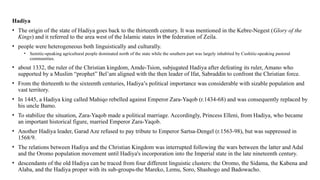
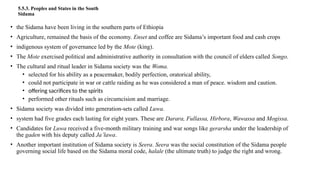
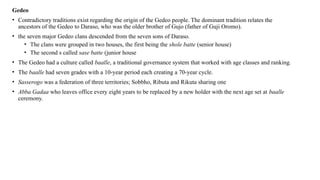
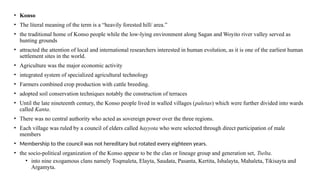
HISTORY OF ETHIOPIA AND
THE HORN (HIST.1012)
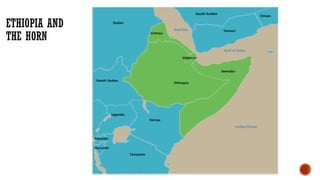
ETHIOPIA AND
THE HORN
UNIT ONE: INTRODUCTION (3 HOURS)
What do you mean by history?
What is the relevance of knowing about the
past?
Have you ever read a historical work? Do you
remember the title and author of the work?
Can you name some writers of the history of
Ethiopia and the Horn?
1.1. THE NATURE AND USES OF HISTORY
A. NATURE OF HISTORY
 The term history derived from the Greek word Istoria, meaning “inquiry” or “an account of one’s inquiries”.
 First use of the term by the ancient Greek historians, Herodotus (c. 484 -425 B.C.E.), who is held as the “father of
history”.
 Ordinary usage – all the things that have happened in the human past.
 Academically – “as an organized and systematic study of the past” – involves discovery, collection,
organization, and presentation of information about past events.
 What happened in the past is almost infinite. Historians select which topics and problems they wish to study
 history studies the interaction between humans and their environment in the past within the framework of the
continuous process of change taking place in time.
 Because of longevity of time, historians organize and divide the human past into discrete periods-
developments in politics, Society, economy, culture, environment etc. through the rigorous study of documents
and artifacts left
 History is conventionally divided into ancient, medieval and modern history – This is what we call periodization in
history: one of the key characteristics of the discipline
 Change and continuity - we continue to speak the languages of our ancestors; follow their beliefs and
religious practices; wear the costumes they were wearing; continue to practice their agricultural or
pastoral ways of life; maintain the fundamental components or structures of their social organization.
B. USES OF HISTORY
 Peoples live in the present and plan for and worry about the future. History, however, is the study of
the past. Why bother with the past while living in the present and anticipating what is yet to come?
 History Helps Better Understand the Present -knowledge of relevant historical background is
essential for a balanced and in-depth understanding of many current world situations.
 History Provides a Sense of Identity - It is only through sense of history that communities define
their identity, orient themselves, and understand their relationships with the past and with other
societies.
 History Provides the Basic Background for Other Disciplines - Historical knowledge is
extremely valuable in the pursuit of other disciplines such as literature, art, philosophy, religion,
sociology, political science, anthropology, economics, etc.
 History Teaches Critical Skills - how to find and evaluate sources; how to make coherent
arguments based on various kinds of evidence and present clearly in writing
 History Helps Develop Tolerance and Open-Mindedness - By studying the past, students of
history acquire broad perspectives that give them the range and flexibility required in many life
situations.
 History Supplies Endless Source of Fascination - Exploring the ways people in distant ages
constructed their lives offers a sense of beauty and excitement, and ultimately another perspective
on human life and society.
1.2. SOURCES AND METHODS OF HISTORICAL STUDY
 Historians are not creative writers like novelists. It is said that “where there are no sources, there is no history”.
 Historical sources are broadly classified into two types: Primary and Secondary.
 Primary Sources:
 surviving traces of the past available to us
 are original or first hand in their proximity to the event both in time and in space
 Examples: manuscripts (handwritten materials), diaries, letters, minutes, court records and administrative files, travel documents,
photographs, maps, video and audiovisual materials, and artifacts such as coins, fossils, weapons, utensils, and buildings
 Secondary Sources:
 second-hand published accounts about past events
 written long after the event, interpretation of what happened, why it happened, and how it happened ,based on primary sources
 Examples: articles, books, textbooks, biographies, and published stories or movies about historical events.
 No history work is final. New sources help new historical interpretations or entirely new historical reconstructions.
 Oral data constitute the other category of historical sources.
 Valuable to study and document the history of non-literate societies
 be used to fill missing gaps and corroborate written words
 information from one generation to another, through folk songs and sayings. This type of oral data is called oral tradition
 oral testimonies or personal recollections of lived experience. Such source is known as oral history.
 the data should be subjected to critical evaluation before it is used as evidence.
 Primary sources have to be verified for their originality and authenticity
 Secondary sources have to be examined for the reliability of their reconstructions
 Oral data may lose its originality and authenticity due to distortion through time
1.3. HISTORIOGRAPHY OF ETHIOPIAAND THE HORN
 Historiography can be defined as the history of historical writing, studying how
knowledge of the past, either recent or distant, is obtained and transmitted.
 The organized study and narration of the past was introduced by ancient Greek
historians notably Herodotus (c.484–425 B.C.E.) and Thucydides (c.455-400 B.C.E.)
 The other major tradition of thinking and writing about the past is the
Chinese.
 early figure in Chinese historical thought and writing was the Han dynasty figure
Sima Qian (145–86 B.C.E.).
 history emerged as an academic discipline in the 2nd
half of 19th
century first in Europe
 The German historian, Leopold Von Ranke (1795–1886) - established history as
an independent discipline in Berlin - methods and concepts by which historians
collect evidence of past events, evaluate that evidence, and present a meaningful
discussion of the subject.
 Ranke’s - the “father of modern historiography.”
 The Periplus of the Erythrean Sea - the earliest known reference to Ethiopia and the Horn is, written in
the 1st
C A.D by an anonymous author.
 The Christian Topography - composed by Cosmas Indicopleustes, a Greek sailor, in the 6th
century A.D.
- document describing Aksum’s trade and the then Aksumite king’s campaigns on both sides of the sea
 Inscriptions
 earliest written Ethiopian material dates from the 7th century A.D.
 found in Abba Gerima monastery in Yeha
 a manuscript discovered in Haiq Istifanos monastery of present day Wollo in the 13th century A.D
 The value of manuscripts is essentially religious, but providing insights into the country’s past
 They provide the list of medieval kings and their history in brief
 Hagiographies: the largest groups of sources available for medieval Ethiopian history, originating from
Ethiopian Orthodox Church
 Written in Ge’ez, enhancing the prestige of saints but related anecdotes such as the development of the church and the
state including territorial conquests by reigning monarchs
 Parallel hagiographical tradition existed among Muslim communities of the country
 he life of a Muslim saint, Shaykh Ja’far Bukko of Gattira, in present day Wollo, in the late
nineteenth century.
 the development of indigenous Islam and contacts between the region’s Muslim community and
the outside world
 Chronicles: indigenous tradition of history writing
 the ancient Ethiopian Ge’ez tongue first appeared in the 14th C. and continue (sometimes in Amharic) into the early 20th
C.
 Kings entrusted the writing of chronicles to court scribes or clergymen of recognized clerical training and calligraphic skills.
 earliest and the last of such surviving documents are the Glorious Victories of Amde-Tsion and the Chronicle of Abeto Iyasu
and Empress Zewditu
 incorporate both legends and facts-past and contemporary about the monarch’s genealogy, upbringing, military exploits,
piety and statesmanship. Known for their factual detail and strong chronological framework
 explain historical events mainly in religious terms; they offer little by way of social and economic developments
 in conjunction with other written documents, such as hagiographies and travel accounts by foreign observers,
 Written accounts of Arabic-speaking visitors
 al-Masudi and Ibn Battuta described the culture, language and import-export trade in the main central region of the east
African coast in the 10th
and in the 14th
centuries
 16th
and 17th:
two documents composed by Yemeni writers
 The first document titled Futuh al Habesha, composed by Shihab ad-Din, who recorded the conflict between the Christian
kingdom and the Muslim principalities in the 16th century
 the operation of the war including the conquest of northern and central Ethiopia by Imam Ahmed ibn Ibrahim al-Ghazi,
the document describes major towns and their inhabitants in the southeastern part of Ethiopia
 other account was by Al-Haymi, who led a Yemeni delegation in 1647 to the court of Fasiledes (r. 1632-67).
 in the 16th
C. include Abba Bahrey’s Geez script on the Oromo written in 1593.
 Except its limitations, it provides first-hand information about the Oromo population movement including the Gadaa System
The contribution of European missionaries and travelers
From the early 16th until the late 19th centuries, missionaries
(Catholics and Protestants)
major topics covered by these sources include religious and political
developments within Ethiopia, and the country’s foreign relations.
An example of such account is The Prester John of the Indies,
composed by a Portuguese priest, Francisco Alvarez who
accompanied the Portuguese mission to the court of Lebne-Dengel in
1520.
travel documents is James Bruce’s Travels to Discover the Source of
the Nile.
both the missionaries and travelers’ materials can only be used with
considerable reservations and with care for they are socially and
politically biased.
Foreign writers also developed interest in Ethiopian studies
One of these figures was a German, Hiob Ludolf (1624-1704).
 Ludolf was the founder of Ethiopian studies in Europe in the 17th
C.
 he wrote Historia Aethiopica (translated into English as A New
History of Ethiopia).
 he never visited Ethiopia:
 he wrote the country’s history largely based on information he
collected from an Ethiopian priest named Abba Gorgorios (Abba
Gregory)
In the 19th
C, August Dillman published two studies on
ancient Ethiopian history.
 demonstrated all markers of objectivity in his historical research
endeavors.
 Historical writing made some departures from the chronicle tradition in the early twentieth century.
 This period saw the emergence of traditional Ethiopian writers
 The earliest group of these writers include: Aleqa Taye Gebre-Mariam, Aleqa Asme Giorgis and Debtera
Fisseha-Giorgis Abyezgi.
 Later, departure
 Negadrases Afework Gebre-Iyesus and
 wrote the first Amharic novel, Tobiya
 Gebre-Hiwot Baykedagn joined them.
 Atse Menilekna Ityopia (Emperor Menilek and Ethiopia) and Mengistna Yehizb Astedader (Government
and Public Administration)
 The most prolific writer of the early twentieth century Ethiopia
 Blatten Geta Hiruy Wolde-Selassie. He published 4 major works: Ethiopiana Metema (Ethiopia and
Metema), Wazema (Eve), Yehiwot Tarik (A Biographical Dictionary) and Yeityopia Tarik (A History of
Ethiopia).
 In contrast to their predecessors, Gebre-Hiwot and Hiruy exhibited relative objectivity and methodological
sophistication
 the Italian occupation of Ethiopia interrupted the early experiment in modern history writing and
publications.
After liberation, Tekle-Tsadik Mekuria formed a bridge between writers in pre-
1935 and Ethiopia professional historians
 published about eight historical works.
 made better evaluation of his sources than his predecessors
Yilma Deressa’s Ye Ityopiya Tarik Be’asra Sidistegnaw Kifle Zemen (A History of
Ethiopia in the Sixteenth Century).
 the Oromo population movement and the wars between the Christian kingdom
and the Muslim sultanates
Blatten Geta Mahteme-Selassie Wolde-Meskel also contributed his share
 wrote Zikre Neger. Zikre Neger,: Ethiopia’s prewar land tenure systems and
taxation
 Another work dealing with land tenure is left by Gebre-Wold Engidawork
Another writer of this category was Dejazmach Kebede Tesema, wrote his
memoir of the imperial period, published as Yetarik Mastawesha in 1962 E.C.
1960s was a crucial decade in the development of Ethiopian
historiography. History emerged as an academic discipline.
In 1963, at the then Haile Selassie I University (HSIU)
the opening of the Department of History
the establishment of the Institute of Ethiopian Studies (IES)
housed a number of historians including the late Richard
Pankhurst, the first Director and founding member of the
Institute
the IES has been publishing the Journal of Ethiopian Studies
for the dissemination of historical research
The Institute’s library contains literary works of diverse
disciplines
 The professionalization of history in other parts of the Horn is a post-colonial phenomenon .
 the establishment of independent nations, a deeper interest in exploring their own past quickly
emerged among Africans: reactions to decades of education in an alien imperial historiography.
Urgent need to recast the historical record and to recover evidence of many lost pre-colonial
civilizations
 decolonization of African historiography required new methodological approach: involved a
critical use of oral data and tapping the percepts of ancillary disciplines like archeology,
anthropology and linguistics.
 European intellectuals’ own discomfort with the Euro-centrism of previous scholarship
provided for the intensive academic study of African history
 Foundational research was done at the School of Oriental and African Studies (SOAS) in
London and the Department of History at the University of Wisconsin-Madison.
 Francophone scholars have been as influential as Anglophones.
 African universities have, despite the instabilities of politics and civil war in many areas,
trained their own scholars and sent many others overseas for training who eventually
published numerous
THE GEOGRAPHICAL CONTEXT OF
ETHIOPIA AND THE HORN
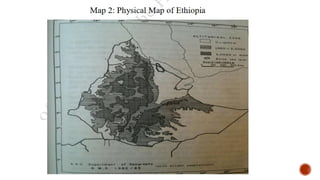
The term “Ethiopia and the Horn”
refers to part of Northeast Africa,
which now contains the countries of
Djibouti, Eritrea, Ethiopia, and
Somalia.
THE GEOGRAPHICAL CONTEXT OF ETHIOPIA AND THE HORN
A. Rift valley: region consists chiefly of the Great Rift Valley that
is a fissure in the Earth’s crust running down from Syria to
Mozambique and marking the separation of the African and
Arabian tectonic plates.
 Its major physiographic features; highland complex mountains, plateaus divided
by the Great Rift Valley and surrounded by lowlands, semi-desert, deserts and
tropical forests
 The diversity of the terrain led to regional variations in climate, natural
vegetation, soil composition, and settlement patterns, languages, religion,
economic activities.
 The history of Ethiopia and the Horn has been shaped by contacts with others
through commerce, migrations, wars, slavery, colonialism, and the waxing and
waning of state systems.
 Yet, the evolution of human history owed much to geographical factors notably
location, landforms, resource endowment, climate and drainage systems which
continue to impact, as incentives and deterrents, the movement of people and
goods in the region.
B. Spatial location in world history
It lies between the Red Sea, Gulf of Aden
and Indian Ocean on the one hand, and the
present-day eastern frontiers of Sudan and
Kenya on the other.
Since early times, the Red Sea and the Gulf
of Aden linked Northeast Africa to the
Eastern Mediterranean, Middle East, India,
and the Far East.
C. Drainage system of Ethiopia and the Horn (five major drainage
systems).
 Nile River: White Nile (Uganda- Victoria lake) + Blue Nile (Abay from Ethiopia-
Tana Lake) meet at Khartoum (Sudan) drains into Mediterranean Sea through
Egypt.
 Omo/Gibe–Gojeb River System links southern Ethiopia to the semi-desert
lowlands of northern Kenya drains into Turkana lake.
 Genale/Jubba-Shebele:They originate in the Eastern highlands and flow southeast
toward Somalia and the Indian Ocean. Genale (named as Jubba in Somalia) flows to
Indian Ocean whereas the Shebele disappears in sand of the coastline.
 Awash River: entirely confined to Ethiopia and links the cool rich highlands of
Central Ethiopia with the hot, dry lowlands of the Danakil Depression.
 Ethiopian Rift Valley Lake systems: Self-contained drainage basin includes a
string of lakes stretching from Lake Ziway in the north to Lake Turkana (Rudolf) on
the Ethio-Kenyan border.
C. Environmental zones: Ethiopia and the Horn can be divided three major zone
 1. Eastern lowland:
 Covers the narrow coastal strip of north-eastern Eritrea, descends southwards includes
lowland Eritrea, the Sahel, the Danakil Depression, the lower Awash valley, Djibouti
and extends to the Ogaden, the lower parts of Hararghe, Bale, Borana, Sidamo and the
whole territory of the Republic of Somalia.
 no much seasonal variation in climatic condition. Hot and dry conditions prevail year-
round along with periodic monsoon winds and irregular (little) rainfall.
 major vegetation covers shrub and bush
 Highland massif: starts from northern Eritrea and continues all the way to southern Ethiopia.
the Rift Valley divided this zone into the western and eastern parts.
 2. Eastern highland massif: consists the Arsi, Bale and Hararghe plateau. The major
physiographic features of the zone are complex of mountains, deep valleys, and extensive
plateaus.
 3. Western highland massifs: Along the western foothills or on the periphery of the
plateau and on borderlands of the Sudan stretching from north to south. It characterized by
thick forests.
UNIT TWO: PEOPLES AND CULTURES IN ETHIOPIA
AND THE HORN (4 HOURS)
Region is referred to as the cradle of humankind.
 Early civilizations (food production, making tools and religious practices were initiated.
2.1. Human Evolution
 Human revolution seen in two ways: Biological and cultural revolution
1. Biological Human evolution :
 formed through gradual natural process from small beings since 4. 5 billion years before
present (YB. P.)
 earliest life came into being between 3 and 1 billion years B. P. Blue green algae, small
plants, fishes, birds and other small beings emerged at c. 800 million B. P.
 Primates: branched at:
 placental mammal stream as of 200-170 million Y.B. P.
 Pongidae (such as gorilla, chimpanzee, orangutan, gibbon etc)
 Hominidae (human ancestors).
 Archaeological evidences (fossil discovery: Suggest East
African Rift Valley (Lower Omo and Middle Awash River valleys)
is the cradle of humanity. E.g
 Chororapithecus: 10 million B. P. was discovered unearthed in Anchar (West
Hararghe) in 2007
 Ardipithicus ramidus kadabba: 5.8-5.2 million YBP) was discovered in
Middle Awash
 Ardipithicus ramidus: 4. 2 million B.P. was discovered at Aramis in Afar in
1994.
 Australopithecines: 3.6 million years B. P discovered at Belohdelie in Middle
Awash.
 Australopithecus afarensis or selam: 3.3 million ybp discovered (3 years old
child’s fossil) Dikika, Mille, Afar in 2000.
 Australopithecus afarnesis (Lucy/Dinkinesh): 3.18 million YB. P.) with 40%
complete body parts, weight 30kg, height 1.07 meters with like bipedal
female was discovered at Hadar, Afar in 1974 A. D.
Stage of human evolution by discovering human brain feature
homo genus (human genus)-2-2.5mybp
1. Homo-habilis (homo-human being; habilis- skilful use of hands):
1.9mybp disc fossil discovered in lower omo
2. Homo-erectus: walking upright; 1.9mybp fossil discovered in Melka
Kunture, Konso, Gardula and gadeb
 First invented fire
 Originated in Africa and spread to the rest of the world
 900-1100cc brain size
3. Homo-sapiens: knowledgeable human being originated 400,000ybp
 Brian size 1300-1400cc
 Discovered in middle Awash
 Homo sapiens sapiens (modern human being)- 100,000ybp
 fossil discovered at porc epic near Dire-dawa & Kibish in lower Omo valley in 1967.
 In 2004 Kibish fossil re-dated to 195000 ybp, the oldest of world modern Homo
sapiens. Homo sapiens idaltu, dated to 1600, 000 ybp found in Middle Awash in 1997,
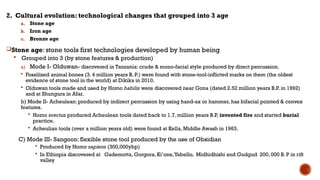
2. Cultural evolution: technological changes that grouped into 3 age
a. Stone age
b. Iron age
c. Bronze age
Stone age: stone tools first technologies developed by human being
 Grouped into 3 (by stone features & production)
a) Mode I- Olduwan- discovered in Tanzania: crude & mono-facial style produced by direct percussion.
 Fossilized animal bones (3. 4 million years B. P.) were found with stone-tool-inflicted marks on them (the oldest
evidence of stone tool in the world) at Dikika in 2010.
 Olduwan tools made and used by Homo habilis were discovered near Gona (dated 2.52 million years B.P. in 1992)
and at Shungura in Afar.
b) Mode II- Acheulean: produced by indirect percussion by using hand-ax or hammer, has bifacial pointed & convex
features.
 Homo erectus produced Acheulean tools dated back to 1.7. million years B.P, invented fire and started burial
practice.
 Acheulian tools (over a million years old) were found at Kella, Middle Awash in 1963.
C) Mode III- Sangoon: flexible stone tool produced by the use of Obsidian
 Produced by Homo sapiens (300,000ybp)
 In Ethiopia discovered at Gademotta, Gorgora, Ki’one,Yabello, Midhidhishi and Gudgud 200, 000 B. P in rift
valley
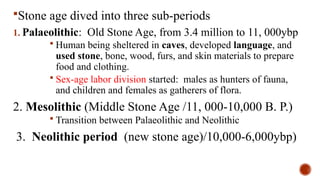
Stone age dived into three sub-periods
1. Palaeolithic: Old Stone Age, from 3.4 million to 11, 000ybp
 Human being sheltered in caves, developed language, and
used stone, bone, wood, furs, and skin materials to prepare
food and clothing.
 Sex-age labor division started: males as hunters of fauna,
and children and females as gatherers of flora.
2. Mesolithic (Middle Stone Age /11, 000-10,000 B. P.)
 Transition between Palaeolithic and Neolithic
3. Neolithic period (new stone age)/10,000-6,000ybp)
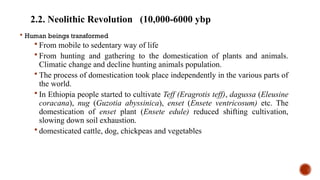
2.2. Neolithic Revolution (10,000-6000 ybp
 Human beings transformed
 From mobile to sedentary way of life
 From hunting and gathering to the domestication of plants and animals.
Climatic change and decline hunting animals population.
 The process of domestication took place independently in the various parts of
the world.
 In Ethiopia people started to cultivate Teff (Eragrotis teff), dagussa (Eleusine
coracana), nug (Guzotia abyssinica), enset (Ensete ventricosum) etc. The
domestication of enset plant (Ensete edule) reduced shifting cultivation,
slowing down soil exhaustion.
 domesticated cattle, dog, chickpeas and vegetables
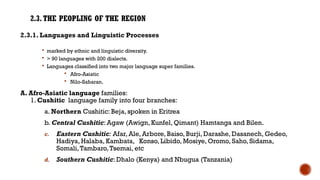
2.3.THE PEOPLING OF THE REGION
2.3.1. Languages and Linguistic Processes
 marked by ethnic and linguistic diversity.
 > 90 languages with 200 dialects.
 Languages classified into two major language super families.
 Afro-Asiatic
 Nilo-Saharan.
A. Afro-Asiatic language families:
1. Cushitic language family into four branches:
a. Northern Cushitic: Beja, spoken in Eritrea
b. Central Cushitic: Agaw (Awign, Kunfel, Qimant) Hamtanga and Bilen.
c. Eastern Cushitic: Afar, Ale, Arbore, Baiso, Burji, Darashe, Dasanech, Gedeo,
Hadiya, Halaba, Kambata, Konso, Libido, Mosiye, Oromo, Saho, Sidama,
Somali,Tambaro,Tsemai, etc
d. Southern Cushitic: Dhalo (Kenya) and Nbugua (Tanzania)
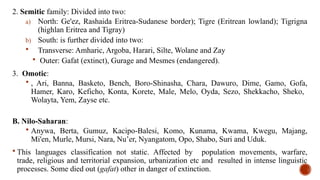
2. Semitic family: Divided into two:
a) North: Ge'ez, Rashaida Eritrea-Sudanese border); Tigre (Eritrean lowland); Tigrigna
(highlan Eritrea and Tigray)
b) South: is further divided into two:
 Transverse: Amharic, Argoba, Harari, Silte, Wolane and Zay
 Outer: Gafat (extinct), Gurage and Mesmes (endangered).
3. Omotic:
 , Ari, Banna, Basketo, Bench, Boro-Shinasha, Chara, Dawuro, Dime, Gamo, Gofa,
Hamer, Karo, Keficho, Konta, Korete, Male, Melo, Oyda, Sezo, Shekkacho, Sheko,
Wolayta, Yem, Zayse etc.
B. Nilo-Saharan:
 Anywa, Berta, Gumuz, Kacipo-Balesi, Komo, Kunama, Kwama, Kwegu, Majang,
Mi'en, Murle, Mursi, Nara, Nu’er, Nyangatom, Opo, Shabo, Suri and Uduk.
 This languages classification not static. Affected by population movements, warfare,
trade, religious and territorial expansion, urbanization etc and resulted in intense linguistic
processes. Some died out (gafat) other in danger of extinction.
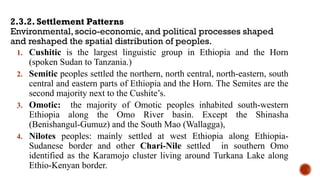
2.3.2. Settlement Patterns
Environmental, socio-economic, and political processes shaped
and reshaped the spatial distribution of peoples.
1. Cushitic is the largest linguistic group in Ethiopia and the Horn
(spoken Sudan to Tanzania.)
2. Semitic peoples settled the northern, north central, north-eastern, south
central and eastern parts of Ethiopia and the Horn. The Semites are the
second majority next to the Cushite’s.
3. Omotic: the majority of Omotic peoples inhabited south-western
Ethiopia along the Omo River basin. Except the Shinasha
(Benishangul-Gumuz) and the South Mao (Wallagga),
4. Nilotes peoples: mainly settled at west Ethiopia along Ethiopia-
Sudanese border and other Chari-Nile settled in southern Omo
identified as the Karamojo cluster living around Turkana Lake along
Ethio-Kenyan border.
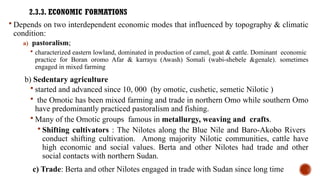
2.3.3. ECONOMIC FORMATIONS
 Depends on two interdependent economic modes that influenced by topography & climatic
condition:
a) pastoralism;
 characterized eastern lowland, dominated in production of camel, goat & cattle. Dominant economic
practice for Boran oromo Afar & karrayu (Awash) Somali (wabi-shebele &genale). sometimes
engaged in mixed farming
b) Sedentary agriculture
 started and advanced since 10, 000 (by omotic, cushetic, semetic Nilotic )
 the Omotic has been mixed farming and trade in northern Omo while southern Omo
have predominantly practiced pastoralism and fishing.
 Many of the Omotic groups famous in metallurgy, weaving and crafts.
 Shifting cultivators : The Nilotes along the Blue Nile and Baro-Akobo Rivers
conduct shifting cultivation. Among majority Nilotic communities, cattle have
high economic and social values. Berta and other Nilotes had trade and other
social contacts with northern Sudan.
c) Trade: Berta and other Nilotes engaged in trade with Sudan since long time
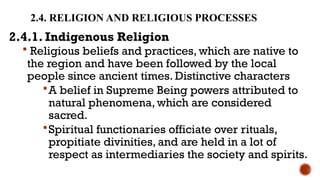
2.4. RELIGION AND RELIGIOUS PROCESSES
2.4.1. Indigenous Religion
 Religious beliefs and practices, which are native to
the region and have been followed by the local
people since ancient times. Distinctive characters
A belief in Supreme Being powers attributed to
natural phenomena, which are considered
sacred.
Spiritual functionaries officiate over rituals,
propitiate divinities, and are held in a lot of
respect as intermediaries the society and spirits.
 major indigenous religious groups
Waqeffanna of the Oromo:
 is based on the existence of one Supreme Being called
Waqa. Waqa's power is manifested through the spirits
called Ayyana.
The major spirits include:
 Abdar/Dache (soil fertility spirit),
 Atete (women or human and animal fertility spirit),
 Awayi/Tiyyana (sanctity spirit),
 Balas (victory spirit),
 Chato/Dora (wild animals defender),
Gijare/ Nabi (father and mother’s sprit),
 Jaricha (peace spirit),
 Qasa (anti-disease spirit) etc.
Dead exist in the form of a ghost called Ekera in the surrounding or
his/her cemetery (Hujuba).
 Irrecha- Thanks giving festivals conduct at the edge of ever-flowing river
and top of mountain (besides New Year (Birbo) rite in spring and automn
season every year
Revered experts known as Qallu (male) and Qallitti (female) have maintained
link between the Ayyana and the believers.
Galma: Qallu's ritual house located on hilltop or in the groves of large trees.
Ayyana possession date: Wednesday and Friday nights.
 Jila/Makkala (delegated messengers) used to make pilgrimage to get consecration of
senior Qallu (Abba Muda or anointment father) until about 1900.
 Abba Muda had turban surrirufa of tri-colors: black at top, red at centre and white at
bottom representing those in pre-active life, active (Luba) and those in post-active life
respectively.
CON..
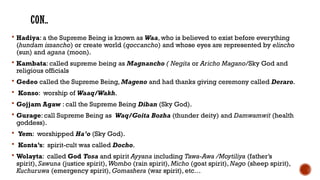
 Hadiya: a the Supreme Being is known as Waa, who is believed to exist before everything
(hundam issancho) or create world (qoccancho) and whose eyes are represented by elincho
(sun) and agana (moon).
 Kambata: called supreme being as Magnancho ( Negita or Aricho Magano/Sky God and
religious officials
 Gedeo called the Supreme Being, Mageno and had thanks giving ceremony called Deraro.
 Konso: worship of Waaq/Wakh.
 Gojjam Agaw : call the Supreme Being Diban (Sky God).
 Gurage: call Supreme Being as Waq/Goita Bozha (thunder deity) and Damwamwit (health
goddess).
 Yem: worshipped Ha’o (Sky God).
 Konta’s: spirit-cult was called Docho.
 Wolayta: called God Tosa and spirit Ayyana including Tawa-Awa /Moytiliya (father’s
spirit), Sawuna (justice spirit), Wombo (rain spirit), Micho (goat spirit), Nago (sheep spirit),
Kuchuruwa (emergency spirit), Gomashera (war spirit), etc…
CONT..
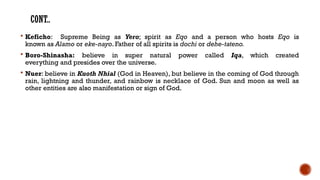
 Keficho: Supreme Being as Yero; spirit as Eqo and a person who hosts Eqo is
known as Alamo or eke-nayo. Father of all spirits is dochi or dehe-tateno.
 Boro-Shinasha: believe in super natural power called Iqa, which created
everything and presides over the universe.
 Nuer: believe in Kuoth Nhial (God in Heaven), but believe in the coming of God through
rain, lightning and thunder, and rainbow is necklace of God. Sun and moon as well as
other entities are also manifestation or sign of God.
2.4.2. JUDAISM
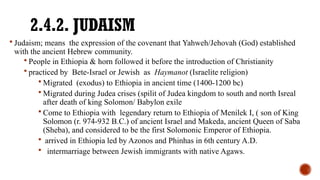
 Judaism; means the expression of the covenant that Yahweh/Jehovah (God) established
with the ancient Hebrew community.
 People in Ethiopia & horn followed it before the introduction of Christianity
 practiced by Bete-Israel or Jewish as Haymanot (Israelite religion)
 Migrated (exodus) to Ethiopia in ancient time (1400-1200 bc)
 Migrated during Judea crises (spilit of Judea kingdom to south and north Isreal
after death of king Solomon/ Babylon exile
 Come to Ethiopia with legendary return to Ethiopia of Menilek I, ( son of King
Solomon (r. 974-932 B.C.) of ancient Israel and Makeda, ancient Queen of Saba
(Sheba), and considered to be the first Solomonic Emperor of Ethiopia.
 arrived in Ethiopia led by Azonos and Phinhas in 6th century A.D.
 intermarriage between Jewish immigrants with native Agaws.
2.4.3. CHRISTIANITY
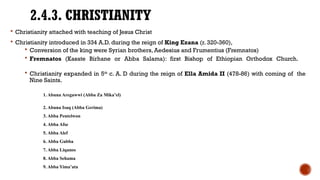
 Christianity attached with teaching of Jesus Christ
 Christianity introduced in 334 A.D. during the reign of King Ezana (r. 320-360),
 Conversion of the king were Syrian brothers, Aedesius and Frumentius (Fremnatos)
 Fremnatos (Kasate Birhane or Abba Salama): first Bishop of Ethiopian Orthodox Church.
 Christianity expanded in 5th
c. A. D during the reign of Ella Amida II (478-86) with coming of the
Nine Saints.
1. Abuna Aregawwi (Abba Za Mika’el)
2. Abuna Isaq (Abba Gerima)
3. Abba Pentelwon
4. Abba Afse
5. Abba Alef
6. Abba Gubba
7. Abba Liqanos
8. Abba Sehama
9. Abba Yima’ata
 Role of nine saint
 translated the Bible and other religious books into Geez.
 Expanded Christianity
 Built monasteries and churches
 Zagwe period (1150-1270)
 early Medieval Period (1270-1527),
 Jesuit missionaries (from mid. 16th
- early17th
c.)
 tried to convert Monophysite EOC to Dyophysite Catholic.
 this led bloody conflicts & expulsion of the Jesuits.
 It intervention triggered religious controversies within the EOC
 Concluded by treaties between European diplomats and Ethiopian authorities 1804.
 Lazarist catholic mission founded by Giuseppe Sapeto),
 Capuchin order founder founded by Giustino De Jacobis
 Protestant missionaries (19th
c.)
 Introduced under Samuel Gobat, C.W. Isenberg and J. L. Krapf.
 They systematically trained local people for expansion of Protestantism
 Translated bible/ spiritual books into vernaculars.
 Opened schools at village for all children's
 Established health centres & medical facilities.
2.4.4. ISLAM
 Islam attached to teaching of Prophet Mohammed had preached Islam in
Mecca since 610 AD, he faced opposition from the Quraysh rulers.
 Under this circumstance, the Prophet sent some of his early followers to
Aksum including his daughter Rukiya and her husband Uthman as well as
the Prophet's future wives Umm Habiba and Umm Salma to Aksum .The first
group of refugees was led by Jafar Abu Talib. In his advice to his followers,
the Prophet said of Ethiopia, "…a king under whom none are persecuted. It is
a land of righteousness, where God will give relief from what you are
suffering." The then Aksumite king, Armah Ella Seham (Ashama b. Abjar or
Ahmed al-Nejash in Arabic sources), gave them asylum from 615-28.
 Leaders of the Quraysh asked Armah to repatriate the refugees, but the king
did not comply. Armah is said to have replied, "If you were to offer me a
mountain of gold I would not give up these people who have taken refugees
with me.”
CON..
Spread peacefully (through trade) to the Horn of Africa
 Established Dahlak (Alalay) Islands on the Red Sea at the
beginning of 8th
c and developed in to sultanate in 9th
c.
Gradually spread to pastoral communities through preachers
and merchants.
 Islamic introduction through Dahlak prohibited by Aksum & other
Christian state in north and shifted to port of Zeila then to Shewa, wollo,
Haraghe
 Islam firmly established itself in the coastal areas by 8th
& 9th
c and then
spread central, southern, and eastern Ethiopia:
 Sheikh Hussein of Bale, a Muslim saint (Waliy) of medieval period,
played very important role in the expansion of Islam into Bale, Arsi and
other. Dire sheik Hussein and Sof Umar cave: Islamic centre
UNIT THREE
POLITICS, ECONOMY AND SOCIETY IN
ETHIOPIAAND THE HORN TO THE END OF
THE THIRTEENTH CENTURY
Unit Starters
• What does a state mean?
• Can you name some of the earliest states in Ethiopia and the
Horn?
• Tell how Ethiopian people in different geographical locations
maintained relationships.
• Explain how religion facilitates peoples’ relations.
Emergence of States
• One important factor for the emergence of states was the beginning of sedentary agriculture.
• Families preferred to live together forming larger communities for better security and to help each other in hard works.
• Using stick or hoe for planting was gradually replaced by ox-drawn plough and farmers acquired surplus produce to
exchange with better tools and clothes with the artisans who were able to specialize in the production of these items.
• intermediaries (traders) also began to buy the products of both to take to predetermined places or markets for exchange
• states were formed mainly through the expansion of agriculture that gave rise to class differentiation
• the growth of trade facilitated the development of states.
• State refers to an autonomous political unit having population, defined territory, sovereignty and government with the
power to decree and enforce laws.
• State was the outcome of regular cultural process.
• Favorable environmental conditions helped to hasten the rate of transformation in some regions
• Religious leaders such as shamans played prominent role in maintaining the social and religious affairs
• As production became market oriented, religious elites were gradually replaced by chiefs, who began collecting regular and
compulsory tributes which amounted to protection payments
• supporters chiefly the army, the bureaucracy and other followers.
• Ethiopia and the Horn is one of the regions in Africa where early state formation took place.
• gradually developed into powerful kingdoms and even empires with a well-demarcated social structure
• control of the international water bodies like Red Sea, Gulf of Aden and Indian Ocean along with their ports
3.2. Ancient States
3.2.1. North and Northeast
A. Punt
• Punt was the earliest recorded state in Ethiopia and the Horn
• evidence on Punt comes from Egyptian hieroglyphic writings, accompanied by vivid paintings that describes series of naval expeditions,
which the Egyptian Pharaohs sent to Punt.
• Pharaoh Sahure (r. 2743-2731 B.C.) sent expedition to collect myrrh, ebony and electrum (gold and silver alloy).
• During Pharaoh Asosi, treasurer of God Bawardede took dancing dwarf “dink" to Egypt from Punt
• The best described expedition was the one by the order of the famous Egyptian Queen Hatshepsut (1490-1468 B.C.), whose expedition is
documented at her tomb in Dier El Bahri.
• She sent five ships under the leadership of Black Nubian Captain Nehasi via Wadi-Tumilat.
• The expedition was warmly welcomed by the Puntites King Perehu, his wife Ati, sons, daughters and followers.
• The expedition returned collecting frank incense, cinnamon, sweet smelling woods (sandal), spices, ivory, rhinoceros horn, leopard
and leopard skins, ostrich feathers and egg, live monkeys, giraffes, people etc.
• Hatshepsut presented some parts of the items to her god, Amun.
• It was because of the ritual importance of their exports that Puntites were also known as Khebis of the Ta
Netjeru (divine or ghosts land).
• Export items: iron, bronze, asses, foxes, cattle, animals fur, dying and medicinal plants were also exported to Egypt.
• Import items: axes, daggers, swords, knives, sickles, clothes, bracelets, necklaces, beads and other trinkets were imported from
Egypt to Punt.
• Scholars have not reached agreement as to the exact location of Punt.
• The varieties of incense and myrrh mentioned suggested northern or northeastern Somalia
• while others are inclined more towards Northern Ethiopia because of the reference to gold, ebony and monkeys.
• still some others argue that it probably stretched from Swakim or Massawa to Babel Mandeb (Gate of Tears) and Cape Guardafui.
B. Da’amat and Other Cultural Centers in Northern Ethiopia and Eritrea
• Da’amat had a center a little to the south of Aksum.
• Inscription of the king of Da’amat tentatively dated to the fifth century BC shows that he used
politico-religious title known as Mukarib.
• Various gods and goddesses like Almouqah (principal god), Astarr (Venus god), Na’uran (light god),
Shamsi (sun god), and Sin (moon god) were worshipped in northern Ethiopian pre-Aksumite cultural
centers
• There were similar practices in South Arabia at the time.
• There were a number of cultural centers in northern Ethiopia
• Yeha: is located 30 kms to the northeast of Aksum and was the oldest of these centers.
• probably emerged around 1, 000 BC as a small emporium where South Arabian merchants and their agents bought and stored
ivory, rhinoceros horn and other commodities coming from the interior.
• It seems that the period of its prosperity (zenith) was from about 750 to 500 B.C.
• Remains of walls of its buildings and stone masonry as well as still standing temple and inscriptions indicate Yeha’s glory.
• Hawulti Melazo: is situated to southeast of Aksum, where stone tablets that are inscribed in rectangular temple surrounded by a
wall decorated with paintings representing herds of cattle have been excavated.
• Addi-Seglemeni: is located at 10kms southwest of Aksum, from where a stone slab is found and the oldest Ethiopian
monumental inscription is discovered.
• There were also other cultural centers like Addi Gelemo, Addi Grameten, Addi Kewih, Atsbi
Dera, Feqiya, Hinzat, Sefra, Senafe, Tekonda etc.
C. The Aksumite State
• The nucleus of the Aksumite state was formed around 200-100 B.C.
• territory
• In its heyday, Aksumite territories extended from the Red Sea coast in the East to the Western edge of Ethiopian plateau overlooking the vast Nile
Valley in the west and from the northern most corner of Eritrea and possibly as far south as northern parts of Shewa.
• According to Periplus of Erithrean Sea,
• Adulis on the western coast of the Red Sea was the major port of Aksum.
• The long distance trade routes passed inland through centers Kaskasse, Coloe, Matara and even further west across Takaze River.
• also mentioned ports of Aden (Eudaemon) Gulf like Avalites (Zayla) and Malao (Berbera), and Indian Ocean Benadir Coasts like Serapion
(Moqadishu), Nicon (Brava) and Merca.
• Commercial activity
• Export items: the natural products such as ivory, myrrh, emerald, frankincense and some spices (like ginger, cassia and cinnamon), gold, rhinoceros
horns, hippopotamus hides, tortoise shells and some curiosity animals like apes
• Import items: manufactured products like garments and textiles from Egypt, India, the Roman Empire, and Persia; glassware and jewelry from
Egypt and other places; metallic sheets, tools or utensils of various kinds, oil and wine from the regions of Roman Empire and Syria were imported.
• Zoscales (c. 76-89), the then king of Aksum, used to speak the Greek language, the Lingua Franca of Greco-Roman world. Aksum also had
relations with Ceylon (Sri Lanka) and Laodicea (Asia Minor).
• The Christian Topography mentions the internal long distance trade between Aksum and a distant region called Sasu, most probably in Beni
Shangul and the adjoining lands beyond the Blue Nile.
• big caravan made up of close to five hundred merchants some of them special agents of the kings of Aksum would take to Sasu cattle, lumps of salt
(probably salt blocks) and iron to exchange for gold. Yet, as they did not speak each other’s language, and did not even trust to be near to each other
to bargain through signs and gestures, the whole exchange was done without one side seeing the other. This was a good example of silent trade.
• From the 3rd to the 7th c, Aksumite kings Aphilas, Endybis, Wazeba, Ezana, Ousanas II, etc. minted coins in gold, silver and bronze for
both overseas and local transactions.
• Contacts with the outside world
• with the South Arabian region, leading to exchange of ideas, material and spiritual culture.
• known recorded conflict between areas on both sides of the sea took place around 200 A.D.
• present day Yemen, had difficulties in defending themselves against the army of the Aksumite king,
Gadarat
• Aksum was one of the 4 great powers of the world (i. e. Roman Empire, Persia, China and Aksum) at
the time.
• It was a major naval and trading power from the 1st to the 7th centuries.
• Aksumite ships were the main means of transporting goods
• sufficient sources of timber for ship building and in those days, the technology for it existed in Adulis.
• Aksum had a large fleet of ships, which was used for trade and its wars across the Red Sea.
• Kaleb (r. 500-35) expanded overseas territories of Aksum beyond Himyar and Saba
• the local prince Dhu-Nuwas was converted to Judaism, marched to Zafar and Nagran, and killed many
Christians.
• Byzantine Vasaliev Justinian (r. 527-65) with sanctification of Patriarch Timit III (518-538) provided
Kaleb with a ships to transport armies led by Julianos and Nonossus against Dhu Nuwas. Dhu Nuwas
was defeated and Kaleb appointed Abraha as governor of Arabia that continued until 570 A. D.
• Kaleb was succeeded by his son Gabra Masqal (535-48) who built a church at Zur Amba in Gayint
• during Gabra Maskal that Yared developed Ethiopian Orthodox Church liturgical songs and hymns
• Reasons of Decline
• the late seventh century because of internal and external challenges.
• Environmental degradation,
• decline in agricultural productivity and possibly plague infestation started to weaken it.
• The rise of Muslim Arabs
• Destroyed the port of Adulis around 702, the international lifeline of the state was cut.
• Aksumite international trade came under the control of the rising and expanding Arab Muslims, isolating the Aksum state
from its old commercial and diplomatic partners.
• Consequently, the Aksumite state declined economically. This naturally led to the decline of its political and military
power not only on the Red Sea coast
• Aksumite hegemony was challenged by local rebellions.
• Recurring rebellions of the Beja, the Agaw and Queen Bani al Hamwiyah (Yodit) finally sealed the collapse of the
Aksumite state.
• as a civilization, Aksum had a profound impact upon the peoples of the Horn of Africa
and beyond, and on its successors. Some of its achievements:
• Sub-Saharan Africa’s only surviving indigenous script and calendar as well as
• EOC hymns and chants, paintings etc;
• diversified ceramic and lithic tools, ivory curving, and
• urbanization and sophisticated building traditions (palaces, stele, rock-hewn churches…).
• The complex administrative and governance system, and
• agricultural system including irrigation etc.
D. Zagwe Dynasty
• After its decline, the center of Aksumite state shifted southwards to Kubar in the territory of the Agaw, one of the
ancient inhabitants between the Eritrean Plateau and Jema River, and to the west up to the Blue Nile valleys.
• This gave Agaw elites the opportunity to take part in Aksumite state structure serving as soldiers and functionaries.
After integrating so well with Aksumite ruling class, they successfully took over the state administration.
• the Agaw prince Merra Teklehaimanot married Masobe Worq, the daughter of the last Aksumite king Dil Na'od.
• Later he overthrew his father-in-law and took control of power.
• Merra-Teklehaimanot's successors include: Yimirahana Kirstos, Harbe, Lalibela (1160-1211), Ne'akuto La'ab,
Yetbarek etc.
• the Zagwe Dynasty is believed to have ruled from c. 1150 to 1270.
• The Zagwe Dynasty made its center in Bugna District within Wag and Lasta, more exactly at Adafa near Roha
(Lalibela).
• The territory of Zagwe extended from most of the highland provinces of the ancient Aksumite kingdom in the north
down to northern Shewa in the south, the Lake Tana region and the northern part of todays Gojjam in the west.
• Zagwe rulers renewed cultural and trade contact with eastern Mediterranean region.
• Export items included slaves, ivory and rare spices
• Imports: cotton, linen, silver and copper vessels, various types of drags and newly minted coins
• Zagwe period was a golden age in Ethiopia's paintings and the translation of religious works from Arabic into Ge'ez
• Zagwe rulers are best known for the construction of cave, semi-hewn and monolithic churches:
• 1. Cave: with some decoration inside, almost similar with natural cave, eg. Bete-Mesqel.
• 2. Semi-hewn: are with detailed interior decoration and partial decoration outside. They are not totally separated from the
surrounding rock. Their roofs or walls are still attached to the rock, eg. Bete Denagil, Bete Debresina/Mikael, Bete Golgota,
Bete Merqoriwos, Bete Gabri’el-Rufa’el and Bete Abba Libanos.
• 3. Monolithic: with detailed decoration in the interior and exterior parts. They are completely separated (carved out) from
surrounding rock, eg. Bete Amanuel, Bete Giyorgis, Bete Mariyam and Bete Medhanialem.
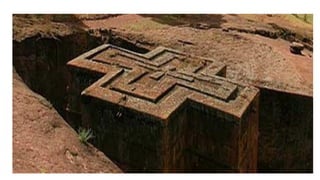
• Among the eleven churches of Lalibela, Bete Medhanelem is the largest of all and Bete Giyorgis is said to be the
most finely built in the shape of the Cross.
• Lalibela wanted to establish the second Jerusalem, to avoid difficulties, which Ethiopian Christians encountered in
their journey to the Holy Lands. This was done by constructing churches based on the model of Holy Lands in Israel.
• Reasons for decline
• due to internal problems of royal succession and
• oppositions from groups claiming descent from the ancient rulers of Aksum.
• considered Zagwe kings “illegitimate rulers” based on the legend of the Queen of Sheba, based on a book
known as Kebra-Negest (Glory of Kings) that was translated from Coptic to Arabic and then into Ge’ez.
• Based on the legend, the power claimants contend that “Solomonic” Dynasty ruled the Aksumite state until
its power was “usurped” by the Zagwes.
• Yekuno-Amlak (r. 1270-1285), claimed decent from the last Aksumite king Dilna’od, with the assistance of
the ecclesiastical hierarchy and engaged the last king of Zagwe. Yetbarek was killed in Gaynt and Yekuno-
Amlak took power proclaiming the “restoration” of “Solomonic” Dynasty.
3.2.2. East, Central, Southern, and Western States
3.2.2.1. Bizamo, Damot, Enarya and Gafat
• A. Bizamo:
• was a kingdom located on the southern bend of Abay River just opposite to the present districts of Gojjam and around the current Wambara area.
• It was founded in the eighth century and had early connections with Damot.
• B. Damot:
• expanded its territories into most of the lands the south of Abay and north of Lake Turkana as well as west of Awash and east of Didessa.
• Motalami was a prominent king of Damot in the 13th
century.
• C. Enarya:
• was a kingdom in the Gibe region in southwestern Ethiopia.
• The royal clan was Hinnare Bushasho (Hinnario Busaso).
• Enarya's kingship was a divine one: the king (Hinnare-Tato) was secluded and considered as sacred. He communicated with visitors through an
intermediary, AfeBusho.
• The real power rested with Mikretcho (council) including Awa-rasha (king's spokesperson) and Atche-rasha (royal treasurer).
• The kings had residences in Yadare and Gowi.
• In the 9th
century, Aksumite king Digna-Jan is said to have led a campaign into Enarya, accompanied by Orthodox Christian priests carrying arks of
covenant (tabots).
• D. Gafat:
• the territory of Gafat lies south of Abay (Blue Nile) River adjoining Damot on the south western periphery of the Christian Kingdom.
• It was inhabited by Semitic speaking population related to Harari and the Gurage.
• It is not clear from available records whether the Gafat formed a “state” or not, but Gafat mountains provided a rich source of gold. Despite efforts by
Christian evangelists, the Gafat largely remained practitioners of their own indigenous religion.
• As of early medieval period, Gafat was paying tribute to the Christian Kingdom mainly in cattle, which came from six districts, among which Gambo
and Shat are Gafat clan names. The state was governed by rulers bearing the title of Awalamo.
3.2.2.2. Muslim Sultanates
• After the spread of Islam since the 8th
C., Muslim communities and states had been established along the main trade routes from Zeila and its many branches penetrating the
interior. These states include:
A. Shewa:
• Makhzumi Khalid ibn al-Walid, who claimed decent from Meca, set up the Makhzumite Sultanate in 896 A. D (283 A.H.) on northeastern foothill of Shewa.
B. Fatagar:
• was founded around Minjar, Shenkora and Ada’a in the 11th
C. Cultivated wheat and barley, fruits, and full of numerous herds of cattle, sheep and goats.
C. Dawaro:
• located south of Fatagar between upper waters of Awash and Wabi-Shebelle extending to Charchar in Northeast and Gindhir in Southeast.
• Valuable information on Dawaro by an Egyptian courtier Ibn Fad Allah el-umari.
• It was smaller than Ifat, but resembled it in many aspects.
• It had a currency called hakuna for transaction .
D. Bali:
• was an extensive kingdom occupying high plateau, separating basins of Shebelle and Rift valley Lakes.
• It was separated from Dawaro by the Wabi-Shebelle River and extended southwards to the Gannale Dirre River.
• Bali was one of the largest of Ethiopia’s Muslim provinces.
• Its economic activity resembles those of other nearby Muslim lands. Trade was mainly based on barter exchanging cattle, sheep, cloth etc.
• It had strong army composed of cavalry and infantry.
E. Ifat:
• was a state located adjacent to Shewan Sultanate. Its territory ran from northeast-southwesterly in the Afar plain eastward to the Awash.
• It was established by Umar Walasma, who claimed descent t from Hashamite clan and said to have come from Arabia between 1271 and 1285. He intervened between
quarrelsome Makzumite princes Dil-Marrah and Dil-Gamis, weakened and annexed the sultanate of Shewa.
• The sultanate was fertile and well watered. Its inhabitants cultivated wheat, sorghum, millet and teff, and animal husbandry. Sugar cane, bananas, variety of fruits, beans, squashes,
cucumbers, and cabbage completed the diet. Chat was described for the first time as being consumed as a stimulant.
F. Others:
• autonomous states mutually independent states like Arababani (between Hadiya and Dawwaro), Biqulzar, Dera (between Dawaro and Bali), Fadise, Gidaya, Hargaya, Harla,
Kwilgora, Qadise, Sharkah (West of Dawaro and North of Bali in Arsi) and Sim were established and flourished.
3.3. External Contacts
• Ethiopia and the Horn had contacts with Egypt since at least 3,000 B. C.
• These relations may be the region’s earliest contacts with the Mediterranean world or the Greco-Roman World.
• It had very close relations with all commercially active South Arabian Kingdoms starting sometimes before 1,000 B.C.
• The introduction of Christianity to Aksum established a new pattern of relation between the region and Egypt.
• Until the introduction of Islam into Egypt and the general reduction of the Christians into minority, relations between the two were fairly smooth and friendly.
• Following the introduction of Christianity, Aksum established close relationship with the East Roman or Byzantine Empire with which it shared common
commercial interest in the Red Sea area against their rival Persians
• Yet, in the 7th
C., the relation began to deteriorate. The rapid expansion of the Muslim Arabs through the Near and Middle East,
North Africa and the Nile valley led to the decline of Aksumite land routes and shipping lines.
• Successive Egyptian Muslim rulers began to use the consecration and sending of a bishop as an instrument to further their own
foreign policy objectives and to squeeze concessions from Ethiopian Christian rulers, who reacted by threatening to divert the Nile.
• The coming to power of the Mamluk was followed by the reciprocal persecution of religious minorities. Moreover, the Mamluk
presented a barrier to the contacts between Christian Ethiopia and European states.
• the tradition to visit Jerusalem and other holy places in the Middle East had begun at the end of the first millennium AD.
• there were considerable numbers of Ethiopian Christian communities found in different regions, in Egyptian monasteries, in the holy
places of Palestine and Armenia, and in Italian city-states in subsequent centuries
• communities living in different parts of the world served as an important link or bridge between Ethiopian Christian Kingdom and
Europe
• Pilgrims transmitted information about the EOC and its exceptional liturgical practices. They also explained about the territorial
extent of the Christian Kingdom.
• From the information, the Europeans began to consider Ethiopian Christian
Kingdom as a very powerful and wealthy state existing in the Horn of Africa.
• they wanted to use this imaginary strong Christian power in their struggle against the
Muslim powers in the Holy land.
• Around the middle of the 12th
century, a myth about a very rich and powerful
Christian ruler known as Prester John began to circulate in Europe.
• The legend was developed when the balance of the crusade was in favor of the Muslims
of the Middle East
• In 1165, a letter addressed to European kings, thought to be sent by the Prester
John appeared in Europe mentioning about the enormous power of the Prester
John.
• The geographical location of the country of Prester John was not known to
Europe. However, they began to regard Ethiopian Christian Kingdom as the land
of Prester John since the only Christian kingdom between the Red Sea and the
Indian sub-continent was the Ethiopian Christian Kingdom.
• they began to search the location of the Kingdom and to make an alliance with it.
3.4. Economic Formations
A. Agriculture and Land Tenure System
• The main stay of ancient states’ economy in highland areas was plough agriculture.
• The mastery of the technology of irrigation
• people used diverse soil fertility enhancement strategies like manuring, compost and spreading residues’ ashes as well as fallowing, crop rotation,
intercropping and contour plowing.
• In times of peak harvest seasons , farmers also organized teamwork.
• Land has always been one of the most precious possessions of human society
• The rules according to which members of the society hold, share and use land constitute what is known as the land tenure system
• The most ancient system of land holding which survived in many parts of Ethiopia and the Horn is the communal land tenure system. Communal
right to land is a group right. these groups had communal right to the land they lived in and freely exploited the resources of the land.
• Peasants in the north had rist rights in their respective areas. Rist is a kind of communal birthright to land by members of the families and clans
whose ancestors had settled and lived in the area over long periods
• It is inherited from generation to generation in accordance to customary law.
• The rist owners were known as bale-rist.
• they paid tributes to the state and all land belonged to the state theoretically
• Tribute was collected through a complex hierarchy of state functionaries or officials who were given gult right over
the areas and populations they administered on behalf of the central government.
• Gult is a right to levy tribute on rist owners’ produce.
• The tribute collected by bale-gults, partly allotted for their own up keep and the rest were sent to the imperial center. Gult
right that became hereditary was called Riste-Gult as prominent well-placed officials used to transfer their position to
their offspring.
B. Handicraft
• The social, economic and political conditions of ancient states had allowed the emergence of artisans in
various fields with diverse forms and applications including metal work, pottery, tannery, carpentry,
masonry, weaving, jewelry, basketry and others.
• Metal workers produced spears’ points, swords , javelins, bows, arrows, traps, slings, slashers, shields,
knives, axes, sickles, hoes, ploughshares, spades, machetes, hatchets, iron tripods, ornaments etc.
• Carpenters engaged in carving wood implements like doors, windows, stools, chairs, tables, beds,
headrests, mortars, bowls, beams, yoke, stilt, coffins etc
• potters produced ceramic utensils like saucepan, ovens, jar, pot, kettle, cooking tripod, plates, granary
etc.
• Tanners produced leather tools used for bed, bed cover, saddles, harness, ropes, footwear, prayer mats,
sacks, honey and butter container, drinking cup and clothes until replaced by weavers’ cotton dresses.
• However, except the carpenters and masons in some cases, the artisans were mostly despised and
marginalized.
• The ruling classes mostly spent their accumulated wealth on imported luxurious items rather than the
domestic technology
• general public attitude towards artisans was not at all encouraging.
• the locally produced agricultural implements and house furniture did not show any significant improvement
and sophistication.
C. Trade
• Trade was another important economic activity of ancient states that obtained
considerable income from both internal and international trade.
• The major socio-economic and political centers of earliest states seem to have
also been major trade centers with wide ranging contacts in various directions
within the region itself and with merchants coming to the area across the
international water bodies
• A network of roads connected the centers with the coast
• Local and international merchants frequented these roads.
• The region was crisscrossed by various trade routes connecting various market
places
• The regular flow of trade was so vital to the states in that one of their major
concerns was to protect the trade routes and make them safe from robbers.
3.5. Socio-cultural Achievements
A. Architecture
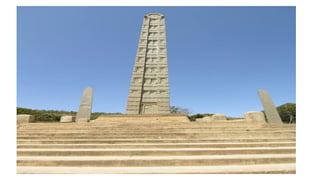
• one of the unique architectural technologies was the engraving of stele around the 3rd
century AD.
• There were totally 58 steles in and around Aksum that can be grouped into well made and decorated, half completed and
megaliths (not hewn).
• As local tradition says, the steles were engraved specifically at Gobodara from which they were transported and planted in
Aksum.
• The longest one of these stele measures 33meters heights (the first in the world).
• It is highly decorated in all of its four sides.
• It represents a-14 storied building with many windows and a false door at the bottom.
• It also bears pre-Christian symbols, which are a disc and a crescent (half moon) at the top.
• Some scholars suggest that this giant stele was broken while the people were trying to erect it.
• The second longest obelisk measures 24 meters height that was successfully erected and represents a ten-storied building with
many windows and a false door at the bottom.
• The third longest stele measures 21 meters and represents a nine-storied building with many windows and a false door at the
bottom. It is smooth at the back of its side with no decoration.
• The Zagwe churches are regarded as some of the finest architecture of artistic achievements of the Christian world and that is
why they were registered by UNESCO as part of world cultural heritage in 1978, two years before that of the Aksumite stele.
• Further refinement can be observed in the construction and decoration of the rockhewn churches in the Zagwe period. Zagwe
architecture used a softer material like sandstone, which was cut and shaped all round, except the floor, into a variety of
delicately decorated churches.
B. Writing System
• The Sabean language had an alphabet with boustrophedon writing type that is paleographical writing
from left to right and right to left alternatively.
• The earliest Sabean inscriptions in Eritrea and Ethiopia date to the 9th
century BC.
• One peculiar feature of Sabean inscriptions is absence of vowels as most of the words are written in
consonants.
• For instance, Da’amat was inscribed as D’mt, while its successive kings are written as RDM, RBH
and LMN using title, mlkn.
• After the 7th
and 6th centuries BC, however, variants of script arose, evolving in the direction of the
Ge ez script (an alpha syllabary).
ʽ
• By the first century AD, "Ge ez alphabet" arose, an
ʽ abjad (26 consonant letters only) written left-to-
right with letters identical to the first-order forms of modern vocalized alphabet.
• Though the first completely vocalized texts known are inscriptions by Ezana (who left trilingual
inscriptions in Greek, Sabean and Ge'ez) c. 330 AD, vocalized letters predate him by some years, as
vocalized letter exists in Wazeba’s coin some 30 or so years before.
• The process was developed under the influence of Christian scripture
• Ethiopia's ancient indigenous writing system has immense contribution to the development of
literature, art and the writing of history.
C. Calendar
• People needed to know and remember the times when the rains would begin and end as
well as the rise and fall of the water level.
• calendars were invented.
• In most cases, the length of the month was based on the movement of the moon or the
apparent movement of the sun.
• the number of days in the week or in the year varied from region to region.
• Calendars were developed and adopted among various peoples of Ethiopia and the Horn.
• Oromo calendar has been based on astronomical observations of moon in
conjunction with seven or eight particular stars or group of stars called Urjii Dhahaa
(guiding stars) and Bakkalcha (morning star).
• There are 29.5 dates in a month and 354 days in 12 months of a year.
• Pillars (dated 300 B.C.), which were discovered in northwestern Kenya from 1978-86
by Archaeologists have suggested to represent site used to develop Oromo calendar.
• In connection with this, c. 900 A. D. Oromo person Waqlim is said to have taken art
of shaping phallic bowls to Zimbabwe.
• The Sidama calendar rotates following movements of stars with 13 months a year, 12
of which are divided equally into 28 days while the 13th
month has 29 days.
• The Sidama week has only 4 days (Dikko, Dela, Qawado and Qawalanka) and hence each month has 7 weeks.
Nominated Mote (King) is presented to Fiche Chambalala, New Year ritual, for Qetela or popular demonstration.
• Ethiopic solar calendar has 12 months of 30 days plus 5 or 6 (is added every 4 years)
Epagomenal days, which comprise a 13th
month.
• A gap of 7–8 years between Ethiopic and Gregorian calendars results from alternative calculation in determining
date of Annunciation.
• The first day of the year, 1 Meskerem/Enkutatash is usually September 11 (Gregorian). However, it falls on
September 12 in years before the Gregorian leap year.
• The Ethiopic solar calendar has evolved to become the official calendar of the country.
• The Muslim (Islamic) calendar is a lunar calendar consisting of 12 months in a year
of 354 or 355 days.
• It employs the Hijra year of 622 AD, in which Mohammed and his followers made flight from Mecca to Medina
and established the first Muslim community (ummah).
• Dates in this era are usually denoted AH (After Hijra, "in the year of the Hijra"). Years prior to the Hijra are
reckoned as BH ("Before the Hijra").
• Other peoples like the Agaw, Halaba, Hadiya, Wolayta, Gedeo, the Nilotes, etc have
their own dating system.
D. Numerals
• Numerals appeared in Ethiopia and the Horn at the beginning of
fourth century A. D. Ge ez uses numeral system comparable to
ʽ
the Hebrew, Arabic and Greek numerals, but it lacks individual
characters for multiples of 100.
• Numbers are over- and underlined in proper typesetting,
combined to make a single bar, but some less sophisticated fonts
cannot render this and show separate bars above and below each
character.
UNIT FOUR: POLITICS, ECONOMY AND SOCIETY 13 to 16th
c
• key concepts
• the concept of the “restoration” of “Solomonic” Dynasty
• legend of the Queen of Sheba and its role in Ethiopian politics?
• What does territorial expansion mean?
• What do we mean by evangelization?
• What do you think are the roles of trade in a society
• rivalry between the Christian Kingdom and Muslim Sultanates
4.1. The “Restoration” of the “Solomonic’’ Dynasty
The rulers of the “Solomonic” Dynasty claimed that they were descendants of the last king of Aksum and
hence, they were legitimate to take over state power from the “illegitimate” rulers of the Zagwe dynasty.
As the claim has no historical evidence, the name “Restoration” is put in quotation mark. b/s
• the claim of descent from King Solomon of Israel is legendary.
• The claim has been elaborated in the Kibre Negest Glory of Kings”) that associated Ethiopia with the
Judeo-Christian tradition. The Kibre Negest claims that Ethiopian ruling class descended from the line of
Menilek I, son of the Queen of Sheba and King Solomon of Israel. As a result, Ethiopian monarchs from
YikunoAmlak to Emperor Haile-Silassie I claimed descent from Menilek I
4.2. Power Struggle, Consolidation, Territorial Expansion and Religious
Processes
4.2.1. Amba Gishen: ‘Royal Prison’
• Established to settle secession problem after death Yikuno-Amlak in 1285,
• a political instability caused by power struggles among his sons and grandsons for succession
(intesfied during Yegba Tsion (r.1285-94).
• The power struggle intensified during the reigns of Yegba-Tsion’s five sons who reigned from
1294 to 1299. to avoid the problem all male members of the royal family were confined until
one among them was installed in power. Loyal soldiers to the reigning monarch guarded the
royal prison. When the monarch died, court dignitaries would send an army to the royal prison
to escort the designated successor and put him on the throne.
• Established during widim ra`ad in 1300 (wollo) and Destroyed by Imam Ahmad Ibrahim Al-
Ghazi's force in 1540.
4.2.2. Amde-Tsion (r.1314-1344 ) Consolidation and Territorial Expansion of the
Christian Kingdom
• No permanent capital from 1270 to Gondar in 1636,
• the centre of the “restored” dynasty was Lake Haiq. Later moved southward to the districts of Menz, Tegulet, Bulga,
and finally to Yerer, Entoto, Menagesha, Wachacha, Furi and Zequalla mountains. After coming to power, Yikuno-
Amlak embarked on consolidating his authority throughout the empire.
• Ifat and Shewa Muslim centres subdued after stiff resistance
• Amde-Tsion (r.1314-44) the most expansionist king (up to Lasta-Tigray, Shewa, Amhara )
• the first "Solomonic" King, who embarked on a policy of a wider and rapid territorial expansion.
• His main motives of expansion were economic and political i.e. to control the trade routes and seize territories.
• witnessed the expansion of trade leading to the flow of commodities to the coast following the major routes.
• In consolidating his power, Amde-Tsion:
• subdued rebellions in an attempt to end centrifugal tendencies, which threatened the unity of the Christian Kingdom.
In the process he expanded his territory
• Agaw (Awi) of Gojjam around 1323/4;
• Bizamo and Damot in 1316/7;
• Bete-Israel (located between Dambiya and Tekeze River) around 1332; and the Red Sea Coast.
• occupied provinces under family relationship ;
• e,g Enderta (Tigray) to his wife Bilen-Saba.
• His son Bahr-Sagad, became the governor of Tigray and Eritrean region. And appointed with title Bahire-Negash.
• Paying tributary to the Christian kingdom. E.g Muslim sultanate in southeast and Omotic kingdom- wolaita &
Gamo in south and Gurage in south and kingdoms.
• In the early 1330s the full control of all the trade routes and sources of trade of the Ethiopian region
4.2.3. Evangelization, Religious Movements, and Religious Reforms of
Zara-Yaqob
• I. Evangelization
• spread of Christianity in several newly incorporated area
• Eyesus-Mo'a opened new opportunities of learning for Christians in 13th
c.
• Amde-Tsion territorial expansion contributed for the spread of Christianity.
• Abune Tekle-Haymanot (thirteenth century) played a key role in reviving
Christianity in Shewa, which was followed by the evangelization of areas in
southern Ethiopia including medieval Damot. He baptized and converted
Motalami to Christianity.
• Yaqob, spread Christianity to different areas of Shewa
II. Religious Movements
A. The Ewostatewos Movement
• Monasticism became a dominant practice in
Ethiopian Orthodox Church in mid 13th
c
• monasticism and religious movements lead by
Ewostatewos called as Ewostatewos movement,
• teachings was the strict observance of Sabbath,
• When he was opposed by an organized religious rival
group of the clergy in Sera'e, he fled to Egypt. He
faced the same opposition in Cairo by Ethiopian
pilgrims.
B. Deqiqe Estifanos/ the Estifanosites
• The movement within Ethiopian monasticism, led by Abba Estifanos from 15th
to 16th
c.
• Aim was to establish a rigid monastic organization, which emphasized poverty, absolute
self-subsistence, equality and autonomy from secular authorities.
• The movement gained followers in various monastic communities. When summoned to
the royal court, Estifanos was initially able to convince the emperor (probably Atse Takla
Maryam, r. 1430-33) that he posed no threat to royal power or the unity of the Church.
• Estifanos appears to have disapproved the Emperor’s religion initiatives, rejected royal
supremacy and authority in spiritual matters and refused to participate in court judiciary
procedures.
• Zara-Yacob took very harsh measures against the Estifanosites allegedly for their
opposition of the veneration of St. Mary.
• Naod appears to have been more favourably inclined towards the Estifanosites and to have been
instrumental in their reintegration into the EOC during the period of Metropolitan Abune Yeshaq.
III. Emperor Zara-Yaqob Religious Reforms
• Emperor Zara-Yaqob (r.1434-68) took several measures to stabilize and consolidate
the Orthodox Church.
• settled the conflict among the Ethiopian clergy in order to create an amicable church-state
relationship.
• made peace with the House of Ewostatewos by reviving Sabbath in the Ethiopian church and
the Ewostatian agreed to receive Holy orders from the Ethiopian prelates.
• urged the clergy to preach Christianity in remote areas.
• ordered the people to observe fasting on Wednesdays and Fridays and get Father Confessors.
• Lack of sufficient religious books was another problem. Thus, the king encouraged the
establishment of a library in every church. This was followed by revival of religious literature.
He himself wrote some books like Metsafe-Birhan, Metsafe-Me’lad, MetsafeSillasie, Metsafe-
te'aqebo Mister,etc. In addition, during his reign, some parts of Te’amreMaryam were
translated from Arabic to Geez.
4.3. Political and Socio-Economic Dynamics in Muslim Sultanates
• Strong sultanates had emerged since the fourteenth century.
• the major factor is Trade
• Trade served as major source of livelihood and acted as a major agent in the formation of Muslm Sultanes
• Trade remained major source of conflict between the Christian Kingdom and Muslim sultanates.
4.3.1. The Rise of Adal
• One of the strong Muslim sultanates that emerged along trade routes and became a centre of resistance against the
Christian Kingdom until the 2nd
half of 16th
• Due to Christian kingdom targeted of attack Ifat, one branch of Walsam family moved further south-eastern
lowland and established vigorous sultanate of Adal around Harar in 1367
• The 1st
centre of this extended Walasma Dynasty, was at a place called Dakar, a place located to the southeast of
Harar.
• The Walasma family consolidated its power in Adal, and began another phase of military campaigns against the
frontiers of the Christian Kingdom.
• In 1520, Adal changed to the city of Harar and
• after the defeat of Imam Ahmed; a growing threat from a new force-the Oromo forced the sultanate to change its
capital to Awsa in 1576/7, to the present Afar region.
• Centres shifted Ifat- adal- Harar- Awsa
4.3.2. Trade and the Expansion of Islam
• Islam spread through Muslim merchants and preachers.
• Trade served as channel for the expansion of Islam in the Muslim
Sultanates and base of the economy.
• The most known Muslim Sultanates were Ifat (1285-1415) and Adal
(1415-1577).
• The main trade outlet /port
• Zeila and the old city-states of Mogadishu, Brava, and Merca were used as ports
for their hinterland. I
• Massawa served as an outlet for the trade in the northeast.
• With the revival of trade, different towns and trade centres emerged
along the route from Zeila to the interior.
4.4. Rivalry between the Christian Kingdom and the Muslim Sultanates
• Major cause: The ambition to control this trade route and commodities that passed through
Zeila led to rivalry between the “Solomonic” rulers and the Sultanate of Ifat. b/s Zeila was the
main outlet to the sea since 1328
• The Muslim Sultanates organized their armies to take military action against the Christian
Kingdom. The Sultan of Ifat, Haqaddin I stopped merchants belonging to the Christian King,
Amde-Tsion, confiscating the goods, capturing, and imprisoning the king's agent, Ti’iyintay
returning from Cairo. These actions forced Amde-Tsion to wage a campaign against Haqaddin
I; defeated and took him prisoner and eventually replaced him by his brother Sabradin. Both
Ifat and Fatagar came under Sabradin. Ifat was defeated and Sabradin was captured during his
retreat. As a result, Ifat, Fatagar and Dawaro were incorporated.
• Amde-Tsion required from them annual tributes and freedom of movement for all caravans
through Zeila. Following the decline of Ifat, other Muslim Sultanates like Sharkha, Bali, Dara,
and Arbabani were also seriously weakened.
• In 15th
c, Emperor Zara Yaqob gained some access to the Red Sea. In 1445, Zara Yaqob
defeated Sultan Ahmed Badlay at the battle of Yeguba. As a result, the son and successor of
Ahmed Badlay, Mohammed Ahmed (r.1445-71) sent a message of submission to Ba’ede
Mariam (r. 1468-78) to remain vassal of the Christian Kings.
Cont..
• Ba’ede-Mariam campaigned against Adal. But his army lost the battle
in 1474.
• leaders of the Muslim Sultanate sought to resolve the problem peacefully (Mohammad ibn
Azhar ad-Din (1488-1518)
• Emir Mahfuz carried out some effective military campaigns into the highlands.
• In 1517 Emir Mahfuz died fighting against Emperor Lebne-Dengel's (r.
1508-40) force and his son-in-law, Imam Ahmed ibn Ibrahim al-Ghazi,
popularly known as Ahmed Gragn or the "left-handed" took over the
leadership.
4.5. External Relations
4.5.1. Relations with Egypt
•Ethiopia continued to act as protectors of religious
minorities in their respective domain.
•Egypt also wanted to ensure secure flow of the Nile (the
Abay River) that originated from Ethiopia.
• early 14th
c, Mohammed ibn Qala’un persecuted the Copts and
destroyed their churches in Cairo.
• In response, Amde-Tsion demanded the restoration of the
church and warned that failure to do so would result in the
diversion of the Nile waters. E,g king Dawit’s reign
4.5.2. Relations with Christian Europe
Contacts between the two regions were
strongly influenced by the legend of
“Prester John”. This was followed by
sustained relations in subsequent
decades.
Con..
• The beginning and continued rivalry between the Christian Kingdom and Muslim
Sultanates in the 15th
c strengthened r/s b/n the Christian Kingdom and Christian Europe.
• Queen Elleni (the daughter of Hadiya Garad and married to King Zara Yaeqob) played an
important role in the strengthening of these relations. She had foreseen the threat that
came from the Ottoman Turkish who showed a clear interest to support the Muslim
Sultanates. She also had foreseen the possibility of consolidating relations with and
getting support from Portugal that was against the Turks.
• In 1508, Portugal sent an envoy to act as an ambassador to Christian Ethiopia. Around
1512, Queen Elleni, the mother and regent of Lebne-Dengel sent an Armenian called
Mathew to Portugal. The Portuguese court doubted his authenticity and was received
coldly.
• The Portuguese Embassy led by Rodrigo di Lima, Duwarto Galliba and Francisco Alvarez
reached Ethiopia in 1520 and remained for six years. The objective was to establish a
naval port against the expanding Turkish power in Red Sea Area. The mission was not
successful.
UNIT FIVE
POLITICS, ECONOMY AND SOCIAL PROCESSES 16th
to 18th
c
• Key concept
• expansion of trade, conflicts between the Christian Kingdom and Muslim
Sultanates (Ahmed Gragn war)
• foreign interventions: Portuguese and Turkish ' involvement
• Population movements of the Afar, the Somali, the Argoba and the Oromo;
religious expansions, interaction of peoples and the resultant integration across
ethnic and religious diversities.
• Gada System and Oromo population movement
• Gondarine Period (1636-1769),
• Zemene Mesafint (1769-1855) including the Yejju rule (1786-1853).
5.1. Conflict between the Christian Kingdom and the Sultanate of Adal (1529-1543)
• Main cause
• Competition and struggle to control long distance trade route
• To occupy Religious supremacy
• Maladministration and exploitation of periphery by possible military mobilization
• Actors:
• Muslim Sultanate led by Adal by Imam Ahmed Ibn Ibrahim al-Ghazi (Ahmed Gragn)
• Internal pushing factors
• pressure from Afar and Somali due environmental change of increased population and over grazing-pushed up too Harar
• Raiding and counter-raiding at water holes or animal rustling intensified.
• Gragn`s remarkable leadership achievements was mobilizing all pastoral communities of the Afar, the Somali, the Harla, Harari and
others to a common cause. He convinced them not to fight amongst themselves but to unite and expand to the Christian Kingdom and
resolve their pressing material needs while at the same time guarding Islamic doctrines and practices from the infiltration of any alien
religious doctrine.
• Under Imam Ahmed Adal built strong army and refused to pay tributes to Christian kingdom in 1520 and started territorial control of
Bali, Dawaro, Fatagar, Sidama, Hadiya and Kambata and putting the Christian Kingdom at risk in 1527.
• has small army but highly motivated and strong leadership and uniform command
• Christian Kingdom led by, Lebne-Dengel (11 year old) assisted by Elleni
• In 1528, Lebne-Dengel mobilized a Christian kingdom
• In 1529, Ahmed Gragn defeated Leben Denagl army at Battle of Shimbra Kure (near modjo). Then controlled
territory up to shewa, Amhara, Lasta, Mereb Milash and port ziela to mssawa (1535).
cont..
• Bati Del Wanbara,
• wife of Imam and most illuminating figures during the war
• daughter of a Muslim military commander of Adal known as Mahfuz and
encouraged her husband to avenge the death of her father.
• accompanied her husband throughout his expeditions
• Lebne Dengel military set back forced to retreat finally died in 1540 as a
fugitive.
• Succeeded by Gelawdewos (r.1540-1559),
• continued war with Imam Ahmed had received Turkish musketeers.
• Based on request of LebneDengel in 1535, 400 Portuguese soldiers arrived in 1541, that led by
Christopher da Gama, the youngest son of Vasco da Gama.
• In August 1542 the Christian army was defeated in Ofla, 200 Portuguese army died and Christopher
da Gama was beheaded.
Cont..
• Role of Seblewongel: wife of Lebne-Dengel/ mother of
Gelawdewos:
• participated in the war against Imam Ahmed in 1542
• advised Emperor Gelawdewos how to prepare and march for the battle of
Woyna-Dega.
• In February 25, 1543 at the Battle of WoynaDega Imam
Ahmed`s army was defeated by Gelawdewos
• After the battle, Gelawdewos
• restored possession of almost all the northern and central plateau.
• Muslim communities in the highlands submitted to Gelawdewos
• restore many of the pre-1520s territories and tributary regions.
• In 1550s, Gelawdewos had established a strong Christian Kingdom.
5.3.1. Population Movements of the Argoba, Afar, and Somali
• Major Cause for population movement
• Consequence of the military conflict between the Christian Kingdom and the Sultanate of Adal I
• environmental pressure conflict.
• Argoba:
• major agents of Islamic expansion, trade and Muslim state formation
• the sultanate of Shewa (Makhzumite and Ifat (Walasma) moved to east joined with argoba in 13th
c.
• Becomes centre of Muslim resistance by joining Afar and Somali against Christian Kingdom because major caravan
trade routes passed through Argoba.
• Consequence Christian-Muslim rivalry: the destroyed Argoba and dispersion of the people, fragmented settlement.
• Afar: due to drought, moved towards the east until middle Awash before 16th
• Trade routes linking the ports in the Horn pass through Afar's territory.
• so Afar becomes centre of competition between the Christian Kingdom and the Muslim sultanates to control the
trade routes.
• conflict pressurized the Afar to move into different directions
• Their pastoral economy helped the Afar to survive the destructive
effects of the wars of the sixteenth century.
• The Somali: lay in the region traversed by major trade routes during medieval period.
5.3.2. Gadaa System and Oromo Population Movement (1522-1618)
• A. The Gadaa System
• The Gadaa system was an institution through which the Oromo socially organized themselves,
administered their affairs, defended their territories, maintained law and order, and managed their
economies.
• Emergence of gadaa system :
• for long the society organized their politics, economy, social, cultural, and religious affairs through the
Gadaa institution.
• Abba Bahrey indicates Gadaa system full functional early 16th
c during oromo population movement
• evolved from the earlier Cushitic age-set social organization based on studies on the Gadaa calendar and
Gadaa centres.
• Time computation and recording history was based on the eight-year segment of time.
• eight years represented one Gadaa period,
• 5-gadaa periods or 40 years represented one generation and nine generations represented an era.
• earliest eras of Gadaa but still obscure were those of Bidiri Dhoqqe.
• Prior to the beginning of Gadaa Borana-Barentu around 1450 AD, the Oromo passed through known eras of Taya, Tasaa,
Munyo, Suftu, Maddile, Abroji, Dhittacha and Warra-Daye (warden), each of which survived for an era.
• Gadaa was interrupted and revitalized during various eras because of various internal and external factors. For instance, the
Borana-Barentu Gadaa was instituted after interruption for nearly two generations. It was revived in 1450 at Madda Walabu
that became the central Chaffe (assembly) and seat of the senior Qallu until 1900.
Cont..
• The constituted democracy elements Gadaa system:
• Periodic succession
• Power sharing to prevent a one-man rule.
• Representation of all lineages, clans and confederacies.
• Served as a mechanism of socialization, education, maintenance of peace and order, and
social cohesion.
• constituted rules of arara (conflict resolution), guma (compensation), and rakoo
(marriage).
• The Gadaa system organized the Oromo society into age-grades and generation sets delineating
members' social, political, and economic responsibilities.
• 10 age grade and five classes operated in parallel.
• The system provided a socio-political framework that institutionalized relationship between
seniors and juniors and egalitarian relations among members of a grade.
• The system helped the members of age-sets to develop a consistent and stable sense of self
and others. Sons joined the first grade as members of Gadaa class (generation class or set)
forty years after their fathers and were initiated into the next higher grade every eight years.
Age-grades and their roles
Gadaa-grade Age Roles
Dabale birth-8 years Socialization
Game 9-16
Socialization ( may be Cattle keeping & supporting
family
Folle 17-24 military training, agriculture etc
Qondala 25-32 military service
Raba-Dori 33-40 candidates for political power
Luba 41-48 leaders of Gadaa government
Yuba 49 to 80
senior advisors, educators and ritual
leaders
Cont..
• Gadaa/luba assumed power for eight years.
• Abba-Gadaa (father of the period): The head of the government assisted by several elected representatives from
among the generation set such as:
• Abba Bokku (father of sceptre),
• Abba Chaffe (head of the assembly),
• Abba-Dula (war leader),
• Abba Sera (father of law),
• Abba Alanga (judge),
• Abba Sa'a (father of treasury)
• In the Gadaa system, the senior Qallu (Abba Muda) played indispensable roles in power transfer and legitimizing the
ruling gadaa class.
• Sinqe: Women maintained their rights by the Sinqe institution, which helped them to form sisterhood and solidarity.
Women from childhood to old age
• guduru (pre-pubescent),
• qarre (adolescent, ready for marriage),
• kalale (wives of Luba and Yuba)-privileged to support and advise the ruling class
• cifire (wives of Gadamojji/above 80 years) were believed to have sacred power. They involved in occasions like
power transfer, conflict resolution, thanks-giving and others.
• The Gadaa system functioned by the cyclical power transfer from one Gadaa class to the next every eight years.
The Five Gadaa Classes
Fathers Sons
Melba Harmufa
Mudena Robale
Kilole Birmajii
Bifole Mul’ata
Michille Dulo
B. The Oromo Population Movement (1522-1618)
• Factors
• Natural: demographic pressure and subsequent need for land to accommodate the
growing human and livestock population.
• Social:
• the conflict between the Christian Kingdom and Muslim Sultanates from 13-
16th
c pressurized mainly pastoral Oromo groups to leave the lands they
inhabited for other areas.
• the organization of the Oromo under the Gadaa system played crucial role in
the success of the Oromo population movement.
• Oromo organized under Borana and Barentu confederacies, when the population
movement began in early 16th
c.
12 Butta wars
• From 1522 to 1618, the Oromo fought twelve Butta wars.
1. Melba (1522-1530) first Gadaa who fought and defeated Christian regiment Batra Amora led by Fasil and occupied Bali
2. Mudena (1530-8) reached the edge of Awash River.
3. Kilole (1538-46) controlled Dawaro after defeating Christian regiment Adal Mabraq
4. Bifole (1546-54) advanced to Waj and Erer.
5. Michille (1554-62) scored victory over Hamalmal's force at Dago, and Jan Amora forces as well as Adal led by Emir Nur
Mujahiddin at Mount Hazalo.
6. Harmufa (1562-70) fought Minas (r.1559-63) at Qacina and Wayyata; occupied
Angot, Ganzyi, Sayint etc.
7. Robale gadaa (1570-78) defeated at Woyna Daga in 1574 by Sartsa Dingil’s (r.1563-97) cavalry led by Azzaj Halibo but
Robale recovered and defeating Zara’a Yohannis’ force.
8. Birmaji (1578-86) controlled Ar'ine in Waj, crossed Jama to Wolaqa and overwhelmed the
Daragoti regiment.
9. Mul’ata (1586-94) seized Damot, Bizamo, Gafat, Dambiya and Tigray.
10. Dulo (1594-1602),
11. Melba (1603-10)
12. Mudena (1610-18)
expanded to West and Northern parts of the Horn of Africa while others like the
War day moved to Kenya and Bur Haqaba and Majertin in Somalia.
Cont..
• Different branches of Gadaa centres.
• Oda Nabee of Tulama,
• Oda Roba of Sikko-Mando (Arsi),
• Oda Bultum of Itu-Humabenna,
• Oda Bisil of Mecha ad Oda Bulluq of Jawwi Mecha became major Gadaa
centers.
• Other Gayo of Sabbo-Gona, Me'e Bokko of Guji, Oda Dogi of Ilu, Oda Hulle
of Jimma, Oda Garado of Waloo, etc.
• Gadaa leaders such as Dawe Gobbo of Borana, Anna Sorra of Guji, Makko-Bili of
Mecha, Babbo Koyye of Jimma and others established Gadaa centers and laid down
cardinal laws in their respective areas
Map
Cont..
• Mada Walabu
• After expansion various Oromo groups kept their relations through the office of
Abba Muda (the father of anointment) seated at Madda Walabu and formed alliances
during times of difficulty.
• they obeyed similar ada (culture) and sera (law) through sending their delegates to
Madda-Walabu, the central chaffe until the pan-Oromo assembly was forbidden in
1900 due to the political influence of the Ethiopian state.
• Qabiyye system: Land holding system to regulate resource and their interaction among
different clans under Gadaa devised resource allocation formula.
• The system established rights of precedence (seniority) in possession of land.
Accordingly, place names were given the names of pioneers as markers of qabiyye
rights.
5.4. Interaction and Integration across Ethnic and Religious Diversities
• The political, social, and economic processes of the medieval period were the major factors for the people's interactions across regions. Such
interactions occurred during peace and conflict times.
• The cases in point were the trade contacts and conflicts to control trade routes, religious expansion, and territorial expansion and population movements.
• One of the major consequences of the interactions
• the integration of peoples across ethnic and religious diversities in Ethiopia and the Horn
• consequence of the Oromo population movement
• put an end to the wars between the Christian and Muslim states as well as the southward expansion of the Christian state
• The Oromo integrated non-Oromo through two adoption mechanisms: Guddifacha and Moggasa.
• Guddifacha refers to the adoption of a child by a foster parent. the child enjoyed equal rights and privileges with a biological child.
• Moggasa was a system of adopting non-Oromos commonly known as Oromsu.
• was the practice of incorporation of individuals or groups to a clan through oath of allegiance with all the rights and obligations that such
membership entailed.
• was undertaken by the Abba Gadaa on behalf of the clan
• adopted groups gained both protection and material benefits
• The process significantly contributed to the social cohesions, national integration, and the revival of long-distance trade.
• The interactions also resulted in an exchange of socio-cultural values and institutions.
• A number of peoples adopted Gadaa system and Oromo language.
• the Oromo adopted and adapted cultures and traditions of the people
• the adoption of monarchical systems and the integration of the Oromo to the Christian and Muslim cultures
• the rise of nobles in the northern Oromo in politics particularly during the Gondar period, Zemene-Mesafint and the making of
modern Ethiopia.
5.5. Peoples and States in Eastern, Central, Southern and Western Regions
5.5.1. Peoples and States in the East
• Somali
• inhabited vast territory in the Horn
• practiced pastoral economy and moved between places for centuries possibly in search of sufficient pasture
• Ibn Said (1214-86), an Arab geographer, noted that Merca town located in the southern Somali coast near Shabele
River was a capital that brought large number of Somalis together during the thirteenth century.
• The songs celebrating King Yeshaq's (r. 1413-30) military success depicts that the Somali lived close to the
Christian Kingdom.
• Somali contingents also played important role in the victories of the Sultanate of Adal against the Christian
kingdom.
• a council known as shir governed the society.
• The decision making process was highly democratic in which all-adult male were allowed equal access and
participation.
• These councils at sub-clan, clan and inter-clan level provided a governing structure that acted as an enforcement of
law and justice.
• The council governed wide-ranging affairs including resource allocation, marriage, trade and crime. As a
component of shir, the guurti (a council of elders) was the highest political council mandated with resolving
conflict and crisis.
Afar
• predominantly lived in northeastern Ethiopia and in northern Djibouti, some have also inhabited southern Eritrea.
• had an indigenous governance system known as Makabanto, which has some elements of democracy
• first mentioned by Ibn Said. During the thirteenth century, they occupied the lowland territory near Bab el-Mande.
• The land inhabited by the Afars was home for many historical cities such as Maduna and Abasa.
• Following the collapse of the power of Sultanate of Adal in the sixteenth century, the Afar established their sultanates like
Awsa, Girrifo, Tadjourah, Rahaito and Gobad.
• Awsa Sultanate succeeded the earlier Imamate of Awsa in the middle Awash
• The latter polity had come into existence in 1577, when Mohammed Jasa moved his capital from Harar to Awsa
• At some point after 1672, Awsa declined and temporarily ended in conjunction with Imam Umar Din bin Adam's
recorded ascension to the throne
• The Sultanate was subsequently re-established by Kedafo around 1734, and was thereafter ruled by his Mudaito Dynasty.
• Primary symbol of the Sultan was silver baton.
• economy mainly depended on Bati-Ginda’e trade route
• Later it became center of Islamic learning led by preachers like Tola Hanfire.
Argoba
• Early reference to the people of Argoba is insufficient. There are two versions on the origin of the people of Argoba.
• 1st
-they descended from the followers of the Prophet Mohammed who came to the Horn of Africa and settled at Ifat.
• 2nd
- the origin of the Argoba is not related with Muslim-Arab immigrants. More plausibly, the Argoba are one of the
ancient peoples in the region that accepted Islam very early from religious leaders who came from Arabia.
The Emirate of Harar
• Harar is one of the earliest Muslim centers
• Harar became the capital of Walasma of Adal replacing Dakar until 1577
• Imam Ahmed ibn Ibrahim used Harar as a center from where he launched his campaigns into the Christian kingdom in
1527.
• during the reign of Emir Nur Mujahid, Harar became a walled city where the sultanate of the Harari developed.
• In the mid seventeenth century, Emir Ali ibn Da’ud (r. 1647-62) in cooperation with the Oromo established a dynasty
which was to rule for nearly two centuries and a half
• strengthened by Amirs like Abdul Shakur (1783-94).
• The Amir’s council, Majilis engaged in supervising Mosque land,
• Waqf and offering other assistance to the Amir.
• The emirate grew in importance to be a steady center of Islamic culture and power.
• Its economic power grew as it controlled trade routes from the Gulf of Aden ports of Zeila and Berbera.
• Its authority was established over the surrounding Oromo and Somali through trade, inter-marriage, and expansion
of Islamic teachings.
• Egyptians were attracted by such a prominence that they sent an expeditionary force in 1875 and controlled the
emirate for nearly a decade
• and ruled by Amir Abdulahi, as the last emir of the Sultanate for two
• Emperor Menilek’s expansion to the region shortly followed in 1887.
5.5.2. Peoples and States in Central and South Central Parts
The Kingdom of Shewa
• was formed by a Menz ruler Negasi Kristos (r.1696-1703) and controlled districts like Asandabo, Debdabo,
Mafud and Yifat.
• second king was Merid Sebestie/Sebastyanos (r.1703-18).
• Abuye/ Abiyye (1718-45) made Haramba, his capital and tried to subjugate the surrounding Oromo before he was
killed by the Karrayu Oromo.
• In addition to his unsuccessful attempts to control the Afar and Abitchu Oromo, Amaha Iyesus/ Amayyes (r.1745-
75) declared authority over Bulga, Efrata, Menz and Tegulet with his capital at Doqaqit which later shifted to
Ankober.
• Asfa-Wosen (r.1775-1808) conquered Antsokia, Asbo, Gedem, Gishe, Merhabete, Morat and Shewa Meda.
• The dynasty became very strong under Negus Sahle-Sellasie (r.1813-47), the grandfather of Emperor Menilek II.
• During his reign, many travelers visited Shewa and he even signed “treaty of friendship and commerce” with the
British in 1841.
• Shewa’s economy was mainly based on agriculture supplemented by trade and craft
• Near the capital, Ankobar, there was an important trade center in Aleyu Amba administered by the Shewan court.
Gurage
• divided into the Western and Northern Gurage
• first are also known as Sebat Bet Gurage and include: Chaha, Muher, Ezha, Gumer (Inamor, Enner, Endegegna and Gyeto)
• The latter are variously known as Kistane, Aymallal or Soddo Gurage.
• Additional groups included Dobbi, Gadabano and Masqan.
• The staple crop in Gurage land is enset.
• The Gurage had traditional system of governance developed over the centuries. It is known as the Yajoka Qicha among the Sebat Bet and the Gordanna
Sera among the Kistane.
• no centralized leadership.
• Power was vested in clan or lineage groups.
• Descent groups displayed corporate rights, obligations, and influence.
Kambata
• By about 1550-70, four communities of separate origin coalesced to form the contemporary state of Kambata which means, “this is the place” (where we
live-as the Kambata believe in).
• its original homeland around Mount Hambericho in the heartland of Kambata territory.
• other three namely the Dubamo, Donga and Tembaro trace their homeland from Sidama highlands.
• the ethno-genesis of Kambata also benefitted from Omotic and Semitic peoples who moved into the region
• Emperor Yeshak (r.1413-30) annexed Kambata proper and controlled the area between Omo and Bilate Rivers, which he incorporated into the
Christian Ethiopian Empire.
• In 1532, the region was captured by Imam Ahmed’s army, which furthered the interaction of peoples.
• the groups were recognized as and conscious of the name Kambata related to one of the seven dominant clans (Kambata Lamala) in the region
• The people were ensete farmers sharing similar culture and speaking the same language called Kambatissa, which belongs to the Highland East
Cushitic family together with Qabena, Halaba, Hadiya, Sidama, Gedeo and Burji groups.
• had a traditional administrative institution called the Hambericho Council.
• council had seven members each representing the seven clans in the region. With a king at the top, the council ruled Kambata until the late nineteenth
century.
Hadiya
• The origin of the state of Hadiya goes back to the thirteenth century. It was mentioned in the Kebre-Negest (Glory of the
Kings) and it referred to the area west of the Islamic states in the federation of Zeila.
• people were heterogeneous both linguistically and culturally.
• Semitic-speaking agricultural people dominated north of the state while the southern part was largely inhabited by Cushitic-speaking pastoral
communities.
• about 1332, the ruler of the Christian kingdom, Amde-Tsion, subjugated Hadiya after defeating its ruler, Amano who
supported by a Muslim “prophet” Bel’am aligned with the then leader of Ifat, Sabraddin to confront the Christian force.
• From the thirteenth to the sixteenth centuries, Hadiya’s political importance was considerable with sizable population and
vast territory.
• In 1445, a Hadiya king called Mahiqo rebelled against Emperor Zara-Yaqob (r.1434-68) and was consequently replaced by
his uncle Bamo.
• To stabilize the situation, Zara-Yaqob made a political marriage. Accordingly, Princess Elleni, from Hadiya, who became
an important historical figure, married Emperor Zara-Yaqob.
• Another Hadiya leader, Garad Aze refused to pay tribute to Emperor Sartsa-Dengel (r.1563-98), but was suppressed in
1568/9.
• The relations between Hadiya and the Christian Kingdom was interrupted following the wars between the latter and Adal
and the Oromo population movement until Hadiya's incorporation into the Imperial state in the late nineteenth century.
• descendants of the old Hadiya can be traced from four different linguistic clusters: the Oromo, the Sidama, the Kabena and
Alaba, and the Hadiya proper with its sub-groups-the Mareko, Lemu, Soro, Shashogo and Badowacho.
5.5.3. Peoples and States in the South
Sidama
• the Sidama have been living in the southern parts of Ethiopia
• Agriculture, remained the basis of the economy. Enset and coffee are Sidama’s important food and cash crops
• indigenous system of governance led by the Mote (king).
• The Mote exercised political and administrative authority in consultation with the council of elders called Songo.
• The cultural and ritual leader in Sidama society was the Woma.
• selected for his ability as a peacemaker, bodily perfection, oratorical ability,
• could not participate in war or cattle raiding as he was considered a man of peace. wisdom and caution.
• offering sacrifices to the spirits
• performed other rituals such as circumcision and marriage.
• Sidama society was divided into generation-sets called Luwa.
• system had five grades each lasting for eight years. These are Darara, Fullassa, Hirbora, Wawassa and Mogissa.
• Candidates for Luwa received a five-month military training and war songs like gerarsha under the leadership of
the gaden with his deputy called Ja’lawa.
• Another important institution of Sidama society is Seera. Seera was the social constitution of the Sidama people
governing social life based on the Sidama moral code, halale (the ultimate truth) to judge the right and wrong.
Gedeo
• Contradictory traditions exist regarding the origin of the Gedeo people. The dominant tradition relates the
ancestors of the Gedeo to Daraso, who was the older brother of Gujo (father of Guji Oromo).
• the seven major Gedeo clans descended from the seven sons of Daraso.
• The clans were grouped in two houses, the first being the shole batte (senior house)
• The second s called sase batte (junior house
• The Gedeo had a culture called baalle, a traditional governance system that worked with age classes and ranking.
• The baalle had seven grades with a 10-year period each creating a 70-year cycle.
• Sasserogo was a federation of three territories; Sobbho, Ributa and Rikuta sharing one
• Abba Gadaa who leaves office every eight years to be replaced by a new holder with the next age set at baalle
ceremony.
• Konso
• The literal meaning of the term is a “heavily forested hill/ area.”
• the traditional home of Konso people while the low-lying environment along Sagan and Woyito river valley served as
hunting grounds
• attracted the attention of local and international researchers interested in human evolution, as it is one of the earliest human
settlement sites in the world.
• Agriculture was the major economic activity
• integrated system of specialized agricultural technology
• Farmers combined crop production with cattle breeding.
• adopted soil conservation techniques notably the construction of terraces
• Until the late nineteenth century, the Konso people lived in walled villages (paletas) which were further divided into wards
called Kanta.
• There was no central authority who acted as sovereign power over the three regions.
• Each village was ruled by a council of elders called hayyota who were selected through direct participation of male
members
• Membership to the council was not hereditary but rotated every eighteen years.
• the socio-political organization of the Konso appear to be the clan or lineage group and generation set, Tselta.
• into nine exogamous clans namely Toqmaleta, Elayta, Saudata, Pasanta, Kertita, Ishalayta, Mahaleta, Tikisayta and
Argamyta.
5.5.4. Peoples and States in Southwestern Part
Wolayta
• first emerged as a state in the thirteenth century
• According to local traditions, the area was inhabited by different communities such as the Badia, Badiagadala and Aruja.
• The state flourished in the late eighteenth and early nineteenth centuries because of successful wars that the Wolayta fought
against their neighbors and the material, human and territorial gains thereof
• At the apex of the social and political hierarchy was the Kawo (king), assisted by a council of advisors.
• From the thirteenth to the late nineteenth centuries, two successive dynasties ruled Wolayta: the Wolayta-Malla and the
Tigre.
• Founded in the thirteenth century by Motalami, the Wolayta-Malla seems to have ruled until the end of the fifteenth century.
• It was then superseded by the Tigre dynasty, so called because it was supposedly founded by Tigreans from northern Ethiopia.
• land relationships were ordered according to three basic principles of social organization i.e. kinship, polity and social
status.
• rights over land were vested in the lineage group, the crown (royal estate) and the nobility.
• There were also communal lands allocated for grazing and social gatherings to which all members of the society except
artisans had equal access.
• grants of land or by threats of dispossession the reigning monarch ensured loyalty to the state. Except those who worked on
the royal estate, landholders paid tribute to the king.
• The dominant food crop was enset (Enset Ventricosum).
• Kafa
• this powerful kingdom emerged in the fourteenth century.
• Around mid seventeenth century, the state had come to prominence.
• The ruling Minjo dynasty and the medieval kingdom of Ennarya had close contact.
• The Oromo expansion might have forced the ruling house of Ennarya to flee south of the Gojeb which as a result brought
Christianity and the royal title tato to Kafa.
• Kafa’s economy was based on the cultivation of enset on peasant farms supported by trade.
• peasants rendered free labor service and tilled royal estates with the support of slaves who were acquired through raiding or
trading, or as payment for debt.
• a prosperous commerce took place with Oromo states of the Gibe region. Major trade items, such as musk, coffee, slaves,
Ivory, gold, honey-wax, and civet were exported via markets like Tonkolla, Tiffa, Qeya etc.
• From the seventeenth to the eighteenth centuries, the kingdom expanded to Bonesho, Mashengo, Maji, Nao, She and Chara
• apex of the administration of the kingdom was the Tato with his major political center at Bonga
• Another seat of power was Andarcha, seven miles to southeast. The Tato was assisted by a council of seven advisors called
Mikrecho. The Mikrecho served to moderate the power of the king but they played important roles in succession as well.
• The Kafa had a tradition of digging deep trenches called Kuripo as defensive barrier. The Gojeb also served as natural
protection against external invasion and it might have contributed to their relative independence until 1897.
• Yem
• The Yem state was located along the eastern banks of the Gibe or to the northeast of the Kafa kingdom.
• Yem’s economy combined agriculture, trade and crafts
• an indigenous dynasty called Dida or Halmam-Gamma ruled Yem from its palace in Dudarkema/Zimarma near Oya
• Besides being at the top of the political ladder, the Amno (king) of Yem acted as a chief priest with attributes of
divinity
• A state council of 12 members named Astessor with its chairperson Waso assisted the Amno in administering the state.
• Erasho were the provincial governors and they were responsible for digging ditches called bero and erecting nearly
fifty-meter wooden or iron pillars at the center of the kingdom around Brisi Bita so that the war father, the Nomiaw,
could patrol the surroundings.
• In the fourteenth century, the last King Oyokam/Amo Dasha was overthrown by people from the north who founded a
new dynasty called Mowa (Howa) with
• In the nineteenth century, the neighboring state of Jimma Abba Jifar tried to control the Yem which itself was absorbed
into the imperial state of Ethiopia under Emperor Menilek II towards the end of the century.
• Gamo
• the Gamo inhabited areas from Lakes Chamo and Abaya to the Gughe Mountain and beyond.
• physical landscape can be divided into two: the geze (highland) and the bazo (lowland)
• The highlands were densely populated while people who escaped coercion by the state at the political center largely settled the lowlands
which also served as hunting fields.
• interrelated indigenous laws called the Woga defined land-use in the Gamo highlands.
• they formed a natural resource management system that governed everything from interpersonal relationships
• The cultivation of enset had been central to the subsistence of Gamo highlands while maize and sweet potato were staple food crops in the
lowlands
• Craft making, pot making, tanning and metalworking were other modes of the subsistence system.
• The first mention of the Gamo in written records dates back to the fifteenth century in the praise songs of king Yishak (r.1413-30).
• The song mentioned the Gamo as one of the tributary states to the monarch
• Between the sixteenth and the nineteenth centuries, the Gamo lived in scattered settlements and organized in different communities called
dere. The dere were politically autonomous villages (units) but shared three essential features.
• 1) each dere had kawo (hereditary ruler) who also offered sacrifices and symbolized the unity of the people.
• 2) every dere had its own initiates called halaqa and;
• (3) every dere had its own assembly place called dubusha, where communal matters were discussed and disputes solved.
• Access to politico-ritual status among the Gamo people was made possible through initiation or election and baira, a system of seniority.
• Through initiation or election the dulata (assembly) elected married men to positions
• The dulata had an institutional authority to give decisions on different social, political and many other important
• the baira, was ascribed and largely based on genealogical seniority according to primogeniture.
Dawuro
• Dawuro’s topography mostly is mountainous and plateau at the central, and lowland and plain at
Gojeb and Omo river basins.
• The livelihood of Dawuro people is based on mixed agricultural activities.
• Dawuro land had been inhabited by three major clans namely Malla, Dogolla, and Amara which
altogether were regarded as Gok’as or K’omos.
• The area was also home for people that came from neighboring Omotic states such as Wolayta,
Kucha, Gamo, Gofa, and Kafa and from places like Gondar, Gojjam, Tigray and Shewa.
• A political alliance through royal marriages was one important factor that facilitated the
movement of people
• By about 1700, the Kawuka dynasty had created a big state from a great number of petty
chieftainships on the territory between the Gojeb and Omo rivers in the north, east and south and
the Kafa high mountains in the west
• Among the rulers of the Kawuka dynasty of Dawuro, Kati Irashu and Kati Halala were famous.
Kati Halala was the grandson of the king of Kafa. During his reign, Dawuro incorporated Konta.
He is known for his stone fortifications, which he oversaw to defend his territories from outsiders.
Ari
• The Omo River basin had been home to different groups of people since early times.
These included the Ari, Dasenech, Tsemayi, Erbore, Hamer, Surma, Meniet,
Nyangatom, Bodi, Male, etc.
• Major economic activities in the region were sedentary agriculture, pastoralism and
handcrafts.
• Ari
• The people were sedentary agriculturalist. The society was organized into ten
independent clan based chiefdoms.
• Hereditary clan chief known as Babi headed each of these chiefdoms.
• The clan chief was entitled with both political and ritual authorities over the people of
his respective domain.
• The clan chief was assisted Godimis (religious leaders), Zis (village heads) and
Tsoikis (intelligence agents of Babi).
5.5.5. Peoples and States in the West
• Berta and Gumuz
• The earliest record of Berta settlement in this region dates from the sixteenth century.
• In addition to the Berta, the Beni-Shangul is home for the Gumuz. They are mentioned by the
Scottish explorer James Bruce. they hunted with bows and arrows, a custom that survives today.
• Islamic influence had been strong on the Berta and other Nilotes because of their trade and
social contacts with the northern Sudan.
• Anywa
• predominantly inhabited areas along Pibor, Sobat, Gila, Akobo, Agwei, Oboth, Baro, and
Alwero Rivers on the western borderlands of the present-day Gambella region.
• had an indigenous administrative system whereby each village lived under a chief called Kuaari
who along with the nobles, Nyiye, managed the distribution of farm and grazing fields, settled
disputes etc with the community
• Although local traditions mention a certain person by the name Oshoda as the founding father of
the Anywa, the administration of the territory was not centralized
• Economically, they are engaged in small-scale cultivation, fishing and hunting.
• While most Anywa practiced Christianity, they also believed in traditional religion.
Nuer
• the Nuer lived in areas that extended across the savannas and marshes of the Bahr el-Ghazal and the Upper Nile regions of the
Sudan.
• Since the nineteenth century, they had been largely settled in the plains of Gambella along the Sobat and Baro Rivers and parts of
the Sudan
• Nuer’s economy was cattle breeding supplemented by crop production.
• had complex spiritual culture around their cattle, which were used as bride wealth as well.
• had an age-set system combining social and political functions.
Majang
• formed the southern end of the Nilo-Saharan settlement that covered the escarpment of the Oromo inhabited highlands to the Baro
plains
• By mid twentieth century, their settlement extended to areas near Dembi-Dollo in the north.
• Economically, they practiced shifting cultivation and animal husbandry, beekeeping, hunting and fishing.
The Kunama
• The Kunama people also called the Baza are one of the ancient inhabitants of western Eritrea on the Gash and Tekkeze Rivers and
in Tigray
• The Arab traveller al-Ya‛qubi in 872 A.D. mentions the kingdom of Baza,
• had a customary institution called sanga-anene mandated with the administration of the society.
• Kunama’s economy is mixed agriculture:based on the use of hoe, spades, sickles and the ox (camel)-drawn plough.
5.6. The Gondarine Period and Zemene-Mesafint
5.6.1. The Gondarine Period
A. Political Developments
• The period of Gondar began from the reign of Emperor Sartsa-Dengle when the political center of Ethiopian emperors
shifted to Gondar area.
• Emperor Sartsa-Dengle established royal camp at Enfranz in 1571.
• Emperor Susenyos also tried to establish his capital near Gondar in such places as Qoga, Gorgora, Danqaz and Azazo.
• Gondar was founded in 1636 when Fasiledas established his political seat there.
• Gondar achieved its glory during the reigns of its first three successive emperors: Fasiledas (r.1632–67), Yohannes I
(r.1667-82) and Iyasu I (r.1682- 1706).
• the major reforms:
• the restoration of Orthodox Church as state religion, and the establishment of a royal prison at Amba Wahni
• Emperor Yohannes I and his council established a separate quarter for Muslims at Addis Alem.
• reformed land tenure system, introduced a system of land measurement in Begemder, taxes, and customs, and revised the Fetha Negest
• Bakafa tried to restore stability with the support of his followers and his wife Etege Mentewab until he was incapacitated
in 1728.
• The Gondarine Period also witnessed increased involvement of the Oromo in Imperial politics and the army
• From 1728 to 1768, Etege Mentewab together with her brother Ras-Bitwaded Walda Le’ul (1732-1767) dominated the
Gondarine court politics.
B. Achievements of the Gondarine Period
• Gondar became the center of state administration, learning, commerce, education, art, and crafts for more than two centuries.
• This enabled Gondar to repeat the splendors of Aksum and Lalibela.
• Architecture: built significant secular buildings like castles, bridges, residences, bath, library, towers, fortifications and
churches of various size and shapes.
• In the city’s compound, in addition to the most impressive building known as Fasil Gemb, there are different palaces
corresponding to Emperor Fasiledas, Yohannes I, Iyasu I, Dawit III, Bakafa and Regent Queen Mentewab. The
Gondarine style of architecture may have started before the reign of emperor Fasiledas during the reign of Emperor
Sartsa-Dengle at about 1586, as could be seen from his palace at Guzara near Enfranz
• Emperor Sartsa-Dengel is said to have built a very fine bridge near his palace at Guzara, and Emperor Susenyos likewise
erected a bridge over Blue Nile at Alata.
• Painting: this period is known as for the production of a wealth of religious paintings on manuscripts and on wood,
ornaments, weapons and other accessories.
• Literature: The Imperial and provincial scriptoria produced a great number of manuscripts. Besides the Gospels, the Miracles
of Mary, the Lives of Ethiopian Saints and the Litanies,;Gondar is also known for its traditional medicine, music and poetry.
• Trade and Urbanization: Gondar was a commercial center that connected long distance trade routes of the southern region
with Massawa and Metemma in the Ethio-Sudan border. With spread of urbanization, the city became residences of foreign
communities like Indians, Greeks and Armenians it served as religious center of Christians, Muslims and Bete-Israel. Many of
the Orthodox churches which served as education centers, known for their excellence in teaching aqwaqwam, liturgical
chanting
5.6.2. The Period of Zemene-Mesafint (1769-1855)
• refers to the period when actual political power was in the hands of different regional lords.
• The period lasted from the time Ras Michael Sehul "assassinated" king Iyoas in 1769 to 1855, when Kasa Hailu was
crowned as Tewodros II.
• Ras Mika’el who was a king-maker in the period
• The main political regions that Zemene-Mesafint lords ruled were Tigray, Semen, Dembiya, Begemedir, Lasta, Yejju,
Wollo, Gojjam and Shewa.
• the “Yejju dynasty” was the leading power during the Zemen-Mesafint with the center at Debre-tabor
• Ali Gwangul (Ali I or Ali Talaq) was considered as the founder of “Yejju dynasty” in 1786.
• Yejju rule reached its zenith under Gugsa Marso (r.1803-1825) who made incessant struggle against Ras Walde-
Silassie of Enderta and Dejjazmatch Sabagadis Woldu of Agame
• Major features of Zemene-Mesafint include:
• absence of effective central government;
• The growing power and influence of the regional warlords
• The domination of yejju lords over other lords in northern Ethiopia
• rivalry and competition among regional lords to assume the position of king-maker;
• establishment of fragile coalitions to advance political interests;
• Ethiopian Orthodox Church was unable to play its traditional role of unifying the state due to doctrinal disputes;
• Revival of foreign contacts that ended the “closed-door” policy.

Hist-1012-chapter 1-5 edited (3) (1).pptx

  • 1.
    HISTORY OF ETHIOPIAAND THE HORN (HIST.1012)
  • 2.
  • 3.
    UNIT ONE: INTRODUCTION(3 HOURS) What do you mean by history? What is the relevance of knowing about the past? Have you ever read a historical work? Do you remember the title and author of the work? Can you name some writers of the history of Ethiopia and the Horn?
  • 4.
    1.1. THE NATUREAND USES OF HISTORY A. NATURE OF HISTORY  The term history derived from the Greek word Istoria, meaning “inquiry” or “an account of one’s inquiries”.  First use of the term by the ancient Greek historians, Herodotus (c. 484 -425 B.C.E.), who is held as the “father of history”.  Ordinary usage – all the things that have happened in the human past.  Academically – “as an organized and systematic study of the past” – involves discovery, collection, organization, and presentation of information about past events.  What happened in the past is almost infinite. Historians select which topics and problems they wish to study  history studies the interaction between humans and their environment in the past within the framework of the continuous process of change taking place in time.  Because of longevity of time, historians organize and divide the human past into discrete periods- developments in politics, Society, economy, culture, environment etc. through the rigorous study of documents and artifacts left  History is conventionally divided into ancient, medieval and modern history – This is what we call periodization in history: one of the key characteristics of the discipline  Change and continuity - we continue to speak the languages of our ancestors; follow their beliefs and religious practices; wear the costumes they were wearing; continue to practice their agricultural or pastoral ways of life; maintain the fundamental components or structures of their social organization.
  • 5.
    B. USES OFHISTORY  Peoples live in the present and plan for and worry about the future. History, however, is the study of the past. Why bother with the past while living in the present and anticipating what is yet to come?  History Helps Better Understand the Present -knowledge of relevant historical background is essential for a balanced and in-depth understanding of many current world situations.  History Provides a Sense of Identity - It is only through sense of history that communities define their identity, orient themselves, and understand their relationships with the past and with other societies.  History Provides the Basic Background for Other Disciplines - Historical knowledge is extremely valuable in the pursuit of other disciplines such as literature, art, philosophy, religion, sociology, political science, anthropology, economics, etc.  History Teaches Critical Skills - how to find and evaluate sources; how to make coherent arguments based on various kinds of evidence and present clearly in writing  History Helps Develop Tolerance and Open-Mindedness - By studying the past, students of history acquire broad perspectives that give them the range and flexibility required in many life situations.  History Supplies Endless Source of Fascination - Exploring the ways people in distant ages constructed their lives offers a sense of beauty and excitement, and ultimately another perspective on human life and society.
  • 6.
    1.2. SOURCES ANDMETHODS OF HISTORICAL STUDY  Historians are not creative writers like novelists. It is said that “where there are no sources, there is no history”.  Historical sources are broadly classified into two types: Primary and Secondary.  Primary Sources:  surviving traces of the past available to us  are original or first hand in their proximity to the event both in time and in space  Examples: manuscripts (handwritten materials), diaries, letters, minutes, court records and administrative files, travel documents, photographs, maps, video and audiovisual materials, and artifacts such as coins, fossils, weapons, utensils, and buildings  Secondary Sources:  second-hand published accounts about past events  written long after the event, interpretation of what happened, why it happened, and how it happened ,based on primary sources  Examples: articles, books, textbooks, biographies, and published stories or movies about historical events.  No history work is final. New sources help new historical interpretations or entirely new historical reconstructions.  Oral data constitute the other category of historical sources.  Valuable to study and document the history of non-literate societies  be used to fill missing gaps and corroborate written words  information from one generation to another, through folk songs and sayings. This type of oral data is called oral tradition  oral testimonies or personal recollections of lived experience. Such source is known as oral history.  the data should be subjected to critical evaluation before it is used as evidence.  Primary sources have to be verified for their originality and authenticity  Secondary sources have to be examined for the reliability of their reconstructions  Oral data may lose its originality and authenticity due to distortion through time
  • 7.
    1.3. HISTORIOGRAPHY OFETHIOPIAAND THE HORN  Historiography can be defined as the history of historical writing, studying how knowledge of the past, either recent or distant, is obtained and transmitted.  The organized study and narration of the past was introduced by ancient Greek historians notably Herodotus (c.484–425 B.C.E.) and Thucydides (c.455-400 B.C.E.)  The other major tradition of thinking and writing about the past is the Chinese.  early figure in Chinese historical thought and writing was the Han dynasty figure Sima Qian (145–86 B.C.E.).  history emerged as an academic discipline in the 2nd half of 19th century first in Europe  The German historian, Leopold Von Ranke (1795–1886) - established history as an independent discipline in Berlin - methods and concepts by which historians collect evidence of past events, evaluate that evidence, and present a meaningful discussion of the subject.  Ranke’s - the “father of modern historiography.”
  • 8.
     The Periplusof the Erythrean Sea - the earliest known reference to Ethiopia and the Horn is, written in the 1st C A.D by an anonymous author.  The Christian Topography - composed by Cosmas Indicopleustes, a Greek sailor, in the 6th century A.D. - document describing Aksum’s trade and the then Aksumite king’s campaigns on both sides of the sea  Inscriptions  earliest written Ethiopian material dates from the 7th century A.D.  found in Abba Gerima monastery in Yeha  a manuscript discovered in Haiq Istifanos monastery of present day Wollo in the 13th century A.D  The value of manuscripts is essentially religious, but providing insights into the country’s past  They provide the list of medieval kings and their history in brief  Hagiographies: the largest groups of sources available for medieval Ethiopian history, originating from Ethiopian Orthodox Church  Written in Ge’ez, enhancing the prestige of saints but related anecdotes such as the development of the church and the state including territorial conquests by reigning monarchs  Parallel hagiographical tradition existed among Muslim communities of the country  he life of a Muslim saint, Shaykh Ja’far Bukko of Gattira, in present day Wollo, in the late nineteenth century.  the development of indigenous Islam and contacts between the region’s Muslim community and the outside world
  • 9.
     Chronicles: indigenoustradition of history writing  the ancient Ethiopian Ge’ez tongue first appeared in the 14th C. and continue (sometimes in Amharic) into the early 20th C.  Kings entrusted the writing of chronicles to court scribes or clergymen of recognized clerical training and calligraphic skills.  earliest and the last of such surviving documents are the Glorious Victories of Amde-Tsion and the Chronicle of Abeto Iyasu and Empress Zewditu  incorporate both legends and facts-past and contemporary about the monarch’s genealogy, upbringing, military exploits, piety and statesmanship. Known for their factual detail and strong chronological framework  explain historical events mainly in religious terms; they offer little by way of social and economic developments  in conjunction with other written documents, such as hagiographies and travel accounts by foreign observers,  Written accounts of Arabic-speaking visitors  al-Masudi and Ibn Battuta described the culture, language and import-export trade in the main central region of the east African coast in the 10th and in the 14th centuries  16th and 17th: two documents composed by Yemeni writers  The first document titled Futuh al Habesha, composed by Shihab ad-Din, who recorded the conflict between the Christian kingdom and the Muslim principalities in the 16th century  the operation of the war including the conquest of northern and central Ethiopia by Imam Ahmed ibn Ibrahim al-Ghazi, the document describes major towns and their inhabitants in the southeastern part of Ethiopia  other account was by Al-Haymi, who led a Yemeni delegation in 1647 to the court of Fasiledes (r. 1632-67).  in the 16th C. include Abba Bahrey’s Geez script on the Oromo written in 1593.  Except its limitations, it provides first-hand information about the Oromo population movement including the Gadaa System
  • 10.
    The contribution ofEuropean missionaries and travelers From the early 16th until the late 19th centuries, missionaries (Catholics and Protestants) major topics covered by these sources include religious and political developments within Ethiopia, and the country’s foreign relations. An example of such account is The Prester John of the Indies, composed by a Portuguese priest, Francisco Alvarez who accompanied the Portuguese mission to the court of Lebne-Dengel in 1520. travel documents is James Bruce’s Travels to Discover the Source of the Nile. both the missionaries and travelers’ materials can only be used with considerable reservations and with care for they are socially and politically biased.
  • 11.
    Foreign writers alsodeveloped interest in Ethiopian studies One of these figures was a German, Hiob Ludolf (1624-1704).  Ludolf was the founder of Ethiopian studies in Europe in the 17th C.  he wrote Historia Aethiopica (translated into English as A New History of Ethiopia).  he never visited Ethiopia:  he wrote the country’s history largely based on information he collected from an Ethiopian priest named Abba Gorgorios (Abba Gregory) In the 19th C, August Dillman published two studies on ancient Ethiopian history.  demonstrated all markers of objectivity in his historical research endeavors.
  • 12.
     Historical writingmade some departures from the chronicle tradition in the early twentieth century.  This period saw the emergence of traditional Ethiopian writers  The earliest group of these writers include: Aleqa Taye Gebre-Mariam, Aleqa Asme Giorgis and Debtera Fisseha-Giorgis Abyezgi.  Later, departure  Negadrases Afework Gebre-Iyesus and  wrote the first Amharic novel, Tobiya  Gebre-Hiwot Baykedagn joined them.  Atse Menilekna Ityopia (Emperor Menilek and Ethiopia) and Mengistna Yehizb Astedader (Government and Public Administration)  The most prolific writer of the early twentieth century Ethiopia  Blatten Geta Hiruy Wolde-Selassie. He published 4 major works: Ethiopiana Metema (Ethiopia and Metema), Wazema (Eve), Yehiwot Tarik (A Biographical Dictionary) and Yeityopia Tarik (A History of Ethiopia).  In contrast to their predecessors, Gebre-Hiwot and Hiruy exhibited relative objectivity and methodological sophistication  the Italian occupation of Ethiopia interrupted the early experiment in modern history writing and publications.
  • 13.
    After liberation, Tekle-TsadikMekuria formed a bridge between writers in pre- 1935 and Ethiopia professional historians  published about eight historical works.  made better evaluation of his sources than his predecessors Yilma Deressa’s Ye Ityopiya Tarik Be’asra Sidistegnaw Kifle Zemen (A History of Ethiopia in the Sixteenth Century).  the Oromo population movement and the wars between the Christian kingdom and the Muslim sultanates Blatten Geta Mahteme-Selassie Wolde-Meskel also contributed his share  wrote Zikre Neger. Zikre Neger,: Ethiopia’s prewar land tenure systems and taxation  Another work dealing with land tenure is left by Gebre-Wold Engidawork Another writer of this category was Dejazmach Kebede Tesema, wrote his memoir of the imperial period, published as Yetarik Mastawesha in 1962 E.C.
  • 14.
    1960s was acrucial decade in the development of Ethiopian historiography. History emerged as an academic discipline. In 1963, at the then Haile Selassie I University (HSIU) the opening of the Department of History the establishment of the Institute of Ethiopian Studies (IES) housed a number of historians including the late Richard Pankhurst, the first Director and founding member of the Institute the IES has been publishing the Journal of Ethiopian Studies for the dissemination of historical research The Institute’s library contains literary works of diverse disciplines
  • 15.
     The professionalizationof history in other parts of the Horn is a post-colonial phenomenon .  the establishment of independent nations, a deeper interest in exploring their own past quickly emerged among Africans: reactions to decades of education in an alien imperial historiography. Urgent need to recast the historical record and to recover evidence of many lost pre-colonial civilizations  decolonization of African historiography required new methodological approach: involved a critical use of oral data and tapping the percepts of ancillary disciplines like archeology, anthropology and linguistics.  European intellectuals’ own discomfort with the Euro-centrism of previous scholarship provided for the intensive academic study of African history  Foundational research was done at the School of Oriental and African Studies (SOAS) in London and the Department of History at the University of Wisconsin-Madison.  Francophone scholars have been as influential as Anglophones.  African universities have, despite the instabilities of politics and civil war in many areas, trained their own scholars and sent many others overseas for training who eventually published numerous
  • 16.
    THE GEOGRAPHICAL CONTEXTOF ETHIOPIA AND THE HORN The term “Ethiopia and the Horn” refers to part of Northeast Africa, which now contains the countries of Djibouti, Eritrea, Ethiopia, and Somalia.
  • 18.
    THE GEOGRAPHICAL CONTEXTOF ETHIOPIA AND THE HORN A. Rift valley: region consists chiefly of the Great Rift Valley that is a fissure in the Earth’s crust running down from Syria to Mozambique and marking the separation of the African and Arabian tectonic plates.  Its major physiographic features; highland complex mountains, plateaus divided by the Great Rift Valley and surrounded by lowlands, semi-desert, deserts and tropical forests  The diversity of the terrain led to regional variations in climate, natural vegetation, soil composition, and settlement patterns, languages, religion, economic activities.  The history of Ethiopia and the Horn has been shaped by contacts with others through commerce, migrations, wars, slavery, colonialism, and the waxing and waning of state systems.  Yet, the evolution of human history owed much to geographical factors notably location, landforms, resource endowment, climate and drainage systems which continue to impact, as incentives and deterrents, the movement of people and goods in the region.
  • 19.
    B. Spatial locationin world history It lies between the Red Sea, Gulf of Aden and Indian Ocean on the one hand, and the present-day eastern frontiers of Sudan and Kenya on the other. Since early times, the Red Sea and the Gulf of Aden linked Northeast Africa to the Eastern Mediterranean, Middle East, India, and the Far East.
  • 20.
    C. Drainage systemof Ethiopia and the Horn (five major drainage systems).  Nile River: White Nile (Uganda- Victoria lake) + Blue Nile (Abay from Ethiopia- Tana Lake) meet at Khartoum (Sudan) drains into Mediterranean Sea through Egypt.  Omo/Gibe–Gojeb River System links southern Ethiopia to the semi-desert lowlands of northern Kenya drains into Turkana lake.  Genale/Jubba-Shebele:They originate in the Eastern highlands and flow southeast toward Somalia and the Indian Ocean. Genale (named as Jubba in Somalia) flows to Indian Ocean whereas the Shebele disappears in sand of the coastline.  Awash River: entirely confined to Ethiopia and links the cool rich highlands of Central Ethiopia with the hot, dry lowlands of the Danakil Depression.  Ethiopian Rift Valley Lake systems: Self-contained drainage basin includes a string of lakes stretching from Lake Ziway in the north to Lake Turkana (Rudolf) on the Ethio-Kenyan border.
  • 21.
    C. Environmental zones:Ethiopia and the Horn can be divided three major zone  1. Eastern lowland:  Covers the narrow coastal strip of north-eastern Eritrea, descends southwards includes lowland Eritrea, the Sahel, the Danakil Depression, the lower Awash valley, Djibouti and extends to the Ogaden, the lower parts of Hararghe, Bale, Borana, Sidamo and the whole territory of the Republic of Somalia.  no much seasonal variation in climatic condition. Hot and dry conditions prevail year- round along with periodic monsoon winds and irregular (little) rainfall.  major vegetation covers shrub and bush  Highland massif: starts from northern Eritrea and continues all the way to southern Ethiopia. the Rift Valley divided this zone into the western and eastern parts.  2. Eastern highland massif: consists the Arsi, Bale and Hararghe plateau. The major physiographic features of the zone are complex of mountains, deep valleys, and extensive plateaus.  3. Western highland massifs: Along the western foothills or on the periphery of the plateau and on borderlands of the Sudan stretching from north to south. It characterized by thick forests.
  • 22.
    UNIT TWO: PEOPLESAND CULTURES IN ETHIOPIA AND THE HORN (4 HOURS) Region is referred to as the cradle of humankind.  Early civilizations (food production, making tools and religious practices were initiated. 2.1. Human Evolution  Human revolution seen in two ways: Biological and cultural revolution 1. Biological Human evolution :  formed through gradual natural process from small beings since 4. 5 billion years before present (YB. P.)  earliest life came into being between 3 and 1 billion years B. P. Blue green algae, small plants, fishes, birds and other small beings emerged at c. 800 million B. P.  Primates: branched at:  placental mammal stream as of 200-170 million Y.B. P.  Pongidae (such as gorilla, chimpanzee, orangutan, gibbon etc)  Hominidae (human ancestors).
  • 23.
     Archaeological evidences(fossil discovery: Suggest East African Rift Valley (Lower Omo and Middle Awash River valleys) is the cradle of humanity. E.g  Chororapithecus: 10 million B. P. was discovered unearthed in Anchar (West Hararghe) in 2007  Ardipithicus ramidus kadabba: 5.8-5.2 million YBP) was discovered in Middle Awash  Ardipithicus ramidus: 4. 2 million B.P. was discovered at Aramis in Afar in 1994.  Australopithecines: 3.6 million years B. P discovered at Belohdelie in Middle Awash.  Australopithecus afarensis or selam: 3.3 million ybp discovered (3 years old child’s fossil) Dikika, Mille, Afar in 2000.  Australopithecus afarnesis (Lucy/Dinkinesh): 3.18 million YB. P.) with 40% complete body parts, weight 30kg, height 1.07 meters with like bipedal female was discovered at Hadar, Afar in 1974 A. D.
  • 24.
    Stage of humanevolution by discovering human brain feature homo genus (human genus)-2-2.5mybp 1. Homo-habilis (homo-human being; habilis- skilful use of hands): 1.9mybp disc fossil discovered in lower omo 2. Homo-erectus: walking upright; 1.9mybp fossil discovered in Melka Kunture, Konso, Gardula and gadeb  First invented fire  Originated in Africa and spread to the rest of the world  900-1100cc brain size 3. Homo-sapiens: knowledgeable human being originated 400,000ybp  Brian size 1300-1400cc  Discovered in middle Awash  Homo sapiens sapiens (modern human being)- 100,000ybp  fossil discovered at porc epic near Dire-dawa & Kibish in lower Omo valley in 1967.  In 2004 Kibish fossil re-dated to 195000 ybp, the oldest of world modern Homo sapiens. Homo sapiens idaltu, dated to 1600, 000 ybp found in Middle Awash in 1997,
  • 25.
    2. Cultural evolution:technological changes that grouped into 3 age a. Stone age b. Iron age c. Bronze age Stone age: stone tools first technologies developed by human being  Grouped into 3 (by stone features & production) a) Mode I- Olduwan- discovered in Tanzania: crude & mono-facial style produced by direct percussion.  Fossilized animal bones (3. 4 million years B. P.) were found with stone-tool-inflicted marks on them (the oldest evidence of stone tool in the world) at Dikika in 2010.  Olduwan tools made and used by Homo habilis were discovered near Gona (dated 2.52 million years B.P. in 1992) and at Shungura in Afar. b) Mode II- Acheulean: produced by indirect percussion by using hand-ax or hammer, has bifacial pointed & convex features.  Homo erectus produced Acheulean tools dated back to 1.7. million years B.P, invented fire and started burial practice.  Acheulian tools (over a million years old) were found at Kella, Middle Awash in 1963. C) Mode III- Sangoon: flexible stone tool produced by the use of Obsidian  Produced by Homo sapiens (300,000ybp)  In Ethiopia discovered at Gademotta, Gorgora, Ki’one,Yabello, Midhidhishi and Gudgud 200, 000 B. P in rift valley
  • 26.
    Stone age divedinto three sub-periods 1. Palaeolithic: Old Stone Age, from 3.4 million to 11, 000ybp  Human being sheltered in caves, developed language, and used stone, bone, wood, furs, and skin materials to prepare food and clothing.  Sex-age labor division started: males as hunters of fauna, and children and females as gatherers of flora. 2. Mesolithic (Middle Stone Age /11, 000-10,000 B. P.)  Transition between Palaeolithic and Neolithic 3. Neolithic period (new stone age)/10,000-6,000ybp)
  • 27.
    2.2. Neolithic Revolution(10,000-6000 ybp  Human beings transformed  From mobile to sedentary way of life  From hunting and gathering to the domestication of plants and animals. Climatic change and decline hunting animals population.  The process of domestication took place independently in the various parts of the world.  In Ethiopia people started to cultivate Teff (Eragrotis teff), dagussa (Eleusine coracana), nug (Guzotia abyssinica), enset (Ensete ventricosum) etc. The domestication of enset plant (Ensete edule) reduced shifting cultivation, slowing down soil exhaustion.  domesticated cattle, dog, chickpeas and vegetables
  • 28.
    2.3.THE PEOPLING OFTHE REGION 2.3.1. Languages and Linguistic Processes  marked by ethnic and linguistic diversity.  > 90 languages with 200 dialects.  Languages classified into two major language super families.  Afro-Asiatic  Nilo-Saharan. A. Afro-Asiatic language families: 1. Cushitic language family into four branches: a. Northern Cushitic: Beja, spoken in Eritrea b. Central Cushitic: Agaw (Awign, Kunfel, Qimant) Hamtanga and Bilen. c. Eastern Cushitic: Afar, Ale, Arbore, Baiso, Burji, Darashe, Dasanech, Gedeo, Hadiya, Halaba, Kambata, Konso, Libido, Mosiye, Oromo, Saho, Sidama, Somali,Tambaro,Tsemai, etc d. Southern Cushitic: Dhalo (Kenya) and Nbugua (Tanzania)
  • 29.
    2. Semitic family:Divided into two: a) North: Ge'ez, Rashaida Eritrea-Sudanese border); Tigre (Eritrean lowland); Tigrigna (highlan Eritrea and Tigray) b) South: is further divided into two:  Transverse: Amharic, Argoba, Harari, Silte, Wolane and Zay  Outer: Gafat (extinct), Gurage and Mesmes (endangered). 3. Omotic:  , Ari, Banna, Basketo, Bench, Boro-Shinasha, Chara, Dawuro, Dime, Gamo, Gofa, Hamer, Karo, Keficho, Konta, Korete, Male, Melo, Oyda, Sezo, Shekkacho, Sheko, Wolayta, Yem, Zayse etc. B. Nilo-Saharan:  Anywa, Berta, Gumuz, Kacipo-Balesi, Komo, Kunama, Kwama, Kwegu, Majang, Mi'en, Murle, Mursi, Nara, Nu’er, Nyangatom, Opo, Shabo, Suri and Uduk.  This languages classification not static. Affected by population movements, warfare, trade, religious and territorial expansion, urbanization etc and resulted in intense linguistic processes. Some died out (gafat) other in danger of extinction.
  • 30.
    2.3.2. Settlement Patterns Environmental,socio-economic, and political processes shaped and reshaped the spatial distribution of peoples. 1. Cushitic is the largest linguistic group in Ethiopia and the Horn (spoken Sudan to Tanzania.) 2. Semitic peoples settled the northern, north central, north-eastern, south central and eastern parts of Ethiopia and the Horn. The Semites are the second majority next to the Cushite’s. 3. Omotic: the majority of Omotic peoples inhabited south-western Ethiopia along the Omo River basin. Except the Shinasha (Benishangul-Gumuz) and the South Mao (Wallagga), 4. Nilotes peoples: mainly settled at west Ethiopia along Ethiopia- Sudanese border and other Chari-Nile settled in southern Omo identified as the Karamojo cluster living around Turkana Lake along Ethio-Kenyan border.
  • 31.
    2.3.3. ECONOMIC FORMATIONS Depends on two interdependent economic modes that influenced by topography & climatic condition: a) pastoralism;  characterized eastern lowland, dominated in production of camel, goat & cattle. Dominant economic practice for Boran oromo Afar & karrayu (Awash) Somali (wabi-shebele &genale). sometimes engaged in mixed farming b) Sedentary agriculture  started and advanced since 10, 000 (by omotic, cushetic, semetic Nilotic )  the Omotic has been mixed farming and trade in northern Omo while southern Omo have predominantly practiced pastoralism and fishing.  Many of the Omotic groups famous in metallurgy, weaving and crafts.  Shifting cultivators : The Nilotes along the Blue Nile and Baro-Akobo Rivers conduct shifting cultivation. Among majority Nilotic communities, cattle have high economic and social values. Berta and other Nilotes had trade and other social contacts with northern Sudan. c) Trade: Berta and other Nilotes engaged in trade with Sudan since long time
  • 32.
    2.4. RELIGION ANDRELIGIOUS PROCESSES 2.4.1. Indigenous Religion  Religious beliefs and practices, which are native to the region and have been followed by the local people since ancient times. Distinctive characters A belief in Supreme Being powers attributed to natural phenomena, which are considered sacred. Spiritual functionaries officiate over rituals, propitiate divinities, and are held in a lot of respect as intermediaries the society and spirits.
  • 33.
     major indigenousreligious groups Waqeffanna of the Oromo:  is based on the existence of one Supreme Being called Waqa. Waqa's power is manifested through the spirits called Ayyana. The major spirits include:  Abdar/Dache (soil fertility spirit),  Atete (women or human and animal fertility spirit),  Awayi/Tiyyana (sanctity spirit),  Balas (victory spirit),  Chato/Dora (wild animals defender), Gijare/ Nabi (father and mother’s sprit),  Jaricha (peace spirit),  Qasa (anti-disease spirit) etc.
  • 34.
    Dead exist inthe form of a ghost called Ekera in the surrounding or his/her cemetery (Hujuba).  Irrecha- Thanks giving festivals conduct at the edge of ever-flowing river and top of mountain (besides New Year (Birbo) rite in spring and automn season every year Revered experts known as Qallu (male) and Qallitti (female) have maintained link between the Ayyana and the believers. Galma: Qallu's ritual house located on hilltop or in the groves of large trees. Ayyana possession date: Wednesday and Friday nights.  Jila/Makkala (delegated messengers) used to make pilgrimage to get consecration of senior Qallu (Abba Muda or anointment father) until about 1900.  Abba Muda had turban surrirufa of tri-colors: black at top, red at centre and white at bottom representing those in pre-active life, active (Luba) and those in post-active life respectively.
  • 35.
    CON..  Hadiya: athe Supreme Being is known as Waa, who is believed to exist before everything (hundam issancho) or create world (qoccancho) and whose eyes are represented by elincho (sun) and agana (moon).  Kambata: called supreme being as Magnancho ( Negita or Aricho Magano/Sky God and religious officials  Gedeo called the Supreme Being, Mageno and had thanks giving ceremony called Deraro.  Konso: worship of Waaq/Wakh.  Gojjam Agaw : call the Supreme Being Diban (Sky God).  Gurage: call Supreme Being as Waq/Goita Bozha (thunder deity) and Damwamwit (health goddess).  Yem: worshipped Ha’o (Sky God).  Konta’s: spirit-cult was called Docho.  Wolayta: called God Tosa and spirit Ayyana including Tawa-Awa /Moytiliya (father’s spirit), Sawuna (justice spirit), Wombo (rain spirit), Micho (goat spirit), Nago (sheep spirit), Kuchuruwa (emergency spirit), Gomashera (war spirit), etc…
  • 36.
    CONT..  Keficho: SupremeBeing as Yero; spirit as Eqo and a person who hosts Eqo is known as Alamo or eke-nayo. Father of all spirits is dochi or dehe-tateno.  Boro-Shinasha: believe in super natural power called Iqa, which created everything and presides over the universe.  Nuer: believe in Kuoth Nhial (God in Heaven), but believe in the coming of God through rain, lightning and thunder, and rainbow is necklace of God. Sun and moon as well as other entities are also manifestation or sign of God.
  • 37.
    2.4.2. JUDAISM  Judaism;means the expression of the covenant that Yahweh/Jehovah (God) established with the ancient Hebrew community.  People in Ethiopia & horn followed it before the introduction of Christianity  practiced by Bete-Israel or Jewish as Haymanot (Israelite religion)  Migrated (exodus) to Ethiopia in ancient time (1400-1200 bc)  Migrated during Judea crises (spilit of Judea kingdom to south and north Isreal after death of king Solomon/ Babylon exile  Come to Ethiopia with legendary return to Ethiopia of Menilek I, ( son of King Solomon (r. 974-932 B.C.) of ancient Israel and Makeda, ancient Queen of Saba (Sheba), and considered to be the first Solomonic Emperor of Ethiopia.  arrived in Ethiopia led by Azonos and Phinhas in 6th century A.D.  intermarriage between Jewish immigrants with native Agaws.
  • 38.
    2.4.3. CHRISTIANITY  Christianityattached with teaching of Jesus Christ  Christianity introduced in 334 A.D. during the reign of King Ezana (r. 320-360),  Conversion of the king were Syrian brothers, Aedesius and Frumentius (Fremnatos)  Fremnatos (Kasate Birhane or Abba Salama): first Bishop of Ethiopian Orthodox Church.  Christianity expanded in 5th c. A. D during the reign of Ella Amida II (478-86) with coming of the Nine Saints. 1. Abuna Aregawwi (Abba Za Mika’el) 2. Abuna Isaq (Abba Gerima) 3. Abba Pentelwon 4. Abba Afse 5. Abba Alef 6. Abba Gubba 7. Abba Liqanos 8. Abba Sehama 9. Abba Yima’ata
  • 39.
     Role ofnine saint  translated the Bible and other religious books into Geez.  Expanded Christianity  Built monasteries and churches  Zagwe period (1150-1270)  early Medieval Period (1270-1527),  Jesuit missionaries (from mid. 16th - early17th c.)  tried to convert Monophysite EOC to Dyophysite Catholic.  this led bloody conflicts & expulsion of the Jesuits.  It intervention triggered religious controversies within the EOC  Concluded by treaties between European diplomats and Ethiopian authorities 1804.  Lazarist catholic mission founded by Giuseppe Sapeto),  Capuchin order founder founded by Giustino De Jacobis  Protestant missionaries (19th c.)  Introduced under Samuel Gobat, C.W. Isenberg and J. L. Krapf.  They systematically trained local people for expansion of Protestantism  Translated bible/ spiritual books into vernaculars.  Opened schools at village for all children's  Established health centres & medical facilities.
  • 40.
    2.4.4. ISLAM  Islamattached to teaching of Prophet Mohammed had preached Islam in Mecca since 610 AD, he faced opposition from the Quraysh rulers.  Under this circumstance, the Prophet sent some of his early followers to Aksum including his daughter Rukiya and her husband Uthman as well as the Prophet's future wives Umm Habiba and Umm Salma to Aksum .The first group of refugees was led by Jafar Abu Talib. In his advice to his followers, the Prophet said of Ethiopia, "…a king under whom none are persecuted. It is a land of righteousness, where God will give relief from what you are suffering." The then Aksumite king, Armah Ella Seham (Ashama b. Abjar or Ahmed al-Nejash in Arabic sources), gave them asylum from 615-28.  Leaders of the Quraysh asked Armah to repatriate the refugees, but the king did not comply. Armah is said to have replied, "If you were to offer me a mountain of gold I would not give up these people who have taken refugees with me.”
  • 41.
    CON.. Spread peacefully (throughtrade) to the Horn of Africa  Established Dahlak (Alalay) Islands on the Red Sea at the beginning of 8th c and developed in to sultanate in 9th c. Gradually spread to pastoral communities through preachers and merchants.  Islamic introduction through Dahlak prohibited by Aksum & other Christian state in north and shifted to port of Zeila then to Shewa, wollo, Haraghe  Islam firmly established itself in the coastal areas by 8th & 9th c and then spread central, southern, and eastern Ethiopia:  Sheikh Hussein of Bale, a Muslim saint (Waliy) of medieval period, played very important role in the expansion of Islam into Bale, Arsi and other. Dire sheik Hussein and Sof Umar cave: Islamic centre
  • 42.
    UNIT THREE POLITICS, ECONOMYAND SOCIETY IN ETHIOPIAAND THE HORN TO THE END OF THE THIRTEENTH CENTURY
  • 43.
    Unit Starters • Whatdoes a state mean? • Can you name some of the earliest states in Ethiopia and the Horn? • Tell how Ethiopian people in different geographical locations maintained relationships. • Explain how religion facilitates peoples’ relations.
  • 44.
    Emergence of States •One important factor for the emergence of states was the beginning of sedentary agriculture. • Families preferred to live together forming larger communities for better security and to help each other in hard works. • Using stick or hoe for planting was gradually replaced by ox-drawn plough and farmers acquired surplus produce to exchange with better tools and clothes with the artisans who were able to specialize in the production of these items. • intermediaries (traders) also began to buy the products of both to take to predetermined places or markets for exchange • states were formed mainly through the expansion of agriculture that gave rise to class differentiation • the growth of trade facilitated the development of states. • State refers to an autonomous political unit having population, defined territory, sovereignty and government with the power to decree and enforce laws. • State was the outcome of regular cultural process. • Favorable environmental conditions helped to hasten the rate of transformation in some regions • Religious leaders such as shamans played prominent role in maintaining the social and religious affairs • As production became market oriented, religious elites were gradually replaced by chiefs, who began collecting regular and compulsory tributes which amounted to protection payments • supporters chiefly the army, the bureaucracy and other followers. • Ethiopia and the Horn is one of the regions in Africa where early state formation took place. • gradually developed into powerful kingdoms and even empires with a well-demarcated social structure • control of the international water bodies like Red Sea, Gulf of Aden and Indian Ocean along with their ports
  • 45.
    3.2. Ancient States 3.2.1.North and Northeast A. Punt • Punt was the earliest recorded state in Ethiopia and the Horn • evidence on Punt comes from Egyptian hieroglyphic writings, accompanied by vivid paintings that describes series of naval expeditions, which the Egyptian Pharaohs sent to Punt. • Pharaoh Sahure (r. 2743-2731 B.C.) sent expedition to collect myrrh, ebony and electrum (gold and silver alloy). • During Pharaoh Asosi, treasurer of God Bawardede took dancing dwarf “dink" to Egypt from Punt • The best described expedition was the one by the order of the famous Egyptian Queen Hatshepsut (1490-1468 B.C.), whose expedition is documented at her tomb in Dier El Bahri. • She sent five ships under the leadership of Black Nubian Captain Nehasi via Wadi-Tumilat. • The expedition was warmly welcomed by the Puntites King Perehu, his wife Ati, sons, daughters and followers. • The expedition returned collecting frank incense, cinnamon, sweet smelling woods (sandal), spices, ivory, rhinoceros horn, leopard and leopard skins, ostrich feathers and egg, live monkeys, giraffes, people etc. • Hatshepsut presented some parts of the items to her god, Amun. • It was because of the ritual importance of their exports that Puntites were also known as Khebis of the Ta Netjeru (divine or ghosts land). • Export items: iron, bronze, asses, foxes, cattle, animals fur, dying and medicinal plants were also exported to Egypt. • Import items: axes, daggers, swords, knives, sickles, clothes, bracelets, necklaces, beads and other trinkets were imported from Egypt to Punt. • Scholars have not reached agreement as to the exact location of Punt. • The varieties of incense and myrrh mentioned suggested northern or northeastern Somalia • while others are inclined more towards Northern Ethiopia because of the reference to gold, ebony and monkeys. • still some others argue that it probably stretched from Swakim or Massawa to Babel Mandeb (Gate of Tears) and Cape Guardafui.
  • 46.
    B. Da’amat andOther Cultural Centers in Northern Ethiopia and Eritrea • Da’amat had a center a little to the south of Aksum. • Inscription of the king of Da’amat tentatively dated to the fifth century BC shows that he used politico-religious title known as Mukarib. • Various gods and goddesses like Almouqah (principal god), Astarr (Venus god), Na’uran (light god), Shamsi (sun god), and Sin (moon god) were worshipped in northern Ethiopian pre-Aksumite cultural centers • There were similar practices in South Arabia at the time. • There were a number of cultural centers in northern Ethiopia • Yeha: is located 30 kms to the northeast of Aksum and was the oldest of these centers. • probably emerged around 1, 000 BC as a small emporium where South Arabian merchants and their agents bought and stored ivory, rhinoceros horn and other commodities coming from the interior. • It seems that the period of its prosperity (zenith) was from about 750 to 500 B.C. • Remains of walls of its buildings and stone masonry as well as still standing temple and inscriptions indicate Yeha’s glory. • Hawulti Melazo: is situated to southeast of Aksum, where stone tablets that are inscribed in rectangular temple surrounded by a wall decorated with paintings representing herds of cattle have been excavated. • Addi-Seglemeni: is located at 10kms southwest of Aksum, from where a stone slab is found and the oldest Ethiopian monumental inscription is discovered. • There were also other cultural centers like Addi Gelemo, Addi Grameten, Addi Kewih, Atsbi Dera, Feqiya, Hinzat, Sefra, Senafe, Tekonda etc.
  • 47.
    C. The AksumiteState • The nucleus of the Aksumite state was formed around 200-100 B.C. • territory • In its heyday, Aksumite territories extended from the Red Sea coast in the East to the Western edge of Ethiopian plateau overlooking the vast Nile Valley in the west and from the northern most corner of Eritrea and possibly as far south as northern parts of Shewa. • According to Periplus of Erithrean Sea, • Adulis on the western coast of the Red Sea was the major port of Aksum. • The long distance trade routes passed inland through centers Kaskasse, Coloe, Matara and even further west across Takaze River. • also mentioned ports of Aden (Eudaemon) Gulf like Avalites (Zayla) and Malao (Berbera), and Indian Ocean Benadir Coasts like Serapion (Moqadishu), Nicon (Brava) and Merca. • Commercial activity • Export items: the natural products such as ivory, myrrh, emerald, frankincense and some spices (like ginger, cassia and cinnamon), gold, rhinoceros horns, hippopotamus hides, tortoise shells and some curiosity animals like apes • Import items: manufactured products like garments and textiles from Egypt, India, the Roman Empire, and Persia; glassware and jewelry from Egypt and other places; metallic sheets, tools or utensils of various kinds, oil and wine from the regions of Roman Empire and Syria were imported. • Zoscales (c. 76-89), the then king of Aksum, used to speak the Greek language, the Lingua Franca of Greco-Roman world. Aksum also had relations with Ceylon (Sri Lanka) and Laodicea (Asia Minor). • The Christian Topography mentions the internal long distance trade between Aksum and a distant region called Sasu, most probably in Beni Shangul and the adjoining lands beyond the Blue Nile. • big caravan made up of close to five hundred merchants some of them special agents of the kings of Aksum would take to Sasu cattle, lumps of salt (probably salt blocks) and iron to exchange for gold. Yet, as they did not speak each other’s language, and did not even trust to be near to each other to bargain through signs and gestures, the whole exchange was done without one side seeing the other. This was a good example of silent trade. • From the 3rd to the 7th c, Aksumite kings Aphilas, Endybis, Wazeba, Ezana, Ousanas II, etc. minted coins in gold, silver and bronze for both overseas and local transactions.
  • 48.
    • Contacts withthe outside world • with the South Arabian region, leading to exchange of ideas, material and spiritual culture. • known recorded conflict between areas on both sides of the sea took place around 200 A.D. • present day Yemen, had difficulties in defending themselves against the army of the Aksumite king, Gadarat • Aksum was one of the 4 great powers of the world (i. e. Roman Empire, Persia, China and Aksum) at the time. • It was a major naval and trading power from the 1st to the 7th centuries. • Aksumite ships were the main means of transporting goods • sufficient sources of timber for ship building and in those days, the technology for it existed in Adulis. • Aksum had a large fleet of ships, which was used for trade and its wars across the Red Sea. • Kaleb (r. 500-35) expanded overseas territories of Aksum beyond Himyar and Saba • the local prince Dhu-Nuwas was converted to Judaism, marched to Zafar and Nagran, and killed many Christians. • Byzantine Vasaliev Justinian (r. 527-65) with sanctification of Patriarch Timit III (518-538) provided Kaleb with a ships to transport armies led by Julianos and Nonossus against Dhu Nuwas. Dhu Nuwas was defeated and Kaleb appointed Abraha as governor of Arabia that continued until 570 A. D. • Kaleb was succeeded by his son Gabra Masqal (535-48) who built a church at Zur Amba in Gayint • during Gabra Maskal that Yared developed Ethiopian Orthodox Church liturgical songs and hymns
  • 49.
    • Reasons ofDecline • the late seventh century because of internal and external challenges. • Environmental degradation, • decline in agricultural productivity and possibly plague infestation started to weaken it. • The rise of Muslim Arabs • Destroyed the port of Adulis around 702, the international lifeline of the state was cut. • Aksumite international trade came under the control of the rising and expanding Arab Muslims, isolating the Aksum state from its old commercial and diplomatic partners. • Consequently, the Aksumite state declined economically. This naturally led to the decline of its political and military power not only on the Red Sea coast • Aksumite hegemony was challenged by local rebellions. • Recurring rebellions of the Beja, the Agaw and Queen Bani al Hamwiyah (Yodit) finally sealed the collapse of the Aksumite state. • as a civilization, Aksum had a profound impact upon the peoples of the Horn of Africa and beyond, and on its successors. Some of its achievements: • Sub-Saharan Africa’s only surviving indigenous script and calendar as well as • EOC hymns and chants, paintings etc; • diversified ceramic and lithic tools, ivory curving, and • urbanization and sophisticated building traditions (palaces, stele, rock-hewn churches…). • The complex administrative and governance system, and • agricultural system including irrigation etc.
  • 50.
    D. Zagwe Dynasty •After its decline, the center of Aksumite state shifted southwards to Kubar in the territory of the Agaw, one of the ancient inhabitants between the Eritrean Plateau and Jema River, and to the west up to the Blue Nile valleys. • This gave Agaw elites the opportunity to take part in Aksumite state structure serving as soldiers and functionaries. After integrating so well with Aksumite ruling class, they successfully took over the state administration. • the Agaw prince Merra Teklehaimanot married Masobe Worq, the daughter of the last Aksumite king Dil Na'od. • Later he overthrew his father-in-law and took control of power. • Merra-Teklehaimanot's successors include: Yimirahana Kirstos, Harbe, Lalibela (1160-1211), Ne'akuto La'ab, Yetbarek etc. • the Zagwe Dynasty is believed to have ruled from c. 1150 to 1270. • The Zagwe Dynasty made its center in Bugna District within Wag and Lasta, more exactly at Adafa near Roha (Lalibela). • The territory of Zagwe extended from most of the highland provinces of the ancient Aksumite kingdom in the north down to northern Shewa in the south, the Lake Tana region and the northern part of todays Gojjam in the west. • Zagwe rulers renewed cultural and trade contact with eastern Mediterranean region. • Export items included slaves, ivory and rare spices • Imports: cotton, linen, silver and copper vessels, various types of drags and newly minted coins • Zagwe period was a golden age in Ethiopia's paintings and the translation of religious works from Arabic into Ge'ez
  • 51.
    • Zagwe rulersare best known for the construction of cave, semi-hewn and monolithic churches: • 1. Cave: with some decoration inside, almost similar with natural cave, eg. Bete-Mesqel. • 2. Semi-hewn: are with detailed interior decoration and partial decoration outside. They are not totally separated from the surrounding rock. Their roofs or walls are still attached to the rock, eg. Bete Denagil, Bete Debresina/Mikael, Bete Golgota, Bete Merqoriwos, Bete Gabri’el-Rufa’el and Bete Abba Libanos. • 3. Monolithic: with detailed decoration in the interior and exterior parts. They are completely separated (carved out) from surrounding rock, eg. Bete Amanuel, Bete Giyorgis, Bete Mariyam and Bete Medhanialem. • Among the eleven churches of Lalibela, Bete Medhanelem is the largest of all and Bete Giyorgis is said to be the most finely built in the shape of the Cross. • Lalibela wanted to establish the second Jerusalem, to avoid difficulties, which Ethiopian Christians encountered in their journey to the Holy Lands. This was done by constructing churches based on the model of Holy Lands in Israel. • Reasons for decline • due to internal problems of royal succession and • oppositions from groups claiming descent from the ancient rulers of Aksum. • considered Zagwe kings “illegitimate rulers” based on the legend of the Queen of Sheba, based on a book known as Kebra-Negest (Glory of Kings) that was translated from Coptic to Arabic and then into Ge’ez. • Based on the legend, the power claimants contend that “Solomonic” Dynasty ruled the Aksumite state until its power was “usurped” by the Zagwes. • Yekuno-Amlak (r. 1270-1285), claimed decent from the last Aksumite king Dilna’od, with the assistance of the ecclesiastical hierarchy and engaged the last king of Zagwe. Yetbarek was killed in Gaynt and Yekuno- Amlak took power proclaiming the “restoration” of “Solomonic” Dynasty.
  • 52.
    3.2.2. East, Central,Southern, and Western States 3.2.2.1. Bizamo, Damot, Enarya and Gafat • A. Bizamo: • was a kingdom located on the southern bend of Abay River just opposite to the present districts of Gojjam and around the current Wambara area. • It was founded in the eighth century and had early connections with Damot. • B. Damot: • expanded its territories into most of the lands the south of Abay and north of Lake Turkana as well as west of Awash and east of Didessa. • Motalami was a prominent king of Damot in the 13th century. • C. Enarya: • was a kingdom in the Gibe region in southwestern Ethiopia. • The royal clan was Hinnare Bushasho (Hinnario Busaso). • Enarya's kingship was a divine one: the king (Hinnare-Tato) was secluded and considered as sacred. He communicated with visitors through an intermediary, AfeBusho. • The real power rested with Mikretcho (council) including Awa-rasha (king's spokesperson) and Atche-rasha (royal treasurer). • The kings had residences in Yadare and Gowi. • In the 9th century, Aksumite king Digna-Jan is said to have led a campaign into Enarya, accompanied by Orthodox Christian priests carrying arks of covenant (tabots). • D. Gafat: • the territory of Gafat lies south of Abay (Blue Nile) River adjoining Damot on the south western periphery of the Christian Kingdom. • It was inhabited by Semitic speaking population related to Harari and the Gurage. • It is not clear from available records whether the Gafat formed a “state” or not, but Gafat mountains provided a rich source of gold. Despite efforts by Christian evangelists, the Gafat largely remained practitioners of their own indigenous religion. • As of early medieval period, Gafat was paying tribute to the Christian Kingdom mainly in cattle, which came from six districts, among which Gambo and Shat are Gafat clan names. The state was governed by rulers bearing the title of Awalamo.
  • 53.
    3.2.2.2. Muslim Sultanates •After the spread of Islam since the 8th C., Muslim communities and states had been established along the main trade routes from Zeila and its many branches penetrating the interior. These states include: A. Shewa: • Makhzumi Khalid ibn al-Walid, who claimed decent from Meca, set up the Makhzumite Sultanate in 896 A. D (283 A.H.) on northeastern foothill of Shewa. B. Fatagar: • was founded around Minjar, Shenkora and Ada’a in the 11th C. Cultivated wheat and barley, fruits, and full of numerous herds of cattle, sheep and goats. C. Dawaro: • located south of Fatagar between upper waters of Awash and Wabi-Shebelle extending to Charchar in Northeast and Gindhir in Southeast. • Valuable information on Dawaro by an Egyptian courtier Ibn Fad Allah el-umari. • It was smaller than Ifat, but resembled it in many aspects. • It had a currency called hakuna for transaction . D. Bali: • was an extensive kingdom occupying high plateau, separating basins of Shebelle and Rift valley Lakes. • It was separated from Dawaro by the Wabi-Shebelle River and extended southwards to the Gannale Dirre River. • Bali was one of the largest of Ethiopia’s Muslim provinces. • Its economic activity resembles those of other nearby Muslim lands. Trade was mainly based on barter exchanging cattle, sheep, cloth etc. • It had strong army composed of cavalry and infantry. E. Ifat: • was a state located adjacent to Shewan Sultanate. Its territory ran from northeast-southwesterly in the Afar plain eastward to the Awash. • It was established by Umar Walasma, who claimed descent t from Hashamite clan and said to have come from Arabia between 1271 and 1285. He intervened between quarrelsome Makzumite princes Dil-Marrah and Dil-Gamis, weakened and annexed the sultanate of Shewa. • The sultanate was fertile and well watered. Its inhabitants cultivated wheat, sorghum, millet and teff, and animal husbandry. Sugar cane, bananas, variety of fruits, beans, squashes, cucumbers, and cabbage completed the diet. Chat was described for the first time as being consumed as a stimulant. F. Others: • autonomous states mutually independent states like Arababani (between Hadiya and Dawwaro), Biqulzar, Dera (between Dawaro and Bali), Fadise, Gidaya, Hargaya, Harla, Kwilgora, Qadise, Sharkah (West of Dawaro and North of Bali in Arsi) and Sim were established and flourished.
  • 54.
    3.3. External Contacts •Ethiopia and the Horn had contacts with Egypt since at least 3,000 B. C. • These relations may be the region’s earliest contacts with the Mediterranean world or the Greco-Roman World. • It had very close relations with all commercially active South Arabian Kingdoms starting sometimes before 1,000 B.C. • The introduction of Christianity to Aksum established a new pattern of relation between the region and Egypt. • Until the introduction of Islam into Egypt and the general reduction of the Christians into minority, relations between the two were fairly smooth and friendly. • Following the introduction of Christianity, Aksum established close relationship with the East Roman or Byzantine Empire with which it shared common commercial interest in the Red Sea area against their rival Persians • Yet, in the 7th C., the relation began to deteriorate. The rapid expansion of the Muslim Arabs through the Near and Middle East, North Africa and the Nile valley led to the decline of Aksumite land routes and shipping lines. • Successive Egyptian Muslim rulers began to use the consecration and sending of a bishop as an instrument to further their own foreign policy objectives and to squeeze concessions from Ethiopian Christian rulers, who reacted by threatening to divert the Nile. • The coming to power of the Mamluk was followed by the reciprocal persecution of religious minorities. Moreover, the Mamluk presented a barrier to the contacts between Christian Ethiopia and European states. • the tradition to visit Jerusalem and other holy places in the Middle East had begun at the end of the first millennium AD. • there were considerable numbers of Ethiopian Christian communities found in different regions, in Egyptian monasteries, in the holy places of Palestine and Armenia, and in Italian city-states in subsequent centuries • communities living in different parts of the world served as an important link or bridge between Ethiopian Christian Kingdom and Europe • Pilgrims transmitted information about the EOC and its exceptional liturgical practices. They also explained about the territorial extent of the Christian Kingdom.
  • 55.
    • From theinformation, the Europeans began to consider Ethiopian Christian Kingdom as a very powerful and wealthy state existing in the Horn of Africa. • they wanted to use this imaginary strong Christian power in their struggle against the Muslim powers in the Holy land. • Around the middle of the 12th century, a myth about a very rich and powerful Christian ruler known as Prester John began to circulate in Europe. • The legend was developed when the balance of the crusade was in favor of the Muslims of the Middle East • In 1165, a letter addressed to European kings, thought to be sent by the Prester John appeared in Europe mentioning about the enormous power of the Prester John. • The geographical location of the country of Prester John was not known to Europe. However, they began to regard Ethiopian Christian Kingdom as the land of Prester John since the only Christian kingdom between the Red Sea and the Indian sub-continent was the Ethiopian Christian Kingdom. • they began to search the location of the Kingdom and to make an alliance with it.
  • 56.
    3.4. Economic Formations A.Agriculture and Land Tenure System • The main stay of ancient states’ economy in highland areas was plough agriculture. • The mastery of the technology of irrigation • people used diverse soil fertility enhancement strategies like manuring, compost and spreading residues’ ashes as well as fallowing, crop rotation, intercropping and contour plowing. • In times of peak harvest seasons , farmers also organized teamwork. • Land has always been one of the most precious possessions of human society • The rules according to which members of the society hold, share and use land constitute what is known as the land tenure system • The most ancient system of land holding which survived in many parts of Ethiopia and the Horn is the communal land tenure system. Communal right to land is a group right. these groups had communal right to the land they lived in and freely exploited the resources of the land. • Peasants in the north had rist rights in their respective areas. Rist is a kind of communal birthright to land by members of the families and clans whose ancestors had settled and lived in the area over long periods • It is inherited from generation to generation in accordance to customary law. • The rist owners were known as bale-rist. • they paid tributes to the state and all land belonged to the state theoretically • Tribute was collected through a complex hierarchy of state functionaries or officials who were given gult right over the areas and populations they administered on behalf of the central government. • Gult is a right to levy tribute on rist owners’ produce. • The tribute collected by bale-gults, partly allotted for their own up keep and the rest were sent to the imperial center. Gult right that became hereditary was called Riste-Gult as prominent well-placed officials used to transfer their position to their offspring.
  • 57.
    B. Handicraft • Thesocial, economic and political conditions of ancient states had allowed the emergence of artisans in various fields with diverse forms and applications including metal work, pottery, tannery, carpentry, masonry, weaving, jewelry, basketry and others. • Metal workers produced spears’ points, swords , javelins, bows, arrows, traps, slings, slashers, shields, knives, axes, sickles, hoes, ploughshares, spades, machetes, hatchets, iron tripods, ornaments etc. • Carpenters engaged in carving wood implements like doors, windows, stools, chairs, tables, beds, headrests, mortars, bowls, beams, yoke, stilt, coffins etc • potters produced ceramic utensils like saucepan, ovens, jar, pot, kettle, cooking tripod, plates, granary etc. • Tanners produced leather tools used for bed, bed cover, saddles, harness, ropes, footwear, prayer mats, sacks, honey and butter container, drinking cup and clothes until replaced by weavers’ cotton dresses. • However, except the carpenters and masons in some cases, the artisans were mostly despised and marginalized. • The ruling classes mostly spent their accumulated wealth on imported luxurious items rather than the domestic technology • general public attitude towards artisans was not at all encouraging. • the locally produced agricultural implements and house furniture did not show any significant improvement and sophistication.
  • 58.
    C. Trade • Tradewas another important economic activity of ancient states that obtained considerable income from both internal and international trade. • The major socio-economic and political centers of earliest states seem to have also been major trade centers with wide ranging contacts in various directions within the region itself and with merchants coming to the area across the international water bodies • A network of roads connected the centers with the coast • Local and international merchants frequented these roads. • The region was crisscrossed by various trade routes connecting various market places • The regular flow of trade was so vital to the states in that one of their major concerns was to protect the trade routes and make them safe from robbers.
  • 59.
    3.5. Socio-cultural Achievements A.Architecture • one of the unique architectural technologies was the engraving of stele around the 3rd century AD. • There were totally 58 steles in and around Aksum that can be grouped into well made and decorated, half completed and megaliths (not hewn). • As local tradition says, the steles were engraved specifically at Gobodara from which they were transported and planted in Aksum. • The longest one of these stele measures 33meters heights (the first in the world). • It is highly decorated in all of its four sides. • It represents a-14 storied building with many windows and a false door at the bottom. • It also bears pre-Christian symbols, which are a disc and a crescent (half moon) at the top. • Some scholars suggest that this giant stele was broken while the people were trying to erect it. • The second longest obelisk measures 24 meters height that was successfully erected and represents a ten-storied building with many windows and a false door at the bottom. • The third longest stele measures 21 meters and represents a nine-storied building with many windows and a false door at the bottom. It is smooth at the back of its side with no decoration. • The Zagwe churches are regarded as some of the finest architecture of artistic achievements of the Christian world and that is why they were registered by UNESCO as part of world cultural heritage in 1978, two years before that of the Aksumite stele. • Further refinement can be observed in the construction and decoration of the rockhewn churches in the Zagwe period. Zagwe architecture used a softer material like sandstone, which was cut and shaped all round, except the floor, into a variety of delicately decorated churches.
  • 62.
    B. Writing System •The Sabean language had an alphabet with boustrophedon writing type that is paleographical writing from left to right and right to left alternatively. • The earliest Sabean inscriptions in Eritrea and Ethiopia date to the 9th century BC. • One peculiar feature of Sabean inscriptions is absence of vowels as most of the words are written in consonants. • For instance, Da’amat was inscribed as D’mt, while its successive kings are written as RDM, RBH and LMN using title, mlkn. • After the 7th and 6th centuries BC, however, variants of script arose, evolving in the direction of the Ge ez script (an alpha syllabary). ʽ • By the first century AD, "Ge ez alphabet" arose, an ʽ abjad (26 consonant letters only) written left-to- right with letters identical to the first-order forms of modern vocalized alphabet. • Though the first completely vocalized texts known are inscriptions by Ezana (who left trilingual inscriptions in Greek, Sabean and Ge'ez) c. 330 AD, vocalized letters predate him by some years, as vocalized letter exists in Wazeba’s coin some 30 or so years before. • The process was developed under the influence of Christian scripture • Ethiopia's ancient indigenous writing system has immense contribution to the development of literature, art and the writing of history.
  • 63.
    C. Calendar • Peopleneeded to know and remember the times when the rains would begin and end as well as the rise and fall of the water level. • calendars were invented. • In most cases, the length of the month was based on the movement of the moon or the apparent movement of the sun. • the number of days in the week or in the year varied from region to region. • Calendars were developed and adopted among various peoples of Ethiopia and the Horn. • Oromo calendar has been based on astronomical observations of moon in conjunction with seven or eight particular stars or group of stars called Urjii Dhahaa (guiding stars) and Bakkalcha (morning star). • There are 29.5 dates in a month and 354 days in 12 months of a year. • Pillars (dated 300 B.C.), which were discovered in northwestern Kenya from 1978-86 by Archaeologists have suggested to represent site used to develop Oromo calendar. • In connection with this, c. 900 A. D. Oromo person Waqlim is said to have taken art of shaping phallic bowls to Zimbabwe.
  • 64.
    • The Sidamacalendar rotates following movements of stars with 13 months a year, 12 of which are divided equally into 28 days while the 13th month has 29 days. • The Sidama week has only 4 days (Dikko, Dela, Qawado and Qawalanka) and hence each month has 7 weeks. Nominated Mote (King) is presented to Fiche Chambalala, New Year ritual, for Qetela or popular demonstration. • Ethiopic solar calendar has 12 months of 30 days plus 5 or 6 (is added every 4 years) Epagomenal days, which comprise a 13th month. • A gap of 7–8 years between Ethiopic and Gregorian calendars results from alternative calculation in determining date of Annunciation. • The first day of the year, 1 Meskerem/Enkutatash is usually September 11 (Gregorian). However, it falls on September 12 in years before the Gregorian leap year. • The Ethiopic solar calendar has evolved to become the official calendar of the country. • The Muslim (Islamic) calendar is a lunar calendar consisting of 12 months in a year of 354 or 355 days. • It employs the Hijra year of 622 AD, in which Mohammed and his followers made flight from Mecca to Medina and established the first Muslim community (ummah). • Dates in this era are usually denoted AH (After Hijra, "in the year of the Hijra"). Years prior to the Hijra are reckoned as BH ("Before the Hijra"). • Other peoples like the Agaw, Halaba, Hadiya, Wolayta, Gedeo, the Nilotes, etc have their own dating system.
  • 65.
    D. Numerals • Numeralsappeared in Ethiopia and the Horn at the beginning of fourth century A. D. Ge ez uses numeral system comparable to ʽ the Hebrew, Arabic and Greek numerals, but it lacks individual characters for multiples of 100. • Numbers are over- and underlined in proper typesetting, combined to make a single bar, but some less sophisticated fonts cannot render this and show separate bars above and below each character.
  • 66.
    UNIT FOUR: POLITICS,ECONOMY AND SOCIETY 13 to 16th c • key concepts • the concept of the “restoration” of “Solomonic” Dynasty • legend of the Queen of Sheba and its role in Ethiopian politics? • What does territorial expansion mean? • What do we mean by evangelization? • What do you think are the roles of trade in a society • rivalry between the Christian Kingdom and Muslim Sultanates 4.1. The “Restoration” of the “Solomonic’’ Dynasty The rulers of the “Solomonic” Dynasty claimed that they were descendants of the last king of Aksum and hence, they were legitimate to take over state power from the “illegitimate” rulers of the Zagwe dynasty. As the claim has no historical evidence, the name “Restoration” is put in quotation mark. b/s • the claim of descent from King Solomon of Israel is legendary. • The claim has been elaborated in the Kibre Negest Glory of Kings”) that associated Ethiopia with the Judeo-Christian tradition. The Kibre Negest claims that Ethiopian ruling class descended from the line of Menilek I, son of the Queen of Sheba and King Solomon of Israel. As a result, Ethiopian monarchs from YikunoAmlak to Emperor Haile-Silassie I claimed descent from Menilek I
  • 67.
    4.2. Power Struggle,Consolidation, Territorial Expansion and Religious Processes 4.2.1. Amba Gishen: ‘Royal Prison’ • Established to settle secession problem after death Yikuno-Amlak in 1285, • a political instability caused by power struggles among his sons and grandsons for succession (intesfied during Yegba Tsion (r.1285-94). • The power struggle intensified during the reigns of Yegba-Tsion’s five sons who reigned from 1294 to 1299. to avoid the problem all male members of the royal family were confined until one among them was installed in power. Loyal soldiers to the reigning monarch guarded the royal prison. When the monarch died, court dignitaries would send an army to the royal prison to escort the designated successor and put him on the throne. • Established during widim ra`ad in 1300 (wollo) and Destroyed by Imam Ahmad Ibrahim Al- Ghazi's force in 1540.
  • 68.
    4.2.2. Amde-Tsion (r.1314-1344) Consolidation and Territorial Expansion of the Christian Kingdom • No permanent capital from 1270 to Gondar in 1636, • the centre of the “restored” dynasty was Lake Haiq. Later moved southward to the districts of Menz, Tegulet, Bulga, and finally to Yerer, Entoto, Menagesha, Wachacha, Furi and Zequalla mountains. After coming to power, Yikuno- Amlak embarked on consolidating his authority throughout the empire. • Ifat and Shewa Muslim centres subdued after stiff resistance • Amde-Tsion (r.1314-44) the most expansionist king (up to Lasta-Tigray, Shewa, Amhara ) • the first "Solomonic" King, who embarked on a policy of a wider and rapid territorial expansion. • His main motives of expansion were economic and political i.e. to control the trade routes and seize territories. • witnessed the expansion of trade leading to the flow of commodities to the coast following the major routes. • In consolidating his power, Amde-Tsion: • subdued rebellions in an attempt to end centrifugal tendencies, which threatened the unity of the Christian Kingdom. In the process he expanded his territory • Agaw (Awi) of Gojjam around 1323/4; • Bizamo and Damot in 1316/7; • Bete-Israel (located between Dambiya and Tekeze River) around 1332; and the Red Sea Coast. • occupied provinces under family relationship ; • e,g Enderta (Tigray) to his wife Bilen-Saba. • His son Bahr-Sagad, became the governor of Tigray and Eritrean region. And appointed with title Bahire-Negash. • Paying tributary to the Christian kingdom. E.g Muslim sultanate in southeast and Omotic kingdom- wolaita & Gamo in south and Gurage in south and kingdoms. • In the early 1330s the full control of all the trade routes and sources of trade of the Ethiopian region
  • 69.
    4.2.3. Evangelization, ReligiousMovements, and Religious Reforms of Zara-Yaqob • I. Evangelization • spread of Christianity in several newly incorporated area • Eyesus-Mo'a opened new opportunities of learning for Christians in 13th c. • Amde-Tsion territorial expansion contributed for the spread of Christianity. • Abune Tekle-Haymanot (thirteenth century) played a key role in reviving Christianity in Shewa, which was followed by the evangelization of areas in southern Ethiopia including medieval Damot. He baptized and converted Motalami to Christianity. • Yaqob, spread Christianity to different areas of Shewa
  • 70.
    II. Religious Movements A.The Ewostatewos Movement • Monasticism became a dominant practice in Ethiopian Orthodox Church in mid 13th c • monasticism and religious movements lead by Ewostatewos called as Ewostatewos movement, • teachings was the strict observance of Sabbath, • When he was opposed by an organized religious rival group of the clergy in Sera'e, he fled to Egypt. He faced the same opposition in Cairo by Ethiopian pilgrims.
  • 71.
    B. Deqiqe Estifanos/the Estifanosites • The movement within Ethiopian monasticism, led by Abba Estifanos from 15th to 16th c. • Aim was to establish a rigid monastic organization, which emphasized poverty, absolute self-subsistence, equality and autonomy from secular authorities. • The movement gained followers in various monastic communities. When summoned to the royal court, Estifanos was initially able to convince the emperor (probably Atse Takla Maryam, r. 1430-33) that he posed no threat to royal power or the unity of the Church. • Estifanos appears to have disapproved the Emperor’s religion initiatives, rejected royal supremacy and authority in spiritual matters and refused to participate in court judiciary procedures. • Zara-Yacob took very harsh measures against the Estifanosites allegedly for their opposition of the veneration of St. Mary. • Naod appears to have been more favourably inclined towards the Estifanosites and to have been instrumental in their reintegration into the EOC during the period of Metropolitan Abune Yeshaq.
  • 72.
    III. Emperor Zara-YaqobReligious Reforms • Emperor Zara-Yaqob (r.1434-68) took several measures to stabilize and consolidate the Orthodox Church. • settled the conflict among the Ethiopian clergy in order to create an amicable church-state relationship. • made peace with the House of Ewostatewos by reviving Sabbath in the Ethiopian church and the Ewostatian agreed to receive Holy orders from the Ethiopian prelates. • urged the clergy to preach Christianity in remote areas. • ordered the people to observe fasting on Wednesdays and Fridays and get Father Confessors. • Lack of sufficient religious books was another problem. Thus, the king encouraged the establishment of a library in every church. This was followed by revival of religious literature. He himself wrote some books like Metsafe-Birhan, Metsafe-Me’lad, MetsafeSillasie, Metsafe- te'aqebo Mister,etc. In addition, during his reign, some parts of Te’amreMaryam were translated from Arabic to Geez.
  • 73.
    4.3. Political andSocio-Economic Dynamics in Muslim Sultanates • Strong sultanates had emerged since the fourteenth century. • the major factor is Trade • Trade served as major source of livelihood and acted as a major agent in the formation of Muslm Sultanes • Trade remained major source of conflict between the Christian Kingdom and Muslim sultanates. 4.3.1. The Rise of Adal • One of the strong Muslim sultanates that emerged along trade routes and became a centre of resistance against the Christian Kingdom until the 2nd half of 16th • Due to Christian kingdom targeted of attack Ifat, one branch of Walsam family moved further south-eastern lowland and established vigorous sultanate of Adal around Harar in 1367 • The 1st centre of this extended Walasma Dynasty, was at a place called Dakar, a place located to the southeast of Harar. • The Walasma family consolidated its power in Adal, and began another phase of military campaigns against the frontiers of the Christian Kingdom. • In 1520, Adal changed to the city of Harar and • after the defeat of Imam Ahmed; a growing threat from a new force-the Oromo forced the sultanate to change its capital to Awsa in 1576/7, to the present Afar region. • Centres shifted Ifat- adal- Harar- Awsa
  • 74.
    4.3.2. Trade andthe Expansion of Islam • Islam spread through Muslim merchants and preachers. • Trade served as channel for the expansion of Islam in the Muslim Sultanates and base of the economy. • The most known Muslim Sultanates were Ifat (1285-1415) and Adal (1415-1577). • The main trade outlet /port • Zeila and the old city-states of Mogadishu, Brava, and Merca were used as ports for their hinterland. I • Massawa served as an outlet for the trade in the northeast. • With the revival of trade, different towns and trade centres emerged along the route from Zeila to the interior.
  • 75.
    4.4. Rivalry betweenthe Christian Kingdom and the Muslim Sultanates • Major cause: The ambition to control this trade route and commodities that passed through Zeila led to rivalry between the “Solomonic” rulers and the Sultanate of Ifat. b/s Zeila was the main outlet to the sea since 1328 • The Muslim Sultanates organized their armies to take military action against the Christian Kingdom. The Sultan of Ifat, Haqaddin I stopped merchants belonging to the Christian King, Amde-Tsion, confiscating the goods, capturing, and imprisoning the king's agent, Ti’iyintay returning from Cairo. These actions forced Amde-Tsion to wage a campaign against Haqaddin I; defeated and took him prisoner and eventually replaced him by his brother Sabradin. Both Ifat and Fatagar came under Sabradin. Ifat was defeated and Sabradin was captured during his retreat. As a result, Ifat, Fatagar and Dawaro were incorporated. • Amde-Tsion required from them annual tributes and freedom of movement for all caravans through Zeila. Following the decline of Ifat, other Muslim Sultanates like Sharkha, Bali, Dara, and Arbabani were also seriously weakened. • In 15th c, Emperor Zara Yaqob gained some access to the Red Sea. In 1445, Zara Yaqob defeated Sultan Ahmed Badlay at the battle of Yeguba. As a result, the son and successor of Ahmed Badlay, Mohammed Ahmed (r.1445-71) sent a message of submission to Ba’ede Mariam (r. 1468-78) to remain vassal of the Christian Kings.
  • 76.
    Cont.. • Ba’ede-Mariam campaignedagainst Adal. But his army lost the battle in 1474. • leaders of the Muslim Sultanate sought to resolve the problem peacefully (Mohammad ibn Azhar ad-Din (1488-1518) • Emir Mahfuz carried out some effective military campaigns into the highlands. • In 1517 Emir Mahfuz died fighting against Emperor Lebne-Dengel's (r. 1508-40) force and his son-in-law, Imam Ahmed ibn Ibrahim al-Ghazi, popularly known as Ahmed Gragn or the "left-handed" took over the leadership.
  • 77.
    4.5. External Relations 4.5.1.Relations with Egypt •Ethiopia continued to act as protectors of religious minorities in their respective domain. •Egypt also wanted to ensure secure flow of the Nile (the Abay River) that originated from Ethiopia. • early 14th c, Mohammed ibn Qala’un persecuted the Copts and destroyed their churches in Cairo. • In response, Amde-Tsion demanded the restoration of the church and warned that failure to do so would result in the diversion of the Nile waters. E,g king Dawit’s reign
  • 78.
    4.5.2. Relations withChristian Europe Contacts between the two regions were strongly influenced by the legend of “Prester John”. This was followed by sustained relations in subsequent decades.
  • 79.
    Con.. • The beginningand continued rivalry between the Christian Kingdom and Muslim Sultanates in the 15th c strengthened r/s b/n the Christian Kingdom and Christian Europe. • Queen Elleni (the daughter of Hadiya Garad and married to King Zara Yaeqob) played an important role in the strengthening of these relations. She had foreseen the threat that came from the Ottoman Turkish who showed a clear interest to support the Muslim Sultanates. She also had foreseen the possibility of consolidating relations with and getting support from Portugal that was against the Turks. • In 1508, Portugal sent an envoy to act as an ambassador to Christian Ethiopia. Around 1512, Queen Elleni, the mother and regent of Lebne-Dengel sent an Armenian called Mathew to Portugal. The Portuguese court doubted his authenticity and was received coldly. • The Portuguese Embassy led by Rodrigo di Lima, Duwarto Galliba and Francisco Alvarez reached Ethiopia in 1520 and remained for six years. The objective was to establish a naval port against the expanding Turkish power in Red Sea Area. The mission was not successful.
  • 80.
    UNIT FIVE POLITICS, ECONOMYAND SOCIAL PROCESSES 16th to 18th c • Key concept • expansion of trade, conflicts between the Christian Kingdom and Muslim Sultanates (Ahmed Gragn war) • foreign interventions: Portuguese and Turkish ' involvement • Population movements of the Afar, the Somali, the Argoba and the Oromo; religious expansions, interaction of peoples and the resultant integration across ethnic and religious diversities. • Gada System and Oromo population movement • Gondarine Period (1636-1769), • Zemene Mesafint (1769-1855) including the Yejju rule (1786-1853).
  • 81.
    5.1. Conflict betweenthe Christian Kingdom and the Sultanate of Adal (1529-1543) • Main cause • Competition and struggle to control long distance trade route • To occupy Religious supremacy • Maladministration and exploitation of periphery by possible military mobilization • Actors: • Muslim Sultanate led by Adal by Imam Ahmed Ibn Ibrahim al-Ghazi (Ahmed Gragn) • Internal pushing factors • pressure from Afar and Somali due environmental change of increased population and over grazing-pushed up too Harar • Raiding and counter-raiding at water holes or animal rustling intensified. • Gragn`s remarkable leadership achievements was mobilizing all pastoral communities of the Afar, the Somali, the Harla, Harari and others to a common cause. He convinced them not to fight amongst themselves but to unite and expand to the Christian Kingdom and resolve their pressing material needs while at the same time guarding Islamic doctrines and practices from the infiltration of any alien religious doctrine. • Under Imam Ahmed Adal built strong army and refused to pay tributes to Christian kingdom in 1520 and started territorial control of Bali, Dawaro, Fatagar, Sidama, Hadiya and Kambata and putting the Christian Kingdom at risk in 1527. • has small army but highly motivated and strong leadership and uniform command • Christian Kingdom led by, Lebne-Dengel (11 year old) assisted by Elleni • In 1528, Lebne-Dengel mobilized a Christian kingdom • In 1529, Ahmed Gragn defeated Leben Denagl army at Battle of Shimbra Kure (near modjo). Then controlled territory up to shewa, Amhara, Lasta, Mereb Milash and port ziela to mssawa (1535).
  • 82.
    cont.. • Bati DelWanbara, • wife of Imam and most illuminating figures during the war • daughter of a Muslim military commander of Adal known as Mahfuz and encouraged her husband to avenge the death of her father. • accompanied her husband throughout his expeditions • Lebne Dengel military set back forced to retreat finally died in 1540 as a fugitive. • Succeeded by Gelawdewos (r.1540-1559), • continued war with Imam Ahmed had received Turkish musketeers. • Based on request of LebneDengel in 1535, 400 Portuguese soldiers arrived in 1541, that led by Christopher da Gama, the youngest son of Vasco da Gama. • In August 1542 the Christian army was defeated in Ofla, 200 Portuguese army died and Christopher da Gama was beheaded.
  • 83.
    Cont.. • Role ofSeblewongel: wife of Lebne-Dengel/ mother of Gelawdewos: • participated in the war against Imam Ahmed in 1542 • advised Emperor Gelawdewos how to prepare and march for the battle of Woyna-Dega. • In February 25, 1543 at the Battle of WoynaDega Imam Ahmed`s army was defeated by Gelawdewos • After the battle, Gelawdewos • restored possession of almost all the northern and central plateau. • Muslim communities in the highlands submitted to Gelawdewos • restore many of the pre-1520s territories and tributary regions. • In 1550s, Gelawdewos had established a strong Christian Kingdom.
  • 84.
    5.3.1. Population Movementsof the Argoba, Afar, and Somali • Major Cause for population movement • Consequence of the military conflict between the Christian Kingdom and the Sultanate of Adal I • environmental pressure conflict. • Argoba: • major agents of Islamic expansion, trade and Muslim state formation • the sultanate of Shewa (Makhzumite and Ifat (Walasma) moved to east joined with argoba in 13th c. • Becomes centre of Muslim resistance by joining Afar and Somali against Christian Kingdom because major caravan trade routes passed through Argoba. • Consequence Christian-Muslim rivalry: the destroyed Argoba and dispersion of the people, fragmented settlement. • Afar: due to drought, moved towards the east until middle Awash before 16th • Trade routes linking the ports in the Horn pass through Afar's territory. • so Afar becomes centre of competition between the Christian Kingdom and the Muslim sultanates to control the trade routes. • conflict pressurized the Afar to move into different directions • Their pastoral economy helped the Afar to survive the destructive effects of the wars of the sixteenth century. • The Somali: lay in the region traversed by major trade routes during medieval period.
  • 85.
    5.3.2. Gadaa Systemand Oromo Population Movement (1522-1618) • A. The Gadaa System • The Gadaa system was an institution through which the Oromo socially organized themselves, administered their affairs, defended their territories, maintained law and order, and managed their economies. • Emergence of gadaa system : • for long the society organized their politics, economy, social, cultural, and religious affairs through the Gadaa institution. • Abba Bahrey indicates Gadaa system full functional early 16th c during oromo population movement • evolved from the earlier Cushitic age-set social organization based on studies on the Gadaa calendar and Gadaa centres. • Time computation and recording history was based on the eight-year segment of time. • eight years represented one Gadaa period, • 5-gadaa periods or 40 years represented one generation and nine generations represented an era. • earliest eras of Gadaa but still obscure were those of Bidiri Dhoqqe. • Prior to the beginning of Gadaa Borana-Barentu around 1450 AD, the Oromo passed through known eras of Taya, Tasaa, Munyo, Suftu, Maddile, Abroji, Dhittacha and Warra-Daye (warden), each of which survived for an era. • Gadaa was interrupted and revitalized during various eras because of various internal and external factors. For instance, the Borana-Barentu Gadaa was instituted after interruption for nearly two generations. It was revived in 1450 at Madda Walabu that became the central Chaffe (assembly) and seat of the senior Qallu until 1900.
  • 86.
    Cont.. • The constituteddemocracy elements Gadaa system: • Periodic succession • Power sharing to prevent a one-man rule. • Representation of all lineages, clans and confederacies. • Served as a mechanism of socialization, education, maintenance of peace and order, and social cohesion. • constituted rules of arara (conflict resolution), guma (compensation), and rakoo (marriage). • The Gadaa system organized the Oromo society into age-grades and generation sets delineating members' social, political, and economic responsibilities. • 10 age grade and five classes operated in parallel. • The system provided a socio-political framework that institutionalized relationship between seniors and juniors and egalitarian relations among members of a grade. • The system helped the members of age-sets to develop a consistent and stable sense of self and others. Sons joined the first grade as members of Gadaa class (generation class or set) forty years after their fathers and were initiated into the next higher grade every eight years.
  • 87.
    Age-grades and theirroles Gadaa-grade Age Roles Dabale birth-8 years Socialization Game 9-16 Socialization ( may be Cattle keeping & supporting family Folle 17-24 military training, agriculture etc Qondala 25-32 military service Raba-Dori 33-40 candidates for political power Luba 41-48 leaders of Gadaa government Yuba 49 to 80 senior advisors, educators and ritual leaders
  • 88.
    Cont.. • Gadaa/luba assumedpower for eight years. • Abba-Gadaa (father of the period): The head of the government assisted by several elected representatives from among the generation set such as: • Abba Bokku (father of sceptre), • Abba Chaffe (head of the assembly), • Abba-Dula (war leader), • Abba Sera (father of law), • Abba Alanga (judge), • Abba Sa'a (father of treasury) • In the Gadaa system, the senior Qallu (Abba Muda) played indispensable roles in power transfer and legitimizing the ruling gadaa class. • Sinqe: Women maintained their rights by the Sinqe institution, which helped them to form sisterhood and solidarity. Women from childhood to old age • guduru (pre-pubescent), • qarre (adolescent, ready for marriage), • kalale (wives of Luba and Yuba)-privileged to support and advise the ruling class • cifire (wives of Gadamojji/above 80 years) were believed to have sacred power. They involved in occasions like power transfer, conflict resolution, thanks-giving and others. • The Gadaa system functioned by the cyclical power transfer from one Gadaa class to the next every eight years.
  • 89.
    The Five GadaaClasses Fathers Sons Melba Harmufa Mudena Robale Kilole Birmajii Bifole Mul’ata Michille Dulo
  • 90.
    B. The OromoPopulation Movement (1522-1618) • Factors • Natural: demographic pressure and subsequent need for land to accommodate the growing human and livestock population. • Social: • the conflict between the Christian Kingdom and Muslim Sultanates from 13- 16th c pressurized mainly pastoral Oromo groups to leave the lands they inhabited for other areas. • the organization of the Oromo under the Gadaa system played crucial role in the success of the Oromo population movement. • Oromo organized under Borana and Barentu confederacies, when the population movement began in early 16th c.
  • 91.
    12 Butta wars •From 1522 to 1618, the Oromo fought twelve Butta wars. 1. Melba (1522-1530) first Gadaa who fought and defeated Christian regiment Batra Amora led by Fasil and occupied Bali 2. Mudena (1530-8) reached the edge of Awash River. 3. Kilole (1538-46) controlled Dawaro after defeating Christian regiment Adal Mabraq 4. Bifole (1546-54) advanced to Waj and Erer. 5. Michille (1554-62) scored victory over Hamalmal's force at Dago, and Jan Amora forces as well as Adal led by Emir Nur Mujahiddin at Mount Hazalo. 6. Harmufa (1562-70) fought Minas (r.1559-63) at Qacina and Wayyata; occupied Angot, Ganzyi, Sayint etc. 7. Robale gadaa (1570-78) defeated at Woyna Daga in 1574 by Sartsa Dingil’s (r.1563-97) cavalry led by Azzaj Halibo but Robale recovered and defeating Zara’a Yohannis’ force. 8. Birmaji (1578-86) controlled Ar'ine in Waj, crossed Jama to Wolaqa and overwhelmed the Daragoti regiment. 9. Mul’ata (1586-94) seized Damot, Bizamo, Gafat, Dambiya and Tigray. 10. Dulo (1594-1602), 11. Melba (1603-10) 12. Mudena (1610-18) expanded to West and Northern parts of the Horn of Africa while others like the War day moved to Kenya and Bur Haqaba and Majertin in Somalia.
  • 92.
    Cont.. • Different branchesof Gadaa centres. • Oda Nabee of Tulama, • Oda Roba of Sikko-Mando (Arsi), • Oda Bultum of Itu-Humabenna, • Oda Bisil of Mecha ad Oda Bulluq of Jawwi Mecha became major Gadaa centers. • Other Gayo of Sabbo-Gona, Me'e Bokko of Guji, Oda Dogi of Ilu, Oda Hulle of Jimma, Oda Garado of Waloo, etc. • Gadaa leaders such as Dawe Gobbo of Borana, Anna Sorra of Guji, Makko-Bili of Mecha, Babbo Koyye of Jimma and others established Gadaa centers and laid down cardinal laws in their respective areas
  • 93.
  • 94.
    Cont.. • Mada Walabu •After expansion various Oromo groups kept their relations through the office of Abba Muda (the father of anointment) seated at Madda Walabu and formed alliances during times of difficulty. • they obeyed similar ada (culture) and sera (law) through sending their delegates to Madda-Walabu, the central chaffe until the pan-Oromo assembly was forbidden in 1900 due to the political influence of the Ethiopian state. • Qabiyye system: Land holding system to regulate resource and their interaction among different clans under Gadaa devised resource allocation formula. • The system established rights of precedence (seniority) in possession of land. Accordingly, place names were given the names of pioneers as markers of qabiyye rights.
  • 95.
    5.4. Interaction andIntegration across Ethnic and Religious Diversities • The political, social, and economic processes of the medieval period were the major factors for the people's interactions across regions. Such interactions occurred during peace and conflict times. • The cases in point were the trade contacts and conflicts to control trade routes, religious expansion, and territorial expansion and population movements. • One of the major consequences of the interactions • the integration of peoples across ethnic and religious diversities in Ethiopia and the Horn • consequence of the Oromo population movement • put an end to the wars between the Christian and Muslim states as well as the southward expansion of the Christian state • The Oromo integrated non-Oromo through two adoption mechanisms: Guddifacha and Moggasa. • Guddifacha refers to the adoption of a child by a foster parent. the child enjoyed equal rights and privileges with a biological child. • Moggasa was a system of adopting non-Oromos commonly known as Oromsu. • was the practice of incorporation of individuals or groups to a clan through oath of allegiance with all the rights and obligations that such membership entailed. • was undertaken by the Abba Gadaa on behalf of the clan • adopted groups gained both protection and material benefits • The process significantly contributed to the social cohesions, national integration, and the revival of long-distance trade. • The interactions also resulted in an exchange of socio-cultural values and institutions. • A number of peoples adopted Gadaa system and Oromo language. • the Oromo adopted and adapted cultures and traditions of the people • the adoption of monarchical systems and the integration of the Oromo to the Christian and Muslim cultures • the rise of nobles in the northern Oromo in politics particularly during the Gondar period, Zemene-Mesafint and the making of modern Ethiopia.
  • 96.
    5.5. Peoples andStates in Eastern, Central, Southern and Western Regions 5.5.1. Peoples and States in the East • Somali • inhabited vast territory in the Horn • practiced pastoral economy and moved between places for centuries possibly in search of sufficient pasture • Ibn Said (1214-86), an Arab geographer, noted that Merca town located in the southern Somali coast near Shabele River was a capital that brought large number of Somalis together during the thirteenth century. • The songs celebrating King Yeshaq's (r. 1413-30) military success depicts that the Somali lived close to the Christian Kingdom. • Somali contingents also played important role in the victories of the Sultanate of Adal against the Christian kingdom. • a council known as shir governed the society. • The decision making process was highly democratic in which all-adult male were allowed equal access and participation. • These councils at sub-clan, clan and inter-clan level provided a governing structure that acted as an enforcement of law and justice. • The council governed wide-ranging affairs including resource allocation, marriage, trade and crime. As a component of shir, the guurti (a council of elders) was the highest political council mandated with resolving conflict and crisis.
  • 97.
    Afar • predominantly livedin northeastern Ethiopia and in northern Djibouti, some have also inhabited southern Eritrea. • had an indigenous governance system known as Makabanto, which has some elements of democracy • first mentioned by Ibn Said. During the thirteenth century, they occupied the lowland territory near Bab el-Mande. • The land inhabited by the Afars was home for many historical cities such as Maduna and Abasa. • Following the collapse of the power of Sultanate of Adal in the sixteenth century, the Afar established their sultanates like Awsa, Girrifo, Tadjourah, Rahaito and Gobad. • Awsa Sultanate succeeded the earlier Imamate of Awsa in the middle Awash • The latter polity had come into existence in 1577, when Mohammed Jasa moved his capital from Harar to Awsa • At some point after 1672, Awsa declined and temporarily ended in conjunction with Imam Umar Din bin Adam's recorded ascension to the throne • The Sultanate was subsequently re-established by Kedafo around 1734, and was thereafter ruled by his Mudaito Dynasty. • Primary symbol of the Sultan was silver baton. • economy mainly depended on Bati-Ginda’e trade route • Later it became center of Islamic learning led by preachers like Tola Hanfire. Argoba • Early reference to the people of Argoba is insufficient. There are two versions on the origin of the people of Argoba. • 1st -they descended from the followers of the Prophet Mohammed who came to the Horn of Africa and settled at Ifat. • 2nd - the origin of the Argoba is not related with Muslim-Arab immigrants. More plausibly, the Argoba are one of the ancient peoples in the region that accepted Islam very early from religious leaders who came from Arabia.
  • 98.
    The Emirate ofHarar • Harar is one of the earliest Muslim centers • Harar became the capital of Walasma of Adal replacing Dakar until 1577 • Imam Ahmed ibn Ibrahim used Harar as a center from where he launched his campaigns into the Christian kingdom in 1527. • during the reign of Emir Nur Mujahid, Harar became a walled city where the sultanate of the Harari developed. • In the mid seventeenth century, Emir Ali ibn Da’ud (r. 1647-62) in cooperation with the Oromo established a dynasty which was to rule for nearly two centuries and a half • strengthened by Amirs like Abdul Shakur (1783-94). • The Amir’s council, Majilis engaged in supervising Mosque land, • Waqf and offering other assistance to the Amir. • The emirate grew in importance to be a steady center of Islamic culture and power. • Its economic power grew as it controlled trade routes from the Gulf of Aden ports of Zeila and Berbera. • Its authority was established over the surrounding Oromo and Somali through trade, inter-marriage, and expansion of Islamic teachings. • Egyptians were attracted by such a prominence that they sent an expeditionary force in 1875 and controlled the emirate for nearly a decade • and ruled by Amir Abdulahi, as the last emir of the Sultanate for two • Emperor Menilek’s expansion to the region shortly followed in 1887.
  • 99.
    5.5.2. Peoples andStates in Central and South Central Parts The Kingdom of Shewa • was formed by a Menz ruler Negasi Kristos (r.1696-1703) and controlled districts like Asandabo, Debdabo, Mafud and Yifat. • second king was Merid Sebestie/Sebastyanos (r.1703-18). • Abuye/ Abiyye (1718-45) made Haramba, his capital and tried to subjugate the surrounding Oromo before he was killed by the Karrayu Oromo. • In addition to his unsuccessful attempts to control the Afar and Abitchu Oromo, Amaha Iyesus/ Amayyes (r.1745- 75) declared authority over Bulga, Efrata, Menz and Tegulet with his capital at Doqaqit which later shifted to Ankober. • Asfa-Wosen (r.1775-1808) conquered Antsokia, Asbo, Gedem, Gishe, Merhabete, Morat and Shewa Meda. • The dynasty became very strong under Negus Sahle-Sellasie (r.1813-47), the grandfather of Emperor Menilek II. • During his reign, many travelers visited Shewa and he even signed “treaty of friendship and commerce” with the British in 1841. • Shewa’s economy was mainly based on agriculture supplemented by trade and craft • Near the capital, Ankobar, there was an important trade center in Aleyu Amba administered by the Shewan court.
  • 100.
    Gurage • divided intothe Western and Northern Gurage • first are also known as Sebat Bet Gurage and include: Chaha, Muher, Ezha, Gumer (Inamor, Enner, Endegegna and Gyeto) • The latter are variously known as Kistane, Aymallal or Soddo Gurage. • Additional groups included Dobbi, Gadabano and Masqan. • The staple crop in Gurage land is enset. • The Gurage had traditional system of governance developed over the centuries. It is known as the Yajoka Qicha among the Sebat Bet and the Gordanna Sera among the Kistane. • no centralized leadership. • Power was vested in clan or lineage groups. • Descent groups displayed corporate rights, obligations, and influence. Kambata • By about 1550-70, four communities of separate origin coalesced to form the contemporary state of Kambata which means, “this is the place” (where we live-as the Kambata believe in). • its original homeland around Mount Hambericho in the heartland of Kambata territory. • other three namely the Dubamo, Donga and Tembaro trace their homeland from Sidama highlands. • the ethno-genesis of Kambata also benefitted from Omotic and Semitic peoples who moved into the region • Emperor Yeshak (r.1413-30) annexed Kambata proper and controlled the area between Omo and Bilate Rivers, which he incorporated into the Christian Ethiopian Empire. • In 1532, the region was captured by Imam Ahmed’s army, which furthered the interaction of peoples. • the groups were recognized as and conscious of the name Kambata related to one of the seven dominant clans (Kambata Lamala) in the region • The people were ensete farmers sharing similar culture and speaking the same language called Kambatissa, which belongs to the Highland East Cushitic family together with Qabena, Halaba, Hadiya, Sidama, Gedeo and Burji groups. • had a traditional administrative institution called the Hambericho Council. • council had seven members each representing the seven clans in the region. With a king at the top, the council ruled Kambata until the late nineteenth century.
  • 101.
    Hadiya • The originof the state of Hadiya goes back to the thirteenth century. It was mentioned in the Kebre-Negest (Glory of the Kings) and it referred to the area west of the Islamic states in the federation of Zeila. • people were heterogeneous both linguistically and culturally. • Semitic-speaking agricultural people dominated north of the state while the southern part was largely inhabited by Cushitic-speaking pastoral communities. • about 1332, the ruler of the Christian kingdom, Amde-Tsion, subjugated Hadiya after defeating its ruler, Amano who supported by a Muslim “prophet” Bel’am aligned with the then leader of Ifat, Sabraddin to confront the Christian force. • From the thirteenth to the sixteenth centuries, Hadiya’s political importance was considerable with sizable population and vast territory. • In 1445, a Hadiya king called Mahiqo rebelled against Emperor Zara-Yaqob (r.1434-68) and was consequently replaced by his uncle Bamo. • To stabilize the situation, Zara-Yaqob made a political marriage. Accordingly, Princess Elleni, from Hadiya, who became an important historical figure, married Emperor Zara-Yaqob. • Another Hadiya leader, Garad Aze refused to pay tribute to Emperor Sartsa-Dengel (r.1563-98), but was suppressed in 1568/9. • The relations between Hadiya and the Christian Kingdom was interrupted following the wars between the latter and Adal and the Oromo population movement until Hadiya's incorporation into the Imperial state in the late nineteenth century. • descendants of the old Hadiya can be traced from four different linguistic clusters: the Oromo, the Sidama, the Kabena and Alaba, and the Hadiya proper with its sub-groups-the Mareko, Lemu, Soro, Shashogo and Badowacho.
  • 102.
    5.5.3. Peoples andStates in the South Sidama • the Sidama have been living in the southern parts of Ethiopia • Agriculture, remained the basis of the economy. Enset and coffee are Sidama’s important food and cash crops • indigenous system of governance led by the Mote (king). • The Mote exercised political and administrative authority in consultation with the council of elders called Songo. • The cultural and ritual leader in Sidama society was the Woma. • selected for his ability as a peacemaker, bodily perfection, oratorical ability, • could not participate in war or cattle raiding as he was considered a man of peace. wisdom and caution. • offering sacrifices to the spirits • performed other rituals such as circumcision and marriage. • Sidama society was divided into generation-sets called Luwa. • system had five grades each lasting for eight years. These are Darara, Fullassa, Hirbora, Wawassa and Mogissa. • Candidates for Luwa received a five-month military training and war songs like gerarsha under the leadership of the gaden with his deputy called Ja’lawa. • Another important institution of Sidama society is Seera. Seera was the social constitution of the Sidama people governing social life based on the Sidama moral code, halale (the ultimate truth) to judge the right and wrong.
  • 103.
    Gedeo • Contradictory traditionsexist regarding the origin of the Gedeo people. The dominant tradition relates the ancestors of the Gedeo to Daraso, who was the older brother of Gujo (father of Guji Oromo). • the seven major Gedeo clans descended from the seven sons of Daraso. • The clans were grouped in two houses, the first being the shole batte (senior house) • The second s called sase batte (junior house • The Gedeo had a culture called baalle, a traditional governance system that worked with age classes and ranking. • The baalle had seven grades with a 10-year period each creating a 70-year cycle. • Sasserogo was a federation of three territories; Sobbho, Ributa and Rikuta sharing one • Abba Gadaa who leaves office every eight years to be replaced by a new holder with the next age set at baalle ceremony.
  • 104.
    • Konso • Theliteral meaning of the term is a “heavily forested hill/ area.” • the traditional home of Konso people while the low-lying environment along Sagan and Woyito river valley served as hunting grounds • attracted the attention of local and international researchers interested in human evolution, as it is one of the earliest human settlement sites in the world. • Agriculture was the major economic activity • integrated system of specialized agricultural technology • Farmers combined crop production with cattle breeding. • adopted soil conservation techniques notably the construction of terraces • Until the late nineteenth century, the Konso people lived in walled villages (paletas) which were further divided into wards called Kanta. • There was no central authority who acted as sovereign power over the three regions. • Each village was ruled by a council of elders called hayyota who were selected through direct participation of male members • Membership to the council was not hereditary but rotated every eighteen years. • the socio-political organization of the Konso appear to be the clan or lineage group and generation set, Tselta. • into nine exogamous clans namely Toqmaleta, Elayta, Saudata, Pasanta, Kertita, Ishalayta, Mahaleta, Tikisayta and Argamyta.
  • 105.
    5.5.4. Peoples andStates in Southwestern Part Wolayta • first emerged as a state in the thirteenth century • According to local traditions, the area was inhabited by different communities such as the Badia, Badiagadala and Aruja. • The state flourished in the late eighteenth and early nineteenth centuries because of successful wars that the Wolayta fought against their neighbors and the material, human and territorial gains thereof • At the apex of the social and political hierarchy was the Kawo (king), assisted by a council of advisors. • From the thirteenth to the late nineteenth centuries, two successive dynasties ruled Wolayta: the Wolayta-Malla and the Tigre. • Founded in the thirteenth century by Motalami, the Wolayta-Malla seems to have ruled until the end of the fifteenth century. • It was then superseded by the Tigre dynasty, so called because it was supposedly founded by Tigreans from northern Ethiopia. • land relationships were ordered according to three basic principles of social organization i.e. kinship, polity and social status. • rights over land were vested in the lineage group, the crown (royal estate) and the nobility. • There were also communal lands allocated for grazing and social gatherings to which all members of the society except artisans had equal access. • grants of land or by threats of dispossession the reigning monarch ensured loyalty to the state. Except those who worked on the royal estate, landholders paid tribute to the king. • The dominant food crop was enset (Enset Ventricosum).
  • 106.
    • Kafa • thispowerful kingdom emerged in the fourteenth century. • Around mid seventeenth century, the state had come to prominence. • The ruling Minjo dynasty and the medieval kingdom of Ennarya had close contact. • The Oromo expansion might have forced the ruling house of Ennarya to flee south of the Gojeb which as a result brought Christianity and the royal title tato to Kafa. • Kafa’s economy was based on the cultivation of enset on peasant farms supported by trade. • peasants rendered free labor service and tilled royal estates with the support of slaves who were acquired through raiding or trading, or as payment for debt. • a prosperous commerce took place with Oromo states of the Gibe region. Major trade items, such as musk, coffee, slaves, Ivory, gold, honey-wax, and civet were exported via markets like Tonkolla, Tiffa, Qeya etc. • From the seventeenth to the eighteenth centuries, the kingdom expanded to Bonesho, Mashengo, Maji, Nao, She and Chara • apex of the administration of the kingdom was the Tato with his major political center at Bonga • Another seat of power was Andarcha, seven miles to southeast. The Tato was assisted by a council of seven advisors called Mikrecho. The Mikrecho served to moderate the power of the king but they played important roles in succession as well. • The Kafa had a tradition of digging deep trenches called Kuripo as defensive barrier. The Gojeb also served as natural protection against external invasion and it might have contributed to their relative independence until 1897.
  • 107.
    • Yem • TheYem state was located along the eastern banks of the Gibe or to the northeast of the Kafa kingdom. • Yem’s economy combined agriculture, trade and crafts • an indigenous dynasty called Dida or Halmam-Gamma ruled Yem from its palace in Dudarkema/Zimarma near Oya • Besides being at the top of the political ladder, the Amno (king) of Yem acted as a chief priest with attributes of divinity • A state council of 12 members named Astessor with its chairperson Waso assisted the Amno in administering the state. • Erasho were the provincial governors and they were responsible for digging ditches called bero and erecting nearly fifty-meter wooden or iron pillars at the center of the kingdom around Brisi Bita so that the war father, the Nomiaw, could patrol the surroundings. • In the fourteenth century, the last King Oyokam/Amo Dasha was overthrown by people from the north who founded a new dynasty called Mowa (Howa) with • In the nineteenth century, the neighboring state of Jimma Abba Jifar tried to control the Yem which itself was absorbed into the imperial state of Ethiopia under Emperor Menilek II towards the end of the century.
  • 108.
    • Gamo • theGamo inhabited areas from Lakes Chamo and Abaya to the Gughe Mountain and beyond. • physical landscape can be divided into two: the geze (highland) and the bazo (lowland) • The highlands were densely populated while people who escaped coercion by the state at the political center largely settled the lowlands which also served as hunting fields. • interrelated indigenous laws called the Woga defined land-use in the Gamo highlands. • they formed a natural resource management system that governed everything from interpersonal relationships • The cultivation of enset had been central to the subsistence of Gamo highlands while maize and sweet potato were staple food crops in the lowlands • Craft making, pot making, tanning and metalworking were other modes of the subsistence system. • The first mention of the Gamo in written records dates back to the fifteenth century in the praise songs of king Yishak (r.1413-30). • The song mentioned the Gamo as one of the tributary states to the monarch • Between the sixteenth and the nineteenth centuries, the Gamo lived in scattered settlements and organized in different communities called dere. The dere were politically autonomous villages (units) but shared three essential features. • 1) each dere had kawo (hereditary ruler) who also offered sacrifices and symbolized the unity of the people. • 2) every dere had its own initiates called halaqa and; • (3) every dere had its own assembly place called dubusha, where communal matters were discussed and disputes solved. • Access to politico-ritual status among the Gamo people was made possible through initiation or election and baira, a system of seniority. • Through initiation or election the dulata (assembly) elected married men to positions • The dulata had an institutional authority to give decisions on different social, political and many other important • the baira, was ascribed and largely based on genealogical seniority according to primogeniture.
  • 109.
    Dawuro • Dawuro’s topographymostly is mountainous and plateau at the central, and lowland and plain at Gojeb and Omo river basins. • The livelihood of Dawuro people is based on mixed agricultural activities. • Dawuro land had been inhabited by three major clans namely Malla, Dogolla, and Amara which altogether were regarded as Gok’as or K’omos. • The area was also home for people that came from neighboring Omotic states such as Wolayta, Kucha, Gamo, Gofa, and Kafa and from places like Gondar, Gojjam, Tigray and Shewa. • A political alliance through royal marriages was one important factor that facilitated the movement of people • By about 1700, the Kawuka dynasty had created a big state from a great number of petty chieftainships on the territory between the Gojeb and Omo rivers in the north, east and south and the Kafa high mountains in the west • Among the rulers of the Kawuka dynasty of Dawuro, Kati Irashu and Kati Halala were famous. Kati Halala was the grandson of the king of Kafa. During his reign, Dawuro incorporated Konta. He is known for his stone fortifications, which he oversaw to defend his territories from outsiders.
  • 110.
    Ari • The OmoRiver basin had been home to different groups of people since early times. These included the Ari, Dasenech, Tsemayi, Erbore, Hamer, Surma, Meniet, Nyangatom, Bodi, Male, etc. • Major economic activities in the region were sedentary agriculture, pastoralism and handcrafts. • Ari • The people were sedentary agriculturalist. The society was organized into ten independent clan based chiefdoms. • Hereditary clan chief known as Babi headed each of these chiefdoms. • The clan chief was entitled with both political and ritual authorities over the people of his respective domain. • The clan chief was assisted Godimis (religious leaders), Zis (village heads) and Tsoikis (intelligence agents of Babi).
  • 111.
    5.5.5. Peoples andStates in the West • Berta and Gumuz • The earliest record of Berta settlement in this region dates from the sixteenth century. • In addition to the Berta, the Beni-Shangul is home for the Gumuz. They are mentioned by the Scottish explorer James Bruce. they hunted with bows and arrows, a custom that survives today. • Islamic influence had been strong on the Berta and other Nilotes because of their trade and social contacts with the northern Sudan. • Anywa • predominantly inhabited areas along Pibor, Sobat, Gila, Akobo, Agwei, Oboth, Baro, and Alwero Rivers on the western borderlands of the present-day Gambella region. • had an indigenous administrative system whereby each village lived under a chief called Kuaari who along with the nobles, Nyiye, managed the distribution of farm and grazing fields, settled disputes etc with the community • Although local traditions mention a certain person by the name Oshoda as the founding father of the Anywa, the administration of the territory was not centralized • Economically, they are engaged in small-scale cultivation, fishing and hunting. • While most Anywa practiced Christianity, they also believed in traditional religion.
  • 112.
    Nuer • the Nuerlived in areas that extended across the savannas and marshes of the Bahr el-Ghazal and the Upper Nile regions of the Sudan. • Since the nineteenth century, they had been largely settled in the plains of Gambella along the Sobat and Baro Rivers and parts of the Sudan • Nuer’s economy was cattle breeding supplemented by crop production. • had complex spiritual culture around their cattle, which were used as bride wealth as well. • had an age-set system combining social and political functions. Majang • formed the southern end of the Nilo-Saharan settlement that covered the escarpment of the Oromo inhabited highlands to the Baro plains • By mid twentieth century, their settlement extended to areas near Dembi-Dollo in the north. • Economically, they practiced shifting cultivation and animal husbandry, beekeeping, hunting and fishing. The Kunama • The Kunama people also called the Baza are one of the ancient inhabitants of western Eritrea on the Gash and Tekkeze Rivers and in Tigray • The Arab traveller al-Ya‛qubi in 872 A.D. mentions the kingdom of Baza, • had a customary institution called sanga-anene mandated with the administration of the society. • Kunama’s economy is mixed agriculture:based on the use of hoe, spades, sickles and the ox (camel)-drawn plough.
  • 113.
    5.6. The GondarinePeriod and Zemene-Mesafint 5.6.1. The Gondarine Period A. Political Developments • The period of Gondar began from the reign of Emperor Sartsa-Dengle when the political center of Ethiopian emperors shifted to Gondar area. • Emperor Sartsa-Dengle established royal camp at Enfranz in 1571. • Emperor Susenyos also tried to establish his capital near Gondar in such places as Qoga, Gorgora, Danqaz and Azazo. • Gondar was founded in 1636 when Fasiledas established his political seat there. • Gondar achieved its glory during the reigns of its first three successive emperors: Fasiledas (r.1632–67), Yohannes I (r.1667-82) and Iyasu I (r.1682- 1706). • the major reforms: • the restoration of Orthodox Church as state religion, and the establishment of a royal prison at Amba Wahni • Emperor Yohannes I and his council established a separate quarter for Muslims at Addis Alem. • reformed land tenure system, introduced a system of land measurement in Begemder, taxes, and customs, and revised the Fetha Negest • Bakafa tried to restore stability with the support of his followers and his wife Etege Mentewab until he was incapacitated in 1728. • The Gondarine Period also witnessed increased involvement of the Oromo in Imperial politics and the army • From 1728 to 1768, Etege Mentewab together with her brother Ras-Bitwaded Walda Le’ul (1732-1767) dominated the Gondarine court politics.
  • 114.
    B. Achievements ofthe Gondarine Period • Gondar became the center of state administration, learning, commerce, education, art, and crafts for more than two centuries. • This enabled Gondar to repeat the splendors of Aksum and Lalibela. • Architecture: built significant secular buildings like castles, bridges, residences, bath, library, towers, fortifications and churches of various size and shapes. • In the city’s compound, in addition to the most impressive building known as Fasil Gemb, there are different palaces corresponding to Emperor Fasiledas, Yohannes I, Iyasu I, Dawit III, Bakafa and Regent Queen Mentewab. The Gondarine style of architecture may have started before the reign of emperor Fasiledas during the reign of Emperor Sartsa-Dengle at about 1586, as could be seen from his palace at Guzara near Enfranz • Emperor Sartsa-Dengel is said to have built a very fine bridge near his palace at Guzara, and Emperor Susenyos likewise erected a bridge over Blue Nile at Alata. • Painting: this period is known as for the production of a wealth of religious paintings on manuscripts and on wood, ornaments, weapons and other accessories. • Literature: The Imperial and provincial scriptoria produced a great number of manuscripts. Besides the Gospels, the Miracles of Mary, the Lives of Ethiopian Saints and the Litanies,;Gondar is also known for its traditional medicine, music and poetry. • Trade and Urbanization: Gondar was a commercial center that connected long distance trade routes of the southern region with Massawa and Metemma in the Ethio-Sudan border. With spread of urbanization, the city became residences of foreign communities like Indians, Greeks and Armenians it served as religious center of Christians, Muslims and Bete-Israel. Many of the Orthodox churches which served as education centers, known for their excellence in teaching aqwaqwam, liturgical chanting
  • 115.
    5.6.2. The Periodof Zemene-Mesafint (1769-1855) • refers to the period when actual political power was in the hands of different regional lords. • The period lasted from the time Ras Michael Sehul "assassinated" king Iyoas in 1769 to 1855, when Kasa Hailu was crowned as Tewodros II. • Ras Mika’el who was a king-maker in the period • The main political regions that Zemene-Mesafint lords ruled were Tigray, Semen, Dembiya, Begemedir, Lasta, Yejju, Wollo, Gojjam and Shewa. • the “Yejju dynasty” was the leading power during the Zemen-Mesafint with the center at Debre-tabor • Ali Gwangul (Ali I or Ali Talaq) was considered as the founder of “Yejju dynasty” in 1786. • Yejju rule reached its zenith under Gugsa Marso (r.1803-1825) who made incessant struggle against Ras Walde- Silassie of Enderta and Dejjazmatch Sabagadis Woldu of Agame • Major features of Zemene-Mesafint include: • absence of effective central government; • The growing power and influence of the regional warlords • The domination of yejju lords over other lords in northern Ethiopia • rivalry and competition among regional lords to assume the position of king-maker; • establishment of fragile coalitions to advance political interests; • Ethiopian Orthodox Church was unable to play its traditional role of unifying the state due to doctrinal disputes; • Revival of foreign contacts that ended the “closed-door” policy.