Ogilvy Report from the Velocity 12 Markets
June 2016
THE VELOCITY
12 MARKETS
Reshaping the world view of middle-class growth
12 of the fastest growing middle-class markets – comprising more than half of
the world’s population – continue to reshape global growth. As they do, they will
create a critical tipping point, as the middle class move from a minority to the
majority of the local population in most of these markets.
01
VELOCITY 12 MARKETS
Appreciating the Velocity of Change / 21
Global Middle Class / 22
Center of Gravity Shifts to South Asia / 30
More Equality, but with Differences / 32
The Intensifying Brand Battle / 42
02
VELOCITY DRIVERS
Diversity and Drivers / 49
Gender Velocity: Reshaping Role of Women / 52
Cultural Velocity: Reshaping of Muslim Futurists / 70
Urbanization Velocity: Reshaping Middle Class Life / 82
Technology Velocity: Digital reshaping of V12 Economies / 98
03
VELOCITY MARKETING
PRINCIPLES
Local Understanding – The Basis for Success / 117
Velocity Marketing Principles / 124
Role of Foresight / 126
Brand Behavior Principles / 134
Omnichannel Principles / 148
Conclusion: Succeeding in the Coming Decade / 156
EMERGING
MARKETS
TRANSFORMING
AS VELOCITY
MARKETS
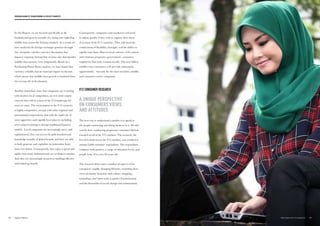
If you want to catch a glimpse of the global economic future, then meet Fahima
Sarkar. In many ways, Fahima – who lives in Lahore, Pakistan – is typical of
her group of friends, and a growing number of women across South Asia. After
attending college, Fahima worked in sales for a Karachi-based garment company
that was rapidly expanding their business in the region. She eventually left the
role because she wanted to start a family.
Fahima is a lot different than her own mother – both in her outlook and her
lifestyle. Rather than being solely a stay at home mom, Fahima has used her time
raising her child to develop a new career as an “Instapreneur,” someone who uses
social media to start her own business. Her online venture (headquartered on her
kitchen table): selling high-end picture frames via the Web to parents who want an
upscale way to display their children’s photos at home. That was her first taste of
entrepreneurship – and she turned a profit almost immediately.
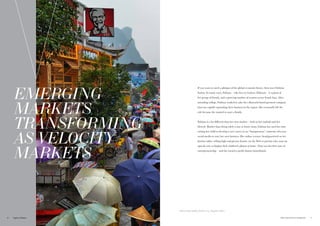
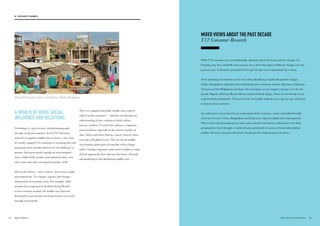
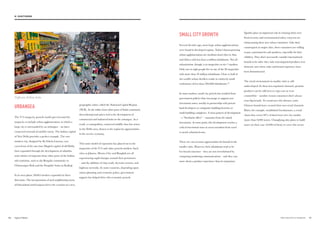
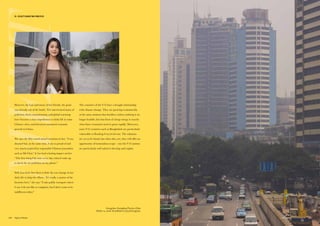
National Day holiday, October 2015, Yangshuo, China
7THE VELOCITY 12 MARKETS6
Now she is on to her next, more ambitious endeavor –
an ecommerce start-up that will use local ingredients
to create Halal (Muslim-sanctioned) beauty products.
Fahima is convinced that this will strike a chord with
her friends and other female shoppers in the growing
urban areas of Pakistan.
Fahima uses her extra income in a variety of ways.
She splurges on cosmetics and home décor products,
but also she sends her ten year-old to special tutoring
sessions. And with her social media skills, Fahima has
become an increasingly active participant in online
conversations and activist campaigns concerning
Muslim traditions and their role in a modern world;
women’s health; evolution of Pakistani politics;
and globalization.
Fahima never imagined that she would have such a
full life as she does today – nor that her voice would be
heard as it is today. But in fact Fahima is one of many,
a perfect paradigm for a much larger trend that is
What will the next billion
middle-class look like?
reshaping global growth in extraordinary ways
in multiple regions around the world: the rapid
expansion in global trade, technology transfers and
urbanization combined with favorable demographics
has given rise to 2 billion new middle-class consumers
like Fahima – predominantly outside the United States
and Europe. More importantly, a billion additional
consumers will join her and the rest of the middle class
over the next decade that are even more digitally
connected and vocal than the other global middle-class
consumers than the prior new middle class.
THE IMPLICATIONS
OF THIS TREND ARE
ENORMOUS.
The Pakistani story is compelling and gaining a lot of
attention from global economists – who view this type
of growth as the next chapter of global growth – as well
as multinationals and marketers seeking to expand their
revenue stream.
The implications of this trend are enormous and will
ultimately affect economic, political, social and cultural
maturation in big and small countries across the globe.
As the middle class moves from a minority to the
majority in individual countries, it will play not only
a fundamental economic role, but be a change agent.
Middle-class individuals will be influencers of government
policy, arbiters of local lifestyles, and empowered
consumers in brand attraction and interaction.
Out of the significance of this shift in economic strata
and the insight it provides about which countries will
thrive as the most vital markets in the not too distant
future, Ogilvy produced a new benchmark for
categorizing countries, the Velocity 12 (or V12).
This comprehensive list ranks the fastest growing
middle-class markets, a group that comprises more
than half of the world’s population.
The rapid expansion in global trade,
technology transfers and urbanization
combined with favorable demographics
has given rise to 2 billion new
middle-class consumers.
Our impetus for the Velocity 12 is the critical need for a
fresh view of economic development around the world,
one that looks at the speed as well as the size of growth;
sees a vastly expanding middle class managing volatility
by the sheer force of its demands; is resistant or resilient
to currency fluctuation; and offers a consumer marketing
perspective to complement economist and banking
studies. Our purpose is to go beyond indices that focus
only on the largest growth markets – and to instead also
recognize smaller and mid-size velocity markets that are
transforming radically and will be the next to gain
influence as key markets for global brands.
98 THE VELOCITY 12 MARKETS
EMERGING MARKETS TRANSFORMING AS VELOCITY MARKETS
INDIA
431
828
63
122
PAKISTAN
INDONESIA
139
189
758
945
CHINA
22
59
+
37
+
13 +
50
+
21
+
397
+
59
+
25
+
28
+
19
+
13
BANGLADESH
56
81
EGYPT
43
25
PHILIPPINES
33
61
140
159
BRAZIL
93
106
199 85 1,281 53.4 251
13
26
MYANMAR
1011,364157190
NIGERIA
180
MEXICO
121
30
49
VIETNAM
91
+
187
+
19
Source: Bhalla, Surjit S: Second Among Equals – The Middle Class
Kingdoms of India and China; 2007; revised and data updated till 2025.
2015
2025
NET GAIN (MILLIONS)
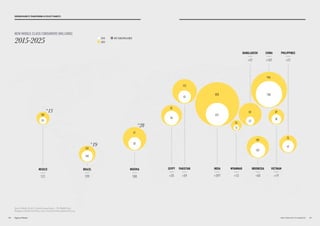
NEW MIDDLE-CLASS CONSUMERS (MILLIONS)
2015-2025
INDIA
431
828
63
122
INDONESIA
139
189
758
945
CHINA
22
59
BANGLADESH
56
81
EGYPT
43
25
PHILIPPINES
33
61
140
159
BRAZIL
93
106
+19 +25 +397 +13 +50
13
26
MYANMAR
+21+187+37
PAKISTAN
+59
NIGERIA
+28
MEXICO
+13
30
49
VIETNAM
+19
11THE VELOCITY 12 MARKETS10
EMERGING MARKETS TRANSFORMING AS VELOCITY MARKETS
WHAT WE FOUND
Ogilvy’s Velocity 12 is eye-opening for a variety of reasons. Among them is the southward
gravitational pull of future growth: the Velocity 12 forms a wide arc across the high growth
markets of Southeast Asia, Africa and parts of Latin America. And equally meaningful is the
social tapestry of the countries in the V12. Complex and varied, Velocity 12 countries contain
greater ethnic, linguistic, cultural and religious diversity than previous generations of middle-
class consumers in the West.
Our research did not solely rely on quantified data. Rather, we conducted a first of its kind
survey of middle-class attitudes across the V12. Based on the many responses to our questions,
a compelling portrait of the next billion middle class – how it will look and behave – emerges.
Over the next decade, this expanding middle-class group will:
	Be increasingly defined by women and youth as the change agents, with purchasing power
crossing cultural, religious and demographic divides.
	Comprise the largest block of newly connected consumers on the internet, globally
connected as never before – with global connectivity that is projected to double in the next
five years.
	Rapidly increase its social engagement, and brands discussion, as marketers compete in
the digital marketplace for greater share of the new middle-class prize.
	Urbanize faster than other parts of the world, dominating the future list of megacities,
while creating a new “urbangea” that connects large swathes of these countries into a
virtual trading zone.
	Propel cities, more than countries, to become the unit of invention, entrepreneurship
and investment.
A DIFFERENTIATED POINT
OF VIEW
This Ogilvy Report from the V12 is intended as a guide
for CEOs seeking new and stable growth markets along
the next trajectory of consumer concentration. It provides
business leaders and influencers with a point of view that
comes directly from the field and highlights four drivers
of growth and opportunity in the V12: gender, culture,
urbanization and technology.
We also present concrete marketing strategies and
programs, with best practice client examples that can
be adapted and leveraged. Throughout, the Report is
grounded in both quantitative research and the results
of a first, middle class attitude survey across the V12.
More than an economic outlook, the Report takes into
account a range of V12 social, cultural, technological
and lifestyle trends that companies planning to do
business in V12 countries must know, both to seize the
prize for their brands and figure out how to capture it.
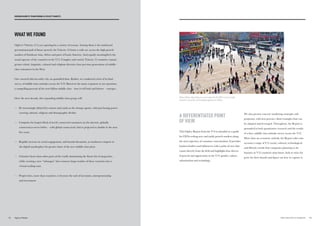
Xian, China: According to a 2012 report by the EIU, it was recently
named as one of the 13 emerging megacities in China.
1312 THE VELOCITY 12 MARKETS
EMERGING MARKETS TRANSFORMING AS VELOCITY MARKETS
EMERGING MARKETS: A TERM
PAST ITS SHELF LIFE
In compiling the V12 rankings, we were forced to
challenge certain outdated categorizations of global
economic development. For one, the idea of “emerging
markets.” Given current conditions, the term “emerging”
is too gradualist and even colonial. When we look at
global trade from a macroeconomic point of view, the
changes are staggering. “Emerging markets” accounted
for only 10% of global trade in 1970; today they hold a
30% share, a number that is expected to grow to over
40% by 2050. In addition, many of the V12 – China,
India, Brazil, Mexico, and Indonesia among them –
have long since emerged to become significant forces
in the world economy.
the problem of excluding smaller markets from global
growth rankings. While Brazil walked down the yellow
BRIC’s road, Mexico did not, in spite of the fact that it
developed G20 status, saw exponential expansion of its
educated, consumer middle class, and exceeded forecasts
for foreign direct investment (FDI); and all of this in a
challenged political environment.
Intense economic growth has been a
driving force throughout the V12.
Intense economic growth has been a driving force
throughout the V12. Many of these countries have seen
doubling (or in some cases tripling) of exports during
the last decade. India’s export numbers have grown by
614% and China’s by 590% between 2001 and 2011.
And this is no longer a strictly West-East phenomenon:
today, intra-Asia trade is already at the same level as
the combined levels of trade Asia conducts with North
America and Europe. Additionally, there has been a
surge in trade between the Asia Pacific (APAC) countries
and Africa (up 576%) and with Latin America (up 429%).
Viewed from the flipside, Latin America has logged an
800% rise in trade with Asia.
Velocity Defined
Throughout this report, we refer
to “velocity”. We use this term
in a broad sense, to signify more
than just economic growth (though
the expansion of middle-income
consumers is the basis of it). “Velocity”
also refers to the pace at which daily
life, social structures, and public
sentiment amongst the next billion
middle-class consumers in the Velocity
12 markets will continue to accelerate
in the decade ahead. This social
velocity will increasingly have its own
swift pace as middle-class lifestyles
grow out of middle-class incomes.
The term “emerging” is also inadequate to describe the
speed at which these markets are moving, and the limited
timeframe that marketers have to stake out advantageous
positions. Indonesia, for example, which has a trillion
dollar plus economy as well as consumer spending at 61%
of GDP, approaches the levels of “developed” economies.
In fact, using a Purchase Power Parity (PPP) measure,
which reconciles currency differences to accurately
compare national economies, V12 countries include
nearly half of the world’s top GDPs.
The so-called BRIC index is also no longer useful or
satisfactory. The four countries in this group – Brazil,
Russia, India, and China – have evolved in dramatically
different directions. Russia has been mired in recession,
while Brazil is beset by government corruption and
inflation. Meanwhile India’s economic development has
kept pace and China’s has slowed compared to its recent
growth rates. The fraying of the BRIC index exposes
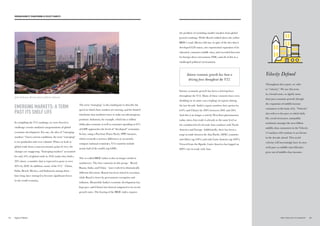
Jalan Sudirman, Business district, Jakarta, Indonesia.
1514 THE VELOCITY 12 MARKETS
EMERGING MARKETS TRANSFORMING AS VELOCITY MARKETS
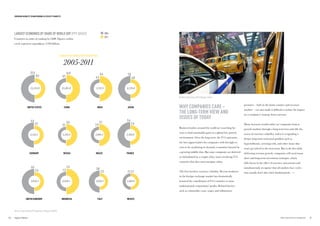
Source: International Comparison Program (ICP).
LARGEST ECONOMIES BY SHARE OF WORLD GDP (PPP-BASED)
Countries in order of ranking by GDP. Figures within
circle represent expenditure (US$ billion).
SHARE OF THE WORLD GDP (WORLD-100)
2005-2011
2005
2011
UNITED STATES
15,533.8
3,352.1
2,056.7
13,495.9
3,216.9
2,058.1
5,757.5
2,816.3
2,056.7
4,379.8
2,369.6
1,894.6
CHINA INDIA JAPAN
GERMANY RUSSIA BRAZIL FRANCE
UNITED KINGDOM INDONESIA ITALY MEXICO
22.5
4.6
3.5
1.3 3.0
2.1
3.1 2.9
3.4
14.9 6.4
4.8
17.1
3.7
2.4
2.3
2.3 2.1
3.5 3.1 2.6
9.7 4.3
7.0
WHY COMPANIES CARE –
THE LONG-TERM VIEW AND
ISSUES OF TODAY
Business leaders around the world are searching for
ways to find sustainable gains in a global low growth
environment. Over the long term, the V12 represents
the best opportunities for companies with foresight to
turn to for marketing in dynamic economies buoyed by
a growing middle class. But some companies are deterred
or intimidated by a couple of key issues involving V12
countries that they must navigate today.
The first involves currency volatility. Recent weakness
in the foreign exchange market has dramatically
lessened the contribution of V12 countries to some
multinational corporations’ profits. Related factors,
such as commodity costs, wages and inflationary
pressures – both in the home country and overseas
markets – can also make it difficult to isolate the impact
on a company’s strategy from currency.
Many investors would rather see companies look at
growth markets through a long-term lens and ride the
waves of currency volatility, unless it is signaling a
deeper long term structural problem such as
hyperinflation, sovereign risk, and other issues that
won’t get solved in the near-term. But to do this while
delivering revenue growth, companies will need smart
short and long-term investment strategies, which
fully factor in the effect of currency movements and
simultaneously recognize that all markets face cycles
that usually don’t alter their fundamentals.
Kolkata (Calcutta), West Bengal, India.
1716 THE VELOCITY 12 MARKETS
EMERGING MARKETS TRANSFORMING AS VELOCITY MARKETS
In this Report, we are focused specifically at the
fundamental growth variable of a rising and exploding
middle class across the Velocity markets. As a result, we
have analyzed the foreign exchange question through
this viewpoint: whether currency fluctuation that
impacts corporate bottom-line revenue also downgrades
middle-class income, even temporarily. Based on a
Purchasing Power Parity analysis, we have found that
currency volatility has no material impact on income,
which means that middle-class growth is insulated from
the revenue hit of devaluation.
Another immediate issue that companies are wrestling
with involves local competition, an ever more urgent
concern that will be a facet of the V12 landscape for
years to come. The environment in the V12 countries
is highly competitive, not just with other regional and
international corporations, but with the rapid rise of
more aggressive and capable local players, including
new e-players aiming to disrupt traditional business
models.  Local companies are increasingly savvy and
sophisticated, they can access the gold standard and
knowledge transfer of global brands, and they are able
to both generate and capitalize on innovation faster
than ever before. Consequently, they enjoy a speed and
agility that many multinationals are seeking to emulate.
And they are increasingly focused on building effective
and enduring brands.
Consequently, companies and marketers will need
to adjust quickly if they wish to capture their share
of revenue from V12 countries. They will need the
combination of flexibility, foresight, and the ability to
rapidly tune their efforts to local cultures, with content
and relations programs (government, consumer,
employees) that truly resonate locally. The next billion
middle-class consumers will provide substantial
opportunities – but only for the most inventive, nimble,
and consumer-centric companies.
V12 CONSUMER RESEARCH
A UNIQUE PERSPECTIVE
ON CONSUMERS VIEWS
AND ATTITUDES
The best way to understand a market is to speak to
the people consuming and doing business in it. We did
exactly that, conducting proprietary consumer lifestyle
research in all of the V12 markets. The research, the
first of its kind across the V12 markets, was conducted
among 3,600 consumer respondents. The respondents
comprise both genders, a range of education levels, and
people from 18 to over 60 years old.
The research delves into a number of aspects of the
consumers’ rapidly changing lifestyles, including their
views on family dynamics and culture, shopping,
technology, and issues such as gender discrimination
and the downsides of social change and urbanization.
19THE VELOCITY 12 MARKETS18
EMERGING MARKETS TRANSFORMING AS VELOCITY MARKETS
THE VELOCITY
12 MARKETS
01
APPRECIATING THE VELOCITY
OF CHANGE
The term velocity describes both the rate of real change in the size of the middle
class as well as a priority for companies as they consider business investment and
marketing in V12 countries. In many of the V12 nations, marketing involves
leapfrogging traditional forms: sophisticated mobile and social media solutions
have become vital to reaching consumers. Companies will need to recalibrate to
the new reality of growing global middle-class demands. Most of all, companies
will need a deep understanding of this multi-polar, multi-channel world in order
to compete effectively – and to avoid being left behind by the velocity of change.
21THE VELOCITY 12 MARKETS20
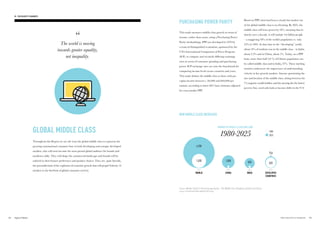
NUMBER OF MIDDLE-CLASS (MILLION)
1980-2025
DEVELOPED
COUNTRIES
WORLDWORLD
1,000
600
750
1,000 500
4,900
CHINA INDIA
Source: Bhalla, Surjit S: Second Among Equals – The Middle Class Kingdoms of India and China;
2007; revised and data updated till 2025.
NEW MIDDLE CLASS INCREASES
1980
2025
GLOBAL MIDDLE CLASS
Throughout this Report we use the term the global middle class to represent the
growing transnational consumer base in both developing and younger developed
markets, who will soon become the most pivotal global audience for brands and
marketers alike. They will shape the commercial landscape and brands will be
tailored to their feature preferences and product choices. They are, quite literally,
the personification of the explosion of economic growth that will propel Velocity 12
markets to the forefront of global consumer activity.
Based on PPP, what had been a steady but modest rise
of the global middle class is accelerating. By 2025, the
middle class will have grown by 35%, meaning that in
shortly over a decade, it will include 4.6 billion people
– a staggering 58% of the world’s population vs. only
25% in 1995. At that time in the “developing” world,
about 14% of residents was in the middle class – in India,
about 3.5% and in China, about 1%. Today, on a PPP
basis, more than half (54 %) of China’s population can
be called middle class and in India, 27%. These startling
statistics underscore the importance of understanding
velocity in key growth markets. Anyone questioning the
size and location of the middle class, sitting between the
1% majority wealth holders and the moving (for the better)
poverty line, need only look at income shifts in the V12.
PURCHASING POWER PARITY
This study measures middle-class growth in terms of
income, rather than assets, using a Purchasing Power
Parity methodology. PPP was developed in 1970 by
a team of distinguished economists, sponsored by the
UN’s International Comparison of Prices Program
(ICP), to compare and reconcile differing exchange
rates in terms of consumer spending and purchasing
power. ICP exchange rates are now the benchmark for
comparing income levels across countries and years.
This study defines the middle class as those with per
capita income between c. $4,000 and $40,000 per
annum, according to latest 2011 base estimates adjusted
for cross-market PPP.
The world is moving
towards greater equality,
not inequality.
2322 THE VELOCITY 12 MARKETS
01. THE VELOCITY 12 MARKETS
66 | 9
MIDDLE CLASS
758 | 945
EMERGING MIDDLE CLASS
106 | 109
MIDDLE CLASS
30 | 49
POOR
9 | 4
EMERGING MIDDLE CLASS
421 | 307
RICH
14 | 35
POOR
171 | 103
EMERGING MIDDLE CLASS
123 | 98
MIDDLE CLASS
22 | 59
POOR
29 | 5
RICH
0 | 1
EMERGING MIDDLE CLASS
47 | 48
RICH
6 | 13
EMERGING MIDDLE CLASS
53 | 45
EMERGING MIDDLE CLASS
37 | 37
POOR
0 | 1
RICH
3 | 0
MIDDLE CLASS
63 | 122
MIDDLE CLASS
13 | 26
RICH
0 | 0
POOR
12 | 4
MIDDLE CLASS
43 | 64
POOR
10 | 4
RICH
1 | 1
EMERGING MIDDLE CLASS
777 | 580
56 | 81
MIDDLE CLASS
MIDDLE CLASS
139 | 189
POOR
3 | 0
RICH
2 | 5
EMERGING MIDDLE CLASS
27 | 15
POOR
1 | 0
RICH
1 | 1
MIDDLE CLASS
431 | 828
RICH
6 | 13
POOR
EMERGING MIDDLE CLASS
21 | 16
RICH
4 | 8
POOR
3 | 3
RICH
0 | 1
POOR
62 | 61
MIDDLE CLASS
33 | 61
EMERGING MIDDLE CLASS
106 | 77
MIDDLE CLASS
93 | 106
EMERCING MIDDLE CLASS
85 | 107
2015
85 97
2025
EGYPT
2015
1,281 1,429
2025
INDIA
190 221
PAKISTAN
2015 2025
2015
53 57
2025
MYANMAR 2015
1,364 1,389
2025
CHINA
2015
91 98
2025
VIETNAM
2015
157 174
2025
BANGLADESH
2015
101 117
2025
PHILIPPINES
INDONESIA
2015
251 270
2025
2015
121 132
2025
MEXICO
2015
180 230
2025
NIGERIA
MIDDLE CLASS
140 | 159
RICH
6 | 11
POOR
7 | 5
EMERGING MIDDLE CLASS
45 | 36
2015
199 212
2025
BRAZIL
66 | 9
MIDDLE CLASS
758 | 945
EMERGING MIDDLE CLASS
106 | 109
MIDDLE CLASS
30 | 49
POOR
9 | 4
EMERGING MIDDLE CLASS
421 | 307
RICH
14 | 35
POOR
171 | 103
EMERGING MIDDLE CLASS
123 | 98
MIDDLE CLASS
22 | 59
POOR
29 | 5
RICH
0 | 1
EMERGING MIDDLE CLASS
47 | 48
RICH
6 | 13
EMERGING MIDDLE CLASS
53 | 45
EMERGING MIDDLE CLASS
37 | 37
POOR
0 | 1
RICH
3 | 0
MIDDLE CLASS
63 | 122
MIDDLE CLASS
13 | 26
RICH
0 | 0
POOR
12 | 4
MIDDLE CLASS
43 | 64
POOR
10 | 4
RICH
1 | 1
EMERGING MIDDLE CLASS
777 | 580
56 | 81
MIDDLE CLASS
MIDDLE CLASS
139 | 189
POOR
3 | 0
RICH
2 | 5
EMERGING MIDDLE CLASS
27 | 15
POOR
1 | 0
RICH
1 | 1
MIDDLE CLASS
431 | 828
RICH
6 | 13
POOR
EMERGING MIDDLE CLASS
21 | 16
RICH
4 | 8
POOR
3 | 3
RICH
0 | 1
POOR
62 | 61
MIDDLE CLASS
33 | 61
EMERGING MIDDLE CLASS
106 | 77
MIDDLE CLASS
93 | 106
EMERCING MIDDLE CLASS
85 | 107
2015
85 97
2025
EGYPT
2015
1,281 1,429
2025
INDIA
190 221
PAKISTAN
2015 2025
2015
53 57
2025
MYANMAR 2015
1,364 1,389
2025
CHINA
2015
91 98
2025
VIETNAM
2015
157 174
2025
BANGLADESH
2015
101 117
2025
PHILIPPINES
INDONESIA
2015
251 270
2025
2015
121 132
2025
MEXICO
2015
180 230
2025
NIGERIA
MIDDLE CLASS
140 | 159
RICH
6 | 11
POOR
7 | 5
EMERGING MIDDLE CLASS
45 | 36
2015
199 212
2025
BRAZIL
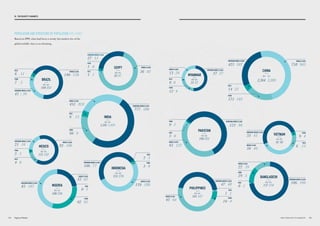
POPULATION AND STRUCTURE OF POPULATION (MILLIONS)
Based on PPP, what had been a steady but modest rise of the
global middle class is accelerating.
2524 THE VELOCITY 12 MARKETS
01. THE VELOCITY 12 MARKETS
IDENTIFYING THE VELOCITY 12
In order to identify the most promising growth markets,
we examined markets using two primary indicators:
first, a country’s share of middle-class consumption in
the world; and second, the projected rate of growth (or
velocity) of this consumption, adjusted for PPP. The
velocity of growth and change is a noteworthy factor
that many companies have grossly underestimated so
far in their global growth plans. Using these two
indicators – size and growth of middle-class spending
– we analyzed 27 markets, all with an ample middle-
class; from these, we derived the V12 markets which
account for 73% of the world’s middle class.
One way of looking at the Velocity 12 is as a futurist
index with significant bottom-line impact.
But it’s also critical to look beyond the purely financial
aspects of velocity. As noted global investor Ray Dalio
of Bridgewater Associates wrote in a paper about why
countries succeed and fail economically, the two most
vital forces in the shifts of relative income and power
are war and the psychology that drives people’s desires
to work, borrow, and consume.1
In this regard, consumer
self-perception and confidence about the positive impact
of change is a key factor generating market velocity.
Middle-class growth is not a guaranteed one-way street
or an absolute. Newly minted middle-class consumers
can see their fortunes fall back in times of downturn.
Thus confidence is critical, since middle classes are
often defined by expectations of a better future.
While various markets (such as Iran, Turkey, Iraq,
South Africa, Ghana, Angola and others) will also enjoy
an increase in middle-class consumers, they do not
qualify as V12 markets in terms of size, scale, and
velocity of change. While these other markets haven’t
made the list, we recognize that they will contribute
growth in the future. Our focus here, though, is on
markets that will contribute most to the continued
reshaping of the global middle class in the next decade.
Which markets expect positive change
in the next decade?
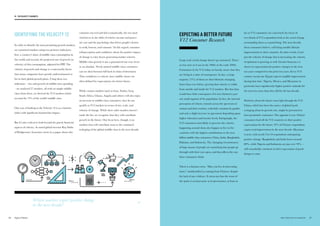
EXPECTING A BETTER FUTURE
V12 Consumer Research
Large scale social change doesn’t go unnoticed. That’s
as true now as it was in the 1960s or the early 1900s.
Consumers in the V12 today are keenly aware that they
are living in a time of consequence. In fact, a large
majority (77%) of them see their lifestyles changing
faster than ever before, proving that velocity is visible
from outside and inside the V12 markets. But that data
would have little consequence if it were limited to just
one small segment of the population. In fact, the internal
perception of velocity extends across the spectrum of
nations and their societies, with little variation by gender,
and only a slight increase in agreement depending upon
higher education and income levels. Intriguingly, the
V12 consumers most likely to perceive the velocity
happening around them also happen to live in the
countries with the highest contributions to the next
billion middle-class consumers: China, India, Bangladesh,
Pakistan, and Indonesia. The changing circumstances
of huge masses of people are something that people go
through with their eyes open, and that affects the way
these consumers think.
There is a famous curse, “May you live in interesting
times,” misidentified as coming from Chinese, despite
the lack of any evidence. It turns out that the tenor of
the quote is as inaccurate as its provenance, at least as
far as V12 consumers are concerned. In excess of
two-thirds of V12 respondents look at the social change
surrounding them as a good thing. The next decade,
these consumers believe, will bring notable lifestyle
improvements to their countries. In other words, it isn’t
just the velocity of change that is increasing; the velocity
of optimism is growing as well. Greater buoyancy is
shown in expectations for positive changes in the next
ten years compared to the prior ten years. Every V12
country except one (Egypt) expects tangible improvement
during that time. Nigeria, Mexico, and Myanmar in
particular have significantly higher positive outlooks for
the next ten years than they did for the last decade.
Positivity about the future runs right through the V12.
China, which has been the source of global hand-
wringing about its growth rate, might be presumed to
have pessimistic consumers. The opposite is true. China’s
consumers lead all the V12 countries in their positive
expectations for the future. 91% of Chinese respondents
expect real improvement in the next decade. Myanmar
is next, with nearly 9 in 10 respondents anticipating
positive change. Bangladesh and India hover around
80%, while Nigeria and Indonesia are just over 70%—
still remarkably consistent in their expectation of good
things to come.
2726 THE VELOCITY 12 MARKETS
01. THE VELOCITY 12 MARKETS
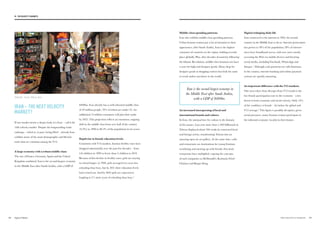
IRAN – THE NEXT VELOCITY
MARKET?
If one market merits a deeper look, it is Iran – call it the
13th velocity market. Despite the longstanding trade
embargo – which is, in part, being lifted – already Iran
exhibits many of the main demographic and lifestyle
traits that are common among the V12:
A large economy with a robust middle class.
The size of France, Germany, Spain and the United
Kingdom combined, Iran is the second-largest economy
in the Middle East after Saudi Arabia, with a GDP of
Middle-class spending patterns.
Iran also exhibits middle-class spending patterns.
Urban Iranian women pay a lot of attention to their
appearance; after Saudi Arabia, Iran is the highest
consumer of cosmetics in the region, holding seventh
place globally. Plus, after decades of austerity following
the Islamic Revolution, middle-class Iranians too have
a taste for high-end designer goods. Many shop for
designer goods at shopping centers that look the same
as retail outlets anywhere in the world.
Iran is the second-largest economy in
the Middle East after Saudi Arabia,
with a GDP of $400bn.
An increased interspersing of local and
international brands and culture.
In Iran, the national love for culture is the domain
of the masses. Last year more than 1,500 billboards in
Tehran displayed about 700 works by renowned local
and foreign artists, transforming Tehran into an
amazing open air art gallery. At the same time, cafés
and restaurants are destinations for young Iranians
socializing and meeting up with friends. Fast food
restaurants have multiplied, copying the concepts
of such companies as McDonald’s, Kentucky Fried
Chicken and Burger King.
Digital reshaping daily life.
Iran connected to the internet in 1993, the second
country in the Middle East to do so. Internet penetration
has grown to 58% of the population; 28% of internet
users have broadband access, with new users mostly
accessing the Web via mobile devices and favoring
social media, including Facebook, WhatsApp and
Integra.3
Although cash payments are still dominant
in the country, internet banking and online payment
systems are quickly maturing.
An important difference with the V12 markets.
One area where Iran diverges from V12 trends is the
low female participation rate in the economy – a key
factor in both economic and social velocity. Only 13%
of the workforce is female – far below the global and
V12 average.4
This figure is possibly deceptive; given
social pressures, many Iranian women participate in
the informal economy via jobs in their homes.
$400bn. Iran already has a well-educated middle class
of 59 million people, 70% of whom are under 35. An
additional 13 million consumers will join their ranks
by 2025. This projection reflects an enormous, ongoing
shift in the middle class from over half of the country
(51.9%) in 1990 to 86.3% of the population in ten years.
Rapid rise in female education levels.
Consistent with V12 markets, Iranian fertility rates have
dropped substantially over the past few decades – from
4.8 children in 1990 to fewer than 2 children in 2013.
Because of this decline in fertility rates, girls are staying
in school longer: in 1990, girls averaged two years less
schooling than boys, but by 2011 their education levels
had evened out. And by 2025 girls are expected to
leapfrog to 2.7 more years of schooling than boys.2
Daily life – bazaar, Tehran, Iran.
2928 THE VELOCITY 12 MARKETS
01. THE VELOCITY 12 MARKETS
AFRICA – LEAPFROGGING INTO THE MIDDLE CLASS
CENTER OF GRAVITY SHIFTS
TO SOUTH ASIA
The center of gravity in world production and growth is moving from the high
productivity and low population base of Western Europe and North America,
to the high population and lower productivity base of Asia (except for Japan).
For the last two decades, economic growth in Asia has been propelled by China.
In the next two decades, China’s economy will likely slow down. But India, the
other population giant, will probably take up the slack. With eight of the V12
markets, Asia won’t just be an emerging player in the next decade – it will be
the dominant one.
For the last two decades,
economic growth in Asia has been
propelled by China.
964
2015
1,213
2025
POOR
58
RICH
0.1
POOR
48.6
RICH
0.3
EMERGING MIDDLE CLASS
33.3
MIDDLE CLASS
8.5
EMERGING MIDDLE CLASS
39.5
MIDDLE CLASS
11.7
Source: World Bank, IMF, Oxus-Research Database.
ASIA
DEVELOPED COUNTRIES
OTHERS
1950
2010
1980
2020
2000
33.9
28.0
37.8
26.7
26.7
27.5
8.9
57.3
52.2
52.4
10.0
20.9
2025
TOTAL
100%
TOTAL
100%
TOTAL
100%
TOTAL
100%
TOTAL
100%
TOTAL
100%
30.2
41.9 35.8 34.5
37.5 38.0
SHARE OF OUTPUT BY REGION (%)
3130 THE VELOCITY 12 MARKETS
01. THE VELOCITY 12 MARKETS
MORE EQUALITY, BUT
WITH DIFFERENCES
Today, much discussion centers on rising wage inequality
and stagnation for middle-income workers as well as
wealth inequity with 1% of the population owning the
lion’s share of global assets. Clearly, by these measures,
the world is not equal. And campaigns focused on
eliminating poverty and balancing wages and wealth
must be pursued.
The growth of the middle class
is a reflection of the world becoming
more equal. (Dr. Bhalla)
Yet when viewed from the perspective of the middle
class’ portion of the 99% majority population, and
measured by income distribution rather than wealth,
the world is more equal than ever before (WIDER,
Luxembourg Income Study Database). Driven by higher
than average income growth in the two most populous
countries of the world, China and India, inequality is
giving way to equality. In the rich, “developed” world
– population of about 900 million people – income has
grown at the rate of 1.6% for the last 35 years; but in
China and India, with nearly 3 billion residents combined
(and with per capita incomes less than one-tenth of the
West in 1980), wages have grown at an average rate
about 6.3% – four times that of the West.
As reported in a recent Washington Post feature, there
has been “a vast reduction in poverty and income
inequality worldwide over the past quarter-century.”
Specifically, the world’s Gini coefficient — the most
commonly used measure of income distribution — has
fallen from 0.69 in 1988 to 0.63 in 2011. A higher Gini
coefficient connotes greater inequality, up to a maximum
of 1.0. That may seem modest until you consider that
the estimate’s author, former World Bank economist
Branko Milanovic, thinks we may be witnessing the first
period of declining global inequality since the Industrial
Revolution. (Source: Dr. Bhalla)
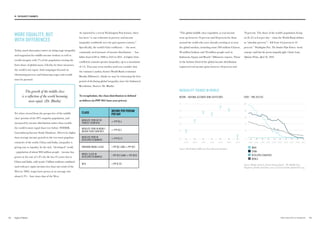
To recapitulate, the class distribution is defined
as follows (in PPP 2011 base year prices):
CLASS
INCOME PER PERSON
PER DAY
ABSOLUTE POOR IN THE
POOREST COUNTRIES
= PPP $1.6
ABSOLUTE POOR IN MIDDLE-
INCOME POOR COUNTRIES
= PPP $3.2
ABSOLUTE POOR IN
DEVELOPED ECONOMIES
= PPP $ 2.0
EMERGING MIDDLE CLASS  PPP $3.2 AND = PPP $12
MIDDLE CLASS IN
DEVELOPED ECONOMIES
 PPP $12.0 AND = PPP $120
RICH  PPP $ 120
“The global middle class expanded, as real income
went up between 70 percent and 80 percent for those
around the world who were already earning at or near
the global median, including some 200 million Chinese,
90 million Indians and 30 million people each in
Indonesia, Egypt and Brazil,” Milanovic reports. Those
in the bottom third of the global income distribution
registered real income gains between 40 percent and
Source: Bhalla, Surjit S: Second Among Equals – The Middle Class
Kingdoms of India and China; 2007; revised and data updated till 2025.
INDIA
CHINA
DEVELOPED COUNTRIES
WORLD
1980 1985 1990 1995 2000 2005 2010 2015 2020 2025
POOR – 1980-2025 (%)
0
20
40
60
80
100
1850 1880 1910 1940 1970 2000 2030
INEQUALITY TRENDS IN WORLD
INCOME – NATIONAL ACCOUNTS (GINI COEFFICIENT)
62
64
66
68
70
72
Source: World Bank, IMF, tone Oxus Research Database.
70 percent. The share of the world’s population living
on $1.25 or less per day—what the World Bank defines
as “absolute poverty”—fell from 44 percent to 23
percent.” Washington Post, The Sanders-Pope Francis ‘moral
economy’ could hurt the income inequality fight. Charles Lane,
Opinion Writer, April 16, 2016.
3332 THE VELOCITY 12 MARKETS
01. THE VELOCITY 12 MARKETS
Intra-V12 trade will be a central factor in creating
economic velocity in the coming decade, and driving
more global economic equality. While V12 trade with
the OECD will remain significant, it will be the increased
trade among these markets that will create a variety
of new opportunities, both on a macro level and for
individual small businesses. And at the center of this
trade bonanza is China, and its One Belt, One Road
policy that is spurring new economic relations with a
variety of countries around world. Already, China is the
largest trading partner for important V12 markets such
as Brazil and India.
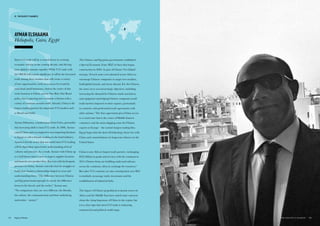
Ayman Elshaama, a businessman from Cairo, personifies
this increasing shift to intra-V12 trade. In 2006, Ayman
visited China and was inspired to start importing furniture
to Egypt to sell to friends working in the hotel industry.
Ayman is keenly aware that successful intra-V12 trading
will be dependent upon better understanding of local
cultures and practice. As a result, Ayman visits China up
to a half dozen times a year to inspect supplier factories
and hunt for new product lines. But even with his frequent
presence in China, Ayman concedes that he struggles to
build close business relationships forged on trust and
understanding there. “The difference between Chinese
and Egyptian businesspeople is exactly the difference
between the bicycle and the rocket,” Ayman says.
“No comparison: they are very different, the lifestyle,
the culture, the communication and their underlying
motivation – money.”
The Chinese and Egyptian governments established
a Special Economic Zone (SEZ) in Suez that began
construction in 2009. As part of China’s ‘Go Global’
strategy, 50 such zones were planned across Africa to
encourage Chinese companies to target new markets,
build global brands, and invest abroad. For the Chinese,
the zones serve several strategic objectives, including
increasing the demand for Chinese-made machinery
and equipment and helping Chinese companies avoid
trade barriers imposed on their exports, particularly
in countries with preferential trade agreements with
other nations.5
The Suez agreement gives China access
to a canal zone that is the center of Middle Eastern
commerce and the main shipping route for Chinese
exports to Europe – the nation’s largest trading bloc.
Egypt hopes that the deal will help forge closer ties with
China and counterbalance its long-term reliance on the
United States.
China is now Africa’s largest trade partner, exchanging
$222 billion in goods and services with the continent in
2015. Chinese firms are building roads and railways
across the continent, often in exchange for resources.6
But other V12 countries are also creating their own SEZ
to similarly encourage trade, investment and the
establishment of industrial hubs.
The impact of China’s geopolitical-economic moves in
Africa and the Middle East have raised some concerns
about the rising hegemony of China in the region, but
it is a clear sign that intra-V12 trade is redrawing
commercial and political world maps.
AYMAN ELSHAAMA
Heliopolis, Cairo, Egypt
35THE VELOCITY 12 MARKETS34
01. THE VELOCITY 12 MARKETS
Source: Barro-Lee Dataset.Note: This calculation excludes Nigeria.
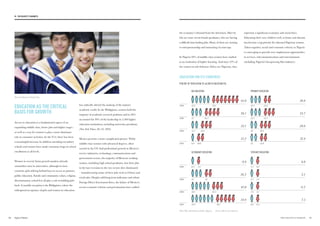
EDUCATION FOR V12 COUNTRIES
PERCENT OF POPULATION (15-64) WITH EDUCATION (%)
NO EDUCATION PRIMARY EDUCATION
61.0 29.9
38.1 33.7
22.1 28.6
15.2 22.4
52.2 34.51960
1980
2000
2010
32 32.3
15.1 28
9.9 22
70.3 23.9
44.5 35.1
29.4 29.4
20.6 22.8
SECONDARY EDUCATION TERTIARY EDUCATION
8.9 0.8
26.2 2.1
43.0 6.3
54.9 7.5
12.1 1.21960
1980
2000
2010
33 2.7
49.1 7.8
59.5 8.6
5.4 0.4
19 1.4
36.5 4.7
50.1 6.4
EDUCATION AS THE CRITICAL
BASIS FOR GROWTH
Access to education is a fundamental aspect of an
expanding middle class, better jobs and higher wages –
as well as a way for women to play a more dominant
role in consumer activities. In the V12, there has been
a meaningful increase in children attending secondary
schools and women have made enormous leaps in school
enrollment at all levels.
Women in several Asian growth markets already
outnumber men in universities, although in most
countries girls still lag behind boys in access to primary
public education. Family and community values, religion,
discrimination, school fees all play a role in holding girls
back. A notable exception is the Philippines, where the
widespread acceptance of girls and women in education
the economy’s rebound from the downturn. Hurt by
this are more recent female graduates, who are having
a difficult time finding jobs. Many of them are turning
to entrepreneurship and innovating via start-ups.
In Nigeria 92% of middle-class women have studied
at an institution of higher learning. And since 25% of
the women in sub-Saharan Africa are Nigerian, they
represent a significant economic and social force.
Educating their own children well, at home and abroad,
has become a top priority for educated Nigerian women.
Taken together, social and economic velocity in Nigeria
is converging to provide new employment opportunities
in services, telecommunications and entertainment
(including Nigeria’s fast-growing film industry).
has radically altered the makeup of the nation’s
academic world. In the Philippines, women hold the
majority of academic research positions and in 2011
accounted for 39% of the leadership in 2,100 higher
education institutions, including university presidents.
(New York Times, Nov 25, 2012).
Mexico presents a more complicated picture. While
middle-class women with advanced degrees, often
earned in the US, find professional growth in Mexico’s
service industries, technology, communications and
government sectors, the majority of Mexican working
women, including high school graduates, lost their jobs
in the last recession in the two sectors they dominated
– manufacturing (some of these jobs went to China) and
retail sales. Despite solid long-term indicators and robust
Foreign Direct Investment flows, the failure of Mexico’s
recent economic reforms and privatization have stalled
New Graduates in South Asia.
3736 THE VELOCITY 12 MARKETS
01. THE VELOCITY 12 MARKETS
GLOBAL MIDDLE CLASS WITH
DIFFERENCES. WHAT IT MEANS
TO BRANDS.
A more equal world with more uniform income distribution
and a growing middle class does not necessitate a
homogeneous one. Technology has enabled worldwide
consumers to connect with each other and with a vast
array of content providers more than ever and
simultaneously to gain control of their relationship with
marketers. With the mass migration to cities, there has
been a loss of nuclear family and village customs – and
many people trying to hold on to the best aspects of
them more tightly as their living conditions change.
Consequently, large swathes of the global population are
more tied into the planet’s activities and more engaged
in social and global issues; yet still fiercely proud and
connected to their culture and family traditions.
The rising middle class in V12 countries is generally a
first-generation group, raised by less than affluent parents.
Coming from a relatively low-income background, this
new middle class, particularly people in their twenties
and thirties, view brands as strong social signifiers that
confer status.
Moreover, marketing to middle-class consumers
has long been focused on reflecting their growing
aspirations. However, today’s global middle class has
more brand sophistication than prior generations; they
are savvy, well-informed, clear about their aspirations
and entrepreneurial.
For example, the old notion that emerging middle-class
consumers would prioritize their spending on home
goods has been upended by greater thirst for technology,
entertainment, and social media. More consumers are
opting to make a smart phone or other device an essential
purchase, which immediately puts them on a level playing
field with other consumers around the globe, including
active social media participation and involvement in a
range of consumer debates and forums. Travel and
entertainment are also taking up more of their new
disposable income.
Foreign brands have traditionally enjoyed some degree
of cachet, particularly in luxury segments. However,
in many V12 markets more consumers prefer to buy
domestic products, assuming similar price and quality.
A McKinsey report (Understanding the Diversity of
Indonesian Consumers) noted that 60% of Indonesian
consumers chose local brands over imports and as more
of them move abroad, they want to see Indonesian
brands and products do well internationally. Baktik,
for example, has had a huge revival in Indonesia and is
incorporated into more goods, including sporting goods.
Our V12 research confirms that similar preferences for
local brands can be found across many V12 markets.
PART OF A GLOBAL SOCIETY
V12 Consumer Research
The billion-member middle class emerging in the V12 is fundamentally unlike any preceding it. Not
only is this new middle class centered in a different part of the world, it is linking into both the local
consumer culture and an international one. The velocity of this change is vividly alive to the consumers
themselves: nearly three-quarters of V12 respondents across all markets indicate that they feel more
connected with the rest of the world than ever before.
This response was echoed by a majority of respondents in each of the individual V12 markets as
well. As is the case in most of the world today, this connection is driven by digital access and the
concomitant participation in social media and the ability to surf websites in other parts of the world.
For example, respondents from Vietnam, Indonesia and the Philippines pointed to the availability of
a wide array of digital devices and channels as the reason for feeling more connected. By contrast,
Myanmar and Bangladesh could not make the same claim, having far fewer opportunities for digital
activities. Nonetheless, 80% of respondents in Myanmar said they feel more connected to the world,
among the highest percentage in the V12 – no doubt a reflection of the opening of the country after
years of isolation. And despite the great China firewall, China ranks second (81% of respondents) in
feeling more connected to the world now than before.
The lesson here is that this newly connected middle class is born worldly. Older notions of consumer
evolution no longer apply in a world that is now flat and wired.
3938 THE VELOCITY 12 MARKETS
01. THE VELOCITY 12 MARKETS
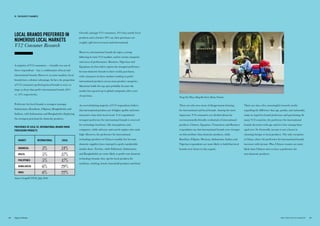
LOCAL BRANDS PREFERRED IN
NUMEROUS LOCAL MARKETS
V12 Consumer Research
A majority of V12 consumers – virtually two out of
three respondents – buy a combination of local and
international brands. However, in some markets, local
brands have a distinct advantage. In fact, the proportion
of V12 consumers preferring local brands is twice as
large as those that prefer international brands (24%
vs. 13% respectively).
Preference for local brands is strongest amongst
Indonesians, Brazilians, Filipinos, Bangladeshis and
Indians, with Indonesians and Bangladeshis displaying
the strongest penchant for domestic products.
PREFERENCE OF LOCAL VS. INTERNATIONAL BRANDS WHEN
PURCHASING PRODUCTS
MARKET INTERNATIONAL LOCAL
INDONESIA 3% 31%
BRAZIL 5% 37%
PHILIPPINES 5% 17%
BANGLADESH 6% 29%
INDIA 6% 22%
Source: GroupM TYNY, July 2014.
Overall, amongst V12 consumers, 45% buy mostly local
products and a further 39% say their purchases are
roughly split between local and international.
However, international brands do enjoy a strong
following in some V12 markets, and in certain categories
and areas of performance. Burmese, Nigerians and
Egyptians (in that order) express the strongest preference
for non-domestic brands in their weekly purchases,
with consumers in these markets tending to prefer
international products across most product categories.
Myanmar holds the top spot probably because the
market has opened up to global companies after years
of sanctions.
An overwhelming majority of V12 respondents believe
that international products are of higher quality and more
innovative than their local rivals. V12 respondents’
strongest preference for international brands is reserved
for technology hardware, like smartphones and
computers, while software and search engines also rank
high. However, the preference for international
technology products in China is notably low because
domestic suppliers have emerged to grab considerable
market share. Further, while Pakistanis, Indonesians
and Bangladeshis are more likely to prefer non-domestic
technology brands, they opt for local products for
medicine, clothing, hotels, household products and food.
There are also new areas of disagreement forming
for international and local brands. Among the more
important, V12 consumers are divided about the
environmentally-friendly credentials of international
products. Chinese, Egyptian, Vietnamese and Burmese
respondents say that international brands were stronger
on this attribute than domestic products, while
Brazilian, Filipino, Mexican, Indonesian, Indian and
Nigerian respondents are more likely to hold that local
brands were better in this regard.
There are also a few, meaningful research results
regarding the difference that age, gender, and nationality
make in regard to brand preference and purchasing. In
many V12 countries, the preference for international
brands decreases with age and/or is low among those
aged over 50. Generally, income is not a factor in
choosing foreign or local products. The only exception
is China, where the preference for international brands
increases with income. Plus, Chinese women are more
likely than Chinese men to have a preference for
non-domestic products.
Trang Tien Plaza, Hang Bai Street, Hanoi, Vietnam.
4140 THE VELOCITY 12 MARKETS
01. THE VELOCITY 12 MARKETS
THE INTENSIFYING BRAND BATTLE
The battle between brands in the V12 nations will heat
up in the coming years, due to continued product
proliferation supported by increased media spending
across these markets. As both international and domestic
companies seek growth, they will need to fully leverage
their traditional strengths – for domestic brands, an
innate closeness to local consumers and for international
brands, quality, innovation and pedigree. But brand-
builders of all stripes will also need to create new
advantages. This essentially will mean local brands
adopting and exploiting approaches that were previously
primarily accessible to international companies operating
at scale, while international companies will need to act
with the speed and agility that has previously been the
hallmark of local brands.
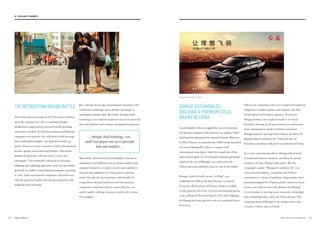
HONGQI AUTOMOBILES –
BUILDING A PREMIUM LOCAL
BRAND IN CHINA
Local brands in China struggled for years to break into
the premium segment of the domestic car market, which
had long been dominated by imported brands. However,
in 2012, Chinese car manufacturer FAW Group launched
the luxury Hongqi H7 sedan to compete with
international nameplates. And it leveraged one of the
potential strengths of a local brand: national patriotism,
which in the case of Hongqi, was connected with
China’s growing ambitions about its role in the world.
Hongqi, which literally means “red flag”, was
established in 1958 as the first Chinese car brand.
It was the official choice of Chinese leaders at public
events, present when they received international guests,
such as Richard Nixon during his 1972 visit to Beijing.
So Hongqi has long enjoyed a role as a standard bearer
for China.
Still, it was a daunting task to try to match international
competitors’ product quality and compete with their
brand stature in the luxury segment. To succeed,
Hongqi needed a new angle to enable it to extend
beyond its heritage as the government car and become
more aspirational to modern Chinese consumers.
Hongqi found it’s opening when Chinese President Xi
Jinping began to promote the “China dream” of
becoming a leading world power as modernized China.
In a series of marketing efforts, Hongqi linked itself
to important historic moments, invoking the proud
memories of what Hongqi represented. But the
campaign’s tagline “Hongqi, let ambition fly” was
more forward looking, resonating with Chinese
consumers as a theme of ambition. Importantly, these
promotions piqued the Chinese public’s interest in local
luxury cars, and served as the platform for Hongqi
to reveal plans to develop more innovative technology
that would help fully realize the China dream. The
campaign buoyed Hongqi to the number three spot
in luxury vehicle sales in China.
Just a decade of two ago, international companies with
mainframe technology had a distinct advantage in
managing customer data. But today, through cloud
technology, even small local players can access powerful
data and analytics and customer management programs.
…through cloud technology, even
small local players can access powerful
data and analytics…
Meanwhile, international brand-builders continue to
experiment with different ways to cluster markets and
organize themselves in order to move more quickly to
unearth and capitalize on evolving local consumer
needs. Overall, the increased pace and breadth of
competition will push both local and international
companies to find new ways to ensure that they can
satisfy rapidly evolving consumer needs in the various
V12 markets.
Hongqi Automobiles, China.
4342 THE VELOCITY 12 MARKETS
01. THE VELOCITY 12 MARKETS
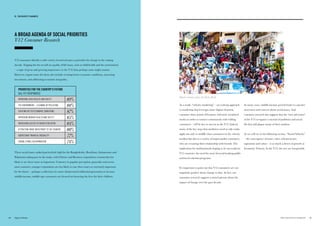
MIXED VIEWS ABOUT THE PAST DECADE
V12 Consumer Research
While V12 consumers are overwhelmingly optimistic about the future and the changes it is
bringing, they have decidedly more uneven views about the impact of lifestyle changes over the
past ten years. Consumers’ perception of the past decade varies substantially by country.
Three groupings of countries can be seen: those identifying considerably positive changes
(China, Bangladesh and India); those identifying more moderate benefits (Myanmar, Indonesia,
Vietnam and the Philippines) and those who on balance see net negative changes over the last
decade (Nigeria, Pakistan, Brazil, Mexico and particularly Egypt, where the last decade is seen
as particularly problematic). This seems to be reasonably uniform across age, income, education
or class in these countries.
An explanation can be found in an examination of the economic, social, and political trends
of the last 10 years. China, Bangladesh, and India have enjoyed stability and robust growth.
Those in the second grouping have had a more mixed recent history while those in the final
grouping have lived through a volatile decade, particularly in matters of social and political
stability. However, this generally hasn’t dampened their enthusiasm for the future.
A WORLD OF MORE SOCIAL
INFLUENCE AND RELATIONS
Technology is a great leveler, enfranchising people
through social participation. As the V12 shift from
minority to majority middle-class societies, a new class
of socially engaged V12 consumers is emerging that will
participate more broadly than ever in “net lobbying” to
pressure their government’s agenda on environmental
issues, child health, product and industrial safety, and
other issues that drive an improved quality of life.
This social velocity – once created – has its own weight
and momentum. To a degree, it grows and changes
independent of economic cycles. For example, while
incomes have stagnated or declined during Brazil’s
recent economic turmoil, the middle class that had
developed in past decades accelerated their vocal reach
through social media.
This very engaged and public middle class could be
called “social consumers” – and they are altering our
understanding of how consumers think, behave,
interact, and buy. To reach this audience, companies
must transform, especially in the velocity markets of
Asia, Africa and Latin America, where cultural values
converge with global access. The one-for-all middle-
class business game plan of yesterday will no longer
suffice: leading companies today need to deploy a range
of fresh approaches that represent the future of brands
and marketing to this globalizing middle class.
Normal life of locals in a poor residential area, Dhaka, Bangladesh.
4544 THE VELOCITY 12 MARKETS
01. THE VELOCITY 12 MARKETS
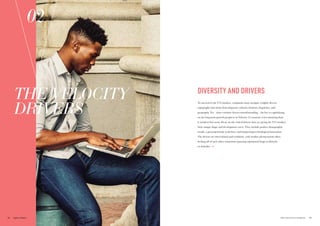
A BROAD AGENDA OF SOCIAL PRIORITIES
V12 Consumer Research
V12 consumers identify a wide variety of societal issues as priorities for change in the coming
decade. Topping the list overall are quality of life issues, such as child health and the environment
– a topic of great and growing importance to the V12 than perhaps some might assume.
However, urgent issues for them also include creating better economic conditions, attracting
investment, and addressing economic inequality.
PRIORITIES FOR THE COUNTRY’S FUTURE
(ALL V12 RESPONSES)
IMPROVING CHILD HEALTH AND SAFETY 89%
THE ENVIRONMENT – CLEANING UP POLLUTION 88%
CREATING BETTER ECONOMIC CONDITIONS 87%
IMPROVING WORKER HEALTH AND SAFETY 85%
INCREASING ACCESS TO HIGHER EDUCATION 84%
ATTRACTING MORE INVESTMENT TO THE COUNTRY 80%
ADDRESSING FINANCIAL INEQUALITY 77%
ENDING ETHNIC DISCRIMINATION 74%
These social issues ranked particularly high for the Bangladeshis, Brazilians, Indonesians and
Pakistanis taking part in the study, with Chinese and Burmese respondents consistently less
likely to see these issues as important. Contrary to popular perception, generally and across
most countries, younger respondents are less likely to rate these issues as extremely important
for the future – perhaps a reflection of a more disinterested millennial generation or because
middle-income, middle-age consumers are focused on bettering the lives for their children.
As a result, “velocity marketing” – an evolving approach
to marketing that leverages more digital channels,
consumer data, points of location, and more socialized
media in order to connect continuously with willing
consumers – will be key to success in the V12. Indeed,
many of the key steps that marketers need to take today
apply not only to middle-class consumers in the velocity
markets but also to a variety of major-market consumers,
who are recasting their relationship with brands. The
implication for multinationals hoping to be successful in
V12 countries: the need for more forward-looking public
and local relations programs.
It’s important to point out that V12 consumers are not
singularly positive about change to date. In fact, our
consumer research suggests a mixed picture about the
impact of change over the past decade.
In many cases, middle-income growth leads to a greater
awareness and concern about social issues. And
consumer research also suggests that the “new advocates”
of the V12 recognize a myriad of problems and social
ills that still plague many of their markets.
As we will see in the following section, “Social Velocity”
– the convergence of issues, cities, infrastructure,
aspiration and values – is as much a driver of growth as
Economic Velocity. In the V12, the two are inseparable.
Popular commerce region, Sao Paulo, Brazil.
4746 THE VELOCITY 12 MARKETS
01. THE VELOCITY 12 MARKETS
DIVERSITY AND DRIVERS
To succeed in the V12 markets, companies must navigate a highly diverse
topography that stems from disparate cultures, histories, linguistics, and
geography. Yet – these extrinsic factors notwithstanding – the key to capitalizing
on the long-term growth prospects in Velocity 12 countries is less daunting than
it would at first seem: Focus on the critical drivers that are giving the V12 markets
their unique shape and development curve. They include positive demographic
trends, a growing female work force and burgeoning technological innovation.
The drivers are inter-related and symbiotic, with market advancements often
feeding off of each other, sometimes spurring exponential leaps in lifestyles
or attitudes.
02
THE VELOCITY
DRIVERS
49THE VELOCITY 12 MARKETS48
WE BELIEVE THAT
BRANDS MUST START
BY UNDERSTANDING
THEMSELVES.
Some of the drivers and features are highly visible, such
as the substantial increase in urbanization. For many V12
markets, the most obvious signs of growth can be found in
new airports, office towers, ports, and other infrastructure
projects that crisscross the regions. One global consultancy
estimates that, in the next 20 years, urban areas in
emergent economies will account for about two-thirds
of worldwide infrastructure spending. Most will go on
building homes; China and India together will add
16 trillion square meters of housing over this period,
to accommodate half a billion extra people.7
Less visible – but equally important – are the social
and lifestyle drivers that both stem from and contribute
to velocity. For example, since several V12 markets have
majority or large minority Muslim populations, practices
related to Halal or Muslim marketing will be a critical
driver. The increased role and influence of female
consumers in the V12, as they eventually overtake
men in terms of education and consumer spending,
is another key driver. So too is the role of connectivity
and technology in spurring new forms of commerce
and mobile lifestyles.
BROAD-BASED CHANGES IN V12 LIFESTYLES
V12 Consumer Research
V12 consumers have seen changes that cut across commercial, physical, and social aspects
of their lives – with the role of technology and new ways to shop predominating. The top eight
changes that V12 consumers identified touched upon a variety of important themes for V12
markets—technology, urbanization, shopping, and female emancipation.
Egypt and Myanmar respondents are less likely to identify significant change in 13 of the 16
areas tested than those from other countries. Conversely, Indonesians, Pakistanis and
Vietnamese are more likely to point to significant change.
BIGGEST CHANGES SEEN IN THEIR LIFETIME
TECHNOLOGY PLAYING A BIGGER ROLE IN DAILY LIVES 87%
	 WITH MORE PEOPLE SHOPPING MORE ON THE INTERNET 71%
SIGNIFICANT GROWTH OF URBANIZATION 73%
NEW APPROACHES TO SHOPPING AND LEISURE, WITH THE
	 RISE OF SHOPPING MALLS 82%
	 EMERGENCE OF ADDITIONAL ENTERTAINMENT AND
LEISURE OPTIONS 70%
	 AND MORE CONSUMERS FLOCKING TO MODERN STORES 69%
NEW OPPORTUNITIES FOR WOMEN
	 TO HAVE A PROFESSION 70%
	 FOR EDUCATION 70%
Across all V12 countries, the growing role of technology
and the ubiquity of shopping malls are seen as the two
greatest lifestyle changes (with the exception of Chinese
respondents who chose the growing role of technology
and more ecommerce).
Too often, companies underestimate the velocity of
change in consumer, social and cultural attitudes that
accompany economic advancement. This occurs in
large part because companies fail to clearly identify the
fundamental drivers that propel growth in a region.
In the V12 countries, these growth drivers can best be
understood and harnessed by viewing them through the
lens of four categories: Gender Velocity, Urbanization
Velocity, Cultural Velocity and Technology Velocity.
What is the key to successfully
capitalize on V12 growth?
5150 THE VELOCITY 12 MARKETS
02. VELOCITY DRIVERS
GENDER VELOCITY
Some argue that women are the great global growth market. After all, their
worldwide income will account for $18 trillion by 2018.8
More and more, women
will drive growth as they increase their participation in the economy in forms old
and new. Women in the V12 are taking more direct financial control of their lives
and the lives of their families than ever. Eventually, they will eclipse men in
making the majority of direct and indirect spending decisions – a fact that
marketing strategies at most companies have not yet adequately embraced.
Yet even as women emerge as an economic force, fulfill
new aspirations and reshape their identities, multiple
societal issues and challenges remain that affect their lives
and their families. In response, women are using social
media to shift mainstream opinions on childcare,
healthcare, workplace opportunities and the like. As
a result, V12 women will be a potent source of social
change in the next decade and more connected to the
internet and other new media than men. As well, they
are becoming better educated than men. With all of this,
women increasingly represent a potent combination of
economic, technological, and educational empowerment.
For that reason, V12 women are the critical starting point
for companies to identify future opportunities.
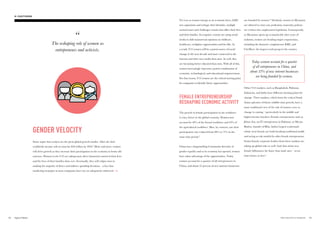
FEMALE ENTREPRENEURSHIP
RESHAPING ECONOMIC ACTIVITY
The growth in female participation in the workforce
is a key driver in the global economy. Women now
account for 40% of the formal workforce and 43% of
the agricultural workforce. Men, by contrast, saw their
participation rate reduced from 88% to 71% in the
same time period.9
China has a longstanding Communist doctrine of
gender equality and as its economy has opened, women
have taken advantage of the opportunities. Today
women account for a quarter of all entrepreneurs in
China, and about 55 percent of new internet businesses
The reshaping role of women as
entrepreneurs and activists.
are founded by women.10
Similarly, women in Myanmar
are allowed to enter any profession; maternity policies
are written into employment legislation. Consequently,
as Myanmar opens up economically after years of
isolation, women are heading major corporations,
including the domestic conglomerate KBZ, and
CityMart, the largest retail group in the country.
Today women account for a quarter
of all entrepreneurs in China, and
about 55% of new internet businesses
are being founded by women.
Other V12 markets, such as Bangladesh, Pakistan,
Indonesia, and India have different starting points for
change. These markets, which form the critical South
Asian epicenter of future middle-class growth, have a
more traditional view of the role of women; even so,
change is coming—particularly in the middle and
higher-income brackets. Female entrepreneurs such as
Jehan Ara, an IT entrepreneur in Pakistan, or Meena
Bindra, founder of Biba, India’s largest readymade
ethnic wear brand, are both breaking traditional molds
and acting as role models for other female entrepreneurs.
Senior female corporate leaders from these markets are
taking up global roles as well. And Asia mints new
female billionaires far faster than male ones – seven
times faster, in fact.ia
5352 THE VELOCITY 12 MARKETS
02. VELOCITY DRIVERS
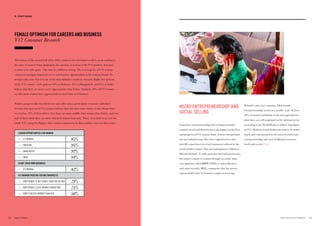
FEMALE OPTIMISM FOR CAREERS AND BUSINESS
V12 Consumer Research
The history of the second half of the 20th century in the developed world is, in no small part,
the story of women rising. Judging by the opinions of women in the V12 markets, that story
is about to be told again—this time in a different setting. The vast majority of V12 women
contacted anticipate improved career and business opportunities in the coming decade. So
strong is this sense that it is one of the most definitive results in research. Eighty-five percent
of the V12 women – with spikes to 94% in Pakistan, 92% in Bangladesh, and 91% in India –
believe that there are more career opportunities than before. Similarly, 83% of V12 women
say that more women have opportunities to start their own business.
Positive prospects like that bleed over into other areas, particularly economic confidence.
Seventy-nine percent of V12 women indicate that they have more money to buy things than
ever before, 74% of them believe that there are more middle-class women than before, and over
half of them think there are more educated women than men. These views hold sway over the
whole V12, except for Egypt, where women rank lowest in their positive views on these issues.
CAREER OPPORTUNITIES FOR WOMEN
	V12 WOMEN 85%
	PAKISTAN 94%
	BANGLADESH 92%
	INDIA 91%
START THEIR OWN BUSINESS
	V12 WOMEN 83%
V12 WOMEN POSITIVE FUTURE PROSPECTS
	MORE MONEY TO BUY THINGS THAN EVER BEFORE 79%
	MORE MIDDLE-CLASS WOMEN THAN BEFORE 74%
	MORE EDUCATED WOMEN THAN MEN 50%
MICRO ENTREPRENEURSHIP AND
SOCIAL SELLING
Grassroots entrepreneurship that is shaped around
women’s needs and lifestyles has a big impact on the lives
and prospects of V12 women. Some of these entrepreneurs
are successful because they have capitalized on their
own life experiences to create businesses tailored to the
needs of other women. One such entrepreneur is Mexico’s
Martha Debayle. A radio presenter and businesswoman,
she targets content to women through an online baby
care platform called BBMUNDO; a radio talk show;
and, most recently, MOI, a magazine that has grown
exponentially since its launch a couple of years ago.
Debayle’s story isn’t common. Most female
entrepreneurship occurs at a smaller scale. At least
30% of women worldwide in the non-agricultural
labor force are self-employed in the informal sector
according to the World Bank; in Africa, that figure
is 63%. Women-owned businesses tend to be home-
based and concentrated in the areas of small-scale
entrepreneurship and such traditional sectors as
retail and service.11
5554 THE VELOCITY 12 MARKETS
02. VELOCITY DRIVERS
It is hard to overstate the velocity that V12 women will
contribute. Women in the V12 are on the rise—in
education, in gender equality, in social activism, and,
crucially, in entrepreneurship. Digital tools and social
networks have liberated economic activity from the
market, the office tower, and the high street. Women,
often attending to household work, no longer have to
make a choice between raising a family and participating
in economic activity. Ayu Kusumayanthai of Jakarta
is a perfect illustration. Her story reflects the lives of
millions of V12 women who are driving increased
economic velocity in their countries through new
forms of micro business and entrepreneurship.
Ayu never imagined that she would become the
entrepreneur she is today. A resident of Jakarta, the
capital city of Indonesia, she lives with her husband and
her daughter, who is currently in the third grade of
elementary school. For Ayu, resigning from her position
at a large multinational company was a tough decision.
Although Ayu had been offered a promotion to manager,
she felt a duty to comply with her husband’s desire for
her to stay at home and focus on their young family. For
them, looking after their two-year-old daughter took
precedence over Ayu’s career aspirations.
AYU KUSUMAYANTHI
Jakarta, Indonesia
“After three years of marriage, finally I gave up my
career in 2009, though I still didn’t have any idea what
to do after that. I was confused at first. But the desire to
be active and productive pushed me to do something.”
Digital connectivity boosted Ayu’s own economic velocity,
enabling her to fulfil a traditional caregiving role in the
family while feeding her aspirations for herself. This
reconciliation, among other shifts, is the nature of
gender roles in the V12. For Ayu, it happened like this.
She began to notice how the people around her were
becoming increasingly avid online shoppers, though it
was not as hyped as it is today. She started to resell baby
clothing online via Blackberry Messenger (BBM)—
a dominant platform in Indonesia. Surprisingly to her,
the endeavor turned out quite well. Although profits
were meagre at around US$1/unit, she built a healthy
customer base.
57THE VELOCITY 12 MARKETS56
02. VELOCITY DRIVERS
Watching Ayu’s interest in online commerce, her husband
suggested she consider expanding her entrepreneurial
activities into reselling organic rice. Although she at first
found the idea a bit dubious, she nonetheless gave it a
try in 2012. She’s fortunate that she did. Through BBM,
WhatsApp, and Facebook, Ayu has grown her rice
business so much that it has expanded to serve customers
outside Java. Committed to maintaining consumer
satisfaction and strong word of mouth, Ayu spends
many hours on her social media channels answering
every question her customers ask of her.
What began as a trade-off for Ayu—leaving her career
to care for her family—has turned into an opportunity
to grow in a new way. While her husband’s salary allows
their little family to live comfortably, her extra income
provides her with greater independence and to spend
One emerging form of micro entrepreneurship is the
growth of Instapreneurs – women who use Instagram to
sell goods in Africa, Southeast Asia, and Latin America.
Instagram’s visual format is ideal for online window
shopping through mobile devices. This logical extension
of the door-to-door selling model that women around
the world have conducted for years enables them to use
their same personal selling techniques digitally for
cosmetics, insurance, and other items. Digital social
networks and cheap smart phones provide women with
a safer, more convenient way to conduct this tried-and-
true form of micro-entrepreneurship. And technology
will continue to boost the efficiency and reach of women
who operate in the informal economy.
In the Philippines, there are 7 million female online
sellers, meaning that fully 35% of internet users in the
country are also micro-entrepreneurs. In Indonesia, 18
million females are involved in online selling providing
an average 33% of their weekly income. 7.9 million
Thai women earn a similar income online.12
This same
trend repeats all over the V12. This digital route to
entrepreneurship provides smart, easy market access.13
The extra money derived from these businesses allows
women to upgrade their consumption choices. While
some women use this extra income for personal items
for themselves, others use it to buy new or better items
for their children, including online education that
furthers the female education cycle. ■
guilt-free money on small luxuries like designer clothes,
trips to a beauty salon and treats with her daughter.
Ayu finds her dual roles—housewife and entrepreneur—
rewarding, but she’s not the only one. Millions of female
social and micro-entrepreneurs are a growing and
influential new segment for international and local brands
to understand and better serve in the coming years.
Their income is growing along with their independence.
Traditional choices for the family are no longer either/or.
Women like Ayu live in a world of “and”.
Online Social Selling in Indonesia.
5958 THE VELOCITY 12 MARKETS
02. VELOCITY DRIVERS
FEMALE ACTIVISM RESHAPING
GENDER ROLES
As their education and career opportunities grow, women
face a tension between new and traditional roles. On the
one hand, they continue to play a significant role in
meeting the needs of their families and households,
especially in countries where traditional values are deeply
rooted. On the other, they seek the fulfillment of a career,
empowerment, social participation—areas not defined by
the boundaries of mother or daughter. As a result, many
women are aiming to recast their roles, assuming modern
identities while still inhabiting their traditional roles in
the family.
Women, at the center of most families, generally have
complex roles – as wives, mothers, grandmothers,
daughters, daughters-in-law, and, increasingly, as single
mothers and caregivers. When a woman redefines her role,
it affects many others, creating far-reaching social change.
The reshaping of a woman’s identity starts with marriage.
According to the United Nations, globally both genders
marry a year later than two decades ago. The youngest
average marrying ages are still in Southern Asia and
sub-Saharan Africa – key markets of the V12 crescent
of growth. Typically, higher education levels, greater
participation in the labor force, and increased economic
independence of women raises the average marrying age.
Markets with the youngest brides are the ones most likely
to have the largest shifts in the future—at least for
middle-class women.14
Today many women are aiming
to recast their roles, assuming modern
identities while still inhabiting their
traditional roles in the family.
Marriage is only one of many options for V12 women
today. Some younger women are opting not to accept a
traditional role. The U.N. report on women, for example,
found that the global divorce rate is rising as is the
INTER-GENERATIONAL CHANGE
ACCELERATING
V12 Consumer Study
Inter-generational issues are no less an issue in the
V12 than they are in the rest of the world. The
dynamic between generations—particularly parents
and children—is always delicate, especially once new
families are built. However, what was for years a stable
status quo has begun to change rapidly. Societal change
often starts at home, which can be seen clearly in the
changing dynamics amongst family members, many
of whom share the same household in the V12 markets.
It should come as no surprise then that a majority of
V12 women say that they differ in some way from their
mothers in terms of their views and lifestyles.
This finding is less uniform than some of the others in
the study. For example, Brazilian women are likely to
say that their attitudes do not differ from those of their
mothers. Burmese, on the other hand, are notable for
the proportion (91%) who say that their attitudes do in
fact differ from those of their mothers. Pakistani and
Bangladeshi women fall on the Burmese side of the
equation while Chinese women are significantly less
likely to say the same. Interestingly, the same patterns
hold for not only what women said directly about their
relationship with their mothers, but also for the changes
that many husbands see in regard to their wives and
their mothers. Attitudes toward changing economic and
educational opportunity lead these familial alterations,
which makes sense. Traditional family structures can
be among the most durable of institutions.
SariWangi
IN INDONESIA
Decades ago SariWangi, Indonesia’s
leading tea brand, introduced a new
way – the teabag – of preparing tea.
To remain relevant as the market
leader, SariWangi needed to
differentiate itself from its soggy
competitors.
More recently, the company decided
to change the role that tea played in
gender stereotypes. Recognizing that
womens’ position in Indonesia was
changing, if slowly, the brand tapped
into the desire of young, modern
Indonesian housewives to have an
equal relationship with their
husbands—not an easy feat in this
conservative Islamic culture. Rather
than reflect the idyllic view of the
past, the brand chose to be a subtle
but potent advocate for the desires
of modern Indonesian women.
In “Let’s Talk,” SariWangi urged
women to share tea rather than just
serve it, and in so doing, redefined the
relationship between husband and wife.
6160 THE VELOCITY 12 MARKETS
02. VELOCITY DRIVERS
Titan Raga
IN INDIA
Brand saliency is a key part of the international and
local brand battle of the V12. And local brands are as
poised as international ones to set a progressive tone
for their communications.
While conversations around feminism have sparked
much debate across the world, the contemporary Indian
woman has also been grappling with conflict about her
identity and her femininity. By questioning a patriarchal
culture that defines a woman by her relationship with a
man, she is beginning to re-define her identity by charting
a new relationship with herself – as a confident, ambitious,
independent and assertive woman.
Titan Raga, a brand of watches that was the flag-bearer
of Indian sensuality and femininity, had to re-evaluate
its positioning to mirror this systemic change that is
beginning to unfold.
Titan Raga’s philosophy on femininity thus evolved
from “A beautiful relationship” (Ek khoobsurat rishta)
– that is, to the man in her life – to “A new relationship
with myself” (Khud se naya rishta).
The ad campaign presented this woman’s progressive
point-of-view on her career and marriage, manifested
in both her attitude and her sensibilities.
TRANSITION MOMS
The Transition Mom is the first generation of women
experimenting with new and modern ways of raising
her kids. She is changing the parameters of what was
considered right and wrong. As a result, she often seeks
information to validate her decisions. As the first change
maker, she wants to prove herself to the world. Still,
while having no role model may be liberating, it can be
frightening too. The online sisterhood is immensely
helpful to mothers seeking others in the same position to
build their bank of expertise, make new connections and
seek guidance.
While women are moving ahead, some are experiencing
a sense of loss. With middle-class lives becoming
more cosmopolitan today, mothers may feel they are
losing touch with their heritage, age-old customs and
rituals. They want to ensure that their children, while
modern, rediscover and connect with their roots as
they move forward.
Still, while middle-class women in the V12 may believe
in traditional practices, they won’t let them get in the
way of empirical, scientific evidence about proper
nutrition, healthcare and other lifestyle issues. Although
they may have grown up hearing about the superiority
of traditional medicine, food, and rituals they are not
willing to follow them blindly.
Consider Himalaya, a company producing healthcare
products in India that contemporize the traditional
Indian healthcare practices known as Ayurveda through
modern scientific research. To a degree, this reflects the
growing influence of Western education and critical
reasoning and challenges to traditional ideologies and
belief systems.
percentage of informal unions. While these relationships
may give young women more freedom, they may also
result in larger numbers of single mothers.
V12 women are reshaping motherhood. Relationships
with mothers, mothers-in-law—a key relationship for
many traditional societies—and children are being
gradually recast, particularly by younger women setting
a more self-directed course and breaking free of old
stereotypes. These women don’t aspire to follow their
mothers’ examples. The social tensions surrounding this
shift are complex. Mothers still play a key role as support
for young women, despite the generational differences in
their ambitions. This is particularly true in rapid-growth
markets where, in the absence of government support
and services, grandmothers or aunts traditionally care
for young children. V12 mothers are looking for new
forms of support as they revise parenting styles and seek
new advantages for their children. Brands have an
enormous opportunity here – both to reflect the velocity
of change in societal norms and to empower young
women seeking guidance and information as they raise
the new generation of children. ■
Dancow Parenting Center in Indonesia.
6362 THE VELOCITY 12 MARKETS
02. VELOCITY DRIVERS
Tapal Family Mixture
IN PAKISTAN
Tapal Family Mixture tea is a traditional brand
centered on family values. It has long focused on young
housewives, often showing a middle-class girl getting
married and making a place in her in-laws’ home.
Tapal’s focus on family values is enduring, but what
constitutes family values is undergoing change in
Pakistan today.
Rather than cling to a singular definition of the
Pakistani family, the brand realized that it could express
its devotion to family values while still adapting with the
times. Tapal did so by recognizing an underserved
market in unmarried girls. This was a woman few
brands understood. She was not waiting to get married;
she wanted to create her own identity first. These
women sought to balance independence with family
values, the brand learned, so that they lived up not only
to their family’s expectations but to their own as well.
Tapal’s campaign, “The blend of ambition and
warmth,” reflected how young Pakistani women are
changing and yearn to be portrayed. They want to be
celebrated as being at the center of the home, while also
pursuing their ambitions in the world outside.
FEMALE ACTIVISM RESHAPING
SOCIAL CONVERSATIONS
As women in the V12 experience increased financial
participation and control, they are using their newfound
voices in social media to press for change on a host of
topics, from women’s issues to the environment. As a
result, gender velocity is being experienced in realms
beyond home and family.
A recent U.N. report found that over one third of
women worldwide have been victims of physical and/or
sexual violence.15
Social media—such as Egypt’s
HarassMap platform—helps women to share their
experiences of sexual violence, keeping international
attention focused on events that might have otherwise
gone unnoticed. The #BringBackOurGirls campaign,
launched in 2014 after the abduction of more than 300
schoolgirls in Chibok, Nigeria, brought sustained
international attention to the Boko Haram kidnapping.16
More women are taking the lead as social activists.
This includes Wasfia Nazreen, a Bangladeshi
mountaineer and activist known for her campaigns to
raise awareness of sex workers and minority groups.
Nazreen dedicated her successful Everest climb to the
women of Bangladesh.17
In China, Li Tingting, better
known as Li Maizi, took part in an “Occupy the Men’s
Toilets” campaign to demonstrate the inadequacy of
women’s facilities; she has also paraded through the
streets in a wedding dress splashed with blood to
increase awareness of domestic violence.18
20 AMAZING SCIENTIFIC REASONS
BEHIND HINDU TRADITIONS
Henna
Mehndi is a very powerful medicinal
herb, and its application on hands
and feet can prevent stress during
weddings. It cools the body and keeps
the nerves from becoming tense.
Toe Rings
Indian women normally wear toe rings
on the second toe. A particular nerve
from this connects the uterus and
passes to heart. Thus, a toe ring on this
toe strengthens the uterus, keeping it
healthy by regulating the blood flow
to it. Moreover, a woman’s menstrual
cycle is said to be regularized.
South Africa Fashion Week, collection by Mantsho “Boko Halaal”, March 15, 2015.
6564 THE VELOCITY 12 MARKETS
02. VELOCITY DRIVERS
72%
69%
school out of home home office
58%
51%
64%
56%
61%
51%
MALE / FEMALE FAIRNESS PERCEPTION GAP
PERCENTAGE EXPRESSING THAT WOMEN ARE FAIRLY TREATED
MALE PERCEPTION
FEMALE PERCEPTION
7% 8% 10%3%
MALE PERCEPTION
FEMALE PERCEPTION
PERCEPTION GAP
V12 OPTIMISM FOR
POSITIVE CHANGE
V12 Consumer Research
Societal change is rarely smooth. As V12 women grow
positive about their opportunities in the future, they are
also keenly aware of that which holds them back. There
are more educational and career opportunities for
women to be sure. But there is also discrimination. The
majority of female respondents report experiencing that
scourge in virtually every setting in their lives. Doubtless,
this form of discrimination has deep roots in society, but
it becomes harder to ignore when it starts to block V12
women from visible, newly-obtainable opportunities.
As a result, the majority of V12 women report that they
regularly or occasionally experience some form of
unfair treatment – most often out of home or at work,
though over 40% admitted having experienced it at
school or at home too.
In particular, Mexican, Brazilian, and Egyptian
women represented the largest percentage of women
feeling unfairly treated both at work and out of home.
For Vietnamese women, unfair treatment was felt most
keenly at home. Across all markets, 69% of women
indicated that the school environment is where they
are most fairly treated.
Interestingly, this also appears to the one place where
the male view of how women are treated was fairly
similar, with 72% of men saying they thought women
were fairly treated at school. Unsurprisingly, men tend
to see less of a problem in how women are treated:
ThePinkChaddi
Campaign
IN INDIA
The unfair treatment of women is
often expressed in language, tacit
discrimination, the tyranny of
expectations, or even closed off
opportunities. However, sometimes it
is alarmingly bold, as was the case in
2009. Forty men from a conservative
and right-wing political group, acting
as moral police, attacked a group of
women in a pub on the grounds of
preserving traditional Indian culture.
The group’s leader threatened to force
unmarried couples found together on
Valentine’s Day to get married. In
response, Nisha Susan of Tehelka
Magazine launched the Pink Chaddi
Campaign (Pink Underwear
Campaign). This nonviolent protest
movement urged Indian women to
deliver pink underwear to the
conservative party’s local office on
Valentine’s Day. Thousands of
women responded, and the resultant
pile of pink panties was a silent, yet
effective protest.
The female-male perception gap is most pronounced in
Egypt, where across most measures, there is a 20% or
larger gap. The standout market in the opposite direction
is Pakistan, where on all measures women felt they are
better treated than men feel they are treated.
The majority of V12 women
report that they regularly or
occasionally experience some form
of unfair treatment
The treatment of women—and the gap between male
and female perceptions of it—will be an issue of great
importance for the decade ahead. With more women
taking on professional careers, becoming entrepreneurs,
and pursuing greater education, societal tolerance for
unfair treatment is sure to diminish. Though the V12
markets are similar in many respects, this one included,
the individual countries start from vastly different social
places when it comes to how women are treated.
Understanding that valance will be crucial for brands
trying to make headway.
6766 THE VELOCITY 12 MARKETS
02. VELOCITY DRIVERS
Asian Paints
IN INDIA
Women as the key purchase
decision makers. Changing social
patterns sometimes enable an existing
gender dynamic to rise to the surface.
That was the case when Asian Paints,
India’s largest industrial paint
manufacturer, decided to reposition
its brand from paint to be seen as
India’s home and décor expert. In
researching decision making about
home décor, Asian Paints discovered
that women were responsible for most
of these choices. This led to a change
in Asian Paints’ strategy since it had
traditionally focused on men and
husbands. Instead, the brand created
a series of color experiences designed
to attract the whole family, but
aimed at inspiring and educating
women about home décor.
As a result of these efforts, Asian
Paints has become the No.1 home
décor brand in India according to
WPP’s BrandZ study.
Khalida Brohdi’s campaign to stop honor killings celebrated the skills of
the craftswomen at the heart of traditional communities, using them as
a key driver of sales—and awareness—in small villages. Indian activist
Kavita Ramdas, a former CEO of the Global Fund for Women, has given
TED Talks on the importance of raising funds to support women-led
organizations that promote economic security, health, safety, education,
and leadership for women and girls.
This new generation of empowered women is proud of its ability to
instigate social conversations. Businesses seeking to connect with V12
consumers would do well to reach out to women about important social
issues of the day.
ADDRESSING THE FEMALE
OPPORTUNITY GAP
Women in the V12 are carving out new roles, yet many brands are
failing to connect with them. At first, companies in the V12 markets
ignored or stereotyped women. In the next wave, they learned to
recognize female consumers. Now, in the third wave, V12 companies
are seeing that empowering female consumers can be good business.
Companies with foresight are keeping a close watch on the behavior,
desires, and aspirations of this uniquely dynamic set of consumers.
Even so, brands in many categories still speak predominantly to males.
This is completely out of sync. Brands must recognize that V12 women
control the majority of the purchase decisions in the V12 and are social
shapers, employees, and brand advocates.
6968 THE VELOCITY 12 MARKETS
02. VELOCITY DRIVERS
CULTURAL VELOCITY
By bringing faith and modern life together, Muslim Futurists are reshaping the
direction of business growth, brands and social change. Unabashedly proud of
their religion, Futurists manage to combine consumerism and faith, uniting
individual self-expression with strong community concern and adherence to their
connections in ummah – the global Muslim nation. They pair eco-concern and
social activism with a love of luxury premium brands. Inevitably they will,
through sheer numbers and impetus, shape wider consumer demands.
The countries with the largest young Muslim populations are among those
nations that are leading global economic growth. For marketers, embracing
Muslim Futurists in the V12 is of critical importance.
FAITH AND MODERNITY
According to original research by Ogilvy Noor, the
Muslim Futurists make up 42 percent of the Muslim
population, yet command disproportionate influence in
the community. These movers and shakers tend to be
young – under 30. They are increasingly educated,
entrepreneurial, and keen to live in the modern world,
while also upholding Islamic principles. Because Muslim
women are staying in education longer, delaying marriage
and children, they are transforming social and familial
gender dynamics. As a group, Muslim Futurists are
disproportionately influential, shaping the culture of the
world’s 1.8 billion Muslims and, by extension, global
consumer trends.
The countries with the largest
young Muslim populations are
among those nations that are leading
global economic growth.
Brands for this consumer group must work hard to meet
Muslim needs, meeting requirements for halal – or
permitted foods and actions – and tayyab, wholesomeness
or purity. Concepts such as ummah are present across
both minority and majority Muslim countries, although
The reshaping role of generation M
– the Muslim Futurists.
they may be presented in slightly different ways. In
countries where Muslims are in the minority, for example,
products and brands might use the language of
‘universal values’ rather than strict Islamic terminology.
While the specific message will be determined by the
social context, the overarching one will combine faith
and modernity.
Faith affects everything for the Muslim Futurists, which
is what sets them apart from their non-Muslim peers.
They believe in asking questions, entering into dialogue
with authority, and crossing geographies and cultures to
connect with other Muslims around the world. They
embrace technology and education and believe that,
inspired by their faith, they can make the world a better
place. They are defined more by their attitude than
their age. Futurists are proudly individualistic. They are
driven by success and progression, believing in Islam as
a tool to bring about positive change.
7170 THE VELOCITY 12 MARKETS
02. VELOCITY DRIVERS
HALAL
Living according to halal, the Muslim law that
describes both food and a way of comportment, is
a badge of identity for the Futurists, allowing them
to wear their Muslim credentials with pride. Halal
consumption has also ensured that the idea of an
“Islamic economy” has gained traction over the last
decade. The brand choices made by Muslim Futurists
deliver a sense of belonging, pride and spiritual
fulfillment.
The concept of halal is an anchor to any practicing
Muslim. In the Quran the term has a straightforward
meaning: “permitted.” Haram, its opposite, means
‘forbidden.’ Halal products, services and actions are
said to have a positive effect on the body, increasing
one’s devotion and purity. As these grow ever stronger,
the will to consume halal products and engage in halal
acts does, too. So the virtuous circle turns.
MUSLIM CONSUMERS AND
INTERNATIONAL BRAND GAP
V12 Consumer Research
There are nearly 2 billion Muslims in the world, and
many of them reside in the V12 countries. Despite the
pull of those astounding numbers, international brands
haven’t succeeded in connecting with them. Nearly
60% of the Muslim respondents across the V12
indicated that international brands either don’t or
barely understand or cater to their needs. This view
was largely consistent across the biggest V12 Muslim
markets – Indonesia, Egypt, Bangladesh, and Pakistan.
The gap between those consumers and the remaining
third of Muslims across the V12 is significant. That
group finds that international brands understand their
needs very well. Multiple factors must underlie this
divergence of opinion, but further research will be
needed to uncover it. Nevertheless, international brands
have a problem in Muslim markets—the ongoing, unmet
needs among a large group of consumers.
TV Series
Burka Avenger
IN PAKISTAN
Pakistani cartoon superhero Burka
Avenger depicts a teacher by day
who at night tackles Talibanesque
villains trying to shut down her
school, fighting them with a mixture
of books, pens and martial arts. The
cartoon’s revolutionary, high-quality
content brings together multiple
threads of Muslim culture through
its vision of female empowerment via
faith and learning. Accordingly, it
has reached beyond Pakistan and
has been successfully launched in
Afghanistan and India. Using local
talent, its creators produced content
for a market hungry for material
reflecting its own culture.
The Quran talks about any food that is consumed being
both ‘halal’ – permitted – and ‘tayyab’ – wholesome.
While the traditional focus has been on halal, the
Futurists believe that wholesomeness is needed, too.
Enforcing this requirement raises philosophical questions
about the nature of the product itself. Just as mainstream
consumers are clamoring for organic, ethical, eco-friendly
food, Muslim Futurists demand that halal products meet
the same standards. Many see themselves as part of an
ethical consumer movement inspired by Islamic teachings
on tayyab.
The halal brand is bigger, more widespread, and worth
more than any other brand, even Apple, Google, Nestlé
or McDonald’s. Its food and beverage sector alone is
estimated at over $1 trillion.
Coffee street vendor, Ho Chi Minh city, Vietnam.
7372 THE VELOCITY 12 MARKETS
02. VELOCITY DRIVERS
The Islamic finance industry has an image problem: Muslim consumers
are confused by banks offering both Islamic and conventional finance
products. How, they wonder, can the same institution be structured to both
avoid interest and charge it? Consumers are suspicious of the terminology
of Islamic finance products, and consider them to be expensive. Yet the
affluent Futurist is looking for ways to invest, and the size and growth
rate of the market is tantalizing for financial services firms.
The third F is, well, Ph – as in pharmaceuticals. Healthcare is a key concern
in these developing markets. Some physical and holistic elements are
under increasing scrutiny. Many medicines contain non-halal ingredients;
the number of halal pharmacopeias – which can suggest which
ingredients are permitted and produce new alternatives – is growing.
The demand for Muslim healthcare goes beyond medication, of course.
Gender sensitivity in treating patients, along with extended family and
visitors, and spiritual guidance and support will be increasingly in
demand by Muslim Futurists.
If Muslim Futurists are about anything, it’s about fun – the last of the
Four Fs. Their lifestyle includes fashion, films, arts and travel, to name
just a few. While rooted in Islamic principles, such as modesty and halal,
these elements embody a new worldview, one that is deeply faith based.
And they demand ethics across the supply chain, from production to
consumption to marketing.
All four Fs are underpinned by a new Muslim cool, a vibrant cultural
expression spanning music, art, fashion, and visual identity that is
developing new outlets to establish its own social capital. There are
Muslim boy bands, reality TV shows, and superheroes – every element
of culture is rapidly becoming a channel for Futurists to express their
faithful modernity. ■
Imam Muda
REALITY TV SHOW
The reality TV show “Imam Muda”
uses the X Factor format to bring
Islam to a wider audience. It aims to
find the next young religious leader
by putting ten sharply dressed young
men through their paces on such tasks
as leading prayers, among other
pastoral requirements. This popular
series ran through several seasons
with over 1,000 applicants from all
over Southeast Asia applying for each
round. Winners received such prizes
as scholarships to study in Saudi
Arabia and pilgrimage trips. Imam
Muda epitomizes the many ways that
faith and modernity are being
reconciled in the Muslim world.
LIFESTYLE AND CULTURE
Muslim Futurists have started to apply halal rules to all
parts of their activities, creating a Muslim lifestyle. The
desire to imbue every aspect of their lives with Muslim
values means that everything for this generation, from
clothes to music to travel to food, is an expression of
their religious identity. Their choices as consumers
demonstrate these values, both their sense of being
Muslim and being part of a modern world, where
consumerism is a key factor in self-definition.
Over 90% of Muslims researched by Ogilvy Noor said
that their faith affected their purchases. The imperative
to live a Muslim lifestyle is unleashing a new creative
energy, leading to a whole range of new products and
services in four main categories – known as the Four Fs
(if not quite literally): food, finance, pharmaceuticals
and fun.
Food is the most well-known of the four F’s; the halal
requirement is non-negotiable. With shifting gender roles
and women taking a more active public and professional
role, ready-made meals that meet the Muslim lifestyle
are in the offing. On the other end of the spectrum,
there are such luxury offerings as halal foie gras and,
even, halal Christmas dinners. Non-alcoholic drinks
are a growing category, too, from beer to champagne
and mocktails.
In the realm of finance, Islamic banking and investing
offers interesting new options to both businesses and
consumers, because it is centered on the notion that
interest-based systems are not permitted. Consequently,
Islamic mortgages create a co-ownership between the
bank and the property purchaser; both risks and profits
are shared between the lender and the borrower.
Other approaches, such as crowdfunding, give Islamic
entrepreneurs the chance to start new brands through
sheer ummah goodwill.
Wardah in Indonesia.
7574 THE VELOCITY 12 MARKETS
02. VELOCITY DRIVERS
UMMAH – DIGITAL AND REAL
WORLD
Community is the underpinning of Muslim life. Even as
Muslim Futurist velocity increases, it will continue as a
defining factor. The concept of a global Muslim nation,
called ummah, gives Muslim Futurists a sense of
solidarity with others of the same religion around the
world. This has important cultural ramifications: lifestyle
and fashion are quickly transmitted, and products and
brands that meet Muslim aspirations are rapidly promoted
through word of mouth, almost as a religious duty.
Information about products that don’t meet Muslim
ideals spreads equally fast.
Building community spaces reinforces the identity of
Muslim Futurists. With young Muslims often feeling
excluded by traditional attitudes in mosques, these
virtual spaces are growing in number as places to
explore their new Futurist identity, and the tensions it
can contain. TwoCircles.net in India, MuslimGirl.net,
MuslimMediaWatch and VirtualMosque are all
examples of spaces where new ideas can be explored
(even if some are not based in the V12, they cover ideas
and values common to the Muslim Futurist population).
These sites use social media to build momentum for
political and social protest, share humor and engage in
debate. Hashtags like #AsAMuslimWoman and
#MuslimValentines demonstrate the humor and passion
of this segment. Online interactions increase during
Ramadan, according to studies in Indonesia and the
Middle East.
Wardah
IN INDONESIA
A local brand speaking to progressive Muslim
needs. Wardah – an Indonesian cosmetics and face care
brand – exemplifies the potential for local products to
connect with progressive Muslim consumers through
deep, local understanding, an appreciation of shared
values, and the creative use of new communications
channels. It also demonstrates how local brands can
distinguish themselves against international competitors
by combining culturally-relevant product formulation
and smart brand positioning.
Wardah’s beauty products are made in keeping with
Halal rules – in other words, permissible under Muslim
dietary and religious restrictions. But while targeting the
desire of Indonesian women to abide by their faith, Wardah
simultaneously taps into the aspirations among modern,
Indonesian women to play a bigger role in society. One
of Wardah’s content campaigns is called “Inspiring
Women” and features a number of hijab-wearing brand
ambassadors who possess both beauty and personal
character. Through their personal stories of success, and
personal beauty tips, these women both reflect their target
audience and serve as natural role models.
A key part of Wardah’s connection with local consumers
comes through their social media activities. To cement
the brand’s rapport with its prospective customers,
Wardah leverages Indonesia’s rapidly growing social
media scene to link users with brand ambassadors
and online influencers. This includes using
#Wahdahselalumenemani (#Wardahalwayswithyou),
a digital engagement approach that involves displaying
consumers’ Twitter or Instagram posts on Wardah’s
website, which provides a feedback loop for consumers to
see other, real Wardah users who reflect their skincare
needs and personal lifestyle.
Wardah is continuing to broaden its market presence and
appeal with an active teen brand, promoted by a young
girl who doesn’t wear the hijab. And it has maintained
close ties to local mainstream culture by signing on as a
spokesperson the popular Indonesian singer Tulus, who
had a hit song that inspired Indonesian women with its
positive message. Plus, Wardah has linked its site to
Lazada – Indonesia’s biggest ecommerce company.
To celebrate its 20th anniversary, Wardah launched
#StartAGoodThing – a campaign inviting Indonesian
women to inspire each other and do something good
every day. The effort features successful modern Muslim
women like a fashion designer and a social activist who
helps bring electricity to remote villages.
In total, Wardah demonstrates that more local brands
will begin to crack the code of combining Muslim
halal formulations with cultural flexibility, progressive
brand messages, and digital channel usage to build an
effective brand.
Halal Hospital
IN CHENNAI
Certified halal in May, 2012, this hospital is the first in
India, and one of just a few in the world, to receive this
certification. About 75% of its patients come from the
Middle East and Southeast Asia, for whom the hospital’s
halal status provides reassurance and comfort. The goal
is to position India as a preferred destination for Muslim
medical tourism.19
7776 THE VELOCITY 12 MARKETS
02. VELOCITY DRIVERS
MIDDLE-CLASS AND LUXURY
Definitions of the size, income and spread of the global middle class vary,
but this much is clear: it is growing year by year, and Muslims make up a
sizeable proportion of it. According to some estimates, the global Muslim
middle class, now about 300 million people, will triple in size by 2030.
This affluent middle-class Muslim market is critically important to brands;
its ideas and taste will set the trend for the wider marketplace. Some of
these, from high end abayas by Dolce  Gabbana to luxury cows
purchased in pristine showrooms in Indonesia, are already apparent.
There’s a tension at the heart of Muslim Futurist life between the
temptation to spend on the finer things in life and adhering to religious
dictates concerned with avoiding extravagance and waste. Muslim
Futurists easily reconcile the two. Like their millennial peers, they define
themselves, in part, by the brands they choose. Their halal consumption
allows them entry into the Muslim club; their love of premium goods
doesn’t threaten this status.
Futurists are increasingly seeking end-to-end supply chains that deliver
ethical, organic and tayyab products. Inevitably, these will lead to more
expensive goods and services.
Buying Luxury Cows
for Eid
IN INDONESIA
Wanting to flex their new found
affluent muscle, Indonesians are
now buying the cows for slaughter
for the annual Eid ul Adha sacrifice
not from pop up stalls on the street
but from converted car showrooms.
There, a top-quality cow, costing up
to $25,000, can be selected with a
sales assistant and paid for by credit
card. Such purchases typify the kind
of shopping experiences being
sought by affluent Muslim Futurists,
who place pecuniary value on
delivering their faith principles.20
Hijabers Community
IN INDONESIA
Across Indonesia, chapters of
the Hijabers community are
proliferating, providing spaces
where young Muslim professional
women who choose to wear the
headscarf can come together with
like-minded others to share their
aspirations for empowerment,
ummah, professional and social
success. Hijabers is not only a
potent social and networking force,
it also provides tangible evidence
that faith and shifting gender roles
can coexist.
The spirit of ummah requires proactive participation in these public
spaces, whether as civic duty or to build social relationships with those
of other faiths. Working in partnership for civic improvement is one
time-honored way for brands to demonstrate long-term commitment in
these societies, while also sharing in their growth. In this spirit, Pril and
Persil were on the scene to support young people, and provide them with
cleaning products, as they volunteered to clean up Cairo’s Tahrir Square
after the early days of the Arab Spring.
Muslim Futurists expect brands to take an active and equal role in social
investment and improvement. As they do, brands are welcomed into a circle
of respect and trust. Corporate social responsibility is vital, but it must meet
the requirements of local communities, be sincere and have beneficial
long-term goals. ■
7978 THE VELOCITY 12 MARKETS
02. VELOCITY DRIVERS
PIONEERS – WATCH OUT FOR THE OUTSIDE
INTO THE MAINSTREAM
With their aspiration to adhere to Islamic principles, Muslim Futurists
are promoting burgeoning consumer movements. Eco activism, which
builds on the Islamic ideal of meticulous stewardship of the Earth and
an ethical end-to-end supply chain, is one example. Investing back in the
community – another Islamic priority – dovetails with such trends as
crowdfunding and social enterprise. The rigorous halal supply chain
parallels a wider consumer concern about the provenance and purity
of food.
Muslim Futurist velocity will have an impact beyond Muslim societies.
Its pioneering of consumer-led movements should have global influence.
Companies, brands and organizations must meet both the ethos and
prescriptive requirements of religions, speaking with authenticity to faith
communities and building mutually beneficial partnerships with them.
This will ensure strong relationships with Muslim Futurists, as well as
wider consumer groups in the V12, many of which are seeking the same
authenticity and respect.
A Taste of Togetherness
IN INDIA
Cultural tension is rich territory for
advertising, but when that tension is
vivid and deep, a brand has to tread
carefully. Red Label Tea did exactly
that, addressing the religious
prejudice between Hindus and
Muslims directly. Ever since the
India-Pakistan partition, Hindu and
Muslim communities have viewed
each other with fear and distrust.
Red Label saw an opportunity for the
brand to be a catalyst in melting
differences between these
communities and bringing people
together.
Tea is a welcome drink – and ritual
– in many cultures, especially in
Indian and Pakistani homes. This
Red Label ad, which showed an
apprehensive Hindu family becoming
good friends with their Muslim
neighbors over cups of tea, received
accolades for its positive message in
bridging the age old religious divide
in the Indian subcontinent.
MUSLIM FUTURISTS IN SOCIETY
Young liberal Muslims in V12 markets are not
exclusionary. Raised in metropolitan environments, they
have friends and confidants of different faiths. Even so,
their adherence to Islam means that they frequently find
themselves with limited consumption options in social
settings. Anticipating this, one Indonesian beer company
launched Bintang Zero in 2004 – the first non-alcoholic
malt beverage in that country. The brand promotes
itself as “best served cold with friends. Bintang Zero.
100% Freedom. 0% Alcohol.” Interestingly, the imagery
created by alcohol advertising also affects Muslim
consumers. This cohort desires the same experience
as other consumers – only, minus the alcohol.
Liberal Muslims push back against prejudice in artful
ways. When Dolce  Gabbana launched its luxury hijab
collection in January, 2016, it seemed to make perfect
business sense. Globally, Muslims spent $266 billion on
clothing and footwear in 2013, according to a recent
report by Thomson Reuters; that spending is expected
to reach $484 billion by 2019. This high fashion hijab
launch generated many conversations around the
stereotyping of Muslim women.21
People did not just see
these garments as only another luxury collection
for Muslim women – they went further, escalating the
brand as a leader of social change.
To address Muslim Futurists, speak to their social
communities, which include people of many faiths.
For Muslim Futurists their faith guides a way of living,
but doesn’t make them intolerant. Their solution to
anti-Muslim prejudice is not to become mainstream,
but to remain themselves.
8180 THE VELOCITY 12 MARKETS
02. VELOCITY DRIVERS
59
68 72
30
37
43
20
26
37
76
47 46
84
47
50
Source: Dr. Surjit Bhalla.
DEVELOPED COUNTRIES
DEVELOPING COUNTRIES
OGILVY V12
1960 1980 2000 2012 2025
AVERAGE URBANIZATION
BY MARKET CLUSTERS (%)
20
0
40
60
80
100
LEADING THE WORLD IN
URBANIZATION
The pace of urbanization is increasing faster in the V12
than in other groups of nations. A typical developing
economy had a 30% urbanization rate in 1960 and a
47% rate today. The V12 markets, by contrast, have
shifted from 20% to 46% in the same period.
Three of the V12 nations lead this rapid change:
together, India, China and Nigeria are expected to
account for over one-third (37%) of the projected
growth of the world’s urban population between 2014
and 2050. India is projected to add 404 million urban
dwellers, China 292 million, and Nigeria 212 million.22
URBANIZATION VELOCITY
The move to cities is one of the main forces that has reshaped global life in the
past 50 years, impacting virtually every corner of the world. Not surprisingly, then,
urbanization will play a significant role in the maturation of V12 markets. V12 cities
will increasingly dominate the list of world megacities, while contiguous satellite
towns around and in between megacities, such as Shanghai and Delhi, will form
an increasing “urbangea” that will also have a substantial impact.
Reshaping
middle-class life.
These changes will create a host of challenges and
opportunities as more middle-class consumers transition
from rural to urban life. Increased urbanization will
result in large social and lifestyle shifts for people
acclimating to new settings. An accelerated middle-class
lifestyle will, for many, lead to new cultural tensions.
Technology will need to compensate for the growing
strain on infrastructure and public services. For brands,
accelerated urbanization will provide new opportunities
for services, marketing, and entertainment.
8382 THE VELOCITY 12 MARKETS
02. VELOCITY DRIVERS
2010 population
(millions)
22.2
14.6
8.8
20.0
10.6
13.1
DELHI (INDIA)
DHAKA (BANGLADESH)
KINSHASA (CONGO)
MUMBAI (INDIA)
KARACHI (PAKISTAN)
LAGOS (NIGERIA)
KOLKATA (INDIA)
SHANGHAI (CHINA)
MANILA (PHILIPPINES)
LAHORE (PAKISTAN)
DAR ES SALAAM (TANZANIA)
HO CHI MINH CITY (VIETNAM)
KHARTOUM (SUDAN)
NAIROBI (KENYA)
BEIJING (CHINA)
15.6
11.6
16.6
7.1
3.3
6.2
5.2
3.5
12.4
Source: The Economist, credited to Credit Suisse.
MEGACITY GROWTH
CITIES IN EMERGING ECONOMIES: Fastest-growing populations, annual average increase, ’000
0 300200100 400 500 600 700
1995-2000
2010-25 FORECAST
URBANIZATION DEVELOPED COUNTRIES
DEVELOPING COUNTRIES
1.7
1.4
0.7
0.6
0.7
1.1
1960-1980 1980-2012 2012-2025
HOW THE SIZE OF MIDDLE CLASS VARIES
0.5
0
1.0
1.5
2.0
as China’s first Special Economic Zone, which opened
up the city to the rest of the world, attracting foreign
direct investment to fuel a labor-intensive, export-based
growth. Shenzhen became the 16th member of
Unesco’s Creative City network, a designation reserved
for urban areas that prioritize cultural industries in
their development plans. Shenzen, the first such
Creative City in China, is focused on design, with
over 6,000 such firms employing 60,000 designers.
URBANIZATION DRIVES
MIDDLE-CLASS GROWTH
In many ways, the story of the rising middle class is
one of urbanization – and vice-versa. Approximately
52% of the world’s population now lives in urban areas;
by 2025 this number will rise to 60%. Today, these
growth-markets city-dwellers account for more than
60% of the world’s GDP growth.23
The accelerated rate of V12 urbanization is also
propelling the rapid rate of middle-class velocity.
The chart below documents the link between the two.
During the pre-globalization period, 1960-1980, each
10 percentage point change in urbanization was
accompanied by a 6% change in the size of the middle
class. Within a decade from now, this rate will double:
each 10 percentage point rise in urbanization will mean
an 11% change in the middle-class. (Note that this
association is actually declining for developed economies,
as their population moves into the ‘rich’ classification.)
V12 LEADING IN MEGACITIES
This is the age of megacities (those with more than
10 million inhabitants). By 2030, nearly 9% of the
world’s population will be living in just 41 megacities.
Asia, with 29 megacities this year, will account for over
half of these. Delhi, where the population is projected to
rise swiftly to 36 million, will become the second most
populous city in the world, after Tokyo.24
But in Africa
some of the most rapid urbanization will take place:
Lagos, Nigeria’s most populous city, will have over 24
million residents by 2030.25
Some cities – such as Shenzhen – are almost overnight
springing from nothing into major metropolises, putting
a strain on infrastructures and transportation needs –
and creating natural resource challenges from pollution
to water and energy shortages.
SHENZHEN’S TRANSFORMATION FROM FISHING
TO TECHNOLOGY AND DESIGN
If there is one city that exemplifies the velocity of
urbanization, it is Shenzhen. In just 30 years, a fishing
town of some 30,000 people was transformed into a
glittering, high-tech hub with a population of 12 million
– 99% of whom are migrants. Hundreds of thousands
of CCTVs equipped with face-recognition software
monitor the movement of this fast-growing population.
The city’s transformation was triggered by its designation
Source: Dr. Surjit Bhalla.
The Chinese government is promoting Shenzhen as a
financial center to rival Hong Kong and has designated
its Qianhai district as a financial hub with special rights
and privileges. The city has also in the last decade
evolved to become a center for China’s high-tech boom.
Brands, employers and city planners are wrestling with
the challenge of meeting the needs of the legions of
Chinese technical university graduates that are heading
to work in this city, which houses the headquarters of
such companies as Huawei, ZTE, Tencent, Skyworth,
Gionee and Konka.
8584 THE VELOCITY 12 MARKETS
02. VELOCITY DRIVERS
URBANGEA
The V12 megacity growth model goes beyond the
megacity to include urban agglomeration, in which a
large city is surrounded by an urbangea – an inter-
connected network of satellite towns. The Indian capital
of New Delhi provides a perfect example. The core
modern city, designed by Sir Edwin Lutyens, was
carved out of the one-time Mughal capital of old Delhi,
then expanded through the development of suburbia
and colonies of migrants from other parts of the Indian
sub-continent, such as the Bengalis community in
Chittaranjan Park and the Punjabis’ home in Kalkaji.
In its next phase, Delhi’s borders expanded in three
directions. The incorporation of such neighboring towns
of Ghaziabad and Gurgaon led to the creation of a new,
geographic entity called the National Capital Region
(NCR). As the influx from other parts of India continued,
skyrocketing land prices led to the development of
commercial and industrial hubs in the urbangea. As a
result, a cosmopolitan, connected middle class has arisen
in the Delhi area, drawn to the region by opportunities
in the service economy.
This same model of expansion has played out in the
megacities of the V12 and other growth markets. Such
cities as Jakarta, Mexico City and Bangkok are all
experiencing rapid changes around their perimeters
– and the addition of ring roads, skytrain systems, and
highway networks. In some countries, depending upon
urban planning and economic policy, government
support has helped drive this economic growth.
SMALL CITY GROWTH
Several decades ago, most large urban agglomerations
were found in developed regions. Today’s fastest-growing
urban agglomerations are medium-sized cities in Asia
and Africa with less than a million inhabitants. Not all
urbanization, though, is in megacities or tier 1 markets.
Only one in eight people live in one of the 28 megacities
with more than 10 million inhabitants. Close to half of
the world’s urban dwellers reside in relatively small
settlements of less than 500,000 inhabitants.26
In some markets, small city growth has resulted from
government policies that encourage or support new
investment zones, usually in partnership with private
land developers or companies building factories or
multi-building complexes. A clear pattern of development
– a “Starbucks effect” – emanates from the initial
investment. At some point, this development reaches a
critical investment mass as areas transition from rural
to newly urbanized ones.
There are vast revenue opportunities for brands in the
smaller cities. However, their inhabitants tend to be
less brand conscious – they are not overwhelmed by
competing marketing communications – and they care
more about a product experience than its reputation.
Quality plays an important role in winning them over.
Food security and environmental safety concerns are
rising among these new urban consumers. Like their
counterparts in major cities, these consumers are willing
to pay a premium for safe products, especially for their
children. They don’t necessarily consider international
brands to be safer: they only trust imported products over
domestic ones when value and brand experience have
been demonstrated.
The retail environment in smaller cities is still
undeveloped. In these less-regulated channels, genuine
products can be sold next to copy-cats or even
counterfeits – another reason consumers don’t always
trust big brands. To counteract this distrust, some
Chinese brands have created their own retail channels.
Haier, for example, established Goodaymart, a retail
chain that covers 92% of their lower tier city market
(more than 9,000 stores). Changhong also plans to build
stores (in their case 10,000 of them) to cover this sector.
Traffic jam, Kolkata, India.
8786 THE VELOCITY 12 MARKETS
02. VELOCITY DRIVERS
REGIONALIZATION AND BEER
In Nigeria’s southeast, SAB Miller’s Hero beer is what
young locals love to drink. They call it “Oh Mpa,”
meaning “Oh Father,” a reflection of regional pride in
its homage to Chukwuemeka Odumegwu-Ojuwuku,
who tried – and failed – to establish the independent
nation of Biafra in the 1960s. The labels on Hero beer
bottles even depict the rising sun symbol that appeared
on the Biafran flag.
SAB Miller insists that its strategy has no political
motivation; its young consumers did not experience the
Biafran movement. Instead, what is important is that
the rising sun image on Oh Mpa’s label has strong local
appeal. “Regional tastes, loyalties and traditions inspire
the growth of regional brands,” as one analyst at Vetiva
Capital Management Ltd. in Lagos puts it. “The big
brewers eventually have to embrace these (products) to
remain competitive.”
The same tactic has played out successfully in Brazil’s
northeast, where AmBev introduced a light brew called
Brahma Fresh. The brand’s TV commercials are
designed for regional appeal, featuring a popular band
Aviões do Forró performing onstage, as couples dance
the forró. The brand also sponsors such traditional
events as the Festa Junina and a local rodeo called the
Vaquejada. Tastes in Brazil’s northeast aren’t just
geared to lighter beers; they run to sweeter soft drinks,
too. That’s why Coca-Cola purchased a regional
powerhouse brand called Guarana Jesus, an electric
pink soda that is a particularly regional take on Brazil’s
national sparkling beverage.
REGIONALIZATION
Most V12 nations are characterized by a dynamic,
ethnolinguistic pluralism. In many places, regional
identities are strengthened through political organizations
that draw upon local or regional frustration with being,
in their view, inadequately represented in the central or
federal government. In India today, a majority of the
country’s 29 states and seven union territories are
governed by such regional political parties as Samajwadi
Party in Uttar Pradesh and Shiromani Akali Dal in
Punjab. Wali Khan, a Pashtun nationalist, expresses
this well, when he says, “I have been a Pashtun for
4,000 years, a Muslim for 1,400 years and a Pakistani
for 40 years.”27
With its 135 ethnic groups and at least 35 spoken
languages, Myanmar provides another example of
regional diversity, as does Pakistan, with its five distinct
sociocultural identities. Inevitably, many ethnic groups
in these societies feel marginalized. Nigeria, home to
such disparate tribes as Ijo, Kanuri, and Bachama,
provides another example of this exceptional diversity.
By aligning themselves with regional traditions, brands
forge deeper connections and become vehicles of
cultural preservation. Given the resilience of these
regional identities, future urbangeas in the V12 will
doubtless be a patchwork of many cultures.
URBAN RETAIL, WITH A BIG DASH OF
SOCIALIZING AND ENTERTAINMENT
Convenience store chain 7-Eleven has built a highly
successful business in Indonesia by adapting its store
format and offerings to the local environment. They’ve
combined the tenets of the international brand with
Indonesian values new and old. One of these, just
hanging out and doing nothing, is so deeply embedded
in Indonesian culture that the local language has a
special word for it: nongkrong. People gather for
nongkrong at street markets and roadside food stalls,
known as warungs, or at such Western food and
beverage chains as McDonald’s or Starbucks.
After studying Indonesia’s culture, habits and tastes,
7-Eleven realized that there was a shortage of places
where urban young people could gather, eat, drink and
follow their new passion of being online. (The country
had an estimated 39 million internet users in 2014,
many of them between the ages of 15 and 19.) 7-Eleven
adopted a unique business model in Jakarta, adding
seating in its small supermarkets, and selling
inexpensive ready-made food. It included everything
local markets and street vendors offered and more, while
offering a hospitable environment, open 24 hours a day,
with easy parking, air-conditioning and, perhaps most
importantly, wireless connectivity (65% of this
franchise’s customers are under 30 and love social
networking). 7-Eleven also added local artists and live
bands to further attract the nongkrong-ing crowds.
Coca-Cola expands
footprint
IN CHINA
All the talk about changing growth
patterns in China misses a crucial
point: In China, retail sales growth
in lower tier cities now outpaces
growth in larger cities by a factor of
four. In order to tap into that growth,
brands must expand regionally and
into lower tier cites, which creates
challenges of consistency and scale.
Coca-Cola uses an extensive network
of staff in over 450 cities. The brand’s
activation program accelerates in
summer, when residents of lower tier
cities often gather at outdoor public
places—proven real estate for a
brand like Coca-Cola. Coca-Cola’s
Happiness Caravans are there to
meet the people, having traveled
through more than 600 towns and
villages in Sichuan, Guangxi,
Hunan and Yunnan.
8988 THE VELOCITY 12 MARKETS
02. VELOCITY DRIVERS
URBAN ADAPTATION AND
SOCIAL TENSIONS
While modern urbangeas seem highly connected, some
populations that have moved into these areas from
different regions and backgrounds may feel anything
but. They face extremes of wealth and poverty. While
there are more jobs in the city, there is also more
unemployment. In Egypt, 28% of urban youth are idle
(as opposed to 9% of the entire working age population).
A quarter of the young in Rio’s favelas (slums) do not
work or study. As for wages, in China, rural migrants
are paid half of what similarly skilled urban workers
earn.28
Also, conditions can be substandard. Although
many urban areas have newly developed transport
systems, they nonetheless struggle to cope with rush
hour demand. The bright lights, innovation, vibrant
culture and economic opportunity that attract people
to the city and its environs also lead to extra pressure
on housing and services. And in all regions, migrants
face a significant backlash from less recent arrivals.
Breakthrough – Ring
the Bell
IN INDIA
One of the main challenges in
urbanization is the erosion of positive
social structures. Anonymity,
difficult to achieve in rural life, is a
major feature of urban living, and it
offers very little in the way of social
accountability to the community.
That means that crime, domestic
crime in particular, can take place
out of sight and with abandon.
Ring the Bell is helping to make
urban women—often silent victims
of domestic violence—feel safer. The
Indian group’s philosophy is a simple
idea: if you believe that a neighbor is
being abused in her home, ring her
doorbell and stop the violence. Social
pressure, the group believes, can be
an effective deterrent against domestic
abuse. In India, witnesses to domestic
violence do not come forward; their
culture does not permit it. This
campaign sought to put pressure
on neighbors who could help…but
choose not to.
URBANIZATION – A POSITIVE
FORCE, WITH STRESSES
V12 Consumer Research
Ubanization, though challenging, is seen as largely a
positive force in V12 lives, but perceptions are mixed.
People in Nigeria, China, and India are the most likely
to see the upside. Those three countries will account for
the largest proportion of overall urban growth in the
decade ahead. On the other hand, Brazilians, Mexicans,
and Burmese feel urbanization brings more negatives
than positives. And overall, one-in-five respondents
throughout the V12 believe that city life is a net
negative. The challenges of urbanization—sanitation,
housing, infrastructure, jobs—are enormous, and with
large-scale migration underway into cities, solving them
quickly will be a pressing issue in the V12 throughout
the next decade. Yet at the same time, megacities and
megacity regions—such as China’s Pearl River Delta—
will continue to be centers of gravity in the V12 markets,
attracting migrants seeking new opportunities.
Development may be imperfect, but it is also unstoppable.
Most of the urban poor are unable to afford habitable
housing or other socio-economic services. The immediate
consequence of this is the emergence of slums and
squatter settlements, especially in large cities. Nearly 35%
of the population of major cities in Bangladesh lives in
slums; in Dhaka, that figure is 37%.
Many V12 megacities have high rates of crime and
violence; law enforcement is inadequate, and often corrupt.
In some cities, citizens are compelled to come up with
their own surveillance and services, even as the market
for such services explodes. In some countries, women
are conflicted by the desire to be more adventurous and
pursue new opportunities in a society that simultaneously
feels more dangerous. In megacities, people with
first-world views increasingly share public spaces with
those with very conservative outlooks, perhaps especially
when it comes to the role of women. As a result, parents
may feel compelled to restrict their daughters’ mobility
for safety reasons.
Normal life of locals in a poor residential area, Dhaka, Bangladesh.
9190 THE VELOCITY 12 MARKETS
02. VELOCITY DRIVERS
Urbanization in the V12 – one of the largest migrations
of people ever – has the double-edge of providing new
economic opportunities, but also creating new stresses
that are relevant social tensions for brands to understand
better. Nguyen Van Hoa is one of the hundreds of
thousands of people who move every year from the
Vietnamese countryside to Ho Chi Minh City (formerly
Saigon) or Hanoi in the north. He is part of one of the
largest and fastest urbanizations in Asia. According to
the World Bank, an estimated 7.5 million people moved
to Vietnam’s cities between 2000 and 2010.29
Since 1975, when decades of war ended in Vietnam, the
nation has developed rapidly from an impoverished
country plagued by food shortages to a middle-income
country and World Trade Organization member.
Despite lingering issues in the banking and state-run
sectors, Vietnam’s gross domestic product is growing
faster than expected; according to analysts, Vietnam is
one of the only countries in Southeast Asia with rising
export rates. With working-age adults heading to major
cities or industrial zones, parts of the countryside are
inhabited mainly by the elderly and the very young.
About 23 million people now live in Vietnam’s cities,
making it the sixth most urbanized country in East
Asia. Both Ho Chi Minh City and Hanoi have been
struggling to build infrastructure to keep up. Their
roads, water supplies and drainage can hardly keep
pace with growth. Traffic congestion has become a
major issue, while schools and hospitals are overloaded.
NGUYEN VAN HOA
Ho Chi Minh City, Vietnam
In Ho Chi Minh City, some 85,000 new pupils enter the
educational system each year; in some neighborhoods,
up to half of these may be from other provinces.30
Nguyen Van Hoa used to live in a remote village in
Quang Nam, a province in central Vietnam, where he
and his seven siblings grew up helping their parents
farm the land allocated to them by the government.
Hoa dropped out of school at the age of 10 after the
death of his father and moved to Ho Chi Minh in 2004.
He has taken whatever jobs he could find to keep his
head above water and is now a full-time taxi motorbike
driver earning enough to send his son to school and to
return home to his village with his family once a year
during the Lunar New Year.
“Life in the countryside was too hard. We could not
make much money and we had to work really hard in
the fields,” he recalls. “In the area I used to live in,
during the rainy season we had nothing to do for more
than two months every year, just sitting in the house
waiting until the rain stopped. There was no
entertainment. For men, they just drank to kill time
or even worse; they got involved in gambling.”
93THE VELOCITY 12 MARKETS92
02. VELOCITY DRIVERS
He met his wife, who is also from Quang Nam, in Ho
Chi Minh City. He could have gone back to his village
to look after his family’s land but he decided to stay in
Ho Chi Minh City. “I think my son will have a better
future in the city,” he said. “The schools here are better
though my son isn’t eligible for the best public school
in the area we live in because I’m not from here.”
He nonetheless hopes his son will get the education
he never had.
“Sometimes, I miss life back in my village though I
don’t want to go back to live in the countryside,” Hoa
said. “Maybe when I’m old I’ll go back to spend the last
days of my life there. The air is fresher and the house is
more spacious there. Ho Chi Minh City is so polluted
now.” Hoa, his wife and son live in a tiny rented room
in one of the central districts in Ho Chi Minh City.
“Being a migrant, I’ve had to move houses a lot. It’s
difficult to find a landlord who wants to offer you a
long-term rent.”
“Most of my brothers and sisters have moved to Ho Chi
Minh city. Only one stays back to look after my mother.
She’s been very sick. I try to send as much money as
I can to help my brother to take good care of her.”
Hoa’s dream is to save enough money to buy a piece of
land or a small house some day in the exurbs surrounding
Ho Chi Minh City so that his family can finally find
some stability. “If I can buy a house, it will make my son
a Ho Chi Minh City’s resident. Also, he will not have to
change school every time we move house. But I know
there is still a very long way to go.”
ROLE OF TECHNOLOGY IN
RESHAPING URBAN LIVING
The growth of urbanization and the middle class are
directly linked to each other – and to technology. Urban
areas that provide a digital layer will continue to alter
the experience of city life, while also spurring the
development of economic benefits and activities.
Ironically, technology will also obviate the need for
physical proximity to cities, which may reverse the
urbanization trend for some as they are able to stay
connected to urban activities via e-cities.
Internet penetration in V12 cities is growing each year,
increasingly via mobile devices. Monthly spending on
online shopping is not much lower for consumers in 3rd
and 4th tier cities than it is in 1st and 2nd tier ones.
Shopping is the second most important recreational
activity in 3rd and 4th tier cities, following music.
“Retail-tainment” is a powerful tool to engage those
consumers, whether in stores or online.
Some V12 nations are launching ambitious smart city
initiatives; India recently allocated US$7.1 billion for
the creation of 100 smart cities. There’s a significant
economic impetus for doing so: IBM’s Institute for
Business Value has determined that the economic value
and competitive differentiation of cities will increasingly
be derived from people and their skills, as well as the
capacity of the economy to create innovation. To
compete in this new environment, cities need to better
apply advanced information technology, analytics and
systems thinking, developing a more citizen-centric
approach to services. The challenges are significant.
Take for example, transportation. According to World
Bank estimates, traffic congestion creates significant
productivity losses in many of V12’s major cities: 4.0%
in Manila, 2.6% in Mexico City, 2.4% in Sao Paulo,
2.1% in Bangkok, and 1.8% in Kuala Lumpur.
Yili
IN CHINA
Yili, a leading local dairy brand,
opened its factories across China for
family visits and spread the word
via a Chinese reality show that
highlighted how memorable visiting
a dairy factory could be. That could
have once been a foolish idea, since
many Chinese families were once
rural residents and knew well what
a dairy farm looked like. However,
urbanization has disconnected more
and more Chinese from their rural
roots. This provides an opportunity
for brands to trade on ideas of
purity and pastoral ideals, a potent
combination in China today given
the frequent food safety scares that
have unnerved consumers. Yili
approached it this way: Families
around the country could sign up
to visit one of its more than fifteen
factories around China via a one-
step process on WeChat. Families
experienced farmlands, saw dairy
cows up close and took part in
activities geared for both parents
and kids. The campaign successfully
created a way for families to spend
quality time together – while of
course, learning more about Yili.
Traffic jam with a congestion of scooters and people, Ho Chi Minh city, Vietnam.
9594 THE VELOCITY 12 MARKETS
02. VELOCITY DRIVERS
But when New Delhi launched an experimental traffic
regulation program for two weeks in 2016, in an effort
to clean up its heavily polluted air, the greatest impact
was felt on the streets. Traffic congestion at the key
bottlenecks was reduced, and commute times fell by up
to 30 minutes for many residents. Technology played a
role: apps sprung up overnight to enable carpooling and
provide service updates about the Delhi Metro. Delhi’s
car owners also cooperated, agreeing to drive only on
alternate days, carpooling with colleagues and co-
workers on the others.
China’s public hospitals, where waiting times can run for
hours, are also getting smarter. Alipay’s Future Hospital
app allows patients to register for their appointments at
participating hospitals; it then alerts patients 15-20
minutes beforehand so that they can leave their homes.
The result: less crowded waiting rooms, less inconvenience
for patients, and lower exposure to infection. Once the
doctor has seen the patient, the assistant or pharmacist
can set up alerts for when to take the medication and
when the next checkups and appointments are due.
In China, where there tends to be low trust in
healthcare services in smaller towns, patients often
travel to bigger cities for consultation and treatment.
Not surprisingly, telehealth services, which connect
hospitals to remote facilities for consultation, diagnosis,
and sometimes training, are gaining in popularity.
In Chongqing, southwest China, two hospitals in the
Shapingba district have implemented telemedicine
solutions, connecting with other participating hospitals
in smaller towns.
The real value of technology will be in connecting people
with public institutions, corporations, government and
entrepreneurs. Until recently, urbanization was
synonymous with a shift in responsibility: control and
power was in the hands of city officials; citizens were
reduced to consumers. This lack of balance cannot, and
should not, be sustained. The trend is towards a more
collaborative city-to-citizen partnership. ■
Akanksha Classroom
IN INDIA
Burgeoning urban centers don’t just need physical
infrastructure; they need human capital, too. Akanksha
Foundation is an NGO with a mission to educate urban
children who cannot afford to go to school. Located
in the cities of Mumbai and Pune, Akanksha sought
volunteers in those communities to teach the kids. The
goal was to sign up at least 150 people. But few people
volunteered, thinking they weren’t sufficiently qualified.
Akanksha disagreed. There is a teacher in all of us, they
believe. Since people were not coming to the classrooms,
they took the classrooms to the people. On September
5th – Teachers Day in India – Akanksha’s kids went out
looking for teachers. Armed with blackboards and
benches, they set up booths in both Mumbai and Pune
– at the airport, shopping malls, and other places –
seeking volunteers.
Soon people – lots of them – stepped forward to teach.
Over 600 applications were received – four times the
target number. Celebrities, including Shashi Tharoor,
a former UN Under Secretary General and Minister
of State for Human Resource Development, taught
and tweeted. MTV supported Akanksha and a leading
local radio station invited the school to hold a live class
on air.
9796 THE VELOCITY 12 MARKETS
02. VELOCITY DRIVERS
TECHNOLOGY VELOCITY
The fourth velocity factor is the reshaping of V12 economies and society through
digital technology. Just as the physical topography of the V12 is undergoing
large-scale transition, so too is its digital landscape. In some respects, the impact
of this digital transformation will be even more profound than the physical one.
The continued reordering of the global digital hierarchy will mean that V12
markets will be increasingly at the center, rather than the periphery, of new
digital developments.
This reshaping can be seen through three main lenses
– access, mobility, and commerce innovation. Key
facets of this next wave of digital reshaping will happen
around the market contours, regulations, and consumer
habits of the V12. As a result, more future V12 digital
solutions will be shaped to local markets – rather than
simply adapting what has worked in Silicon Valley. In
many areas, the V12 markets will lead the world, not
follow it.
Critically, the combined benefits of mobility, location,
data, and increased automation will mean unprecedented
power to conduct commerce, as well as aspects of
government and society, in new ways. This will change
some of the fundamental physics of both, resulting in new
solutions that weren’t previously economically feasible.
Consequently, digital technology will generate changes
in the V12 in the coming decade that will amplify the
impact it has already had over the past 25 years.
RESHAPING CONNECTIVITY
Connectivity – the essential resource today – is the
starting point of the digital reshaping. Internet penetration
rates within the V12 still vary greatly, ranging from
57.6% in Brazil to 12.6% in Myanmar.31
But the overall
connectivity story in the V12 is already fundamentally
about scale. China continues to evolve as the world’s
most widely connected nation, dwarfing any other
nation, and even Europe as a whole. India is in hot
pursuit, having surpassed the US, both in smartphone
sales and as the second-largest population of internet
users after China.32
And some of the other V12 markets
already rank among the top user bases in the world, in
terms of absolute numbers.
Nonetheless, there is a lot more connectivity still to come,
as more than half the world lacks internet access. Of
those unconnected globally, nearly half reside in China
and India, along with some of the other, sizeable V12
markets. So as global connectivity increasingly aligns
more with the world’s population distribution, further
large leaps in Web access will occur in the V12 markets.
In fact, some estimates forecast a doubling of the online
population in the next five years, enfranchising another
three billion consumers – a development which would
have a profound impact on many potential entrants to
the middle class.33
Digital reshaping of V12
economies and society.
9998 THE VELOCITY 12 MARKETS
02. VELOCITY DRIVERS
AustraliaBelgiumCanadaFranceGermanyIreland
Italy
SpainSweden
NetherlandsPolandPortugal
UK
USARussia
HongKong
Japan
SingaporeTaiwan
SouthKoreaTurkey
SaudiArabia
UAEArgentinaThailandMalaysia
SouthAfrica
India
ChinaIndonesia
PhilippinesBrazilMexicoVietnam
TIME SPENT ONLINE VS. TRADITIONAL MEDIA (BY MARKET)
10
9
8
7
6
5
4
3
2
1
0
DIGITAL (HOURS)
TRADITIONAL (HOURS)
Source: Global Web Index 2015.
Consequently, V12 access is continuing to grow at a
faster pace than other markets. These markets will lead
the world in the next decade in terms of new user growth;
six of the V12 markets are already in the top 10 by
annual internet user growth rates, with India, Philippines,
and Indonesia holding the top three slots.34
While the
internet in India took more than a decade to move from
10 million to 100 million users, and then 3 years to go
from 100 to 200 million, it took only one year to move
from 300 to 400 million users.35
And it’s set to grow
even more: India’s internet population is forecast to leap
to 600 million by 2020.36
Content is the subject of the other big rebalancing
underway. Historically, there was a disproportionate
amount of web content in English. But the continued rise
of the internet in India, Indonesia, Brazil, China and
other V12 markets points the way to a world of robust
local content in local languages. In fact, the majority
of content on the internet today is already non-English.
Content around the world is increasingly video-based,
and in China, Vietnam, and other V12 markets, there
is a raft of local viral video stars. In China, these stars
on the WeChat platform are akin to YouTube celebrities
in other countries. There are also more pan-Asian stars,
with K-Pop and J-Pop artists crossing language divides
to shape culture in Asian markets. It should be noted,
however, that markets such as China and Vietnam
censor access to certain types of content, hoping to limit
participation in online conversation on sensitive topics.
However, this has not yet stopped the pace of
technology velocity in these countries.
Virtual Reality
IN CHINA
While Chinese platforms Baidu,
Alibaba and Tencent (often referred
to as BAT) continue to dominate
the country’s digital scene, young
start-ups also abound. Many of
these entrepreneurial firms focus on
reframing the potential of digital
technology in Chinese consumers’
lives in fresh ways, particularly in
new areas of content. One company
– Zanadu – aims to marry the
growing business of virtual reality,
with the already massive intra-
China travel industry, which is
expected to generate ¥3.9 trillion
($615 billion) in annual revenue by
2020. Zanadu is in the process of
producing 30 virtual reality travel
films, which allow users to enjoy
a trip and new experience – all
without leaving their flat.
Once V12 consumers have internet access, they show a propensity to use
that access more intensively than others. They are leading, not catching
up to, the rest of the world. Consider the amount of time people spend
online. One study ranked six of the V12 markets in the top 10 – all
ahead of the United States at number 11—in terms of hours spent per
day online.
More time is being spent with online media than with traditional media
in 26 of 32 countries, according to Global Web Index research. This is
not a surprise, given the clear global shift to digital media. But notice
that the countries where digital is already in command are the more
dynamic V12 markets.
Connectivity, particularly mobile connectivity, has accelerated various
forms of social change in the V12. Connected is the default mode of life
around the world, driving the desire for more interaction, advocacy,
opinions, and opportunities – as much in Manila, Jakarta, Rio or Lagos
as in San Francisco, Barcelona, or Sydney. And for many new middle-
class consumers, being connected is a sign of their continued economic
and social advancement. V12 consumers are consciously and actively
harnessing technology to propel their views and position in the world.
Connectivity also manifests in a variety of forms through social media,
empowering female activism on a range of social issues and playing
a role in elections and revolutions throughout the Middle East. Most
importantly, connectivity is directly linked with economic growth and
velocity. In fact, a report by Deloitte found that extending internet
penetration in India to levels enjoyed in more developed countries
could more than double the country’s growth rate.37
For this reason, governments are playing an increasing role in
sponsoring various initiatives to increase internet access and in
supporting technology development more broadly, including China’s
investments to create the world’s largest super computer. ■
101100 THE VELOCITY 12 MARKETS
02. VELOCITY DRIVERS
MYANMAR AND BANGLADESH –
FOLLOWING FAST
China and India grab the headlines for the sheer scale
of their digital markets. Rightly so, since the numbers of
connected people in those two countries is astounding.
However, brands would be wise to pay close attention to
the rapid change taking place in less connected markets,
such as Myanmar and Bangladesh. While the numbers
may not yet be as impressive, the rate of change is
enough to make any brand marketer take notice.
When Myanmar effectively reopened in 2011, only 1%
of the population had mobile phones and internet access
barely existed. Myanmar had only one mobile phone
operator. A SIM card, if you could get one, cost
$1,500—more than the country’s average annual
household income. Then, in 2012, the telecom market
opened up, and prices dropped precipitously. SIMs went
from $1500 to $1.50—a 1000% drop. Recent U.N.
research found that Myanmar’s mobile phone penetration
rate increased to 13% by 2013 and is expected to reach
about 60% in 2015 and balloon to about 80% in 2016.
Myanmar has become a ‘straight to smartphone market’:
more than 90% of all internet traffic is via mobile. 99%
of all mobile connections are pay-as you-go. This massive
acceleration of internet and mobile is transforming the
country from a closed to a more open one at a blistering
pace. Messaging apps are hugely popular, and there are
MYANMAR’S SILENT DIGITAL REVOLUTION
Myanmar’s rapidly expanding internet connectivity and
growing political freedoms paved the way for the nation’s
first free and fair elections in 50 years. So intertwined
are the two shifts, that each was fully dependent on the
other. Soon after the polls opened on November 8, 2015,
photos of ink-stained pinkie fingers emerged on social
media pages in Myanmar. In the absence of televised
programming or professional websites, people turned
to Facebook to exchange opinions. In addition, official
apps such as mVoter2015 and Mae Pay Soh (Let’s go
vote) provided information on the electoral processes.
Myanmar’s activists and politicians use the growing
popularity of social media to expand their influence.
Both State Counselor Aung San Suu Kyi and outgoing
President Thein Sein posted video messages to voters on
their Facebook pages. “One of my friends called it the
silent revolution. We don’t have an armed force, but it’s
an ideological revolution,” said Suu Kyi, the one-time
political prisoner and dissident blogger.
some thriving fledgling anonymous discussion apps.
All kinds of citizens – street cleaners, tea shop workers,
monks and farmers – can be seen with smartphones
in hand.
Bangladesh, too, is enjoying rapid changes in internet
access. Bangladesh has the eighth largest population in
the world, but it still is an up-and-coming digital market.
As recently as 2000, there was nearly no internet access
in Bangladesh. 15 years later, a third of the country is
connected.38
Connections come predominantly through
mobile, as they do in Myanmar, enabled by deregulation
and the influx of more competitors.
Bangladeshis use their connections for more than just
communication and commerce. The Bangladeshi
government sees digital communications technology
playing a central role in reshaping the country’s future.
“Digital Bangladesh” is a key pillar of the government’s
“Vision 2021” plan, which aims to have the nation
become a majority middle-income nation by that year.
103102 THE VELOCITY 12 MARKETS
02. VELOCITY DRIVERS
When mobile devices are the primary, often exclusive
Web platform, marketing, payments, commerce, social
services and government organizations must have robust
mobile sites that reflect the entirety of what they do and
offer. If there is a primary V12 market that can serve as
a possible template for the future, it is China, where 90.1%
of the 688 million people on the internet connect through
a phone.
Mobile platforms in China have moved rapidly to cross
functionality, widening the reach and application of
mobility and building-out the mobile life ecosystem.
WeChat is an example of this. It is a colossus that
combines functions of WhatsApp, Pinterest, Instagram,
Uber, PayPal, and more, covering virtually all aspects
of a user’s day. In 2011, Chinese internet giant Tencent
launched WeChat as a smartphone app for people to
send free text messages. Five years later, WeChat’s
hundreds of millions of users in China tap the service
to send money to friends, buy shoes, and even book
doctors’ appointments.
MOBILE AS THE DEFAULT SETTING
For most V12 consumers, digital equals mobile. There
are various reasons for this, starting with the simple
practicalities of lower cost of entry, lack of space in V12
homes, ease of connection, and the use of technology
from remote areas and urbangea locations. Today, three
quarters of the global population has been enfranchised
through some form of mobile device. And the continued
decrease of the cost of technology will make access to
the internet to mobile devices even more affordable to
hundreds of millions of people, enfranchising them for
the first time. Demographics show that in the future
internet access will grow via mobile devices in Asia, the
Middle East, and Africa. For example, mobile comprises
82% of Nigeria’s web traffic. That’s the highest such
percentage in the world, but Indonesia and India are
not far behind. Where connectivity is growing the
fastest, new middle-class consumers increasingly jump
straight to mobile.39
WeChat has a lot of competition and more is on the way. For example,
more than 200 companies now compete in the fast-growing Chinese
mobile payment market. Tencent leads the content, gaming, and
entertainment niches, and is trying to make inroads in commerce
through investments in Jingdong. It is also monetizing its aggregated
data from across its ecosystem by offering brands on its platform ever
more targeted audience segments. Meanwhile, Alibaba enjoys a
dominant position in retail, but through recent investments in Youku
and Hollywood-based content companies, it is trying to make inroads
as a content player. It also has an e-money line, AliPay, and the ability
to monetize its data from both browsing and commerce.
Didi Zhuanche’s blood-
sucking overtime game
IN CHINA
Didi Zhuanche, China’s version of
Uber, launched a mobile campaign
called the “Blood-Sucking Overtime
Building Competition.” Targeting
workers in tier 1 cities, who often
work overtime, Didi called on its
audience to vote for the country’s
Top 100 buildings and have the
chance to win a coupon for free car
service. The campaign hit a nerve
with tier 1 cities’ hard-working
young people and spawned
impressive buzz in social media.
It was also a great, cheeky example
of a brand harvesting tensions about
urbanization, mobile technology,
and new business models.
Yihaodian
IN CHINA
Yihaodian is an example of the new players in China who are using
digital channels to disrupt traditional segments of the economy.
Yihaodian is China’s leading ecommerce platform for grocery products,
but that doesn’t mean they reach everyone in the massive Chinese online
shopping ecosystem. Food shopping remains something that many
people prefer to do in person, but Yihaodian played right into that bias.
The brand created 1,000 Yihaodian virtual “pop up” stores overnight in
front of iconic landmarks or competitors’ supermarkets in major cities in
China. Location-based technology combined with mobile devices is
changing the physics of marketing to create presence without requiring
a permanent physical space.
105104 THE VELOCITY 12 MARKETS
02. VELOCITY DRIVERS
bKash
IN BANGLADESH
Mobile financial services were
introduced five years back in
Bangladesh, aiming to create
financial access for the low income,
poor and unbanked population
through offering basic financial
services via mobile phone. The
central bank has given licence to
29 banks in Bangladesh, of which
18 are in operation. bKash Limites,
with around 22 million customers,
is the largest mobile money provider
in Bangladesh. bKash offers mass
market mobile financial services for
its customers to make person to
person fund transfers, top-up mobile
airtime, pay bills and shop in-store.
Customers can also store the money
in their bKash accounts and earn
interest on savings. bKash has four
shareholders – The BRAC Bank,
U.S.-based Money in Motion LLC,
International Finance Corporation
of World Bank Group, and Bill and
Melinda Gates Foundation.
THE ROLE OF MOBILE
V12 Consumer Research
In many V12 markets, individuals are getting access to
the internet for the first time via mobile networks. Nearly
half (48%) of all V12 respondents indicated that they
used their mobile devices primarily to browse the net.
Other uses, such as checking news, sending email, and
online purchasing, tend to track to the sophistication of
services in their respective market. China has a lead over
the rest of the V12. A greater percentage of Chinese
consumers use their mobile devices for commerce,
banking, and managing their finances. Moreover, 16%
of Chinese say that the primary use of their smartphones
is for online purchasing. Vietnamese, Burmese, and
Mexicans ranked mobile devices “among the most
important things I own.”
Mobile social commerce is on the rise, piloted by WeChat, which launched
WeStore in 2014 as well as a digital commerce platform integrated in the
WeChat app. Any purchase on WeStore can be shared with friends. Given
the highly integrated nature of the Chinese mobile ecosystem, the app’s
potential is enormous. It’s one of the reasons that, as of 2016, globally
China has the third highest percentage of population that has made
a purchase using a smartphone. In 2015, 358 million Chinese – or
approximately half of the country’s internet users – made payments
on their mobile devices.40
In other, less advanced V12 markets, social media and telecommunications
players are hoping to replicate this merging of social media with lifestyle
and commerce. The ascent up the mobility ladder generally starts with
mobile transactions, which will increasingly form the backbone of V12
commerce. Kenya’s M-Pesa, the most robust mobile phone-based
financing and payment system in the world, is so widespread that it now
accounts for 25% of the nation’s GDP. M-Pesa has inspired another
business called M-Kopa, which lets people in rural areas pay a small
monthly fee wirelessly to have solar lighting and cell phone charging in
their homes. Other, alternative payment forms are facilitating commerce
in previously unbanked communities, ranging from Bitcoin in Afghanistan,
to bKash in Bangladesh and Pay TM in India.
Municipal governments and local services in the V12 countries are
investing in mobile systems that can transform daily life as well. For
example, in China Neusoft is working with the city of ChongQing to
develop a “health cloud” that provides all citizens with their health
records and ancillary information everywhere they go. In Bangladesh,
mobile services like Aponjon have cropped up to help expectant mothers
by educating pregnant women about efficacious neonatal and maternal
health and nutrition behavior. ■
Savaree
IN PAKISTAN
Pakistan has both a large population
and heavy urban congestion. Even
though the country has only 8%
smartphone penetration, many of
Pakistan’s smartphone users live in
urban areas. And many of those
smartphone users are sitting in
terrible traffic because the rate of
infrastructure construction hasn’t
kept pace with the rate of
urbanization—a problem that isn’t
limited to Pakistan. Emerging
patterns of mobility linked to
progressive thinking made a solution
possible. Savaree was launched in
April 2014 to serve as a carpooling
matchmaker. People can register
either as drivers (Savaree captains) or
passengers and then hook up via
mobile devices to travel together to
their destination. The service is free
to use, although there are plans to
monetize it eventually. In the
meantime, Savaree is getting
additional cars off the road, making
the urbanization trend more
seamless, and showing the way for
other brands to develop new
businesses and commercial patterns
out of V12 trends. Recently, Careem,
a Middle East based on-demand cab
service company, acquired Savaree.
107106 THE VELOCITY 12 MARKETS
02. VELOCITY DRIVERS
RESHAPING OF COMMERCE
Digital commerce is the biggest growth business in
marketing and now stands at $1 trillion in sales globally.
More is spent on digital commerce than on all other
digital channels combined.41
And it is growing at 17%[1]
.
An increasing proportion of this global growth will be
coming from V12 markets. Already, four of the Velocity
12 markets are in the global top 30 ecommerce markets
by size.
Digital commerce exposes consumers to a broader range
of goods and recalibrates V12 shopping habits and
expectations via greater convenience. It also drives new
channels of demand, such as China’s internet Black Friday
and Single’s Day. And digital commerce is driving velocity
through business-to-business growth and modernized
online marketplaces, which create the ecosystem
necessary to support even more digital commerce.
Experiences in China suggest that there will be a race
to scale in digital commerce. The development of digital
commerce infrastructure—logistics, sourcing, security,
optimization, payments and other services— ultimately
helps the market mature while providing a common
platform and standards that foster other businesses.
Many small- and medium-sized companies operate on
online malls like Taobao or Tmall faster and more
efficiently than with their own sites. However, though
Tmall still accounts for more than three quarters of
digital commerce transactions in China, branded
digital commerce sites and other commerce verticals are
springing up, showing that some of the smaller and
more niche e-tailers are coming of age.
For example, there has been a surge in fresh-commodity
commerce sites, a response to rising concerns about
food safety especially among China’s middle class.
Online sellers such as Benlai or Yiguo offer high-quality
agricultural produce to families at reasonable costs.
As V12 markets continue to grow, the battle for market
position in commerce and services will intensify. But the
V12 marketplaces are often complicated by a myriad
of laws and regulations, some of which forbid foreign
participation in sectors including retail. As a result,
a growing web of investments by global players are
funding local start-ups and there is more cross border
growth of the large digital players in the V12.
Chinese ecommerce giants such as Alibaba and Tencent
are riding the momentum of China’s well-developed
internet infrastructure and rising consumerism to
branch out from China into V12 markets. These players
have, of course, grown within the walled environment
of China, which has restricted international platforms
from the domestic market. In Indonesia, Matahari Mall
launched as the nationalist answer to Lazada, which
currently dominates the Indonesian ecommerce scene.
But this didn’t stop JD.com – one of China’s biggest
ecommerce players – from launching JD.id., further
adding to the competitiveness of the Indonesian market.
The Chinese are not the only aggressive cross-border
digital players. Japan’s SoftBank Group Corp. is on
course to exceed its planned $10 billion investment in
India over the next decade. The Japanese technology
company has already invested $2 billion in India in the
past year and the pace of investments could accelerate
in the future.
In India, where a vast array of digital start-ups has
emerged, there is a fierce competitive battle to stake
out positions in fast-growing areas such as ride sharing
applications. India’s Tata conglomerate entered into
a strategic partnership with Uber, which is trying to
play catch-up to rival Ola, backed by foreign investors
including Japan’s Softbank.
The battle for the V12 market share will not be easy for
all companies. Facebook’s attempts to promote “Free
Basics” in India – a program that gives users free access
to Facebook in 36 countries – ran into stiff opposition
from activists, several hundred thousand of whom
signed petitions against the service, seeing it as a digital
land grab.42
109108 THE VELOCITY 12 MARKETS
02. VELOCITY DRIVERS
Jumania
IN NIGERIA
Ecommerce is a significant velocity driver all over the
V12, but rapid patterns of migration, social changes,
and uneven infrastructure means significant barriers to
its acceptance. While China has emerged as a massive
ecommerce powerhouse, its success isn’t repeated across
the V12. Brands must look to local conditions when
assessing the ecommerce environment in individual
economies. Fortunately, innovative solutions to
ecommerce barriers are being incubated by mobile.
Consider Nigeria, which has great potential as an
ecommerce market. Already, the information and
computer technology (ICT) sector contributes about
8.4% to Nigeria’s GDP. That’s just the beginning,
however. The ecommerce sector has been growing
strongly over the past three years and it is expected to
contribute about 10% to the GDP by 2018.44
Go-Jek
IN INDONESIA
Nadiem Makarim was inspired to help increase the
productivity of Indonesians and add convenience to
their daily, complex lives. In 2011, his team created a
system for ordering called “Go-Jek.” Starting as a
telephone based call center, it grew to offer food,
personal shopping, and courier services. It is now in 10
cities in Indonesia with expanded services and products.
Thousands of Indonesians, including people with
college degrees applied to be Go-Jek drivers. As with
any good business innovation, competition has followed
quickly with Grab Bike, Blu Jek and other competitors.
Similar services are also available now in Vietnam,
Thailand, and some African markets. Like Uber or
Airbnb, Go-Jek has made more efficient use of idle
human and physical capital, showing how the
opportunities of digital velocity can solve the challenges
associated with rapid urbanization. If the cliché is
correct and necessity is the mother of invention, then
new businesses and business models like Go-Jek,
Savaree, bKash, and others are just the first of a raft
of new ideas to come from the V12.
The potential of ecommerce in Nigeria has a knock-on
effect. Ecommerce contributes significantly in driving
the trade sector which has grown to 16.4% of the economy.
But there are real barriers to wider adoption of online
shopping: cost of delivery, concern about getting the
right product, and worry about the security of online
payments. Jumania answered these consumer concerns
by building in flexible credit card/debit card payment
systems and payment on delivery. Moreover, the brand
began with a mobile-first attitude. It has a great mobile
user interface and a strong presence in social media (not
to mention a couple of high-profile partnerships with
mobile providers). It’s become the most trusted
ecommerce brand in Nigeria.
Growth can be complicated. In some V12 markets,
the biggest barrier to online shopping is payment and
product fraud leading to more cash on delivery and
other workarounds. There are also interesting new
mobile payment methods, such as TootPay, which
doesn’t depend on smartphone technology itself, hence
its growing popularity in countries where smartphones
are not yet dominant.
Consumer demand for ecommerce services places new
pressure on logistics, customer service, and after service
that will challenge all companies to provide world-class
customer experiences. Logistics in V12 markets have
long centered on the movement of large quantities of
manufactured goods or commodities between businesses
through global supply chains. But rising consumption
driven by a growing middle class will require logistics
firms to refocus on parcel delivery to consumers in
developing countries. Parcel shipments from businesses
to consumers will grow nearly 14% a year in the next
five years in the Asia-Pacific region, outstripping growth
in North America and Western Europe, according to
Accenture. By 2020, business-to-consumer parcel
shipment volume will surpass business-to-business
volume in the region. In China, where domestic shipping
infrastructure is still in early stages of development,
digital players such as Alibaba have invested in delivery
networks to fill the demand that China’s highly
segmented logistics industry hasn’t fully met.43
111110 THE VELOCITY 12 MARKETS
02. VELOCITY DRIVERS
The growth of digital in the V12 is creating new, home-
grown opportunities that even Silicon Valley cannot
match. Renie Ravie is a good example of someone
with a golden ticket, who opted instead for better
opportunities at home.
Renie had a good job as a web architect for a US-based
company, and a lucrative job offer to relocate to the
United States. But he felt greater prospects awaited
him at home in India. Just a little while ago, his story
would have followed a very different course, but the
combined velocity factors present in India – as well
as the other V12 countries – are quickly changing the
roads to ultimate success. As one of the founders of
IndiBlogger, India’s largest blogging and most active
blogging forum, Renie is part of a generation of aspiring
entrepreneurs turning their backs on Silicon Valley to
pursue opportunities at home.
The idea for IndiBlogger came up in conversation
among three friends who shared a passion for blogging
at a pub in India’s answer to Silicon Valley – Bengaluru.
For Renie the idea of IndiBlogger was so infectious that
“I stayed up all night after the conversation building the
beta version of the site and sent it across to my friends
the next morning.”
RENIE RAVIN
Chennai, India
Renie says that IndiBlogger was “created with the aim
of helping bloggers in India find a larger audience,
one that went beyond the closely knit circle of bloggers
community in India.” The company developed
Indirank, an algorithm that for the first time ever
ranked bloggers in India.
“From our first blogger meet in Bangalore which was
attended by 60 people, IndiBlogger today has [grown to]
38,956 active bloggers. IndiBloggers’s blogger meets
now happen across Delhi, Mumbai, Pune, Bengaluru
and Chennai” says Renie. “Not only have they become
an integral part of the blogging scene in India, they
have also become the main way through which some
of the biggest brands in the country engage with the
blogging community in India” he continues. The
company’s client roster today spans a diverse portfolio
of local and international clients including Dove,
Colgate, Tata Motors, HP, Domex and Flipkart, India’s
answer to Amazon.
Renie believes that things are moving as fast, if not
faster, in India as the rest of the world, and he can
well imagine new opportunities beyond IndiBlogger.
Sites like Blogger and WordPress, for example, began
from similar roots, and they now define the global blog
landscape. IndiBlogger may have a similarly bright and
international future, but at least for now, Renie says, he’s
happy to take on the world from here.
113THE VELOCITY 12 MARKETS112
02. VELOCITY DRIVERS
Juice stall owner selling fresh fruit juices, Dehli, India.
Small companies can gain access to consumers and
resources that can match the reach of much larger
corporations. Smart social media amplification, cloud
computing, big data analytics, search technology, plus
the impact of mobility and location-based services means
small companies no longer suffer the huge disadvantages
of scale. Not only that but many big companies are
trying to learn how to act like small ones, with greater
consumer intimacy, more one-to-one communication,
and more social media persuasion.
These trends will have a big impact on small business
innovation – both in business to consumer and business
to business. The importance of small business velocity
cannot be under-estimated. A World Bank Group study
suggests there are up to 445 million micro, small and
medium enterprises (MSMEs) in “emerging markets,”
25-30 million are SMEs and 55-70 million are micro
enterprises. Further, the study indicates formal SMEs
contribute up to 45% of total employment and up
to 33% of national income (GDP) in fast growth
economies. These numbers are significantly higher
when informal SMEs are included. Technology – at
a big scale and on a micro scale too – will be the key
to further economic take-off of the V12 markets.
Increasingly, new applications of technology in the
V12 will drive both financial and social velocity. The
ability of companies and governments to successfully
master a core and inter-connected set of competencies
will determine the winners in the next phases of this
next era of growth. But with this expanded reach will
come transparency. This imposes very specific demands
on companies. Quite literally, there will be no hiding
place for them. ■
115114 THE VELOCITY 12 MARKETS
02. VELOCITY DRIVERS
LOCAL UNDERSTANDING –
THE BASIS FOR SUCCESS
For any brands venturing into the V12, the critical issue is how to connect
with customers in these countries. Success in the V12 will not be built upon
an oversimplified view of a homogenizing world nor a superficial analysis of a
group of markets. Instead, companies in the next decade will need foresight and
nimbleness – original ideas and creativity – to continually target and retune their
products and services to very diverse and still-evolving customer bases across
a wide swath of the world. Companies will need to understand new markets,
regions, and cities that are perhaps less familiar to them.
03
THE NEW
GUIDEPOSTS
FOR SUCCESS
VELOCITY
MARKETING
PRINCIPLES
117THE VELOCITY 12 MARKETS116
COMPANIES ARE
CHALLENGED LIKE
NEVER BEFORE.
THE CHALLENGES OF EFFECTIVE
BRAND BUILDING – CHINESE
BRANDS AS AN EXAMPLE
One might assume that the V12 markets could trade
with and invest in each other more adroitly than
countries outside of this exclusive group. After all, they
are each experiencing first-hand an expanding middle
class in their midst – and it would seem that there are
likely enough similarities to lubricate interactions among
these country’s companies and markets. But this natural
advantage does not really exist, in large part because
V12 nations are a diverse, non-homogeneous group.
When a V12 company has an edge in other V12 countries
it is usually due to common history or traditional ties.
For example, Chinese businesses might be able to make
inroads with ethnic Chinese in Indonesia because of
their shared background. However, these same companies
would be at a loss to understand African consumers just
as Indonesian companies would struggle to connect
in Brazil.
The key question is
what’s the best way forward?
Not surprisingly, Chinese people tend to favor Chinese
products. In 2014, local brands enjoyed improved
market share in 18 of 26 categories, increasing their
position by on average 10%; meanwhile, in the other
eight categories, foreign brands’ market share growth
averaged only 3%.
However, the rest of the world does not share China’s
feeling about its own brands.
In the FutureBrand ‘Made In’ report, which analyzes
global consumer views about products based on country
of origin, China ranked 9th.
Broadly speaking, in the last ten years, China has been
very successful in building strong businesses, but less so
in building top brands. For instance, there are 106
Chinese companies in the 2015 Global Fortune 500
rankings, but only two in the Interbrand 2015 Best
Global Brands ranking. The Interbrand ranking is
telling because it measures a product’s hard attributes
– for instance, financial value – and its soft characteristics,
such as the brand’s influence in consumer purchasing
decisions and the loyalty it engenders.
Part of the problem confronting China is its seeming
inability to understand different cultures outside of its
borders and its apparent disinterest in integrating into
the social fabric of other V12 countries that it hopes to
do business with. A recent survey by global market
analysts IPSOS labeled China the biggest threat to
Kenya’s economic and political development, despite
the fact that China has invested billions in infrastructure
development in Kenya and that Kenya is China’s
second-largest trading partner.
In a similar vein, a recent story in the International
New York Times was headlined: “Chinese Firm
Stumbles Over Indian Culture.” This article concerns
the efforts by Beiqi Foton Motor to build a factory in
Maharashta, India, a project that has been stalled by
local residents who have condemned Foton for choosing
a sacred Hindu site for its proposed plant. ■
ESCALATING BRAND INVESTMENT
The challenge of effective brand-building starts with local
culture, but extends into a variety of other areas as well.
Both local and international brands are continuously
exploring new approaches to marketing in an attempt
to capture share growth among V12 consumers. This
includes identifying new and emerging consumer lifestyle
and psychographic segments; the push to innovate first
in new channels; and the efforts to both create and
exploit new retail environments and activation spaces.
But it also includes an escalation in one of the traditional
battlegrounds for brands: media spending to gain an
edge through share of voice.
A brief macro view of global media spending provides
some basic context. According to data from GroupM,
the past 15 years has seen nearly a doubling of worldwide
measured media spending, from around $274 billion in
2000 to around half a trillion dollars in 2015. Some of
this is due to media inflation, but much of this is due to
the enormous investments that brands have made in
growth markets. This, in turn, has led to a large reshaping
of global media spending; while overall media spending
in 2000 in Asia ($67.6 billion) was a bit more than half
the size of North American spending ($108 billion), by
2014 it was estimated to have a eclipsed North America
($175.9 billion in Asia versus $174.4 billion in North
America) as the largest region for media spending in
the world.
119118 THE VELOCITY 12 MARKETS
03. VELOCITY MARKETING PRINCIPLES
GLOBAL MEDIA SPENDING (2015)
COUNTRY % OF WORLD
NATURAL ALL-AD
SHARE (TYNY)
INDEX
FMCG % OF
REGIONAL TOTAL
NORTH AMERICA 21 36 57 19
LATIN AMERICA 7 7 97 39
WESTERN EUROPE 16 19 83 25
CENTRAL  EASTERN EUROPE 4 3 145 43
ASIA-PACIFIC (ALL) 48 32 151 57
NORTH ASIA 34 18 191 62
ASEAN 7 3 227 74
AFRICA  MIDDLE EAST 5 4 129 51
WORLD 100 100 100 35
Source: GroupM, Ad Categories 2015.
Driving this shift have been some of the larger V12
markets, particularly China, which witnessed media
spending go from $3.8 billion in 2000 to an estimated
$84 billion in 2015 – vaulting it to a position as one of
the largest media markets in the world. Other V12
markets have also seen large percentage rises over the
past 15 years, though not at the scale of China. Yet even
with this increased spending, most of the V12 markets
have relatively low per capita media and marketing
spending levels versus more developed and saturated
media markets in the U.S., U.K., Hong Kong, or Japan.
So, there is a lot more room for growth in the coming
decade, which will be the ongoing battleground of local
and international brands.
FMCG categories – meaning here the total of Personal
Care, Food, Beverage, Pharma, and Household Care –
tend to increase in sync with increased consumerism in
growth markets. So, it’s no surprise that this FMCG
super group accounted for 35% of measured global
category spending in 2014, three points up on 2013,
driven by velocity markets in ASEAN, other parts of
Asia, and Africa/Middle East, which index particularly
strongly in FMCG spending.
As local V12 media markets have grown rapidly, top
international and local brands have continued to up the
ante on spending to build or maintain a dominant presence
in the market. In most V12 markets, international brands
account for the majority of top brand spending. For
example, in markets such as India, China, and Pakistan,
international brands account for approximately 75% of
the spending of the top 10-20 brands in the country.
Further, those top 10-20 brands often account for a
sizeable portion of the overall media market. In a country
such as Pakistan, the top 10 spenders in the market
account for one-third of all media spending in the
country, while in a larger media market such as India,
the top 10 spenders have accounted for 12-15% of total
market spending (Source: GroupM).
The figures and patterns are by no means static, and
have fluctuated over the past several years, pending the
business strategies and investment timing of various
local and international brands. In India, the top local
brands have increased their share of voice by 5.5%
points versus international brands – reflective of the
increased push by local brands. However, in China and
Indonesia, the top 10-20 international spenders have
gained in share of voice versus the top local spenders
over the last five years, as more international brands
make both markets an investment priority.
The reality is that with the continued proliferation of
communications and engagement channels, share of
voice has become a more complicated business. More
spending is going through alternative and digital
channels. Plus, smaller, local players are exploiting
social and new media channels to break through with
lower spending levels. Plus, even the large spenders are
needing to create campaigns integrating more channels
to create effective brand engagement, and are using a
wider spread of channels to achieve it. In this environment,
media mix models are becoming more critical to help
both local and international brands figure out where to
get their best bang for their Yuan, Rupiah, or Dong. ■
LOCAL AND INTERNATIONAL
BRANDS – COMPETING FOR
AN EDGE
As more brands compete in growing consumer segments,
identifying a unique edge will be essential. We noted
earlier that international and local brands have both
traditionally enjoyed some distinct advantages with
consumers; our V12 research identified consumers’ local
brand bias in several of the V12 countries, while consumers
also generally recognize international brands’ advantages
in quality and innovation. However, in category after
product category, more is up for grabs between
international and local brands, with each seeking to best
the others in areas such as satisfying local consumers’
tastes; creating meaningful new product formulations
and formats; and identifying relevant new areas for
innovation. And brands on both sides of the battle are
making new types of inroads against each other.
We’ve seen through the lens of media spending that the
FMCG categories are often the turf for intense brand
battles in growth markets. Food is one category in
which understanding local tastes – including varying
regionalized tastes in the V12 countries – is fundamental.
Yet large international food players have also enjoyed
success over the years by introducing international
quality standards and safety measures in a host of items
ranging from water to baby foods to premium adult
foods. Plus a variety of local and global players have
introduced new food categories and formats to various
V12 markets, from instant products to luxury ice cream.
As a result, consumer food choices and loyalties are
increasingly complex.
121120 THE VELOCITY 12 MARKETS
03. VELOCITY MARKETING PRINCIPLES
The fast food category, has long been seen as a stronghold
of international players. But not in the Philippines,
where Jollibee – a local brand that has been expanding
in Asia and other international markets – holds a
unique position. Jollibee is the leading quick serve
restaurant brand in the Philippines, with an estimated
28% share, currently ahead of both McDonald’s and
KFC. In fact, according to research, Jollibee occupies
the same brand needs positioning as McDonalds, which
presents a challenge to McDonald’s gaining share. One
of the key reasons for Jollibee’s success is its ability to
take the most popular products and formats from the
international brands and give them a Pinoy (local
Philippine) flavor profile, which is slightly more sweet
and sour. As a result, many Filipinos prefer Jollibee’s
fried chicken – “Chicken Joy” in blind taste tests.
This has led to various attempts by the international
brands to make inroads against Jollibee. One example is
a campaign that McDonald’s ran for their fried chicken
in which they took Jollibee’s Chicken Joy head on. The
campaign included a TV commercial “Anong chicken
ni Joy (What is Joy’s Chicken)” in which women named
Joy confess why McDonald’s Chicken McDo is their friend
chicken of choice. McDonald’s also gave away free
chicken meals one afternoon for anyone named “Joy”.
The approach had mixed reactions though, as the day it
was launched, it was actually “Chicken Joy” that trended
on Twitter. Plus, in response, Jollibee re-aired their 2015
commercial called #ChickenJoyNation, which showed
people around the Philippines talking about their love
of Chicken Joy. Ironically, for a food category that is not
indigenous, the competitive advertising piqued the
home town pride of some Jollibee fans.45
In India, international players often modify their menus
and ingredients to better suit local eating habits and
taste buds. In the case of McDonald’s, the beef burger
became the Aloo Tikki burger. The dominant approach
today is “Indianising” international offers to suit local
consumers. This is true in the localizing of international
products across other V12 markets as well. However
there is also huge potential in going the other way around
– namely, applying local traditions and ingredients in
new product areas and formats that take on international
brands. This could be via the product itself, packaging,
and communication insights that connect more deeply
with consumers, building on existing cultural truths.
Home care and personal care are additional categories
in which the interplay of local tastes, lifestyles, and
product formulations is complex, leading to new areas
of innovation and competition. International competitors
often bring to these categories science and innovation-
based approaches that support claims of superior efficacy.
However, in an era when more V12 consumers are
concerned about product safety, the natural (and local)
ingredient approach of local competitors can resonate in
the face of what some see as a more chemically-based
approach to product formulation. As a result, brands in
both home care and personal care categories – ranging
from Himalaya in Indian cosmetics, Marina Cosmetics,
and Blue Moon home care products – have developed new
innovations around their eco credentials. This includes
the use of more non-toxic ingredients, natural essences,
indigenous ingredients, and organic certifications. ■
Dabur
IN INDIA
Dabur, India’s largest Ayurvedic medicine and related
products manufacturer, grew to a strong market position
through a nuanced understanding of a particularly
strong cultural stream in India thought – Ayurveda.
Ayurveda has evolved in India over millennia, with
very deep roots in therapies and herbal compounds.
But Dabur has not just relied upon its Ayurvedic heritage
alone. As the brand has grown, it has become a one-stop
beauty solutions stop, using modern communications
tools and approaches to socialize its brand positioning.
That has meant moving to an always-on online
communications approach to challenge international
brands. Dabur’s MyBeautyNaturally.com is a utility
portal that showcases some of the best and easiest hair
and skin care tips. The site tapped into international
best practice approaches for how-to’s, natural beauty
tips, and videos. But the brand added its particular,
local flavor to it by focusing on Bollywood style and the
vivid ingredient stories that can help animate the
Ayurvedic movement. Dabur has leveraged its deep
cultural and religious roots into ongoing relationships
with a sizeable population looking for a connection with
a beauty brand that has a more local pedigree and ethos.
Crowds passing in front of McDonald’s in Delhi, India.
123122 THE VELOCITY 12 MARKETS
03. VELOCITY MARKETING PRINCIPLES
The start of the answer lies in the
Velocity Marketing Principles.
VELOCITY MARKETING
PRINCIPLES
While there are various best practice examples to turn to, both global and local
brands are generally not evolving their marketing techniques or worldview fast
enough to fully capitalize on new opportunities. If they wish to succeed in the
V12, many will need new game plans to generate brand velocity by leveraging
V12 trends. And they must do it fast, since the pace of transformation is
increasing. The key question is what’s the best way forward?
THE ANSWER LIES IN VELOCITY
MARKETING PRINCIPLES:
FORESIGHTBe a brand that does
Start a conversation
Think like a publisher
Design for participation
and contribution
Personalize
(with care and privacy)
Create continuous
commerce
BRAND BEHAVIOR
PRINCIPLES
OMNI-CHANNEL
PRINCIPLES
There are two main groups of principles – Brand Behavior
and Omni Channel – that stem from Foresight. Foresight
primes brand promoters to anticipate coming market
behaviors rather than allowing themselves to get stuck
on only evaluating existing behaviors. This is particularly
important in V12 markets, which move too fast for
traditional insights alone to suffice. With Foresight,
marketers take into account differences in culture as
well as cultural tensions that could be rich areas for
companies to analyze and understand so that their
brands can be at the crux of change. The purpose of
using Foresight is to understand that brands don’t always
have to mirror reality as it is now: they can spearhead
opportunities by anticipating the velocity of change at
all levels in consumer markets.
The power of Velocity Marketing Principles lies in the
notion that there is no ready-made formula. Global
principles don’t absolve the marketer from needing
intimate knowledge of local consumers, but these
principles, when used with creativity and local market
understanding, can help companies create more
effective marketing approaches and sustainable brands
for the V12 in the coming decade. A market’s level of
development, regulations, and infrastructure will impact
how marketers apply these principles. And centering
it all must be pervasive creativity—ideas that permeate
everything that a company does in product design,
communications design, social media, ecommerce, and
all other forms of customer service and engagement.
Formulaic, packaged communications once ruled
emerging market communications, but the ethos of
pervasive creativity rejects that. Pervasive creativity
generates ideas that work in an ever-widening variety
of channels, which enable—even demand—consumer
interaction, fit seamlessly with new technologies, yet still
tap into human emotions through age-old storytelling
Here is a deeper dive into the three primary
fundamentals of Velocity Marketing Principles.
125124 THE VELOCITY 12 MARKETS
03. VELOCITY MARKETING PRINCIPLES
ROLE OF FORESIGHT
Foresight—an umbrella principle—focuses on the rapidly changing attitudes and
views of consumers in the V12. The tastes and attitudes of the V12 middle class
evolve so fast that some brands struggle to adeptly keep up with these changes.
By the time a supposed insight is gleaned, it may not be relevant anymore.
Simply put, planning by insight alone in V12 nations is a hazardous approach.
Instead, companies need to have and use foresight. This entails predicting and
mapping consumers’ preferences for the next one to five years, then translating
that knowledge into products and campaigns that are focused on the future.
Foresight helps brands remain relevant on the local level even as cultural
and consumer attitudes shift, a challenging task in a multi-polar world, where
generalizations masking as globalization are likely to fall flat. In short, foresight
helps brands shape the future.
The emerging middle-class consumer in V12 nations reflects a point
of view that in large part clusters around a wide variety of societal and
environmental issues with an outsized impact on the quality of life,
changing family interactions, and new generational aspirations. Many
of these consumers will stretch traditional cultural norms in the next
decade, particularly as they are influenced by Muslim Futurists and the
changing roles for women.
The power of connectivity to a global grid of commerce, influence, and
social interaction means that many velocity market consumers have the
same access to information and competitive options as higher income
markets. So, while they are diverse in size and rate of velocity, plus
locally loyal and culturally proud, they live in a technology environment
that has leveled the global marketing playing field. As a result, middle-
class consumers of the coming decade will have an accelerated
understanding of their options, plus a megaphone for expressing their
tastes and opinions.
This, however, does not portend a homogenized, “global” world. In
many cases, shifts in consumer attitudes will bear the remnants of locally
distinct mores and history. Understanding the link between the future
and the past and having foresight about the appetite for social change
and the cultural issues that resonate in a particular country in a period
of change will be key ingredients for success in the decade ahead.
Foresight reflects the evolving aspirations of a younger generation
driving social change.
Foresight will be needed to tap into the issues that revolve around shifting
gender roles and relationships. This is reflected in husbands and wives
renegotiating the terms of their partnerships and in the shifting role of
women in society, increasingly not defined by men’s roles.
The transformation in women’s roles has a cascading effect on intra-family
dynamics. New opportunities for and demands on women are changing the
nature of the crucial relationship between daughters-in-law and mothers-in-
law, which is a mainstay of many multigenerational V12 households.
Toyota Prius
IN MEXICO
When Toyota Prius wanted to
solidify its position in the Mexican
market, it decided to promote the
vehicle with a campaign that went
well beyond the benefits of buying
and driving a hybrid car. Instead, it
landed on an inspirational theme,
portraying the Prius as a choice
young people can make to change
the world for the better.
In a series of TV spots, well-known
celebrities relayed how Mexican life
is changing for the better, emphasizing
the importance of acting differently,
rather than following the crowd.
Foresight reflects the evolving
aspirations of a younger generation
driving social change.
127126 THE VELOCITY 12 MARKETS
03. VELOCITY MARKETING PRINCIPLES
Cadbury Dairy Milk
IN INDIA
Badhti Dosti ke naam’ (to growing
friendships). Cadbury Dairy Milk
demonstrated foresight in the Indian
market with a campaign that touched
upon significant changes in one of
the most important relationships in
Indian culture. The cold, formal
character of the mother-in-law/
daughter-in-law relationship in India
is so widespread as to be a cliché. As
a result, Cadbury decided to depict
how a spontaneous unleashing of joy
could warm this frosty relationship,
in essence contending that as gender
roles and social mores change the
way these women interact is ripe for
re-evaluation, even if it is not yet
visible to the culture at large.
The brand’s campaign shows the
awkwardness of the classical mother-
in-law and daughter-in-law relationship
melting away as they both dance
with abandon on the streets to the
tune of a popular, classic Bollywood
song from the 1980s. This is just
another example of how using
‘foresight’ helps brands create a unique
bond with their audience.
IMPORTANCE OF CULTURE
V12 Consumer Research
The importance of local culture, defined as family
traditions, is strong in the V12, but varies considerably by
market. Indeed, a plurality of respondents to our surveys
indicated that as time goes by, their culture is becoming
increasingly important to them. However, a significant
minority has the opposite point of view and considers
local culture as becoming less important.
Cultural ties are highly localized, of course, and it stands
to reason that respondents’ affinity for local culture would
vary more by nation than by age or class. Culture plays
a strong role to Brazilians, Indians, Mexicans and
Nigerians, who are notable for believing more strongly
that their culture matters more to them as time goes by.
Meanwhile Filipinos, Egyptians and Vietnamese are
distinctive in indicating that culture in fact matters less
to them over time.
MORE IMPORTANT
BRAZIL 66%
INDIA 65%
MEXICO 66%
NIGERIA 63%
LESS IMPORTANT
PHILIPPINES 45%
EGYPT 46%
VIETNAM 50%
Foresight is needed for brands confronting shifting sexual boundaries, a
complicated social and religious issue in V12 nations. While some brands
consider this a no-go zone, others are embracing the topic as a way to
demonstrate a contemporary stance.
For the first time in history, the middle class in velocity markets has joined
its counterpart in more advanced economies to create a global middle class
with diverse interests and passions. In some cases, the middle class is opting
for spiritual pursuit or entertainment over material abundance. Other
consumers are showing a desire for experiences, offering the recreational
and leisure industry an opportunity to grow at GDP-plus rates in V12
countries. And more women seek to indulge themselves as part self-
exploration and part self-fulfillment.
In the consumables category, localized products with global standards are
increasingly important for V12 consumers, in part because of rapid
urbanization and industrialization in some of these countries has resulted
in tainted food supplies (China is a prominent example). ■
Anouk Clothing
IN INDIA
Brands have a long history of tearing
down unjust social strictures.
Benneton’s famous Pieta ad didn’t
just make formally invisible AIDS
patients visible, it sanctified them.
Similarly, IKEA broke ground by
featuring a gay couple shopping for
furniture. Indeed, cross-cultural
understanding has become table
stakes in many OECD markets.
In India, Anouk Clothing is taking
a similar approach, encouraging a
new cultural narrative. In a recent
commercial – a three-minute filmed
entitled “The Visit,” – Anouk Ethnic
apparel showed a lesbian couple
preparing to meet their parents. The
ad, which went viral immediately
after it was posted, was the first
Indian advertisement to feature gay
partners. In a country where some
types of sexuality are still illegal and
punished, Anouk’s creative effort
didn’t just challenge stereotypes, it
also helped reflect cultural changes
that are already underway.
Orijin
IN NIGERIA
Introduced in 2013, Orijin, is a new ready-to-drink bitters for the Nigerian
market. In developing this product, Guinness Nigeria looked at two
emerging forces in the local market: an increasing appreciation of herbs
as sources of health and the growing popularity of artisanal products.
The brand’s marketing communication promotes African fruits, natural
herbs and alcohol. Only two years old, Orijin already has 50 percent market
share of alcoholic, non-beer bottled drinks. Its success rests on its local
branding ideas and Guinness’ international muscle and perceived quality.
This is a powerful example of how an international player can leverage
local knowledge and its global reputation to dominate a market quickly.
129128 THE VELOCITY 12 MARKETS
03. VELOCITY MARKETING PRINCIPLES
One of the defining cultural tensions in the V12 is the
concern over environmental destruction that often
accompanies rapid economic development. Activists like
Luo Shuyang are hoping to slow down the effects of this
very serious problem.
The urbangea of the Pearl River Delta cities is the
economic engine that powers Guangdong Province in
southeastern China and also much of the rest of China.
Home to around 60,000 factories, Guangdong produces
everything from shoes to iPhones. A reported 45 million
people have moved to Guangdong since the 1980s, with
many of them now working in manufacturing.46
Luo Shuyang, who was born in a small regional city but
moved to Guangzhou when she was 18 years old, has
watched the region and much of China become more
and more polluted as industrialization dug in. As part of
the growing legion of New Advocates, Luo seeks to raise
awareness about this issue. Luo says, “Since I was a child,
the pollution problem has become obvious from simply
looking in the sky. It has changed a lot since I was a
child, and my friends from Beijing say it is even worse
there. In the north they wear masks sometimes when
they go outside, in the south we think that this is not
necessary, but sometimes I worry we need them too.”
LUO SHUYANG
Guangzhou, China
While China has signed on to take part in the international
effort against global warming, for many, including Luo,
the change can’t come quickly enough. As they see it,
the effects of pollution and global warming are likely to
be felt in economic terms, not just quality of life. That’s
also the position of the World Bank’s Development
Committee, which wrote: “Climate change and natural
disasters put hard-earned development gains at risk,
particularly for the poor and vulnerable.”47
Luo’s environmental consciousness has been awake for
a while, but it was spurred into action by a sensational
media event that highlighted the challenges of political
advocacy in China. Luo was one of the reportedly 150
million Chinese who, within the first three days of its
release, watched Under the Dome – a 2015 documentary
film concerning air pollution in China. The self-
financed film was made by Chai Jing, a former China
Central Television journalist, who had become pregnant
and feared for the health of her unborn child due to the
extreme levels of air pollution. The film shows how
regulations over emissions are being ignored in China’s
industrial expansion, with factories exceeding their limits.48
Chai is no dissident, and at the film’s launch event the
Chinese Environmental Protection Minister, Chen
Jining, compared the film to Silent Spring, which helped
launch the environmental movement in the West. But
despite Chen’s comments, the film eventually proved too
embarrassing for the government – so it was blocked on
social media.
131THE VELOCITY 12 MARKETS130
03. VELOCITY MARKETING PRINCIPLES
However, for Luo and many of her friends, the genie
was already out of the bottle. The intertwined issues of
pollution, food contamination, and global warming
have become a clear impediment to daily life in some
Chinese cities, and threatens sustained economic
growth in China.
She says the film raised mixed emotions in her: “I was
shocked but, at the same time, I am so proud of and
very much inspired by responsible Chinese journalists
such as Ms Chai.” It has had a lasting impact on her:
“The first thing I do now every day when I wake up
is check the air pollution on my phone.”
Still, Luo feels that there is little she can change in her
daily life to help the efforts. “It’s really a matter of the
factories here,” she says “I take public transport where
I can. I do not like to complain, but I don’t want to be
indifferent either.”
The countries of the V12 have a fraught relationship
with climate change. They are growing economically
at the same moment that heedless carbon emitting is no
longer feasible, but that form of cheap energy is exactly
what these economies need to grow rapidly. Moreover,
some V12 countries such as Bangladesh are particularly
vulnerable to flooding if sea levels rise. The solutions
are yet to be found, but when they are, they will offer an
opportunity of tremendous scope—one the V12 nations
are particularly well suited to develop and exploit.
Guangzhou, Guangdong Province, China
October 12, 2006: Air pollution in city of Guangzhou.
133THE VELOCITY 12 MARKETS132
03. VELOCITY MARKETING PRINCIPLES
BRAND BEHAVIOR PRINCIPLES
These principles reflect the ongoing evolution of the purpose of brands and their
impact on people’s lives. They focus on what brands do, how they behave, and
what matters to people. These principles embed brands in society – and in social
discussion. They create brands that do, which communicate with rapidly-changing
V12 consumers via ongoing demonstrations of their values. While these principles
apply to brands anywhere in the world, they are critical for the V12 markets,
where brands must keep up with, and reflect, rapidly changing consumer values.
Perhaps more than elsewhere, V12 consumers want brands that do things that
matter to them.
BE A BRAND THAT DOES
Brands must start by understanding themselves – and defining the values
that they want to impart. This is critical, as every brand faces the
challenge of understanding how the brand consumer sees the world and
how the world sees the brand. Any gap that exists between the two,
particularly due to cultural misunderstandings, becomes a key issue that
must be addressed. Great global brands like IBM, Coca-Cola and Dove
tend to be built on ideals that inform all aspects of brand and company
activity. These ideals need to then be expressed, activated, and manifested
through a variety of ways that resonate with local consumers.
Purpose-driven companies have a vision of how they fit in and can help
the world. Purpose and values are more credibly brought to life through
behavior, action, and creation than they are through generic internal
statements of values. In fact, tangible action can be a vivid, credible
demonstration of a company’s purpose or product’s value proposition
to its customers.
Brands have fully embraced the fact that they don’t create themselves.
Customers have significant impact on how brands are built, and brands
cannot abstain from ongoing interaction. Realizing this is one thing.
Adapting to it requires a shift in thinking and behavior. That shift is
called Behavior Branding. Behavior Branding asks brands to do, not just
say. Marketers need to employ Behavior Branding in V12 markets in
order to outpace their local and international competitors.
Tang Recyclass
IN THE PHILIPPINES
Pollution isn’t just found in carbon
emissions and smog. It is also a
problem on land as garbage – which
Tang’s Recyclass addressed by
reducing waste. Pollution of all sorts
is a keenly important issue for
middle-class individuals who are
helping forge a future for their
countries and their children.
Recyclass launched a recycling drive
that encouraged Filipino children to
collect recyclable foil packs, which
were then used to make flood-proof
plastic school chairs. Tang donated
10,000 of these chairs to selected
underprivileged public schools across
the country. Many trees were saved,
since it takes three full-grown trees
to create a single conventional chair.
V12 consumers want
brands that do things that
matter to them.
135134 THE VELOCITY 12 MARKETS
03. VELOCITY MARKETING PRINCIPLES
Bank Alfalah
IN PAKISTAN
Bank Alfalah, a young challenger
brand in Pakistan, wants to be the
bank for individuals who carve out
their own paths. The brand is an
example of a local product that
deepens its connection to the
population by supporting the
people’s ambitions.
In order to illustrate that commitment,
Alfalah launched “Rising Talent,”
a program that transforms ideas into
reality for those who have the talent,
creativity, and will to succeed.
Rising Talent’s first project was to
support Adnan Sarwar, who wanted
to tell the story of the Pakistani
boxing hero Hussain Shah – the only
boxer who won a medal for Pakistan
in the Olympics. The bank sponsored
Adnan – who had no filmmaking
experience nor a superstar cast – in
making his movie, “Shah,” and
distributing it to cinemas nationwide.
Around the world, including in the V12, more consumers are choosing
to give their business to brands that provide a higher promise and purpose.
V12 consumers are growing up in a global age of transparency: companies
and institutions are being held accountable as never before.
The increase in middle-class wealth is bringing a growing awareness of
social issues along with it. These issues vary by V12 market, but they
include the environment, child labor, gender equality, and a host of other
important topics. These social issues – and the actions brands take in
response – are critical as drivers of change in V12 societies.
Coca-Cola
Sari-Saring Happiness
IN THE PHILIPPINES
Coca-Cola unified several themes in one campaign in the Philippines.
The brand discerned that the spirit of the holiday season was under threat
as Philippine society changed. Moreover, environmental consciousness is
never far from a priority for a brand that relies on plastic bottle packaging.
To reanimate the holiday spirit of Filipinos, Coca-Cola designed a
creative effort to lead consumers back to a simpler idea of happiness
during the Christmas season. Happiness, Coca-Cola inferred in its
campaign, relies not on expensive gifts but on ordinary everyday actions.
To spread this concept, the brand asked people to share bite-sized ideas
that could have a big impact on society. Out of this Coke supported
efforts to make inexpensive Christmas lanterns with Coke bottles. More
than 100,000 Coke PET bottles were recycled, enough to light up every
urban district in the Philippines.
United for Healthier
Kids Program
IN MEXICO
Mexico now has the most obese
population in the world. For the first
time, young people will have a
shorter life span than their parents.
To address this problem, Nestlé
created United for Healthier Kids.
The company had already designed
a similar campaign for the
Philippines, but since the problem
was different in Mexico, the solution
had to be, too.
In Mexico, Nestlé chose a playful
approach, including the creation of
products that make healthier living
fun for children; among them,
maracas to shake away fat and
plates that control portions. The
company also produced a primetime
TV show called “Hermosa
Esperanza (Beautiful Hope),” which
followed four real families as they
adopt a healthier way of life.
Health and nutrition are central issues in the V12 markets. Some of the
V12 countries still have substantial portions of their population suffering
from malnutrition, primarily people who have not yet reached middle-
class status. On the other hand, rising incomes have also led to increased
obesity, which is highlighted in this next case from Mexico.
Brands that do will promote the development of ambitious young people
looking for opportunities in growing V12 markets. These human interest
stories will play an increasingly important role in reflecting the ambitions
of a rising V12 middle-class consumer base.
Increasing wealth in V12 markets and concomitant social change will
often lead to a consumer backlash against the potential problems that
emerge from new social values. Brands that do can address that
increasing social tension by supporting traditional and important social
values often through new media. ■
137136 THE VELOCITY 12 MARKETS
03. VELOCITY MARKETING PRINCIPLES
Dove
IN CHINA
Chinese women are subjected to a lot of harsh criticism
about their appearance. For Dove, long an advocate
for women, this injustice needed to be called out and
the notion of changing gender ideas needed to be
addressed. Dove achieved this through a campaign that
gave voice to three unborn girls, via body paint on their
mother’s pregnant belly. They said:
	I’m a girl who has not been born. If I grow up with
a flat nose, will you still embrace me?
	I’m a girl who is yet to join the world. If I grow up
to weigh 70kg or more, will you still welcome me?
	I’m a girl who is yet to breathe. If I grow up with
A-cup breasts, will you tease me?
If the metric for success, is “Why should they care?”
then Dove achieved its aims. Faced with those crushing
fears delivered on the most fecund canvas imaginable,
consumers had no choice but to deeply engage and care.
These voices had a ripple effect, inspiring female
opinion leaders to share their personal stories, call for
an end to harsh criticism, and celebrate female beauty.
START A CONVERSATION
Consumers in the V12 are building communities of
conversation and trust with each other more readily
than with marketers. Companies wanting to tap into
the rapidly changing lives of V12 consumers must both
prompt and take part in dialogues with them instead
of hurling messages at them.
V12 middle-class consumers are increasingly social
natives, growing up with social networks at the center
of their media and channel worlds. As a result, they are
not just populating the growing global social megalopolises
such as Facebook, Twitter, and WeChat; they are
fundamentally incorporating social media into the way
they interact, live, shop, buy and discuss important
issues in their lives.
There’s a new collective view of brands, generated by
consumers. This large scale incorporation of social media
into more aspects of peoples’ lives leads to a change in
the relationship of consumers and brands. Brands have
long enjoyed a “collective view” among a core of believers
and enthusiasts that supported the credence of the
brand. That view was largely formed and guided by
marketers. These days, brands must win attention, along
with respect and affection, to engender loyalty.
This shift from the age of interruption to the age of
engagement requires a reorientation for all types of
marketers from just selling to staking out a more expansive,
active view of a brand in a wider context of society. This
creates a need for an “earn-in” view of consumers’ social
conversations. This earned influence is deeper and more
resonant than what results from buying reach and
interruption through traditional advertising spaces.
361º Sportswear
IN CHINA
361˚ is one of a growing group of Chinese sportswear
brands. In 2011, 361˚ became an official sponsor of
The Asia Games to help drive brand recognition. For
this event, 361 developed a unique campaign designed
to instigate social conversations about its star athlete
– Chinese swimmer, Sun Yang. For example, in a series
of tongue-in-cheek ads, “The Verbal Duel of Two
Swimmers” (隔空约战), Sun Yang politely trash talked
his rival, South Korean superstar swimmer Tae
Hwan Park.
While the campaign led with traditional media, the real
heat happened on social media, where impassioned
discussion on the nature of sportsmanship and competition
took place. The brand repositioned itself by making
itself the originator and facilitator of a pent-up social
debate. It was a shrewd effort by 361, successful
primarily because the company knew the local market
well and did not make a cultural faux pas. Leading
or even participating in a social discussion without
understanding the nuances, taboos and sensitivites
of the local market can be a recipe for disaster for
multinational brands. For 361˚, the gamble paid off,
evolving the brand’s image and presence.
Dove in China, Messages from Unborn Babies.
139138 THE VELOCITY 12 MARKETS
03. VELOCITY MARKETING PRINCIPLES
Wendy Figueroa is a living example of how middle-
class lifestyles are supporting heightened participation
in social advocacy. Born and raised in Mexico City in
a middle class family, Figueroa studied psychology at
the Universidad Nacional Autónoma de México with a
keen interest in vulnerable groups, especially indigenous
people. In her first job as a psychology consultant for
a 24-hour emergency phone line, Figueroa had to
deal directly with gender violence for the very first
time: “A 16-year-old girl called one night because she
was thinking about killing herself. Her stepfather had
raped her some time ago and since then she decided to
willingly stay in the house in order to protect her little
siblings aged four, eight and 12 from the same abuse.
The pain, desperation and inner struggle of this girl
opened my eyes to what I felt I was being called to do
with the rest of my life: I was going to choose life and
give the possibility of life to as many women as I could,”
Figueroa recalls.
Today, Figueroa is the director of Red Nacional de
Refugios, an NGO devoted to offering shelter and
assistance to women victims of violence and their
children in more than 47 centers around the country.
According to the Mexican national statistics institute
(INEGI) 63% of women over 15 years of age49
(roughly
30 million people) have experienced some form of
gender violence, which could include physical, sexual,
emotional, or psychological violence.
WENDY FIGUEROA
Mexico City, Mexico
“Mexican culture is permeated with negative attitudes
about gender that allow violence to prosper,” says
Figueroa. “Among these stubborn stereotypes about
the role of men and women you find patriarchy,
traditional practices that facilitate human trafficking
and child marriage, sexist assumptions the media help
disseminate, as well as a structural lack of commitment
from the government to include the gender perspective
in its public agenda.” An impunity rate of more than
95% in femicide cases fuels the idea that the Mexican
government is not interested in putting an end to gender
violence: with more than 44,000 women murdered
in the past three decades, only a fraction of the
perpetrators have been brought to justice.50
After working at the help line, Figueroa received a
call from Fortaleza, a women´s refuge in Mexico City,
which had an opening for a psychologist. Although the
wages were low, Figueroa accepted the position and in
six months was appointed director of the refuge. She
remained in that role for the next 11 years, while the
idea of generating a network of life for women and their
children all around Mexico percolated in her mind.
“In 2004 I founded, along with other activists, Red
Nacional de Refugios, the only network that includes
refuges dedicated to assist women victims of violence
with the perspective of giving them the tools of self-
empowerment to fend for themselves and their children.
The Red has impacted more than one million women
so far. We are very proud of what we have achieved,”
Figueroa says.
141THE VELOCITY 12 MARKETS140
03. VELOCITY MARKETING PRINCIPLES
In Mexico the first and foremost form of violence is
economic violence. Women become wives and mothers
at a very early age (19 years old on average, 13 or 14 in
some rural areas) leaving them with few possibilities to
study or prepare to find a job to provide for themselves.
Most of the women who are victims of domestic violence
– especially those with children – are forced to come
back to their abusors because they can’t find a job that
allows them to support their family.
The Red Nacional de Refugios provides women with
a shelter and a place to recover after a traumatic
violent incident but most importantly, it gives them the
opportunity to discover their “powers,” realize their
abilities, learn a trade and start their own business as
a micro entrepreneur. “Most of the women that come
to a refuge are completely lost. They have been afraid
about dying for so long that they forget about their
worth as human beings. Their children are as afraid as
them and most are unable to talk or play, so we focus in
bringing them back to life, in making them realize their
value with the help of our psychologists and our team
of vocation experts. In most cases, within three to five
days, you start to see a change: the women rediscover
their passions and the things they liked to do are
suddenly seen under a different light. They start talking
about their dreams of having a beauty salon, or a cyber
café, or to go back to school to finish their studies. The
children play, they smile and want to learn. The whole
scene turns into a little miracle,” Figueroa says.
As long as there is no political will to strengthen the
laws that support women in Mexico, only the work of
civil society organizations and of people like Wendy
Figueroa will make a difference in the life of thousands
of women left with few options.
Much of Figueroa and Red’s activism is conducted using
social media. For an organization looking to achieve
societal change like Red, social media is a natural fit
as materials are shared and endorsed by passionate
followers reaching secondary networks of Mexicans
whose awareness of these issues is raised. Importantly
they also offer private lines of communication between
women seeking help and the professionals at Red who
provide it.
Companies need to pay close attention to connected
consumers who can impact the brand discussion locally
and at the same time recognize that those connected
consumers can be heard across the globe. This means
companies are challenged like never before; it will
require organizations to stretch well beyond the way
they have thought about and marketed to “emerging
markets” in the past.
Marketers today need to start with a basic question in
developing their brand communication, particularly
content: Why should they care? This simple query can
have a profound effect on how a brand is presented to
consumers, particularly when it comes to a brand
actively engaging in, and prompting, social debate.
“Meaningful” is an operative word when it comes to
deciding what types of social conversation, or debate,
a brand should generate. Some of the most meaningful
social tension surrounds the traditional role of women
in the V12.
Increased wealth for the newly middle-class often goes
hand-in-hand with heightened participation in social
activism and issues of governance. As economic velocity
generates social velocity, the middle-class of the V12 is
becoming more active in tackling social issues.
Sometimes these actions are spurred by brands playing
a vocal role, raising the public’s consciousness about
issues. In other cases, they are inspired by personal
experiences that prompt their involvement.
Not all social discussion has to focus on pressing social
issues to resonate with the public. As entertainment
and sports spending expands in V12 markets,
celebrities in these fields are using social media as
personal platforms. Legions of fans follow these stars
and are active in social media discussions about these
personalities. Brands can create similar campaigns
around themselves on digital channels and build brand
distinction and consumer connections.
Every generation creates its own unique vernacular. It is
often disastrous when brands attempt to coopt it and
sound hip; however, brands can play an important role
in highlighting shifting patterns of expression. ■
143142 THE VELOCITY 12 MARKETS
03. VELOCITY MARKETING PRINCIPLES
THINK LIKE A BRAND PUBLISHER
To master an ever-broadening range of content opportunities for brands,
companies must think like publishers. This means gaining a significantly
deeper understanding of content, while developing robust content strategies
and calendars. Brands must also turn to editors who can ensure a focus
on meaningful brand approaches avoid content landfill – the growing
clutter of over-communication that is far too commonplace today.
Brand content will range from magnetic content – which creates high
brand visibility – to tailored, more practical content that teaches
consumers how to use products, perhaps even encourages them to know
more about the product by using real-time smart content.
There’s a continued move towards infinite media and over the top
delivery via the internet. More V12 consumers are leapfrogging technology,
consuming video content online. A higher percentage of online consumers
in Mexico, India, and China, for example, watch video in different
formats than online consumers in the United States or the U.K.51
Fami
IN VIETNAM
In Vietnam there are two distinct modes of language.
One is used in real life – this is Real. The other is used
in newspapers or in government propaganda posters –
this is Proper, full of grandeur and aphorisms that make
many Vietnamese cringe. For years, brands spoke to
young people using the Proper “mode” of language.
Fami, the leading soy milk brand in Vietnam, wanted to
connect with the whole family, not just the adult women
who were its traditional customers. It realized that
changing modes of expression may be driving a wedge
between it and the young people it wanted to reach.
So, the brand went out to meet young people where they
were: the coffee shop, the cinema, school, streets,
restaurants, and more. They overheard real life
conversations, dug through countless Facebook posts,
and found that, contrary to conventional wisdom,
young Vietnamese were not shy or reserved. They
expressed their emotions as often and effortlessly as
anybody else. They just did it in their own way.
Fami designed an open-ended platform for Vietnamese
Family Day to give people a chance to share what family
meant to them – in their own language and without the
anachronistic language usually seen in media and
advertisements. Not only did they start a conversation
about language and how it used by different types of
people and different groups, they helped spread the idea
that modern families no longer conformed to old-
fashioned definitions either. Fami sidestepped the peril
that usually befalls brands attempting to speak in slang
– something that many social media strategists for big
brands have experienced – by reaching out to the
originators of new language themselves.
Visit Britain in China.
Visit Britain
IN CHINA
When British tourism experts found
that Britain was not viewed as a
welcome venue by Chinese tourists,
they turned to social media for a
solution. China, they uncovered, has
an obsession for naming. Sure, Britain
already had names for all of its great
sights, but why not give the people of
China a chance to give their own names
to the 101 places of interest they might
want to visit?
The British Ambassador to China
kicked off the campaign, which
blanketed traditional and social media,
encouraging people to go to the Visit
Britain site – or even better, Britain
itself – to nominate new names for
old sites. Over 13,000 unique Chinese
names were coined – online at least
– and the birthplace of English
became a little more multi-lingual.
The campaign was a playful way to
reach out to a growing V12 market
– newly comfortable Chinese tourists.
Moreover, it turned a colonial legacy
on its head while demonstrating a
powerful understanding of local
Chinese customs and motivations.
Finally, the campaign subtly recognized
that the linguistic center of the we –
and perhaps the global lingua franca
as well – is moving to Asia.
145144 THE VELOCITY 12 MARKETS
03. VELOCITY MARKETING PRINCIPLES
Axe
IN INDONESIA
In a wonderful example of thinking
like a publisher, Axe took its position
as the olfactory social lubricant that
brings couples together and extended
it to a need its audience displayed but
had no idea how to solve. Axe saw
that its target market of teen boys in
Indonesia was relatively shy and less
aggressive than their Western
counter-parts. They lack confidence
and practice in approaching girls.
The brand responded with The Axe
University – an online academy where
young male Indonesians can practice
the art of attracting women. The Axe
University provided a venue where
they could learn the art of attraction
in a fun and safe environment together
with their friends. Online lessons,
tests and offline events provided a
program for teens to engage, upload
user-generated content and share on
social media. This sort of service
publishing is exactly what propels
some of the world’s largest media
brands to continued success and
bonding with consumers.
Coke Studio
IN PAKISTAN
Since its inception in 2008, Coke Studio has striven to
blur differences and strengthen commonalities in
Pakistan through the power of music. The TV-based
music show has played a critical role in uniting a nation
often split along sectarian, provincial and linguistic fault
lines by using the fusion genre to propel both national
discourse and a deeper understanding of Pakistan’s
various cultures. Currently in its 9th season, Coke
Studio has evolved, both in terms of its content as well
as the manner in which it is disseminated to end users,
while still ensuring that each season is eagerly
anticipated.
Coke Studio consists of 28 tracks shot live on the set
featuring an eclectic collective of established, emerging
and folk artists.
Over the years, the platform has been leveraged and
supplemented with initiatives that help drive brand
With content increasingly produced in local languages such as Hindi,
Urdu, Bahasa Indonesian, Mandarin, and Portuguese, consumers have
outlets of expression in their native tongue. This provides new avenues
for brands to engage with consumers using language and content in
novel ways.
The combination of cheap but high-quality video production and
consumers’ desires to watch video has made producing Web content an
essential part of doing business for marketers. To take advantage of this
trend, companies need to set out content strategies mapped to their
business requirements. Further, they need to heed the lessons of the best
content creators by listening to their communities, publishing regularly,
displaying passion, and downplaying the hard sell.
The marketing landscape in the V12 will be marked by a proliferation of
channel options, fueled by increased wealth and economic diversification.
These will range from digital channels (in the form over-the-top services)
and mobile channels and apps, to music, videogames, and related
merchandise. Smart brands are taking advantage of this trend in the V12
markets to create more forms of localized content that will resonate with
local consumers.
Content is alluring to marketers, but making good digital content is
every bit as delicate a task as creating content for other media. V12
brands need to avoid contributing to content “landfill” – that is,
extraneous content that serves little purpose and has virtually no value.
Acting as a content publisher should not be an unlimited license to
produce. Rather, it requires the skills of a modern-day editor who can
distinguish – via taste, data, consumer foresight, and good judgment –
the types of brand-relevant content necessary to engage and compel
given audiences. The new maxim of content publishing is to create
marketing that works so well that consumers choose to spend time with
it, save it and share it. ■
equity, media productivity, online reach and most
importantly presence, or volume, in the country’s
cultural discussions. With close to US$ 2 million worth
of media productivity and over 120 million online views
last year alone, Coke Studio has expanded well beyond
TV into a variety of media channels: digital platforms,
android and iOS apps, airplanes, radio and much more.
When political unrest forced Coke Studio to cancel
public events with performing artists due to security
concerns, these sessions were recreated digitally with
direct access to celebrities via live tweet sessions. In fact,
despite the challenging climate in Pakistan, in 2015,
Coke Studio increased its market share. This is an
excellent illustration of a brand nimble enough to jump
from channel to channel in order to continue to grow
even as social conditions change.
147146 THE VELOCITY 12 MARKETS
03. VELOCITY MARKETING PRINCIPLES
OMNICHANNEL PRINCIPLES
Omnichannel principles address critical changes occurring in V12 markets due to
the rapid evolution of technology and the multiplication of platforms and ways to
reach people. Brands need to devise strategies to capitalize on opportunities made
possible by technology and meet the expectations of consumers on whatever
technological medium they use. Omnichannel principles leverage key drivers
of velocity, with a focus on mobility, ecommerce, and data.
ARCHITECT IN PARTICIPATION
AND CONTRIBUTION
Marketers must re-cast their perception of consumers from being
“targets” to being active participants, who expect, and even sometimes
demand, a role in marketing activities. Further, marketers will need to
understand and embrace the full potential of customer contributions in
helping to build and differentiate brand development and overall
business models.
In order to make the most of the potential to link new channels and
properties, brands will need to use creative elements that amplify and
enhance one another so that consumers see and experience marketing
across more parts of their lives. Even as it deploys more extensive
channels and consumer data, multi-channel marketing needs to stay
focused on the goal of creating “something so good, you want to spend
time with it.”
Marketing in V12 nations must encourage consumers to move from
recommendation to contribution. Consumers have long participated in
the support of their favorite brands by recommending them to others –
a critical part of the loyalty pay-back of brands. In the past, recommendations
often happened in a personal interchange of some type. Now, most
brand commentary and participation has jumped to social networks,
comparative websites, and other online forums. As it has done so, the
potential for consumer contribution to brands has increased. As a result,
companies must consciously design ways for consumers to support and
prompt contribution.
Baileys
IN MEXICO
On Mother’s Day, Baileys inspired
Mexican women to take back that
phrase and use it to honor their
mothers by joining a movement
called Hija de Mi Madre (Daughter
of My Mother).
The campaign was built around
audience contributions. Short films
of women declaring themselves
daughters of their mothers challenged
the viewer to do so as well. That, plus
a manifesto where women talked
about great lessons they learned from
their mothers, led to an ongoing
conversation in social networks,
during which shared photos and
messages expressing the pride of
being a daughter. In adopting this
approach, Baileys made itself part
of the Mexican culture and lexicon
and intertwined its fortunes with a
very different sort of word of mouth.
This work shows the power of digital
recommendation and contribution
as a combined strategy.
…something so good, you want
to spend time with it.
149148 THE VELOCITY 12 MARKETS
03. VELOCITY MARKETING PRINCIPLES
TripAdvisor
IN CHINA
The rise of economic and social
power in China has led to dramatic
growth in the travel industry. China
will overtake the U.S. as the largest
domestic-travel market in the world
in 2030. In order to gain a larger
share of this market, TripAdvisor
printed thousands of its unbiased
traveler reviews on bus shelters in
Beijing, Shanghai and Guangzhou.
In a short time, TripAdvisor had
successfully joined the mainstream
conversation in social media.
TripAdvisor highlighted its
differentiating feature – unfiltered
consumer reviews delivered online
– via the very physical
infrastructure that is booming all
over China. It’s a plan that marries
traditional high-traffic marketing
with digital and social power, much
as TripAdvisor itself is a mashup of
the digital and physical worlds. It’s a
strategy more and more brands will
be following in the V12.
KFC
IN CHINA
With more than 34 million fans on the Chinese social site Baidu BBS,
Korean boy band sensation EXO is one of the fastest growing pop groups
in China. For the digitally-savvy fans of the group, KFC saw the
opportunity to create an omnichannel physical/digital universe, thus
honoring the preferred connection channels – and mobile first leanings
– of the band’s millions of followers.
KFC created a universe of content anchored on a 3D mobile app
EXO-themed dancing game. Then, KFC linked the digital experience
to QR codes on band figurines (distributed with KFC’s new Korean
meals), thus turning a digital-only idea into a connected real-world event.
The app also offered other fun bonus content, including EXO alarm
clocks, stickers to share on WeChat, and cartoons where people could
add their own photo into scenes with the band.
Brands should search for their super fans, highly
motivated, highly involved members of digital
communities who can act as drivers of commerce and
engagement for content creators and the brands they
associate with. Not only do super fans drive revenue
themselves, but they also set the tastes for the remainder
of the community and lead their commercial activities.
However, they are not the only golden nuggets for a
brand to find.
For years, the key measure of loyalty was the lifetime
value of a customer, primarily a measure of their repeat
purchases. This transactional measure still counts, but
now there is also the growing economic value of the
network effect of customer contribution. A consumer
might purchase a lot of a company’s product, but if she
fails to tell anyone about the product, her value as a
consumer pales against her counterpart who spends
the same amount of money on a company’s products
and regularly tells her social network how much
better her skin looks as a result. This amplification
of recommendation, from word of mouth in the past
to activated social network today is a key factor in social
seeding of new campaigns and products, and to generating
velocity for marketers.
Rapid urbanization in the V12 markets has led to a variety
of changes in their physical landscape, particularly in
the megacities. The V12 cities have seen explosive growth
of malls, mega airports and other locations that can act
as nexuses of consumers. Marketing plans that aim to
build customer contribution and participation must
increasingly locate these high impact geographic areas.
Mobile and other digital devices must also play an active
role in connecting physical, in-market activities with the
virtual world.
Most research indicates that the impact is greater when
channels are linked and pervasive – when they work
together. This is true, not just for media channels, but
for digital ones that extend and amplify messages,
entertainment properties, and even physical merchandise.
Social media and earned influence, while extending
these ideas, can also often generate traditional media
coverage. Key linkages reinforce core ideas, and each
channel plays a role. ■
151150 THE VELOCITY 12 MARKETS
03. VELOCITY MARKETING PRINCIPLES
PERSONALIZE (WITH CARE
AND PRIVACY)
Success in the V12 markets will increasingly require
robust data and personalization strategies. Failing
to fully leverage data, and the personalization it
can support, will likely result in falling behind the
competition and failing to keep up with consumers’
escalating demands. Given the power of cloud
technology, even smaller local brands can now
leverage data and data mining.
Personalization is the promise of the age, whether
through mass customization of products, or through
deep algorithm-based insights that are part of a CRM
program. At the center of much of this is data – the fuel
and byproduct of personalization. Data mining
promises to improve lives, provide more relevant and
tailored products and experiences, and anticipate the
needs of individual consumers. However, privacy is
the potential wolf at the marketing door.
Consumers are increasingly data aware, but privacy
paranoid. They are fully aware of the importance and
value of their data. Consequently, they are increasingly
paranoid about how it is collected, stored, and used.
Marketers need smart strategies to collect, understand,
and use data to personalize.
In many V12 markets, social services lag behind demand,
and brands play an ever-larger role in satisfying the
needs of consumers. Where government services lag,
brands increasingly fill the void with new useful
activities connected with individual data. For more
brands, this means moving beyond communications to
creating platforms for action and service innovation.
Nestlé Beyond
IN VIETNAM
Brands don’t need to be selling
a service to provide a service to
consumers. Nestlé’s MILO Beyond
program created a MILO
Champions Band and app that is
the first kid-specific tracking system
for nutrition and performance.
It monitors nutrition intake via the
Champions Energy Calculator and
provides parents and children with
useful information, rewards, and
inspiration to encourage a healthy
lifestyle. The ecosystem is made up
of a customized wearable tracking
device that connects via Bluetooth to
specially designed apps that monitor,
analyze, and suggests ways to improve
a child’s daily food and activity level
in a fun, gamified manner.
Why was this necessary? While
smartphones and technology are
becoming prevalent, basic health
information is less easy to come by.
In this case, an international brand
has provided that valuable service.
Share a Coke
IN INDONESIA
The Share a Coke program, which allows consumers to put their names
on bottles of soda, has traveled from its birthplace in Sydney all over the
world. But when it was launched in Indonesia, this emblem of personalization
had to personalize its own strategy due to a unique feature of the
Indonesian marketplace.
Indonesians place tremendous cultural weight on someone’s name.
The name a person has not only means something in the language, it is
also believed to reflect something of the character of the person bearing
it. Parents in Indonesia embed their dreams and aspirations into the
names they give their children. And there is an unspoken hope that a
child will live up to the meaning of his/her name. This devotion to
names has taken an ugly turn recently during a rash of public name
calling. In Indonesia, cruel slurs stick and a negative nickname can
have a devastating effect on a person.
To align its campaign to Indonesia’s unique attachment to names,
Coca-Cola created Web content tackling the problem of name bullying
in Indonesia. In an online video created by Coke that has become
extremely popular, a group of teenagers who have been teased about
their names share the pain they’ve experienced and their parents are
shown defending their children, talking about the love that went into
choosing these names. This extra twist on a global personalization
program enables Coke to both expand a marketing campaign and
address a critical social issue in Indonesia.
Share a Coke in Indonesia.
153152 THE VELOCITY 12 MARKETS
03. VELOCITY MARKETING PRINCIPLES
Sources of consumer data today include both closed graph personal
data (for example, your credit card information), and open graph data,
which is now readily available via social networks and platforms. All
of it, structured and unstructured alike, is being mined with more
sophisticated technology than ever before.
Search is one of the key sources of personal data. Search data is, in many
ways, the purest expression of intent: people generally search for things
they want or need. Smart intent modeling from this search data is a
powerful tool available to marketers today. Given the equalizing effect
of cloud technology and the data that supports it, this applies as much
to the V12 markets as anywhere else in the world today.
The leveling effect of technology is creating a V12 data leapfrog.
Companies such as Google are as sophisticated in Mexico City or
Bangalore as they are in San Francisco. And there are local technology
platforms and players ranging from Brazil, to India, and China.
Consequently, many local V12 companies, even middle-sized ones,
can access powerful platforms and exploit data as well as any American
or European Fortune 500 company.
The benefits of using data well are manifold – but so are the liabilities.
Handle data with extreme care! Consumers worry about the potential
misuse or theft of their data. Plus, just as we warned against the dangers
of the content landfill, the dangers of the data landfill are equally perilous.
Data that constitutes personal consumer information can create a liability
if lost or stolen, and if there was no good reason to collect it in the first
place, a company will have increased its risk for no gain whatsoever. Data
integrity and security must be a vigilant focus of all companies as they
leverage the benefits of Velocity Marketing approaches. ■
Hellmann’s
Mayonnaise
IN BRAZIL
Unilever has a long-standing and
strong presence in Brazil. Nevertheless,
marketing Hellmann’s mayonnaise
has been a challenge in the country.
Hellmann’s may be a multi-purpose
condiment around the world, but most
people in Brazil think mayonnaise is
only good for sandwiches.
So Unilever chose a creative approach
to overcome this obstacle – at the
point-of-sale. Software was installed
in 100 cash registers at a major
supermarket chain. When the
computer in the cash register
recognized a Hellmann’s purchase,
it scanned the other items in the
shopping cart and generated a
personalized recipe for the shopper
that included mayonnaise as an
ingredient. Innovative, location-
and data-enabled marketing can
help overcome cultural barriers and
habits to introduce new uses for
great brands.
DEPLOY COMMERCE CONTINUOUSLY
As the $1 trillion force of ecommerce and m-commerce continues to reshape
the way people shop and buy in more of the world, an important shift in focus
needs to take place: a move toward Continuous Commerce. This shift widens
the view of ecommerce to better link brand and sales efforts.
It’s Continuous Commerce, not simply ecommerce. Some marketers
equate ecommerce with a website or the shopping cart. But Continuous
Commerce is more than that. It tracks the full arc of the consumer
journey and connects the brand efforts more tightly with the final sale.
Consumer connections to both ecommerce and m-commerce intersect in
more parts of consumers’ lives today. So, an omnichannel approach
centered on the brand and customer experience is key to success.
However, many companies fail because they begin and end at the
transaction, embracing only part of the full commerce relationship with
the customer – a relationship which begins well before the sale and
continues well after the first transaction. In many ecommerce
relationships, the first transaction is not profitable; the money is in the
lifetime customer relationship.
Many ecommerce solutions don’t answer consumers’ needs. They just solve
part of them. Some offer robust technological solutions but poor customer
and brand experiences. Others provide beautiful imagery and storytelling
but fail to deliver a reliable and scalable technology infrastructure. Most
commerce solutions are uni-channel, while over 80% of consumers’
purchase journeys involve at least two channels.
Those multiple channels may include connections via a QR code on a
billboard in an airport or train station or a shoppable window in an online
banner served via an ad exchange. Or it could be a click-to-call button at
the end of a piece of content or at a brand comparison or review site.
Because shoppers want to connect more seamlessly from brand browsing
or content to purchase, it’s critical to build brand interactions into
transactional platforms, rather than just looking at commerce functionality
(though that must work flawlessly and securely, too). ■
All Things Hair
IN THE PHILIPPINES
All Things Hair is the first-ever
online brand channel for hair
solutions. It is a platform that
leverages Unilever’s extensive hair
expertise by providing useful and
relevant content based on Filipino
women’s online search activities,
an attempt to build an ongoing
relationship with the consumer.
Rather than just pump out branded
content for its consumers, All Things
Hair partnered with already-popular
local vloggers and style influencers to
create content, in effect piggybacking
on their influence and breadth of
material and making sure that there
was dynamically changing content to
keep consumers engaged. In order to
make the advice on the site actionable,
All Things Hair integrated an
ecommerce system that drove sales
through a partnership with
ecommerce giant Lazada, closing
the loop from brand building to
continuous commerce.
155154 THE VELOCITY 12 MARKETS
03. VELOCITY MARKETING PRINCIPLES
CONCLUSION: SUCCEEDING IN
THE COMING DECADE
While the V12 nations enjoy many advantages, their full growth potential will
ultimately depend upon a number of factors that allow infrastructure to develop,
incentivize innovation, and support growth. In the V12, as anywhere, growth is
best managed by attentive, transparent governments with a set of laws and
regulations that ensure a safe, profitable, ethical and peaceful business
environment for foreign investors and their companies.
Conversely, economic mismanagement, onerous
taxation, war, terrorism, pollution and resource
degradation, corruption and breaches of intellectual
property rights can deter both internal growth and
external investment. Even worker, consumer and
environmental backlashes can send a fly-by message to
multinational companies considering doing business in
these countries. Steady growth is not guaranteed, even
with the strong intrinsic factors in the V12. And it is no
longer possible for countries to keep secrets about their
business environment and policies, particularly when
international watchdog groups are more vigilant than
ever about substandard commercial, labor and regulatory
conditions and publish openly on the internet. In other
words, compliance with high standards and good
government has become another form of good business.
Succeeding in the next decade in
the V12, will require new skills,
and a shift of mindset regarding the
“emerging markets.”
The V12 markets depend on a complex matrix of
macro-economic and geopolitical policies in order to
realize their potential. Four areas in particular stand
out as concerns that V12 nations need to focus on in
order to develop, thrive, and spur commercial growth:
	Intellectual Property Protection;
	Rooting Out Corruption;
	Protecting the Environment; and
	Balanced and Intelligent Taxation.
These four areas are likely to be flash points in the
coming decade and, therefore, the focus of corporate
and government relations. Ultimately, they will
determine the contours of V12 economic development.
INTELLECTUAL PROPERTY
PROTECTION
The regulation of intellectual property rights in the
V12 is an evolving story, by no means consistent across
markets. In some countries, it is built into the local
Constitution, which does not always guarantee compliance.
In others, it has become a lightning rod for litigation,
especially from multinational corporations paying a
high cost for its violation. All of the V12 nations are
members of the World Trade Organization, which
means they have committed to a series of IP and patent
regulations. Yet, it is generally accepted that the
enforcement of these policies varies.
One solution for intellectual property infringement that
is having a palliative effect is the idea of trading zones
that promote intellectual property rights as an essential
component for regional economic growth and
sustainability. For example, APEC (Asia-Pacific
Economic Cooperation) recognizes that “intellectual
property rights (IPR) protection and enforcement is a
key factor for promoting foreign trade and investment,
as well as for boosting economic development.”
Intellectual property protection can also incentivize
innovation in the V12. We see this not only among local
corporations establishing RD hubs and developing
patents for export and brand competition, but also with
the young SMEs (Small and Medium Size Enterprises)
that are burgeoning with the expanding middle class.
In Asia, APEC has taken the lead in educating SME0s
about the best ways to protect their intellectual property.
Companies investing in brand building in the V12
markets will need to step-up their intellectual property
lobbying and government relations efforts in the coming
decade to ensure the integrity of their brands and the
protection of their distinctive product advantages.
The geopolitical picture.
157156 THE VELOCITY 12 MARKETS
03. VELOCITY MARKETING PRINCIPLES
BANGLADESH
MYANMAR
NIGERIA
PAKISTAN
VIETNAM
BRAZIL
MEXICO
INDIA
EGYPT
CHINA
PHILIPPINES
INDONESIA
2.9
3.2
3.3
3.5
3.6
3.6
3.7
3.8
3.9
4.2
4.3
4.3
Source: World Economic Forum’s Global Competitiveness Report 2015
– Executive Opinion Survey.
CORPORATE ETHICS ACROSS THE V12
Among the worst in the world Among the best in the world
4.2GLOBAL AVERAGE: 4.2
1.00 2.0 3.0 4.0 5.0 6.0 7.0
ROOTING OUT CORRUPTION
All of the V12 countries scored below 50 in the 2015
Corruption Perception index, a gauge of the perceived
levels of public sector corruption by the watchdog group
Transparency International. On a scale of 0 to 100 –
ranging from highly corrupt (0) to very clean (100) –
India and Brazil achieved the best scores at 38; Nigeria,
Bangladesh and Myanmar were the most challenged at
26, 25 and 22 respectively. In addition, in the World
Economic Forum’s ranking of corporate ethical
behavior in interactions with public officials, politicians,
and other firms, V12 countries are just under (or in the
case of the Philippines and Indonesia, just above) the
global average.
TRANSPARENCY INTERNATIONAL CORRUPTION
PERCEPTIONS INDEX (2015)
RANK COUNTRY SCORE
76 INDIA 38
76 BRAZIL 38
83 CHINA 37
88 INDONESIA 36
88 EGYPT 36
95 PHILIPPINES 35
95 MEXICO 35
112 VIETNAM 31
117 PAKISTAN 30
136 NIGERIA 26
139 BANGLADESH 25
147 MYANMAR 22
Source: Transparency International, 2015 Corruption Perceptions Index).
Like intellectual property legislation, the reach of extra-
territorial legislation on corruption and bribery abroad
is having a significant impact. The UK Bribery Act and
the US Foreign Corrupt Practices Act (FCPA) make it
a crime in their respective jurisdictions to bribe officials
of another country or engage in other corrupt activities
abroad. Under FCPA, multinationals that have engaged
in corrupt activities in V12 and other developing nations
companies have been successfully prosecuted and ordered
to pay fines. OECD countries may lead the way in helping
V12 nations to curtail corruption, but the V12 cannot
afford to ignore this problem.
Companies operating or expanding their presence in the
V12 could play a big role in driving more ethical practices
and in leveling commercial playing fields, particularly
given the inherent policing power in global transparency.
In your country, how would you rate the corporate ethics
of companies (ethical behavior in interactions with public
officials, politicians, and other firms)?
[1 = extremely poor—among the worst in the world;
7 = excellent—among the best in the world]
Sao Paulo, Brazil, 13 March 2016: Millions of Brazilians took to the streets to protest
against the government of Dilma Rousseff and ask for her impeachment.
159158 THE VELOCITY 12 MARKETS
03. VELOCITY MARKETING PRINCIPLES
Traffic jam with a congestion of scooters and people, Ho Chi Minh city, Vietnam.
PROTECTING THE ENVIRONMENT
The global pressure for climate change policies, activist
exposure of industrial pollution, and the World Health
Organization’s (WHO) efforts on behalf of public and
worker health and safety rules have intensified concern
for environmental protections in V12 countries. The
growing middle-class awareness of environmental
issues, noted above, adds further local pressure in
several of the V12 markets.
In some cases, the significance and size of the export
market along with the global strength of industry
associations have incentivized, and rewarded, reticent
countries to improve their environmental performance.
As an example, responding to activist exposure of the
high lead content in Chinese-made toys – revelations
that hurt the reputation of the Chinese toy industry in
the West – the International Toys Industry Association
has over the past 15 years instituted a self-regulating
public-private partnership with Chinese supply chains,
(ICTI Cares), local authorities, the Chinese central
government and Chinese environmental watchdogs.
Companies from Mattel to Lego to Microsoft Xbox
have effectively argued to their Chinese partners that
export profits depend on environmental compliance.
In a globalizing world, growth economies will not be
exempt from this aspect of doing business.
This issue is a moving target. There are still many
multinational companies that are devoted environmental
citizens at home but environmental agnostics abroad,
out of view from their own public and regulators. But
it is harder than ever to sweep environmental safety
problems under the rug by adopting a “pollute now,
pay later” policy, particularly with activists on social
media more than happy to broadcast allegations of
public health and worker safety breaches that can
destroy the reputation of MNCs and their CEOs.
BANGLADESH
MYANMAR
NIGERIA
PAKISTAN
VIETNAM
BRAZIL
MEXICO
INDIA
EGYPT
CHINA
PHILIPPINES
INDONESIA
41.8
49.0
58.3
51.4
65.1
58.5
73.6
53.6
66.5
65.1
73.7
65.9
Source: 2016 Environmental Performance Index,
Yale University  Columbia University.
ENVIRONMENTAL PROTECTION ACROSS THE V12
Meets no global protection targets Meets all global
protection targets
67GLOBAL AVERAGE: 67
0 20 40 60 80 100
Even with the persistence of serious problems, V12
markets – some new to environmental regulation, others
new to enforcing these regulations – are performing
better. Half rank above the global average in the most
recent Environmental Index. Companies can – and will
need to – play a role in supporting local environmental
efforts. By reaching beyond baseline regulatory
compliance, international and local companies can find
it extremely advantageous to build their positions as
good corporate citizens, in tune with growing local
consumer concerns about their environment.
All of these issues ultimately point toward one, very
large implication: In the coming decade, it will be
essential for companies to have more robust government,
consumer, and employee relations programs to ensure
that they are – and are perceived as – responsible
corporate citizens in local V12 markets. As these
markets continue to rapidly evolve, and more local and
international companies vie for a share of growth,
marketing campaigns alone won’t be enough. In
addition to following Velocity Marketing Principles for
consumer communications, companies will need more
sophisticated programs focused on governmental and
policymaker outreach, efforts that target the matrix of
macro-economic and geopolitical practices that ultimately
determine the fate of economic and consumer velocity.
161160 THE VELOCITY 12 MARKETS
03. VELOCITY MARKETING PRINCIPLES
BALANCED AND INTELLIGENT
TAXATION
Government tax incentives not only attract foreign
direct investment (FDI), the key driver of economic
growth in Southeast Asia, they also challenge regional
trading partners to harmonize their tax policies.52
The
single trading zone ASEAN markets and the ASEAN
Economic Community (AEC 2015), which includes the
V12 markets of Indonesia, the Philippines, Vietnam and
now Myanmar, each offer attractive tax incentives for
investment in critical economic development zones.
From a multinational’s perspective, knowing that its
brands will be price competitive is essential before
making the decision to enter or expand in a market.
Location marketing is a highly competitive game even
in the fastest-growing, next tier markets. Corporations
and their tax advisors appropriately scrutinize FDI
offers diligently to assure that taxes on revenues,
business establishment and professional taxes, duties
and labor taxes are set at a level that allows for sufficient
and growing profit. Other things being equal, low
tariff, low tax jurisdictions will be more attractive than
their higher tax competitors.
Indonesia is the largest ASEAN economy, with the
most populous consumer middle class. The country’s
“tax holidays,” part of its 2025 economic development,
are symptomatic of changes occurring throughout the
AEC single market. Under this policy, the Indonesian
government can eliminate or reduce the tax burden of
companies investing in industries linked to new technologies
or that strategic value for the country’s economy.53
Like countries elsewhere that look to foreign investment
to support growth, the V12, face a catch-22. Tax
environments that are too low, however attractive, make
it harder for governments to invest in public infrastructure
required for economic growth as well as in the health
and education systems needed to ensure that there is the
requisite workforce and consumer base for multinationals.
Similarly, when the tax base is skewed away from company
or professional taxes and towards consumption and
personal income taxes, consumer purchases on which
foreign investors hope to build their businesses often
decline. Balance and negotiation that meets the needs
of both the host market and the foreign investor require
government and corporate leaders to be partners, from
the outset, in mutual economic benefit.
However essential tax incentives are to attract FDI to
fast-growing markets, they are not always the most
important incentive. Executives surveyed 54
in the latest
WEF Executive Opinion Survey (2014-15), expressed:
	more concern in China “about access to financing
than about an inadequately educated workforce
or tax rates”
	equal concern in Brazil about labor regulations
and infrastructure, as well as tax rates
	 more concern in Nigeria about lack of
infrastructure than about tax rates or restrictive
labor regulations
As with everything else in the V12, there is a social as
well as an economic dimension to taxation. Companies
rely on a ‘social license to operate’ granted to them by
consumers and the governments that represent them.
Companies live up to their responsibilities under this
social license by aligning with a country’s or city’s public
policy priorities, which are funded in part by corporate
taxes, and by smart and respectful management of
corporate communications, government relations and
social responsibility programs in host markets.
The damage to a company’s reputation when it doesn’t
comply with or is indifferent to the social contract was
a hard lesson learned by Walmart in China when it was
maligned in documentary films as an exploiter of cheap
labor in its Chinese factories. Since Walmart’s future
depends on Chinese consumers as well as Chinese
manufacturing, Walmart has since 2011 changed its
approach in the country and, has been partnering closely
with national and local governments in the country to
address social and economic issues and agendas.
“Just as China is providing Walmart with the lifeblood
of its commercial growth, Walmart is helping the Chinese
state not just to satisfy the escalating demands of its
consumers but to extend Beijing’s regulatory writ.
Together, they are engaging in a bold experiment in
consumer behavior modification, market economics,
and environmental stewardship.” 55
Jakarta City, Indonesia.
163162 THE VELOCITY 12 MARKETS
03. VELOCITY MARKETING PRINCIPLES
THE DECADES AHEAD –
A CONTINUED RESHAPING
OF THE WORLD
At a macro level, the future holds the promise of billions
more consumers in the V12 markets of Asia, Africa, and
Latin America who will seek to fulfill their aspirations
for a better life, particularly through leveraging
technology and connectivity. Over time, the top third
of the Velocity 12 will eventually migrate into the upper
middle class. As they do, others will take their place as
new middle-class consumers.
There will be setbacks along the way for some countries.
World economic cycles – and unforeseen political events
– will create various headwinds. Plus, the progression of
demographics will pose challenges over time for some
markets as the population ages and labor forces shrink.
However, the changes happening with the global middle
class are fundamental and societal, not solely dependent
upon economic cycles. A continued investment of
resources and focus in the Velocity 12 markets
represents a key, long-term opportunity for forward-
looking marketers seeking global growth.
Succeeding in the next decade in the V12, however, will
require new skills, and a shift of mindset regarding the
“emerging markets.” The brand development strategies
and approaches of the past are not an easy or winning
formula for the future in these markets. Companies
must be ready to re-cast their approaches to product
development, brand management, communications,
and relations. The most inventive, nimble, and consumer-
centric companies will prosper. Companies wanting to
capitalize on the velocity opportunities of the future,
plus ensure that their brands continue to matter with
consumers in new and relevant ways, must be ready to:
165THE VELOCITY 12 MARKETS164
03. VELOCITY MARKETING PRINCIPLES
Apply consistent principles with foresight,
but tune activities to local attitudes and
preferences – their cultures, subcultures,
and unique circumstances.
THIS WILL WIN HEARTS –
AS WELL AS MINDS.
167THE VELOCITY 12 MARKETS166
CREATE NEW CONSUMER
STRATEGIES LEVERAGING
TECHNOLOGY, DATA, AND THE
VELOCITY OF SOCIAL CHANGE.
Companies will need to step-change from
pure selling to greater engagement strategies
that not only convince consumers about their
product or service features, but that also
prove their corporate values.
169THE VELOCITY 12 MARKETS168
DEVELOP INCREASINGLY
SOPHISTICATED GOVERNMENT,
CONSUMER, AND EMPLOYEE
RELATIONSHIPS PROGRAMS.
Particularly as more national, state, and city
governments seek to promote themselves as
attractive business destinations.
171THE VELOCITY 12 MARKETS170
DEPLOY GREATER FORESIGHT,
RECOGNIZING THE VELOCITY OF
IMPORTANT SOCIAL CHANGES.
This will increasingly place women as a critical
consumer audience to target when designing
products and services and related marketing
activities, and it will involve embracing Muslim
Futurists and the changing a new approach to
Islamic branding that connects it to mainstream
values in V12 countries.
173THE VELOCITY 12 MARKETS172
A “MOBILE-FIRST” APPROACH
MATCHES THE REALITY OF
V12 MARKETS.
Make mobile technology and emerging ecommerce
a centerpiece of ground-up design of products,
services, commerce, and communications.
175THE VELOCITY 12 MARKETS174
DEVELOP MORE PERVASIVE
IDEAS THAT MAKE YOUR
BRANDS MATTER.
Particularly in the face of increasingly
nimble, sophisticated, and empowered
competitors of all sizes that can use cloud
technology and world-class services to
compete in virtually any segment in
any market.
177THE VELOCITY 12 MARKETS176
In the end, growth is no guarantee, particularly
given the aggressive and capable competition
among both local and international brands, with
e-players increasingly poised to disrupt traditional
business models in every corner of the globe.
IN THE COMING DECADE,
COMPANIES SEEKING GROWTH
IN THE VELOCITY 12 MARKETS
MUST BE READY TO EVOLVE
FAST OR LOSE OUT.
179THE VELOCITY 12 MARKETS178
Ogilvy  Mather is one of the world’s foremost global
communications companies, with a market-leading
presence in key emerging markets noted in this study,
including China, Brazil, and India.
In fact, in terms of market position and creative awards won, Ogilvy leads the world in the emerging
markets. This affords Ogilvy a unique view of the developments, cross-market patterns, and
cutting-edge communications solutions in these key markets. Our lens is marketing growth and
opportunities, and our role is to identify important commonalities across growth markets that
marketers can use to gain advantage in fast-developing markets.
Contributors
Miles Young, Executive Editor
Kent Wertime, Principal Author  Project Director
Dr. Surjit Bhalla, Economics Contributor
Robert Lear, Contributing Author
Velocity Drivers Contributors
Shelina Janmohamad, Muslim Futurists
Lucy Hurst, Benoit Wiesser, Gender Velocity
Kunal Sinha, Urbanization Velocity
Satoko Sato, Technology Velocity
Market Contributors
Madhukar Sabnavis, Prem Narayan, Aparna Jain, India
Lillian Wu, Mason Xiang, Jeremy Webb, Ali Kazmi, China
Shen Acosta, Elly Puyat, Philippines
Georges Aoun, Egypt
Fahima Choudhury, Bangladesh
Daniela Glicenstajn, Juliana Franca, Brazil
Ruby Sudoyo, Anton Reyniers, Katryna Mojica, Indonesia
Muzakir Ijaz, Asim Naqvi, Pakistan
Jan Erhardt, Guillermina Mendoza, Mexico
Andy Annett, Myanmar
Ossama El Kaoukji, Iran
Alex Clegg, Vietnam
Research, Trends, and Project Management Contributors
Simon Webb, Velocity 12 Research Director
Alexander Banon, Research and Project Management
Samar Taher, Research and Project Management
Mittu Torka, Trends
Jennifer Jamieson, Research
Editorial and Production
Jeremy Katz, Editor and Production Director
Christopher Celletti, Production and Proofing
181THE VELOCITY 12 MARKETS180
1
Ray Dalio, Bridgewater Associates, Why Countries Succeed and Fail Economically, page 5
2
Research from Dr. Sujit Bhalla
3
Ossama el kaoukji, MEMAC Ogilvy
4
http://www.al-monitor.com/pulse/originals/2014/03/iranian-economy-women-reform.html
5
“Chinese Investments in Special Economic Zones in Africa: Progress, Challenges and Lessons
Learned” Final Report, World Bank, January 2011, page 8
6
Xi Expected to Pledge Investment in Africa on Trip, Te-Ping Chen and Patrick McGroarty,
The Wall Street Journal, December 1, 2015, page A5
7
http://www.economist.com/blogs/graphicdetail/2012/04/focus-4
8
“Top 10 Things Everyone Should Know About Women Consumers”, Bridget Brennan,
Contributor, Forbes, January 21, 2015
9
Unilever CMI/The Future’s Company, Oct 2015
10
Female entrepreneurs account for one quarter in China: white paper (Xinhua) Updated:
2015-09-22 12:01, http://www.chinadaily.com.cn/china/2015-09/22/content_21947630.htm
ia
“Billionaires Report”/PWC and UBS, 2015
11
Female Entrepreneurship Resource Point — Introduction and Module 1: Why Gender
Matters, http://web.worldbank.org/WBSITE/EXTERNAL/TOPICS/EXTGENDER/0,,
contentMDK:23392638~pagePK:210058~piPK:210062~theSitePK:336868,00.html
12
Reported in e-marketer Sept 2015 via the Dentsu Aegis network).
13
Female Entrepreneurship Resource Point — Introduction and Module 1: Why Gender
Matters, http://web.worldbank.org/WBSITE/EXTERNAL/TOPICS/XTGENDER/0,,
contentMDK:23392638~pagePK:210058~ piPK:210062~theSitePK:336868,00.html
14
United Nations, The World’s Women 2015” report, October 2015
15
United Nations, The World’s Women 2015” report, October 2015
16
“Women’s rights activists use social media to get their message”, The Guardian, Liz Ford,
Thursday 19 March 2015
17
https://en.wikipedia.org/wiki/Wasfia_Nazreen
18
“Five Chinese feminists held over International Women’s Day plans”, The Guardian,
Tania Branigan, Thursday 12 March 2015 18.03 GMT
19
http://www.globalhospitalsinfocentre.lk/global-health-city-chennai-first-hospital-in-india-to-
achieve-halal-certification.html
20
http://www.businessinsider.com/afp-indonesians-snap-up-luxury-cows-for-muslim-eid-
festival-2014-10?IR=T
21
http://www.theguardian.com/world/2016/jan/07/dolce-gabbana-debuts-luxury-
hijab-collection
22
UN Global Prospectus
23
http://www.economist.com/blogs/graphicdetail/2012/04/focus-4
24
UN Global Prospectus
25
The Economist, Daily chart, “Bright lights, big cities: Urbanization and the rise of
the megacity, Feb 4th 2015, http://www.economist.com/node/21642053
26
https://hbr.org/2015/10/the-future-and-how-to-survive-it
27
http://archives.dailytimes.com.pk/editorial/20-Apr-2013/view-identity-crisis-in-pakistan-ii-
mudasir-nazar
28
Ursula Grant (2012): Urbanization and the Employment Opportunities of Youth in
Developing Countries, Unesco working Paper.
29
“Packed Cities, empty villages Vietnam’s Migration Dilemma”, Thanhnien News, Tran Thi
Minh Ha, AFP, Sunday, December 13, 2015
30
“Packed Cities, empty villages Vietnam’s Migration Dilemma”, Thanhnien News, Tran Thi
Minh Ha, AFP, Sunday, December 13, 2015. http://www.thanhniennews.com/society/
packed-cities-empty-villages-vietnams-migration-dilemma-55922.html
page 22
page 28
page 29
page 34
page 50
page 52
page 53
page 55
page 59
page 60
page 65
page 65
page 76
page 79
page 80
page 83
page 84
page 87
page 89
page 90
page 92
183182 THE VELOCITY 12 MARKETS
31
http://www.internetworldstats.com/stats2.htm
32
The Indian Express, India to surpass US with 402 million Internet by 2016: IAMAI,
November 20, 2015
33
http://www.entrepreneur.com/article/254026, Joe Hyrkin, “More Than 2 Chinas Worth
of People Will Be Digitally Connected By 2020. Are You Ready?, January 14, 2016.
34
EMarketer, April 2015
35
The Indian Express, India to surpass US with 402 million Internet by 2016: IAMAI,
November 20, 2015
http://indianexpress.com/article/technology/tech-news-technology/india-to-have-402-mn-
internet-users-by-dec-2015-will-surpass-us-iamai-report/#sthash.yHeLuqER.dpuf
36
Can’t give it away, The Economist, January 9, 2016, page 55
37
Financial Times, “Facebook, Google, and the Race to Sign-Up India”, page 18/19,
March 19/20, 2016
38
http://www.internetworldstats.com/asia/bd.htm
39
We Are Social, 2016 Report, Mobile’s Share of Web Traffic, page 27
40
GlobalWebIndex, Q4 2015
41
Brian Fetherstonhaugh article on e-commerce
42
Can’t give it away, The Economist, January 9, 2016, page 55
43
Loretta Chao, “Emerging-Market Consumers in Focus for Logistics Providers”,
Asian Wall Street Journal, Sept. 30, 2015
44
http://www.vanguardngr.com/2015/08/how-online-marketplace-drives-
e-commerce-growth-in-nigeria
45
http://www.adobomagazine.com/philippine-news/battle-fried-chicken-chicken-mcdo-
vs-chicken-joy
46
https://www.gov.uk/government/publications/china-labour-relations-in-guangdong/
china-labour-relations-in-guangdong. Foreign and Commonwealth Office. “Research and
analysis China – labour relations in Guangdong”, 30 January 2015.
47
http://www.worldbank.org/en/news/feature/2015/10/10/action-urged-on-climate-change-
growth-slowdown, Action Urged on Climate Change, Growth Slowdown”, World Bank
website, October 10, 2015
48
“Smash-hit Chinese pollution doc Under the Dome taken offline by government”, The
Guardian, Ben Beaumont-Thomas, Monday 9 March, 2015. http://www.theguardian.com/
film/2015/mar/09/chinese-pollution-documentary-under-the-dome-taken-offline-government
49
INEGI Instituto Nacional de Estadística y Geografía. Censo Nacional de Procuración
de Justicia Estatal 2014.
50
INMUJERES. Violencia Feminicida en México 1985-2010
51
Statista
52
ASEAN TAX GUIDE, KPMG International November, 2013) kpmg.com/Global/en/
IssuesAndInsights/ArticlesPublications/Documents/asean-tax-guide-v2.pdf
53
PWC, South East Asia Investment Opportunities, Tax and Other Incentives, September 2012
54
As reported by EY Tax Insights for Business Leaders, No.13, 2015
55
The Atlantic, December, 2011. theatlantic.com/magazine/archive/2011/12/how-walmart-is-
changing-china/308709/)
page 99
page 100
page 101
page 103
page 104
page 107
page 108
page 109
page 110
page 111
page 122
page 130
page 130
page 140
page 145
page 162
page 163
185184 THE VELOCITY 12 MARKETS
M A D E I N Q U E E N S B Y C 4 2 D

The Velocity12 markets

  • 1.
    Ogilvy Report fromthe Velocity 12 Markets June 2016 THE VELOCITY 12 MARKETS Reshaping the world view of middle-class growth
  • 2.
    12 of thefastest growing middle-class markets – comprising more than half of the world’s population – continue to reshape global growth. As they do, they will create a critical tipping point, as the middle class move from a minority to the majority of the local population in most of these markets.
  • 3.
    01 VELOCITY 12 MARKETS Appreciatingthe Velocity of Change / 21 Global Middle Class / 22 Center of Gravity Shifts to South Asia / 30 More Equality, but with Differences / 32 The Intensifying Brand Battle / 42 02 VELOCITY DRIVERS Diversity and Drivers / 49 Gender Velocity: Reshaping Role of Women / 52 Cultural Velocity: Reshaping of Muslim Futurists / 70 Urbanization Velocity: Reshaping Middle Class Life / 82 Technology Velocity: Digital reshaping of V12 Economies / 98 03 VELOCITY MARKETING PRINCIPLES Local Understanding – The Basis for Success / 117 Velocity Marketing Principles / 124 Role of Foresight / 126 Brand Behavior Principles / 134 Omnichannel Principles / 148 Conclusion: Succeeding in the Coming Decade / 156
  • 4.
    EMERGING MARKETS TRANSFORMING AS VELOCITY MARKETS If youwant to catch a glimpse of the global economic future, then meet Fahima Sarkar. In many ways, Fahima – who lives in Lahore, Pakistan – is typical of her group of friends, and a growing number of women across South Asia. After attending college, Fahima worked in sales for a Karachi-based garment company that was rapidly expanding their business in the region. She eventually left the role because she wanted to start a family. Fahima is a lot different than her own mother – both in her outlook and her lifestyle. Rather than being solely a stay at home mom, Fahima has used her time raising her child to develop a new career as an “Instapreneur,” someone who uses social media to start her own business. Her online venture (headquartered on her kitchen table): selling high-end picture frames via the Web to parents who want an upscale way to display their children’s photos at home. That was her first taste of entrepreneurship – and she turned a profit almost immediately. National Day holiday, October 2015, Yangshuo, China 7THE VELOCITY 12 MARKETS6
  • 5.
    Now she ison to her next, more ambitious endeavor – an ecommerce start-up that will use local ingredients to create Halal (Muslim-sanctioned) beauty products. Fahima is convinced that this will strike a chord with her friends and other female shoppers in the growing urban areas of Pakistan. Fahima uses her extra income in a variety of ways. She splurges on cosmetics and home décor products, but also she sends her ten year-old to special tutoring sessions. And with her social media skills, Fahima has become an increasingly active participant in online conversations and activist campaigns concerning Muslim traditions and their role in a modern world; women’s health; evolution of Pakistani politics; and globalization. Fahima never imagined that she would have such a full life as she does today – nor that her voice would be heard as it is today. But in fact Fahima is one of many, a perfect paradigm for a much larger trend that is What will the next billion middle-class look like? reshaping global growth in extraordinary ways in multiple regions around the world: the rapid expansion in global trade, technology transfers and urbanization combined with favorable demographics has given rise to 2 billion new middle-class consumers like Fahima – predominantly outside the United States and Europe. More importantly, a billion additional consumers will join her and the rest of the middle class over the next decade that are even more digitally connected and vocal than the other global middle-class consumers than the prior new middle class. THE IMPLICATIONS OF THIS TREND ARE ENORMOUS. The Pakistani story is compelling and gaining a lot of attention from global economists – who view this type of growth as the next chapter of global growth – as well as multinationals and marketers seeking to expand their revenue stream. The implications of this trend are enormous and will ultimately affect economic, political, social and cultural maturation in big and small countries across the globe. As the middle class moves from a minority to the majority in individual countries, it will play not only a fundamental economic role, but be a change agent. Middle-class individuals will be influencers of government policy, arbiters of local lifestyles, and empowered consumers in brand attraction and interaction. Out of the significance of this shift in economic strata and the insight it provides about which countries will thrive as the most vital markets in the not too distant future, Ogilvy produced a new benchmark for categorizing countries, the Velocity 12 (or V12). This comprehensive list ranks the fastest growing middle-class markets, a group that comprises more than half of the world’s population. The rapid expansion in global trade, technology transfers and urbanization combined with favorable demographics has given rise to 2 billion new middle-class consumers. Our impetus for the Velocity 12 is the critical need for a fresh view of economic development around the world, one that looks at the speed as well as the size of growth; sees a vastly expanding middle class managing volatility by the sheer force of its demands; is resistant or resilient to currency fluctuation; and offers a consumer marketing perspective to complement economist and banking studies. Our purpose is to go beyond indices that focus only on the largest growth markets – and to instead also recognize smaller and mid-size velocity markets that are transforming radically and will be the next to gain influence as key markets for global brands. 98 THE VELOCITY 12 MARKETS EMERGING MARKETS TRANSFORMING AS VELOCITY MARKETS
  • 6.
    INDIA 431 828 63 122 PAKISTAN INDONESIA 139 189 758 945 CHINA 22 59 + 37 + 13 + 50 + 21 + 397 + 59 + 25 + 28 + 19 + 13 BANGLADESH 56 81 EGYPT 43 25 PHILIPPINES 33 61 140 159 BRAZIL 93 106 199 851,281 53.4 251 13 26 MYANMAR 1011,364157190 NIGERIA 180 MEXICO 121 30 49 VIETNAM 91 + 187 + 19 Source: Bhalla, Surjit S: Second Among Equals – The Middle Class Kingdoms of India and China; 2007; revised and data updated till 2025. 2015 2025 NET GAIN (MILLIONS) NEW MIDDLE-CLASS CONSUMERS (MILLIONS) 2015-2025 INDIA 431 828 63 122 INDONESIA 139 189 758 945 CHINA 22 59 BANGLADESH 56 81 EGYPT 43 25 PHILIPPINES 33 61 140 159 BRAZIL 93 106 +19 +25 +397 +13 +50 13 26 MYANMAR +21+187+37 PAKISTAN +59 NIGERIA +28 MEXICO +13 30 49 VIETNAM +19 11THE VELOCITY 12 MARKETS10 EMERGING MARKETS TRANSFORMING AS VELOCITY MARKETS
  • 7.
    WHAT WE FOUND Ogilvy’sVelocity 12 is eye-opening for a variety of reasons. Among them is the southward gravitational pull of future growth: the Velocity 12 forms a wide arc across the high growth markets of Southeast Asia, Africa and parts of Latin America. And equally meaningful is the social tapestry of the countries in the V12. Complex and varied, Velocity 12 countries contain greater ethnic, linguistic, cultural and religious diversity than previous generations of middle- class consumers in the West. Our research did not solely rely on quantified data. Rather, we conducted a first of its kind survey of middle-class attitudes across the V12. Based on the many responses to our questions, a compelling portrait of the next billion middle class – how it will look and behave – emerges. Over the next decade, this expanding middle-class group will: Be increasingly defined by women and youth as the change agents, with purchasing power crossing cultural, religious and demographic divides. Comprise the largest block of newly connected consumers on the internet, globally connected as never before – with global connectivity that is projected to double in the next five years. Rapidly increase its social engagement, and brands discussion, as marketers compete in the digital marketplace for greater share of the new middle-class prize. Urbanize faster than other parts of the world, dominating the future list of megacities, while creating a new “urbangea” that connects large swathes of these countries into a virtual trading zone. Propel cities, more than countries, to become the unit of invention, entrepreneurship and investment. A DIFFERENTIATED POINT OF VIEW This Ogilvy Report from the V12 is intended as a guide for CEOs seeking new and stable growth markets along the next trajectory of consumer concentration. It provides business leaders and influencers with a point of view that comes directly from the field and highlights four drivers of growth and opportunity in the V12: gender, culture, urbanization and technology. We also present concrete marketing strategies and programs, with best practice client examples that can be adapted and leveraged. Throughout, the Report is grounded in both quantitative research and the results of a first, middle class attitude survey across the V12. More than an economic outlook, the Report takes into account a range of V12 social, cultural, technological and lifestyle trends that companies planning to do business in V12 countries must know, both to seize the prize for their brands and figure out how to capture it. Xian, China: According to a 2012 report by the EIU, it was recently named as one of the 13 emerging megacities in China. 1312 THE VELOCITY 12 MARKETS EMERGING MARKETS TRANSFORMING AS VELOCITY MARKETS
  • 8.
    EMERGING MARKETS: ATERM PAST ITS SHELF LIFE In compiling the V12 rankings, we were forced to challenge certain outdated categorizations of global economic development. For one, the idea of “emerging markets.” Given current conditions, the term “emerging” is too gradualist and even colonial. When we look at global trade from a macroeconomic point of view, the changes are staggering. “Emerging markets” accounted for only 10% of global trade in 1970; today they hold a 30% share, a number that is expected to grow to over 40% by 2050. In addition, many of the V12 – China, India, Brazil, Mexico, and Indonesia among them – have long since emerged to become significant forces in the world economy. the problem of excluding smaller markets from global growth rankings. While Brazil walked down the yellow BRIC’s road, Mexico did not, in spite of the fact that it developed G20 status, saw exponential expansion of its educated, consumer middle class, and exceeded forecasts for foreign direct investment (FDI); and all of this in a challenged political environment. Intense economic growth has been a driving force throughout the V12. Intense economic growth has been a driving force throughout the V12. Many of these countries have seen doubling (or in some cases tripling) of exports during the last decade. India’s export numbers have grown by 614% and China’s by 590% between 2001 and 2011. And this is no longer a strictly West-East phenomenon: today, intra-Asia trade is already at the same level as the combined levels of trade Asia conducts with North America and Europe. Additionally, there has been a surge in trade between the Asia Pacific (APAC) countries and Africa (up 576%) and with Latin America (up 429%). Viewed from the flipside, Latin America has logged an 800% rise in trade with Asia. Velocity Defined Throughout this report, we refer to “velocity”. We use this term in a broad sense, to signify more than just economic growth (though the expansion of middle-income consumers is the basis of it). “Velocity” also refers to the pace at which daily life, social structures, and public sentiment amongst the next billion middle-class consumers in the Velocity 12 markets will continue to accelerate in the decade ahead. This social velocity will increasingly have its own swift pace as middle-class lifestyles grow out of middle-class incomes. The term “emerging” is also inadequate to describe the speed at which these markets are moving, and the limited timeframe that marketers have to stake out advantageous positions. Indonesia, for example, which has a trillion dollar plus economy as well as consumer spending at 61% of GDP, approaches the levels of “developed” economies. In fact, using a Purchase Power Parity (PPP) measure, which reconciles currency differences to accurately compare national economies, V12 countries include nearly half of the world’s top GDPs. The so-called BRIC index is also no longer useful or satisfactory. The four countries in this group – Brazil, Russia, India, and China – have evolved in dramatically different directions. Russia has been mired in recession, while Brazil is beset by government corruption and inflation. Meanwhile India’s economic development has kept pace and China’s has slowed compared to its recent growth rates. The fraying of the BRIC index exposes Jalan Sudirman, Business district, Jakarta, Indonesia. 1514 THE VELOCITY 12 MARKETS EMERGING MARKETS TRANSFORMING AS VELOCITY MARKETS
  • 9.
    Source: International ComparisonProgram (ICP). LARGEST ECONOMIES BY SHARE OF WORLD GDP (PPP-BASED) Countries in order of ranking by GDP. Figures within circle represent expenditure (US$ billion). SHARE OF THE WORLD GDP (WORLD-100) 2005-2011 2005 2011 UNITED STATES 15,533.8 3,352.1 2,056.7 13,495.9 3,216.9 2,058.1 5,757.5 2,816.3 2,056.7 4,379.8 2,369.6 1,894.6 CHINA INDIA JAPAN GERMANY RUSSIA BRAZIL FRANCE UNITED KINGDOM INDONESIA ITALY MEXICO 22.5 4.6 3.5 1.3 3.0 2.1 3.1 2.9 3.4 14.9 6.4 4.8 17.1 3.7 2.4 2.3 2.3 2.1 3.5 3.1 2.6 9.7 4.3 7.0 WHY COMPANIES CARE – THE LONG-TERM VIEW AND ISSUES OF TODAY Business leaders around the world are searching for ways to find sustainable gains in a global low growth environment. Over the long term, the V12 represents the best opportunities for companies with foresight to turn to for marketing in dynamic economies buoyed by a growing middle class. But some companies are deterred or intimidated by a couple of key issues involving V12 countries that they must navigate today. The first involves currency volatility. Recent weakness in the foreign exchange market has dramatically lessened the contribution of V12 countries to some multinational corporations’ profits. Related factors, such as commodity costs, wages and inflationary pressures – both in the home country and overseas markets – can also make it difficult to isolate the impact on a company’s strategy from currency. Many investors would rather see companies look at growth markets through a long-term lens and ride the waves of currency volatility, unless it is signaling a deeper long term structural problem such as hyperinflation, sovereign risk, and other issues that won’t get solved in the near-term. But to do this while delivering revenue growth, companies will need smart short and long-term investment strategies, which fully factor in the effect of currency movements and simultaneously recognize that all markets face cycles that usually don’t alter their fundamentals. Kolkata (Calcutta), West Bengal, India. 1716 THE VELOCITY 12 MARKETS EMERGING MARKETS TRANSFORMING AS VELOCITY MARKETS
  • 10.
    In this Report,we are focused specifically at the fundamental growth variable of a rising and exploding middle class across the Velocity markets. As a result, we have analyzed the foreign exchange question through this viewpoint: whether currency fluctuation that impacts corporate bottom-line revenue also downgrades middle-class income, even temporarily. Based on a Purchasing Power Parity analysis, we have found that currency volatility has no material impact on income, which means that middle-class growth is insulated from the revenue hit of devaluation. Another immediate issue that companies are wrestling with involves local competition, an ever more urgent concern that will be a facet of the V12 landscape for years to come. The environment in the V12 countries is highly competitive, not just with other regional and international corporations, but with the rapid rise of more aggressive and capable local players, including new e-players aiming to disrupt traditional business models.  Local companies are increasingly savvy and sophisticated, they can access the gold standard and knowledge transfer of global brands, and they are able to both generate and capitalize on innovation faster than ever before. Consequently, they enjoy a speed and agility that many multinationals are seeking to emulate. And they are increasingly focused on building effective and enduring brands. Consequently, companies and marketers will need to adjust quickly if they wish to capture their share of revenue from V12 countries. They will need the combination of flexibility, foresight, and the ability to rapidly tune their efforts to local cultures, with content and relations programs (government, consumer, employees) that truly resonate locally. The next billion middle-class consumers will provide substantial opportunities – but only for the most inventive, nimble, and consumer-centric companies. V12 CONSUMER RESEARCH A UNIQUE PERSPECTIVE ON CONSUMERS VIEWS AND ATTITUDES The best way to understand a market is to speak to the people consuming and doing business in it. We did exactly that, conducting proprietary consumer lifestyle research in all of the V12 markets. The research, the first of its kind across the V12 markets, was conducted among 3,600 consumer respondents. The respondents comprise both genders, a range of education levels, and people from 18 to over 60 years old. The research delves into a number of aspects of the consumers’ rapidly changing lifestyles, including their views on family dynamics and culture, shopping, technology, and issues such as gender discrimination and the downsides of social change and urbanization. 19THE VELOCITY 12 MARKETS18 EMERGING MARKETS TRANSFORMING AS VELOCITY MARKETS
  • 11.
    THE VELOCITY 12 MARKETS 01 APPRECIATINGTHE VELOCITY OF CHANGE The term velocity describes both the rate of real change in the size of the middle class as well as a priority for companies as they consider business investment and marketing in V12 countries. In many of the V12 nations, marketing involves leapfrogging traditional forms: sophisticated mobile and social media solutions have become vital to reaching consumers. Companies will need to recalibrate to the new reality of growing global middle-class demands. Most of all, companies will need a deep understanding of this multi-polar, multi-channel world in order to compete effectively – and to avoid being left behind by the velocity of change. 21THE VELOCITY 12 MARKETS20
  • 12.
    NUMBER OF MIDDLE-CLASS(MILLION) 1980-2025 DEVELOPED COUNTRIES WORLDWORLD 1,000 600 750 1,000 500 4,900 CHINA INDIA Source: Bhalla, Surjit S: Second Among Equals – The Middle Class Kingdoms of India and China; 2007; revised and data updated till 2025. NEW MIDDLE CLASS INCREASES 1980 2025 GLOBAL MIDDLE CLASS Throughout this Report we use the term the global middle class to represent the growing transnational consumer base in both developing and younger developed markets, who will soon become the most pivotal global audience for brands and marketers alike. They will shape the commercial landscape and brands will be tailored to their feature preferences and product choices. They are, quite literally, the personification of the explosion of economic growth that will propel Velocity 12 markets to the forefront of global consumer activity. Based on PPP, what had been a steady but modest rise of the global middle class is accelerating. By 2025, the middle class will have grown by 35%, meaning that in shortly over a decade, it will include 4.6 billion people – a staggering 58% of the world’s population vs. only 25% in 1995. At that time in the “developing” world, about 14% of residents was in the middle class – in India, about 3.5% and in China, about 1%. Today, on a PPP basis, more than half (54 %) of China’s population can be called middle class and in India, 27%. These startling statistics underscore the importance of understanding velocity in key growth markets. Anyone questioning the size and location of the middle class, sitting between the 1% majority wealth holders and the moving (for the better) poverty line, need only look at income shifts in the V12. PURCHASING POWER PARITY This study measures middle-class growth in terms of income, rather than assets, using a Purchasing Power Parity methodology. PPP was developed in 1970 by a team of distinguished economists, sponsored by the UN’s International Comparison of Prices Program (ICP), to compare and reconcile differing exchange rates in terms of consumer spending and purchasing power. ICP exchange rates are now the benchmark for comparing income levels across countries and years. This study defines the middle class as those with per capita income between c. $4,000 and $40,000 per annum, according to latest 2011 base estimates adjusted for cross-market PPP. The world is moving towards greater equality, not inequality. 2322 THE VELOCITY 12 MARKETS 01. THE VELOCITY 12 MARKETS
  • 13.
    66 | 9 MIDDLECLASS 758 | 945 EMERGING MIDDLE CLASS 106 | 109 MIDDLE CLASS 30 | 49 POOR 9 | 4 EMERGING MIDDLE CLASS 421 | 307 RICH 14 | 35 POOR 171 | 103 EMERGING MIDDLE CLASS 123 | 98 MIDDLE CLASS 22 | 59 POOR 29 | 5 RICH 0 | 1 EMERGING MIDDLE CLASS 47 | 48 RICH 6 | 13 EMERGING MIDDLE CLASS 53 | 45 EMERGING MIDDLE CLASS 37 | 37 POOR 0 | 1 RICH 3 | 0 MIDDLE CLASS 63 | 122 MIDDLE CLASS 13 | 26 RICH 0 | 0 POOR 12 | 4 MIDDLE CLASS 43 | 64 POOR 10 | 4 RICH 1 | 1 EMERGING MIDDLE CLASS 777 | 580 56 | 81 MIDDLE CLASS MIDDLE CLASS 139 | 189 POOR 3 | 0 RICH 2 | 5 EMERGING MIDDLE CLASS 27 | 15 POOR 1 | 0 RICH 1 | 1 MIDDLE CLASS 431 | 828 RICH 6 | 13 POOR EMERGING MIDDLE CLASS 21 | 16 RICH 4 | 8 POOR 3 | 3 RICH 0 | 1 POOR 62 | 61 MIDDLE CLASS 33 | 61 EMERGING MIDDLE CLASS 106 | 77 MIDDLE CLASS 93 | 106 EMERCING MIDDLE CLASS 85 | 107 2015 85 97 2025 EGYPT 2015 1,281 1,429 2025 INDIA 190 221 PAKISTAN 2015 2025 2015 53 57 2025 MYANMAR 2015 1,364 1,389 2025 CHINA 2015 91 98 2025 VIETNAM 2015 157 174 2025 BANGLADESH 2015 101 117 2025 PHILIPPINES INDONESIA 2015 251 270 2025 2015 121 132 2025 MEXICO 2015 180 230 2025 NIGERIA MIDDLE CLASS 140 | 159 RICH 6 | 11 POOR 7 | 5 EMERGING MIDDLE CLASS 45 | 36 2015 199 212 2025 BRAZIL 66 | 9 MIDDLE CLASS 758 | 945 EMERGING MIDDLE CLASS 106 | 109 MIDDLE CLASS 30 | 49 POOR 9 | 4 EMERGING MIDDLE CLASS 421 | 307 RICH 14 | 35 POOR 171 | 103 EMERGING MIDDLE CLASS 123 | 98 MIDDLE CLASS 22 | 59 POOR 29 | 5 RICH 0 | 1 EMERGING MIDDLE CLASS 47 | 48 RICH 6 | 13 EMERGING MIDDLE CLASS 53 | 45 EMERGING MIDDLE CLASS 37 | 37 POOR 0 | 1 RICH 3 | 0 MIDDLE CLASS 63 | 122 MIDDLE CLASS 13 | 26 RICH 0 | 0 POOR 12 | 4 MIDDLE CLASS 43 | 64 POOR 10 | 4 RICH 1 | 1 EMERGING MIDDLE CLASS 777 | 580 56 | 81 MIDDLE CLASS MIDDLE CLASS 139 | 189 POOR 3 | 0 RICH 2 | 5 EMERGING MIDDLE CLASS 27 | 15 POOR 1 | 0 RICH 1 | 1 MIDDLE CLASS 431 | 828 RICH 6 | 13 POOR EMERGING MIDDLE CLASS 21 | 16 RICH 4 | 8 POOR 3 | 3 RICH 0 | 1 POOR 62 | 61 MIDDLE CLASS 33 | 61 EMERGING MIDDLE CLASS 106 | 77 MIDDLE CLASS 93 | 106 EMERCING MIDDLE CLASS 85 | 107 2015 85 97 2025 EGYPT 2015 1,281 1,429 2025 INDIA 190 221 PAKISTAN 2015 2025 2015 53 57 2025 MYANMAR 2015 1,364 1,389 2025 CHINA 2015 91 98 2025 VIETNAM 2015 157 174 2025 BANGLADESH 2015 101 117 2025 PHILIPPINES INDONESIA 2015 251 270 2025 2015 121 132 2025 MEXICO 2015 180 230 2025 NIGERIA MIDDLE CLASS 140 | 159 RICH 6 | 11 POOR 7 | 5 EMERGING MIDDLE CLASS 45 | 36 2015 199 212 2025 BRAZIL POPULATION AND STRUCTURE OF POPULATION (MILLIONS) Based on PPP, what had been a steady but modest rise of the global middle class is accelerating. 2524 THE VELOCITY 12 MARKETS 01. THE VELOCITY 12 MARKETS
  • 14.
    IDENTIFYING THE VELOCITY12 In order to identify the most promising growth markets, we examined markets using two primary indicators: first, a country’s share of middle-class consumption in the world; and second, the projected rate of growth (or velocity) of this consumption, adjusted for PPP. The velocity of growth and change is a noteworthy factor that many companies have grossly underestimated so far in their global growth plans. Using these two indicators – size and growth of middle-class spending – we analyzed 27 markets, all with an ample middle- class; from these, we derived the V12 markets which account for 73% of the world’s middle class. One way of looking at the Velocity 12 is as a futurist index with significant bottom-line impact. But it’s also critical to look beyond the purely financial aspects of velocity. As noted global investor Ray Dalio of Bridgewater Associates wrote in a paper about why countries succeed and fail economically, the two most vital forces in the shifts of relative income and power are war and the psychology that drives people’s desires to work, borrow, and consume.1 In this regard, consumer self-perception and confidence about the positive impact of change is a key factor generating market velocity. Middle-class growth is not a guaranteed one-way street or an absolute. Newly minted middle-class consumers can see their fortunes fall back in times of downturn. Thus confidence is critical, since middle classes are often defined by expectations of a better future. While various markets (such as Iran, Turkey, Iraq, South Africa, Ghana, Angola and others) will also enjoy an increase in middle-class consumers, they do not qualify as V12 markets in terms of size, scale, and velocity of change. While these other markets haven’t made the list, we recognize that they will contribute growth in the future. Our focus here, though, is on markets that will contribute most to the continued reshaping of the global middle class in the next decade. Which markets expect positive change in the next decade? EXPECTING A BETTER FUTURE V12 Consumer Research Large scale social change doesn’t go unnoticed. That’s as true now as it was in the 1960s or the early 1900s. Consumers in the V12 today are keenly aware that they are living in a time of consequence. In fact, a large majority (77%) of them see their lifestyles changing faster than ever before, proving that velocity is visible from outside and inside the V12 markets. But that data would have little consequence if it were limited to just one small segment of the population. In fact, the internal perception of velocity extends across the spectrum of nations and their societies, with little variation by gender, and only a slight increase in agreement depending upon higher education and income levels. Intriguingly, the V12 consumers most likely to perceive the velocity happening around them also happen to live in the countries with the highest contributions to the next billion middle-class consumers: China, India, Bangladesh, Pakistan, and Indonesia. The changing circumstances of huge masses of people are something that people go through with their eyes open, and that affects the way these consumers think. There is a famous curse, “May you live in interesting times,” misidentified as coming from Chinese, despite the lack of any evidence. It turns out that the tenor of the quote is as inaccurate as its provenance, at least as far as V12 consumers are concerned. In excess of two-thirds of V12 respondents look at the social change surrounding them as a good thing. The next decade, these consumers believe, will bring notable lifestyle improvements to their countries. In other words, it isn’t just the velocity of change that is increasing; the velocity of optimism is growing as well. Greater buoyancy is shown in expectations for positive changes in the next ten years compared to the prior ten years. Every V12 country except one (Egypt) expects tangible improvement during that time. Nigeria, Mexico, and Myanmar in particular have significantly higher positive outlooks for the next ten years than they did for the last decade. Positivity about the future runs right through the V12. China, which has been the source of global hand- wringing about its growth rate, might be presumed to have pessimistic consumers. The opposite is true. China’s consumers lead all the V12 countries in their positive expectations for the future. 91% of Chinese respondents expect real improvement in the next decade. Myanmar is next, with nearly 9 in 10 respondents anticipating positive change. Bangladesh and India hover around 80%, while Nigeria and Indonesia are just over 70%— still remarkably consistent in their expectation of good things to come. 2726 THE VELOCITY 12 MARKETS 01. THE VELOCITY 12 MARKETS
  • 15.
    IRAN – THENEXT VELOCITY MARKET? If one market merits a deeper look, it is Iran – call it the 13th velocity market. Despite the longstanding trade embargo – which is, in part, being lifted – already Iran exhibits many of the main demographic and lifestyle traits that are common among the V12: A large economy with a robust middle class. The size of France, Germany, Spain and the United Kingdom combined, Iran is the second-largest economy in the Middle East after Saudi Arabia, with a GDP of Middle-class spending patterns. Iran also exhibits middle-class spending patterns. Urban Iranian women pay a lot of attention to their appearance; after Saudi Arabia, Iran is the highest consumer of cosmetics in the region, holding seventh place globally. Plus, after decades of austerity following the Islamic Revolution, middle-class Iranians too have a taste for high-end designer goods. Many shop for designer goods at shopping centers that look the same as retail outlets anywhere in the world. Iran is the second-largest economy in the Middle East after Saudi Arabia, with a GDP of $400bn. An increased interspersing of local and international brands and culture. In Iran, the national love for culture is the domain of the masses. Last year more than 1,500 billboards in Tehran displayed about 700 works by renowned local and foreign artists, transforming Tehran into an amazing open air art gallery. At the same time, cafés and restaurants are destinations for young Iranians socializing and meeting up with friends. Fast food restaurants have multiplied, copying the concepts of such companies as McDonald’s, Kentucky Fried Chicken and Burger King. Digital reshaping daily life. Iran connected to the internet in 1993, the second country in the Middle East to do so. Internet penetration has grown to 58% of the population; 28% of internet users have broadband access, with new users mostly accessing the Web via mobile devices and favoring social media, including Facebook, WhatsApp and Integra.3 Although cash payments are still dominant in the country, internet banking and online payment systems are quickly maturing. An important difference with the V12 markets. One area where Iran diverges from V12 trends is the low female participation rate in the economy – a key factor in both economic and social velocity. Only 13% of the workforce is female – far below the global and V12 average.4 This figure is possibly deceptive; given social pressures, many Iranian women participate in the informal economy via jobs in their homes. $400bn. Iran already has a well-educated middle class of 59 million people, 70% of whom are under 35. An additional 13 million consumers will join their ranks by 2025. This projection reflects an enormous, ongoing shift in the middle class from over half of the country (51.9%) in 1990 to 86.3% of the population in ten years. Rapid rise in female education levels. Consistent with V12 markets, Iranian fertility rates have dropped substantially over the past few decades – from 4.8 children in 1990 to fewer than 2 children in 2013. Because of this decline in fertility rates, girls are staying in school longer: in 1990, girls averaged two years less schooling than boys, but by 2011 their education levels had evened out. And by 2025 girls are expected to leapfrog to 2.7 more years of schooling than boys.2 Daily life – bazaar, Tehran, Iran. 2928 THE VELOCITY 12 MARKETS 01. THE VELOCITY 12 MARKETS
  • 16.
    AFRICA – LEAPFROGGINGINTO THE MIDDLE CLASS CENTER OF GRAVITY SHIFTS TO SOUTH ASIA The center of gravity in world production and growth is moving from the high productivity and low population base of Western Europe and North America, to the high population and lower productivity base of Asia (except for Japan). For the last two decades, economic growth in Asia has been propelled by China. In the next two decades, China’s economy will likely slow down. But India, the other population giant, will probably take up the slack. With eight of the V12 markets, Asia won’t just be an emerging player in the next decade – it will be the dominant one. For the last two decades, economic growth in Asia has been propelled by China. 964 2015 1,213 2025 POOR 58 RICH 0.1 POOR 48.6 RICH 0.3 EMERGING MIDDLE CLASS 33.3 MIDDLE CLASS 8.5 EMERGING MIDDLE CLASS 39.5 MIDDLE CLASS 11.7 Source: World Bank, IMF, Oxus-Research Database. ASIA DEVELOPED COUNTRIES OTHERS 1950 2010 1980 2020 2000 33.9 28.0 37.8 26.7 26.7 27.5 8.9 57.3 52.2 52.4 10.0 20.9 2025 TOTAL 100% TOTAL 100% TOTAL 100% TOTAL 100% TOTAL 100% TOTAL 100% 30.2 41.9 35.8 34.5 37.5 38.0 SHARE OF OUTPUT BY REGION (%) 3130 THE VELOCITY 12 MARKETS 01. THE VELOCITY 12 MARKETS
  • 17.
    MORE EQUALITY, BUT WITHDIFFERENCES Today, much discussion centers on rising wage inequality and stagnation for middle-income workers as well as wealth inequity with 1% of the population owning the lion’s share of global assets. Clearly, by these measures, the world is not equal. And campaigns focused on eliminating poverty and balancing wages and wealth must be pursued. The growth of the middle class is a reflection of the world becoming more equal. (Dr. Bhalla) Yet when viewed from the perspective of the middle class’ portion of the 99% majority population, and measured by income distribution rather than wealth, the world is more equal than ever before (WIDER, Luxembourg Income Study Database). Driven by higher than average income growth in the two most populous countries of the world, China and India, inequality is giving way to equality. In the rich, “developed” world – population of about 900 million people – income has grown at the rate of 1.6% for the last 35 years; but in China and India, with nearly 3 billion residents combined (and with per capita incomes less than one-tenth of the West in 1980), wages have grown at an average rate about 6.3% – four times that of the West. As reported in a recent Washington Post feature, there has been “a vast reduction in poverty and income inequality worldwide over the past quarter-century.” Specifically, the world’s Gini coefficient — the most commonly used measure of income distribution — has fallen from 0.69 in 1988 to 0.63 in 2011. A higher Gini coefficient connotes greater inequality, up to a maximum of 1.0. That may seem modest until you consider that the estimate’s author, former World Bank economist Branko Milanovic, thinks we may be witnessing the first period of declining global inequality since the Industrial Revolution. (Source: Dr. Bhalla) To recapitulate, the class distribution is defined as follows (in PPP 2011 base year prices): CLASS INCOME PER PERSON PER DAY ABSOLUTE POOR IN THE POOREST COUNTRIES = PPP $1.6 ABSOLUTE POOR IN MIDDLE- INCOME POOR COUNTRIES = PPP $3.2 ABSOLUTE POOR IN DEVELOPED ECONOMIES = PPP $ 2.0 EMERGING MIDDLE CLASS PPP $3.2 AND = PPP $12 MIDDLE CLASS IN DEVELOPED ECONOMIES PPP $12.0 AND = PPP $120 RICH PPP $ 120 “The global middle class expanded, as real income went up between 70 percent and 80 percent for those around the world who were already earning at or near the global median, including some 200 million Chinese, 90 million Indians and 30 million people each in Indonesia, Egypt and Brazil,” Milanovic reports. Those in the bottom third of the global income distribution registered real income gains between 40 percent and Source: Bhalla, Surjit S: Second Among Equals – The Middle Class Kingdoms of India and China; 2007; revised and data updated till 2025. INDIA CHINA DEVELOPED COUNTRIES WORLD 1980 1985 1990 1995 2000 2005 2010 2015 2020 2025 POOR – 1980-2025 (%) 0 20 40 60 80 100 1850 1880 1910 1940 1970 2000 2030 INEQUALITY TRENDS IN WORLD INCOME – NATIONAL ACCOUNTS (GINI COEFFICIENT) 62 64 66 68 70 72 Source: World Bank, IMF, tone Oxus Research Database. 70 percent. The share of the world’s population living on $1.25 or less per day—what the World Bank defines as “absolute poverty”—fell from 44 percent to 23 percent.” Washington Post, The Sanders-Pope Francis ‘moral economy’ could hurt the income inequality fight. Charles Lane, Opinion Writer, April 16, 2016. 3332 THE VELOCITY 12 MARKETS 01. THE VELOCITY 12 MARKETS
  • 18.
    Intra-V12 trade willbe a central factor in creating economic velocity in the coming decade, and driving more global economic equality. While V12 trade with the OECD will remain significant, it will be the increased trade among these markets that will create a variety of new opportunities, both on a macro level and for individual small businesses. And at the center of this trade bonanza is China, and its One Belt, One Road policy that is spurring new economic relations with a variety of countries around world. Already, China is the largest trading partner for important V12 markets such as Brazil and India. Ayman Elshaama, a businessman from Cairo, personifies this increasing shift to intra-V12 trade. In 2006, Ayman visited China and was inspired to start importing furniture to Egypt to sell to friends working in the hotel industry. Ayman is keenly aware that successful intra-V12 trading will be dependent upon better understanding of local cultures and practice. As a result, Ayman visits China up to a half dozen times a year to inspect supplier factories and hunt for new product lines. But even with his frequent presence in China, Ayman concedes that he struggles to build close business relationships forged on trust and understanding there. “The difference between Chinese and Egyptian businesspeople is exactly the difference between the bicycle and the rocket,” Ayman says. “No comparison: they are very different, the lifestyle, the culture, the communication and their underlying motivation – money.” The Chinese and Egyptian governments established a Special Economic Zone (SEZ) in Suez that began construction in 2009. As part of China’s ‘Go Global’ strategy, 50 such zones were planned across Africa to encourage Chinese companies to target new markets, build global brands, and invest abroad. For the Chinese, the zones serve several strategic objectives, including increasing the demand for Chinese-made machinery and equipment and helping Chinese companies avoid trade barriers imposed on their exports, particularly in countries with preferential trade agreements with other nations.5 The Suez agreement gives China access to a canal zone that is the center of Middle Eastern commerce and the main shipping route for Chinese exports to Europe – the nation’s largest trading bloc. Egypt hopes that the deal will help forge closer ties with China and counterbalance its long-term reliance on the United States. China is now Africa’s largest trade partner, exchanging $222 billion in goods and services with the continent in 2015. Chinese firms are building roads and railways across the continent, often in exchange for resources.6 But other V12 countries are also creating their own SEZ to similarly encourage trade, investment and the establishment of industrial hubs. The impact of China’s geopolitical-economic moves in Africa and the Middle East have raised some concerns about the rising hegemony of China in the region, but it is a clear sign that intra-V12 trade is redrawing commercial and political world maps. AYMAN ELSHAAMA Heliopolis, Cairo, Egypt 35THE VELOCITY 12 MARKETS34 01. THE VELOCITY 12 MARKETS
  • 19.
    Source: Barro-Lee Dataset.Note:This calculation excludes Nigeria. EDUCATION FOR V12 COUNTRIES PERCENT OF POPULATION (15-64) WITH EDUCATION (%) NO EDUCATION PRIMARY EDUCATION 61.0 29.9 38.1 33.7 22.1 28.6 15.2 22.4 52.2 34.51960 1980 2000 2010 32 32.3 15.1 28 9.9 22 70.3 23.9 44.5 35.1 29.4 29.4 20.6 22.8 SECONDARY EDUCATION TERTIARY EDUCATION 8.9 0.8 26.2 2.1 43.0 6.3 54.9 7.5 12.1 1.21960 1980 2000 2010 33 2.7 49.1 7.8 59.5 8.6 5.4 0.4 19 1.4 36.5 4.7 50.1 6.4 EDUCATION AS THE CRITICAL BASIS FOR GROWTH Access to education is a fundamental aspect of an expanding middle class, better jobs and higher wages – as well as a way for women to play a more dominant role in consumer activities. In the V12, there has been a meaningful increase in children attending secondary schools and women have made enormous leaps in school enrollment at all levels. Women in several Asian growth markets already outnumber men in universities, although in most countries girls still lag behind boys in access to primary public education. Family and community values, religion, discrimination, school fees all play a role in holding girls back. A notable exception is the Philippines, where the widespread acceptance of girls and women in education the economy’s rebound from the downturn. Hurt by this are more recent female graduates, who are having a difficult time finding jobs. Many of them are turning to entrepreneurship and innovating via start-ups. In Nigeria 92% of middle-class women have studied at an institution of higher learning. And since 25% of the women in sub-Saharan Africa are Nigerian, they represent a significant economic and social force. Educating their own children well, at home and abroad, has become a top priority for educated Nigerian women. Taken together, social and economic velocity in Nigeria is converging to provide new employment opportunities in services, telecommunications and entertainment (including Nigeria’s fast-growing film industry). has radically altered the makeup of the nation’s academic world. In the Philippines, women hold the majority of academic research positions and in 2011 accounted for 39% of the leadership in 2,100 higher education institutions, including university presidents. (New York Times, Nov 25, 2012). Mexico presents a more complicated picture. While middle-class women with advanced degrees, often earned in the US, find professional growth in Mexico’s service industries, technology, communications and government sectors, the majority of Mexican working women, including high school graduates, lost their jobs in the last recession in the two sectors they dominated – manufacturing (some of these jobs went to China) and retail sales. Despite solid long-term indicators and robust Foreign Direct Investment flows, the failure of Mexico’s recent economic reforms and privatization have stalled New Graduates in South Asia. 3736 THE VELOCITY 12 MARKETS 01. THE VELOCITY 12 MARKETS
  • 20.
    GLOBAL MIDDLE CLASSWITH DIFFERENCES. WHAT IT MEANS TO BRANDS. A more equal world with more uniform income distribution and a growing middle class does not necessitate a homogeneous one. Technology has enabled worldwide consumers to connect with each other and with a vast array of content providers more than ever and simultaneously to gain control of their relationship with marketers. With the mass migration to cities, there has been a loss of nuclear family and village customs – and many people trying to hold on to the best aspects of them more tightly as their living conditions change. Consequently, large swathes of the global population are more tied into the planet’s activities and more engaged in social and global issues; yet still fiercely proud and connected to their culture and family traditions. The rising middle class in V12 countries is generally a first-generation group, raised by less than affluent parents. Coming from a relatively low-income background, this new middle class, particularly people in their twenties and thirties, view brands as strong social signifiers that confer status. Moreover, marketing to middle-class consumers has long been focused on reflecting their growing aspirations. However, today’s global middle class has more brand sophistication than prior generations; they are savvy, well-informed, clear about their aspirations and entrepreneurial. For example, the old notion that emerging middle-class consumers would prioritize their spending on home goods has been upended by greater thirst for technology, entertainment, and social media. More consumers are opting to make a smart phone or other device an essential purchase, which immediately puts them on a level playing field with other consumers around the globe, including active social media participation and involvement in a range of consumer debates and forums. Travel and entertainment are also taking up more of their new disposable income. Foreign brands have traditionally enjoyed some degree of cachet, particularly in luxury segments. However, in many V12 markets more consumers prefer to buy domestic products, assuming similar price and quality. A McKinsey report (Understanding the Diversity of Indonesian Consumers) noted that 60% of Indonesian consumers chose local brands over imports and as more of them move abroad, they want to see Indonesian brands and products do well internationally. Baktik, for example, has had a huge revival in Indonesia and is incorporated into more goods, including sporting goods. Our V12 research confirms that similar preferences for local brands can be found across many V12 markets. PART OF A GLOBAL SOCIETY V12 Consumer Research The billion-member middle class emerging in the V12 is fundamentally unlike any preceding it. Not only is this new middle class centered in a different part of the world, it is linking into both the local consumer culture and an international one. The velocity of this change is vividly alive to the consumers themselves: nearly three-quarters of V12 respondents across all markets indicate that they feel more connected with the rest of the world than ever before. This response was echoed by a majority of respondents in each of the individual V12 markets as well. As is the case in most of the world today, this connection is driven by digital access and the concomitant participation in social media and the ability to surf websites in other parts of the world. For example, respondents from Vietnam, Indonesia and the Philippines pointed to the availability of a wide array of digital devices and channels as the reason for feeling more connected. By contrast, Myanmar and Bangladesh could not make the same claim, having far fewer opportunities for digital activities. Nonetheless, 80% of respondents in Myanmar said they feel more connected to the world, among the highest percentage in the V12 – no doubt a reflection of the opening of the country after years of isolation. And despite the great China firewall, China ranks second (81% of respondents) in feeling more connected to the world now than before. The lesson here is that this newly connected middle class is born worldly. Older notions of consumer evolution no longer apply in a world that is now flat and wired. 3938 THE VELOCITY 12 MARKETS 01. THE VELOCITY 12 MARKETS
  • 21.
    LOCAL BRANDS PREFERREDIN NUMEROUS LOCAL MARKETS V12 Consumer Research A majority of V12 consumers – virtually two out of three respondents – buy a combination of local and international brands. However, in some markets, local brands have a distinct advantage. In fact, the proportion of V12 consumers preferring local brands is twice as large as those that prefer international brands (24% vs. 13% respectively). Preference for local brands is strongest amongst Indonesians, Brazilians, Filipinos, Bangladeshis and Indians, with Indonesians and Bangladeshis displaying the strongest penchant for domestic products. PREFERENCE OF LOCAL VS. INTERNATIONAL BRANDS WHEN PURCHASING PRODUCTS MARKET INTERNATIONAL LOCAL INDONESIA 3% 31% BRAZIL 5% 37% PHILIPPINES 5% 17% BANGLADESH 6% 29% INDIA 6% 22% Source: GroupM TYNY, July 2014. Overall, amongst V12 consumers, 45% buy mostly local products and a further 39% say their purchases are roughly split between local and international. However, international brands do enjoy a strong following in some V12 markets, and in certain categories and areas of performance. Burmese, Nigerians and Egyptians (in that order) express the strongest preference for non-domestic brands in their weekly purchases, with consumers in these markets tending to prefer international products across most product categories. Myanmar holds the top spot probably because the market has opened up to global companies after years of sanctions. An overwhelming majority of V12 respondents believe that international products are of higher quality and more innovative than their local rivals. V12 respondents’ strongest preference for international brands is reserved for technology hardware, like smartphones and computers, while software and search engines also rank high. However, the preference for international technology products in China is notably low because domestic suppliers have emerged to grab considerable market share. Further, while Pakistanis, Indonesians and Bangladeshis are more likely to prefer non-domestic technology brands, they opt for local products for medicine, clothing, hotels, household products and food. There are also new areas of disagreement forming for international and local brands. Among the more important, V12 consumers are divided about the environmentally-friendly credentials of international products. Chinese, Egyptian, Vietnamese and Burmese respondents say that international brands were stronger on this attribute than domestic products, while Brazilian, Filipino, Mexican, Indonesian, Indian and Nigerian respondents are more likely to hold that local brands were better in this regard. There are also a few, meaningful research results regarding the difference that age, gender, and nationality make in regard to brand preference and purchasing. In many V12 countries, the preference for international brands decreases with age and/or is low among those aged over 50. Generally, income is not a factor in choosing foreign or local products. The only exception is China, where the preference for international brands increases with income. Plus, Chinese women are more likely than Chinese men to have a preference for non-domestic products. Trang Tien Plaza, Hang Bai Street, Hanoi, Vietnam. 4140 THE VELOCITY 12 MARKETS 01. THE VELOCITY 12 MARKETS
  • 22.
    THE INTENSIFYING BRANDBATTLE The battle between brands in the V12 nations will heat up in the coming years, due to continued product proliferation supported by increased media spending across these markets. As both international and domestic companies seek growth, they will need to fully leverage their traditional strengths – for domestic brands, an innate closeness to local consumers and for international brands, quality, innovation and pedigree. But brand- builders of all stripes will also need to create new advantages. This essentially will mean local brands adopting and exploiting approaches that were previously primarily accessible to international companies operating at scale, while international companies will need to act with the speed and agility that has previously been the hallmark of local brands. HONGQI AUTOMOBILES – BUILDING A PREMIUM LOCAL BRAND IN CHINA Local brands in China struggled for years to break into the premium segment of the domestic car market, which had long been dominated by imported brands. However, in 2012, Chinese car manufacturer FAW Group launched the luxury Hongqi H7 sedan to compete with international nameplates. And it leveraged one of the potential strengths of a local brand: national patriotism, which in the case of Hongqi, was connected with China’s growing ambitions about its role in the world. Hongqi, which literally means “red flag”, was established in 1958 as the first Chinese car brand. It was the official choice of Chinese leaders at public events, present when they received international guests, such as Richard Nixon during his 1972 visit to Beijing. So Hongqi has long enjoyed a role as a standard bearer for China. Still, it was a daunting task to try to match international competitors’ product quality and compete with their brand stature in the luxury segment. To succeed, Hongqi needed a new angle to enable it to extend beyond its heritage as the government car and become more aspirational to modern Chinese consumers. Hongqi found it’s opening when Chinese President Xi Jinping began to promote the “China dream” of becoming a leading world power as modernized China. In a series of marketing efforts, Hongqi linked itself to important historic moments, invoking the proud memories of what Hongqi represented. But the campaign’s tagline “Hongqi, let ambition fly” was more forward looking, resonating with Chinese consumers as a theme of ambition. Importantly, these promotions piqued the Chinese public’s interest in local luxury cars, and served as the platform for Hongqi to reveal plans to develop more innovative technology that would help fully realize the China dream. The campaign buoyed Hongqi to the number three spot in luxury vehicle sales in China. Just a decade of two ago, international companies with mainframe technology had a distinct advantage in managing customer data. But today, through cloud technology, even small local players can access powerful data and analytics and customer management programs. …through cloud technology, even small local players can access powerful data and analytics… Meanwhile, international brand-builders continue to experiment with different ways to cluster markets and organize themselves in order to move more quickly to unearth and capitalize on evolving local consumer needs. Overall, the increased pace and breadth of competition will push both local and international companies to find new ways to ensure that they can satisfy rapidly evolving consumer needs in the various V12 markets. Hongqi Automobiles, China. 4342 THE VELOCITY 12 MARKETS 01. THE VELOCITY 12 MARKETS
  • 23.
    MIXED VIEWS ABOUTTHE PAST DECADE V12 Consumer Research While V12 consumers are overwhelmingly optimistic about the future and the changes it is bringing, they have decidedly more uneven views about the impact of lifestyle changes over the past ten years. Consumers’ perception of the past decade varies substantially by country. Three groupings of countries can be seen: those identifying considerably positive changes (China, Bangladesh and India); those identifying more moderate benefits (Myanmar, Indonesia, Vietnam and the Philippines) and those who on balance see net negative changes over the last decade (Nigeria, Pakistan, Brazil, Mexico and particularly Egypt, where the last decade is seen as particularly problematic). This seems to be reasonably uniform across age, income, education or class in these countries. An explanation can be found in an examination of the economic, social, and political trends of the last 10 years. China, Bangladesh, and India have enjoyed stability and robust growth. Those in the second grouping have had a more mixed recent history while those in the final grouping have lived through a volatile decade, particularly in matters of social and political stability. However, this generally hasn’t dampened their enthusiasm for the future. A WORLD OF MORE SOCIAL INFLUENCE AND RELATIONS Technology is a great leveler, enfranchising people through social participation. As the V12 shift from minority to majority middle-class societies, a new class of socially engaged V12 consumers is emerging that will participate more broadly than ever in “net lobbying” to pressure their government’s agenda on environmental issues, child health, product and industrial safety, and other issues that drive an improved quality of life. This social velocity – once created – has its own weight and momentum. To a degree, it grows and changes independent of economic cycles. For example, while incomes have stagnated or declined during Brazil’s recent economic turmoil, the middle class that had developed in past decades accelerated their vocal reach through social media. This very engaged and public middle class could be called “social consumers” – and they are altering our understanding of how consumers think, behave, interact, and buy. To reach this audience, companies must transform, especially in the velocity markets of Asia, Africa and Latin America, where cultural values converge with global access. The one-for-all middle- class business game plan of yesterday will no longer suffice: leading companies today need to deploy a range of fresh approaches that represent the future of brands and marketing to this globalizing middle class. Normal life of locals in a poor residential area, Dhaka, Bangladesh. 4544 THE VELOCITY 12 MARKETS 01. THE VELOCITY 12 MARKETS
  • 24.
    A BROAD AGENDAOF SOCIAL PRIORITIES V12 Consumer Research V12 consumers identify a wide variety of societal issues as priorities for change in the coming decade. Topping the list overall are quality of life issues, such as child health and the environment – a topic of great and growing importance to the V12 than perhaps some might assume. However, urgent issues for them also include creating better economic conditions, attracting investment, and addressing economic inequality. PRIORITIES FOR THE COUNTRY’S FUTURE (ALL V12 RESPONSES) IMPROVING CHILD HEALTH AND SAFETY 89% THE ENVIRONMENT – CLEANING UP POLLUTION 88% CREATING BETTER ECONOMIC CONDITIONS 87% IMPROVING WORKER HEALTH AND SAFETY 85% INCREASING ACCESS TO HIGHER EDUCATION 84% ATTRACTING MORE INVESTMENT TO THE COUNTRY 80% ADDRESSING FINANCIAL INEQUALITY 77% ENDING ETHNIC DISCRIMINATION 74% These social issues ranked particularly high for the Bangladeshis, Brazilians, Indonesians and Pakistanis taking part in the study, with Chinese and Burmese respondents consistently less likely to see these issues as important. Contrary to popular perception, generally and across most countries, younger respondents are less likely to rate these issues as extremely important for the future – perhaps a reflection of a more disinterested millennial generation or because middle-income, middle-age consumers are focused on bettering the lives for their children. As a result, “velocity marketing” – an evolving approach to marketing that leverages more digital channels, consumer data, points of location, and more socialized media in order to connect continuously with willing consumers – will be key to success in the V12. Indeed, many of the key steps that marketers need to take today apply not only to middle-class consumers in the velocity markets but also to a variety of major-market consumers, who are recasting their relationship with brands. The implication for multinationals hoping to be successful in V12 countries: the need for more forward-looking public and local relations programs. It’s important to point out that V12 consumers are not singularly positive about change to date. In fact, our consumer research suggests a mixed picture about the impact of change over the past decade. In many cases, middle-income growth leads to a greater awareness and concern about social issues. And consumer research also suggests that the “new advocates” of the V12 recognize a myriad of problems and social ills that still plague many of their markets. As we will see in the following section, “Social Velocity” – the convergence of issues, cities, infrastructure, aspiration and values – is as much a driver of growth as Economic Velocity. In the V12, the two are inseparable. Popular commerce region, Sao Paulo, Brazil. 4746 THE VELOCITY 12 MARKETS 01. THE VELOCITY 12 MARKETS
  • 25.
    DIVERSITY AND DRIVERS Tosucceed in the V12 markets, companies must navigate a highly diverse topography that stems from disparate cultures, histories, linguistics, and geography. Yet – these extrinsic factors notwithstanding – the key to capitalizing on the long-term growth prospects in Velocity 12 countries is less daunting than it would at first seem: Focus on the critical drivers that are giving the V12 markets their unique shape and development curve. They include positive demographic trends, a growing female work force and burgeoning technological innovation. The drivers are inter-related and symbiotic, with market advancements often feeding off of each other, sometimes spurring exponential leaps in lifestyles or attitudes. 02 THE VELOCITY DRIVERS 49THE VELOCITY 12 MARKETS48
  • 26.
    WE BELIEVE THAT BRANDSMUST START BY UNDERSTANDING THEMSELVES. Some of the drivers and features are highly visible, such as the substantial increase in urbanization. For many V12 markets, the most obvious signs of growth can be found in new airports, office towers, ports, and other infrastructure projects that crisscross the regions. One global consultancy estimates that, in the next 20 years, urban areas in emergent economies will account for about two-thirds of worldwide infrastructure spending. Most will go on building homes; China and India together will add 16 trillion square meters of housing over this period, to accommodate half a billion extra people.7 Less visible – but equally important – are the social and lifestyle drivers that both stem from and contribute to velocity. For example, since several V12 markets have majority or large minority Muslim populations, practices related to Halal or Muslim marketing will be a critical driver. The increased role and influence of female consumers in the V12, as they eventually overtake men in terms of education and consumer spending, is another key driver. So too is the role of connectivity and technology in spurring new forms of commerce and mobile lifestyles. BROAD-BASED CHANGES IN V12 LIFESTYLES V12 Consumer Research V12 consumers have seen changes that cut across commercial, physical, and social aspects of their lives – with the role of technology and new ways to shop predominating. The top eight changes that V12 consumers identified touched upon a variety of important themes for V12 markets—technology, urbanization, shopping, and female emancipation. Egypt and Myanmar respondents are less likely to identify significant change in 13 of the 16 areas tested than those from other countries. Conversely, Indonesians, Pakistanis and Vietnamese are more likely to point to significant change. BIGGEST CHANGES SEEN IN THEIR LIFETIME TECHNOLOGY PLAYING A BIGGER ROLE IN DAILY LIVES 87% WITH MORE PEOPLE SHOPPING MORE ON THE INTERNET 71% SIGNIFICANT GROWTH OF URBANIZATION 73% NEW APPROACHES TO SHOPPING AND LEISURE, WITH THE RISE OF SHOPPING MALLS 82% EMERGENCE OF ADDITIONAL ENTERTAINMENT AND LEISURE OPTIONS 70% AND MORE CONSUMERS FLOCKING TO MODERN STORES 69% NEW OPPORTUNITIES FOR WOMEN TO HAVE A PROFESSION 70% FOR EDUCATION 70% Across all V12 countries, the growing role of technology and the ubiquity of shopping malls are seen as the two greatest lifestyle changes (with the exception of Chinese respondents who chose the growing role of technology and more ecommerce). Too often, companies underestimate the velocity of change in consumer, social and cultural attitudes that accompany economic advancement. This occurs in large part because companies fail to clearly identify the fundamental drivers that propel growth in a region. In the V12 countries, these growth drivers can best be understood and harnessed by viewing them through the lens of four categories: Gender Velocity, Urbanization Velocity, Cultural Velocity and Technology Velocity. What is the key to successfully capitalize on V12 growth? 5150 THE VELOCITY 12 MARKETS 02. VELOCITY DRIVERS
  • 27.
    GENDER VELOCITY Some arguethat women are the great global growth market. After all, their worldwide income will account for $18 trillion by 2018.8 More and more, women will drive growth as they increase their participation in the economy in forms old and new. Women in the V12 are taking more direct financial control of their lives and the lives of their families than ever. Eventually, they will eclipse men in making the majority of direct and indirect spending decisions – a fact that marketing strategies at most companies have not yet adequately embraced. Yet even as women emerge as an economic force, fulfill new aspirations and reshape their identities, multiple societal issues and challenges remain that affect their lives and their families. In response, women are using social media to shift mainstream opinions on childcare, healthcare, workplace opportunities and the like. As a result, V12 women will be a potent source of social change in the next decade and more connected to the internet and other new media than men. As well, they are becoming better educated than men. With all of this, women increasingly represent a potent combination of economic, technological, and educational empowerment. For that reason, V12 women are the critical starting point for companies to identify future opportunities. FEMALE ENTREPRENEURSHIP RESHAPING ECONOMIC ACTIVITY The growth in female participation in the workforce is a key driver in the global economy. Women now account for 40% of the formal workforce and 43% of the agricultural workforce. Men, by contrast, saw their participation rate reduced from 88% to 71% in the same time period.9 China has a longstanding Communist doctrine of gender equality and as its economy has opened, women have taken advantage of the opportunities. Today women account for a quarter of all entrepreneurs in China, and about 55 percent of new internet businesses The reshaping role of women as entrepreneurs and activists. are founded by women.10 Similarly, women in Myanmar are allowed to enter any profession; maternity policies are written into employment legislation. Consequently, as Myanmar opens up economically after years of isolation, women are heading major corporations, including the domestic conglomerate KBZ, and CityMart, the largest retail group in the country. Today women account for a quarter of all entrepreneurs in China, and about 55% of new internet businesses are being founded by women. Other V12 markets, such as Bangladesh, Pakistan, Indonesia, and India have different starting points for change. These markets, which form the critical South Asian epicenter of future middle-class growth, have a more traditional view of the role of women; even so, change is coming—particularly in the middle and higher-income brackets. Female entrepreneurs such as Jehan Ara, an IT entrepreneur in Pakistan, or Meena Bindra, founder of Biba, India’s largest readymade ethnic wear brand, are both breaking traditional molds and acting as role models for other female entrepreneurs. Senior female corporate leaders from these markets are taking up global roles as well. And Asia mints new female billionaires far faster than male ones – seven times faster, in fact.ia 5352 THE VELOCITY 12 MARKETS 02. VELOCITY DRIVERS
  • 28.
    FEMALE OPTIMISM FORCAREERS AND BUSINESS V12 Consumer Research The history of the second half of the 20th century in the developed world is, in no small part, the story of women rising. Judging by the opinions of women in the V12 markets, that story is about to be told again—this time in a different setting. The vast majority of V12 women contacted anticipate improved career and business opportunities in the coming decade. So strong is this sense that it is one of the most definitive results in research. Eighty-five percent of the V12 women – with spikes to 94% in Pakistan, 92% in Bangladesh, and 91% in India – believe that there are more career opportunities than before. Similarly, 83% of V12 women say that more women have opportunities to start their own business. Positive prospects like that bleed over into other areas, particularly economic confidence. Seventy-nine percent of V12 women indicate that they have more money to buy things than ever before, 74% of them believe that there are more middle-class women than before, and over half of them think there are more educated women than men. These views hold sway over the whole V12, except for Egypt, where women rank lowest in their positive views on these issues. CAREER OPPORTUNITIES FOR WOMEN V12 WOMEN 85% PAKISTAN 94% BANGLADESH 92% INDIA 91% START THEIR OWN BUSINESS V12 WOMEN 83% V12 WOMEN POSITIVE FUTURE PROSPECTS MORE MONEY TO BUY THINGS THAN EVER BEFORE 79% MORE MIDDLE-CLASS WOMEN THAN BEFORE 74% MORE EDUCATED WOMEN THAN MEN 50% MICRO ENTREPRENEURSHIP AND SOCIAL SELLING Grassroots entrepreneurship that is shaped around women’s needs and lifestyles has a big impact on the lives and prospects of V12 women. Some of these entrepreneurs are successful because they have capitalized on their own life experiences to create businesses tailored to the needs of other women. One such entrepreneur is Mexico’s Martha Debayle. A radio presenter and businesswoman, she targets content to women through an online baby care platform called BBMUNDO; a radio talk show; and, most recently, MOI, a magazine that has grown exponentially since its launch a couple of years ago. Debayle’s story isn’t common. Most female entrepreneurship occurs at a smaller scale. At least 30% of women worldwide in the non-agricultural labor force are self-employed in the informal sector according to the World Bank; in Africa, that figure is 63%. Women-owned businesses tend to be home- based and concentrated in the areas of small-scale entrepreneurship and such traditional sectors as retail and service.11 5554 THE VELOCITY 12 MARKETS 02. VELOCITY DRIVERS
  • 29.
    It is hardto overstate the velocity that V12 women will contribute. Women in the V12 are on the rise—in education, in gender equality, in social activism, and, crucially, in entrepreneurship. Digital tools and social networks have liberated economic activity from the market, the office tower, and the high street. Women, often attending to household work, no longer have to make a choice between raising a family and participating in economic activity. Ayu Kusumayanthai of Jakarta is a perfect illustration. Her story reflects the lives of millions of V12 women who are driving increased economic velocity in their countries through new forms of micro business and entrepreneurship. Ayu never imagined that she would become the entrepreneur she is today. A resident of Jakarta, the capital city of Indonesia, she lives with her husband and her daughter, who is currently in the third grade of elementary school. For Ayu, resigning from her position at a large multinational company was a tough decision. Although Ayu had been offered a promotion to manager, she felt a duty to comply with her husband’s desire for her to stay at home and focus on their young family. For them, looking after their two-year-old daughter took precedence over Ayu’s career aspirations. AYU KUSUMAYANTHI Jakarta, Indonesia “After three years of marriage, finally I gave up my career in 2009, though I still didn’t have any idea what to do after that. I was confused at first. But the desire to be active and productive pushed me to do something.” Digital connectivity boosted Ayu’s own economic velocity, enabling her to fulfil a traditional caregiving role in the family while feeding her aspirations for herself. This reconciliation, among other shifts, is the nature of gender roles in the V12. For Ayu, it happened like this. She began to notice how the people around her were becoming increasingly avid online shoppers, though it was not as hyped as it is today. She started to resell baby clothing online via Blackberry Messenger (BBM)— a dominant platform in Indonesia. Surprisingly to her, the endeavor turned out quite well. Although profits were meagre at around US$1/unit, she built a healthy customer base. 57THE VELOCITY 12 MARKETS56 02. VELOCITY DRIVERS
  • 30.
    Watching Ayu’s interestin online commerce, her husband suggested she consider expanding her entrepreneurial activities into reselling organic rice. Although she at first found the idea a bit dubious, she nonetheless gave it a try in 2012. She’s fortunate that she did. Through BBM, WhatsApp, and Facebook, Ayu has grown her rice business so much that it has expanded to serve customers outside Java. Committed to maintaining consumer satisfaction and strong word of mouth, Ayu spends many hours on her social media channels answering every question her customers ask of her. What began as a trade-off for Ayu—leaving her career to care for her family—has turned into an opportunity to grow in a new way. While her husband’s salary allows their little family to live comfortably, her extra income provides her with greater independence and to spend One emerging form of micro entrepreneurship is the growth of Instapreneurs – women who use Instagram to sell goods in Africa, Southeast Asia, and Latin America. Instagram’s visual format is ideal for online window shopping through mobile devices. This logical extension of the door-to-door selling model that women around the world have conducted for years enables them to use their same personal selling techniques digitally for cosmetics, insurance, and other items. Digital social networks and cheap smart phones provide women with a safer, more convenient way to conduct this tried-and- true form of micro-entrepreneurship. And technology will continue to boost the efficiency and reach of women who operate in the informal economy. In the Philippines, there are 7 million female online sellers, meaning that fully 35% of internet users in the country are also micro-entrepreneurs. In Indonesia, 18 million females are involved in online selling providing an average 33% of their weekly income. 7.9 million Thai women earn a similar income online.12 This same trend repeats all over the V12. This digital route to entrepreneurship provides smart, easy market access.13 The extra money derived from these businesses allows women to upgrade their consumption choices. While some women use this extra income for personal items for themselves, others use it to buy new or better items for their children, including online education that furthers the female education cycle. ■ guilt-free money on small luxuries like designer clothes, trips to a beauty salon and treats with her daughter. Ayu finds her dual roles—housewife and entrepreneur— rewarding, but she’s not the only one. Millions of female social and micro-entrepreneurs are a growing and influential new segment for international and local brands to understand and better serve in the coming years. Their income is growing along with their independence. Traditional choices for the family are no longer either/or. Women like Ayu live in a world of “and”. Online Social Selling in Indonesia. 5958 THE VELOCITY 12 MARKETS 02. VELOCITY DRIVERS
  • 31.
    FEMALE ACTIVISM RESHAPING GENDERROLES As their education and career opportunities grow, women face a tension between new and traditional roles. On the one hand, they continue to play a significant role in meeting the needs of their families and households, especially in countries where traditional values are deeply rooted. On the other, they seek the fulfillment of a career, empowerment, social participation—areas not defined by the boundaries of mother or daughter. As a result, many women are aiming to recast their roles, assuming modern identities while still inhabiting their traditional roles in the family. Women, at the center of most families, generally have complex roles – as wives, mothers, grandmothers, daughters, daughters-in-law, and, increasingly, as single mothers and caregivers. When a woman redefines her role, it affects many others, creating far-reaching social change. The reshaping of a woman’s identity starts with marriage. According to the United Nations, globally both genders marry a year later than two decades ago. The youngest average marrying ages are still in Southern Asia and sub-Saharan Africa – key markets of the V12 crescent of growth. Typically, higher education levels, greater participation in the labor force, and increased economic independence of women raises the average marrying age. Markets with the youngest brides are the ones most likely to have the largest shifts in the future—at least for middle-class women.14 Today many women are aiming to recast their roles, assuming modern identities while still inhabiting their traditional roles in the family. Marriage is only one of many options for V12 women today. Some younger women are opting not to accept a traditional role. The U.N. report on women, for example, found that the global divorce rate is rising as is the INTER-GENERATIONAL CHANGE ACCELERATING V12 Consumer Study Inter-generational issues are no less an issue in the V12 than they are in the rest of the world. The dynamic between generations—particularly parents and children—is always delicate, especially once new families are built. However, what was for years a stable status quo has begun to change rapidly. Societal change often starts at home, which can be seen clearly in the changing dynamics amongst family members, many of whom share the same household in the V12 markets. It should come as no surprise then that a majority of V12 women say that they differ in some way from their mothers in terms of their views and lifestyles. This finding is less uniform than some of the others in the study. For example, Brazilian women are likely to say that their attitudes do not differ from those of their mothers. Burmese, on the other hand, are notable for the proportion (91%) who say that their attitudes do in fact differ from those of their mothers. Pakistani and Bangladeshi women fall on the Burmese side of the equation while Chinese women are significantly less likely to say the same. Interestingly, the same patterns hold for not only what women said directly about their relationship with their mothers, but also for the changes that many husbands see in regard to their wives and their mothers. Attitudes toward changing economic and educational opportunity lead these familial alterations, which makes sense. Traditional family structures can be among the most durable of institutions. SariWangi IN INDONESIA Decades ago SariWangi, Indonesia’s leading tea brand, introduced a new way – the teabag – of preparing tea. To remain relevant as the market leader, SariWangi needed to differentiate itself from its soggy competitors. More recently, the company decided to change the role that tea played in gender stereotypes. Recognizing that womens’ position in Indonesia was changing, if slowly, the brand tapped into the desire of young, modern Indonesian housewives to have an equal relationship with their husbands—not an easy feat in this conservative Islamic culture. Rather than reflect the idyllic view of the past, the brand chose to be a subtle but potent advocate for the desires of modern Indonesian women. In “Let’s Talk,” SariWangi urged women to share tea rather than just serve it, and in so doing, redefined the relationship between husband and wife. 6160 THE VELOCITY 12 MARKETS 02. VELOCITY DRIVERS
  • 32.
    Titan Raga IN INDIA Brandsaliency is a key part of the international and local brand battle of the V12. And local brands are as poised as international ones to set a progressive tone for their communications. While conversations around feminism have sparked much debate across the world, the contemporary Indian woman has also been grappling with conflict about her identity and her femininity. By questioning a patriarchal culture that defines a woman by her relationship with a man, she is beginning to re-define her identity by charting a new relationship with herself – as a confident, ambitious, independent and assertive woman. Titan Raga, a brand of watches that was the flag-bearer of Indian sensuality and femininity, had to re-evaluate its positioning to mirror this systemic change that is beginning to unfold. Titan Raga’s philosophy on femininity thus evolved from “A beautiful relationship” (Ek khoobsurat rishta) – that is, to the man in her life – to “A new relationship with myself” (Khud se naya rishta). The ad campaign presented this woman’s progressive point-of-view on her career and marriage, manifested in both her attitude and her sensibilities. TRANSITION MOMS The Transition Mom is the first generation of women experimenting with new and modern ways of raising her kids. She is changing the parameters of what was considered right and wrong. As a result, she often seeks information to validate her decisions. As the first change maker, she wants to prove herself to the world. Still, while having no role model may be liberating, it can be frightening too. The online sisterhood is immensely helpful to mothers seeking others in the same position to build their bank of expertise, make new connections and seek guidance. While women are moving ahead, some are experiencing a sense of loss. With middle-class lives becoming more cosmopolitan today, mothers may feel they are losing touch with their heritage, age-old customs and rituals. They want to ensure that their children, while modern, rediscover and connect with their roots as they move forward. Still, while middle-class women in the V12 may believe in traditional practices, they won’t let them get in the way of empirical, scientific evidence about proper nutrition, healthcare and other lifestyle issues. Although they may have grown up hearing about the superiority of traditional medicine, food, and rituals they are not willing to follow them blindly. Consider Himalaya, a company producing healthcare products in India that contemporize the traditional Indian healthcare practices known as Ayurveda through modern scientific research. To a degree, this reflects the growing influence of Western education and critical reasoning and challenges to traditional ideologies and belief systems. percentage of informal unions. While these relationships may give young women more freedom, they may also result in larger numbers of single mothers. V12 women are reshaping motherhood. Relationships with mothers, mothers-in-law—a key relationship for many traditional societies—and children are being gradually recast, particularly by younger women setting a more self-directed course and breaking free of old stereotypes. These women don’t aspire to follow their mothers’ examples. The social tensions surrounding this shift are complex. Mothers still play a key role as support for young women, despite the generational differences in their ambitions. This is particularly true in rapid-growth markets where, in the absence of government support and services, grandmothers or aunts traditionally care for young children. V12 mothers are looking for new forms of support as they revise parenting styles and seek new advantages for their children. Brands have an enormous opportunity here – both to reflect the velocity of change in societal norms and to empower young women seeking guidance and information as they raise the new generation of children. ■ Dancow Parenting Center in Indonesia. 6362 THE VELOCITY 12 MARKETS 02. VELOCITY DRIVERS
  • 33.
    Tapal Family Mixture INPAKISTAN Tapal Family Mixture tea is a traditional brand centered on family values. It has long focused on young housewives, often showing a middle-class girl getting married and making a place in her in-laws’ home. Tapal’s focus on family values is enduring, but what constitutes family values is undergoing change in Pakistan today. Rather than cling to a singular definition of the Pakistani family, the brand realized that it could express its devotion to family values while still adapting with the times. Tapal did so by recognizing an underserved market in unmarried girls. This was a woman few brands understood. She was not waiting to get married; she wanted to create her own identity first. These women sought to balance independence with family values, the brand learned, so that they lived up not only to their family’s expectations but to their own as well. Tapal’s campaign, “The blend of ambition and warmth,” reflected how young Pakistani women are changing and yearn to be portrayed. They want to be celebrated as being at the center of the home, while also pursuing their ambitions in the world outside. FEMALE ACTIVISM RESHAPING SOCIAL CONVERSATIONS As women in the V12 experience increased financial participation and control, they are using their newfound voices in social media to press for change on a host of topics, from women’s issues to the environment. As a result, gender velocity is being experienced in realms beyond home and family. A recent U.N. report found that over one third of women worldwide have been victims of physical and/or sexual violence.15 Social media—such as Egypt’s HarassMap platform—helps women to share their experiences of sexual violence, keeping international attention focused on events that might have otherwise gone unnoticed. The #BringBackOurGirls campaign, launched in 2014 after the abduction of more than 300 schoolgirls in Chibok, Nigeria, brought sustained international attention to the Boko Haram kidnapping.16 More women are taking the lead as social activists. This includes Wasfia Nazreen, a Bangladeshi mountaineer and activist known for her campaigns to raise awareness of sex workers and minority groups. Nazreen dedicated her successful Everest climb to the women of Bangladesh.17 In China, Li Tingting, better known as Li Maizi, took part in an “Occupy the Men’s Toilets” campaign to demonstrate the inadequacy of women’s facilities; she has also paraded through the streets in a wedding dress splashed with blood to increase awareness of domestic violence.18 20 AMAZING SCIENTIFIC REASONS BEHIND HINDU TRADITIONS Henna Mehndi is a very powerful medicinal herb, and its application on hands and feet can prevent stress during weddings. It cools the body and keeps the nerves from becoming tense. Toe Rings Indian women normally wear toe rings on the second toe. A particular nerve from this connects the uterus and passes to heart. Thus, a toe ring on this toe strengthens the uterus, keeping it healthy by regulating the blood flow to it. Moreover, a woman’s menstrual cycle is said to be regularized. South Africa Fashion Week, collection by Mantsho “Boko Halaal”, March 15, 2015. 6564 THE VELOCITY 12 MARKETS 02. VELOCITY DRIVERS
  • 34.
    72% 69% school out ofhome home office 58% 51% 64% 56% 61% 51% MALE / FEMALE FAIRNESS PERCEPTION GAP PERCENTAGE EXPRESSING THAT WOMEN ARE FAIRLY TREATED MALE PERCEPTION FEMALE PERCEPTION 7% 8% 10%3% MALE PERCEPTION FEMALE PERCEPTION PERCEPTION GAP V12 OPTIMISM FOR POSITIVE CHANGE V12 Consumer Research Societal change is rarely smooth. As V12 women grow positive about their opportunities in the future, they are also keenly aware of that which holds them back. There are more educational and career opportunities for women to be sure. But there is also discrimination. The majority of female respondents report experiencing that scourge in virtually every setting in their lives. Doubtless, this form of discrimination has deep roots in society, but it becomes harder to ignore when it starts to block V12 women from visible, newly-obtainable opportunities. As a result, the majority of V12 women report that they regularly or occasionally experience some form of unfair treatment – most often out of home or at work, though over 40% admitted having experienced it at school or at home too. In particular, Mexican, Brazilian, and Egyptian women represented the largest percentage of women feeling unfairly treated both at work and out of home. For Vietnamese women, unfair treatment was felt most keenly at home. Across all markets, 69% of women indicated that the school environment is where they are most fairly treated. Interestingly, this also appears to the one place where the male view of how women are treated was fairly similar, with 72% of men saying they thought women were fairly treated at school. Unsurprisingly, men tend to see less of a problem in how women are treated: ThePinkChaddi Campaign IN INDIA The unfair treatment of women is often expressed in language, tacit discrimination, the tyranny of expectations, or even closed off opportunities. However, sometimes it is alarmingly bold, as was the case in 2009. Forty men from a conservative and right-wing political group, acting as moral police, attacked a group of women in a pub on the grounds of preserving traditional Indian culture. The group’s leader threatened to force unmarried couples found together on Valentine’s Day to get married. In response, Nisha Susan of Tehelka Magazine launched the Pink Chaddi Campaign (Pink Underwear Campaign). This nonviolent protest movement urged Indian women to deliver pink underwear to the conservative party’s local office on Valentine’s Day. Thousands of women responded, and the resultant pile of pink panties was a silent, yet effective protest. The female-male perception gap is most pronounced in Egypt, where across most measures, there is a 20% or larger gap. The standout market in the opposite direction is Pakistan, where on all measures women felt they are better treated than men feel they are treated. The majority of V12 women report that they regularly or occasionally experience some form of unfair treatment The treatment of women—and the gap between male and female perceptions of it—will be an issue of great importance for the decade ahead. With more women taking on professional careers, becoming entrepreneurs, and pursuing greater education, societal tolerance for unfair treatment is sure to diminish. Though the V12 markets are similar in many respects, this one included, the individual countries start from vastly different social places when it comes to how women are treated. Understanding that valance will be crucial for brands trying to make headway. 6766 THE VELOCITY 12 MARKETS 02. VELOCITY DRIVERS
  • 35.
    Asian Paints IN INDIA Womenas the key purchase decision makers. Changing social patterns sometimes enable an existing gender dynamic to rise to the surface. That was the case when Asian Paints, India’s largest industrial paint manufacturer, decided to reposition its brand from paint to be seen as India’s home and décor expert. In researching decision making about home décor, Asian Paints discovered that women were responsible for most of these choices. This led to a change in Asian Paints’ strategy since it had traditionally focused on men and husbands. Instead, the brand created a series of color experiences designed to attract the whole family, but aimed at inspiring and educating women about home décor. As a result of these efforts, Asian Paints has become the No.1 home décor brand in India according to WPP’s BrandZ study. Khalida Brohdi’s campaign to stop honor killings celebrated the skills of the craftswomen at the heart of traditional communities, using them as a key driver of sales—and awareness—in small villages. Indian activist Kavita Ramdas, a former CEO of the Global Fund for Women, has given TED Talks on the importance of raising funds to support women-led organizations that promote economic security, health, safety, education, and leadership for women and girls. This new generation of empowered women is proud of its ability to instigate social conversations. Businesses seeking to connect with V12 consumers would do well to reach out to women about important social issues of the day. ADDRESSING THE FEMALE OPPORTUNITY GAP Women in the V12 are carving out new roles, yet many brands are failing to connect with them. At first, companies in the V12 markets ignored or stereotyped women. In the next wave, they learned to recognize female consumers. Now, in the third wave, V12 companies are seeing that empowering female consumers can be good business. Companies with foresight are keeping a close watch on the behavior, desires, and aspirations of this uniquely dynamic set of consumers. Even so, brands in many categories still speak predominantly to males. This is completely out of sync. Brands must recognize that V12 women control the majority of the purchase decisions in the V12 and are social shapers, employees, and brand advocates. 6968 THE VELOCITY 12 MARKETS 02. VELOCITY DRIVERS
  • 36.
    CULTURAL VELOCITY By bringingfaith and modern life together, Muslim Futurists are reshaping the direction of business growth, brands and social change. Unabashedly proud of their religion, Futurists manage to combine consumerism and faith, uniting individual self-expression with strong community concern and adherence to their connections in ummah – the global Muslim nation. They pair eco-concern and social activism with a love of luxury premium brands. Inevitably they will, through sheer numbers and impetus, shape wider consumer demands. The countries with the largest young Muslim populations are among those nations that are leading global economic growth. For marketers, embracing Muslim Futurists in the V12 is of critical importance. FAITH AND MODERNITY According to original research by Ogilvy Noor, the Muslim Futurists make up 42 percent of the Muslim population, yet command disproportionate influence in the community. These movers and shakers tend to be young – under 30. They are increasingly educated, entrepreneurial, and keen to live in the modern world, while also upholding Islamic principles. Because Muslim women are staying in education longer, delaying marriage and children, they are transforming social and familial gender dynamics. As a group, Muslim Futurists are disproportionately influential, shaping the culture of the world’s 1.8 billion Muslims and, by extension, global consumer trends. The countries with the largest young Muslim populations are among those nations that are leading global economic growth. Brands for this consumer group must work hard to meet Muslim needs, meeting requirements for halal – or permitted foods and actions – and tayyab, wholesomeness or purity. Concepts such as ummah are present across both minority and majority Muslim countries, although The reshaping role of generation M – the Muslim Futurists. they may be presented in slightly different ways. In countries where Muslims are in the minority, for example, products and brands might use the language of ‘universal values’ rather than strict Islamic terminology. While the specific message will be determined by the social context, the overarching one will combine faith and modernity. Faith affects everything for the Muslim Futurists, which is what sets them apart from their non-Muslim peers. They believe in asking questions, entering into dialogue with authority, and crossing geographies and cultures to connect with other Muslims around the world. They embrace technology and education and believe that, inspired by their faith, they can make the world a better place. They are defined more by their attitude than their age. Futurists are proudly individualistic. They are driven by success and progression, believing in Islam as a tool to bring about positive change. 7170 THE VELOCITY 12 MARKETS 02. VELOCITY DRIVERS
  • 37.
    HALAL Living according tohalal, the Muslim law that describes both food and a way of comportment, is a badge of identity for the Futurists, allowing them to wear their Muslim credentials with pride. Halal consumption has also ensured that the idea of an “Islamic economy” has gained traction over the last decade. The brand choices made by Muslim Futurists deliver a sense of belonging, pride and spiritual fulfillment. The concept of halal is an anchor to any practicing Muslim. In the Quran the term has a straightforward meaning: “permitted.” Haram, its opposite, means ‘forbidden.’ Halal products, services and actions are said to have a positive effect on the body, increasing one’s devotion and purity. As these grow ever stronger, the will to consume halal products and engage in halal acts does, too. So the virtuous circle turns. MUSLIM CONSUMERS AND INTERNATIONAL BRAND GAP V12 Consumer Research There are nearly 2 billion Muslims in the world, and many of them reside in the V12 countries. Despite the pull of those astounding numbers, international brands haven’t succeeded in connecting with them. Nearly 60% of the Muslim respondents across the V12 indicated that international brands either don’t or barely understand or cater to their needs. This view was largely consistent across the biggest V12 Muslim markets – Indonesia, Egypt, Bangladesh, and Pakistan. The gap between those consumers and the remaining third of Muslims across the V12 is significant. That group finds that international brands understand their needs very well. Multiple factors must underlie this divergence of opinion, but further research will be needed to uncover it. Nevertheless, international brands have a problem in Muslim markets—the ongoing, unmet needs among a large group of consumers. TV Series Burka Avenger IN PAKISTAN Pakistani cartoon superhero Burka Avenger depicts a teacher by day who at night tackles Talibanesque villains trying to shut down her school, fighting them with a mixture of books, pens and martial arts. The cartoon’s revolutionary, high-quality content brings together multiple threads of Muslim culture through its vision of female empowerment via faith and learning. Accordingly, it has reached beyond Pakistan and has been successfully launched in Afghanistan and India. Using local talent, its creators produced content for a market hungry for material reflecting its own culture. The Quran talks about any food that is consumed being both ‘halal’ – permitted – and ‘tayyab’ – wholesome. While the traditional focus has been on halal, the Futurists believe that wholesomeness is needed, too. Enforcing this requirement raises philosophical questions about the nature of the product itself. Just as mainstream consumers are clamoring for organic, ethical, eco-friendly food, Muslim Futurists demand that halal products meet the same standards. Many see themselves as part of an ethical consumer movement inspired by Islamic teachings on tayyab. The halal brand is bigger, more widespread, and worth more than any other brand, even Apple, Google, Nestlé or McDonald’s. Its food and beverage sector alone is estimated at over $1 trillion. Coffee street vendor, Ho Chi Minh city, Vietnam. 7372 THE VELOCITY 12 MARKETS 02. VELOCITY DRIVERS
  • 38.
    The Islamic financeindustry has an image problem: Muslim consumers are confused by banks offering both Islamic and conventional finance products. How, they wonder, can the same institution be structured to both avoid interest and charge it? Consumers are suspicious of the terminology of Islamic finance products, and consider them to be expensive. Yet the affluent Futurist is looking for ways to invest, and the size and growth rate of the market is tantalizing for financial services firms. The third F is, well, Ph – as in pharmaceuticals. Healthcare is a key concern in these developing markets. Some physical and holistic elements are under increasing scrutiny. Many medicines contain non-halal ingredients; the number of halal pharmacopeias – which can suggest which ingredients are permitted and produce new alternatives – is growing. The demand for Muslim healthcare goes beyond medication, of course. Gender sensitivity in treating patients, along with extended family and visitors, and spiritual guidance and support will be increasingly in demand by Muslim Futurists. If Muslim Futurists are about anything, it’s about fun – the last of the Four Fs. Their lifestyle includes fashion, films, arts and travel, to name just a few. While rooted in Islamic principles, such as modesty and halal, these elements embody a new worldview, one that is deeply faith based. And they demand ethics across the supply chain, from production to consumption to marketing. All four Fs are underpinned by a new Muslim cool, a vibrant cultural expression spanning music, art, fashion, and visual identity that is developing new outlets to establish its own social capital. There are Muslim boy bands, reality TV shows, and superheroes – every element of culture is rapidly becoming a channel for Futurists to express their faithful modernity. ■ Imam Muda REALITY TV SHOW The reality TV show “Imam Muda” uses the X Factor format to bring Islam to a wider audience. It aims to find the next young religious leader by putting ten sharply dressed young men through their paces on such tasks as leading prayers, among other pastoral requirements. This popular series ran through several seasons with over 1,000 applicants from all over Southeast Asia applying for each round. Winners received such prizes as scholarships to study in Saudi Arabia and pilgrimage trips. Imam Muda epitomizes the many ways that faith and modernity are being reconciled in the Muslim world. LIFESTYLE AND CULTURE Muslim Futurists have started to apply halal rules to all parts of their activities, creating a Muslim lifestyle. The desire to imbue every aspect of their lives with Muslim values means that everything for this generation, from clothes to music to travel to food, is an expression of their religious identity. Their choices as consumers demonstrate these values, both their sense of being Muslim and being part of a modern world, where consumerism is a key factor in self-definition. Over 90% of Muslims researched by Ogilvy Noor said that their faith affected their purchases. The imperative to live a Muslim lifestyle is unleashing a new creative energy, leading to a whole range of new products and services in four main categories – known as the Four Fs (if not quite literally): food, finance, pharmaceuticals and fun. Food is the most well-known of the four F’s; the halal requirement is non-negotiable. With shifting gender roles and women taking a more active public and professional role, ready-made meals that meet the Muslim lifestyle are in the offing. On the other end of the spectrum, there are such luxury offerings as halal foie gras and, even, halal Christmas dinners. Non-alcoholic drinks are a growing category, too, from beer to champagne and mocktails. In the realm of finance, Islamic banking and investing offers interesting new options to both businesses and consumers, because it is centered on the notion that interest-based systems are not permitted. Consequently, Islamic mortgages create a co-ownership between the bank and the property purchaser; both risks and profits are shared between the lender and the borrower. Other approaches, such as crowdfunding, give Islamic entrepreneurs the chance to start new brands through sheer ummah goodwill. Wardah in Indonesia. 7574 THE VELOCITY 12 MARKETS 02. VELOCITY DRIVERS
  • 39.
    UMMAH – DIGITALAND REAL WORLD Community is the underpinning of Muslim life. Even as Muslim Futurist velocity increases, it will continue as a defining factor. The concept of a global Muslim nation, called ummah, gives Muslim Futurists a sense of solidarity with others of the same religion around the world. This has important cultural ramifications: lifestyle and fashion are quickly transmitted, and products and brands that meet Muslim aspirations are rapidly promoted through word of mouth, almost as a religious duty. Information about products that don’t meet Muslim ideals spreads equally fast. Building community spaces reinforces the identity of Muslim Futurists. With young Muslims often feeling excluded by traditional attitudes in mosques, these virtual spaces are growing in number as places to explore their new Futurist identity, and the tensions it can contain. TwoCircles.net in India, MuslimGirl.net, MuslimMediaWatch and VirtualMosque are all examples of spaces where new ideas can be explored (even if some are not based in the V12, they cover ideas and values common to the Muslim Futurist population). These sites use social media to build momentum for political and social protest, share humor and engage in debate. Hashtags like #AsAMuslimWoman and #MuslimValentines demonstrate the humor and passion of this segment. Online interactions increase during Ramadan, according to studies in Indonesia and the Middle East. Wardah IN INDONESIA A local brand speaking to progressive Muslim needs. Wardah – an Indonesian cosmetics and face care brand – exemplifies the potential for local products to connect with progressive Muslim consumers through deep, local understanding, an appreciation of shared values, and the creative use of new communications channels. It also demonstrates how local brands can distinguish themselves against international competitors by combining culturally-relevant product formulation and smart brand positioning. Wardah’s beauty products are made in keeping with Halal rules – in other words, permissible under Muslim dietary and religious restrictions. But while targeting the desire of Indonesian women to abide by their faith, Wardah simultaneously taps into the aspirations among modern, Indonesian women to play a bigger role in society. One of Wardah’s content campaigns is called “Inspiring Women” and features a number of hijab-wearing brand ambassadors who possess both beauty and personal character. Through their personal stories of success, and personal beauty tips, these women both reflect their target audience and serve as natural role models. A key part of Wardah’s connection with local consumers comes through their social media activities. To cement the brand’s rapport with its prospective customers, Wardah leverages Indonesia’s rapidly growing social media scene to link users with brand ambassadors and online influencers. This includes using #Wahdahselalumenemani (#Wardahalwayswithyou), a digital engagement approach that involves displaying consumers’ Twitter or Instagram posts on Wardah’s website, which provides a feedback loop for consumers to see other, real Wardah users who reflect their skincare needs and personal lifestyle. Wardah is continuing to broaden its market presence and appeal with an active teen brand, promoted by a young girl who doesn’t wear the hijab. And it has maintained close ties to local mainstream culture by signing on as a spokesperson the popular Indonesian singer Tulus, who had a hit song that inspired Indonesian women with its positive message. Plus, Wardah has linked its site to Lazada – Indonesia’s biggest ecommerce company. To celebrate its 20th anniversary, Wardah launched #StartAGoodThing – a campaign inviting Indonesian women to inspire each other and do something good every day. The effort features successful modern Muslim women like a fashion designer and a social activist who helps bring electricity to remote villages. In total, Wardah demonstrates that more local brands will begin to crack the code of combining Muslim halal formulations with cultural flexibility, progressive brand messages, and digital channel usage to build an effective brand. Halal Hospital IN CHENNAI Certified halal in May, 2012, this hospital is the first in India, and one of just a few in the world, to receive this certification. About 75% of its patients come from the Middle East and Southeast Asia, for whom the hospital’s halal status provides reassurance and comfort. The goal is to position India as a preferred destination for Muslim medical tourism.19 7776 THE VELOCITY 12 MARKETS 02. VELOCITY DRIVERS
  • 40.
    MIDDLE-CLASS AND LUXURY Definitionsof the size, income and spread of the global middle class vary, but this much is clear: it is growing year by year, and Muslims make up a sizeable proportion of it. According to some estimates, the global Muslim middle class, now about 300 million people, will triple in size by 2030. This affluent middle-class Muslim market is critically important to brands; its ideas and taste will set the trend for the wider marketplace. Some of these, from high end abayas by Dolce Gabbana to luxury cows purchased in pristine showrooms in Indonesia, are already apparent. There’s a tension at the heart of Muslim Futurist life between the temptation to spend on the finer things in life and adhering to religious dictates concerned with avoiding extravagance and waste. Muslim Futurists easily reconcile the two. Like their millennial peers, they define themselves, in part, by the brands they choose. Their halal consumption allows them entry into the Muslim club; their love of premium goods doesn’t threaten this status. Futurists are increasingly seeking end-to-end supply chains that deliver ethical, organic and tayyab products. Inevitably, these will lead to more expensive goods and services. Buying Luxury Cows for Eid IN INDONESIA Wanting to flex their new found affluent muscle, Indonesians are now buying the cows for slaughter for the annual Eid ul Adha sacrifice not from pop up stalls on the street but from converted car showrooms. There, a top-quality cow, costing up to $25,000, can be selected with a sales assistant and paid for by credit card. Such purchases typify the kind of shopping experiences being sought by affluent Muslim Futurists, who place pecuniary value on delivering their faith principles.20 Hijabers Community IN INDONESIA Across Indonesia, chapters of the Hijabers community are proliferating, providing spaces where young Muslim professional women who choose to wear the headscarf can come together with like-minded others to share their aspirations for empowerment, ummah, professional and social success. Hijabers is not only a potent social and networking force, it also provides tangible evidence that faith and shifting gender roles can coexist. The spirit of ummah requires proactive participation in these public spaces, whether as civic duty or to build social relationships with those of other faiths. Working in partnership for civic improvement is one time-honored way for brands to demonstrate long-term commitment in these societies, while also sharing in their growth. In this spirit, Pril and Persil were on the scene to support young people, and provide them with cleaning products, as they volunteered to clean up Cairo’s Tahrir Square after the early days of the Arab Spring. Muslim Futurists expect brands to take an active and equal role in social investment and improvement. As they do, brands are welcomed into a circle of respect and trust. Corporate social responsibility is vital, but it must meet the requirements of local communities, be sincere and have beneficial long-term goals. ■ 7978 THE VELOCITY 12 MARKETS 02. VELOCITY DRIVERS
  • 41.
    PIONEERS – WATCHOUT FOR THE OUTSIDE INTO THE MAINSTREAM With their aspiration to adhere to Islamic principles, Muslim Futurists are promoting burgeoning consumer movements. Eco activism, which builds on the Islamic ideal of meticulous stewardship of the Earth and an ethical end-to-end supply chain, is one example. Investing back in the community – another Islamic priority – dovetails with such trends as crowdfunding and social enterprise. The rigorous halal supply chain parallels a wider consumer concern about the provenance and purity of food. Muslim Futurist velocity will have an impact beyond Muslim societies. Its pioneering of consumer-led movements should have global influence. Companies, brands and organizations must meet both the ethos and prescriptive requirements of religions, speaking with authenticity to faith communities and building mutually beneficial partnerships with them. This will ensure strong relationships with Muslim Futurists, as well as wider consumer groups in the V12, many of which are seeking the same authenticity and respect. A Taste of Togetherness IN INDIA Cultural tension is rich territory for advertising, but when that tension is vivid and deep, a brand has to tread carefully. Red Label Tea did exactly that, addressing the religious prejudice between Hindus and Muslims directly. Ever since the India-Pakistan partition, Hindu and Muslim communities have viewed each other with fear and distrust. Red Label saw an opportunity for the brand to be a catalyst in melting differences between these communities and bringing people together. Tea is a welcome drink – and ritual – in many cultures, especially in Indian and Pakistani homes. This Red Label ad, which showed an apprehensive Hindu family becoming good friends with their Muslim neighbors over cups of tea, received accolades for its positive message in bridging the age old religious divide in the Indian subcontinent. MUSLIM FUTURISTS IN SOCIETY Young liberal Muslims in V12 markets are not exclusionary. Raised in metropolitan environments, they have friends and confidants of different faiths. Even so, their adherence to Islam means that they frequently find themselves with limited consumption options in social settings. Anticipating this, one Indonesian beer company launched Bintang Zero in 2004 – the first non-alcoholic malt beverage in that country. The brand promotes itself as “best served cold with friends. Bintang Zero. 100% Freedom. 0% Alcohol.” Interestingly, the imagery created by alcohol advertising also affects Muslim consumers. This cohort desires the same experience as other consumers – only, minus the alcohol. Liberal Muslims push back against prejudice in artful ways. When Dolce Gabbana launched its luxury hijab collection in January, 2016, it seemed to make perfect business sense. Globally, Muslims spent $266 billion on clothing and footwear in 2013, according to a recent report by Thomson Reuters; that spending is expected to reach $484 billion by 2019. This high fashion hijab launch generated many conversations around the stereotyping of Muslim women.21 People did not just see these garments as only another luxury collection for Muslim women – they went further, escalating the brand as a leader of social change. To address Muslim Futurists, speak to their social communities, which include people of many faiths. For Muslim Futurists their faith guides a way of living, but doesn’t make them intolerant. Their solution to anti-Muslim prejudice is not to become mainstream, but to remain themselves. 8180 THE VELOCITY 12 MARKETS 02. VELOCITY DRIVERS
  • 42.
    59 68 72 30 37 43 20 26 37 76 47 46 84 47 50 Source:Dr. Surjit Bhalla. DEVELOPED COUNTRIES DEVELOPING COUNTRIES OGILVY V12 1960 1980 2000 2012 2025 AVERAGE URBANIZATION BY MARKET CLUSTERS (%) 20 0 40 60 80 100 LEADING THE WORLD IN URBANIZATION The pace of urbanization is increasing faster in the V12 than in other groups of nations. A typical developing economy had a 30% urbanization rate in 1960 and a 47% rate today. The V12 markets, by contrast, have shifted from 20% to 46% in the same period. Three of the V12 nations lead this rapid change: together, India, China and Nigeria are expected to account for over one-third (37%) of the projected growth of the world’s urban population between 2014 and 2050. India is projected to add 404 million urban dwellers, China 292 million, and Nigeria 212 million.22 URBANIZATION VELOCITY The move to cities is one of the main forces that has reshaped global life in the past 50 years, impacting virtually every corner of the world. Not surprisingly, then, urbanization will play a significant role in the maturation of V12 markets. V12 cities will increasingly dominate the list of world megacities, while contiguous satellite towns around and in between megacities, such as Shanghai and Delhi, will form an increasing “urbangea” that will also have a substantial impact. Reshaping middle-class life. These changes will create a host of challenges and opportunities as more middle-class consumers transition from rural to urban life. Increased urbanization will result in large social and lifestyle shifts for people acclimating to new settings. An accelerated middle-class lifestyle will, for many, lead to new cultural tensions. Technology will need to compensate for the growing strain on infrastructure and public services. For brands, accelerated urbanization will provide new opportunities for services, marketing, and entertainment. 8382 THE VELOCITY 12 MARKETS 02. VELOCITY DRIVERS
  • 43.
    2010 population (millions) 22.2 14.6 8.8 20.0 10.6 13.1 DELHI (INDIA) DHAKA(BANGLADESH) KINSHASA (CONGO) MUMBAI (INDIA) KARACHI (PAKISTAN) LAGOS (NIGERIA) KOLKATA (INDIA) SHANGHAI (CHINA) MANILA (PHILIPPINES) LAHORE (PAKISTAN) DAR ES SALAAM (TANZANIA) HO CHI MINH CITY (VIETNAM) KHARTOUM (SUDAN) NAIROBI (KENYA) BEIJING (CHINA) 15.6 11.6 16.6 7.1 3.3 6.2 5.2 3.5 12.4 Source: The Economist, credited to Credit Suisse. MEGACITY GROWTH CITIES IN EMERGING ECONOMIES: Fastest-growing populations, annual average increase, ’000 0 300200100 400 500 600 700 1995-2000 2010-25 FORECAST URBANIZATION DEVELOPED COUNTRIES DEVELOPING COUNTRIES 1.7 1.4 0.7 0.6 0.7 1.1 1960-1980 1980-2012 2012-2025 HOW THE SIZE OF MIDDLE CLASS VARIES 0.5 0 1.0 1.5 2.0 as China’s first Special Economic Zone, which opened up the city to the rest of the world, attracting foreign direct investment to fuel a labor-intensive, export-based growth. Shenzhen became the 16th member of Unesco’s Creative City network, a designation reserved for urban areas that prioritize cultural industries in their development plans. Shenzen, the first such Creative City in China, is focused on design, with over 6,000 such firms employing 60,000 designers. URBANIZATION DRIVES MIDDLE-CLASS GROWTH In many ways, the story of the rising middle class is one of urbanization – and vice-versa. Approximately 52% of the world’s population now lives in urban areas; by 2025 this number will rise to 60%. Today, these growth-markets city-dwellers account for more than 60% of the world’s GDP growth.23 The accelerated rate of V12 urbanization is also propelling the rapid rate of middle-class velocity. The chart below documents the link between the two. During the pre-globalization period, 1960-1980, each 10 percentage point change in urbanization was accompanied by a 6% change in the size of the middle class. Within a decade from now, this rate will double: each 10 percentage point rise in urbanization will mean an 11% change in the middle-class. (Note that this association is actually declining for developed economies, as their population moves into the ‘rich’ classification.) V12 LEADING IN MEGACITIES This is the age of megacities (those with more than 10 million inhabitants). By 2030, nearly 9% of the world’s population will be living in just 41 megacities. Asia, with 29 megacities this year, will account for over half of these. Delhi, where the population is projected to rise swiftly to 36 million, will become the second most populous city in the world, after Tokyo.24 But in Africa some of the most rapid urbanization will take place: Lagos, Nigeria’s most populous city, will have over 24 million residents by 2030.25 Some cities – such as Shenzhen – are almost overnight springing from nothing into major metropolises, putting a strain on infrastructures and transportation needs – and creating natural resource challenges from pollution to water and energy shortages. SHENZHEN’S TRANSFORMATION FROM FISHING TO TECHNOLOGY AND DESIGN If there is one city that exemplifies the velocity of urbanization, it is Shenzhen. In just 30 years, a fishing town of some 30,000 people was transformed into a glittering, high-tech hub with a population of 12 million – 99% of whom are migrants. Hundreds of thousands of CCTVs equipped with face-recognition software monitor the movement of this fast-growing population. The city’s transformation was triggered by its designation Source: Dr. Surjit Bhalla. The Chinese government is promoting Shenzhen as a financial center to rival Hong Kong and has designated its Qianhai district as a financial hub with special rights and privileges. The city has also in the last decade evolved to become a center for China’s high-tech boom. Brands, employers and city planners are wrestling with the challenge of meeting the needs of the legions of Chinese technical university graduates that are heading to work in this city, which houses the headquarters of such companies as Huawei, ZTE, Tencent, Skyworth, Gionee and Konka. 8584 THE VELOCITY 12 MARKETS 02. VELOCITY DRIVERS
  • 44.
    URBANGEA The V12 megacitygrowth model goes beyond the megacity to include urban agglomeration, in which a large city is surrounded by an urbangea – an inter- connected network of satellite towns. The Indian capital of New Delhi provides a perfect example. The core modern city, designed by Sir Edwin Lutyens, was carved out of the one-time Mughal capital of old Delhi, then expanded through the development of suburbia and colonies of migrants from other parts of the Indian sub-continent, such as the Bengalis community in Chittaranjan Park and the Punjabis’ home in Kalkaji. In its next phase, Delhi’s borders expanded in three directions. The incorporation of such neighboring towns of Ghaziabad and Gurgaon led to the creation of a new, geographic entity called the National Capital Region (NCR). As the influx from other parts of India continued, skyrocketing land prices led to the development of commercial and industrial hubs in the urbangea. As a result, a cosmopolitan, connected middle class has arisen in the Delhi area, drawn to the region by opportunities in the service economy. This same model of expansion has played out in the megacities of the V12 and other growth markets. Such cities as Jakarta, Mexico City and Bangkok are all experiencing rapid changes around their perimeters – and the addition of ring roads, skytrain systems, and highway networks. In some countries, depending upon urban planning and economic policy, government support has helped drive this economic growth. SMALL CITY GROWTH Several decades ago, most large urban agglomerations were found in developed regions. Today’s fastest-growing urban agglomerations are medium-sized cities in Asia and Africa with less than a million inhabitants. Not all urbanization, though, is in megacities or tier 1 markets. Only one in eight people live in one of the 28 megacities with more than 10 million inhabitants. Close to half of the world’s urban dwellers reside in relatively small settlements of less than 500,000 inhabitants.26 In some markets, small city growth has resulted from government policies that encourage or support new investment zones, usually in partnership with private land developers or companies building factories or multi-building complexes. A clear pattern of development – a “Starbucks effect” – emanates from the initial investment. At some point, this development reaches a critical investment mass as areas transition from rural to newly urbanized ones. There are vast revenue opportunities for brands in the smaller cities. However, their inhabitants tend to be less brand conscious – they are not overwhelmed by competing marketing communications – and they care more about a product experience than its reputation. Quality plays an important role in winning them over. Food security and environmental safety concerns are rising among these new urban consumers. Like their counterparts in major cities, these consumers are willing to pay a premium for safe products, especially for their children. They don’t necessarily consider international brands to be safer: they only trust imported products over domestic ones when value and brand experience have been demonstrated. The retail environment in smaller cities is still undeveloped. In these less-regulated channels, genuine products can be sold next to copy-cats or even counterfeits – another reason consumers don’t always trust big brands. To counteract this distrust, some Chinese brands have created their own retail channels. Haier, for example, established Goodaymart, a retail chain that covers 92% of their lower tier city market (more than 9,000 stores). Changhong also plans to build stores (in their case 10,000 of them) to cover this sector. Traffic jam, Kolkata, India. 8786 THE VELOCITY 12 MARKETS 02. VELOCITY DRIVERS
  • 45.
    REGIONALIZATION AND BEER InNigeria’s southeast, SAB Miller’s Hero beer is what young locals love to drink. They call it “Oh Mpa,” meaning “Oh Father,” a reflection of regional pride in its homage to Chukwuemeka Odumegwu-Ojuwuku, who tried – and failed – to establish the independent nation of Biafra in the 1960s. The labels on Hero beer bottles even depict the rising sun symbol that appeared on the Biafran flag. SAB Miller insists that its strategy has no political motivation; its young consumers did not experience the Biafran movement. Instead, what is important is that the rising sun image on Oh Mpa’s label has strong local appeal. “Regional tastes, loyalties and traditions inspire the growth of regional brands,” as one analyst at Vetiva Capital Management Ltd. in Lagos puts it. “The big brewers eventually have to embrace these (products) to remain competitive.” The same tactic has played out successfully in Brazil’s northeast, where AmBev introduced a light brew called Brahma Fresh. The brand’s TV commercials are designed for regional appeal, featuring a popular band Aviões do Forró performing onstage, as couples dance the forró. The brand also sponsors such traditional events as the Festa Junina and a local rodeo called the Vaquejada. Tastes in Brazil’s northeast aren’t just geared to lighter beers; they run to sweeter soft drinks, too. That’s why Coca-Cola purchased a regional powerhouse brand called Guarana Jesus, an electric pink soda that is a particularly regional take on Brazil’s national sparkling beverage. REGIONALIZATION Most V12 nations are characterized by a dynamic, ethnolinguistic pluralism. In many places, regional identities are strengthened through political organizations that draw upon local or regional frustration with being, in their view, inadequately represented in the central or federal government. In India today, a majority of the country’s 29 states and seven union territories are governed by such regional political parties as Samajwadi Party in Uttar Pradesh and Shiromani Akali Dal in Punjab. Wali Khan, a Pashtun nationalist, expresses this well, when he says, “I have been a Pashtun for 4,000 years, a Muslim for 1,400 years and a Pakistani for 40 years.”27 With its 135 ethnic groups and at least 35 spoken languages, Myanmar provides another example of regional diversity, as does Pakistan, with its five distinct sociocultural identities. Inevitably, many ethnic groups in these societies feel marginalized. Nigeria, home to such disparate tribes as Ijo, Kanuri, and Bachama, provides another example of this exceptional diversity. By aligning themselves with regional traditions, brands forge deeper connections and become vehicles of cultural preservation. Given the resilience of these regional identities, future urbangeas in the V12 will doubtless be a patchwork of many cultures. URBAN RETAIL, WITH A BIG DASH OF SOCIALIZING AND ENTERTAINMENT Convenience store chain 7-Eleven has built a highly successful business in Indonesia by adapting its store format and offerings to the local environment. They’ve combined the tenets of the international brand with Indonesian values new and old. One of these, just hanging out and doing nothing, is so deeply embedded in Indonesian culture that the local language has a special word for it: nongkrong. People gather for nongkrong at street markets and roadside food stalls, known as warungs, or at such Western food and beverage chains as McDonald’s or Starbucks. After studying Indonesia’s culture, habits and tastes, 7-Eleven realized that there was a shortage of places where urban young people could gather, eat, drink and follow their new passion of being online. (The country had an estimated 39 million internet users in 2014, many of them between the ages of 15 and 19.) 7-Eleven adopted a unique business model in Jakarta, adding seating in its small supermarkets, and selling inexpensive ready-made food. It included everything local markets and street vendors offered and more, while offering a hospitable environment, open 24 hours a day, with easy parking, air-conditioning and, perhaps most importantly, wireless connectivity (65% of this franchise’s customers are under 30 and love social networking). 7-Eleven also added local artists and live bands to further attract the nongkrong-ing crowds. Coca-Cola expands footprint IN CHINA All the talk about changing growth patterns in China misses a crucial point: In China, retail sales growth in lower tier cities now outpaces growth in larger cities by a factor of four. In order to tap into that growth, brands must expand regionally and into lower tier cites, which creates challenges of consistency and scale. Coca-Cola uses an extensive network of staff in over 450 cities. The brand’s activation program accelerates in summer, when residents of lower tier cities often gather at outdoor public places—proven real estate for a brand like Coca-Cola. Coca-Cola’s Happiness Caravans are there to meet the people, having traveled through more than 600 towns and villages in Sichuan, Guangxi, Hunan and Yunnan. 8988 THE VELOCITY 12 MARKETS 02. VELOCITY DRIVERS
  • 46.
    URBAN ADAPTATION AND SOCIALTENSIONS While modern urbangeas seem highly connected, some populations that have moved into these areas from different regions and backgrounds may feel anything but. They face extremes of wealth and poverty. While there are more jobs in the city, there is also more unemployment. In Egypt, 28% of urban youth are idle (as opposed to 9% of the entire working age population). A quarter of the young in Rio’s favelas (slums) do not work or study. As for wages, in China, rural migrants are paid half of what similarly skilled urban workers earn.28 Also, conditions can be substandard. Although many urban areas have newly developed transport systems, they nonetheless struggle to cope with rush hour demand. The bright lights, innovation, vibrant culture and economic opportunity that attract people to the city and its environs also lead to extra pressure on housing and services. And in all regions, migrants face a significant backlash from less recent arrivals. Breakthrough – Ring the Bell IN INDIA One of the main challenges in urbanization is the erosion of positive social structures. Anonymity, difficult to achieve in rural life, is a major feature of urban living, and it offers very little in the way of social accountability to the community. That means that crime, domestic crime in particular, can take place out of sight and with abandon. Ring the Bell is helping to make urban women—often silent victims of domestic violence—feel safer. The Indian group’s philosophy is a simple idea: if you believe that a neighbor is being abused in her home, ring her doorbell and stop the violence. Social pressure, the group believes, can be an effective deterrent against domestic abuse. In India, witnesses to domestic violence do not come forward; their culture does not permit it. This campaign sought to put pressure on neighbors who could help…but choose not to. URBANIZATION – A POSITIVE FORCE, WITH STRESSES V12 Consumer Research Ubanization, though challenging, is seen as largely a positive force in V12 lives, but perceptions are mixed. People in Nigeria, China, and India are the most likely to see the upside. Those three countries will account for the largest proportion of overall urban growth in the decade ahead. On the other hand, Brazilians, Mexicans, and Burmese feel urbanization brings more negatives than positives. And overall, one-in-five respondents throughout the V12 believe that city life is a net negative. The challenges of urbanization—sanitation, housing, infrastructure, jobs—are enormous, and with large-scale migration underway into cities, solving them quickly will be a pressing issue in the V12 throughout the next decade. Yet at the same time, megacities and megacity regions—such as China’s Pearl River Delta— will continue to be centers of gravity in the V12 markets, attracting migrants seeking new opportunities. Development may be imperfect, but it is also unstoppable. Most of the urban poor are unable to afford habitable housing or other socio-economic services. The immediate consequence of this is the emergence of slums and squatter settlements, especially in large cities. Nearly 35% of the population of major cities in Bangladesh lives in slums; in Dhaka, that figure is 37%. Many V12 megacities have high rates of crime and violence; law enforcement is inadequate, and often corrupt. In some cities, citizens are compelled to come up with their own surveillance and services, even as the market for such services explodes. In some countries, women are conflicted by the desire to be more adventurous and pursue new opportunities in a society that simultaneously feels more dangerous. In megacities, people with first-world views increasingly share public spaces with those with very conservative outlooks, perhaps especially when it comes to the role of women. As a result, parents may feel compelled to restrict their daughters’ mobility for safety reasons. Normal life of locals in a poor residential area, Dhaka, Bangladesh. 9190 THE VELOCITY 12 MARKETS 02. VELOCITY DRIVERS
  • 47.
    Urbanization in theV12 – one of the largest migrations of people ever – has the double-edge of providing new economic opportunities, but also creating new stresses that are relevant social tensions for brands to understand better. Nguyen Van Hoa is one of the hundreds of thousands of people who move every year from the Vietnamese countryside to Ho Chi Minh City (formerly Saigon) or Hanoi in the north. He is part of one of the largest and fastest urbanizations in Asia. According to the World Bank, an estimated 7.5 million people moved to Vietnam’s cities between 2000 and 2010.29 Since 1975, when decades of war ended in Vietnam, the nation has developed rapidly from an impoverished country plagued by food shortages to a middle-income country and World Trade Organization member. Despite lingering issues in the banking and state-run sectors, Vietnam’s gross domestic product is growing faster than expected; according to analysts, Vietnam is one of the only countries in Southeast Asia with rising export rates. With working-age adults heading to major cities or industrial zones, parts of the countryside are inhabited mainly by the elderly and the very young. About 23 million people now live in Vietnam’s cities, making it the sixth most urbanized country in East Asia. Both Ho Chi Minh City and Hanoi have been struggling to build infrastructure to keep up. Their roads, water supplies and drainage can hardly keep pace with growth. Traffic congestion has become a major issue, while schools and hospitals are overloaded. NGUYEN VAN HOA Ho Chi Minh City, Vietnam In Ho Chi Minh City, some 85,000 new pupils enter the educational system each year; in some neighborhoods, up to half of these may be from other provinces.30 Nguyen Van Hoa used to live in a remote village in Quang Nam, a province in central Vietnam, where he and his seven siblings grew up helping their parents farm the land allocated to them by the government. Hoa dropped out of school at the age of 10 after the death of his father and moved to Ho Chi Minh in 2004. He has taken whatever jobs he could find to keep his head above water and is now a full-time taxi motorbike driver earning enough to send his son to school and to return home to his village with his family once a year during the Lunar New Year. “Life in the countryside was too hard. We could not make much money and we had to work really hard in the fields,” he recalls. “In the area I used to live in, during the rainy season we had nothing to do for more than two months every year, just sitting in the house waiting until the rain stopped. There was no entertainment. For men, they just drank to kill time or even worse; they got involved in gambling.” 93THE VELOCITY 12 MARKETS92 02. VELOCITY DRIVERS
  • 48.
    He met hiswife, who is also from Quang Nam, in Ho Chi Minh City. He could have gone back to his village to look after his family’s land but he decided to stay in Ho Chi Minh City. “I think my son will have a better future in the city,” he said. “The schools here are better though my son isn’t eligible for the best public school in the area we live in because I’m not from here.” He nonetheless hopes his son will get the education he never had. “Sometimes, I miss life back in my village though I don’t want to go back to live in the countryside,” Hoa said. “Maybe when I’m old I’ll go back to spend the last days of my life there. The air is fresher and the house is more spacious there. Ho Chi Minh City is so polluted now.” Hoa, his wife and son live in a tiny rented room in one of the central districts in Ho Chi Minh City. “Being a migrant, I’ve had to move houses a lot. It’s difficult to find a landlord who wants to offer you a long-term rent.” “Most of my brothers and sisters have moved to Ho Chi Minh city. Only one stays back to look after my mother. She’s been very sick. I try to send as much money as I can to help my brother to take good care of her.” Hoa’s dream is to save enough money to buy a piece of land or a small house some day in the exurbs surrounding Ho Chi Minh City so that his family can finally find some stability. “If I can buy a house, it will make my son a Ho Chi Minh City’s resident. Also, he will not have to change school every time we move house. But I know there is still a very long way to go.” ROLE OF TECHNOLOGY IN RESHAPING URBAN LIVING The growth of urbanization and the middle class are directly linked to each other – and to technology. Urban areas that provide a digital layer will continue to alter the experience of city life, while also spurring the development of economic benefits and activities. Ironically, technology will also obviate the need for physical proximity to cities, which may reverse the urbanization trend for some as they are able to stay connected to urban activities via e-cities. Internet penetration in V12 cities is growing each year, increasingly via mobile devices. Monthly spending on online shopping is not much lower for consumers in 3rd and 4th tier cities than it is in 1st and 2nd tier ones. Shopping is the second most important recreational activity in 3rd and 4th tier cities, following music. “Retail-tainment” is a powerful tool to engage those consumers, whether in stores or online. Some V12 nations are launching ambitious smart city initiatives; India recently allocated US$7.1 billion for the creation of 100 smart cities. There’s a significant economic impetus for doing so: IBM’s Institute for Business Value has determined that the economic value and competitive differentiation of cities will increasingly be derived from people and their skills, as well as the capacity of the economy to create innovation. To compete in this new environment, cities need to better apply advanced information technology, analytics and systems thinking, developing a more citizen-centric approach to services. The challenges are significant. Take for example, transportation. According to World Bank estimates, traffic congestion creates significant productivity losses in many of V12’s major cities: 4.0% in Manila, 2.6% in Mexico City, 2.4% in Sao Paulo, 2.1% in Bangkok, and 1.8% in Kuala Lumpur. Yili IN CHINA Yili, a leading local dairy brand, opened its factories across China for family visits and spread the word via a Chinese reality show that highlighted how memorable visiting a dairy factory could be. That could have once been a foolish idea, since many Chinese families were once rural residents and knew well what a dairy farm looked like. However, urbanization has disconnected more and more Chinese from their rural roots. This provides an opportunity for brands to trade on ideas of purity and pastoral ideals, a potent combination in China today given the frequent food safety scares that have unnerved consumers. Yili approached it this way: Families around the country could sign up to visit one of its more than fifteen factories around China via a one- step process on WeChat. Families experienced farmlands, saw dairy cows up close and took part in activities geared for both parents and kids. The campaign successfully created a way for families to spend quality time together – while of course, learning more about Yili. Traffic jam with a congestion of scooters and people, Ho Chi Minh city, Vietnam. 9594 THE VELOCITY 12 MARKETS 02. VELOCITY DRIVERS
  • 49.
    But when NewDelhi launched an experimental traffic regulation program for two weeks in 2016, in an effort to clean up its heavily polluted air, the greatest impact was felt on the streets. Traffic congestion at the key bottlenecks was reduced, and commute times fell by up to 30 minutes for many residents. Technology played a role: apps sprung up overnight to enable carpooling and provide service updates about the Delhi Metro. Delhi’s car owners also cooperated, agreeing to drive only on alternate days, carpooling with colleagues and co- workers on the others. China’s public hospitals, where waiting times can run for hours, are also getting smarter. Alipay’s Future Hospital app allows patients to register for their appointments at participating hospitals; it then alerts patients 15-20 minutes beforehand so that they can leave their homes. The result: less crowded waiting rooms, less inconvenience for patients, and lower exposure to infection. Once the doctor has seen the patient, the assistant or pharmacist can set up alerts for when to take the medication and when the next checkups and appointments are due. In China, where there tends to be low trust in healthcare services in smaller towns, patients often travel to bigger cities for consultation and treatment. Not surprisingly, telehealth services, which connect hospitals to remote facilities for consultation, diagnosis, and sometimes training, are gaining in popularity. In Chongqing, southwest China, two hospitals in the Shapingba district have implemented telemedicine solutions, connecting with other participating hospitals in smaller towns. The real value of technology will be in connecting people with public institutions, corporations, government and entrepreneurs. Until recently, urbanization was synonymous with a shift in responsibility: control and power was in the hands of city officials; citizens were reduced to consumers. This lack of balance cannot, and should not, be sustained. The trend is towards a more collaborative city-to-citizen partnership. ■ Akanksha Classroom IN INDIA Burgeoning urban centers don’t just need physical infrastructure; they need human capital, too. Akanksha Foundation is an NGO with a mission to educate urban children who cannot afford to go to school. Located in the cities of Mumbai and Pune, Akanksha sought volunteers in those communities to teach the kids. The goal was to sign up at least 150 people. But few people volunteered, thinking they weren’t sufficiently qualified. Akanksha disagreed. There is a teacher in all of us, they believe. Since people were not coming to the classrooms, they took the classrooms to the people. On September 5th – Teachers Day in India – Akanksha’s kids went out looking for teachers. Armed with blackboards and benches, they set up booths in both Mumbai and Pune – at the airport, shopping malls, and other places – seeking volunteers. Soon people – lots of them – stepped forward to teach. Over 600 applications were received – four times the target number. Celebrities, including Shashi Tharoor, a former UN Under Secretary General and Minister of State for Human Resource Development, taught and tweeted. MTV supported Akanksha and a leading local radio station invited the school to hold a live class on air. 9796 THE VELOCITY 12 MARKETS 02. VELOCITY DRIVERS
  • 50.
    TECHNOLOGY VELOCITY The fourthvelocity factor is the reshaping of V12 economies and society through digital technology. Just as the physical topography of the V12 is undergoing large-scale transition, so too is its digital landscape. In some respects, the impact of this digital transformation will be even more profound than the physical one. The continued reordering of the global digital hierarchy will mean that V12 markets will be increasingly at the center, rather than the periphery, of new digital developments. This reshaping can be seen through three main lenses – access, mobility, and commerce innovation. Key facets of this next wave of digital reshaping will happen around the market contours, regulations, and consumer habits of the V12. As a result, more future V12 digital solutions will be shaped to local markets – rather than simply adapting what has worked in Silicon Valley. In many areas, the V12 markets will lead the world, not follow it. Critically, the combined benefits of mobility, location, data, and increased automation will mean unprecedented power to conduct commerce, as well as aspects of government and society, in new ways. This will change some of the fundamental physics of both, resulting in new solutions that weren’t previously economically feasible. Consequently, digital technology will generate changes in the V12 in the coming decade that will amplify the impact it has already had over the past 25 years. RESHAPING CONNECTIVITY Connectivity – the essential resource today – is the starting point of the digital reshaping. Internet penetration rates within the V12 still vary greatly, ranging from 57.6% in Brazil to 12.6% in Myanmar.31 But the overall connectivity story in the V12 is already fundamentally about scale. China continues to evolve as the world’s most widely connected nation, dwarfing any other nation, and even Europe as a whole. India is in hot pursuit, having surpassed the US, both in smartphone sales and as the second-largest population of internet users after China.32 And some of the other V12 markets already rank among the top user bases in the world, in terms of absolute numbers. Nonetheless, there is a lot more connectivity still to come, as more than half the world lacks internet access. Of those unconnected globally, nearly half reside in China and India, along with some of the other, sizeable V12 markets. So as global connectivity increasingly aligns more with the world’s population distribution, further large leaps in Web access will occur in the V12 markets. In fact, some estimates forecast a doubling of the online population in the next five years, enfranchising another three billion consumers – a development which would have a profound impact on many potential entrants to the middle class.33 Digital reshaping of V12 economies and society. 9998 THE VELOCITY 12 MARKETS 02. VELOCITY DRIVERS
  • 51.
    AustraliaBelgiumCanadaFranceGermanyIreland Italy SpainSweden NetherlandsPolandPortugal UK USARussia HongKong Japan SingaporeTaiwan SouthKoreaTurkey SaudiArabia UAEArgentinaThailandMalaysia SouthAfrica India ChinaIndonesia PhilippinesBrazilMexicoVietnam TIME SPENT ONLINEVS. TRADITIONAL MEDIA (BY MARKET) 10 9 8 7 6 5 4 3 2 1 0 DIGITAL (HOURS) TRADITIONAL (HOURS) Source: Global Web Index 2015. Consequently, V12 access is continuing to grow at a faster pace than other markets. These markets will lead the world in the next decade in terms of new user growth; six of the V12 markets are already in the top 10 by annual internet user growth rates, with India, Philippines, and Indonesia holding the top three slots.34 While the internet in India took more than a decade to move from 10 million to 100 million users, and then 3 years to go from 100 to 200 million, it took only one year to move from 300 to 400 million users.35 And it’s set to grow even more: India’s internet population is forecast to leap to 600 million by 2020.36 Content is the subject of the other big rebalancing underway. Historically, there was a disproportionate amount of web content in English. But the continued rise of the internet in India, Indonesia, Brazil, China and other V12 markets points the way to a world of robust local content in local languages. In fact, the majority of content on the internet today is already non-English. Content around the world is increasingly video-based, and in China, Vietnam, and other V12 markets, there is a raft of local viral video stars. In China, these stars on the WeChat platform are akin to YouTube celebrities in other countries. There are also more pan-Asian stars, with K-Pop and J-Pop artists crossing language divides to shape culture in Asian markets. It should be noted, however, that markets such as China and Vietnam censor access to certain types of content, hoping to limit participation in online conversation on sensitive topics. However, this has not yet stopped the pace of technology velocity in these countries. Virtual Reality IN CHINA While Chinese platforms Baidu, Alibaba and Tencent (often referred to as BAT) continue to dominate the country’s digital scene, young start-ups also abound. Many of these entrepreneurial firms focus on reframing the potential of digital technology in Chinese consumers’ lives in fresh ways, particularly in new areas of content. One company – Zanadu – aims to marry the growing business of virtual reality, with the already massive intra- China travel industry, which is expected to generate ¥3.9 trillion ($615 billion) in annual revenue by 2020. Zanadu is in the process of producing 30 virtual reality travel films, which allow users to enjoy a trip and new experience – all without leaving their flat. Once V12 consumers have internet access, they show a propensity to use that access more intensively than others. They are leading, not catching up to, the rest of the world. Consider the amount of time people spend online. One study ranked six of the V12 markets in the top 10 – all ahead of the United States at number 11—in terms of hours spent per day online. More time is being spent with online media than with traditional media in 26 of 32 countries, according to Global Web Index research. This is not a surprise, given the clear global shift to digital media. But notice that the countries where digital is already in command are the more dynamic V12 markets. Connectivity, particularly mobile connectivity, has accelerated various forms of social change in the V12. Connected is the default mode of life around the world, driving the desire for more interaction, advocacy, opinions, and opportunities – as much in Manila, Jakarta, Rio or Lagos as in San Francisco, Barcelona, or Sydney. And for many new middle- class consumers, being connected is a sign of their continued economic and social advancement. V12 consumers are consciously and actively harnessing technology to propel their views and position in the world. Connectivity also manifests in a variety of forms through social media, empowering female activism on a range of social issues and playing a role in elections and revolutions throughout the Middle East. Most importantly, connectivity is directly linked with economic growth and velocity. In fact, a report by Deloitte found that extending internet penetration in India to levels enjoyed in more developed countries could more than double the country’s growth rate.37 For this reason, governments are playing an increasing role in sponsoring various initiatives to increase internet access and in supporting technology development more broadly, including China’s investments to create the world’s largest super computer. ■ 101100 THE VELOCITY 12 MARKETS 02. VELOCITY DRIVERS
  • 52.
    MYANMAR AND BANGLADESH– FOLLOWING FAST China and India grab the headlines for the sheer scale of their digital markets. Rightly so, since the numbers of connected people in those two countries is astounding. However, brands would be wise to pay close attention to the rapid change taking place in less connected markets, such as Myanmar and Bangladesh. While the numbers may not yet be as impressive, the rate of change is enough to make any brand marketer take notice. When Myanmar effectively reopened in 2011, only 1% of the population had mobile phones and internet access barely existed. Myanmar had only one mobile phone operator. A SIM card, if you could get one, cost $1,500—more than the country’s average annual household income. Then, in 2012, the telecom market opened up, and prices dropped precipitously. SIMs went from $1500 to $1.50—a 1000% drop. Recent U.N. research found that Myanmar’s mobile phone penetration rate increased to 13% by 2013 and is expected to reach about 60% in 2015 and balloon to about 80% in 2016. Myanmar has become a ‘straight to smartphone market’: more than 90% of all internet traffic is via mobile. 99% of all mobile connections are pay-as you-go. This massive acceleration of internet and mobile is transforming the country from a closed to a more open one at a blistering pace. Messaging apps are hugely popular, and there are MYANMAR’S SILENT DIGITAL REVOLUTION Myanmar’s rapidly expanding internet connectivity and growing political freedoms paved the way for the nation’s first free and fair elections in 50 years. So intertwined are the two shifts, that each was fully dependent on the other. Soon after the polls opened on November 8, 2015, photos of ink-stained pinkie fingers emerged on social media pages in Myanmar. In the absence of televised programming or professional websites, people turned to Facebook to exchange opinions. In addition, official apps such as mVoter2015 and Mae Pay Soh (Let’s go vote) provided information on the electoral processes. Myanmar’s activists and politicians use the growing popularity of social media to expand their influence. Both State Counselor Aung San Suu Kyi and outgoing President Thein Sein posted video messages to voters on their Facebook pages. “One of my friends called it the silent revolution. We don’t have an armed force, but it’s an ideological revolution,” said Suu Kyi, the one-time political prisoner and dissident blogger. some thriving fledgling anonymous discussion apps. All kinds of citizens – street cleaners, tea shop workers, monks and farmers – can be seen with smartphones in hand. Bangladesh, too, is enjoying rapid changes in internet access. Bangladesh has the eighth largest population in the world, but it still is an up-and-coming digital market. As recently as 2000, there was nearly no internet access in Bangladesh. 15 years later, a third of the country is connected.38 Connections come predominantly through mobile, as they do in Myanmar, enabled by deregulation and the influx of more competitors. Bangladeshis use their connections for more than just communication and commerce. The Bangladeshi government sees digital communications technology playing a central role in reshaping the country’s future. “Digital Bangladesh” is a key pillar of the government’s “Vision 2021” plan, which aims to have the nation become a majority middle-income nation by that year. 103102 THE VELOCITY 12 MARKETS 02. VELOCITY DRIVERS
  • 53.
    When mobile devicesare the primary, often exclusive Web platform, marketing, payments, commerce, social services and government organizations must have robust mobile sites that reflect the entirety of what they do and offer. If there is a primary V12 market that can serve as a possible template for the future, it is China, where 90.1% of the 688 million people on the internet connect through a phone. Mobile platforms in China have moved rapidly to cross functionality, widening the reach and application of mobility and building-out the mobile life ecosystem. WeChat is an example of this. It is a colossus that combines functions of WhatsApp, Pinterest, Instagram, Uber, PayPal, and more, covering virtually all aspects of a user’s day. In 2011, Chinese internet giant Tencent launched WeChat as a smartphone app for people to send free text messages. Five years later, WeChat’s hundreds of millions of users in China tap the service to send money to friends, buy shoes, and even book doctors’ appointments. MOBILE AS THE DEFAULT SETTING For most V12 consumers, digital equals mobile. There are various reasons for this, starting with the simple practicalities of lower cost of entry, lack of space in V12 homes, ease of connection, and the use of technology from remote areas and urbangea locations. Today, three quarters of the global population has been enfranchised through some form of mobile device. And the continued decrease of the cost of technology will make access to the internet to mobile devices even more affordable to hundreds of millions of people, enfranchising them for the first time. Demographics show that in the future internet access will grow via mobile devices in Asia, the Middle East, and Africa. For example, mobile comprises 82% of Nigeria’s web traffic. That’s the highest such percentage in the world, but Indonesia and India are not far behind. Where connectivity is growing the fastest, new middle-class consumers increasingly jump straight to mobile.39 WeChat has a lot of competition and more is on the way. For example, more than 200 companies now compete in the fast-growing Chinese mobile payment market. Tencent leads the content, gaming, and entertainment niches, and is trying to make inroads in commerce through investments in Jingdong. It is also monetizing its aggregated data from across its ecosystem by offering brands on its platform ever more targeted audience segments. Meanwhile, Alibaba enjoys a dominant position in retail, but through recent investments in Youku and Hollywood-based content companies, it is trying to make inroads as a content player. It also has an e-money line, AliPay, and the ability to monetize its data from both browsing and commerce. Didi Zhuanche’s blood- sucking overtime game IN CHINA Didi Zhuanche, China’s version of Uber, launched a mobile campaign called the “Blood-Sucking Overtime Building Competition.” Targeting workers in tier 1 cities, who often work overtime, Didi called on its audience to vote for the country’s Top 100 buildings and have the chance to win a coupon for free car service. The campaign hit a nerve with tier 1 cities’ hard-working young people and spawned impressive buzz in social media. It was also a great, cheeky example of a brand harvesting tensions about urbanization, mobile technology, and new business models. Yihaodian IN CHINA Yihaodian is an example of the new players in China who are using digital channels to disrupt traditional segments of the economy. Yihaodian is China’s leading ecommerce platform for grocery products, but that doesn’t mean they reach everyone in the massive Chinese online shopping ecosystem. Food shopping remains something that many people prefer to do in person, but Yihaodian played right into that bias. The brand created 1,000 Yihaodian virtual “pop up” stores overnight in front of iconic landmarks or competitors’ supermarkets in major cities in China. Location-based technology combined with mobile devices is changing the physics of marketing to create presence without requiring a permanent physical space. 105104 THE VELOCITY 12 MARKETS 02. VELOCITY DRIVERS
  • 54.
    bKash IN BANGLADESH Mobile financialservices were introduced five years back in Bangladesh, aiming to create financial access for the low income, poor and unbanked population through offering basic financial services via mobile phone. The central bank has given licence to 29 banks in Bangladesh, of which 18 are in operation. bKash Limites, with around 22 million customers, is the largest mobile money provider in Bangladesh. bKash offers mass market mobile financial services for its customers to make person to person fund transfers, top-up mobile airtime, pay bills and shop in-store. Customers can also store the money in their bKash accounts and earn interest on savings. bKash has four shareholders – The BRAC Bank, U.S.-based Money in Motion LLC, International Finance Corporation of World Bank Group, and Bill and Melinda Gates Foundation. THE ROLE OF MOBILE V12 Consumer Research In many V12 markets, individuals are getting access to the internet for the first time via mobile networks. Nearly half (48%) of all V12 respondents indicated that they used their mobile devices primarily to browse the net. Other uses, such as checking news, sending email, and online purchasing, tend to track to the sophistication of services in their respective market. China has a lead over the rest of the V12. A greater percentage of Chinese consumers use their mobile devices for commerce, banking, and managing their finances. Moreover, 16% of Chinese say that the primary use of their smartphones is for online purchasing. Vietnamese, Burmese, and Mexicans ranked mobile devices “among the most important things I own.” Mobile social commerce is on the rise, piloted by WeChat, which launched WeStore in 2014 as well as a digital commerce platform integrated in the WeChat app. Any purchase on WeStore can be shared with friends. Given the highly integrated nature of the Chinese mobile ecosystem, the app’s potential is enormous. It’s one of the reasons that, as of 2016, globally China has the third highest percentage of population that has made a purchase using a smartphone. In 2015, 358 million Chinese – or approximately half of the country’s internet users – made payments on their mobile devices.40 In other, less advanced V12 markets, social media and telecommunications players are hoping to replicate this merging of social media with lifestyle and commerce. The ascent up the mobility ladder generally starts with mobile transactions, which will increasingly form the backbone of V12 commerce. Kenya’s M-Pesa, the most robust mobile phone-based financing and payment system in the world, is so widespread that it now accounts for 25% of the nation’s GDP. M-Pesa has inspired another business called M-Kopa, which lets people in rural areas pay a small monthly fee wirelessly to have solar lighting and cell phone charging in their homes. Other, alternative payment forms are facilitating commerce in previously unbanked communities, ranging from Bitcoin in Afghanistan, to bKash in Bangladesh and Pay TM in India. Municipal governments and local services in the V12 countries are investing in mobile systems that can transform daily life as well. For example, in China Neusoft is working with the city of ChongQing to develop a “health cloud” that provides all citizens with their health records and ancillary information everywhere they go. In Bangladesh, mobile services like Aponjon have cropped up to help expectant mothers by educating pregnant women about efficacious neonatal and maternal health and nutrition behavior. ■ Savaree IN PAKISTAN Pakistan has both a large population and heavy urban congestion. Even though the country has only 8% smartphone penetration, many of Pakistan’s smartphone users live in urban areas. And many of those smartphone users are sitting in terrible traffic because the rate of infrastructure construction hasn’t kept pace with the rate of urbanization—a problem that isn’t limited to Pakistan. Emerging patterns of mobility linked to progressive thinking made a solution possible. Savaree was launched in April 2014 to serve as a carpooling matchmaker. People can register either as drivers (Savaree captains) or passengers and then hook up via mobile devices to travel together to their destination. The service is free to use, although there are plans to monetize it eventually. In the meantime, Savaree is getting additional cars off the road, making the urbanization trend more seamless, and showing the way for other brands to develop new businesses and commercial patterns out of V12 trends. Recently, Careem, a Middle East based on-demand cab service company, acquired Savaree. 107106 THE VELOCITY 12 MARKETS 02. VELOCITY DRIVERS
  • 55.
    RESHAPING OF COMMERCE Digitalcommerce is the biggest growth business in marketing and now stands at $1 trillion in sales globally. More is spent on digital commerce than on all other digital channels combined.41 And it is growing at 17%[1] . An increasing proportion of this global growth will be coming from V12 markets. Already, four of the Velocity 12 markets are in the global top 30 ecommerce markets by size. Digital commerce exposes consumers to a broader range of goods and recalibrates V12 shopping habits and expectations via greater convenience. It also drives new channels of demand, such as China’s internet Black Friday and Single’s Day. And digital commerce is driving velocity through business-to-business growth and modernized online marketplaces, which create the ecosystem necessary to support even more digital commerce. Experiences in China suggest that there will be a race to scale in digital commerce. The development of digital commerce infrastructure—logistics, sourcing, security, optimization, payments and other services— ultimately helps the market mature while providing a common platform and standards that foster other businesses. Many small- and medium-sized companies operate on online malls like Taobao or Tmall faster and more efficiently than with their own sites. However, though Tmall still accounts for more than three quarters of digital commerce transactions in China, branded digital commerce sites and other commerce verticals are springing up, showing that some of the smaller and more niche e-tailers are coming of age. For example, there has been a surge in fresh-commodity commerce sites, a response to rising concerns about food safety especially among China’s middle class. Online sellers such as Benlai or Yiguo offer high-quality agricultural produce to families at reasonable costs. As V12 markets continue to grow, the battle for market position in commerce and services will intensify. But the V12 marketplaces are often complicated by a myriad of laws and regulations, some of which forbid foreign participation in sectors including retail. As a result, a growing web of investments by global players are funding local start-ups and there is more cross border growth of the large digital players in the V12. Chinese ecommerce giants such as Alibaba and Tencent are riding the momentum of China’s well-developed internet infrastructure and rising consumerism to branch out from China into V12 markets. These players have, of course, grown within the walled environment of China, which has restricted international platforms from the domestic market. In Indonesia, Matahari Mall launched as the nationalist answer to Lazada, which currently dominates the Indonesian ecommerce scene. But this didn’t stop JD.com – one of China’s biggest ecommerce players – from launching JD.id., further adding to the competitiveness of the Indonesian market. The Chinese are not the only aggressive cross-border digital players. Japan’s SoftBank Group Corp. is on course to exceed its planned $10 billion investment in India over the next decade. The Japanese technology company has already invested $2 billion in India in the past year and the pace of investments could accelerate in the future. In India, where a vast array of digital start-ups has emerged, there is a fierce competitive battle to stake out positions in fast-growing areas such as ride sharing applications. India’s Tata conglomerate entered into a strategic partnership with Uber, which is trying to play catch-up to rival Ola, backed by foreign investors including Japan’s Softbank. The battle for the V12 market share will not be easy for all companies. Facebook’s attempts to promote “Free Basics” in India – a program that gives users free access to Facebook in 36 countries – ran into stiff opposition from activists, several hundred thousand of whom signed petitions against the service, seeing it as a digital land grab.42 109108 THE VELOCITY 12 MARKETS 02. VELOCITY DRIVERS
  • 56.
    Jumania IN NIGERIA Ecommerce isa significant velocity driver all over the V12, but rapid patterns of migration, social changes, and uneven infrastructure means significant barriers to its acceptance. While China has emerged as a massive ecommerce powerhouse, its success isn’t repeated across the V12. Brands must look to local conditions when assessing the ecommerce environment in individual economies. Fortunately, innovative solutions to ecommerce barriers are being incubated by mobile. Consider Nigeria, which has great potential as an ecommerce market. Already, the information and computer technology (ICT) sector contributes about 8.4% to Nigeria’s GDP. That’s just the beginning, however. The ecommerce sector has been growing strongly over the past three years and it is expected to contribute about 10% to the GDP by 2018.44 Go-Jek IN INDONESIA Nadiem Makarim was inspired to help increase the productivity of Indonesians and add convenience to their daily, complex lives. In 2011, his team created a system for ordering called “Go-Jek.” Starting as a telephone based call center, it grew to offer food, personal shopping, and courier services. It is now in 10 cities in Indonesia with expanded services and products. Thousands of Indonesians, including people with college degrees applied to be Go-Jek drivers. As with any good business innovation, competition has followed quickly with Grab Bike, Blu Jek and other competitors. Similar services are also available now in Vietnam, Thailand, and some African markets. Like Uber or Airbnb, Go-Jek has made more efficient use of idle human and physical capital, showing how the opportunities of digital velocity can solve the challenges associated with rapid urbanization. If the cliché is correct and necessity is the mother of invention, then new businesses and business models like Go-Jek, Savaree, bKash, and others are just the first of a raft of new ideas to come from the V12. The potential of ecommerce in Nigeria has a knock-on effect. Ecommerce contributes significantly in driving the trade sector which has grown to 16.4% of the economy. But there are real barriers to wider adoption of online shopping: cost of delivery, concern about getting the right product, and worry about the security of online payments. Jumania answered these consumer concerns by building in flexible credit card/debit card payment systems and payment on delivery. Moreover, the brand began with a mobile-first attitude. It has a great mobile user interface and a strong presence in social media (not to mention a couple of high-profile partnerships with mobile providers). It’s become the most trusted ecommerce brand in Nigeria. Growth can be complicated. In some V12 markets, the biggest barrier to online shopping is payment and product fraud leading to more cash on delivery and other workarounds. There are also interesting new mobile payment methods, such as TootPay, which doesn’t depend on smartphone technology itself, hence its growing popularity in countries where smartphones are not yet dominant. Consumer demand for ecommerce services places new pressure on logistics, customer service, and after service that will challenge all companies to provide world-class customer experiences. Logistics in V12 markets have long centered on the movement of large quantities of manufactured goods or commodities between businesses through global supply chains. But rising consumption driven by a growing middle class will require logistics firms to refocus on parcel delivery to consumers in developing countries. Parcel shipments from businesses to consumers will grow nearly 14% a year in the next five years in the Asia-Pacific region, outstripping growth in North America and Western Europe, according to Accenture. By 2020, business-to-consumer parcel shipment volume will surpass business-to-business volume in the region. In China, where domestic shipping infrastructure is still in early stages of development, digital players such as Alibaba have invested in delivery networks to fill the demand that China’s highly segmented logistics industry hasn’t fully met.43 111110 THE VELOCITY 12 MARKETS 02. VELOCITY DRIVERS
  • 57.
    The growth ofdigital in the V12 is creating new, home- grown opportunities that even Silicon Valley cannot match. Renie Ravie is a good example of someone with a golden ticket, who opted instead for better opportunities at home. Renie had a good job as a web architect for a US-based company, and a lucrative job offer to relocate to the United States. But he felt greater prospects awaited him at home in India. Just a little while ago, his story would have followed a very different course, but the combined velocity factors present in India – as well as the other V12 countries – are quickly changing the roads to ultimate success. As one of the founders of IndiBlogger, India’s largest blogging and most active blogging forum, Renie is part of a generation of aspiring entrepreneurs turning their backs on Silicon Valley to pursue opportunities at home. The idea for IndiBlogger came up in conversation among three friends who shared a passion for blogging at a pub in India’s answer to Silicon Valley – Bengaluru. For Renie the idea of IndiBlogger was so infectious that “I stayed up all night after the conversation building the beta version of the site and sent it across to my friends the next morning.” RENIE RAVIN Chennai, India Renie says that IndiBlogger was “created with the aim of helping bloggers in India find a larger audience, one that went beyond the closely knit circle of bloggers community in India.” The company developed Indirank, an algorithm that for the first time ever ranked bloggers in India. “From our first blogger meet in Bangalore which was attended by 60 people, IndiBlogger today has [grown to] 38,956 active bloggers. IndiBloggers’s blogger meets now happen across Delhi, Mumbai, Pune, Bengaluru and Chennai” says Renie. “Not only have they become an integral part of the blogging scene in India, they have also become the main way through which some of the biggest brands in the country engage with the blogging community in India” he continues. The company’s client roster today spans a diverse portfolio of local and international clients including Dove, Colgate, Tata Motors, HP, Domex and Flipkart, India’s answer to Amazon. Renie believes that things are moving as fast, if not faster, in India as the rest of the world, and he can well imagine new opportunities beyond IndiBlogger. Sites like Blogger and WordPress, for example, began from similar roots, and they now define the global blog landscape. IndiBlogger may have a similarly bright and international future, but at least for now, Renie says, he’s happy to take on the world from here. 113THE VELOCITY 12 MARKETS112 02. VELOCITY DRIVERS
  • 58.
    Juice stall ownerselling fresh fruit juices, Dehli, India. Small companies can gain access to consumers and resources that can match the reach of much larger corporations. Smart social media amplification, cloud computing, big data analytics, search technology, plus the impact of mobility and location-based services means small companies no longer suffer the huge disadvantages of scale. Not only that but many big companies are trying to learn how to act like small ones, with greater consumer intimacy, more one-to-one communication, and more social media persuasion. These trends will have a big impact on small business innovation – both in business to consumer and business to business. The importance of small business velocity cannot be under-estimated. A World Bank Group study suggests there are up to 445 million micro, small and medium enterprises (MSMEs) in “emerging markets,” 25-30 million are SMEs and 55-70 million are micro enterprises. Further, the study indicates formal SMEs contribute up to 45% of total employment and up to 33% of national income (GDP) in fast growth economies. These numbers are significantly higher when informal SMEs are included. Technology – at a big scale and on a micro scale too – will be the key to further economic take-off of the V12 markets. Increasingly, new applications of technology in the V12 will drive both financial and social velocity. The ability of companies and governments to successfully master a core and inter-connected set of competencies will determine the winners in the next phases of this next era of growth. But with this expanded reach will come transparency. This imposes very specific demands on companies. Quite literally, there will be no hiding place for them. ■ 115114 THE VELOCITY 12 MARKETS 02. VELOCITY DRIVERS
  • 59.
    LOCAL UNDERSTANDING – THEBASIS FOR SUCCESS For any brands venturing into the V12, the critical issue is how to connect with customers in these countries. Success in the V12 will not be built upon an oversimplified view of a homogenizing world nor a superficial analysis of a group of markets. Instead, companies in the next decade will need foresight and nimbleness – original ideas and creativity – to continually target and retune their products and services to very diverse and still-evolving customer bases across a wide swath of the world. Companies will need to understand new markets, regions, and cities that are perhaps less familiar to them. 03 THE NEW GUIDEPOSTS FOR SUCCESS VELOCITY MARKETING PRINCIPLES 117THE VELOCITY 12 MARKETS116
  • 60.
    COMPANIES ARE CHALLENGED LIKE NEVERBEFORE. THE CHALLENGES OF EFFECTIVE BRAND BUILDING – CHINESE BRANDS AS AN EXAMPLE One might assume that the V12 markets could trade with and invest in each other more adroitly than countries outside of this exclusive group. After all, they are each experiencing first-hand an expanding middle class in their midst – and it would seem that there are likely enough similarities to lubricate interactions among these country’s companies and markets. But this natural advantage does not really exist, in large part because V12 nations are a diverse, non-homogeneous group. When a V12 company has an edge in other V12 countries it is usually due to common history or traditional ties. For example, Chinese businesses might be able to make inroads with ethnic Chinese in Indonesia because of their shared background. However, these same companies would be at a loss to understand African consumers just as Indonesian companies would struggle to connect in Brazil. The key question is what’s the best way forward? Not surprisingly, Chinese people tend to favor Chinese products. In 2014, local brands enjoyed improved market share in 18 of 26 categories, increasing their position by on average 10%; meanwhile, in the other eight categories, foreign brands’ market share growth averaged only 3%. However, the rest of the world does not share China’s feeling about its own brands. In the FutureBrand ‘Made In’ report, which analyzes global consumer views about products based on country of origin, China ranked 9th. Broadly speaking, in the last ten years, China has been very successful in building strong businesses, but less so in building top brands. For instance, there are 106 Chinese companies in the 2015 Global Fortune 500 rankings, but only two in the Interbrand 2015 Best Global Brands ranking. The Interbrand ranking is telling because it measures a product’s hard attributes – for instance, financial value – and its soft characteristics, such as the brand’s influence in consumer purchasing decisions and the loyalty it engenders. Part of the problem confronting China is its seeming inability to understand different cultures outside of its borders and its apparent disinterest in integrating into the social fabric of other V12 countries that it hopes to do business with. A recent survey by global market analysts IPSOS labeled China the biggest threat to Kenya’s economic and political development, despite the fact that China has invested billions in infrastructure development in Kenya and that Kenya is China’s second-largest trading partner. In a similar vein, a recent story in the International New York Times was headlined: “Chinese Firm Stumbles Over Indian Culture.” This article concerns the efforts by Beiqi Foton Motor to build a factory in Maharashta, India, a project that has been stalled by local residents who have condemned Foton for choosing a sacred Hindu site for its proposed plant. ■ ESCALATING BRAND INVESTMENT The challenge of effective brand-building starts with local culture, but extends into a variety of other areas as well. Both local and international brands are continuously exploring new approaches to marketing in an attempt to capture share growth among V12 consumers. This includes identifying new and emerging consumer lifestyle and psychographic segments; the push to innovate first in new channels; and the efforts to both create and exploit new retail environments and activation spaces. But it also includes an escalation in one of the traditional battlegrounds for brands: media spending to gain an edge through share of voice. A brief macro view of global media spending provides some basic context. According to data from GroupM, the past 15 years has seen nearly a doubling of worldwide measured media spending, from around $274 billion in 2000 to around half a trillion dollars in 2015. Some of this is due to media inflation, but much of this is due to the enormous investments that brands have made in growth markets. This, in turn, has led to a large reshaping of global media spending; while overall media spending in 2000 in Asia ($67.6 billion) was a bit more than half the size of North American spending ($108 billion), by 2014 it was estimated to have a eclipsed North America ($175.9 billion in Asia versus $174.4 billion in North America) as the largest region for media spending in the world. 119118 THE VELOCITY 12 MARKETS 03. VELOCITY MARKETING PRINCIPLES
  • 61.
    GLOBAL MEDIA SPENDING(2015) COUNTRY % OF WORLD NATURAL ALL-AD SHARE (TYNY) INDEX FMCG % OF REGIONAL TOTAL NORTH AMERICA 21 36 57 19 LATIN AMERICA 7 7 97 39 WESTERN EUROPE 16 19 83 25 CENTRAL EASTERN EUROPE 4 3 145 43 ASIA-PACIFIC (ALL) 48 32 151 57 NORTH ASIA 34 18 191 62 ASEAN 7 3 227 74 AFRICA MIDDLE EAST 5 4 129 51 WORLD 100 100 100 35 Source: GroupM, Ad Categories 2015. Driving this shift have been some of the larger V12 markets, particularly China, which witnessed media spending go from $3.8 billion in 2000 to an estimated $84 billion in 2015 – vaulting it to a position as one of the largest media markets in the world. Other V12 markets have also seen large percentage rises over the past 15 years, though not at the scale of China. Yet even with this increased spending, most of the V12 markets have relatively low per capita media and marketing spending levels versus more developed and saturated media markets in the U.S., U.K., Hong Kong, or Japan. So, there is a lot more room for growth in the coming decade, which will be the ongoing battleground of local and international brands. FMCG categories – meaning here the total of Personal Care, Food, Beverage, Pharma, and Household Care – tend to increase in sync with increased consumerism in growth markets. So, it’s no surprise that this FMCG super group accounted for 35% of measured global category spending in 2014, three points up on 2013, driven by velocity markets in ASEAN, other parts of Asia, and Africa/Middle East, which index particularly strongly in FMCG spending. As local V12 media markets have grown rapidly, top international and local brands have continued to up the ante on spending to build or maintain a dominant presence in the market. In most V12 markets, international brands account for the majority of top brand spending. For example, in markets such as India, China, and Pakistan, international brands account for approximately 75% of the spending of the top 10-20 brands in the country. Further, those top 10-20 brands often account for a sizeable portion of the overall media market. In a country such as Pakistan, the top 10 spenders in the market account for one-third of all media spending in the country, while in a larger media market such as India, the top 10 spenders have accounted for 12-15% of total market spending (Source: GroupM). The figures and patterns are by no means static, and have fluctuated over the past several years, pending the business strategies and investment timing of various local and international brands. In India, the top local brands have increased their share of voice by 5.5% points versus international brands – reflective of the increased push by local brands. However, in China and Indonesia, the top 10-20 international spenders have gained in share of voice versus the top local spenders over the last five years, as more international brands make both markets an investment priority. The reality is that with the continued proliferation of communications and engagement channels, share of voice has become a more complicated business. More spending is going through alternative and digital channels. Plus, smaller, local players are exploiting social and new media channels to break through with lower spending levels. Plus, even the large spenders are needing to create campaigns integrating more channels to create effective brand engagement, and are using a wider spread of channels to achieve it. In this environment, media mix models are becoming more critical to help both local and international brands figure out where to get their best bang for their Yuan, Rupiah, or Dong. ■ LOCAL AND INTERNATIONAL BRANDS – COMPETING FOR AN EDGE As more brands compete in growing consumer segments, identifying a unique edge will be essential. We noted earlier that international and local brands have both traditionally enjoyed some distinct advantages with consumers; our V12 research identified consumers’ local brand bias in several of the V12 countries, while consumers also generally recognize international brands’ advantages in quality and innovation. However, in category after product category, more is up for grabs between international and local brands, with each seeking to best the others in areas such as satisfying local consumers’ tastes; creating meaningful new product formulations and formats; and identifying relevant new areas for innovation. And brands on both sides of the battle are making new types of inroads against each other. We’ve seen through the lens of media spending that the FMCG categories are often the turf for intense brand battles in growth markets. Food is one category in which understanding local tastes – including varying regionalized tastes in the V12 countries – is fundamental. Yet large international food players have also enjoyed success over the years by introducing international quality standards and safety measures in a host of items ranging from water to baby foods to premium adult foods. Plus a variety of local and global players have introduced new food categories and formats to various V12 markets, from instant products to luxury ice cream. As a result, consumer food choices and loyalties are increasingly complex. 121120 THE VELOCITY 12 MARKETS 03. VELOCITY MARKETING PRINCIPLES
  • 62.
    The fast foodcategory, has long been seen as a stronghold of international players. But not in the Philippines, where Jollibee – a local brand that has been expanding in Asia and other international markets – holds a unique position. Jollibee is the leading quick serve restaurant brand in the Philippines, with an estimated 28% share, currently ahead of both McDonald’s and KFC. In fact, according to research, Jollibee occupies the same brand needs positioning as McDonalds, which presents a challenge to McDonald’s gaining share. One of the key reasons for Jollibee’s success is its ability to take the most popular products and formats from the international brands and give them a Pinoy (local Philippine) flavor profile, which is slightly more sweet and sour. As a result, many Filipinos prefer Jollibee’s fried chicken – “Chicken Joy” in blind taste tests. This has led to various attempts by the international brands to make inroads against Jollibee. One example is a campaign that McDonald’s ran for their fried chicken in which they took Jollibee’s Chicken Joy head on. The campaign included a TV commercial “Anong chicken ni Joy (What is Joy’s Chicken)” in which women named Joy confess why McDonald’s Chicken McDo is their friend chicken of choice. McDonald’s also gave away free chicken meals one afternoon for anyone named “Joy”. The approach had mixed reactions though, as the day it was launched, it was actually “Chicken Joy” that trended on Twitter. Plus, in response, Jollibee re-aired their 2015 commercial called #ChickenJoyNation, which showed people around the Philippines talking about their love of Chicken Joy. Ironically, for a food category that is not indigenous, the competitive advertising piqued the home town pride of some Jollibee fans.45 In India, international players often modify their menus and ingredients to better suit local eating habits and taste buds. In the case of McDonald’s, the beef burger became the Aloo Tikki burger. The dominant approach today is “Indianising” international offers to suit local consumers. This is true in the localizing of international products across other V12 markets as well. However there is also huge potential in going the other way around – namely, applying local traditions and ingredients in new product areas and formats that take on international brands. This could be via the product itself, packaging, and communication insights that connect more deeply with consumers, building on existing cultural truths. Home care and personal care are additional categories in which the interplay of local tastes, lifestyles, and product formulations is complex, leading to new areas of innovation and competition. International competitors often bring to these categories science and innovation- based approaches that support claims of superior efficacy. However, in an era when more V12 consumers are concerned about product safety, the natural (and local) ingredient approach of local competitors can resonate in the face of what some see as a more chemically-based approach to product formulation. As a result, brands in both home care and personal care categories – ranging from Himalaya in Indian cosmetics, Marina Cosmetics, and Blue Moon home care products – have developed new innovations around their eco credentials. This includes the use of more non-toxic ingredients, natural essences, indigenous ingredients, and organic certifications. ■ Dabur IN INDIA Dabur, India’s largest Ayurvedic medicine and related products manufacturer, grew to a strong market position through a nuanced understanding of a particularly strong cultural stream in India thought – Ayurveda. Ayurveda has evolved in India over millennia, with very deep roots in therapies and herbal compounds. But Dabur has not just relied upon its Ayurvedic heritage alone. As the brand has grown, it has become a one-stop beauty solutions stop, using modern communications tools and approaches to socialize its brand positioning. That has meant moving to an always-on online communications approach to challenge international brands. Dabur’s MyBeautyNaturally.com is a utility portal that showcases some of the best and easiest hair and skin care tips. The site tapped into international best practice approaches for how-to’s, natural beauty tips, and videos. But the brand added its particular, local flavor to it by focusing on Bollywood style and the vivid ingredient stories that can help animate the Ayurvedic movement. Dabur has leveraged its deep cultural and religious roots into ongoing relationships with a sizeable population looking for a connection with a beauty brand that has a more local pedigree and ethos. Crowds passing in front of McDonald’s in Delhi, India. 123122 THE VELOCITY 12 MARKETS 03. VELOCITY MARKETING PRINCIPLES
  • 63.
    The start ofthe answer lies in the Velocity Marketing Principles. VELOCITY MARKETING PRINCIPLES While there are various best practice examples to turn to, both global and local brands are generally not evolving their marketing techniques or worldview fast enough to fully capitalize on new opportunities. If they wish to succeed in the V12, many will need new game plans to generate brand velocity by leveraging V12 trends. And they must do it fast, since the pace of transformation is increasing. The key question is what’s the best way forward? THE ANSWER LIES IN VELOCITY MARKETING PRINCIPLES: FORESIGHTBe a brand that does Start a conversation Think like a publisher Design for participation and contribution Personalize (with care and privacy) Create continuous commerce BRAND BEHAVIOR PRINCIPLES OMNI-CHANNEL PRINCIPLES There are two main groups of principles – Brand Behavior and Omni Channel – that stem from Foresight. Foresight primes brand promoters to anticipate coming market behaviors rather than allowing themselves to get stuck on only evaluating existing behaviors. This is particularly important in V12 markets, which move too fast for traditional insights alone to suffice. With Foresight, marketers take into account differences in culture as well as cultural tensions that could be rich areas for companies to analyze and understand so that their brands can be at the crux of change. The purpose of using Foresight is to understand that brands don’t always have to mirror reality as it is now: they can spearhead opportunities by anticipating the velocity of change at all levels in consumer markets. The power of Velocity Marketing Principles lies in the notion that there is no ready-made formula. Global principles don’t absolve the marketer from needing intimate knowledge of local consumers, but these principles, when used with creativity and local market understanding, can help companies create more effective marketing approaches and sustainable brands for the V12 in the coming decade. A market’s level of development, regulations, and infrastructure will impact how marketers apply these principles. And centering it all must be pervasive creativity—ideas that permeate everything that a company does in product design, communications design, social media, ecommerce, and all other forms of customer service and engagement. Formulaic, packaged communications once ruled emerging market communications, but the ethos of pervasive creativity rejects that. Pervasive creativity generates ideas that work in an ever-widening variety of channels, which enable—even demand—consumer interaction, fit seamlessly with new technologies, yet still tap into human emotions through age-old storytelling Here is a deeper dive into the three primary fundamentals of Velocity Marketing Principles. 125124 THE VELOCITY 12 MARKETS 03. VELOCITY MARKETING PRINCIPLES
  • 64.
    ROLE OF FORESIGHT Foresight—anumbrella principle—focuses on the rapidly changing attitudes and views of consumers in the V12. The tastes and attitudes of the V12 middle class evolve so fast that some brands struggle to adeptly keep up with these changes. By the time a supposed insight is gleaned, it may not be relevant anymore. Simply put, planning by insight alone in V12 nations is a hazardous approach. Instead, companies need to have and use foresight. This entails predicting and mapping consumers’ preferences for the next one to five years, then translating that knowledge into products and campaigns that are focused on the future. Foresight helps brands remain relevant on the local level even as cultural and consumer attitudes shift, a challenging task in a multi-polar world, where generalizations masking as globalization are likely to fall flat. In short, foresight helps brands shape the future. The emerging middle-class consumer in V12 nations reflects a point of view that in large part clusters around a wide variety of societal and environmental issues with an outsized impact on the quality of life, changing family interactions, and new generational aspirations. Many of these consumers will stretch traditional cultural norms in the next decade, particularly as they are influenced by Muslim Futurists and the changing roles for women. The power of connectivity to a global grid of commerce, influence, and social interaction means that many velocity market consumers have the same access to information and competitive options as higher income markets. So, while they are diverse in size and rate of velocity, plus locally loyal and culturally proud, they live in a technology environment that has leveled the global marketing playing field. As a result, middle- class consumers of the coming decade will have an accelerated understanding of their options, plus a megaphone for expressing their tastes and opinions. This, however, does not portend a homogenized, “global” world. In many cases, shifts in consumer attitudes will bear the remnants of locally distinct mores and history. Understanding the link between the future and the past and having foresight about the appetite for social change and the cultural issues that resonate in a particular country in a period of change will be key ingredients for success in the decade ahead. Foresight reflects the evolving aspirations of a younger generation driving social change. Foresight will be needed to tap into the issues that revolve around shifting gender roles and relationships. This is reflected in husbands and wives renegotiating the terms of their partnerships and in the shifting role of women in society, increasingly not defined by men’s roles. The transformation in women’s roles has a cascading effect on intra-family dynamics. New opportunities for and demands on women are changing the nature of the crucial relationship between daughters-in-law and mothers-in- law, which is a mainstay of many multigenerational V12 households. Toyota Prius IN MEXICO When Toyota Prius wanted to solidify its position in the Mexican market, it decided to promote the vehicle with a campaign that went well beyond the benefits of buying and driving a hybrid car. Instead, it landed on an inspirational theme, portraying the Prius as a choice young people can make to change the world for the better. In a series of TV spots, well-known celebrities relayed how Mexican life is changing for the better, emphasizing the importance of acting differently, rather than following the crowd. Foresight reflects the evolving aspirations of a younger generation driving social change. 127126 THE VELOCITY 12 MARKETS 03. VELOCITY MARKETING PRINCIPLES
  • 65.
    Cadbury Dairy Milk ININDIA Badhti Dosti ke naam’ (to growing friendships). Cadbury Dairy Milk demonstrated foresight in the Indian market with a campaign that touched upon significant changes in one of the most important relationships in Indian culture. The cold, formal character of the mother-in-law/ daughter-in-law relationship in India is so widespread as to be a cliché. As a result, Cadbury decided to depict how a spontaneous unleashing of joy could warm this frosty relationship, in essence contending that as gender roles and social mores change the way these women interact is ripe for re-evaluation, even if it is not yet visible to the culture at large. The brand’s campaign shows the awkwardness of the classical mother- in-law and daughter-in-law relationship melting away as they both dance with abandon on the streets to the tune of a popular, classic Bollywood song from the 1980s. This is just another example of how using ‘foresight’ helps brands create a unique bond with their audience. IMPORTANCE OF CULTURE V12 Consumer Research The importance of local culture, defined as family traditions, is strong in the V12, but varies considerably by market. Indeed, a plurality of respondents to our surveys indicated that as time goes by, their culture is becoming increasingly important to them. However, a significant minority has the opposite point of view and considers local culture as becoming less important. Cultural ties are highly localized, of course, and it stands to reason that respondents’ affinity for local culture would vary more by nation than by age or class. Culture plays a strong role to Brazilians, Indians, Mexicans and Nigerians, who are notable for believing more strongly that their culture matters more to them as time goes by. Meanwhile Filipinos, Egyptians and Vietnamese are distinctive in indicating that culture in fact matters less to them over time. MORE IMPORTANT BRAZIL 66% INDIA 65% MEXICO 66% NIGERIA 63% LESS IMPORTANT PHILIPPINES 45% EGYPT 46% VIETNAM 50% Foresight is needed for brands confronting shifting sexual boundaries, a complicated social and religious issue in V12 nations. While some brands consider this a no-go zone, others are embracing the topic as a way to demonstrate a contemporary stance. For the first time in history, the middle class in velocity markets has joined its counterpart in more advanced economies to create a global middle class with diverse interests and passions. In some cases, the middle class is opting for spiritual pursuit or entertainment over material abundance. Other consumers are showing a desire for experiences, offering the recreational and leisure industry an opportunity to grow at GDP-plus rates in V12 countries. And more women seek to indulge themselves as part self- exploration and part self-fulfillment. In the consumables category, localized products with global standards are increasingly important for V12 consumers, in part because of rapid urbanization and industrialization in some of these countries has resulted in tainted food supplies (China is a prominent example). ■ Anouk Clothing IN INDIA Brands have a long history of tearing down unjust social strictures. Benneton’s famous Pieta ad didn’t just make formally invisible AIDS patients visible, it sanctified them. Similarly, IKEA broke ground by featuring a gay couple shopping for furniture. Indeed, cross-cultural understanding has become table stakes in many OECD markets. In India, Anouk Clothing is taking a similar approach, encouraging a new cultural narrative. In a recent commercial – a three-minute filmed entitled “The Visit,” – Anouk Ethnic apparel showed a lesbian couple preparing to meet their parents. The ad, which went viral immediately after it was posted, was the first Indian advertisement to feature gay partners. In a country where some types of sexuality are still illegal and punished, Anouk’s creative effort didn’t just challenge stereotypes, it also helped reflect cultural changes that are already underway. Orijin IN NIGERIA Introduced in 2013, Orijin, is a new ready-to-drink bitters for the Nigerian market. In developing this product, Guinness Nigeria looked at two emerging forces in the local market: an increasing appreciation of herbs as sources of health and the growing popularity of artisanal products. The brand’s marketing communication promotes African fruits, natural herbs and alcohol. Only two years old, Orijin already has 50 percent market share of alcoholic, non-beer bottled drinks. Its success rests on its local branding ideas and Guinness’ international muscle and perceived quality. This is a powerful example of how an international player can leverage local knowledge and its global reputation to dominate a market quickly. 129128 THE VELOCITY 12 MARKETS 03. VELOCITY MARKETING PRINCIPLES
  • 66.
    One of thedefining cultural tensions in the V12 is the concern over environmental destruction that often accompanies rapid economic development. Activists like Luo Shuyang are hoping to slow down the effects of this very serious problem. The urbangea of the Pearl River Delta cities is the economic engine that powers Guangdong Province in southeastern China and also much of the rest of China. Home to around 60,000 factories, Guangdong produces everything from shoes to iPhones. A reported 45 million people have moved to Guangdong since the 1980s, with many of them now working in manufacturing.46 Luo Shuyang, who was born in a small regional city but moved to Guangzhou when she was 18 years old, has watched the region and much of China become more and more polluted as industrialization dug in. As part of the growing legion of New Advocates, Luo seeks to raise awareness about this issue. Luo says, “Since I was a child, the pollution problem has become obvious from simply looking in the sky. It has changed a lot since I was a child, and my friends from Beijing say it is even worse there. In the north they wear masks sometimes when they go outside, in the south we think that this is not necessary, but sometimes I worry we need them too.” LUO SHUYANG Guangzhou, China While China has signed on to take part in the international effort against global warming, for many, including Luo, the change can’t come quickly enough. As they see it, the effects of pollution and global warming are likely to be felt in economic terms, not just quality of life. That’s also the position of the World Bank’s Development Committee, which wrote: “Climate change and natural disasters put hard-earned development gains at risk, particularly for the poor and vulnerable.”47 Luo’s environmental consciousness has been awake for a while, but it was spurred into action by a sensational media event that highlighted the challenges of political advocacy in China. Luo was one of the reportedly 150 million Chinese who, within the first three days of its release, watched Under the Dome – a 2015 documentary film concerning air pollution in China. The self- financed film was made by Chai Jing, a former China Central Television journalist, who had become pregnant and feared for the health of her unborn child due to the extreme levels of air pollution. The film shows how regulations over emissions are being ignored in China’s industrial expansion, with factories exceeding their limits.48 Chai is no dissident, and at the film’s launch event the Chinese Environmental Protection Minister, Chen Jining, compared the film to Silent Spring, which helped launch the environmental movement in the West. But despite Chen’s comments, the film eventually proved too embarrassing for the government – so it was blocked on social media. 131THE VELOCITY 12 MARKETS130 03. VELOCITY MARKETING PRINCIPLES
  • 67.
    However, for Luoand many of her friends, the genie was already out of the bottle. The intertwined issues of pollution, food contamination, and global warming have become a clear impediment to daily life in some Chinese cities, and threatens sustained economic growth in China. She says the film raised mixed emotions in her: “I was shocked but, at the same time, I am so proud of and very much inspired by responsible Chinese journalists such as Ms Chai.” It has had a lasting impact on her: “The first thing I do now every day when I wake up is check the air pollution on my phone.” Still, Luo feels that there is little she can change in her daily life to help the efforts. “It’s really a matter of the factories here,” she says “I take public transport where I can. I do not like to complain, but I don’t want to be indifferent either.” The countries of the V12 have a fraught relationship with climate change. They are growing economically at the same moment that heedless carbon emitting is no longer feasible, but that form of cheap energy is exactly what these economies need to grow rapidly. Moreover, some V12 countries such as Bangladesh are particularly vulnerable to flooding if sea levels rise. The solutions are yet to be found, but when they are, they will offer an opportunity of tremendous scope—one the V12 nations are particularly well suited to develop and exploit. Guangzhou, Guangdong Province, China October 12, 2006: Air pollution in city of Guangzhou. 133THE VELOCITY 12 MARKETS132 03. VELOCITY MARKETING PRINCIPLES
  • 68.
    BRAND BEHAVIOR PRINCIPLES Theseprinciples reflect the ongoing evolution of the purpose of brands and their impact on people’s lives. They focus on what brands do, how they behave, and what matters to people. These principles embed brands in society – and in social discussion. They create brands that do, which communicate with rapidly-changing V12 consumers via ongoing demonstrations of their values. While these principles apply to brands anywhere in the world, they are critical for the V12 markets, where brands must keep up with, and reflect, rapidly changing consumer values. Perhaps more than elsewhere, V12 consumers want brands that do things that matter to them. BE A BRAND THAT DOES Brands must start by understanding themselves – and defining the values that they want to impart. This is critical, as every brand faces the challenge of understanding how the brand consumer sees the world and how the world sees the brand. Any gap that exists between the two, particularly due to cultural misunderstandings, becomes a key issue that must be addressed. Great global brands like IBM, Coca-Cola and Dove tend to be built on ideals that inform all aspects of brand and company activity. These ideals need to then be expressed, activated, and manifested through a variety of ways that resonate with local consumers. Purpose-driven companies have a vision of how they fit in and can help the world. Purpose and values are more credibly brought to life through behavior, action, and creation than they are through generic internal statements of values. In fact, tangible action can be a vivid, credible demonstration of a company’s purpose or product’s value proposition to its customers. Brands have fully embraced the fact that they don’t create themselves. Customers have significant impact on how brands are built, and brands cannot abstain from ongoing interaction. Realizing this is one thing. Adapting to it requires a shift in thinking and behavior. That shift is called Behavior Branding. Behavior Branding asks brands to do, not just say. Marketers need to employ Behavior Branding in V12 markets in order to outpace their local and international competitors. Tang Recyclass IN THE PHILIPPINES Pollution isn’t just found in carbon emissions and smog. It is also a problem on land as garbage – which Tang’s Recyclass addressed by reducing waste. Pollution of all sorts is a keenly important issue for middle-class individuals who are helping forge a future for their countries and their children. Recyclass launched a recycling drive that encouraged Filipino children to collect recyclable foil packs, which were then used to make flood-proof plastic school chairs. Tang donated 10,000 of these chairs to selected underprivileged public schools across the country. Many trees were saved, since it takes three full-grown trees to create a single conventional chair. V12 consumers want brands that do things that matter to them. 135134 THE VELOCITY 12 MARKETS 03. VELOCITY MARKETING PRINCIPLES
  • 69.
    Bank Alfalah IN PAKISTAN BankAlfalah, a young challenger brand in Pakistan, wants to be the bank for individuals who carve out their own paths. The brand is an example of a local product that deepens its connection to the population by supporting the people’s ambitions. In order to illustrate that commitment, Alfalah launched “Rising Talent,” a program that transforms ideas into reality for those who have the talent, creativity, and will to succeed. Rising Talent’s first project was to support Adnan Sarwar, who wanted to tell the story of the Pakistani boxing hero Hussain Shah – the only boxer who won a medal for Pakistan in the Olympics. The bank sponsored Adnan – who had no filmmaking experience nor a superstar cast – in making his movie, “Shah,” and distributing it to cinemas nationwide. Around the world, including in the V12, more consumers are choosing to give their business to brands that provide a higher promise and purpose. V12 consumers are growing up in a global age of transparency: companies and institutions are being held accountable as never before. The increase in middle-class wealth is bringing a growing awareness of social issues along with it. These issues vary by V12 market, but they include the environment, child labor, gender equality, and a host of other important topics. These social issues – and the actions brands take in response – are critical as drivers of change in V12 societies. Coca-Cola Sari-Saring Happiness IN THE PHILIPPINES Coca-Cola unified several themes in one campaign in the Philippines. The brand discerned that the spirit of the holiday season was under threat as Philippine society changed. Moreover, environmental consciousness is never far from a priority for a brand that relies on plastic bottle packaging. To reanimate the holiday spirit of Filipinos, Coca-Cola designed a creative effort to lead consumers back to a simpler idea of happiness during the Christmas season. Happiness, Coca-Cola inferred in its campaign, relies not on expensive gifts but on ordinary everyday actions. To spread this concept, the brand asked people to share bite-sized ideas that could have a big impact on society. Out of this Coke supported efforts to make inexpensive Christmas lanterns with Coke bottles. More than 100,000 Coke PET bottles were recycled, enough to light up every urban district in the Philippines. United for Healthier Kids Program IN MEXICO Mexico now has the most obese population in the world. For the first time, young people will have a shorter life span than their parents. To address this problem, Nestlé created United for Healthier Kids. The company had already designed a similar campaign for the Philippines, but since the problem was different in Mexico, the solution had to be, too. In Mexico, Nestlé chose a playful approach, including the creation of products that make healthier living fun for children; among them, maracas to shake away fat and plates that control portions. The company also produced a primetime TV show called “Hermosa Esperanza (Beautiful Hope),” which followed four real families as they adopt a healthier way of life. Health and nutrition are central issues in the V12 markets. Some of the V12 countries still have substantial portions of their population suffering from malnutrition, primarily people who have not yet reached middle- class status. On the other hand, rising incomes have also led to increased obesity, which is highlighted in this next case from Mexico. Brands that do will promote the development of ambitious young people looking for opportunities in growing V12 markets. These human interest stories will play an increasingly important role in reflecting the ambitions of a rising V12 middle-class consumer base. Increasing wealth in V12 markets and concomitant social change will often lead to a consumer backlash against the potential problems that emerge from new social values. Brands that do can address that increasing social tension by supporting traditional and important social values often through new media. ■ 137136 THE VELOCITY 12 MARKETS 03. VELOCITY MARKETING PRINCIPLES
  • 70.
    Dove IN CHINA Chinese womenare subjected to a lot of harsh criticism about their appearance. For Dove, long an advocate for women, this injustice needed to be called out and the notion of changing gender ideas needed to be addressed. Dove achieved this through a campaign that gave voice to three unborn girls, via body paint on their mother’s pregnant belly. They said: I’m a girl who has not been born. If I grow up with a flat nose, will you still embrace me? I’m a girl who is yet to join the world. If I grow up to weigh 70kg or more, will you still welcome me? I’m a girl who is yet to breathe. If I grow up with A-cup breasts, will you tease me? If the metric for success, is “Why should they care?” then Dove achieved its aims. Faced with those crushing fears delivered on the most fecund canvas imaginable, consumers had no choice but to deeply engage and care. These voices had a ripple effect, inspiring female opinion leaders to share their personal stories, call for an end to harsh criticism, and celebrate female beauty. START A CONVERSATION Consumers in the V12 are building communities of conversation and trust with each other more readily than with marketers. Companies wanting to tap into the rapidly changing lives of V12 consumers must both prompt and take part in dialogues with them instead of hurling messages at them. V12 middle-class consumers are increasingly social natives, growing up with social networks at the center of their media and channel worlds. As a result, they are not just populating the growing global social megalopolises such as Facebook, Twitter, and WeChat; they are fundamentally incorporating social media into the way they interact, live, shop, buy and discuss important issues in their lives. There’s a new collective view of brands, generated by consumers. This large scale incorporation of social media into more aspects of peoples’ lives leads to a change in the relationship of consumers and brands. Brands have long enjoyed a “collective view” among a core of believers and enthusiasts that supported the credence of the brand. That view was largely formed and guided by marketers. These days, brands must win attention, along with respect and affection, to engender loyalty. This shift from the age of interruption to the age of engagement requires a reorientation for all types of marketers from just selling to staking out a more expansive, active view of a brand in a wider context of society. This creates a need for an “earn-in” view of consumers’ social conversations. This earned influence is deeper and more resonant than what results from buying reach and interruption through traditional advertising spaces. 361º Sportswear IN CHINA 361˚ is one of a growing group of Chinese sportswear brands. In 2011, 361˚ became an official sponsor of The Asia Games to help drive brand recognition. For this event, 361 developed a unique campaign designed to instigate social conversations about its star athlete – Chinese swimmer, Sun Yang. For example, in a series of tongue-in-cheek ads, “The Verbal Duel of Two Swimmers” (隔空约战), Sun Yang politely trash talked his rival, South Korean superstar swimmer Tae Hwan Park. While the campaign led with traditional media, the real heat happened on social media, where impassioned discussion on the nature of sportsmanship and competition took place. The brand repositioned itself by making itself the originator and facilitator of a pent-up social debate. It was a shrewd effort by 361, successful primarily because the company knew the local market well and did not make a cultural faux pas. Leading or even participating in a social discussion without understanding the nuances, taboos and sensitivites of the local market can be a recipe for disaster for multinational brands. For 361˚, the gamble paid off, evolving the brand’s image and presence. Dove in China, Messages from Unborn Babies. 139138 THE VELOCITY 12 MARKETS 03. VELOCITY MARKETING PRINCIPLES
  • 71.
    Wendy Figueroa isa living example of how middle- class lifestyles are supporting heightened participation in social advocacy. Born and raised in Mexico City in a middle class family, Figueroa studied psychology at the Universidad Nacional Autónoma de México with a keen interest in vulnerable groups, especially indigenous people. In her first job as a psychology consultant for a 24-hour emergency phone line, Figueroa had to deal directly with gender violence for the very first time: “A 16-year-old girl called one night because she was thinking about killing herself. Her stepfather had raped her some time ago and since then she decided to willingly stay in the house in order to protect her little siblings aged four, eight and 12 from the same abuse. The pain, desperation and inner struggle of this girl opened my eyes to what I felt I was being called to do with the rest of my life: I was going to choose life and give the possibility of life to as many women as I could,” Figueroa recalls. Today, Figueroa is the director of Red Nacional de Refugios, an NGO devoted to offering shelter and assistance to women victims of violence and their children in more than 47 centers around the country. According to the Mexican national statistics institute (INEGI) 63% of women over 15 years of age49 (roughly 30 million people) have experienced some form of gender violence, which could include physical, sexual, emotional, or psychological violence. WENDY FIGUEROA Mexico City, Mexico “Mexican culture is permeated with negative attitudes about gender that allow violence to prosper,” says Figueroa. “Among these stubborn stereotypes about the role of men and women you find patriarchy, traditional practices that facilitate human trafficking and child marriage, sexist assumptions the media help disseminate, as well as a structural lack of commitment from the government to include the gender perspective in its public agenda.” An impunity rate of more than 95% in femicide cases fuels the idea that the Mexican government is not interested in putting an end to gender violence: with more than 44,000 women murdered in the past three decades, only a fraction of the perpetrators have been brought to justice.50 After working at the help line, Figueroa received a call from Fortaleza, a women´s refuge in Mexico City, which had an opening for a psychologist. Although the wages were low, Figueroa accepted the position and in six months was appointed director of the refuge. She remained in that role for the next 11 years, while the idea of generating a network of life for women and their children all around Mexico percolated in her mind. “In 2004 I founded, along with other activists, Red Nacional de Refugios, the only network that includes refuges dedicated to assist women victims of violence with the perspective of giving them the tools of self- empowerment to fend for themselves and their children. The Red has impacted more than one million women so far. We are very proud of what we have achieved,” Figueroa says. 141THE VELOCITY 12 MARKETS140 03. VELOCITY MARKETING PRINCIPLES
  • 72.
    In Mexico thefirst and foremost form of violence is economic violence. Women become wives and mothers at a very early age (19 years old on average, 13 or 14 in some rural areas) leaving them with few possibilities to study or prepare to find a job to provide for themselves. Most of the women who are victims of domestic violence – especially those with children – are forced to come back to their abusors because they can’t find a job that allows them to support their family. The Red Nacional de Refugios provides women with a shelter and a place to recover after a traumatic violent incident but most importantly, it gives them the opportunity to discover their “powers,” realize their abilities, learn a trade and start their own business as a micro entrepreneur. “Most of the women that come to a refuge are completely lost. They have been afraid about dying for so long that they forget about their worth as human beings. Their children are as afraid as them and most are unable to talk or play, so we focus in bringing them back to life, in making them realize their value with the help of our psychologists and our team of vocation experts. In most cases, within three to five days, you start to see a change: the women rediscover their passions and the things they liked to do are suddenly seen under a different light. They start talking about their dreams of having a beauty salon, or a cyber café, or to go back to school to finish their studies. The children play, they smile and want to learn. The whole scene turns into a little miracle,” Figueroa says. As long as there is no political will to strengthen the laws that support women in Mexico, only the work of civil society organizations and of people like Wendy Figueroa will make a difference in the life of thousands of women left with few options. Much of Figueroa and Red’s activism is conducted using social media. For an organization looking to achieve societal change like Red, social media is a natural fit as materials are shared and endorsed by passionate followers reaching secondary networks of Mexicans whose awareness of these issues is raised. Importantly they also offer private lines of communication between women seeking help and the professionals at Red who provide it. Companies need to pay close attention to connected consumers who can impact the brand discussion locally and at the same time recognize that those connected consumers can be heard across the globe. This means companies are challenged like never before; it will require organizations to stretch well beyond the way they have thought about and marketed to “emerging markets” in the past. Marketers today need to start with a basic question in developing their brand communication, particularly content: Why should they care? This simple query can have a profound effect on how a brand is presented to consumers, particularly when it comes to a brand actively engaging in, and prompting, social debate. “Meaningful” is an operative word when it comes to deciding what types of social conversation, or debate, a brand should generate. Some of the most meaningful social tension surrounds the traditional role of women in the V12. Increased wealth for the newly middle-class often goes hand-in-hand with heightened participation in social activism and issues of governance. As economic velocity generates social velocity, the middle-class of the V12 is becoming more active in tackling social issues. Sometimes these actions are spurred by brands playing a vocal role, raising the public’s consciousness about issues. In other cases, they are inspired by personal experiences that prompt their involvement. Not all social discussion has to focus on pressing social issues to resonate with the public. As entertainment and sports spending expands in V12 markets, celebrities in these fields are using social media as personal platforms. Legions of fans follow these stars and are active in social media discussions about these personalities. Brands can create similar campaigns around themselves on digital channels and build brand distinction and consumer connections. Every generation creates its own unique vernacular. It is often disastrous when brands attempt to coopt it and sound hip; however, brands can play an important role in highlighting shifting patterns of expression. ■ 143142 THE VELOCITY 12 MARKETS 03. VELOCITY MARKETING PRINCIPLES
  • 73.
    THINK LIKE ABRAND PUBLISHER To master an ever-broadening range of content opportunities for brands, companies must think like publishers. This means gaining a significantly deeper understanding of content, while developing robust content strategies and calendars. Brands must also turn to editors who can ensure a focus on meaningful brand approaches avoid content landfill – the growing clutter of over-communication that is far too commonplace today. Brand content will range from magnetic content – which creates high brand visibility – to tailored, more practical content that teaches consumers how to use products, perhaps even encourages them to know more about the product by using real-time smart content. There’s a continued move towards infinite media and over the top delivery via the internet. More V12 consumers are leapfrogging technology, consuming video content online. A higher percentage of online consumers in Mexico, India, and China, for example, watch video in different formats than online consumers in the United States or the U.K.51 Fami IN VIETNAM In Vietnam there are two distinct modes of language. One is used in real life – this is Real. The other is used in newspapers or in government propaganda posters – this is Proper, full of grandeur and aphorisms that make many Vietnamese cringe. For years, brands spoke to young people using the Proper “mode” of language. Fami, the leading soy milk brand in Vietnam, wanted to connect with the whole family, not just the adult women who were its traditional customers. It realized that changing modes of expression may be driving a wedge between it and the young people it wanted to reach. So, the brand went out to meet young people where they were: the coffee shop, the cinema, school, streets, restaurants, and more. They overheard real life conversations, dug through countless Facebook posts, and found that, contrary to conventional wisdom, young Vietnamese were not shy or reserved. They expressed their emotions as often and effortlessly as anybody else. They just did it in their own way. Fami designed an open-ended platform for Vietnamese Family Day to give people a chance to share what family meant to them – in their own language and without the anachronistic language usually seen in media and advertisements. Not only did they start a conversation about language and how it used by different types of people and different groups, they helped spread the idea that modern families no longer conformed to old- fashioned definitions either. Fami sidestepped the peril that usually befalls brands attempting to speak in slang – something that many social media strategists for big brands have experienced – by reaching out to the originators of new language themselves. Visit Britain in China. Visit Britain IN CHINA When British tourism experts found that Britain was not viewed as a welcome venue by Chinese tourists, they turned to social media for a solution. China, they uncovered, has an obsession for naming. Sure, Britain already had names for all of its great sights, but why not give the people of China a chance to give their own names to the 101 places of interest they might want to visit? The British Ambassador to China kicked off the campaign, which blanketed traditional and social media, encouraging people to go to the Visit Britain site – or even better, Britain itself – to nominate new names for old sites. Over 13,000 unique Chinese names were coined – online at least – and the birthplace of English became a little more multi-lingual. The campaign was a playful way to reach out to a growing V12 market – newly comfortable Chinese tourists. Moreover, it turned a colonial legacy on its head while demonstrating a powerful understanding of local Chinese customs and motivations. Finally, the campaign subtly recognized that the linguistic center of the we – and perhaps the global lingua franca as well – is moving to Asia. 145144 THE VELOCITY 12 MARKETS 03. VELOCITY MARKETING PRINCIPLES
  • 74.
    Axe IN INDONESIA In awonderful example of thinking like a publisher, Axe took its position as the olfactory social lubricant that brings couples together and extended it to a need its audience displayed but had no idea how to solve. Axe saw that its target market of teen boys in Indonesia was relatively shy and less aggressive than their Western counter-parts. They lack confidence and practice in approaching girls. The brand responded with The Axe University – an online academy where young male Indonesians can practice the art of attracting women. The Axe University provided a venue where they could learn the art of attraction in a fun and safe environment together with their friends. Online lessons, tests and offline events provided a program for teens to engage, upload user-generated content and share on social media. This sort of service publishing is exactly what propels some of the world’s largest media brands to continued success and bonding with consumers. Coke Studio IN PAKISTAN Since its inception in 2008, Coke Studio has striven to blur differences and strengthen commonalities in Pakistan through the power of music. The TV-based music show has played a critical role in uniting a nation often split along sectarian, provincial and linguistic fault lines by using the fusion genre to propel both national discourse and a deeper understanding of Pakistan’s various cultures. Currently in its 9th season, Coke Studio has evolved, both in terms of its content as well as the manner in which it is disseminated to end users, while still ensuring that each season is eagerly anticipated. Coke Studio consists of 28 tracks shot live on the set featuring an eclectic collective of established, emerging and folk artists. Over the years, the platform has been leveraged and supplemented with initiatives that help drive brand With content increasingly produced in local languages such as Hindi, Urdu, Bahasa Indonesian, Mandarin, and Portuguese, consumers have outlets of expression in their native tongue. This provides new avenues for brands to engage with consumers using language and content in novel ways. The combination of cheap but high-quality video production and consumers’ desires to watch video has made producing Web content an essential part of doing business for marketers. To take advantage of this trend, companies need to set out content strategies mapped to their business requirements. Further, they need to heed the lessons of the best content creators by listening to their communities, publishing regularly, displaying passion, and downplaying the hard sell. The marketing landscape in the V12 will be marked by a proliferation of channel options, fueled by increased wealth and economic diversification. These will range from digital channels (in the form over-the-top services) and mobile channels and apps, to music, videogames, and related merchandise. Smart brands are taking advantage of this trend in the V12 markets to create more forms of localized content that will resonate with local consumers. Content is alluring to marketers, but making good digital content is every bit as delicate a task as creating content for other media. V12 brands need to avoid contributing to content “landfill” – that is, extraneous content that serves little purpose and has virtually no value. Acting as a content publisher should not be an unlimited license to produce. Rather, it requires the skills of a modern-day editor who can distinguish – via taste, data, consumer foresight, and good judgment – the types of brand-relevant content necessary to engage and compel given audiences. The new maxim of content publishing is to create marketing that works so well that consumers choose to spend time with it, save it and share it. ■ equity, media productivity, online reach and most importantly presence, or volume, in the country’s cultural discussions. With close to US$ 2 million worth of media productivity and over 120 million online views last year alone, Coke Studio has expanded well beyond TV into a variety of media channels: digital platforms, android and iOS apps, airplanes, radio and much more. When political unrest forced Coke Studio to cancel public events with performing artists due to security concerns, these sessions were recreated digitally with direct access to celebrities via live tweet sessions. In fact, despite the challenging climate in Pakistan, in 2015, Coke Studio increased its market share. This is an excellent illustration of a brand nimble enough to jump from channel to channel in order to continue to grow even as social conditions change. 147146 THE VELOCITY 12 MARKETS 03. VELOCITY MARKETING PRINCIPLES
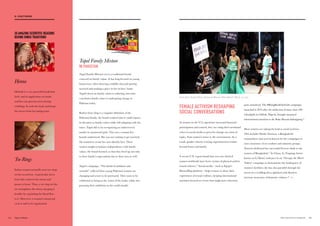
  • 75.
    OMNICHANNEL PRINCIPLES Omnichannel principlesaddress critical changes occurring in V12 markets due to the rapid evolution of technology and the multiplication of platforms and ways to reach people. Brands need to devise strategies to capitalize on opportunities made possible by technology and meet the expectations of consumers on whatever technological medium they use. Omnichannel principles leverage key drivers of velocity, with a focus on mobility, ecommerce, and data. ARCHITECT IN PARTICIPATION AND CONTRIBUTION Marketers must re-cast their perception of consumers from being “targets” to being active participants, who expect, and even sometimes demand, a role in marketing activities. Further, marketers will need to understand and embrace the full potential of customer contributions in helping to build and differentiate brand development and overall business models. In order to make the most of the potential to link new channels and properties, brands will need to use creative elements that amplify and enhance one another so that consumers see and experience marketing across more parts of their lives. Even as it deploys more extensive channels and consumer data, multi-channel marketing needs to stay focused on the goal of creating “something so good, you want to spend time with it.” Marketing in V12 nations must encourage consumers to move from recommendation to contribution. Consumers have long participated in the support of their favorite brands by recommending them to others – a critical part of the loyalty pay-back of brands. In the past, recommendations often happened in a personal interchange of some type. Now, most brand commentary and participation has jumped to social networks, comparative websites, and other online forums. As it has done so, the potential for consumer contribution to brands has increased. As a result, companies must consciously design ways for consumers to support and prompt contribution. Baileys IN MEXICO On Mother’s Day, Baileys inspired Mexican women to take back that phrase and use it to honor their mothers by joining a movement called Hija de Mi Madre (Daughter of My Mother). The campaign was built around audience contributions. Short films of women declaring themselves daughters of their mothers challenged the viewer to do so as well. That, plus a manifesto where women talked about great lessons they learned from their mothers, led to an ongoing conversation in social networks, during which shared photos and messages expressing the pride of being a daughter. In adopting this approach, Baileys made itself part of the Mexican culture and lexicon and intertwined its fortunes with a very different sort of word of mouth. This work shows the power of digital recommendation and contribution as a combined strategy. …something so good, you want to spend time with it. 149148 THE VELOCITY 12 MARKETS 03. VELOCITY MARKETING PRINCIPLES
  • 76.
    TripAdvisor IN CHINA The riseof economic and social power in China has led to dramatic growth in the travel industry. China will overtake the U.S. as the largest domestic-travel market in the world in 2030. In order to gain a larger share of this market, TripAdvisor printed thousands of its unbiased traveler reviews on bus shelters in Beijing, Shanghai and Guangzhou. In a short time, TripAdvisor had successfully joined the mainstream conversation in social media. TripAdvisor highlighted its differentiating feature – unfiltered consumer reviews delivered online – via the very physical infrastructure that is booming all over China. It’s a plan that marries traditional high-traffic marketing with digital and social power, much as TripAdvisor itself is a mashup of the digital and physical worlds. It’s a strategy more and more brands will be following in the V12. KFC IN CHINA With more than 34 million fans on the Chinese social site Baidu BBS, Korean boy band sensation EXO is one of the fastest growing pop groups in China. For the digitally-savvy fans of the group, KFC saw the opportunity to create an omnichannel physical/digital universe, thus honoring the preferred connection channels – and mobile first leanings – of the band’s millions of followers. KFC created a universe of content anchored on a 3D mobile app EXO-themed dancing game. Then, KFC linked the digital experience to QR codes on band figurines (distributed with KFC’s new Korean meals), thus turning a digital-only idea into a connected real-world event. The app also offered other fun bonus content, including EXO alarm clocks, stickers to share on WeChat, and cartoons where people could add their own photo into scenes with the band. Brands should search for their super fans, highly motivated, highly involved members of digital communities who can act as drivers of commerce and engagement for content creators and the brands they associate with. Not only do super fans drive revenue themselves, but they also set the tastes for the remainder of the community and lead their commercial activities. However, they are not the only golden nuggets for a brand to find. For years, the key measure of loyalty was the lifetime value of a customer, primarily a measure of their repeat purchases. This transactional measure still counts, but now there is also the growing economic value of the network effect of customer contribution. A consumer might purchase a lot of a company’s product, but if she fails to tell anyone about the product, her value as a consumer pales against her counterpart who spends the same amount of money on a company’s products and regularly tells her social network how much better her skin looks as a result. This amplification of recommendation, from word of mouth in the past to activated social network today is a key factor in social seeding of new campaigns and products, and to generating velocity for marketers. Rapid urbanization in the V12 markets has led to a variety of changes in their physical landscape, particularly in the megacities. The V12 cities have seen explosive growth of malls, mega airports and other locations that can act as nexuses of consumers. Marketing plans that aim to build customer contribution and participation must increasingly locate these high impact geographic areas. Mobile and other digital devices must also play an active role in connecting physical, in-market activities with the virtual world. Most research indicates that the impact is greater when channels are linked and pervasive – when they work together. This is true, not just for media channels, but for digital ones that extend and amplify messages, entertainment properties, and even physical merchandise. Social media and earned influence, while extending these ideas, can also often generate traditional media coverage. Key linkages reinforce core ideas, and each channel plays a role. ■ 151150 THE VELOCITY 12 MARKETS 03. VELOCITY MARKETING PRINCIPLES
  • 77.
    PERSONALIZE (WITH CARE ANDPRIVACY) Success in the V12 markets will increasingly require robust data and personalization strategies. Failing to fully leverage data, and the personalization it can support, will likely result in falling behind the competition and failing to keep up with consumers’ escalating demands. Given the power of cloud technology, even smaller local brands can now leverage data and data mining. Personalization is the promise of the age, whether through mass customization of products, or through deep algorithm-based insights that are part of a CRM program. At the center of much of this is data – the fuel and byproduct of personalization. Data mining promises to improve lives, provide more relevant and tailored products and experiences, and anticipate the needs of individual consumers. However, privacy is the potential wolf at the marketing door. Consumers are increasingly data aware, but privacy paranoid. They are fully aware of the importance and value of their data. Consequently, they are increasingly paranoid about how it is collected, stored, and used. Marketers need smart strategies to collect, understand, and use data to personalize. In many V12 markets, social services lag behind demand, and brands play an ever-larger role in satisfying the needs of consumers. Where government services lag, brands increasingly fill the void with new useful activities connected with individual data. For more brands, this means moving beyond communications to creating platforms for action and service innovation. Nestlé Beyond IN VIETNAM Brands don’t need to be selling a service to provide a service to consumers. Nestlé’s MILO Beyond program created a MILO Champions Band and app that is the first kid-specific tracking system for nutrition and performance. It monitors nutrition intake via the Champions Energy Calculator and provides parents and children with useful information, rewards, and inspiration to encourage a healthy lifestyle. The ecosystem is made up of a customized wearable tracking device that connects via Bluetooth to specially designed apps that monitor, analyze, and suggests ways to improve a child’s daily food and activity level in a fun, gamified manner. Why was this necessary? While smartphones and technology are becoming prevalent, basic health information is less easy to come by. In this case, an international brand has provided that valuable service. Share a Coke IN INDONESIA The Share a Coke program, which allows consumers to put their names on bottles of soda, has traveled from its birthplace in Sydney all over the world. But when it was launched in Indonesia, this emblem of personalization had to personalize its own strategy due to a unique feature of the Indonesian marketplace. Indonesians place tremendous cultural weight on someone’s name. The name a person has not only means something in the language, it is also believed to reflect something of the character of the person bearing it. Parents in Indonesia embed their dreams and aspirations into the names they give their children. And there is an unspoken hope that a child will live up to the meaning of his/her name. This devotion to names has taken an ugly turn recently during a rash of public name calling. In Indonesia, cruel slurs stick and a negative nickname can have a devastating effect on a person. To align its campaign to Indonesia’s unique attachment to names, Coca-Cola created Web content tackling the problem of name bullying in Indonesia. In an online video created by Coke that has become extremely popular, a group of teenagers who have been teased about their names share the pain they’ve experienced and their parents are shown defending their children, talking about the love that went into choosing these names. This extra twist on a global personalization program enables Coke to both expand a marketing campaign and address a critical social issue in Indonesia. Share a Coke in Indonesia. 153152 THE VELOCITY 12 MARKETS 03. VELOCITY MARKETING PRINCIPLES
  • 78.
    Sources of consumerdata today include both closed graph personal data (for example, your credit card information), and open graph data, which is now readily available via social networks and platforms. All of it, structured and unstructured alike, is being mined with more sophisticated technology than ever before. Search is one of the key sources of personal data. Search data is, in many ways, the purest expression of intent: people generally search for things they want or need. Smart intent modeling from this search data is a powerful tool available to marketers today. Given the equalizing effect of cloud technology and the data that supports it, this applies as much to the V12 markets as anywhere else in the world today. The leveling effect of technology is creating a V12 data leapfrog. Companies such as Google are as sophisticated in Mexico City or Bangalore as they are in San Francisco. And there are local technology platforms and players ranging from Brazil, to India, and China. Consequently, many local V12 companies, even middle-sized ones, can access powerful platforms and exploit data as well as any American or European Fortune 500 company. The benefits of using data well are manifold – but so are the liabilities. Handle data with extreme care! Consumers worry about the potential misuse or theft of their data. Plus, just as we warned against the dangers of the content landfill, the dangers of the data landfill are equally perilous. Data that constitutes personal consumer information can create a liability if lost or stolen, and if there was no good reason to collect it in the first place, a company will have increased its risk for no gain whatsoever. Data integrity and security must be a vigilant focus of all companies as they leverage the benefits of Velocity Marketing approaches. ■ Hellmann’s Mayonnaise IN BRAZIL Unilever has a long-standing and strong presence in Brazil. Nevertheless, marketing Hellmann’s mayonnaise has been a challenge in the country. Hellmann’s may be a multi-purpose condiment around the world, but most people in Brazil think mayonnaise is only good for sandwiches. So Unilever chose a creative approach to overcome this obstacle – at the point-of-sale. Software was installed in 100 cash registers at a major supermarket chain. When the computer in the cash register recognized a Hellmann’s purchase, it scanned the other items in the shopping cart and generated a personalized recipe for the shopper that included mayonnaise as an ingredient. Innovative, location- and data-enabled marketing can help overcome cultural barriers and habits to introduce new uses for great brands. DEPLOY COMMERCE CONTINUOUSLY As the $1 trillion force of ecommerce and m-commerce continues to reshape the way people shop and buy in more of the world, an important shift in focus needs to take place: a move toward Continuous Commerce. This shift widens the view of ecommerce to better link brand and sales efforts. It’s Continuous Commerce, not simply ecommerce. Some marketers equate ecommerce with a website or the shopping cart. But Continuous Commerce is more than that. It tracks the full arc of the consumer journey and connects the brand efforts more tightly with the final sale. Consumer connections to both ecommerce and m-commerce intersect in more parts of consumers’ lives today. So, an omnichannel approach centered on the brand and customer experience is key to success. However, many companies fail because they begin and end at the transaction, embracing only part of the full commerce relationship with the customer – a relationship which begins well before the sale and continues well after the first transaction. In many ecommerce relationships, the first transaction is not profitable; the money is in the lifetime customer relationship. Many ecommerce solutions don’t answer consumers’ needs. They just solve part of them. Some offer robust technological solutions but poor customer and brand experiences. Others provide beautiful imagery and storytelling but fail to deliver a reliable and scalable technology infrastructure. Most commerce solutions are uni-channel, while over 80% of consumers’ purchase journeys involve at least two channels. Those multiple channels may include connections via a QR code on a billboard in an airport or train station or a shoppable window in an online banner served via an ad exchange. Or it could be a click-to-call button at the end of a piece of content or at a brand comparison or review site. Because shoppers want to connect more seamlessly from brand browsing or content to purchase, it’s critical to build brand interactions into transactional platforms, rather than just looking at commerce functionality (though that must work flawlessly and securely, too). ■ All Things Hair IN THE PHILIPPINES All Things Hair is the first-ever online brand channel for hair solutions. It is a platform that leverages Unilever’s extensive hair expertise by providing useful and relevant content based on Filipino women’s online search activities, an attempt to build an ongoing relationship with the consumer. Rather than just pump out branded content for its consumers, All Things Hair partnered with already-popular local vloggers and style influencers to create content, in effect piggybacking on their influence and breadth of material and making sure that there was dynamically changing content to keep consumers engaged. In order to make the advice on the site actionable, All Things Hair integrated an ecommerce system that drove sales through a partnership with ecommerce giant Lazada, closing the loop from brand building to continuous commerce. 155154 THE VELOCITY 12 MARKETS 03. VELOCITY MARKETING PRINCIPLES
  • 79.
    CONCLUSION: SUCCEEDING IN THECOMING DECADE While the V12 nations enjoy many advantages, their full growth potential will ultimately depend upon a number of factors that allow infrastructure to develop, incentivize innovation, and support growth. In the V12, as anywhere, growth is best managed by attentive, transparent governments with a set of laws and regulations that ensure a safe, profitable, ethical and peaceful business environment for foreign investors and their companies. Conversely, economic mismanagement, onerous taxation, war, terrorism, pollution and resource degradation, corruption and breaches of intellectual property rights can deter both internal growth and external investment. Even worker, consumer and environmental backlashes can send a fly-by message to multinational companies considering doing business in these countries. Steady growth is not guaranteed, even with the strong intrinsic factors in the V12. And it is no longer possible for countries to keep secrets about their business environment and policies, particularly when international watchdog groups are more vigilant than ever about substandard commercial, labor and regulatory conditions and publish openly on the internet. In other words, compliance with high standards and good government has become another form of good business. Succeeding in the next decade in the V12, will require new skills, and a shift of mindset regarding the “emerging markets.” The V12 markets depend on a complex matrix of macro-economic and geopolitical policies in order to realize their potential. Four areas in particular stand out as concerns that V12 nations need to focus on in order to develop, thrive, and spur commercial growth: Intellectual Property Protection; Rooting Out Corruption; Protecting the Environment; and Balanced and Intelligent Taxation. These four areas are likely to be flash points in the coming decade and, therefore, the focus of corporate and government relations. Ultimately, they will determine the contours of V12 economic development. INTELLECTUAL PROPERTY PROTECTION The regulation of intellectual property rights in the V12 is an evolving story, by no means consistent across markets. In some countries, it is built into the local Constitution, which does not always guarantee compliance. In others, it has become a lightning rod for litigation, especially from multinational corporations paying a high cost for its violation. All of the V12 nations are members of the World Trade Organization, which means they have committed to a series of IP and patent regulations. Yet, it is generally accepted that the enforcement of these policies varies. One solution for intellectual property infringement that is having a palliative effect is the idea of trading zones that promote intellectual property rights as an essential component for regional economic growth and sustainability. For example, APEC (Asia-Pacific Economic Cooperation) recognizes that “intellectual property rights (IPR) protection and enforcement is a key factor for promoting foreign trade and investment, as well as for boosting economic development.” Intellectual property protection can also incentivize innovation in the V12. We see this not only among local corporations establishing RD hubs and developing patents for export and brand competition, but also with the young SMEs (Small and Medium Size Enterprises) that are burgeoning with the expanding middle class. In Asia, APEC has taken the lead in educating SME0s about the best ways to protect their intellectual property. Companies investing in brand building in the V12 markets will need to step-up their intellectual property lobbying and government relations efforts in the coming decade to ensure the integrity of their brands and the protection of their distinctive product advantages. The geopolitical picture. 157156 THE VELOCITY 12 MARKETS 03. VELOCITY MARKETING PRINCIPLES
  • 80.
    BANGLADESH MYANMAR NIGERIA PAKISTAN VIETNAM BRAZIL MEXICO INDIA EGYPT CHINA PHILIPPINES INDONESIA 2.9 3.2 3.3 3.5 3.6 3.6 3.7 3.8 3.9 4.2 4.3 4.3 Source: World EconomicForum’s Global Competitiveness Report 2015 – Executive Opinion Survey. CORPORATE ETHICS ACROSS THE V12 Among the worst in the world Among the best in the world 4.2GLOBAL AVERAGE: 4.2 1.00 2.0 3.0 4.0 5.0 6.0 7.0 ROOTING OUT CORRUPTION All of the V12 countries scored below 50 in the 2015 Corruption Perception index, a gauge of the perceived levels of public sector corruption by the watchdog group Transparency International. On a scale of 0 to 100 – ranging from highly corrupt (0) to very clean (100) – India and Brazil achieved the best scores at 38; Nigeria, Bangladesh and Myanmar were the most challenged at 26, 25 and 22 respectively. In addition, in the World Economic Forum’s ranking of corporate ethical behavior in interactions with public officials, politicians, and other firms, V12 countries are just under (or in the case of the Philippines and Indonesia, just above) the global average. TRANSPARENCY INTERNATIONAL CORRUPTION PERCEPTIONS INDEX (2015) RANK COUNTRY SCORE 76 INDIA 38 76 BRAZIL 38 83 CHINA 37 88 INDONESIA 36 88 EGYPT 36 95 PHILIPPINES 35 95 MEXICO 35 112 VIETNAM 31 117 PAKISTAN 30 136 NIGERIA 26 139 BANGLADESH 25 147 MYANMAR 22 Source: Transparency International, 2015 Corruption Perceptions Index). Like intellectual property legislation, the reach of extra- territorial legislation on corruption and bribery abroad is having a significant impact. The UK Bribery Act and the US Foreign Corrupt Practices Act (FCPA) make it a crime in their respective jurisdictions to bribe officials of another country or engage in other corrupt activities abroad. Under FCPA, multinationals that have engaged in corrupt activities in V12 and other developing nations companies have been successfully prosecuted and ordered to pay fines. OECD countries may lead the way in helping V12 nations to curtail corruption, but the V12 cannot afford to ignore this problem. Companies operating or expanding their presence in the V12 could play a big role in driving more ethical practices and in leveling commercial playing fields, particularly given the inherent policing power in global transparency. In your country, how would you rate the corporate ethics of companies (ethical behavior in interactions with public officials, politicians, and other firms)? [1 = extremely poor—among the worst in the world; 7 = excellent—among the best in the world] Sao Paulo, Brazil, 13 March 2016: Millions of Brazilians took to the streets to protest against the government of Dilma Rousseff and ask for her impeachment. 159158 THE VELOCITY 12 MARKETS 03. VELOCITY MARKETING PRINCIPLES
  • 81.
    Traffic jam witha congestion of scooters and people, Ho Chi Minh city, Vietnam. PROTECTING THE ENVIRONMENT The global pressure for climate change policies, activist exposure of industrial pollution, and the World Health Organization’s (WHO) efforts on behalf of public and worker health and safety rules have intensified concern for environmental protections in V12 countries. The growing middle-class awareness of environmental issues, noted above, adds further local pressure in several of the V12 markets. In some cases, the significance and size of the export market along with the global strength of industry associations have incentivized, and rewarded, reticent countries to improve their environmental performance. As an example, responding to activist exposure of the high lead content in Chinese-made toys – revelations that hurt the reputation of the Chinese toy industry in the West – the International Toys Industry Association has over the past 15 years instituted a self-regulating public-private partnership with Chinese supply chains, (ICTI Cares), local authorities, the Chinese central government and Chinese environmental watchdogs. Companies from Mattel to Lego to Microsoft Xbox have effectively argued to their Chinese partners that export profits depend on environmental compliance. In a globalizing world, growth economies will not be exempt from this aspect of doing business. This issue is a moving target. There are still many multinational companies that are devoted environmental citizens at home but environmental agnostics abroad, out of view from their own public and regulators. But it is harder than ever to sweep environmental safety problems under the rug by adopting a “pollute now, pay later” policy, particularly with activists on social media more than happy to broadcast allegations of public health and worker safety breaches that can destroy the reputation of MNCs and their CEOs. BANGLADESH MYANMAR NIGERIA PAKISTAN VIETNAM BRAZIL MEXICO INDIA EGYPT CHINA PHILIPPINES INDONESIA 41.8 49.0 58.3 51.4 65.1 58.5 73.6 53.6 66.5 65.1 73.7 65.9 Source: 2016 Environmental Performance Index, Yale University Columbia University. ENVIRONMENTAL PROTECTION ACROSS THE V12 Meets no global protection targets Meets all global protection targets 67GLOBAL AVERAGE: 67 0 20 40 60 80 100 Even with the persistence of serious problems, V12 markets – some new to environmental regulation, others new to enforcing these regulations – are performing better. Half rank above the global average in the most recent Environmental Index. Companies can – and will need to – play a role in supporting local environmental efforts. By reaching beyond baseline regulatory compliance, international and local companies can find it extremely advantageous to build their positions as good corporate citizens, in tune with growing local consumer concerns about their environment. All of these issues ultimately point toward one, very large implication: In the coming decade, it will be essential for companies to have more robust government, consumer, and employee relations programs to ensure that they are – and are perceived as – responsible corporate citizens in local V12 markets. As these markets continue to rapidly evolve, and more local and international companies vie for a share of growth, marketing campaigns alone won’t be enough. In addition to following Velocity Marketing Principles for consumer communications, companies will need more sophisticated programs focused on governmental and policymaker outreach, efforts that target the matrix of macro-economic and geopolitical practices that ultimately determine the fate of economic and consumer velocity. 161160 THE VELOCITY 12 MARKETS 03. VELOCITY MARKETING PRINCIPLES
  • 82.
    BALANCED AND INTELLIGENT TAXATION Governmenttax incentives not only attract foreign direct investment (FDI), the key driver of economic growth in Southeast Asia, they also challenge regional trading partners to harmonize their tax policies.52 The single trading zone ASEAN markets and the ASEAN Economic Community (AEC 2015), which includes the V12 markets of Indonesia, the Philippines, Vietnam and now Myanmar, each offer attractive tax incentives for investment in critical economic development zones. From a multinational’s perspective, knowing that its brands will be price competitive is essential before making the decision to enter or expand in a market. Location marketing is a highly competitive game even in the fastest-growing, next tier markets. Corporations and their tax advisors appropriately scrutinize FDI offers diligently to assure that taxes on revenues, business establishment and professional taxes, duties and labor taxes are set at a level that allows for sufficient and growing profit. Other things being equal, low tariff, low tax jurisdictions will be more attractive than their higher tax competitors. Indonesia is the largest ASEAN economy, with the most populous consumer middle class. The country’s “tax holidays,” part of its 2025 economic development, are symptomatic of changes occurring throughout the AEC single market. Under this policy, the Indonesian government can eliminate or reduce the tax burden of companies investing in industries linked to new technologies or that strategic value for the country’s economy.53 Like countries elsewhere that look to foreign investment to support growth, the V12, face a catch-22. Tax environments that are too low, however attractive, make it harder for governments to invest in public infrastructure required for economic growth as well as in the health and education systems needed to ensure that there is the requisite workforce and consumer base for multinationals. Similarly, when the tax base is skewed away from company or professional taxes and towards consumption and personal income taxes, consumer purchases on which foreign investors hope to build their businesses often decline. Balance and negotiation that meets the needs of both the host market and the foreign investor require government and corporate leaders to be partners, from the outset, in mutual economic benefit. However essential tax incentives are to attract FDI to fast-growing markets, they are not always the most important incentive. Executives surveyed 54 in the latest WEF Executive Opinion Survey (2014-15), expressed: more concern in China “about access to financing than about an inadequately educated workforce or tax rates” equal concern in Brazil about labor regulations and infrastructure, as well as tax rates more concern in Nigeria about lack of infrastructure than about tax rates or restrictive labor regulations As with everything else in the V12, there is a social as well as an economic dimension to taxation. Companies rely on a ‘social license to operate’ granted to them by consumers and the governments that represent them. Companies live up to their responsibilities under this social license by aligning with a country’s or city’s public policy priorities, which are funded in part by corporate taxes, and by smart and respectful management of corporate communications, government relations and social responsibility programs in host markets. The damage to a company’s reputation when it doesn’t comply with or is indifferent to the social contract was a hard lesson learned by Walmart in China when it was maligned in documentary films as an exploiter of cheap labor in its Chinese factories. Since Walmart’s future depends on Chinese consumers as well as Chinese manufacturing, Walmart has since 2011 changed its approach in the country and, has been partnering closely with national and local governments in the country to address social and economic issues and agendas. “Just as China is providing Walmart with the lifeblood of its commercial growth, Walmart is helping the Chinese state not just to satisfy the escalating demands of its consumers but to extend Beijing’s regulatory writ. Together, they are engaging in a bold experiment in consumer behavior modification, market economics, and environmental stewardship.” 55 Jakarta City, Indonesia. 163162 THE VELOCITY 12 MARKETS 03. VELOCITY MARKETING PRINCIPLES
  • 83.
    THE DECADES AHEAD– A CONTINUED RESHAPING OF THE WORLD At a macro level, the future holds the promise of billions more consumers in the V12 markets of Asia, Africa, and Latin America who will seek to fulfill their aspirations for a better life, particularly through leveraging technology and connectivity. Over time, the top third of the Velocity 12 will eventually migrate into the upper middle class. As they do, others will take their place as new middle-class consumers. There will be setbacks along the way for some countries. World economic cycles – and unforeseen political events – will create various headwinds. Plus, the progression of demographics will pose challenges over time for some markets as the population ages and labor forces shrink. However, the changes happening with the global middle class are fundamental and societal, not solely dependent upon economic cycles. A continued investment of resources and focus in the Velocity 12 markets represents a key, long-term opportunity for forward- looking marketers seeking global growth. Succeeding in the next decade in the V12, however, will require new skills, and a shift of mindset regarding the “emerging markets.” The brand development strategies and approaches of the past are not an easy or winning formula for the future in these markets. Companies must be ready to re-cast their approaches to product development, brand management, communications, and relations. The most inventive, nimble, and consumer- centric companies will prosper. Companies wanting to capitalize on the velocity opportunities of the future, plus ensure that their brands continue to matter with consumers in new and relevant ways, must be ready to: 165THE VELOCITY 12 MARKETS164 03. VELOCITY MARKETING PRINCIPLES
  • 84.
    Apply consistent principleswith foresight, but tune activities to local attitudes and preferences – their cultures, subcultures, and unique circumstances. THIS WILL WIN HEARTS – AS WELL AS MINDS. 167THE VELOCITY 12 MARKETS166
  • 85.
    CREATE NEW CONSUMER STRATEGIESLEVERAGING TECHNOLOGY, DATA, AND THE VELOCITY OF SOCIAL CHANGE. Companies will need to step-change from pure selling to greater engagement strategies that not only convince consumers about their product or service features, but that also prove their corporate values. 169THE VELOCITY 12 MARKETS168
  • 86.
    DEVELOP INCREASINGLY SOPHISTICATED GOVERNMENT, CONSUMER,AND EMPLOYEE RELATIONSHIPS PROGRAMS. Particularly as more national, state, and city governments seek to promote themselves as attractive business destinations. 171THE VELOCITY 12 MARKETS170
  • 87.
    DEPLOY GREATER FORESIGHT, RECOGNIZINGTHE VELOCITY OF IMPORTANT SOCIAL CHANGES. This will increasingly place women as a critical consumer audience to target when designing products and services and related marketing activities, and it will involve embracing Muslim Futurists and the changing a new approach to Islamic branding that connects it to mainstream values in V12 countries. 173THE VELOCITY 12 MARKETS172
  • 88.
    A “MOBILE-FIRST” APPROACH MATCHESTHE REALITY OF V12 MARKETS. Make mobile technology and emerging ecommerce a centerpiece of ground-up design of products, services, commerce, and communications. 175THE VELOCITY 12 MARKETS174
  • 89.
    DEVELOP MORE PERVASIVE IDEASTHAT MAKE YOUR BRANDS MATTER. Particularly in the face of increasingly nimble, sophisticated, and empowered competitors of all sizes that can use cloud technology and world-class services to compete in virtually any segment in any market. 177THE VELOCITY 12 MARKETS176
  • 90.
    In the end,growth is no guarantee, particularly given the aggressive and capable competition among both local and international brands, with e-players increasingly poised to disrupt traditional business models in every corner of the globe. IN THE COMING DECADE, COMPANIES SEEKING GROWTH IN THE VELOCITY 12 MARKETS MUST BE READY TO EVOLVE FAST OR LOSE OUT. 179THE VELOCITY 12 MARKETS178
  • 91.
    Ogilvy Matheris one of the world’s foremost global communications companies, with a market-leading presence in key emerging markets noted in this study, including China, Brazil, and India. In fact, in terms of market position and creative awards won, Ogilvy leads the world in the emerging markets. This affords Ogilvy a unique view of the developments, cross-market patterns, and cutting-edge communications solutions in these key markets. Our lens is marketing growth and opportunities, and our role is to identify important commonalities across growth markets that marketers can use to gain advantage in fast-developing markets. Contributors Miles Young, Executive Editor Kent Wertime, Principal Author Project Director Dr. Surjit Bhalla, Economics Contributor Robert Lear, Contributing Author Velocity Drivers Contributors Shelina Janmohamad, Muslim Futurists Lucy Hurst, Benoit Wiesser, Gender Velocity Kunal Sinha, Urbanization Velocity Satoko Sato, Technology Velocity Market Contributors Madhukar Sabnavis, Prem Narayan, Aparna Jain, India Lillian Wu, Mason Xiang, Jeremy Webb, Ali Kazmi, China Shen Acosta, Elly Puyat, Philippines Georges Aoun, Egypt Fahima Choudhury, Bangladesh Daniela Glicenstajn, Juliana Franca, Brazil Ruby Sudoyo, Anton Reyniers, Katryna Mojica, Indonesia Muzakir Ijaz, Asim Naqvi, Pakistan Jan Erhardt, Guillermina Mendoza, Mexico Andy Annett, Myanmar Ossama El Kaoukji, Iran Alex Clegg, Vietnam Research, Trends, and Project Management Contributors Simon Webb, Velocity 12 Research Director Alexander Banon, Research and Project Management Samar Taher, Research and Project Management Mittu Torka, Trends Jennifer Jamieson, Research Editorial and Production Jeremy Katz, Editor and Production Director Christopher Celletti, Production and Proofing 181THE VELOCITY 12 MARKETS180
  • 92.
    1 Ray Dalio, BridgewaterAssociates, Why Countries Succeed and Fail Economically, page 5 2 Research from Dr. Sujit Bhalla 3 Ossama el kaoukji, MEMAC Ogilvy 4 http://www.al-monitor.com/pulse/originals/2014/03/iranian-economy-women-reform.html 5 “Chinese Investments in Special Economic Zones in Africa: Progress, Challenges and Lessons Learned” Final Report, World Bank, January 2011, page 8 6 Xi Expected to Pledge Investment in Africa on Trip, Te-Ping Chen and Patrick McGroarty, The Wall Street Journal, December 1, 2015, page A5 7 http://www.economist.com/blogs/graphicdetail/2012/04/focus-4 8 “Top 10 Things Everyone Should Know About Women Consumers”, Bridget Brennan, Contributor, Forbes, January 21, 2015 9 Unilever CMI/The Future’s Company, Oct 2015 10 Female entrepreneurs account for one quarter in China: white paper (Xinhua) Updated: 2015-09-22 12:01, http://www.chinadaily.com.cn/china/2015-09/22/content_21947630.htm ia “Billionaires Report”/PWC and UBS, 2015 11 Female Entrepreneurship Resource Point — Introduction and Module 1: Why Gender Matters, http://web.worldbank.org/WBSITE/EXTERNAL/TOPICS/EXTGENDER/0,, contentMDK:23392638~pagePK:210058~piPK:210062~theSitePK:336868,00.html 12 Reported in e-marketer Sept 2015 via the Dentsu Aegis network). 13 Female Entrepreneurship Resource Point — Introduction and Module 1: Why Gender Matters, http://web.worldbank.org/WBSITE/EXTERNAL/TOPICS/XTGENDER/0,, contentMDK:23392638~pagePK:210058~ piPK:210062~theSitePK:336868,00.html 14 United Nations, The World’s Women 2015” report, October 2015 15 United Nations, The World’s Women 2015” report, October 2015 16 “Women’s rights activists use social media to get their message”, The Guardian, Liz Ford, Thursday 19 March 2015 17 https://en.wikipedia.org/wiki/Wasfia_Nazreen 18 “Five Chinese feminists held over International Women’s Day plans”, The Guardian, Tania Branigan, Thursday 12 March 2015 18.03 GMT 19 http://www.globalhospitalsinfocentre.lk/global-health-city-chennai-first-hospital-in-india-to- achieve-halal-certification.html 20 http://www.businessinsider.com/afp-indonesians-snap-up-luxury-cows-for-muslim-eid- festival-2014-10?IR=T 21 http://www.theguardian.com/world/2016/jan/07/dolce-gabbana-debuts-luxury- hijab-collection 22 UN Global Prospectus 23 http://www.economist.com/blogs/graphicdetail/2012/04/focus-4 24 UN Global Prospectus 25 The Economist, Daily chart, “Bright lights, big cities: Urbanization and the rise of the megacity, Feb 4th 2015, http://www.economist.com/node/21642053 26 https://hbr.org/2015/10/the-future-and-how-to-survive-it 27 http://archives.dailytimes.com.pk/editorial/20-Apr-2013/view-identity-crisis-in-pakistan-ii- mudasir-nazar 28 Ursula Grant (2012): Urbanization and the Employment Opportunities of Youth in Developing Countries, Unesco working Paper. 29 “Packed Cities, empty villages Vietnam’s Migration Dilemma”, Thanhnien News, Tran Thi Minh Ha, AFP, Sunday, December 13, 2015 30 “Packed Cities, empty villages Vietnam’s Migration Dilemma”, Thanhnien News, Tran Thi Minh Ha, AFP, Sunday, December 13, 2015. http://www.thanhniennews.com/society/ packed-cities-empty-villages-vietnams-migration-dilemma-55922.html page 22 page 28 page 29 page 34 page 50 page 52 page 53 page 55 page 59 page 60 page 65 page 65 page 76 page 79 page 80 page 83 page 84 page 87 page 89 page 90 page 92 183182 THE VELOCITY 12 MARKETS
  • 93.
    31 http://www.internetworldstats.com/stats2.htm 32 The Indian Express,India to surpass US with 402 million Internet by 2016: IAMAI, November 20, 2015 33 http://www.entrepreneur.com/article/254026, Joe Hyrkin, “More Than 2 Chinas Worth of People Will Be Digitally Connected By 2020. Are You Ready?, January 14, 2016. 34 EMarketer, April 2015 35 The Indian Express, India to surpass US with 402 million Internet by 2016: IAMAI, November 20, 2015 http://indianexpress.com/article/technology/tech-news-technology/india-to-have-402-mn- internet-users-by-dec-2015-will-surpass-us-iamai-report/#sthash.yHeLuqER.dpuf 36 Can’t give it away, The Economist, January 9, 2016, page 55 37 Financial Times, “Facebook, Google, and the Race to Sign-Up India”, page 18/19, March 19/20, 2016 38 http://www.internetworldstats.com/asia/bd.htm 39 We Are Social, 2016 Report, Mobile’s Share of Web Traffic, page 27 40 GlobalWebIndex, Q4 2015 41 Brian Fetherstonhaugh article on e-commerce 42 Can’t give it away, The Economist, January 9, 2016, page 55 43 Loretta Chao, “Emerging-Market Consumers in Focus for Logistics Providers”, Asian Wall Street Journal, Sept. 30, 2015 44 http://www.vanguardngr.com/2015/08/how-online-marketplace-drives- e-commerce-growth-in-nigeria 45 http://www.adobomagazine.com/philippine-news/battle-fried-chicken-chicken-mcdo- vs-chicken-joy 46 https://www.gov.uk/government/publications/china-labour-relations-in-guangdong/ china-labour-relations-in-guangdong. Foreign and Commonwealth Office. “Research and analysis China – labour relations in Guangdong”, 30 January 2015. 47 http://www.worldbank.org/en/news/feature/2015/10/10/action-urged-on-climate-change- growth-slowdown, Action Urged on Climate Change, Growth Slowdown”, World Bank website, October 10, 2015 48 “Smash-hit Chinese pollution doc Under the Dome taken offline by government”, The Guardian, Ben Beaumont-Thomas, Monday 9 March, 2015. http://www.theguardian.com/ film/2015/mar/09/chinese-pollution-documentary-under-the-dome-taken-offline-government 49 INEGI Instituto Nacional de Estadística y Geografía. Censo Nacional de Procuración de Justicia Estatal 2014. 50 INMUJERES. Violencia Feminicida en México 1985-2010 51 Statista 52 ASEAN TAX GUIDE, KPMG International November, 2013) kpmg.com/Global/en/ IssuesAndInsights/ArticlesPublications/Documents/asean-tax-guide-v2.pdf 53 PWC, South East Asia Investment Opportunities, Tax and Other Incentives, September 2012 54 As reported by EY Tax Insights for Business Leaders, No.13, 2015 55 The Atlantic, December, 2011. theatlantic.com/magazine/archive/2011/12/how-walmart-is- changing-china/308709/) page 99 page 100 page 101 page 103 page 104 page 107 page 108 page 109 page 110 page 111 page 122 page 130 page 130 page 140 page 145 page 162 page 163 185184 THE VELOCITY 12 MARKETS
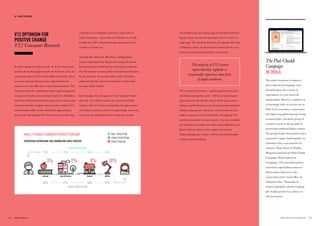
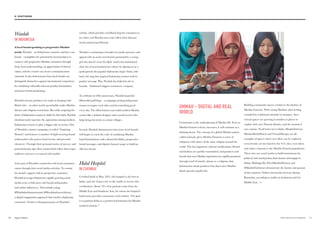
  • 95.
    M A DE I N Q U E E N S B Y C 4 2 D