IMAP
amagazinecreatedbyimapdedicatedtocreatingvalueintheM&Amid-market
Creating
value
no. 3 decEMBER 2017
Chemical manufacturer DBWT
Up Groupe expands in Brazil
Mirka acquires in Italy
CASE STUDIES
IMAP in Latin America
Rise of Multilatinas
Automotive Technologies
INSIGHTS
Fertility Treatment a global industry
Retail looks to be in fashion
Cautious optimism in Oil & Gas
Consolidation in Live Music
SECTOR FOCUS
www.imap.com
In This Issue
30
04
INSIGHTS
Latin America Special Feature	 4
IMAP Bogota Conference & Rise of Multilatinas	
Automotive Technologies	 12
Interview with Javier Lazpita (CEO, Teknia Group)
Merchant Banking Revival	 16
Interview with Dan Bricken (Founder, EH Global Capital)
Construction Boom in Central Eastern Europe	 18
Is construction the next big thing?
	
SECTOR FOCUS
Fertility Treatment	 20
Cultural and lifestyle changes driving demand for fertility services
Oil & Gas	 24
Cautious optimism in an ever-changing industry
Fashion Retail – Quiz IPO	 28
Investing in retail looks to be in fashion
Live Music Entertainment	 30
Is live entertainment on the road to consolidation?
CROSS-BORDER FOCUS & CASE STUDIES
Private Equity Driving Chemicals M&A Surge	 34
Chemical manufacturer DBWT advised on sale to SK Capital
Partners
Up Groupe Expands in Brazil	 36
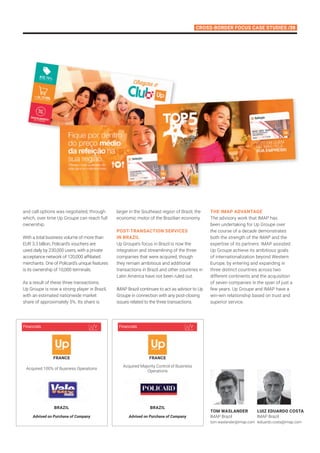
Up Groupe advised on three acquisitions in the prepaid benefit
cards market
Mirka Develops Business Globally 	 40
Finnish tool and abrasives manufacturer Mirka advised on the
acquisition of Cafro in Italy
Turnaround Management Best Practices	 42
PE fund Nimbus transforms RCP before selling to Zobel
Peru – Mexico Pharmaceutical Deal	 44
A family-owned success story in the pharmaceutical sector
IMAP IN FOCUS
Selected IMAP Transactions	 46
About IMAP	 48
IMAP Poland – Euromoney Award	 50
12
18
Editors:
Dr. Carsten Lehmann
Managing Partner, IMAP Germany.
Chairman, IMAP European Council.
carsten.lehmann@imap.com
Gabor Szendroi
Managing Partner, IMAP Hungary.
Deputy Chairman, IMAP European Council.
gabor.szendroi@imap.com
Welcome to the latest edition of Creating Value. As we end a very
successful 2017, we look back on a few of our recent successes
and consider a wide range of developments impacting business
sectors and the M&A market.
As forecasted in the previous edition, 2017 has been a transaction rich period at IMAP.
As we go to print we have registered around 160 transactions with a total reported deal
value of over $10 billion. In this edition, you will find a few of our recent success stories,
including the sale of a pioneering chemicals producer to a private equity firm, as well as
a transaction involving a 100-year old family-owned Peruvian pharma company.
Last October IMAP held its semi-annual meeting in Bogota, Colombia, our first
conference in Latin America since 2007. During the conference, we heard from
distinguished guests about the rise of the ‘Multilatinas’ and the role of private equity in
the region, and had panel discussions about M&A opportunities and how to increase
cooperation between Latin America and the rest of the world. Naturally, our cover story
features some excerpts from these discussions.
As always, we are also including some sector-focused deep dives covering
issues in a diverse set of industries from growth in fertility treatment services, to
technological disruption in the fashion retail space, and movement in the live music
entertainment industry.
Finally, we congratulate IMAP Poland – Trigon on being named Best Investment Bank
in Poland by Euromoney Awards for Excellence 2017. As Piotr Chudzik notes, “…(this)
is not only a great honor, but also a reflection of our clients’ trust, cooperation and
openness, all of which motivates us in our ongoing efforts to provide the best level of
products and services. We are confident that by continuing to work together with our
clients, we will achieve many successes in the future.” It is this spirit that motivates all
IMAP partners, and it is fitting that our Spring 2018 conference will be held in Warsaw.
Looking ahead, IMAP’s global nature and tradition of international cooperation is being
reinforced through our focus on industrial sectors and specific sector expertise. The
number of deals being executed and closed by multi-office teams is also on the rise. We
look forward to the busy times ahead of us, and wish you all a very successful 2018.
44
Looking forward to
another great year
in 2018!
24
JURGIS V. ONIUNAS
IMAP Chairman
jurgis.oniunas@imap.com
IMAP’s 2017 Fall
Conference in Bogotá
IMAP as an organization
has a unique global
footprint in developing
countries
Why Bogotá this year?
IMAP’s biannual international conferences
are each held in the region of one of
its partner firms. In 2007, IMAP held a
conference in Mexico City, but we were
yet to hold one in South America, so we
saw this year as the ideal opportunity. We
see a great deal of potential in Colombia;
a dynamic economy and companies have
led to improved business and economic
progression and whose President, Juan
Manuel Santos, was awarded the Nobel
Peace Prize in 2016.
How do you view the Latin American market?
Latin America continues to be a very
attractive developing market for
companies, due to the size of the joint
market that it represents as a region, but
above all because of the great growth
potential it offers and the growing
economic capacity of its population.
What is IMAP’s strategy
for Latin America?
IMAP recognizes the strategic importance
of developing countries for our clients,
who are more internationally focused
than ever before, and that IMAP as an
organization has a unique global footprint
in developing countries.
IMAP is strategically placed and
connected in the Latin American region
and we want to make our clients and
investors know about the investment
opportunities in the Latin American region
and the caliber and experience of IMAP´s
LATAM team.
JURGIS V. ONIUNAS
IMAP Chairman
jurgis.oniunas@imap.com
IMAP Chairman, Jurgis Oniunas, explains why for the first time a South American
city was selected to host its 2017 Fall Conference in October
4/ INSIGHTS: LAtin America Special Feature
INSIGHTS: LAtin America Special Feature /5
Taking away the stigma
as a country in conflict
will attract significant
improvements and bring
a new wave of investment
Stability in the economic
and political backdrop
Colombia has had a difficult political
history, but the current panorama is highly
optimistic.
The Peace Accord with the FARC
guerilla was signed recently, generating
opportunities across all industries, and
giving a tangible solution to the conflict.
Taking away the stigma as a country in
conflict will attract significant improvements
and bring a new wave of investment.
While there is currently some uncertainty
around the upcoming 2018 Presidential
elections with no clear candidate, there are
plenty of reasons for Colombia’s optimistic
outlook, including:
	Colombia is one of the Best Business
Environments in Latin America and one
of the most competitive countries in
the region (World Bank, Doing Business
Report, 2017).
	Very attractive to foreign investors
looking for Latin American options.
	Reduced country risk, due to
institutional stability.
	New opportunities in diverse industries
due to the end of the armed conflict.
MAURICIO SALDARRIAGA
IMAP Colombia
mauricio.saldarriaga@imap.com
IMAP’s Colombian partner is one of the most prominent investment banking
firms in Latin America. Managing Partner, Mauricio Saldarriaga, outlines the
reasons for Colombia’s positivity
The IMAP Latin America team discusses MA trends. From the left: Sergio Milic (IMAP Chile), Marcio Fiuza (IMAP Brazil), Pablo
Teubal (IMAP Argentina), Carlos A. Garcia (IMAP Peru), Gilberto Escobedo (IMAP Mexico), Mauricio Saldarriaga (IMAP Colombia)
6/ INSIGHTS: LAtin America Special Feature
Number of Transactions
Total market: all deals done in Latin America
Source: IMAP
Latin America growth potential
Infographic Sources: United Nations, Department of Ecommerce and Social Sustainability World Economic Outlook (October 2017)
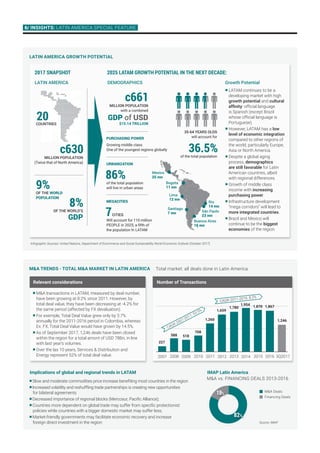
	LATAM continues to be a
developing market with high
growth potential and cultural
affinity: official language
is Spanish (except Brazil
whose official language is
Portuguese).
	However, LATAM has a low
level of economic integration
compared to other regions of
the world, particularly Europe,
Asia or North America.
	Despite a global aging
process, demographics
are still favorable for Latin
American countries, albeit
with regional differences.
	Growth of middle class
income with increasing
purchasing power.
	Infrastructure development
“mega corridors” will lead to
more integrated countries.
	Brazil and Mexico will
continue to be the biggest
economies of the region.
Growth PotentialDEMOGRAPHICSLATIN AMERICA
2017 SNAPSHOT
OF THE WORLD
POPULATION
9%
OF THE WORLD’S
GDP
8%
MILLION POPULATION
with a combined
GDP of USD
$15.14 TRILLION
c661
2025 LATAM GROWTH POTENTIAL IN THE NEXT DECADE:
PURCHASING POWER
Growing middle class
One of the youngest regions globally
URBANIZATION
of the total population
will live in urban areas
86%
MEGACITIES
Will account for 110 million
PEOPLE in 2025; a fifth of
the population In LATAM
7CITIES
of the total population
36.5%
35-64 YEARS OLDS
will account for
Mexico
25 mn
Bogota
11 mn
Lima
12 mn
Santiago
7 mn
Buenos Aires
16 mn
Sãn Paulo
23 mn
Rio
14 mn
MILLION POPULATION
(Twice that of North America)
c630
COUNTRIES
20
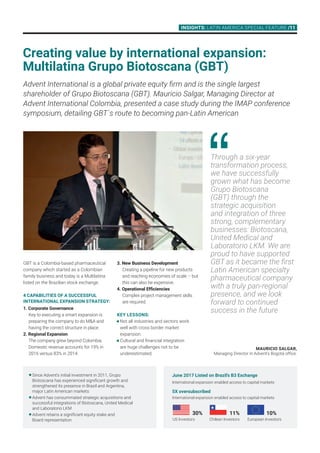
MA trends - total MA market in Latin America
Implications of global and regional trends in LATAM
MA vs. FINANCING DEALS 2013-2016
IMAP Latin America
Relevant considerations
	MA transactions in LATAM, measured by deal number,
have been growing at 8.2% since 2011. However, by
total deal value, they have been decreasing at -4.2% for
the same period (affected by FX devaluation).
	For exemple, Total Deal Value grew only by 3.7%
annually for the 2011-2016 period in Colombia, whereas
Ex. FX, Total Deal Value would have grown by 14.5%.
	As of September 2017, 1,246 deals have been closed
within the region for a total amont of USD 78Bn, in line
with last year’s volumes.
	Over the las 10 years, Services  Distribution and
Energy represent 52% of total deal value.
Slow and moderate commodities price increase benefiting most countries in the region
Increased volatility and reshuffling trade partnerships is creating new opportunities 	
for bilateral agreements
Decreased importance of regional blocks (Mercosur, Pacific Alliance);
Countries more dependent on global trade may suffer from specific protectionist
policies while countries with a bigger domestic market may suffer less;
Market-friendly governments may facilitate economic recovery and increase 	
foreign direct investment in the region
1,659
1,954
1,780 1,870 1,867
1,246
708
1,260
518588
227
2007 201620152014201320122011201020092008 3Q2017
CAGR 2007-2011: 53.5%
CAGR 2011-2016: 8.2%
18%
82%
MA Deals
Financing Deals
INSIGHTS: LAtin America Special Feature /7
WHAT ARE MULTILATINAS?
During the last two decades, Latin America
has witnessed the emergence of the so-
called Multilatinas, which are multinational
firms of Latin American origin that
have achieved incredible success in the
transformation from local companies to
global players.
Multilatinas are industry leaders that have
grown beyond their country’s borders and
have typically expanded into other markets
within the LATAM region, but in many cases
have also expanded into markets such as
the United States or Europe.
In the last ten years the number of
Multilatinas in the top Fortune 500 list have
tripled. To get a perspective of revenue,
100 leading Multilatinas have aggregated
revenues of USD 761 BN, representing 15%
of LATAM´s GDP.
THE RISE – how did they become so
successful?
Originally predominantly family-owned and
self reliant financially, many achieved market
dominance through consolidation in their
local markets. Realizing the need to grow
beyond their own markets to diversify and
survive, access to cheaper capital and a
relatively stable economic environment were
drivers for internationalization
Multilatinas do not necessarily need to be
large and established players. Small and
medium sized firms can achieve regional
presence. As Esteban Giraldo, from Grupo
Bimbo says: “It’s not a matter of being big or
not, it’s a matter of mastering your business.
A business model that is good, and
replicable in other markets, will successfully
expand in other markets.”
Multilatinas have developed a core
competence of learning through expanding.
These companies have built a success
formula around scaling in a cost-effective
and sustainable way to generate value.
THE ROLE – why are Multilatinas
important?
The Multilatinas phenomenon has
considerably increased investment
attractiveness in the region as it has forced
markets, governments, legislation, capital
repatriation rules, among others, to become
more streamlined and, consequently, has
made it easier for investors to enter into a
given market and use it as a natural bridge to
other countries in the region.
Shared learnings and secrets of success
from the path set by the Multilatinas will bring
others along the same route to success.
Multilatinas are industry leaders of Latin American origin that have grown impressively
in terms of scale and diversity and are emerging as important regional investors
Outbound MA by leading Multilatinas as
a share within the MA market in Latin
America has been growing. Out of a total of
2,347 transactions worth USD 50 million or
more, the 100 leading Multilatinas comprise
approximately 17% of the number of MA
deals in LATAM since 2007.
Source: Institutional Investor, How Multilatinas are Taking Over the World.
How Latin American companies became global leaders
1970s 1980s 1990s 2000s 2010 2020...
Global
Regional
National
Local
	Impressive not only in scale and diversity, many of today’s Multilatinas were forged
during the decade when the region’s debt crisis, high inflation rates, extensive state
control over the economy and political instability caused stagnation
	Companies that managed to survive and grow through that turbulent period tended
to be family-owned and largely debt-free
	The situation improved in the 90s with more market-oriented policies. Private
companies took advantage of a wave of privatizations to buy up assets at bargain
prices and establish dominant market positions that provided a springboard for
foreign expansion
	Multilatinas have benefited from a stable macroeconomic and political climate 		
and access to cheap capital thanks to the development of local markets
The rise and role of Multilatinas
It’s not a matter of being
big or not, it’s a matter of
mastering your business.
A business model that
is good, and replicable
in other markets, will
successfully expand in
other markets.
ESTEBAN GIRALDO,
President of LATAM Centro at Grupo Bimbo
8/ INSIGHTS: LAtin America Special Feature
Notable Multilatinas
100 leading Multilatinas have aggregated revenues of US$761 billion, representing 15% of LATAM’s GDP.
97% of the Leading Multilatinas are concentrated in Argentina, Brazil, Chile, Colombia, Mexico and Peru.
Source: América Economía Magazine
Mexico
Other countries
Multilatinas
3
Global Footprint of Multilatinas Consolidated Revenue Breakdown by Sector
Number of 100 Leading Multilatinas with a presence
internationally – numbers noted in each region
14
Canada
65
USA
60
Mexico
74
Brasil
50
Europe
21
Africa
10
Oceania
93
South
America
19
Middle
East
40
Asia
Pacific
49
Central
America
OilGas 	
Food  Beverages 	
Telco 	
Multisector 	
Iron  Steel 	
Finance 	
Retail 	
Mining 	
Air transport 	
Others 	
USD 761 BN
17%
29%
19%
8%
6%
5%
5%
4%
4%
3%
Chile
Multilatinas
19 Argentina
Brazil
Colombia
Multilatinas
10
Multilatinas
30
Multilatinas
7
Multilatinas
26
Peru
Multilatinas
5
INSIGHTS: LAtin America Special Feature /9
Top Multilatina’s discussion on expanding
regionally and globally
The session explored the challenges,
opportunities, risks and mitigants
Multilatinas face when they go about
expanding their businesses across the
region and internationally.
Areas covered included:
	 Internationalization and market entry
strategy and how the analysis and
business modelling plan performed versus
actual experience.
	 A discussion on the risks (political, market,
regulatory, currency, integration and
execution) and how these were mitigated.
	 Organic versus inorganic growth when
deciding on new market entry. Pros and
cons to each, especially in relation to global
and local branding
The symposium event was attended by more
than a hundred entrepreneurs, top executives
of the most important companies in Latin
America and investment bankers from more
than 30 countries.
A question to the panelists: What were the main
motivations for carrying out an international
expansion process in your company?
MAURICIO SALDARRIAGA,
Managing Partner at Inverlink IMAP
During the Bogotá Conference, IMAP’s Colombian partner firm held a symposium
event which featured a panel from Multilatina companies that have excelled in
international expansion
10/ INSIGHTS: LAtin America Special Feature
Esteban Giraldo,
President of LATAM Centro at Grupo Bimbo
Necessity; we were the largest, yet couldn’t
grow any more. Our CEO’s leadership at the
time was critical – Peru first, then Brazil
Andreas Baracaldo Sarmiento,
Vice President of Business Development at ISA
We needed to diversify; we didn’t like all
our eggs concentrated in one basket
Global vision and deal making
are in the DNA of the family
Diego Echave,
Director MA at Kaluz
Diversity mostly; we had a high market
share and there was political stability
Jonathan Nickell,
Vice President of Strategy  Business
Development for Organizacion Corona
INSIGHTS: LAtin America Special Feature /11
Through a six-year
transformation process,
we have successfully
grown what has become
Grupo Biotoscana
(GBT) through the
strategic acquisition
and integration of three
strong, complementary
businesses: Biotoscana,
United Medical and
Laboratorio LKM. We are
proud to have supported
GBT as it became the first
Latin American specialty
pharmaceutical company
with a truly pan-regional
presence, and we look
forward to continued
success in the future
GBT is a Colombia-based pharmaceutical
company which started as a Colombian
family business and today is a Multilatina
listed on the Brazilian stock exchange.
4 CAPABILITIES OF A SUCCESSFUL
INTERNATIONAL EXPANSION STRATEGY:
1. Corporate Governance
Key to executing a smart expansion is
preparing the company to do MA and
having the correct structure in place.
2. Regional Expansion
The company grew beyond Colombia.
Domestic revenue accounts for 19% in
2016 versus 83% in 2014.
3. New Business Development
Creating a pipeline for new products
and reaching economies of scale – but
this can also be expensive.
4. Operational Efficiencies
Complex project management skills 		
are required.
KEY LESSONS:
	Not all industries and sectors work
well with cross border market
expansion.
	Cultural and financial integration
are huge challenges not to be
underestimated.
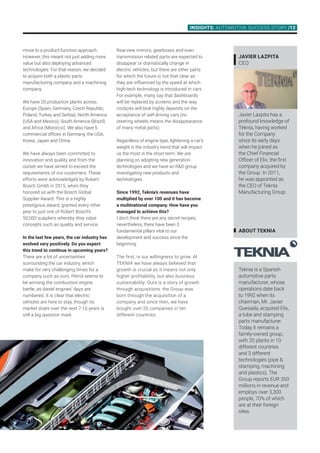
Advent International is a global private equity firm and is the single largest
shareholder of Grupo Biotoscana (GBT). Mauricio Salgar, Managing Director at
Advent International Colombia, presented a case study during the IMAP conference
symposium, detailing GBT´s route to becoming pan-Latin American
Creating value by international expansion:
Multilatina Grupo Biotoscana (GBT)
Mauricio Salgar,
Managing Director in Advent’s Bogotá office.
	Since Advent’s initial investment in 2011, Grupo
Biotoscana has experienced significant growth and
strengthened its presence in Brazil and Argentina,
major Latin American markets
	Advent has consummated strategic acquisitions and 	
successful integrations of Biotoscana, United Medical 	
and Laboratorio LKM
	Advent retains a significant equity stake and 		
Board representation
June 2017 Listed on Brazil’s B3 Exchange
International expansion enabled access to capital markets
5X oversubscribed
International expansion enabled access to capital markets
30%
US Investors
11%
Chilean Investors
	 10%
European Investors
12/ INSIGHTS: AUTOMOTIVE SUCCESS STORY
Strategic growth
in the auto parts sector
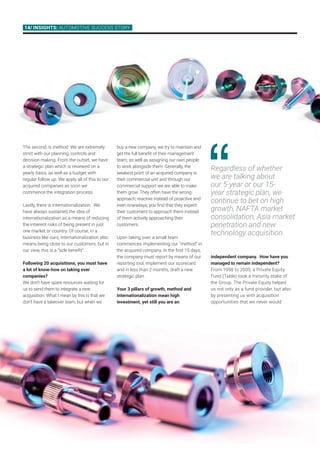
Teknia Manufacturing Group CEO, Javier Lazpita, discusses disappearing
gearboxes, uncertainties facing the automotive industry and the 3 pillars
crucial to Teknia’s success
2017 is Teknia’s 25th anniversary.
How have things changed since its
beginning?
The TEKNIA Group has always worked in
the automotive industry, which is where
the entirety of our output is destined;
principally for the passenger car industry,
although we do manufacture parts for the
commercial and heavy-duty vehicle
industries as well. Our customers are
TIER 1s and OEMs (80% and 20%
respectively) and as we grow and add
further value to our production, OEMs are
starting to gain share in our portfolio.
In the beginning we solely manufactured
tube parts for TIER 2s, but we soon
realized that adding value was key if we
wanted to move up the supply chain. Even
in the early days, we had the vision that the
usual product-part approach taken by
manufacturing companies needed to
INSIGHTS: AUTOMOTIVE SUCCESS STORY /13
Rearview mirrors, gearboxes and even
transmission related parts are expected to
disappear or dramatically change in
electric vehicles, but there are other parts
for which the future is not that clear as
they are influenced by the speed at which
high-tech technology is introduced in cars.
For example, many say that dashboards
will be replaced by screens and the way
cockpits will look highly depends on the
acceptance of self-driving cars (no
steering wheels means the disappearance
of many metal parts).
Regardless of engine type, lightening a car’s
weight is the industry trend that will impact
us the most in the short-term. We are
planning on adopting new generation
technologies and we have an RD group
investigating new products and
technologies.
Since 1992, Teknia’s revenues have
multiplied by over 100 and it has become
a multinational company. How have you
managed to achieve this?
I don’t think there are any secret recipes,
nevertheless, there have been 3
fundamental pillars vital to our
development and success since the
beginning.
The first, is our willingness to grow. At
TEKNIA we have always believed that
growth is crucial as it means not only
higher profitability, but also business
sustainability. Ours is a story of growth
through acquisitions: the Group was
born through the acquisition of a
company and since then, we have
bought over 20 companies in ten
different countries.
ABOUT TEKNIA
Teknia is a Spanish
automotive parts
manufacturer, whose
operations date back
to 1992 when its
chairman, Mr. Javier
Quesada, acquired Elix,
a tube and stamping
parts manufacturer.
Today it remains a
family-owned group,
with 20 plants in 10
different countries
and 3 different
technologies (pipe 
stamping, machining
and plastics). The
Group reports EUR 350
millions in revenue and
employs over 3,300
people, 70% of which
are at their foreign
sites.
Javier Lazpita
CEO
Javier Lazpita has a
profound knowledge of
Teknia, having worked
for the Company
since its early days
when he joined as
the Chief Financial
Officer of Elix, the first
company acquired by
the Group. In 2011,
he was appointed as
the CEO of Teknia
Manufacturing Group.
move to a product-function approach.
However, this meant not just adding more
value but also deploying advanced
technologies. For that reason, we decided
to acquire both a plastic parts
manufacturing company and a machining
company.
We have 20 production plants across
Europe (Spain, Germany, Czech Republic,
Poland, Turkey and Serbia), North America
(USA and Mexico), South America (Brazil)
and Africa (Morocco). We also have 5
commercial offices in Germany, the USA,
Korea, Japan and China.
We have always been committed to
innovation and quality and from the
outset we have aimed to exceed the
requirements of our customers. These
efforts were acknowledged by Robert
Bosch Gmbh in 2015, when they
honored us with the Bosch Global
Supplier Award. This is a highly
prestigious award, granted every other
year to just one of Robert Bosch’s
50,000 suppliers whereby they value
concepts such as quality and service.
In the last few years, the car industry has
evolved very positively. Do you expect
this trend to continue in upcoming years?
There are a lot of uncertainties
surrounding the car industry, which
make for very challenging times for a
company such as ours. Petrol seems to
be winning the combustion engine
battle, as diesel engines’ days are
numbered. It is clear that electric
vehicles are here to stay, though its
market share over the next 7-10 years is
still a big question mark.
14/ INSIGHTS: AUTOMOTIVE SUCCESS STORY
The second, is method. We are extremely
strict with our planning, controls and
decision making. From the outset, we have
a strategic plan which is reviewed on a
yearly basis, as well as a budget with
regular follow up. We apply all of this to our
acquired companies as soon we
commence the integration process.
Lastly, there is internationalization. We
have always sustained the idea of
internationalization as a means of reducing
the inherent risks of being present in just
one market or country. Of course, in a
business like ours, internationalization also
means being close to our customers, but in
our view, this is a “side benefit”.
Following 20 acquisitions, you must have
a lot of know-how on taking over
companies?
We don’t have spare resources waiting for
us to send them to integrate a new
acquisition. What I mean by this is that we
don’t have a takeover team, but when we
buy a new company, we try to maintain and
get the full benefit of their management
team, as well as assigning our own people
to work alongside them. Generally, the
weakest point of an acquired company is
their commercial unit and through our
commercial support we are able to make
them grow. They often have the wrong
approach; reactive instead of proactive and
even nowadays, you find that they expect
their customers to approach them instead
of them actively approaching their
customers.
Upon taking over, a small team
commences implementing our “method” in
the acquired company. In the first 15 days,
the company must report by means of our
reporting tool, implement our scorecard
and in less than 2 months, draft a new
strategic plan.
Your 3 pillars of growth, method and
internationalization mean high
investment, yet still you are an
Regardless of whether
we are talking about
our 5-year or our 15-
year strategic plan, we
continue to bet on high
growth, NAFTA market
consolidation, Asia market
penetration and new
technology acquisition
independent company. How have you
managed to remain independent?
From 1998 to 2005, a Private Equity
Fund (Talde) took a minority stake of
the Group. The Private Equity helped
us not only as a fund provider, but also
by presenting us with acquisition
opportunities that we never would
INSIGHTS: AUTOMOTIVE SUCCESS STORY /15
FERNANDO CABOS
IMAP Spain
fernando.cabos@imap.com
business plan might seem a bit unusual,
but as I mentioned before, we are a
company with a very long-term project. In
addition, all the challenges that surround
the car industry as well as changes in
consumption habits, in terms of car usage
or willingness to own a car, should mean
that having a very long-term vision is not
that unusual.
Regardless of whether we are talking about
our 5-year or our 15-year strategic plan, we
continue to bet on high growth, NAFTA
market consolidation, Asia market
penetration and new technology
acquisition.
Are you expecting to acquire more
companies? What specific markets,
products and technologies interest
Teknia?
Of all the technologies in which we are
currently present (stamping, machining
and plastics), machining is the one we are
planning to invest more in. We are also
interested in aluminum and in a lower
range forging, in the automotive sector
of course.
In terms of geographies, NAFTA and Asia,
with our preferred countries in Asia being
Japan, India, China or Thailand.
Regarding other technologies we are
aiming to move into, one of our top
priorities is aluminum, following the
weight lightening concern, but without
disregarding any other technology or
products that allows us to position
ourselves closer to OEMs.
Finally, at how many times EBITDA do you
usually value a company?
This is a question that does not have just
one answer, as multiples depend on the
country the company is in, its size, its
financial health and performance, if it is a
multi-site company or how strategic the
target company is. In any case, we aim to
pay no more than 3-4 times the two-year
ahead EBITDA.
have come across otherwise. During
that period, we bought 3 or 4
companies which helped the Group
take shape through the consolidation
of the 3 technologies we have been
operating until today: pipe and
stamping, machining and plastics.
Do you see any drawbacks to having a
Private Equity in your shareholding?
In our case, we are a group with a very
long-term perspective, whereas private
equity firms need to do their business over
too short a period of time for us. When
Talde first conveyed us its short exit
strategy, we felt that it was too early, even
for a financial investor and as such tried to
convince them to stay longer. However,
they had their time constraints and the
timeframe mismatch forced the family to
buy back Talde’s stake.
Having said this, we are open to partnering
with investors who have an understanding
of industrial business and therefore could
potentially pursue a long-standing
relationship with us. From our point of
view, Asian investors fit much better for
industrial projects like ours as they are
more patient, which does not mean less
demanding, but their eagerness to do quick
business does not prevail over the project
development, whereas with Western
investors, it usually does.
You mentioned that you update your
strategic plan every year. What are the
strategic guidelines of your plan in such
an uncertain industry?
We have a 5-year business plan as well as
a 15-year business plan. The 15-year
Private merchant banking on the rise:
a new player on the field
Dan Bricken, a seasoned banker with almost 20 years in the sector, shares
his thoughts on setting up a new investment management and advisory firm
A year ago, the Federal Reserve, America’s
most powerful banking regulator,
recommended that Congress reverse a
17-year-old law allowing banks to take big
equity stakes in non-financial companies,
as it seeks to put new curbs on activities
that it says could pose a threat to the
broader financial system. The report was
received with strong objection from those
involved as that would put a stop to the
merchant banking activities of big banks.
Though Congress hasn’t yet enacted
these new regulations, such restrictions
seem to be a natural extension of the
constraints imposed on banks under the
Volker Rule and related regulations since
the financial crisis.
Perhaps in part as a reaction to this,
another trend can be observed: the re-
emergence of an earlier type of banking,
one in which investment advice and
proprietary investment is provided by the
same firm, backed with equity provided by
the founders and partners and potentially
some external investors. This is the
merchant bank, which merges what
traditional PEs and investment banks offer.
A recently born example of this renewed
concept is the London-based Eastern
Harmony Global Capital (EHGC), founded
by seasoned banker, Dan Bricken, and
entrepreneur Daglar Cizmeci. Creating
Value talked to Dan Bricken about their
new venture.
Where did the idea that you wanted to
build a merchant bank come from?
After having spent almost 20 years in
banking, with Wachovia in the US and
then in London (which was subsequently
acquired by Wells Fargo) and after
having built the international MA
network of Wells Fargo covering almost
all significant geographies of the globe,
I thought it was the right time to make
a change. When considering the next
chapter of my professional life, I knew
that I wanted to continue working on
cross-border transactions in collaboration
with the relationships I have built over
the past 20-years, but I wanted to move
beyond simple advisory services towards
building true long-term partnerships
with companies where we could provide
strategic advice, bring capital, and have a
true alignment of interest through having
an equity stake in the businesses we’re
working with.
What is your firm built on?
Our new firm is built on a strategic
relationship with a very special client,
but also on a set of principles that will
Our objective is to build
the firm and execute our
business through our
partnering mindset – while
we will surely remain in the
driver’s seat in all cases
in delivering our services,
we are bringing best in
class partners who bring
specific industry, local
market, and/or product
expertise to work with us
on each specific project
16/ INSIGHTS: merchant banking revival
INSIGHTS: merchant banking revival /17
GABOR SZENDROI
IMAP Hungary
gabor.szendroi@imap.com
banker at a partner bank recently reached
out to us to help a company he is close
to raise capital and also provide them
financial advisory services on an ongoing
basis (including supporting business
selection decisions, capital raising, and
financial management). We will have a
board seat and an ownership stake in this
company, and are bringing capital to the
business that is non-traditional and very
long-term. We are working with several
other banks and advisors to select the right
capital provider and to identify a senior
advisor with substantial related industry
experience to join the team of EHGC
professionals who will be advising this
company.
How did you meet your business partner?
Daglar and I met through our membership
in YPO, the Young Presidents’ Organization,
which is the premier leadership
organization for chief executives in the
world. YPO is the global platform for chief
executives to engage, learn and grow.
With my friend and business partner, we
indeed managed to “engage and learn” in
this process of establishing and launching
EHGC – and we look forward to growing
the business and growing ourselves in the
coming years.
What are your long-term objectives for EH
Global Capital?
To build a team of great people at EHGC
and provide them with a fantastic career
opportunity. To work with owners and
managers of outstanding companies that
we enjoy working with and where we can
be instrumental in helping them achieve
extraordinary international success. To
build a reputation for EHGC of integrity,
outstanding service, exceptional thinking,
true long-term partnership and shared
success.
guide the further growth of the firm. We
have a strategic cooperation with HNA
Group, the Chinese conglomerate initially
working in the travel and accommodation
sectors, later entering into new industries
and territories. In the past few years,
HNA Group has purchased a portfolio of
operating companies outside of China. My
business partner, Daglar, has been working
with HNA for the past seven-plus years
as their business partner (having sold a
majority stake in two of his companies
to HNA in 2010) and as a trusted advisor
helping them acquire and manage various
businesses outside of China. Through our
new firm, EH Global Capital, we support
HNA and other clients through a long-
term, strategic, holistic perspective. We
help them develop and execute on their
business strategies, identify and support
cross-border growth initiatives (including
acquisitions, joint ventures, strategic
investments, etc.), facilitate their on-going
funding needs and raise capital for specific
projects. In doing so, we will often end up
having a stake in the businesses we work
with and have an ongoing role in their
governance and management.
How do you execute your services?
We plan to keep the firm fairly small,
headquartered in London, with a presence in
Hong Kong and perhaps the US. The team
is about a dozen professionals now, and
we’ll likely add a few more people over the
course of the next year or so. Our objective
is to build the firm and execute our business
through our partnering mindset – while
we will surely remain in the driver’s seat
in all cases in delivering our services, we
are bringing “best in class” partners who
bring specific industry, local market, and/or
product expertise to work with us on each
specific project. In fact, I think this is our
most important differentiator. While at Wells
Fargo, I developed a large partner bank
network. We have already begun working
with several of these partner banks and are
working on several active situations with my
former colleagues at Wells Fargo. Daglar
brings tremendous operational experience
and a deep set of relationships within HNA
and beyond.
Could you please give us an example
of how you are using this network of
relationships in your new firm?
Every situation is different, but I can give
you a real-time example. A former senior
DAN BRICKEN
Dan Bricken spent
the last 9 years as
Managing Director
and Group Head of
International MA at
Wells Fargo Securities
in London. Prior to that,
he served as Managing
Director at Wachovia
Securities, which was
subsequently acquired
by Wells Fargo. He
also spent 3 years
as a Consultant at
Bain  Company in
Toronto. Bricken holds
a J.D. from Georgetown
University.
18/ INSIGHTS: construction boom in cee
Central Eastern Europe:
Is construction the next big thing?
Large car manufacturing
plant projects in the
region will further drive
the demand for industrial
buildings as their suppliers
find themselves in
need of new production
and logistics facilities.
The demand for large
distribution centers and
smaller last-mile delivery
facilities in the burgeoning
e-commerce sector is also
rapidly increasing
Construction Recovery
The economic boom in Central Eastern
Europe continues. Following last year’s strong
GDP figures, its three economies (Hungary,
Czech Republic and Slovakia) are expected
to grow by 3-4% in 2017, with construction
both a driver and a beneficiary of this trend.
Low levels of unemployment, quick wage
growth, an increase in lending activity by
banks as well as the acceleration of EU fund
drawdowns, are fueling both private and
public investments in the real estate sector.
Expectations are that the sector will deliver a
star performance over the coming years.
Infrastructure Investments
In the three economies, infrastructure
investments have been financed by
both the EU and domestic public
funds and following the anticipated,
regulation-induced temporary slowdown
of EU fund payments in 2016, this
source of spending is back in full
force. Furthermore, good economic
performance is increasing budget
revenues, thus driving domestic public
spending on infrastructure, without
threatening budget deficit targets.
Housing Sector
While the Czech and Slovak housing
sectors have shown a more balanced
performance, in Hungary, the sector
came to a standstill between 2008
and 2016. However, the previous
high indebtedness of Hungarian
households has slowly started to
disappear and savings have begun to
increase. A favorable combination of
INSIGHTS: construction boom in cee /19
low unemployment, quick real wage
growth and an increasing readiness to
lend by banks, has ignited a housing
recovery. In addition, the government
has implemented measures to kick-start
this process (providing subsidies to
young families with children, lower VAT
for housing construction, etc.). Although
the continuing double-digit price growth
(see chart) might indicate overheating,
the number of new homes is still
significantly below pre-crisis levels.
Industrial Buildings
Vacancy levels of industrial buildings
are currently at historical lows across
the region (between 3-5%). The high
demand for this type of building is derived
for the most part by two sectors; car
manufacturing and e-commerce. Large
car manufacturing plant projects in the
region (Jaguar plant in Slovakia and the
expansion of Mercedes and Audi car
plants in Hungary) will further drive the
demand, as their suppliers find themselves
in need of new production and logistics
facilities. Another significant driver is the
expansion of e-commerce in the region.
This is a relatively underdeveloped market
and the demand for large distribution
centers and smaller last-mile delivery
facilities is rapidly increasing.
Office and Retail Buildings
The office market in the Czech Republic
and Slovakia has been experiencing the
most successful period in its history.
Low vacancy rates suggest that further
growth can be expected, albeit at a slower
pace. The Hungarian market remains in
an earlier phase of the cycle and although
vacancy rates are at very low levels, new
construction has continued to remain
limited. The overall landscape is expected
to change however, in 2017-2018.
The retail sector is the clear winner of the
recent consumption boom in the region,
indeed several large new shopping center
projects are under construction in both
the Czech Republic and Slovakia.
Recovery Expected to Continue
The recent construction sector
recovery in the region is based on
several factors; consumption growth,
increasing investments by households/
the corporate sector and the availability
of public and EU funds and is expected
to continue. One factor that may prevent
the full maximization of this potential
Source: Eurostat
House Prices Index, 2010=100
2008
125
120
115
110
105
100
95
90
85
80
Czech Republic SlovakiaHungary
2009 2010 2011 2012 2013 2014 20172015 2016
Kalman Nagy
IMAP Hungary
kalman.nagy@imap.com
is the limited availability of additional
construction labor forces, due to the
currently very low unemployment levels.
Fertility market: a large and
rapidly growing global industry
Rising global demand for
fertility treatment
The increase in demand for fertility
treatments, combined with the increasing
supply of ways by which to produce
babies, has resulted in a rapidly growing
and evolving fertility market. Infertility
can be treated with medicine, Intrauterine
insemination (IUI), assisted reproductive
technologies (ART) services; including in
vitro fertilization (IVF), intracytoplasmic
sperm injection (ICSI), cryopreservation,
surrogacy and in some cases, surgery.
The global fertility market, including
drugs and procedures, is estimated to
be between USD 30 - USD 40 billion, with
the largest markets being Japan and
the United States. The largest segment
of the market is comprised of ART, with
the remainder being largely comprised
of drugs that induce ovulation and other
fertility drugs.
Cultural and lifestyle changes around the world are driving demand for
fertility treatments. MA in the sector is also on the rise as strategic and
financial buyers seek to expand and capture returns
Europe
49%
Asia
26%
Noth America
13%
Australia  New Zealand
26%
Africa
1%
Latin America
3%
Middle East
3%
ART Cycles by Geographic Region
Source: ICMART World Preliminary Report on ART
20/ Sector focus: fertility treatment
Sector focus: fertility treatment /21
Key growth drivers
The industry is gaining momentum in many
regions around the world due to a number
of key drivers:
	 Women are delaying childbirth for
career and educational development
in order to achieve financial
independence. However, delaying
childbirth to a later age significantly
increases the likelihood of infertility.
	 Obesity, which affects fertility by causing
hormonal imbalances for both men and
women, is becoming more prevalent.
	 With improving success rates, patient
awareness and acceptance of ART
procedures continues to increase.
	 The number of same-sex couples
is growing, driven by greater social
acceptance and legal recognition in
certain regions.
	 Success rates of single embryo
transfers have improved significantly,
thereby easing concerns regarding
multiple births.
	 Similarly, the development of
sophisticated technologies, such as
Financial buyers have
also begun to take
notice of the sector,
as many private equity
firms and family
offices are developing
internal theses on the
segment and have
been aggressively
approaching fertility
clinics
preimplantation genetic screening
(testing for chromosomal normalcy)
and preimplantation genetic diagnosis
(testing for a specific genetic condition),
have also addressed certain concerns of
those considering ART.
	 Governments are becoming more
proactive in establishing better
reimbursement policies.
	 There are also certain country or region-
specific factors that are driving fertility
treatment demand. For example, it has
been estimated that the number of
Chinese women seeking IVF treatment
has increased 20% since the relaxation
of the one-child policy in 2013.
Total ART Cycles in the United States (# in 000s)
232209191176
152
147146148142138134
2005-2009 CAGR: 2.2%
2009-2015 CAGR: 8.0%
2005 201420132012201120102009200820072006 2015
Source: 2015 CDC ART National Summary Report
22/ Sector focus: fertility treatment
Fertility MA also on the rise
Given the favorable market dynamics on
the clinical side of ART, along with the
opportunity to capture ancillary revenue
(e.g. fertility and genetic testing labs,
surgery centers, egg and sperm banking, as
well as combinations with other physician
practices such as OB/GYN), it is no surprise
that the fragmented fertility market is
undergoing rapid consolidation. Strategic
buyers are looking to expand in countries
or regions where they already have a
local presence, as well as grow into other
geographic areas to gain critical mass
and minimize risk. In addition, financial
buyers have also begun to take notice of
the sector, as many private equity firms
and family offices are developing internal
theses on the segment and have been
aggressively approaching fertility clinics.
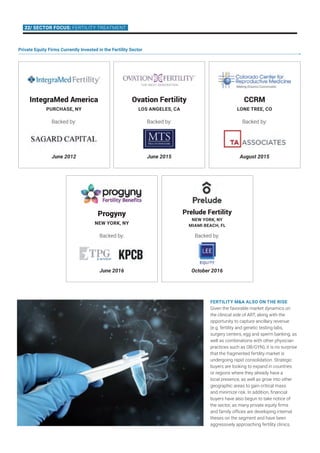
Private Equity Firms Currently Invested in the Fertility Sector
Backed by:
June 2012
IntegraMed America
Purchase, NY
Backed by:
June 2015
Ovation Fertility
Los Angeles, CA
Backed by:
August 2015
CCRM
Lone Tree, CO
Backed by:
June 2016
Progyny
New York, NY
Backed by:
October 2016
Prelude Fertility
New york, NY
Miami Beach, FL
Sector focus: fertility treatment /23
MITCHELL STERN
IMAP USA, Fort Lauderdale
mitchell.stern@imap.com
PAUL HOFFMAN
IMAP USA, Chicago
paul.hoffman@imap.com
ROBERT FRIEDMAN
IMAP USA, New York
robert.friedman@imap.com
BRIAN SCHOFIELD
IMAP USA, Chicago
brian.schofield@imap.com
Similar to what occurred (and is still
occurring) in other physician practice
areas, such as dermatology, dentistry
and ophthalmology, pricing multiples
are beginning to experience significant
increases. For example, a number of
fertility clinics with single-digit EBITDA
are receiving offers in the low double-digit
EBITDA multiple range.
Dresner (IMAP USA) at the
forefront of fertility and other
physician practice MA
Dresner (IMAP USA) has been extremely
active working with companies in the fertility
treatment industry and other physician
practice sectors. In late 2016, a team of
healthcare experts advised on the sale of
IGENOMIX, a leading provider of genetic
testing services for reproductive health
patients and clinics, to Charme Capital
Partners, Amadeus Capital Partners, Aleph
Capital and Graham Snudden.
Just a few months later, the team advised
Reproductive Medicine Associates of
New Jersey (RMANJ) on its combination
with the Valencian Infertility Institute (IVI)
in Spain. The merged company, IVI-RMA
Global, is now the largest and one of the
most successful global fertility networks,
with nearly 2,400 employees across 70
locations in 11 countries worldwide,
maintaining a team of over 200 physicians
and over 300 scientists and researchers.
The team is also currently advising a
Midwest U.S. fertility practice in the sale
of the company and is currently under
an exclusive Letter of Intent (LOI). The
transaction is expected to close in Q4 2017.
Acquired
Advised on Sale of Company
LONDON
SPAIN
Healthcare
Merged with
Advised on Sale of Company
SPAIN
UNITED STATES
Healthcare
Sale of Midwestern Fertility Clinics
Advising Athenea on Sale of Company
UNITED STATES
Healthcare
Project athena
Scheduled to Close December 2017
With continuing drops in oil and gas
prices since the summer of 2014,
the industry has been forced into
survival mode and must prove it can
be both dynamic and innovative.
Acknowledging the importance
of cost reduction and efficiency,
companies are now beginning
to engage in MA activity in an
attempt to increase capacity
and realize synergies
Oil and Gas market outlook
remains uncertain although
some positivity is returning
Oil and Gas Industry Trends and Developments
Following the peak in June
2014, oil prices declined sharply
due to oversupply, falling to
USD 26 per barrel in January
2016. Though demonstrating
flexibility during the downturn,
it does remain price dependent.
OPEC’s production cuts,
announced at the end of 2016,
helped oil prices recover, with
prices reaching USD 50 per
barrel. Overall, the industry is
more dependent on oil prices
than natural gas prices.
The industry was forced
to adapt in order to survive
the major drop in oil prices.
Between 2014 and 2016 there
was a global cost reduction of
29% in the gas and oil sector,
though their exact sustainability
remains uncertain. McKinsey
 Company estimate that
approximately half the cost
reductions are sustainable with
rising oil and gas prices.
The development and adaption
of alternative energy sources
threatens the oil and gas
sector, especially in the long
term. Natural gas will play an
important role in the transition
period towards alternative
energy sources, acting as a
source of flexible generation
during peak demand. The
pace of the transition towards
alternative energy remains
uncertain, however, McKinsey
 Company predicts that until
2050, 77% of the new energy
capacity will come from solar
and wind.
Companies are increasingly
engaging in smaller projects
with a short time-to-market.
This type of corporate
investing strategy provides
some certainty in an uncertain
marketplace.
Oil and Gas Prices Cost Reduction Alternative Energy Project Selection
24/ Sector focus: oil  gas
transaction multiples reflect the differences
in market outlooks for the oil and gas
sector compared to the alternative energy
sector. Gas will however, become more
important for the transition phase towards
alternative energy, since it is suitable
to serve as a source of flexible power
generation during peak demands.
Overall, positivity, though cautious, is
returning in the sector following the
downturn from 2014-2016.
Oil prices have recovered somewhat to
a level of USD 50 per barrel, which in
part was caused by the production cuts
announced by OPEC back in November
2016. Global transaction value is also up
by 63.2% at EUR 217 Billion in 1H 2017,
compared to just EUR 133 billion in 1H
2016, though deal volume has actually
slightly decreased. In the European
market, cross-border deals amount to over
2/3 of its transactions, reaching 72.8%,
demonstrating its orientation towards
international MA, whereas, in the US,
45.0% of deals were cross-border, versus
55.0% domestic.
It is expected that alternative energy will
grasp the bulk of new energy capacity, thus
threatening the oil and gas sector. Indeed,
US shale oil production
disrupted the global market,
contributing to oversupply
which pushed back oil prices.
Many oil majors are moving
towards shale oil production,
which continues to grow.
Since 2014, approximately
400,000 employees were let go
during the downturn of the oil
and gas industry. Automation
is replacing workers and the
minimum level of required
technical knowledge is on
the rise and employees with
operational/digital skills are
highly desirable.
Laws and regulations will
play an important role in the
long-term transition towards
alternative energy. In fact,
France already announced
that all diesel and gasoline
vehicles sales will be banned
by 2040 with the UK making a
similar announcement. OPEC’s
production target policies will
continue to affect oil prices.
The industry is embracing new
technology, such as hydraulic
fracturing and horizontal
drilling though the adaption
of new digital technologies
has been rather slow. Analytic
programs can analyze big data
to point out cost savings in
design, engineering and supply
chain, as well as production
optimization.
Shale Production Employees Laws and Regulations Technology
Sector focus: Oil  GAs /25
Global Transaction Volumes
Whereas from 2010-2014 global
deal volume in the oil and gas sector
increased, peaking at 680 deals in 2014,
2015 was a very different story, as MA
activity slowed down drastically with
only 432 global transactions. In terms
of number of transactions, 2016 was
actually slightly better than 2015, though
1H 2017 was marginally worse than 1H
2016. Europe, Asia and the US account
for approximately 60% to 80% of the
transactions.
By continent of target company from January 2010 to June 2017. Includes transactions with a transaction value higher than EUR 25M.
Number of Global Transactions
121 134
189 191
239
130
167
87 75
152 146
130
222
185
134
127
64
48
149
166
155
130
157
101
87
42
56
39
40
52
39
55
46
51
24
22
46
52
31
37
44
21
16
8
11
0
100
200
300
400
500
600
700
2010 2011 2012 2013 2014 2015 2016 1H2016 1H2017
U.S. Europe Other Asia South America
Source: Zephyr, U.S. Energy Information Administration (EIA)
0
20
40
60
80
100
120
0
100
200
300
400
500
600
700
Total transactions Average oil prices
2010
2011
2012
2013
2014
2015
2016
1H2016
1H2017
507 538 557 619 680 432 448 225 212
80
111 112 109
99
52
44 40
52
26/ Sector focus: oil  gas
Global Transaction Values
When looking at 1H 2017, transaction
values are significantly higher compared
to those during the same period in 2016
though the deal volume remains almost
the same. Transactions in 1H 2017 were
valued at EUR 217 Billion versus EUR 133
Billion in 1H 2016.
In the US, the total transaction value is the
highest for almost every given year, whilst
in South America, MA activity has slowed
down in terms of deal value from 2015-1H
2017. Europe, Asia and the US account
for approximately 60% to 90% of the total
transaction value.
It should be noted that yearly transaction
value is sensitive for large deals, hence any
results need to be interpreted with care.
Global deal value by continent of the target company from January 2010 to June 2017. Includes transactions with a
transaction value higher than EUR 25M. Reported in billions of EUR following Zephyr’s definition of (estimated) ‘deal value’ as:
“the consideration paid for the actual stake acquired.”
Deal Value
Transaction multiples reflect the
differences in market outlooks for
the oil and gas sector compared
to the alternative energy sector
Additional information can be found in the Oil  Gas sector report published by experts from the IMAP Netherlands team.
(www.imap.com/our-thinking)
JAN-PIETER BORST
IMAP Netherlands
jborst@imap.nl
FRANK RUIJGROK
IMAP Netherlands
fruijgrok@imap.nl
93
69 67
91
116 112
102
42
92
49
70
51
72
59 68 96
72
40
25 26
36
39
46
58 29
13
40
17 14
12
12
17
9
17
5
41
72
16
18
50 28
5 4
1
3
0
50
100
150
200
250
300
2010 2011 2012 2013 2014 2015 2016 1H2016 1H2017
U.S. Europe Other Asia South America
Source: Zephyr
Sector focus: Oil  GAs /27
Investing in retail
looks to be in fashion
GROWTH AND TRANSFORMATION
The fashion industry has recovered
from the financial crisis and since 2012,
apparel retailers have become highly
attractive targets. A clear indication of
this was the level of MA activity in 2012,
which averaged four times that of 2011.
Furthermore, from 2012 to 2016, there
have been on average 114 annual global
transactions, with the highest volumes
registered in Western Europe and the
majority of transactions valued above 10x
EBITDA (median: 13.0x). With a predicted
2017 industry growth of between 2-3% in
line with GDP, Affordable Luxury is expected
to be the strongest segment at 3.5-4.5%
growth and Athletic Wear the leading
product type at 6.5-7.5%.
It is clear that investors are increasingly
interested in the retail industry and that there
are certainly high growth opportunities.
However, the industry is rapidly transforming
and traditional retailers, even those with
multi-channel routes to market, in particular,
now face the risk of being left behind
unless they fully embrace the evolution in
consumer behavior and trends motivating
MA activity.
The rise of click-and-collect
While there has been a noted fall in the
popularity of brick-and-mortar stores as
consumers increasingly shift online for
their purchases, physical stores still have
a very important role to play in the omni-
channel story for retailers. They are key to
click-and-collect and have become more
“experiential” as pure online retailers are
now opening physical stores to tap into this
trend (see Missguided opening high street
stores, Farfetch buying Browns, Amazon
opening a store in New York).
The contribution of online sales to total
revenue is a reflection of this (Germany
12%, US 17%, China 13% - soon to be 20%
and UK 21%). Retailers with advanced IT
systems (especially online stores) have a
distinct competitor advantage, particularly
over smaller retailers who are lacking such
capabilities.
Accelerated fashion cycles
More and more retailers are also gravitating
towards a “test and repeat” fast supply
chain as it enables them to replicate best-
selling items and respond quickly to new
trends. By shortening design room to store
times, the average number of collections
has increased to 6 per year and could rise
up to 12. Again, this gives online retailers
a competitive advantage over their more
traditional peers, who tend to buy season
collections 6 months in advance.
Emerging markets
The increase in participation by second
and third-tier cities in shopping in China
has resulted in more opportunities opening
up for retailers able to make the move into
the market. In addition, in tier-one cities,
the luxury segment from abroad is ever
more popular, though lower tier cities are
dominated by large mid-market firms,
signifying the increase in affordable luxury
by domestic brands.
The fashion retail industry continues to
undergo significant changes amid evolving
consumer trends and technological disruption.
While online retailers are gaining market
share, physical stores are being
retained as an integral component of
their omni-channel retail offering.
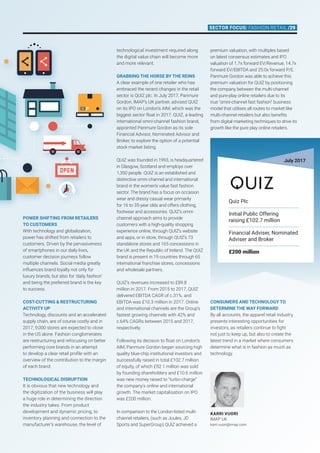
In July 2017 Panmure Gordon
(IMAP UK) advised women’s fast
fashion brand QUIZ plc. on its IPO
on London’s AIM, which was the
biggest sector float in 2017
The industry is rapidly
transforming and
traditional retailers, even
those with multi-channel
routes to market, now face
the risk of being left behind
unless they fully embrace
the evolution in consumer
behavior and trends
motivating MA activity
Online retailing (e-tailing) is essential in
tackling changing customer habits and
remaining competitive so it is no surprise
that it is showing signs of rapid growth.
28/ Sector focus: FASHION RETAIL
Power shifting from retailers
to customers
With technology and globalization,
power has shifted from retailers to
customers. Driven by the pervasiveness
of smartphones in our daily lives,
customer decision journeys follow
multiple channels. Social media greatly
influences brand loyalty not only for
luxury brands, but also for ‘daily fashion’
and being the preferred brand is the key
to success.
Cost-cutting  restructuring
activity up
Technology, discounts and an accelerated
supply chain, are of course costly and in
2017, 9,000 stores are expected to close
in the US alone. Fashion conglomerates
are restructuring and refocusing on better
performing core brands in an attempt
to develop a clear retail profile with an
overview of the contribution to the margin
of each brand.
Technological disruption
It is obvious that new technology and
the digitization of the business will play
a huge role in determining the direction
the industry takes. From product
development and dynamic pricing, to
inventory planning and connection to the
manufacturer’s warehouse, the level of
technological investment required along
the digital value chain will become more
and more relevant.
Grabbing the horse by the reins
A clear example of one retailer who has
embraced the recent changes in the retail
sector is QUIZ plc. In July 2017, Panmure
Gordon, IMAP’s UK partner, advised QUIZ
on its IPO on London’s AIM, which was the
biggest sector float in 2017. QUIZ, a leading
international omni-channel fashion brand,
appointed Panmure Gordon as its sole
Financial Advisor, Nominated Advisor and
Broker, to explore the option of a potential
stock market listing.
QUIZ was founded in 1993, is headquartered
in Glasgow, Scotland and employs over
1,350 people. QUIZ is an established and
distinctive omni-channel and international
brand in the women’s value fast fashion
sector. The brand has a focus on occasion
wear and dressy casual wear primarily
for 16 to 35-year olds and offers clothing,
footwear and accessories. QUIZ’s omni-
channel approach aims to provide
customers with a high-quality shopping
experience online, through QUIZ’s website
and apps, or in store, through QUIZ’s 73
standalone stores and 165 concessions in
the UK and the Republic of Ireland. The QUIZ
brand is present in 19 countries through 65
international franchise stores, concessions
and wholesale partners.
QUIZ’s revenues increased to £89.8
million in 2017. From 2015 to 2017, QUIZ
delivered EBITDA CAGR of c.31%. and
EBITDA was £10.3 million in 2017. Online
and international channels are the Group’s
fastest growing channels with 42% and
c.64% CAGRs between 2015 and 2017,
respectively.
Following its decision to float on London’s
AIM, Panmure Gordon began sourcing high
quality blue-chip institutional investors and
successfully raised in total £102.7 million
of equity, of which £92.1 million was sold
by founding shareholders and £10.6 million
was new money raised to “turbo-charge”
the company’s online and international
growth. The market capitalisation on IPO
was £200 million.
In comparison to the London-listed multi-
channel retailers, (such as Joules, JD
Sports and SuperGroup) QUIZ achieved a
premium valuation, with multiples based
on latest consensus estimates and IPO
valuation of 1.7x forward EV/Revenue, 14.7x
forward EV/EBITDA and 25.0x forward P/E.
Panmure Gordon was able to achieve this
premium valuation for QUIZ by positioning
the company between the multi-channel
and pure-play online retailers due to its
true “omni-channel fast fashion” business
model that utilises all routes to market like
multi-channel retailers but also benefits
from digital marketing techniques to drive its
growth like the pure play online retailers.
KARRI VUORI
IMAP UK
karri.vuori@imap.com
July 2017
Quiz Plc
Initial Public Offering
raising £102.7 million
Financial Adviser, Nominated
Adviser and Broker
£200 million
Consumers and technology to
determine the way forward
By all accounts, the apparel retail industry
presents interesting opportunities for
investors, as retailers continue to fight
not just to keep up, but also to create the
latest trend in a market where consumers
determine what is in fashion as much as
technology.
Sector focus: FASHION RETAIL /29
Following a recent transaction by US based private equity firm Providence Equity
Partners buying a 70 percent stake in the Hungarian festival company Sziget,
IMAP Hungary examines business deal trends in the live entertainment industry
strong economic growth driving the need
for culture, especially in Africa and Asia.
The appetite for physical events and
venues has also increased and the music
industry has shifted to live events with
revenues from live shows now surpassing
recorded music sales in some regions.
In Europe, ticket revenues for live music
performances are now more than twice
that of recorded music sales. Festivals
are increasingly becoming an asset for
cultural tourism worldwide and developing
Live entertainment on the road
to consolidation?
MARKET DRIVERS
The global population of young people is
swelling; in 2014, the UN Population Fund
estimated that 1.8 billion of the world’s
population was between 10 and 24 years
old, a record high. This combines with
Trends driving the future of festivals can be grouped into four sections
Festival industry trends
SOCIAL MEDIA
	Fans expect a mix of
options and more
personalized experiences
	Social media provides hard
cash benefits to event
organizers, especially in
ticket sales channeling
	Video content and live
broadcasting on mobile
is becoming increasingly
important
TECHNOLOGY
	Immersive theater, Virtual
Reality and Augmented
Reality will influence live
music performances
	Blockchain solutions
may transform ticketing
solutions and licensing
royalty collection for public
performances
	Hybrid music events bring in
bigger audiences and more
money (eg. film, media and
video games)
	Online ticketing unlocks
powerful data and insights
like never before
	Mobile technology improves
the overall attendee
experience (tickets, cashless
payment and real-time event
guides)
	RFID technology and smart
cards add value once inside
the event
	Live streaming events keep
fans connected
ARTISTS
	Artists are turning their gaze
to touring to take advantage
of the massive jump in artist
fees
	Lack of strong headliners
(announcement dates are
earlier: 8-9 months instead
of 3-4) – influenced by
cheap airline tickets
	Activism (political) is
expected to revive the live
music community
	Artists are recognizing the
role sponsors play in helping
to fund festivals, and are
more willing to participate
in auxiliary activities (Lady
Gaga’s Dive Bar Tour,
sponsored by Bud Light).
Brands will become even
more intertwined with artists
NEW DIMENSIONS
	Strong competition
and festival export (e.g.
Lollapalooza going to Berlin)
	Reconsider catering options:
in-house or outsource, “food-
line-ups” or new lines: veggie,
bio, organic, local
	Increasing staff numbers
to secure better
experience derived from
professionalism and security
needs
	Need to take a look at how
to tackle the challenges
posed by extreme weather
conditions
	Increase revenues from
potential upgrades (VIP and
VVIP)
	Niche, high-end boutique
gatherings: targeting
the wealthier and family
demographics
30/ Sector focus: live music entertainment
The music industry has shifted to live events with revenues
from live shows now surpassing recorded music sales
in some regions. Despite the overwhelming expansion of
the digital world, live entertainment events give fans an
experience that is both engaging and unparalleled
In 2017 we see an uptick in the number of deals by industry players*
Number of acquisitions by live entertainment and event organization players
90
80
70
60
50
40
30
20
10
0
2012
* Covering global transactions where percentage of acquired stake is 51% or above
Source: Zephyr / IMAP
2013 2014 2015 2016 2017
	For this research,
we examined the
activity of players
already present in the
entertainment/event
business.
	In 2014, the number
of transactions
executed by arts
facility operators and
convention organizers
(excluding business/
conference purpose
and sports deals)
peaked at 83 yearly,
based on the data
provided by Bureau
Van Dijk.
	The most active
players were Live
Entertainment
Group and Live Style
Inc. (formerly SFX
Entertainment Inc.).
the overwhelming expansion of the digital
world, live entertainment events give
fans an experience that is both engaging
and unparalleled, indeed this growing
trend reflects the needs by millennials for
an “experience-rich life” as opposed to
collecting things or wealth.
cultural infrastructure is crucial in emerging
countries as it is expected to attract more
than half of international tourists by 2030
according to EY Cultural Report. Despite
Sector focus: live music entertainment /31
32/ Sector focus: live music entertainment
	Acquiring other revenue streams in the
value chain: ticketing, merchandising, PR
and marketing
	New, supplementary businesses: on-
site payment, mobile apps and online
solutions
Another direction that is currently rare,
though might become relevant in the
long run:
	Venue operation
We have not seen examples for enterprise
level-investments in:
	Equipment, with strong physical
characteristics (sound, light, stage,
security and facility)
	Artist management or agency
Buying other formats as competition to live
entertainment events, such as the non-
music event segment (theatre, circuses,
shows, comedy and discotheques) and
sport events (MMA pay per view and
e-sports) are also commonly used tools for
diversification.
AcQUIsiTION ACTIVITY
On studying the value chain in the
event market and MA activity of large
international live entertainment and event
organization players, we have identified the
most typical categories for expansion:
	Geographical expansion and extending
event offering via the acquisition of tour
promoters and concert, event and festival
organizers
There are clear directions that the main players follow
Transaction density by area of operation
Venue operator
Ticketing (branded /
white label
solution)
On-site payment
solutions
Mobile apps and
online solutions
Festivals /
Concerts /
Other events
PR  Marketing
(incl. Digital)
Number of examples
HighLow
Merchandising
 licensing
Equipment
Artist
management/
agency
Other
formats
Tour / concert /
event / festival
organizer or
promoter
Sector focus: live music entertainment /33
TRANSACTION MULTIPLES REFLECT
UNIQUE INDUSTRY DYNAMICS
The industry’s valuation levels are generally
kept out of sight and there are only a few
publicly available data points. However,
the EV/EBITDA range is wide, spanning
from about 5x to 15x. One explanation for
the higher valuations reaching 15x EV/
EBITDA could be that the unique business
relationship networks of the owners of
acquired companies would be hard and
time-consuming to replicate, if possible at
all. As a result, it is a common practice for
management to remain unchanged after an
acquisition.
Date Target name Country Target business description Acquiror Deal type EV (eur m) EV/EBITDA
Tour / concert / event / festival organizer or promoter
2014 Zibrant Ltd GB Event management services Zebra 1234 Ltd Acquisition
100%
2.5 6.0x
2014 Kilimanjaro Live
Ltd
GB Entertainment events promotion
services, Live music events
promotion services
DEAG Concerts
GmbH
Acquisition
51%
6.7 13.7x
2012 Hammersmith
Apollo Ltd
GB Live music and performance venue Stage C Ltd Acquisition
100%
23.2 6.0x
Ticketing
2016 Best Union
Company Spa
IT Event organisation and
management services, Online
electronic ticketing services
Bidco Acquisition
75%
40.2 9.7x
2014 Irec Eurl FR Ticketing software developer Best Union
Company Spa
Acquisition
100%
5.6 5.6x
2013 Encore Tickets
Ltd
GB Theatre ticket agency operator MBO Team – UK 100% 79.1 14.2x
2012 Infoconcert Sa FR Online ticket retailer Digitick Sa Acquisition
100%
1.5 8.5x
2011 West End
Theatre
Bookings Ltd
GB Theatre ticket booking services Encore Tickets
Ltd
Acquisition
100%
11.0 8.6x
Other formats
2015 Stage
Entertainment
BV
NL Theatrical and live entertainment
production services holding
company
CVC Capital
Partners Ltd
Ambassador
Theatre Group Ltd
60% 737.8 13.1x
Diversified
2017 See Corporation
Ltd
BM Artist management services, Event
organisation services, Film and TV
programme production services
investment
Giant Lead Profits
Ltd
Acquisition
increased
from 34% to
100% acting
in concert
27.4 12.0x
2015 Cube
Entertainment
Inc.
KR Artist management services,
Concert production services,
Music publisher, Visual contents
production services
Woori Special
Purpose
Acquisition 2 Co.,
Ltd
Acquisition
100%
32.1 15.3x
Transaction multiples
Gabriella Hajdu-Tar
IMAP Hungary
gabriella.hajdu.tar@imap.com
Boom in chemicals MA
as private equity moves in
yet lowest capital cost, maintenance and
energy usage in the industry. DBWT was
the Beetham family’s last remaining plant—
and their most valuable.
Looking to exit the business in order to
pursue other interests, the Beetham family
hired Capstone (IMAP USA) to run a sale
process and initiate a shareholder liquidity
event. While DBWT had received interest
from industry-leading buyers in the past,
the buyers were not viable options for the
Beethams due to two key deal issues that
created a challenging environment for
Capstone: 1) The Beetham family did not
want to sell to a competitor (they wished
to retain the employee “family” culture and
were concerned that proprietary know-how
would be in the hands of competitors), and
2) Dennis Beetham, the founder, did not
want extensive restrictions on his ability to
design and build a chemical plant utilizing
Capstone Partners (IMAP USA) advised D.B.
Western, Inc. – Texas, a leading technology-driven
producer of formaldehyde and derivatives,
on its acquisition by SK Capital Partners,
a New York-based private equity firm that
invests in the specialty materials,
chemicals and pharmaceutical sectors
cases, mothballed production because
DBWT sells it cheaper than their own cost
of production.
Based in the United States’ largest
chemical hub of La Porte (Houston),
Texas, DBWT’s facility boasts the greatest
capacity for production of formaldehyde,
UFC and MEA triazine in North America and
is one of the largest formaldehyde plants in
the world.
Pioneering chemical plants and
proprietary know-how
DBWT was founded in 2000 by a
formaldehyde-production pioneer Dennis
Beetham, who has designed, engineered
and fabricated over 40 chemical plants
globally. The resulting design, engineering
and product technology expertise has
benefited DBWT as it operates on an
automated basis, with the highest yield,
An industry-leader supplying
sector titans
D.B. Western, Inc.–Texas (DBWT) is a
chemical producer that utilizes the most
advanced technology in the industry
to manufacture formaldehyde and
formaldehyde-derivatives such as urea-
formaldehyde concentrates (UFC) and
MEA triazine. Formaldehyde is perhaps
best known for its preservative and anti-
bacterial properties, but it is also used to
make a wide range of value-added products
including composite and engineered wood
products, glues, molded auto components,
exterior primers and clear-coat paints. UFC
serves as a binder in agricultural fertilizers
and MEA triazine is used to scavenge
hydrogen sulfide from oil and gas. Due to
DBWT’s industry-leading product efficiency,
it manufactures commodity products as a
leading supplier to industry titans (Georgia
Pacific, Hexion and DuPont) who, in some
34/ Cross-Border Focus  Case Studies
Cross-Border Focus  Case Studies /35
key technology. Potential buyers that had
previously contacted DBWT required Mr.
Beetham to discontinue global design and
building activity.
Overcoming sale process
obstacles
In order to achieve a premium value for
the asset, as well as to continue design
and building operations, Capstone
were required to run a sale process to
companies that excluded DBWT’s direct
competitors. Following engagement, two
issues arose that Capstone had to work
around. Firstly, one of the top customers
discontinued operations related to
consumption of DBWT’s product, resulting
in nearly a 10% drop in revenue. Secondly,
the Company was projecting a meaningful
shift in product-mix towards higher-margin
products that had not yet materialized.
Capstone retooled its marketing
documents; focusing buyers on DBWT’s
potential to regain the lost business as
it shifted to other suppliers, who also
happened to be DBWT customers and a
monthly projection, illustrating the shifting
product-mix resulting in increasing margins
and EBITDA.
Premium price and key
exceptions achieved through
negotiation
After creating a strong prospect list
of chemical companies, private equity
groups and non-obvious buyers, Capstone
established a robust process that
produced a very competitive environment.
With multiple offers after management
meetings, the shareholders eventually
chose SK Capital, a chemicals-focused
private equity group. Through strong
management of due diligence and hard-
nosed negotiation, the eventual purchase
price represented a premium relative to
the market. In addition, Capstone was able
to negotiate key exceptions to the non-
compete agreement, allowing the Beetham
family to continue their design/build efforts
and serve as a potential value-added
partner as DBWT expands its business
globally. The transaction closed in June
2017 and is one of the most significant
recent acquisitions in the formaldehyde
market.
MA surging as a growth
strategy in chemical sector and
boosted further by PE
The DBWT transaction is part of a broader
boom in chemicals MA, large even
compared to the increased acquisition
activity in other sectors over the past
two years. Lackluster global chemical
organic growth has resulted in companies
utilizing MA as a key growth initiative.
Also, companies are strengthening their
positions within core markets through the
acquisition of competitive product lines
The team was able to negotiate key exceptions to
the non-compete agreement, allowing the family to
continue their design/build efforts and serve as a
potential value-added partner as DBWT expands its
business globally
and manufacturing plants. Competition
remains intense and major global players
are consolidating in an effort to remain at
the top of the pile. This is evident by the
recent mega deals that have taken place
in the chemicals market. The year 2016
had many mega deals in chemicals, with
USD 231 billion in total value, as compared
to just USD 77 billion in 2014. Another
factor impacting the chemicals MA boom
is private equity involvement. As private
equity groups have become more active in
the space valuations have swelled and the
number of exits have increased, spurring
additional activity.
DAVID BENCH
IMAP USA, Orange County
david.bench@imap.com
Acquired 100% of Business Operations
Advised on Sale of Company
united states
united states
Materials
36/ Cross-Border Focus  Case StudIES
Up Groupe expands international
footprint with market entry and
roll-up in Brazil
In less than 12 months, IMAP Brazil advised French company Up Groupe in
relation to three acquisitions in the prepaid benefit cards market
LOOKING BEYOND WESTERN EUROPE
Up Groupe (formerly Groupe Chèque
Déjeuner) is the 3rd
largest prepaid benefit
vouchers and cards company in the world.
Its main competitors are Sodexo and
Edenred (formerly Accor Group). It sells
non-banking products and services such
as vouchers, cards and mobile and web
applications to facilitate access to food,
culture, leisure, education, home help
and social aid. Up Groupe also supports
companies in managing their business
expenses as well as developing incentive
and loyalty programs. Present in the daily
lives of over 24.5 million people across 17
countries, it has around 3,400 employees
and in 2016 had an issue volume of
approximately EUR 7.1 billion.
By 2007, Up Groupe was already well
established in Western Europe and began
evaluating opportunities to expand further
afield, which is when IMAP began its long-
standing cross-border partnership with the
company. In 2010, IMAP Turkey advised
Up Groupe in relation to the acquisition of
Multinet, the market leader in Turkey and
in 2013, expanded its reach into North
America when IMAP Mexico advised Up
Groupe in relation to the acquisition of Sí
Vale, Mexico’s largest player. Following their
acquisition in Mexico, Up Groupe set its
sight on Brazil, the largest prepaid benefit
vouchers and cards market in the world.
In 2014, IMAP Brazil was retained by Up
Groupe to conduct a market screening
and to develop a strategy and negotiation
process for potential acquisitions in Brazil.
Cross-Border Focus Case StudIES /37
IMAP Brazil’s extensive knowledge of not
only the Brazilian MA market overall
but specifically Up Groupe’s industry in
Brazil was crucial in refining the client’s
acquisition strategy and determining the
right target companies.
ENTRY INTO THE BRAZILIAN MARKET
IMAP Brazil embarked on a nationwide
screening process, searching for
companies that met specific criteria such
as minimum size, relevant geography, fit
in terms of product portfolio and exposure
to private sector clients as opposed to
public sector clients, among others. This
initial screening resulted in a list of 15-20
potential targets, including those which
were subsequently acquired.
Negotiation processes in Brazil tend to
be complex and based heavily on trust.
As a buy-side advisor, it is crucial to be
close to the sellers and truly understand
their needs and concerns. Another critical
element is proper due diligence as most
middle market companies in Brazil are not
audited and oftentimes the interpretation
of due diligence results is quite complex.
Transaction-specific structures need to
be negotiated in order to protect the buyer
from contingencies.
IMAP Brazil successfully demonstrated to
each target the benefits of being acquired
by an experienced and reputable company
such as Up Groupe while minimizing
concerns regarding the impact of a
transaction on their businesses, not least
on the people working at the companies
since their foundation.
Notwithstanding the complexities and
particularities of the Brazilian MA market,
in just under six months of the project
starting, a binding agreement was signed to
acquire 100% of Planvale, a leading player
in the State of São Paulo, Brazil’s economic
motor. This transaction closed in May 2015.
Planvale was founded in 1999 and operates
mainly in the São Paulo State. At the time
of the acquisition in 2015, it operated in two
business units: traditional benefit cards/
vouchers for meals, food, transportation,
culture and gifts along with a card charge/
recharge business for public transport.
Its annual business volume at the time
IMAP assisted Up Groupe achieve its ambitious
goals of internationalization beyond Western
Europe, by entering and expanding in three
distinct countries across two different
continents and the acquisition of seven
companies in the span of just a few years
38/ Cross-Border Focus  Case StudIES
Acquired 100% of Business Operations
Advised on Purchase of Company
FRANCE
TURKEY
Financials
Acquired 100% of Business Operations
Advised on Purchase of Company
FRANCE
MEXICO
Financials
Acquired 100% of Business Operations
Advised on Purchase of Company
france
BRAZIL
Financials
was approximately EUR 500 million.
With 250,000 users, Planvale processes
approximately 25 million transactions
annually, has a network of 60,000 affiliated
merchants and over 700,000 cards in
circulation.
ADDITIONAL ACQUISTIONS IN THE
BRAZILIAN MARKET
In January 2016, a second transaction was
concluded; this time the 100% acquisition
of Valemais, the market leader in the
Espírito Santo State.
Valemais was founded in 2001 and
was the market leader in cards and
vouchers for meals, food and gasoline
vouchers in the Espírito Santo State,
located in Brazil’s key Southeast
Region. It operated exclusively through
a proprietary system of point-of-sale
payment terminals and in 2015, not long
before its acquisition, the company’s
business volume reached more than
EUR 100 million. Enjoying a strong brand
image in the region, Valemais’s service
vouchers are used daily by 150,000
users and accepted by a network of
7,000 affiliated merchants.
Simultaneously with the Valemais
deal, IMAP Brazil began working on a
transaction with Policard, a leading player
in the key Minas Gerais State and just a
few months after the Valemais transaction
closed, a merger was completed with
Policard. As a result of this new merger,
Up Groupe owned 60% of the combined
business and the shareholders of Policard,
the remaining 40%. A mechanism of put
Cross-Border Focus Case StudIES /39
Tom Waslander
IMAP Brazil
tom.waslander@imap.com
Luiz Eduardo Costa
IMAP Brazil
leduardo.costa@imap.com
Acquired 100% of Business Operations
Advised on Purchase of Company
france
BRAZIL
Financials
Acquired Majority Control of Business
Operations
Advised on Purchase of Company
france
BRAZIL
Financials
and call options was negotiated, through
which, over time Up Groupe can reach full
ownership.
With a total business volume of more than
EUR 3.3 billion, Policard’s vouchers are
used daily by 230,000 users, with a private
acceptance network of 120,000 affiliated
merchants. One of Policard’s unique features
is its ownership of 10,000 terminals.
As a result of these three transactions,
Up Groupe is now a strong player in Brazil,
with an estimated nationwide market
share of approximately 5%. Its share is
larger in the Southeast region of Brazil, the
economic motor of the Brazilian economy.
POST-TRANSACTION SERVICES
IN BRAZIL
Up Groupe’s focus in Brazil is now the
integration and streamlining of the three
companies that were acquired, though
they remain ambitious and additional
transactions in Brazil and other countries in
Latin America have not been ruled out.
IMAP Brazil continues to act as advisor to Up
Groupe in connection with any post-closing
issues related to the three transactions.
THE IMAP ADVANTAGE
The advisory work that IMAP has
been undertaking for Up Groupe over
the course of a decade demonstrates
both the strength of the IMAP and the
expertise of its partners. IMAP assisted
Up Groupe achieve its ambitious goals
of internationalization beyond Western
Europe, by entering and expanding in
three distinct countries across two
different continents and the acquisition
of seven companies in the span of just a
few years. Up Groupe and IMAP have a
win-win relationship based on trust and
superior service.
40/ Cross-Border Focus  Case StudIES
A potential for synergy and
new market penetration
Mirka Oy, part of the Finnish family
owned KWH Group, is a market leader in
surface finishing technologies, offering
comprehensive sanding solutions, a wide
range of abrasive and polishing products
and innovatively designed tools for high
quality surface finishing. In 2016, Mirka
achieved a turnover of EUR 240 million, of
which 96% was generated by exports. It
employs over 1100 professionals across
Finland and its 16 subsidiaries worldwide.
Mirka was looking to expand its product
and service portfolio into superabrasives
Mirka, a leading Finnish
manufacturer of abrasives,
expands global reach and product
portfolio with Italian acquisition
IMAP Finland, with early stage support from IMAP Italy, advised Mirka Oy, one of the
world’s leading abrasives and power tools manufacturers on their acquisition of Cafro,
an Italian superabrasive wheels and tools manufacturer
Cross-Border Focus  Case Studies /41
and grinding solutions which were often
used by their existing clients in addition to
Mirka products. The potential for synergy
was identified by using Mirka’s global sales
network in conjunction with their product
development knowledge and resources.
Looking to minimize the time-to-market,
Mirka’s management realized that internal
organic product development work would
be too time consuming and require new
know-how, hence they decided to acquire a
leading company in this field.
Cross-border collaboration
with local IMAP advisors
Based on Mirka’s target profile, IMAP
Finland undertook a market survey of
possible acquisition targets. However, it
soon became clear that these types of
companies were not to be found in the
Nordics, but rather in Germany, Switzerland
and Italy. Based on the resulting target
list, they devised a shortlist of the most
promising companies to contact and initial
meetings were held across the 3 countries.
Local IMAP partners helped arrange the
initial meeting and more often than not,
assisted not only to “open the door” but
also acted as translators and facilitators.
Following a primary meeting with a
potential target in Italy, IMAP Finland and
Mirka took over the project management
and proceeded with the buy mandate.
IMAP Italy continued to offer support in
terms of providing financial information as
well as an overview of cultural and legal
differences between Finland and Italy and
their initial support was crucial in eventually
getting the deal done.
As an end result, Mirka acquired 100%
of the shares of Cafro S.p.A., an Italian
family-owned company, with 79 employees
at its production site in Italy and sales
representatives in 25 different countries
globally. A market leader in the field of
diamond and CBN wheels as well as PCD
and PCBN tools, Cafro’s tools are most
typically used in precision grinding, turning
and milling operations and in 2016, their
turnover was EUR 10 million.
Rapid expansion strategy
According to Mirka CEO Stefan Sjöberg,
Cafro’s specialized knowledge and
manufacturing capabilities in conjunction
with Mirka’s global presence, are an excellent
match and conjugative for rapid business
expansion. For Cafro, the acquisition
provided an attractive opportunity to expand
the business in the global market and
for Mirka, a cornerstone in developing its
precision grinding business. In the future,
both companies’ customers will benefit from
a comprehensive offer of surface finishing
and grinding solutions.
Local IMAP partners helped arrange the initial meeting
and assisted not only to “open the door” but also acted
as translators and facilitators
Lars Wikholm
IMAP Finland
lars.wikholm@imap.com
Acquired Majority of the Company
Advised on Purchase of Company
finland
italy
Industrials
42/ Cross-Border Focus  Case Studies
Turnaround management
best practies – how to create value
very promising niche in the field of wet wipes,
specifically lens wipes for glasses, which
they had first introduced to the German
market as a product innovation back in 1979.
However, a scattered and unfocused product
portfolio as well as a loose organizational
structure, combined with missing controlling
tools (e.g. on product level) and obvious
mismanagement, meant that the company
was facing hard times with regards to
liquidity and overall indebtedness.
IMAP Germany advised
Nimbus hands-on
investors on the sale of
RCP Ranstadt, to Zobel
Values. The sale came
after a transformational
turnaround of RCP
whereby the company
achieved operational
excellence
The Starting Point
In 2009, Nimbus acquired 100% of the
shares of Budelpack Ranstadt GmbH, the
German branch of the insolvent Budelpack
Group, renaming the company RCP Ranstadt
GmbH. Although almost insolvent, Nimbus
had recognized the company’s strong
potential, mainly due to its long-standing
customer relationships in the German
market and its highly specialized product
portfolio. Budelpack, now RCP, had found a
Nimbus
As a private equity fund, Nimbus invests
in European-based industrial companies
with evident and substantial potential
for improvement and seeks majority
shareholdings or management control. It
has offices in Zeist (The Netherlands) and
Munich (Germany).
RCP Ranstadt GmbH (RCP)
One of Europe’s leading manufacturers
of single-use products such as wet
wipes, sachets and stand-up pouches,
RCP has over 60 years of experience and
focusses heavily on both technology and
cost leadership. Long-standing customer
relationships position the Company as a
reliable partner in the market, with relatively
little competition. Products are delivered as
either manufacturer brands or private label,
to renowned brand owners, retailers and
discounters within the home care, personal
care and, to a lesser extent, food industries,
in Germany and other European countries.
Zobel Values AG (Zobel)
A Swiss based single family office with
an evergreen fund approach, Zobel
invests foremost in established, mid-cap
companies in the DACH region.
PRODUCT OVERVIEW
Cross-Border Focus  Case Studies /43
Turnaround Management
Following the acquisition, the real question
for Nimbus was how the turnaround
process should be designed and who could
manage the change. On the basis that
their integral strategy was to bring in new
management and clean up old structures,
Mr. Karl Koob was introduced to RCP in
late 2010. As an experienced and process
oriented manager, who had earned his
stripes in the FMCG sector (e.g. Wella and
PG, hairstyling products), Mr. Koob began
his time at RCP in the production halls,
learning about the production processes
in order to get a feeling for “how to make
money with (single-use) wet wipes”.
IMAP met with Mr. Koob to discuss his
challenges and first steps, as well as how it
would be possible to successfully turn the
company business around:
We understand that you came to RCP with
a lot of production know-how and
experience in setting up new production
facilities. What were your first steps and
challenges you faced when you took
control of RCP?
Indeed, I brought quite a degree of
experience to the table, however, the
organizational set-up and structural
problems I had to deal with were immense.
First of all, I had to learn about the company
completely from scratch, in order to fully
understand the metrics of the wet wipes
and packaging business. By this I mean I
literally stood for hours beside the machine
workers, so as to understand fundamental
problems from both the technical, as well
as the logistical side. After listening and
learning for quite some time, I gathered the
most motivated and capable employees,
gave them a raise and a path of opportunity
to develop their skills. Following on this, I
appointed a new staff level of group leaders
to motivate personnel. After setting up the
team, I prepared a game plan for how to
proceed with the restructuring. More or less
in parallel to reorganizing the HR structure
and with a higher level of urgency, we first
had to manage the financial and in essence,
operating cash needs of the company to
ensure payment could be made to both the
suppliers and the production staff. With
a newly acquired understanding of the
inherent potential in production processes,
along with the new HR structure, it was
possible to stabilize the business operations
and build a platform for future efforts.
We learned that RCP was to a large extent
active in a niche market. However, the
company’s activities were somewhat
diverse and with no clear focus. How did
you manage to drive RCP to becoming a
market leader for lens cleaning wipes?
That is exactly the same question that I was
asking myself at the time. The answer was
to effectively concentrate on the realities of
the niche market. As the market was and
still is defined by price pressure, we had to
somehow become the price leader. The key
to this was our investment in innovative
machinery, ensuring we first became the
technology leader and subsequently, the
cost leader. Having established in-house
engineering expertise, we were able to fully
maximize our technological advantage and
outperform our competitors. This, together
with a step-by-step approach to optimizing
sourcing, including in foreign countries, in
conjunction with our focus on quality, had
a tremendous impact on RCP’s market
position. Having achieved that goal, we then
set our sights on reducing OPEX i.e. mainly
personnel costs - in terms of personnel
fluctuation. I am happy to say that to a large
extent, I didn’t have to let staff go during
this transition period. Overall, RCP’s EBITDA
grew approximately 15% annually from
2011 to 2016.
Could you let us in on your secret to
creating value? How does this all come
together before the sale to a family office
like ZOBEL Values?
Actually, there is no real secret. Having
concentrated in our niche market on
both the product and the technological
side, we then implemented a financial
controlling system (software) to look at
the contribution margins on a product level
outside of the wet wipe business. We were
therefore able to identify underperforming
and loss generating contracts and simply
fade them out over time when possible. Our
Following a successful restructuring process and
having put in place the best management and staff
base, Nimbus created an ideal environment for a
family office to further develop the company and
create additional value
market leading position enabled us to both
further enhance profit levels and invest in
top-notch machinery in order to best serve
market demands. A lot of growth potential
lies in the fact that domestic as well as
foreign development and full penetration of
the market, is not yet complete. However,
future value creation lies foremost in
the opportunities that arise in terms of
the internationalization of the business.
Following a successful restructuring
process and having put in place the best
management and staff base, Nimbus
created an ideal environment for a family
office to further develop the company and
create additional value.
mario flory
IMAP Germany
mario.flory@imap.de
Acquired 100% of Business Operations
Advised on Sale of Company
Switzerland
Germany
Consumer Products and Services
44/ Cross-Border Focus  Case Studies
A family owned success story in the
Peruvian pharmaceutical industry
of foreign companies by means of newly
installed distribution facilities and/or the
acquisition of local and for the most part,
family-owned, pharmaceutical companies.
At the same time, following many years of
double-digit growth rates, Grupo Portugal had
reached the stage at which it was looking not
only to secure its transition into a larger and
more innovative company with a stronger
portfolio, but also to expand its distribution
IMAP Peru advised Grupo Portugal on its majority equity sale
to Mexican pharma company Sanfer
IMAP Peru developed a strategy to promote
Grupo Portugal, specifically targeting both
multi-national and multi-Latin strategic players
that, in addition to modernizing Grupo Portugal,
would be willing to incorporate more complex
and innovative products to its portfolio
has developed lasting, solid relations with
nation-wide pharmacy chains, independent
pharmacies, wholesalers and public
healthcare institutions.
Portfolio and geographic
expansion through a new
partnership
At an industry level, Peru has been
experiencing a rapid increase in the presence
leading Peruvian Pharma Group
Grupo Portugal is a family owned
pharmaceutical company and with over
100 years of experience in the Peruvian
pharmaceutical industry, is one of the
leading laboratories in Peru. With sales
of approximately USD 60 million, its
vertically integrated business model
involves developing its own brands of low
complexity generics, branded generics,
OTC and cosmetic products, as well as
manufacturing for third-parties.
The Groups’ 50,000ft² production facilities
are located in the southern province of
Arequipa, and through in-house logistics and
distribution units, it reaches all the territories
in Peru, as well as some countries in Latin
America. With an impressive level of growth,
having doubled its sales during the last six
years, it has achieved extremely attractive
profitability levels in comparison to its peers
and at a commercial level, Grupo Portugal
Cross-Border Focus  Case Studies /45
network outside of Peru. Motivated by the
industry outlook and its strategy for growth,
it decided to search for a new partner to take
the Group to the next level.
A collective growth strategy
Having been appointed as their Advisor,
IMAP Peru began work developing a
strategy to promote Grupo Portugal,
specifically targeting both multi-national
and multi-Latin strategic players that, in
addition to modernizing Grupo Portugal,
would be willing to incorporate more
complex and innovative products to its
portfolio. Part of these efforts took the form
of a roadshow, during which and in line with
IMAP Peru’s expectations, it became clear
that there was indeed an avid appetite for
pharma assets in an emerging economy
such as Peru. One of the main drivers for
this was the significant growth potential
revealed by the lagged pharma spending
figures per capita in Peru, in comparison to
others in the Latin American region.
On completion of what turned out to be an
extensive roadshow and highly competitive
process, a leading Mexican pharma
company, Sanfer, was selected as the ideal
candidate. Sanfer (Grupo INVEKRA) has
been very active in developing its inorganic
growth strategy throughout the Latin
America region and as such, Peru was
an attractive asset for consolidating its
strategic position in the region.
Restructuring and optimizing
cash flow
The transaction was structured as
a majority equity stake sale, with
mechanisms for both parties to perform
additional sales and/or purchases in the
future. As the buyer had leveraged the
purchase price and with the intention
of optimizing its cash flow for debt
repayment, a major restructuring of Grupo
Portugal’s companies was carried out
as part of the transaction. This involved
a spin-off of intangible assets (i.e.
commercial brand names) as well as the
implementation of a royalty scheme. The
deal also involved the negotiation of special
GUIDO VINGERHOETS
IMAP Peru
guido.vingerhoets@imap.com
Acquired 51% Equity Stake
Advised on Sale of Company
mexico
peru
Healthcare
arrangements at a shareholder level, with
the objective of guaranteeing seamless
corporate governance and aligned interests
between the new partners, whereby
an experienced and balanced board of
directors was appointed, which included
independent members. Also included in
the transaction, was the future acquisition
of two small distribution companies in
Bolivia and Ecuador, through which Sanfer
will initiate operations in Bolivia, while
in Ecuador, it would be an add-on to its
existing distribution facility.
46/ imap transactions
IMAP Germany advised Aluminiumwerk Unna, a leading manufacturer of aluminum
alloy tubes headquartered near Dortmund on its sale to a subsidiary of listed China
Zhongwang Holding Ltd., headquartered in Beijing. China Zhongwand is Asia’s largest
manufacturer and developer of aluminum extrusion products. The acquisition was
realized by way of a capital increase at the holding company as well as the acquisition
of the shares of the employees. The transaction provides Aluminiumwerk Unna with
new growth perspectives as part of a globally strong and broadly positioned industrial
aluminum group.
​IMAP Colombia advised Masisa S.A., a leader in the production and distribution of
wood panels in Latin America, on the sale of its industrial unit in Argentina to Egger
Holzwerkstoffe GmbH. Based in Austria, Egger is one of the main players in the world
in the wood panel industry, with 18 production plants in Europe as well as 21 sales
offices and close to 9,000 employees around the globe. Mainly focused in the European
markets, this acquisition is the first venture for the company into the Latin American
market. IMAP Colombia continues to advise Masisa on the sale process of its industrial
assets in Brazil and Mexico.
IMAP UK advised Mullin International, the New York City based provider of career
transition services, on its sale to The Adecco Group, the world’s leading provider of
workforce solutions. Mullin has a 35-year track record of delivering outplacement,
redeployment and executive search for companies engaged in critical management
changes. Mullin will be integrated into The Adecco Group’s subsidiary Lee Hecht
Harrison, strengthening its position as the leading global provider of career transition
and talent development solutions.
IMAP Italy advised world leading asset management firm Blackstone Group, on the
disposal of all the units of Kensington Fund to international insurance group Allianz.
Kensington Fund is an Italian closed-end real estate alternative investment fund
reserved for professional investors. The Fund’s portfolio includes two prime office
buildings in Milan and is managed by Kyralos SGR. IMAP Italy played an active advisory
role throughout the entire sale process.
Selected IMAP transactions
Acquired
Advised on Sale of Company
China
Germany
Industrials
Acquired 100% of Shares
Advised on Sale of Company
Switzerland
United States
Consumer Products and Services
Acquired Selected Assets of Seller’s
Business Operations
Advised on Sale of Company
Austria
Argentina
Materials
Advised on Sale of Company
Italy
Real Estate
Acquired 100% of the shares of the
closed-end real estate alternative
investment fund “Kensington” managed
by Kryalos on behalf of Blackstone
Germany
imap transactions /47
Reverse Takeover
Advised on Transaction and ECM fundraising
United Kingdom
Belgium
Consumer Products and Services
Acquired Investment Interest
Advised on Strategic Investment in the Company
Singapore
India
Consumer Staples
Acquired 100% of Business Operations
Advised on Purchase of Company
China
Germany
Industrials
SEC Holding Co., Ltd.
Acquired Majority Control of Business
Operations
Advised on Sale of Company
United States
United States
Industrials
LongueVue Capital,
Clavis Capital  IBCF
Acquired Majority Share of Company
Advised on Sale of Majority Share of Company
United Kingdom
Croatia
Consumer Products and Services
Acquired 100% of Business Operations
Advised on Sale of Company
Belgium
Netherlands
TMT
Acquired 100% of Business Operations
Advised on Purchase of Company
finland
finland
Consumer Products and Services
Acquired 100% of Business Operations
Advised on Sale of Company
Germany
United States
TMT
Acquired 100% of Business Operations
Advised on Sale of Company
Sweden
United Kingdom
Consumer Products and Services
48/ imap transactions
Financials
Energy  Power
Consumer
Staples
Materials
Industrials
Consumer
Products 
Services
Healthcare
TMT
Retail
Real Estate
5%
3%
11%
8%
24%16%
9%
18%
4%
2%
30
20
64
50
145
95
57
107
23
11
Deals by Sector 2014-2016
Deals by Region 2014-2016
About IMAP
Founded in 1973, IMAP is one of the first
and worldwide leading organizations for
Mergers  Acquisitions. IMAP is located
in 35 countries with more than 350
MA advisors organized in international
sector teams.
IMAP is specialized in the sale and the
acquisition of companies as well as on
strategic corporate finance advisory.
Our customers are primarily family-
owned, mid-sized companies, but also
include large international corporations,
as well as family offices and financial
investors.
IMAP advisors successfully execute
about 200 transactions per annum with
a transaction volume of approximately
USD 10 billion.
IMAP Introduction
IMAP
Western
Europe 40%
Central 
Eastern Europe
11%
Nordics
15%
Asia, Middle
East  Africa
9%
Americas
24%
242
147
57
91
65
imap transactions /49
IMAP Global Presence
35COUNTRIES
350ADVISORS
Argentina I Belgium I Bosnia and Herzegovina I Brazil I Canada I Chile I China I Colombia I Croatia I Czechia I Egypt I
Finland I France I Germany I Hungary I India I Ireland I Italy I Ivory Coast I Japan I Mexico I Morocco I Netherlands I
Norway I Peru I Poland I Russia I Senegal I Serbia I Slovenia I Spain I Sweden ITurkey I United Kingdom I United States
50/ imap transactions
Euromoney’s Awards for Excellence,
established in 1992, were the first of their
kind in the global banking industry, are
highly coveted and considered the awards
that matter to the banks and bankers
that matter. The awards program covers
20 global awards, more than 50 regional
awards and best bank awards in almost
100 countries. Receiving the award for Best
Bank in Poland was therefore an important
recognition by the industry of the IMAP
Poland team’s hard work, dedication to its
clients and professionalism.
The Euromoney awards ceremony was held
at the Tower of London in July 2017 and over
600 senior bankers from around the world
were in attendance, including several from
the IMAP Poland team. Some of the other
big names in the industry also celebrating
were HSBC, named as the World’s Best Bank,
Morgan Stanley, named as the World’s Best
Investment Bank and UniCredit’s CEO, Jean
Pierre Mustier, who was announced Banker
of the Year 2017. IMAP Poland was in fact
one of only very few independent firms that
received an award.
Managing Partner, Piotr Chudzik, said,
“Being named The Best Investment Bank in
Poland is not only a great honor, but also a
reflection of our clients’ trust, cooperation
and openness, all of which motivates us in
our ongoing efforts to provide the best level
of products and services. We are confident
that by continuing to work together with our
clients, we will achieve many successes in
the future.”
IMAP Poland (Trigon)
named Best Investment Bank in
Poland by Euromoney Awards
for Excellence 2017
Piotr Chudzik
IMAP Poland
piotr.chudzik@imap.com
Contact:
IMAP, Inc.
Balmes, 114 5th floor
08008 Barcelona - Spain
www.imap.com
T. +34 936 026 710
© IMAP, Inc. 2017
www.imap.com
The world’s leading global MA partnership since 1973
IMAP

Creating Value - December 2017

  • 1.
    IMAP amagazinecreatedbyimapdedicatedtocreatingvalueintheM&Amid-market Creating value no. 3 decEMBER2017 Chemical manufacturer DBWT Up Groupe expands in Brazil Mirka acquires in Italy CASE STUDIES IMAP in Latin America Rise of Multilatinas Automotive Technologies INSIGHTS Fertility Treatment a global industry Retail looks to be in fashion Cautious optimism in Oil & Gas Consolidation in Live Music SECTOR FOCUS
  • 2.
    www.imap.com In This Issue 30 04 INSIGHTS LatinAmerica Special Feature 4 IMAP Bogota Conference & Rise of Multilatinas Automotive Technologies 12 Interview with Javier Lazpita (CEO, Teknia Group) Merchant Banking Revival 16 Interview with Dan Bricken (Founder, EH Global Capital) Construction Boom in Central Eastern Europe 18 Is construction the next big thing? SECTOR FOCUS Fertility Treatment 20 Cultural and lifestyle changes driving demand for fertility services Oil & Gas 24 Cautious optimism in an ever-changing industry Fashion Retail – Quiz IPO 28 Investing in retail looks to be in fashion Live Music Entertainment 30 Is live entertainment on the road to consolidation? CROSS-BORDER FOCUS & CASE STUDIES Private Equity Driving Chemicals M&A Surge 34 Chemical manufacturer DBWT advised on sale to SK Capital Partners Up Groupe Expands in Brazil 36 Up Groupe advised on three acquisitions in the prepaid benefit cards market Mirka Develops Business Globally 40 Finnish tool and abrasives manufacturer Mirka advised on the acquisition of Cafro in Italy Turnaround Management Best Practices 42 PE fund Nimbus transforms RCP before selling to Zobel Peru – Mexico Pharmaceutical Deal 44 A family-owned success story in the pharmaceutical sector IMAP IN FOCUS Selected IMAP Transactions 46 About IMAP 48 IMAP Poland – Euromoney Award 50 12 18 Editors: Dr. Carsten Lehmann Managing Partner, IMAP Germany. Chairman, IMAP European Council. carsten.lehmann@imap.com Gabor Szendroi Managing Partner, IMAP Hungary. Deputy Chairman, IMAP European Council. gabor.szendroi@imap.com
  • 3.
    Welcome to thelatest edition of Creating Value. As we end a very successful 2017, we look back on a few of our recent successes and consider a wide range of developments impacting business sectors and the M&A market. As forecasted in the previous edition, 2017 has been a transaction rich period at IMAP. As we go to print we have registered around 160 transactions with a total reported deal value of over $10 billion. In this edition, you will find a few of our recent success stories, including the sale of a pioneering chemicals producer to a private equity firm, as well as a transaction involving a 100-year old family-owned Peruvian pharma company. Last October IMAP held its semi-annual meeting in Bogota, Colombia, our first conference in Latin America since 2007. During the conference, we heard from distinguished guests about the rise of the ‘Multilatinas’ and the role of private equity in the region, and had panel discussions about M&A opportunities and how to increase cooperation between Latin America and the rest of the world. Naturally, our cover story features some excerpts from these discussions. As always, we are also including some sector-focused deep dives covering issues in a diverse set of industries from growth in fertility treatment services, to technological disruption in the fashion retail space, and movement in the live music entertainment industry. Finally, we congratulate IMAP Poland – Trigon on being named Best Investment Bank in Poland by Euromoney Awards for Excellence 2017. As Piotr Chudzik notes, “…(this) is not only a great honor, but also a reflection of our clients’ trust, cooperation and openness, all of which motivates us in our ongoing efforts to provide the best level of products and services. We are confident that by continuing to work together with our clients, we will achieve many successes in the future.” It is this spirit that motivates all IMAP partners, and it is fitting that our Spring 2018 conference will be held in Warsaw. Looking ahead, IMAP’s global nature and tradition of international cooperation is being reinforced through our focus on industrial sectors and specific sector expertise. The number of deals being executed and closed by multi-office teams is also on the rise. We look forward to the busy times ahead of us, and wish you all a very successful 2018. 44 Looking forward to another great year in 2018! 24 JURGIS V. ONIUNAS IMAP Chairman jurgis.oniunas@imap.com
  • 4.
    IMAP’s 2017 Fall Conferencein Bogotá IMAP as an organization has a unique global footprint in developing countries Why Bogotá this year? IMAP’s biannual international conferences are each held in the region of one of its partner firms. In 2007, IMAP held a conference in Mexico City, but we were yet to hold one in South America, so we saw this year as the ideal opportunity. We see a great deal of potential in Colombia; a dynamic economy and companies have led to improved business and economic progression and whose President, Juan Manuel Santos, was awarded the Nobel Peace Prize in 2016. How do you view the Latin American market? Latin America continues to be a very attractive developing market for companies, due to the size of the joint market that it represents as a region, but above all because of the great growth potential it offers and the growing economic capacity of its population. What is IMAP’s strategy for Latin America? IMAP recognizes the strategic importance of developing countries for our clients, who are more internationally focused than ever before, and that IMAP as an organization has a unique global footprint in developing countries. IMAP is strategically placed and connected in the Latin American region and we want to make our clients and investors know about the investment opportunities in the Latin American region and the caliber and experience of IMAP´s LATAM team. JURGIS V. ONIUNAS IMAP Chairman jurgis.oniunas@imap.com IMAP Chairman, Jurgis Oniunas, explains why for the first time a South American city was selected to host its 2017 Fall Conference in October 4/ INSIGHTS: LAtin America Special Feature
  • 5.
    INSIGHTS: LAtin AmericaSpecial Feature /5 Taking away the stigma as a country in conflict will attract significant improvements and bring a new wave of investment Stability in the economic and political backdrop Colombia has had a difficult political history, but the current panorama is highly optimistic. The Peace Accord with the FARC guerilla was signed recently, generating opportunities across all industries, and giving a tangible solution to the conflict. Taking away the stigma as a country in conflict will attract significant improvements and bring a new wave of investment. While there is currently some uncertainty around the upcoming 2018 Presidential elections with no clear candidate, there are plenty of reasons for Colombia’s optimistic outlook, including: Colombia is one of the Best Business Environments in Latin America and one of the most competitive countries in the region (World Bank, Doing Business Report, 2017). Very attractive to foreign investors looking for Latin American options. Reduced country risk, due to institutional stability. New opportunities in diverse industries due to the end of the armed conflict. MAURICIO SALDARRIAGA IMAP Colombia mauricio.saldarriaga@imap.com IMAP’s Colombian partner is one of the most prominent investment banking firms in Latin America. Managing Partner, Mauricio Saldarriaga, outlines the reasons for Colombia’s positivity The IMAP Latin America team discusses MA trends. From the left: Sergio Milic (IMAP Chile), Marcio Fiuza (IMAP Brazil), Pablo Teubal (IMAP Argentina), Carlos A. Garcia (IMAP Peru), Gilberto Escobedo (IMAP Mexico), Mauricio Saldarriaga (IMAP Colombia)
  • 6.
    6/ INSIGHTS: LAtinAmerica Special Feature Number of Transactions Total market: all deals done in Latin America Source: IMAP Latin America growth potential Infographic Sources: United Nations, Department of Ecommerce and Social Sustainability World Economic Outlook (October 2017) LATAM continues to be a developing market with high growth potential and cultural affinity: official language is Spanish (except Brazil whose official language is Portuguese). However, LATAM has a low level of economic integration compared to other regions of the world, particularly Europe, Asia or North America. Despite a global aging process, demographics are still favorable for Latin American countries, albeit with regional differences. Growth of middle class income with increasing purchasing power. Infrastructure development “mega corridors” will lead to more integrated countries. Brazil and Mexico will continue to be the biggest economies of the region. Growth PotentialDEMOGRAPHICSLATIN AMERICA 2017 SNAPSHOT OF THE WORLD POPULATION 9% OF THE WORLD’S GDP 8% MILLION POPULATION with a combined GDP of USD $15.14 TRILLION c661 2025 LATAM GROWTH POTENTIAL IN THE NEXT DECADE: PURCHASING POWER Growing middle class One of the youngest regions globally URBANIZATION of the total population will live in urban areas 86% MEGACITIES Will account for 110 million PEOPLE in 2025; a fifth of the population In LATAM 7CITIES of the total population 36.5% 35-64 YEARS OLDS will account for Mexico 25 mn Bogota 11 mn Lima 12 mn Santiago 7 mn Buenos Aires 16 mn Sãn Paulo 23 mn Rio 14 mn MILLION POPULATION (Twice that of North America) c630 COUNTRIES 20 MA trends - total MA market in Latin America Implications of global and regional trends in LATAM MA vs. FINANCING DEALS 2013-2016 IMAP Latin America Relevant considerations MA transactions in LATAM, measured by deal number, have been growing at 8.2% since 2011. However, by total deal value, they have been decreasing at -4.2% for the same period (affected by FX devaluation). For exemple, Total Deal Value grew only by 3.7% annually for the 2011-2016 period in Colombia, whereas Ex. FX, Total Deal Value would have grown by 14.5%. As of September 2017, 1,246 deals have been closed within the region for a total amont of USD 78Bn, in line with last year’s volumes. Over the las 10 years, Services Distribution and Energy represent 52% of total deal value. Slow and moderate commodities price increase benefiting most countries in the region Increased volatility and reshuffling trade partnerships is creating new opportunities for bilateral agreements Decreased importance of regional blocks (Mercosur, Pacific Alliance); Countries more dependent on global trade may suffer from specific protectionist policies while countries with a bigger domestic market may suffer less; Market-friendly governments may facilitate economic recovery and increase foreign direct investment in the region 1,659 1,954 1,780 1,870 1,867 1,246 708 1,260 518588 227 2007 201620152014201320122011201020092008 3Q2017 CAGR 2007-2011: 53.5% CAGR 2011-2016: 8.2% 18% 82% MA Deals Financing Deals
  • 7.
    INSIGHTS: LAtin AmericaSpecial Feature /7 WHAT ARE MULTILATINAS? During the last two decades, Latin America has witnessed the emergence of the so- called Multilatinas, which are multinational firms of Latin American origin that have achieved incredible success in the transformation from local companies to global players. Multilatinas are industry leaders that have grown beyond their country’s borders and have typically expanded into other markets within the LATAM region, but in many cases have also expanded into markets such as the United States or Europe. In the last ten years the number of Multilatinas in the top Fortune 500 list have tripled. To get a perspective of revenue, 100 leading Multilatinas have aggregated revenues of USD 761 BN, representing 15% of LATAM´s GDP. THE RISE – how did they become so successful? Originally predominantly family-owned and self reliant financially, many achieved market dominance through consolidation in their local markets. Realizing the need to grow beyond their own markets to diversify and survive, access to cheaper capital and a relatively stable economic environment were drivers for internationalization Multilatinas do not necessarily need to be large and established players. Small and medium sized firms can achieve regional presence. As Esteban Giraldo, from Grupo Bimbo says: “It’s not a matter of being big or not, it’s a matter of mastering your business. A business model that is good, and replicable in other markets, will successfully expand in other markets.” Multilatinas have developed a core competence of learning through expanding. These companies have built a success formula around scaling in a cost-effective and sustainable way to generate value. THE ROLE – why are Multilatinas important? The Multilatinas phenomenon has considerably increased investment attractiveness in the region as it has forced markets, governments, legislation, capital repatriation rules, among others, to become more streamlined and, consequently, has made it easier for investors to enter into a given market and use it as a natural bridge to other countries in the region. Shared learnings and secrets of success from the path set by the Multilatinas will bring others along the same route to success. Multilatinas are industry leaders of Latin American origin that have grown impressively in terms of scale and diversity and are emerging as important regional investors Outbound MA by leading Multilatinas as a share within the MA market in Latin America has been growing. Out of a total of 2,347 transactions worth USD 50 million or more, the 100 leading Multilatinas comprise approximately 17% of the number of MA deals in LATAM since 2007. Source: Institutional Investor, How Multilatinas are Taking Over the World. How Latin American companies became global leaders 1970s 1980s 1990s 2000s 2010 2020... Global Regional National Local Impressive not only in scale and diversity, many of today’s Multilatinas were forged during the decade when the region’s debt crisis, high inflation rates, extensive state control over the economy and political instability caused stagnation Companies that managed to survive and grow through that turbulent period tended to be family-owned and largely debt-free The situation improved in the 90s with more market-oriented policies. Private companies took advantage of a wave of privatizations to buy up assets at bargain prices and establish dominant market positions that provided a springboard for foreign expansion Multilatinas have benefited from a stable macroeconomic and political climate and access to cheap capital thanks to the development of local markets The rise and role of Multilatinas It’s not a matter of being big or not, it’s a matter of mastering your business. A business model that is good, and replicable in other markets, will successfully expand in other markets. ESTEBAN GIRALDO, President of LATAM Centro at Grupo Bimbo
  • 8.
    8/ INSIGHTS: LAtinAmerica Special Feature Notable Multilatinas 100 leading Multilatinas have aggregated revenues of US$761 billion, representing 15% of LATAM’s GDP. 97% of the Leading Multilatinas are concentrated in Argentina, Brazil, Chile, Colombia, Mexico and Peru. Source: América Economía Magazine Mexico Other countries Multilatinas 3 Global Footprint of Multilatinas Consolidated Revenue Breakdown by Sector Number of 100 Leading Multilatinas with a presence internationally – numbers noted in each region 14 Canada 65 USA 60 Mexico 74 Brasil 50 Europe 21 Africa 10 Oceania 93 South America 19 Middle East 40 Asia Pacific 49 Central America OilGas Food Beverages Telco Multisector Iron Steel Finance Retail Mining Air transport Others USD 761 BN 17% 29% 19% 8% 6% 5% 5% 4% 4% 3% Chile Multilatinas 19 Argentina Brazil Colombia Multilatinas 10 Multilatinas 30 Multilatinas 7 Multilatinas 26 Peru Multilatinas 5
  • 9.
    INSIGHTS: LAtin AmericaSpecial Feature /9 Top Multilatina’s discussion on expanding regionally and globally The session explored the challenges, opportunities, risks and mitigants Multilatinas face when they go about expanding their businesses across the region and internationally. Areas covered included: Internationalization and market entry strategy and how the analysis and business modelling plan performed versus actual experience. A discussion on the risks (political, market, regulatory, currency, integration and execution) and how these were mitigated. Organic versus inorganic growth when deciding on new market entry. Pros and cons to each, especially in relation to global and local branding The symposium event was attended by more than a hundred entrepreneurs, top executives of the most important companies in Latin America and investment bankers from more than 30 countries. A question to the panelists: What were the main motivations for carrying out an international expansion process in your company? MAURICIO SALDARRIAGA, Managing Partner at Inverlink IMAP During the Bogotá Conference, IMAP’s Colombian partner firm held a symposium event which featured a panel from Multilatina companies that have excelled in international expansion
  • 10.
    10/ INSIGHTS: LAtinAmerica Special Feature Esteban Giraldo, President of LATAM Centro at Grupo Bimbo Necessity; we were the largest, yet couldn’t grow any more. Our CEO’s leadership at the time was critical – Peru first, then Brazil Andreas Baracaldo Sarmiento, Vice President of Business Development at ISA We needed to diversify; we didn’t like all our eggs concentrated in one basket Global vision and deal making are in the DNA of the family Diego Echave, Director MA at Kaluz Diversity mostly; we had a high market share and there was political stability Jonathan Nickell, Vice President of Strategy Business Development for Organizacion Corona
  • 11.
    INSIGHTS: LAtin AmericaSpecial Feature /11 Through a six-year transformation process, we have successfully grown what has become Grupo Biotoscana (GBT) through the strategic acquisition and integration of three strong, complementary businesses: Biotoscana, United Medical and Laboratorio LKM. We are proud to have supported GBT as it became the first Latin American specialty pharmaceutical company with a truly pan-regional presence, and we look forward to continued success in the future GBT is a Colombia-based pharmaceutical company which started as a Colombian family business and today is a Multilatina listed on the Brazilian stock exchange. 4 CAPABILITIES OF A SUCCESSFUL INTERNATIONAL EXPANSION STRATEGY: 1. Corporate Governance Key to executing a smart expansion is preparing the company to do MA and having the correct structure in place. 2. Regional Expansion The company grew beyond Colombia. Domestic revenue accounts for 19% in 2016 versus 83% in 2014. 3. New Business Development Creating a pipeline for new products and reaching economies of scale – but this can also be expensive. 4. Operational Efficiencies Complex project management skills are required. KEY LESSONS: Not all industries and sectors work well with cross border market expansion. Cultural and financial integration are huge challenges not to be underestimated. Advent International is a global private equity firm and is the single largest shareholder of Grupo Biotoscana (GBT). Mauricio Salgar, Managing Director at Advent International Colombia, presented a case study during the IMAP conference symposium, detailing GBT´s route to becoming pan-Latin American Creating value by international expansion: Multilatina Grupo Biotoscana (GBT) Mauricio Salgar, Managing Director in Advent’s Bogotá office. Since Advent’s initial investment in 2011, Grupo Biotoscana has experienced significant growth and strengthened its presence in Brazil and Argentina, major Latin American markets Advent has consummated strategic acquisitions and successful integrations of Biotoscana, United Medical and Laboratorio LKM Advent retains a significant equity stake and Board representation June 2017 Listed on Brazil’s B3 Exchange International expansion enabled access to capital markets 5X oversubscribed International expansion enabled access to capital markets 30% US Investors 11% Chilean Investors 10% European Investors
  • 12.
    12/ INSIGHTS: AUTOMOTIVESUCCESS STORY Strategic growth in the auto parts sector Teknia Manufacturing Group CEO, Javier Lazpita, discusses disappearing gearboxes, uncertainties facing the automotive industry and the 3 pillars crucial to Teknia’s success 2017 is Teknia’s 25th anniversary. How have things changed since its beginning? The TEKNIA Group has always worked in the automotive industry, which is where the entirety of our output is destined; principally for the passenger car industry, although we do manufacture parts for the commercial and heavy-duty vehicle industries as well. Our customers are TIER 1s and OEMs (80% and 20% respectively) and as we grow and add further value to our production, OEMs are starting to gain share in our portfolio. In the beginning we solely manufactured tube parts for TIER 2s, but we soon realized that adding value was key if we wanted to move up the supply chain. Even in the early days, we had the vision that the usual product-part approach taken by manufacturing companies needed to
  • 13.
    INSIGHTS: AUTOMOTIVE SUCCESSSTORY /13 Rearview mirrors, gearboxes and even transmission related parts are expected to disappear or dramatically change in electric vehicles, but there are other parts for which the future is not that clear as they are influenced by the speed at which high-tech technology is introduced in cars. For example, many say that dashboards will be replaced by screens and the way cockpits will look highly depends on the acceptance of self-driving cars (no steering wheels means the disappearance of many metal parts). Regardless of engine type, lightening a car’s weight is the industry trend that will impact us the most in the short-term. We are planning on adopting new generation technologies and we have an RD group investigating new products and technologies. Since 1992, Teknia’s revenues have multiplied by over 100 and it has become a multinational company. How have you managed to achieve this? I don’t think there are any secret recipes, nevertheless, there have been 3 fundamental pillars vital to our development and success since the beginning. The first, is our willingness to grow. At TEKNIA we have always believed that growth is crucial as it means not only higher profitability, but also business sustainability. Ours is a story of growth through acquisitions: the Group was born through the acquisition of a company and since then, we have bought over 20 companies in ten different countries. ABOUT TEKNIA Teknia is a Spanish automotive parts manufacturer, whose operations date back to 1992 when its chairman, Mr. Javier Quesada, acquired Elix, a tube and stamping parts manufacturer. Today it remains a family-owned group, with 20 plants in 10 different countries and 3 different technologies (pipe stamping, machining and plastics). The Group reports EUR 350 millions in revenue and employs over 3,300 people, 70% of which are at their foreign sites. Javier Lazpita CEO Javier Lazpita has a profound knowledge of Teknia, having worked for the Company since its early days when he joined as the Chief Financial Officer of Elix, the first company acquired by the Group. In 2011, he was appointed as the CEO of Teknia Manufacturing Group. move to a product-function approach. However, this meant not just adding more value but also deploying advanced technologies. For that reason, we decided to acquire both a plastic parts manufacturing company and a machining company. We have 20 production plants across Europe (Spain, Germany, Czech Republic, Poland, Turkey and Serbia), North America (USA and Mexico), South America (Brazil) and Africa (Morocco). We also have 5 commercial offices in Germany, the USA, Korea, Japan and China. We have always been committed to innovation and quality and from the outset we have aimed to exceed the requirements of our customers. These efforts were acknowledged by Robert Bosch Gmbh in 2015, when they honored us with the Bosch Global Supplier Award. This is a highly prestigious award, granted every other year to just one of Robert Bosch’s 50,000 suppliers whereby they value concepts such as quality and service. In the last few years, the car industry has evolved very positively. Do you expect this trend to continue in upcoming years? There are a lot of uncertainties surrounding the car industry, which make for very challenging times for a company such as ours. Petrol seems to be winning the combustion engine battle, as diesel engines’ days are numbered. It is clear that electric vehicles are here to stay, though its market share over the next 7-10 years is still a big question mark.
  • 14.
    14/ INSIGHTS: AUTOMOTIVESUCCESS STORY The second, is method. We are extremely strict with our planning, controls and decision making. From the outset, we have a strategic plan which is reviewed on a yearly basis, as well as a budget with regular follow up. We apply all of this to our acquired companies as soon we commence the integration process. Lastly, there is internationalization. We have always sustained the idea of internationalization as a means of reducing the inherent risks of being present in just one market or country. Of course, in a business like ours, internationalization also means being close to our customers, but in our view, this is a “side benefit”. Following 20 acquisitions, you must have a lot of know-how on taking over companies? We don’t have spare resources waiting for us to send them to integrate a new acquisition. What I mean by this is that we don’t have a takeover team, but when we buy a new company, we try to maintain and get the full benefit of their management team, as well as assigning our own people to work alongside them. Generally, the weakest point of an acquired company is their commercial unit and through our commercial support we are able to make them grow. They often have the wrong approach; reactive instead of proactive and even nowadays, you find that they expect their customers to approach them instead of them actively approaching their customers. Upon taking over, a small team commences implementing our “method” in the acquired company. In the first 15 days, the company must report by means of our reporting tool, implement our scorecard and in less than 2 months, draft a new strategic plan. Your 3 pillars of growth, method and internationalization mean high investment, yet still you are an Regardless of whether we are talking about our 5-year or our 15- year strategic plan, we continue to bet on high growth, NAFTA market consolidation, Asia market penetration and new technology acquisition independent company. How have you managed to remain independent? From 1998 to 2005, a Private Equity Fund (Talde) took a minority stake of the Group. The Private Equity helped us not only as a fund provider, but also by presenting us with acquisition opportunities that we never would
  • 15.
    INSIGHTS: AUTOMOTIVE SUCCESSSTORY /15 FERNANDO CABOS IMAP Spain fernando.cabos@imap.com business plan might seem a bit unusual, but as I mentioned before, we are a company with a very long-term project. In addition, all the challenges that surround the car industry as well as changes in consumption habits, in terms of car usage or willingness to own a car, should mean that having a very long-term vision is not that unusual. Regardless of whether we are talking about our 5-year or our 15-year strategic plan, we continue to bet on high growth, NAFTA market consolidation, Asia market penetration and new technology acquisition. Are you expecting to acquire more companies? What specific markets, products and technologies interest Teknia? Of all the technologies in which we are currently present (stamping, machining and plastics), machining is the one we are planning to invest more in. We are also interested in aluminum and in a lower range forging, in the automotive sector of course. In terms of geographies, NAFTA and Asia, with our preferred countries in Asia being Japan, India, China or Thailand. Regarding other technologies we are aiming to move into, one of our top priorities is aluminum, following the weight lightening concern, but without disregarding any other technology or products that allows us to position ourselves closer to OEMs. Finally, at how many times EBITDA do you usually value a company? This is a question that does not have just one answer, as multiples depend on the country the company is in, its size, its financial health and performance, if it is a multi-site company or how strategic the target company is. In any case, we aim to pay no more than 3-4 times the two-year ahead EBITDA. have come across otherwise. During that period, we bought 3 or 4 companies which helped the Group take shape through the consolidation of the 3 technologies we have been operating until today: pipe and stamping, machining and plastics. Do you see any drawbacks to having a Private Equity in your shareholding? In our case, we are a group with a very long-term perspective, whereas private equity firms need to do their business over too short a period of time for us. When Talde first conveyed us its short exit strategy, we felt that it was too early, even for a financial investor and as such tried to convince them to stay longer. However, they had their time constraints and the timeframe mismatch forced the family to buy back Talde’s stake. Having said this, we are open to partnering with investors who have an understanding of industrial business and therefore could potentially pursue a long-standing relationship with us. From our point of view, Asian investors fit much better for industrial projects like ours as they are more patient, which does not mean less demanding, but their eagerness to do quick business does not prevail over the project development, whereas with Western investors, it usually does. You mentioned that you update your strategic plan every year. What are the strategic guidelines of your plan in such an uncertain industry? We have a 5-year business plan as well as a 15-year business plan. The 15-year
  • 16.
    Private merchant bankingon the rise: a new player on the field Dan Bricken, a seasoned banker with almost 20 years in the sector, shares his thoughts on setting up a new investment management and advisory firm A year ago, the Federal Reserve, America’s most powerful banking regulator, recommended that Congress reverse a 17-year-old law allowing banks to take big equity stakes in non-financial companies, as it seeks to put new curbs on activities that it says could pose a threat to the broader financial system. The report was received with strong objection from those involved as that would put a stop to the merchant banking activities of big banks. Though Congress hasn’t yet enacted these new regulations, such restrictions seem to be a natural extension of the constraints imposed on banks under the Volker Rule and related regulations since the financial crisis. Perhaps in part as a reaction to this, another trend can be observed: the re- emergence of an earlier type of banking, one in which investment advice and proprietary investment is provided by the same firm, backed with equity provided by the founders and partners and potentially some external investors. This is the merchant bank, which merges what traditional PEs and investment banks offer. A recently born example of this renewed concept is the London-based Eastern Harmony Global Capital (EHGC), founded by seasoned banker, Dan Bricken, and entrepreneur Daglar Cizmeci. Creating Value talked to Dan Bricken about their new venture. Where did the idea that you wanted to build a merchant bank come from? After having spent almost 20 years in banking, with Wachovia in the US and then in London (which was subsequently acquired by Wells Fargo) and after having built the international MA network of Wells Fargo covering almost all significant geographies of the globe, I thought it was the right time to make a change. When considering the next chapter of my professional life, I knew that I wanted to continue working on cross-border transactions in collaboration with the relationships I have built over the past 20-years, but I wanted to move beyond simple advisory services towards building true long-term partnerships with companies where we could provide strategic advice, bring capital, and have a true alignment of interest through having an equity stake in the businesses we’re working with. What is your firm built on? Our new firm is built on a strategic relationship with a very special client, but also on a set of principles that will Our objective is to build the firm and execute our business through our partnering mindset – while we will surely remain in the driver’s seat in all cases in delivering our services, we are bringing best in class partners who bring specific industry, local market, and/or product expertise to work with us on each specific project 16/ INSIGHTS: merchant banking revival
  • 17.
    INSIGHTS: merchant bankingrevival /17 GABOR SZENDROI IMAP Hungary gabor.szendroi@imap.com banker at a partner bank recently reached out to us to help a company he is close to raise capital and also provide them financial advisory services on an ongoing basis (including supporting business selection decisions, capital raising, and financial management). We will have a board seat and an ownership stake in this company, and are bringing capital to the business that is non-traditional and very long-term. We are working with several other banks and advisors to select the right capital provider and to identify a senior advisor with substantial related industry experience to join the team of EHGC professionals who will be advising this company. How did you meet your business partner? Daglar and I met through our membership in YPO, the Young Presidents’ Organization, which is the premier leadership organization for chief executives in the world. YPO is the global platform for chief executives to engage, learn and grow. With my friend and business partner, we indeed managed to “engage and learn” in this process of establishing and launching EHGC – and we look forward to growing the business and growing ourselves in the coming years. What are your long-term objectives for EH Global Capital? To build a team of great people at EHGC and provide them with a fantastic career opportunity. To work with owners and managers of outstanding companies that we enjoy working with and where we can be instrumental in helping them achieve extraordinary international success. To build a reputation for EHGC of integrity, outstanding service, exceptional thinking, true long-term partnership and shared success. guide the further growth of the firm. We have a strategic cooperation with HNA Group, the Chinese conglomerate initially working in the travel and accommodation sectors, later entering into new industries and territories. In the past few years, HNA Group has purchased a portfolio of operating companies outside of China. My business partner, Daglar, has been working with HNA for the past seven-plus years as their business partner (having sold a majority stake in two of his companies to HNA in 2010) and as a trusted advisor helping them acquire and manage various businesses outside of China. Through our new firm, EH Global Capital, we support HNA and other clients through a long- term, strategic, holistic perspective. We help them develop and execute on their business strategies, identify and support cross-border growth initiatives (including acquisitions, joint ventures, strategic investments, etc.), facilitate their on-going funding needs and raise capital for specific projects. In doing so, we will often end up having a stake in the businesses we work with and have an ongoing role in their governance and management. How do you execute your services? We plan to keep the firm fairly small, headquartered in London, with a presence in Hong Kong and perhaps the US. The team is about a dozen professionals now, and we’ll likely add a few more people over the course of the next year or so. Our objective is to build the firm and execute our business through our partnering mindset – while we will surely remain in the driver’s seat in all cases in delivering our services, we are bringing “best in class” partners who bring specific industry, local market, and/or product expertise to work with us on each specific project. In fact, I think this is our most important differentiator. While at Wells Fargo, I developed a large partner bank network. We have already begun working with several of these partner banks and are working on several active situations with my former colleagues at Wells Fargo. Daglar brings tremendous operational experience and a deep set of relationships within HNA and beyond. Could you please give us an example of how you are using this network of relationships in your new firm? Every situation is different, but I can give you a real-time example. A former senior DAN BRICKEN Dan Bricken spent the last 9 years as Managing Director and Group Head of International MA at Wells Fargo Securities in London. Prior to that, he served as Managing Director at Wachovia Securities, which was subsequently acquired by Wells Fargo. He also spent 3 years as a Consultant at Bain Company in Toronto. Bricken holds a J.D. from Georgetown University.
  • 18.
    18/ INSIGHTS: constructionboom in cee Central Eastern Europe: Is construction the next big thing? Large car manufacturing plant projects in the region will further drive the demand for industrial buildings as their suppliers find themselves in need of new production and logistics facilities. The demand for large distribution centers and smaller last-mile delivery facilities in the burgeoning e-commerce sector is also rapidly increasing Construction Recovery The economic boom in Central Eastern Europe continues. Following last year’s strong GDP figures, its three economies (Hungary, Czech Republic and Slovakia) are expected to grow by 3-4% in 2017, with construction both a driver and a beneficiary of this trend. Low levels of unemployment, quick wage growth, an increase in lending activity by banks as well as the acceleration of EU fund drawdowns, are fueling both private and public investments in the real estate sector. Expectations are that the sector will deliver a star performance over the coming years. Infrastructure Investments In the three economies, infrastructure investments have been financed by both the EU and domestic public funds and following the anticipated, regulation-induced temporary slowdown of EU fund payments in 2016, this source of spending is back in full force. Furthermore, good economic performance is increasing budget revenues, thus driving domestic public spending on infrastructure, without threatening budget deficit targets. Housing Sector While the Czech and Slovak housing sectors have shown a more balanced performance, in Hungary, the sector came to a standstill between 2008 and 2016. However, the previous high indebtedness of Hungarian households has slowly started to disappear and savings have begun to increase. A favorable combination of
  • 19.
    INSIGHTS: construction boomin cee /19 low unemployment, quick real wage growth and an increasing readiness to lend by banks, has ignited a housing recovery. In addition, the government has implemented measures to kick-start this process (providing subsidies to young families with children, lower VAT for housing construction, etc.). Although the continuing double-digit price growth (see chart) might indicate overheating, the number of new homes is still significantly below pre-crisis levels. Industrial Buildings Vacancy levels of industrial buildings are currently at historical lows across the region (between 3-5%). The high demand for this type of building is derived for the most part by two sectors; car manufacturing and e-commerce. Large car manufacturing plant projects in the region (Jaguar plant in Slovakia and the expansion of Mercedes and Audi car plants in Hungary) will further drive the demand, as their suppliers find themselves in need of new production and logistics facilities. Another significant driver is the expansion of e-commerce in the region. This is a relatively underdeveloped market and the demand for large distribution centers and smaller last-mile delivery facilities is rapidly increasing. Office and Retail Buildings The office market in the Czech Republic and Slovakia has been experiencing the most successful period in its history. Low vacancy rates suggest that further growth can be expected, albeit at a slower pace. The Hungarian market remains in an earlier phase of the cycle and although vacancy rates are at very low levels, new construction has continued to remain limited. The overall landscape is expected to change however, in 2017-2018. The retail sector is the clear winner of the recent consumption boom in the region, indeed several large new shopping center projects are under construction in both the Czech Republic and Slovakia. Recovery Expected to Continue The recent construction sector recovery in the region is based on several factors; consumption growth, increasing investments by households/ the corporate sector and the availability of public and EU funds and is expected to continue. One factor that may prevent the full maximization of this potential Source: Eurostat House Prices Index, 2010=100 2008 125 120 115 110 105 100 95 90 85 80 Czech Republic SlovakiaHungary 2009 2010 2011 2012 2013 2014 20172015 2016 Kalman Nagy IMAP Hungary kalman.nagy@imap.com is the limited availability of additional construction labor forces, due to the currently very low unemployment levels.
  • 20.
    Fertility market: alarge and rapidly growing global industry Rising global demand for fertility treatment The increase in demand for fertility treatments, combined with the increasing supply of ways by which to produce babies, has resulted in a rapidly growing and evolving fertility market. Infertility can be treated with medicine, Intrauterine insemination (IUI), assisted reproductive technologies (ART) services; including in vitro fertilization (IVF), intracytoplasmic sperm injection (ICSI), cryopreservation, surrogacy and in some cases, surgery. The global fertility market, including drugs and procedures, is estimated to be between USD 30 - USD 40 billion, with the largest markets being Japan and the United States. The largest segment of the market is comprised of ART, with the remainder being largely comprised of drugs that induce ovulation and other fertility drugs. Cultural and lifestyle changes around the world are driving demand for fertility treatments. MA in the sector is also on the rise as strategic and financial buyers seek to expand and capture returns Europe 49% Asia 26% Noth America 13% Australia New Zealand 26% Africa 1% Latin America 3% Middle East 3% ART Cycles by Geographic Region Source: ICMART World Preliminary Report on ART 20/ Sector focus: fertility treatment
  • 21.
    Sector focus: fertilitytreatment /21 Key growth drivers The industry is gaining momentum in many regions around the world due to a number of key drivers: Women are delaying childbirth for career and educational development in order to achieve financial independence. However, delaying childbirth to a later age significantly increases the likelihood of infertility. Obesity, which affects fertility by causing hormonal imbalances for both men and women, is becoming more prevalent. With improving success rates, patient awareness and acceptance of ART procedures continues to increase. The number of same-sex couples is growing, driven by greater social acceptance and legal recognition in certain regions. Success rates of single embryo transfers have improved significantly, thereby easing concerns regarding multiple births. Similarly, the development of sophisticated technologies, such as Financial buyers have also begun to take notice of the sector, as many private equity firms and family offices are developing internal theses on the segment and have been aggressively approaching fertility clinics preimplantation genetic screening (testing for chromosomal normalcy) and preimplantation genetic diagnosis (testing for a specific genetic condition), have also addressed certain concerns of those considering ART. Governments are becoming more proactive in establishing better reimbursement policies. There are also certain country or region- specific factors that are driving fertility treatment demand. For example, it has been estimated that the number of Chinese women seeking IVF treatment has increased 20% since the relaxation of the one-child policy in 2013. Total ART Cycles in the United States (# in 000s) 232209191176 152 147146148142138134 2005-2009 CAGR: 2.2% 2009-2015 CAGR: 8.0% 2005 201420132012201120102009200820072006 2015 Source: 2015 CDC ART National Summary Report
  • 22.
    22/ Sector focus:fertility treatment Fertility MA also on the rise Given the favorable market dynamics on the clinical side of ART, along with the opportunity to capture ancillary revenue (e.g. fertility and genetic testing labs, surgery centers, egg and sperm banking, as well as combinations with other physician practices such as OB/GYN), it is no surprise that the fragmented fertility market is undergoing rapid consolidation. Strategic buyers are looking to expand in countries or regions where they already have a local presence, as well as grow into other geographic areas to gain critical mass and minimize risk. In addition, financial buyers have also begun to take notice of the sector, as many private equity firms and family offices are developing internal theses on the segment and have been aggressively approaching fertility clinics. Private Equity Firms Currently Invested in the Fertility Sector Backed by: June 2012 IntegraMed America Purchase, NY Backed by: June 2015 Ovation Fertility Los Angeles, CA Backed by: August 2015 CCRM Lone Tree, CO Backed by: June 2016 Progyny New York, NY Backed by: October 2016 Prelude Fertility New york, NY Miami Beach, FL
  • 23.
    Sector focus: fertilitytreatment /23 MITCHELL STERN IMAP USA, Fort Lauderdale mitchell.stern@imap.com PAUL HOFFMAN IMAP USA, Chicago paul.hoffman@imap.com ROBERT FRIEDMAN IMAP USA, New York robert.friedman@imap.com BRIAN SCHOFIELD IMAP USA, Chicago brian.schofield@imap.com Similar to what occurred (and is still occurring) in other physician practice areas, such as dermatology, dentistry and ophthalmology, pricing multiples are beginning to experience significant increases. For example, a number of fertility clinics with single-digit EBITDA are receiving offers in the low double-digit EBITDA multiple range. Dresner (IMAP USA) at the forefront of fertility and other physician practice MA Dresner (IMAP USA) has been extremely active working with companies in the fertility treatment industry and other physician practice sectors. In late 2016, a team of healthcare experts advised on the sale of IGENOMIX, a leading provider of genetic testing services for reproductive health patients and clinics, to Charme Capital Partners, Amadeus Capital Partners, Aleph Capital and Graham Snudden. Just a few months later, the team advised Reproductive Medicine Associates of New Jersey (RMANJ) on its combination with the Valencian Infertility Institute (IVI) in Spain. The merged company, IVI-RMA Global, is now the largest and one of the most successful global fertility networks, with nearly 2,400 employees across 70 locations in 11 countries worldwide, maintaining a team of over 200 physicians and over 300 scientists and researchers. The team is also currently advising a Midwest U.S. fertility practice in the sale of the company and is currently under an exclusive Letter of Intent (LOI). The transaction is expected to close in Q4 2017. Acquired Advised on Sale of Company LONDON SPAIN Healthcare Merged with Advised on Sale of Company SPAIN UNITED STATES Healthcare Sale of Midwestern Fertility Clinics Advising Athenea on Sale of Company UNITED STATES Healthcare Project athena Scheduled to Close December 2017
  • 24.
    With continuing dropsin oil and gas prices since the summer of 2014, the industry has been forced into survival mode and must prove it can be both dynamic and innovative. Acknowledging the importance of cost reduction and efficiency, companies are now beginning to engage in MA activity in an attempt to increase capacity and realize synergies Oil and Gas market outlook remains uncertain although some positivity is returning Oil and Gas Industry Trends and Developments Following the peak in June 2014, oil prices declined sharply due to oversupply, falling to USD 26 per barrel in January 2016. Though demonstrating flexibility during the downturn, it does remain price dependent. OPEC’s production cuts, announced at the end of 2016, helped oil prices recover, with prices reaching USD 50 per barrel. Overall, the industry is more dependent on oil prices than natural gas prices. The industry was forced to adapt in order to survive the major drop in oil prices. Between 2014 and 2016 there was a global cost reduction of 29% in the gas and oil sector, though their exact sustainability remains uncertain. McKinsey Company estimate that approximately half the cost reductions are sustainable with rising oil and gas prices. The development and adaption of alternative energy sources threatens the oil and gas sector, especially in the long term. Natural gas will play an important role in the transition period towards alternative energy sources, acting as a source of flexible generation during peak demand. The pace of the transition towards alternative energy remains uncertain, however, McKinsey Company predicts that until 2050, 77% of the new energy capacity will come from solar and wind. Companies are increasingly engaging in smaller projects with a short time-to-market. This type of corporate investing strategy provides some certainty in an uncertain marketplace. Oil and Gas Prices Cost Reduction Alternative Energy Project Selection 24/ Sector focus: oil gas
  • 25.
    transaction multiples reflectthe differences in market outlooks for the oil and gas sector compared to the alternative energy sector. Gas will however, become more important for the transition phase towards alternative energy, since it is suitable to serve as a source of flexible power generation during peak demands. Overall, positivity, though cautious, is returning in the sector following the downturn from 2014-2016. Oil prices have recovered somewhat to a level of USD 50 per barrel, which in part was caused by the production cuts announced by OPEC back in November 2016. Global transaction value is also up by 63.2% at EUR 217 Billion in 1H 2017, compared to just EUR 133 billion in 1H 2016, though deal volume has actually slightly decreased. In the European market, cross-border deals amount to over 2/3 of its transactions, reaching 72.8%, demonstrating its orientation towards international MA, whereas, in the US, 45.0% of deals were cross-border, versus 55.0% domestic. It is expected that alternative energy will grasp the bulk of new energy capacity, thus threatening the oil and gas sector. Indeed, US shale oil production disrupted the global market, contributing to oversupply which pushed back oil prices. Many oil majors are moving towards shale oil production, which continues to grow. Since 2014, approximately 400,000 employees were let go during the downturn of the oil and gas industry. Automation is replacing workers and the minimum level of required technical knowledge is on the rise and employees with operational/digital skills are highly desirable. Laws and regulations will play an important role in the long-term transition towards alternative energy. In fact, France already announced that all diesel and gasoline vehicles sales will be banned by 2040 with the UK making a similar announcement. OPEC’s production target policies will continue to affect oil prices. The industry is embracing new technology, such as hydraulic fracturing and horizontal drilling though the adaption of new digital technologies has been rather slow. Analytic programs can analyze big data to point out cost savings in design, engineering and supply chain, as well as production optimization. Shale Production Employees Laws and Regulations Technology Sector focus: Oil GAs /25
  • 26.
    Global Transaction Volumes Whereasfrom 2010-2014 global deal volume in the oil and gas sector increased, peaking at 680 deals in 2014, 2015 was a very different story, as MA activity slowed down drastically with only 432 global transactions. In terms of number of transactions, 2016 was actually slightly better than 2015, though 1H 2017 was marginally worse than 1H 2016. Europe, Asia and the US account for approximately 60% to 80% of the transactions. By continent of target company from January 2010 to June 2017. Includes transactions with a transaction value higher than EUR 25M. Number of Global Transactions 121 134 189 191 239 130 167 87 75 152 146 130 222 185 134 127 64 48 149 166 155 130 157 101 87 42 56 39 40 52 39 55 46 51 24 22 46 52 31 37 44 21 16 8 11 0 100 200 300 400 500 600 700 2010 2011 2012 2013 2014 2015 2016 1H2016 1H2017 U.S. Europe Other Asia South America Source: Zephyr, U.S. Energy Information Administration (EIA) 0 20 40 60 80 100 120 0 100 200 300 400 500 600 700 Total transactions Average oil prices 2010 2011 2012 2013 2014 2015 2016 1H2016 1H2017 507 538 557 619 680 432 448 225 212 80 111 112 109 99 52 44 40 52 26/ Sector focus: oil gas
  • 27.
    Global Transaction Values Whenlooking at 1H 2017, transaction values are significantly higher compared to those during the same period in 2016 though the deal volume remains almost the same. Transactions in 1H 2017 were valued at EUR 217 Billion versus EUR 133 Billion in 1H 2016. In the US, the total transaction value is the highest for almost every given year, whilst in South America, MA activity has slowed down in terms of deal value from 2015-1H 2017. Europe, Asia and the US account for approximately 60% to 90% of the total transaction value. It should be noted that yearly transaction value is sensitive for large deals, hence any results need to be interpreted with care. Global deal value by continent of the target company from January 2010 to June 2017. Includes transactions with a transaction value higher than EUR 25M. Reported in billions of EUR following Zephyr’s definition of (estimated) ‘deal value’ as: “the consideration paid for the actual stake acquired.” Deal Value Transaction multiples reflect the differences in market outlooks for the oil and gas sector compared to the alternative energy sector Additional information can be found in the Oil Gas sector report published by experts from the IMAP Netherlands team. (www.imap.com/our-thinking) JAN-PIETER BORST IMAP Netherlands jborst@imap.nl FRANK RUIJGROK IMAP Netherlands fruijgrok@imap.nl 93 69 67 91 116 112 102 42 92 49 70 51 72 59 68 96 72 40 25 26 36 39 46 58 29 13 40 17 14 12 12 17 9 17 5 41 72 16 18 50 28 5 4 1 3 0 50 100 150 200 250 300 2010 2011 2012 2013 2014 2015 2016 1H2016 1H2017 U.S. Europe Other Asia South America Source: Zephyr Sector focus: Oil GAs /27
  • 28.
    Investing in retail looksto be in fashion GROWTH AND TRANSFORMATION The fashion industry has recovered from the financial crisis and since 2012, apparel retailers have become highly attractive targets. A clear indication of this was the level of MA activity in 2012, which averaged four times that of 2011. Furthermore, from 2012 to 2016, there have been on average 114 annual global transactions, with the highest volumes registered in Western Europe and the majority of transactions valued above 10x EBITDA (median: 13.0x). With a predicted 2017 industry growth of between 2-3% in line with GDP, Affordable Luxury is expected to be the strongest segment at 3.5-4.5% growth and Athletic Wear the leading product type at 6.5-7.5%. It is clear that investors are increasingly interested in the retail industry and that there are certainly high growth opportunities. However, the industry is rapidly transforming and traditional retailers, even those with multi-channel routes to market, in particular, now face the risk of being left behind unless they fully embrace the evolution in consumer behavior and trends motivating MA activity. The rise of click-and-collect While there has been a noted fall in the popularity of brick-and-mortar stores as consumers increasingly shift online for their purchases, physical stores still have a very important role to play in the omni- channel story for retailers. They are key to click-and-collect and have become more “experiential” as pure online retailers are now opening physical stores to tap into this trend (see Missguided opening high street stores, Farfetch buying Browns, Amazon opening a store in New York). The contribution of online sales to total revenue is a reflection of this (Germany 12%, US 17%, China 13% - soon to be 20% and UK 21%). Retailers with advanced IT systems (especially online stores) have a distinct competitor advantage, particularly over smaller retailers who are lacking such capabilities. Accelerated fashion cycles More and more retailers are also gravitating towards a “test and repeat” fast supply chain as it enables them to replicate best- selling items and respond quickly to new trends. By shortening design room to store times, the average number of collections has increased to 6 per year and could rise up to 12. Again, this gives online retailers a competitive advantage over their more traditional peers, who tend to buy season collections 6 months in advance. Emerging markets The increase in participation by second and third-tier cities in shopping in China has resulted in more opportunities opening up for retailers able to make the move into the market. In addition, in tier-one cities, the luxury segment from abroad is ever more popular, though lower tier cities are dominated by large mid-market firms, signifying the increase in affordable luxury by domestic brands. The fashion retail industry continues to undergo significant changes amid evolving consumer trends and technological disruption. While online retailers are gaining market share, physical stores are being retained as an integral component of their omni-channel retail offering. In July 2017 Panmure Gordon (IMAP UK) advised women’s fast fashion brand QUIZ plc. on its IPO on London’s AIM, which was the biggest sector float in 2017 The industry is rapidly transforming and traditional retailers, even those with multi-channel routes to market, now face the risk of being left behind unless they fully embrace the evolution in consumer behavior and trends motivating MA activity Online retailing (e-tailing) is essential in tackling changing customer habits and remaining competitive so it is no surprise that it is showing signs of rapid growth. 28/ Sector focus: FASHION RETAIL
  • 29.
    Power shifting fromretailers to customers With technology and globalization, power has shifted from retailers to customers. Driven by the pervasiveness of smartphones in our daily lives, customer decision journeys follow multiple channels. Social media greatly influences brand loyalty not only for luxury brands, but also for ‘daily fashion’ and being the preferred brand is the key to success. Cost-cutting restructuring activity up Technology, discounts and an accelerated supply chain, are of course costly and in 2017, 9,000 stores are expected to close in the US alone. Fashion conglomerates are restructuring and refocusing on better performing core brands in an attempt to develop a clear retail profile with an overview of the contribution to the margin of each brand. Technological disruption It is obvious that new technology and the digitization of the business will play a huge role in determining the direction the industry takes. From product development and dynamic pricing, to inventory planning and connection to the manufacturer’s warehouse, the level of technological investment required along the digital value chain will become more and more relevant. Grabbing the horse by the reins A clear example of one retailer who has embraced the recent changes in the retail sector is QUIZ plc. In July 2017, Panmure Gordon, IMAP’s UK partner, advised QUIZ on its IPO on London’s AIM, which was the biggest sector float in 2017. QUIZ, a leading international omni-channel fashion brand, appointed Panmure Gordon as its sole Financial Advisor, Nominated Advisor and Broker, to explore the option of a potential stock market listing. QUIZ was founded in 1993, is headquartered in Glasgow, Scotland and employs over 1,350 people. QUIZ is an established and distinctive omni-channel and international brand in the women’s value fast fashion sector. The brand has a focus on occasion wear and dressy casual wear primarily for 16 to 35-year olds and offers clothing, footwear and accessories. QUIZ’s omni- channel approach aims to provide customers with a high-quality shopping experience online, through QUIZ’s website and apps, or in store, through QUIZ’s 73 standalone stores and 165 concessions in the UK and the Republic of Ireland. The QUIZ brand is present in 19 countries through 65 international franchise stores, concessions and wholesale partners. QUIZ’s revenues increased to £89.8 million in 2017. From 2015 to 2017, QUIZ delivered EBITDA CAGR of c.31%. and EBITDA was £10.3 million in 2017. Online and international channels are the Group’s fastest growing channels with 42% and c.64% CAGRs between 2015 and 2017, respectively. Following its decision to float on London’s AIM, Panmure Gordon began sourcing high quality blue-chip institutional investors and successfully raised in total £102.7 million of equity, of which £92.1 million was sold by founding shareholders and £10.6 million was new money raised to “turbo-charge” the company’s online and international growth. The market capitalisation on IPO was £200 million. In comparison to the London-listed multi- channel retailers, (such as Joules, JD Sports and SuperGroup) QUIZ achieved a premium valuation, with multiples based on latest consensus estimates and IPO valuation of 1.7x forward EV/Revenue, 14.7x forward EV/EBITDA and 25.0x forward P/E. Panmure Gordon was able to achieve this premium valuation for QUIZ by positioning the company between the multi-channel and pure-play online retailers due to its true “omni-channel fast fashion” business model that utilises all routes to market like multi-channel retailers but also benefits from digital marketing techniques to drive its growth like the pure play online retailers. KARRI VUORI IMAP UK karri.vuori@imap.com July 2017 Quiz Plc Initial Public Offering raising £102.7 million Financial Adviser, Nominated Adviser and Broker £200 million Consumers and technology to determine the way forward By all accounts, the apparel retail industry presents interesting opportunities for investors, as retailers continue to fight not just to keep up, but also to create the latest trend in a market where consumers determine what is in fashion as much as technology. Sector focus: FASHION RETAIL /29
  • 30.
    Following a recenttransaction by US based private equity firm Providence Equity Partners buying a 70 percent stake in the Hungarian festival company Sziget, IMAP Hungary examines business deal trends in the live entertainment industry strong economic growth driving the need for culture, especially in Africa and Asia. The appetite for physical events and venues has also increased and the music industry has shifted to live events with revenues from live shows now surpassing recorded music sales in some regions. In Europe, ticket revenues for live music performances are now more than twice that of recorded music sales. Festivals are increasingly becoming an asset for cultural tourism worldwide and developing Live entertainment on the road to consolidation? MARKET DRIVERS The global population of young people is swelling; in 2014, the UN Population Fund estimated that 1.8 billion of the world’s population was between 10 and 24 years old, a record high. This combines with Trends driving the future of festivals can be grouped into four sections Festival industry trends SOCIAL MEDIA Fans expect a mix of options and more personalized experiences Social media provides hard cash benefits to event organizers, especially in ticket sales channeling Video content and live broadcasting on mobile is becoming increasingly important TECHNOLOGY Immersive theater, Virtual Reality and Augmented Reality will influence live music performances Blockchain solutions may transform ticketing solutions and licensing royalty collection for public performances Hybrid music events bring in bigger audiences and more money (eg. film, media and video games) Online ticketing unlocks powerful data and insights like never before Mobile technology improves the overall attendee experience (tickets, cashless payment and real-time event guides) RFID technology and smart cards add value once inside the event Live streaming events keep fans connected ARTISTS Artists are turning their gaze to touring to take advantage of the massive jump in artist fees Lack of strong headliners (announcement dates are earlier: 8-9 months instead of 3-4) – influenced by cheap airline tickets Activism (political) is expected to revive the live music community Artists are recognizing the role sponsors play in helping to fund festivals, and are more willing to participate in auxiliary activities (Lady Gaga’s Dive Bar Tour, sponsored by Bud Light). Brands will become even more intertwined with artists NEW DIMENSIONS Strong competition and festival export (e.g. Lollapalooza going to Berlin) Reconsider catering options: in-house or outsource, “food- line-ups” or new lines: veggie, bio, organic, local Increasing staff numbers to secure better experience derived from professionalism and security needs Need to take a look at how to tackle the challenges posed by extreme weather conditions Increase revenues from potential upgrades (VIP and VVIP) Niche, high-end boutique gatherings: targeting the wealthier and family demographics 30/ Sector focus: live music entertainment
  • 31.
    The music industryhas shifted to live events with revenues from live shows now surpassing recorded music sales in some regions. Despite the overwhelming expansion of the digital world, live entertainment events give fans an experience that is both engaging and unparalleled In 2017 we see an uptick in the number of deals by industry players* Number of acquisitions by live entertainment and event organization players 90 80 70 60 50 40 30 20 10 0 2012 * Covering global transactions where percentage of acquired stake is 51% or above Source: Zephyr / IMAP 2013 2014 2015 2016 2017 For this research, we examined the activity of players already present in the entertainment/event business. In 2014, the number of transactions executed by arts facility operators and convention organizers (excluding business/ conference purpose and sports deals) peaked at 83 yearly, based on the data provided by Bureau Van Dijk. The most active players were Live Entertainment Group and Live Style Inc. (formerly SFX Entertainment Inc.). the overwhelming expansion of the digital world, live entertainment events give fans an experience that is both engaging and unparalleled, indeed this growing trend reflects the needs by millennials for an “experience-rich life” as opposed to collecting things or wealth. cultural infrastructure is crucial in emerging countries as it is expected to attract more than half of international tourists by 2030 according to EY Cultural Report. Despite Sector focus: live music entertainment /31
  • 32.
    32/ Sector focus:live music entertainment Acquiring other revenue streams in the value chain: ticketing, merchandising, PR and marketing New, supplementary businesses: on- site payment, mobile apps and online solutions Another direction that is currently rare, though might become relevant in the long run: Venue operation We have not seen examples for enterprise level-investments in: Equipment, with strong physical characteristics (sound, light, stage, security and facility) Artist management or agency Buying other formats as competition to live entertainment events, such as the non- music event segment (theatre, circuses, shows, comedy and discotheques) and sport events (MMA pay per view and e-sports) are also commonly used tools for diversification. AcQUIsiTION ACTIVITY On studying the value chain in the event market and MA activity of large international live entertainment and event organization players, we have identified the most typical categories for expansion: Geographical expansion and extending event offering via the acquisition of tour promoters and concert, event and festival organizers There are clear directions that the main players follow Transaction density by area of operation Venue operator Ticketing (branded / white label solution) On-site payment solutions Mobile apps and online solutions Festivals / Concerts / Other events PR Marketing (incl. Digital) Number of examples HighLow Merchandising licensing Equipment Artist management/ agency Other formats Tour / concert / event / festival organizer or promoter
  • 33.
    Sector focus: livemusic entertainment /33 TRANSACTION MULTIPLES REFLECT UNIQUE INDUSTRY DYNAMICS The industry’s valuation levels are generally kept out of sight and there are only a few publicly available data points. However, the EV/EBITDA range is wide, spanning from about 5x to 15x. One explanation for the higher valuations reaching 15x EV/ EBITDA could be that the unique business relationship networks of the owners of acquired companies would be hard and time-consuming to replicate, if possible at all. As a result, it is a common practice for management to remain unchanged after an acquisition. Date Target name Country Target business description Acquiror Deal type EV (eur m) EV/EBITDA Tour / concert / event / festival organizer or promoter 2014 Zibrant Ltd GB Event management services Zebra 1234 Ltd Acquisition 100% 2.5 6.0x 2014 Kilimanjaro Live Ltd GB Entertainment events promotion services, Live music events promotion services DEAG Concerts GmbH Acquisition 51% 6.7 13.7x 2012 Hammersmith Apollo Ltd GB Live music and performance venue Stage C Ltd Acquisition 100% 23.2 6.0x Ticketing 2016 Best Union Company Spa IT Event organisation and management services, Online electronic ticketing services Bidco Acquisition 75% 40.2 9.7x 2014 Irec Eurl FR Ticketing software developer Best Union Company Spa Acquisition 100% 5.6 5.6x 2013 Encore Tickets Ltd GB Theatre ticket agency operator MBO Team – UK 100% 79.1 14.2x 2012 Infoconcert Sa FR Online ticket retailer Digitick Sa Acquisition 100% 1.5 8.5x 2011 West End Theatre Bookings Ltd GB Theatre ticket booking services Encore Tickets Ltd Acquisition 100% 11.0 8.6x Other formats 2015 Stage Entertainment BV NL Theatrical and live entertainment production services holding company CVC Capital Partners Ltd Ambassador Theatre Group Ltd 60% 737.8 13.1x Diversified 2017 See Corporation Ltd BM Artist management services, Event organisation services, Film and TV programme production services investment Giant Lead Profits Ltd Acquisition increased from 34% to 100% acting in concert 27.4 12.0x 2015 Cube Entertainment Inc. KR Artist management services, Concert production services, Music publisher, Visual contents production services Woori Special Purpose Acquisition 2 Co., Ltd Acquisition 100% 32.1 15.3x Transaction multiples Gabriella Hajdu-Tar IMAP Hungary gabriella.hajdu.tar@imap.com
  • 34.
    Boom in chemicalsMA as private equity moves in yet lowest capital cost, maintenance and energy usage in the industry. DBWT was the Beetham family’s last remaining plant— and their most valuable. Looking to exit the business in order to pursue other interests, the Beetham family hired Capstone (IMAP USA) to run a sale process and initiate a shareholder liquidity event. While DBWT had received interest from industry-leading buyers in the past, the buyers were not viable options for the Beethams due to two key deal issues that created a challenging environment for Capstone: 1) The Beetham family did not want to sell to a competitor (they wished to retain the employee “family” culture and were concerned that proprietary know-how would be in the hands of competitors), and 2) Dennis Beetham, the founder, did not want extensive restrictions on his ability to design and build a chemical plant utilizing Capstone Partners (IMAP USA) advised D.B. Western, Inc. – Texas, a leading technology-driven producer of formaldehyde and derivatives, on its acquisition by SK Capital Partners, a New York-based private equity firm that invests in the specialty materials, chemicals and pharmaceutical sectors cases, mothballed production because DBWT sells it cheaper than their own cost of production. Based in the United States’ largest chemical hub of La Porte (Houston), Texas, DBWT’s facility boasts the greatest capacity for production of formaldehyde, UFC and MEA triazine in North America and is one of the largest formaldehyde plants in the world. Pioneering chemical plants and proprietary know-how DBWT was founded in 2000 by a formaldehyde-production pioneer Dennis Beetham, who has designed, engineered and fabricated over 40 chemical plants globally. The resulting design, engineering and product technology expertise has benefited DBWT as it operates on an automated basis, with the highest yield, An industry-leader supplying sector titans D.B. Western, Inc.–Texas (DBWT) is a chemical producer that utilizes the most advanced technology in the industry to manufacture formaldehyde and formaldehyde-derivatives such as urea- formaldehyde concentrates (UFC) and MEA triazine. Formaldehyde is perhaps best known for its preservative and anti- bacterial properties, but it is also used to make a wide range of value-added products including composite and engineered wood products, glues, molded auto components, exterior primers and clear-coat paints. UFC serves as a binder in agricultural fertilizers and MEA triazine is used to scavenge hydrogen sulfide from oil and gas. Due to DBWT’s industry-leading product efficiency, it manufactures commodity products as a leading supplier to industry titans (Georgia Pacific, Hexion and DuPont) who, in some 34/ Cross-Border Focus Case Studies
  • 35.
    Cross-Border Focus Case Studies /35 key technology. Potential buyers that had previously contacted DBWT required Mr. Beetham to discontinue global design and building activity. Overcoming sale process obstacles In order to achieve a premium value for the asset, as well as to continue design and building operations, Capstone were required to run a sale process to companies that excluded DBWT’s direct competitors. Following engagement, two issues arose that Capstone had to work around. Firstly, one of the top customers discontinued operations related to consumption of DBWT’s product, resulting in nearly a 10% drop in revenue. Secondly, the Company was projecting a meaningful shift in product-mix towards higher-margin products that had not yet materialized. Capstone retooled its marketing documents; focusing buyers on DBWT’s potential to regain the lost business as it shifted to other suppliers, who also happened to be DBWT customers and a monthly projection, illustrating the shifting product-mix resulting in increasing margins and EBITDA. Premium price and key exceptions achieved through negotiation After creating a strong prospect list of chemical companies, private equity groups and non-obvious buyers, Capstone established a robust process that produced a very competitive environment. With multiple offers after management meetings, the shareholders eventually chose SK Capital, a chemicals-focused private equity group. Through strong management of due diligence and hard- nosed negotiation, the eventual purchase price represented a premium relative to the market. In addition, Capstone was able to negotiate key exceptions to the non- compete agreement, allowing the Beetham family to continue their design/build efforts and serve as a potential value-added partner as DBWT expands its business globally. The transaction closed in June 2017 and is one of the most significant recent acquisitions in the formaldehyde market. MA surging as a growth strategy in chemical sector and boosted further by PE The DBWT transaction is part of a broader boom in chemicals MA, large even compared to the increased acquisition activity in other sectors over the past two years. Lackluster global chemical organic growth has resulted in companies utilizing MA as a key growth initiative. Also, companies are strengthening their positions within core markets through the acquisition of competitive product lines The team was able to negotiate key exceptions to the non-compete agreement, allowing the family to continue their design/build efforts and serve as a potential value-added partner as DBWT expands its business globally and manufacturing plants. Competition remains intense and major global players are consolidating in an effort to remain at the top of the pile. This is evident by the recent mega deals that have taken place in the chemicals market. The year 2016 had many mega deals in chemicals, with USD 231 billion in total value, as compared to just USD 77 billion in 2014. Another factor impacting the chemicals MA boom is private equity involvement. As private equity groups have become more active in the space valuations have swelled and the number of exits have increased, spurring additional activity. DAVID BENCH IMAP USA, Orange County david.bench@imap.com Acquired 100% of Business Operations Advised on Sale of Company united states united states Materials
  • 36.
    36/ Cross-Border Focus Case StudIES Up Groupe expands international footprint with market entry and roll-up in Brazil In less than 12 months, IMAP Brazil advised French company Up Groupe in relation to three acquisitions in the prepaid benefit cards market LOOKING BEYOND WESTERN EUROPE Up Groupe (formerly Groupe Chèque Déjeuner) is the 3rd largest prepaid benefit vouchers and cards company in the world. Its main competitors are Sodexo and Edenred (formerly Accor Group). It sells non-banking products and services such as vouchers, cards and mobile and web applications to facilitate access to food, culture, leisure, education, home help and social aid. Up Groupe also supports companies in managing their business expenses as well as developing incentive and loyalty programs. Present in the daily lives of over 24.5 million people across 17 countries, it has around 3,400 employees and in 2016 had an issue volume of approximately EUR 7.1 billion. By 2007, Up Groupe was already well established in Western Europe and began evaluating opportunities to expand further afield, which is when IMAP began its long- standing cross-border partnership with the company. In 2010, IMAP Turkey advised Up Groupe in relation to the acquisition of Multinet, the market leader in Turkey and in 2013, expanded its reach into North America when IMAP Mexico advised Up Groupe in relation to the acquisition of Sí Vale, Mexico’s largest player. Following their acquisition in Mexico, Up Groupe set its sight on Brazil, the largest prepaid benefit vouchers and cards market in the world. In 2014, IMAP Brazil was retained by Up Groupe to conduct a market screening and to develop a strategy and negotiation process for potential acquisitions in Brazil.
  • 37.
    Cross-Border Focus CaseStudIES /37 IMAP Brazil’s extensive knowledge of not only the Brazilian MA market overall but specifically Up Groupe’s industry in Brazil was crucial in refining the client’s acquisition strategy and determining the right target companies. ENTRY INTO THE BRAZILIAN MARKET IMAP Brazil embarked on a nationwide screening process, searching for companies that met specific criteria such as minimum size, relevant geography, fit in terms of product portfolio and exposure to private sector clients as opposed to public sector clients, among others. This initial screening resulted in a list of 15-20 potential targets, including those which were subsequently acquired. Negotiation processes in Brazil tend to be complex and based heavily on trust. As a buy-side advisor, it is crucial to be close to the sellers and truly understand their needs and concerns. Another critical element is proper due diligence as most middle market companies in Brazil are not audited and oftentimes the interpretation of due diligence results is quite complex. Transaction-specific structures need to be negotiated in order to protect the buyer from contingencies. IMAP Brazil successfully demonstrated to each target the benefits of being acquired by an experienced and reputable company such as Up Groupe while minimizing concerns regarding the impact of a transaction on their businesses, not least on the people working at the companies since their foundation. Notwithstanding the complexities and particularities of the Brazilian MA market, in just under six months of the project starting, a binding agreement was signed to acquire 100% of Planvale, a leading player in the State of São Paulo, Brazil’s economic motor. This transaction closed in May 2015. Planvale was founded in 1999 and operates mainly in the São Paulo State. At the time of the acquisition in 2015, it operated in two business units: traditional benefit cards/ vouchers for meals, food, transportation, culture and gifts along with a card charge/ recharge business for public transport. Its annual business volume at the time IMAP assisted Up Groupe achieve its ambitious goals of internationalization beyond Western Europe, by entering and expanding in three distinct countries across two different continents and the acquisition of seven companies in the span of just a few years
  • 38.
    38/ Cross-Border Focus Case StudIES Acquired 100% of Business Operations Advised on Purchase of Company FRANCE TURKEY Financials Acquired 100% of Business Operations Advised on Purchase of Company FRANCE MEXICO Financials Acquired 100% of Business Operations Advised on Purchase of Company france BRAZIL Financials was approximately EUR 500 million. With 250,000 users, Planvale processes approximately 25 million transactions annually, has a network of 60,000 affiliated merchants and over 700,000 cards in circulation. ADDITIONAL ACQUISTIONS IN THE BRAZILIAN MARKET In January 2016, a second transaction was concluded; this time the 100% acquisition of Valemais, the market leader in the Espírito Santo State. Valemais was founded in 2001 and was the market leader in cards and vouchers for meals, food and gasoline vouchers in the Espírito Santo State, located in Brazil’s key Southeast Region. It operated exclusively through a proprietary system of point-of-sale payment terminals and in 2015, not long before its acquisition, the company’s business volume reached more than EUR 100 million. Enjoying a strong brand image in the region, Valemais’s service vouchers are used daily by 150,000 users and accepted by a network of 7,000 affiliated merchants. Simultaneously with the Valemais deal, IMAP Brazil began working on a transaction with Policard, a leading player in the key Minas Gerais State and just a few months after the Valemais transaction closed, a merger was completed with Policard. As a result of this new merger, Up Groupe owned 60% of the combined business and the shareholders of Policard, the remaining 40%. A mechanism of put
  • 39.
    Cross-Border Focus CaseStudIES /39 Tom Waslander IMAP Brazil tom.waslander@imap.com Luiz Eduardo Costa IMAP Brazil leduardo.costa@imap.com Acquired 100% of Business Operations Advised on Purchase of Company france BRAZIL Financials Acquired Majority Control of Business Operations Advised on Purchase of Company france BRAZIL Financials and call options was negotiated, through which, over time Up Groupe can reach full ownership. With a total business volume of more than EUR 3.3 billion, Policard’s vouchers are used daily by 230,000 users, with a private acceptance network of 120,000 affiliated merchants. One of Policard’s unique features is its ownership of 10,000 terminals. As a result of these three transactions, Up Groupe is now a strong player in Brazil, with an estimated nationwide market share of approximately 5%. Its share is larger in the Southeast region of Brazil, the economic motor of the Brazilian economy. POST-TRANSACTION SERVICES IN BRAZIL Up Groupe’s focus in Brazil is now the integration and streamlining of the three companies that were acquired, though they remain ambitious and additional transactions in Brazil and other countries in Latin America have not been ruled out. IMAP Brazil continues to act as advisor to Up Groupe in connection with any post-closing issues related to the three transactions. THE IMAP ADVANTAGE The advisory work that IMAP has been undertaking for Up Groupe over the course of a decade demonstrates both the strength of the IMAP and the expertise of its partners. IMAP assisted Up Groupe achieve its ambitious goals of internationalization beyond Western Europe, by entering and expanding in three distinct countries across two different continents and the acquisition of seven companies in the span of just a few years. Up Groupe and IMAP have a win-win relationship based on trust and superior service.
  • 40.
    40/ Cross-Border Focus Case StudIES A potential for synergy and new market penetration Mirka Oy, part of the Finnish family owned KWH Group, is a market leader in surface finishing technologies, offering comprehensive sanding solutions, a wide range of abrasive and polishing products and innovatively designed tools for high quality surface finishing. In 2016, Mirka achieved a turnover of EUR 240 million, of which 96% was generated by exports. It employs over 1100 professionals across Finland and its 16 subsidiaries worldwide. Mirka was looking to expand its product and service portfolio into superabrasives Mirka, a leading Finnish manufacturer of abrasives, expands global reach and product portfolio with Italian acquisition IMAP Finland, with early stage support from IMAP Italy, advised Mirka Oy, one of the world’s leading abrasives and power tools manufacturers on their acquisition of Cafro, an Italian superabrasive wheels and tools manufacturer
  • 41.
    Cross-Border Focus Case Studies /41 and grinding solutions which were often used by their existing clients in addition to Mirka products. The potential for synergy was identified by using Mirka’s global sales network in conjunction with their product development knowledge and resources. Looking to minimize the time-to-market, Mirka’s management realized that internal organic product development work would be too time consuming and require new know-how, hence they decided to acquire a leading company in this field. Cross-border collaboration with local IMAP advisors Based on Mirka’s target profile, IMAP Finland undertook a market survey of possible acquisition targets. However, it soon became clear that these types of companies were not to be found in the Nordics, but rather in Germany, Switzerland and Italy. Based on the resulting target list, they devised a shortlist of the most promising companies to contact and initial meetings were held across the 3 countries. Local IMAP partners helped arrange the initial meeting and more often than not, assisted not only to “open the door” but also acted as translators and facilitators. Following a primary meeting with a potential target in Italy, IMAP Finland and Mirka took over the project management and proceeded with the buy mandate. IMAP Italy continued to offer support in terms of providing financial information as well as an overview of cultural and legal differences between Finland and Italy and their initial support was crucial in eventually getting the deal done. As an end result, Mirka acquired 100% of the shares of Cafro S.p.A., an Italian family-owned company, with 79 employees at its production site in Italy and sales representatives in 25 different countries globally. A market leader in the field of diamond and CBN wheels as well as PCD and PCBN tools, Cafro’s tools are most typically used in precision grinding, turning and milling operations and in 2016, their turnover was EUR 10 million. Rapid expansion strategy According to Mirka CEO Stefan Sjöberg, Cafro’s specialized knowledge and manufacturing capabilities in conjunction with Mirka’s global presence, are an excellent match and conjugative for rapid business expansion. For Cafro, the acquisition provided an attractive opportunity to expand the business in the global market and for Mirka, a cornerstone in developing its precision grinding business. In the future, both companies’ customers will benefit from a comprehensive offer of surface finishing and grinding solutions. Local IMAP partners helped arrange the initial meeting and assisted not only to “open the door” but also acted as translators and facilitators Lars Wikholm IMAP Finland lars.wikholm@imap.com Acquired Majority of the Company Advised on Purchase of Company finland italy Industrials
  • 42.
    42/ Cross-Border Focus Case Studies Turnaround management best practies – how to create value very promising niche in the field of wet wipes, specifically lens wipes for glasses, which they had first introduced to the German market as a product innovation back in 1979. However, a scattered and unfocused product portfolio as well as a loose organizational structure, combined with missing controlling tools (e.g. on product level) and obvious mismanagement, meant that the company was facing hard times with regards to liquidity and overall indebtedness. IMAP Germany advised Nimbus hands-on investors on the sale of RCP Ranstadt, to Zobel Values. The sale came after a transformational turnaround of RCP whereby the company achieved operational excellence The Starting Point In 2009, Nimbus acquired 100% of the shares of Budelpack Ranstadt GmbH, the German branch of the insolvent Budelpack Group, renaming the company RCP Ranstadt GmbH. Although almost insolvent, Nimbus had recognized the company’s strong potential, mainly due to its long-standing customer relationships in the German market and its highly specialized product portfolio. Budelpack, now RCP, had found a Nimbus As a private equity fund, Nimbus invests in European-based industrial companies with evident and substantial potential for improvement and seeks majority shareholdings or management control. It has offices in Zeist (The Netherlands) and Munich (Germany). RCP Ranstadt GmbH (RCP) One of Europe’s leading manufacturers of single-use products such as wet wipes, sachets and stand-up pouches, RCP has over 60 years of experience and focusses heavily on both technology and cost leadership. Long-standing customer relationships position the Company as a reliable partner in the market, with relatively little competition. Products are delivered as either manufacturer brands or private label, to renowned brand owners, retailers and discounters within the home care, personal care and, to a lesser extent, food industries, in Germany and other European countries. Zobel Values AG (Zobel) A Swiss based single family office with an evergreen fund approach, Zobel invests foremost in established, mid-cap companies in the DACH region. PRODUCT OVERVIEW
  • 43.
    Cross-Border Focus Case Studies /43 Turnaround Management Following the acquisition, the real question for Nimbus was how the turnaround process should be designed and who could manage the change. On the basis that their integral strategy was to bring in new management and clean up old structures, Mr. Karl Koob was introduced to RCP in late 2010. As an experienced and process oriented manager, who had earned his stripes in the FMCG sector (e.g. Wella and PG, hairstyling products), Mr. Koob began his time at RCP in the production halls, learning about the production processes in order to get a feeling for “how to make money with (single-use) wet wipes”. IMAP met with Mr. Koob to discuss his challenges and first steps, as well as how it would be possible to successfully turn the company business around: We understand that you came to RCP with a lot of production know-how and experience in setting up new production facilities. What were your first steps and challenges you faced when you took control of RCP? Indeed, I brought quite a degree of experience to the table, however, the organizational set-up and structural problems I had to deal with were immense. First of all, I had to learn about the company completely from scratch, in order to fully understand the metrics of the wet wipes and packaging business. By this I mean I literally stood for hours beside the machine workers, so as to understand fundamental problems from both the technical, as well as the logistical side. After listening and learning for quite some time, I gathered the most motivated and capable employees, gave them a raise and a path of opportunity to develop their skills. Following on this, I appointed a new staff level of group leaders to motivate personnel. After setting up the team, I prepared a game plan for how to proceed with the restructuring. More or less in parallel to reorganizing the HR structure and with a higher level of urgency, we first had to manage the financial and in essence, operating cash needs of the company to ensure payment could be made to both the suppliers and the production staff. With a newly acquired understanding of the inherent potential in production processes, along with the new HR structure, it was possible to stabilize the business operations and build a platform for future efforts. We learned that RCP was to a large extent active in a niche market. However, the company’s activities were somewhat diverse and with no clear focus. How did you manage to drive RCP to becoming a market leader for lens cleaning wipes? That is exactly the same question that I was asking myself at the time. The answer was to effectively concentrate on the realities of the niche market. As the market was and still is defined by price pressure, we had to somehow become the price leader. The key to this was our investment in innovative machinery, ensuring we first became the technology leader and subsequently, the cost leader. Having established in-house engineering expertise, we were able to fully maximize our technological advantage and outperform our competitors. This, together with a step-by-step approach to optimizing sourcing, including in foreign countries, in conjunction with our focus on quality, had a tremendous impact on RCP’s market position. Having achieved that goal, we then set our sights on reducing OPEX i.e. mainly personnel costs - in terms of personnel fluctuation. I am happy to say that to a large extent, I didn’t have to let staff go during this transition period. Overall, RCP’s EBITDA grew approximately 15% annually from 2011 to 2016. Could you let us in on your secret to creating value? How does this all come together before the sale to a family office like ZOBEL Values? Actually, there is no real secret. Having concentrated in our niche market on both the product and the technological side, we then implemented a financial controlling system (software) to look at the contribution margins on a product level outside of the wet wipe business. We were therefore able to identify underperforming and loss generating contracts and simply fade them out over time when possible. Our Following a successful restructuring process and having put in place the best management and staff base, Nimbus created an ideal environment for a family office to further develop the company and create additional value market leading position enabled us to both further enhance profit levels and invest in top-notch machinery in order to best serve market demands. A lot of growth potential lies in the fact that domestic as well as foreign development and full penetration of the market, is not yet complete. However, future value creation lies foremost in the opportunities that arise in terms of the internationalization of the business. Following a successful restructuring process and having put in place the best management and staff base, Nimbus created an ideal environment for a family office to further develop the company and create additional value. mario flory IMAP Germany mario.flory@imap.de Acquired 100% of Business Operations Advised on Sale of Company Switzerland Germany Consumer Products and Services
  • 44.
    44/ Cross-Border Focus Case Studies A family owned success story in the Peruvian pharmaceutical industry of foreign companies by means of newly installed distribution facilities and/or the acquisition of local and for the most part, family-owned, pharmaceutical companies. At the same time, following many years of double-digit growth rates, Grupo Portugal had reached the stage at which it was looking not only to secure its transition into a larger and more innovative company with a stronger portfolio, but also to expand its distribution IMAP Peru advised Grupo Portugal on its majority equity sale to Mexican pharma company Sanfer IMAP Peru developed a strategy to promote Grupo Portugal, specifically targeting both multi-national and multi-Latin strategic players that, in addition to modernizing Grupo Portugal, would be willing to incorporate more complex and innovative products to its portfolio has developed lasting, solid relations with nation-wide pharmacy chains, independent pharmacies, wholesalers and public healthcare institutions. Portfolio and geographic expansion through a new partnership At an industry level, Peru has been experiencing a rapid increase in the presence leading Peruvian Pharma Group Grupo Portugal is a family owned pharmaceutical company and with over 100 years of experience in the Peruvian pharmaceutical industry, is one of the leading laboratories in Peru. With sales of approximately USD 60 million, its vertically integrated business model involves developing its own brands of low complexity generics, branded generics, OTC and cosmetic products, as well as manufacturing for third-parties. The Groups’ 50,000ft² production facilities are located in the southern province of Arequipa, and through in-house logistics and distribution units, it reaches all the territories in Peru, as well as some countries in Latin America. With an impressive level of growth, having doubled its sales during the last six years, it has achieved extremely attractive profitability levels in comparison to its peers and at a commercial level, Grupo Portugal
  • 45.
    Cross-Border Focus Case Studies /45 network outside of Peru. Motivated by the industry outlook and its strategy for growth, it decided to search for a new partner to take the Group to the next level. A collective growth strategy Having been appointed as their Advisor, IMAP Peru began work developing a strategy to promote Grupo Portugal, specifically targeting both multi-national and multi-Latin strategic players that, in addition to modernizing Grupo Portugal, would be willing to incorporate more complex and innovative products to its portfolio. Part of these efforts took the form of a roadshow, during which and in line with IMAP Peru’s expectations, it became clear that there was indeed an avid appetite for pharma assets in an emerging economy such as Peru. One of the main drivers for this was the significant growth potential revealed by the lagged pharma spending figures per capita in Peru, in comparison to others in the Latin American region. On completion of what turned out to be an extensive roadshow and highly competitive process, a leading Mexican pharma company, Sanfer, was selected as the ideal candidate. Sanfer (Grupo INVEKRA) has been very active in developing its inorganic growth strategy throughout the Latin America region and as such, Peru was an attractive asset for consolidating its strategic position in the region. Restructuring and optimizing cash flow The transaction was structured as a majority equity stake sale, with mechanisms for both parties to perform additional sales and/or purchases in the future. As the buyer had leveraged the purchase price and with the intention of optimizing its cash flow for debt repayment, a major restructuring of Grupo Portugal’s companies was carried out as part of the transaction. This involved a spin-off of intangible assets (i.e. commercial brand names) as well as the implementation of a royalty scheme. The deal also involved the negotiation of special GUIDO VINGERHOETS IMAP Peru guido.vingerhoets@imap.com Acquired 51% Equity Stake Advised on Sale of Company mexico peru Healthcare arrangements at a shareholder level, with the objective of guaranteeing seamless corporate governance and aligned interests between the new partners, whereby an experienced and balanced board of directors was appointed, which included independent members. Also included in the transaction, was the future acquisition of two small distribution companies in Bolivia and Ecuador, through which Sanfer will initiate operations in Bolivia, while in Ecuador, it would be an add-on to its existing distribution facility.
  • 46.
    46/ imap transactions IMAPGermany advised Aluminiumwerk Unna, a leading manufacturer of aluminum alloy tubes headquartered near Dortmund on its sale to a subsidiary of listed China Zhongwang Holding Ltd., headquartered in Beijing. China Zhongwand is Asia’s largest manufacturer and developer of aluminum extrusion products. The acquisition was realized by way of a capital increase at the holding company as well as the acquisition of the shares of the employees. The transaction provides Aluminiumwerk Unna with new growth perspectives as part of a globally strong and broadly positioned industrial aluminum group. ​IMAP Colombia advised Masisa S.A., a leader in the production and distribution of wood panels in Latin America, on the sale of its industrial unit in Argentina to Egger Holzwerkstoffe GmbH. Based in Austria, Egger is one of the main players in the world in the wood panel industry, with 18 production plants in Europe as well as 21 sales offices and close to 9,000 employees around the globe. Mainly focused in the European markets, this acquisition is the first venture for the company into the Latin American market. IMAP Colombia continues to advise Masisa on the sale process of its industrial assets in Brazil and Mexico. IMAP UK advised Mullin International, the New York City based provider of career transition services, on its sale to The Adecco Group, the world’s leading provider of workforce solutions. Mullin has a 35-year track record of delivering outplacement, redeployment and executive search for companies engaged in critical management changes. Mullin will be integrated into The Adecco Group’s subsidiary Lee Hecht Harrison, strengthening its position as the leading global provider of career transition and talent development solutions. IMAP Italy advised world leading asset management firm Blackstone Group, on the disposal of all the units of Kensington Fund to international insurance group Allianz. Kensington Fund is an Italian closed-end real estate alternative investment fund reserved for professional investors. The Fund’s portfolio includes two prime office buildings in Milan and is managed by Kyralos SGR. IMAP Italy played an active advisory role throughout the entire sale process. Selected IMAP transactions Acquired Advised on Sale of Company China Germany Industrials Acquired 100% of Shares Advised on Sale of Company Switzerland United States Consumer Products and Services Acquired Selected Assets of Seller’s Business Operations Advised on Sale of Company Austria Argentina Materials Advised on Sale of Company Italy Real Estate Acquired 100% of the shares of the closed-end real estate alternative investment fund “Kensington” managed by Kryalos on behalf of Blackstone Germany
  • 47.
    imap transactions /47 ReverseTakeover Advised on Transaction and ECM fundraising United Kingdom Belgium Consumer Products and Services Acquired Investment Interest Advised on Strategic Investment in the Company Singapore India Consumer Staples Acquired 100% of Business Operations Advised on Purchase of Company China Germany Industrials SEC Holding Co., Ltd. Acquired Majority Control of Business Operations Advised on Sale of Company United States United States Industrials LongueVue Capital, Clavis Capital IBCF Acquired Majority Share of Company Advised on Sale of Majority Share of Company United Kingdom Croatia Consumer Products and Services Acquired 100% of Business Operations Advised on Sale of Company Belgium Netherlands TMT Acquired 100% of Business Operations Advised on Purchase of Company finland finland Consumer Products and Services Acquired 100% of Business Operations Advised on Sale of Company Germany United States TMT Acquired 100% of Business Operations Advised on Sale of Company Sweden United Kingdom Consumer Products and Services
  • 48.
    48/ imap transactions Financials Energy Power Consumer Staples Materials Industrials Consumer Products Services Healthcare TMT Retail Real Estate 5% 3% 11% 8% 24%16% 9% 18% 4% 2% 30 20 64 50 145 95 57 107 23 11 Deals by Sector 2014-2016 Deals by Region 2014-2016 About IMAP Founded in 1973, IMAP is one of the first and worldwide leading organizations for Mergers Acquisitions. IMAP is located in 35 countries with more than 350 MA advisors organized in international sector teams. IMAP is specialized in the sale and the acquisition of companies as well as on strategic corporate finance advisory. Our customers are primarily family- owned, mid-sized companies, but also include large international corporations, as well as family offices and financial investors. IMAP advisors successfully execute about 200 transactions per annum with a transaction volume of approximately USD 10 billion. IMAP Introduction IMAP Western Europe 40% Central Eastern Europe 11% Nordics 15% Asia, Middle East Africa 9% Americas 24% 242 147 57 91 65
  • 49.
    imap transactions /49 IMAPGlobal Presence 35COUNTRIES 350ADVISORS Argentina I Belgium I Bosnia and Herzegovina I Brazil I Canada I Chile I China I Colombia I Croatia I Czechia I Egypt I Finland I France I Germany I Hungary I India I Ireland I Italy I Ivory Coast I Japan I Mexico I Morocco I Netherlands I Norway I Peru I Poland I Russia I Senegal I Serbia I Slovenia I Spain I Sweden ITurkey I United Kingdom I United States
  • 50.
    50/ imap transactions Euromoney’sAwards for Excellence, established in 1992, were the first of their kind in the global banking industry, are highly coveted and considered the awards that matter to the banks and bankers that matter. The awards program covers 20 global awards, more than 50 regional awards and best bank awards in almost 100 countries. Receiving the award for Best Bank in Poland was therefore an important recognition by the industry of the IMAP Poland team’s hard work, dedication to its clients and professionalism. The Euromoney awards ceremony was held at the Tower of London in July 2017 and over 600 senior bankers from around the world were in attendance, including several from the IMAP Poland team. Some of the other big names in the industry also celebrating were HSBC, named as the World’s Best Bank, Morgan Stanley, named as the World’s Best Investment Bank and UniCredit’s CEO, Jean Pierre Mustier, who was announced Banker of the Year 2017. IMAP Poland was in fact one of only very few independent firms that received an award. Managing Partner, Piotr Chudzik, said, “Being named The Best Investment Bank in Poland is not only a great honor, but also a reflection of our clients’ trust, cooperation and openness, all of which motivates us in our ongoing efforts to provide the best level of products and services. We are confident that by continuing to work together with our clients, we will achieve many successes in the future.” IMAP Poland (Trigon) named Best Investment Bank in Poland by Euromoney Awards for Excellence 2017 Piotr Chudzik IMAP Poland piotr.chudzik@imap.com
  • 51.
    Contact: IMAP, Inc. Balmes, 1145th floor 08008 Barcelona - Spain www.imap.com T. +34 936 026 710 © IMAP, Inc. 2017
  • 52.
    www.imap.com The world’s leadingglobal MA partnership since 1973 IMAP