
The Use of Force
Flavio Mota,
Attorney
The Agenda
 To Discuss the Use of Force Guidelines While
Covering a Few of the Related General Orders
The Use of Force Model GO3-02-01
Force Options GO3-02-02
Deadly Force GO3-02-03
Canines as a Force Option GO3-02-04
Incidents Requiring a TRR GO3-02-05
Weapons Discharge Incidents GO3-02-06
The Use of Force Model
GO3-02-01
1) Officers escalate or de-escalate the amount
of force in relation to the level of force
offered by the subject
2) The legal test is “Reasonable Amount of Force
Based on the Totality of the Circumstances”
3) The “Use of Force Model” is a guideline and
does not account for all possible factors
Force Options
GO3-02-02
 Cooperative Subject: 1. Social Control, Presence; 2.
Verbal
 Resister: 1. Passive Resister; 2. Active Resister
 Assailant:
1) Aggressively offensive, no weapons;
2) Actions will likely cause physical injury;
3) Actions will likely cause death or serious physical injury
Canines as a Force Option
GO3-02-04
1) Allowed to use a dog on an assailant—this includes an
assailant against the canine
2) The use of a canine requires the completion of a TRR
3) Allowed to use on an active resister who is alleged to
have committed a felony or a violent misdemeanor
4) Prior to the use of the dog, the handler will announce
her police authority and warn about the dog
5) Must give a warning in a manner that can be heard,
multiple warnings might be required—several floors
6) A command staff approval needed for a crowd control
Incidents Requiring a TRR
GO3-02-05
 The subject is an assailant and the officer intervenes
 The subject is an active resistor and the officer does
more than just
 Use verbal commands or control holds
 A TRR is required when there are allegations of injuries
 The subject alleges injury
 Discharge OC spray, chemical weapon, taser, impact
munitions, or a firearm
 The subject physically obstructs a police officer
Incidents that do not Require a TRR
GO3-02-05
 A firm grip hold and no injury or allegation of
injury
 Force necessary to overcome a passive resister
due to disability or intoxication
 Control holds with handcuffing and searching
 No injury or allegation of injury
 An approved training exercise
Procedures for a TRR Incident
GO3-02-05
 A police officer or detention aide will
 Immediately notify the immediate supervisor
 Complete a TRR
 Make notifications to OEMC and the Desk Sergeant at the
district of occurrence
 Ensure that the completed TRR is submitted
A Supervisor’s Duties
GO3-02-05
 A Supervisor who has been notified will
1) Respond to the scene
2) Ensure that all witnesses are interviewed
3) Request the assignment of an ET
A. When there are injuries or allegations of injuries
B. When deemed appropriate by the supervisor
4) Ensure that other evidence is handled and processed
5) Review the TRR for completeness and legibility
6) Complete the TRR for an injured member who is unable
to complete the TRR
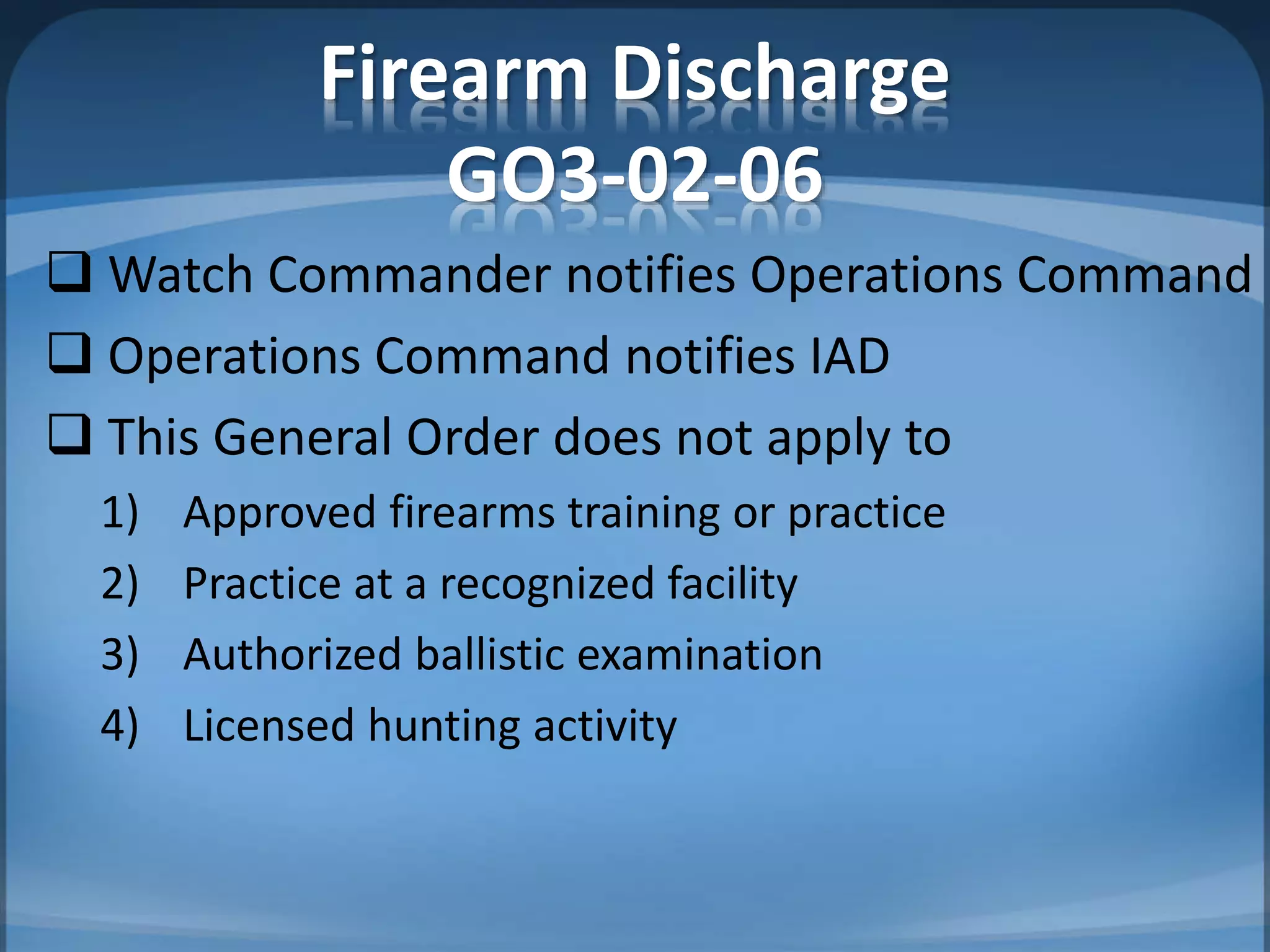
Firearm Discharge
GO3-02-06
 Watch Commander notifies Operations Command
 Operations Command notifies IAD
 This General Order does not apply to
1) Approved firearms training or practice
2) Practice at a recognized facility
3) Authorized ballistic examination
4) Licensed hunting activity
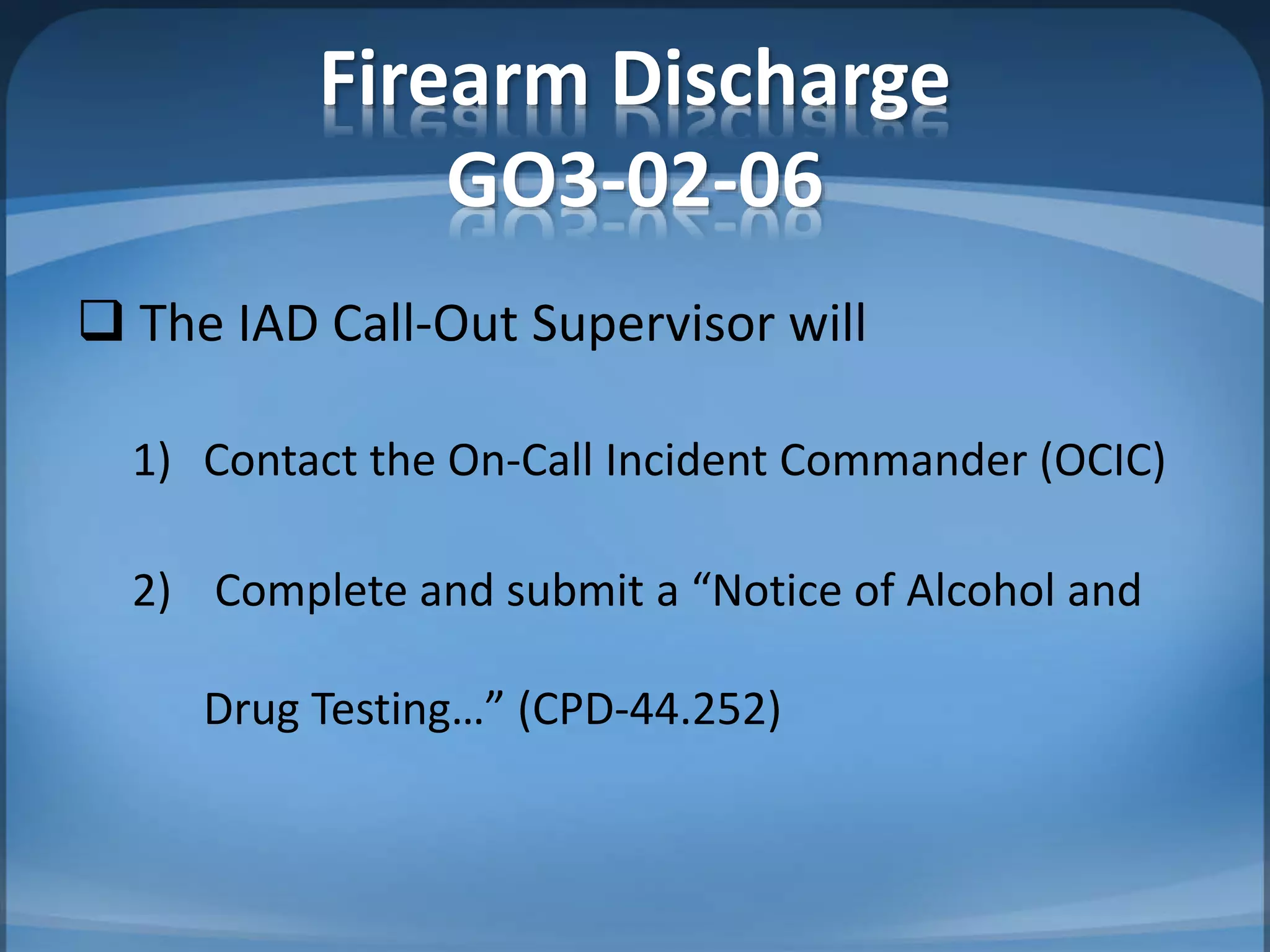
Firearm Discharge
GO3-02-06
 The IAD Call-Out Supervisor will
1) Contact the On-Call Incident Commander (OCIC)
2) Complete and submit a “Notice of Alcohol and
Drug Testing…” (CPD-44.252)
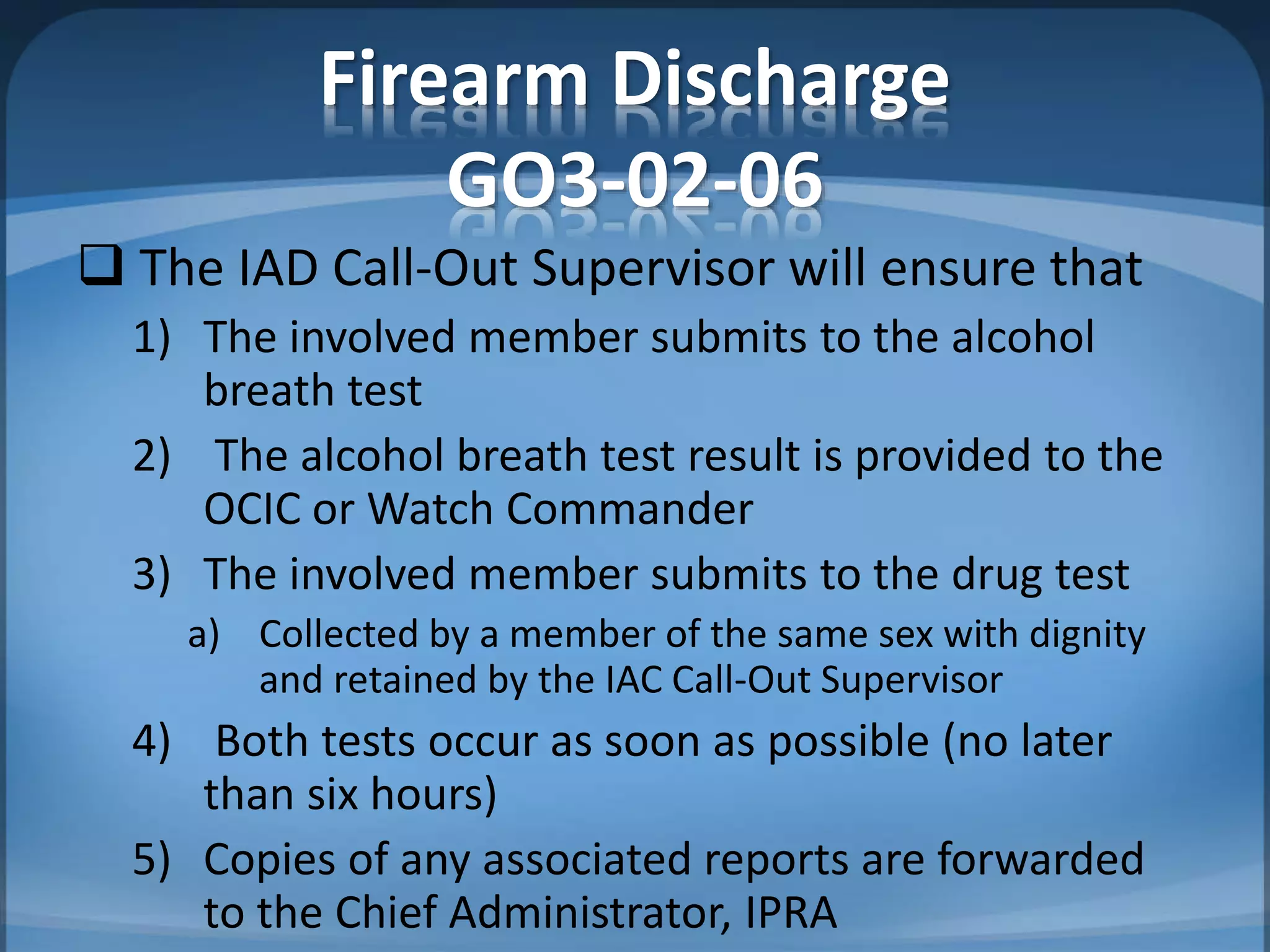
Firearm Discharge
GO3-02-06
 The IAD Call-Out Supervisor will ensure that
1) The involved member submits to the alcohol
breath test
2) The alcohol breath test result is provided to the
OCIC or Watch Commander
3) The involved member submits to the drug test
a) Collected by a member of the same sex with dignity
and retained by the IAC Call-Out Supervisor
4) Both tests occur as soon as possible (no later
than six hours)
5) Copies of any associated reports are forwarded
to the Chief Administrator, IPRA
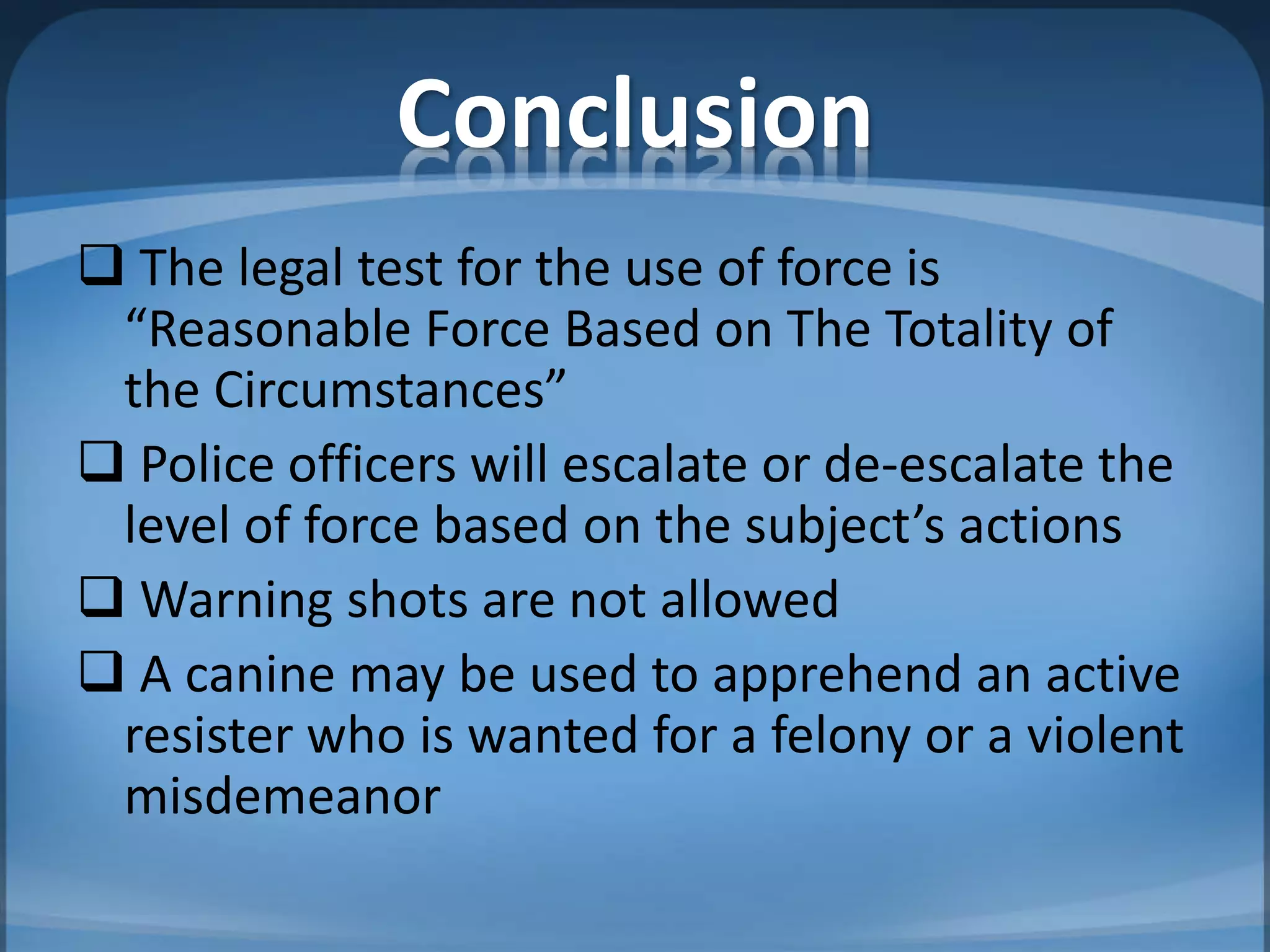
Conclusion
 The legal test for the use of force is
“Reasonable Force Based on The Totality of
the Circumstances”
 Police officers will escalate or de-escalate the
level of force based on the subject’s actions
 Warning shots are not allowed
 A canine may be used to apprehend an active
resister who is wanted for a felony or a violent
misdemeanor

THE USE OF FORCE POWERPOINT

  • 1.
    The Use ofForce Flavio Mota, Attorney
  • 2.
    The Agenda  ToDiscuss the Use of Force Guidelines While Covering a Few of the Related General Orders The Use of Force Model GO3-02-01 Force Options GO3-02-02 Deadly Force GO3-02-03 Canines as a Force Option GO3-02-04 Incidents Requiring a TRR GO3-02-05 Weapons Discharge Incidents GO3-02-06
  • 3.
    The Use ofForce Model GO3-02-01 1) Officers escalate or de-escalate the amount of force in relation to the level of force offered by the subject 2) The legal test is “Reasonable Amount of Force Based on the Totality of the Circumstances” 3) The “Use of Force Model” is a guideline and does not account for all possible factors
  • 4.
    Force Options GO3-02-02  CooperativeSubject: 1. Social Control, Presence; 2. Verbal  Resister: 1. Passive Resister; 2. Active Resister  Assailant: 1) Aggressively offensive, no weapons; 2) Actions will likely cause physical injury; 3) Actions will likely cause death or serious physical injury
  • 5.
    Canines as aForce Option GO3-02-04 1) Allowed to use a dog on an assailant—this includes an assailant against the canine 2) The use of a canine requires the completion of a TRR 3) Allowed to use on an active resister who is alleged to have committed a felony or a violent misdemeanor 4) Prior to the use of the dog, the handler will announce her police authority and warn about the dog 5) Must give a warning in a manner that can be heard, multiple warnings might be required—several floors 6) A command staff approval needed for a crowd control
  • 6.
    Incidents Requiring aTRR GO3-02-05  The subject is an assailant and the officer intervenes  The subject is an active resistor and the officer does more than just  Use verbal commands or control holds  A TRR is required when there are allegations of injuries  The subject alleges injury  Discharge OC spray, chemical weapon, taser, impact munitions, or a firearm  The subject physically obstructs a police officer
  • 7.
    Incidents that donot Require a TRR GO3-02-05  A firm grip hold and no injury or allegation of injury  Force necessary to overcome a passive resister due to disability or intoxication  Control holds with handcuffing and searching  No injury or allegation of injury  An approved training exercise
  • 8.
    Procedures for aTRR Incident GO3-02-05  A police officer or detention aide will  Immediately notify the immediate supervisor  Complete a TRR  Make notifications to OEMC and the Desk Sergeant at the district of occurrence  Ensure that the completed TRR is submitted
  • 9.
    A Supervisor’s Duties GO3-02-05 A Supervisor who has been notified will 1) Respond to the scene 2) Ensure that all witnesses are interviewed 3) Request the assignment of an ET A. When there are injuries or allegations of injuries B. When deemed appropriate by the supervisor 4) Ensure that other evidence is handled and processed 5) Review the TRR for completeness and legibility 6) Complete the TRR for an injured member who is unable to complete the TRR
  • 10.
    Firearm Discharge GO3-02-06  WatchCommander notifies Operations Command  Operations Command notifies IAD  This General Order does not apply to 1) Approved firearms training or practice 2) Practice at a recognized facility 3) Authorized ballistic examination 4) Licensed hunting activity
  • 11.
    Firearm Discharge GO3-02-06  TheIAD Call-Out Supervisor will 1) Contact the On-Call Incident Commander (OCIC) 2) Complete and submit a “Notice of Alcohol and Drug Testing…” (CPD-44.252)
  • 12.
    Firearm Discharge GO3-02-06  TheIAD Call-Out Supervisor will ensure that 1) The involved member submits to the alcohol breath test 2) The alcohol breath test result is provided to the OCIC or Watch Commander 3) The involved member submits to the drug test a) Collected by a member of the same sex with dignity and retained by the IAC Call-Out Supervisor 4) Both tests occur as soon as possible (no later than six hours) 5) Copies of any associated reports are forwarded to the Chief Administrator, IPRA
  • 13.
    Conclusion  The legaltest for the use of force is “Reasonable Force Based on The Totality of the Circumstances”  Police officers will escalate or de-escalate the level of force based on the subject’s actions  Warning shots are not allowed  A canine may be used to apprehend an active resister who is wanted for a felony or a violent misdemeanor