Russian Embassy School in Madagascar
Project
“The United Kingdom of Great
Britain and Northern Ireland”
Made by Varvara Korznikova,
Grigory Sizov (9th form)
Antananarivo-2015
 Size:242,5 thousand sq km
 Highest Mountains: Ben Nevis 1,343 m
 Longest River: The Severn 354 km
 Largest Lake: Lough Neagh 382 square km
 Population: 61,8 million
 Nationality: Britons
 Ethnic/Cultural groups: English, Scots, Welsh, Irish.
 Official language: English
 Main cities: Birmingham, Glasgow, Liverpool,
Manchester, Leeds, Edinburgh, Sheffield, Belfast,
Newcastle, Cardiff.
Basic information
The official name
The official or political name of the country is The
United Kingdom of Great Britain and Northern
Ireland. At the United Nations and in the European
Parliament, it is usually known by a shorter name:The
United Kingdom or the abbreviation The UK.
The Flag
The flag of the United Kingdom is called the Union
Flag or The Union Jack. Now the flag combines the
emblems of the three countries (England, Scotland, and
Northern Ireland) united under one monarch. Wales is
not represented in the flag because at the time the flag
appeared in 1606, Wales was already united with
England.
The State Emblem
The State Emblem of the United Kingdom of Great Britain
and Northern Ireland shows the union of its four parts:
England, Scotland, Wales and Northern Ireland. The
emblem was introduced after the union with Scotland in
1603. The shield is divided into four parts. There are two
emblems of England (three lions on a red background), the
emblem of Scotland (a red lion on a yellow background)
and the emblem of Northern Ireland (a yellow harp on a
blue background)
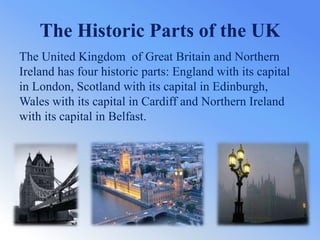
The Historic Parts of the UK
The United Kingdom of Great Britain and Northern
Ireland has four historic parts: England with its capital
in London, Scotland with its capital in Edinburgh,
Wales with its capital in Cardiff and Northern Ireland
with its capital in Belfast.
The Floral Symbol of England
The floral symbol of England is the RED ROSE. Earlier, it
decorated the arms of the House of Lancaster. The
Lancastrians argued for the throne of England with the
Yorkists whose arms had a white rose. The war for the
throne between the Lancastrians and the Yorkists became
known in the history of the country as the War of the Red
and White Rose. It lasted 30 years (1455-1485). When the
Lancastrians won the war, their arms of the Red Rose
became the symbol of the whole England.
The Floral Symbol of Scotland
The Scottish symbol is a wild plant called the THISTLE.
The Scandinavians planned to attack a Scottish village. But
since the Scots knew they were coming, they started to
prepare for war. Late at night, the Scandinavians came in
their bare feet, they didn`t want to awake the Scottish
warriors in the village. But the thorns of the thistle hurt their
bare feet. Their howls of pain pierced the silence and the
Scots awoke to fight the enemy.
The Floral Symbol of Wales
The Welsh symbol is a vegetable called the LEEK (or,
on occasion, the flower, the daffodil). The patron saint
of Wales, David, ate only leeks and bread. In memory of
this Christian saint, the leek became the symbol of
Wales. Daffodils which burst into flames by the 1st of
March celebrate the revered Welsh saint.
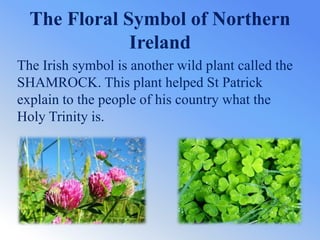
The Floral Symbol of Northern
Ireland
The Irish symbol is another wild plant called the
SHAMROCK. This plant helped St Patrick
explain to the people of his country what the
Holy Trinity is.
Thank you for your
attention!

The uk 9 кл

  • 1.
    Russian Embassy Schoolin Madagascar Project “The United Kingdom of Great Britain and Northern Ireland” Made by Varvara Korznikova, Grigory Sizov (9th form) Antananarivo-2015
  • 2.
     Size:242,5 thousandsq km  Highest Mountains: Ben Nevis 1,343 m  Longest River: The Severn 354 km  Largest Lake: Lough Neagh 382 square km  Population: 61,8 million  Nationality: Britons  Ethnic/Cultural groups: English, Scots, Welsh, Irish.  Official language: English  Main cities: Birmingham, Glasgow, Liverpool, Manchester, Leeds, Edinburgh, Sheffield, Belfast, Newcastle, Cardiff. Basic information
  • 3.
    The official name Theofficial or political name of the country is The United Kingdom of Great Britain and Northern Ireland. At the United Nations and in the European Parliament, it is usually known by a shorter name:The United Kingdom or the abbreviation The UK.
  • 4.
    The Flag The flagof the United Kingdom is called the Union Flag or The Union Jack. Now the flag combines the emblems of the three countries (England, Scotland, and Northern Ireland) united under one monarch. Wales is not represented in the flag because at the time the flag appeared in 1606, Wales was already united with England.
  • 5.
    The State Emblem TheState Emblem of the United Kingdom of Great Britain and Northern Ireland shows the union of its four parts: England, Scotland, Wales and Northern Ireland. The emblem was introduced after the union with Scotland in 1603. The shield is divided into four parts. There are two emblems of England (three lions on a red background), the emblem of Scotland (a red lion on a yellow background) and the emblem of Northern Ireland (a yellow harp on a blue background)
  • 6.
    The Historic Partsof the UK The United Kingdom of Great Britain and Northern Ireland has four historic parts: England with its capital in London, Scotland with its capital in Edinburgh, Wales with its capital in Cardiff and Northern Ireland with its capital in Belfast.
  • 7.
    The Floral Symbolof England The floral symbol of England is the RED ROSE. Earlier, it decorated the arms of the House of Lancaster. The Lancastrians argued for the throne of England with the Yorkists whose arms had a white rose. The war for the throne between the Lancastrians and the Yorkists became known in the history of the country as the War of the Red and White Rose. It lasted 30 years (1455-1485). When the Lancastrians won the war, their arms of the Red Rose became the symbol of the whole England.
  • 8.
    The Floral Symbolof Scotland The Scottish symbol is a wild plant called the THISTLE. The Scandinavians planned to attack a Scottish village. But since the Scots knew they were coming, they started to prepare for war. Late at night, the Scandinavians came in their bare feet, they didn`t want to awake the Scottish warriors in the village. But the thorns of the thistle hurt their bare feet. Their howls of pain pierced the silence and the Scots awoke to fight the enemy.
  • 9.
    The Floral Symbolof Wales The Welsh symbol is a vegetable called the LEEK (or, on occasion, the flower, the daffodil). The patron saint of Wales, David, ate only leeks and bread. In memory of this Christian saint, the leek became the symbol of Wales. Daffodils which burst into flames by the 1st of March celebrate the revered Welsh saint.
  • 10.
    The Floral Symbolof Northern Ireland The Irish symbol is another wild plant called the SHAMROCK. This plant helped St Patrick explain to the people of his country what the Holy Trinity is.
  • 11.
    Thank you foryour attention!