
The
Undereducated
  American
  Anthony P. Carnevale & Stephen J. Rose
Table of Contents
 8   Introduction
     Americans are undereducated.

11   Section One
     Economic growth is linked with
     educational attainment.

15   Section Two
     High wage premiums indicate that
     we need more college-educated
     workers.

21   Section Three
     Income inequality is driven largely
     by access to college.

24   Section Four
     But—are there too many college
     graduates already?

31   Section Five
     How many more college graduates
     do we need for efficiency and
     equity purposes?

37   Conclusion
The United States has
been underproducing
college-going workers
since 1980. Supply has
failed to keep pace
with growing demand,
and as a result, income
inequality has grown
precipitously.
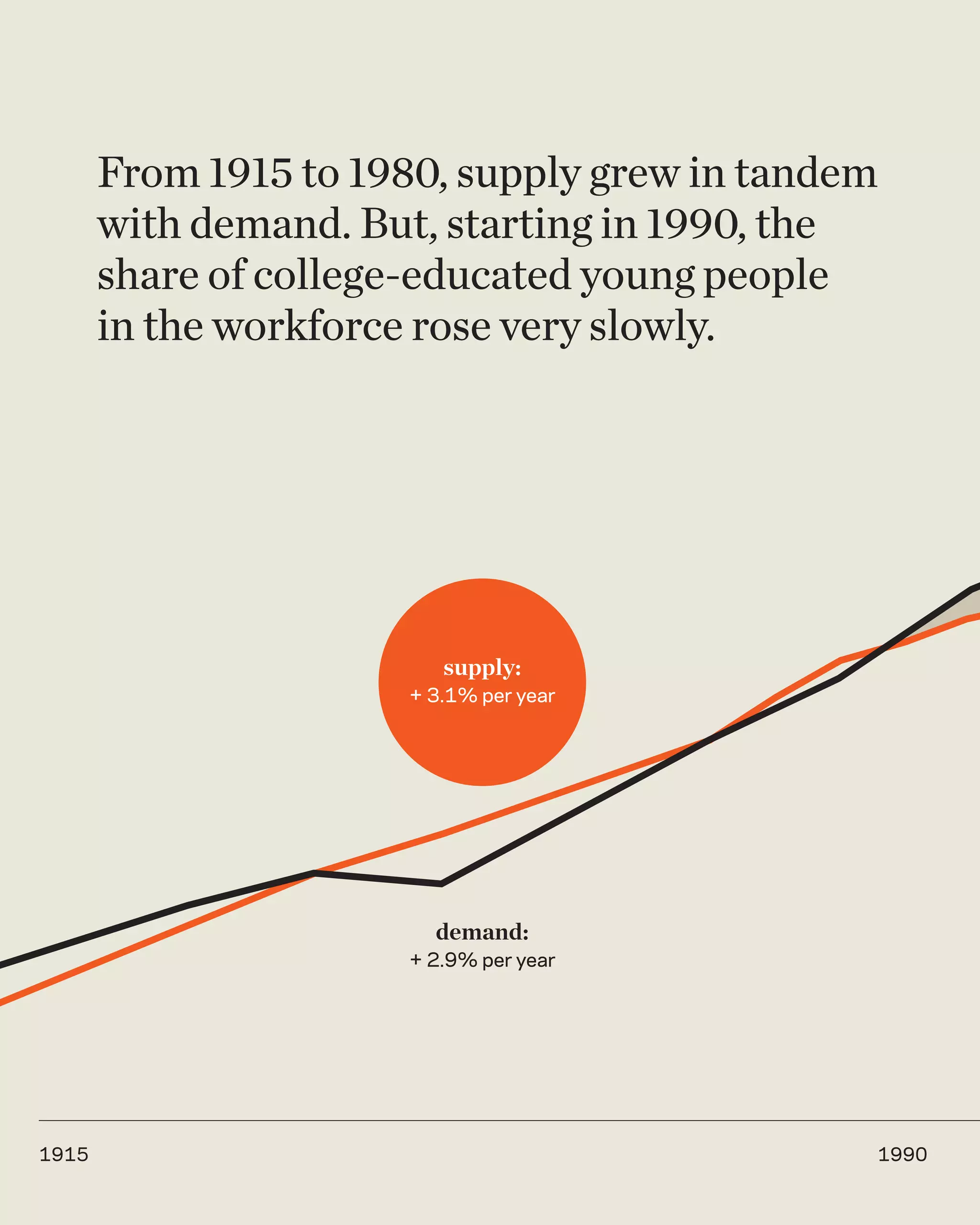
From 1915 to 1980, supply grew in tandem
       with demand. But, starting in 1990, the
       share of college-educated young people
       in the workforce rose very slowly.


                          supply:
                       + 3.1% per year


                         demand:
                       + 2.9% per year


1915                                          1990
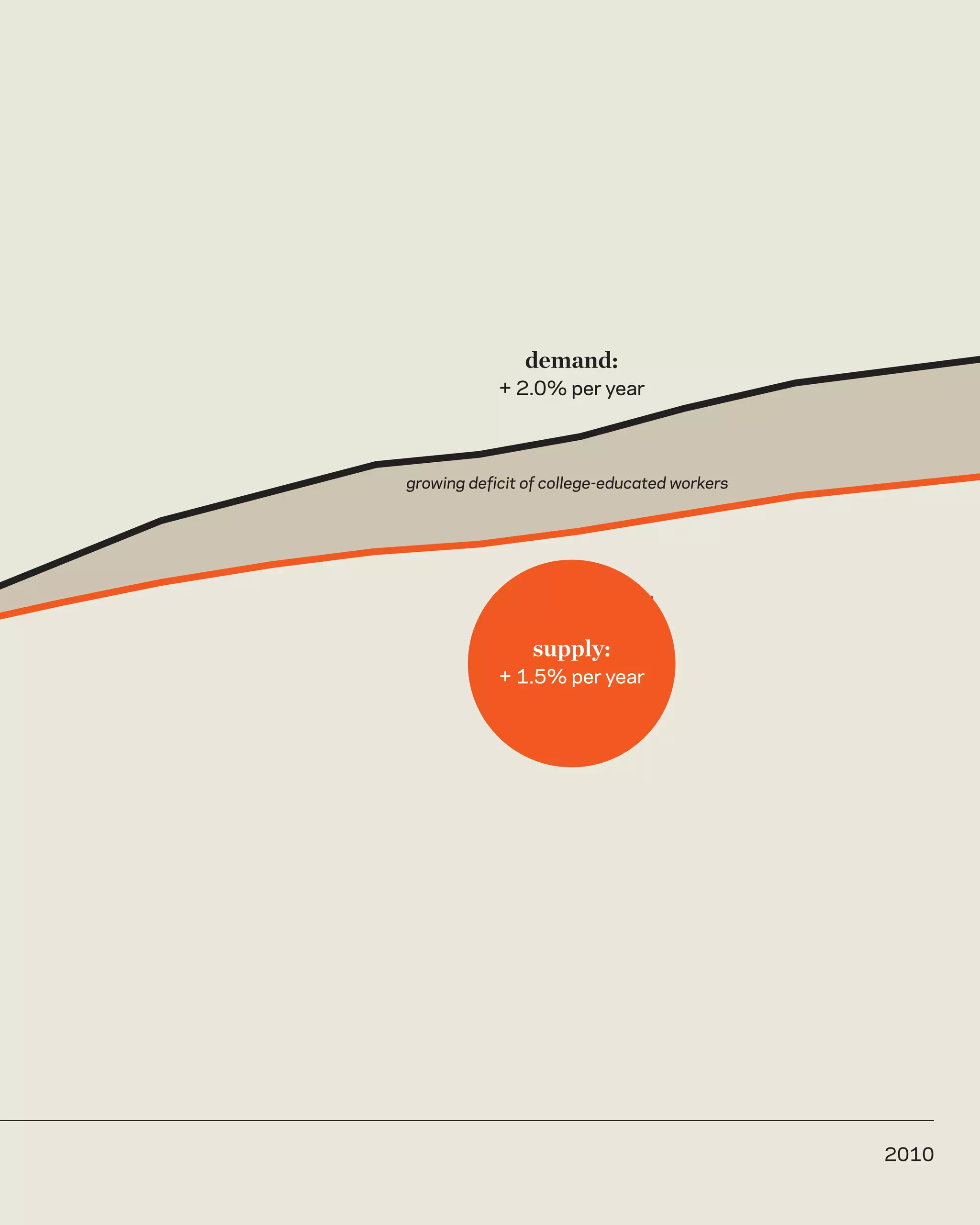
demand:
            + 2.0% per year


growing deficit of college-educated workers


                supply
           + 1.0% per year

                supply:
            + 1.5% per year


                                              2010
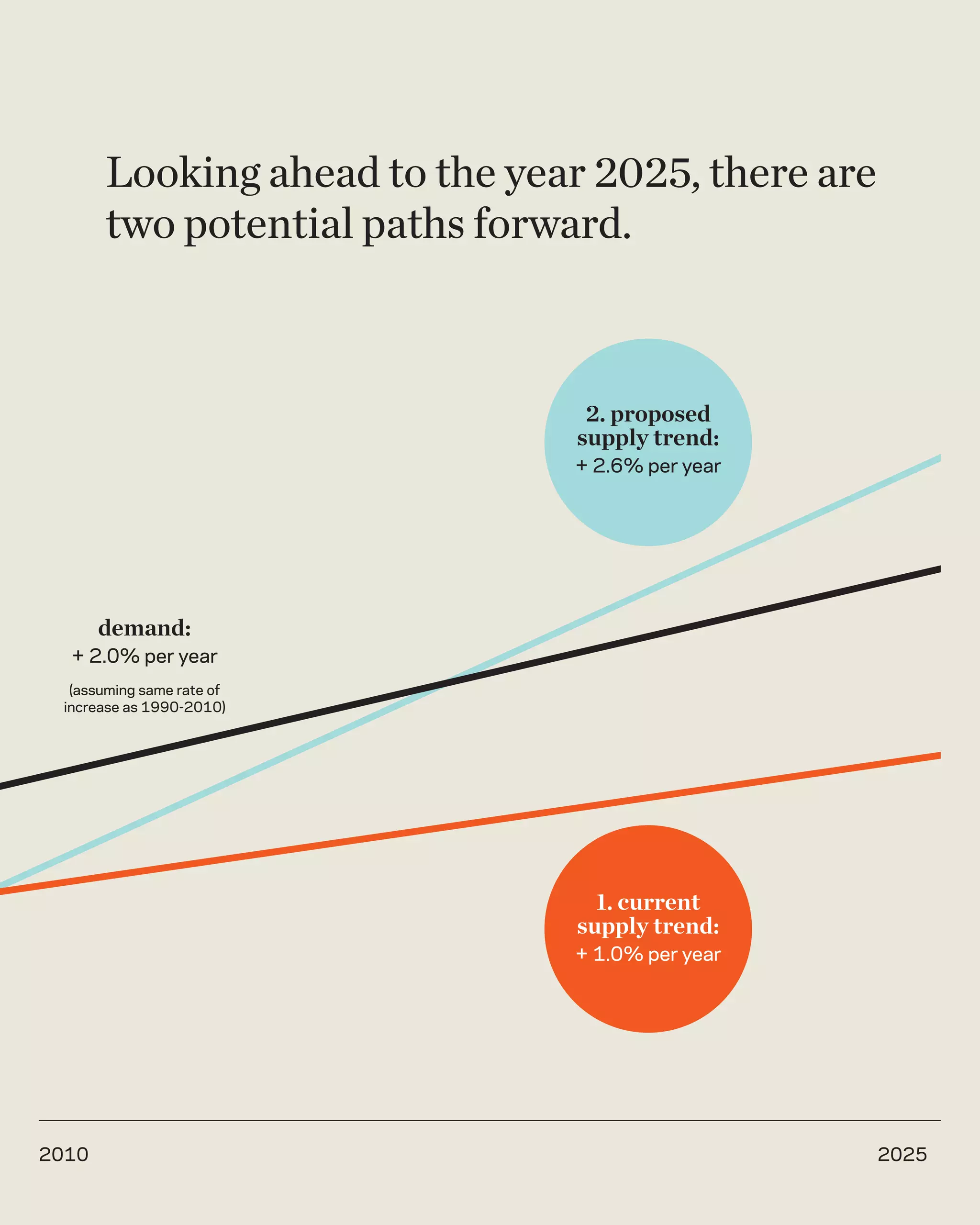
Looking ahead to the year 2025, there are
       two potential paths forward.


                                 2. proposed
                                supply trend:
                               + 2.6% per year


       demand:
  + 2.0% per year
  (assuming same rate of
 increase as 1990-2010)


                                  1. current
                                supply trend:
                               + 1.0% per year


2010                                               2025
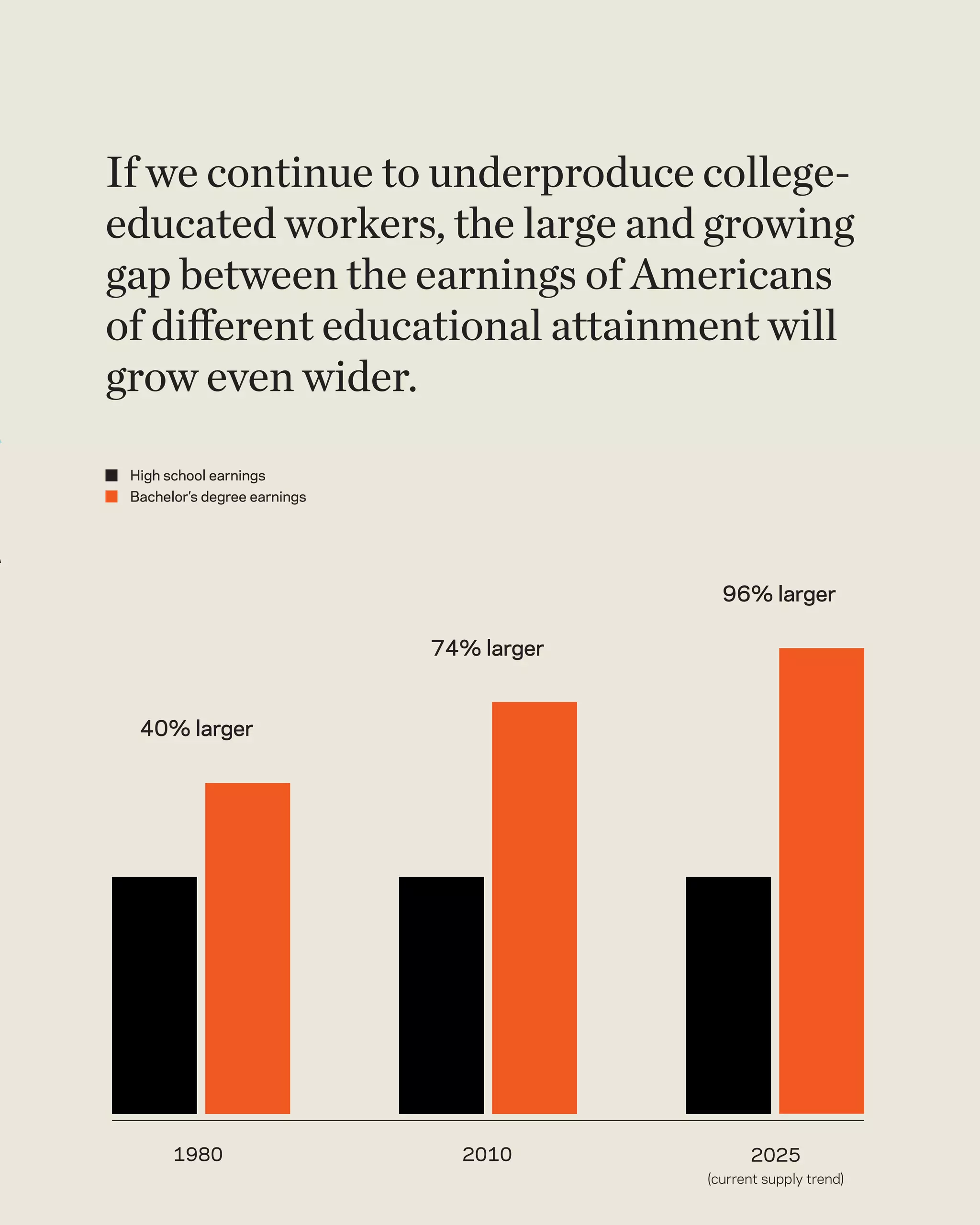
If we continue to underproduce college-
educated workers, the large and growing
gap between the earnings of Americans
of different educational attainment will
grow even wider.

 High school earnings
 Bachelor’s degree earnings


                                             96% larger

                              74% larger


  40% larger


       1980                     2010             2025
                                           (current supply trend)
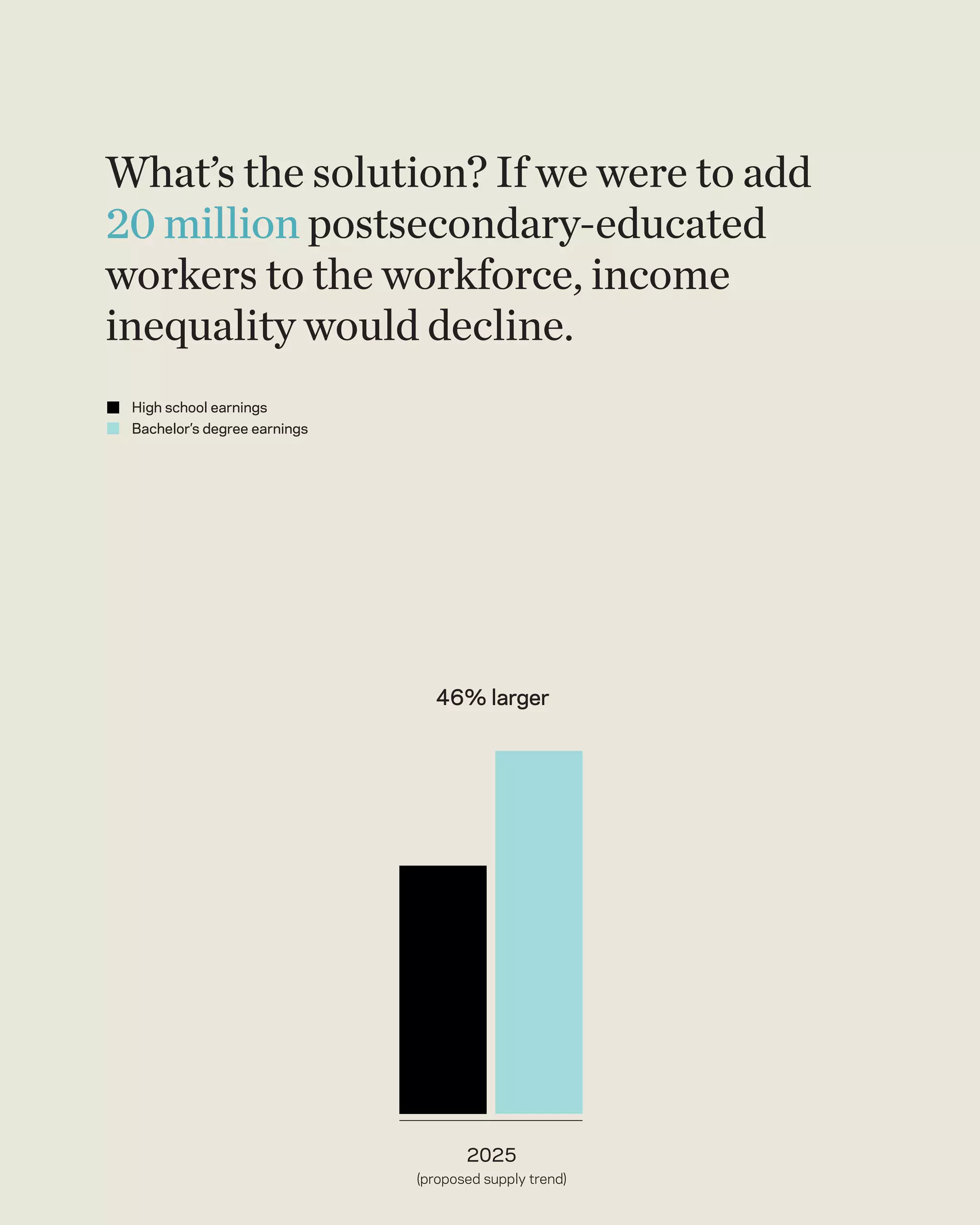
What’s the solution? If we were to add
20 million postsecondary-educated
workers to the workforce, income
inequality would decline.
 High school earnings
 Bachelor’s degree earnings


                                46% larger


                                     2025
                              (proposed supply trend)
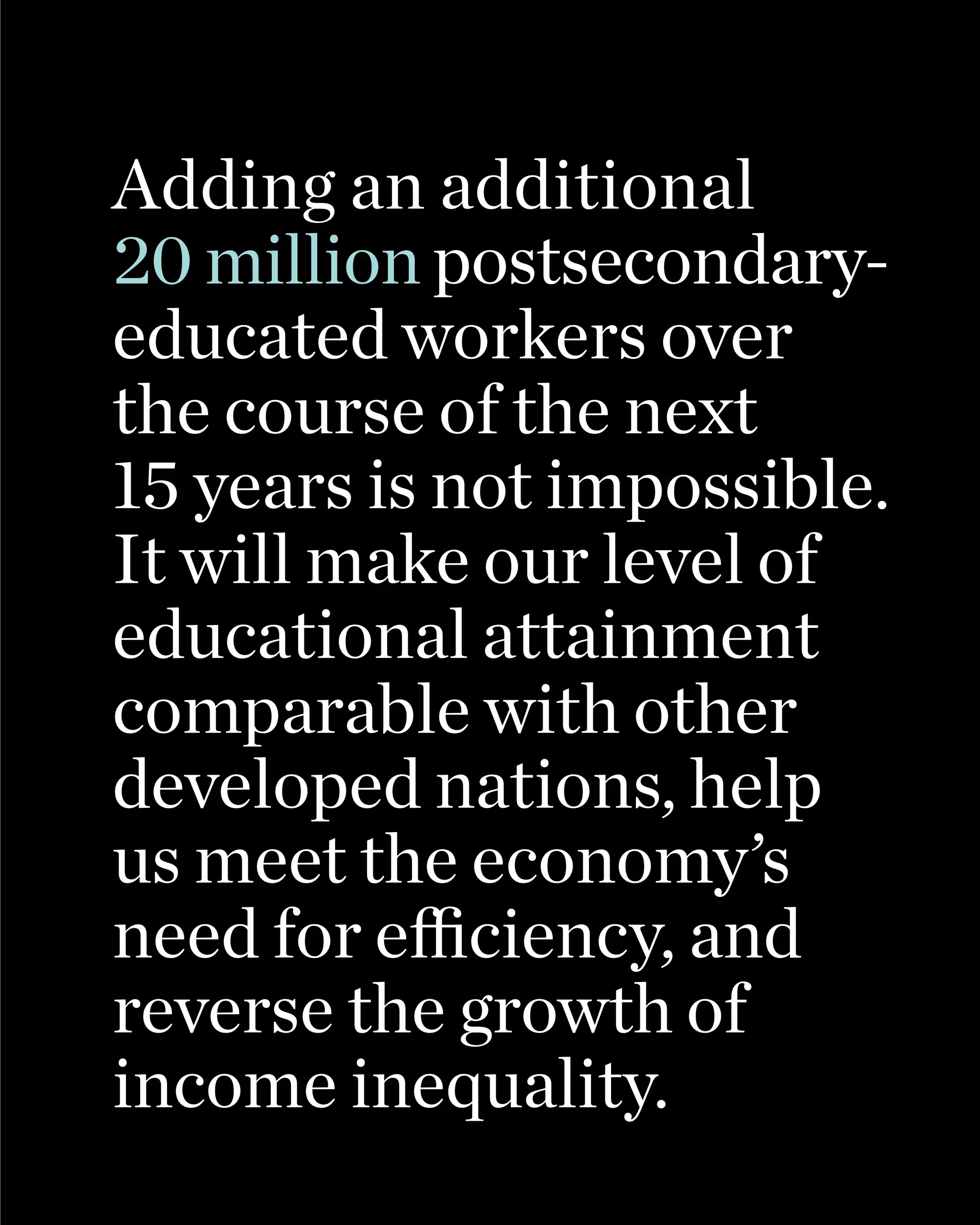
Adding an additional
20 million postsecondary-
educated workers over
the course of the next
15 years is not impossible.
It will make our level of
educational attainment
comparable with other
developed nations, help
us meet the economy’s
need for efficiency, and
reverse the growth of
income inequality.
8	                                                                                                                                   THE UNDErEDUCATED AMErICAN


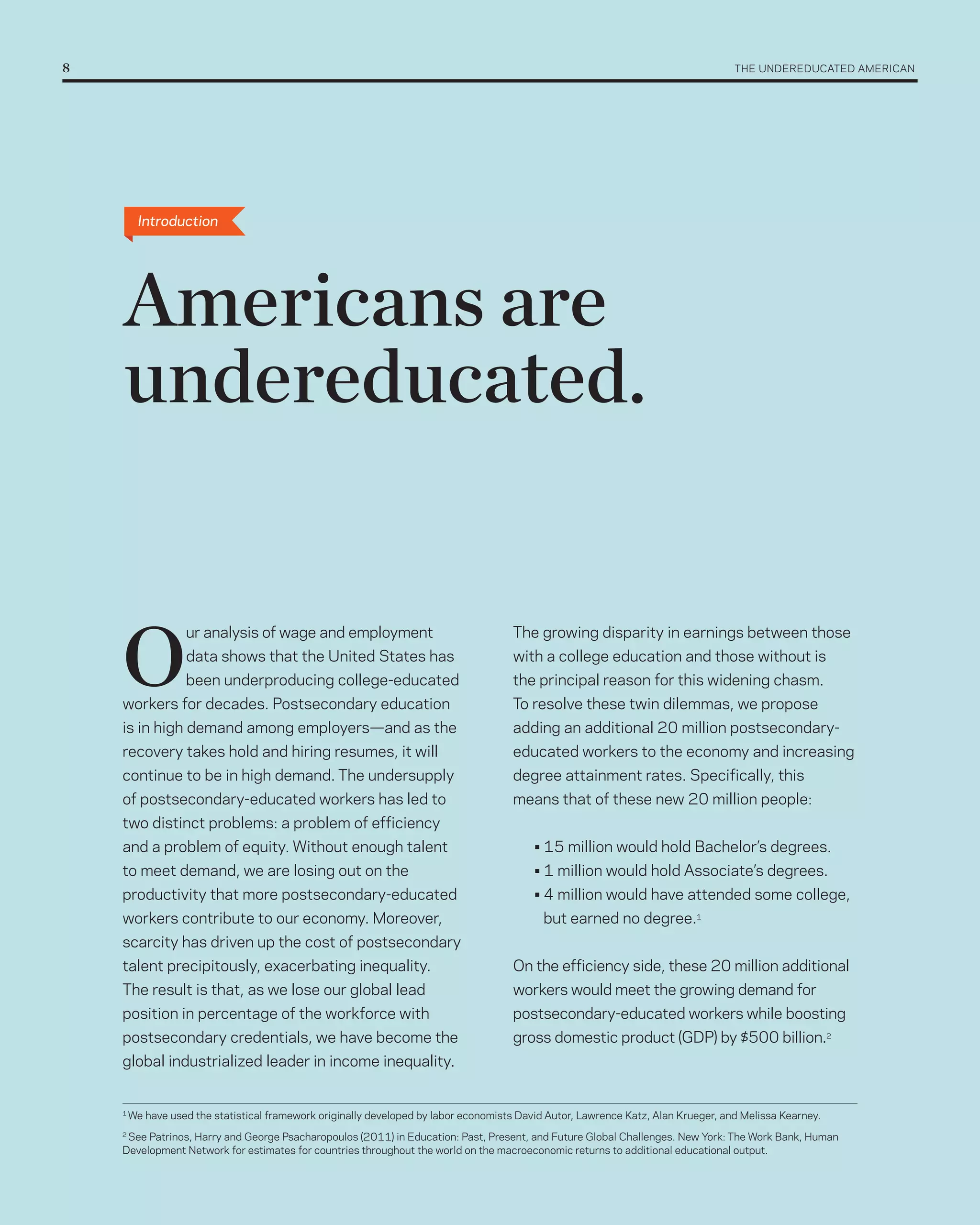
           Introduction


     Americans are
     undereducated.


     O
                    ur analysis of wage and employment                                 The growing disparity in earnings between those
                    data shows that the United States has                              with a college education and those without is
                    been underproducing college-educated                               the principal reason for this widening chasm.
     workers for decades. Postsecondary education                                      To resolve these twin dilemmas, we propose
     is in high demand among employers—and as the                                      adding an additional 20 million postsecondary-
     recovery takes hold and hiring resumes, it will                                   educated workers to the economy and increasing
     continue to be in high demand. The undersupply                                    degree attainment rates. Specifically, this
     of postsecondary-educated workers has led to                                      means that of these new 20 million people:
     two distinct problems: a problem of efficiency
     and a problem of equity. Without enough talent                                         • 15 million would hold Bachelor’s degrees.
     to meet demand, we are losing out on the                                               • 1 million would hold Associate’s degrees.
     productivity that more postsecondary-educated                                          • 4 million would have attended some college,
     workers contribute to our economy. Moreover,                                             but earned no degree.1
     scarcity has driven up the cost of postsecondary
     talent precipitously, exacerbating inequality.                                    On the efficiency side, these 20 million additional
     The result is that, as we lose our global lead                                    workers would meet the growing demand for
     position in percentage of the workforce with                                      postsecondary-educated workers while boosting
     postsecondary credentials, we have become the                                     gross domestic product (GDP) by $500 billion.2
     global industrialized leader in income inequality.


     1
         We have used the statistical framework originally developed by labor economists David Autor, Lawrence Katz, Alan Krueger, and Melissa Kearney.
     2
      See Patrinos, Harry and George Psacharopoulos (2011) in Education: Past, Present, and Future Global Challenges. New York: The Work Bank, Human
     Development Network for estimates for countries throughout the world on the macroeconomic returns to additional educational output.
THE UNDErEDUCATED AMErICAN 	                                                                                         9


         On the equity side, adding these workers would          It turned out that the critics’ predictions were
         reduce the wage premium paid to college-edu-            startlingly shortsighted. Instead of declining,
         cated workers from 74 to 46 percent, beginning          earnings for college-educated workers grew
         to reverse the decades-long inequality trend. To        rapidly throughout the 1980s and 1990s, out-
         be clear, adding 20 million additional college-         pacing growth in earnings of their less-educated
         educated workers will help raise the wages of all       counterparts. The gap between these relative
         workers. Inequality will be reduced because the         wages widened significantly.This trend remained
         wages of college-educated workers, while rising,        strong for more than 20 years, and technology
         will no longer be rising faster than the wages of       has accelerated the trend, as unskilled labor is
         high school–educated workers. The wages of high         increasingly automated and employers look for
         school–educated workers will rise by 24 percent,        workers who can productively utilize the latest
         those with Associate’s degrees will rise by 15          technological products. As a result, richard
         percent, while the wages of those with Bachelor’s       Freeman would eventually concede that he
         degrees will rise by 6 percent.                         did not foresee the rising demand for college-
                                                                 educated labor. Economists now generally agree
         Critics will respond that we already have too many      that the “overeducated American” saw impressive
         college graduates, and that it is irresponsible to      wage growth and employment stability through
         invest more in postsecondary education during a         the 1980s and 1990s because of, not in spite of,
         time when many graduates are unemployed. This           his or her postsecondary education.
         is not the first time critics have complained that
         too many young people were going to college.            During this same period, however, the earnings
         In 1976, Harvard economist richard Freeman              potential of workers with only a high school
         published The Overeducated American, arguing            diploma began to erode. Middle-class earnings are
         that the huge investment in college education was       increasingly secured by those with at least some
         wasteful and that the surge in college attendance       postsecondary education, and men with only a
         among baby boomers was sure to reduce the               high school diploma have been losing ground for
         earnings of college graduates in the future. At that    decades. These two trends combined—rising
         time, using the best available evidence and sound       relative wages for college-educated workers and
         economic reasoning, his conclusion seemed rea-          falling relative wages for those with only a high
         sonable. Also in the midst of the 1981 recession,       school diploma—have contributed significantly to
         stories popped up in the media questioning the          the concomitant rise in income inequality in the
         value of college. The Washington Post ran a story       United States.
         chronicling the experience of Lyman Crump, who
         translated his liberal arts college degree into a job   The relative wages of college-educated workers
         as a janitor. In 1984, ronald Kutscher, the Assis-      have been rising much faster than the wages of
         tant Commissioner for employment projections            people with a high school diploma. The laws of
         at the Bureau of Labor Statistics, was quoted in        supply and demand are the best single indicator
         The New York Times as saying, “We are going to be       of whether the United States is producing
         turning out about 200,000 to 300,000 too many           enough, too few, or too many college graduates.
         college graduates a year in the ‘80s.”                  If the relative earnings of college-educated
10	                                                                                              THE UNDErEDUCATED AMErICAN


      workers rise faster than the earnings of their           to rising educational levels. The second section
      counterparts, it means the demand is growing faster      documents the change in the supply and demand
      than supply. The data, therefore, are unequivocal—       of college-educated workers from 1915 to 2005.
      Americans are undereducated.                             We assess and confirm the consensus economic
                                                               interpretation of the rise of the Bachelor’s degree
      To correct our undersupply and meet our                  to high school wage premium from 1980 to 2005
      efficiency and equity goals for the economy and          that suggests that there has been an undersupply
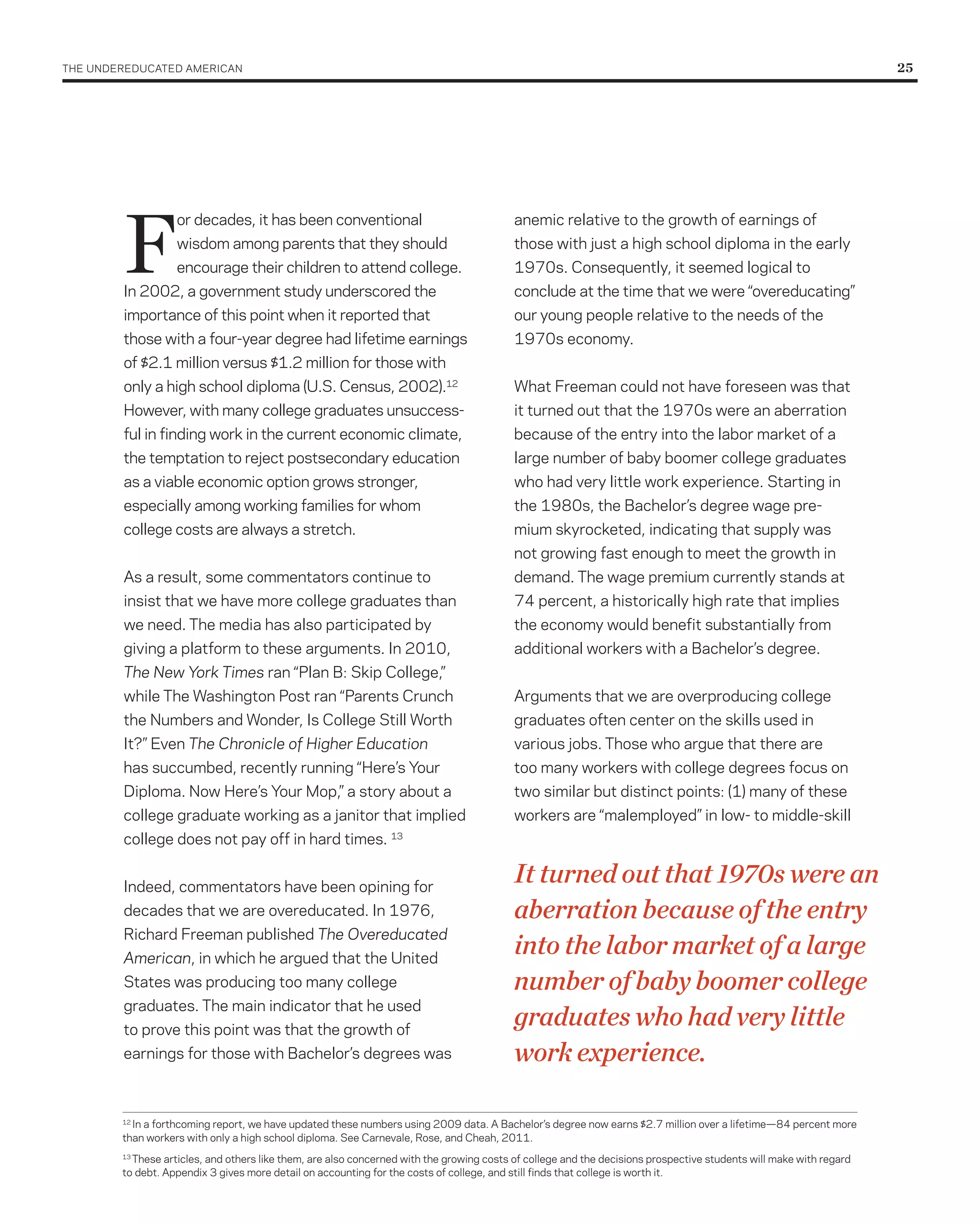
      for our society, we will need to add an additional       of college graduates. The third section shows how
      20 million postsecondary-educated workers                this rising Bachelor’s degree premium has led to a
      to the economy by 2025. reaching this goal               sharp, distressing rise in inequality and discusses
      is a significant challenge; it requires more             the positive effects of increased postsecondary
      productivity from our education system at all            attainment on wages and inequality. We find that
      levels. That effort is not only possible, but critical   attaining our goal of 20 million additional workers
      to maintaining American economic strength in             with postsecondary education will help reverse
      an increasingly competitive world, as many,              the growth of income inequality. The fourth
      including President Obama, have recognized.              section addresses the arguments that we have
                                                               too many college graduates today. Neither the
      These numbers put our goal firmly in line with the       historical earnings data nor future projections of
      President’s postsecondary education goal. reach-         postsecondary demand support the notion that
      ing our goal of 20 million additional postsecondary      college workers are oversupplied. The final
      workers assumes that by 2025, 75 percent of the          section details our calculations regarding how
      workforce will have at least one year of postsec-        many additional college graduates are needed
      ondary education. This represents a significant          between now and 2025 to meet the rising demand
      increase from the current trend, which would lead        for college-educated workers and to meet a
      to 65 percent of the labor force with at least some      target Bachelor’s degree to high school wage
      college by 2025. Furthermore, achieving this goal        ratio that will result in a more shared prosperity.
      would result in 55 percent of the labor force
      having at least an Associate’s degree, compared          Our findings are not surprising. Postsecondary
      with 42 percent today. For the youngest age              education has historically been one of the safest
      cohort, 60 percent of workers would have an              long-term investments we can make in our
      Associate’s or Bachelor’s degree, compared with          economic future. Educated workers are more
      the 42 percent who had a college degree in 2005.         productive, earn more, and pay more taxes.
                                                               Not only is higher education a sure return on
      We lay out our argument in five sections. The first      investment, but access to postsecondary
      tracks the evolution of increasing educational           education has become the arbiter of economic
      attainment in this country and in other countries        success and upward mobility in our society.
      around the world. We give an overview of the             More postsecondary education will achieve not
      data that demonstrate that other countries have          only a more dynamic and vibrant economy, but
      accepted that economic growth has been tied              a more equitable society.
THE UNDErEDUCATED AMErICAN 	              11


      Section One


    Economic growth is
    linked with educational
    attainment.


      “A clear trend has emerged:
       The United States is losing
       ground in postsecondary
       education relative to our
       competitors. The significance
       of these rankings goes beyond
       mere bragging rights—
       increasing our supply of skilled
       labor is central to the vitality
       of the U.S. economy. ”
12	                                                                                                                                   THE UNDErEDUCATED AMErICAN


      O                                                                                  For many years, the United
                     ver the past century, economic growth
                     in the United States has been tied to
                     technological change. First, it was the                             States was the undisputed
      assembly line machines of the manufacturing
                                                                                         leader in educational expansion
      age, and now it is computers and the Internet
      that have revolutionized skill needs in the work-                                  and had a significantly higher
      force. America’s relentless engine of technologi-
                                                                                         rate of college completion than
      cal development, fueled by increasingly fierce
      global competition, has required an ever-growing                                   any other country. In the 1960’s,
      pool of workers savvy enough to integrate these
                                                                                         between 50 and 60 percent of
      sophisticated new tools into their work routines.
      The growing need for technical sophistication                                      each age cohort attended post-
      has been coupled with a reduced need, often the
                                                                                         secondary institutions.
      result of automation, for unskilled labor. As an
      outcome of these technological changes, there
      has been a persistent and ongoing demand for                                       access to college, and eventually between 50
      more postsecondary education and training.                                         and 60 percent (approximately 35 percent would
      We have long been at the forefront of keeping up                                   get a degree) of each age cohort attended post-
      with this growing need. In fact, the United States’                                secondary institutions.
      commitment to mass education has a long histo-
      ry. We were the first country to institute free and                                What looked like folly and wasted resources to
      compulsory education in publicly-run schools. We                                   some turned out to be very productive for our
      expanded this commitment first to mass atten-                                      economy—and other countries noticed and
      dance in high schools in the first part of the 20th                                followed suit. As other countries expanded their
      century, and then to a majority of young people                                    educational systems, our advantage narrowed.
      having at least some postsecondary education                                       By 2008, the United States had dropped to
      (most often in public colleges and universities) in                                second behind Norway in the share of its work-
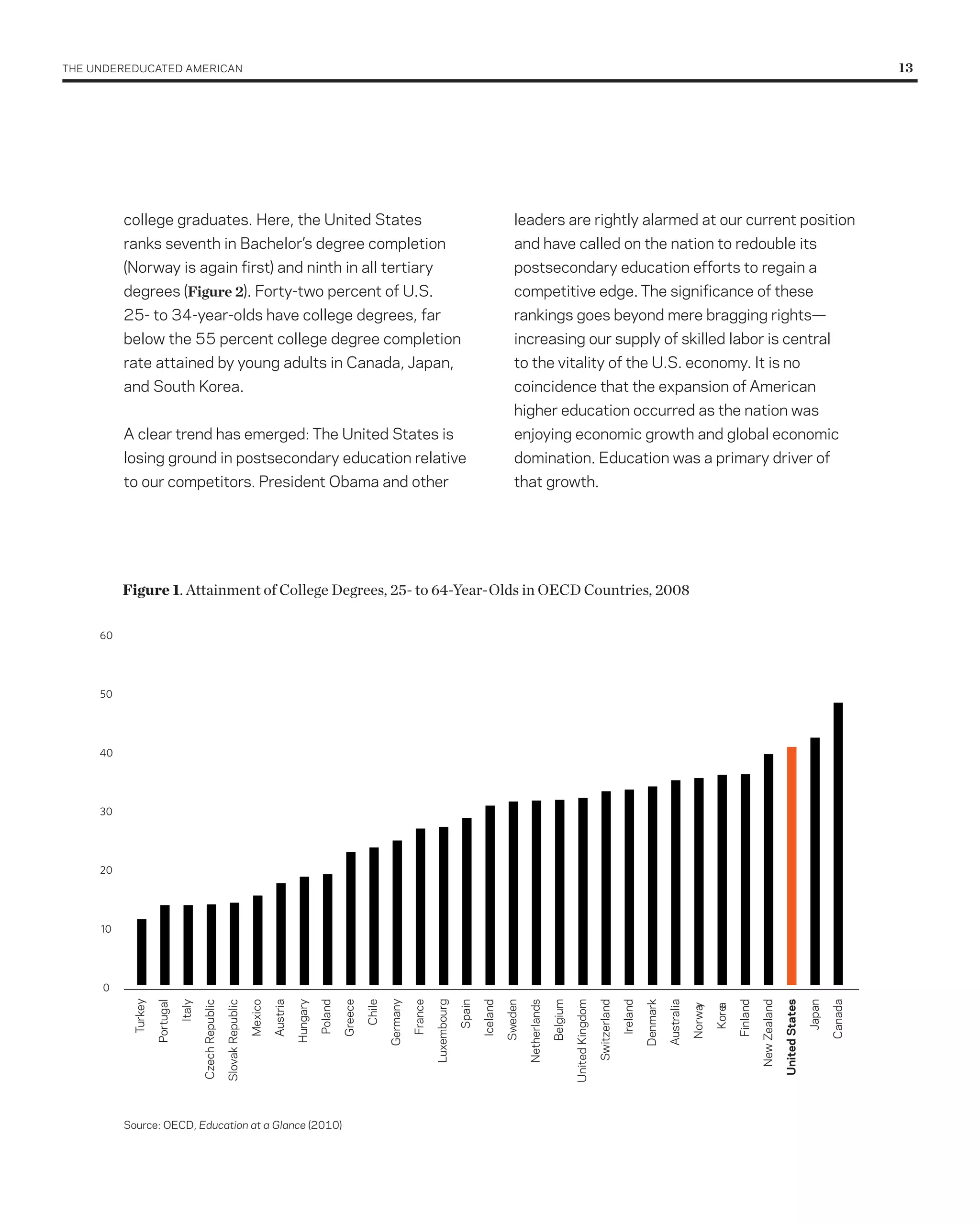
      the second half of the 20th century.                                               force with a four-year degree.3 Figure 1 includes
                                                                                         short-term college degrees (our Associate’s
      For many years, the United States was the                                          degree), which results in the United States being
      undisputed leader in educational expansion                                         third in terms of prime-age adult educational
      and had a significantly higher rate of college                                     attainment, behind Canada and Japan.4
      completion than any other country. In the 1960s,
      when our lead in the share of the workforce with                                   More significantly for our future, the picture is
      a college degree was large compared with other                                     bleaker for the United States among the 25–34
      industrialized countries, we continued to expand                                   age group, which includes the majority of recent


      3
          “Type A tertiary education,” according to the Organisation for Economic Co-operation and Development (OECD).
      4
          Their shares of short-term degrees in the workforceare 24 percent and 19 percent, respectively, compared with 10 percent for the United States.
THE UNDErEDUCATED AMErICAN 	                                                                                                                                                                                                                                                                                                                                    13


               college graduates. Here, the United States                                                                                                                                   leaders are rightly alarmed at our current position
               ranks seventh in Bachelor’s degree completion                                                                                                                                and have called on the nation to redouble its
               (Norway is again first) and ninth in all tertiary                                                                                                                            postsecondary education efforts to regain a
               degrees (Figure 2). Forty-two percent of U.S.                                                                                                                                competitive edge. The significance of these
               25- to 34-year-olds have college degrees, far                                                                                                                                rankings goes beyond mere bragging rights—
               below the 55 percent college degree completion                                                                                                                               increasing our supply of skilled labor is central
               rate attained by young adults in Canada, Japan,                                                                                                                              to the vitality of the U.S. economy. It is no
               and South Korea.                                                                                                                                                             coincidence that the expansion of American
                                                                                                                                                                                            higher education occurred as the nation was
               A clear trend has emerged: The United States is                                                                                                                              enjoying economic growth and global economic
               losing ground in postsecondary education relative                                                                                                                            domination. Education was a primary driver of
               to our competitors. President Obama and other                                                                                                                                that growth.


               Figure 1. Attainment of College Degrees, 25- to 64-Year-Olds in OECD Countries, 2008

          60


          50


          40
Percent


          30


          20


          10


          0
                Turkey


                                                                                                                                      Germany


                                                                                                                                                         Luxembourg
                                                                                        Austria
                         Portugal

                                    Italy

                                            Czech republic

                                                             Slovak republic

                                                                               Mexico


                                                                                                  Hungary

                                                                                                            Poland

                                                                                                                     Greece

                                                                                                                              Chile


                                                                                                                                                France


                                                                                                                                                                      Spain

                                                                                                                                                                              Iceland

                                                                                                                                                                                        Sweden

                                                                                                                                                                                                 Netherlands

                                                                                                                                                                                                               Belgium

                                                                                                                                                                                                                         United Kingdom

                                                                                                                                                                                                                                          Switzerland

                                                                                                                                                                                                                                                        Ireland

                                                                                                                                                                                                                                                                  Denmark

                                                                                                                                                                                                                                                                            Australia


                                                                                                                                                                                                                                                                                                       Finland

                                                                                                                                                                                                                                                                                                                 New Zealand

                                                                                                                                                                                                                                                                                                                               United States

                                                                                                                                                                                                                                                                                                                                               Japan

                                                                                                                                                                                                                                                                                                                                                       Canada
                                                                                                                                                                                                                                                                                            y

                                                                                                                                                                                                                                                                                                   a
                                                                                                                                                                                                                                                                                        Norwa

                                                                                                                                                                                                                                                                                                Kore


               Source: OECD, Education at a Glance (2010)
14	


                                                               0
                                                                   10
                                                                             30


                                                                        20
                                                                                       50
                                                                                                 70


                                                                                            60


                                                                                  40
                                                     Turkey

                                             Czech republic

                                             Slovak republic

                                                     Austria

                                                     Mexico

                                                       Italy

                                                    Portugal

                                                   Germany

                                                   Hungary


Source: OECD, Education at a Glance (2010)
                                                     Greece

                                                     Poland

                                                     Iceland

                                                       Chile

                                                     Finland

                                             United kingdom

                                                Switzerland

                                                Luxembourg

                                                      Spain

                                                Netherlands

                                                     France

                                                    Sweden

                                              United States
                                                                                                      Figure 2. Attainment of College Degrees, 25- to 34-Year-Olds in OECD Countries


                                                   Australia

                                                    Belgium

                                                   Denmark

                                                     Ireland

                                                    Norway

                                               New Zealand

                                                      Japan

                                                    Canada

                                                      Korea
                                                                                                                                                                                       THE UNDErEDUCATED AMErICAN
THE UNDErEDUCATED AMErICAN 	           15


      Section Two


    High wage premiums
    indicate that we need
    more college-educated
    workers.


      “The evidence is clear that
       the United States needs more,
       not fewer, college graduates.
       Proof is apparent when
       applying the most fundamental
       concept of economics:
       supply and demand.”
16	                                                                                                                        THE UNDErEDUCATED AMErICAN


      T
                    he increased focus on the availability of                             term, technically speaking, there is no such thing
                    skilled labor in the United States is not                             as a shortage—only different levels of supply and
                    born of idle concern; the evidence is clear                           demand, which affect the prices of goods.
      that the United States needs more, not fewer,
      college graduates. Proof is apparent when apply-                                    The labor market is not a perfect market. It is
      ing the most fundamental concept of economics:                                      based on personal decisions, not easily produced
      supply and demand. In the labor market, workers                                     products. Furthermore, in the real world, politics
      supply their services for a price (or wage) and                                     often intrude on the labor market. State and
      employers demand services in the form of jobs.                                      federal governments, for example, set minimum
      The “supply curve” shows that workers are willing                                   wages, and workers can organize into unions to
      to supply more labor at higher prices and less                                      engage in collective bargaining relationships.
      at lower prices. Conversely, the demand curve                                       Government trade policies can affect the labor
      shows that employers are willing to hire more                                       market, too, through the importation of goods
      workers at lower prices and fewer workers at                                        from abroad produced by workers who are paid
      higher prices. The market clearing price, or                                        lower wages. In addition, a number of economists
      “equilibrium,” is where the two curves intersect.                                   argue that employers sometimes pay higher
                                                                                          wages than necessary to motivate their workers
      Technically, there is never a shortage or surplus                                   and help them identify with their companies, a
      in the market, but an equilibrium price based on                                    concept called an “efficiency” wage.
      the current state of supply and demand. If goods
      go off the shelves faster than expected, or if their                                Even so, supply and demand are still the most
      price is higher than expected, then firms will                                      critical of the economic laws governing labor
      make above-average profits and expand supply,                                       markets.5 Ultimately, companies enforce these
      ultimately leading to a new equilibrium with                                        economic laws by hiring workers with the skills
      more production at a lower price. Conversely, if                                    they need to fill their job openings and earn a
      goods are not sold at their expected price, extra
      stock will build up and prices will drop (sales and
      closeouts) to clear inventory. This situation will                                  If qualified workers are in
      lead firms to produce less in the future or even
      lead some firms to go out of business. In either
                                                                                          short supply relative to
      case, supply will contract to the point at which                                    employer demand for them,
      the new market price and supply will generate
                                                                                          the rational response on the
      normal profits for the remaining firms. In the
      short term, there can be a shortage of goods,                                       part of employers is to bid up
      such as if a cereal maker does not have enough                                      wages for the workers they
      of a certain cereal brand on the shelf. However,
      in the long term, the company will adjust to the
                                                                                          want—in this case, college-
      level of demand and prices will adjust. In the long                                 educated workers.
      5
          See Autor, Katz, and Kearney (2008) and Hotchkiss and Shiferaw (2010) for a quantitative proofs of this point.
THE UNDErEDUCATED AMErICAN 	                                                                                                                                         17


          healthy return on investment. If qualified workers                                average, than they pay workers with only a high
          are in short supply relative to employer demand                                   school diploma.
          for them, the rational response on the part of
          employers is to bid up wages for the workers                                      This wage premium is not static, indicating that
          they want—in this case, college-educated work-                                    employers are responding to the market and
          ers. This has the effect of increasing the “wage                                  not just hiring degrees. Historically, the wage
          premium” that college workers make relative to                                    premium has risen and fallen depending on
          less-educated workers. Today, employers are                                       the complex interaction between supply and
          signaling that they want employees with college                                   demand.7 As reported in Goldin and Katz (2008),
          degrees or other forms of postsecondary training                                  the premium fluctuated throughout the 20th
          for the majority of jobs. In fact, they want these
                                            6
                                                                                            century (in Figure 3, the earnings of workers with
          employees so much that they are willing to pay                                    a graduate degree are included with those with
          Bachelor’s degree holders 74 percent more, on                                     just a Bachelor’s degree).


          Figure 3. Wage Premium of Skilled versus Unskilled Labor, 1915–2005
    100

              89%
     90
                                                                                                                                                          81%
                                                                                                                                        78%
     80

                                65%                                                                                    66%
     70

                                                                                   59%
     60
                                                                  49%                               48%
     50
                                                  37%
     40


     30


     20


     10


     0
              1915            1940              1950             1960              1970              1980             1990              2000              2005


          Source: Goldin and Katz (2008)8


          6
            Because of data limitations, we do not have complete historical data on those with two-year degrees or certificates. Although our analytic focus is on
          the Bachelor’s degree premium, it should be remembered that there are many other people who have postsecondary education but not a four-year degree
          (e.g., two-year degrees, certificates, and some college but no degree).
          7
           We would have liked to have tracked the Associate’s/high school and Bachelor’s/Associate’s wage ratios, but information of those getting an Associ-
          ate’s degree (as distinct from some college without a degree) only became available in the Current Population Survey in 1992, by which time most of the
          increase in earnings inequality had occurred.
          8
           “Skilled labor” is defined as all Bachelor’s and graduate degree holders plus one-half of those with some postsecondary education with a Bachelor’s
          degree (including Associate’s degrees). ”Unskilled labor” is defined as those who did not complete high school, those with a high school degree and no
          postsecondary education, and the other half of those with some postsecondary education.
18	                                                                                                                                   THE UNDErEDUCATED AMErICAN


      In 1915, there were few college graduates, and                                    In 1890, just 4 percent of workers had earned
      they tended to be business leaders with earnings                                  a high school diploma; by 1915, this figure
      much higher than less-educated rank-and-file                                      rose to 16 percent. This means that, in 1915,
      workers. As the Great Depression dawned and                                       approximately 6 percent of workers had ever
      jobs were hard to come by, the number of college-                                 attended school after high school.
      going young adults increased. That increase in
      supply, combined with wage and price controls                                     The education of the workforce has risen steadily
      related to World War II, contributed to a dramatic                                for two reasons. First, younger people are com-
      fall in the skilled-to-unskilled wage premium to                                  pleting more schooling than previous generations.
      just 37 percent by 1950. From there, though, the                                  Second, these more highly educated young work-
      premium began climbing again, fueled by strong                                    ers replace retiring workers who have much less
      economic growth in the postwar years, hitting 59                                  education. From 1915 to 1990, the supply of
      percent by 1970. Over the next decade, the sup-                                   college-educated workers in the workforce rose
      ply of college-educated workers spiked as waves                                   steadily by 3.1 percent a year because of both
      of highly educated (by historical standards) baby                                 of these factors. Starting in 1985, however, the
      boomers entered the workforce and, predictably,                                   increase in youth college-going compared with
      the wage premium dropped in tandem. From                                          their immediate predecessors slowed down to a
      1980 on, however, both the supply of college-                                     crawl. But the net replacement of less educated
      educated workers and the wage premium paid to                                     retirees with more highly-educated young people
      them continued to grow as the spread of informa-                                  still means that the relative supply of college-
      tion technology fueled a skyrocketing demand for                                  education in the work force grew by 2.5 percent
      college level skills throughout the economy.                                      a year from 1980 to 1990.


      Since we know the change in supply of educated                                    As the workforce gradually became more
      workers over these years and the relative price                                   educated, however, adding more beyond what
      of skilled versus unskilled labor, we can use the                                 was there after 1990 became more difficult
      supply and demand model of Autor, Katz, and                                       because the education of retirees was progres-
      Kearney (2008) to compute the change in                                           sively higher and the difference between the
      “relative demand” for skilled workers. Figure 4      9
                                                                                        educational levels of new entrants and that of
      shows the nearly parallel growth of supply and                                    retirees shrank. Consequently, from 1990 to
      demand for college-educated workers (25-64                                        2000, the supply of college-educated workers
      years old) from 1915 to 2010. The data on this                                    rose by 2.0 percent a year and fell to 1.0 per year
      chart represent the relative position of supply                                   from 2000 to 2010. The movements of demand
      and demand for college talent each year, as                                       follow a different logic. Depression and war in
      compared with 1970 conditions (set to zero).                                      the early twentieth century resulted in slow-


      9
        This figure is based on a logarithmic scale which means that the numbers of different years can be understood as the percent difference from 1970 con-
      ditions. In others words, in 1915, relative supply of college-educated labor in the work force was 68 percent less than the 1970 ratio of college-educated
      to non-college labor (while the relative demand in 1915 was at 55% lower than it was in 1970).
THE UNDErEDUCATED AMErICAN 	                                                                                                                                  19


           Figure 4. The March of Supply and Demand for College-Educated Workers Relative to 1970 Conditions, 1915-2010


    80%


    60%


    40%


    20%


     0%


    -20%


    -40%

                                                                                                                                           supply
                                                                                                                                           demand
    -60%


    -80%
            1915


                   1920


                          1925


                                  1930


                                            1935


                                                   1940


                                                          1945


                                                                 1950


                                                                        1955


                                                                               1960


                                                                                      1965


                                                                                               1970


                                                                                                      1975


                                                                                                             1980


                                                                                                                    1985


                                                                                                                           1990


                                                                                                                                  1995


                                                                                                                                         2000


                                                                                                                                                2005


                                                                                                                                                       2010
           Source: Goldin and Katz (2008)


           growing demand for skilled workers in those                                       These numbers demonstrate that increasing
           years, even as more young people stayed in                                        demand for more skilled workers has a long,
           school longer. relative demand for skilled labor                                  consistent history and is not solely based on the
           grew by 1.7 percent per year from 1915 through                                    more recent history of rising computerization.
           1950. Starting in 1950, the long boom of the                                      Further, the interaction of supply and demand
           fifties and sixties was followed by the computer                                  explains the movements of the skilled labor
           and internet revolutions starting in the 1980s.                                   premium shown in Figure 3. In particular, it
           The yearly growth of demand between 1950                                          explains the rise in the Bachelor’s to high school
           and 2005 was an impressive 3.6 percent.                                           wage premium (which is not exactly the skill
20	                                                                                                                                                                                                                                                             THE UNDErEDUCATED AMErICAN


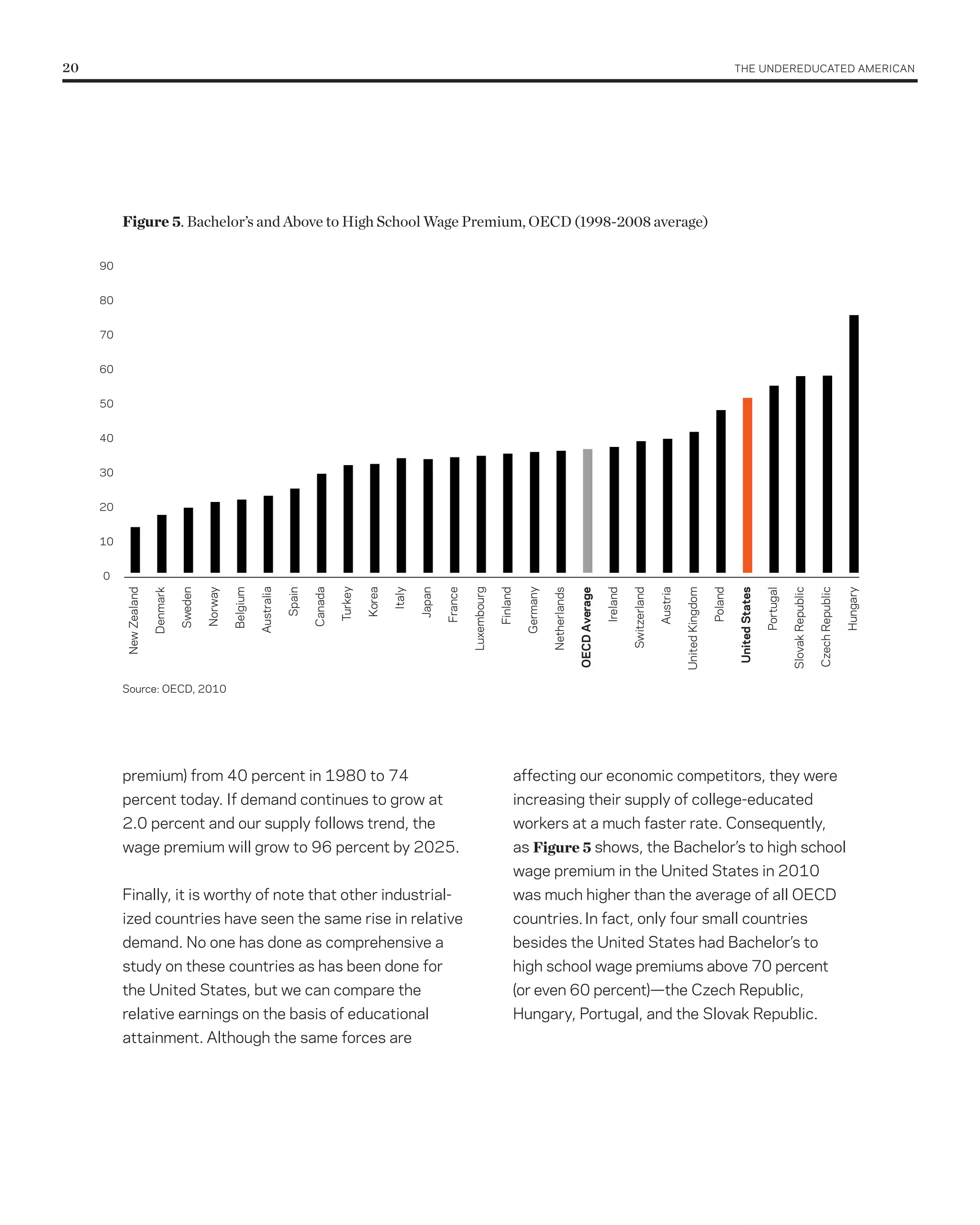
           Figure 5. Bachelor’s and Above to High School Wage Premium, OECD (1998-2008 average)

      90


      80


      70


      60


      50


      40


      30


      20


      10


      0
                                                                                            Turkey
                                                               Australia


                                                                                                                                      Luxembourg


                                                                                                                                                             Germany


                                                                                                                                                                                                                            Austria
           New Zealand

                         Denmark

                                   Sweden

                                            Norway

                                                     Belgium


                                                                           Spain

                                                                                   Canada


                                                                                                     Korea

                                                                                                             Italy

                                                                                                                     Japan

                                                                                                                             France


                                                                                                                                                   Finland


                                                                                                                                                                       Netherlands

                                                                                                                                                                                     OECD Average

                                                                                                                                                                                                    Ireland

                                                                                                                                                                                                              Switzerland


                                                                                                                                                                                                                                      United Kingdom

                                                                                                                                                                                                                                                       Poland

                                                                                                                                                                                                                                                                United States

                                                                                                                                                                                                                                                                                Portugal

                                                                                                                                                                                                                                                                                           Slovak republic

                                                                                                                                                                                                                                                                                                             Czech republic

                                                                                                                                                                                                                                                                                                                              Hungary
           Source: OECD, 2010


           premium) from 40 percent in 1980 to 74                                                                                                        affecting our economic competitors, they were
           percent today. If demand continues to grow at                                                                                                 increasing their supply of college-educated
           2.0 percent and our supply follows trend, the                                                                                                 workers at a much faster rate. Consequently,
           wage premium will grow to 96 percent by 2025.                                                                                                 as Figure 5 shows, the Bachelor’s to high school
                                                                                                                                                         wage premium in the United States in 2010
           Finally, it is worthy of note that other industrial-                                                                                          was much higher than the average of all OECD
           ized countries have seen the same rise in relative                                                                                            countries. In fact, only four small countries
           demand. No one has done as comprehensive a                                                                                                    besides the United States had Bachelor’s to
           study on these countries as has been done for                                                                                                 high school wage premiums above 70 percent
           the United States, but we can compare the                                                                                                     (or even 60 percent)—the Czech republic,
           relative earnings on the basis of educational                                                                                                 Hungary, Portugal, and the Slovak republic.
           attainment. Although the same forces are
THE UNDErEDUCATED AMErICAN 	             21


      Section Three


    Income inequality is
    driven largely by access
    to college.


      “One notable drawback to rapidly
       growing wages for more highly
       educated workers has been
       the concomitant rise in income
       inequality in the United States
       since 1980.”
22	                                                                                                                                         THE UNDErEDUCATED AMErICAN


          O
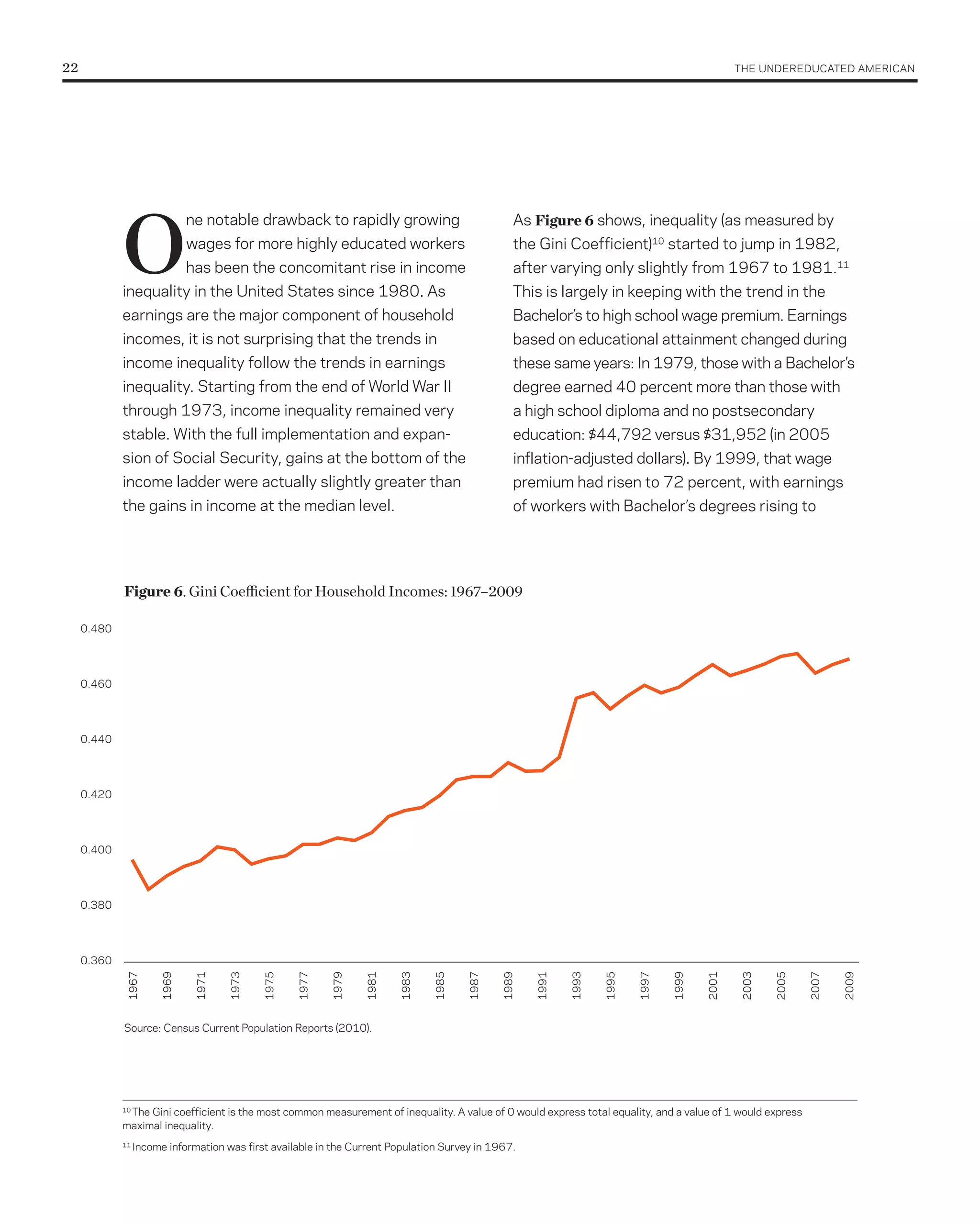
                           ne notable drawback to rapidly growing                             As Figure 6 shows, inequality (as measured by
                           wages for more highly educated workers                             the Gini Coefficient)10 started to jump in 1982,
                           has been the concomitant rise in income                            after varying only slightly from 1967 to 1981.11
          inequality in the United States since 1980. As                                      This is largely in keeping with the trend in the
          earnings are the major component of household                                       Bachelor’s to high school wage premium. Earnings
          incomes, it is not surprising that the trends in                                    based on educational attainment changed during
          income inequality follow the trends in earnings                                     these same years: In 1979, those with a Bachelor’s
          inequality. Starting from the end of World War II                                   degree earned 40 percent more than those with
          through 1973, income inequality remained very                                       a high school diploma and no postsecondary
          stable. With the full implementation and expan-                                     education: $44,792 versus $31,952 (in 2005
          sion of Social Security, gains at the bottom of the                                 inflation-adjusted dollars). By 1999, that wage
          income ladder were actually slightly greater than                                   premium had risen to 72 percent, with earnings
          the gains in income at the median level.                                            of workers with Bachelor’s degrees rising to


          Figure 6. Gini Coefficient for Household Incomes: 1967–2009

  0.480


  0.460


  0.440


  0.420


  0.400


  0.380


  0.360
          1967


                    1969


                            1971


                                   1973


                                          1975


                                                 1977


                                                        1979


                                                               1981


                                                                      1983


                                                                             1985


                                                                                    1987


                                                                                           1989


                                                                                                  1991


                                                                                                         1993


                                                                                                                1995


                                                                                                                       1997


                                                                                                                              1999


                                                                                                                                     2001


                                                                                                                                            2003


                                                                                                                                                   2005


                                                                                                                                                            2007


                                                                                                                                                                   2009


          Source: Census Current Population reports (2010).


          10
             The Gini coefficient is the most common measurement of inequality. A value of 0 would express total equality, and a value of 1 would express
          maximal inequality.
          11
               Income information was first available in the Current Population Survey in 1967.
THe UnderedUcATed AmerIcAn 	                                                                                      23


         $52,668 and those of workers with high school
         diplomas only falling to $30,586. By 2005,
                                                              We believe that 46 percent
         earnings had risen for both groups of workers,       strikes the proper balance
         but the Bachelor’s degree to high school
         wage premium had still increased modestly to
                                                              between an appropriate return
         74 percent ($54,502 to $31,242).                     on investment in postsecondary
         If we agree that this 74 percent premium is
                                                              education and the importance
         too high—both because it is a signal that the        of shared prosperity to stability
         economy is underproducing college graduates
         and because of its contribution to wage
                                                              and fairness in our society.
         inequality—the problem becomes judging
         what level would sufficiently addresses both         investment in postsecondary education and the
         issues. We settled on a Bachelor’s degree to         importance of shared prosperity to stability
         high school wage premium level of 46 percent         and fairness in our society. How would this 46
         for three reasons:                                   percent premium affect wage inequality? At
                                                              2009 levels, the earnings of the 90th percentile
            • This was the average premium rate for a         were 428 percent higher than earnings at the
             Bachelor’s degree over a high school diploma     10th percentile. Lowering the Bachelor’s degree
             from 1950 to 1970 in the United States.          to high school wage premium drops that per-
            • Forty-six percent represents a 10 percent       centage significantly but does not eliminate the
             rate of return for each of the four years of     advantages of a college degree. If the Bachelor’s
             college attendance (compounded), high            to high school wage premium was at a more
             enough to still make borrowing money to          healthy 46 percent of earnings in 2009, the
             attend college a good investment.                90th percentile would still be 376 percent higher
            • This level of wage premium is consistent with   than earnings at the 10th percentile.
             the premium level in many other industrialized
             countries with more educational attainment,      The remaining question is, what it would take
             including Australia, Finland, France, Germany,   to bring the wage premium down to 46 percent?
             and the United Kingdom (see Figure 5).           The answer goes back to supply and demand.
                                                              Until the economy’s demand for workers with
         We believe that workers should be rewarded           postsecondary education is met, the wage
         for their efforts and hard work in college, and      premium will continue to rise or not come
         we believe that 46 percent strikes the proper        down appreciably. That means producing more
         balance between an appropriate return on their       workers with postsecondary credentials.
24	                                      THE UNDErEDUCATED AMErICAN


      Section Four


      But—are there too
      many college graduates
      already?


      “With many college graduates
       unsuccessful in finding work in
       the current economic climate,
       the temptation to reject post-
       secondary education as a viable
       economic option grows stronger,
       especially among working
       families for whom college costs
       are always a stretch.”
The UnderedUcaTed american 	                                                                                                                                          25


         F
                    or decades, it has been conventional                                   anemic relative to the growth of earnings of
                    wisdom among parents that they should                                  those with just a high school diploma in the early
                    encourage their children to attend college.                            1970s. consequently, it seemed logical to
         in 2002, a government study underscored the                                       conclude at the time that we were “overeducating”
         importance of this point when it reported that                                    our young people relative to the needs of the
         those with a four-year degree had lifetime earnings                               1970s economy.
         of $2.1 million versus $1.2 million for those with
         only a high school diploma (U.S. census, 2002).12                                 What Freeman could not have foreseen was that
         however, with many college graduates unsuccess-                                   it turned out that the 1970s were an aberration
         ful in finding work in the current economic climate,                              because of the entry into the labor market of a
         the temptation to reject postsecondary education                                  large number of baby boomer college graduates
         as a viable economic option grows stronger,                                       who had very little work experience. Starting in
         especially among working families for whom                                        the 1980s, the Bachelor’s degree wage pre-
         college costs are always a stretch.                                               mium skyrocketed, indicating that supply was
                                                                                           not growing fast enough to meet the growth in
         as a result, some commentators continue to                                        demand. The wage premium currently stands at
         insist that we have more college graduates than                                   74 percent, a historically high rate that implies
         we need. The media has also participated by                                       the economy would benefit substantially from
         giving a platform to these arguments. in 2010,                                    additional workers with a Bachelor’s degree.
         The New York Times ran “Plan B: Skip college,”
         while The Washington Post ran “Parents crunch                                     arguments that we are overproducing college
         the numbers and Wonder, is college Still Worth                                    graduates often center on the skills used in
         it?” even The Chronicle of Higher Education                                       various jobs. Those who argue that there are
         has succumbed, recently running “here’s Your                                      too many workers with college degrees focus on
         diploma. now here’s Your mop,” a story about a                                    two similar but distinct points: (1) many of these
         college graduate working as a janitor that implied                                workers are “malemployed” in low- to middle-skill
         college does not pay off in hard times.                 13


         indeed, commentators have been opining for
                                                                                           It turned out that 1970s were an
         decades that we are overeducated. in 1976,                                        aberration because of the entry
         richard Freeman published The Overeducated
         American, in which he argued that the United
                                                                                           into the labor market of a large
         States was producing too many college                                             number of baby boomer college
         graduates. The main indicator that he used
         to prove this point was that the growth of
                                                                                           graduates who had very little
         earnings for those with Bachelor’s degrees was                                    work experience.

         12
           in a forthcoming report, we have updated these numbers using 2009 data. a Bachelor’s degree now earns $2.7 million over a lifetime—84 percent more
         than workers with only a high school diploma. See carnevale, rose, and cheah, 2011.
         13
            These articles, and others like them, are also concerned with the growing costs of college and the decisions prospective students will make with regard
         to debt. appendix 3 gives more detail on accounting for the costs of college, and still finds that college is worth it.
26	                                                                                                                               THE UNDErEDUCATED AMErICAN


            jobs for which a degree is unnecessary                                             clerical workers), and less-skilled jobs (e.g., work-
            (taxi drivers, for instance);14 and (2) many jobs                                  ers at factories, construction sites, retail outlets,
            that are composed mainly of workers with                                           and service businesses).15 These groupings
            Bachelor’s degrees do not require these                                            are meant to be hierarchical, and the median
            credentials (e.g., insurance salesman).                                            earnings among full-time, full-year workers from
                                                                                               2007 to 2009 were $55,000 for managerial/
            If we believe that employers are acting rationally,                                professional workers, $39,310 for middle-skill
            however, neither argument holds up. To test                                        workers, and $28,212 for less-skilled workers.
            whether there are too many college graduates,
            we analyzed pay in specific occupations that                                       As Figure 7 shows, highly educated workers are
            employ both workers with Bachelor’s degrees and                                    more likely to be in the top tier of managers and
            workers with only high school diplomas. To sim-                                    professionals and less likely to be in the lower tier
            plify the analysis, we divided jobs into three tiers:                              of unskilled workers. But there are people at each
            managerial and professional jobs, middle-skill                                     education level employed in each of the three
            jobs (e.g., skilled blue collar workers, technicians,                              tiers. Among those with a high school diploma
            police officers, firefighters, line supervisors, and                               and no college, 17 percent were employed in


            Figure 7. Occupational Employment by Educational Attainment for Full-time, Full-year Workers, 2007–2009


      100

      90

      80

      70

      60
                                                                                                                    laborer, sales, operative, or
                                                                                                                    service worker (less-skilled Job)
      50

      40                                                                                                            Middle-skilled Job
      30

      20                                                                                                            Manager or Professional
      10

       0

                   Less than        High school or       Associate’s          Bachelor’s           Graduate
                  high school        GED but no           degree or            degree               degree
                                    postsecondary       some college


            14
                 For a more technical and narrower definition of overeducation, see rubb (2003).
            15
                 See Carnevale and rose (1998) for a detailed description of how these occupations were grouped.
THE UNDErEDUCATED AMErICAN 	                                                                                                                                         27


          managerial/professional jobs, 43 percent in                                       degree (i.e., that their degree “wasn’t worth it”
          middle-skilled jobs, and 41 percent in less-skilled                               and/or that they “don’t need it”). Figure 8, however,
          jobs. By contrast, among workers with a Bach-                                     indicates just the opposite. It shows the median
          elor’s degree, 65 percent were in managerial/                                     earnings of full-time, full-year workers in the
          professional jobs, 25 percent in middle-skilled                                   occupational tiers for those with only a high school
          jobs, and 11 percent in less-skilled jobs.                                        diploma and those with a Bachelor’s degree. Within
                                                                                            each occupational tier, those with Bachelor’s
          The data demonstrate how rare it is for high school                               degrees earn between 37 to 45 percent more than
          graduates to become managers and professionals                                    those with only high school diplomas.16 In fact, the
          (just 17 percent), implying that some postsecond-                                 median earnings of workers with a Bachelor’s
          ary education is a prerequisite for entry into most                               degree in less-skilled jobs (the bottom 11 percent
          of these jobs. However, the fact that at least one in                             of workers with a Bachelor’s degree) are just
          three Bachelor’s degree holders are in jobs that do                               slightly below the median earnings of high school
          not require a four-year degree mistakenly seems                                   diploma workers in elite jobs (the top 7 percent of
          to support the notion that these workers did not                                  only high school workers). The median earnings
          have earnings gains from finishing their four-year                                of workers with a Bachelor’s degree in middle-


          Figure 8. Median Earnings by Occupational Tier and Educational Attainment, 2007–2009


    100

     90                                                                     45% difference

     80                                       43% difference

     70
               37% difference
     60

     50

     40
                                                                                                                          Bachelor’s degree
     30

     20                                                                                                                   High school diploma
     10

     0

                 Laborer, Sales,              Middle-skilled Job                Manager or
                  Operative, or                                                 Professional
                 Service Worker
                (Low-skilled Job)


          16
            Some people believe in Thurow’s “job competition” model, in which pay is connected to the job and not the quality of the individual worker. Therefore,
          workers with a Bachelor’s degree earn more than workers with only high school diplomas because employers hire them for the best-paying job. The fact
          that there is a large wage premium within jobs undercuts the premise of this approach.
28	                                                                                                                                 THE UNDErEDUCATED AMErICAN


      skill jobs are 25 percent higher than those of high                             Still, the data suggest that roughly 15 percent of
      school workers in elite jobs.                                                   workers with Bachelor’s degrees have not been
                                                                                      able to translate their skills into labor market
      The conclusion drawn from the data is that                                      success. This is a diverse group. The group also
      job clusters do not completely reflect pay. For                                 includes some immigrants who have trouble using
      example, a police officer is considered a middle-                               their credentials to get professional jobs in the
      skill job, but officers with a Bachelor’s degree                                United States, some people moving between jobs,
      earn 30 percent more than those with just a high                                some people with physical disabilities or drug
      school diploma. Much of this gap is related to                                  and/or alcohol problems, some people with mental
      more employees with Bachelor’s degrees working                                  illness, and some people who become enamored
      in higher-paying jobs on the police force, such as                              with a less-stress, low-paid manual position.
      detectives or supervisors. Another example is a
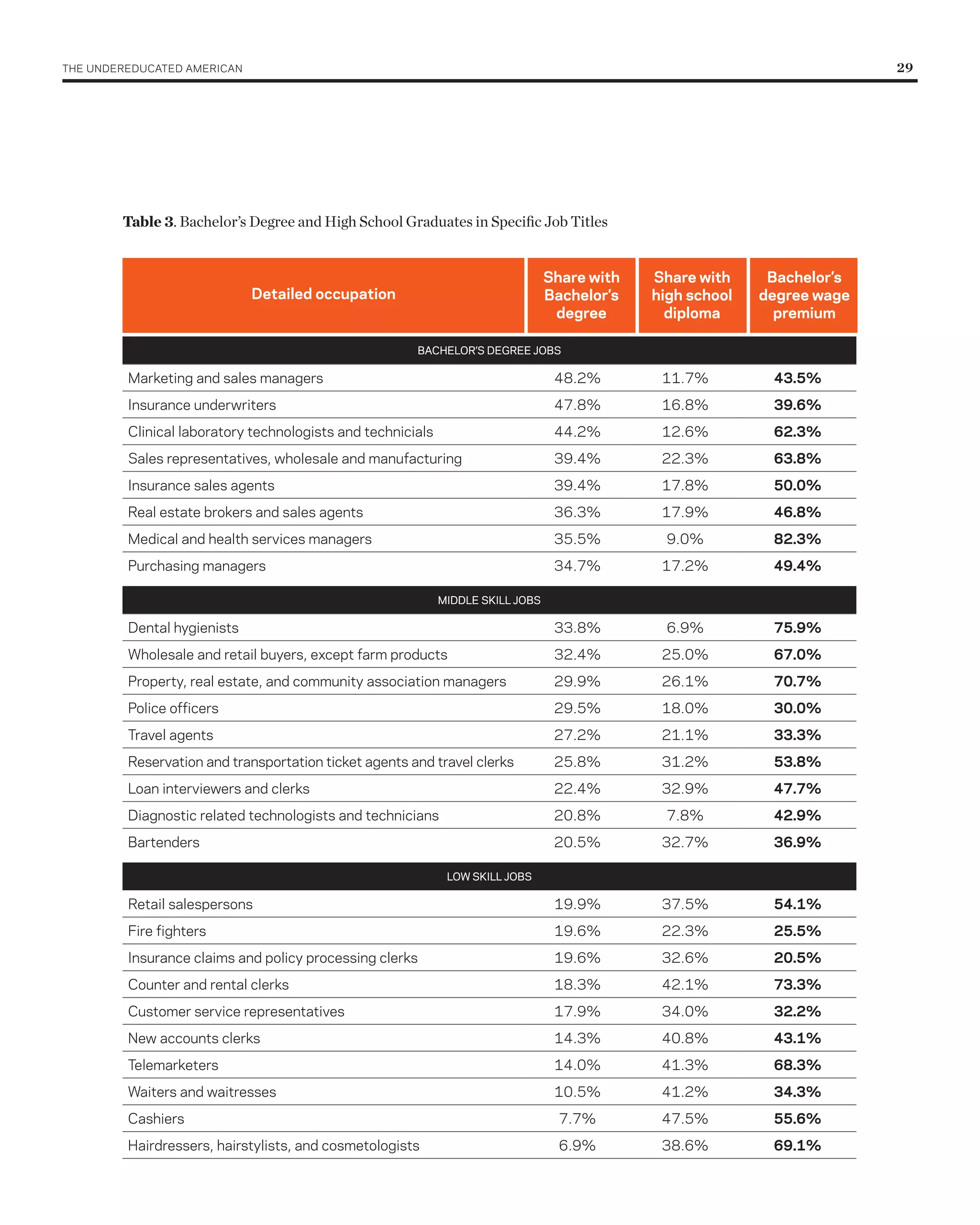
      self-employed plumber or other craftsperson                                     Table 3 presents a series of narrow job occupation
      who earns more than many college graduates.                                     titles across the job market: Some are heavily
                                                                                      populated with workers with a Bachelor’s degree
      There are various reasons for the discrepancies in                              and others that do not have many workers with
      pay beyond postsecondary attainment, however.                                   a Bachelor’s degree. This list is meant to provide
      Some of these discrepancies are due to the fact                                 examples where postsecondary skills led to
      that occupations may have the same names but                                    higher earnings relative to workers with only a
      represent very different bundles of tasks. Some is                              high school education in the same narrow field.
      due to the fact that some employers pay more than                               The number of occupations in which there is a low
      others (Holzer, et al., 2011). Some of the discrep-                             wage premium is small, and these tend to be
      ancy relates to the industry in which one works. But                            low-skill or very job-specific skill occupations
      it is important to remember that while access to                                (such as skilled blue collar workers).
      postsecondary education is crucial, so is access to
      learning on the job. Employer investment in learning                            The first group of jobs in this table consist mainly
      is roughly equivalent in size to the entire post-                               of “Bachelor’s degree jobs”: those where a plurality
      secondary system (Carnevale, Smith, and Strohl,                                 of workers have a Bachelor’s or graduate degree.
      2010). Sometimes a job is the best teacher.                                     Among insurance agents, for example, 80 percent
                                                                                      have attended college and nearly 50 percent have
      Nonetheless, it is true that people with college                                at least a four-year degree. By contrast, in 1959,
      degrees do better than others in very similar                                   half of insurance agents had only a high school
      positions. In other words, many workers with a                                  education and only 23 percent had a four-year
      Bachelor’s degree in “non-college jobs” transform                               degree. Furthermore, there was not much leeway
      these jobs into positions that utilize their skills,                            in the job, as college-educated insurance agents
      such that their jobs come to resemble jobs that                                 made only 10 percent more than their high school-
      require a Bachelor’s degree.            17
                                                                                      educated counterparts. The preponderance of

      17
        Harrington and Sum (2010) find a much smaller premium for “malemployed BA workers” relative to the earnings of all high school-educated workers.
      We were unable to obtain their methodology and therefore ’could not determine where our two approaches differed. However, we used full-time, full-year
      workers where they do not, and this difference probably explains some of the increase in the wage premium over high school-educated workers.
THE UNDErEDUCATED AMErICAN 	                                                                                               29


         Table 3. Bachelor’s Degree and High School Graduates in Specific Job Titles


                                                                                  Share with   Share with     Bachelor’s
                               Detailed occupation                                Bachelor’s   high school   degree wage
                                                                                   degree        diploma       premium

                                                        BacHelor’s Degree JoBs

          Marketing and sales managers                                             48.2%        11.7%         43.5%
          Insurance underwriters                                                   47.8%        16.8%         39.6%
          Clinical laboratory technologists and technicials                        44.2%        12.6%         62.3%
          Sales representatives, wholesale and manufacturing                       39.4%        22.3%         63.8%
          Insurance sales agents                                                   39.4%        17.8%         50.0%
          real estate brokers and sales agents                                     36.3%        17.9%         46.8%
          Medical and health services managers                                     35.5%         9.0%         82.3%
          Purchasing managers                                                      34.7%        17.2%         49.4%

                                                              MIDDle sKIll JoBs

          Dental hygienists                                                        33.8%         6.9%         75.9%
          Wholesale and retail buyers, except farm products                        32.4%        25.0%         67.0%
          Property, real estate, and community association managers                29.9%        26.1%         70.7%
          Police officers                                                          29.5%        18.0%         30.0%
          Travel agents                                                            27.2%        21.1%         33.3%
          reservation and transportation ticket agents and travel clerks           25.8%        31.2%         53.8%
          Loan interviewers and clerks                                             22.4%        32.9%         47.7%
          Diagnostic related technologists and technicians                         20.8%         7.8%         42.9%
          Bartenders                                                               20.5%        32.7%         36.9%

                                                               low sKIll JoBs

          retail salespersons                                                      19.9%        37.5%         54.1%
          Fire fighters                                                            19.6%        22.3%         25.5%
          Insurance claims and policy processing clerks                            19.6%        32.6%         20.5%
          Counter and rental clerks                                                18.3%        42.1%         73.3%
          Customer service representatives                                         17.9%        34.0%         32.2%
          New accounts clerks                                                      14.3%        40.8%         43.1%
          Telemarketers                                                            14.0%        41.3%         68.3%
          Waiters and waitresses                                                   10.5%        41.2%         34.3%
          Cashiers                                                                  7.7%        47.5%         55.6%
         Hairdressers, hairstylists, and cosmetologists                             6.9%        38.6%         69.1%
30	                                                                                           THE UNDErEDUCATED AMErICAN


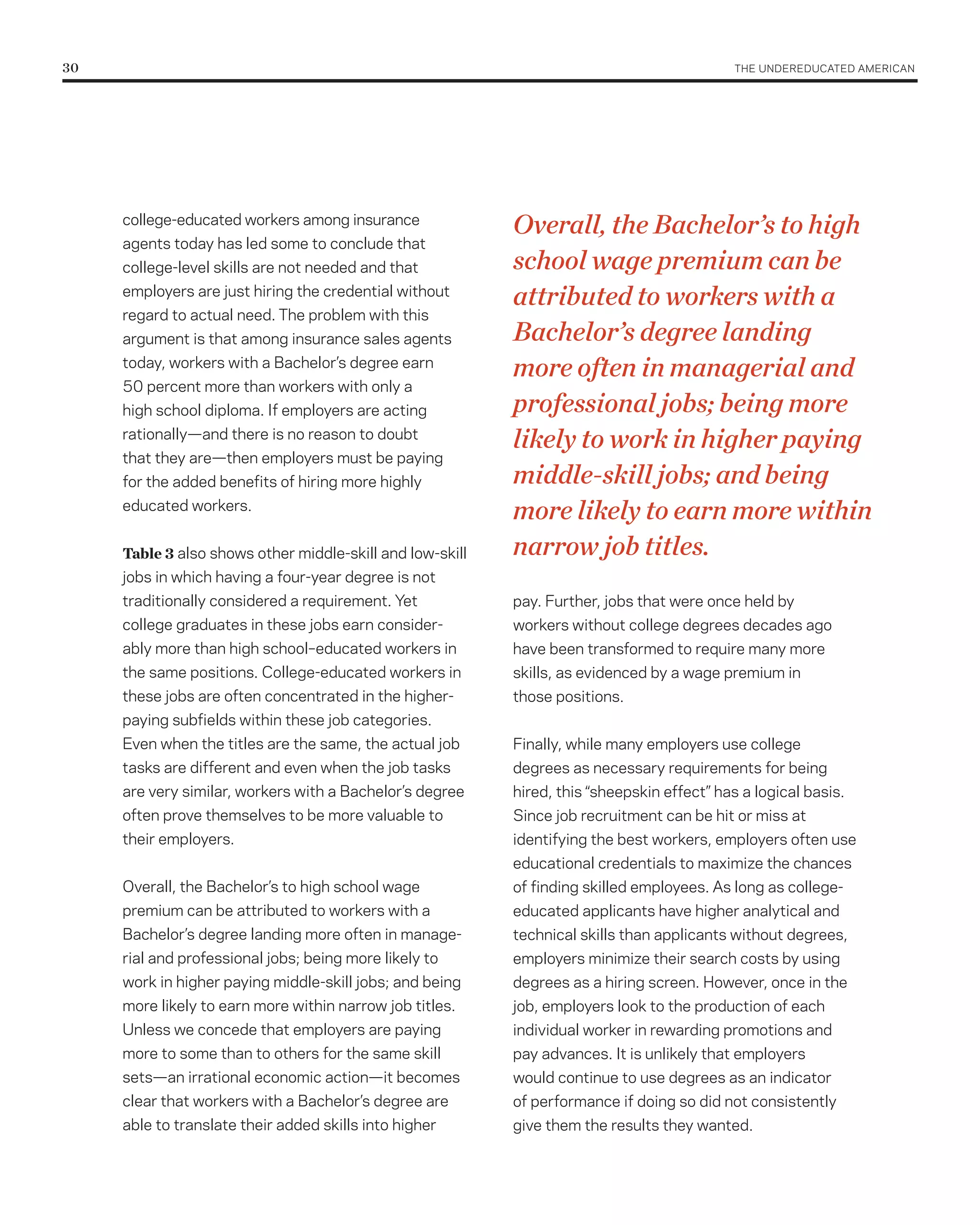
      college-educated workers among insurance
                                                            Overall, the Bachelor’s to high
      agents today has led some to conclude that
      college-level skills are not needed and that          school wage premium can be
      employers are just hiring the credential without
                                                            attributed to workers with a
      regard to actual need. The problem with this
      argument is that among insurance sales agents         Bachelor’s degree landing
      today, workers with a Bachelor’s degree earn
                                                            more often in managerial and
      50 percent more than workers with only a
      high school diploma. If employers are acting          professional jobs; being more
      rationally—and there is no reason to doubt
                                                            likely to work in higher paying
      that they are—then employers must be paying
      for the added benefits of hiring more highly          middle-skill jobs; and being
      educated workers.
                                                            more likely to earn more within
      Table 3 also shows other middle-skill and low-skill   narrow job titles.
      jobs in which having a four-year degree is not
      traditionally considered a requirement. Yet           pay. Further, jobs that were once held by
      college graduates in these jobs earn consider-        workers without college degrees decades ago
      ably more than high school–educated workers in        have been transformed to require many more
      the same positions. College-educated workers in       skills, as evidenced by a wage premium in
      these jobs are often concentrated in the higher-      those positions.
      paying subfields within these job categories.
      Even when the titles are the same, the actual job     Finally, while many employers use college
      tasks are different and even when the job tasks       degrees as necessary requirements for being
      are very similar, workers with a Bachelor’s degree    hired, this “sheepskin effect” has a logical basis.
      often prove themselves to be more valuable to         Since job recruitment can be hit or miss at
      their employers.                                      identifying the best workers, employers often use
                                                            educational credentials to maximize the chances
      Overall, the Bachelor’s to high school wage           of finding skilled employees. As long as college-
      premium can be attributed to workers with a           educated applicants have higher analytical and
      Bachelor’s degree landing more often in manage-       technical skills than applicants without degrees,
      rial and professional jobs; being more likely to      employers minimize their search costs by using
      work in higher paying middle-skill jobs; and being    degrees as a hiring screen. However, once in the
      more likely to earn more within narrow job titles.    job, employers look to the production of each
      Unless we concede that employers are paying           individual worker in rewarding promotions and
      more to some than to others for the same skill        pay advances. It is unlikely that employers
      sets—an irrational economic action—it becomes         would continue to use degrees as an indicator
      clear that workers with a Bachelor’s degree are       of performance if doing so did not consistently
      able to translate their added skills into higher      give them the results they wanted.
THE UNDErEDUCATED AMErICAN 	               31


      Section Five


    How many more college
    graduates do we need
    for efficiency and equity
    purposes?


      “Today, about two-thirds of young
       people in their late teens attend
       college for at least a year. We
       estimate that to meet the demand
       for more skilled workers and to
       keep the Bachelor’s degree to
       high school wage premium at
       46 percent, the number of
       youth attending college for at
       least a year will need to rise to
       86 percent by 2025.”
32	                                                                                                                                THE UNDErEDUCATED AMErICAN


      I                                                                               Any strategy to increase the
                f supply and demand work as economists
                predict, then the question remains why
                market signals (i.e., the wage premium) have                          number of college graduates
      not led more young people to attend and complete
      college. In fact, there are more than half a million
                                                                                      must be based on improving
      students who graduate in the upper half of their                                the quality of graduating high
      high school graduating class who don’t get either
      a two- or four-year degree (Carnevale and Strohl,
                                                                                      school seniors; otherwise, we
      2010). The true but unsatisfying answer is that                                 cannot produce the additional
      there are a host of social and economic reasons
      that even qualified students don’t enroll or
                                                                                      college graduates needed to
      complete college degrees.                                                       meet the desired goal.
      However, for students who are less successful in                                chances of successfully earning a degree.19 They
      high school, the decision not to enroll in college                              find that, even though the reward of obtaining
      or to drop out may be reasonable, given their past                              a degree is high, the “risk-adjusted” returns are
      experiences in school. Every decision individuals                               lower, leading many prospective students to make
      make cuts off another potential choice. If these                                the “rational” choice to enter the labor market
      students decide to pursue a four-year degree                                    immediately after high school and not pursue
      and fail to obtain one, they are passing up the                                 postsecondary education. This is also applicable
      opportunity to start work directly out of high                                  to adult students who see too much risk and not
      school, which would then permit them to gain                                    enough reward in returning to college for skill
      experience and find a better job. Furthermore,                                  enhancement.
      they might be passing up or delaying the
      opportunity to learn useful job skills by pursuing                              These findings suggest that any strategy to
      a certificate in a vocational, business, or trade                               increase the number of college graduates must
      school.     18
                       In other words, pursuing a Bachelor’s                          be based both on (1) removing barriers to
      degree and failing to obtain one has real costs                                 degree completion for qualified students, and
      to the student, not only in terms of the financial                              (2) improving the quality of graduating high
      cost of attending college, but in terms of delaying                             school seniors. Otherwise, we will not be able to
      the acquisition of appropriate job skills.                                      produce the additional college graduates needed
                                                                                      to meet our desired goal of a 46 percent wage
      Athreya and Eberly (forthcoming) empirically                                    premium. Our calculations to attain 46 percent
      model the decision-making process of high                                       assumes that a strategy that accounts for these
      school students with low grades and hence low                                   youth is both possible and desirable.


      18
           See also Carneiro and Heckman (2010).
      19
        In Pathways to Prosperity (2011), researchers from the Harvard Graduate School of Education deal with the lack of preparation of many high school
      graduates by suggesting that they pursue technical and vocational certificates.
THe UnderedUcATed AmerIcAn 	                                                                                                                                     33


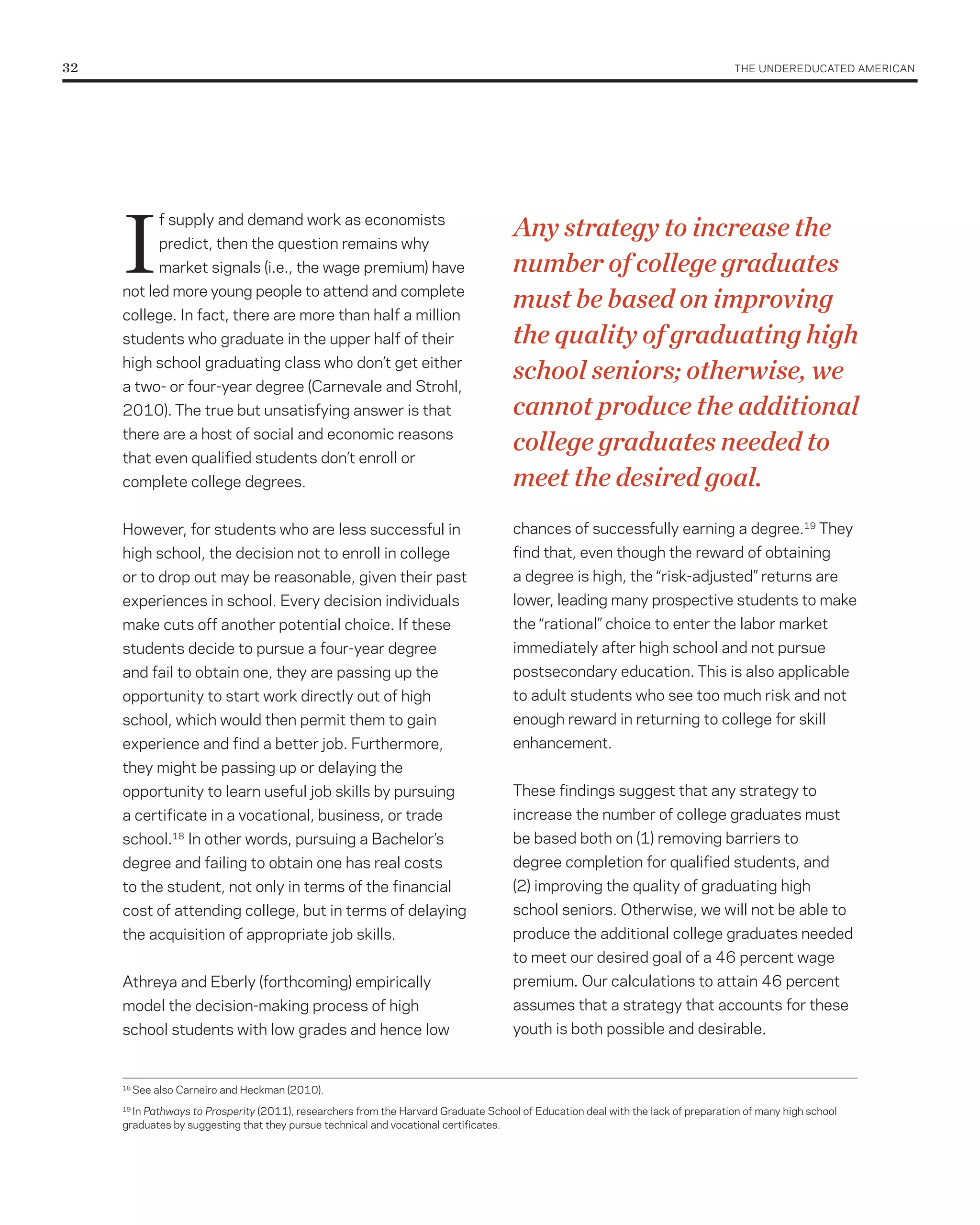
          If we continue following current trends, there                                 To determine whether this increase will be
          will be 8 million more postsecondary-educated                                  enough to move the wage premium to 46 percent,
          workers by 2025.           20
                                          Without intervention, then,                    we need to estimate the growth in demand for
          we will see a yearly supply gain of 1 percent.                                 college-educated workers between 2010 and
          By 2025, the new educational division of                                       2025. One option is to look at the long-term
          workers would be 34 percent with at most a                                     trend in the rise of demand for college talent.
          high school diploma, 32 percent with some                                      From 1915 to 2005, this figure grew by 2.8
          college but no four-year degree, and 34 percent                                percent per year. However, the share of workers
          with a Bachelor’s or graduate degree.                                          with a Bachelor’s degree was very low in 1915


          Figure 9. Supply and Demand with Two Paths Forward to 2025


    130


    125


    120


    115


    110


    105
                                                                                                                          relative supply of
                                                                                                                          college- educated workers

                                                                                                                          relative demand for
    100
                                                                                                                          college- educated workers

                                                                                                                          current supply trend
    195                                                                                                                   2010-2025

                                                                                                                          proposed expansion of
     90                                                                                                                   college enrollment


     85
           1950


                    1955


                              1960


                                          1965


                                                 1970


                                                          1975


                                                                    1980


                                                                             1985


                                                                                      1990


                                                                                                1995


                                                                                                         2000


                                                                                                                   2005


                                                                                                                            2010


                                                                                                                                     2015


                                                                                                                                               2020


                                                                                                                                                        2025


          20
            We chose 2025 because that much time would be needed to realistically increase the supply of college-educated labor to meet technological need and
          reduce the Bachelor’s degree to high school wage premium.
34	                                                                                                                                    ThE UnDErEDUCATED AmErICAn


      and reached 30 percent in 2005. Going forward                                     degree. As the red line on Figure 9 shows, this
      from 30 percent is likely to be different, and                                    projected growth represents a 2.6 percent yearly
      more difficult, than moving up to 30 percent.                                     rise in the supply of college-educated workers,
                                                                                        an increase over the current yearly growth of
      Consequently, we estimate that relative demand                                    1 percent. While 2.6 percent is higher than the
      will only increase at 2.0 percent per year between                                recent growth rate of college workers, it is lower
      now and 2025. The dotted red line in Figure 9                                     than the 2.9 percent yearly growth rate that
      shows supply rising by 1 percent a year, resulting                                existed between 1915 and 2010.
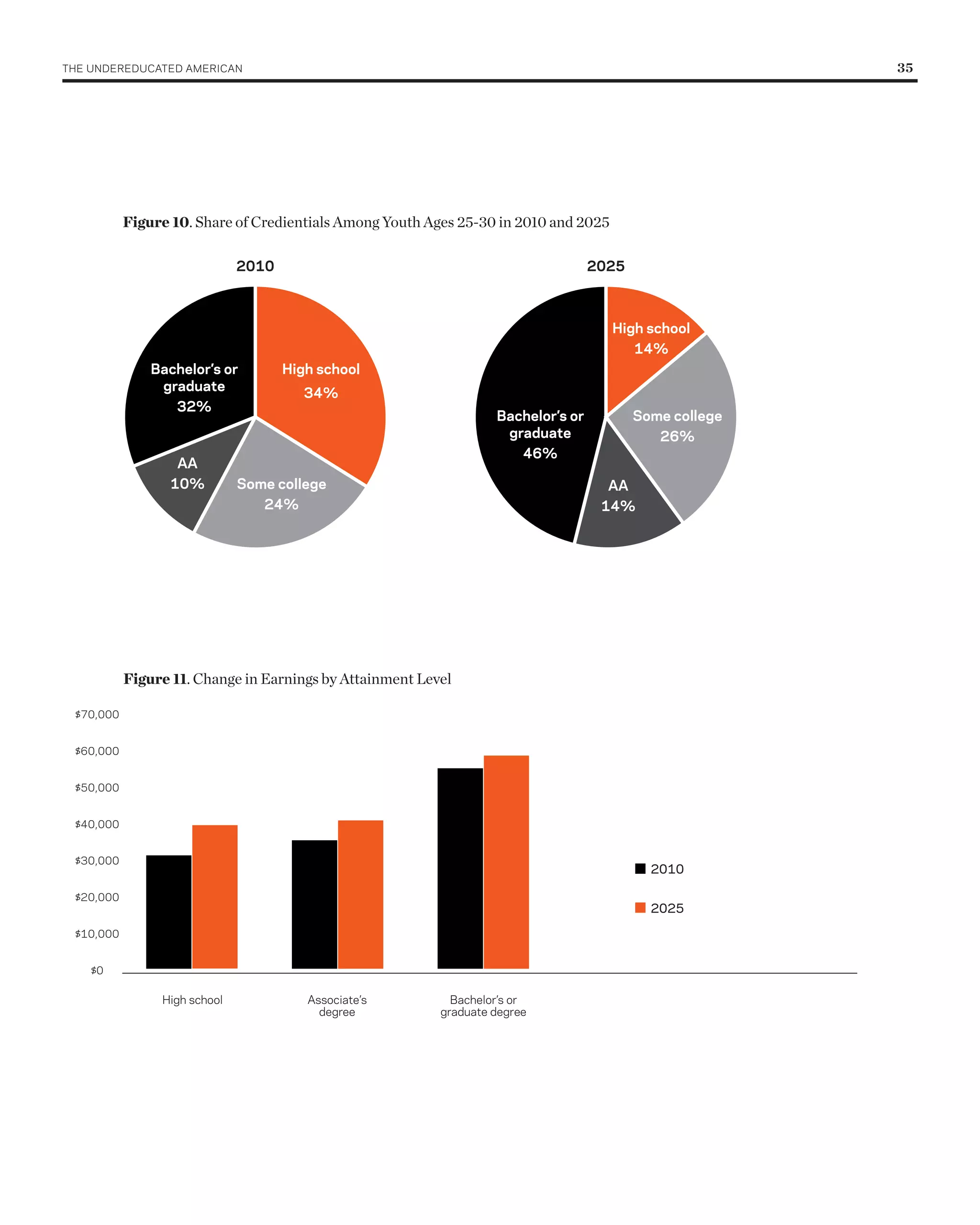
      in an increasing gap between it and the yearly
      2 percent rise in demand. We project that this                                    If we attain a 2.6 percent growth rate, three-
      scenario, in which demand grows at a faster rate                                  quarters of the labor force would have at least
      than supply for fifteen years, will result in the                                 some postsecondary education—34 percent
      Bachelor’s degree to high school wage premium                                     having obtained an Associate’s degree or attended
      rising to 96 percent.                                                             some college, and 41 percent having obtained a
                                                                                        Bachelor’s degree. That would mean adding 15
      We estimate that to meet the demand for more                                      million workers with Bachelor’s degrees above
      skilled workers and to reduce inequality, the                                     current levels and 5.3 million additional workers
      number of young people attending college will                                     with some college (including about 1.4 million
      need to rise from 66 percent today to 86 percent                                  additional workers with Associate’s degrees).
      by 2025.21 As Figure 10 shows, the share of                                       Since even without our intervention, the current
      young adults with a college degree will also rise                                 trend of increasing college attendance would
      to 60 percent—46 percent with a Bachelor’s                                        result in 8 million new college-educated workers,
      degree and 14 percent with an Associate’s                                         our preferred path requires producing an
                                                                                        additional 12 million people with postsecondary

      We estimate that to meet                                                          attendance over 15 years.


      the demand for more skilled                                                       Finally, if this alternative path is adopted,

      workers and to reduce                                                             GDP will be $500 billion higher than current
                                                                                        projections and there will be earnings increases
      inequality, the number of                                                         across the board even though the earnings gaps

      young people attending                                                            between Bachelor’s degree holders and high
                                                                                        school educated workers will decline. Figure 11
      college will need to rise                                                         projects the average increase in earnings by

      from 66 percent today to                                                          education level. Earnings of workers with a
                                                                                        Bachelor’s degree would rise by 6 percent (from
      86 percent by 2025.                                                               $56,138 to $59,329 [2010 dollars]) and the


      21
        Appendix 2 traces the year by year changes in BA attainment and the share of young people going from high school to postsecondary. Because not
      every college graduate enters or remains in the labor force, adding 15 million additional workers with Bachelor’s degrees to the workforce would actually
      require about 18 million additional college graduates.
THE UNDErEDUCATED AMErICAN 	                                                                             35


           Figure 10. Share of Credientials Among Youth Ages 25-30 in 2010 and 2025

                              2010                                                 2025


                                                                                      High school
                                                                                         14%
               Bachelor’s or         High school
                graduate                34%
                  32%
                                                                   Bachelor’s or          Some college
                                                                    graduate                 26%
                                                                      46%
                   AA
                  10%         Some college                                           AA
                                 24%                                                14%


           Figure 11. Change in Earnings by Attainment Level

 $70,000


 $60,000


 $50,000


 $40,000


 $30,000
                                                                                            2010

 $20,000
                                                                                            2025

 $10,000


    $0

                High school             Associate’s         Bachelor’s or
                                          degree          graduate degree
36	                                                                                        THE UNDErEDUCATED AMErICAN


      earnings of workers with only a high school         than it is today, and the share of the labor force
      diploma would rise by 24 percent (from $32,179      with only a high school diploma or less will
      to $40,003), which would bring the wage premium     decline from 40 percent to 25 percent, making
      down to 46 percent. For those with an Associate’s   high school workers more scarce. High school
      degree, earnings would rise 15 percent (from        workers’ scarcity will result in higher wages.
      $36,160 to $41,584).                                Further, as part of meeting the goal of producing
                                                          more college graduates, we specified that
      Given the declining earnings of male high school    the quality of the K-12 system would have to
      graduates over the past 30 years, our predicted     increase; therefore, the quality of the non-
      24 percent rise in real high school earnings        college-educated group in 2025 is likely to be
      may seem improbable. But the supply and             higher than their counterparts today. Therefore,
      demand conditions for less-skilled workers will     our projected higher wages for high school
      be very different under our 2025 scenario:          graduates reflect both higher skills and a large
      Output per worker will be 25 percent higher         decline in supply.
THE UNDErEDUCATED AMErICAN 	                 37


      Conclusion


    Getting an additional
    20 million postsecondary-
    educated workers will
    be difficult, but is not
    beyond our capacity.


      “If we do nothing, current trend
       will produce 8 million college
       graduates. Adding an additional
       12 million over fifteen years is an
       attainable goal, as it represents
       less than a million additional
       students per year.”
38	                                                                                          THE UNDErEDUCATED AMErICAN


      T                                                     By increasing the number of
                wo of the most pressing challenges
                facing the United States in the coming
                decades are remaining competitive in        people in the workforce with
      the global economy and ensuring that we follow
                                                            postsecondary credentials to
      through on the promise of a decent living wage
      to those willing to work for it. Helping more         20 million, we will not only
      students complete their college degrees is one
                                                            have a more competitive
      way to address both of these challenges.
                                                            economy, we will also have
      reaching our goal of 20 million additional
                                                            more equitable prosperity.
      postsecondary-educated workers in 2025 is not
      an impossible, or even improbable, task. If we
      do nothing, current trend will produce 8 million      quantifiable metrics such as the number of
      college graduates. Adding an additional 12            workers with four-year degrees, the increased
      million over fifteen years is an attainable goal,     number of people with some college but without
      as it represents less than a million additional       a four-year degree is just as important.
      students per year. There is clearly room to
      grow, as many students who are capable of             However, beyond the immediate and obvious
      college-level coursework never enroll in college.     benefits to our economy, meeting the goal of an
      Moreover, most European countries have higher         additional 20 million postsecondary-educated
      educational attainment levels than we do in the       workers is likely to have wider repercussions
      United States. There is no reason to think that       for our entire society. We have established that
      these countries have an inherently more capable       meeting this goal of an additional 20 million
      population. Attaining 20 million more will put        postsecondary-educated workers by 2025 will
      us back in the ranks of other developed nations       have a profound effect on the Bachelor’s degree
      in terms of educational attainment.                   to high school wage premium, making the return
                                                            to earnings on education a more reasonable
      Still, just because it is possible does not mean      46 percent and reversing wage inequality. We
      it will be easy. First, it will take political will   believe that this is a desirable outcome. By
      and commitment from various actors. In this           increasing the number of people in the workforce
      budgetary climate, this is a lot to ask for, but is   with postsecondary credentials to 20 million, we
      not out of reach. Moreover, attaining 20 million      will not only have a more competitive economy,
      additional college-educated workers will require      we will also have more equitable prosperity—and
      higher performance from all of our educational        the American dream will come within reach of
      institutions. Although we have focused on easily      millions more of our citizens.
The UnderedUcaTed american 	                                                                                                               39


         Appendix 1: Methodology
         The statistical framework presented in autor, Katz, and Kearney (2008) is based on a simplified model of how the
         economy functions based on skilled and unskilled labor (a “constant elasticity of substitution production function” in
         which the earnings of each group of workers equals their marginal product). Their supply and demand framework is
         based on dividing the economy into two groups: skilled workers (those with a Bachelor’s or graduate degree plus half
         of workers who have attended college but not received a Bachelor’s degree) and unskilled workers (those with at most
         a high school diploma plus the other half of the some college group). The relative wage of skilled vs. unskilled workers
         is determined by the weighted average of the wages of Bachelor’s and graduate degree wages as the wage of skilled
         workers and the wage of those with a high school diploma or equivalent as the wage of unskilled workers. The relative
         supply of skilled vs. unskilled workers consists of the wage bill of skilled labor divided by the wage bill of unskilled labor.

         From available government data sources, information on prices and quantities (average earnings by level of education
         and number of workers with different levels of education) is available. equation 1 is the wage bill, and equation 2 de-
         scribes the change in supply. These numbers, along with a reasonable setting of the elasticity of substitution between
         skilled and unskilled workers, can be plugged into equation 3 to determine the change in relative demand (which is not
         observable). The results of these computations for selected years from 1915 to 2005 are presented in Table 8.1 and
         appendix d of Goldin and Katz (2008).


         1. Wage Bill =                     , where     equals the share of skilled labor of total wages.

         2. change in relative supply           :


         where = number of college equivalents (those with a Bachelor’s or graduate degree and half of those with some col-
         lege but not a four-year degree), U is high school equivalents (those with a high school diploma or Ged, those who have
         not finished high school, and half of those with some college), and are the composition-adjusted (fixed weights at 1980
         levels of division within college and high school equivalents) wages of skilled and unskilled labor.

         3. change in relative demand               :


         where     is the elasticity of substitution between skilled and unskilled labor. From previous research, this figure has
         been estimated between 1.4 and 1.84; a value of 1.64 is used.


         Estimation of the Number of Extra College-Educated Workers Needed between 1980 and 2005 to Have the
         Bachelor’s degree to high school Wage Premium be 46 Percent.
         in an exercise not discussed in the body of the text, we estimated the number of extra college-educated workers who
         would have needed to have been produced from 1980 to 2005 to result in a 46 percent wage premium. We begin by
         setting           at 0.417, rather than the 0.576 that it was. This implies that the change in the wage bill was just 0.25
         percent a year rather than the observable 0.9 percent. Using equation 2, the change in relative supply (2.0 percent per
         year), the result must be 3.08 percent per year to equal the 3.48 percent change per year in relative demand.

         Using equation 1, the change in the wage bill must now be 3.33 percent per year (3.08 percent and 0.25–the log of
         the relatives, which is subtracted on the right side of the equation). The relative wage bill is dependent on changes in
         the number of bodies and the wages of skilled and unskilled labor. To change the relative wages in order to produce
         a smaller Bachelor’s degree wage premium, we chose to decrease the pay of workers with a Bachelor’s degree and
         increase the pay of high school wages by the same percentage. The log of the wage bill in 2005 was 1.779; the log of
40	                                                                                                        THE UNDErEDUCATED AMErICAN


      the simulated wage bill had to be 1.517. Equation 3 shows that a 7.95 percent increase in high school wages and a
      7.95 percent decrease in college wages get us to this point.


      4. 1,517 = 1.779 x (1-p)/(1 + p) where p equals the change in wages
      reordering the terms gets us p = (1.779-1.517)/(1.779+1.517).

      The next task is to translate this change in earnings into changes in people with more education. To get the extra
      added demand of 3.33 percent per year, the wage bill has to be higher. Using Equation 4, the new ratio of the skilled
      to unskilled wage bill must rise from 57.6 percent to 60.0 percent. Because the relative wages have been lowered,
      the number of college equivalents must be increased by 12.1 percent. Table A1 shows the distribution of workers by
      educational levels; therefore, the number of college equivalents (approximately 61 million) must be increased by 7.3
      million to reach 68.3 million.

      TaBle a1: worKers 18- To 65-Years-olD BY eDucaTIon, 2005

      education level       employment             share         equivalents
      1. HS or less         54,055,955             40.0%         74,109,159
      2. AA + SC            40,106,408             29.7%
      3. BA + Grad          40,883,985             30.3%         60,937,189
      Total                 135,046,348
      Note: HS = high school; SC = some college.


      Because some college counts as one-half of a college equivalent, there is no single solution to the number of extra
      Bachelor’s degree recipients and number of extras who have some college. If the number of people with postsecond-
      ary education does not change, then all of the increase in college equivalents is accomplished by having 14.6 million
      people with some college obtain a Bachelor’s degree. In this simulation, we can alter the number of people who have at
      least some college. If we change the 60 percent of the workforce with some postsecondary education to 72 percent,
      then the number of people with some college would increase by 17.8 million, while the number of people with a Bach-
      elor’s degree would decrease by 1.5 million to satisfy the 7.3 million increase in college equivalents.

      These two scenarios represent extremes on how to obtain the added college equivalents. We choose to simulate that
      the labor force shifted to 66 percent going on to postsecondary education, which resulted in 6.6 million extra people
      with Bachelor’s degrees and 1.6 million extra people with some college, to reach the 7.3 million increase in college
      equivalents needed to result in the lower Bachelor’s degree to high school wage premium.


      Estimation of the Number of Extra College-Educated Workers Needed between 2005 and 2025 to Have the
      Bachelor’s degree to high school Wage Premium be 46 Percent
      The next task was to estimate the number of additional college-educated workers needed to meet the rising demand
      for college educated workers and result in a Bachelor’s degree to high school wage premium of 46 percent in 2025.
      We considered the following relevant numbers: From 1915 to 2005, the change in relative demand was 2.83 percent
      per year, and from 1980 to 2005, it was 3.48 percent; however, from 1980 to 1990 the change was 5.0 percent per
      year, from 1990 to 2000 it was 3.0 percent, and from 2000 to 2005 it was 1.4 percent annually.

      Obviously, the greater the increase in relative skill demands the more extra Bachelor’s degrees that will have to be
      produced. It is tempting to pick the trend line from 1915 to 2005, but we think that this number is too high. The rise
      during the 20th century started from a position in which there were very few people with postsecondary education, and
      as a result it was very easy for the economy to incorporate more college-educated workers. If we presume that the rela-
      tive demand for college-educated labor will increase by nearly 3 percent a year, eventually virtually the entire workforce
      should have a four-year degree. Therefore, it would seem that there has to be some slowing in the increase in relative
      demand for skilled labor. To accommodate for this, we chose the lower number of 2.0 percent per year.
THE UNDErEDUCATED AMErICAN 	                                                                                                            41


         Since we are keeping the relative wages fixed from our simulated 2005 numbers (with a 46 percent wage premium), a
         2 percent rise in relative demand is accomplished with an annual 2 percent rise in relative supply. This means that the
         share of the wage bill going to college equivalents must rise to 69 percent: 15 percent higher than 2005 level when
         adjusted for a lower Bachelor’s degree to high school wage premium.

         Once again, getting to 69 percent can be accomplished in many different ways, depending on the number of people
         who have some postsecondary education. To split the adjustment between more people going to college and more
         people getting a Bachelor’s degree among those going to college, we picked a new postsecondary education rate for
         the workforce in 2025 to be 75 percent (up from the 67 percent of today’s young cohorts). To get the number of added
         college-educated workers needed, we kept the total labor force of 18- to 65-year-olds fixed at its 2005 level. The total
         labor force will grow because many aging baby boomers will continue to work (resulting in a much expanded number of
         workers over 65 years old), and because of new immigrants coming into the country.

         Finally, if we had used 2.83 percent as a gain in relative demand (trend figure 1915–2005), the added number of workers
         with Bachelor’s degrees required to meet growing technological demand would have been 27.5 million, as opposed to the
         18 million with the 2 percent growth in relative demand. Conversely, if relative demand grew by only 1 percent a year, there
         would be less pressure to change the entire education pipeline. Consequently, the share of the workforce with at least
         some postsecondary education could be 70 percent, and then the 1 percent growth would require 14 million extra workers
         with Bachelor’s degrees. If the K–12 pipeline produced 75 percent going to postsecondary education (as we presume in
         our current projection), the added some college would only require 5.9 million new workers with Bachelor’s degrees.


         Appendix 2: Simulation to Create
         Additional 18 Million Bachelor’s Degrees
         through 2025
                                         Share going on to                        Additional Bachelor’s degree attainment
               Year
                                      postsecondary education                             of 25- to 64-year-olds

              2011                               67.0%                                                 0.1%
              2012                               68.0%                                                 0.2%
              2013                               69.0%                                                 0.3%
              2014                               70.0%                                                 0.4%
              2015                               71.0%                                                 0.5%
              2016                               72.5%                                                 0.5%
              2017                               74.0%                                                 0.5%
              2018                               75.5%                                                 0.5%
              2019                               77.0%                                                 0.5%
              2020                               78.5%                                                 0.5%
              2021                               80.0%                                                 0.5%
              2022                               81.5%                                                 0.5%
              2023                               83.0%                                                 0.5%
              2024                               84.5%                                                 0.5%
              2025                               86.0%                                                 0.4%
42	                                                                                                            THe UnderedUcATed AmerIcAn


      Appendix 3: Considering the Costs of
      College-Going
      Stories about one-year tuition, fees, room, and board running to more than $50,000 a year get a lot of media attention
      and send chills up the spine of many parents of young children. In reality, this experience of college is the exception.
      Students have a wide variety of choices when facing college costs and a high proportion of college students from
      moderate-income families get grants, scholarships, and tax benefits. consequently, the “net price” that most students
      pay for a year of schooling is much lower than the “sticker price” of total college costs at all schools, and only a tiny frac-
      tion (5 percent) of students in four-year schools pay more than $50,000 for college.

      A slightly different calculation is ‘out of pocket expenses’ which includes room, board, tuition, fees, travel, books, and
      other expenses but excludes tax benefits. The national center for education Statistics reports that in the academic
      year ending in June 2008, the average out-of-pocket expenses for a ‘lower middle-class’ family was $10,000 while the
      comparable figure was $17,300 for a family in the highest income group. All of these figures include room and board,
      expenses that a young adult might face regardless of whether they are enrolled in school or not (if they are not living at
      home).

      Finally, the numbers on total debt of graduating seniors are not as dire as some make them out to be. Fully 34 per-
      cent of young Bachelor’s degree holders have no debt at all, while the median debt value of all graduating students is
      about $12,000. Heavier debt loads apply to progressively smaller shares of student: only one in four have debts over
      $30,000 and only ten percent have debts over $40,000.

      A more thorough economic accounting of the costs of college might include the wages lost by attending school instead
      of working. But two factors make this cost rather low. First, the vast majority of students either work part-time while in
      school and/or full-time during the summer months. Second, the jobs available to 19-22 year-olds without any postsec-
      ondary education pay very little.

      Adding up all the direct and indirect costs of choosing to get a four-year degree (which often takes longer than four
      years) amount to under $150,000 for most students. measured against added earnings of over $25,000 a year for 40
      years and it’s clear that the investment in a Bachelor’s degree is a sound one.

      For the small share of students whose college costs run over $200,000, getting a Bachelor’s degree is still a good in-
      vestment—even allowing for only average returns. Given that these students are in the best schools and come from the
      wealthiest families, it is highly likely that these students will make considerably more than the typical Bachelor’s degree
      holder. consequently, their earnings premium is higher than average and support paying off these high expenses in
      under 10 years.
THE UNDErEDUCATED AMErICAN 	                                                                                                        43


         References
         Athreya, Kartik, and Janice Eberly (forthcoming). “The Education risk Premium.” Preliminary draft, cited with
         author permission.

         Autor, David H., Lawrence F. Katz, and Melissa S. Kearney (2008). “Trends in U.S. Wage Inequality: revising the
         revisionists.” The Review of Economic and Statistics 90:2 (May), 300–323.

         Autor, David H., Lawrence F. Katz, and Alan B. Krueger (1998). “Computing Inequality: Have Computers Changed
         the Labor Market?” Quarterly Journal of Economics 113 (November), 1169–1213.

         Bluestone, Barry, and Mark Melnik (2010). After the Recovery: Help Needed: The Coming Labor Shortage and
         How People in Encore Careers Can Help Solve It. Kitty and Michael Dukakis Center for Urban and regional Policy,
         Northeastern University. 2010.

         Carneiro, Pedo, James J. Heckman, and Edward Vytlacil (2010). Estimating Marginal Returns to Education.
         National Bureau of Economic research, Working Paper 16474.

         Carnevale, Anthony P. and Jeff Strohl (2010). “How Increasing College Access is Increasing Inequality, and What to
         Do About It.” In Rewarding Strivers: Helping Low-Income Students Succeed in College. New York: The Century
         Foundation Press.

         Carnevale, Anthony P., Nicole Smith, and Jeff Strohl. Help Wanted: Projections of Jobs and Education Requirements
         Through 2018 (2010). Washington, DC: Georgetown University Center on Education and the Workforce.
         http://cew.georgetown.edu/JOBS2018/.

         Carnevale, Anthony P., and Stephen rose (1998). Education for What? The New Office Economy. Princeton, NJ:
         Educational Testing Service.

         Carnevale, Anthony P., Stephen rose, and Ban Cheah (2011). “The College Payoff: Education, Occupations, Lifetime
         Earnings.” Washington, DC: Georgetown University Center on Education and the Workforce.

         Cheeseman Day, Jennifer, and Eric C. Newburger (2002). “The Big Payoff: Educational Attainment and Synthetic
         Estimates of Work-Life Earnings.” Current Population Reports. U.S. Census Bureau. July.

         Day, Jennifer, and E. Newberger (2002). “The Big Payoff: Educational Attainment and Synthetic Estimates of Work-Life
         Earning.” U.S. Census Bureau.

         DeNavas-Walt, et al. (2010). “Income, Poverty, and Health Insurance Coverage in the United States: 2009.”
         Current Population Reports. U.S. Census Bureau. September.

         Goldin, Claudia, and Lawrence F. Katz (2008). The Race Between Education and Technology. Cambridge, MA:
         Belknap Press of Harvard University Press.

         Harrington, Paul, and Andrew Sum. “College Labor Shortages in 2018?” The New England Journal of Higher Education.
         November 8, 2010. http://www.nebhe.org/2010/11/08/college-labor-shortages-in-2018/.

         Harvard Graduate School of Education (2011). Pathways to Prosperity: Meeting the Challenge of Preparing Young
         Americans for the 21st Century.

         Holzer, Harry, and Julia Lane, David rosenblum, and Fredrik Andersson (2011). Where Are All the Good Jobs Going?:
         What National and Local Job Quality and Dynamics Mean for U.S. Workers. New York: russell Sage Foundation.

         Holzer, Harry J., and robert I. Lerman (2009). The Future of Middle-Skill Jobs. Washington, DC: The Brookings Institute.

         Hotchkiss, Julie L., and Menbere Shiferaw (2010). Decomposing the Education Wage Gap: Everything but the
         Kitchen Sink. Federal reserve Bank of Atlanta. Working Paper.

         Organization for Economic Cooperation and Development (2010). Education at a Glance 2010, OECD Indicators. Web.

         rubb, Stephen (2003). “Post-College Schooling, Overeducation, and Hourly Earnings in the United States.”
         Education Economics 11:1: 53–72.
44	                                                                                                   THe UnderedUcATed AmerIcAn


      Acknowledgments
      We would like to express our gratitude to the individuals and organizations that have made this report
      possible. First, we thank Lumina Foundation and the Bill and melinda Gates Foundation for their
      support of our research over the past few years, and in particular, we are grateful for the support of
      Jamie merisotis, Hilary Pennington, Holly Zanville, and Parminder Jassal. We are honored to be partners
      in their mission of promoting postsecondary access and completion for all Americans.


      We would like to thank Larry Katz and david Autor for their kind assistance in helping us understand all of
      the details on their supply and demand model. We would also like to acknowledge Harry Holzer, who read
      an early draft and made several useful suggestions.


      We also want to thank our editor, Vic caleca, and our designer, Levine and Associates, as well as Jeff
      Strohl, nicole Smith, Tamara Jayasundera, Laura meyer, and numerous other colleagues, too many to list
      here, who provided support and insight throughout the process.


      Finally, we would like to thank michelle melton at the center for her editorial and research assistance
      throughout the project.


      The views expressed in this publication are those of the authors and do not necessarily represent those of
      Lumina Foundation or the Bill and Melinda Gates Foundation, their officers, or employees.
The Undereducated American is comprised of a
     full report and an executive summary.
         Both can be accessed online at
     cew.georgetown.edu/undereducated.


    3300 Whitehaven Street, NW, Suite 5000
           Washington, DC 20007

Mail: Campus Box 571444, Washington, DC 20057

             cew.georgetown.edu

The Undereducated American

  • 1.
    The Undereducated American Anthony P. Carnevale & Stephen J. Rose
  • 2.
    Table of Contents 8 Introduction Americans are undereducated. 11 Section One Economic growth is linked with educational attainment. 15 Section Two High wage premiums indicate that we need more college-educated workers. 21 Section Three Income inequality is driven largely by access to college. 24 Section Four But—are there too many college graduates already? 31 Section Five How many more college graduates do we need for efficiency and equity purposes? 37 Conclusion
  • 3.
    The United Stateshas been underproducing college-going workers since 1980. Supply has failed to keep pace with growing demand, and as a result, income inequality has grown precipitously.
  • 4.
    From 1915 to1980, supply grew in tandem with demand. But, starting in 1990, the share of college-educated young people in the workforce rose very slowly. supply: + 3.1% per year demand: + 2.9% per year 1915 1990
  • 5.
    demand: + 2.0% per year growing deficit of college-educated workers supply + 1.0% per year supply: + 1.5% per year 2010
  • 6.
    Looking ahead tothe year 2025, there are two potential paths forward. 2. proposed supply trend: + 2.6% per year demand: + 2.0% per year (assuming same rate of increase as 1990-2010) 1. current supply trend: + 1.0% per year 2010 2025
  • 7.
    If we continueto underproduce college- educated workers, the large and growing gap between the earnings of Americans of different educational attainment will grow even wider. High school earnings Bachelor’s degree earnings 96% larger 74% larger 40% larger 1980 2010 2025 (current supply trend)
  • 8.
    What’s the solution?If we were to add 20 million postsecondary-educated workers to the workforce, income inequality would decline. High school earnings Bachelor’s degree earnings 46% larger 2025 (proposed supply trend)
  • 9.
    Adding an additional 20million postsecondary- educated workers over the course of the next 15 years is not impossible. It will make our level of educational attainment comparable with other developed nations, help us meet the economy’s need for efficiency, and reverse the growth of income inequality.
  • 10.
    8 THE UNDErEDUCATED AMErICAN Introduction Americans are undereducated. O ur analysis of wage and employment The growing disparity in earnings between those data shows that the United States has with a college education and those without is been underproducing college-educated the principal reason for this widening chasm. workers for decades. Postsecondary education To resolve these twin dilemmas, we propose is in high demand among employers—and as the adding an additional 20 million postsecondary- recovery takes hold and hiring resumes, it will educated workers to the economy and increasing continue to be in high demand. The undersupply degree attainment rates. Specifically, this of postsecondary-educated workers has led to means that of these new 20 million people: two distinct problems: a problem of efficiency and a problem of equity. Without enough talent • 15 million would hold Bachelor’s degrees. to meet demand, we are losing out on the • 1 million would hold Associate’s degrees. productivity that more postsecondary-educated • 4 million would have attended some college, workers contribute to our economy. Moreover, but earned no degree.1 scarcity has driven up the cost of postsecondary talent precipitously, exacerbating inequality. On the efficiency side, these 20 million additional The result is that, as we lose our global lead workers would meet the growing demand for position in percentage of the workforce with postsecondary-educated workers while boosting postsecondary credentials, we have become the gross domestic product (GDP) by $500 billion.2 global industrialized leader in income inequality. 1 We have used the statistical framework originally developed by labor economists David Autor, Lawrence Katz, Alan Krueger, and Melissa Kearney. 2 See Patrinos, Harry and George Psacharopoulos (2011) in Education: Past, Present, and Future Global Challenges. New York: The Work Bank, Human Development Network for estimates for countries throughout the world on the macroeconomic returns to additional educational output.
  • 11.
    THE UNDErEDUCATED AMErICAN 9 On the equity side, adding these workers would It turned out that the critics’ predictions were reduce the wage premium paid to college-edu- startlingly shortsighted. Instead of declining, cated workers from 74 to 46 percent, beginning earnings for college-educated workers grew to reverse the decades-long inequality trend. To rapidly throughout the 1980s and 1990s, out- be clear, adding 20 million additional college- pacing growth in earnings of their less-educated educated workers will help raise the wages of all counterparts. The gap between these relative workers. Inequality will be reduced because the wages widened significantly.This trend remained wages of college-educated workers, while rising, strong for more than 20 years, and technology will no longer be rising faster than the wages of has accelerated the trend, as unskilled labor is high school–educated workers. The wages of high increasingly automated and employers look for school–educated workers will rise by 24 percent, workers who can productively utilize the latest those with Associate’s degrees will rise by 15 technological products. As a result, richard percent, while the wages of those with Bachelor’s Freeman would eventually concede that he degrees will rise by 6 percent. did not foresee the rising demand for college- educated labor. Economists now generally agree Critics will respond that we already have too many that the “overeducated American” saw impressive college graduates, and that it is irresponsible to wage growth and employment stability through invest more in postsecondary education during a the 1980s and 1990s because of, not in spite of, time when many graduates are unemployed. This his or her postsecondary education. is not the first time critics have complained that too many young people were going to college. During this same period, however, the earnings In 1976, Harvard economist richard Freeman potential of workers with only a high school published The Overeducated American, arguing diploma began to erode. Middle-class earnings are that the huge investment in college education was increasingly secured by those with at least some wasteful and that the surge in college attendance postsecondary education, and men with only a among baby boomers was sure to reduce the high school diploma have been losing ground for earnings of college graduates in the future. At that decades. These two trends combined—rising time, using the best available evidence and sound relative wages for college-educated workers and economic reasoning, his conclusion seemed rea- falling relative wages for those with only a high sonable. Also in the midst of the 1981 recession, school diploma—have contributed significantly to stories popped up in the media questioning the the concomitant rise in income inequality in the value of college. The Washington Post ran a story United States. chronicling the experience of Lyman Crump, who translated his liberal arts college degree into a job The relative wages of college-educated workers as a janitor. In 1984, ronald Kutscher, the Assis- have been rising much faster than the wages of tant Commissioner for employment projections people with a high school diploma. The laws of at the Bureau of Labor Statistics, was quoted in supply and demand are the best single indicator The New York Times as saying, “We are going to be of whether the United States is producing turning out about 200,000 to 300,000 too many enough, too few, or too many college graduates. college graduates a year in the ‘80s.” If the relative earnings of college-educated
  • 12.
    10 THE UNDErEDUCATED AMErICAN workers rise faster than the earnings of their to rising educational levels. The second section counterparts, it means the demand is growing faster documents the change in the supply and demand than supply. The data, therefore, are unequivocal— of college-educated workers from 1915 to 2005. Americans are undereducated. We assess and confirm the consensus economic interpretation of the rise of the Bachelor’s degree To correct our undersupply and meet our to high school wage premium from 1980 to 2005 efficiency and equity goals for the economy and that suggests that there has been an undersupply for our society, we will need to add an additional of college graduates. The third section shows how 20 million postsecondary-educated workers this rising Bachelor’s degree premium has led to a to the economy by 2025. reaching this goal sharp, distressing rise in inequality and discusses is a significant challenge; it requires more the positive effects of increased postsecondary productivity from our education system at all attainment on wages and inequality. We find that levels. That effort is not only possible, but critical attaining our goal of 20 million additional workers to maintaining American economic strength in with postsecondary education will help reverse an increasingly competitive world, as many, the growth of income inequality. The fourth including President Obama, have recognized. section addresses the arguments that we have too many college graduates today. Neither the These numbers put our goal firmly in line with the historical earnings data nor future projections of President’s postsecondary education goal. reach- postsecondary demand support the notion that ing our goal of 20 million additional postsecondary college workers are oversupplied. The final workers assumes that by 2025, 75 percent of the section details our calculations regarding how workforce will have at least one year of postsec- many additional college graduates are needed ondary education. This represents a significant between now and 2025 to meet the rising demand increase from the current trend, which would lead for college-educated workers and to meet a to 65 percent of the labor force with at least some target Bachelor’s degree to high school wage college by 2025. Furthermore, achieving this goal ratio that will result in a more shared prosperity. would result in 55 percent of the labor force having at least an Associate’s degree, compared Our findings are not surprising. Postsecondary with 42 percent today. For the youngest age education has historically been one of the safest cohort, 60 percent of workers would have an long-term investments we can make in our Associate’s or Bachelor’s degree, compared with economic future. Educated workers are more the 42 percent who had a college degree in 2005. productive, earn more, and pay more taxes. Not only is higher education a sure return on We lay out our argument in five sections. The first investment, but access to postsecondary tracks the evolution of increasing educational education has become the arbiter of economic attainment in this country and in other countries success and upward mobility in our society. around the world. We give an overview of the More postsecondary education will achieve not data that demonstrate that other countries have only a more dynamic and vibrant economy, but accepted that economic growth has been tied a more equitable society.
  • 13.
    THE UNDErEDUCATED AMErICAN 11 Section One Economic growth is linked with educational attainment. “A clear trend has emerged: The United States is losing ground in postsecondary education relative to our competitors. The significance of these rankings goes beyond mere bragging rights— increasing our supply of skilled labor is central to the vitality of the U.S. economy. ”
  • 14.
    12 THE UNDErEDUCATED AMErICAN O For many years, the United ver the past century, economic growth in the United States has been tied to technological change. First, it was the States was the undisputed assembly line machines of the manufacturing leader in educational expansion age, and now it is computers and the Internet that have revolutionized skill needs in the work- and had a significantly higher force. America’s relentless engine of technologi- rate of college completion than cal development, fueled by increasingly fierce global competition, has required an ever-growing any other country. In the 1960’s, pool of workers savvy enough to integrate these between 50 and 60 percent of sophisticated new tools into their work routines. The growing need for technical sophistication each age cohort attended post- has been coupled with a reduced need, often the secondary institutions. result of automation, for unskilled labor. As an outcome of these technological changes, there has been a persistent and ongoing demand for access to college, and eventually between 50 more postsecondary education and training. and 60 percent (approximately 35 percent would We have long been at the forefront of keeping up get a degree) of each age cohort attended post- with this growing need. In fact, the United States’ secondary institutions. commitment to mass education has a long histo- ry. We were the first country to institute free and What looked like folly and wasted resources to compulsory education in publicly-run schools. We some turned out to be very productive for our expanded this commitment first to mass atten- economy—and other countries noticed and dance in high schools in the first part of the 20th followed suit. As other countries expanded their century, and then to a majority of young people educational systems, our advantage narrowed. having at least some postsecondary education By 2008, the United States had dropped to (most often in public colleges and universities) in second behind Norway in the share of its work- the second half of the 20th century. force with a four-year degree.3 Figure 1 includes short-term college degrees (our Associate’s For many years, the United States was the degree), which results in the United States being undisputed leader in educational expansion third in terms of prime-age adult educational and had a significantly higher rate of college attainment, behind Canada and Japan.4 completion than any other country. In the 1960s, when our lead in the share of the workforce with More significantly for our future, the picture is a college degree was large compared with other bleaker for the United States among the 25–34 industrialized countries, we continued to expand age group, which includes the majority of recent 3 “Type A tertiary education,” according to the Organisation for Economic Co-operation and Development (OECD). 4 Their shares of short-term degrees in the workforceare 24 percent and 19 percent, respectively, compared with 10 percent for the United States.
  • 15.
    THE UNDErEDUCATED AMErICAN 13 college graduates. Here, the United States leaders are rightly alarmed at our current position ranks seventh in Bachelor’s degree completion and have called on the nation to redouble its (Norway is again first) and ninth in all tertiary postsecondary education efforts to regain a degrees (Figure 2). Forty-two percent of U.S. competitive edge. The significance of these 25- to 34-year-olds have college degrees, far rankings goes beyond mere bragging rights— below the 55 percent college degree completion increasing our supply of skilled labor is central rate attained by young adults in Canada, Japan, to the vitality of the U.S. economy. It is no and South Korea. coincidence that the expansion of American higher education occurred as the nation was A clear trend has emerged: The United States is enjoying economic growth and global economic losing ground in postsecondary education relative domination. Education was a primary driver of to our competitors. President Obama and other that growth. Figure 1. Attainment of College Degrees, 25- to 64-Year-Olds in OECD Countries, 2008 60 50 40 Percent 30 20 10 0 Turkey Germany Luxembourg Austria Portugal Italy Czech republic Slovak republic Mexico Hungary Poland Greece Chile France Spain Iceland Sweden Netherlands Belgium United Kingdom Switzerland Ireland Denmark Australia Finland New Zealand United States Japan Canada y a Norwa Kore Source: OECD, Education at a Glance (2010)
  • 16.
    14 0 10 30 20 50 70 60 40 Turkey Czech republic Slovak republic Austria Mexico Italy Portugal Germany Hungary Source: OECD, Education at a Glance (2010) Greece Poland Iceland Chile Finland United kingdom Switzerland Luxembourg Spain Netherlands France Sweden United States Figure 2. Attainment of College Degrees, 25- to 34-Year-Olds in OECD Countries Australia Belgium Denmark Ireland Norway New Zealand Japan Canada Korea THE UNDErEDUCATED AMErICAN
  • 17.
    THE UNDErEDUCATED AMErICAN 15 Section Two High wage premiums indicate that we need more college-educated workers. “The evidence is clear that the United States needs more, not fewer, college graduates. Proof is apparent when applying the most fundamental concept of economics: supply and demand.”
  • 18.
    16 THE UNDErEDUCATED AMErICAN T he increased focus on the availability of term, technically speaking, there is no such thing skilled labor in the United States is not as a shortage—only different levels of supply and born of idle concern; the evidence is clear demand, which affect the prices of goods. that the United States needs more, not fewer, college graduates. Proof is apparent when apply- The labor market is not a perfect market. It is ing the most fundamental concept of economics: based on personal decisions, not easily produced supply and demand. In the labor market, workers products. Furthermore, in the real world, politics supply their services for a price (or wage) and often intrude on the labor market. State and employers demand services in the form of jobs. federal governments, for example, set minimum The “supply curve” shows that workers are willing wages, and workers can organize into unions to to supply more labor at higher prices and less engage in collective bargaining relationships. at lower prices. Conversely, the demand curve Government trade policies can affect the labor shows that employers are willing to hire more market, too, through the importation of goods workers at lower prices and fewer workers at from abroad produced by workers who are paid higher prices. The market clearing price, or lower wages. In addition, a number of economists “equilibrium,” is where the two curves intersect. argue that employers sometimes pay higher wages than necessary to motivate their workers Technically, there is never a shortage or surplus and help them identify with their companies, a in the market, but an equilibrium price based on concept called an “efficiency” wage. the current state of supply and demand. If goods go off the shelves faster than expected, or if their Even so, supply and demand are still the most price is higher than expected, then firms will critical of the economic laws governing labor make above-average profits and expand supply, markets.5 Ultimately, companies enforce these ultimately leading to a new equilibrium with economic laws by hiring workers with the skills more production at a lower price. Conversely, if they need to fill their job openings and earn a goods are not sold at their expected price, extra stock will build up and prices will drop (sales and closeouts) to clear inventory. This situation will If qualified workers are in lead firms to produce less in the future or even lead some firms to go out of business. In either short supply relative to case, supply will contract to the point at which employer demand for them, the new market price and supply will generate the rational response on the normal profits for the remaining firms. In the short term, there can be a shortage of goods, part of employers is to bid up such as if a cereal maker does not have enough wages for the workers they of a certain cereal brand on the shelf. However, in the long term, the company will adjust to the want—in this case, college- level of demand and prices will adjust. In the long educated workers. 5 See Autor, Katz, and Kearney (2008) and Hotchkiss and Shiferaw (2010) for a quantitative proofs of this point.
  • 19.
    THE UNDErEDUCATED AMErICAN 17 healthy return on investment. If qualified workers average, than they pay workers with only a high are in short supply relative to employer demand school diploma. for them, the rational response on the part of employers is to bid up wages for the workers This wage premium is not static, indicating that they want—in this case, college-educated work- employers are responding to the market and ers. This has the effect of increasing the “wage not just hiring degrees. Historically, the wage premium” that college workers make relative to premium has risen and fallen depending on less-educated workers. Today, employers are the complex interaction between supply and signaling that they want employees with college demand.7 As reported in Goldin and Katz (2008), degrees or other forms of postsecondary training the premium fluctuated throughout the 20th for the majority of jobs. In fact, they want these 6 century (in Figure 3, the earnings of workers with employees so much that they are willing to pay a graduate degree are included with those with Bachelor’s degree holders 74 percent more, on just a Bachelor’s degree). Figure 3. Wage Premium of Skilled versus Unskilled Labor, 1915–2005 100 89% 90 81% 78% 80 65% 66% 70 59% 60 49% 48% 50 37% 40 30 20 10 0 1915 1940 1950 1960 1970 1980 1990 2000 2005 Source: Goldin and Katz (2008)8 6 Because of data limitations, we do not have complete historical data on those with two-year degrees or certificates. Although our analytic focus is on the Bachelor’s degree premium, it should be remembered that there are many other people who have postsecondary education but not a four-year degree (e.g., two-year degrees, certificates, and some college but no degree). 7 We would have liked to have tracked the Associate’s/high school and Bachelor’s/Associate’s wage ratios, but information of those getting an Associ- ate’s degree (as distinct from some college without a degree) only became available in the Current Population Survey in 1992, by which time most of the increase in earnings inequality had occurred. 8 “Skilled labor” is defined as all Bachelor’s and graduate degree holders plus one-half of those with some postsecondary education with a Bachelor’s degree (including Associate’s degrees). ”Unskilled labor” is defined as those who did not complete high school, those with a high school degree and no postsecondary education, and the other half of those with some postsecondary education.
  • 20.
    18 THE UNDErEDUCATED AMErICAN In 1915, there were few college graduates, and In 1890, just 4 percent of workers had earned they tended to be business leaders with earnings a high school diploma; by 1915, this figure much higher than less-educated rank-and-file rose to 16 percent. This means that, in 1915, workers. As the Great Depression dawned and approximately 6 percent of workers had ever jobs were hard to come by, the number of college- attended school after high school. going young adults increased. That increase in supply, combined with wage and price controls The education of the workforce has risen steadily related to World War II, contributed to a dramatic for two reasons. First, younger people are com- fall in the skilled-to-unskilled wage premium to pleting more schooling than previous generations. just 37 percent by 1950. From there, though, the Second, these more highly educated young work- premium began climbing again, fueled by strong ers replace retiring workers who have much less economic growth in the postwar years, hitting 59 education. From 1915 to 1990, the supply of percent by 1970. Over the next decade, the sup- college-educated workers in the workforce rose ply of college-educated workers spiked as waves steadily by 3.1 percent a year because of both of highly educated (by historical standards) baby of these factors. Starting in 1985, however, the boomers entered the workforce and, predictably, increase in youth college-going compared with the wage premium dropped in tandem. From their immediate predecessors slowed down to a 1980 on, however, both the supply of college- crawl. But the net replacement of less educated educated workers and the wage premium paid to retirees with more highly-educated young people them continued to grow as the spread of informa- still means that the relative supply of college- tion technology fueled a skyrocketing demand for education in the work force grew by 2.5 percent college level skills throughout the economy. a year from 1980 to 1990. Since we know the change in supply of educated As the workforce gradually became more workers over these years and the relative price educated, however, adding more beyond what of skilled versus unskilled labor, we can use the was there after 1990 became more difficult supply and demand model of Autor, Katz, and because the education of retirees was progres- Kearney (2008) to compute the change in sively higher and the difference between the “relative demand” for skilled workers. Figure 4 9 educational levels of new entrants and that of shows the nearly parallel growth of supply and retirees shrank. Consequently, from 1990 to demand for college-educated workers (25-64 2000, the supply of college-educated workers years old) from 1915 to 2010. The data on this rose by 2.0 percent a year and fell to 1.0 per year chart represent the relative position of supply from 2000 to 2010. The movements of demand and demand for college talent each year, as follow a different logic. Depression and war in compared with 1970 conditions (set to zero). the early twentieth century resulted in slow- 9 This figure is based on a logarithmic scale which means that the numbers of different years can be understood as the percent difference from 1970 con- ditions. In others words, in 1915, relative supply of college-educated labor in the work force was 68 percent less than the 1970 ratio of college-educated to non-college labor (while the relative demand in 1915 was at 55% lower than it was in 1970).
  • 21.
    THE UNDErEDUCATED AMErICAN 19 Figure 4. The March of Supply and Demand for College-Educated Workers Relative to 1970 Conditions, 1915-2010 80% 60% 40% 20% 0% -20% -40% supply demand -60% -80% 1915 1920 1925 1930 1935 1940 1945 1950 1955 1960 1965 1970 1975 1980 1985 1990 1995 2000 2005 2010 Source: Goldin and Katz (2008) growing demand for skilled workers in those These numbers demonstrate that increasing years, even as more young people stayed in demand for more skilled workers has a long, school longer. relative demand for skilled labor consistent history and is not solely based on the grew by 1.7 percent per year from 1915 through more recent history of rising computerization. 1950. Starting in 1950, the long boom of the Further, the interaction of supply and demand fifties and sixties was followed by the computer explains the movements of the skilled labor and internet revolutions starting in the 1980s. premium shown in Figure 3. In particular, it The yearly growth of demand between 1950 explains the rise in the Bachelor’s to high school and 2005 was an impressive 3.6 percent. wage premium (which is not exactly the skill
  • 22.
    20 THE UNDErEDUCATED AMErICAN Figure 5. Bachelor’s and Above to High School Wage Premium, OECD (1998-2008 average) 90 80 70 60 50 40 30 20 10 0 Turkey Australia Luxembourg Germany Austria New Zealand Denmark Sweden Norway Belgium Spain Canada Korea Italy Japan France Finland Netherlands OECD Average Ireland Switzerland United Kingdom Poland United States Portugal Slovak republic Czech republic Hungary Source: OECD, 2010 premium) from 40 percent in 1980 to 74 affecting our economic competitors, they were percent today. If demand continues to grow at increasing their supply of college-educated 2.0 percent and our supply follows trend, the workers at a much faster rate. Consequently, wage premium will grow to 96 percent by 2025. as Figure 5 shows, the Bachelor’s to high school wage premium in the United States in 2010 Finally, it is worthy of note that other industrial- was much higher than the average of all OECD ized countries have seen the same rise in relative countries. In fact, only four small countries demand. No one has done as comprehensive a besides the United States had Bachelor’s to study on these countries as has been done for high school wage premiums above 70 percent the United States, but we can compare the (or even 60 percent)—the Czech republic, relative earnings on the basis of educational Hungary, Portugal, and the Slovak republic. attainment. Although the same forces are
  • 23.
    THE UNDErEDUCATED AMErICAN 21 Section Three Income inequality is driven largely by access to college. “One notable drawback to rapidly growing wages for more highly educated workers has been the concomitant rise in income inequality in the United States since 1980.”
  • 24.
    22 THE UNDErEDUCATED AMErICAN O ne notable drawback to rapidly growing As Figure 6 shows, inequality (as measured by wages for more highly educated workers the Gini Coefficient)10 started to jump in 1982, has been the concomitant rise in income after varying only slightly from 1967 to 1981.11 inequality in the United States since 1980. As This is largely in keeping with the trend in the earnings are the major component of household Bachelor’s to high school wage premium. Earnings incomes, it is not surprising that the trends in based on educational attainment changed during income inequality follow the trends in earnings these same years: In 1979, those with a Bachelor’s inequality. Starting from the end of World War II degree earned 40 percent more than those with through 1973, income inequality remained very a high school diploma and no postsecondary stable. With the full implementation and expan- education: $44,792 versus $31,952 (in 2005 sion of Social Security, gains at the bottom of the inflation-adjusted dollars). By 1999, that wage income ladder were actually slightly greater than premium had risen to 72 percent, with earnings the gains in income at the median level. of workers with Bachelor’s degrees rising to Figure 6. Gini Coefficient for Household Incomes: 1967–2009 0.480 0.460 0.440 0.420 0.400 0.380 0.360 1967 1969 1971 1973 1975 1977 1979 1981 1983 1985 1987 1989 1991 1993 1995 1997 1999 2001 2003 2005 2007 2009 Source: Census Current Population reports (2010). 10 The Gini coefficient is the most common measurement of inequality. A value of 0 would express total equality, and a value of 1 would express maximal inequality. 11 Income information was first available in the Current Population Survey in 1967.
  • 25.
    THe UnderedUcATed AmerIcAn 23 $52,668 and those of workers with high school diplomas only falling to $30,586. By 2005, We believe that 46 percent earnings had risen for both groups of workers, strikes the proper balance but the Bachelor’s degree to high school wage premium had still increased modestly to between an appropriate return 74 percent ($54,502 to $31,242). on investment in postsecondary If we agree that this 74 percent premium is education and the importance too high—both because it is a signal that the of shared prosperity to stability economy is underproducing college graduates and because of its contribution to wage and fairness in our society. inequality—the problem becomes judging what level would sufficiently addresses both investment in postsecondary education and the issues. We settled on a Bachelor’s degree to importance of shared prosperity to stability high school wage premium level of 46 percent and fairness in our society. How would this 46 for three reasons: percent premium affect wage inequality? At 2009 levels, the earnings of the 90th percentile • This was the average premium rate for a were 428 percent higher than earnings at the Bachelor’s degree over a high school diploma 10th percentile. Lowering the Bachelor’s degree from 1950 to 1970 in the United States. to high school wage premium drops that per- • Forty-six percent represents a 10 percent centage significantly but does not eliminate the rate of return for each of the four years of advantages of a college degree. If the Bachelor’s college attendance (compounded), high to high school wage premium was at a more enough to still make borrowing money to healthy 46 percent of earnings in 2009, the attend college a good investment. 90th percentile would still be 376 percent higher • This level of wage premium is consistent with than earnings at the 10th percentile. the premium level in many other industrialized countries with more educational attainment, The remaining question is, what it would take including Australia, Finland, France, Germany, to bring the wage premium down to 46 percent? and the United Kingdom (see Figure 5). The answer goes back to supply and demand. Until the economy’s demand for workers with We believe that workers should be rewarded postsecondary education is met, the wage for their efforts and hard work in college, and premium will continue to rise or not come we believe that 46 percent strikes the proper down appreciably. That means producing more balance between an appropriate return on their workers with postsecondary credentials.
  • 26.
    24 THE UNDErEDUCATED AMErICAN Section Four But—are there too many college graduates already? “With many college graduates unsuccessful in finding work in the current economic climate, the temptation to reject post- secondary education as a viable economic option grows stronger, especially among working families for whom college costs are always a stretch.”
  • 27.
    The UnderedUcaTed american 25 F or decades, it has been conventional anemic relative to the growth of earnings of wisdom among parents that they should those with just a high school diploma in the early encourage their children to attend college. 1970s. consequently, it seemed logical to in 2002, a government study underscored the conclude at the time that we were “overeducating” importance of this point when it reported that our young people relative to the needs of the those with a four-year degree had lifetime earnings 1970s economy. of $2.1 million versus $1.2 million for those with only a high school diploma (U.S. census, 2002).12 What Freeman could not have foreseen was that however, with many college graduates unsuccess- it turned out that the 1970s were an aberration ful in finding work in the current economic climate, because of the entry into the labor market of a the temptation to reject postsecondary education large number of baby boomer college graduates as a viable economic option grows stronger, who had very little work experience. Starting in especially among working families for whom the 1980s, the Bachelor’s degree wage pre- college costs are always a stretch. mium skyrocketed, indicating that supply was not growing fast enough to meet the growth in as a result, some commentators continue to demand. The wage premium currently stands at insist that we have more college graduates than 74 percent, a historically high rate that implies we need. The media has also participated by the economy would benefit substantially from giving a platform to these arguments. in 2010, additional workers with a Bachelor’s degree. The New York Times ran “Plan B: Skip college,” while The Washington Post ran “Parents crunch arguments that we are overproducing college the numbers and Wonder, is college Still Worth graduates often center on the skills used in it?” even The Chronicle of Higher Education various jobs. Those who argue that there are has succumbed, recently running “here’s Your too many workers with college degrees focus on diploma. now here’s Your mop,” a story about a two similar but distinct points: (1) many of these college graduate working as a janitor that implied workers are “malemployed” in low- to middle-skill college does not pay off in hard times. 13 indeed, commentators have been opining for It turned out that 1970s were an decades that we are overeducated. in 1976, aberration because of the entry richard Freeman published The Overeducated American, in which he argued that the United into the labor market of a large States was producing too many college number of baby boomer college graduates. The main indicator that he used to prove this point was that the growth of graduates who had very little earnings for those with Bachelor’s degrees was work experience. 12 in a forthcoming report, we have updated these numbers using 2009 data. a Bachelor’s degree now earns $2.7 million over a lifetime—84 percent more than workers with only a high school diploma. See carnevale, rose, and cheah, 2011. 13 These articles, and others like them, are also concerned with the growing costs of college and the decisions prospective students will make with regard to debt. appendix 3 gives more detail on accounting for the costs of college, and still finds that college is worth it.
  • 28.
    26 THE UNDErEDUCATED AMErICAN jobs for which a degree is unnecessary clerical workers), and less-skilled jobs (e.g., work- (taxi drivers, for instance);14 and (2) many jobs ers at factories, construction sites, retail outlets, that are composed mainly of workers with and service businesses).15 These groupings Bachelor’s degrees do not require these are meant to be hierarchical, and the median credentials (e.g., insurance salesman). earnings among full-time, full-year workers from 2007 to 2009 were $55,000 for managerial/ If we believe that employers are acting rationally, professional workers, $39,310 for middle-skill however, neither argument holds up. To test workers, and $28,212 for less-skilled workers. whether there are too many college graduates, we analyzed pay in specific occupations that As Figure 7 shows, highly educated workers are employ both workers with Bachelor’s degrees and more likely to be in the top tier of managers and workers with only high school diplomas. To sim- professionals and less likely to be in the lower tier plify the analysis, we divided jobs into three tiers: of unskilled workers. But there are people at each managerial and professional jobs, middle-skill education level employed in each of the three jobs (e.g., skilled blue collar workers, technicians, tiers. Among those with a high school diploma police officers, firefighters, line supervisors, and and no college, 17 percent were employed in Figure 7. Occupational Employment by Educational Attainment for Full-time, Full-year Workers, 2007–2009 100 90 80 70 60 laborer, sales, operative, or service worker (less-skilled Job) 50 40 Middle-skilled Job 30 20 Manager or Professional 10 0 Less than High school or Associate’s Bachelor’s Graduate high school GED but no degree or degree degree postsecondary some college 14 For a more technical and narrower definition of overeducation, see rubb (2003). 15 See Carnevale and rose (1998) for a detailed description of how these occupations were grouped.
  • 29.
    THE UNDErEDUCATED AMErICAN 27 managerial/professional jobs, 43 percent in degree (i.e., that their degree “wasn’t worth it” middle-skilled jobs, and 41 percent in less-skilled and/or that they “don’t need it”). Figure 8, however, jobs. By contrast, among workers with a Bach- indicates just the opposite. It shows the median elor’s degree, 65 percent were in managerial/ earnings of full-time, full-year workers in the professional jobs, 25 percent in middle-skilled occupational tiers for those with only a high school jobs, and 11 percent in less-skilled jobs. diploma and those with a Bachelor’s degree. Within each occupational tier, those with Bachelor’s The data demonstrate how rare it is for high school degrees earn between 37 to 45 percent more than graduates to become managers and professionals those with only high school diplomas.16 In fact, the (just 17 percent), implying that some postsecond- median earnings of workers with a Bachelor’s ary education is a prerequisite for entry into most degree in less-skilled jobs (the bottom 11 percent of these jobs. However, the fact that at least one in of workers with a Bachelor’s degree) are just three Bachelor’s degree holders are in jobs that do slightly below the median earnings of high school not require a four-year degree mistakenly seems diploma workers in elite jobs (the top 7 percent of to support the notion that these workers did not only high school workers). The median earnings have earnings gains from finishing their four-year of workers with a Bachelor’s degree in middle- Figure 8. Median Earnings by Occupational Tier and Educational Attainment, 2007–2009 100 90 45% difference 80 43% difference 70 37% difference 60 50 40 Bachelor’s degree 30 20 High school diploma 10 0 Laborer, Sales, Middle-skilled Job Manager or Operative, or Professional Service Worker (Low-skilled Job) 16 Some people believe in Thurow’s “job competition” model, in which pay is connected to the job and not the quality of the individual worker. Therefore, workers with a Bachelor’s degree earn more than workers with only high school diplomas because employers hire them for the best-paying job. The fact that there is a large wage premium within jobs undercuts the premise of this approach.
  • 30.
    28 THE UNDErEDUCATED AMErICAN skill jobs are 25 percent higher than those of high Still, the data suggest that roughly 15 percent of school workers in elite jobs. workers with Bachelor’s degrees have not been able to translate their skills into labor market The conclusion drawn from the data is that success. This is a diverse group. The group also job clusters do not completely reflect pay. For includes some immigrants who have trouble using example, a police officer is considered a middle- their credentials to get professional jobs in the skill job, but officers with a Bachelor’s degree United States, some people moving between jobs, earn 30 percent more than those with just a high some people with physical disabilities or drug school diploma. Much of this gap is related to and/or alcohol problems, some people with mental more employees with Bachelor’s degrees working illness, and some people who become enamored in higher-paying jobs on the police force, such as with a less-stress, low-paid manual position. detectives or supervisors. Another example is a self-employed plumber or other craftsperson Table 3 presents a series of narrow job occupation who earns more than many college graduates. titles across the job market: Some are heavily populated with workers with a Bachelor’s degree There are various reasons for the discrepancies in and others that do not have many workers with pay beyond postsecondary attainment, however. a Bachelor’s degree. This list is meant to provide Some of these discrepancies are due to the fact examples where postsecondary skills led to that occupations may have the same names but higher earnings relative to workers with only a represent very different bundles of tasks. Some is high school education in the same narrow field. due to the fact that some employers pay more than The number of occupations in which there is a low others (Holzer, et al., 2011). Some of the discrep- wage premium is small, and these tend to be ancy relates to the industry in which one works. But low-skill or very job-specific skill occupations it is important to remember that while access to (such as skilled blue collar workers). postsecondary education is crucial, so is access to learning on the job. Employer investment in learning The first group of jobs in this table consist mainly is roughly equivalent in size to the entire post- of “Bachelor’s degree jobs”: those where a plurality secondary system (Carnevale, Smith, and Strohl, of workers have a Bachelor’s or graduate degree. 2010). Sometimes a job is the best teacher. Among insurance agents, for example, 80 percent have attended college and nearly 50 percent have Nonetheless, it is true that people with college at least a four-year degree. By contrast, in 1959, degrees do better than others in very similar half of insurance agents had only a high school positions. In other words, many workers with a education and only 23 percent had a four-year Bachelor’s degree in “non-college jobs” transform degree. Furthermore, there was not much leeway these jobs into positions that utilize their skills, in the job, as college-educated insurance agents such that their jobs come to resemble jobs that made only 10 percent more than their high school- require a Bachelor’s degree. 17 educated counterparts. The preponderance of 17 Harrington and Sum (2010) find a much smaller premium for “malemployed BA workers” relative to the earnings of all high school-educated workers. We were unable to obtain their methodology and therefore ’could not determine where our two approaches differed. However, we used full-time, full-year workers where they do not, and this difference probably explains some of the increase in the wage premium over high school-educated workers.
  • 31.
    THE UNDErEDUCATED AMErICAN 29 Table 3. Bachelor’s Degree and High School Graduates in Specific Job Titles Share with Share with Bachelor’s Detailed occupation Bachelor’s high school degree wage degree diploma premium BacHelor’s Degree JoBs Marketing and sales managers 48.2% 11.7% 43.5% Insurance underwriters 47.8% 16.8% 39.6% Clinical laboratory technologists and technicials 44.2% 12.6% 62.3% Sales representatives, wholesale and manufacturing 39.4% 22.3% 63.8% Insurance sales agents 39.4% 17.8% 50.0% real estate brokers and sales agents 36.3% 17.9% 46.8% Medical and health services managers 35.5% 9.0% 82.3% Purchasing managers 34.7% 17.2% 49.4% MIDDle sKIll JoBs Dental hygienists 33.8% 6.9% 75.9% Wholesale and retail buyers, except farm products 32.4% 25.0% 67.0% Property, real estate, and community association managers 29.9% 26.1% 70.7% Police officers 29.5% 18.0% 30.0% Travel agents 27.2% 21.1% 33.3% reservation and transportation ticket agents and travel clerks 25.8% 31.2% 53.8% Loan interviewers and clerks 22.4% 32.9% 47.7% Diagnostic related technologists and technicians 20.8% 7.8% 42.9% Bartenders 20.5% 32.7% 36.9% low sKIll JoBs retail salespersons 19.9% 37.5% 54.1% Fire fighters 19.6% 22.3% 25.5% Insurance claims and policy processing clerks 19.6% 32.6% 20.5% Counter and rental clerks 18.3% 42.1% 73.3% Customer service representatives 17.9% 34.0% 32.2% New accounts clerks 14.3% 40.8% 43.1% Telemarketers 14.0% 41.3% 68.3% Waiters and waitresses 10.5% 41.2% 34.3% Cashiers 7.7% 47.5% 55.6% Hairdressers, hairstylists, and cosmetologists 6.9% 38.6% 69.1%
  • 32.
    30 THE UNDErEDUCATED AMErICAN college-educated workers among insurance Overall, the Bachelor’s to high agents today has led some to conclude that college-level skills are not needed and that school wage premium can be employers are just hiring the credential without attributed to workers with a regard to actual need. The problem with this argument is that among insurance sales agents Bachelor’s degree landing today, workers with a Bachelor’s degree earn more often in managerial and 50 percent more than workers with only a high school diploma. If employers are acting professional jobs; being more rationally—and there is no reason to doubt likely to work in higher paying that they are—then employers must be paying for the added benefits of hiring more highly middle-skill jobs; and being educated workers. more likely to earn more within Table 3 also shows other middle-skill and low-skill narrow job titles. jobs in which having a four-year degree is not traditionally considered a requirement. Yet pay. Further, jobs that were once held by college graduates in these jobs earn consider- workers without college degrees decades ago ably more than high school–educated workers in have been transformed to require many more the same positions. College-educated workers in skills, as evidenced by a wage premium in these jobs are often concentrated in the higher- those positions. paying subfields within these job categories. Even when the titles are the same, the actual job Finally, while many employers use college tasks are different and even when the job tasks degrees as necessary requirements for being are very similar, workers with a Bachelor’s degree hired, this “sheepskin effect” has a logical basis. often prove themselves to be more valuable to Since job recruitment can be hit or miss at their employers. identifying the best workers, employers often use educational credentials to maximize the chances Overall, the Bachelor’s to high school wage of finding skilled employees. As long as college- premium can be attributed to workers with a educated applicants have higher analytical and Bachelor’s degree landing more often in manage- technical skills than applicants without degrees, rial and professional jobs; being more likely to employers minimize their search costs by using work in higher paying middle-skill jobs; and being degrees as a hiring screen. However, once in the more likely to earn more within narrow job titles. job, employers look to the production of each Unless we concede that employers are paying individual worker in rewarding promotions and more to some than to others for the same skill pay advances. It is unlikely that employers sets—an irrational economic action—it becomes would continue to use degrees as an indicator clear that workers with a Bachelor’s degree are of performance if doing so did not consistently able to translate their added skills into higher give them the results they wanted.
  • 33.
    THE UNDErEDUCATED AMErICAN 31 Section Five How many more college graduates do we need for efficiency and equity purposes? “Today, about two-thirds of young people in their late teens attend college for at least a year. We estimate that to meet the demand for more skilled workers and to keep the Bachelor’s degree to high school wage premium at 46 percent, the number of youth attending college for at least a year will need to rise to 86 percent by 2025.”
  • 34.
    32 THE UNDErEDUCATED AMErICAN I Any strategy to increase the f supply and demand work as economists predict, then the question remains why market signals (i.e., the wage premium) have number of college graduates not led more young people to attend and complete college. In fact, there are more than half a million must be based on improving students who graduate in the upper half of their the quality of graduating high high school graduating class who don’t get either a two- or four-year degree (Carnevale and Strohl, school seniors; otherwise, we 2010). The true but unsatisfying answer is that cannot produce the additional there are a host of social and economic reasons that even qualified students don’t enroll or college graduates needed to complete college degrees. meet the desired goal. However, for students who are less successful in chances of successfully earning a degree.19 They high school, the decision not to enroll in college find that, even though the reward of obtaining or to drop out may be reasonable, given their past a degree is high, the “risk-adjusted” returns are experiences in school. Every decision individuals lower, leading many prospective students to make make cuts off another potential choice. If these the “rational” choice to enter the labor market students decide to pursue a four-year degree immediately after high school and not pursue and fail to obtain one, they are passing up the postsecondary education. This is also applicable opportunity to start work directly out of high to adult students who see too much risk and not school, which would then permit them to gain enough reward in returning to college for skill experience and find a better job. Furthermore, enhancement. they might be passing up or delaying the opportunity to learn useful job skills by pursuing These findings suggest that any strategy to a certificate in a vocational, business, or trade increase the number of college graduates must school. 18 In other words, pursuing a Bachelor’s be based both on (1) removing barriers to degree and failing to obtain one has real costs degree completion for qualified students, and to the student, not only in terms of the financial (2) improving the quality of graduating high cost of attending college, but in terms of delaying school seniors. Otherwise, we will not be able to the acquisition of appropriate job skills. produce the additional college graduates needed to meet our desired goal of a 46 percent wage Athreya and Eberly (forthcoming) empirically premium. Our calculations to attain 46 percent model the decision-making process of high assumes that a strategy that accounts for these school students with low grades and hence low youth is both possible and desirable. 18 See also Carneiro and Heckman (2010). 19 In Pathways to Prosperity (2011), researchers from the Harvard Graduate School of Education deal with the lack of preparation of many high school graduates by suggesting that they pursue technical and vocational certificates.
  • 35.
    THe UnderedUcATed AmerIcAn 33 If we continue following current trends, there To determine whether this increase will be will be 8 million more postsecondary-educated enough to move the wage premium to 46 percent, workers by 2025. 20 Without intervention, then, we need to estimate the growth in demand for we will see a yearly supply gain of 1 percent. college-educated workers between 2010 and By 2025, the new educational division of 2025. One option is to look at the long-term workers would be 34 percent with at most a trend in the rise of demand for college talent. high school diploma, 32 percent with some From 1915 to 2005, this figure grew by 2.8 college but no four-year degree, and 34 percent percent per year. However, the share of workers with a Bachelor’s or graduate degree. with a Bachelor’s degree was very low in 1915 Figure 9. Supply and Demand with Two Paths Forward to 2025 130 125 120 115 110 105 relative supply of college- educated workers relative demand for 100 college- educated workers current supply trend 195 2010-2025 proposed expansion of 90 college enrollment 85 1950 1955 1960 1965 1970 1975 1980 1985 1990 1995 2000 2005 2010 2015 2020 2025 20 We chose 2025 because that much time would be needed to realistically increase the supply of college-educated labor to meet technological need and reduce the Bachelor’s degree to high school wage premium.
  • 36.
    34 ThE UnDErEDUCATED AmErICAn and reached 30 percent in 2005. Going forward degree. As the red line on Figure 9 shows, this from 30 percent is likely to be different, and projected growth represents a 2.6 percent yearly more difficult, than moving up to 30 percent. rise in the supply of college-educated workers, an increase over the current yearly growth of Consequently, we estimate that relative demand 1 percent. While 2.6 percent is higher than the will only increase at 2.0 percent per year between recent growth rate of college workers, it is lower now and 2025. The dotted red line in Figure 9 than the 2.9 percent yearly growth rate that shows supply rising by 1 percent a year, resulting existed between 1915 and 2010. in an increasing gap between it and the yearly 2 percent rise in demand. We project that this If we attain a 2.6 percent growth rate, three- scenario, in which demand grows at a faster rate quarters of the labor force would have at least than supply for fifteen years, will result in the some postsecondary education—34 percent Bachelor’s degree to high school wage premium having obtained an Associate’s degree or attended rising to 96 percent. some college, and 41 percent having obtained a Bachelor’s degree. That would mean adding 15 We estimate that to meet the demand for more million workers with Bachelor’s degrees above skilled workers and to reduce inequality, the current levels and 5.3 million additional workers number of young people attending college will with some college (including about 1.4 million need to rise from 66 percent today to 86 percent additional workers with Associate’s degrees). by 2025.21 As Figure 10 shows, the share of Since even without our intervention, the current young adults with a college degree will also rise trend of increasing college attendance would to 60 percent—46 percent with a Bachelor’s result in 8 million new college-educated workers, degree and 14 percent with an Associate’s our preferred path requires producing an additional 12 million people with postsecondary We estimate that to meet attendance over 15 years. the demand for more skilled Finally, if this alternative path is adopted, workers and to reduce GDP will be $500 billion higher than current projections and there will be earnings increases inequality, the number of across the board even though the earnings gaps young people attending between Bachelor’s degree holders and high school educated workers will decline. Figure 11 college will need to rise projects the average increase in earnings by from 66 percent today to education level. Earnings of workers with a Bachelor’s degree would rise by 6 percent (from 86 percent by 2025. $56,138 to $59,329 [2010 dollars]) and the 21 Appendix 2 traces the year by year changes in BA attainment and the share of young people going from high school to postsecondary. Because not every college graduate enters or remains in the labor force, adding 15 million additional workers with Bachelor’s degrees to the workforce would actually require about 18 million additional college graduates.
  • 37.
    THE UNDErEDUCATED AMErICAN 35 Figure 10. Share of Credientials Among Youth Ages 25-30 in 2010 and 2025 2010 2025 High school 14% Bachelor’s or High school graduate 34% 32% Bachelor’s or Some college graduate 26% 46% AA 10% Some college AA 24% 14% Figure 11. Change in Earnings by Attainment Level $70,000 $60,000 $50,000 $40,000 $30,000 2010 $20,000 2025 $10,000 $0 High school Associate’s Bachelor’s or degree graduate degree
  • 38.
    36 THE UNDErEDUCATED AMErICAN earnings of workers with only a high school than it is today, and the share of the labor force diploma would rise by 24 percent (from $32,179 with only a high school diploma or less will to $40,003), which would bring the wage premium decline from 40 percent to 25 percent, making down to 46 percent. For those with an Associate’s high school workers more scarce. High school degree, earnings would rise 15 percent (from workers’ scarcity will result in higher wages. $36,160 to $41,584). Further, as part of meeting the goal of producing more college graduates, we specified that Given the declining earnings of male high school the quality of the K-12 system would have to graduates over the past 30 years, our predicted increase; therefore, the quality of the non- 24 percent rise in real high school earnings college-educated group in 2025 is likely to be may seem improbable. But the supply and higher than their counterparts today. Therefore, demand conditions for less-skilled workers will our projected higher wages for high school be very different under our 2025 scenario: graduates reflect both higher skills and a large Output per worker will be 25 percent higher decline in supply.
  • 39.
    THE UNDErEDUCATED AMErICAN 37 Conclusion Getting an additional 20 million postsecondary- educated workers will be difficult, but is not beyond our capacity. “If we do nothing, current trend will produce 8 million college graduates. Adding an additional 12 million over fifteen years is an attainable goal, as it represents less than a million additional students per year.”
  • 40.
    38 THE UNDErEDUCATED AMErICAN T By increasing the number of wo of the most pressing challenges facing the United States in the coming decades are remaining competitive in people in the workforce with the global economy and ensuring that we follow postsecondary credentials to through on the promise of a decent living wage to those willing to work for it. Helping more 20 million, we will not only students complete their college degrees is one have a more competitive way to address both of these challenges. economy, we will also have reaching our goal of 20 million additional more equitable prosperity. postsecondary-educated workers in 2025 is not an impossible, or even improbable, task. If we do nothing, current trend will produce 8 million quantifiable metrics such as the number of college graduates. Adding an additional 12 workers with four-year degrees, the increased million over fifteen years is an attainable goal, number of people with some college but without as it represents less than a million additional a four-year degree is just as important. students per year. There is clearly room to grow, as many students who are capable of However, beyond the immediate and obvious college-level coursework never enroll in college. benefits to our economy, meeting the goal of an Moreover, most European countries have higher additional 20 million postsecondary-educated educational attainment levels than we do in the workers is likely to have wider repercussions United States. There is no reason to think that for our entire society. We have established that these countries have an inherently more capable meeting this goal of an additional 20 million population. Attaining 20 million more will put postsecondary-educated workers by 2025 will us back in the ranks of other developed nations have a profound effect on the Bachelor’s degree in terms of educational attainment. to high school wage premium, making the return to earnings on education a more reasonable Still, just because it is possible does not mean 46 percent and reversing wage inequality. We it will be easy. First, it will take political will believe that this is a desirable outcome. By and commitment from various actors. In this increasing the number of people in the workforce budgetary climate, this is a lot to ask for, but is with postsecondary credentials to 20 million, we not out of reach. Moreover, attaining 20 million will not only have a more competitive economy, additional college-educated workers will require we will also have more equitable prosperity—and higher performance from all of our educational the American dream will come within reach of institutions. Although we have focused on easily millions more of our citizens.
  • 41.
    The UnderedUcaTed american 39 Appendix 1: Methodology The statistical framework presented in autor, Katz, and Kearney (2008) is based on a simplified model of how the economy functions based on skilled and unskilled labor (a “constant elasticity of substitution production function” in which the earnings of each group of workers equals their marginal product). Their supply and demand framework is based on dividing the economy into two groups: skilled workers (those with a Bachelor’s or graduate degree plus half of workers who have attended college but not received a Bachelor’s degree) and unskilled workers (those with at most a high school diploma plus the other half of the some college group). The relative wage of skilled vs. unskilled workers is determined by the weighted average of the wages of Bachelor’s and graduate degree wages as the wage of skilled workers and the wage of those with a high school diploma or equivalent as the wage of unskilled workers. The relative supply of skilled vs. unskilled workers consists of the wage bill of skilled labor divided by the wage bill of unskilled labor. From available government data sources, information on prices and quantities (average earnings by level of education and number of workers with different levels of education) is available. equation 1 is the wage bill, and equation 2 de- scribes the change in supply. These numbers, along with a reasonable setting of the elasticity of substitution between skilled and unskilled workers, can be plugged into equation 3 to determine the change in relative demand (which is not observable). The results of these computations for selected years from 1915 to 2005 are presented in Table 8.1 and appendix d of Goldin and Katz (2008). 1. Wage Bill = , where equals the share of skilled labor of total wages. 2. change in relative supply : where = number of college equivalents (those with a Bachelor’s or graduate degree and half of those with some col- lege but not a four-year degree), U is high school equivalents (those with a high school diploma or Ged, those who have not finished high school, and half of those with some college), and are the composition-adjusted (fixed weights at 1980 levels of division within college and high school equivalents) wages of skilled and unskilled labor. 3. change in relative demand : where is the elasticity of substitution between skilled and unskilled labor. From previous research, this figure has been estimated between 1.4 and 1.84; a value of 1.64 is used. Estimation of the Number of Extra College-Educated Workers Needed between 1980 and 2005 to Have the Bachelor’s degree to high school Wage Premium be 46 Percent. in an exercise not discussed in the body of the text, we estimated the number of extra college-educated workers who would have needed to have been produced from 1980 to 2005 to result in a 46 percent wage premium. We begin by setting at 0.417, rather than the 0.576 that it was. This implies that the change in the wage bill was just 0.25 percent a year rather than the observable 0.9 percent. Using equation 2, the change in relative supply (2.0 percent per year), the result must be 3.08 percent per year to equal the 3.48 percent change per year in relative demand. Using equation 1, the change in the wage bill must now be 3.33 percent per year (3.08 percent and 0.25–the log of the relatives, which is subtracted on the right side of the equation). The relative wage bill is dependent on changes in the number of bodies and the wages of skilled and unskilled labor. To change the relative wages in order to produce a smaller Bachelor’s degree wage premium, we chose to decrease the pay of workers with a Bachelor’s degree and increase the pay of high school wages by the same percentage. The log of the wage bill in 2005 was 1.779; the log of
  • 42.
    40 THE UNDErEDUCATED AMErICAN the simulated wage bill had to be 1.517. Equation 3 shows that a 7.95 percent increase in high school wages and a 7.95 percent decrease in college wages get us to this point. 4. 1,517 = 1.779 x (1-p)/(1 + p) where p equals the change in wages reordering the terms gets us p = (1.779-1.517)/(1.779+1.517). The next task is to translate this change in earnings into changes in people with more education. To get the extra added demand of 3.33 percent per year, the wage bill has to be higher. Using Equation 4, the new ratio of the skilled to unskilled wage bill must rise from 57.6 percent to 60.0 percent. Because the relative wages have been lowered, the number of college equivalents must be increased by 12.1 percent. Table A1 shows the distribution of workers by educational levels; therefore, the number of college equivalents (approximately 61 million) must be increased by 7.3 million to reach 68.3 million. TaBle a1: worKers 18- To 65-Years-olD BY eDucaTIon, 2005 education level employment share equivalents 1. HS or less 54,055,955 40.0% 74,109,159 2. AA + SC 40,106,408 29.7% 3. BA + Grad 40,883,985 30.3% 60,937,189 Total 135,046,348 Note: HS = high school; SC = some college. Because some college counts as one-half of a college equivalent, there is no single solution to the number of extra Bachelor’s degree recipients and number of extras who have some college. If the number of people with postsecond- ary education does not change, then all of the increase in college equivalents is accomplished by having 14.6 million people with some college obtain a Bachelor’s degree. In this simulation, we can alter the number of people who have at least some college. If we change the 60 percent of the workforce with some postsecondary education to 72 percent, then the number of people with some college would increase by 17.8 million, while the number of people with a Bach- elor’s degree would decrease by 1.5 million to satisfy the 7.3 million increase in college equivalents. These two scenarios represent extremes on how to obtain the added college equivalents. We choose to simulate that the labor force shifted to 66 percent going on to postsecondary education, which resulted in 6.6 million extra people with Bachelor’s degrees and 1.6 million extra people with some college, to reach the 7.3 million increase in college equivalents needed to result in the lower Bachelor’s degree to high school wage premium. Estimation of the Number of Extra College-Educated Workers Needed between 2005 and 2025 to Have the Bachelor’s degree to high school Wage Premium be 46 Percent The next task was to estimate the number of additional college-educated workers needed to meet the rising demand for college educated workers and result in a Bachelor’s degree to high school wage premium of 46 percent in 2025. We considered the following relevant numbers: From 1915 to 2005, the change in relative demand was 2.83 percent per year, and from 1980 to 2005, it was 3.48 percent; however, from 1980 to 1990 the change was 5.0 percent per year, from 1990 to 2000 it was 3.0 percent, and from 2000 to 2005 it was 1.4 percent annually. Obviously, the greater the increase in relative skill demands the more extra Bachelor’s degrees that will have to be produced. It is tempting to pick the trend line from 1915 to 2005, but we think that this number is too high. The rise during the 20th century started from a position in which there were very few people with postsecondary education, and as a result it was very easy for the economy to incorporate more college-educated workers. If we presume that the rela- tive demand for college-educated labor will increase by nearly 3 percent a year, eventually virtually the entire workforce should have a four-year degree. Therefore, it would seem that there has to be some slowing in the increase in relative demand for skilled labor. To accommodate for this, we chose the lower number of 2.0 percent per year.
  • 43.
    THE UNDErEDUCATED AMErICAN 41 Since we are keeping the relative wages fixed from our simulated 2005 numbers (with a 46 percent wage premium), a 2 percent rise in relative demand is accomplished with an annual 2 percent rise in relative supply. This means that the share of the wage bill going to college equivalents must rise to 69 percent: 15 percent higher than 2005 level when adjusted for a lower Bachelor’s degree to high school wage premium. Once again, getting to 69 percent can be accomplished in many different ways, depending on the number of people who have some postsecondary education. To split the adjustment between more people going to college and more people getting a Bachelor’s degree among those going to college, we picked a new postsecondary education rate for the workforce in 2025 to be 75 percent (up from the 67 percent of today’s young cohorts). To get the number of added college-educated workers needed, we kept the total labor force of 18- to 65-year-olds fixed at its 2005 level. The total labor force will grow because many aging baby boomers will continue to work (resulting in a much expanded number of workers over 65 years old), and because of new immigrants coming into the country. Finally, if we had used 2.83 percent as a gain in relative demand (trend figure 1915–2005), the added number of workers with Bachelor’s degrees required to meet growing technological demand would have been 27.5 million, as opposed to the 18 million with the 2 percent growth in relative demand. Conversely, if relative demand grew by only 1 percent a year, there would be less pressure to change the entire education pipeline. Consequently, the share of the workforce with at least some postsecondary education could be 70 percent, and then the 1 percent growth would require 14 million extra workers with Bachelor’s degrees. If the K–12 pipeline produced 75 percent going to postsecondary education (as we presume in our current projection), the added some college would only require 5.9 million new workers with Bachelor’s degrees. Appendix 2: Simulation to Create Additional 18 Million Bachelor’s Degrees through 2025 Share going on to Additional Bachelor’s degree attainment Year postsecondary education of 25- to 64-year-olds 2011 67.0% 0.1% 2012 68.0% 0.2% 2013 69.0% 0.3% 2014 70.0% 0.4% 2015 71.0% 0.5% 2016 72.5% 0.5% 2017 74.0% 0.5% 2018 75.5% 0.5% 2019 77.0% 0.5% 2020 78.5% 0.5% 2021 80.0% 0.5% 2022 81.5% 0.5% 2023 83.0% 0.5% 2024 84.5% 0.5% 2025 86.0% 0.4%
  • 44.
    42 THe UnderedUcATed AmerIcAn Appendix 3: Considering the Costs of College-Going Stories about one-year tuition, fees, room, and board running to more than $50,000 a year get a lot of media attention and send chills up the spine of many parents of young children. In reality, this experience of college is the exception. Students have a wide variety of choices when facing college costs and a high proportion of college students from moderate-income families get grants, scholarships, and tax benefits. consequently, the “net price” that most students pay for a year of schooling is much lower than the “sticker price” of total college costs at all schools, and only a tiny frac- tion (5 percent) of students in four-year schools pay more than $50,000 for college. A slightly different calculation is ‘out of pocket expenses’ which includes room, board, tuition, fees, travel, books, and other expenses but excludes tax benefits. The national center for education Statistics reports that in the academic year ending in June 2008, the average out-of-pocket expenses for a ‘lower middle-class’ family was $10,000 while the comparable figure was $17,300 for a family in the highest income group. All of these figures include room and board, expenses that a young adult might face regardless of whether they are enrolled in school or not (if they are not living at home). Finally, the numbers on total debt of graduating seniors are not as dire as some make them out to be. Fully 34 per- cent of young Bachelor’s degree holders have no debt at all, while the median debt value of all graduating students is about $12,000. Heavier debt loads apply to progressively smaller shares of student: only one in four have debts over $30,000 and only ten percent have debts over $40,000. A more thorough economic accounting of the costs of college might include the wages lost by attending school instead of working. But two factors make this cost rather low. First, the vast majority of students either work part-time while in school and/or full-time during the summer months. Second, the jobs available to 19-22 year-olds without any postsec- ondary education pay very little. Adding up all the direct and indirect costs of choosing to get a four-year degree (which often takes longer than four years) amount to under $150,000 for most students. measured against added earnings of over $25,000 a year for 40 years and it’s clear that the investment in a Bachelor’s degree is a sound one. For the small share of students whose college costs run over $200,000, getting a Bachelor’s degree is still a good in- vestment—even allowing for only average returns. Given that these students are in the best schools and come from the wealthiest families, it is highly likely that these students will make considerably more than the typical Bachelor’s degree holder. consequently, their earnings premium is higher than average and support paying off these high expenses in under 10 years.
  • 45.
    THE UNDErEDUCATED AMErICAN 43 References Athreya, Kartik, and Janice Eberly (forthcoming). “The Education risk Premium.” Preliminary draft, cited with author permission. Autor, David H., Lawrence F. Katz, and Melissa S. Kearney (2008). “Trends in U.S. Wage Inequality: revising the revisionists.” The Review of Economic and Statistics 90:2 (May), 300–323. Autor, David H., Lawrence F. Katz, and Alan B. Krueger (1998). “Computing Inequality: Have Computers Changed the Labor Market?” Quarterly Journal of Economics 113 (November), 1169–1213. Bluestone, Barry, and Mark Melnik (2010). After the Recovery: Help Needed: The Coming Labor Shortage and How People in Encore Careers Can Help Solve It. Kitty and Michael Dukakis Center for Urban and regional Policy, Northeastern University. 2010. Carneiro, Pedo, James J. Heckman, and Edward Vytlacil (2010). Estimating Marginal Returns to Education. National Bureau of Economic research, Working Paper 16474. Carnevale, Anthony P. and Jeff Strohl (2010). “How Increasing College Access is Increasing Inequality, and What to Do About It.” In Rewarding Strivers: Helping Low-Income Students Succeed in College. New York: The Century Foundation Press. Carnevale, Anthony P., Nicole Smith, and Jeff Strohl. Help Wanted: Projections of Jobs and Education Requirements Through 2018 (2010). Washington, DC: Georgetown University Center on Education and the Workforce. http://cew.georgetown.edu/JOBS2018/. Carnevale, Anthony P., and Stephen rose (1998). Education for What? The New Office Economy. Princeton, NJ: Educational Testing Service. Carnevale, Anthony P., Stephen rose, and Ban Cheah (2011). “The College Payoff: Education, Occupations, Lifetime Earnings.” Washington, DC: Georgetown University Center on Education and the Workforce. Cheeseman Day, Jennifer, and Eric C. Newburger (2002). “The Big Payoff: Educational Attainment and Synthetic Estimates of Work-Life Earnings.” Current Population Reports. U.S. Census Bureau. July. Day, Jennifer, and E. Newberger (2002). “The Big Payoff: Educational Attainment and Synthetic Estimates of Work-Life Earning.” U.S. Census Bureau. DeNavas-Walt, et al. (2010). “Income, Poverty, and Health Insurance Coverage in the United States: 2009.” Current Population Reports. U.S. Census Bureau. September. Goldin, Claudia, and Lawrence F. Katz (2008). The Race Between Education and Technology. Cambridge, MA: Belknap Press of Harvard University Press. Harrington, Paul, and Andrew Sum. “College Labor Shortages in 2018?” The New England Journal of Higher Education. November 8, 2010. http://www.nebhe.org/2010/11/08/college-labor-shortages-in-2018/. Harvard Graduate School of Education (2011). Pathways to Prosperity: Meeting the Challenge of Preparing Young Americans for the 21st Century. Holzer, Harry, and Julia Lane, David rosenblum, and Fredrik Andersson (2011). Where Are All the Good Jobs Going?: What National and Local Job Quality and Dynamics Mean for U.S. Workers. New York: russell Sage Foundation. Holzer, Harry J., and robert I. Lerman (2009). The Future of Middle-Skill Jobs. Washington, DC: The Brookings Institute. Hotchkiss, Julie L., and Menbere Shiferaw (2010). Decomposing the Education Wage Gap: Everything but the Kitchen Sink. Federal reserve Bank of Atlanta. Working Paper. Organization for Economic Cooperation and Development (2010). Education at a Glance 2010, OECD Indicators. Web. rubb, Stephen (2003). “Post-College Schooling, Overeducation, and Hourly Earnings in the United States.” Education Economics 11:1: 53–72.
  • 46.
    44 THe UnderedUcATed AmerIcAn Acknowledgments We would like to express our gratitude to the individuals and organizations that have made this report possible. First, we thank Lumina Foundation and the Bill and melinda Gates Foundation for their support of our research over the past few years, and in particular, we are grateful for the support of Jamie merisotis, Hilary Pennington, Holly Zanville, and Parminder Jassal. We are honored to be partners in their mission of promoting postsecondary access and completion for all Americans. We would like to thank Larry Katz and david Autor for their kind assistance in helping us understand all of the details on their supply and demand model. We would also like to acknowledge Harry Holzer, who read an early draft and made several useful suggestions. We also want to thank our editor, Vic caleca, and our designer, Levine and Associates, as well as Jeff Strohl, nicole Smith, Tamara Jayasundera, Laura meyer, and numerous other colleagues, too many to list here, who provided support and insight throughout the process. Finally, we would like to thank michelle melton at the center for her editorial and research assistance throughout the project. The views expressed in this publication are those of the authors and do not necessarily represent those of Lumina Foundation or the Bill and Melinda Gates Foundation, their officers, or employees.
  • 48.
    The Undereducated Americanis comprised of a full report and an executive summary. Both can be accessed online at cew.georgetown.edu/undereducated. 3300 Whitehaven Street, NW, Suite 5000 Washington, DC 20007 Mail: Campus Box 571444, Washington, DC 20057 cew.georgetown.edu