Sponsored by:
The Three Languages of
Appreciations
Gilbert Brenson-Lazan
May 8, 2013
Twitter Hashtag - #npweb
Part
Of:
Sponsored by:
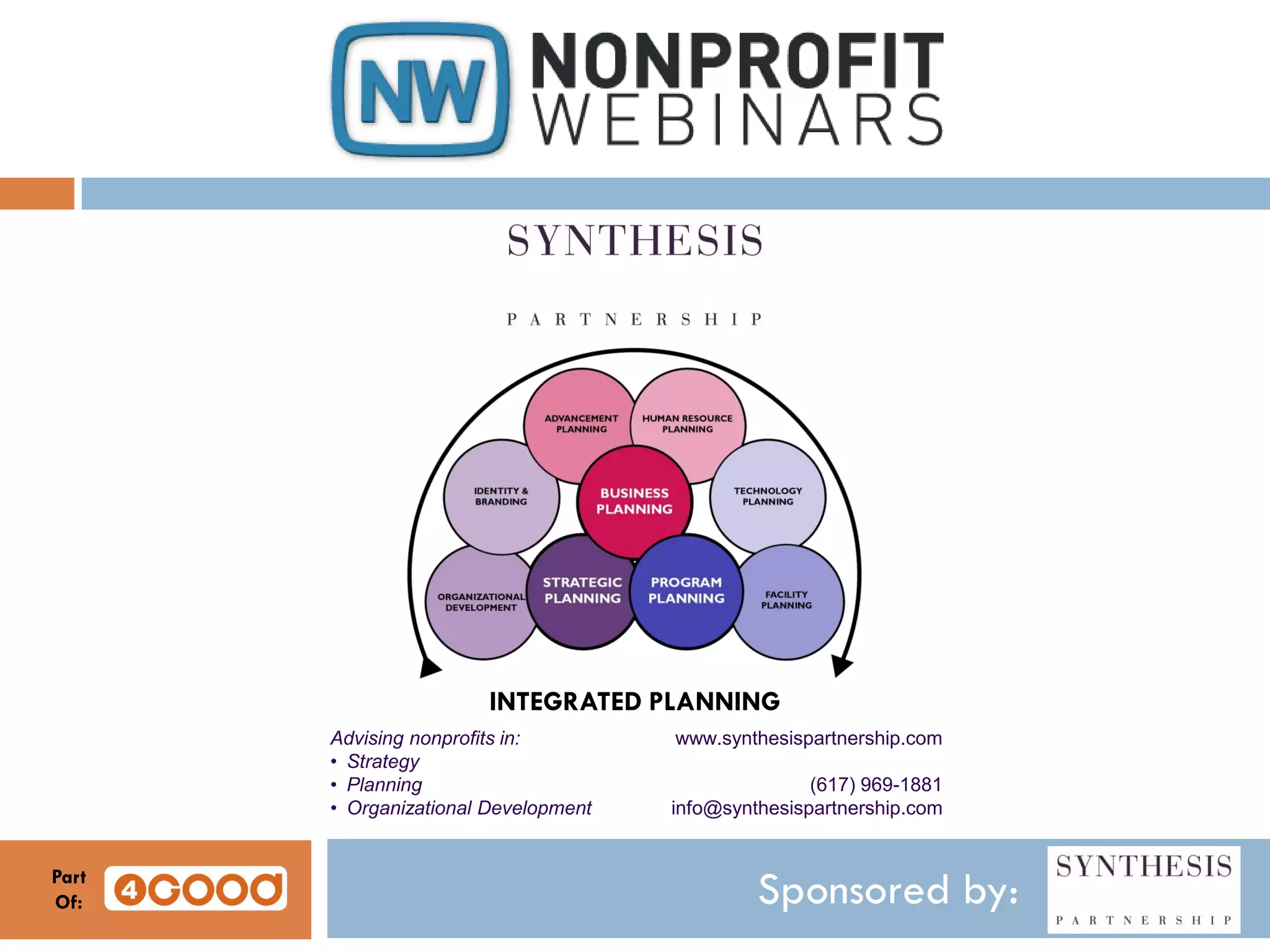
Advising nonprofits in:
• Strategy
• Planning
• Organizational Development
www.synthesispartnership.com
(617) 969-1881
info@synthesispartnership.com
INTEGRATED PLANNING
Part
Of:
Sponsored by:Part
Of:
Coming this June
Sponsored by:
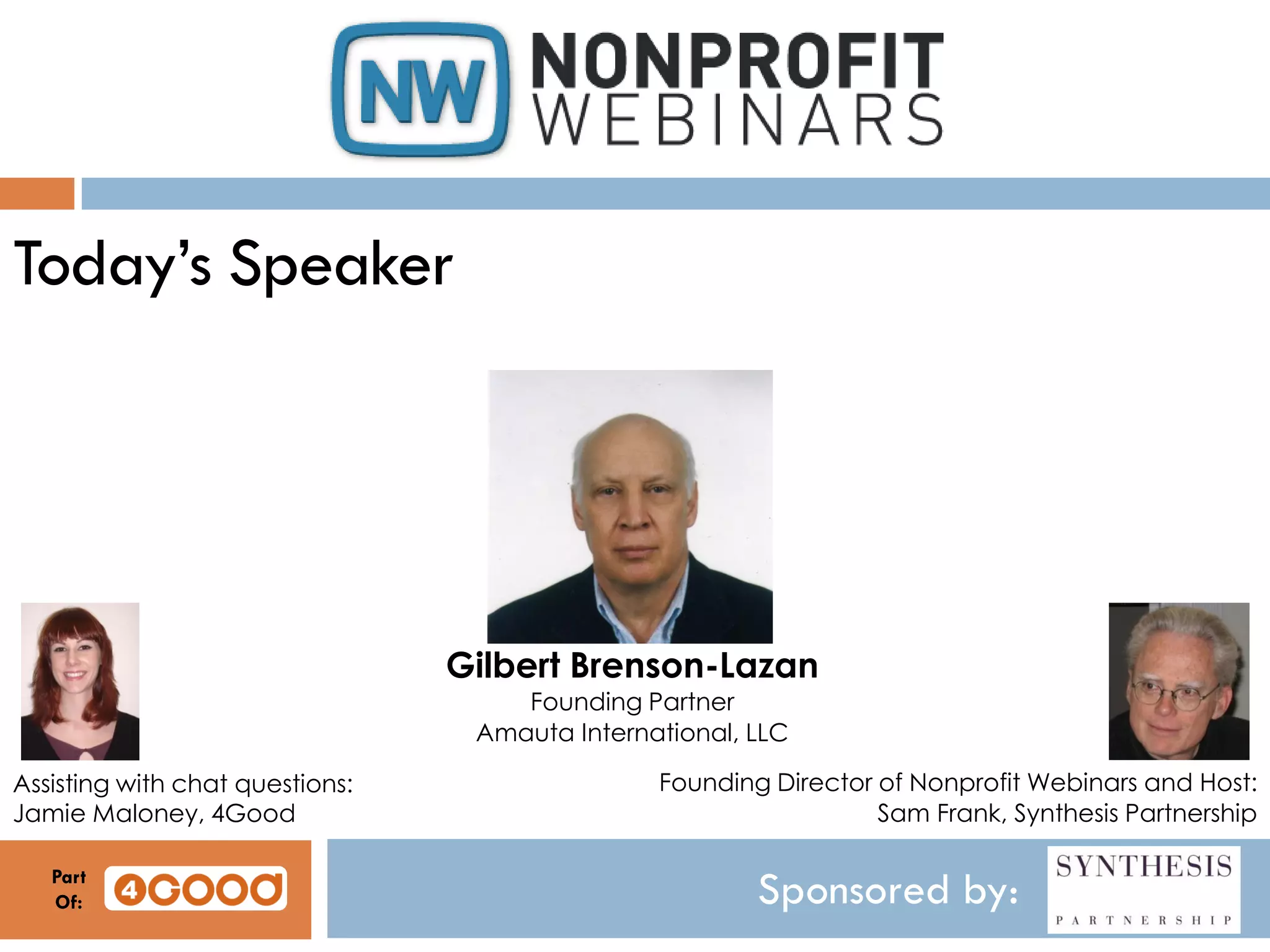
Today’s Speaker
Gilbert Brenson-Lazan
Founding Partner
Amauta International, LLC
Assisting with chat questions:
Jamie Maloney, 4Good
Founding Director of Nonprofit Webinars and Host:
Sam Frank, Synthesis Partnership
Part
Of:
THE THREE
LANGUAGES OF
APPRECIATION
GILBERT BRENSON LAZAN
8
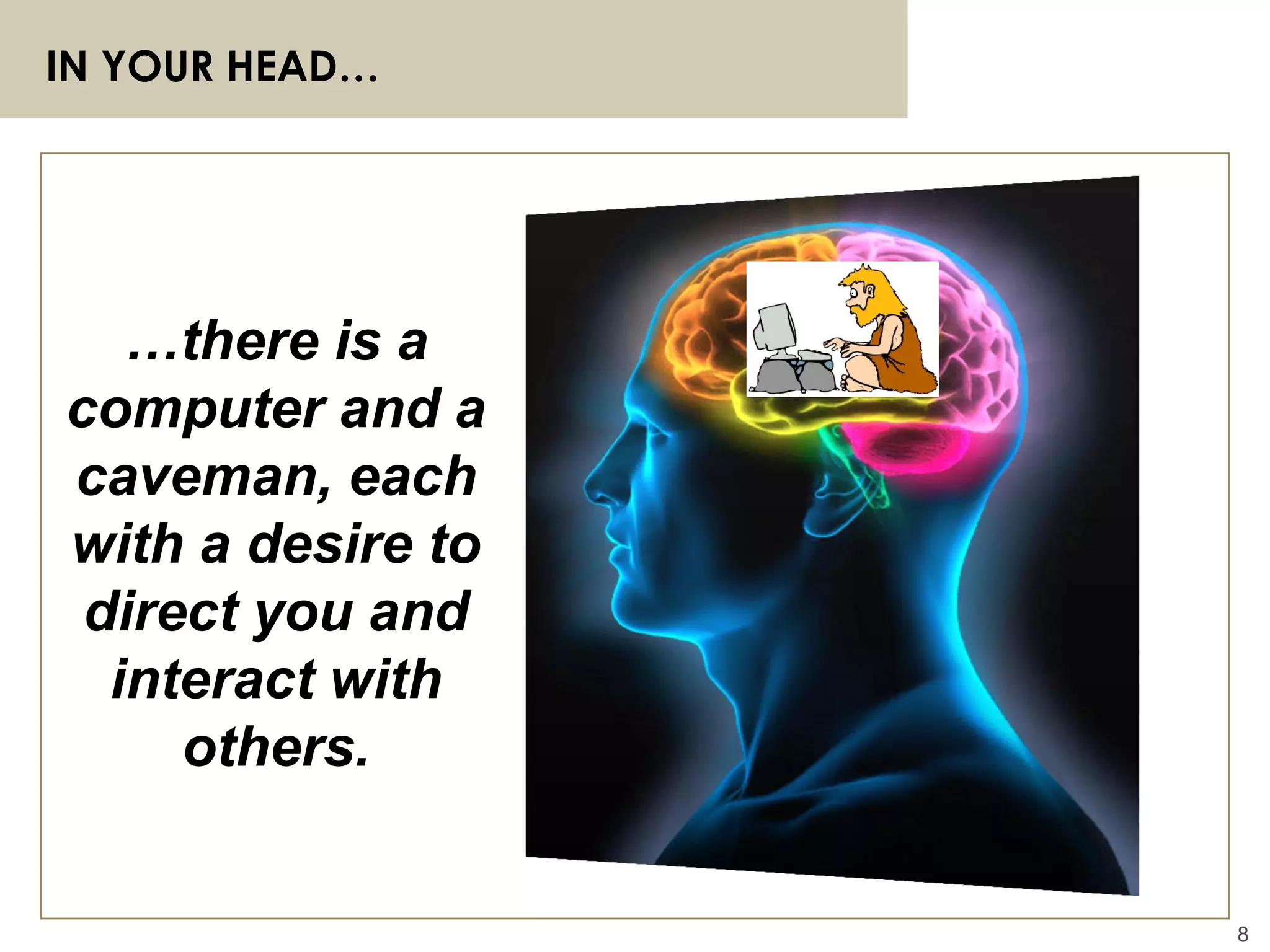
IN YOUR HEAD…
…there is a
computer and a
caveman, each
with a desire to
direct you and
interact with
others.
9
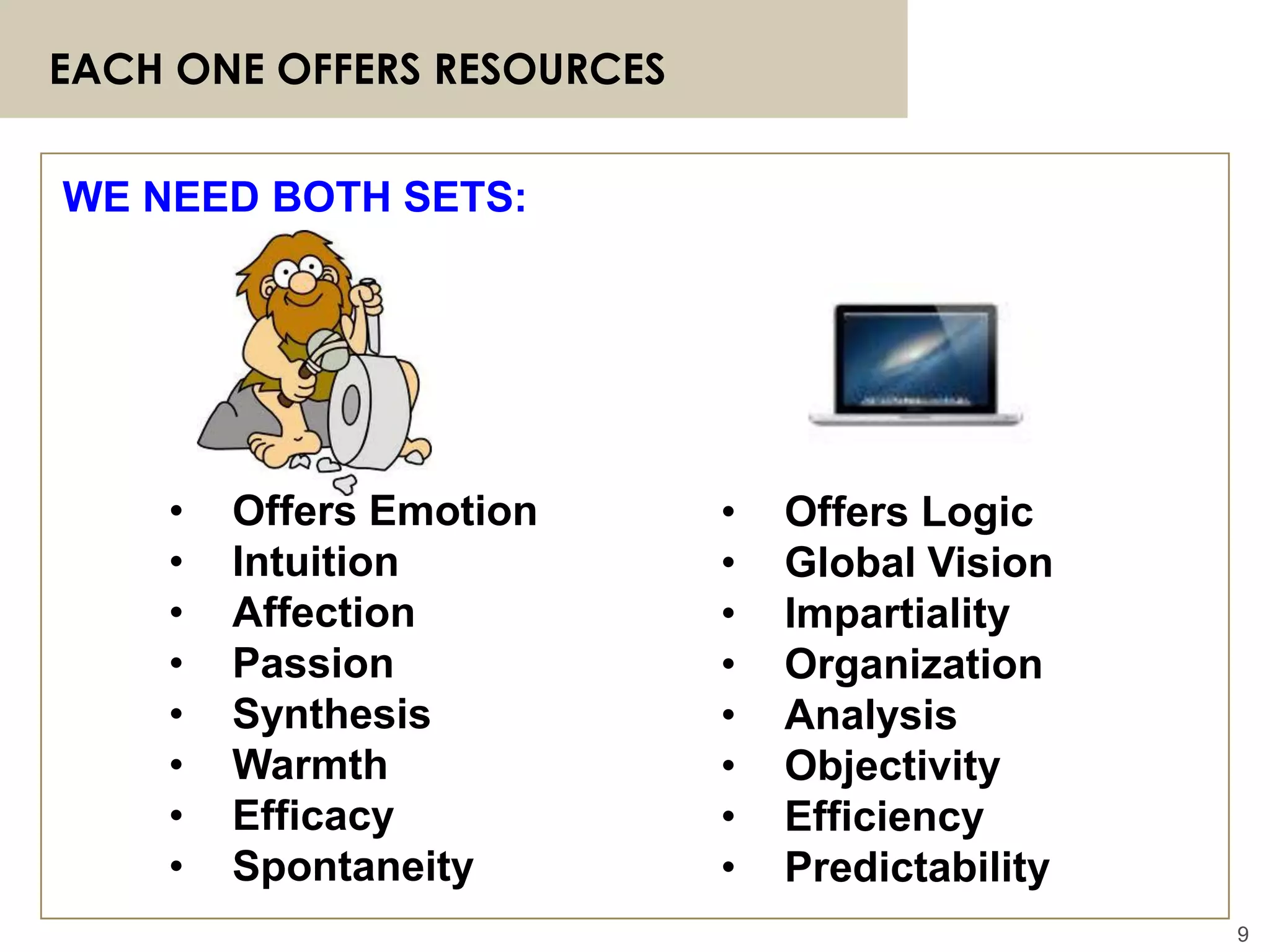
EACH ONE OFFERS RESOURCES
• Offers Logic
• Global Vision
• Impartiality
• Organization
• Analysis
• Objectivity
• Efficiency
• Predictability
WE NEED BOTH SETS:
• Offers Emotion
• Intuition
• Affection
• Passion
• Synthesis
• Warmth
• Efficacy
• Spontaneity
10
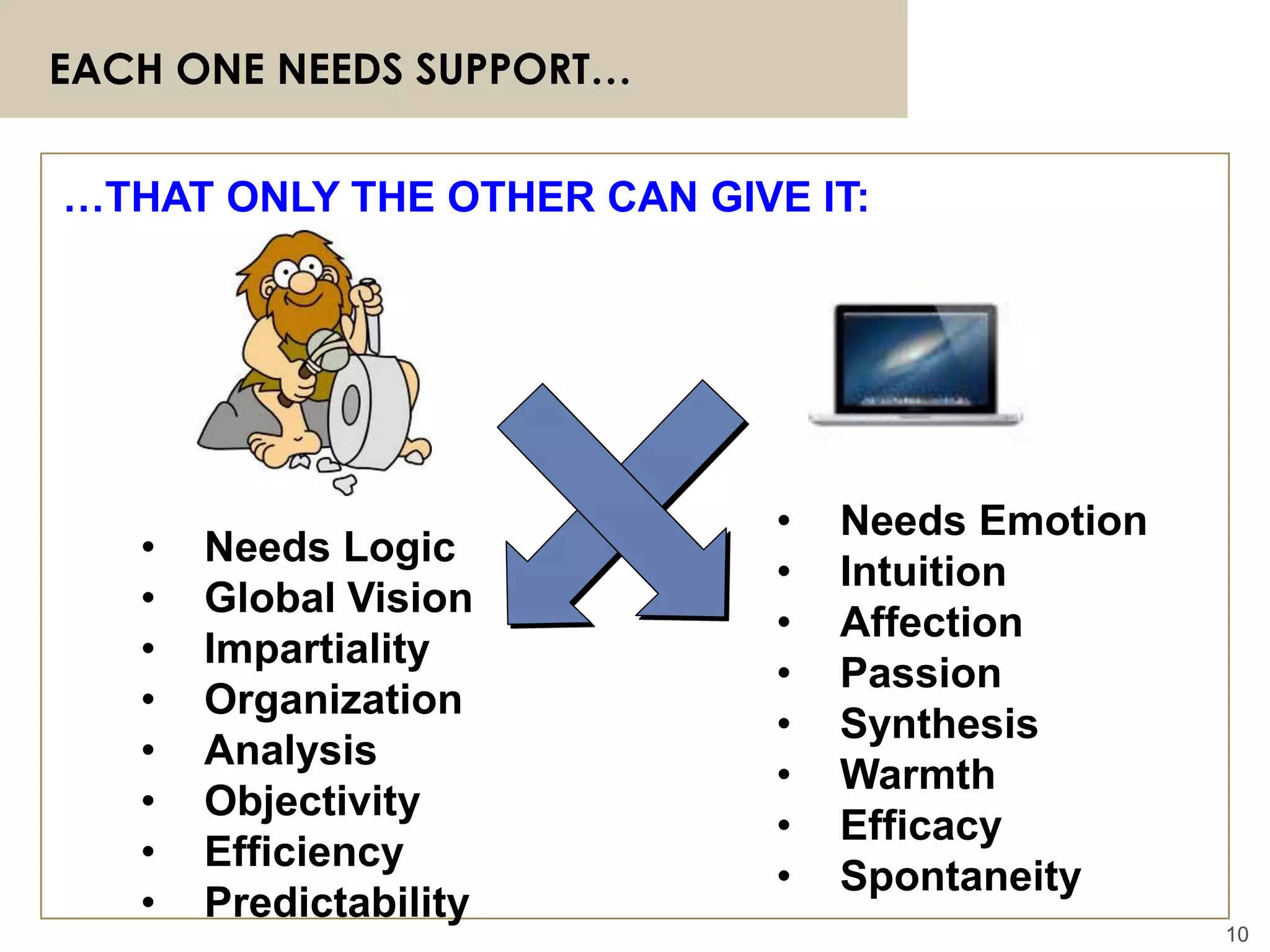
EACH ONE NEEDS SUPPORT…
• Needs Emotion
• Intuition
• Affection
• Passion
• Synthesis
• Warmth
• Efficacy
• Spontaneity
• Needs Logic
• Global Vision
• Impartiality
• Organization
• Analysis
• Objectivity
• Efficiency
• Predictability
…THAT ONLY THE OTHER CAN GIVE IT:
11
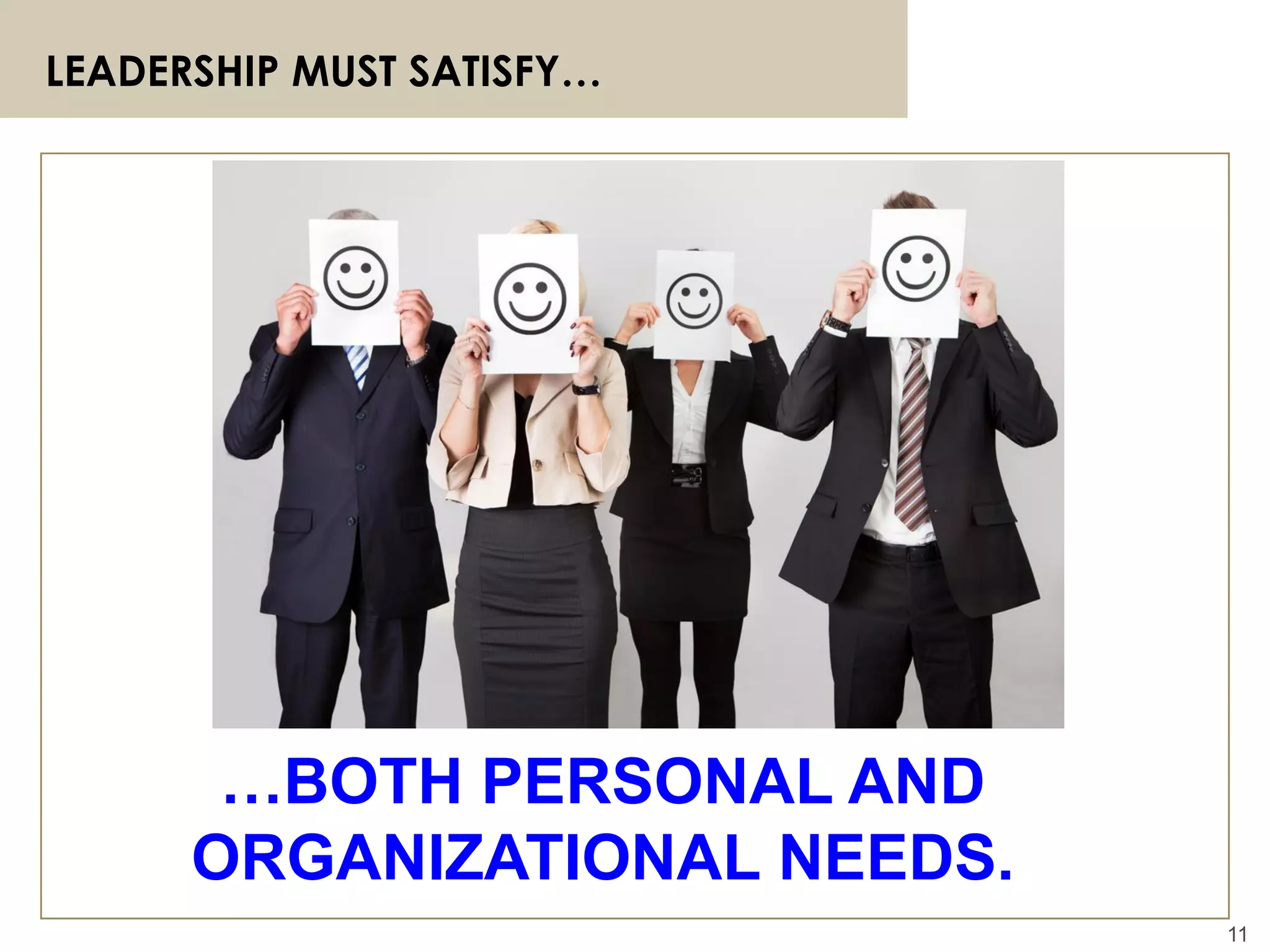
LEADERSHIP MUST SATISFY…
…BOTH PERSONAL AND
ORGANIZATIONAL NEEDS.
12
A LEARNING EXERCISE
12
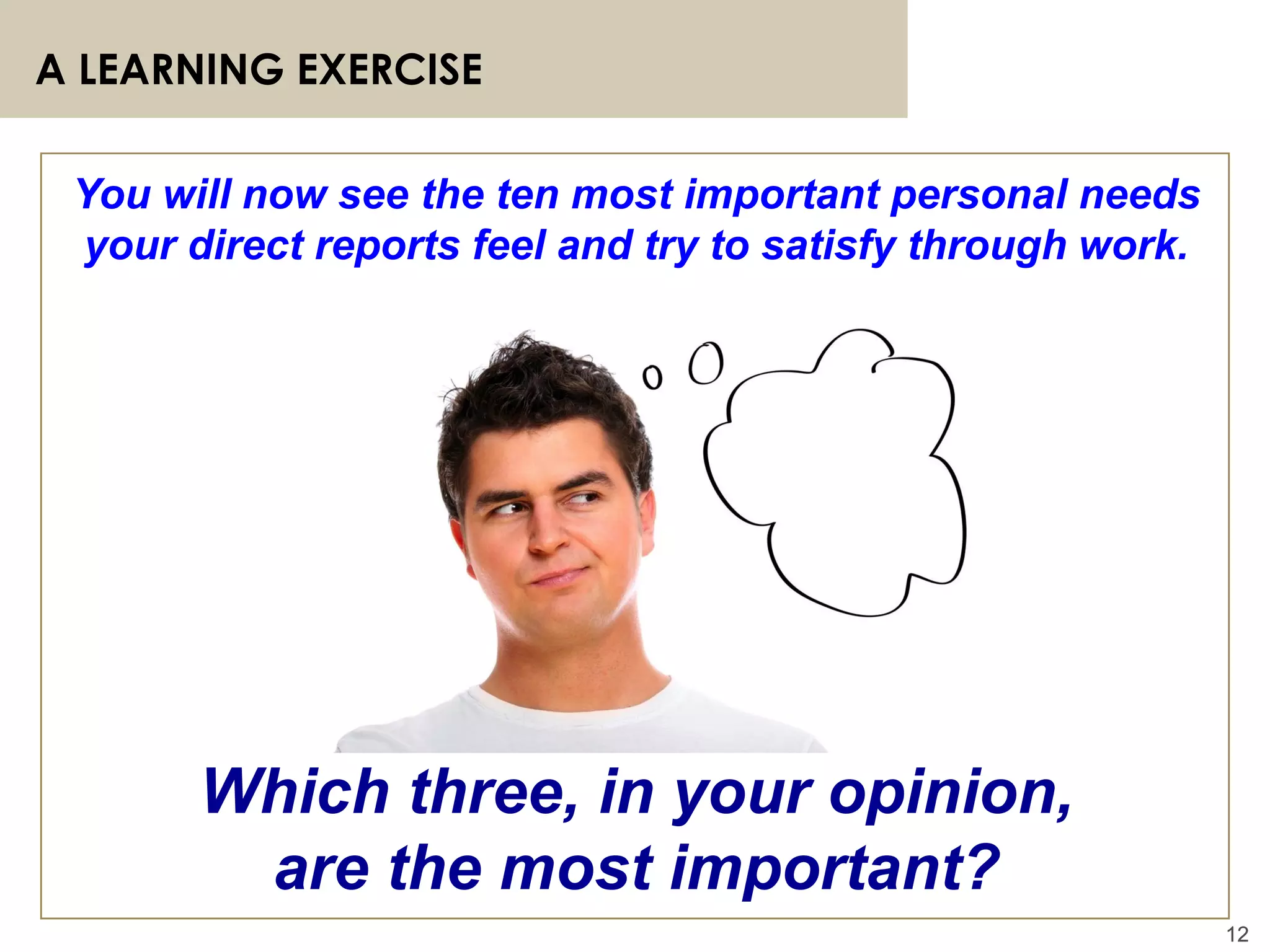
You will now see the ten most important personal needs
your direct reports feel and try to satisfy through work.
Which three, in your opinion,
are the most important?
13
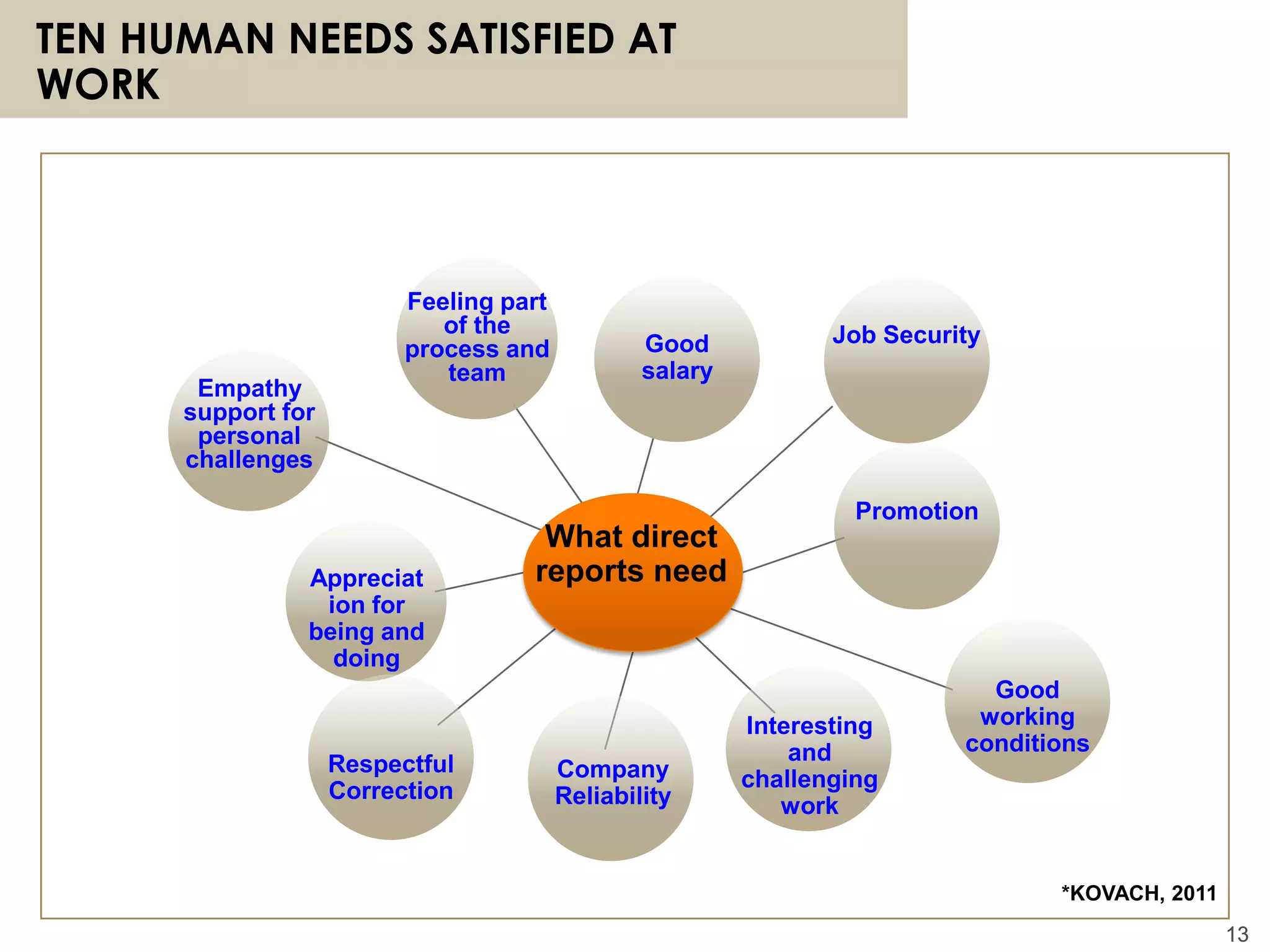
TEN HUMAN NEEDS SATISFIED AT
WORK
*KOVACH, 2011
13
What direct
reports need
Good
salary
Job Security
Promotion
Good
working
conditions
Respectful
Correction
Appreciat
ion for
being and
doing
Empathy
support for
personal
challenges
Feeling part
of the
process and
team
Interesting
and
challenging
work
Company
Reliability
14
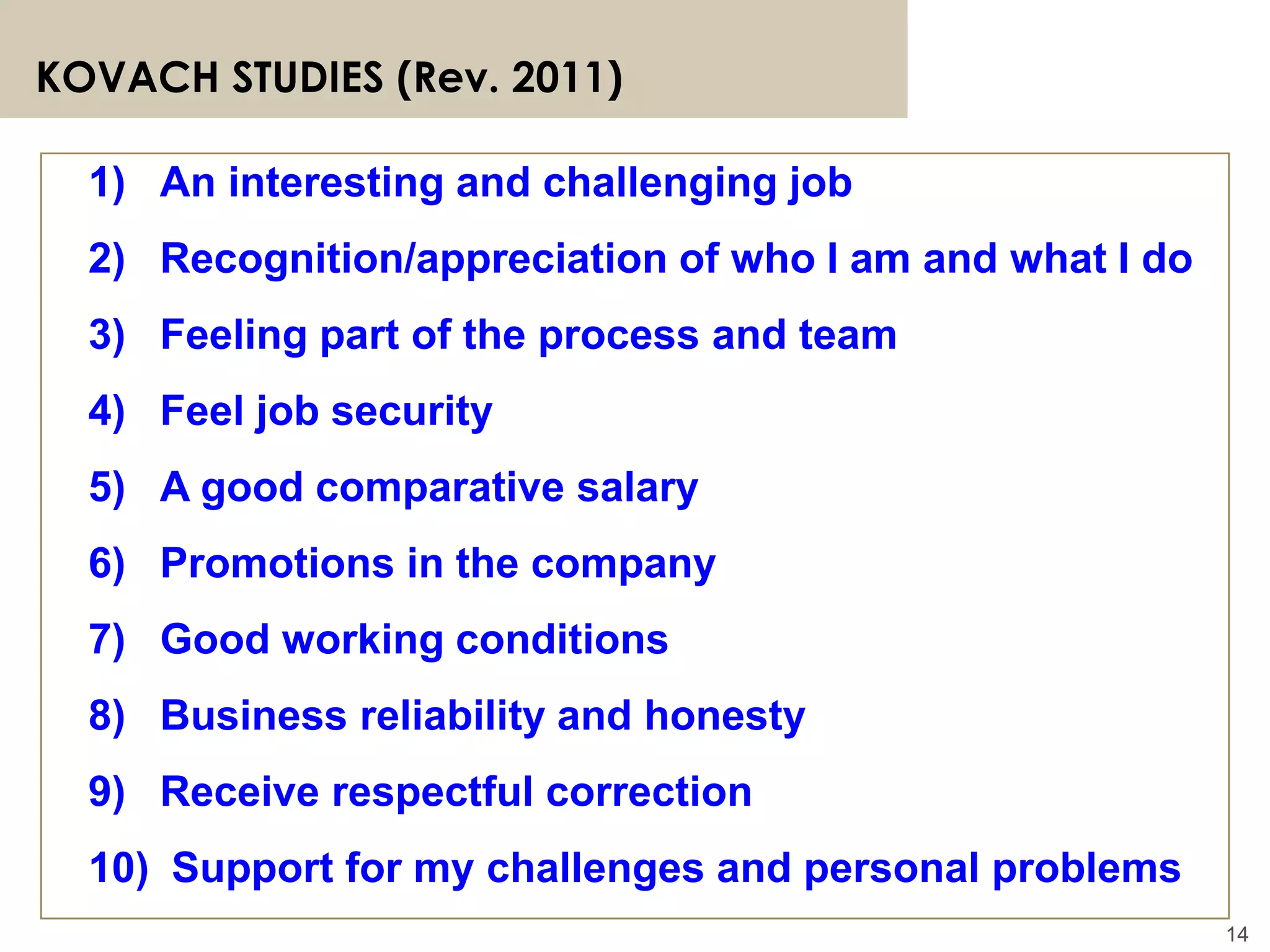
KOVACH STUDIES (Rev. 2011)
1) An interesting and challenging job
2) Recognition/appreciation of who I am and what I do
3) Feeling part of the process and team
4) Feel job security
5) A good comparative salary
6) Promotions in the company
7) Good working conditions
8) Business reliability and honesty
9) Receive respectful correction
10) Support for my challenges and personal problems
15
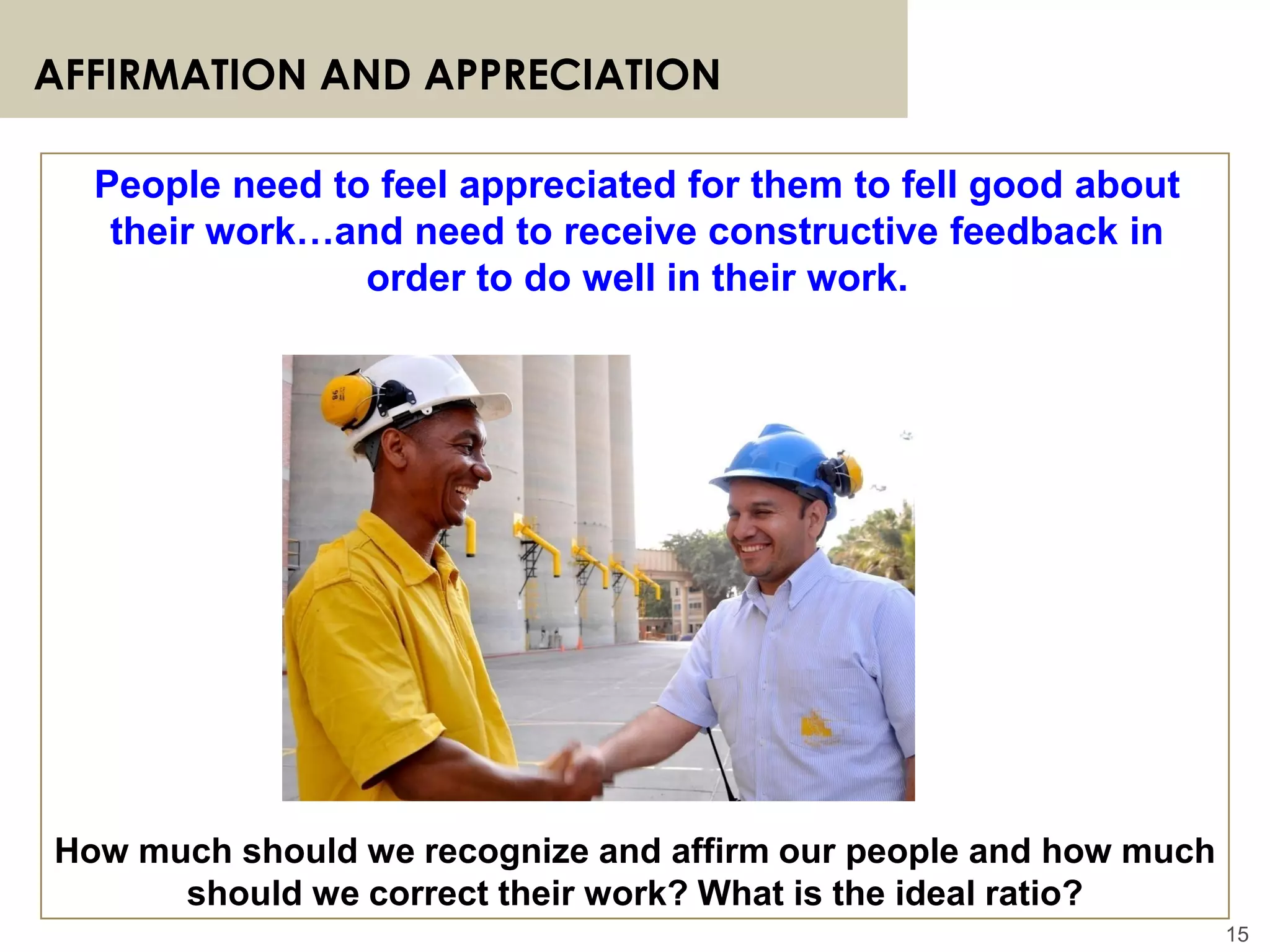
AFFIRMATION AND APPRECIATION
How much should we recognize and affirm our people and how much
should we correct their work? What is the ideal ratio?
People need to feel appreciated for them to fell good about
their work…and need to receive constructive feedback in
order to do well in their work.
16
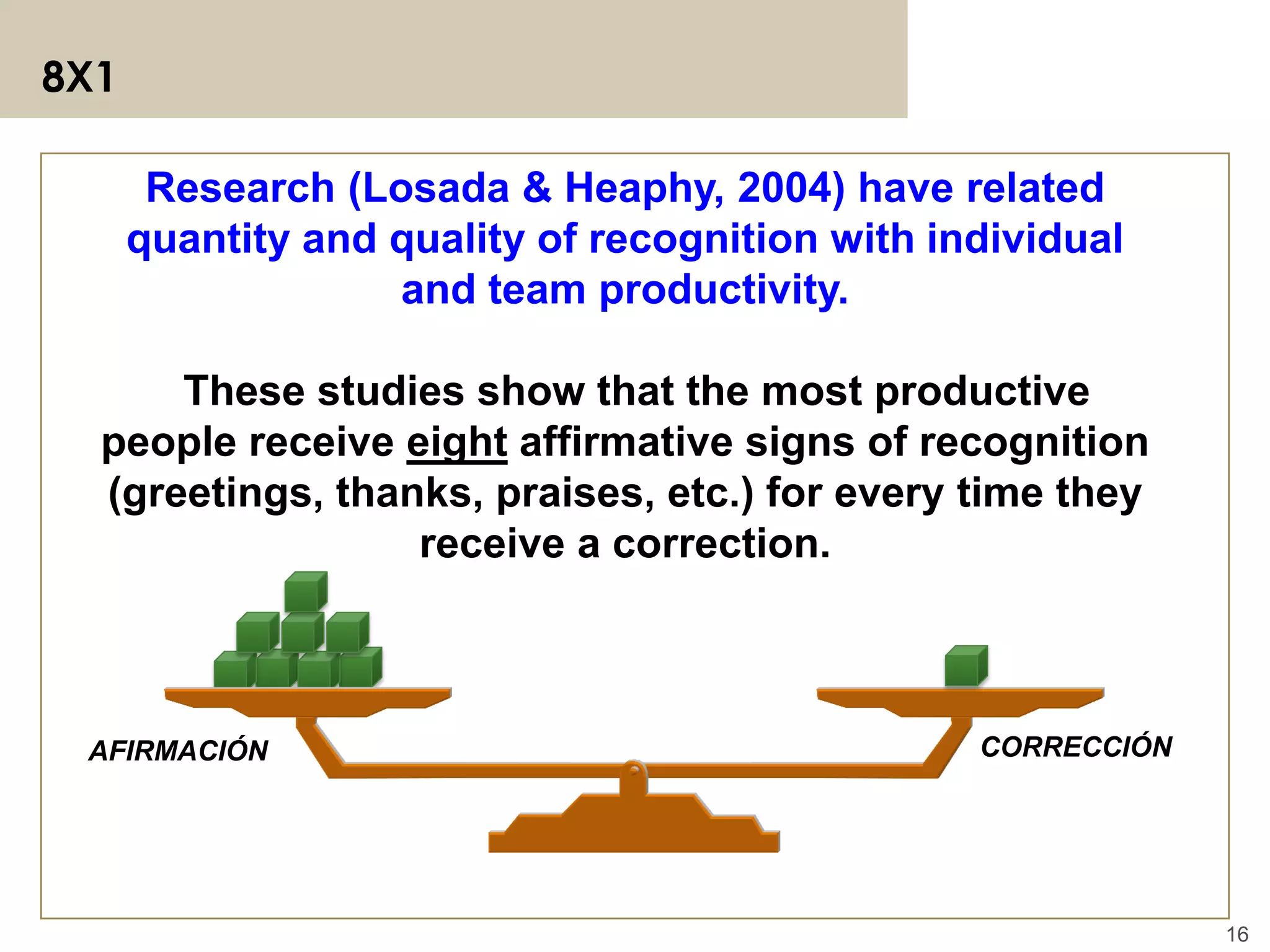
8X1
Research (Losada & Heaphy, 2004) have related
quantity and quality of recognition with individual
and team productivity.
These studies show that the most productive
people receive eight affirmative signs of recognition
(greetings, thanks, praises, etc.) for every time they
receive a correction.
AFIRMACIÓN CORRECCIÓN
17
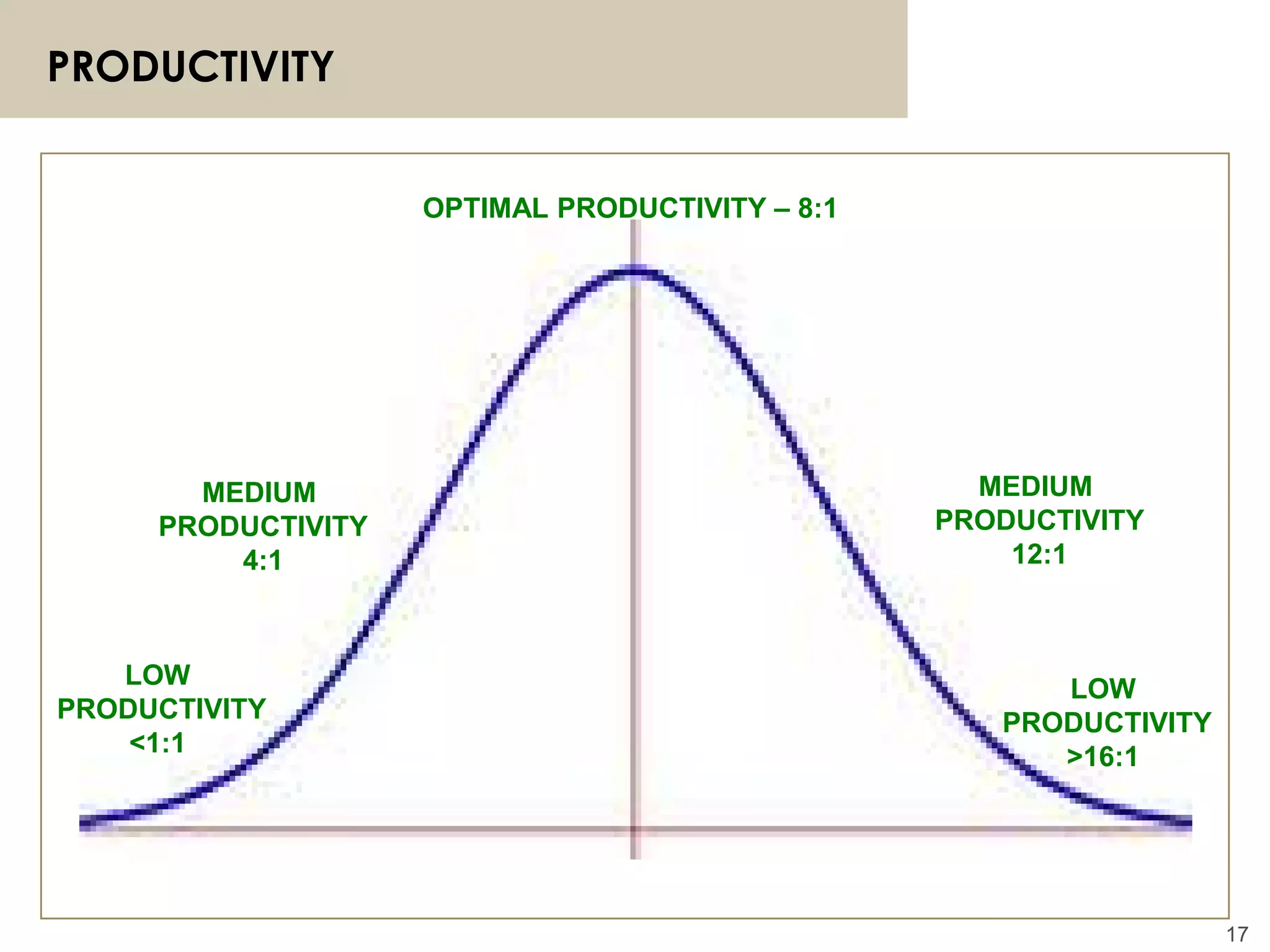
PRODUCTIVITY
OPTIMAL PRODUCTIVITY – 8:1
MEDIUM
PRODUCTIVITY
4:1
MEDIUM
PRODUCTIVITY
12:1
LOW
PRODUCTIVITY
<1:1
LOW
PRODUCTIVITY
>16:1
18
THE APPRECIATIVE MINDSET
Focuses much more on the positive aspects: strengths,
successes, future potential and abundance…than in the
negative aspects: weaknesses, failures, past errors and
deficiencies.
THE RESULT IS A 57% PRODUCTIVITY INCREASE
(Blanchard, 2012)
19
APPRECIATION LANGUAGES
1.Active Perception
2.Linguistic Affirmation
1.Servant Leadership
THERE ARE DIFFERENT LANGUAGES
TO AFFIRM AND TO
EXPRESS APPRECIATION
20
1. ACTIVE PERCEPTION
21
WHICH IS THE DARKEST SQUARE
ARE YOU SURE?
22
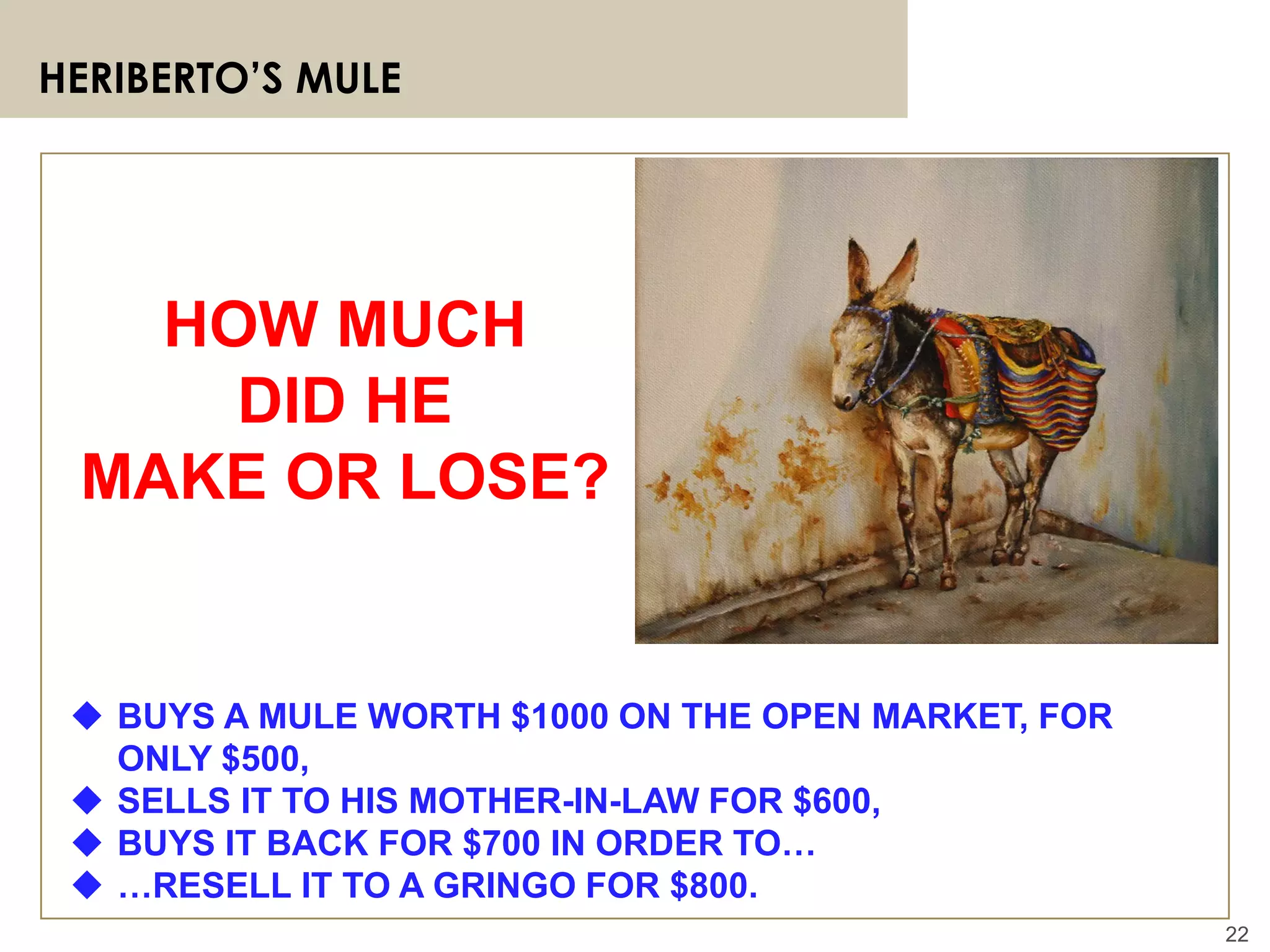
HERIBERTO’S MULE
 BUYS A MULE WORTH $1000 ON THE OPEN MARKET, FOR
ONLY $500,
 SELLS IT TO HIS MOTHER-IN-LAW FOR $600,
 BUYS IT BACK FOR $700 IN ORDER TO…
 …RESELL IT TO A GRINGO FOR $800.
HOW MUCH
DID HE
MAKE OR LOSE?
23
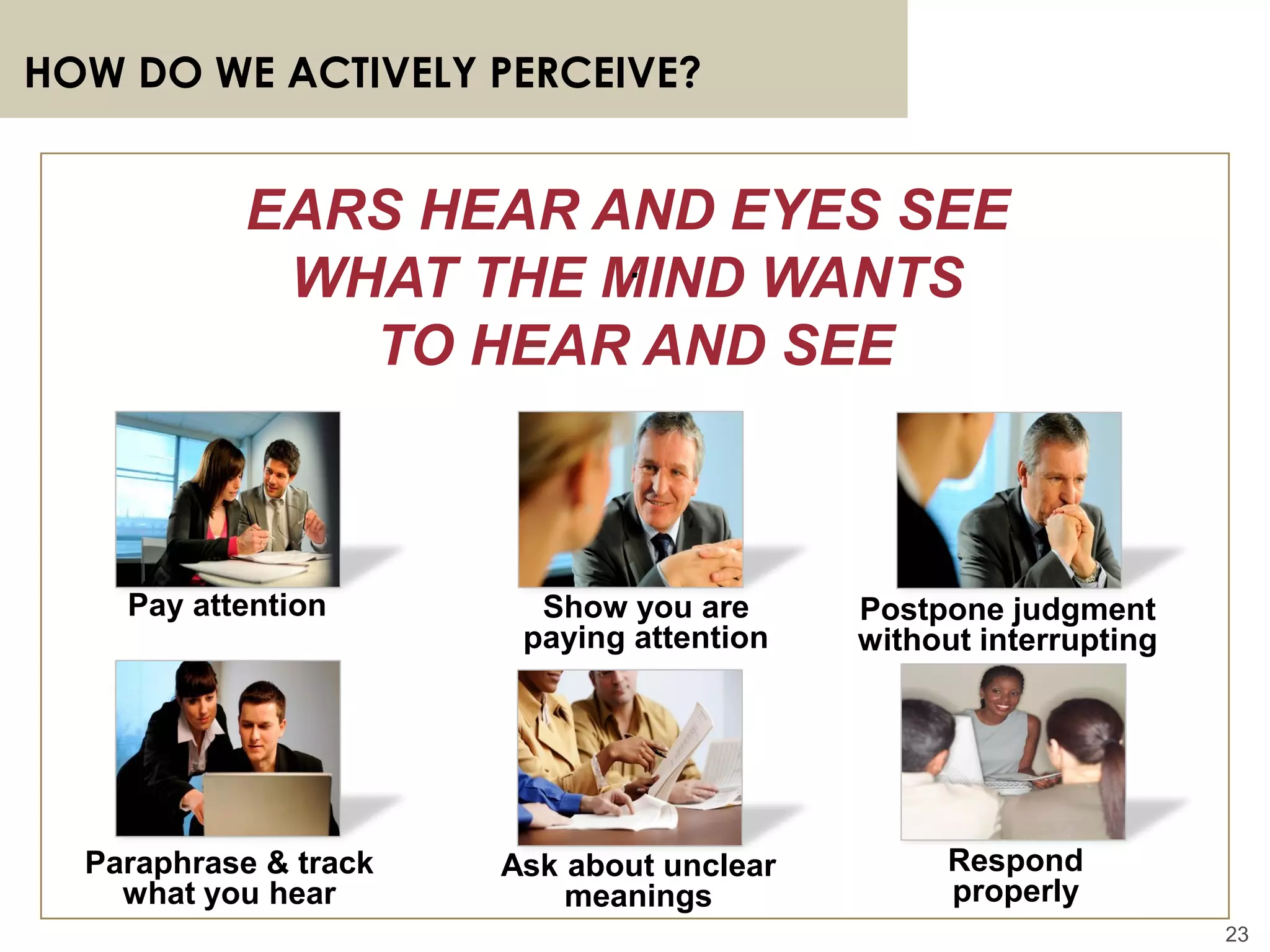
HOW DO WE ACTIVELY PERCEIVE?
EARS HEAR AND EYES SEE
WHAT THE MIND WANTS
TO HEAR AND SEE
Pay attention
.
Show you are
paying attention
Ask about unclear
meanings
Paraphrase & track
what you hear
Postpone judgment
without interrupting
Respond
properly
24
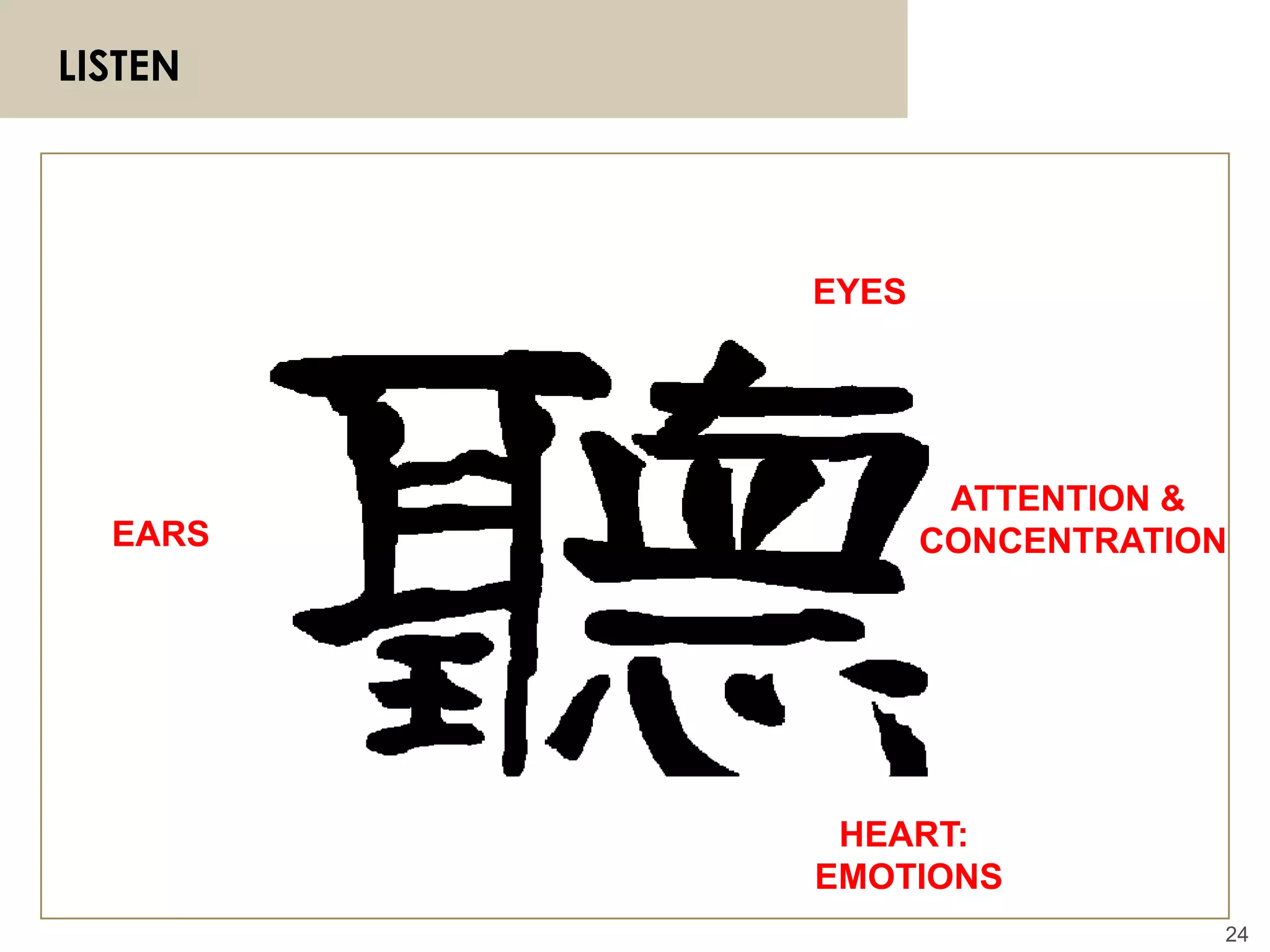
LISTEN
EARS
EYES
ATTENTION &
CONCENTRATION
HEART:
EMOTIONS
25
2. AFFIRMATION
26
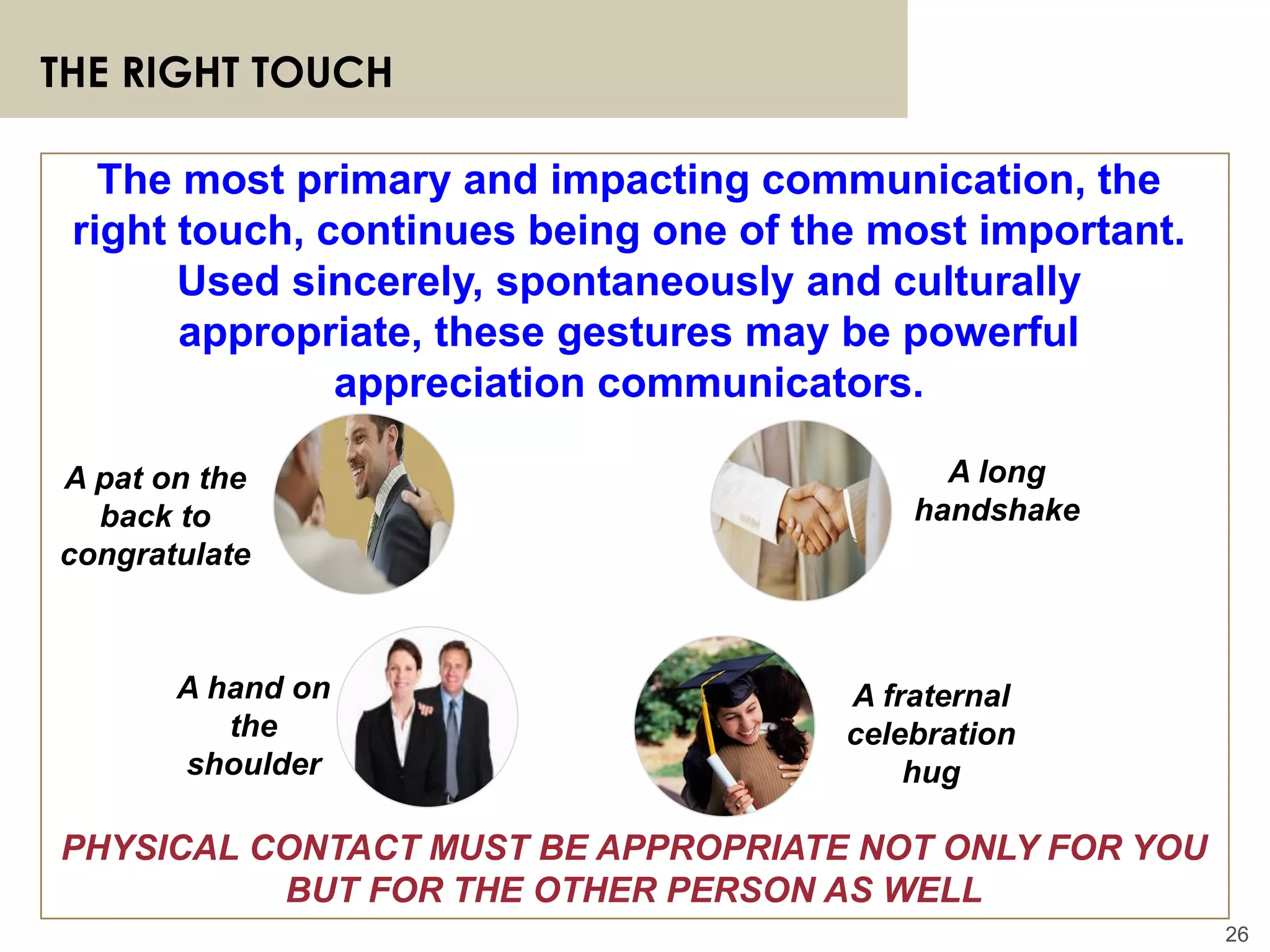
THE RIGHT TOUCH
PHYSICAL CONTACT MUST BE APPROPRIATE NOT ONLY FOR YOU
BUT FOR THE OTHER PERSON AS WELL
The most primary and impacting communication, the
right touch, continues being one of the most important.
Used sincerely, spontaneously and culturally
appropriate, these gestures may be powerful
appreciation communicators.
A pat on the
back to
congratulate
A long
handshake
A fraternal
celebration
hug
A hand on
the
shoulder
27
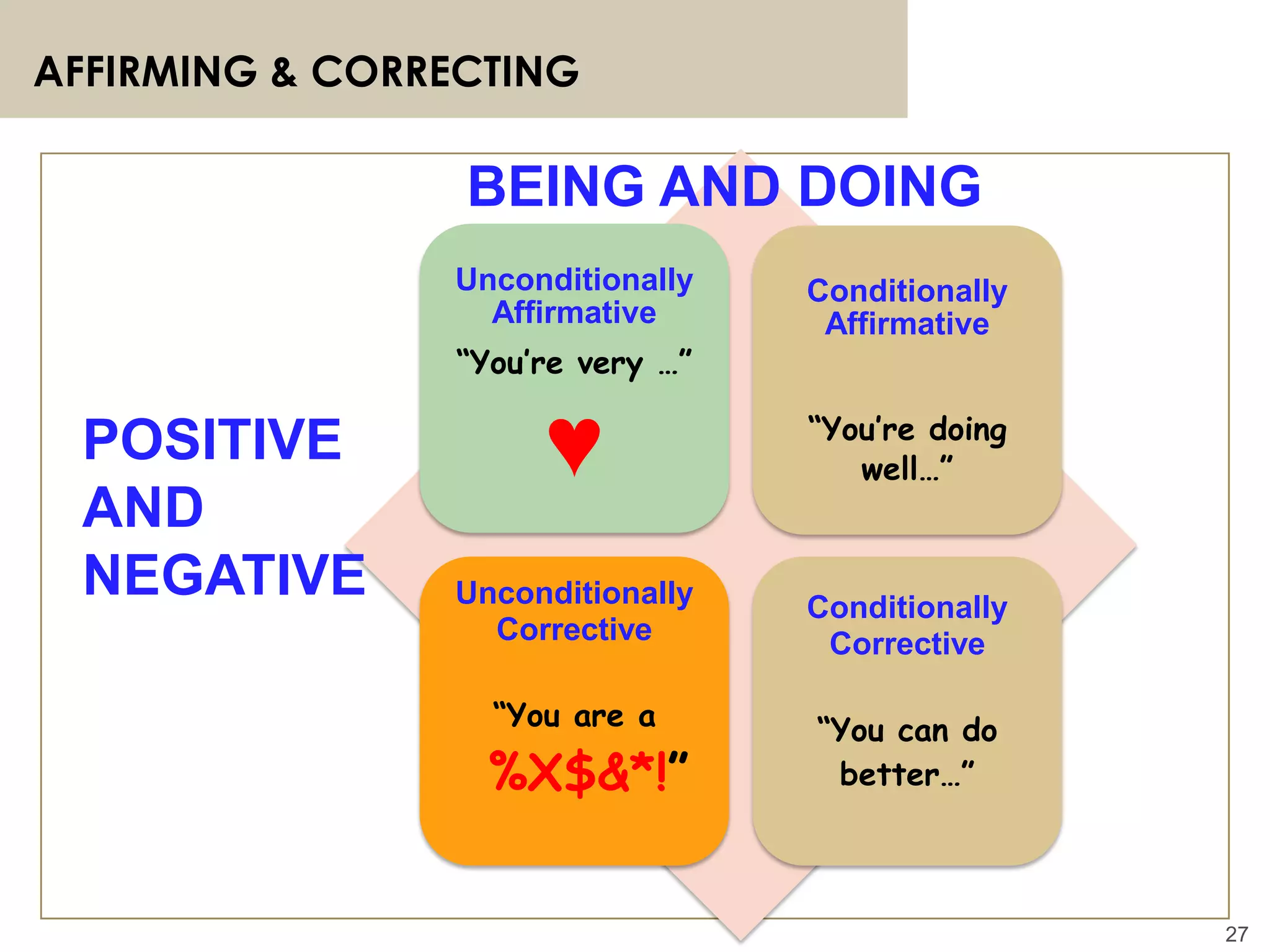
AFFIRMING & CORRECTING
Unconditionally
Affirmative
“You’re very …”
♥
Conditionally
Affirmative
“You’re doing
well…”
Unconditionally
Corrective
“You are a
%X$&*!”
Conditionally
Corrective
“You can do
better…”
BEING AND DOING
POSITIVE
AND
NEGATIVE
28
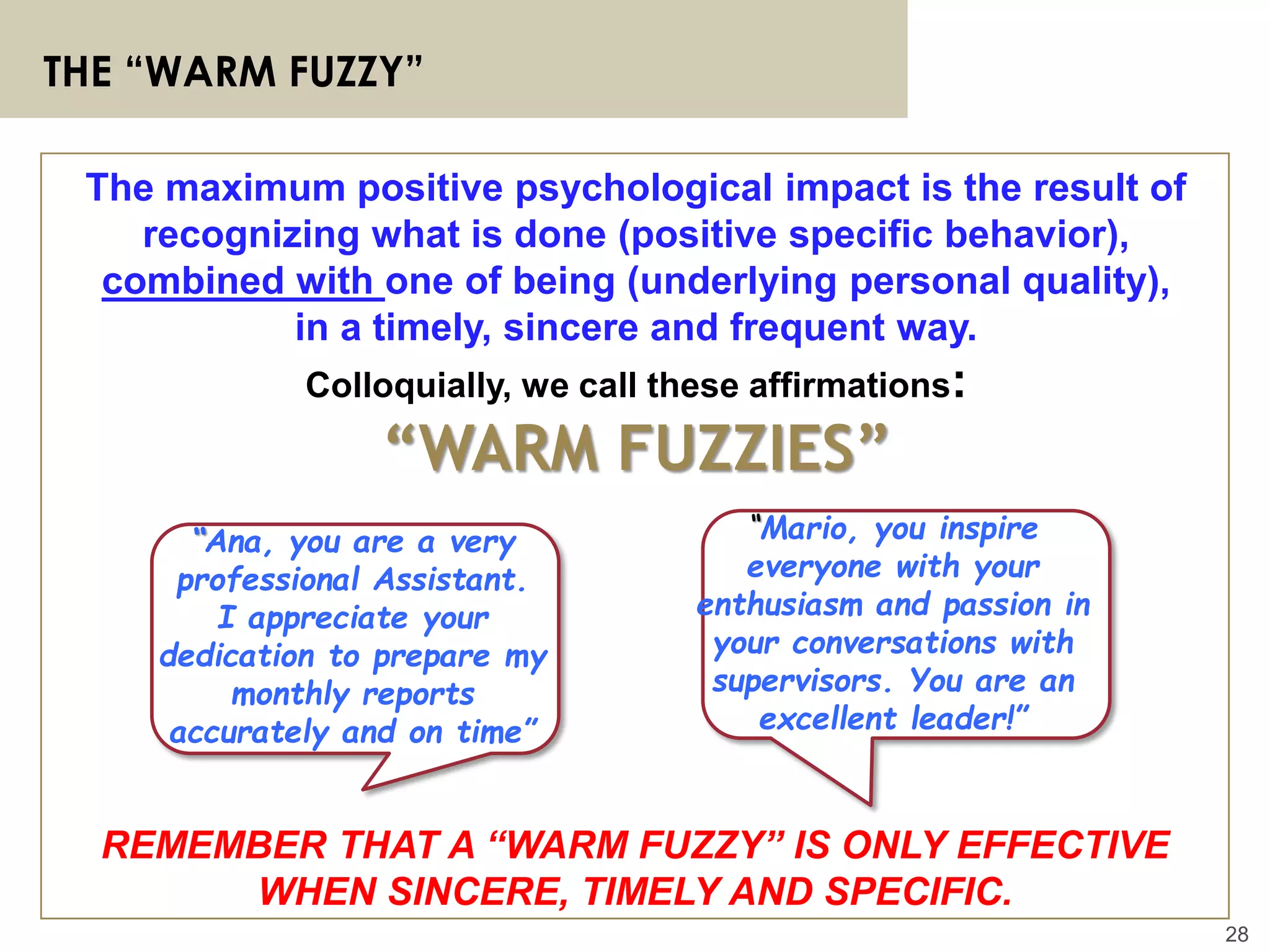
THE “WARM FUZZY”
REMEMBER THAT A “WARM FUZZY” IS ONLY EFFECTIVE
WHEN SINCERE, TIMELY AND SPECIFIC.
The maximum positive psychological impact is the result of
recognizing what is done (positive specific behavior),
combined with one of being (underlying personal quality),
in a timely, sincere and frequent way.
Colloquially, we call these affirmations:
“WARM FUZZIES”
“Ana, you are a very
professional Assistant.
I appreciate your
dedication to prepare my
monthly reports
accurately and on time”
“Mario, you inspire
everyone with your
enthusiasm and passion in
your conversations with
supervisors. You are an
excellent leader!”
29
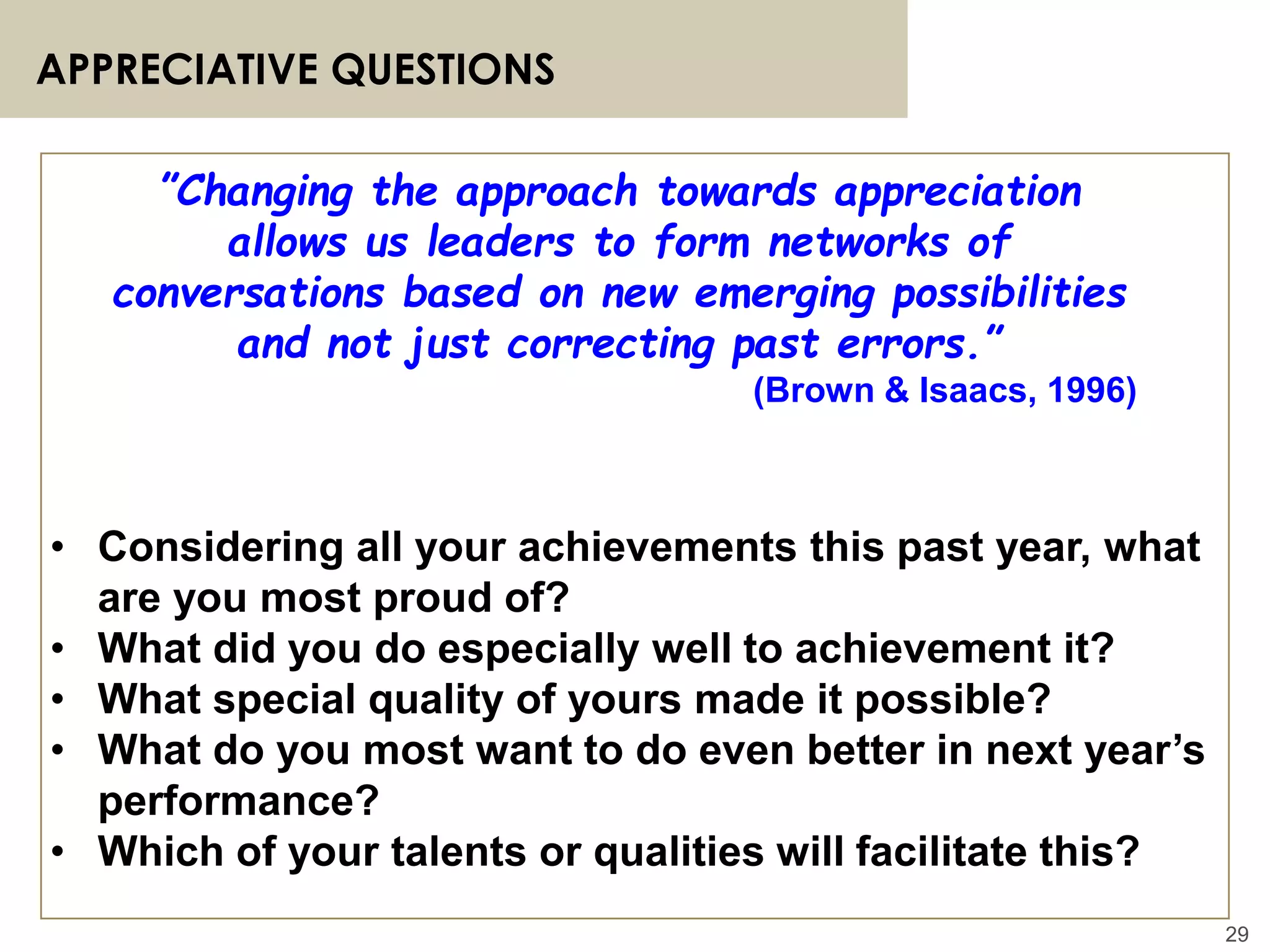
APPRECIATIVE QUESTIONS
”Changing the approach towards appreciation
allows us leaders to form networks of
conversations based on new emerging possibilities
and not just correcting past errors.”
(Brown & Isaacs, 1996)
• Considering all your achievements this past year, what
are you most proud of?
• What did you do especially well to achievement it?
• What special quality of yours made it possible?
• What do you most want to do even better in next year’s
performance?
• Which of your talents or qualities will facilitate this?
30
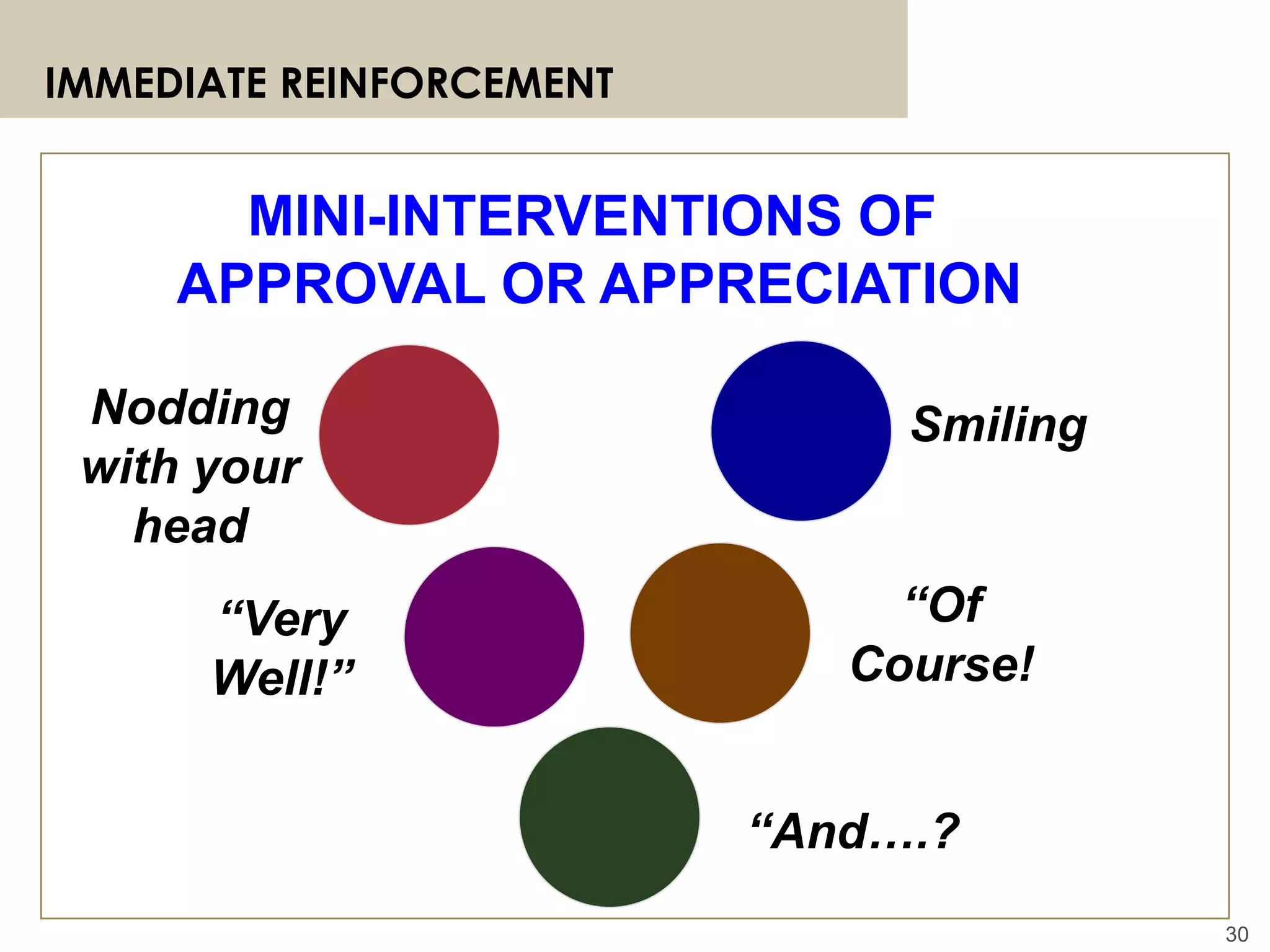
IMMEDIATE REINFORCEMENT
Nodding
with your
head
Smiling
“Of
Course!
“Very
Well!”
MINI-INTERVENTIONS OF
APPROVAL OR APPRECIATION
“And….?
31
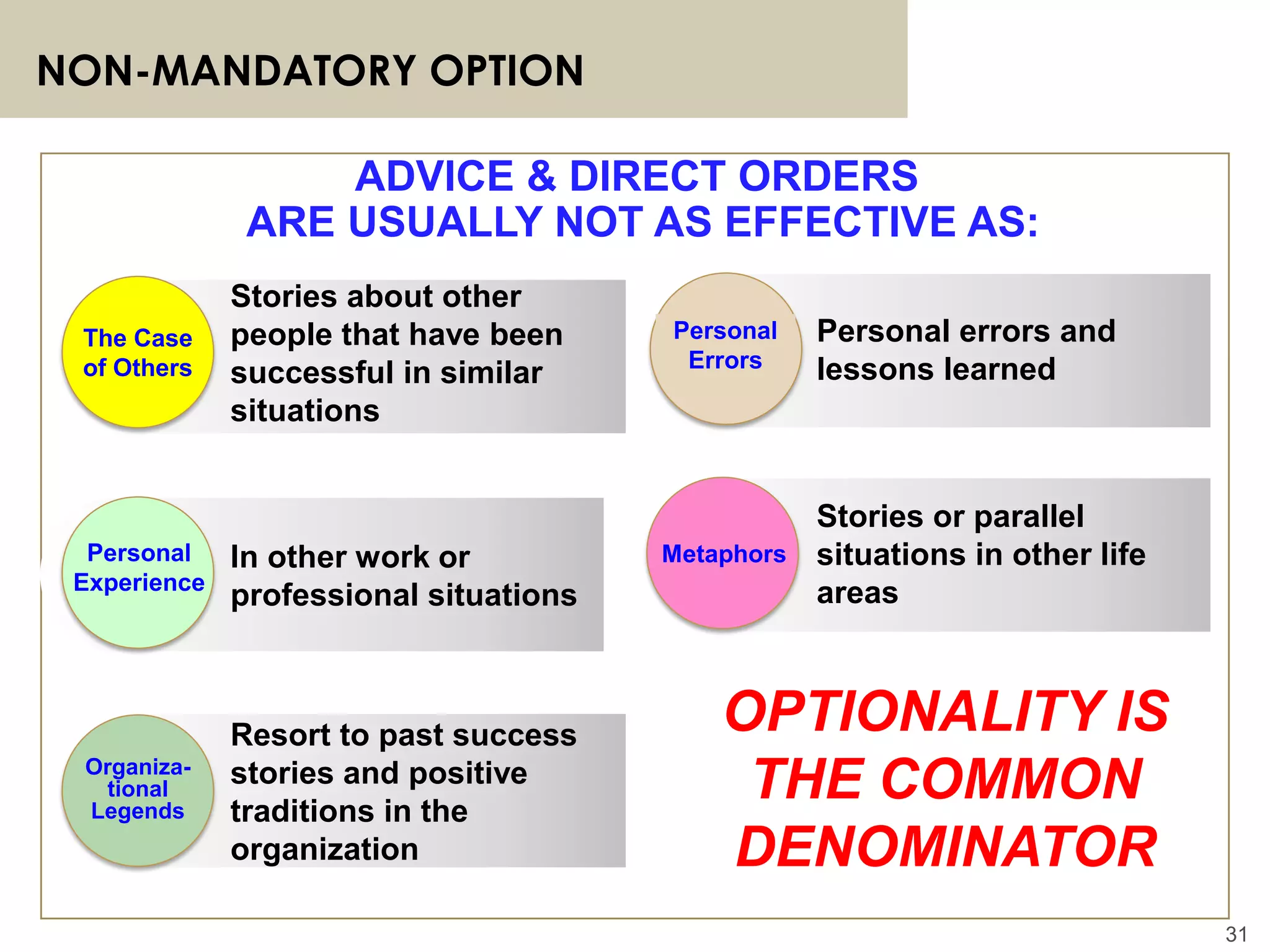
NON-MANDATORY OPTION
Stories about other
people that have been
successful in similar
situations
The Case
of Others
Personal errors and
lessons learned
In other work or
professional situations
Personal
Experience
Stories or parallel
situations in other life
areas
Metaphors
Resort to past success
stories and positive
traditions in the
organization
Organiza-
tional
Legends
OPTIONALITY IS
THE COMMON
DENOMINATOR
ADVICE & DIRECT ORDERS
ARE USUALLY NOT AS EFFECTIVE AS:
Personal
Errors
32
3. SERVANT LEADERSHIP
33
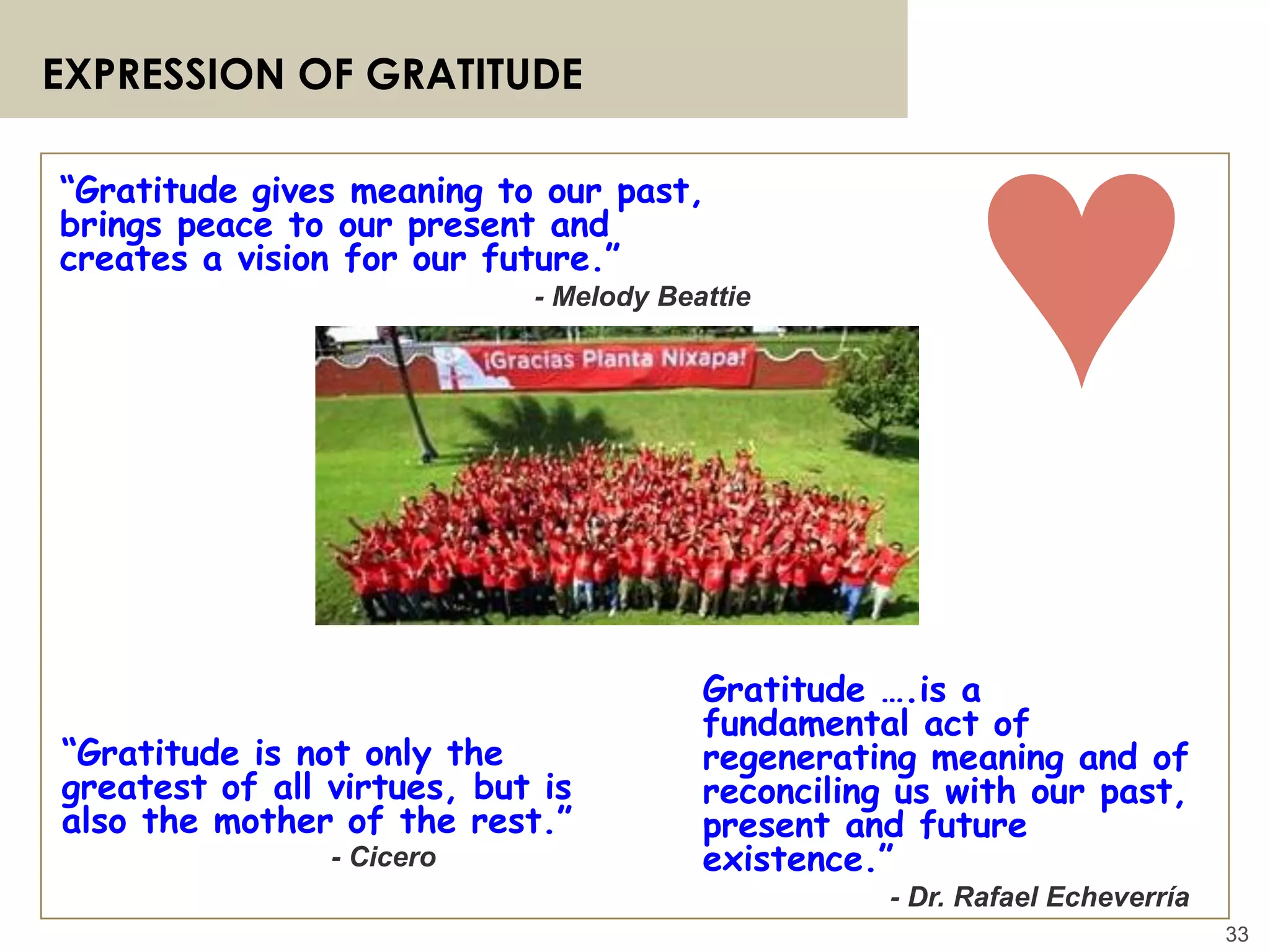
EXPRESSION OF GRATITUDE
“Gratitude gives meaning to our past,
brings peace to our present and
creates a vision for our future.”
- Melody Beattie
“Gratitude is not only the
greatest of all virtues, but is
also the mother of the rest.”
- Cicero
Gratitude ….is a
fundamental act of
regenerating meaning and of
reconciling us with our past,
present and future
existence.”
- Dr. Rafael Echeverría
♥
34
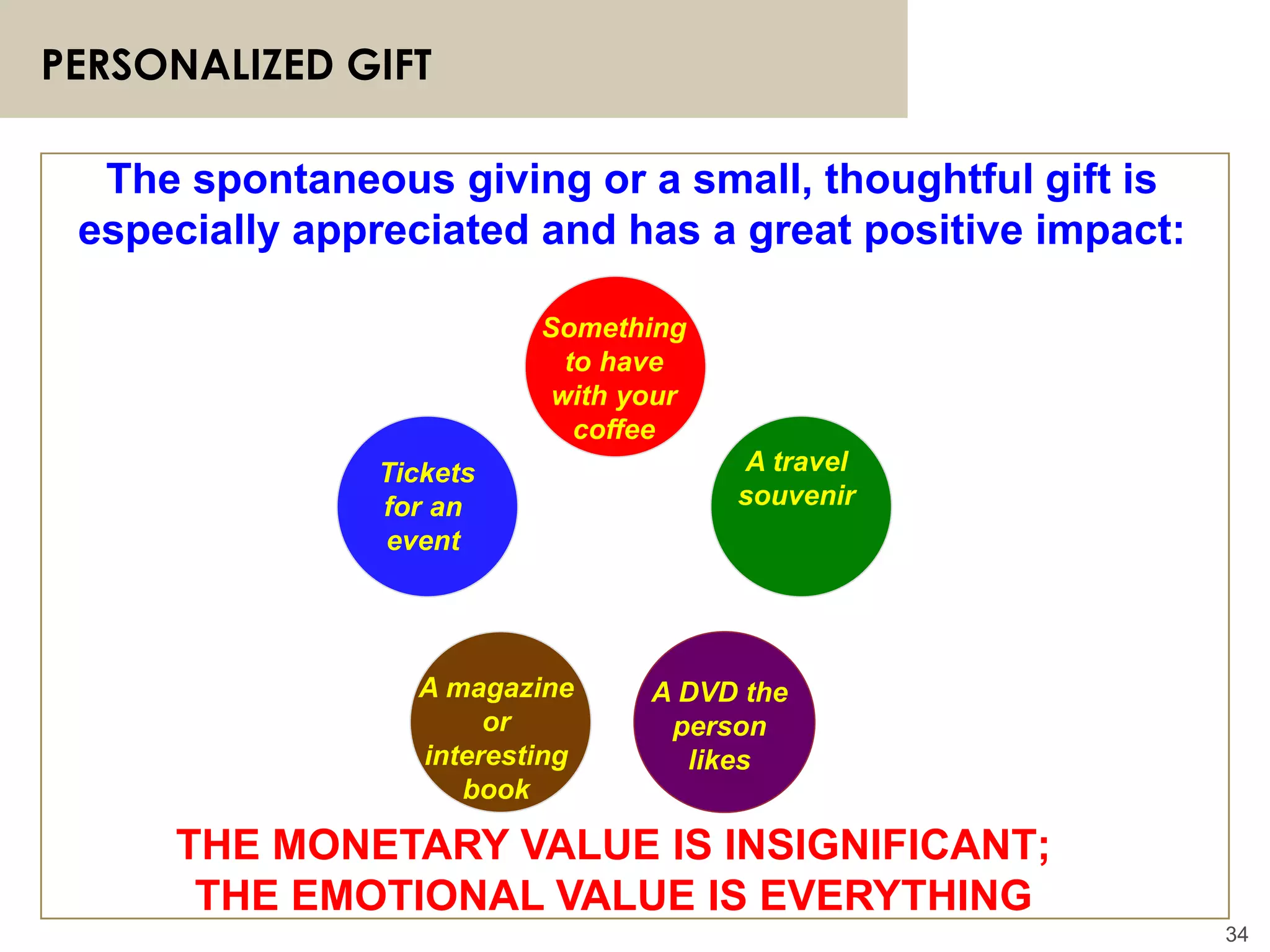
PERSONALIZED GIFT
The spontaneous giving or a small, thoughtful gift is
especially appreciated and has a great positive impact:
Something
to have
with your
coffee
A magazine
or
interesting
book
THE MONETARY VALUE IS INSIGNIFICANT;
THE EMOTIONAL VALUE IS EVERYTHING
A travel
souvenir
A DVD the
person
likes
Tickets
for an
event
35
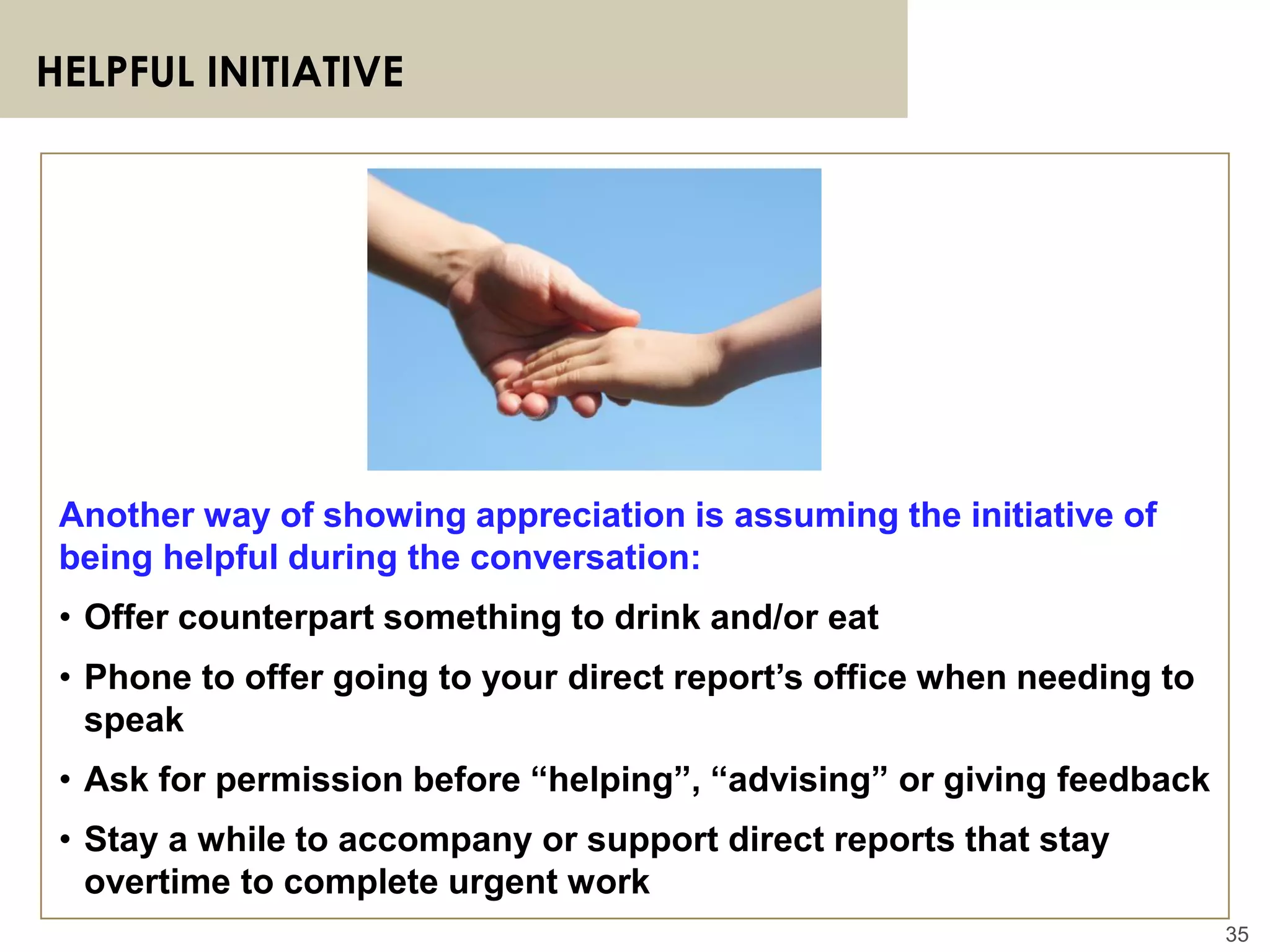
HELPFUL INITIATIVE
Another way of showing appreciation is assuming the initiative of
being helpful during the conversation:
• Offer counterpart something to drink and/or eat
• Phone to offer going to your direct report’s office when needing to
speak
• Ask for permission before “helping”, “advising” or giving feedback
• Stay a while to accompany or support direct reports that stay
overtime to complete urgent work
36
SHOW VULNERABILITY
• THEY ASK FOR FEEDBACK sincerely and accept it well
• SHARE THEIR FEELINGS even those not “convenient”
for their image
• THEY RECOGNIZE THEIR ERRORS both publically and
privately
• THEY EXCUSE THEMSELVES OR ASK FORGIVENESS
after recognizing their error
• THEY ASK FOR HELP when needed or convenient
VULNERABILITY IS THE ABILITY AND DISPOSITION TO
RECOGNIZE AND SHARE OUR IMPERFECTIONS….
THAT WHICH MAKES US HUMAN.
Successful leaders show their when:
37
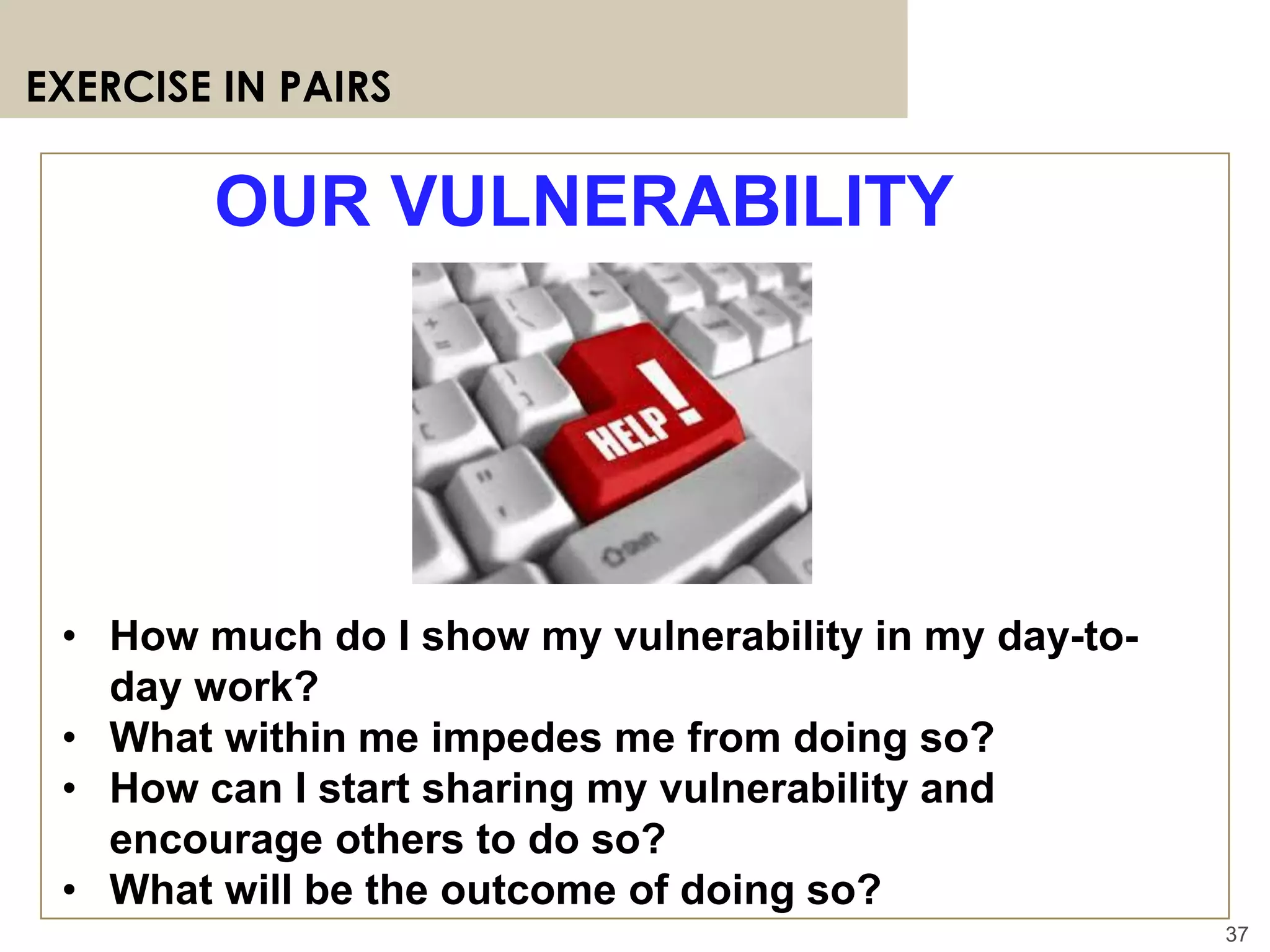
EXERCISE IN PAIRS
OUR VULNERABILITY
• How much do I show my vulnerability in my day-to-
day work?
• What within me impedes me from doing so?
• How can I start sharing my vulnerability and
encourage others to do so?
• What will be the outcome of doing so?
Thanks for your
participation.
Gilbert Brenson Lazan
http://amauta-international.com
E-mail: amauta@me.com
Sponsored by:
Find listings for our current season
of webinars and register at:
NonprofitWebinars.com
Part
Of:

The Three Languages of Appreciation

  • 1.
    Sponsored by: The ThreeLanguages of Appreciations Gilbert Brenson-Lazan May 8, 2013 Twitter Hashtag - #npweb Part Of:
  • 2.
    Sponsored by: Advising nonprofitsin: • Strategy • Planning • Organizational Development www.synthesispartnership.com (617) 969-1881 info@synthesispartnership.com INTEGRATED PLANNING Part Of:
  • 3.
  • 4.
    Sponsored by: Today’s Speaker GilbertBrenson-Lazan Founding Partner Amauta International, LLC Assisting with chat questions: Jamie Maloney, 4Good Founding Director of Nonprofit Webinars and Host: Sam Frank, Synthesis Partnership Part Of:
  • 5.
  • 6.
    8 IN YOUR HEAD… …thereis a computer and a caveman, each with a desire to direct you and interact with others.
  • 7.
    9 EACH ONE OFFERSRESOURCES • Offers Logic • Global Vision • Impartiality • Organization • Analysis • Objectivity • Efficiency • Predictability WE NEED BOTH SETS: • Offers Emotion • Intuition • Affection • Passion • Synthesis • Warmth • Efficacy • Spontaneity
  • 8.
    10 EACH ONE NEEDSSUPPORT… • Needs Emotion • Intuition • Affection • Passion • Synthesis • Warmth • Efficacy • Spontaneity • Needs Logic • Global Vision • Impartiality • Organization • Analysis • Objectivity • Efficiency • Predictability …THAT ONLY THE OTHER CAN GIVE IT:
  • 9.
    11 LEADERSHIP MUST SATISFY… …BOTHPERSONAL AND ORGANIZATIONAL NEEDS.
  • 10.
    12 A LEARNING EXERCISE 12 Youwill now see the ten most important personal needs your direct reports feel and try to satisfy through work. Which three, in your opinion, are the most important?
  • 11.
    13 TEN HUMAN NEEDSSATISFIED AT WORK *KOVACH, 2011 13 What direct reports need Good salary Job Security Promotion Good working conditions Respectful Correction Appreciat ion for being and doing Empathy support for personal challenges Feeling part of the process and team Interesting and challenging work Company Reliability
  • 12.
    14 KOVACH STUDIES (Rev.2011) 1) An interesting and challenging job 2) Recognition/appreciation of who I am and what I do 3) Feeling part of the process and team 4) Feel job security 5) A good comparative salary 6) Promotions in the company 7) Good working conditions 8) Business reliability and honesty 9) Receive respectful correction 10) Support for my challenges and personal problems
  • 13.
    15 AFFIRMATION AND APPRECIATION Howmuch should we recognize and affirm our people and how much should we correct their work? What is the ideal ratio? People need to feel appreciated for them to fell good about their work…and need to receive constructive feedback in order to do well in their work.
  • 14.
    16 8X1 Research (Losada &Heaphy, 2004) have related quantity and quality of recognition with individual and team productivity. These studies show that the most productive people receive eight affirmative signs of recognition (greetings, thanks, praises, etc.) for every time they receive a correction. AFIRMACIÓN CORRECCIÓN
  • 15.
    17 PRODUCTIVITY OPTIMAL PRODUCTIVITY –8:1 MEDIUM PRODUCTIVITY 4:1 MEDIUM PRODUCTIVITY 12:1 LOW PRODUCTIVITY <1:1 LOW PRODUCTIVITY >16:1
  • 16.
    18 THE APPRECIATIVE MINDSET Focusesmuch more on the positive aspects: strengths, successes, future potential and abundance…than in the negative aspects: weaknesses, failures, past errors and deficiencies. THE RESULT IS A 57% PRODUCTIVITY INCREASE (Blanchard, 2012)
  • 17.
    19 APPRECIATION LANGUAGES 1.Active Perception 2.LinguisticAffirmation 1.Servant Leadership THERE ARE DIFFERENT LANGUAGES TO AFFIRM AND TO EXPRESS APPRECIATION
  • 18.
  • 19.
    21 WHICH IS THEDARKEST SQUARE ARE YOU SURE?
  • 20.
    22 HERIBERTO’S MULE  BUYSA MULE WORTH $1000 ON THE OPEN MARKET, FOR ONLY $500,  SELLS IT TO HIS MOTHER-IN-LAW FOR $600,  BUYS IT BACK FOR $700 IN ORDER TO…  …RESELL IT TO A GRINGO FOR $800. HOW MUCH DID HE MAKE OR LOSE?
  • 21.
    23 HOW DO WEACTIVELY PERCEIVE? EARS HEAR AND EYES SEE WHAT THE MIND WANTS TO HEAR AND SEE Pay attention . Show you are paying attention Ask about unclear meanings Paraphrase & track what you hear Postpone judgment without interrupting Respond properly
  • 22.
  • 23.
  • 24.
    26 THE RIGHT TOUCH PHYSICALCONTACT MUST BE APPROPRIATE NOT ONLY FOR YOU BUT FOR THE OTHER PERSON AS WELL The most primary and impacting communication, the right touch, continues being one of the most important. Used sincerely, spontaneously and culturally appropriate, these gestures may be powerful appreciation communicators. A pat on the back to congratulate A long handshake A fraternal celebration hug A hand on the shoulder
  • 25.
    27 AFFIRMING & CORRECTING Unconditionally Affirmative “You’revery …” ♥ Conditionally Affirmative “You’re doing well…” Unconditionally Corrective “You are a %X$&*!” Conditionally Corrective “You can do better…” BEING AND DOING POSITIVE AND NEGATIVE
  • 26.
    28 THE “WARM FUZZY” REMEMBERTHAT A “WARM FUZZY” IS ONLY EFFECTIVE WHEN SINCERE, TIMELY AND SPECIFIC. The maximum positive psychological impact is the result of recognizing what is done (positive specific behavior), combined with one of being (underlying personal quality), in a timely, sincere and frequent way. Colloquially, we call these affirmations: “WARM FUZZIES” “Ana, you are a very professional Assistant. I appreciate your dedication to prepare my monthly reports accurately and on time” “Mario, you inspire everyone with your enthusiasm and passion in your conversations with supervisors. You are an excellent leader!”
  • 27.
    29 APPRECIATIVE QUESTIONS ”Changing theapproach towards appreciation allows us leaders to form networks of conversations based on new emerging possibilities and not just correcting past errors.” (Brown & Isaacs, 1996) • Considering all your achievements this past year, what are you most proud of? • What did you do especially well to achievement it? • What special quality of yours made it possible? • What do you most want to do even better in next year’s performance? • Which of your talents or qualities will facilitate this?
  • 28.
  • 29.
    31 NON-MANDATORY OPTION Stories aboutother people that have been successful in similar situations The Case of Others Personal errors and lessons learned In other work or professional situations Personal Experience Stories or parallel situations in other life areas Metaphors Resort to past success stories and positive traditions in the organization Organiza- tional Legends OPTIONALITY IS THE COMMON DENOMINATOR ADVICE & DIRECT ORDERS ARE USUALLY NOT AS EFFECTIVE AS: Personal Errors
  • 30.
  • 31.
    33 EXPRESSION OF GRATITUDE “Gratitudegives meaning to our past, brings peace to our present and creates a vision for our future.” - Melody Beattie “Gratitude is not only the greatest of all virtues, but is also the mother of the rest.” - Cicero Gratitude ….is a fundamental act of regenerating meaning and of reconciling us with our past, present and future existence.” - Dr. Rafael Echeverría ♥
  • 32.
    34 PERSONALIZED GIFT The spontaneousgiving or a small, thoughtful gift is especially appreciated and has a great positive impact: Something to have with your coffee A magazine or interesting book THE MONETARY VALUE IS INSIGNIFICANT; THE EMOTIONAL VALUE IS EVERYTHING A travel souvenir A DVD the person likes Tickets for an event
  • 33.
    35 HELPFUL INITIATIVE Another wayof showing appreciation is assuming the initiative of being helpful during the conversation: • Offer counterpart something to drink and/or eat • Phone to offer going to your direct report’s office when needing to speak • Ask for permission before “helping”, “advising” or giving feedback • Stay a while to accompany or support direct reports that stay overtime to complete urgent work
  • 34.
    36 SHOW VULNERABILITY • THEYASK FOR FEEDBACK sincerely and accept it well • SHARE THEIR FEELINGS even those not “convenient” for their image • THEY RECOGNIZE THEIR ERRORS both publically and privately • THEY EXCUSE THEMSELVES OR ASK FORGIVENESS after recognizing their error • THEY ASK FOR HELP when needed or convenient VULNERABILITY IS THE ABILITY AND DISPOSITION TO RECOGNIZE AND SHARE OUR IMPERFECTIONS…. THAT WHICH MAKES US HUMAN. Successful leaders show their when:
  • 35.
    37 EXERCISE IN PAIRS OURVULNERABILITY • How much do I show my vulnerability in my day-to- day work? • What within me impedes me from doing so? • How can I start sharing my vulnerability and encourage others to do so? • What will be the outcome of doing so?
  • 36.
    Thanks for your participation. GilbertBrenson Lazan http://amauta-international.com E-mail: amauta@me.com
  • 37.
    Sponsored by: Find listingsfor our current season of webinars and register at: NonprofitWebinars.com Part Of: